On Islam: An Interview with Mehdi Kia

On Islam: An Interview with Mehdi Kia
by Cihan Aksan

The following interview was conducted via email in November 2005.

Mehdi Kia is a political activist and co-editor of Iran Bulletin-Middle East Forum (http://www.iran-bulletin.org). The journal is a political quarterly in defence of democracy and socialism in the Middle East. It was first published in 1993 under the name of Iran Bulletin and has since been expanded with a new editorial board.

M. Shahid Alam was born in Bangladesh, moved to Pakistan in 1971, and received his PhD in economics from Canada in 1979. He has published three books; his latest, Is There An Islamic Problem, was published by The Other Press, Kuala Lumpur, in 2004. His political essays have been featured in Dawn (Pakistan), The Nation (Pakistan), Al-Ahram (Egypt), The Star (Bangladesh), CounterPunch (USA), Commondreams (USA), Scoop (New Zealand) and others. Currently, Alam teaches economics at Northeastern University in Boston. He may be reached at [email protected].

Q: Islam as a religion holds within it a potent political force. Its message extends to the legal, economic and social organization of the Muslim community. Does this make it incompatible with secularism? Is secularism a deviation from the basic principles of Islam? Is it merely an idea imported from the West to which Islam can never relate? Or is there a place for a secular political order in Islamic countries?

A: Secularism is an idea and a system of governance. The idea seeks to create a secular man who lives his life without reference to God. It believes in the sufficiency of reason as a guide to life. Conversely, it rejects the authority of religion, as a source of meaning and values. As a system of governance, secularism is a bit less ambitious. On the assumption that life divides into a public and a private sphere, each neatly separable, it seeks to exclude religion from the public sphere. The objective is to create a system of laws that does not favor any religion.

The conflict between Islam – any religion, for that matter – and secularism as an idea should be transparent. A Muslim lives his life with reference to God, His Book and His Prophet. A Muslim also reasons because God reasons with him. The Qur’an urges man to use his reason and experience to understand God, His creation and His Book, and based on this understanding to create a just society. The secular idea is not only incompatible with Islam. Indeed, they must oppose each other.

As a system of governance, secularism can be expansive or accommodating. It can marginalize religion or give it greater sway over society. The actual results depend on a variety of factors. Most importantly, perhaps, it depends on the way the boundaries are drawn between the public and private spheres. Is the public sphere large or small? For instance, does it include education? Secondly, how rigorously does the state exclude religion from the public sphere? And what restrictions does it place on the expression of religion in the private sphere?

One can imagine an extreme form of secular governance. In this case, the public sphere is large – extending over education, media, laws of inheritance, relations between sexes, and modes of dress. It legislates religion out of this large public sphere, taking positions which contradict religious values. In addition, it inhibits the practice of religion even in traditionally private spheres. Very likely, this will breed discontent if a majority or even substantial segment of the population is religious. In the event, this form of secularism would also be incompatible with democracy.

On the other hand, secularism can be minimalist. This is a secularism that works within a limited public sphere, allows the democratic expression of widely-held religious values in the public sphere, and even supports religious organizations without discrimination in some activities (say, education or charitable work) provided they contribute to public order and morality. Indeed, variants of this minimalist secularism were the norm in most of the Muslim Sultanates before they were destroyed or restructured, starting in the nineteenth century, under the impact of Western power. If Muslim countries had enjoyed a measure of democracy over the past decades, this is the kind of secularism many of them would have produced.

In the face of colonial erosion of Islamic values and institutions – followed by suppression of Islamic tendencies under corrupt and often militantly secular governments – many Islamic thinkers have sought to recreate Islamic societies. In several instances this re-Islamization is more ambitious than any recent historical model. This reconstituted Islamic society must recognize the Qur’an and the Sunnah as the ultimate source of legislation on all questions. Some Islamic thinkers believe that this cannot be achieved under democratic governance. Others argue that democracy is compatible with Islam if its laws are subject to oversight by a council of Islamic scholars. It would appear that Iran illustrates this second model.

More here.

Posted in History, State / Politics | Leave a comment

Huxley Redux

Recently, I uploaded a copy of John Huxley’s article ‘Armed, dangerous but shocking organisers’ (Sydney Morning Herald, December 20, 2005). It purported to explore the Australian ‘neo-Nazi underground’. According to Huxley: “For those with the time and the stomach to wade around the internet, neo-Nazis and their near neighbours, the white supremacists, are not difficult to find”. But what else did Huxley discover that allowed him to conclude that contemporary neo-Nazis living in Australia are ‘armed’, ‘dangerous’ but — fortunately — ‘shocking organisers’?

The first few paragraphs of Huxley’s article establishes the framework for his argument that contemporary Australian neo-Nazis are of “limited intelligence” and have quite bizarre “preoccupations”: nothing especially newsworthy in this observation. However, did they really have “little” to do with ‘Cronulla’ and its aftermath?

Prompted by reported sightings of racist flyers, inflammatory text messages, shaven heads, black boots and swastika tattoos, NSW Deputy Police Commissioner Andrew Scipione has promised to investigate neo-Nazi activity.

Fears that extreme right-wing groups may have been involved appear to have been confirmed by the revelation that white supremacists were among those subsequently arrested. Clearly, they were present and armed.

A pity Huxley does not source his claim that Scipione‘s promise to investigate neo-Nazi activity was prompted by such “sightings”. In reality, such ‘sights’ are — rather like the insight that neo-Nazis are stupid — not that uncommon. Well, not to those with the eyes to see.

But how well organised are such groups? How significant are they in the Australian political landscape? And what part did they play in the Cronulla riots and their aftermath?

Ah! After gently taking the hand of the (no doubt, culturally sensitive) liberal reader and, leading them out of their safe urban ghetto and into this bewilderingly ugly and marginal political landscape, Huxley zeroes in on his target.

While ugly and – given their weaponry, highly dangerous – the involvement of such individuals should not be exaggerated, says Associate Professor Andrew Moore, of the University of Western Sydney, a specialist in Australian right-wing politics.

Oh! So one should be alert but not alarmed. Then again, what qualifies Andrew Moore to comment on contemporary neo-Nazi activism in Australia? According to Huxley, Moore’s qualifications rest on the fact that Moore’s “a specialist in Australian right-wing politics”. I’ve searched for online publications which might support Huxley’s claim, and discovered the following:

Moore — along with Dr John Perkins — has just recently edited a special thematic issue of Labour History: ‘Old wine and new bottles: the extreme right in twentieth century Australia’. Moore’s editorial statement in this issue of the journal, like the six essays which it introduces, concentrates on history, especially early- to mid- 20th Century Australian history. The only article which is in any way contemporary is Murray Goot’s essay on ‘Pauline Hanson’s One Nation: Extreme Right, Centre Party or Extreme Left?’. As the title suggests, its focus is on placing One Notion on the political spectrum of Left to Right. Further, Moore’s book on fascism in Australia — published almost 11 years ago now — is also an historical account.

In essence, one might say that Moore is very well-qualified as an historian of the far right in Australia, but his qualifications to comment on contemporary neo-Nazi events, groups, individuals and projects in Australia are far less credible.

(Oh, and what “weaponry” is Huxley referring to?)

Moore continues:

“I’m sure they’d like to take responsibility for all of the Cronulla events, but in terms of impact, of shaping the events, they would have been insignificant.

“The reality is that Prime Minister Howard probably had more to do with the riots in terms of generating racial tension than they have over the past few years.”

That does not mean they should not be taken seriously.

The danger is that, fuelled by alcohol, equipped with the latest communications and inspired by right-wing groups in Europe, they can exploit, escalate and inflame community friction. French anarchists had a word for it: situationism.

Oh dear… Moore reckons that contemporary Australian neo-Nazi activists would be more than happy to “take responsibility” for the racist assaults at Cronulla on Sunday, December 11, 2005; while in reality, they do not ‘deserve’ being given ‘credit’ for such an achievement as their involvement was “insignificant”.

Moore offers no evidence to support his contention; he’s obviously speculating. Nevertheless, Huxley is happy to agree with his expert’s speculations. So too, presumably, Moore’s identification of the Howard Government as playing a role in “generating racial tension”.

As for the ‘danger’ Huxley detects in contemporary neo-Nazi activism…

‘Situationism’ is not, in fact, a term used by ‘French anarchists’ to describe the manner in which, “fuelled by alcohol, equipped with the latest communications and inspired by right-wing groups in Europe, [contemporary Australian neo-Nazi activists] can exploit, escalate and inflame community friction”.

In fact, the term ‘Situationism’ is derived from an actual organisation: the Situationist International (1957 — 1972). While generally described as being ‘anarchic’, the group itself was not anarchist. If anything, the ideas and practices of the SI derived from Marx, Hegel, and the European artistic, literary and political avant-gardes of the early- to mid- twentieth century; especially Surrealism. Granted, Huxley’s hardly the first to mis-characterise the SI. Still, one wonders what he means. What exactly is “it” that “the French anarchists” called “situationism”? The danger that “they” — neo-Nazi / extreme right-wing / White supremacist groups such as “Aryan Nations, Skinheads, Volksfront, Redwatch and White-Sydney” — will get pissed and destroy? If so, what on Earth does this have to do with French anarchists? Which French anarchists? Or “situationism” (sic)? French anarchists frequently clash with fascists. And “situationism” doesn’t exist!

The journal Internationale Situationniste defined situationist as “having to do with the theory or practical activity of constructing situations.” The same journal defined situationism as “a meaningless term improperly derived from the above. There is no such thing as situationism, which would mean a doctrine of interpretation of existing facts. The notion of situationism is obviously devised by antisituationists.”

Ahem. To resume:

“Australian fascism may not have produced an antipodean Kristallnacht [Germany’s “night of broken glass” in 1938 when synagogues were destroyed], but neither should its force or appeal be underestimated in the ‘quiet continent’,” says Professor Moore, author of a biography of Frank de Groot. “The Sydney Harbour Bridge incident is invariably remembered as humorous, but to do that diminishes the reality of right-wing extremism in Australia.”

For the Antipodean reader, Kristallnacht is presumably the first thing that springs to mind when thinking ‘Nazi riot’; Moore claims that the incident at The Coathanger — the principal protagonist Frank de Groot being, incidentally, the subject of a biography by Moore — is the closest thing we have to an Australian equivalent. Moore’s final words are cautionary ones: to remember this incident as humorous would “diminish… the reality of right-wing extremism in Australia”.

Huh?

First, let’s rewind to 1938: ‘Kristallnacht’.

On the nights of November 9 and 10, rampaging mobs throughout Germany and the newly acquired territories of Austria and Sudetenland freely attacked Jews in the street, in their homes and at their places of work and worship. At least 96 Jews were killed and hundreds more injured, more than 1,000 synagogues were burned (and possibly as many as 2,000), almost 7,500 Jewish businesses were destroyed, cemeteries and schools were vandalized, and 30,000 Jews were arrested and sent to concentration camps. [Hence, in the opinion of some, more deserving of the name Pogromnacht. Wikipedia again:] Today in official German sources it is mostly called Pogromnacht (“pogrom night”), reflecting the fear that “Kristallnacht” was too euphemistic given the fact that the original dimension of the term has been lost. Many other Germans refuse to call it that way; the perversity, obscenity and uniqueness of the Reichskristallnacht was only described in the proper name “Kristallnacht”, and “Pogromnacht” itself was an euphemism.

Now, to 1932, Frank de Groot, and that incident. First though, it should be noted that no mobs throughout Australia and the newly acquired territory of New Zealand freely attacked Jews in the street, in their homes and at their places of work and worship. Further, no Jews were killed, nor hundreds more injured; no synagogues were burned, no Jewish businesses destroyed. Jewish cemeteries and schools were left unmolested. Finally, no Jews were arrested or sent to non-existent concentration camps. What happened was:

Frank de Groot, [an] antiques dealer and New Guardsmen… slashed the opening ribbon of the Sydney Harbour Bridge in March 1932, depriving Premier Jack Lang of the kudos.

While seemingly trivial(!), according to Moore:

Captain De Groot’s legendary deed – of slashing the opening ribbon of the Sydney Harbour Bridge on 19 March 1932 – was of immense consequence to the continuing stability of responsible government and parliamentary democracy in New South Wales. The New Guard was actively plotting to unseat a democratically elected government. De Groot may have warded off more militant elements within the New Guard from more extreme action, including a possible coup d’etat and kidnapping of the New South Wales premier. Part of the folklore of the city of Sydney, at the very least De Groot’s deed may be seen as a partial circuit breaker of the tensions of a highly volatile political situation.

Well, it may be considered humorous by some, and it may be considered by others as being “of immense consequence to the continuing stability of responsible government and parliamentary democracy in New South Wales”, but it has nothing to do with neo-Nazi / extreme right-wing / White supremacist groups such as Aryan Nations, Skinheads, Volksfront, Redwatch and White-Sydney.

Dr. Jim Saleam, on the other hand, is quite a different proposition.

Although his political views are almost diametrically opposed to those of Professor Moore, Dr Jim Saleam, NSW secretary of the Australia First Party, agrees that the true number of neo-Nazis is small.

OK, so Dr. Jim Saleam — our second ‘expert’ — is the NSW [read: Sydney] secretary of the Australia First Party, and, despite having political views which are “almost diametrically opposed” to those of Moore, agrees with him “that the true number of neo-Nazis [in Australia] is small”.

A few questions occur to me at this stage:

1) What are Moore’s political views?
2) How many neo-Nazis does he think there are in Australia?

1) If Moore has political views, they’re not stated in this article. This makes it a litle difficult to conclude anything at all about Saleam’s “diametrically opposed” views.
2) Presumably, given Moore’s concerns that “the involvement of [neo-Nazis at Cronulla] should not be exaggerated”, they number A student of the so-called “Kangarooreich”, [Saleam] has identified several “criminal-political gangs”, such as White Power, Aryan Guard and the Australian National Socialist Movement.

‘Kangarooreich’ is in fact the term Saleam uses to describe Australian neo-Nazism. His site ‘Inside The Kangaroo Reich: Selected Materials On Australian Neo-Nazis And Other Dirty Tricks Operations Against Freedom Of Expression In Australia’, was established in October 2002, and contains numerous articles by Saleam, mostly concentrating on elaborating his thesis that: “…the real Kangaroo Reich is neither the shouting street neo-nazi, nor the would-be media fuhrer, but the shadowy trained coordinators who call the tune, the intelligence agents and others who are the real gestapo-like thought and political police of our time.” In essence, then, contemporary Australian neo-Nazism / the ‘Kangaroo Reich’, is, according to Saleam the Expert, little more than a government plot.

A pity Huxley failed to include this revelation in his article.

“They absorb some of the Nazi motifs and style themselves that way, but they’re defined more by their criminality than by Nazi ideology,” says Dr Saleam, who received his doctorate at Sydney University for a thesis examining contemporary Australian extreme-right ideology, politics and organisation.

“There are people who believe in the ideology, but in Australia they probably number no more than two dozen.”

Saleam, the expert on contemporary Australian neo-Nazism — or should that be expert contemporary neo-Nazi? — is, unlike Moore, at least able to put a figure on the number of neo-Nazis in Australia: “probably… no more than two dozen”.

This is a lot less than 5,000.

Of course, Saleam is at pains to distinguish between this group — presumably ‘genuine’ neo-Nazis — and those other groups — “such as White Power, Aryan Guard and the Australian National Socialist Movement” — that are inauthentic “criminal-political gangs”. But who are these groups?

While not referrring to the article by name, it appears that Huxley has read Saleam’s article ‘”Racist” Criminal-Political Gangs Are No Friends Of Ours’ (dated November 28, 2005), in which Saleam names the following groups as being particularly disruptive to the activities of non-criminal political gangs such as, presumably, Australia First and the Patriotic Youth League: White Power (Adelaide), the Australian National Socialist Movement (ANSM) (Brisbane), Aryan Guard (Melbourne), The (Gary) Middap group (Melbourne), The ‘men in black’ security group (Melbourne), The White Devils (Perth) and The Snowtown Murderers (Adelaide).

Q. Why does Saleam place the term “racist” in quotation marks?

Moreover, [Saleam] explains, they tend to be more interested in alcohol, and crime, than ideas. They are poor organisers. They splinter into ever smaller groups.

The message? Nothing to see here: move along! (Although it’s interesting to note that Saleam appears to believe that alcohol, crime and neo-Nazi ideology are incompatible. Another revelation that Huxley has failed to highlight?)

Members of the Australia First Party – whose NSW members probably number only in the hundreds – were in Cronulla when the [first] rioting occurred, distributing flyers calling for a crackdown on “refugees, contract labour, overseas students and illegals”.

According to Saleam, presumably. Writing for The Age, Richard Baker (‘Australia First: reclaiming the agenda’, December 14, 2005) claims Australia First “mobilised 120 people to attend Sunday’s violent rally in Cronulla”. Their flyer purportedly distributed at the ‘riot’ is not available; however, Saleam did produce a text in anticipation of the rally cum riot in which he stated: “All members and friends of Australia First, particularly those in the Sutherland Shire, will participate as individuals in this first great mobilisation of Australians against the terror of multiculturalist ideology and practise in this country’s history.”

But who is Dr Jim Saleam? And why is he so agitated by “the terror of multiculturalist ideology”?
Posted in Anti-fascism, History, Media | Leave a comment

Merry Crassmas!

Fucking BRILLIANT!

Santarchy!

Bad Santa: Do you want this man in YOUR chimney?
Tue Dec 20, 2005 10:54 AM ET164

By Erik Kirschbaum

BERLIN (Reuters) – Drunken Santas on a rampage in New Zealand, armed German robbers in Santa disguises, a British St. Nick wanted for flashing, and a Swedish vandal in a Santa outfit are giving the big man in red a bad name this year.

Reports of “Bad Santas” breaking the law or otherwise wreaking havoc have been circulating around the world.

Armed with a gun, a man in a Santa outfit held up a furniture store in the German town of Ludwigshafen Saturday and forced two cashiers to open the safe. He filled his sack with cash, locked the two women in the safe and escaped.

He is still on the loose, but police in Tuebingen were able to nab a bank robber armed with a machine gun in a Santa costume with the aid of an infrared camera and helicopter. They found him hiding in a ditch in a nearby forest.

“The machine gun was fake,” a police spokesman said. Dressed in a Santa cap, beard and wearing sun glasses, he was wanted for stealing 500,000 euros in four separate bank robberies.

One Santa was stopped by police for driving 150 kph (90 mph) on a northern German motorway, 50 kph over the speed limit.

“He said he was in a rush because he still had packages to deliver,” said a spokesman for the police. They gave Santa a fine and took away his license.

Last week an inebriated half-naked Santa disrupted a Christmas market in Dabringhausen before police intervened.

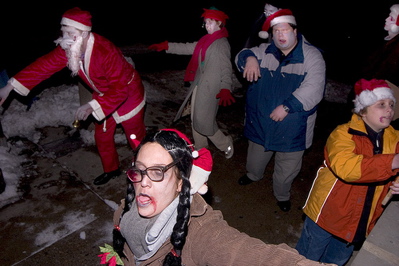
That incident paled in comparison to what happened in Auckland Saturday when 40 drunken Santas rampaged through the city center, stealing from stores and assaulting security guards in a protest against Christmas becoming too commercial.

In Britain, police said they were looking for a Santa acting suspiciously — a flasher who exposed himself to women.

Officers in Swanage on the south coast of England said the flasher had struck a number of times since December 6, and a week later exposed himself whilst wearing a Santa Claus outfit.

A British agency recently issued a code of conduct to root out substandard Santas. “Santa is a magical and cuddly man, not a fat, smelly slob,” said James Lovell of the Ministry of Fun agency in London. “He must not smell of drink or body odor.”

Last Christmas, a shopping center in south Wales installed a webcam dubbed “Santacam” in his grotto to overcome parents’ concerns after several high-profile pedophile cases in Britain.

======

Police hope Santa mayhem a one-off

19.12.05
By Derek Cheng

Police are hoping the drunken antics of 50 men in Santa Claus outfits at the weekend is not the start of a regular problem at this time of year.

The group, participating in this year’s “Santarchy” – Santa anarchy – stole from shops, urinated in the streets and threw rocks at buses in downtown Auckland on Saturday.

“It’s just a pack of clowns, just a bunch of idiots getting together and taking the opportunity to be relatively anonymous by all wearing the same clothing, making it difficult to identify who’s done what,” said Senior Sergeant Matt Rogers.

He hoped the problems this year were a one-off event at a time when office and end-of-year parties already whet people’s appetites for alcohol.

“We hope people go out and have a good time and behave in a civilised manner, but if people can’t, police will deal with it appropriately.”

Police arrested three men and will charge a fourth after the group hurled glass bottles at several security guards.

Two of the guards were treated for cuts to the head.

“We started getting phone calls from the public at 5.15pm. They were at Britomart, behaving loutishly, just being silly.”

About 6pm the group, which had shrunk from 50 to about 20, made their way to Princes Wharf, where one adventurous Santa scaled the mooring rope of a cruise ship.

When he came back down, several security guards grabbed him, sparking the flurry of flying bottles.

Auckland Chamber of Commerce chief executive Michael Barnett said he was disappointed that a stronger signal wasn’t sent out about public disorder.

“It’s a bit disappointing that the law is not being enforced that sends a strong signal to the rest of them and to anyone else who thinks this is humorous,” he said.

“There’s a group of people obviously organised and going into shopping areas and just intimidating shop owners and operators.”

Alex Dyer, who organised the Santa spree, explained Saturday’s antics as a group of men who liked having a drink and a laugh.

“It doesn’t mean anything and it’s not against anyone. It’s just having fun. That’s what life’s about.”

While Mr Dyer did not condone illegal behaviour, he washed his hands of any responsibility.

“I can’t physically restrain people from doing stupid things. I can’t say, ‘Okay 50 drunk men, all listen to me: Please, nobody do anything stupid’.

“If someone does something stupid and gets caught for it, that’s their problem.”

He said Saturday was not an anti-commercialisation protest.

“People do Santarchy in other countries, sure, and for them maybe that’s their aim, but with us we’re just dressing up as Santa and getting drunk. We just like booze.”

Mr Dyer said he had never been arrested, and he had never met the people who were arrested.

“I had a great time.”

Posted in Anarchism, Poetry | Leave a comment

Special Guest Commentary

Stop reading this blog. Go out there and overthrow the social order. Form collectives. Celebrate diversity. Don’t accept money. Stealing from the rich is OK.

Love,
The Dugongs.

Posted in Uncategorized | Leave a comment

‘Disarmed, pointless and shockingly bad journalism’

‘Armed, dangerous but shocking organisers’
Sydney Morning Herald
December 20, 2005

Cronulla and its aftermath had little to do with the neo-Nazis. John Huxley explains why.

IT SAYS much, perhaps, for the brainpower and preoccupations of Australia’s neo-Nazis and white supremacists that the Socceroos’ recent World Cup win prompted an angry analysis of the Aryan purity of the players.

“Just what are we supposed to be supporting, the victory of multiculturalism?” complained one visitor to the Stormfront White Nationalist Community’s chat room. “But their skin colour looked pretty good to me!” another replied.

A third conceded it was a good result. “Just a shame that the Jew [Football Federation Australia chairman Frank] Lowy was shown on screen several times. Could have done without him.”

For those with the time and the stomach to wade around the internet, neo-Nazis and their near neighbours, the white supremacists, are not difficult to find. They inhabit sites – sometimes linked, always anonymous – operated by groups such as Aryan Nations, Skinheads, Volksfront, Redwatch and White-Sydney.

They sell Aryan Nations wallpaper: Hail the Fourth Reich. They quote Adolf Hitler with approval: “Those who want to live, let them fight, and those who do not want to fight in this world of eternal struggle do not deserve to live.”

And in the case of the invisible White-Sydney, they pledge to cleanse inner-city suburbs, such as Parramatta, Auburn and West Ryde, that have become “safe havens for criminals”.

Prompted by reported sightings of racist flyers, inflammatory text messages, shaven heads, black boots and swastika tattoos, NSW Deputy Police Commissioner Andrew Scipione has promised to investigate neo-Nazi activity.

Fears that extreme right-wing groups may have been involved appear to have been confirmed by the revelation that white supremacists were among those subsequently arrested. Clearly, they were present and armed.

But how well organised are such groups? How significant are they in the Australian political landscape? And what part did they play in the Cronulla riots and their aftermath?

While ugly and – given their weaponry, highly dangerous – the involvement of such individuals should not be exaggerated, says Associate Professor Andrew Moore, of the University of Western Sydney, a specialist in Australian right-wing politics.

“I’m sure they’d like to take responsibility for all of the Cronulla events, but in terms of impact, of shaping the events, they would have been insignificant.

“The reality is that Prime Minister Howard probably had more to do with the riots in terms of generating racial tension than they have over the past few years.”

That does not mean they should not be taken seriously.

The danger is that, fuelled by alcohol, equipped with the latest communications and inspired by right-wing groups in Europe, they can exploit, escalate and inflame community friction. French anarchists had a word for it: situationism.

“Australian fascism may not have produced an antipodean Kristallnacht [Germany’s “night of broken glass” in 1938 when synagogues were destroyed], but neither should its force or appeal be underestimated in the ‘quiet continent’,” says Professor Moore, author of a biography of Frank de Groot. “The Sydney Harbour Bridge incident is invariably remembered as humorous, but to do that diminishes the reality of right-wing extremism in Australia.”

Although his political views are almost diametrically opposed to those of Professor Moore, Dr Jim Saleam, NSW secretary of the Australia First Party, agrees that the true number of neo-Nazis is small.

A student of the so-called “Kangarooreich”, he has identified several “criminal-political gangs”, such as White Power, Aryan Guard and the Australian National Socialist Movement.

“They absorb some of the Nazi motifs and style themselves that way, but they’re defined more by their criminality than by Nazi ideology,” says Dr Saleam, who received his doctorate at Sydney University for a thesis examining contemporary Australian extreme-right ideology, politics and organisation.

“There are people who believe in the ideology, but in Australia they probably number no more than two dozen.”

Moreover, he explains, they tend to be more interested in alcohol, and crime, than ideas. They are poor organisers. They splinter into ever smaller groups.

Members of the Australia First Party – whose NSW members probably number only in the hundreds – were in Cronulla when the fist rioting occurred, distributing flyers calling for a crackdown on “refugees, contract labour, overseas students and illegals”.

But Dr Saleam dismisses suggestions the party is in any way neo-Nazi.

He concedes that photographs of him wearing a Nazi armband exist, but points out that they date from the mid-1970s, when he was experimenting with political groups of different persuasions.

The Patriotic Youth League similarly denies any connection with neo-Nazi groups.

A spokesman, Luke Connors, said: “None of our members sympathises with Nazis. We’re just young blokes standing up for our own sort.”

Both Dr Saleam and Mr Connors point out that an “uprising” involving about 5000 people is beyond the organisation of any single political group.

Meanwhile, groups such as the PYL are enjoying the publicity. Mr Connors explains: “Mate, I’m going to get brain cancer from having the mobile phone pressed to me ear all day and all night. Answering membership and media inquiries.”

[In a recent article in the Sydney Morning Herald, John Huxley said:
“Increasingly, Australians live in a society in which it is always someone else’s fault; in which perpetrators masquerade as victims; in which personal responsibility has been replaced, all too frequently, by a readiness to lie, to sue, to redirect blame or, worse, to find scapegoats.”]

Posted in Anti-fascism, Media | Leave a comment

Faster Pussycat Kill Kill!

‘Barbie all the rage for irate girls’
The Age

By Nick Foley
December 20, 2005

GIRLS hate Barbie so much that many admit torturing, maiming and even decapitating the doll, according to British research.

The all-American toy has become a “hate figure” among seven to 11-year-old girls, who regard Barbie as a “babyish” symbol of their earlier childhood.

Researchers from the University of Bath questioned 100 children about their attitudes to a range of branded products and found the doll provoked the strongest reaction.

“When we asked the groups of junior school children about Barbie, the doll provoked rejection, hatred and violence,” said Agnes Nairn, who headed the study.

“The meaning of ‘Barbie’ went beyond an expressed antipathy. Actual physical violence towards the doll was repeatedly reported, quite gleefully, across age, school and gender.

“The girls we spoke to see Barbie torture as a legitimate play activity, and see the torture as a ‘cool’ activity in contrast to other forms of play with the doll.

“The types of mutilation are varied and creative, and range from removing the hair to decapitation, burning, breaking and even microwaving.” Academics found the girls’ violent hatred of Barbie was linked to the doll’s “rich symbolism”. Children said they disliked the toy because they regarded it as a feminine icon, “plastic”, and an unwelcome reminder of their childhood. “It’s as though disavowing Barbie is a rite of passage and a rejection of their past,” Dr Nairn said.

The study also found that while boys expressed feelings of nostalgia and affection towards Action Man, girls’ attitude to Barbie remained hostile. The doll was regarded as an inanimate object by girls rather than a treasured toy and friend.

“On a deeper level, Barbie has become inanimate,” Dr Nairn said. “She has lost any individual warmth that she might have possessed if she were perceived as a singular person.

“This may go some way towards explaining the violence and torture.”

Posted in Anarchism, Anti-fascism, Poetry, Sex & Sexuality | Leave a comment

The Tyranny of Structurelessness & The Tyranny of Tyranny: A Review

My next project.

Posted in Anarchism, State / Politics | Leave a comment

Read… My… Lips!

Do you love me because I’m beautiful, or am I beautiful because you love me?

Posted in Art, Sex & Sexuality | Leave a comment

The Only Good Fascist Is A Dead One


Or so says Fiona X.

I agree.

Here’s a picture.

Posted in Anti-fascism, Art, Sex & Sexuality | Leave a comment

Kute

Take that, fascist!

Posted in Anti-fascism, Cats | Leave a comment