
General Strike : ‘Federation’

Written & Produced by Leigh Kendall. Recorded @ Richmond Recorders, 1987. Re-Released as the ‘Red & Black Reggae’ CD by the Vicente Ruiz Foundation, 2001 (VRF001).

Vicente Ruiz, Snr.

Vicente Ruiz was born in 1912 in a small town not far from Cordoba, Spain. When he was three months old Vicente’s family moved to Malaga, a town at the very bottom of the Iberian Peninsula, not far from Gibraltar. In his youth Vicente was a member of the Juventudes Libertarias (Libertarian Youth), and joined the anarcho-syndicalist Confederacion Nacional del Trabajo (National Confederation of Labour) when he went to work in the Malaga railways in early adulthood. Vicente eventually became secretary of the section.

At the outbreak of the Spanish Revolution and Civil War in July, 1936, Vicente and his brother formed a brigade which became part of the railway workers’ militia, and became part of the thousands of ordinary people who put down the Francoist revolt in numerous parts of Spain. The brigade the Ruiz brothers formed came to be known, perhaps self-evidently, as the Ruiz Brothers’ Brigade. Vicente was involved in the collectivisation of the railway workshops in Malaga where the trains were repaired, the bosses having been kicked out, and the the workers taking control of production and organising decision-making collectively and democratically. Vicente fought with the CNT militia against the fascist onslaught around Malaga until its fall early in 1937, at which time he travelled between Barcelona, Alicante, Saragossa and Madrid aiding the revolution, the last two major flash points in the history of the Civil War.

At the end of the Civil War in 1939, Vicente managed to escape Spain via Alicante in the west for Iran on one of the last boats to leave the country. On the boat were Congost, a former secretary of the anarcho-syndicalist International Workers’ Association, and numerous refugees from the CNT and the wider libertarian and anti-fascists movement who later emigrated to Australia, some names including Robert, Quiñones, Beneito, Collado and Dominguez.

Having escaped with his life, and like many of his compatriots fleeing the deadly vengeance being wrought by the victorious Francoists on anyone who dared to question their authority, Vicente was put in detention upon his arrival in Iran Oran, and otherwise treated like a criminal for having actively opposed an insurgent fascist army. He was shortly afterwards transferred to Algiers. Algeria was still under the colonial domination of France at that time, and in particular by the fascist Vichy puppet regime, which answered to the Nazis. Vicente was put into a concentration camp at Algiers, and was later moved to a number of hard labour camps, where he was put to work mining coal and building roads for the Germans virtually in the centre of the Sahara desert. He managed to escape but was recaptured by the colonial authority and tortured by having the soles of his feet burnt. This sadistic act caused severe damage to his feet and for the rest of his life Vicente was unable to walk properly.

When Liberation came at the end of the war Vicente stayed in Algeria until the war of independence, joining the Algerian liberation movement with many other Spanish anarchists and aiding their rebellion against the French colonisers, who were thus expelled from the country. Having already been involved in establishing a CNT-in-exile movement in North Africa, publishing a local version of the CNT journal Solidaridad Obrera (Workers’ Solidarity), Vicente moved to Casablanca in Morocco and set up the Centro Cultural de Harmonia (Harmony Cultural Centre), which was an organising point for Solidaridad Internacional Antifascista (International Anti-Fascist Solidarity), the CNT-in-exile movement.

The Centro in Casablanca became a focal point for Vicente’s activities over the next decade or so. After the end of the Civil War Casablanca was a filtering point for anti-fascist refugees, and Vicente like many others was involved in aiding their movement out of Spain. In addition to aiding refugees the Centro also hosted lectures by prominent anarchists such as Federica Monseny, Ramon Liarte, Miguel Selma and others. By the time Vicente and his family left Casablanca in order to emigrate to Australia in September 1965 Vicente was Press Secretary for the Centro.

In Australia Vicente made contact with CNT-in-exile groups in Sydney and Melbourne, and began publishing the anarchist journals Ravachol and then Acracia. He made contact with exiles from Italy and Greece and at one point was involved in producing a joint Spanish/Greek leaflet about the authoritarian injustices perpetrated in both countries. Vicente was also involved in the publication of el Democrata (Democracy), a publication of the Melbourne and Sydney sections of the Centro Democratia Español (Spanish Democratic Centre). The Centro Democratia Español was a broad anti-fascist coalition of Spanish republicans, socialists and anarchists, and the work of this organisation was often marred by conflicts between the very different viewpoints of those involved, anti-fascism being a very wide brush which painted many Spanish exiles of widely-varying ideological and social persuasions.

The more well-known of Vicente’s long legacy of activity in Melbourne include the Free Store at 42 Smith Street, Collingwood, where people could bring and take things as they needed them, the Tenants’ Union in Johnston Street, Fitzroy, and the Fitzroy Legal Service, which provides free legal advice to workers and people on low incomes. All are well-known as products of the clear-sightedness and experience of the Spanish exiles in Melbourne. Vicente was also involved in the Australian anarchist conference, held in Melbourne in 1986, along with other Spanish, Italian, Greek and Bulgarian anarchists, including Bruno Vanini and Jack Grancharoff, and others including Andrew Giles-Peters. He participated in the conference, giving several talks. This conference was also attended by Abel Paz, biographer of Buenaventura Durruti, the famous anarchist militant from the Spanish Revolution. [See : Durruti in the Spanish Revolution, Chuck Morse (Translator) and Abel Paz, AK Press, 2006.]

Vicente Ruiz carried on his organisational and educational work until his death in Melbourne at the age of eighty-six in 1998. The Vicente Ruiz Foundation aims to keep his memory alive and to continue his legacy of firm commitment to social responsibility and libertarian principles of organisation and action.

Thanks to Vicente Ruiz, Jnr. for the information.

Anarchists start Australia’s first free legal aid service

The first group in Australia to set up a free legal aid service were a group of Melbourne anarchists. In 1972 a group of Melbourne anarchists, including veteran Spanish anarchist, Vicente Ruiz, set up a store front free legal aid service at the Free Store at 42 Smith Street, Collingwood. They set up this part time free legal service with the help of two sympathetic part-time lawyers.

Both lawyers provided a free service to anyone who required legal assistance. In 1972 legal assistance was only available to those who could afford it. The great majority of people were not able to obtain representation and took their chances within the legal system without legal representation. Melbourne Anarchists set up the forerunner of the modern Australian legal aid system.

Their practical example encouraged other people to set up similar centres. Eventually the example of direct community service they set up was taken up by the Whitlam Labor government. Their example lay the ground for the introduction of free legal aid to the rest of Australia. This is just one example of the influence anarchists have had on Australian society.

More : Carnival anarchism in Melbourne 1970-1975

APPENDIX : GET OUT OF FITZROY

“While some celebrated the rejuvenation of south Fitzroy, others were ambivalent. Most who had lived in Fitzroy prior to the 1970s appeared to accept the suburb’s make over with resignation or indifference (or an initial sense of helplessness in the case of slum clearance). Others, however, did ponder the effects of the middle class ‘moving in, doing up cottages, (and) pushing up the values that squeezed out the oldies’, with one resident asking: ‘where else could the drunks sleep it off… Kew? Balwyn?’

Yet the rapid demographic and social change occurring in Fitzroy in the 1970s did not pass without more rigorous public challenge. Opposition to what was labelled ‘Trendy Kulture’ was voiced loudly by a particular activist group, the ‘fitzroy anarchists’, comprising of both old and new Fitzroy residents. The group produced a series of newsletters and pamphlets from mid-1974 to 1975 entitled get out of fitzroy!

The campaign launched by the fitzroy anarchists focused on the social and economic baggage that accompanied the changes in the suburb. In an uncompromising and many ways prescient fashion, they tackled head on many of the groups who felt that they were acting in the best interests of Fitzroy’s poor and marginalised. get out of fitzroy! attacked ‘the student population with their trendy bourgeois tastes and friends’. It called for ‘a boycott on all the pizza places the kentaky fried chicken houses and trendy pubs and shops’.

The fitzroy anarchists were critical of the Fitzroy City Council for abandoning its working-class and migrant constituency, for pandering to ‘trendy tastes’ expressed in the council’s period-detail restoration of the City Library. The anarchists claimed that through this restoration the council was attempting to identify with the renovated terrace owners in the surrounding area, rather than its working-class ‘heartland’, subsequently launching a catchcry ‘multi-lingual papers not chandeliers!’

In another campaign, this time in response to the council’s predilection for the construction of traffic barriers and roundabouts (a definite middle-class fetish), the anarchists offered the ultimate solution to Fitzroy’s traffic problems: ‘if necessary, create a bubble over Fitzroy—let them go round’.

The group also waged a graffiti campaign that saw the slogan ‘piss off trendies, piss off’ daubed on factory walls and inside some properties under renovation.

Some of its more serious criticism, however, was reserved not for ‘trendy’ renovators but for those perceived by the fitzroy anarchists as nothing more than ‘trendy’ political activists:

The trendy [Marxists] are the very people who are making the area one of the ‘best’ middle-class areas of Melbourne… as well as making the needy suffer and with an apparent complete lack of conscience… [They] are to blame for the suffering, in spite of the fact that fitzroy is needed for the poor, the migrants, the single mothers, the alcoholics, the pensioners and the lower working-class whites.

In a poster that was pasted throughout the suburb, ‘get out! …of fitzroy’, the fitzroy anarchists lampooned the baggage of the ‘trendies’ and provided an eclectic list of all that it wanted banished from the suburb: ‘charity organisations, antique joints, The Flying Trapeze (café) and The Melbourne Crime’ (a variant on the name of a local newspaper that carried extensive real estate advertising). Perhaps the most effective expression of the fitzroy anarchists’ cause came in the form of a poem by long-time south Fitzroy resident and poet ∏O. A founding member of the group, ∏O wrote his ‘get out of fitzroy’ to remind the middle class of what they had previously feared or despised and how they had transformed the suburb:

1)

get out of fitzroy

…you’ve sidestepped the bloodpools
the pusholes &
raised the rents
classed the restaurants
closed down the hamburgers
gouged out the stomachs of houses
& photoed the bedrooms of drunks
you’ve made this place hell.
we’ll burn down the street signs
we know our way around

get out of fitzroy

Although the ‘get out of fitzroy’ campaign received wide publicity and some media support, over the next twenty years Trendy Kulture proliferated across the suburb. In many other parts of inner-city Melbourne also, an increasing number of properties were transformed from ‘slums’ into places where the middle class could imagine the ‘respectable self’; where they could ensconce themselves in such fashionably renovated accommodation as a ‘balcony terrace in Gore Street, Fitzroy’ that ‘brought the idea of the Victorian bourgeois family into the present’.

Throughout the inner suburbs, but perhaps in south Fitzroy most dramatically, the arrival of the new bourgeois family began to displace those who found it increasingly difficult to afford to live in a previously maligned suburb that had been their home…”

— Tony Birch, ‘The Best TV Reception in Melbourne’: Fitzroy ‘Low-life’ & the Invasion of the Renovator [PDF]; see also Mission Yuppie Eradication Project

Posted in Anarchism, Anti-fascism, History, Music | 8 Comments

Squatters…

Some people think cities aren’t just for cars and yuppies.

Unbelievable.

Sweden

Police in Sweden have embarked on a mission to evict squatters living in the south of the country, with the university town of Malmo turning into something of a hotbed of activism. The squatters are not happy about an ongoing housing shortage in the region, so they’ve taken to the streets in Malmo and Lund to protest the need for more homes in southern Sweden…

England

A rooftop protest is being staged in Bristol by squatters who have been evicted from the building. A group occupying the four-storey house in Ashley Road, St Pauls, moved onto the roof after eviction orders were made on 12 November. The squatters are calling for talks with the housing association which owns the building – Places For People…

Italy

last night also saw the screening of Uso improprio by Luca Gasparini and Alberto Masi (in competition in the Italiana.doc section), a film that has also made news, going beyond what the filmmakers had originally intended or imagined. “We wanted to make a documentary on the All Reds sports club, which is in the occupied ex-Cinodromo in Roma”, says Gasparini, who at nearly 50 had gone back to playing rugby with the team from the social centre, Acrobax. Then two of the young “squatters” died: one while working as a messenger, the other stabbed by a young fascist. Thus, what was originally an intimate story of a newfound competitive sports spirit transformed into a film on politics as well.

Czech Republic

Squatters’ rights: Police raid on Prague’s Cibulka squat sheds light on global way of life
Benjamin Thomas Cunningham
The Prague Post
November 26, 2008

There is no place like home for the holidays.

Assuming one has a home — and that is sort of the point of their whole movement, say squatters.

At least seven people are looking for a new place to live after police raided their home, a squat in Cibulka, a former monastery in Prague 5–Košíře, allegedly pursuing a criminal into the residence. A chaotic scene ensued, during which at least one gunshot was fired.

“We thought we were being attacked,” said one former Cibulka resident who would only give his first name, Ondřej. “We climbed up onto the roof, because that is the hardest place for them to get you. The roof tiles started to collapse under us and a gunshot was fired, but by that time we were trying to come down.”

Squatting is a phenomenon the world over, but has seen increased popularity in Europe since the late 20th century, when rent prices in city centers began outpacing what many people could pay…

Those wishing to subvert the system have learned by now, from bitter experience, that we cannot place our faith in states. The last decade has instead seen the development of thousands of forms of mutual aid association, most of which have not even made it onto the radar of the global media. They range from tiny cooperatives and associations to vast anti-capitalist experiments, archipelagos of occupied factories in Paraguay or Argentina or of self-organized tea plantations and fisheries in India, autonomous institutes in Korea, whole insurgent communities in Chiapas or Bolivia, associations of landless peasants, urban squatters, neighborhood alliances, that spring up pretty much anywhere that … state power and global capital seem to temporarily [be] looking the other way. They might have almost no ideological unity and many are not even aware of the other’s existence, but all are marked by a common desire to break with the logic of capital. And in many places, they are beginning to combine. “Economies of solidarity” exist on every continent, in at least eighty different countries. We are at the point where we can begin to perceive the outlines of how these can knit together on a global level, creating new forms of planetary commons to create a genuine insurgent civilization.

Visible alternatives shatter the sense of inevitability, that the system must, necessarily, be patched together in the same form—this is why it became such an imperative of global governance to stamp them out, or, when that’s not possible, to ensure that no one knows about them. To become aware of it allows us to see everything we are already doing in a new light. To realize we’re all already communists when working on … common projects, all already anarchists when we solve problems without recourse to lawyers or police, all revolutionaries when we make something genuinely new…

See also : Reflecting on “Hope in Common”, by David Graeber by the authors of the excellent blog Colonos. “Colonos – Amazonia por la vida? is a blog that two colonists, Colono and Colona, are using to communicate experiences arising from living on what is probably best described as the frontiers of capitalism, or western, (neo-)liberal colonisation of the rain forest. Colonos is the word used locally to describe the people, encouraged by the Ecuadorian governments in the past and the present, who come to seek fortune in the land opened up by the destruction of the forest and the inclusion in the capitalist economy of the people who traditionally lived in the Amazon – the so-called indigenous peoples. Although it is clear that we, as Europeans and as members of a higher education institution, are also colonos, we hope that we will be able to engage and live with the people and the environment in a slightly less destructive manner than is common for the Euro-breed.”

Posted in Anarchism | 1 Comment

Students are revolting

Rally out the front of SHAC
272-278 Faraday Street, Carlton
Friday 28th November
Midday

Squat students set to defy uni order
Miki Perkins
The Age
November 27, 2008

STUDENTS squatters are refusing to leave a Melbourne University property in defiance of an final eviction notice.

About 20 students have occupied four terrace houses in Faraday Street, Carlton, since August to highlight the scarcity of affordable accommodation.

This week the university issued an ultimatum to squatters that they leave by tomorrow.

But the students, who formed the Student Housing Action Collective (SHAC), have refused to move out and will hold a rally at the houses tomorrow.

“We have nowhere else to go and this rally shows that we’re not planning to go quietly,” student Elizabeth Patterson said.

Inner Melbourne rental vacancy rates are only 1.1 per cent and median rents have gone up by 17 per cent.

The students have proposed converting the properties into a student-run housing co-operative under housing association Common Equity Housing.

“We’re not asking the university for any money. We can finance the conversion ourselves with Common Equity,” SHAC spokesman Teishan Ahearne said.

University spokeswoman Christina Buckridge said she expected that students would move out tomorrow after the university had allowed them to stay until exams finished.

The university said it would not discuss the housing co-operative proposal while university property was occupied.

The houses are to be refurbished as a centre for student off-campus activities.

Christina is the Corporate Affairs Manager @ the University on Melbourne: that is, chief propagandist for the institution. As such, her statement is largely meaningless: until such time as sufficient pressure is placed upon University authorities to agree to negotiations, they presumably believe that they have little to lose by telling concerned students to go fuck themselves.

Given a certain level of rat-cunning on the part of the bean-counters running the ship, the eviction may well proceed at a slightly later date. Over the Summer, perhaps, when many students are otherwise occupied and less able to rally to the support of the occupiers.

Note that the buildings themselves were left unoccupied and unused for several years prior to the August occupation. Note also that the University was more than happy to run Melbourne University Private (2000-2008) at a loss of $20 million, and has recently embarked on a further decimation of the Arts faculty. In the meantime, the University of Melbourne’s VC Glyn Davis earned $610,000 in 2007, and lives on campus in a house that is not included in that package.

That is, Glyn Davis lives rent-free.

In Sydney, students at the University of Sydney enjoy the dubious delights of STUCCO. According to its website: “In 1982, a group of Sydney University students came together to establish community housing. An old glass-making factory was purchased and renovated with a design from the architecture faculty at Sydney University, based around a central courtyard and retaining much of the original timber structure. Funding was supplied by the university and the Department of Housing. STUCCO opened in its current form in February 1991.” Missing from this brief history is the fact that, prior to its purchase in 1982, the factory was squatted: it was only after a struggle such as the one SHAC is now engaged in that the University gave in to common sense and provided some assistance to students wanting low-cost accommodation.

“I like anything that gives people the chance to get together and talk about ideas,” says Davis, 48. “The world is such a fascinating place and it’s full of such possibilities, and how else do you access that except for listening to people talk and debate? A signal to the community that there can be a debate outside the confines of the partisan political process is a really good thing in my view. That we can talk about ideas and not have to frame them in a for-and-against debate isn’t how we (usually) discuss ideas in this country. It will actually, I hope, crack open the agenda a little; there will be a whole range of things we don’t normally talk about.”

And if you don’t leave, we’ll call the cops.

See also : Uphill battle to bring back campus life, Harriet Alexander, The Sydney Morning Herald, November 10, 2008 | Protest over more Victorian universities job cuts, Andrew Trounson, The Australian, November 20, 2008 (“The University of Melbourne has been downsizing its arts faculty with around 50 academic staff cut in the last two years, and a further 12 set to go”) | Minister for Uranium Mining & Woodchipping Peter Garrett continues to pursue a stunning political career: “Mr Garrett stunned the arts community by axing Australia’s only elite training institution for professional musicians, the Australian National Academy of Music in Melbourne” (Fans pan Garrett’s cuts to music, Cynthia Banham, The Sydney Morning Herald, November 22, 2008).

Posted in Student movement | Leave a comment

Ill Bill

Posted in Music | Leave a comment

BNP Top Ten

10 I was curious

A DAD-OF-TWO has claimed he made a mistake by signing up to the BNP. Andrew Thomas, of Nightingale Park, Cimla, paid to join the far-right political party “out of curiosity” five years ago. He said he was horrified when his name and address popped up on a leaked list of British National Party members. The 50-year-old said he quit the controversial group years ago. He said: “I only joined out of curiosity. In that time I had leaflets and newsletters posted from the party — but I decided that it was not for me. I want to make it clear that I never met any BNP members and have never been to any of their functions. Me and my wife are not political people at all. We don’t even vote.”

9 I was duped

A Dungannon man identified on a leaked list of British National Party members has described how he was “duped” into joining the organisation. Harry Martin (64), who served as district commander of the fire brigade until retiring 15 years ago, admitted making a one-off payment to the far-right extremist party and said he bitterly regretted doing so.

8 Was I bollocks

SPACE expert Steve Bennett has vehemently denied having links with the far-right British National Party after his name appeared on a leaked list of members. The rocket engineer was shocked to learn that his details were on the list published on the internet this week. He believes his name and an old address were noted down by the party after he made a complaint in 2002 over an article in the BNP magazine.

7 I blame the IRA

A FORMER soldier has spoken of his horror at being named as a member of the British National Party. In 1990, as a reaction to an IRA bombing in which five colleagues were killed in Northern Ireland, Carl Bougourd, along with other servicemen, paid a one-off £6 membership fee to the National Front because of a campaign it was running calling for British soldiers to be taken out of Ireland.

6 I liked their environmental policies

The Green Party has revealed one of its former parliamentary candidates joined the British National Party because he believed its climate change policy “was more radical”. Details of Keith Bessant, who ran for MP in Cheltenham, Gloucestershire, in 2001 and 2005, appear on the leaked list of the far right party’s entire membership register.

5 I did it for research

DJ Rod Lucas has claimed that he became a member of the British National Party (BNP) to research a story.

4 I f***ing fancied a f***ing cup of f***ing tea

A RETIRED police chief inspector has been exposed as a BNP member. Scots pensioner Charles Reid’s name was on a list of activists leaked on the internet this week. But when the Record contacted him, he tried to distance himself from the racist British National Party. Reid, from Glasgow, said: “I’m not answering any of your f***ing questions. I haven’t been a BNP member for three years. I’m not telling you whether I was a policeman – it’s none of your business.” Reid changed his story when he called back, saying: “I am not a BNP member – I went to a BNP meeting once to find out what it was all about and I might have put my name down somewhere.”

3 I prefer to keep that sort of thing to myself

Aberdeenshire man John Shackleton said he joined the BNP about 15 years ago and last night spoke of his shock after discovering his name was among those leaked. “I’m not too chuffed about it,” said the 72-year-old who stays at Portlethen. “I prefer to keep that sort of thing to myself. The first I heard about it was on the radio this morning and presumed it was something going on in the Midlands – I didn’t think it would truly cover the whole nation.”

2 I was a flunkey who likes to socialise

[Paul] Murray, whose wife Jennifer is also on the list, is identified as living at the Royal Mews, Buckingham Palace. The couple are understood to have since moved. A Buckingham Palace source said: “Although his name is on the list he has told us it is only on there because he was invited to a social event that he did not attend.”

1 I’m going to sue

A vicar, the Rev Dr Paul Barker, has threatened to sue the BNP for failing to keep his details safe.

Medium and Spiritual Healer

I am a spiritual healer and also a platform medium and a spiritualist centre speaker in Leeds and Bradford for both the SNU and the Greater World Church in Clarendon Road Leeds[.] I have a PhD from Cant[e]rbury University and a min[i]sterial doct[o]rate from a liberal the[o]logical coll[e]ge in the U.S.A. I have my own independent clients here in Wakefield who I have served for over 10 years now. I charge for my services but not an extorti[o]n[a]te amount as it is my bel[ie]f that we have a higher duty than to our selves and our material needs. I therefore charge £25 pounds for a sitting and there is no time limit. I also do small evening groups at people’s homes who might like to have a small party of say up to 12 people, the fee for this is £5 with the organiser not paying anything as long as there are more than 8 people, the idea with these groups is to give people the opportunity to be in a relaxed atmosphere with their friends without feeling the intimidation felt with a one on one reading.

Posted in !nataS, Anti-fascism | 2 Comments

I Dare Call Dr. Cam’s Bluff At Being ZOG Scrabble Champion

o n e

None Dare Call It Dr. Cam’s Internet Weblog/473/11-Nov-2008
racism wins the day

oh goodness gracious me, andy!

it appears this game belongs to me

thanks to my triple word ‘nazi’

and because you couldn’t play your ‘qi’

it’s not in the scrabble dictionary

cos of sinophobic bigotry?

so i shall revel in victory

because this game belongs to me

309 to 303

t w o

None Dare Call It Dr. Cam’s Internet Weblog/474/18-Nov-2008
oh sugar sugar

Went around to Andy Slackbastard’s opulent yuppie townhouse to see what the haps were, only to find he already had company – Michael Burd had popped around to borrow some “sugar” and the two were in a heated debate regarding Occupied Palestine.

Andy seemed to have the upper hand, arguing that blocking humanitarian supplies to Gaza was necessary to weaken the resolve of Hamas militants, but then Burd pulled out his Green Left Weekly and started rattling off statistics about poverty and disease on the strip. It was an argumentative two-fist tango! Andy was on the ropes. He scrambled blindly behind him for the latest IPA Review, but there were none to be found. It appeared that Burd had landed a knockout blow on behalf of Hamas.

It was at this point that Andy resorted to physical violence, delivering a knockout blow of his own with a handy saucepan (the help had been making saffron rice).

“Fuck!” Andy yelped, “help me get rid of this body, dude!”

“Um, Andy… I don’t think he’s dead. He’s kind of moaning a little.”

“What!?” Andy cried in disbelief. I was also incredulous. It seemed to me that Michael Burd possessed the resilience of an expertly-trained Hezbollah operative.

“Where do you think he trained?” I wondered aloud.

“I’m not sure, but we’ll find out when he comes to.”

So we tied Burd to a chair and played some fucking Scrabble. I won 296 to 285. Thank you very much FEEDLO and S on an open T for FEEDLOTS and 50-something points.

t h r e e

Cam’s next blog entry will be brought to you by the letters p, r, i, d, e, f, a, and l, and the numbers 2, 7, and 3.

“I have come to play. A-one and a-two and a-chicka booma chick!”

Posted in Uncategorized | Leave a comment

Anarchy! Spies! Private eyes! Libraries!

OMG!!!!1!!

Next thing you know, tricksy police and corporate whores will be infiltrating groups, sending undercovers to punk gigs (and to protests wearing Che Guevara caps), and freeing chickens.

Oh.

Wait.

Private spies hired by police
Richard Baker and Nick McKenzie
The Age
November 26, 2008

THE internet communications and websites of anti-war campaigners, environmentalists, animal rights activists and other protest groups are being secretly monitored by state and federal agencies.

A Melbourne private intelligence firm specialising in “open-source intelligence” has been engaged by Victoria Police, the Australian Federal Police and the federal Attorney-General’s Department to monitor and report on the protest movements’ use of the internet.

The monitoring, which has been secretly conducted for at least five years, includes exploring websites, online chat rooms, social networking sites, email lists and bulletin boards to gather information on planned demonstrations and other activities. Many of those monitored have not broken any laws, but it is believed information about their participation in online activities is conveyed to government agencies that also deal with terrorism…

On the other hand, the National Library of Australia has recently decided to archive http://anarchy.org.au — “your portal to the world of anarchy in Australia… and beyond”. “As agreed this licence permits the Library to copy your publication into the Archive and to retain that copy and provide online public access to it in perpetuity.”

What next? slackbastard?!?

    Welcome to anarchy.org.au!

    This site is your portal to the world of anarchy in Australia… and beyond. It contains:

    a Forum;

    a Reading Room with a selection of anarchist texts;

    a Regional Directory to various anarchist groups and projects around Australia, as well as links to various other libertarian sites and;

    a guide to Organising Resources.

    anarchy.org.au is hosted by xchange, Australia’s oldest anarchist internet presence.

anarchy.org.au in the PANDORA Archive at http://nla.gov.au/nla.arc-89883

Posted in Anarchism, Media, State / Politics, War on Terror | 1 Comment

Cheese-eating surrender monkeys vs. very fast trains : Free the Tarnac Nine!

Update : For infos in English, see site of the US support committee for the Tarnac 9, featuring a ‘Letter from the parents of the Tarnac nine’. “When all the media come together in a cacophony of lies to slander a handful of young people currently languishing in jail it is very difficult to find the right tone with which to call an end to this racket and make room for a little truth. Many journalists bent over backwards to confirm the statements of the Minister of the Interior, even while the raids were still taking place. Those arrested were assumed to be guilty from the outset…”

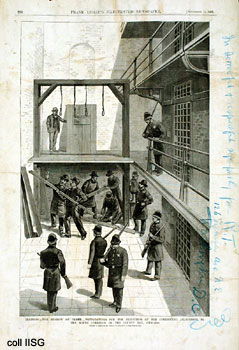
    On 11 November 1887 the prison in Illinois is preparing for the execution of Parsons, Spies, Fischer, and Engel, the Haymarket anarchists. The Haymarket Affair started in May 1886 when a mass meeting was held in the Chicago Haymarket in the course of a strike for the eight-hour workday. When the police ordered the protest meeting to disperse, a bomb was thrown by an unknown person, killing several officers. Four [sic] anarchists were accused. The drawing in Frank Leslie’s Illustrated Newspaper shows the scaffold, complete with a trap door. The balcony outside the cells was on the same level. At the back was a large box in which the hangman waited to release the rope for the trap door. At the execution Parsons could not be prevented from speaking his last words: “Let the voice of the people be heard!”

French company Connex — a fully-owned subsidiary of Veolia Environnement — owns and manages Melbourne’s rail system: part of Melbourne’s shitful, ever-deteriorating public transport system. In addition to transport, Veolia owns water — lots of water. In fact, Veolia is the world’s largest water company; in 2007, it had revenues of $47bn and employed around 300,000 people.

The French corporate sector has a thing for transport, and the French state has a thing for anarchists — to be precise, the “anarcho autonomous milieu” — especially those who tamper with the mandate to destroy the ecology the state gives the corporations which dominate the ‘public’ transport system.

The thoroughly depressing Tory Government of Jeff Kennett began the privatisation of Melbourne’s public transport system — with the grudging cooperation of the ALP and its union — in the early ’90s: that is, within a few short years of a small revolt by tram workers who for one day placed the system under workers’ self-management.

    “The 1990 tramways dispute is one of many industrial disputes in which rank and file unionists displayed the courage and daring to take control of their working situation. Workers’ self-management raised its head for a week or two. In this dispute, like many others, the union bosses sold out their members, through a deal done with the State Labor government. But the real story is how a small group of militants succeeded for a few years in setting the agenda among rank and file workers in the public transport industry in Melbourne.”

The period immediately prior to this witnessed the elimination of large numbers of jobs (train guards, tram conductors, station staff) and the introduction of a new ticketing system, the attempted closure of unprofitable lines, and a range of other measures intended to prepare the ground for privatisation and corporatisation.

And corporations like Connex.

In France, on November 11, 121 years after the US state executed four anarchists for a crime they did not commit, ten radicals were arrested by French ‘anti-terrorist’ squads. Those arrested have been accused of various crimes against property — in this instance, high-speed rail networks.

French police arrest anarchists for train sabotage
November 11, 2008

French police raided alleged anarchist cells in three cities on Tuesday and arrested at least 10 suspects following a series of sabotage attacks on the country’s high-speed rail network. Interior Minister Michele Alliot-Marie said police intelligence officers had been investigating an “ultra-left anarchist movement” for several months and had acted following the weekend’s disruption of train services. “We found that this ultra-left movement has links in five European countries and in other non-European countries,” she said, alleging that the French gang has contacts in Belgium, Germany, Italy and Greece. None of those arrested works for the SNCF state rail network, she added.

A source close to the investigation told AFP anti-terrorist officers were examining “possible links between the suspects and the German hard-left, which has claimed responsibility for actions agains trains carrying nuclear waste”. President Nicolas Sarkozy congratulated police on the arrests and welcomed “the rapid and promising progress made in the context of the inquiry.”

Despite the most intense protests by anti-nuclear campaigners for several years, a French shipment of radioactive waste arrived in Germany early on Tuesday after a 20-hour delay. Eleven lorries carrying 123 tonnes of nuclear waste arrived at the Gorleben dump in northern Germany just after midnight (2200 GMT), police said. For most of the journey from western France the waste travelled by train and was halted for half a day at the German border by three activists who had jammed their arms into a concrete block under the track. Once in Germany, around 16,000 baton-wielding police were deployed as around 15,000 demonstrators rallied along the route to try to hinder progress using tactics such as setting barricades on fire on the tracks. The train eventually arrived at its final destination on Monday, more than 14 and a half hours late and the cargo was then transferred to lorries for the final 20 kilometres (12 miles) trip to Gorleben. Along the final leg some 1,000 activists had to be removed one-by-one by riot police before the lorries could pass. Tractors had been parked across the road and activists chained themselves to tall cement pyramids. (See also : Nuclear Waste Reaches German Storage Site Amid Fierce Protests, Spiegel Online, November 11, 2008.)

Since then one of those arrested has been released without charge (French court investigates 9 over railway sabotage, International Herald Tribune (The Associated Press), November 14, 2008).

soutien aux inculpés du 11 novembre is a website in some foreign bloody language (I think French?) what will presumably provide information in English at some point for impoverished mono-linguists such as myself. In the meantime, here’s the thoughts of Comrade George:

‘Terrorism or Tragicomedy’
Giorgio Agamben
3:AM Magazine
(Originally published in French in Libération)

On the morning of November 11, 150 police officers, most of which belonged to the anti-terrorist brigades, surrounded a village of 350 inhabitants on the Millevaches plateau, before raiding a farm in order to arrest nine young people (who ran the local grocery store and tried to revive the cultural life of the village). Four days later, these nine people were sent before an anti-terrorist judge and “accused of criminal conspiracy with terrorist intentions.” The newspapers reported that the Ministry of the Interior and the Secretary of State “had congratulated local and state police for their diligence.” Everything is in order, or so it would appear. But let’s try to examine the facts a little more closely and grasp the reasons and the results of this “diligence.”

First the reasons: the young people under investigation “were tracked by the police because they belonged to the ultra-left and the anarcho autonomous milieu.” As the entourage of the Ministry of the Interior specifies, “their discourse is very radical and they have links with foreign groups.” But there is more: certain of the suspects “participate regularly in political demonstrations,” and, for example, “in protests against the Fichier Edvige (Exploitation Documentaire et Valorisation de l’Information Générale) and against the intensification of laws restricting immigration.” So political activism (this is the only possible meaning of linguistic monstrosities such as “anarcho autonomous milieu”) or the active exercise of political freedoms, and employing a radical discourse are therefore sufficient reasons to call in the anti-terrorist division of the police (SDAT) and the central intelligence office of the Interior (DCRI). But anyone possessing a minimum of political conscience could not help sharing the concerns of these young people when faced with the degradations of democracy entailed by the Fichier Edvige, biometrical technologies and the hardening of immigration laws.

As for the results, one might expect that investigators found weapons, explosives and Molotov cocktails on the farm in Millevaches. Far from it. SDAT officers discovered “documents containing detailed information on railway transportation, including exact arrival and departure times of trains.” In plain French: an SNCF train schedule. But they also confiscated “climbing gear.” In simple French: a ladder, such as one might find in any country house.

Now let’s turn our attention to the suspects and, above all, to the presumed head of this terrorist gang, “a 33 year old leader from a well-off Parisian background, living off an allowance from his parents.” This is Julien Coupat, a young philosopher who (with some friends) formerly published Tiqqun, a journal whose political analyses – while no doubt debatable – count among the most intelligent of our time. I knew Julien Coupat during that period and, from an intellectual point of view, I continue to hold him in high esteem.

Let’s move on and examine the only concrete fact in this whole story. The suspects’ activities are supposedly connected with criminal acts against the SNCF that on November 8 caused delays of certain TGV trains on the Paris-Lille line. The devices in question, if we are to believe the declarations of the police and the SNCF agents themselves, can in no way cause harm to people: they can, in the worst case, hinder communications between trains causing delays. In Italy, trains are often late, but so far no one has dreamed of accusing the national railway of terrorism. It’s a case of minor offences, even if we don’t condone them. On November 13, a police report prudently affirmed that there are perhaps “perpetrators among those in custody, but it is not possible to attribute a criminal act to any one of them.”

The only possible conclusion to this shadowy affair is that those engaged in activism against the (in any case debatable) way social and economic problems are managed today are considered ipso facto as potential terrorists, when not even one act can justify this accusation. We must have the courage to say with clarity that today, numerous European countries (in particular France and Italy), have introduced laws and police measures that we would previously have judged barbaric and anti-democratic, and that these are no less extreme than those put into effect in Italy under fascism. One such measure authorizes the detention for ninety-six hours of a group of young – perhaps careless – people, to whom “it is not possible to attribute a criminal act.” Another, equally serious, is the adoption of laws that criminalize association, the formulations of which are left intentionally vague and that allow the classification of political acts as having terrorist “intentions” or “inclinations,” acts that until now were never in themselves considered terrorist.

Sounds familiar…

See also : Anarchist arrest sweep in France: “French Anti-Terrorism Police arrested around twenty people across France today (Nov. 11th)”, Tommy, nyc.indymedia.org, November 11, 2008. From the commentary: “Minister of Interior Michèle Alliot-Marie (or MAM) has been on a crusade for at least a year against what she’s dubbed the “l’ultra-gauche” Movement (or the “Anarcho-Autonomous Movement”) [and] has continued to trumpet the arrests as a blow against terrorism, and claims that there are “around 300” members of such groups in France. She has studiously refused to link them to what the French call “l’extrême-gauche” (Communists, Trotskyists, Revolutionary Syndicalists, etc), who are helping Rail unions organise work stoppages against a possible plan to privatise the railways. It seems a transparent attempt to criminalise elements of the left and create a bogeyman to split left groups.” | RNC 8 (October 1, 2008) | October15thSolidarity.info : “online project organised by a small group of people spread around the world. We hope to provide a platform to help support those affected by the [October 15, 2007, Aotearoa/New Zealand] raids and their wider communities. We also hope to strengthen the networks of existing and future support groups.”

PS.

French anarchists linked to New York bombing
Henry Samuel
The Daily Telegraph
November 14, 2008

French anti-terrorist police are holding 10 alleged members of a violent anarchist movement suspected of sabotaging power cables on high speed TGV train lines. But it now transpires that the alleged culprits were netted thanks to information from the FBI, which allegedly linked two of them to the home-made bomb attack on an army recruitment centre in New York’s Times Square in March. Julien Coupat, 34, the suspected head of the “anarcho-autonomist” group, and his 25-year old girlfriend, known only as Yldune L, were stopped allegedly trying to enter Canada from the US illegally in January. It was claimed they were carrying anarchist texts in English and photos of an army recruitment centre in New York. Although they had left the US before the bomb attack, they had allegedly been spotted shortly before at American anarchist meetings in New York. Tipped off by the FBI, France’s domestic intelligence services and anti-terrorist police had been watching them for months in a tiny village in the Corrèze region, central France. Police also carried out arrests in the northern city of Rouen, the Meuse region in the northeast and in the Paris area. Tens of thousands of French were hit by severe delays at the weekend when power was cut by metal bars hooked onto overhead electric cables on TGV lines around Paris. “These individuals are characterised by a total rejection of any democratic expression of political opinion and an extremely violent tone,” said Michele Alliot-Marie, the interior minister.

Bonus!

KYEO!

Posted in Anarchism, War on Terror | 7 Comments

It takes one to know one

Former Marxist bizarro turned Tory weirdo Mick Hume reckons the British National Party is being subject to over-policing. And he’s got a point. But it irks me to read “As one who exchanged blows rather than opinions with the National Front in the 1980s, it gives me no pleasure to say this. But we ought to uphold the right of the British National Party to express its views, however vile, after Merseyside Police arrested 13 of its members for distributing leaflets. I’m afraid that free speech means freedom for fools and scumbags, too.” Fools and scumbags being an eerily appropriate term for the rich kids surrounding the remnants of the Revolutionary Communist Party and its lider maximo Frank Furedi.

Wankers.

In 1970, nevertheless, Furedi and his future comrades were in the International Socialists (IS), the precursor of the Socialist Workers’ Party. They were ambitious and impatient, so they did what a certain kind of activist does: they formed a faction. Unlike all the other left-wing groups, then and now, they did not have a set of ideas. Instead, as a contemporary pamphlet called The British Left Explained described, they watched and waited: “When asked to contribute to a discussion, faction members would either remain silent or mutter . . . Any attempt to agree on specific proposals would have split the group.”

By 1973, the other members of IS had tired of this posing. Furedi and his allies were condemned as “the Right opposition” and expelled. They decided to call themselves the Revolutionary Communist Group (RCG). At first, the RCG sought success through theorising: in particular, about the precise rate by which profits would fall as capitalism inevitably – they assumed – exhausted itself. David Yaffe, an academic at Sussex University, unveiled a calculating machine, called the velocitometer, which he had invented to measure this decay. Claiming his device was accurate to five decimal points, he made a bid for the RCG leadership

Posted in Anti-fascism, History | Leave a comment

Well I read it in the paper…

November 12, 2008
FOR IMMEDIATE [Ah… er… um…] RELEASE

SPECIAL TIMES EDITION BLANKETS U.S. CITIES, PROCLAIMS END TO WAR

* PDF: http://www.nytimes-se.com/pdf
* For video updates: http://www.nytimes-se.com/video
* Contact: mailto:[email protected]

Early this morning, commuters nationwide were delighted to find out that while they were sleeping, the wars in Iraq and Afghanistan had come to an end.

If, that is, they happened to read a “special edition” of today’s New York Times.

In an elaborate operation six months in the planning, 1.2 million papers were printed at six different presses and driven to prearranged pickup locations, where thousands of volunteers stood ready to pass them out on the street.

Articles in the paper announce dozens of new initiatives including the establishment of national health care, the abolition of corporate lobbying, a maximum wage for C.E.O.s, and, of course, the end of the war.

The paper, an exact replica of The New York Times, includes International, National, New York, and Business sections, as well as editorials, corrections, and a number of advertisements, including a recall notice for all cars that run on gasoline. There is also a timeline describing the gains brought about by eight months of progressive support and pressure, culminating in President Obama’s “Yes we REALLY can” speech. (The paper is post-dated July 4, 2009.)

“It’s all about how at this point, we need to push harder than ever,” said Bertha Suttner, one of the newspaper’s writers. “We’ve got to make sure Obama and all the other Democrats do what we elected them to do. After eight, or maybe twenty-eight years of hell, we need to start imagining heaven.”

Not all readers reacted favorably. “The thing I disagree with is how they did it,” said Stuart Carlyle, who received a paper in Grand Central Station while commuting to his Wall Street brokerage. “I’m all for freedom of speech, but they should have started their own paper.”

======

November 12, 2008
FOR IMMEDIATE [Ah… er… um] RELEASE

CONTACT:
[email protected]
917-202-5479
718-208-0684
415-533-3961

“SPECIAL” NEW YORK TIMES BLANKETS CITIES WITH MESSAGE OF HOPE AND CHANGE
Thousands of volunteers behind elaborate operation

* PDF: http://www.nytimes-se.com/pdf
* Ongoing video releases: http://www.nytimes-se.com/video

* The New York Times responds: http://cityroom.blogs.nytimes.com/2008/11/12/pranksters-spoof-the-times/

Hundreds of independent writers, artists, and activists are claiming credit for an elaborate project, 6 months in the making, in which 1.2 million copies of a “special edition” of the New York Times were distributed in cities across the U.S. by thousands of volunteers.

The papers, dated July 4th of next year, were headlined with long-awaited news: “IRAQ WAR ENDS”. The edition, which bears the same look and feel as the real deal, includes stories describing what the future could hold: national health care, the abolition of corporate lobbying, a maximum wage for CEOs, etc. There was also a spoof site, at http://www.nytimes-se.com/.

“Is this true? I wish it were true!” said one reader. “It can be true, if we demand it.”

“We wanted to experience what it would look like, and feel like, to read headlines we really want to read. It’s about what’s possible, if we think big and act collectively,” said Steve Lambert, one of the project’s organizers and an editor of the paper.

“This election was a massive referendum on change. There’s a lot of hope in the air, but there’s a lot of uncertainty too. It’s up to all of us now to make these headlines come true,” said Beka Economopoulos, one of the project’s organizers.

“It doesn’t stop here. We gave Obama a mandate, but he’ll need mandate after mandate after mandate to do what we elected him to do. He’ll need a lot of support, and yes, a lot of pressure,” said Andy Bichlbaum, another project organizer and editor of the paper.

The people behind the project are involved in a diverse range of groups, including The Yes Men, the Anti-Advertising Agency, CODEPINK, United for Peace and Justice, Not An Alternative, May First/People Link, Improv Everywhere, Evil Twin, and Cultures of Resistance.

In response to the spoof, the New York Times said only, “We are looking into it.” Alex S. Jones, former Times reporter who is an authority on the history of the paper, says: “I would say if you’ve got one, hold on to it. It will probably be a collector’s item.

======

[Ken Knabb komments:]

Regardless of critiques that might be made of the ideas in some of the imagined stories, the perpetrators of this scandal have pulled off a remarkable coup, a coup that may help to spread some salutary memes regarding social change.

The social changes envisioned in some of the articles could be accomplished even within the current social setup (in which case people will be contrasting these possible changes with the probably very different results of the new Democratic administration). In other cases, notably those involving economic matters, it will be evident that the imagined changes could not be effected under current conditions, but would require a fundamental transformation of the whole socio-economic system (in which case people might start considering what sort of transformation would be sufficient, and how such a transformation could be brought about).

But in both types of cases, an important first step is clearing away the existing clouds of habit and resignation, so that people are able to get some sense that things could be different. This “Special Edition” coup may help to do just that. As limited as the particular “solutions” suggested may be, they are presented with a freshness and good humor that may provoke people to start questioning supposed inevitabilities and encourage them to take the initiative rather than to remain in panic-stricken, passive-defensive positions.

Many of you will have recognized that this Times “Special Edition” is an example of the situationist tactic of detournement. For information on this tactic, see these two articles:

“A User’s Guide to Detournement”
“The Situationists and the New Forms of Action Against Politics and Art”

Then compare and contrast the New York Times scandal with the situationists’ notorious “Strasbourg scandal”, which helped prepare the way for the May 1968 revolt in France:

“On the Poverty of Student Life”
“Our Goals and Methods in the Strasbourg Scandal”

============

Wai Quarterly
November 2008
Available online

Posted in !nataS, Media | Leave a comment