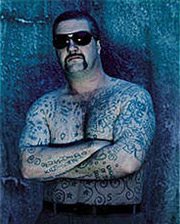
hodges and weerheym are daft neo-nazi punks

One more time, we’re gonna celebrate
Oh yeah, alright, don’t stop dancing
One more time, we’re gonna celebrate, oh yeah
One more time

Since installing haloscan, I’ve received a handful of rather silly messages from Darrin and Ben, the Jewish-Plot Men. Ben writes:

Hey “@ndy”, [i]f you have so much to say that you are [so] obviously proud of[,] then why don’t you want to associate your identity with what you write? Got something to hide mate? Nah, just another “anti-fascist” COWARD.

Ben plays ‘bad fascist’ to Darrin’s (or someone writing on Darrin’s behalf) ‘good’. For the second (or perhaps third) time, Darrin has requested that I remove “Darrin Hodges’ personal details, photographic images and accompanying information” from this blog. (Actually, Darrin has shifted from “insisting” to “requesting”.) Further, Darrin feels constrained to point out that: “The procurement, copying, and broadcasting of these p[h]otographic images may be in breach of the Copyright [A]ct. [S]ource: Guide to the Copyright Amendment (Digital Agenda) Act 2000”. Darrin’s even provided me with a link to a Departmental discussion document. In addition, Darrin requests that I provide him with a mailing address so that he can write a letter to me inre to this matter. Finally, Darrin expresses the tremendous loss he felt upon reading of Timur Kacharava’s murder by his Russian comrades: “I wish you well with your organisation of the benefit gig for your friend and mate. I agree with you, it was a dreadful outrage. Why can’t people just love one another and accept them as they are? We are all precious in his sight. It wasn’t fair, where is the justice? We were all made for something better than this.”

Indeed.

Unfortunately, Darrin fails to inform me whose rights he alleges I’ve violated, or why he believes that information inre to his neo-Nazi activism ahould be easily, and publically, available for anyone who cares to search for it, but that this information should not be published on my blog. Further, Darrin disputes the accuracy of none of the information I or others have published. Until such time as he does, I see no reason why I should censor my posts in the manner he suggests. Finally, given Darrin’s obvious predilection for changing his mind inre to seemingly substantial matters at the drop of a white hood (first pride, then a fall, followed by another attempt to mount a fascist platform), I think I can be forgiven for regarding his latest position as subject-to-change-without-notice.

Elsewhere, Hodges continues to publish misleading information. According to Hodges, on the Australian Anarchy Bulletin Board, I have provided “interesting links… in relation to wrecking social structures and authority”, viz:

1) Randy BORUM and Chuck TILBY, “Anarchist Direct Actions : A Challenge for Law Enforcement“, Studies in Conflict and Terrorism, Volume 28, Number 3 / May-June 2005, pp.201-223;

ABSTRACT:

This article provides a descriptive, operational analysis of the modern anarchist movement, emphasizing the actions of the criminal anarchists and implications for US law enforcement. It begins by explaining some core tenets of anarchist “theory,” and its relationship to violence, then describes the structure, tactics and tradecraft of militant anarchist activists. It concludes that Anarchism is a revolutionary movement, not just a “protest group.” Clearly not all anarchists advocate or engage in violence, but some do. Those individuals and factions pose a particular concern to law enforcement. This article offers some practical recommendations to law enforcement for preventing and managing those direct action attacks that may compromise public safety.

2) Gary ACKERMAN, Beyond Arson? A Threat Assessment of the Earth Liberation Front, Terrorism and Political Violence, Volume 15, Number 4 / Winter 2003, pp.143 – 170;

ABSTRACT:

The Earth Liberation Front (ELF) is [a] radical environmentalist group that has in the past engaged in profile acts of arson, thus far without causing casualties. In order to determine the correct level of official response, it is necessary to examine the potential for the ELF and other radical environmentalist groups to engage in various levels of violence against human beings. Using empirically-based threat assessment, this study investigates the motivational and capability-related attributes of the ELF and concludes that there is a moderate-high threat of an escalation to internationally targeting people, a moderate probability that its members will at some point seek to inflict mass casualties and a low potential for ELF attacks using unconventional weapons. The assessment also identifies several factors indicating that the threat of all three types of violence is increasing, although determining the magnitude of this increase requires further study. Recommendations are given for law enforcement strategies with respect to the ELF and similarly-oriented radical groups.

3) Bron TAYLOR, Threat Assessments and Radical Environmentalism, Terrorism and Political Violence, Volume 15, Number 4 / Winter 2003, pp.173-182 and finally;

ABSTRACT:

Recent claims that Radical Environmentalists are becoming increasingly likely to deploy weapons of mass death are characterized by a selective reading of the facts, a failure to apprehend significant differences among radical groups, and injudicious speculation. A more careful analysis of the likelihood of violence emerging from radical environmentalist, animal rights, and green anarchist groups requires an analysis of the differences that characterize these groups as well as their intersections. Such an analysis suggests that among these three groups, only green anarchism can provide a possible ideological rationale for the use of weapons of mass death, but even in this case, there are many reasons to doubt they will utilize such tactics.

4) An anonymously authored pamphlet called Bodyhammer: Tactics and Self-Defence For the Modern Protester; and described as “a booklet detailing means by which protesters can reclaim the freedom of movement and assembly through self-defence and protection… not something promoting or endorsing street violence… its for information purposes only”.

I wonder how many of these ‘papers’ contravene the anti-terror laws?

asks Darrin. The answer? None.

The last word on this subject belongs to the AAP:

Accused rioter’s reprisal terror
January 9, 2006 – 3:42PM

A man charged over the Cronulla race riot was “petrified” of deadly reprisals in prison, a Sydney court has been told.

Danny Glen Shanahan, 20, was one of three men refused bail in Sutherland Local Court today, charged with riot and affray.

Shanahan, Daniel Paul Kelly, 20, and 19-year-old Samuel Murray were allegedly part of a mob targeting people of Middle Eastern appearance in the violent incidents at Cronulla beach on December 11 last year.

Prosecutor Paul Upsall tendered media photographs of the riot showing Shanahan striking alleged victim Safi Merhi, who was “cowering” with his arms over his head in an effort to protect himself.

But defence lawyer Lionel Rattenbury argued that his client, an apprentice carpenter from Picton, should be granted bail.

Shanahan was in protective custody while on remand and feared violence from Middle Eastern inmates, he said.

Another prisoner, with no involvement in the riot, had been bashed because he was from Cronulla, Mr Rattenbury told the court, and Shanahan was “petrified of being in jail … living in fear that he may be killed”.

Shanahan acknowledged that “this is a cowardly act and deserves punishment”, he said.

“But at the end of the day it is … a punch to the back of the head. Sure, it was in the middle of a riot … [but] that does not call for a period in prison necessarily,” Mr Rattenbury said.

He added that Shanahan had learned his lesson and “wants to warn other people not to get involved in these mass rallies”.

Kelly also applied for bail, his barrister Linda McSpedden telling the court he was “quite frankly terrified” in jail.

She said it was “an isolated event, a product of the tensions on the particular day” in which alcohol played a part, and Kelly did not appear to be “the prime mover in the events”.

But Magistrate Ross Clugston refused both men bail, saying photographs showed them at “the very forefront of those persons who allegedly assaulted a male of Middle Eastern appearance”.

“It is necessary to refuse bail for the protection of the community,” he said.

He remanded Kelly, an apprentice plumber from Engadine, and Shanahan in custody, to face the same court on January 27 and 31 respectively.

Kelly cried when he was refused bail.

Murray, of Barden Ridge, did not seek bail today and will return to court on January 23.

He faces two counts each of riot and affray, accused of using unlawful violence against Mr Merhi and the occupants of a car during the December 11 melee.

Greens MP Lee Rhiannon today condemned legislative changes removing the presumption in favour of bail for those charged with riot and affray.

She said the changes, rushed through by the NSW Parliament in the wake of the riot, were “more of a PR stunt than a genuine attempt to tackle the root causes of racism and violence”.

“The Government should be using the justice system to foster co-operation and understanding between different communities,” Ms Rhiannon said.

AAP

Posted in Anti-fascism | Leave a comment

Dane Sweetman: Go Directly (Back) To Jail?

Dane Sweetman is a neo-Nazi axe murderer.

He’s also:

1) out on parole;
2) allegedly responsible for a violent assault on patrons at The Tote Hotel (71 Johnston St (cnr Wellington St.) Collingwood).

Released in early October of last year, it appears not to have taken very long — about three months — for Sweetman to find himself back in trouble. If the report is correct — and you can find a rather tedious discussion of it here — then Sweetman has no doubt broken his parole and will be going back into custody.

But who’s Dane Sweetman anyway?

Neo-Nazi axe-murderer due for release

By Mark Buttler and Paul Anderson * September 10, 2005

A NEO-NAZI axe murderer who boasted of waging a bloody race war on Melbourne streets will be free within weeks.

Dane Sweetman, who bashed Asians and gays, and firebombed synagogues, was granted parole after a hearing in June. It was his first bid for parole and will save him from another five years in jail.

Sweetman, 36, will be released from Fulham Prison, Gippsland, on October 3.

He has been behind bars since 1990 when he killed Adelaide man [and fellow neo-Nazi] David Noble with an axe at a party to celebrate Adolf Hitler’s birthday.

A year later, on the day he was sentenced in the Supreme Court, he sparked a security furore by plunging a home-made knife into the dock.

Sweetman also has convictions for a sex offence, attempted murder, malicious wounding, possessing a pistol, intentionally causing serious injury and assault with a weapon.

The Herald Sun learned of Sweetman’s impending release through independent sources.

Adult Parole Board secretary David Provan said releases were not made public unless it was in the public interest, such as the recent freeing of notorious pedophile Brian Keith Jones.

Mr Provan said the board granted parole to Sweetman so there would be a period in which he could be monitored. A source said Sweetman started his jail term as an uncooperative, violent and foul-mouthed prisoner, but had kept out of trouble in recent years.

Another source said Sweetman still believed in the neo-Nazi movement.

The source said Sweetman was a feared individual who, he hoped, would walk from prison a changed man, but had a reputation of contempt for authority.

“He has shown contempt for the system. I would not like to be his parole officer,” the source said.

“I have heard Sweetman is still very feared within the prison system, and still holds true to neo-Nazi views.”

The source said Sweetman was known to harbour a hatred of police. Sweetman became a neo-Nazi while in prison in the years before the Noble murder. He and fellow extremists in Pentridge Prison formed a group called The Guard.

Internet references suggest that he may have supporters in the community.

On one website [bovination: google cache] where people can post their views about sex, religion and politics, a person has written under the name Dane Sweetman: “I’ve noticed that letters in the paper in support of the war are usually from Jews in Jewish enclaves. I’d like to see another holocaust. Any takers?”

It is highly unlikely Sweetman personally posted the message because prisoners do not have access to the internet [and is therefore largely irrelevant].

Sweetman’s hate-filled jail diaries said he wanted to kill drug users, doctors, teachers, police, priests, pornographers and homosexuals.

He boasted that the day after his 1989 release, he firebombed a synagogue. The next day he attacked a man at a Thornbury halfway house, believing he was gay.

He bragged of launching a brutal attack on a woman in Fitzroy because she had an Asian boyfriend.

Sweetman’s freedom ended when he and Martin Darren Bayston attacked the English-born Mr Noble at the Hitler birthday celebrations at a Pascoe Vale South house.

Things got out of hand when Mr Noble said that they didn’t make women like Sweetman’s girlfriend in England, and asked if he could borrow her for the night.

Sweetman, on bail over the Thornbury assault, responded by embedding an axe in Mr Noble’s head.

Mr Noble apparently pulled the weapon out and said: “I’ve got a hammer in my head.”

Bayston then got a boning knife from the kitchen and stabbed Mr Noble 18 times.

His body was left in the backyard until morning when his legs were severed and the remains stuffed in a car boot and dumped near the Yarra River at Kew.

Some devotees of Melbourne’s punk scene have long memories of Sweetman.

On the Melbourne Punx Forum website, contributors recently spoke of Sweetman and others trashing a gig at a Melbourne venue and assaulting staff and patrons.

And so we come full circle?

More background on Sweetman is provided in Tough: 101 Australian Gangsters: A Crime Companion by John Silvester and Andrew Rule.

DANE Sweetman was a small-time criminal and full-time loser when he embraced the racist world of neo-Nazis while serving two years jail for armed robbery. His love of violence was ingrained. He had been found guilty of attempted murder by age 16.

But it was while in jail in the late 1980s that Sweetman found a violent cause to match his vicious nature. As far as he was concerned, he was no longer just another head case, he was a political freedom fighter. He covered himself in tattoos, including swastikas, Nazi skinheads, KKK and Native White Protestants Supreme. From within jail, Sweetman wrote to colleagues urging them to violence and providing plans on bomb-making. In one letter, Sweetman told a Nazi sympathiser how a group of Right-wing fanatics had a secret organisation called “The Guard” in Pentridge prison in 1987. “Give the dogs what they deserve, full-on racial warfare, there is no stopping us when we’ve started,” he wrote. From jail, Sweetman provided detailed plans for a car bomb. “I’ve seen them blow the entire back end off a Commodore,” he wrote. In his rambling jail diary, “Dance of the Skin, Reflections of a Neo Nazi Skinhead”, Sweetman gave an insight into the mind of a disturbed racist. He said that while in prison in the 1980s he developed his Manifesto for Racial Warfare. He declared he wanted to kill drug users, pushers, homosexuals, doctors, teachers, police, child molesters, priests and pornographers.

“We recruited men within the jail and even some in blue for the purpose of information. There are many screws (prison officers) who espouse our Guard philosophy, some are Klan (Ku Klux Klan).” In his diary, Sweetman claims responsibility for a secret war on the streets of Melbourne. He admitted a series of crimes, including murder, arson, stabbings, bashings and street assaults. “The day after my release (in December, 1989) we set about and thus fire-bombed the St Kilda Road Synagogue. The Yids were furious.” He said his group returned the following day and daubed the synagogue with racist taunts and Nazi slogans before throwing more fire bombs. “We then made our petrol bombs right there on the street. It was a job well done.”

He said that soon after his release he began to walk around the city. “The place was awash with yellow, black and mongrel brown faces.” He gloated over details of his gang attacking two Asian men in the city and using a razor to slash one’s throat. He wrote about attacking another man because he suspected he was a homosexual. Sweetman said he brought gloves and balaclavas at a city army disposal shop for the job. His gang wrapped the man’s head in a sheet and beat his genitals with a baton and Sweetman jumped on five of his ribs. Like many of his German Nazi heroes, he was hypocritical about homosexuality. He had already been charged with the sexual penetration of a male under 16. As a payback against the man who informed police of an assault, Sweetman wrote, he built another bomb. “l sat the bomb at the base of the front door, I lit the fuse and ran…”Later that night we drove back to the scene. The house was a scene of utter destruction, the front door was nowhere to be seen, the veranda had a huge gaping hole in it and the brickwork surrounding the door was blackened and ruined. The paper said no-one was hurt which was unfortunate as we wanted to see as many hurt and maimed as possible.”

He wrote with pride of kicking a young woman in the street because she had an Asian boyfriend. By the time he was 22, he had been charged with attempted murder, malicious wounding, intentionally cause serious injury, possession of a pistol, assault with a weapon, armed robbery, assault by kicking and murder.

When police arrested him as a teenager, they went to his room and found the walls covered with posters from horror movies, and kit creatures from horror movies. They also found two sawn-off shotguns and a canister of cyanide in a secret storage area. A policeman, who wrote a report on Sweetman in the early days, stated with bureaucratic understatement: “The defendant appears to be pre-occupied with violence”.

In 1991, on his birthday, December 19, he was sentenced to 20 years with a minimum of 15 for the murder of David Noble. He expected a longer sentence. Sweetman murdered Noble with an axe at a party to celebrate Hitler’s birthday on April 20, 1990, and then cut the legs off the body before dumping the remains in the Boulevard, Kew. He stunned the court when he produced a prison ‘shiv’ and slammed it into the bench, saying he had it to kill a police witness. Sweetman is due out of jail in November 2005, but few believe he is reformed. He has a written hit list of 11 witnesses and police he intends to attack. “Your day is coming,” he wrote. But while Sweetman has vowed war against the world, mainstream prisoners are tired of him.

His predatory sexual behaviour in jail has resulted in him becoming an outcast. On December 30, 1994, five of Australia’s toughest prisoners went to see Sweetman. The committee was a murderer, a drug dealer, an armed robber and two brothers with violent records. “They told Sweetman that he was a boy raper and a dog. They said they knew he was providing sweets and canteen goods to a group of younger prisoners in return for sexual favours,” a prison source said. “He was told he was to be put off (murdered).” Next day he put himself into protection in Barwon prison. But on seven occasions notes were put under his cell door telling him he would be killed. In March 1995, he was moved to the protection unit in K Division in Pentridge. Fellow inmates included Paul Denyer, the Frankston triple murderer, multiple rapist and double killer Raymond “Mr Stinky” Edmunds, and Hoddle street mass murderer Julian Knight.

Posted in Anti-fascism, History, Music, State / Politics | Leave a comment

Pies in 2006!

A Potted History of the Greatest Football Club in the History of the Universe

COLLINGWOOD Football Club has a tradition of performance that is unparallelled in league history.

The Magpies were the youngest of the clubs that formed the Victorian Football League in 1897, but have made a huge impact on the competition and the game in general.

For the best part of the history of League football, Collingwood has been the most consistently performed of all clubs, having appeared in 72 final series out of a possible 103 to the end of 1999. That is 10 instances more than the next best side – arch rival Carlton…

While the Magpies were always part of the finals in the first decade of the new competition they did not take out a flag until 1902…

Collingwood made it back to back flags in 1903 and along the way played a pioneering game in Sydney [!] for premiership points against arch rival Fitzroy. The Magpies lost that game, but won the most important match of the year, the Grand Final, by a nerve-tingling two points.

It was in this year that a young man named Jock McHale first turned out for the club. He was to have a profound influence firstly as a player then as a coach, over the next 50 years…

…in 1910 [Collingwood] added another flag to their collection when they won a fiery Grand Final against Carlton which began with Magpie follower Les Hughes being poleaxed before the first bounce.

During this era Collingwood produced the first great full-forward of League football. “Dick” Lee was a high flying spearhead with an innate goal-sense. He topped the VFL goalkicking for four consecutive seasons from 1906 and in all would head the list on 10 occasions in a stunning career…

The end of Lee’s career overlapped the emergence of a new star in front of goals – the bulky Gordon Coventry who was the antithesis of Lee in style and build, but had an appetite for goals that mirrored his predecessor’s.

Collingwood missed two finals series in a row as the side rebuilt in 1923 and 1924. The temporary step backwards, however would herald an era of sustained domination, the like of which had never been seen in VFL football…

COVENTRY and his brother Syd were lynchpins of the side and others such as Harry and Albert Collier, Jack Beveridge and Charlie Dibbs developed into players of the highest calibre.

Grand Final losses in 1925 and 1926 were merely the platform to a stunning run.

Collingwood won the 1927 flag in miserable conditions that were obvious in the scores of Collingwood 2.13(25) to Richmond 1.7 (13).

The result was more clearcut a year later when the Magpies rolled the same opponent by 33 points.

Ruckman Syd Coventry led from the front and his Brownlow Medal in 1927 had been a fitting accolade for such a magnificent footballer.

There would be more Brownlow success in 1929 when Albert Collier took out the honor. His brother Harry tied for the 1930 Brownlow only to lose it on a countback. Harry Collier received a retrospective medal in 1989.

Individual honors were all very well, but the team and The Club were everything at Collingwood. “The Machine” was at its peak in 1929 when it hummed through 18 home and away games without a defeat.

Overconfidence in the semi-final led to a 10 goal upset at the hands of Richmond, but the Magpies quickly regrouped and McHale produced a tactical masterstroke for the Grand Final when he used star full-forward Gordon Coventry as a decoy and focussed the attacks on “Tubby” Edmonds. The result was Collingwood’s third flag on the trot.

Ironically McHale was laid up in bed with severe influenza on the day Collingwood took a record fourth flag in a row on Grand Final day 1930 [a record which still stands].

The Magpies greatest era did not just fizzle away and by 1935 another premiership flag was hoisted at Victoria Park…

In 1936 it was again a case of the same Grand Final combatants facing up to each other and once more Collingwood proved victorious. It was the Magpies’ 11th flag and confirmed the club’s dominance of the VFL competition that was then just 39 years old. At the time Fitzroy was the next most successful club with seven flags followed by Essendon with six [in the unlikely event anyone cares]…

Coventry, universally known as “Nuts”, hung up his boots at the end of 1937 and drew the curtain on a career that had produced 1299 goals from 306 games. It was a record for any League player and would stand until 1999 when it was passed by Tony [“You’d have marked it if it was a bag of donuts”] Lockett…

…Losing many players to the services, Collingwood slipped during the years of World War II, but on the resumption of normal competition ran third in 1945.

Jock McHale announced his retirement after 38 years as coach just prior to the 1950 season [and was] replaced by Phonse Kyne…

Within two years Kyne had the team in a Grand Final in which it succumbed to Geelong, but in 1953 the Magpies gave the hint of things to come by rolling Geelong in the second semi-final.

On Grand Final day, with Lou Richards as skipper, the Magpies held off a late Geelong charge to win by 12 points. Richards and his brother Ron were the third generation of a Magpie dynasty that had started with their grandfather Charlie Pannam.

From the mid-1950s Melbourne emerged as the power side of League football and the clashes between Collingwood and the Demons became highlights of the League fixture.

In 1955 and 1956 Melbourne rolled over Collingwood in Grand Finals and by the time the two sides faced each other in the 1958 Grand Final the Demons were looking for their fourth successive flag and the chance to equal Colingwood’s proud record established from 1927-30.

The Demons were red-hot favorites and skipped away to a three-goal lead at quarter-time. But Magpie skipper Murray Weideman and dour ruckman Barry Harrison applied physical pressure which had Melbourne players concentrating on revenge rather than football. With the Demons distracted, Collingwood forged ahead and staved off Melbourne in the last quarter to seize the 1958 flag.

…Collingwood made the 1964 Grand Final against its nemesis, Melbourne.

With just minutes left in the game huge ruckman Ray Gabelich took off for a memorable three bounce run and slotted home a goal that put the Magpies ahead. Collingwood fans watched in horror as Melbourne back-pocket Neil Crompton bobbed up for a goal at the other end to pluck the premiership cup from Magpie hands.

The four-point loss was the start of a horror stretch for Bob Rose, one of the club’s favorite sons as a player and now the non-playing coach. the four point loss of 1964 would be followed by a tantalising one point defeat at the hands of St Kilda in the 1966 Grand Final then an almost inexplicable loss to Carlton in the 1970 play-off after the Magpies had led by 44 points at half-time.

…in 1976 the team’s [poor] performance [meant] it slumped to the first wooden spoon in Collingwood’s history.

Former Richmond coach Tom Hafey engineered a remarkable transformation in 1977 which took the team from the bottom of the ladder to a Grand final date with North Melbourne. Losing brilliant ex-South Australian Phil Carman because of a suspension incurred in the semi-final cost the Magpies dearly.

Still, they were 27 points ahead at the final change before North stormed home. A goal by Ross “Twiggy” Dunne secured a draw for the Magpies, but in the replay North bolted away at the end.

More heartbreak lay ahead with losses in the 1979, 1980 and 1981 Grand Finals. Hafey had extracted the most he could from a team that had few superstars, apart from 1979 Brownlow medallist Peter Moore and the brilliant Peter Daicos.

In 1982 the veteran coach was axed mid-season. In 1983, a new committee, the big spending “New Magpies”, swept into power.

South Australian Jack Cahill took the reins for two years then Bob Rose re-assumed the role he had last occupied in 1971.

Former Hawk champion Leigh Matthews was secured as assistant coach in 1986, but was thrust into the main role early in the year when Rose stepped aside at the same time as New Magpies leader Ranald Macdonald stood down from the presidency.

Matthews set about rebuilding the side through youngsters such as Darren Millane and Gavin Brown supplementing the experience of 100 goal full-forward Brian Taylor and determined skipper Tony Shaw.

In 1990 the Magpies barrelled into the Grand Final and this time made no mistakes. Against Essendon they ended a 32 year drought that had become one of the most highly publicised sagas in Australian sport.

…It was a time of change and in 1994 Collingwood moved the majority of its home games to the MCG and a decreasing amount of matches were played at Victoria Park.

Shaw proved to be an innovative coach, but he lacked material and too often the workload was left to a small batch of stars headed by Nathan Buckley who emerged as one of the game’s genuine superstars in the latter part of the decade.

A new broom swept through the club as Eddie [“Every-fucking-where”] McGuire took on the presidency in the 1999 season. The year also marked the final appearance at Victoria Park and the emotional end of an era.

With Shaw’s departure as coach, former Footscray and West Coast coach Michael Malthouse took over the post and the game’s most famous club looked ahead to a future full of fresh challenges… [2002]

:: Mark Brandon “Chopper” Read: Collingwood fan ::

Posted in Collingwood | Leave a comment

Comments

commenting and trackback have been added to this blog…

…again! Ooops. I’ll now be working my way through the comments that have been made over the last week or so.

Cheers,

@ndy.

Posted in Uncategorized | Leave a comment

What’s up with the Socialist Alliance?

…is the question on everyone’s lips. Below is a “no-bullshit assessment” I found on sydney.indymedia. The text has been edited slightly (for reasons of clarity), but I’ll be returning to it later to add even more clarity (and possibly even some caustic commentary). In the meantime, here ’tis…

What’s up with the Socialist Alliance?
by Mark Lockett
January 2, 2006

A no-bullshit assessment of the Socialist Alliance. Includes the DSP’s four big[gest?] lies of 2005.

[This article was submitted to Alliance Voices on Jan 1, 2006 — latest issue here]

Crisis, what crisis?

Receiving an email is a funny way to find out that the Socialist Alliance [SA] is dead, but that’s the way it happened.

It surprised me. My branch [Perth] seemed to be going quite well. At our last branch meeting we had 13 members in attendance: 5 members of the DSP; 1 member of the ISO and 7 who weren’t members of any affiliate. The non-aligned are a mixed bunch, comprising: a former member of the Greens and refugee rights activist [Mark]; a former member of the CPA and former trade union militant; a former member of the ALP and former trade union militant; a supporter of the Fourth International; a former member of the British WRP; and two self-described ‘greenies’.

The branch decided to hold 4 public meetings in the first three months of 2006: hardly [evidence of] a political party that has collapsed and is being propped up by the DSP. Indeed, our WA state membership is currently at record high levels.

Of course, while the Perth branch is not the only branch of the SA that’s still operational, the sad reality is that a large number of branches — particularly in the major East Coast capitals — appear to have simply stopped operating.

Demoralisation, what demoralisation?

The DSP attempts to blame the current problems of the SA on demoralisation caused by the defeat of Latham in the 2004 federal election. (This is despite the fact that the DSP was the loudest in proclaiming that the re-election of Howard ‘made no difference’.) While I have no doubt that some [SA members] were demoralised by Howard’s victory in 2004, a lot of us were prepared for just that [eventuality]. After all, Howard had won what had seemed an unwinnable election only three [years] prior, in 2001. Some [SA members] — and activists outside it — were demoralised by this previous loss as well. Some people were [also] demoralised by the fact that the SA polled so poorly, and that the DSP [which tends to dominate internal discussion], did not wish to discuss this issue. Eventually, the federal election campaign committee did address the issue, but [by then] it was [a case of] too little, too late…

In the [last] federal election, the SA was able to run the biggest Socialist election campaign in decades, and to run campaigns in regional and outer suburban areas that had never previously been within the reach of the left [sic] (at least, not within living memory). The problem was that Green Left Weekly played a very minor role in this campaign. In fact, far from Green Left Weekly being the ‘scaffolding’ around which the SA was formed, it was the practical task of running an election campaign that formed the ‘scaffolding’ of the Alliance.

After the election, the DSP turned back towards its usual modus operandi: orientation towards ‘movement activism’ and prioritising Green Left Weekly sales and distribution. Simply put, the DSP tried to lead and hoped that others might follow; that is, they attempted to simply ‘progress’ Green Left Weekly to ‘the next level’, and make distribution of [GLW] an Alliance task. They also sought to simply remove anyone who disagreed with this line from the [GLW?] editorial board. The non-aligned majority on the [SA’s] National Executive baulked at this manouevre, and voted down the DSP’s extremely sectarian proposal, although only by a majority of one. [“The new national executive elected [at the last SA conference] comprises: Alex Miller, Alison Thorne, Craig Johnston, Dave Riley, David Glanz, Dick Nichols, Kieran Latty, Lisa Macdonald, Mark Lockett, Melanie Sjoberg, Peter Boyle, Pip Hinman, Sam Watson, Sue Bolton and Tim Gooden” (names in bold = DSP).]

The DSP then generalised its assault on the ‘non-aligned’ leaders of the Alliance, getting rid of them in factional manouervering of the type we commonly see from ALP hacks. And once the conference was over, the DSP simply ‘switched off’ the Alliance. [As a result] a large number of branches, probably a majority, have simply not met since then. Instead, the DSP has concentrated its energies on distributing and fundraising for Green Left Weekly, and sending 20% of their members on a trip to Venezuela. It’s demoralising when there are people around who want a new workers’ party, and the people who are supposed to help build it are off doing other things.

Web of Lies

The DSP told four big lies in 2005:

1) that the DSP did not have a majority at the 2005 national conference of the Alliance;
2) that the DSP did not produce and distribute a how-to-vote card for that conference;
3) that Alex Miller and Dave Riley were actually non-aligned members of the Alliance and;
4) as stated in the DSP NE recommendation to the DSP conference: “…national executive… includes prominent trade union and social movement leaders such as Craig Johnston, Sam Watson and Tim Gooden. The challenge is to try to develop this into an effective leadership” (The Democratic Socialist Perspective and the Socialist Alliance: Draft resolution for the DSP congress, point 11).

The first three need no comment: the [deceit] of the DSP has been exposed and admitted to. In the case of the fourth: Johnston and Watson simply do not come to meetings of the Socialist Alliance National Executive, [while] Gooden has been a member of the DSP for many years. The actual attendees at National Executive meetings are the DSP, the [Non-Aligned Caucus?] independents and the Freedom Socialist Party’s Alison Thorne.

The problem when you start spinning a web of lies is you [can eventually] get caught up in it. Even the lie about Johnston and Watson is [in reality only a] cover for the disastrous restructure of the Alliance National Executive at the last conference, and the accompanying attack on the Non-aligned National Convenors and their supporters. Nor are the above four items the only things in the web; there are many more, actually. These four are simply the only ones ‘well known’ nationally[?]. [Such deceit and political manipulation] is another source of demoralisation: the Alliance should be a step towards a “new workers’ party”, but here we have the leading faction [the DSP] behaving like the worst elements of the “old workers’ party” [that is, the ALP].

The 2004 Election and the Greens

Firstly, the Alliance put in a very poor performance in the 2004 election — no question about it. For our most well known candidate, the (then) Assistant Secretary of Geelong Trades Hall, to have gotten much less than one percent was [a] very poor [result].

But the results represented something of an aberration[?]. [For example] in the run-up to the election, the Alliance scored some much better results. Coral Wynter got 1.6% for the seat of Brisbane in the Queensland state election and 3.5% in the Brisbane council election, but [could] only manage a paltry 0.39% for the federal seat of Brisbane. Lynda Hansen got 3.0% for the South Brisbane state seat but saw that collapse to 0.72% [at a federal level]. The Alliance got 3.1% in the seat of Inala (outpolling the Greens at two polling booths) but in the federal poll Mike Myles (in Oxley) got hammered, getting only 0.45%. In the Tasmanian upper house by-election for Elwick, Kamala Emmuanel scored a respectable 5.4%, but in the federal poll got only 0.85%.

After the [federal] election, things picked up again. [In] the local government elections in Victoria[?], held 7 weeks after the federal poll, the Alliance got between 4% and 13% over 5 different wards[?]. Even in the much maligned Marrickville by-election, the Alliance was able to improve on its [previous] vote in Grayndler, and in fact got a higher vote than in 25 out of 26 electorates in the federal election[?].

That’s not to say all of our other election campaigns got good votes; our vote in the WA state election was pretty ordinary, but then again we deliberately engaged in a strategy that would allow us to best use the resources (that is, people) at our disposal, rather than maximise our percentage vote[?!?].

The 2004 election was also a poor performance for the Greens. Before the election there was much talk that the Greens would win seats in the federal lower house. As it turned out, they didn’t come close: in fact, they couldn’t even muster a second place. All this in spite of having a sitting MP! [In] the WA state election, it only got worse. Sitting state upper house member Jim Scott tried to move to the lower house; not only did he not win, not only did he not come second, he actually suffered a swing against of approximately 1.0%.

The WA Greens’ woes were not limited to Jim Scott: they suffered an overall decline in their upper house vote, a tiny increase in their lower house vote (only brought about by them standing in more seats than in the previous election) and the loss of three of their five seats in the upper house. This was very embarrassing for them, especially in an election where their main third party competitors — the Democrats and One Nation — had collapsed. In Marrickville, the Greens once again failed to take a single seat, [just when one] seemed to be [within their] reach.

One thing can be said from all of this: the Greens have not increased their hold on the electoral space to the left of the ALP over the last two years; if anything they have [reduced it].

Left Reactionaries

Australia’s worst reactionaries are [on?] the left. Something happens, and the left reacts. There’s a race riot in Cronulla, and Dave Riley creates the ‘Racism No‘ blog. Did it ever occur to him to create it six or twelve months beforehand? The racism of John Howard has been apparent for a long time now. Of course the Racism No blog has hardly any comments on it, and as a consequence we can say hardly anyone reads it. (It seemed to die out after about two weeks anyway.) I don’t wish to unfairly single out Dave over this, he was simply doing the same thing that the rest of the left do: something happens, [we] react. [Nor do I mean to suggest that we shouldn’t react; we simply need to do more than that.] For example, the refugee rights movement held a very successful protest at the Baxter Immigration Detention centre in March this year; we were even able to win real improvements in the conditions of asylum seekers: refugees were not a big issue in the news when organisation for that protest began.

The Alliance has the ability to overcome the [reactionary nature] of the left and to be a… progressive force for social change. Our 2004 federal election campaign was just such a [force]. Pre-selection was conducted early (in most places) and campaigns were well-prepared. Despite the fact that we scored a poor result, we were able to mobilise more people than had been mobilised for a Socialist election campaign in Australia for a very long time. This is in stark contrast to the election campaigns run by the DSP before the founding of the Alliance. These campaigns were typically slapped together at the last minute, poorly run, few people outside the DSP were ever involved, and the actual result was without exception ignored.

The Alliance could have done a lot better though. For an organisation that is nearly five years old, it is to our shame that we have no meaningful policy and no program. The 2003 conference voted to authorise the production of a book about socialism: it was never mentioned again. To this day, should someone ask the question ‘What does the Socialist Alliance do or stand for?’, we can only point them to a shambolic collection of motions passed at various conferences.

The Future for the Socialist Alliance

The above may seem pretty bleak, but it’s rather easy to [solve] the problems of the Alliance. We only need do two major things:

1) Develop decent policy and a decent understanding of the role we play in the class struggle. This shouldn’t take up the majority of our time, but a determined effort [to] make sure it takes up [no] more time [than necessary] will ensure it gets done.

2) Vigorously contest the upcoming state elections in Victoria, New South Wales and Queensland, as well as vigorously contest the 2007 federal election. Elections are what the Alliance was created to do and over our five year history they are what we have done the best. This should not be seen as a ‘timeless’ solution to the Alliance’s current problems: it’s simply a way of jolting the Alliance out of its current slumber. [The fact is] the Alliance is the only party that takes working class issues seriously.

Growing the Alliance requires not just bringing in new members but developing a new leadership. Despite the fact that [this] was not its intention, the previous policy of reserving 50% of all seats on the National Executive [for the NAC?!?] was able to develop exactly this [leadership]. Therefore, in order to further develop the Alliance, we should return to a structure more closely resembling the former structure, and end the current situation where all meaningful decisions are made by DSP full-timers.

The above [argument] is in stark contradiction to the [current] DSP position, which is that the Alliance should be transformed into a trade union caucus. This position is best summed up in their document: “[SA] remains the best available political vehicle to win over more militant trade union leaders and work more closely with a wider layer of working-class militants in the current political conditions” (The Democratic Socialist Perspective and the Socialist Alliance: Draft resolution for the DSP congress, point 18). The unfortunate reality is otherwise. In the two and a half years that Chris Cain has been state secretary of the MUA, no members of that union have become active in the Alliance who weren’t active before his election. That’s not to say that the MUA Rank and File Group and the Alliance aren’t allies, they are. [But] the Alliance has mostly grown by recruiting old lefties.

The Socialist Alliance should play to its strengths and not to its weaknesses. We won’t overthrow the old order in the immediate future, but modest progress is possible.

Posted in Trot Guide | Leave a comment

2006 Trot Guide


OK, it’s about that time… time for a 2006 Trot Guide!

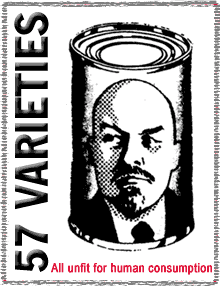
Now, exactly how many Trot groups are out there has long been a matter of speculation. Most experts, however, agree that 57 is the most likely figure. In Australia, we find quite a lot less than this number, which naturally suggests that the most recent group to split has yet to decide on a name. Rest assured that when he and his dog do finally arrive at a suitably arresting title, you’ll read it here first. In the meantime, here’s a rough A-Z guide to Australia’s dwindling (neo-)Trotskyist sects:

1) The Communist League (CL). The CL split from the SWP in 1986. It stood one candidate in the 2004 Federal election, and no doubt thrilled to the 335 first-preference votes it gained as a result.

2) The Democratic Socialist Perspective (DSP). Together with the ISO, the DSP is probably the largest (neo-)Trotskyist organisation in Australia, although over the last 15 years or so the DSP has moved some way from its ideological origins. Publishes the Green Left Weekly. (The DSP was known until 1989 as the Socialist Workers’ Party, and until even more recently as the Democratic Socialist Party.) Once a member of the USFI, the DSP now seems to be attempting to cobble together some other ‘International’. [Note: “The Democratic Socialist Party is now the Democratic Socialist Perspective. At our 21st Congress on December 27-30, 2003, we voted to stop operating as a separate party, and to function from now on as a tendency within the Socialist Alliance, working to implement the decision of the May 2003 Socialist Alliance conference to become a united, multi-tendency socialist party. The May 2004 SA conference took further steps in that direction, voting to continue the process of the Socialist Alliance having more editorial input into Green Left Weekly.”]

3) The Freedom Socialist Party (FSP). Formed in 1983, the FSP publishes the Freedom Socialist Bulletin and is also part of the Socialist Alliance. Essentially a North American phenomenon, the FSP appears to be what happens when you cross feminism with Trotskyism and to have its strongest — perhaps only real — base in Melbourne. These ‘revolutionary feminists’ appear to be in a class of their own.

4) The International Socialist Organisation (ISO). Formed all the way back in 1971 as the Socialist Workers’ Action Group (SWAG), the ISO publishes the fortnightly Socialist Worker, and is a member of the Socialist Alliance. It’s also a member of the International Socialist Tendency.

5) The Socialist Action Group (SAG). The SAG publishes a zine called Red Alert, and apparently formed as a split from Socialist Alternative in 2004. Tiny and with a membership that appears to be almost entirely located in Brisbane.

6) The Socialist Alliance (SA). Publishes Seeing Red (although probably not for much longer). Easily the largest (neo-)Trotskyist political formation in Australia, dominated by the DSP and ISO. “The Socialist Alliance was formed on February 17, 2001, by eight socialist groups and parties that saw an urgent need for greater left unity in Australia at a time of escalating government attacks on the rights and living conditions of workers and the poor, in Australia and overseas. The founding conference of the Socialist Alliance took place in Melbourne on August 4-5, 2001.” Its dismal electoral performance, together with the DSP’s typically clumsy attempts to establish hegemony within the SA, suggests that it won’t be too long before the Australian SA goes the way of its British predecessor, with the DSP in Australia fulfilling the same function as the SWP in the UK. (“The SA was wound up in February 2005, having been moribund for about a year. In March, a few groups and former members of the SA, who did not join in the Respect Coalition, met as the Socialist Alliance (Provisional). On November 12, 2005, most but not all of the provisional grouping met again and claimed the name of the Socialist Alliance.”)

7) Socialist Alternative (SocAlt). A Trotskyist splinter from the ISO. Largest Trotskyist group outside of the SA and publisher of the monthly Socialist Alternative (click here for Dec 05/Jan 06 issue), SA appears to regard the University of Melbourne, and Melbourne generally, as its stronghold.

[8) Socialist Appeal. Socialist Appeal is actually the former name of the Militant socialist organisation, now Socialist Party.]

9) Socialist Democracy (SD). A Trotskyist groupuscle that formed as a result of a split in the Progressive Labor Party in 2000. Alleged to be ‘close’ to the USFI.

10) The Socialist Equality Party (SEP). It’s the Australian section of the International Committee of the Fourth International. Formed in 1972 as the Socialist Labor League, in the last few years it appears to have ceased most activism outside of maintaining a website, although it did stand a candidate — Mike Head — in the 2005 Werriwa by-election, gaining 458 (0.68%) of first-preference votes (in 2004, Head gained 497 votes (0.6%)). In fact, the SEP/WSWS stood several other candidates in the 2004 Federal election: “Nick Beams and Terry Cook for the Senate in New South Wales, James Cogan in the Sydney eastern suburbs seat of Kingsford Smith, Mike Head in the Sydney western suburbs electorate of Werriwa and Peter Byrne in the northern Melbourne seat of Batman”. Results suggest that the socialist revolution is more than just a t-shirt away for the SEP: James Cogan received 214 votes or 0.3% of the total and Peter Byrne even less: 201 votes or 0.3%. And ah, Nick Beams and Terry Cook received a miserly 99 (00.0%) and 17 (00.0%) (out of a possible 4,117,674) votes respectively, for a grand total of 0.0002% of the vote.

Is this the least successful electoral campaign in Australian electoral history? Enquiring anarchist minds demand to know!

*11) The Socialist Labor Party of Australia (SLP). The SLP was formed in the USA in 1907. Or possibly 1890. The Australian branch appears to be just that. (Oh, and the SLP proudly proclaims itself to be “the home of Marxism-De Leonism”, so strictly speaking, it’s not actually ‘Trotskyist’.)

12) The Socialist Party (SP). Until January 2000, the SP was known as the Militant Socialist Organisation (MSO). The SP has distinguished itself from the rest of the Trotskyist pack by actually being successful at contesting an election… A member of the Committee for a Workers’ International.

13) Solidarity. One of the most recent additions to the Guide, Solidarity formed in 2003 as a split from the ISO, and is led by Ian Rintoul.

14) The Spartacist League of Australia (SL). My personal favourite. Unreconstructed Trotskyists and proud of it. Publish the Australasian Spartacist and member of the International Communist League (Fourth Internationalist).

15) Workers’ League. Another tiny sect, it too is a member of the SA, is currently aligned with the International Workers League (Fourth International) and is closely associated with Bob Gould’s circle (see below).

16) Workers’ Liberty (AWL). Formed in 1980, the (Alliance for) WL in Australia is a subset of the AWL in the UK, and is also a member of the SA.

17) Workers’ Power. See above. I first encountered this mob in 2000, and again last year at the Sydney Social Forum. Member of the League for the Fifth International.

*18) The World Socialist Party of Australia. Formed in 1996, but kept a close family secret, it allegedly publishes Socialist Comment (I can find no reference to it anywhere I look). One of the more obscure parties, it’s the local chapter of “The World Socialist Movement (WSM)… an international organisation of socialist parties. They are revolutionary Marxist but not Leninist. All the parties, except the Austrian BDS, began as offshoots from the Socialist Party of Great Britain; WSM members in countries without a companion party of their own are as a rule SPGB members.” Sure to take the world by storm… very, very slowly.

OK folks, that’s just about all for now. (Incidentally, most of the information contained herein is based on that available at the Leftist Parties of the World site; the Australian section in particular.) In the meantime, you could do worse than refer to Ozleft for gossip and discussion of the latest batch of resignations. However I really do need to conclude by way of quoting David Greason (I was a teenage fascist, pp.244-246) on the Spartacists:

I wanted to join the Spartacist League. True, we used to laugh at them; in fact everyone laughed at them, but in their isolation lay their appeal. The Spartacist League was this bad-tempered Trotskyist group that had probably no more than twenty — no, make that thirty — members throughout the country mainly based on campuses like LaTrobe and Sydney. We occasionally had run-ins with them, although they tended to keep their distance because they imagined that we were out to kidnap them individually and dump the bodies in shallow graves off Rye backbeach. We wouldn’t have done; there were plenty of leftist groups clamouring for that opportunity.

Since the early 1970s, the Australian left had been more gauche than sinister, despite what groups like People Against Communism said. That was the appeal of the far-right, I guess: groups like the League and the Nazis were either nutty or offensive, both of which amused me no end; or it spoke such unambiguous commonsense (like the British NF or the Alliance) that you couldn’t help but identify with it. Well, at least I couldn’t. Most of the left, on the other hand, was dull and earnest and out of touch. You just had to read the left’s papers or, even better, look at the miserable faces of the people selling them. How they ever recruited was beyond me. I certainly didn’t fancy spending my Saturday afternoons in draughty meeting rooms discussing Marx’s Theory of Surplus Value. If I’d wanted to learn that sort of thing I’d have paid attention in fourth form economics classes.

That was the beauty of the Spartacist League. They had this paper, Australasian Spartacist, and virtually every issue had at least one page devoted to sectarianism. Yes, they were Marxists, and yes, they also ran pages of boring leftist tripe that they no doubt thought had some appeal to the working masses — the very same working masses who would never buy their paper, week after week after week — but they specialised in airing the dirty laundry of all the other rival left groups around: the Maoists, the Eurocommunists of the CPA, the Send In the Tanks Stalinists of the Socialist Party, and all the other cheek-by-jowl rivals to the title of Trotsky’s heirs — the Socialist Workers’ Party, the Socialist Labour League, the Communist League (were they still going?), the International Socialists, etc. etc. No wonder they were generally considered to be police agents.

And they had a great writing style — snotty and sneering and puffed-up. It was pretty much like ours, actually. If you could hear what you read, they’d be saying it from the corners of their mouths, then laughing at you. They insulted other leftists worse than we insulted other leftists. They insulted other leftists worse than they insulted us. That was no doubt why they kept getting bashed by other Trotskyists. Technically, though, we were the Great Satan, because we were Fascists with a capital F, and the other left groups were part of the workers’ movement.

The politics would have taken a bit of getting used to, but that certainly wasn’t beyond the realms of possibility. I envied them. They knew what they believed. They knew who they hated, and why, and it was all footnoted and there was never any room for error and they could pick up deviationism from the most innocuous slip of the tongue and they were as hard on their own people as they were on everyone else and by Christ they were hard on everyone else. No one was good enough for them.

The line was laid down, probably in the US, and you’d know pretty much from the start what you could like and dislike and it would all be explained and there’d be references and cross-references in all the back issues of Australasian Spartacist so no one could just make it up as they went along…

Posted in Trot Guide | Leave a comment

Venezuelan Anarchists on Chavez, WSF

WSF Caracas: Shroud for Venezuela’s social movements

A member of the group promoting the Alternative Social Forum explains why the World Social Forum (WSF), taking place in Caracas during January 2006, is another attempt by the Chavez government to impede the autonomous development of social struggles in the country.

::

During the week of January 24 to 29, 2006 the polycentric version of the VI World Social Forum as well as the II Social Forum of the Americas will take place in Caracas. The event has generated great expectations since this city is the epicenter of what since 1999 has been known as the “Bolivarian Revolution”, with much impact in Latin America and wide popularity among diverse social and left movements in the world. The fact that Venezuela is the second continental seat of the WSF is a tacit backing of the governmental performance of President Hugo Chavez, as happened at the time with the local government of the Workers Party in Porto Alegre during its slow but true climb to the presidential chair. Is this backing of the government related to the actual strength of the social movements of Venezuela? Or, to say in different words, what contributions the WSF in Caracas will make towards the process of consolidation, expansion and articulation of the country’s social movements? To answer this question we will first make a brief review of the nation’s contemporary history.

“Punto Fijo” and “Caracazo”

After decades of military and strong man dictatorships, in 1958 a new democratic period is inaugurated in Venezuela. The so called Pact of Punto Fijo is made among the principal dominating actors, who agree to alternate the main political parties of that era, Democratic Action and COPEI, in power. A few years later a period of armed struggle by the insurgent left starts, a chapter lasting less than a decade with the progressive incorporation of these actors into the “legal” and parliamentary politics, motivated by, among other things, the social floor built by the social-democracy thanks to the large income from oil. The royalties of black gold allow for democratic stability unknown in the continent, paying for a generous social security, widespread education at all levels and subsidizing labor unions and trade associations all over the territory. The oil tanker that daily filled their hulls at the Venezuelan ports financed the ample middle class that developed during the decades of the 60’s and 70’s, reaching its climax with the so-called nationalization of oil that happened in 1976, when transnational corporations such as Shell stopped operating in the country. From that year until the end of 1981 it was the period known as the fat cows due to the huge amount of money that came into the national treasury. At the beginning of 1983 the devaluation of the currency, the bolivar, is announced, and a period of economic crises begins that initiates the break up of this governmental model started in 1958. During the mid 80’s large popular mobilizations start but do not translate into votes for the left political parties which historically maintain a percentage around 5%.

The most notable expression of the death throes of the Pact of the Punto Fijo happens in February 1989, during the so called “Caracazo”, when hundreds of businesses were looted in different cities in a week of violent popular explosions, brutally repressed by the army, with a number of deaths and disappearances still unknown, which some say is over a thousand. It is from that February that a civil society, outside the established political parties and with no client relationship to the state, begins to take form. To name but a few, we find the first human rights organizations, ecological associations and networks that promote the Environmental Penal Law and the social initiatives that fueled the mobilizations against the neo-liberal “package” of Carlos Andres Perez -– then president of Venezuela –- which constitute examples of what autonomous social struggle were possible in that context when political parties and other upholders of the government showed clear signs of fatigue.

1989 represented an important moment in the history of the autonomous social organization of popular demands. The effervescence apparent before and after the popular revolt shows the seams of a social fabric made up of infinite socio-political initiatives, with different and growing levels of articulation among themselves. They take aim against the president and his policy of “the big turn”: his attempt to apply the neo-liberal prescription dictated by the International Monetary Fund which contrasted with the populist policies imposed by previous governments. In this scenario of growing citizen mobilization something never seen before takes place: the Attorney General of the Republic opens a case against the president for corruption and misappropriation of the so called “secret parties”. In May 1993 Perez was suspended from his functions.

Chavez and his movement

A year before the president’s fall due to charges of corruption, a political recourse that seemed to be relegated to the past came back to the front pages of the press: the coup d’etat. From the years 1899 to 1958, five conspiracies headed by the military forced the change of the first president, paradoxically including one that in 1945 claimed to be in the name of democracy and the parties system.

Military insubordination in order to take power wasn’t the exclusive patrimony of sectors identified with the right. Several armed insurrections stimulated by the Marxist-Leninist left spoke of the “civil-military alliance”, in which political vanguards linked with “progressive sectors of the armed forces” to provoke change. This appeal to a pretended progressiveness of the Venezuelan army interpreted its multi-class character under dialectical materialism, attempting to exacerbate the “class contradictions” between soldiers and officers to “win them over to the socialist cause”. It is true that the popular heterogeneity of the Venezuelan army is different from the elitist conformation of other armies in the continent, but the Marxist reductionism forgot that its hierarchical and value systems educated them to see themselves as a class different from the civilians. On the other hand, the Venezuelan army was also formed in the anti-communism and the fight against subversion according to the dictates of the Southern Command of the United States, as part of the logic of the Cold War.

After 34 years without military conspiracies – one of the premises of the Pact of Punto Fijo – in 1992 a large group of middle rank army officers attempts a coup d’etat against Carlos Andres Perez. On TV, a character in uniform unknown to all announced the defeat of the uprising “for the time being”. That officer was Hugo Chavez, who spend some years arrested for military mutiny and was set free, via pardon, by the next elected president: Rafael Caldera, who, like Perez, was in power for the second time.

Chavez liberation, which happened during the mid 90’s, took place amid large mass mobilization and consciousness rising. For the first time a presidential candidate from the non-traditional sectors, Andres Velasquez, got to improve on the historical 5% of the left, placing himself very close to the elected candidate in percentage points. This was symptomatic of the will for change that like an epidemic grew among Venezuelans faced with the economic crisis and the fatigue of the democratic system. Chavez and his movement piggy back on that dynamic giving it a face to the unhappiness, thanks to the media magnification and its insurrectional aura. We repeat: a development that qualitatively and quantitatively is contemporary to Chavez’s movement and of which the MBR-200 (the name of Chavez’s first political group) was only a part. The paratrooper from Sabaneta makes a cynical and pragmatic reading of this reality, going from his militant abstention, during which time he was able to get the sympathy of many grass roots social movements, to the presidential candidature, and let’s not forget, with the support of the mass media and the financing from sectors of international capital. Chavez and his charismatic dominion convince many sectors that he represents the vanguard of the struggle against the binomial AD-COPEI and is a project for revolutionary transformation. The shortsightedness of the traditional parties and their own mummification accelerated their final crisis, partially masked by the media show of the events of 2002 but that sooner rather than later –as indeed happened – would end up dismantling the empty shells of such parties.

Institutionalizing rebellion

We were saying Chavez rides on a wave of popular unhappiness that in 1989 started weaving a social fabric made up of infinity of embryonic organizations, with different but growing levels of mutual articulation. One of the virtues of chavism is gathering diverse demands and incorporating them in its diffuse ideology giving the sensation that bolivarianism was a legitimate expression of the left’s and the community’s will. The next step was the establishment of an uncontestable direction, paradoxically spreading a democratic proposal of “participation” and the imposition upon its grass root basis of an agenda decided at the top, basically limited to re-legitimization at the ballot. This way the social movements already spent due to their progressive incorporation in the cumulative politico-electoral logic are mortgaging their own autonomy, and even more important, to the imposition of an authoritarian model of domination, becoming immobilized to raise their own demands. It is in the imposition of organizational models directed by a single hand and in the dismantling of citizen’s initiatives that preceded it that one finds the key to understand the current fragmentation of the social movements in Venezuela.

Whoever watches from the outside the avalanche of revolutionary propaganda financed by the Venezuelan state may well be astonished by this statement. Out of the many examples that support it let’s name one key fact. During the 90’s the management of the state’s hydrocarbon company, Pdvsa, attempted to lobby around a policy of opening up the oil trade in order to involve transnational companies in the exploration and exploitation of new wells, reversing the nationalization of 1976. The proposal, in agreement with free market policies, generated widespread and rabid resistance in many sectors, rendering it politically inapplicable. Behind the revolutionary and anti-imperialist rhetoric centered mainly on George Bush Jr., President Chavez has signed off on the largest concessions of energy resources since the decade of the 40’s with no internal opposition. For example, the largest natural gas reserve in the country, the Delta Platform, has been given in concession to Chevron, Conoco-Phillips and Statoil for periods of over 30 years. From January 1, 2006 on, mixed enterprises between the multinationals and the state’s oil company will be in force, both parts being partners in the exploration and commercial development of the reserves. As of this writing, December 2005, there had been no mobilization by any sector against this measure. Pablo Hernandez Parra, an oil expert and collaborator with the web site www.soberania.org says in one of his articles in the press: “The essence of all that’s happening in this new Macondo called Venezuela is just the fact that national and international capital headed by oil companies have donned the red beret and sash, and advancing with triumphant strides impose their privatization program under the guise of socialism for the XXI century. Everything that happens today in this country, from the oil policy to the media circus with land expropriations, is nothing more than a vulgar show between the puppets of capital: government and opposition, in order to consolidate the process of privatization of the natural resources of the nation: oil, gas, mines, land, for the exclusive benefit of big capital.”

The World Social Forum

In the last four years Venezuela has undergone a polarization induced by the top players vying for power: the old “punto fijista” bureaucracy (Fedecamaras, CTV, political parties) against the new Chavez bureaucracy that has supplanted the previous one. This antagonism, false inasmuch as real vs. pretended exercise of power, sustained and amplified by the media, has benefited those who have cast themselves as legitimate voices of the sector of Venezuelan society they claim to represent. Part of the demobilization of the social movements answers to this logic: having taken part in, and assumed blindly the political agenda imposed from above, postponing their own claims. Another chapter belongs to the expectations created by some of the social activists faced with a “progressive and left” government, spokesmen of a discourse that assumes the language of the movements but whose policies go in the opposite direction.

The former U.S. ambassador to Venezuela, John Maisto, told the press: “Chavez has to be evaluated by what he does, not by what he says”. This explains why in spite of diplomatic bruising, Venezuela makes her best deals with the most dynamic sectors of global capitalism, including the Big Brother from the North, which consumes over 60% of the energy exports leaving our ports. Here we need to clarify that international geopolitics is radically different from that of the Cold War. As long as countries keep to their roles assigned by economic globalization, they can have the local politics they like best. This is precisely the Venezuelan case not only on oil and energy matters – counting on more than $60 a barrel, the highest prices ever – but also in the most dynamic sectors of the world’s economy: banks, finances and telecommunications. Also, remember that Caracas continues to be a punctual payer of its external debt and obeys without any flack the obligations contracted with the IMF.

This is the context in which the World Social Forum will take place in these shores of the Caribbean: with demobilized local social movements and with no freedom of action, with a government that will finance it and even brags about it in advertisements and press conferences, at the beginning of a year of presidential elections and with the tribune of the WSF as the ideal starting point in the electoral campaign. The lack of operative social networks and infrastructure of citizen’s initiative, the event’s logistics: room and board, transportation, will be done by the Venezuelan army for the lesser delegations and by the Hilton hotel chain for those of higher strategic importance for the national executive, as has been the tradition in previous “revolutionary” councils in Caracas. As a movement Chavism – where the main spokespeople of the committee promoting the WSF in Caracas belong – in seven years has only recognized as players those who submit to the leadership of Hugo Chavez, therefore his declarations regarding the realization of a pluralistic forum sound like demagogic speech for the peanut gallery. In this sense, this event will deepen the current dispersal of social elements and will not, in our opinion, change anything.

Because of this and in spite of all the difficulties, of the lack of resources and infrastructure and the asymmetry, a group of us believe it’s necessary to have an event parallel to the WSF (in the same city and during the same days) to insure that energy policy discussions, concentration of power, militarism, autonomy and new social movements, the model for the development of the mine industry and the environment, alternative communications and counter-power will take place opening the possibility to spread other versions of what’s happening in Venezuela. To this we add the degradation experienced by the WSF: it being controlled by NGO’s and sanitized social groups such as ATTAC and Greenpeace, as well as the manipulation by left political parties as platforms for propaganda. Besides, the Latin American situation opens up new agendas for discussion which we feel will not be sufficiently considered at the WSF: the fact that several South American governments are “left” and how their social policies have been incapable of reducing poverty, promote structural changes, preserve the environment and safeguard the rights of minorities, since they limit themselves to capitalism with a human face. We think our event, the Alternative Social Forum (ASF) can be one of the many necessary spaces for gathering and dialog among different grass roots movements, in order to establish our claims and elaborate our agenda of events and mobilizations, without interference from anybody outside its own dynamic. Therefore we invite all activists to visit Venezuela in this fourth week of January to participate whether in the WSF or the ASF, and, most importantly, to see with their own eyes the reality of this country, to contrast versions and data and stop interpreting things listening exclusively to the propaganda manufactured by the Venezuelan state or the opposition political parties.

Facts on the paralysis of the Venezuelan social movements:

* Mobilizations in solidarity with the direct action done by the indigenous Pemon people (Gran Sabana) against the electrical transmission line to Brazil at the beginnings of 2001: None.
* The largest demonstration against the war in Iraq: Gathering at Plaza Venezuela, Caracas, 1200 people, May 25, 2003.
* Are there independent media centers, Indymedia in Venezuela? No
* Attendees at the demonstration before the Supreme Court of Justice by women’s groups protesting the release of the accused for the physical attack of Linda Loayza, October 26 2004: 80 people.
* Attendees at the national march against carbon exploitation in the state of Zulia, March 31 2005: 1000 people.
* Attendees at the demonstration called by the Bari, Yukpa and Wayuu peoples on October 11 2005 at Plaza Bolivar against carbon exploitation in the state of Zulia: 150 people.
* Mobilizations against the energy concessions by the government to multinational companies: None.
* Mobilizations against the governmental regulation of the largest forest in the country, Imataca, for mine and lumber exploitation: None.
* Mobilizations against the deplorable state of the hospitals in the country: None.
* Audiovisual productions the from a Chavist position denounce the contradictions between what the government says and what it does: One, “Our oil and other tales” (2004) by the Italians Gabrielle Muzio, Max Pugh and others, censored by the government. The TV stations Telesur, Canal 8 and Vive TV show previous productions from this audiovisual collective, but don’t show this last one.
* Any other direct action called by popular movements? On October 12, 2004 about one hundred activists from Chavist grass roots organizations gathered in front of a statue of Columbus in Plaza Venezuela to tear it down. During the convocation they expressed their desire to “take the head to Chavez” who at the time was at a function in the Teatro Teresa Carreño. Three activists were arrested for the destruction of the statue. On October 21 50 people demonstrated in front of the Court demanding the release of those arrested. A year later, according to writer Luis Britto Garcia, one of them continued in prison.

Rafael Uzcategui

El Libertario

===================
* El Libertario is a journal of an anarchist collective in Venezuela
_______________________________________________
A-infos-en mailing list
[email protected]

Posted in Anarchism, History, State / Politics | Leave a comment

The more things change


George Orwell (Eric Blair), ‘As I Please’, Tribune, May 19, 1944

A SPECIMEN of Tribune’s correspondence:

TO THE JEW-PAID EDITOR, TRIBUNE, LONDON.
JEWS IN THE POLISH ARMY.
YOU ARE CONSTANTLY ATTACKING OUR GALLANT POLISH ALLY BECAUSE THEY KNOW HOW TO TREAT THE JEW PEST. THEY ALSO KNOW HOW TO TREAT ALL JEW-PAID EDITORS AND COMMUNIST PAPERS. WE KNOW YOU ARE IN THE PAY OF THE YIDS AND SOVIETS.
YOU ARE A FRIEND OF THE ENEMIES OF BRITAIN! THE DAY OF RECKONING IS AT HAND. BEWARE. ALL JEW PIGS WILL BE EXTERMINATED THE HITLER WAY—THE ONLY WAY TO GET RID OF THE YIDS.
PERISH JUDAH.

Typed on a Remington typewriter (postmark S.W.), and, what is to my mind an interesting detail, this is a carbon copy.

Anyone acquainted with the type will know that no assurance, no demonstration, no proof of the most solid kind would ever convince the writer of this that Tribune is not a Communist paper and not in the pay of the Soviet Government. One very curious characteristic of Fascists—I am speaking of amateur Fascists: I assume that the Gestapo are cleverer—is their failure to recognize that the parties of the Left are distinct from one another and by no means aiming at the same thing. It is always assumed that they are all one gang, whatever the outward appearances may be. In the first number of Mosley’s British Union Quarterly, which I have by me (incidentally, it contains an article by no less a person than Major Vidkun Quisling), I note that even Wyndham Lewis speaks of Stalin and Trotsky as though they were equivalent persons. Arnold Lunn, in his Spanish Rehearsal, actually seems to suggest that Trotsky started the Fourth International on Stalin’s instructions.

In just the same way, very few Communists, in my experience, will believe that the Trotskyists are not in the pay of Hitler. I have sometimes tried the experiment of pointing out that if the Trotskyists were in the pay of Hitler, or of anybody, they would occasionally have some money. But it is no use, it doesn’t register. So also with the belief in the machinations of the Jews, or the belief, widespread among Indian nationalists, that all Englishmen, of whatever political colour, are in secret conspiracy with one another. The belief in the Freemasons as a revolutionary organization is the strangest of all. In this country it would be just as reasonable to believe such a thing of the Buffaloes. Less than a generation ago, if not now, there were Catholic nuns who believed that at Masonic gatherings the Devil appeared in person, wearing full evening dress with a hole in the trousers for his tail to come through. In one form or another this kind of thing seems to attack nearly everybody, apparently answering to some obscure psychological need of our time.

Fighting Fascism in 1930s Britain
1958: Beating back Mosley in Notting Hill
The Battle of Lewisham, 1977

Posted in Anti-fascism, History | Leave a comment

Lenin On Trial


Almost five years ago now, Lenin was placed on trial:

L E N I N O N T R I A L:

Condemned by History, Who Dares Defend Him?

Presented by ‘NO GODS, NO MASTERS’, the Melbourne Anarchist and Autonomist Conference.

WHEN:

Sunday April 29th, [2001], 6 – 9pm.

WHERE:

Public Lecture Theatre, Old Arts Building, University of Melbourne. (400 seats, advance tickets available.)

ENTRY:

$5.00 (free to conference goers).

ENQUIRIES:

Rob Dolchek:

——

PROCEEDINGS WILL BE VIDEOTAPED BY SKA-TV, AND BROADCAST AT A LATER DATE.

——

The CHARGES:

* Counter-revolution * Tyranny * Treason * Terror *

——

V.I. Lenin: Revolutionary Genius or Social Frankenstein?

The collapse of the Soviet Union has read the verdict of history on Lenin’s megalomaniac adventurism, but the Red Left has yet to learn the lessons. Old slogans reappear in new catchphrases, and old tactics are repainted as the urgent and necessary goals of the moment. Anarchists are putting Lenin on trial, and challenge the Red Left to defend him. Four charges will be heard:

1) That Lenin was a counter-revolutionary, who attacked the revolutionary movement to build his own power.

Prosecutor: Leigh Kendall
Offences: The suppression and massacre of the Kronstadt garrison.

2) That Lenin was a terrorist, who enslaved the people with all the instruments of military and civil repression.

Prosecutor: Rob Dolchek
Offences: The supression of the Maknovschyna, and the wars against
autonomous revolutionary collectives throughout Russia.

3) That Lenin was a tyrant, who enslaved the people under state capitalism, deceitfully proclaiming it to be the dawn of Marx’s utopia.

Prosecutor: Owen Gager
Offences: Lenin’s butchery of Marxist theory of the state and
socialist economy.

4) That Lenin was a traitor, who continually undermined his own party and betrayed his own revolutionary colleagues.

Prosecutor: Leigh Riley
Offences: Lenin’s subversion of Party democracy, manipulation of the
Party program, and selective and opportunistic betrayal of his rivals and of dissidents generally.

——

PROCEDURE:

Each charge will be heard in turn, with a prosecution and a defence each speaking for 12 minutes.

All speakers will then be allowed a short response.

Questions and contributions will be taken from the floor.

The assembly will vote on Lenin’s guilt.

——

CHALLENGE:

We invite the Red Left to nominate speakers for the defence. Contact Rob Dolchek on

——

TICKETS:

Door tickets will be available, but we advise that pre-purchasing will secure a seat, and a chance to join in the fun. For more details, ring Rob or purchase tickets directly from:

BARRICADE BOOKS / INFOSHOP

——

FURTHER ARRANGEMENTS:

Will be notified as planning proceeds.
To be realistic, demand the impossible

As it turned out, only one person was daring enough to defend Lenin: Lev Lafeyette. (In fact, you can still find Lev’s defence — titled ‘Defending Lenin’s application of Marx’s theory of the state and socialist economics’ — here.) I was disappointed by the Red Left’s reaction, but not altogether surprised: they have enough difficulty defending their bankrupt ideology as it is without having to do so in front of a hostile audience. Still, it would have been fun I reckon. And it wasn’t like nobody had the time; a number of authoritarian leftists attended the conference at one point or another, including some more ‘senior’ party members.

Or maybe they just felt like Chicken That Night?

Finally, in other, related news:

News Highlights from October 23-October 30, 2000

Vladimir Lenin is on the run—wanted in Estonia for tax fraud.
The inclusion of Lenin’s name on a police wanted list on October 24 raised eyebrows in Estonia. The fugitive, however, isn’t the famed Communist revolutionary, but a namesake 34-year-old.
Estonia’s Lenin, an ethnic-Russian Estonian citizen, even shares the same middle initial as the founder of the Soviet Union, “I,” according to Estonian police spokesman Hannes Kont.
The living Vladimir I. Lenin is accused of participating in a scam with nine other suspects to set up a phony oil firm to fraudulently claim some 800,000 dollars in tax rebates from the government.
Many Estonians do advocate putting the better-known Lenin on trial posthumously for setting up the Soviet secret police system blamed for the murder and deportation of millions of people last century.
Police spokesman Kont said he couldn’t say if Lenin, the Communist revolutionary, might qualify for prosecution under Estonia’s tough crimes against humanity laws used to convict several living ex-Soviet secret police.

Posted in Anarchism, History, State / Politics, Trot Guide | Leave a comment

Sub Motorcycle Diaries

Everyone knows about Che’s famous journey by motorcycle through South America. But as Paul Berman reminds us:

The cult of Ernesto Che Guevara is an episode in the moral callousness of our time. Che was a totalitarian. He achieved nothing but disaster. Many of the early leaders of the Cuban Revolution favored a democratic or democratic-socialist direction for the new Cuba. But Che was a mainstay of the hardline pro-Soviet faction, and his faction won. Che presided over the Cuban Revolution’s first firing squads. He founded Cuba’s “labor camp” system—the system that was eventually employed to incarcerate gays, dissidents, and AIDS victims. To get himself killed, and to get a lot of other people killed, was central to Che’s imagination. In the famous essay in which he issued his ringing call for “two, three, many Vietnams,” he also spoke about martyrdom and managed to compose a number of chilling phrases: “Hatred as an element of struggle; unbending hatred for the enemy, which pushes a human being beyond his natural limitations, making him into an effective, violent, selective, and cold-blooded killing machine. This is what our soldiers must become …”— and so on. He was killed in Bolivia in 1967, leading a guerrilla movement that had failed to enlist a single Bolivian peasant. And yet he succeeded in inspiring tens of thousands of middle class Latin-Americans to exit the universities and organize guerrilla insurgencies of their own. And these insurgencies likewise accomplished nothing, except to bring about the death of hundreds of thousands, and to set back the cause of Latin-American democracy—a tragedy on the hugest scale.

And in news just to hand:

Approaching this year’s Presidential elections, the Zapatistas take to the road on the Other Campaign with the aim of turning México upside-down.

Sub Motorcycle Diaries
by Ramor Ryan
Chiapas
January 3rd, 2006

Like a cross between Mad Max and Zorro, Subcomandante Marcos zoomed out of the remote Zapatista stronghold of La Garrucha on a black motorbike with EZLN blazed across its handlebars and his cock hanging off the back. As the gathered scrum of media scrambled to capture the dramatic exit and beginning of the new Zapatista political initiative, all they were left with was a cloud of dust and the fading squawk of the unfortunate chicken – the campaign mascot called “Penguin” for its lopsided appearance – riding pillion.

The infamous guerrilla commander, a kind of post modern Che Guevara with a flair for the theatrical, was on the road again. Somewhere outside San Cristobal, reporters caught up with him and asked was he really going to go on the campaign trail on this
motorcycle. “All the way to Tijuana” he replied.

From Sub Commander to Delegate Zero

Under the moniker Delegate Zero, Marcos launches a six month tour of all Mexico, unarmed and apparently alone, not to speak or run for office but “to listen to the simple and humble people who struggle”. This new political initiative, called the Other Campaign, is intended to influence Mexico’s July presidential election. The Zapatistas will reach out to anti-capitalist and leftist organizations across the country, creating a nation wide movement that will turn the national political agenda “upside down”.

Rejecting the suggestion that they were leaving the armed struggle and entering the political mainstream, the Zapatistas say they are conducting a campaign “from below, for below”, focusing on “a radical transformation of the Mexican political system”.

A Tumultuous Night in San Cristobal

Flight from the Zapatista lair in the Lacandon Jungle – the Desert of Solitude of colonial literature fame – was, for Marcos, brief. 80 miles away, some 15,000 Zapatistas and supporters, heralded Marcos´ arrival in San Cristobal. Amidst the ubiquitous frantic and impassioned welcome, Marcos — now joined by the other Zapatista comandantes — surfed through the multitude occupying a town center completely deserted of police and military.

From the stage, Comandante David explained the mission – “A new stage of the political struggle of the EZLN has arrived. Delegate Zero will blaze the trail and open new doors”.

Rapturous applause greeted Marcos as he took to the platform. An unlikely hero, he bowed his masked head and characteristically mumbled his words.

“I have been chosen to go out across the country to test the road and to see what dangers lie there within, and to recognize who by their face and word is down with the struggle. So that we can unite the Zapatista struggle with the struggle of the farmers and the workers of the country called Mexico.”

The Long Road of Struggle

It has been 12 years since the Zapatistas exploded onto the Mexican and world stage with the 1994 armed uprising, and 4 years since the unarmed “Zapatour” across the nation, which brought out millions of supporters, but no resolution to the conflict, as proposed legislation for indigenous autonomy failed to go through Congress. Frustrated by the lack of political progress, the Zapatistas fell into a silence and concentrated on building local autonomy in their zones of influence.

This led to the creation of 32 autonomous municipalities which refused to accept any state presence and set about organizing health and education services, as well as overseeing the implementation of justice and social welfare measures themselves, through a system of participatory democracy and assembly based council communalism.

Despite heavy repression from state and military forces, Zapatista guns remained silent during the low-intensity conflict as they undertook a path of non-violent resistance. This strategy led to the Sixth Declaration of the Lacandon Jungle – La Sexta (‘the Sixth’) — which spelt out their political philosophy as distinctly anti-capitalist, against parliamentary democracy and in favour of direct or participatory democracy, as exemplified by their autonomous municipalities.

La Sexta was made public during the red alert of August 2005, when some analysts predicted a EZLN return to armed struggle. Instead they announced an unarmed strategy to critique and organize against the unequal, unjust and corrupt form of democracy permeating the Mexican political system.

In answer to the ever prevalent question posed by Lenin a hundred years ago — ‘What is to be done?’, the Zapatistas subtly rephrase it — ‘What do we want to do?’. And the answer is “reorganize the nation from below and to the left”.

Sinister Elements

The reaction of the political parties and establishment has been favourable, choosing to focus on the apparent abandoning of arms instead of the political issues raised by the Other Campaign. “It’s a good thing that they have left behind the armed struggle”, said Cardinal Rivera Carrera, head of Mexico’s conservative Catholic church. The out-going ruling party PAN has also welcomed the new Zapatista initiative, but elements within the right wing, neo-liberal party, such as Congress leader Hector Larios, dismiss the campaign as “surreal and clown-like”. The center-left PRD — favourites in the poll to win the upcoming elections — are adopting a conciliatory tone despite much of Marcos’ stringent criticisms directed at the neo-liberal drift of the party.

The PRI, who ruled the country un-interrupted for 70 years, is running a close second place to the PRD in the polls. Sinister elements within the ex-dictatorship are the ones to be wary of. These are the intellectual authors of the Acteal massacre in 1997, and the assassination of the reforming Presidential candidate Luis Colosio, in 1994. Marcos has dwelt on the possibility of his own assassination as he goes about the country. “We don’t fear to die struggling. The good word has already been planted in fertile soil. This fertile soil is in the heart of all of you, and it is there that Zapatista dignity flourishes.” In a bizarre move, the PRI mayor’s office turned off the lights of the Boulevard as the Zapatista caravan swept into San Cristobal on the night of the 1st.

Town Hall Meetings

Hundreds of delegates from some of the 443 social organizations and NGOs who subscribe to the Other Campaign packed out the first series of town hall meetings held in San Cristobal on January 2nd.

Marcos, masked and flanked by an unarmed civilian bodyguard, introduced the encounter. “Its necessary to hold public meetings but not the type of the old politics where one speaks and the rest applaud.” In this sense, he proposed to differentiate the Other Campaign from the “electoral circus”.

Speaking from the floor, Fr Miguel Concha Fray Francisco de Vitoria (Human Rights Centre), explained how this new campaign was not a stunt to influence July elections, nor a parody of the official election campaigns but a renewal of nationwide grassroots political organizing. “It’s not an anti-campaign. This is another campaign that goes beyond the electoral consensus: its something focused on the medium or long term.”

The tour continues to the state of Yucatan on January 9th.
_______________________________________________
A-infos-en mailing list
[email protected]

Posted in Anarchism, History, Trot Guide | Leave a comment