Trot Guide 2008: RSP!

A W E S O M E !

Introducing the artist formerly known as the Leninist Party Faction…

The Revolutionary Socialist Party!

The Leninist Party Faction, a dissident minority expelled from the Democratic Socialist Perspective on May 13, and Direct Action, an organisation established by former DSP members in Melbourne and Geelong after they left the DSP in June 2006, have united to launch a new party, the Revolutionary Socialist Party (RSP), with members in Sydney, Melbourne, Brisbane, Canberra, Perth, Geelong, Adelaide, Newcastle and Cairns, and others currently residing overseas.

This is a principled unification of our two organisations. Both the LPF and Direct Action support the Program of the Democratic Socialist Party, a program that the DSP remains formally committed to but which it is abandoning in practice. Together, LPF and Direct Action members waged a common struggle against the degeneration of the DSP until June 2006, when six LPF members decided to leave the DSP to establish Direct Action.

Both the LPF and DA seek to preserve the continuity of the revolutionary tradition of the DSP prior to its political and organisational degeneration in recent years, culminating in the wholesale purge of the LPF on May 13. The LPF and Direct Action share not only basic programmatic agreement, but also agreement on the main tasks and perspectives for regrouping and rebuilding the revolutionary Marxist current once embodied in the DSP and its predecessor, the Socialist Workers Party, founded in 1972. The RSP’s strategic aim is to build a mass revolutionary workers party capable of leading the Australian working class and its allies to overthrow capitalism and, together with the working people of other countries, to build socialism, a global society of shared wealth and democratic planning to meet social needs. We recognise that we are not the only revolutionary socialist organisation in Australia, and that a future mass revolutionary socialist party will not be achieved solely through the incremental growth of any one of the existing far-left organisations.

Building towards the future mass revolutionary workers party will require a variety of tactics, among them efforts to unify the existing far-left organisations. But in today’s conditions of continuing working class retreat, the creation of a broad left party of anti-capitalist resistance is simply not on the agenda. The necessary partners for such a party — substantial new class-struggle forces and leaders — do not yet exist, and will not come into existence until there is a sustained mass upsurge of working class resistance. The Socialist Alliance is not such a broad left party or even a modest step torwards such a party, but a front for the DSP. The RSP rejects any such sectarian attempt to masquerade as a broad left party. Rather, we seek to collaborate with all left and progressive organisations and individuals to achieve the maximum unity in action where we have agreement.

The RSP’s ongoing campaign priority is to help build a broadly based solidarity movement with the Latin American socialist revolutions in Venezuela and Cuba. Building solidarity with the Venezuelan and Cuban peoples is the duty of revolutionaries everywhere, especially in an imperialist country closely allied with US imperialism. Moreover, the inspiration of these living socialist revolutions is key to winning a wider hearing for revolutionary socialist ideas among working people in Australia. The RSP seeks to build the Australia-Venezuela Solidarity Network as a democratically functioning national network of affiliated solidarity groups and individual solidarity activists.

Next week the RSP will launch a new monthly radical left publication, Direct Action. This new publication, and its associated website, will present the views of the RSP as well as encouraging constructive debate on the left and will seek contributions from a broad range of radical commentators, activists and organisations. The RSP will hold a delegated founding congress in early 2009.

May 28, 2008

* * *

The RSP has set up a website, where the party’s documents and political positions will be progressively uploaded. The RSP’s initial Perspectives Resolution is available there, as well as the RSP’s program and constitution… For further background on the political debate in the DSP see the article by Allen Myers, “The Political and Organisational Degeneration of the DSP” on the LPF website.

The RSP has established a National Office in Sydney at Suite 72/65 Myrtle St, Chippendale 2008. For further information contact John Percy 0419 989 720, Marce Cameron 0413 158 480 or Doug Lorimer 0434 209 342, or email nationaloffice[at]rsp[dot]org[dot]au.

The Bad News: RIP Direct Action and LPF. Nevertheless, one must maintain the

Party spirit

25. We must strive to cultivate the spirit of revolutionary comradeship in the RSP. We need a party spirit that can sustain us through the ups and downs of the struggle, that takes from each of us all that we are capable of giving and that gives each of us, in return, something infinitely precious and beautiful – a tiny glimpse of the communist future of humanity.

Posted in Trot Guide | 8 Comments

Bloggy Wednesday

    “Blogging may help people feel happier and more satisfied with their friends, according to Melbourne researchers.” ~ Bloggers ‘feel more connected’, Chee Chee Leung, Science Reporter, The Age, March 4, 2008

A few blogs which have caught my eye recently.

1) The Local:

“News, commentary, resources, advice and discussion about Australian blogging, bloggers, the .AU blogosphere, blogebrities, blog networks, blog wars, blog search, blogging law, blog crushes, blog hosts… well generally it will contain everything to do with weblogs.”

2) The Hack & Caz:

Weird shit. The Hack & Caz is dedicated to two bloggers, ‘The Hack’ (Jamie Duncan) and ‘Caz’ (Caroline Hamilton). Apparently, Jamie and Caroline were responsible for a now-defunct blog called ‘The Spin Starts Here’ (originally titled ‘The spin starts here darl’), established in October 2002 and ceasing publication in April 2007. The blog’s authors are rather um, ‘critical’ of Jamie and Clive’s blogging activities, claiming that TSSH was responsible for all kinds of scurrilous and damaging attacks upon other bloggers whom the pair happened to dislike.

3) boudist:

“Boudist is Daniel Boud’s personal website. He lives in Sydney, takes the occasional photo and loves the rock’n’roll music.” Daniel recently took a photo of a rock’n’roll band in Sydney: Juliette Lewis & The Licks. For my money, Juliette Lewis is one of the most disturbing-looking individuals every to grace Hollywood celluloid. Every time I see her, I wince. Why is that? I dunno. Same goes for Chloë Sevigny. *shudder* But anyway, Daniel’s blog is ace, and his photos are grouse.

(See also : Strong Lessons for Engaged Buddhists.)

4) Public Opinion:

Loadsa stuff on Gary Sauer-Thompson’s weblog. Interesting stuff. Or maybe not. He needs an editor. To edit. His words. On his blog.

5) Defamer Australia:

Local version of LA gossip column. Almost as good as — nay, better — than browsing the magazines in the supermarket aisle.

6) Top 100 Australian Blogs Index:

Not a blog, but a blog page. Mostly dull, but popular, apparently.

(See also : Australia logs on and blogs on and on and on, Nick Miller, The Age, April 19, 2007.)

7 ) Reasons You Will Hate Me:

whimsical

Main Entry:
whim·si·cal Listen to the pronunciation of whimsical
Pronunciation:
\ˈhwim-zi-kəl, ˈwim-\
Function:
adjective
Etymology:
whimsy
Date:
1653

1: full of, actuated by, or exhibiting whims2 a: resulting from or characterized by whim or caprice; especially : lightly fanciful b: subject to erratic behavior or unpredictable change
— whim·si·cal·i·ty Listen to the pronunciation of whimsicality \ˌhwim-zə-ˈka-lə-tē, ˌwim-\ noun
— whim·si·cal·ly Listen to the pronunciation of whimsically \ˈhwim-zi-k(ə-)lē, ˈwim-\ adverb
— whim·si·cal·ness Listen to the pronunciation of whimsicalness \-kəl-nəs\ noun

(See also : ‘Ms Fits’ named top blogger, Suzanne Carbone and Lawrence Money, The Age, April 9, 2008 | Bloggies™.)

Posted in Media | 7 Comments

Burchell on 1968 and all that

    David Burchell is (was?) a Senior Lecturer in Humanities at the University of Western Sydney. He is the author of Western Horizon: Sydney’s Heartland and the Future of Australian Politics (Scribe, 2003). He was the co-editor, with Andrew Leigh, of The Prince’s New Clothes: Why do Australians Dislike their Politicians? (UNSW Press, 2002).

    For some years the editor of Australian Left Review [1966–1993] he currently chairs the board of Australian Universities Review, and is an associate editor at Australian Policy Online. He researches and pubishes in areas of public policy, ethics and citizenship, and has a specific research interest in current debates around multiculturalism, religion and ethnicity.

David Burchell flogs “the generation of May 1968” with a wet lettuce:

Barristers beat the bureaucrats
David Burchell
The Australian
May 26, 2008

RECENTLY I’ve found my leisure moments dominated by two troubling sets of thoughts, which seem to churn over in my head like unmatched socks in a washing machine.

The first is the seemingly endless outpouring of sentiment in the international media for the generation of May 1968. The sickly-sweet, self-justifying character of these memoirs, I confess, only reduces me to weary distaste.

I’m talking about people, now in their greying years, who seem perpetually suspended in the spirit of childlike exultation and Oedipal frenzy that characterised the student revolts of that year. Reading this stuff is like being a spectator at a Reichian psychoanalysis session.

The second is the phenomenon I’ve come to think of as the great shrinking of our public life. We live in an era in which we seem fated to be governed – with a few honourable exceptions – by an increasingly bloodless and enervated cast of public individuals. Our public life seems to have become a limited-budget B-movie, with all the real stars occupied elsewhere.

George Megalogenis may have been unkind when he described Kevin Rudd as our “first national premier”. But there’s little doubt that, with a few notable exceptions, the federal cabinet eerily resembles a state cabinet of an older generation, right down to the fact that almost everybody seems to be a former party official. And as for the federal Opposition…

Then the disquieting thought occurred to me, like a light bulb popping above Wile E. Coyote’s head in an old Warner Bros cartoon, that my two worries were perhaps related.

The 68ers have claimed all sorts of things for themselves over the years: the invention of free love, personal self-expression, even politics itself. Most of these claims are pure jeu d’esprit, as the French would say. Mere whimsy.

And yet, if we are indeed so glaringly light-on for talent in our public leadership and administration, might not the 1960s kids for once truly be the cause of it? What if, after 40 years of monotonous incantations, the nation’s best and brightest have truly imbibed the old ’60s mantra that public service is purely for the short-back-and-sides set, the button-down shirt brigade? And, contrariwise, that all the really interesting experiences in life – all the things that get you genuinely in touch with yourself, man – are to be found elsewhere?

When in younger days I moonlighted as a doctoral candidate, one of my brightest colleagues declared (in something like a coming-out moment) that he felt called to pursue his social ideals among the ranks of the federal public service. (Today he’s a division head in an important federal department.) Among the friends in attendance, there was a moment of dazed silence, as if somebody had died. How could an outbreak of social idealism cause you to want to join the bureaucracy? How could you shape the world closer to your dreams in a collar and tie, in a partitioned office, bundying on and off? And even if you could, where was the poetry in it?

In order to understand how politics and public service have come to seem so ineffably uncool, it helps to recall the fears and horrors that seized the children of the old professional middle class in the epoch-changing decades after World WarII. These were societies in which mass democratic politics had finally come to maturity.

The old working classes, once pitied objects of solicitation, had got their hands on property and security, and had succeeded in imprinting their cultural tastes on national life. And the children of the old cultural elites, whose ancestors had basked among servants, aspidistras and string quartets, were increasingly corralled into a world of salaried office jobs with airconditioning and too-bright fluorescent lights.

Behind all the bombast and wild imaginings of the 68ers lay the simple primal fear (which kept them awake at night) of taking their place as mere salarymen, cogs in the machine. This was not what their schooling, or their gene pool, had trained them for.

All the shouting, chaos and confusion amounted merely to this declaration: no, we won’t be battened down. Instead, like the romantic free spirits before us, we’ll go our own way. We’ll create our own new professions and para-professions, with suitably informal work regimes and dress rules. And we’ll craft our own loftier global morality (which we’ll choose to call our politics, on the ground that everything is political, except what they call politics).

Indeed, if you look at the political romantics of today – the heirs of 1968 – you’ll see that in surprising measure they still occupy independent niches in the professions, and they still spend a good part of their time protecting the masses from themselves. Successful barristers present themselves as guardians of the nation’s human rights, against the supposed predations of lying politicians and craven public servants (mere salarymen, all). And medical specialists become the special protectors of what they present as indigenous interests, resisting on principle any intervention by politicians and the state on their sacred turf.

Mind you, as the former 68er Paul Berman has observed [A Tale of Two Utopias: The Political Journey of the Generation of 1968, WW Norton, 1997], that era also produced a more honourable species of survivor. These are the old activists who cast off their errors, rescued the useful experiences and then moved on. And so, first Joschka Fischer in Germany and now Bernard Kouchner in France evolved from the ultra politics of 1968 to the foreign ministries of their respective countries, where they’ve espoused idealistic versions of liberal internationalism in Kosovo, Iraq and elsewhere. It goes without saying that they now find themselves denounced by the 68er wannabes of today as traitors and imperialist lapdogs. Why, they’re working for the Man.

When Fischer resigned from public office in Germany in 2005, he is said to have commented: “After 20 years of power, I want my freedom back.” Would that more of his kind could sublimate that restless quest for personal freedom to the rigours of power for 20 years. Our public life might be a healthier, brighter place.

See also : Mills on May ‘68 (May 14, 2008) | Salute: Peter Norman (May 10, 2008) | Ooh la la… (May 3, 2008) | REVEALED! Foreign provocateurs have long history of causing trouble (January 23, 2007) | ‘We need to push and shove and throw things’ (October 21, 2006)

Speaking of ‘1968’, Mick Armstrong of local Trotskyist group Socialist Alternative has apparently just completed a speaking tour on the subject with fellow Italian Marxist Yurii Colombo. Bob Gould attended the presentation in Sydney and, perhaps not unexpectedly, was not impressed. Which is unfortunate, as Mick and Bob were certainly able to reach agreement on the G20 protest in Melbourne in 2006. Bob wrote:

Morgan: A Suitable Case for Treatment was a funny movie, but 100 Morgans running around is a political pain in the neck.

The old movie, Morgan: A Suitable Case for Treatment, starring a very young Vanessa Redgrave, is one of my personal all-time favourite movies. The penultimate scene, with the whole world chasing Morgan in his monkey suit all over London, is very funny indeed.

One Morgan is okay, but a hundred or so southern-hemisphere Black Bloc wannabes trashing police vehicles at an otherwise peaceful but relatively small Melbourne demonstration, in the current reactionary Australian political climate, is something essentially quite different to Morgan’s monkey suit.

The essential question [sic] is the fact that these irresponsible political adventurers disguise their faces. I agree strongly with Mick Armstrong’s post on this matter on Leftwrites, and I defer to his knowledge, based on his investigation as to who these people were [viz, crazy, ultra-violent, exploitative, hostile, contemptuous, abusive, ultra-sectarian, anarchist provocateurs and wreckers from New Zealand, Sweden, Germany, England and interstate]. The very act of people from outside a city invading a demonstration in another city with the clear intention of launching a semi-military attack on the cops, with their faces covered, irrespective of the consequences for the rest of the demonstrators, is a calculated political act directed against the bulk of the demonstrators.

People with covered faces who attack the cops, unless they are rather unlucky and their covering falls off, are very dangerous to everybody else at the demonstrations, and quite possibly include fascists and agents provocateur… real agents provocateur certainly do exist, and organised contingents with covered faces clearly facilitate the [activities] of real agents provocateur

But that was then and this is now, and despite their unanimous condemnation of the scum who spoilt G20, Bob and Mick certainly don’t agree on ‘1968’, nor on how a public meeting to discuss the subject should be conducted. After noting that the meeting “kicked off with a report for a minute or two by a rather gloomy looking bloke”, a teacher, on a teachers’ dispute, “the Italian speaker went on for about 40 minutes, which was a bit on the painful side, as he wasn’t very fluent in English and his political conclusions seemed pretty obscure. At the end of his speech he got dutiful explosive applause, led from the platform. Then Mick spoke, also for about 40 minutes.” Writes Bob (Mick Armstrong’s prayer meeting about May 1968, Ozleft, May 28, 2008):

His speech was reasonably rousing, although pretty general, and he didn’t really make any serious observations about the strategic and tactical issues for Australia posed by the events of May 1968 and 1969, other than very general ones.

Mick himself is a rather unlikely candidate for the role of cult leader, but in a way he has clearly become one, which has got me beat a bit. He got uproarious applause.

Then the chair of the meeting gave a little package of Socialist Alternative books to the Italian comrade as a memento and the meeting was closed.

To say the least, I was gobsmacked. That was partly personal irritation, being the only person present who had been a reasonably significant participant in the events of that time in Australia, but the personal insult was not the most important point. What got under my skin politically was the graphic way, demonstrated at that meeting, a propaganda group actually operates in the rounded way that Mick theorises in his recent pamphlet.

A discussion of May 1968, which was a rolling, global revolutionary event, marked by popular assemblies, and an enormous clash of ideas, strategic conceptions and a whole ferment of argument and debate, can’t be reduced to a totally ritualised formulaic meeting.

Socialist Alternative is turning into a political replica of the Hillsong Church. It is propagandism gone totally loopy – a hermetically sealed world from which serious argument appears to be excluded…

Despite the fact that I’m writing this in a mood of exasperation and irritation, I’m also rather glad that I attended the meeting because I have the very distinct feeling that I got an very good view of the kind of protracted moment that Socialist Alternative is going through as it transforms from a socialist group into a kind of cult with a most unlikely cult leader…

Cruel perhaps, but fair? Fair and cruel: Still at it: Labor’s $100,000 lunches (Andrew West, The Sydney Morning Herald, May 26, 2008): “THE Iemma Government is still selling access to its most senior ministers for more than $100,000, despite a pledge by the Premier to clean up the state’s controversial election funding system”.

    Note that the English, German and Swedish “football hooligans who travel the world looking for violence” (according to Eagle-Eye Armstrong) appear to have slipped through the police net, and only one Kiwi, not 10 or 20 or 30 or 40, has been arrested so far in connection to the G20 protests. Further, that of the 28 so far charged, Akin Sari — a (former) Monash student and political refugee from Turkey — has been banged up, while ten others — university students, plus a barman, child-care worker and a couple of unemployed (average age 24) — pleaded guilty to charges of riot, affray and assault, and were given non-custodial sentences. Four minors and fourteen adults are yet to go to trial.
Posted in History, State / Politics | 8 Comments

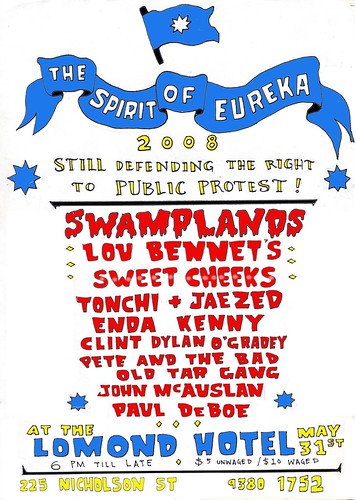
G20 : The Spirit of Eureka 2008 fundraising gig, Saturday May 31

There’s a fundraising gig on this Saturday at the Lomond Hotel (225 Nicholson Street, East Brunswick), organised by OGASN (The Ongoing G20 Arrestee Support Network), and featuring the talents of Swamplands, Lou Bennett & The Sweet Cheeks, Tonchi & Jaezed, Enda Kenny, Clint Dylan O’Gradey, Pete and the Bad Old Tar Gang, John McAuslan and Sir Paul DeBoe. $10 workers, $5 shirkers, 6pm ’til late.

“We swear by the Southern Cross to stand truly by each other and fight to defend our rights and liberties.”

Posted in Music | Leave a comment

2020 Open Letter in Support of Bill Henson

2020 Open Letter in Support of Bill Henson
theatre notes
Tuesday, May 27, 2008

I know it’s been quiet on the blog the past couple of days. However, it has not been quiet at home: I’ve been putting together an Open Letter in Support of Bill Henson from a number of the Creative Stream representatives at the Australia 2020 Summit. The letter has just gone out to media outlets, and runs as follows:

PRESS RELEASE: MAY 27, 2008

Open Letter in support of Bill Henson
From Creative Australia 2020 Summit representatives

Wednesday, May 28, 2008

As members of the Creative Stream of the Australia 2020 Summit, we wish to express our dismay at the police raid on Bill Henson’s recent Sydney exhibition, the allegations that he is a child pornographer, and the subsequent reports that he and others may be charged with obscenity.

The potential prosecution of one of our most respected artists is no way to build a Creative Australia, and does untold damage to our cultural reputation.

The public debate prompted by the Henson exhibition is welcome and important. We need to discuss the ethics of art and the issues that it raises. That is one of the things art is for: it is valuable because it gives rise to such debate and difference, because it raises difficult, sometimes unanswerable, questions about who we are, as individuals and as members of society. However, this on-going discussion, which is crucial to the healthy functioning of our democracy, cannot take place in a court of law.

We invite the Prime Minister, Mr Rudd, and the NSW Premier, Mr Iemma, to rethink their public comments about Mr Henson’s work. We understand that they were made in the context of deep community concern about the sexual exploitation of children. We understand and respect also that they have every right to their personal opinions. However, as political leaders they are influential in forming public opinion, and we believe their words should be well considered.

We also call on the Minister for Environment Heritage and the Arts, Mr Garrett, to stand up for artists against a trend of encroaching censorship which has recently resulted in the closure of this and other exhibitions.

We wish to make absolutely clear that none of us endorses, in any way, the abuse of children. Mr Henson’s work has nothing to do with child pornography and, according to the judgment of some of the most respected curators and critics in the world, it is certainly art. We ask for the following points to be fairly considered:

1. Mr Henson is a highly distinguished artist. His work is held in all major Australian collections including the Art Gallery of NSW, Art Gallery of SA, Art Gallery of WA, National Gallery of Victoria and the National Gallery of Australia.

Among international collections, his work is held in the Solomon R Guggenheim Museum, New York; the Victoria and Albert Museum, London; San Francisco Museum of Modern Art; the Los Angeles County Museum of Art; the Denver Art Museum; the Houston Museum of Fine Art; 21C Museum, Louisville; the Montreal Museum of Fine Art; Bibliothèque Nationale in Paris; the DG Bank Collection in Frankfurt and the Sammlung Volpinum and the Museum Moderner Kunst, Vienna.

Major retrospectives of Mr Henson’s work at the Art Galleries of NSW and Victoria attracted more than 115,000 people, and produced not one complaint of obscenity. His work has also been studied widely in schools for many years.

2. Mr Henson has been photographing young models for more than 15 years. Until now, there has been no suggestion by any of his subjects or their families of any abusive practices. On the contrary, his models have strongly defended his practice and the feeling of safety generated in his process, and have expressed pride in his work.

We suggest that the media sensationalism and the criminalisation of laying charges against Mr Henson, his gallery and the parents of the young people depicted in his work, would be far more traumatic for the young people concerned than anything Mr Henson has done.

3. The work itself is not pornographic, even though it includes depictions of naked human beings. It is more justly seen in a tradition of the nude in art that stretches back to the ancient Greeks, and which includes painters such as Caravaggio and Michelangelo. Many of Henson’s controversial images are not in fact sexual at all. Others depict the sexuality of young people, but in ways that are fundamentally different from how naked bodies are depicted in pornography. The intention of the art is not to titillate or to gratify perverse sexual desires, but rather to make the viewer consider the fragility, beauty, mystery and inviolabilty of the human body.

In contrast, the defining essence of pornography is that it endorses, condones or encourages abusive sexual practice. We respectfully suggest that Henson’s work, even when it is disturbing, does nothing of the sort. I would personally argue that, in its respect for the autonomy of its subjects, the work is a counter-argument to the exploitation and commodification of young people in both commercial media and in pornographic images.

Many of us have children of our own. The sexual abuse and exploitation of children fills us all with abhorrence. But it is equally damaging to deny the obvious fact that adolescents are sexual beings. This very denial contributes to abusive behaviour, because it is part of the denial of the personhood of the young. In my opinion, Mr Henson’s work shows the delicacy of the transition from childhood to adulthood, its troubledness and its beauty, in ways which do not violate the essential innocence of his subjects. It can be confronting, but that does not mean that it is pornography.

Legal opinion is that if charges were laid against Mr Henson, he would be unlikely to be found guilty. The seizure of the photographs, and the possible prosecution of Mr Henson, the Rosyln Oxley9 Gallery or the parents of Henson’s subjects, takes up valuable police and court time that would be much better spent pursuing those who actually do abuse children.

4. Perhaps the most distressing aspect of the trial-by-media to which Mr Henson and his work has been subject over the past few days, is how his art has been diminished and corrupted. The allegations that he is making child pornography have done more to promote his work to possible paedophiles than any art gallery, where the work is seen in its proper, contemplative context. It is notable that the attacks on Mr Henson’s work have, almost without exception, come from those who are unfamiliar with the photographs, or who have seen them in mutilated or reduced images on the internet.

If an example is made of Bill Henson, one of Australia’s most prominent artists, it is hard to believe that those who have sought to bring these charges will stop with him. Rather, this action will encourage a repressive climate of hysterical condemnation, backed by the threat of prosecution.

We are already seeing troubling signs in the pre-emptive self-censorship of some galleries. This is not the hallmark of an open democracy nor of a decent and civilised society. We should remember that an important index of social freedom, in earlier times or in repressive regimes elsewhere in the world, is how artists and art are treated by the state.

We urge our political leaders to follow the example of Neville Wran, when in 1982 a similar outcry greeted paintings by Juan Davila. At that time, Mr Wran said: “I do not believe that art has anything to do with the vice squad”. With Mr Wran, we believe the proper place for debate is outside the courts of law.

Alison Croggon
Writer

Signatories:

Louise Adler, CEO & Publisher-in-Chief, Melbourne University Publishing
Geoffery Atherden, Writer
Stephen Armstrong, Executive Producer, Malthouse Theatre
James Baker, Tax advisor and accountant
Geraldine Barlow, Curator
Larissa Behrendt, Professor of Law, University of Technology Sydney
Cate Blanchett, Actor
Daryl Buckley, Musician
Leticia Cacares, Theatre Director
Karen Casey, Visual Artist
Kate Champion, Choreographer, Artistic Director Force Majeure
Rachel Dixon, New media developer
Phoebe Dunn, Chief Executive Officer, Australian Commercial Galleries Association
Jo Dyer, Executive Producer, Sydney Theatre Company
Kristy Edmunds, Artistic Director, Melbourne International Festival of the Arts
Saul Eslake, Economist
Richard Gill, Artistic Director, Victorian Opera
Peter Goldsworthy, Writer
Marieke Hardy, Writer and broadcaster
Sam Haren, Artistic Director, The Border Project
Frank Howarth
Cathy Hunt, Creative consultant
Nicholas Jose, Writer
Andrew Kay, Producer
Ana Kokkinos, Film maker
Sandra Levy
Matthew Lutton, Theatre director
Nick Marchand, Artistic Director, Griffin Theatre
Sue Maslin, Producer, Film Art Doco Pty Ltd
Elizabeth Ann Macgregor, Director, Museum of Contemporary Art
Callum Morton, Visual Artist
Rosemary Myers, Artistic Director, Windmill Performing Arts
Rachel Healy, Director Performing Arts, Sydney Opera House
Liza Lim, Composer
Jan Minchin, Director, Tolarno Galleries
Helen O’Neil, Executive producer
Charles Parkinson, Artistic Director, Tasmanian Theatre Company
David Pledger, Theatre director
Marion Potts, Theatre Director
Katrina Sedgwick, Festival Director, Adelaide Film Festival

Additional signatories:

The following support the appeal contained in this letter without necessarily endorsing the detailed argument:

John Coetzee, Novelist
Ramona Koval, Writer and broadcaster
Julianne Schultz, Academic

Posted in Art, Sex & Sexuality, State / Politics | 16 Comments

Bill Henson … Again

Update (May 28) : Art or not, it’s still exploitation, Steve Biddulph, The Age | High Court’s soft spot for Henson, Leo Shanahan, The Age | Henson art is great, Sebastian Smee, The Australian

Henson images not porn, says expert, AAP/Herald Sun, May 26, 2008: Betty Churcher, a former director of the National Gallery of Australia opines. (Also Henson’s naked teen shots ‘not pornography’, ABC, May 26, 2008).

In reaction to the NSW police raid and confiscation of some of his work, a gallery in Albury has also removed a number of Bill’s other works: Another gallery removes Henson nudes, ABC, May 26, 2008. “The council’s James Jenkins says police have been asked to look at the works, which have been exhibited before without complaint.” (Also Gallery removes Henson photos / Henson hit again, Victoria McDonald and Brad Worrall, The Age, May 26, 2008.)

Whatever the good burghers of Albury might suddenly discover about the photos that have been hanging on their gallery’s walls, PM Krudd is under fire for his denunciation of Henson’s work as “revolting”. Australian PM under fire in row over art and pornography (AFP, May 26, 2008): Playwright Michael Gow, the artistic director of the Queensland Theatre Company, is quoted as opining that KRudd’s revulsion “was at odds with Rudd’s comments at a brain-storming meeting he called last month which included 100 leading members of the country’s arts community. “Among the many cliches endorsed at the 2020 Summit was the one about art… being provocative and challenging,” Gow wrote in a letter to the Sydney Morning Herald. “Now that some art has provoked, what has happened? The prime minister who invited us to Canberra has questioned the abilities and credentials of a major Australian artist.” Writing in The Sydney Morning Herald (Festival of filth and wagging tongues, May 27, 2008), Annabel Crabb reckons “POLITICIANS should keep out of art”. Which begs the question: should artists stay out of politics?

Unlike Albury, a Wollongong gallery reckons its gonna keep on keeping on with Henson (Wollongong gallery keeps Henson art, Jodie Minus, Illawarra Mercury, May 26, 2008). The question is: will they be inviting the police in to offer some expert advice?

The Age editorial (Consent is central issue in the Henson debate) of May 27 argues that “At the heart of this matter lies something more profound and of greater concern than the perhaps irresolvable question of whether Henson’s images of pubescent children are art or pornography. The crucial issue is that of consent: can a 13-year-old give mature consent to being depicted in this way?” Legally speaking, the answer is quite probably ‘no’, which is also the opinion of former judge and law professor George Hampel (Henson model could sue, Karen Kissane, The Age, May 27, 2008).

In a final example of the reaction of the corporate/state media sector to the controversy, following his comrade Andrew Bolt’s lead, Tim Blair in The Daily Telegraph (Bone of artistic contention, May 27, 2008) weighs in, taking a free kick at leftists/the art world/Catharine Lumby.

Speaking of art and cops, on previous censorship of a piece by thirty-something Trotskyist Azlan McLennan, see also : Art = Ego (January 12, 2006) | Victorian Authorities Censor ‘Entartete Kunst’… Again (January 28, 2006) | “If someone has a go at me I’ll always have a go back” (February 7, 2006) | Leunig saved from free-fall (February 15, 2006) | Burn-A-Flag-For-Lenin Week! (November 12, 2006)

Oh yeah, millionaire street artist Banksy got competition. While his uncle is busy being revolted, Young Rudd’s fiery artwork too hot for council to handle, apparently (Michelle Grattan, The Age, May 23, 2008): “MELBOURNE City Council has rejected a controversial painting by Prime Minister Kevin Rudd’s nephew that depicts the clown Ronald McDonald carrying the Olympic torch past a burning monk.” Which is not the first time the MCC has gotten more than it’s bargained for from some upstart artist: in May 2004, Azlan McLennan’s Fifty Six was given the arse, and the MCC also told him to piss off from an exhibition in September 2005.

    Above : McLennan’s work being cleansed

Finally, a fact that is both obscene and not-obscene. Since the end of the G20 summit in Melbourne on November 19, 2006 to today — and despite the protestations of thousands of young people organised by some young social entrepreneurs — UNICEF estimates that 16,650,000 children have died as a result of poverty-related causes.

Bummer eh?

Posted in Art, Sex & Sexuality, State / Politics | 8 Comments

Desperately Seeking Lenin

Having updated the small ranks of the Francis de Groot Brigade, I thought I may as well update the Trot Guide, last overhauled in August 2006. In the intervening two years, there’s been a number of exciting developments.

Plan A

First, unfortunately, I can find almost bugger-all information on the following vanguards, rendering them almost certainly Dead Parrots:

1 ) Committee for a Revolutionary Communist Party in Australia: A Maoist groupuscule associated with the Revolutionary Internationalist Movement (RIM), formed as the result of an expulsion from the Communist Party of Australia in 1984, the CRCPA was previously known as the Committee to Reconstruct the Communist Party of Australia (PDF) and may also be known as the Marxist Workers Party of Australia. RIM was established in 1983/4, in an attempt to consolidate the global forces adhering to Marxism-Leninism-Maoism. Now, I’m not absolutely sure about this, but the RIM appears to have done its job, and dissolved. Or at least, the journal associated with RIM, A World to Win, no longer provides links to any groups belonging to it. In fact, the journal itself appears to have ceased publication in 2006. AWtW does, however, maintain a blog, the most recent entry for which is dated May 20, 2008

As for the CRCPA, the most recent missive I can find is dated 1996, from the magazine Rabblerouser, No.11, June 1996, and concerns The Glorious People’s War in Peru, conducted under the auspices of the Communist Party of Peru (Partido Comunista del Perú) aka Shining Path (Sendero Luminoso) of Presidente Gonzalo, aka Manuel Rubén Abimael Guzmán Reynoso. The Glorious Leader is currently incarcerated at the Callao naval base, near the city of Lima, Peru, and has been since 1992. In 2004, a bloke called Artemio popped up claiming to be the (new) leader, and announced a new wave of activity. Note that it’s estimated that the Dirty/People’s War between the Peruvian state and armed rebels claimed the lives of approximately 70,000 people during the period 1980–2000. On a flimic note, the Peruvian war formed the basis of a novel (Nicholas Shakespeare, The Dancer Upstairs, Harvill, 1995) and John Malkovic’s directorial debut, The Dancer Upstairs (2003).

2 ) Communist Left Discussion Circle: A tiny mob adhering to the Left Communism propounded by the International Communist Current. Nothing’s been heard of them for several years (2005).

*3 ) Marxist Initiative: Um, as far as I can figure out, ‘Marxist Initiative’ — whoever or whatever it is — is actually alive, well (presumably), and taking some part in the publication of the Australian Socialist, “A Progressive Independent Marxist Journal of Ideas and Discussion”. Three cheers and a loud huzzah!

4 ) National Preparatory Committee of the Marxist-Leninist Communist Party of Australia: A sad fate for a group with such an awesome name, the National Preparatory Committee of the Marxist-Leninist Communist Party of Australia appears to be an urban myth, which is disappointing news, as I especially like the name, and will run with any excuse to repeat it. That number again: National Preparatory Committee of the Marxist-Leninist Communist Party of Australia.

5 ) New Era Communist Party of Australia: See above. Sad, but not as sad as above.

6 ) October Seventh Socialist Movement: Um… er… ah… hello?

*7 ) Socialist Appeal: Socialist Appeal is extraordinarily limited, its adherents claiming affiliation to the fabulous legacy of the International Marxist Tendency (IMT). The IMT was formerly known as the Committee for a Marxist International, which emerged as a split from Militant in the UK in 1992, renaming itself in 2006. Its chief ideologue was Ted Grant (1913–2006), who has since been replaced by Alan Woods (1944–). …Oh! Socialist Appeal also has an awesome new website: Fightback.

8 ) Socialist Democracy: Still dead.

9 ) Socialist Labor Party of Australia: See above.

10 ) Trotskyist Platform (TP): Off hunting wabbits?

11 ) Workers’ League (WL): Also likely to be found off hunting wabbits. Since 2003.

12 ) Workers’ Power (WP): WP expelled 33 members of its Fifth International in July 2006, including 5 members from Australia. Happily, the Australian section has survived, and continues to eke out an existence as ‘Revo Australia’. “Revolution is a socialist youth organisat[i]on based in Melbourne, Australia”. If correct, I think Revo must have found the Fountain of Eternal Socialist Yoof.

Plan B

While some groups may (or may not) have disappeared into the dustbin of history, others have dissolved only to re-appear in a new form:

1 ) Communist Party Advocate(s): The Advocate or Advocates have since morphed into an online journal called Labor Tribune, and constitute a tiny left-wing fraction within the Australian Labor Party (ALP).

2 ) International Socialist Organisation (ISO): The ISO has merged with the SAG and Solidarity.

3 ) Marxist Solidarity Network (MSN): The MSN has re-named itself ‘Direct Action’.

4 ) Socialist Action Group (SAG): The SAG has merged with the ISO and Solidarity.

Plan C

1 ) Communist League (CL): The CL lives! CL member Ronald Poulsen contested the seat of Watson in NSW in the 2007 Federal election, and got 424 votes, or 0.5% of the total, for his trouble.

2 ) Communist Party of Australia (CPA): The Party Formerly Known as the Political Artiste “Socialist Party of Australia”, it changed its name in October, 1996.

It has a yoof section.

3 ) Communist Party of Australia (Marxist-Leninist) (CPA-ML): Maoist party established in 1964. Dying a long, slow death in Melbourne.

4 ) Democratic Socialist Perspective (DSP): Until very recently, the DSP was likely the largest organisation on the left outside of (arguably) the ALP and the Greens. Unfortunately, earlier this month, the DSP underwent a split, with approximately 1/5 of its membership departing. (DSP statement, May 13, 2008.) The DSP’s yoof wing, Resistance, has also been going through difficult times, while its Socialist Alliance is in seemingly terminal decline…

5 ) Direct Action (DA): When a half-dozen members of the DSP left it in 2006, they formed the Marxist Solidarity Network. Then Workers & Community First. Now they appear to have settled on Direct Action. Worryingly, however, DA has made overtures to another mob to have left the DSP (the Leninist Party Faction), so who knows how long DA will last?

    Gah! Exactly two days after posting, DA announced its merger with the LPF to form the RSP. XYZ!

6 ) Freedom Socialist Party (FSP): The glorious marriage of feminism and Trotskyism.

7 ) Leninist Party Faction (LPF): NEW! The LPF consists of a few dozen former DSP members expelled earlier in the month. Its status as an independent party is a little tenuous at the moment. Most recently, DA has offered the LPF the opportunity to join them in a new vanguard.

    Hah! An offer which has been courteously accepted.

8 ) Progressive Labour Party (PLP): Prior to the emergence of SA in 2001, the PLP — formed in 1996 — was the most recent attempt to forge a left-wing workers’ party to rival the ALP. Like the CL, SA, SEP and SP, it contested the last Federal election in November 2007. The results? In the race for a seat on the NSW Senate, the PLP gained 948 votes or 0.02%.

9 ) Revo Australia (Revo): As indicated above, Revo formed a couple of years ago, and meets in a phonebox somewhere in Melbourne.

10 ) Socialist Alliance (SA): Formed in 2001 as an alliance of eight or so parties of the (far) left — the AWL, DSP, ISO, FSP, SAlt, Socialist Democracy, Worker-Communist Party of Iraq (in Australia) and Workers League — the Alliance has gradually unravelled over the last seven years. SAlt was the first go, followed by Socialist Democracy (dissolved in December 2005), WP (April 2006), ISO (January 2007) and the FSP (March 2007). The Worker-Communist Party, Workers League and Workers Liberty apparently remain part of the alliance, if an inactive one, and SA was joined by the DSP’s yoof wing Resistance in 2003 and the Chilean Popular and Indigenous Network in 2004/5. Meaning that the de facto reality for SA is that it functions as an electoral front for the DSP. Electorally, SA battles the LaRouchite Citizens Electoral Council as least popular electoral grouping.

11 ) Socialist Alternative (SAlt): next to and perhaps even exceeding the DSP, SAlt is one of if not the largest groups on the (far) left. Forming as a split from the ISO in 1995, SAlt was, unlike the ISO, savvy enough to avoid joining the SA, and in subsequent years has gained a good deal of recruits on University campuses, especially in Melbourne, effectively displacing Resistance and the ISO as a transmission belt for Trotskyism. On the other hand, it has undergone one minor split in Brisbane, when SAG was formed; SAG has now re-joined the ISO in the new party called Solidarity.

12 ) Socialist Appeal: In exciting news (to me), Socialist Appeal has a website! Called Fightback! Fightback aims “to bring you articles about the struggle for socialism both from Australia and around the world. Articles on this site will also present socialist analysis and theory which are indispensible weapons in the struggle for socialism.” Live long and prosper!

13 ) Socialist Equality Party (SEP): The SEP is the name given to the efforts of the wsws.org to get bumped into Parliament. As is the case with other groupings on the (far) left, the results have been equivocal. Or as Marx, Engels, Lenin and/or Trotsky may have put it: abysmal. For last year’s Federal election, in NSW, the SEP ran candidates in Charlton, Chifley, Grayndler, Kingsford Smith, Newcastle and Parramatta; in Victoria, Calwell and Melbourne; and in WA, Swan. The SEP also called on proletarians to vote for them in the Senate contests in NSW and Victoria. In Charlton, Terry Cook got 404 votes; in Chifley, James Cogan got 1,069 votes; in Grayndler, Patrick O’Connor did less good, gaining just 328 votes, and coming last; so did Alex Safari (1,096 votes) in Kingsford Smith, and Noel Holt in Newcastle (277 votes). Chris Gordon, on the other hand, with 261 votes, beat some bloke called Alistair into last place in Parramatta. Across the whole of this wide brown land, 4,542 people voted for the SEP to join the Senate; 12,983,272 people did not. Check yourself before you wreck yourself: SEPElectionSite07.

14 ) Socialist Party (SP): As far as I can tell, the SP is pretty much where it was mid-2006. It has the unique distinction of being the only Marxist mob in the country to have someone elected to local office; its returns in the last Federal election, however, were very poor. See also: UNITE, “Australia’s fighting union for fast food and retail workers in Victoria”.

15 ) Solidarity: Shazam! Solidarity has been completely reinvigorated in the preceding period, having merged with the ISO and SAG, and it is now the official, authorised, accept-no-substitutes embodiment of Tony Cliff/Yigael Gluckstein Thought in Australia. As such, Solidarity/the iSt is likely to once again rival the DSP and SAlt for the hearts and minds of today’s Marxist-inclined yoof.

16 ) Spartacist League of Australia (SL): The SL remains both incredibly bad-tempered! and obscure! But still brimming with revolutionary enthusiasm! for the teachings of Marx! Engels! Lenin! & Trotsky! “It is the class struggle of the multiracial proletariat, led by a Leninist-Trotskyist party, that can open the road to overthrowing this deeply racist, decrepit, capitalist system through workers revolution. Only under the rule of the working class and based on a planned collectivised economy will it be possible to address the special needs of Aboriginal people created by more than two centuries of capitalist injustice and oppression. The multiracial working class must come to the defence of their Aboriginal brothers and sisters now! Cops/military out of Aboriginal communities! For proletarian-centred defence of Aborigines against racist terror! For a workers republic of Australia, part of a socialist Asia!

Alright!

17 ) Workers’ Liberty (AWL): Who?

18 ) World Socialist Party of Australia: Write: PO Box 1266, North Richmond, Victoria, 3121.

    “Fukui-san?”
    “Yes, Ota?”
    “The Slack Bastard has, indeed, created quite possibly the most entertaining Trot Guide in blogging history!”

    Bang a gong, ideological battle is on!

    But whose ideological cuisine will reign supreme?

Posted in Trot Guide | 36 Comments

Bill Henson : Crikey! says Clive

In today’s Crikey, Clive Hamilton expands upon — actually, merely re-elaborates — his earlier essay on Bill Henson’s work, identifying three ways of viewing it: as ‘art’, as ‘pornography’ and as… well, ‘pornography’, albeit of a more nuanced variety; a product less of the artist’s intention than of the social environment, one in which children are subjected to ubiquitous forms of sexualisation (See Corporate Paedophilia: Sexualisation of children in Australia, E Rush and A La Nauze, Australia Institute, October 2006).

And again, it would seem that Hamilton is contradicting himself: on the one hand maintaining that “Despite her nakedness, the girl is not posed or presented in a sexualised way; if they are consumed in a pornographic way it is not the artist’s intention”; on the other, “In such a cultural environment, the naked body of a child, particularly a girl of 12 showing the first signs of sexual development, can no longer be viewed “innocently”, and cannot but be seen by everyone, other than hermits, in a sexual context”. So, with the possible exception of social hermits, Henson’s photography (to be precise, a handful of images until very recently on display at a gallery in Sydney), must be viewed as p-rnography. Perhaps the only saving grace for Henson, according to Hamilton, is the distinction that may be drawn between his intention — not, presumably, to produce titillating imagery of young girls — and the social context in which his work is received. But even in this instance Hamilton equivocates. Thus “Even among his fans, there seems to be a widespread feeling that his earlier images of intoxicated youths engaged in sex in dingy settings are ‘creepy’ and exploitative”. So too, presumably, his latest work.

It seems to me that, in vastly broadening the scope of artistic interpretation to the whole of society, Hamilton has effectively condemned Henson, as well as the gallery owners. Under Section 91G of the Crimes Act, the Act under which NSW police were authorised to confiscate Henson’s work, the crime of child pornography is defined, in part, as follows:

Any person who:

(a) uses a child who is under the age of 14 years for pornographic purposes, or
(b) causes or procures a child of that age to be so used, or
(c) having the care of a child of that age, consents to the child being so used or allows the child to be so used,

is guilty of an offence. For which the maximum penalty is imprisonment for 14 years. In addition:

(3) For the purposes of this section, a child is used by a person for pornographic purposes if:

(a) the child is engaged in sexual activity, or
(b) the child is placed in a sexual context, or
(c) the child is subjected to torture, cruelty or physical abuse (whether or not in a sexual context),

for the purposes of the production of pornographic material by that person.

Assuming that (a) and (c) do not apply in this case, it would appear that guilt or innocence would depend on whether or not “the child is placed in a sexual context”. If one were to accept Hamilton’s logic — the context is society, and the society is one in which children are ‘sexualised’ — this would seem, perhaps sadly, but inevitably, to be the case.

And Henson is a p-rnographer.

The Art Gallery of NSW makes Bill Henson part of its “for schools” program.

Henson represented Australia at the Venice Biennale in 1995 which broke records with 123,649 people attending the exhibition. He also received a $20,000 Australia Council fellowship that same year.

He had a major retrospective in 2005 at the Art Gallery of NSW and the National Gallery of Victoria in 2005.

According to the AGNSW, Henson’s work is held in all major Australian collections including the Art Gallery of NSW, Art Gallery of SA, Art Gallery of WA, National Gallery of Victoria and the National Gallery of Australia. Among international collections, Henson’s work is held in the Solomon R. Guggenheim Museum, New York, the San Francisco Museum of Modern Art, the Los Angeles County Museum of Art, the Denver Art Museum, the Houston Museum of Fine Art, 21C Museum, Louisville, the Montreal Museum of Fine Art, Bibliothèque Nationale in Paris, the DG Bank Collection in Frankfurt, and the Sammlung Volpinum and the Museum Moderner Kunst, Vienna.

“I find them absolutely revolting,” said Kevin Rudd, who may not know much about art…

2 . Hamilton: Art or p-rn is not the question

Clive Hamilton writes:

For decades in post-war Israel performances of works by Richard Wagner were banned. The associations between Nazi Germany and Wagner’s music were too strong in the minds of most Israelis.

The argument was not about the quality of Wagner’s music but the political meaning of it. I make this observation in the context of the furore over Bill Henson’s photographic exhibition, which includes pictures of a n-ked 13-year-old girl, to remind us that art, like sport, cannot be separated from politics.

All art engages with culture, at least good art does. Henson has been praised by critics and supporters for challenging our sensibilities and pushing the boundaries of social acceptability. So why is Henson, by all accounts a garrulous man, refusing to defend his work?

Artists and the artistic community cannot push the boundaries of social acceptance and then, when they get a reaction, step back declaring “I’m just an artist” or “Art is sacrosanct and should be above the fray”, especially when the reaction is the one they wanted, if in smaller doses.

There are at three ways of looking at Henson’s latest images. The first is to see them as artistic representations designed to elicit certain feelings and ideas concerned with themes like the vulnerability of youth, the transformation of children into adults, and the contrast between teenage angst and the pointlessness of life.

Something along these lines is Henson’s primary purpose and, it’s fair to assume, is the type of experience anticipated by most of those who would have visited the Roslyn Oxley9 Gallery to see Henson’s work.

The second way of looking at the pictures is through the eyes of pederasts and perhaps the much larger number of men who have normal s-xual lives but cannot help finding these sorts of images disturbingly er-tic.

In most of the public comment on the controversy these are the only two ways of understanding Henson’s photographs ─ they are either art or p-rnography. Within this conventional frame, they are art in my opinion. Despite her nakedness, the girl is not posed or presented in a s-xualised way; if they are consumed in a p-rnographic way it is not the artist’s intention.

Although not expert in the law, I would be very surprised if a court convicted anyone for taking or displaying these pictures. However, deciding that the photographs are not p-rnographic does not end the ethical argument. Despite the predictable positions taken by moral campaigners and civil libertarians, the situation is more complicated, which brings me to the third way of seeing Henson’s pictures.

Over the last decade or so advertisers and the wider culture have increasingly er-ticised children. They have been over-loaded with adult s-xual material and have had attributed to them forms of adult s-xual behaviour, including being dressed, posed and made up as if they were s-xually active, taught that having crushes and s-xual feelings is normal and even that engaging in various s-xual practices at their age is fine. Children as young as eight and nine are now routinely treated in this way.

This has been a recent phenomenon ─ previously it was only teenagers of around 16 or more who were presented this way ─ yet it has occurred slowly enough for most Australians to be inured to it or to accept that that is just how the world is. After all, when even respectable retailers like David Jones er-ticise 10 and 12-year-old girls in their advertisements, it is easy to dismiss any objections we may have as peculiar to ourselves.

The er-ticisation of childhood means that we have been conditioned to see children differently, as having adult s-xual characteristics, urges and desires. How else can we explain why we seem to accept mothers going shopping with 12-year-old daughters dressed like pr-stitutes? Why are we blasé about pre-teens watching video clips showing simulated intercourse? And why do we allow girls magazines widely read by pre-teens to advise that an-l s-x is a “personal choice”?”

Why have we done nothing about these and a hundred other manifestations of child s-xualisation?

In such a cultural environment, the n-ked body of a child, particularly a girl of 12 showing the first signs of s-xual development, can no longer be viewed “innocently”, and cannot but be seen by everyone, other than hermits, in a s-xual context.

If Henson did not know this then he should have, and so should the gallery owner and the girl’s parents. Putting the images on the internet was unforgivable, for in doing so they relinquished all control over how the images are seen and consumed.

It is fair to ask whether Henson was entirely innocent of the s-xual context in which his pictures would be viewed. Even among his fans, there seems to be a widespread feeling that his earlier images of intoxicated youths engaged in s-x in dingy settings are ‘creepy’ and exploitative.

Yet it is now clear that over the last two years, the Australian public has woken from its apathy and has become restive over the exploitation of children by the marketers and purveyors of popular culture. We should not be surprised that this disquiet has boiled over in response to the Henson exhibition.

I suspect that the extraordinary levels of anxiety over paedophilia in recent years have represented, at least in part, an over-compensation by society for its complicity in permitting children to be s-xualised. Now that anger is being directed at the real targets, Henson’s latest work might be collateral damage or it might be more deeply implicated.

CRIKEY: See Leo Schofield in conversation with Bill Henson here.

Crikey hyphenates words like s-x and v-gina not out of prudery, but in an attempt to lull over-zealous email spam filters into a false sense of security.

See also : Bill Henson: Art or Pornography? | mgk / suki has an opinion down after complaint by local white supremacists to MD Webhosting | Stateporn (archive : s0metim3s)

Posted in Art, Sex & Sexuality, State / Politics | 4 Comments

Utah Phillips (1935–2008)

Legendary US folk singer and radical labour activist Bruce “U. Utah” Phillips has died.

U. Utah Phillips has passed away in his sleep at 11:30PM PDT on May 23, 2008.

Utah has caught the westbound, and I am at a great loss. For myself and my wife Pam, to Joanna and to all Utah’s family and friends we express our deepest sympathy.

We have lost a truly caring man.

-Chris 05/24/08

See also:

U. Utah Phillips, 1935-2008, Derk Richardson, S.F. Music Examiner
1935-2008: Bruce ‘Utah’ Phillips: Folk artist made name singing of Utah history, Nate Carlisle and Lindsay Whitehurst, The Salt Lake Tribune
Utah Phillips Remembered, The Progressive
“Folksinger, Storyteller, Railroad Tramp Utah Phillips Dead at 73”, Bay Area Indymedia

Posted in History, Music | 3 Comments

Google weirdness

Shit. I hope I ain’t got the flu. Searching Google blogs for “Bill Henson” I get:

We’re sorry…

… but your query looks similar to automated requests from a computer virus or spyware application. To protect our users, we can’t process your request right now.

We’ll restore your access as quickly as possible, so try again soon. In the meantime, if you suspect that your computer or network has been infected, you might want to run a virus checker or spyware remover to make sure that your systems are free of viruses and other spurious software.

We apologize for the inconvenience, and hope we’ll see you again on Google.

Posted in Uncategorized | Leave a comment