Ian Tomlinson & G20 @ The Age

A brief survey of the response of a ‘liberal’ Melbourne institution to the public protests in London which accompanied the April G20 Summit.

To begin with, ‘Man died of heart attack in G20 protest’ reads the article of April 4 (produced by AFP).

The article places Ian Tomlinson’s death in the context of the “epicentre” of “violent protests” which lead to 86 arrests, repeats police claims that Ian died of a heart attack, and notes that “Scotland Yard had previously said that police medics had bottles thrown at them by protesters as they tried to save Tomlinson”.

All lies, as it happens.

On April 3, The Age (re-)published another AFP report, ‘UK police detain dozens over G20 riots’ by Prashant Rao. It describes what has become standard police practice before/during/after major anti-summit protests: raids, arrests, sometimes jailings and sometimes beatings, of individuals in ‘convergence’ spaces. (Perhaps the worst example of this took place during the G8 summit in Genoa in 2001.)* It also repeats police claims regarding the circumstances surrounding Ian’s death. Thus: “One resident died during Wednesday night’s violence after suffering a heart attack, with the authorities saying they came under attack while they tried to help him… The police said demonstrators rained a hail of missiles on officers trying to revive a dying man who collapsed at the protest site on Wednesday.”

    *The Diaz school was the place of residence for the Genoa Social Forum, which had coordinated the demonstrations. After midnight the school was raided by 150 heavily armed and disguised police officers, who proceeded to systematically assault the hundreds of sleeping youth. They were beaten for hours by clubs, with many later requiring hospital treatment. The group’s computers were destroyed, hard disks confiscated and many arrests were made. The actions of the police at the school have long since been confirmed by testimonies from a number of sources. ~ State violence at 2001 G8 summit in Genoa goes unpunished, Marianne Arens, wsws.org, July 25, 2008

On April 9, The Age (re-)published an article from The Guardian and AFP by Paul Lewis: ‘London man who died at G20 protest attacked by police, video shows‘. The production of video footage of a police assault upon Ian minutes before his death marks the beginning at which the police version of events began to unravel.

::::::::::::::::::::::::::::::::::::::::::::::::::::::::::::::::::::::::::::::::::::::::::::::::::::

The chief Europe correspondent for The Age (and the Fairfax corporation as a whole) is Paola Totaro. Paola authored a dozen or so articles prior to and during the summit — most of which concentrate upon the plans world leaders have to deal with the financial ‘crisis’ — but only returned to the subject of G20 — and Ian’s death — several weeks after the event.

Of the protest at which Ian died, Paola writes: “The great majority of the police, seemingly ever-patient and self-controlled, stood for hours as kids baited and yelled, shoved and provoked. A handful of officers used well-placed elbows while batons were raised only in response to the vandalism” (G20 protesters strike at London’s heart, Paola Totaro, April 2, 2009).

News Corporation blogger Tim Blair took note of Paola’s report, and especial, and sadistic, delight in reports that police had given protesters ‘A Bit of Stick’. In addition to police bashings, Tim also seizes upon another aspect of Paola’s reportage, which is that some protesters urinated in public:

[Paola] Unfortunately, the walls of the banks and every available corner were also used as urinals.

[Tim] Typically, these carbon-hating clean-earth types trashed the place:

[Paola] Protesters were still in the square burning effigies as night fell. The cesspool they would leave behind, however, was probably the worst damage of the protest.

[Tim] That cesspool says more than a million essays.

As previously noted, Paola’s reportage on G20 is seriously flawed, demonstrating an acceptance of police claims as fact, ignorance of police procedure (and law), and the infantilisation of protesters. It raises questions of perspective, bias, and selectivity. But it is in many ways unexceptional, and serves to illustrate the more general functioning of the mass media as a source of corporate/state propaganda. Reliance upon the pronouncements of authority, for example, is standard, and a systematic feature of the production of ‘news’:

Robert McChesney, a professor of communications at the University of Illinois at Urbana-Champaign, points out that ‘Professional journalism relies heavily on official sources. Reporters have to talk to the PM’s official spokesperson, the White House press secretary, the business association, the army general. What those people say is news. Their perspectives are automatically legitimate.’ Whereas, according to McChesney, ‘if you talk to prisoners, strikers, the homeless, or protesters, you have to paint their perspectives as unreliable, or else you’ve become an advocate and are no longer a “neutral” professional journalist.’ Such reliance on official sources gives the news an inherently conservative cast and gives those in power tremendous influence over defining what is or isn’t ‘news’. McChesney, author of Rich Media, Poor Democracy, warns: ‘This is precisely the opposite of what a functioning democracy needs, which is a ruthless accounting of the powers that be.’

As for Paola’s later reportage, on April 18 she writes ‘G20 death result of police attack: report’. On April 19, ‘Tests finger police over G20 bashing death’.

In both of these articles, Paola fails to mention that, while the existence of ‘independent’ video footage has been crucial to uncovering the truth of the circumstances surrounding Ian’s death, in February the UK Government introduced legislation which makes it a criminal offence to document police action. (She also fails to note that the first police post mortem was conducted by a pathologist with a record of (unofficial) police service: Pathologist in Ian Tomlinson G20 death case was reprimanded over conduct, Paul Lewis, The Guardian, April 11, 2009.)

Is it a crime to take pictures?
Victoria Bone
BBC News
February 16, 2009

From today, anyone taking a photograph of a police officer could be deemed to have committed a criminal offence.

That is because of a new law – Section 76 of the Counter Terrorism Act – which has come into force.

It permits the arrest of anyone found “eliciting, publishing or communicating information” relating to members of the armed forces, intelligence services and police officers, which is “likely to be useful to a person committing or preparing an act of terrorism”.

That means anyone taking a picture of one of those people could face a fine or a prison sentence of up to 10 years, if a link to terrorism is proved.

The law has angered photographers, both professional and amateur, who fear it could exacerbate the harassment they already sometimes face…

See also : Printing Police Lies, George Monbiot, Dissident Voice, April 22, 2009.

Posted in Media | 1 Comment

Books!

Books are a funny thing. I love ’em; always have. But sometimes, when I walk into a (good) library or a (good) second-hand bookshop, I have a momentary feeling, and that feeling is that I could wander forever in the Vast Realms of human knowledge contained in these millions upon millions of precious pages — and still remain a slack, dumb, bastard.

Ah well. As US philosopher Mike Brady famously put it, ‘Wherever you go, there you are’. And here I am.

And I can has…

one

Haymarket: A Novel by Martin Duberman (Seven Stories, 2003), made available to this slackbastard courtesy of PEte (and by way of Owen). A novelisation by a US labour historian of The Haymarket Affair (1886), a torrid period in US history what gave birth to the modern May Day, an occasion the significance of which persists despite over 120 years of denial and historical revisionism.

In addition to providing an account of the class war in late nineteenth century Chicago, Martin, moreover, imagines the lives of two of its key players: Albert Parsons and Lucy Gonzalez (Lucy Parsons).

The relationship of Albert and Lucy forms the centre of the novel. Even without the drama of the Haymarket affair, theirs is a remarkable story: An ex-Confederate soldier who first became a Republican, then labour agitator and anarchist, and an African-American woman who forever maintained she was of Spanish and Native American origin, a political militant in her own right who was prepared to call for class violence against the rich. So, there are plenty of political arguments in the book, along with debates on sex and, inevitably, race. The radical culture of the Chicago anarchist movement, from beer halls to workers’ militias, is also shown.

May 1, 1886 also marks the birth of the anarchist movement in Australia with the formation of the Melbourne Anarchist Club. In 1894, Red Rosa wrote:

The happy idea of using a proletarian holiday celebration as a means to attain the eight-hour day was first born in Australia. The workers there decided in 1856 to organize a day of complete stoppage together with meetings and entertainment as a demonstration in favor of the eight-hour day. The day of this celebration was to be April 21. At first, the Australian workers intended this only for the year 1856. But this first celebration had such a strong effect on the proletarian masses of Australia, enlivening them and leading to new agitation, that it was decided to repeat the celebration every year.

‘May Day’ is still ‘celebrated’ in Australia, although it might be fairer to characterise the assembly — in Melbourne, by the trades union movement and the remnants of the left, on the first Sunday following the First of May — as more closely resembling a funeral procession.

(See also : The ONLY Spies I trust!, May 9, 2006.)

two

After several years of pestering by LK, I also finally gots me a copy of Talkin’ Up to the White Woman by Aileen Moreton-Robinson (University of Queensland Press, 2000) (reviewed by Carolyn Hughes). In the period since its publication, an ‘Australian Critical Race and Whiteness Studies Association’ (an academic network) has been established, which further explores the relationship of feminism to whiteness, indigenous women, and — obviously — much more besides. Like, whiteness. (See also : Why Whiteness Studies?, b o r d e r l a n d s e-journal, Vol.3, No.2, 2004).

Both Michael Connor @ Quadrant and the meatheads on Stormfront Down Under hatesss the nasssty ACRAWSA, which is a big plus in my book. Curiously, an article in the ACRAWSA e-journal (Vol.4, No.2, 2008) by Denise Cuthbert on ‘FORBIDDEN KNOWLEDGE? THE POLITICS OF VOICE, WHITE PRIVILEGE AND THE ETHICS OF RESEARCH’ cites my blog [PDF].

three

Speaking of race and stuff, Constituent Imagination: Militant Investigations // Collective Theorization (Edited by Steppven Shukaitis + David Graeber with Erika Biddle, AK Press, 2007) gots an essay by Ashar Latif + Sandra Jeppesen what looks ‘Toward an Anti-Authoritarian Anti-Racist Pedagogy’ and n-n-n-n-nineteen other explorations of the rocky road ‘from the ivory tower to the barricades’ (and back again).

four

Speaking of anarchy, I also picked up a copy of 21st Century Dissent: Anarchism, Anti-Globalization and Environmentalism by Giorel Curran (Palgrave Macmillan, 2006). I haven’t penetrated the text much further than the back cover, but as elsewhere it raises what, to me, is the rather thorny question of the relationship between the anarchism of crazy kids like Albert and Lucy and the more recent wave of ‘post-ideological’ anarchy.

five

‘Classical anarchism’ is well and truly buried, it seems, and certainly not for the first (or the last) time by Julián Casanova in Anarchism, the Republic and Civil War in Spain: 1931–1939 (Routledge, 2004 (1997)); or: ‘classical anarchism’ rendered as an unhealthy excursion, propelled by Latin temperaments, and constituting a detour in the otherwise implacable progress of capitalist development in (a temporarily backwards) Spain. Funnily enough, the scientific socialists of the wsws.org have a crack at Professor Paul Preston (who may be blamed for the publication) as:

British Trotskyists challenge falsification of Spanish Civil War history
April 21, 2009

The Spanish Civil War “remains very much a burning issue of contemporary political significance,” an audience at the British Academy heard Professor Paul Preston of the London School of Economics say introducing an evening discussion entitled “Civil War and Foreign Intervention in Spain” on April 2.

Professor Preston was chairing a panel made up of Professor Angel Viñas of the Universidad Complutense de Madrid and Professor Helen Graham of Royal Holloway College, London. The meeting was to commemorate the end of the Spanish Civil War on March 31, 1939.

“Political debate today in Spain still rages around issues of the Spanish Civil War and particularly,” Professor Preston noted, “that has been the case over the last six or seven years.”

“The generation of what one might call the grandchildren of the Civil War have started to ask questions,” he stressed. Scarcely a village in Spain is now without a Group for the Recovery of Historical Memory who are excavating unmarked mass graves. (See video: “‘So many thousands of unknown nameless people’—Franco’s mass graves”.)

“The controversy,” he continued, “has been an important part of the political tension that surrounds elections in Spain and it’s as burning today as it was at the death of Franco.”

From the start, the discussion at the British Academy took on an explicitly political character and reflected the highly polarised character of contemporary Spanish politics.

Preston set the tone by condemning George Orwell’s Homage to Catalonia, a book which gives an account of the Spanish Civil War based on Orwell’s personal experiences in Spain and particularly of the May Days or May Events in Barcelona. Orwell wrote his book to expose the role that the Stalinists were playing in suppressing the Spanish revolution. The Stalinists and their allies tried to prevent the book’s publication at the time. Over half a century later, the discussion at the British Academy demonstrated that the question of Stalinism’s role in Spain and the events in Barcelona remain as controversial as ever…

Two things.

One, on this question, both Stuart Chrsitie’s We The Anarchists!: A Study Of The Iberian Anarchist Federation (FAI) 1927–1937 (AK Press, 2008 (2000)) and the rather lengthy section of the Anarchist FAQ on ‘Marxists and Spanish Anarchism’ are useful:

In this appendix of our FAQ we discuss and reply to various analyses of Spanish anarchism put forward by Marxists, particularly Marxist-Leninists of various shades. The history and politics of Spanish Anarchism is not well known in many circles, particularly Marxist ones, and the various misrepresentations and distortions that Marxists have spread about that history and politics are many. This appendix is an attempt to put the record straight with regards the Spanish Anarchist movement and point out the errors associated with the standard Marxist accounts of that movement, its politics and its history.

Hopefully this appendix will go some way towards making Marxists (and others) investigate the actual facts of anarchism and Spanish anarchist history rather than depending on inaccurate secondary material (usually written by their comrades).

With the crowd of commonplace chatterers, we are already past praying for: no reproach is too bitter for us, no epithet too insulting. Public speakers on social and political subjects find that abuse of anarchists is an unfailing passport to popular favour. Every conceivable crime is laid to our charge, and opinion, too indolent to learn the truth, is easily persuaded that anarchy is but another name for wickedness and chaos. Overwhelmed with opprobrium and held up to hatred, we are treated on the principle that the surest way of hanging a dog is to give it a bad name. ~ Élisée Reclus (March 15, 1830–July 4, 1905)

Woof!

six

Also: my bro gave me a copy of what is now certainly the biggest book in my library: a copy of George Orwell’s Nineteen Eighty-Four: The Facsimile of the Extant Manuscript, edited by Peter Davison (Secker & Warburg, 1984). Apparently, it’s one of only 275 copies published by the company.

Woof! Woof!

Posted in Media | 4 Comments

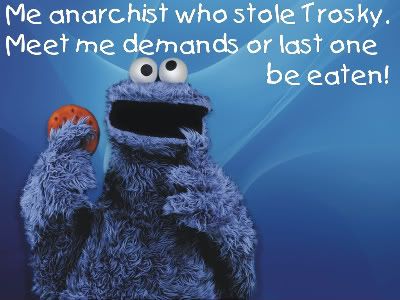
Anarchist can has Trosky cookie?

‘Struth!

Posted in !nataS | Leave a comment

Abel Paz (August 12, 1921–April 13, 2009)

The writer and historian Abel Paz (Diego Camacho Escámez) died yesterday (April 13) in Barcelona at the age of 87. Paz was born in 1921. He was fifteen when the Spanish Revolution began. After the revolution’s defeat, he spent several years in exile, returning to Spain in 1942 as a guerilla fighter against the Franco regime. He spent most of the subsequent eleven years in prison.

Fallece Abel Paz, militante e historiador libertario
CNT-AIT
April 14, 2009

El escritor e historiador Abel Paz falleció ayer en Barcelona a los 87 años. Sus restos mortales permanecerán hasta mañana en el tanatorio barcelonés de la calle Sancho de Ávila, junto al puente de Marina, donde a las 16 horas, se celebrará un acto de despedida en el que se leerán varios comunicados. Además, poetas y cantautores recordarán a un compañero que militó en el Movimiento Libertario desde niño.

Diego Camacho Escámez, su auténtico nombre, nació en Almería el 12 de agosto de 1921 y se crió entre jornaleros del campo. Desde muy joven, se aproximó al anarquismo, entrando a formar parte de la Federación Ibérica de Juventudes Libertarias (FIJL), la Confederación Nacional del Trabajo (CNT) y a la Federación Anarquista Ibérica (FAI). Durante la Revolución Española, combatió en Lérida en los grupos de defensa confederales del Clot.

En 1939, fue internado en los campos de concentración de Saint-Cyprien, Argelès-sur-Mer, Le Barcarès y Bram y fue sometido a trabajos forzados por el partido nazi. Tras escaparse, regresó a España, donde fue encarcelado dos veces. Exiliado en Francia, no volvió a España hasta 1977, cuando se estableció hasta el final de su vida en el barrio de Gràcia, en Barcelona.

Su paso por el frente en las milicias confederales y libertarias, dio a Abel Paz la sabiduría necesaria para terminar escribiendo obras imprescindibles en el Movimiento Libertario como Durruti, en la revolución española, Crónica de la Columna de Ferro o Entre la niebla, una autobiografía publicada en 1993.

Además, a lo largo de su vida participó en numerosas conferencias relacionadas con el anarquismo y la Revolución de 1936, el mundo libertario y cenetista.

La historia de Diego Camacho Escámez es ejemplo de la lucha y vida de los libertarios españoles que, con el tiempo, se van marchando. Su legado, sin embargo, vivirá siempre.

“Soy anarquista y ser anarquista es ser una persona coherente (paz espiritual, la tranquilidad, el campo, trabajar lo menos posible, el suficiente para poder vivir, disfrutar de la belleza, del sol. Disfrutar de la vida con mayúsculas, ahora se vive en minúsculas). Tener una conducta personal. Llevar las ideas a la práctica al máximo, sin esperar que haya una revolución. Eso se puede hacer ahora. Es una concepción filosófica, es un estado de espíritu, una actitud ante la vida. Pienso que esta sociedad está muy mal organizada, tanto socialmente, como políticamente, como económicamente. Hay que cambiarlo todo. El anarquismo invoca una vida completamente diferente. Trata de vivir esta utopía un poco cada día.”

~ Secretariado Permanente del Comité Nacional, CNT-AIT

See also : Barcelona in Flames — Excerpt from Abel Paz’s Durruti in the Spanish Revolution (AK Press, 2006), December 22, 2008.

Posted in Anarchism, Anti-fascism, Death, History | 9 Comments

Bound for Europe

Readers,

“ZOG”* has ordered that I attend a very important meeting at midnight in a cemetery in Prague, after which I will be going to London to table a report to The International Anarchist Conspiracy at its central headquarters. A brief stop-over in Paris (where I will be entertained by the girls of Les Folies Bergère) is also mandated, so: no blogging for a week or so I’m afraid. In the meantime, a hot new comic title has hit the stands! I reckon it’s gonna be a bestseller.

*”The word “ZOG” is commonly used by Revolutionary Nationalist Socialists today but for the uninitiated, ZOG is an acronym for Zionist Occupation Government. The term is used to describe the assortment of traitors and Zionist lackeys who control most of the White nations on this planet. A typical example is the Blair KRudd Government in the “United Kingdom” “Commonwealth of Australia” and their willing collaborators in the police, media, civil service and local councils who enforce their anti-White laws on the British Australian People. What we are seeing in our respective Aryan Nations today is a struggle for the control of White people’s minds from the highest government levels down to the lowliest civil servant.

Although the Zionist Occupation Governments appear to operate independently, they are merely puppets of the International Financiers who stealthily coordinate their agendas. These governments rule our lives with a common aim: to institute tyrannies which can suppress any criticism of their treasonous policies. Their aim is the establishment of a nationless world devoid of races and cultures populated by mindless grey automatons who pose no threat to their illegally acquired wealth and privilege.”

Posted in !nataS | Leave a comment

Leon Trotsky & The Cookie Monsters

An unlikely story…

Supposedly, some hungry anarchists (?) in Mexico recently broke into The Trotsky Museum (Museo Casa de León Trotsky) in Coyoacán on the outskirts of Mexico City. Once there, they expropriated Trotsky’s ashes, took them home, and made some cookies.

Inside the Museum (Trotsky’s former residence and the location of his murder by a Russian agent) a stone monument engraved with a hammer and sickle marks the spot where Trotsky’s ashes are interred. According to the baking brigade, what they stole was “a silver large vase that bears the inscription of his name, wrapped in the red scarf that he carried around the neck, containing the ashes of the corpse inside”.

Time magazine, Letters, Monday, October 7, 1940:

Sirs:

WHAT THE H —? TIME SEPT. 9, P. 32, SAYS TROTSKY’S ASHES WEIGHED 1.76 LB. LIFE, P. 26, SAYS THE SAME ASHES WEIGHED ABOUT 6 LB. WHAT THE H —?

RODERICK M. MONTGOMERY

Houston, Tex.

≫ Reader Montgomery doesn’t know the worst. A recheck shows Trotsky’s ashes weighed 1,200 grams (2.64 lb.). —ED.

Hmmm…

Posted in !nataS, Trot Guide | 1 Comment

Franklin Rosemont (October 2, 1943–April 12, 2009)

Franklin Rosemont RIP April 12th, 2009

Long-time activist and author Franklin Rosemont died suddenly yesterday evening in Chicago.

Franklin and his wife, Penelope Rosemont, who survives him, have been the driving force behind the Charles H. Kerr Publishing Company since the early 1970s, were co-founders of the Chicago Surrealist Group in the late 1960s, and have been active in the IWW, the Chicago chapter of Earth First!, the Chicago Labor History Society, Students for a Democratic Society, and many, many other projects. Plans for a memorial have not been finalized.

Franklin Rosemont, SmallTalk, April 14, 2009 | Labor Beat: I Never Died, Says He, Joe Hill lecture by Franklin Rosemont at Chicago’s Sulzer Library in 2003.

Posted in Death | 3 Comments

Black Flag: Bulletin of the Anarchist Black Cross

I’ve been reading over some old issues of Black Flag, the English anarchist zine.

Volume 1 Number 1 was published on July 19, 1968 as the ‘Bulletin of the Anarchist Black Cross’, and includes on the front cover the following statement — reminiscent of Australian anarchist Chummy Fleming’s remarks — by Emile Henry:

I know my head will not be the last to fall. You will add other names to the list of the men you’ve killed. You have sent us to the gallows in Chicago, to the block in Germany, you have strangled us in Jerez, sent us before the firing squad in Barcelona, guillotined us in Montbrison and Paris, but you will never be able to destroy anarchy.

Its roots are too deep; it comes out of your rotten society and destroys it, it is a violent reaction against established order. It represents the equalitarian and libertarian aspirations that are rising to crush present-day authority; it is everywhere and it cannot be suppressed. It will end by destroying you.

It also contains an editorial and essay on Makhno’s “Black Cross” by Albert Meltzer. In order to satiate the interests of the one, probably fictional, person in addition to myself who cares, here it is:

It is fifty years since Nestor Makhno organised units of the Black Cross, originally intended as field-working units similar to those of the Red Cross (as used elsewhere in Russia, described in this issue). The Black Cross units in various cities of the Ukraine were for purposes of workers’ self-defence, as well as for purely “ambulance” type activity. The use of Cossacks, the prevalence of White Guards, pogromists, as well as the growing Red Army, made it necessary for city dwellers to be able to protect themselves in the streets.

They wore no particular uniform except that, to enable themselves to be recognised at times of violence in the streets, they wore denim overalls with a recognisable armband. Their job was to organise resistance to sudden pogroms, whether the conventional Czarist pogrom, or the sudden onslaught of Red or White Guards.

Those who think of movements for self-defence purely in terms that we think of them in the West today (largely legalistic, like the Council for Civil Liberties, excellent though such a body is for its specific function) will find it surprising that a body organised solely for defence of prisoners, and for the protection of workers in their homes and factories, should have become one of the major adjuncts to the fighting forces of Makhno’s peasant army. It was, indeed, the first urban army to be formed in the Ukraine; by 1920, when the Whites were an organised body aided by foreign intervention, the city-Makhnovistas, the Black Cross, was the only force in the towns that could organise military self-defence along with the peasants. They faced three enemies, Petliura in the West, the Bolsheviks in the North, and the monarchists in the East and South. But they were able to defend the cities though they were never a mobile force like the peasant army.

Most certainly, in a revolutionary situation such as existed in Germany when the Nazis were rising to power, it is highly necessary to have a movement that is able to resist. The mere provocation of the State by protest, when one can only be crushed by the full powers at the disposal of the State, is not enough. It is necessary, when fighting dictatorship, to be able to oppose a monolithic force to it that can fight back when attacked.

The Ukrainian “Black Cross” arose out of purely defensive needs, in order to protect workers occupying their places of work, to defend demonstrations in the streets, and so on. Its form of organisation might have been that of the Red Cross (even that of the Salvation Army, as one observer sneered!) but it was able to adapt that form of organisation into a fighting force.

“And Kropotkin said that in his view, the Royal Lifeboat Institution and the International Red Cross were examples of Mutual Aid, and presumably, of Anarchism!”

So runs the gentle joke of many a don commenting on Kropotkin’s teachings. And he omits to point out that in the very same paragraph that Kropotkin says this, he grants the fact that “princes of the blood” and others have conferred their patronage on such organisations, after they have shown that they are socially acceptable, but that the actual work done by the lifeboatmen or the Red Cross volunteers is a supreme example of the principle of Mutual Aid between mankind. The lifeboatman does not count the profit; he does not argue with the sinking captain for commercial advantage (though he could, and capitalist morality would justify his doing so?).

The RED CROSS founded by Dunant has saved innumerable lives in warfare between nations. We are far from criticising it; but depending as it does on governmental tolerance, it has its limitations. It can arbitrate as regards the sick and wounded and imprisoned of, say, Germany and England; it cannot help those of Russia and Japan because the governments of those countries do not care a damn about their subjects and (at least in the Second World War) were beyond the point where they need care for public opinion. (Even the Germans would have protested had the Nazis left German POWs to their fate; but the Samurais of Nippon and the Soviet regarded them as “traitors”.)

In the same way, it was always impossible to ask the Red Cross to look after the sick and wounded and imprisoned of the Class War. In a Civil War (e.g. Spain 1936) they might do so; but not in cases where there was no declared civil war. This gap in the Red Cross became particularly noticeable in Czarist Russia. The rulers of that country had in effect declared a civil war against their own subjects. In particular they used the Cossacks to murder the Jews. The Jewish population was a hostage to the revolution. If the Russian workers protested, the Czar diverted their revolutionary aims by organising a pogrom. It was at once an example to the Russian masses, and a warning as to what would happen to those who incurred official displeasure. When the “Black Hundreds” raided the Jewish districts, the police stood by. If ever the Jews resisted (and Anarchists and Bundists at times organised Self Defence Committees that fought back) the police stepped in and fought the defenders, arresting them for violent activity.

International Jewry organised its own committees for relief of the Russian Jews; but such bodies did not extend their help to the Anarchists and Bundists who had — dreadful to relate to the bourgeois sponsors of such committees — had the temerity to fight back. So a committee was formed in America, amongst Russian Jewish workers in particular, called the WORKERS RED CROSS (which changed its title after a few months to ANARCHIST RED CROSS, since the Red Cross Workers, asked them to do so to avoid confusion).

The ANARCHIST RED CROSS, centred in Chicago, raised a large amount of aid not only for the Jewish fighters in Russia but also for the entire Russian revolutionary movement. It sent field workers to Russian prisons, aided deportees and (not being bound by any convention such as the official Red Cross) also sent in illegal propaganda. The existence of such a body meant, too, that aid could speedily be sent to victims of the class war in many countries. Perhaps one day the full story of the Anarchist Red Cross will be told. (Its work was carried on for a long time after its demise by the Free Society Group of Chicago; in particular, comrades Boris Yelensky and Celia Goldberg.)

When the Russian Revolution came, the Anarchists needed their Red Cross units more than ever. The organisation set up, in many ways a continuation of the old A.R.C., was known as the Black Cross (partly to distinguish itself from the Bolshevik “Red” and partly again to save the Geneva organisation, doing good work in general relief, from embarrassment).

The Anarchist Black Cross was overwhelmed with work. The prisoners multiplied; there was no abatement in government tyranny. Alexander Berkman, expelled from Russia to Berlin, tried to cope with the fund for Russian prisoners, when a new demand came in (for the victims of the Fascisti in Italy). The album of Kropotkin’s funeral (the last permitted non-Bolshevik demonstration in Russia, for which Anarchists were especially released from Russian jails, which we may at some time reproduce) was sold to alleviate distress amongst prisoners in Italy and Russia. With repression in Spain, the rise of the Nazis, and depression in the countries from which the money was coming, the Black Cross collapsed.

There were similar organisations from time to time (e.g. Solidaridad Internacional Antifascista, whose secretary in London was Ethel Mannin) which did good work in their time. When, however, our friend Stuart Christie was arrested in Spain, we found the lack of any organisation which could help in such a case. In particular, Amnesty did not want to know. They were prepared to take up the cases of political prisoners provided those prisoners were “innocent”, their ideal prisoner was a University professor charged with liberal thinking, who had never lifted a finger against repression in his life and had still found himself in jail.

Many comrades from many countries sent food parcels and the like to Stuart; from Germany and elsewhere, people who had never met him. (And this gave us particular satisfaction, remembering 1945, when we had organised sending food parcels to Germany, which had come from Britain, USA and even Palestine; a factor helpful in keeping many old militants alive in the post-war period.)

In prison, the Anarchists and some other political prisoners (but not the Moscow-liners, who refused to collaborate) had formed a commune in which they shared their food parcels from outside. Spanish prisons permit food and medical supplies to be sent from outside; if one relied on the prison hospital one would die neglected. But, while parsimonious, it is prepared (unlike British jails) to allow donations from outside. When Stuart returned, he knew who was in difficulties in Spain, he was indeed a “mouthpiece” of the libertarian political prisoners in Spain.

We began to send parcels, and in doing so, revived the idea of the ANARCHIST BLACK CROSS. Some start has been made to making it a permanent organisation.

It is not intended to be a charity.

It is to organise solidarity for victims of the class war.

We are sending food parcels at present but by no means wish to limit what we send (whether to Spain or elsewhere?) merely to food or medical supplies, vital as these are to those concerned. If the governments would recognise our work, we would confine it to humanitarian purposes and relief of prisoners.

As it is, we deem it part of our task to help with other facets of the struggle; in places where we can provide effective solidarity.

In some parts of the world Anarchists are able to work without undue interruption by authoritarian forces; and they can also be isolated geographically from participating in the more active struggle such as exists in Spain.

Their aid is needed. We hope to bridge the gap.

On Stuart Christie, see: ChristieBooks.com.
On Albert Meltzer (1920–1996), read his autobiography, I Couldn’t Paint Golden Angels, AK Press, 1996.
Brighton Anarchist Black Cross (links page).

(I also recently picked up a copy of 325 (#6, January 2009) . . a data network for direct action . . a media framework for social war . . the refusal of fixed territory . . an insurgent anti-prison zine of social war and anarchy . . it’s a neat-o publication which, like most other @ projects, really needs and deserves your solidarity.)

The Italian Effect (c.1980)*

Black Flag Volume VI, Number 6 (1981) contains a brief article on Italy, a letter from ‘Some comrades of Anarchismo‘: ‘Anarchy/Autonomy’. I’ve searched (a little), but I’ve read very little about the relationship between the anarchist movement in Italy and the autonomist movement which emerged there in the 1960s and 1970s, so this snippet is interesting.

Following the various blitz operations carried out by the anti-terrorist divisions of the carabinieri and the police, some of which succeeded and others fortunately failed, the situation of struggle in Italy has become more schematic in recent times.

One of the clamorous attempts that failed was the one against the comrades involved in the review Anarchismo, which began with the arrest of twenty-one comrades and finished with one sentence only (Massimo Gaspari), for possession of explosives. The others, as is known, have all been released and charges dropped due to complete lack of evidence against them. Only in the case of the comrade Alfredo Bonanno has the charge of propaganda against the State remained.

In the article published in No.3 of your paper [‘Italy: Assault on Anarchism’] there appeared to be a certain confusion concerning the Italian revolutionary movement. The reaction against the provocation initiated by the secret services and the Ministry of the Interior and police forces with the Piazza Fontana massacres and teh anarchist-hunt at the end of 1969 pushed many comrades towards an awareness of the problems of revolutionary organization.

In this period Potere Operiao (Worker Power) gave their maximum contribution to the struggles and to the elaboration of an insurrectional theory. Then, followed in this by various other formations of post ’68 origins, they dissolved into the so-called movement, taking with them the contribution of their own experience and their own militants’ actions of struggle.

It is in this period in which Collettivo metropolitano was formed in Milan, from which the first military formations of the Brigate rosse originate.

Revolutionary practice meanwhile (we are around the years 1976–1977, before the Convegno do Bologna, a meeting against repression where over 100,000 comrades were present) expanded with large mass demonstrations and bloody battles with the police.

At the Bologna meeting, where the revolutionary forces confronted each other with all their various differences, but where the last moment of a historic period of the class struggle in Italy was signed, the area of autonomy was present in two different currents:
a) the current of autonomy as a movement, represented by the theses of the comrades of Rome, supporting autonomy as the absence of whatever closed and centralized structure.
b) current of autonomy as a party, represented by the theses of the comrades of Padova and Milan, who supported the formation of an “autonomy party” of a strictly leninist character.

Both of these currents can be defined as being of marxist-leninist observance, even though breaks with the orthodox tradition have become more evident, and re-evaluation of the function of the minority organization including the clandestine one.

Still at the Bologna meeting, the different forces of the anarchist movement were also present, in a more or less bilinear component: on the one side the various expressions of educationism, pacifism, pluralism, individualism, etc.; on the other side a numerically inferior but more competitive side, who insisted on a greater penetration in the reality of the struggles, territorial roots in the interventions made by comrades, and the organization of armed and clandestine struggle, revolutionary violence and insurrection.

But both these tendencies shared suspicions towards all the more or less marxist thesis, and also agreed in the rejection of any ideological identification with the area of autonomy. For both these tendencies in the anarchist movement the theory and practice of struggle continue to be those of the libertarian tradition.

The fact that on the operational level of the struggle anarchists and autonomists may sometimes have acted together should not necessarily lead one to believe that the substantial differences that divide these two parts of the Italian revolutionary movement have been overcome. each has contributed within the limits of their own operative possibilities, remaining independent as organizational structures and, more obviously, as theoretical heritages.

We consider that this clarification is sufficient to show more clearly the relationship existing today between anarchists and the area of autonomy in Italy.

A final clarification seems necessary to us. In the article published by Black Flag on the blitz against Anarchismo reference was made to Alfredo Bonanno’s book La Gioia Armata, translating the title to The Joy of Arms. We think that this translation of the title is not only literally mistaken, but could also create a mistaken impression and distract the interest of comrades from a book which is far from being a hymn to violence but is a thoroughly examined critical inquiry into the problem of armed struggle. The correct translation which we are bringing to comrades’ notice is therefore Armed Joy.

Funnily enough, the 325 collective makes available the English translation of Bonanno’s book on its site [PDF].

*The title given to an academic conference in Sydney in September 2004:

After several decades during which the humanities in Australia and globally have been strongly influenced by French thought, in the new millennium the work of Italian thinkers is having a profound impact upon intellectual activity. The most notable signs of this “Italian effect” are the widespread interest in the work of Giorgio Agamben and the popularity of Antonio Negri and Michael Hardt’s Empire, but this is only to scratch the surface of the productivity of contemporary Italian thought across a wide variety of disciplines.

This conference aims to address the current and potential international impact of radical Italian thought, focusing not only on Negri and Agamben but also on the work of Franco Berardi (Bifo), Paolo Virno, Maurizio Lazzarato and others.

Empire (Harvard University Press, 2000) contains one reference to ‘anarchists’ (p.350):

You are just a bunch of anarchists, the new Plato on the block will finally yell at us. That is not true. We would be anarchists if we were not to speak (as did Thrasymacus and Callicles, Plato’s immortal interlocutors) from the standpoint of a materiality constituted in the networks of productive cooperation, in other words, from the perspective of a humanity that is constructed productively, that is constituted through the “common name” of freedom. No, we are not anarchists but communists who have seen how much repression and destruction of humanity have been wrought by liberal and socialist big governments. We have seen how all this is being re-created in imperial government, just when the circuits of productive cooperation have made labour power as a whole capable of constituting itself in government.

I’m still trying to understand that one.

Posted in Anarchism, History, Media | 11 Comments

Jeff Monson v Sergei Kharitonov

39-year-old pencil-necked geek (and anarchist) Jeff ‘The Snowman’ Monson ~versus~ Sergei Kharitonov:

Monson: ‘I’d Do It Again’ (January 18, 2009) | Them’s Fightin’ Words! (July 15, 2008) | Go Jeff! (November 16, 2006)

Posted in Anarchism | 2 Comments

May Day

The Anarcho-Syndicalist Federation and Melbourne Anarchist Club are putting on a May Day celebration on Friday, May 1st.

There will be an ASF picnic at the 8 Hour Monument, cnr of Lygon and Victoria St, opposite Trades Hall, at 12:00 midday.

Bring food to share.

This will be followed by a social gathering at the Melbourne Anarchist Resource Centre, 62 St Georges Rd, Northcote at 7:00pm.

MAC is also using this event to kick off a regular Friday night anarchist meet-up with drinks and discussion.

[The original ‘Melbourne Anarchist Club’ was launched on May 1, 1886.]

Posted in Anarchism | 1 Comment