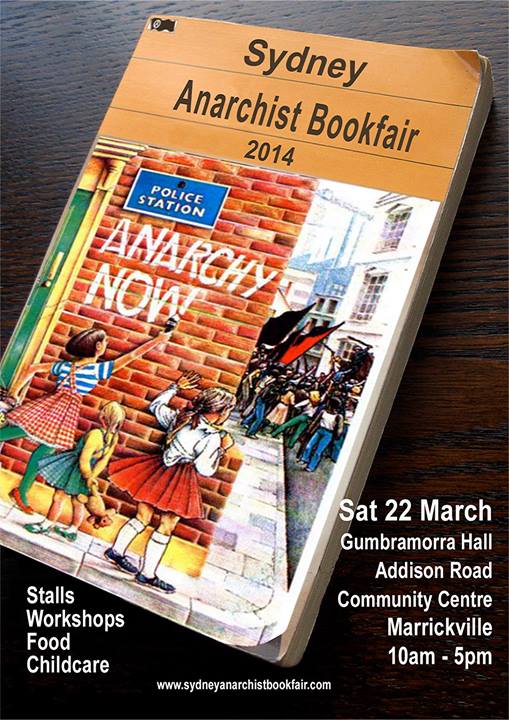
Sydney Anarchist Bookfair : Saturday, March 22, 2014

[press release]

Hundreds expected to attend first Sydney Anarchist Bookfair

For the first-time ever in Sydney, dozens of anarchist groups from across Australasia will be converging on Sydney for an ‘Anarchist Bookfair.’

The State and Capital are sure to shake in their boots at the sight of so many punks, trade unionists, feminists, queers, rabble-rousers and general ratbags all browsing books and discussing ideas.

Anarchist bookfairs started thirty years ago in the UK, and have since spread to cities all over the world. The original London Anarchist Bookfair now sees over 5,000 visitors attending and engaging with the radical ideas and texts. The bookfair was infamously described by prominent UK anarchist Ian Bone as ‘the anarchist Christmas’ – where anarchists come together, meet up with old friends – and enemies – and buy presents for themselves and others.

Bookfair spokesperson Nic Neven expects attendance at this year’s Bookfair to “reflect the fact that more and more people are beginning to search for an alternative to the chaotic political system that is capitalism.”

“There’s something for everyone at the Anarchist Bookfair,” Nic Neven concluded. “You don’t have to be an anarchist or even to know anything about anarchism to come along. All you need is a willingness to explore and share new ideas. A few hours spent at the Anarchist Bookfair will indeed be a well spent few hours of your life.”

Highlights on the meeting schedule include:

Organising against the G20 summit taking place in November in Brisbane: Let’s send these state representatives packing- Direct action workshop.

Michael Schmidt, co-author of Black Flame- Revolutionary Class Politics of Anarchism and Syndicalism:

Revolutionary anarchism gained a foothold in the daily lives of the popular classes 15 decades ago in the heart of the industrialised world – but also, crucially, in the colonial and post-colonial worlds where it offered the oppressed a practical set of tools with which they could challenge the tiny, heavily armed, parasitic elites. Anarchism provided the most devastating and comprehensive critique of capitalism, landlordism, the state, and power relations in general, whether based on gender, race, or other forms of oppression and exploitation. But it went far beyond that: African historian Michael Schmidt examines the anarchist practice of running cities in Spain during the Cantonalist Revolt of 1873-1874, their control of the city of Guangzhou in China over 1921-1923, of the two-million-strong Shinmin free zone in Manchuria of 1929-1931, the anarchist-influenced free zone in Nicaragua in 1927-1933, the better-known territorial control exercised in parts of Mexico, Ukraine, and Spain, and their involvement in the Iranian Revolution of 1978. These and other examples show that far from eschewing the exercise of power, anarchists actively decentralised power into the hands of the popular classes, a “counter-power” enlivened by working class counter-culture.

* Michael is an investigative journalist from South Africa and will be representing the Instituto do Teore e Historico Anarquismo (ITHA) of Brazil.

Bookstalls carrying an array of radical literature and books, and information stalls from a huge number of campaign groups will be set up for the day. Among the organisations hosting Bookstalls and information stalls will be AK Press, Pluto Press, Jura Books, Black Rose, environmental and workplace campaigning groups and many more

Full details of the meetings, bookstalls and information stands can be found at www.sydneyanarchistbookfair.com or on Facebook at https://www.facebook.com/sydneyanarchistbookfair

22 March – Addison Rd Community Centre, Marrickville

Posted in Anarchism | Tagged | 1 Comment

#19BOS Action: Biennale of Sydney and Transfield [5.30pm, Monday, February 24, Melbourne]

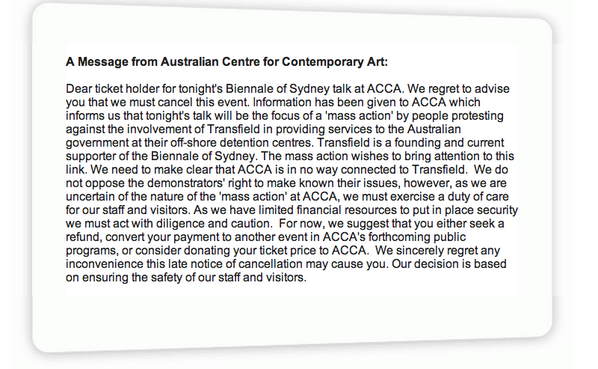
[Update (February 24) : ACCA cancelled the address by the Biennale director promoting the event citing security concerns (Melbourne arts event halted over fears of mass protest over involvement of Transfield Services, ABC). About 50 or so people rocked up anyways and had a yarn about the Biennale. My prediction? Things are gonna get worse …]

Monday in Melbourne:

Stage a creative protest outside ACCA during their talk promoting the 19th Biennale of Sydney, in order to draw attention to Transfield’s sponsorship of the event. Please share ideas regarding peaceful, creative actions that can be undertaken outside the venue.

The Australian Centre for Contemporary Art is located at 11 Sturt Street, Southbank, Melbourne.

See also : Open letter from artists to the Board of Directors of the Biennale of Sydney [#19BOS] (February 19, 2014) | Boycott the 19th Biennale of Sydney [#19bos] (February 14, 2014) | The Biennale boycott and diversity of tactics, Matt, xborderoperationalmatters, February 19, 2014.

Posted in Art, State / Politics, That's Capitalism! | Tagged , , , | 2 Comments

Against the Boycott of the 19th Biennale of Sydney [#19bos]

[… some friendly notes in response to the reply by the Board of Directors of the Biennale of Sydney to an open letter by concerned artists …]

Firstly, let us say that we truly empathise with the artists in this situation.

A positive beginning: seeking to establish common ground with artists whose work will be on display at the Biennale achieves two aims. First, it invites a sympathetic response. Secondly, it helps to negate the possibility that the interests of the Biennale (or, to be precise, its governing Board) and that of participating artists — especially those who’ve expressed particular concerns about Transfield’s sponsorship — are in fact in real conflict.

Like them, we are inadvertently caught somewhere between ideology and principle. Both parties are ‘collateral damage’ in a complex argument. Neither wants to see human suffering.

Again: an emphasis upon the existence of common predicaments and concerns, the re-framing of the link between Transfield, the Biennale and the prison camps in terms of its ‘accidental’ nature, and the relegation of the debate to the realm of complex questions of ideology and principle serves to obscure the real questions being posed to the Board by artists. (Note that the use of the term ‘collateral damage’, while appropriate, may also, perhaps “inadvertently”, bring to mind the conditions from which many of the asylum seekers are fleeing, and thus serve to remind the reader that, in these contexts, ‘collateral damage’ means something rather more significant than, say, negotiating awkward dinner party conversations on the matter of the relationship between art and politics or the political responsibilities of The Artist. But this is a minor criticism.)

Artists must make a decision according to their own understanding and beliefs. We respect their right to do so.

Although there is some risk in issuing banalities such as these — artists think, reflect, act upon, and have a right to act upon their considered beliefs — it tends to underline the overall seriousness which the Board would like artists to understand it adopts in reference to their support of a potential boycott. Additionally, for those artists who merely wish to have their concerns recognised, such statements may well be sufficient to placate their conscience.

While being mindful of these valid concerns, it is this Board’s duty to act in the interests of the Biennale and all its stakeholders – our audiences, government partners, staff, benefactors and sponsors, along with all Biennale artists and the broader arts sector.

Extending the domain of concern away from asylum seekers — whose plight is at the core of the artists’ open letter — to the responsibility the Board carries with regards the many parties with an interest in ensuring its success is a significant and worthwhile endeavour. It is especially so if one considers asylum seekers and refugees as being naturally excluded from “the broader arts sector”, a position for which there is of course ample evidence.

On the one hand, there are assertions and allegations that are open to debate. On the other, we have a long-term history of selfless philanthropy, which has been the foundation of an event that has served the arts and wider community for the past 40 years.

A very worthy gambit. Re-framing the relationship between Transfield and the Biennale in terms of “assertions and allegations”, and pitting these against Transfield’s demonstrable support for the arts (and by extension the “wider community” — from which, naturally, asylum seekers and refugees are excluded), serves to foreground the worthy qualities of the Biennale and, moreover, those of Transfield. In emphasising Transfield’s “selfless” philanthropy, the statement also: a) subtly underlines the precarious nature of this support (with all that that entails for artists, both participating and non-participating) and; b) draws attention to the sense of moral obligation artists and others can and should feel in exchange for this support.

The Biennale’s ability to effectively contribute to the cessation of bi-partisan government policy is far from black and white. The only certainty is that without our Founding Partner, the Biennale will no longer exist.

This is another key point, one which displaces political responsibility onto others (government) and thereby serves to depoliticise the Biennale: to effectively remove the political rationale for participating in a boycott. It also serves to further obscure the very real, material links between the profits Transfield generates from its investments in the prison industry, on the one hand, and that small proportion of these profits which it then ‘selflessly’ uses to fund the Biennale, on the other hand. In other words, the statement recasts the purpose of the boycott in terms of altering government policy rather than seeking to sever the link between Transfield and the Biennale. A more subtle (and therefore appropriate) recognition of this fact is given in the subsequent statement, which underscores the fact that, amidst a sea of assertions, allegations, ideologies, principles, complexities and so on, opposing Transfield’s investment in the Biennale amounts to a desire for the Biennale’s extinguishment.

Consequently, we unanimously believe that our loyalty to the Belgiorno-Nettis family – and the hundreds of thousands of people who benefit from the Biennale – must override claims over which there is ambiguity.

This is a risky manoeuvre, despite the reference to ‘ambiguity’ (see above). First, it explicitly ties the interests of the Biennale to one wealthy, if philanthropic, family. For those whose fortunes, artistic or otherwise, depend upon the good graces of the Belgiorno-Nettis family, such expressions of loyalty make good sense. But what of those many more people for whom such expressions make little or no sense? A partial remedy is obtained through invoking the notion of a widely extended family: the Biennale audience. Nevertheless, the statement risks allowing critics to dismiss the Board’s statement as proceeding from a vulgar (in the sense of common, material) stake in protecting its own interests; these being dependent, apparently, upon the issuance of an oath of fealty. (The fact that Luca Belgiorno-Nettis chairs the Board is a further complicating factor.) Secondly, if one is to invoke family ties in this context, the unfortunate because inescapable reality is that asylum seekers and refugees have friends and families too, and if a utilitarian argument is to be mounted on this basis, the interests thousands of families have in ensuring their loved ones are uncaged trumps the interest one family has in appearing to be selflessly committed to the arts.

While we unequivocally state our support and gratitude for our sponsor’s continued patronage, we also extend an invitation to the Working Group to engage with us in dialogue with the purpose of finding an acceptable accommodation.

The establishment of some kind of ‘working group’ is an excellent suggestion, one which has proven in the past to be an effective means of defusing criticism of alleged corporate wrongdoing. Ideally, artists will split over the issue of whether or not to enter into a dialogue, its scope, terms and conditions. Those reluctant to commit to an actual boycott are thereby provided with an opportunity to do something ‘constructive’ (perhaps even create a work decrying the situation of asylum seekers), a pose which can be usefully contrasted with the negativity of those (probably very few, if any) artists who may choose to withdraw from the Biennale. Support for dialogue and constructive engagement of this sort can also easily be obtained from other artists and commentators, and functions effectively to undermine any notion of solidarity among artists committed to a boycott.

The Biennale has long been a platform for artists to air their sometimes challenging but important views unfettered and we would like to explore this avenue of expression, rather than see the demise of an important community asset.

Drawing attention to the role of the Biennale in providing artists with an opportunity to engage in political and social critique is a crucial tool in the counter-propaganda campaign. It assumes further importance when the penalty for refusing to do so — that is, to engage in an actual boycott of the event — means, as the Board claims, the demise of the Biennale, a “community asset” which exists only as a result of the generosity of a wealthy and influential family to whom one owes a display of loyalty.

In summary: the Board’s statement is a worthy, if occasionally flawed piece, one which will hopefully contribute to the disruption of a boycott call, rally artists and commentators in support of the Biennale, create some small degree of confusion among artists, and provide a suitable basis for a continued counter-propaganda campaign. Thus while there has been a good deal of negative public relations generated by the boycott campaign’s focus upon Transfield’s links to the Biennale, the situation is far from unsalvageable, and the coming weeks will provide many opportunities for the Board and for Transfield to hammer home the points raised in its statement:

• the link between the Biennale and the imprisonment of asylum seekers is obscure;
• the Biennale provides an important platform for artists to express political and social concerns;
• support for a boycott will do nothing to ‘free the refugees’;
• the appropriate target for protesting mandatory detention is government;
• support for a boycott endangers the future of the Biennale.

Mobilising personal and professional contacts within the culture industry to support the Biennale is an appropriate task for both members of the Board and for its PR agent [art]iculate, “Australia’s leading consultancy specialising in visual arts & contemporary culture”. Appropriate care should be exercised when cultivating such support: the most useful critics of the boycott are those able to assume a perspective independent of any reliance on the Biennale or Transfield for direct or indirect funding or support.
Posted in Art, Media, State / Politics, That's Capitalism! | Tagged , , , , | Leave a comment

#19BOS : Biennale of Sydney responds to critics …


Above : 23yo asylum seeker Reza Berati, killed on Manus Island.

The Biennale of Sydney has issued the following statement in response to an open letter from concerned artists:

Firstly, let us say that we truly empathise with the artists in this situation.

Like them, we are inadvertently caught somewhere between ideology and principle. Both parties are ‘collateral damage’ in a complex argument. Neither wants to see human suffering.

Artists must make a decision according to their own understanding and beliefs. We respect their right to do so.

While being mindful of these valid concerns, it is this Board’s duty to act in the interests of the Biennale and all its stakeholders – our audiences, government partners, staff, benefactors and sponsors, along with all Biennale artists and the broader arts sector.

On the one hand, there are assertions and allegations that are open to debate. On the other, we have a long-term history of selfless philanthropy, which has been the foundation of an event that has served the arts and wider community for the past 40 years.

The Biennale’s ability to effectively contribute to the cessation of bi-partisan government policy is far from black and white. The only certainty is that without our Founding Partner, the Biennale will no longer exist.

Consequently, we unanimously believe that our loyalty to the Belgiorno-Nettis family – and the hundreds of thousands of people who benefit from the Biennale – must override claims over which there is ambiguity.

While we unequivocally state our support and gratitude for our sponsor’s continued patronage, we also extend an invitation to the Working Group to engage with us in dialogue with the purpose of finding an acceptable accommodation.

The Biennale has long been a platform for artists to air their sometimes challenging but important views unfettered and we would like to explore this avenue of expression, rather than see the demise of an important community asset.

After the Kapp Putsch of 1920 (an attempt by the radical right to violently overthrow the new Weimar Republic) clashes occurred between the army and workers in Dresden. A bullet went through the window of the Zwinger Gallery and damaged a Rubens painting. Incensed by the incident, Kokoschka – then art professor at the Dresden Academy – financed an appeal which appeared in local newspapers and as wallposters, urging the two sides to settle their scores well away from cultural treasures. Kokoschka’s elevation of art above political struggle outraged Grosz and Heartfield (political art activists) who replied with a furious polemic ‘Der Kunstlump’ (The Artist As Scab) ridiculing the idea that art could be considered more important than lives of workers. They welcomed the fact that bullets had penetrated galleries, palaces and a Rubens, rather than the homes of the poor.”

~ Photomontage: A Political Weapon, David Evans & Sylvia Gohl, Gordon Fraser, 1986

Posted in Art, State / Politics, That's Capitalism! | Tagged , , , , | 3 Comments

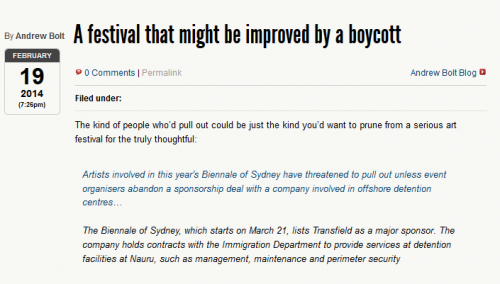
#19BOS update w BONUS! #fuckyeahandrewbolt

From the Department of #FUCKYEAHANDREWBOLT:

I’ve been hoping and praying that someone sensible would step in and sort out the mess surrounding the Sydney Biennale and no sooner had I written —

— than BINGO!

As a result, I have now become a WINNER!

Otherwise:

• Reportedly, six more artists — Sara van der Heide, Henna-Riikka Halonen, Ane Hjort Guttu, Hadley+Maxwell, Shannon Te Ao and Yael Bartana — have signed on to the Open letter from artists to the Board of Directors of the Biennale of Sydney, bringing the total number of engaged artists to 34 (over 1/3 of all artists exhibiting). The Board is meeting tonight to discuss the letter and to formulate a more formal response to the boycott than the following jerk of the knee:

• The Open Letter has also generated some virtual ink in Biennale of Sydney: artists send protest letter over detention centre links (Nicole Hasham, The Sydney Morning Herald, February 19, 2014) and Biennale artists want Transfield out (Deborah Stone, ArtsHub, February 19, 2014); four of the artists — Hester, Gray, de Vietri and Sofo — are interviewed about the boycott, the Biennale and Transfield in Crikey’s Daily Review here.

• In other news, ARTINFOAustralia ‏– the same mob that first responded to the boycott by tweeting that “The Biennale is an incredible event and a great asset to Sydney and Australia. End of story.” — has now published an article on the subject (Artists Protest Over Biennale of Sydney’s Links with Detention Centres, Nicholas Forrest, February 19, 2014), while the story has also been written about by Fairfax (The ethical minefield of arts sponsorship, Fiona Gruber, February 19, 2014) and Murdoch (Artists demand Biennale of Sydney severs ties with company linked to asylum seeker detention centres, Elizabeth Fortescue, February 19, 2014).

• An online petition has been launched while Facebook is blocking links to a discussion on boycott tactics on the xborderoperationalmatters blog.

• I’m unaware of the precise level of financial support Transfield provides for #19BOS but an article in the Financial Times (Wealth of talents, Cristina Ruiz, September 7, 2012) states that “[t]he execution and installation of [a] work, one of hundreds in five venues across the city as part of the 18th edition of the Sydney Biennale, were paid for by a private foundation set up by local philanthropists Luca Belgiorno-Nettis and his wife Anita, just two of the many wealthy individuals who have contributed to the costs of the exhibition. This private support, which accounts for 21 per cent of the Sydney Biennale’s A$10.7m ($11m) budget, has given the curators the freedom to choose artists whose work may be difficult to sell.”

• Finally, Helen Razer has composed a slightly daft piece titled Sydney Biennale: artists divide over dirty money (February 20, 2014). And while there’s probably little point in engaging with it — more productive discussions on strategy + tactics are taking place elsewhere — it may be worth making a few notes. First, rendering political positions suspect through invoking the notion of ‘purity’ is a familiar one to anarchists; secondly, abstracting the call for a boycott from its location within a broader critique of the regime of mandatory detention tends to render invisible the wider struggle from within which the campaign emerged (and for which it forms one of many parts).

See also : #19BOS Action: Biennale of Sydney and Transfield [5.30pm, Monday, February 24, Melbourne] + Collated links for 19th Biennale of Sydney Boycott.

Posted in Art, State / Politics, That's Capitalism! | Tagged , , , , , , | 2 Comments

Open letter from artists to the Board of Directors of the Biennale of Sydney [#19BOS]

19 February 2014

To the Board of Directors of the Biennale of Sydney,

We are a group of artists ­— Gabrielle de Vietri, Bianca Hester, Charlie Sofo, Nathan Gray, Deborah Kelly, Matt Hinkley, Benjamin Armstrong, Libia Castro, Ólafur Ólafsson, Sasha Huber, Sonia Leber, David Chesworth, Daniel McKewen, Angelica Mesiti, Ahmet Öğüt, Meriç Algün Ringborg, Joseph Griffiths, Sol Archer, Tamas Kaszas, Krisztina Erdei, Nathan Coley, Corin Sworn, Ross Manning, Martin Boyce, Callum Morton, Emily Roysdon, Søren Thilo Funder, Mikhail Karikis ­— all participants in the 19th Biennale of Sydney.

We are writing to you about our concerns with the Biennale’s sponsorship arrangement with Transfield.[1]

We would like to begin with an affirmation and recognition of the Biennale staff, other sponsors and donors, and our fellow artists. We maintain the utmost respect for Juliana Engberg’s artistic vision and acknowledge the support and energy that the Biennale staff have put into the creation of our projects and this exhibition. We acknowledge that this issue places the Biennale team in a difficult situation.

However, we want to emphasise that this issue has presented us with an opportunity to become aware of, and to acknowledge, responsibility for our own participation in a chain of connections that links to human suffering; in this case, that is caused by Australia’s policy of mandatory detention.

We trust that you understand the implications of Transfield’s recent move to secure new contracts to take over garrison and welfare services in Australia’s offshore immigration detention centres on Manus Island and in Nauru. We have attached for your information, a document that outlines our understanding of the links between the Biennale, Transfield and Australia’s asylum seeker policy.

We appeal to you to work alongside us to send a message to Transfield, and in turn the Australian Government and the public: that we will not accept the mandatory detention of asylum seekers, because it is ethically indefensible and in breach of human rights; and that, as a network of artists, arts workers and a leading cultural organisation, we do not want to be associated with these practices.

Our current circumstances are complex: public institutions are increasingly reliant on private finance, and less on public funding, and this can create ongoing difficulties. We are aware of these complexities and do not believe that there is one easy answer to the larger situation.

However, in this particular case, we regard our role in the Biennale, under the current sponsorship arrangements, as adding value to the Transfield brand. Participation is an active endorsement, providing cultural capital for Transfield.

In light of all this, we ask the Board: what will you do? We urge you to act in the interests of asylum seekers. As part of this we request the Biennale withdraw from the current sponsorship arrangements with Transfield and seek to develop new ones. This will set an important precedent for Australian and international arts institutions, compelling them to exercise a greater degree of ethical awareness and transparency regarding their funding sources. We are asking you, respectfully, to respond with urgency.

Our interests as artists don’t merely concern our individual moral positions. We are concerned too with the ways cultural institutions deal with urgent social responsibilities. We expect the Biennale to acknowledge the voice of its audience and the artist community that is calling on the institution to act powerfully and immediately for justice by cutting its ties with Transfield.

We believe that artists and art­workers can — and should — create an environment that empowers individuals and groups to act on conscience, opening up other pathways to develop more sustainable, and in turn sustaining, forms of cultural production.

We want to extend this discussion to a range of people and organisations, in order to bring to light the various forces shaping our current situation, and to work towards imagining other possibilities into being. In our current political circumstances we believe this to be one of the most crucial challenges that we are compelled to engage with, and we invite you into this process of engagement.

We look forward to hearing your response and given the urgency of this issue, hope that we can receive it by the end of this week.

Thank you for your consideration.

Sincerely,

Gabrielle de Vietri, Bianca Hester, Charlie Sofo, Nathan Gray, Deborah Kelly, Matt Hinkley, Benjamin Armstrong, Libia Castro, Ólafur Ólafsson, Sasha Huber, Sonia Leber, David Chesworth, Daniel McKewen, Angelica Mesiti, Ahmet Öğüt, Meriç Algün Ringborg, Joseph Griffiths, Sol Archer, Tamas Kaszas, Krisztina Erdei, Nathan Coley, Corin Sworn, Ross Manning, Martin Boyce, Callum Morton, Emily Roysdon, Søren Thilo Funder, Mikhail Karikis

NOTES 1. Please note that in this document we use the name Transfield to refer to three branches of the Transfield brand: Transfield Holdings, Services and Foundation.

Posted in Art, State / Politics, That's Capitalism! | Tagged , , , | 5 Comments

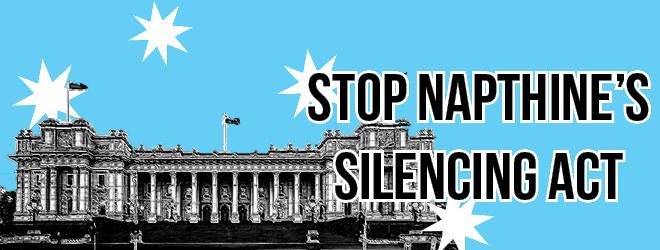
Rally and march v Napthine’s Silencing Act: 10am, Tuesday, February 18, 2014

Yeah so there’s a rally (at Trades Hall) and march (to Parliament) tomorrow to protest Premier Napthine’s new laws (Summary Offences and Sentencing Amendment Bill 2013 plus) intended to repress community and union pickets and make the public understand they’re only getting in the way and should stay at home …

Silly buggers.

See : Australian state government bolsters “move-on” police powers, Daniel Saul, wsws.org, February 17, 2014 | New police powers to deal with pickets in Victoria, Herbert Smith Freehills, December 19, 2013.

Posted in State / Politics | Tagged , , | Leave a comment

“Give me the money Jew or else I will get you” (antifa notes, feb 16, 2014)

Some brief notes.

A bloke by the name of Neil Luke Erikson “has avoided jail for abusing a Melbourne rabbi in a series of racially-motivated phone calls he tried to explain as a prank”.

Hurr hurr.

Erikson has form, counter-protesting the Wilders demonstration in Somerton in February last year

… and also attending an anti-Muslim rally outside the State Library in September, 2012.

In both cases, Erikson was working with members of Melbourne-based neo-Nazi groupuscule Nationalist Alternative.

See also : Who’s Keeping An Eye on Aussie Neo-Nazis?, New Matilda, January 22, 2014.

Posted in Anti-fascism | Tagged , , , | 3 Comments

Boycott the 19th Biennale of Sydney [#19bos]

[Update (February 19) : The boycott campaign now has a website and Facebook page.]

A few weeks ago Matt Kiem wrote ‘An art educator’s open letter to colleagues about detention profits and the Sydney Biennale’ (Crossborder Operational Matters, February 4, 2014). It outlines the case for artists and the public to boycott the event on the basis of its sponsorship by Transfield, an Australian-based corporation which profits from the asylum seeker industry.

The xborderoperationalmatters blog is an excellent resource for matters relating to the policing of Australian borders; RISE is a grassroots initiative “and the first refugee and asylum seeker welfare and advocacy organisation in Australia to be run by refugees, asylum seekers, and ex-detainees; as such, we view those who seek assistance from RISE as members and participants, not “clients”.”

Otherwise, #19BOS is a tumblr which compiles a contact list for artists appearing at the Biennale. In Sydney on Monday, February 17 at 6.30pm at Elwyn Lynn Conference Room, College of Fine Art, Oxford Street, there’ll be an “open discussion on how artists and activists can protest against Transfield’s sponsorship of the 2014 Sydney Biennale”.

The following video has been created in support of the boycott:

transfield and the sydney biennale from Beyond Borders on Vimeo.

The following articles discuss the boycott:

Sydney Biennale faces Transfield boycott threat, Ben Eltham, ArtsHub, February 7, 2014
The 19th Biennale of Sydney & their partner Transfield, Excerpt Magazine, February 7, 2014
Supporting the call to Boycott the 19th Biennale of Sydney (2014), Van Thanh Rudd, February 8, 2014
Why I Will Be Boycotting the 2014 Sydney Biennale- Protest Refugee Detention Centre Profiteering in Corporate Sponsorship, Ruth Skilbeck, February 8, 2014
Should artists boycott the Sydney Biennale over Transfield links?, Matt Kiem, The Conversation, February 12, 2014
Sydney Biennale and a question of corporate sponsorship, Antony Lowenstein, The Guardian, February 12, 2014
Beyond Borders Report – Why to boycott Transfield & the Biennale, beyond borders collective melbourne, February 13, 2014
Boycott The Sydney Biennale, Kevin Loo, literatico, February 14, 2014

Collated links for 19th Biennale of Sydney Boycott

See also : ‘The Work of Art and the Problem of Politics in Dada Berlin’, Brigid Doherty, October, No.105, Summer 2003.

After the Kapp Putsch of 1920 (an attempt by the radical right to violently overthrow the new Weimar Republic) clashes occurred between the army and workers in Dresden. A bullet went through the window of the Zwinger Gallery and damaged a Rubens painting. Incensed by the incident, Kokoschka – then art professor at the Dresden Academy – financed an appeal which appeared in local newspapers and as wallposters, urging the two sides to settle their scores well away from cultural treasures. Kokoschka’s elevation of art above political struggle outraged Grosz and Heartfield (political art activists) who replied with a furious polemic ‘Der Kunstlump’ (The Artist As Scab) ridiculing the idea that art could be considered more important than lives of workers. They welcomed the fact that bullets had penetrated galleries, palaces and a Rubens, rather than the homes of the poor.”

~ Photomontage: A Political Weapon, David Evans & Sylvia Gohl, Gordon Fraser, 1986

Posted in Art, Broken Windows, Death, Media, State / Politics, That's Capitalism! | Tagged , , , , , , | 5 Comments

A rose … [on anarchy and summit protest and stuff | overland]

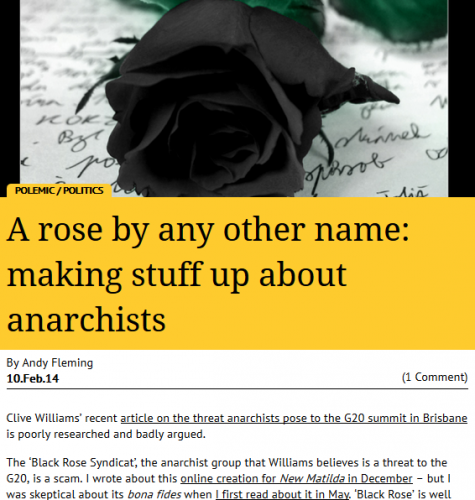
I wrote some stuff for overland zine about the phony ‘Black Rose Syndicat’, black blocs and teh anarchy. You can find it here. It was inspired by Clive Williams’ rather poor article in The Canberra Times, which you can read there.

Posted in !nataS, Anarchism, Broken Windows, History, Media, State / Politics, That's Capitalism!, War on Terror | 3 Comments