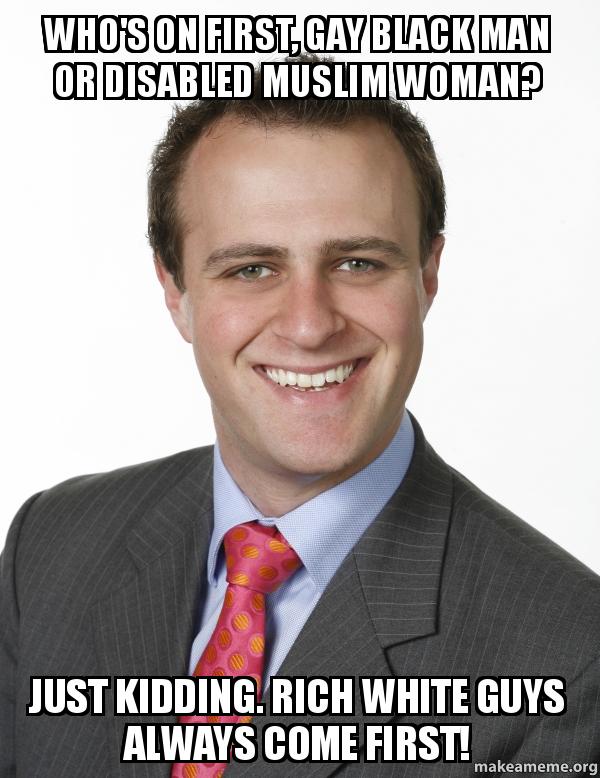
Who’s on first, gay black man or disabled Muslim woman?

Posted in !nataS, History, Media, Sex & Sexuality, State / Politics, Student movement, That's Capitalism! | Tagged , , , | Leave a comment

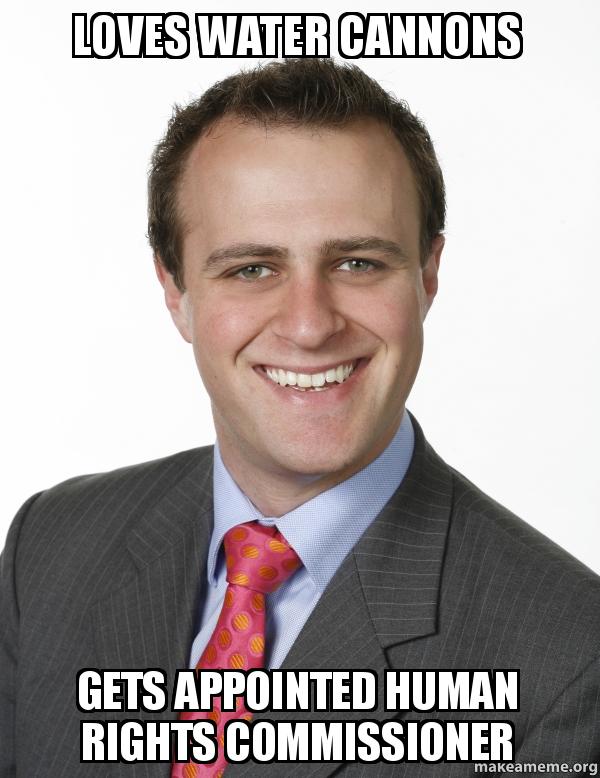
Tim Wilson, Australian Human Rights Commissioner, ♥s Water Cannons

For the $325,000-a-year record:

Otherwise:

1. I picked the wrogn side in the class war.
2. I’m available for hire at a fraction of Tim’s salary.

Posted in !nataS, Broken Windows, History, Media, State / Politics, Student movement, That's Capitalism! | Tagged , , , | Leave a comment

My First Little Boob Job

Posted in Art | Leave a comment

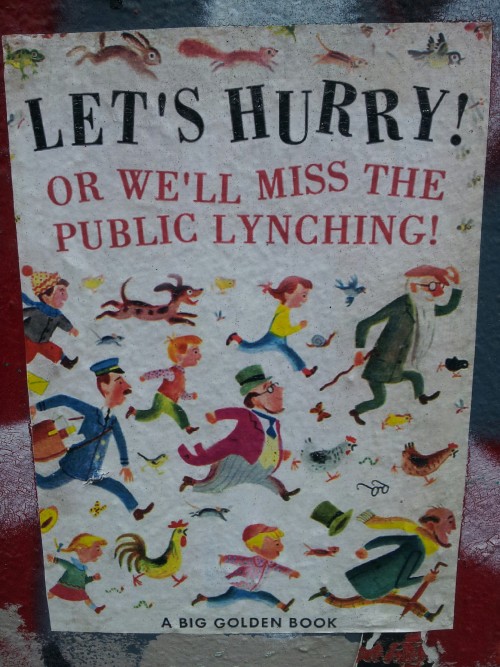
Let’s Hurry! Or We’ll Miss The Public Lynching!

Posted in Art | 1 Comment

Zippy Denies The Holocaust

Posted in Art | Leave a comment

movement beyond borders forum redux

Update (December 12, 2013) : Don’t take my word for it: you can watch a video of the forum here.

Last Saturday I attended a public forum on movement beyond borders, organised by the ‘beyond borders’ collective, a group of local ne’er-do-wells. The forum was recorded for later broadcast on 3CR but I made a few notes and thought I may as well share them, despite being hopelessly incomplete and probably of most use to me when, in n months or years time (assuming I’m still alive), I wonder WTF I was doing in December 2013.

*sigh*

In any event, there were five speakers on the panel — Lia Incognita, Dawood, Ruben Blake, Kaneez Raza and Angela Mitropoulos — and maybe 50 (?) or so in the audience. Several other speakers were invited but were unable to attend …

Lia spoke first and inter alia made a distinction between the nation as private and collective property, described HoWARd’s nationalism as adolescent, and identified one of the weaknesses of some ‘pro-refugee’ rhetoric as its failure to properly address the question of the government’s legitimacy, especially in terms of its colonial status. Lia also invoked the notion that the project of the colonial state was never complete and referred to the work of Meaghan Morris on the question of … something-or-other-which-my-notes-fail-to-disclose-and-I-can’t-remember … so like, yeah.

Dawood addressed four main issues in his presentation. First, he provided an historical account of war and the refugees it creates, paying particular attention to migration patterns in Afghanistan, Iraq and Syria and arguing that the Cold War played a critical role in determining the attitude of Western governments to those fleeing from the official enimy. He then attempted to explain the emergence of the especially punitive migratory regimes since its end, partly by reference to the rapid entrenchment of global inequalities and the popular force of right-wing politics in the West. Thirdly, Dawood contrasted the commitment within Australia to multiculturalism and the general ignorance of many Australians with regards the conditions from which refugees escape and the treatment they receive upon arrival. Finally, he made reference to the damaging psychological effects of ‘Temporary Protection Visas’.

Ruben spoke next, and provided an account of and reflection upon the Freedom Flotilla to West Papua, which ended in September; having successfully helped to place, however briefly, the issue of the Indonesian state’s control of the territory on the political map. The Flotilla was memorably described by former Foreign Affairs minister and hard-workin’ Labor man Bob Carr as perpetrating “a cruel hoax on the people of the Papuan provinces by suggesting that Papuan independence was on the international agenda”. Not also that ‘Police brutality payout helps subsidise West Papua Freedom Flotilla’ (Joel Magery, The Australian, September 17, 2013).

Kaneez provided an account of the situation of minority, mostly Shiite Muslim Hazaras in the Pakistani city of Quetta. She also outlined some of the many problems confronting those on ‘Temporary Protection Visas’, the economic and personal insecurity and psychological damage temporary protection fosters, and drew some parallels with the damaging effects similar policies have had on individuals and families in the past (including, if memory serves, the Stolen Generations).

The final speaker was Angela. Angela made reference to xborder and its development in the context of various campaigns around ‘anti-globalisation’ in the late 1990s and early 2000s, including the Woomera protests of 2002 (later the subject of a video game called Escape from Woomera) and, echoing Lia, drew attention to the concept of borders in relation to notions of citizenship and sovereignty. Finally, Angela highlighted the fact that: a) while much of the political campaigning around refugees and attendant issues has as its focus the electoral arena, the assemblage of the materials required to police the borders is also vulnerable to subversion and; b) Australia f(n)s as a kind of political and technical laboratory for Western regimes, with various of the techniques and policies developed here being exported o/s for political fun and economic profit.

A few notes, questions and comments: what’s the difference between a colonial and a non-colonial state in terms of its regulatory functions? While there’s a requirement for The Border to be constantly reimposed, is it not possible for the colonial state to succeed insofar as extinguishing the lives and cultures of ‘indigenous’ populations is concerned (cf. Foley on future of Aboriginal peoples in Australia)? How does ‘shame’ operate, which audiences does it affect, and what are the dangers of attempting to employ it on an already resentful mass?

Bonus Decolonizationalizings!

Posted in Anti-fascism, Broken Windows, Death, History, Media, State / Politics, Student movement, That's Capitalism!, War on Terror | Tagged | Leave a comment

Libertarian Anthology IV : ‘The negativity of Anarchism’ by David Thoreau Wieck

A new issue of Libertarian Anthology by a local group of anarchists known as the Grupo Cultural de Estudios Sociales de Melbourne was published this week. You can download a copy here [PDF]. I’ve republished the ‘Introduction’ below. You can find previous anthologies elsewhere on the blog: Libertarian Anthology Volume 3 : Trade Unionism, Councilism and Revolutionary Syndicalism (November 2012); Libertarian Anthology II : The Ancient Greeks and the Anarchist tradition (September 2012) [PDF]; Libertarian Anthology I : Anarchism: Aims, Principles, Historical Development and Objections (July 2012) [PDF].

Libertarian Anthology IV | Edited, Published and Produced by: Acracia Publications with the co-operation of Grupo Cultural de Estudios Sociales de Melbourne | December 2013

Introduction

An investigation into anarchism always directs the researcher towards progressive and freedom seeking events recorded through the centuries onto the pages of history, opening up new social outlooks of negating institutionalised authority and replacing it with the concepts of solidarity, mutualism and self management.

Yet, we must also recognise that at the same time, authority, be it a tradition, a custom, a law or arbitrary has since the evolvement of the human species, placed its claws upon a number of human interrelationships, an incident that undoubtedly derives from an even more pre-historic and animalistic era. Despite the consequences, history records through the ages, a continuous effort of struggles by humanity to liberate itself from the claws of authority.

The advents of those struggles were so varied, the battles so cruel and rigid that relatively few have reached an anarchist outlook. The majority of the struggles fought for partial freedoms and often tried to reconcile their new freedoms with the maintenance of ancient authorities believing they could never evolve into autocratic authoritarianism, or innocently believed authority to be useful in their endeavours to maintain and defend the new freedoms. In modern history many individuals have struggled for constitutional or democratic freedom, unfortunately this freedom has always been confined to the custody of a government. Such misunderstanding in the complexity of social evolvement has produced social statism; that is socialism imposed authoritatively and deprived of the
fundamental concept which gives it life.

Comprehending that socialism can only flourish in an environment of complete freedom, the editorial collective of Libertarian Anthology has subsequently decided to devote this fourth issue to an essay written in the 1970’s by David Thoreau Wieck, The negativity of Anarchism.

The members of this editorial collective were first exposed to this essay by Wieck in the pages of the multilingual magazine “interrogations” in 1976, produced in Paris, France. “interrogations” was an international magazine of anarchist research, publishing articles in French, English, Italian and Spanish incorporating a resumé of the essay in the alternative languages.

In September of 1977 we once again came across this essay, this time translated into Spanish by compañero Eduardo Vivancos from Canada, published in number 32 of “Ruta”, an anarchist publication produced in Venezuela by exiled Spanish anarchist compañeros.

It could be said that by republishing this essay we are positioning ourselves within a certain heterodoxy. Nothing new for us, for we have previously incurred these type of accusations. None the less, we are well aware that it is necessary to occasionally shake the social bodies of doctrine if we do not want to paralyse the continuous transition and evolvement required particularly within anarchism ensuring it does not stagnate as an ideal and that it cannot be misrepresented. Anarchism by its own definition and condition of permanent confrontation is obliged to question itself every day by testing the soundness of its structures, the foundations of its ideals, given that it progresses from within the confines of a permanently evolving egoistical and suicidal society.

For these reasons we thought it would be worthwhile to publish this philosophical examination, because to read David Wieck is to travel along a new road of the libertarian ideal.

Posted in Anarchism, Media | Tagged , , , , | Leave a comment

FORUM : movement beyond borders : Saturday, November 30, 6pm

The ‘beyond borders collective’ has organised a public forum to be held at Trades Hall next Saturday. It looks really interesting … so I’ll have to try hard to find an excuse not to attend:

It seems like every day we hear of some new tragedy at sea. We hear about Operation Sovereign Borders extending into Indonesia and Malaysia. We see slave-like conditions created by cruel visa rules. Every day people’s hopes and attempts at a future are destroyed by Australia’s shifting border practices. These are moments in an ongoing and brutal assertion of sovereignty by a regime built on stolen land and the ongoing dispossession of Indigenous peoples. A lot of us are feeling hopeless about the state of politics around the Australian border.

It is now, in this moment, that we want to organise, think, and speak together. The border is not a natural or inevitable thing. What can a cross-border, a no-border, a pro-refugee and migrant politics look like in Australia, today? Whose actions have come to count as political? Which actions, movements, and struggles are being ignored? How can we break from the language that defines the discussion now? – ‘genuine refugees’ ‘economic migrants’ ‘dodgy international students’ and ‘457 workers taking Aussie jobs’

We don’t have the answers: this forum is about discussing these questions and building solidarity and the potential for resistance.

SPEAKERS:

Lia Incognita is a Shanghainese/Melburnian writer, performer and mediamaker who co-hosts Queering the Air on 3CR Community Radio.

Kaneez Raza is a student from Pakistan. She is here on a scholarship (endeavour award) from the Australian government and is now studying Nursing. She is a Hazara by ethnicity.

Angela Mitropoulos (University of Sydney) was a founding member of xborder in 2000, and involved in producing noborder media for Woomera2002 and the Flotilla to Nauru in 2004. She has written extensively on borders and some of her most recent writings can be found in Contract and Contagion: From Biopolitics to Oikonomia (London: Minor Compositions/Autonomedia). Her current book project is titled Infrastructures of Uncommon Forms.

Dawood arrived in Australia in 2011, having lived illegally in Quetta, Pakistan, for many decades, where he was a politically active Marxist. Dawood is an Afghan Hazara who arrived in Australia by boat and was subsequently recognised as a refugee.

More to be announced…

Posted in Broken Windows, Death, History, Media, State / Politics, Student movement, Television, That's Capitalism!, War on Terror | Tagged , , | Leave a comment

November 2013 episode of Floating Anarchy // The SUWA Show w Dave K

FYI, this month’s episode of Floating Anarchy on The SUWA Show on Melbourne community radio station 3CR features an interview with Dave K, who writes:

Wow, culture shock and jetlag, huh?

Anyway, I did a prerec with Cam and Andy of the Floating Anarchy segment of the Squatters Unwaged Workers Airwaves (SUWA) show on 3CR today. We talked about Andy’s favourite topic – neonazis – and my fun experiences in Istanbul. I discuss my views (already expounded here in depth, as long time readers know) on #Occupygezi, Mayday in Turkey and anarchism in Istanbul.

The show goes to air at 5:30pm Friday 22nd of November. 3CR is 855am in Melbourne, or is broadcast here online, or turned into a podcast available after the fact here.

More information about Turkish anarchism can be found here:

DAFMeydanKolektif 26A (English)- The DAF’s An anarchist criticism to Occupy

Posted in Anarchism, Broken Windows, History, Media, State / Politics, Student movement, That's Capitalism! | Tagged | Leave a comment

antifa notes (november 19, 2013)

Aotearoa/New Zealand // Australia (and er, Sweden)

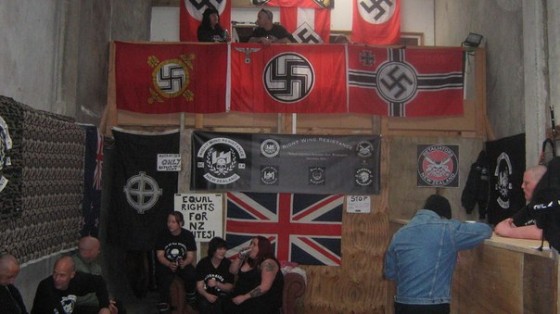
Aryan Superman Kyle Chapman has been very busy drumming up publicity for ‘Right Wing Resistance New Zealand’, his latest attempt to manufacture a political vehicle that will propel him to the commanding heights of the Kiwi state. Dear Leader’s latest stunt involves invoking the idea of boneheads on rubber dinghies warding off “Indonesian people smugglers” from landing in Hobbiton. While some — including his enimies in The Controlled Media — have scoffed at the image of the neo-Nazi Mormon as New Zealand’s version of Admiral Chris Barrie in a bargain basement Operation Sovereign Borders, if his intention was to grab a little attention then Chapman has more-or-less succeeded.
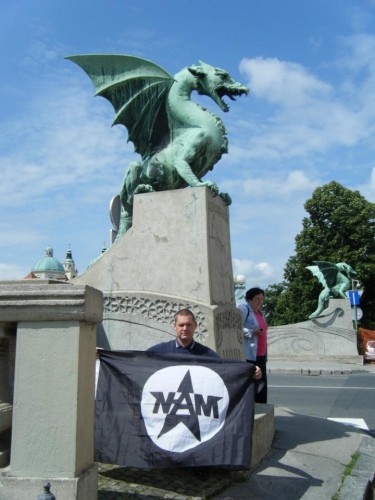
In any case, the gauntlet has now been thrown at the feet of German-Australian nazi warrior Welf Herfurth, who can surely assemble some boys to go on a boat on Sydney Harbour to stop all those New Zealanders from colonising Bondi. Note that one of Herfurth’s latest bone-headed recruits is Bradley Trappitt. You may remember Bradley from such exciting political pranks as “Welcome to Suleymaniye Mosque!”, and “Combat 18”.
Speaking of Straya, two things.

First, a Swedish ex-bonehead named Robert Orell is in town, meeting with ZOG. You can read what the former wanna-be fuehrer has to say about stuff on Reddit here. Note that this year marks the 20th anniversary of the Swedish national anti-fascist network Antifascistisk Aktion.

From November 14-22, Robert will be sharing his experiences while visiting Sydney, Melbourne and Perth as a guest of All Together Now, in partnership with the Australian Attorney-General’s Department and PAVE (People Against Violent Extremism).

PAVE is one of a number of international projects aimed at combating ‘violent extremism’, typically defined as emanating from the far right or Islamist groups. The US franchise was opened in April 2012 and the project appears to have gathered considerable support, not least from Google:

Google Backs Network of Former Terrorists
The Daily Telegraph
April 25, 2012

Google has backed a project to link up former terrorists and former violent radicals online, in an effort to combat extremism worldwide.

It is planned that more than a thousand reformed Islamic, far-right, far-left and other extremists will collaborate on counter-radicalisation via the new network, “Against Violent Extremism”. Victims of terrorism will also participate, including Jo Berry, the daughter of the Conservative MP Anthony Berry, who was killed in the IRA Brighton bombing in 1984. The hub of the network is a new website, allowing members to exchange ideas on fundraising, policy-making and research. Google is involved via its own think tank, Google Ideas, which is funding AVE for two years initially. The web giant has previously been criticised by politicians in Britain and the United States for hosting extremist propaganda on YouTube, its video sharing website, including as the sermons of Anwar al-Awlaki, a senior al-Qaeda cleric, who killed by a US drone strike last year. The criticism helped prompt a major clean-up effort last year. Google said it had removed 135 videos for “national security” reasons in response to government requests.

Robert Orell, a former far-right extremist who now runs EXIT Sweden, an organisation countering neo-Nazi ideology, said private sector involvement would be helpful. “If you are trying to counter extremism but you are too close to the Government you are too close to what many extremist groups see as the enemy,” he said. “Large corporations can be seen as the enemy too, but not to the same extent.” In Britain, charities involved in the Government’s ‘Prevent’ counter-terrorism strategy were seen as tools of state surveillance by some Muslims. Sasha Havlicek, Director of the Institute for Strategic Dialogue, the London-based think-tank that will manage the online network, pledged it would not be “another talking shop”. “For instance, a youth worker could post a request for a thousand Euros in funding to pay the rent on their office for a few months and if a donor is interested they can connect through the website. Or a community group might be looking for help in organising a social media campaign, which could be picked up by a tech company in Silicon Valley.”

Mr Orell said that organisations fighting extremism had fallen behind in the battle of ideas online. Cases such as Anders Breivik, the far-right mass killer currently on trial in Norway, have showed how those with radical views are able to network and air their views unchallenged. “We definitely need to catch up,” said Mr Orell. Extremists are very efficient at networking online.” Tim Stevens, of the Centre for Science and Security Studies at King’s College London, said Google has been under pressure from both governments and private lobbies, such as Jewish groups, over extremism online. “On the face of it, this network looks like a good idea,” he said. “But Google will need to be careful about being drawn into such a highly-politicised area.”

For more on Robert’s tour see : Anatomy of a neo-Nazi, Henry Benjamin, J-Wire, November 17, 2013 | Ex neo-Nazi joins anti-racist campaign, SBS, November 18, 2013. On Sunday Robert will be interviewed by ZOG agents John Safran and Father Bob on the (G)A(Y)BC.

Secondly … shit? What was second? I forgots. Maybe I’ll come back to it later. Leave a comment if you care (which you don’t). Final notes:

Poland : Neo-Nazi pogrom targets Warsaw squatters, WW4 Report, November 15, 2013 … Again. See : The Rebirth of Radical Nationalism: Welcome back to the ’30s, November 17, 2012.

Greece : “The Militant People’s Revolutionary Forces assumes responsibility for the political executions of … the neo-Nazis,” reads a statement posted on teh Intarwebs, supposedly from the ones what shot dead two upright citizens/members of the Greek neo-Nazi gang Golden Dawn last Thursday. This is the first time an action has been claimed on behalf of the Militant People’s Revolutionary Forces, already denounced in a joint statement by the Militant Forces for People’s Revolution and the Revolutionary People’s Militant Forces (tho’ on a slightly moar srs note, the authenticity of the Forces has been called into serious question by some).

This year was also the 40th anniversary of the Polytechnic uprising of November 17 [Athens | Thessaloniki]. The week prior antifa in London burned a Golden Dawn flag kindly donated by some of their supporters, presumably at some point “after the sense of shear fear on their faces” had been replaced by the recognition of beta things todo in their bRanes.
Posted in Anti-fascism | Tagged , | 2 Comments