[For P.]
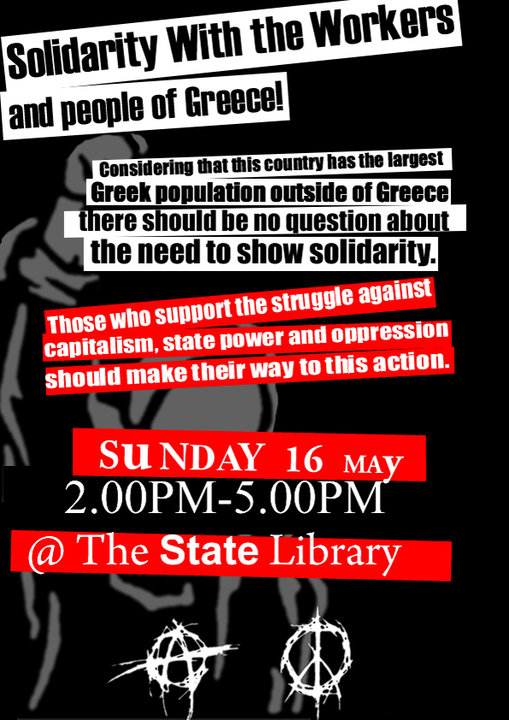
This Sunday, May 16, a rally has been organised to express solidarity with “the Workers and people of” / anti-capitalist movement in Greece. It takes place @ the State Library from 2pm. Note that Melbourne was once touted as the second (after Athens), then third (after Athens and Thessaloniki), most populous Greek city in the world. See also : Relief over Greek bailout, Stuart Rintoul, The Australian, May 11, 2010.
In critical and suffocating times
Ta Paida Tis Galarias (The Children of The Gallery) / TPTG
May 9, 2010The Ta Paida Tis Galarias (The Children of The Gallery) group report on the recent demonstrations in Athens against austerity measures, including the events leading to the tragic deaths of three bank workers and its implications for the movement of opposition.
What follows is a report on the demo of the 5th of May and the one that followed the day after and some general thoughts on the critical situation the movement in Greece is in at the time being.
Although in a period of acute fiscal terrorism escalating day after day with constant threats of an imminent state bankruptcy and “sacrifices to be made”, the proletariat’s response on the eve of the voting of the new austerity measures in Greek parliament was impressive. It was probably the biggest workers’ demonstration since the fall of the dictatorship, even bigger than the 2001 demo which had led to the withdrawal of a planned pension reform. We estimate that there were more than two hundred thousand demonstrators in the centre of Athens and about fifty thousands in the rest of the country.
There were strikes in almost all sectors of the (re)production process. A proletarian crowd similar to the one which had taken to the streets in December 2008 (also called derogatorily “hooded youth” by mainstream media propaganda) was also there equipped with axes, sledges, hammers, molotov cocktails, stones, gas masks, goggles and sticks. Although there were instances that hooded rioters were booed when they attempted or actually made violent attacks on buildings, in general they fitted well within this motley, colourful, angered river of demonstrators. The slogans ranged from those that rejected the political system as a whole, like “Let’s burn the Parliament brothel” to patriotic ones, like “IMF go away”, and to populist ones like “Thieves!” and “People demand crooks to be sent to prison”. Aggressive slogans referring to politicians in general are becoming more and more dominant nowadays.
At the GSEE-ADEDY demo (general and public sector worker unions) people started swarming the place in thousands and the GSEE president was hooted when he started speaking. When the GSEE leadership repeated their detour they had first done on the 11th of March in order to avoid the bulk of the demo and come to the front, just few followed this time…
The demo by the PAME (the Communist Party’s – CP’s – “Workers’ Front”) was also big (well over 20,000) and reached Syntagma Square first. Their plan was to stay there for a while and leave just before the main, bigger demo was about to approach. However, their members would not leave but remained there angered chanting slogans against the politicians. According to the leader of the CP there were fascist provocateurs (she actually accused the LAOS party, this mish-mash of far-right thugs and junta nostalgic scum) carrying PAME placards inciting CP members to storm the Parliament and thus discredit the party’s loyalty to the constitution!
Although this accusation bears some validity because fascists were actually seen there, the truth is –according to witnesses– that the CP leaders had some difficulty with their members in leading them quickly away from the square and preventing them from shouting angry slogans against the Parliament. It’s maybe too bold to regard it as a sign of a gradual disobedience to this monolithic party’s iron rule, but in such fluid times no one really knows…
The 70 or more fascists stationed opposite the riot police were cursing the politicians (“Sons of a bitch, politicians”), chanting the national anthem and even throwing some stones against the parliament and probably had the vain intention to prevent any escalation of the violence but were soon swallowed into huge waves of demonstrators approaching the square.
Soon, crowds of workers (electricians, postal workers, municipal workers etc.) tried to enter the building from any access available but there was none as hundreds of riot cops were strung out all along the forecourt and the entrances. Another crowd of workers of both sexes and all ages stood against the cops who were in front of the Tomb of the Unknown Soldier cursing and threatening them.
Despite the fact that the riot police made a massive counter-attack with tear gas and fire grenades and managed to disperse the crowd, there were constantly new blocks of demonstrators arriving in front of the Parliament while the first blocks which had been pushed back were reorganizing themselves in Panepistimiou St. and Syngrou Ave. They started smashing whatever they could and attacked the riot police squads who were strung out in the nearby streets.
Although most of the big buildings in the centre of the town were closed with rolling shutters, they managed to attack some banks and state buildings. There was extensive destruction of property especially in Syngrou Ave. because the cops were not enough to react immediately against that part of the rioters as the police had been ordered to give priority to the protection of the Parliament and the evacuation of Panepistimiou St. and Stadiou St., the two main avenues through which the crowd was constantly returning to it. Luxury cars, a Tax Office building and the Prefecture of Athens were set on fire and even hours later the area looked like a war-zone.
The fights lasted for almost three hours. It is impossible to record everything that happened in the streets. Just one incident: some teachers and other workers managed to encircle a few riot cops belonging to Group D –a new body of riot police on motorcycles– and thrash them while the cops were screaming “Please no, we are workers, too”!
Demonstrators pushed into Panepistimiou St. kept returning in blocs to the Parliament and there were constant clashes with the police. The crowd was mixed again and would not go. A middle-aged municipal worker with stones in his hands was telling us, moved, how much the situation there reminded him of the first years after the fall of the dictatorship when he was present at the 1980 demo in commemoration of the Polytechnic uprising when the police murdered a woman, the 20-year old worker Kanellopoulou.
Soon the terrible news from foreign news agencies came on mobile phones: Three or four people dead in a burnt down bank!