#FreeJoel [international appeal for solidarity with swedish antifa]

::: International call for solidarity! :::

We, anti-fascists of Stockholm, call upon the international left-wing movement to show solidarity and support to one of our imprisoned comrades. He is in jail for defending a local community-organized anti-racist demonstration in the Kärrtorp area of Stockholm against a brutal nazi-attack on the 15th of December. Locals of all sorts, including parents with their children, elderly and youth, gathered in their neighbourhood to show strength against a nazi organisation that had been attacking local anti-racists and spreading nazi propaganda in schools in the area. They gathered in a peaceful protest when they were attacked by the most militant nazi group in Sweden with knives, sticks and glass bottles. Anti-fascists at the scene defended the local families from the attack and were injured themselves. One of the anti-fascists got arrested by the police a few days later although the anti-fascists did nothing but defend themselves.

A week later, on the 22nd of December, the largest manifestation in modern history in Sweden against racism and nazism took place in the same area. Around 20.000 people gathered with a clear message: Nazis are not welcome in our society!

Although the left-wing people of Stockholm showed strength we need your solidarity, your solidarity actions and your letters to our imprisoned comrade!

:::

For moar infos pls see the Free Joel facebook page.

Posted in Anti-fascism, Media | Tagged , , , | Leave a comment

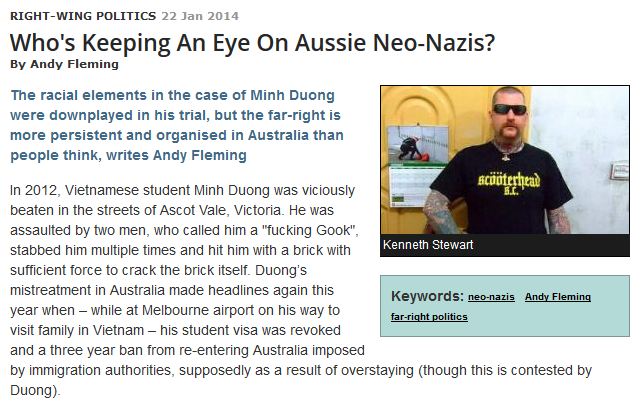
Who’s Keeping An Eye on Aussie Neo-Nazis? [newmatilda]

So I wrote another thing for New Matilda, this time on nazisinstraya.

You can read it here.

That’s all for now.

Posted in Anti-fascism, History, Media, State / Politics | Tagged , , , , , , , , , , , , , | 5 Comments

ASIO and the Communist Party: New Light on an Old Tradition (Phillip Deery, 2007)

[The second episode of the documentary Persons of Interest screens tonight (January 14, 2014) on SBS at 8.30. It’s prompted me to publish the following …]

Phillip Deery (2007), ‘ASIO and the Communist Party: New Light on an Old Tradition’, in Julie Kimber, Peter Love and Phillip Deery (eds) (2007), Labour Traditions: Proceedings of the 10th National Labour History Conference, Melbourne: Australian Society for the Study of Labour History, pp. 67-74.

Archival records concerning ASIO undercover operations are rare. Consequently the literature on ASIO’s infiltration of the Left is almost non-existent. This paper uses, for the first time, recently released ASIO files on one of its own agents. It thereby attempts to contribute to our understanding of undercover operations by the security services within the Australian labour movement. It will concentrate only on this agent’s infiltration of his first ‘target’, the Communist Party of Australia. The paper will also provide an insight into the manner in which intelligence was collected and into the largely unknown operational culture of ASIO in the early 1970s.

At one point in Melissa Reeves’ play, ‘The Spook’, performed at Melbourne’s Malthouse Theatre in 2007, the Australian Security Intelligence Organisation (ASIO) controller, Alex, commented on the work of his organisation: ‘It’s so fucking necessary it’s frightening. We could tip either way’.[1] This was in 1965 when the Communist Party of Australia (CPA) was a shrunken shadow of its former self. However, Alex’s comment to his young operative illuminates ASIO’s continuing concerns about the threat of communism to national security. It also points to its readiness to employ agents to infiltrate organisations on the Left.

The fictional ‘spook’ in this play, Martin Porter, was drawn from the actual experiences of Phil Geri, a Bendigo hospital orderly who was recruited by ASIO at the age of nineteen. He was a Catholic, a member of the Citizens Military Force and highly patriotic. ‘I didn’t know what ASIO was. I was keen on the CMF and thought it was another arm of the army’.[2] In 1963 he joined the Bendigo branch of the CPA, which was ‘very small, mainly elderly people who met in private homes and talked about the workers’ cause’. He soon became a delegate to the state conference of the CPA. This enabled him to memorise faces and match them to the hundreds of photographs taken surreptitiously by ASIO: ‘Everyone in the vicinity was photographed. Car licence plates were taken; they did the job well. But it was a hard time for me because the debriefing went on for hours, sometimes days, and I would just get sick of it’. Yet Geri’s distaste was temporary, since he remained an agent for twenty-three years. After the membership of the Bendigo branch dwindled to three, ASIO re-deployed him to infiltrate the apparently more dangerous and certainly more secretive Maoist-aligned Communist Party of Australia (Marxist-Leninist). His coup was procuring and passing on inner-party documents circulated at the CPA (M-L) national conference. But such ‘successes’ carried a personal price:

It was a very lonely time. My whole life changed. I had played a lot of sport and enjoyed the army, but now I was regarded as a radical left-winger. Bendigo people just didn’t know what had happened to me. It was extremely difficult to live with, and still is. Sometimes I thought of giving it away.

Finally, it was ASIO, not Geri himself, who terminated his services. His seventh case officer, ‘Pat’, met him in Bendigo’s Shamrock Hotel, produced a letter of thanks from ASIO’s director-general, and drove away, along with ‘a bit of my past’.

The subject of this paper, another ASIO undercover agent, underwent similar experiences. He was also young, zealous, naïve, successful — in terms of relatively high-level penetration — and was redeployed, like Geri, from the CPA to a seemingly more insidious communist organisation. However, his disillusionment was quicker: he worked for ASIO for two years not two decades. The profound strength of will it took to maintain a double life, with all its dissembling and mendacity, proved too much for this less resilient other ‘spook’. The reason he gave to his case officer for his resignation was ‘nervousness and deteriorating health arising from his role’.[3] Notwithstanding Geri coming in from the cold, the literature on ASIO’s infiltration of the Left is, apart from McKnight,[4] non-existent. Indeed, the most illuminating study emanates from New Zealand where George Fraser was recruited by the Special Branch and worked undercover within the Communist Party of New Zealand for nine years.[5] This paper, therefore, attempts to contribute to our understanding of the murky world that is a long-standing tradition: undercover operations by the security services within the Australian labour movement.

Continue reading →

Posted in !nataS, History, State / Politics, That's Capitalism!, War on Terror | Tagged , , , | Leave a comment

WikiLeaks Party : R U Syrias?

John Shipton, CEO of the WikiLeaks Party (and Assange’s old man), recently sat down for a nice cup of tea with that nice man Bashar al-Assad, President of Syria and General Secretary of the Ba’ath Party (Bashar was of course preceded as President by his old man, Hafez). Accompanied by other senior Party members and Sydney academic Tim Anderson, the trip was ostensibly a “fact-finding mission”. Not unexpectedly, it raised a number of eyebrows.

Asked in an interview with ABC radio what his discussion with Bashar consisted of, Shipton stated that he posed Bashar two questions: one, was Bashar going to declare war on Saudi Arabia? and two (sic), the status of several imprisoned Internet activists. Shipton doesn’t state what the answer to his first question was but claims that the Party has entered into negotiations with the government regarding the release of imprisoned bloggers. While they’re not named, this group would presumably include folks like Bassel Khartabil, among others.

In any event, the occasion got me thinking: what’s the position of the Australian left on Syria? For the Marxists, it’s mostly opposition to war (ie, US/NATO military intervention) accompanied by varying degrees of antipathy towards Assad. Thus SA and SAlt reckon Assad is Bad (Assad’s backers on the left are ignoring reality, Michael Karadjis, May 5, 2013; Syria: support the revolution, oppose US bombing, Vashti Kenway, September 8, 2013/Stop the US-led war on Syria!, August 28, 2013), while the CPA/CPA(ML) is neutral (People of the world demand HANDS OFF SYRIA!, September 4, 2013/Hands off Syria!, January 27, 2013), the Spartacists (ICLFI) hold the line in Imperialists’ Hands Off Syria! (Australasian Spartacist, No.221, Spring 2013), while the most detailed statement by the Northites (ICFI) is that by David North/(Green): US imperialism and the proxy war in Syria (September 9, 2013).

Curiously, North refers to the SSNP, noting that “On April 22, 1955, [senior Syrian military figure] Malki was assassinated while attending a soccer match by a member of the pro-US and right-wing Syrian Social National Party. An official investigation into the assassination found that the US was a major supporter and financier of the SSNP. It was well known that the SSNP had close ties with the CIA.” Committed to the (re-)construction of a Great(er) Syria, I last read reference to the SSNP via its participation in the Sydney Forum, the Australia First Party’s annual conference. And AF, of course, gained some inadvertent publicity when, somehow or other, it managed to sneak ahead of various other worthies on the WLP preference list in NSW …

Funny Olde Worlde.

See also : Razan Ghazzawi.

Posted in !nataS, Media, State / Politics, That's Capitalism!, Trot Guide, War on Terror | Tagged , , | 9 Comments

Anarchist Memes v Facebook

Briefly:

The Facebook page ‘Anarchist Memes’ has been unpublished by Facebook. Ben Norton has written an article in response, published at Counterpunch and Dissident Voice. The reasons why Facebook chose to close the page are a bit obscure: precisely how it transgressed the site’s guidelines is unknown. Ben writes that recent acts of censorship included:

a picture of a Klansman who had accidentally set himself, instead of a large wooden cross, on fire, accompanied by the words “IRONY, it strikes at the best of times” … a picture featuring a portrait of famous Ukrainian anarchist communist Nestor Mahkno with the text “You may be anti-racist… but are you shoot anti-Semites on sight anti-racist?” … a picture simply reading “Some women have penises. Get over it!” … [and finally] an Eat That Toast! cartoon depicting how strange stalkers who consider themselves “nice guys” really look to others.

Controversial images and ideas, perhaps, but hardly ones which would seem to violate either laws or ‘community standards’.

Anyway, while I have some disagreement with Ben’s analysis of anarchism, his article is worthwhile reading and, as he notes, Facebook’s policies regarding the limits of legitimate public expression are important to keep track of and respond to.

Posted in Anarchism, Media | Tagged , | Leave a comment

ASIO : Persons of Interest : Interview with director Haydn Keenan

PERSONS OF INTEREST – Trailer from Smart Street Films on Vimeo.

Tonight on ‘The SUWA Show’ (5.30pm, 855AM, streaming at 3CR.org.au), Dr Cam & I have a chat with Haydn Keenan, the director of ‘Persons of Interest’, a new documentary about ASIO currently screening on SBS on Tuesdays at 8.30pm. (Episode 1 broadcast on January 7; episodes 2, 3 and 4 will be broadcast on January 14, 21 and 28.) It’s a really interesting attempt to document the development of the agency as told through the experiences of four ‘persons of interest’: Roger Milliss, Albert Langer Michael Hyde, Gary Foley and Frank Hardy.

As Haydn notes, ASIO has undergone a massive expansion in its size and ambitions since the period under examination (ASIO’s founding in 1949 through to the late 1960s and early 1970s). Also remarkable is an expansion in the size and number of private companies engaged in the monitoring of individuals and/or infiltration of groups with ‘subversive’ political agendas. In January 2012, Philip Dorling reported that the federal government had outsourced some of the former tasks to the National Open Source Intelligence Centre (Australia). In October 2008, Richard Baker and Nick McKenzie wrote that “The owners of Australia’s biggest uranium mines paid a former undercover Victoria Police officer to infiltrate environment and Aboriginal groups in Melbourne” (see also : Revealed: spying on Anarchists, October 3, 2006). In Aotearoa/New Zealand, Rob Gilchrist performed a similar role. Such activities are undoubtedly continuing and as the climate heats so too will political conflict and repression (see also : Anarchy ~versus~ State Terror, November 30, 2012). The legal landscape in Australia has also changed in significant ways, both in the aftermath of 9/11 and in the willingness of state governments to implement laws attacking basic civil rights.

I blame everything on refugees.

Of related interest : Democracy in the Age of Google, Facebook and WikiLeaks (John Keane).

Posted in Film, History, Media, State / Politics, That's Capitalism!, War on Terror | Tagged , , , | 1 Comment

Black Rose Syndicat (Addendum)

A couple of weeks ago I wrote a thing for New Matilda about a storm in a teacup surrounding the Brisbane G20 summit, in this case one stamped ‘Black Rose Syndicat’. Apart from being somewhat bizarre (and therefore amusing), the story was noteworthy for illustrating the ways in which the mainstream media adopts such tales and adapts them to suit broader purposes:– such as the repression of political dissent. Hence ‘How The Press Sets Up A Protest Crackdown’. The story’s most likely exhausted itself but due to unpopular demand I thought I’d add a few more notes about the Syndicat’s online evolution.

To begin with, as previously noted, I first became aware of the Syndicat back in May when it launched. It appeared then to function as an advertisement for an online retailer. Since then, some names have been changed in order to protect the innocent. Thus the Syndicat’s eBay account has the following history:


In other words, the Syndicat has its origins in an eBay retailer originally known as redragrockshop (established in September 2012) which became blackroserockshop and then vanadiumrockshop in December 2013. So far, so good: an online merchant seeks publicity and attains it. More recently, on Facebook the Syndicat has once again changed its name, from ‘Syndicat a la Rose Noire’ to ‘Social Libertarian Party of Australia’. Presumably, the shell game will continue, and it would be pointless to pursue it any further.

I suppose I could go on, but for now I recommend listening to and pondering upon the views of “bindigoat” (including on stormfront and inre ‘national anarchism’) and the avant-garde “Australien Universal Space Industries”.

Cyberspace: the final frontier …

Posted in !nataS, Anarchism, Media, State / Politics, Student movement, That's Capitalism! | Tagged , , , , | 1 Comment

ASIO is really interesting to this person too …

Persons of Interest is a three-part documentary on ASIO which commences screening on SBS on Tuesday, January 7 at 8.30pm. I haven’t seen it yet but Dr Cam and I interviewed filmmaker Haydn Keenan (and academic Victoria Stead about PNG and refugees) back in July for the SUWA Show — you can listen to that interview here (13:30). As Haydn points out, it’s less a history of ASIO than an account of its activities as told through the personal histories of four ‘persons of interest’: Gary Foley, Frank Hardy, Albert Langer (Arthur Dent) Michael Hyde and Roger Milliss. (Of related interest: East Timor institutes proceedings against Australia in relation to documents seized from office of Australian lawyer, December 24, 2103, re ASIO raid of December 3 on the office of Canberra lawyer Bernard Collaery.)

See also : ASIO’s all-seeing eye, Rick Feneley, The Age, January 3, 2014 | Film buff David Stratton’s starring role on ASIO spy cam, The Age, January 4, 2013 | Persons of interest caught in ASIO’s net, The Australian, January 4, 2013.

Otherwise : Your rights with ASIO – advice for activists (Dale Mills) (May 16, 2013) | ASIO &/Or Anarchy (November 14, 2012) | Nicola Roxon, ASIO, and a growing number of links across some sort of groups who are anarchist, others who meld into some religious, sometimes… (April 17, 2012) | ASIO, fascism and anti-fascism (cont.) (on October 18, 2011) | ASIO, fascism and anti-fascism (October 12, 2011) | ASIO ~versus~ WikiLeaks : The WikiLeaks Amendment (July 7, 2011) | Three cheers and a loud huzzah for The WikiLeaks Amendment! (July 5, 2011) …

For a broader historical view, see Jenny Hocking, Beyond Terrorism (Allen & Unwin, 1993) and Frank Cain, The Origins of Political Surveillance in Australia (Angus & Robertson, 1993).

Chorus:
ASIO ASIO ASIO
They’ll never know
ASIO ASIO ASIO
They’ll never know

The WMDs aren’t in Bahgdad
They’re still under my bed
ASIO they’ll never know
Andrew Bolt runs a sleeper cell
And Costello used to be a woman
Claimed it all on Medicare
Johnny Howard is running JI
And I helped write The Flood Report that said

Chorus

Why our intelligence agency would get it wrong
On such enormous scale
Legitimise a war for oil
And keep the ones they want in jail
But don’t try to fight it
No right to remain silent
Don’t speak your mind
Cause you’re not alone
They’ve bugged your house
And tapped your phone

Chorus

How to silence thought
Keep opinions near
Fake security
Controlled by the fear of being jailed for shit
Then being told to deal with it
No rights, no calls, no lawyers
Can’t you see that things have changed?
Is this what it means to be free?

Chorus

Posted in Film, History, State / Politics, That's Capitalism! | Tagged , | 1 Comment

housekeeping for anarchy

Well well, bloody Hell.

Because I’m an idi0t, I thought I’d spend some time doing some housekeeping: namely, going through the sites I link to in order to establish which are still active. Unsurprisingly, because I haven’t done so for several years, a number of sites have disappeared or become inactive (by which I mean, in this context, not having been updated for over a year). I’ll remove the dead links from the sidebar eventually, but in the meantime here’s a list of defunct/inactive anarchist(y) sites along, where relevant, with updated links:

@ Sauce

Anarchist Yellow Pages
Anarcho-Syndicalism 101 : Class Struggle Online
AnarchoTV
Anarchy in the Garden (inactive) –> on twitter
*Black Rose (inactive) –> on wordpress (black rose seems to be undergoing the latest of several recent changes in composition)
*IllVox –> previously a site by/about/for ‘anarchist people of color’ it now links to The Party for Socialism and Liberation (prior to which it was named People of Color Organize!)
*Katipo Books (i’m unsure if katipo is dead or just resting)
Love & Rage
Research on Anarchism –> new location

Anarchist Blogs / Sites

A-SOCCER
anarchia (inactive)
anarch[oi]!
angry news … (inactive)
*bombs & shields (revived)
everything is dangerous
fire to the prisons (archived)
fires never extinguished (inactive)
insultadarity
lines of flight
mickey z –> on wordpress
michael boda (inactive)
negations
planes for baskets
riot porn (inactive … still)
run amok (inactive)
sketchy thoughts –> new location
social rupture
the boulevardier (protected)
this is our job (archived)
truth, reason & liberty (inactive)
WOMBLES

Obviously, quite a few blogs have disappeared since last I looked, and a number of others emerged to take their place. Unfortunately, though I may have mentioned them previously, I haven’t bothered to add these to my sidebar, so in the unlikely event somebody reads this and thinks I should add something to my (active) list, please feel free to comment.

BONUS MELBOURNE!

Barricade infoshop, Melbourne Anti-Intervention, City is Ours and Workers Solidarity collectives (and the Melbourne Wobs (blog)) all now appear to be defunct, Food Not Bombs is on facebook, while loophole is in the process of relocating. Finally, Underground Melbourne [is] looking for new editor/blogger (November 5, 2013).

Posted in Anarchism, Broken Windows, Media | Tagged , , | Leave a comment

1994–2014 : ¡Viva Zapata!

[January 1, 2014 is the 20th anniversary (BBC) of the Zapatista uprising in Chiapas, Mexico, so I thought I may as well re-post this interview with Subcomandante Marcos, an EZLN leader, conducted in April, 1994. There’s another interview with Marcos that was published in Love & Rage (c.1994/1995), the US anarchist zine, which traces the leftist origins of the EZLN, but I can’t find it online and my copy is buried somewhere in the slackbastard archive, so this will have to do for now. See also this English translation of ‘Cuando los muertos callan en voz alta, (Rebobinar 1)’/(Rewind 1) When the dead silently speak out’, an EZLN communique of December 28, 2013. Note that one of the ways in which the Zaps were able to extend their struggle was through the intarwebs. See : Harry Cleaver, Computer-linked Social Movements and the Global Threat to Capitalism (1999) for more disco on that subject …]

FROM AN ANTI-AUTHORITARIAN PERSPECTIVE: INTERVIEW WITH INSURGENT SUBCOMMANDER MARCOS OF THE ZAPATISTA NATIONAL LIBERATION ARMY (EZLN)
[Early April]
Bill Weinberg

What kind of support do you need from your sympathizers in the United States? What should we be doing?

Well, we have a lot of necessities here because the federal army has surrounded us. For our troops, that is not a problem, but the civilian population here is suffering a lot. They lack necessities like food, clothes, medicine. Even the children. Our people, the civilian people here, cannot go to the city to buy such necessities, because the federal army can take them prisoner and “disappear” them. So our people are under very strong conditions of war, even if it is not one of bullets and guns now, but the “dirty war” that the government is making against us. The only chance that we have is support from other people, from Mexico, and from Mexicans in other parts of the world. I mean, we know that in the States there are a lot of people whose families are Mexican Indian people …

But what about anglos and other folks who aren’t Mexican or Indian who support the struggle? What can we do?

We have a lot of necessities. The first concerns the federal government–the government of Salinas. They have made a big lie about our country. They say that our country is free, without serious economic or social problems, a good partner for the NAFTA. His government is making a big publicity campaign for other people in other parts of the world, principally the United States. So it is imperative for us that the world know that Mexican people, especially Indian people, are not in the life condition that Salinas says–as you can see in this trip that you have made here. We need people in the United States to create counter-propaganda to that of the Mexican federal government, and get out the truth, against the lie of Salinas.

Salinas wants to isolate our struggle, contain it to only one part of Mexico, and only one part of Chiapas. He says that what we are fighting for are not concerns elsewhere in the country. But it is a lie again. He made an agreement with Canada and the United States in NAFTA. When he shook hands on this agreement, he was playing with the lives of a lot of Indian people. You cannot shake hands on an agreement like that without staining your hands with blood.

But the federal government is very sophisticated with its publicity. If the truth is known in all parts of the world, especially the United States, it would be a great help to us. That is the first thing.

There is another kind of help. You can see that here there are many children without anything–without food, without healthcare, without education, without good houses. So organizations that help the poor in other parts of the world should notice us. Our movement is a true movement. There are no strangers or foreigners behind us. We are all Mexicans, and the big majority of our army are Indian people. We think the government is lying to us with their promises to solve our problems. We don’t trust any more in this government. But our needs remain, and maybe we have to rely on people in other parts of the world to help us. I repeat, our troops are surrounded, and the civilian population here needs such necessities as food and clothes …

Who can we work with here in Mexico to get you donations?

One way is through the non-governmental organizations here in Mexico, like the Red Cross, the non-governmental human rights groups, the Diocese of Bishop Samuel Ruiz. Or come here yourselves, and we will receive this help with plenty of thanks.

If we can get it through the army checkpoints…

Well, the federal army doesn’t interfere with American people, because they are afraid of the American government.

Some of your early statements back in the first days of the uprising in January spoke about fighting for socialism, and marching on Mexico City. Almost immediately, your rhetoric changed to what it is now–demands for democracy and indigenous autonomy. So what prompted the change? And when you talk about “socialism”, what do you mean? What kind of socialism? Socialism like in Cuba?

The directorate of our army has never spoken about Cuban or Soviet socialism. We have always spoken about the basic rights of the human. Education, housing, health, food, land, good pay for our work, democracy, liberty. Some people may call this socialism. But it doesn’t matter what name you give these demands. In Mexico there is no democracy. So it doesn’t matter what you think, or what your political goal is. Because only the political goal of the government party wins–always wins.

We say, make a democratic space, make enough liberty so that you can explain your ideas. It doesn’t matter what kind of ideas–communism or socialism or capitalism or lo que quiere, whatever you want. With democracy and liberty, you can tell the people, “I want this, follow me.” And if the majority follow you, you will win. But this doesn’t exist. Now, it doesn’t matter if people follow you, what kind of government you want, or your political ideas. The people doesn’t matter for the government. It is always the government’s political ideas and economic projects which are imposed on the people. So we don’t want any more of this. We want to find ways to resolve our own problems. When there is democracy, we can decide which leaders we agree with–and by “we”, I mean the people, not the Zapatista Army.

The federal government does not represent us. We want to follow our own Mexican way to democracy and liberty and justice.

And what about socialism?

The kind of life we want–life with good food, good land, good health, good education, good work, democracy, independence, justice and peace–if you want to call it socialism, OK, call it that. But we are not a cliché of Cuban socialism, or Castrismo or Sendero Luminoso [Shining Path]. If you want to call it Mexican socialism or the Mexican way to liberty, that’s a good name for it.

Have you been influenced by anarchism at all, especially Magonismo, the Mexican anarchist tradition?

Basically, all of our thoughts about the workers and campesinos and the revolution are taken from Flores Magón, Francisco Villa, Emiliano Zapata. Their ideas about the farm workers, the workers in the cities, the hopes of liberty, are our inspiration for this movement.

You’ve said that you don’t want any more ecological reserves for the Lacandon Selva. How do you envision protecting what remains of Mexico’s last rainforest?

Well, look. We don’t agree with this preoccupation with the trees over the death of our people. We say, we want trees. We want the mountains. But we also want a dignified life for our people. So we say, if the government makes a good plan and the people have what they need, they will not have to attack the trees and mountains. The government just declares by decree that there will be no more cutting of trees.

We say, we don’t want to cut the trees. Because the mountain is very important for Indian people. It is a part of their tradition and their history. So we agree, we say, “No, there should be no more cutting of trees–but give me the life conditions for another way, so I will no longer have the necessity to cut the trees. I will take good care of this mountain, I will take good care of these trees, and I will take care for the future of my child, from one generation to another generation. But now my people have no way to live other than to cut trees and burn them. That is the only way we can find land.” I mean here there are no tractors, here there is no machinery; there is nothing for the Indian people. There is no option but to cut the trees, burn them, and put the seed in the land. It doesn’t matter how the land is taken when you are hungry.

The average production here from one hectare is less than half what it is in other parts of the country. In other parts of the country, its about eight tons per hectare. Here in the Selva Lacandona the average is about a half-ton per hectare. There is no justice for us. And our land, you can see, with good work, and some technology, could produce.

What about land redistribution? What about taking land away from the ganaderos [ranchers] and fincas [plantations], and giving it to the campesinos?

Yes. This is the second way to make a better life for our peasants. I mean, this land was originally for the Indian people. The white people, the big farmers and ranchers, imposed their force over the Indian people and pushed them up into the mountains. You can see that here the good land is on the fincas–the plains, the valleys. The Indians have the rocky lands in the mountains. But the Indian sees the good land below and says, “Originally, this was my land, so I have the right to recover it.”

The big farmer says, “they have stolen my land, they have stolen my cattle.” But my people say, “before you were even born, my grandparents made their life here.”

So, our lands cannot produce with this injustice. We need redistribution of the land. But that is not all we need.

¿Qué más?

We need roads, water, schools, hospitals, technology–like tractors, like planes. So even if the land is producing, the next question is the price. You can grow a good crop of coffee, but when you take it to the city, the coyote, the intermediary, thinks, “you don’t speak Spanish, so I can lie to you and cheat you.” You can bring in one hundred pounds of coffee and he will say it is only fifty. He will say that the quality isn’t good, and he can only pay you half price. And you have to walk four or five days from your village to get to the city, so you just take the money. You can’t bear the thought of carrying your hundred pounds of coffee back to the village.

So the Indian people face very complex structures of exploitation. I’ve implicated the federal government, the big farmers, the coyotes, the municipal governments, the police, the army. Over all these there are a lot of people who are living with the blood of Indian people. People don’t understand this in other countries. They think that Mexico is Acapulco, it’s Cancun, it’s Puerto Vallarta, Guadalajara, Monterrey, Mexico City. They think that the Indians just make pretty clothes, they are curiosities. They cannot even imagine that these people are dying.

There’s been speculation that helicopters which were donated to Mexico by the United States for the War on Drugs have been used against the civilian population here in Chiapas. Do see the War on Drugs as a significant factor in the militarization of Mexico and Indian lands?

There’s no speculation. The people saw the choppers that said PGR [the Mexican Attorney General’s office], and we know the American government gives the PGR choppers to fight against drug dealers. But everybody knows that there are no drugs in our territory. The DEA knows it. The federal army knows it. The PGR knows it. All they have to do is look at their maps and their satellite pictures.

The Indian people who were attacked from these helicopters with machine guns and bombs–they don’t have anything. If they were trafficking drugs–well, look at their houses. Where are the big trucks, the luxury?

A lot of people, even journalists, saw these choppers fight in San Cristóbal, fight in Ocosingo, fight in Altamirano, fight in Las Margaritas. We sent a letter to Bill Clinton about this problem, and we never received an answer. The choppers are even now in the airport at Tuxtla Gutierrez, ready to strike again.

Would you support the legalization of drugs as a means to undercut this kind of militarization?

Well, we must think about this, reflect on it. But our problems are very urgent. I mean, our problem is dire survival, and our principal work is in this direction.

During the 1980s in Guatemala and El Salvador, after rebel movements emerged there was terrible repression. Whole villages were massacred. How do you hope to avoid such a scenario in Chiapas?

The only way is that our movement becomes national. If our war gains support all around the country, then the army can’t take one place and make a total effort against us. If the war is only here, of course the federal army can put all of its force against us. But if there are a lot of guerrillas, or social movements, against the government, we can divide their forces.

In any case, our people are prepared for resistance. We are training the civilian people to resist an attack. But this resistance will cost a lot. So it would be better if there was a push against the government, if there was civil pressure on the government to change direction, not in their own interests, but in the interests of the people of Mexico. The political exit would be better. I hope that it is possible. But if it is not possible, we will continue the war.

What do you think is to be learned from the experience of the rebels in Guatemala, who often let the Indian civil population suffer the worst of the repression?

Well, we think our principal effort must be directed towards a national revolutionary movement that could incorporate a lot of forces. Not only the forces of the Zapatista National Liberation Army. I mean, other political forces, cultural forces. Our problems are the same problems faced in other parts of the country. We are learning about what happened in other parts of Latin America, in Guatemala, El Salvador, Nicaragua. When the guerrilla provided the direction for all the movements, there were a lot of problems of division, unity became impossible. So we must find the right flag to incorporate all the ways of struggle.

Are you optimistic that there can be a peaceful solution, or do you think that there’s going to be more violence?

We see a lot of signs of violence. We don’t see any signal of peace. We are very skeptical about the peace process. Some parts of the government say, “OK, make a deal.” But other parts of the government say “no, the strong hand is better.” The big farmers don’t want peace. They just want to protect their land, and they don’t want the Indians to live in the same state as the white people. I mean, the big farmers have been educated to think that they are the aristocracy. They think the Indian people should only serve the white people. Equality? They don’t want to hear about it. You are dealing with very reactionary people. In their minds, it is still centuries ago. So we are making an effort for peace, but if it is impossible …

You’re prepared.

We’ll fight, of course. We are prepared for a long war. I’m talking about years and years of war, throughout the mountains of the southeast of Mexico.

Do you think there’s a threat of US military intervention?

Whenever we talk to the American media, we say, “we don’t want to attack the White House. We want to live with dignity.” Our demands are the same demands of the American people–I mean, the average American people. So why should they want to fight us?

Because the American government has a whole lot riding on NAFTA.

But do you want a NAFTA with blood on it? We don’t want a NAFTA written with the blood of Indian people. If you want a NAFTA, make some kind of reform to incorporate Indian people. Because Indian people will not die without a fight. This is our message to the American people. Let us live with dignity, understand us. If you understand our situation, our reasons for fighting, the American people will not want to go to fight against Mexican people. We are trusting in this.


Posted in Anarchism, Broken Windows, Death, History, Media, Poetry, State / Politics, That's Capitalism!, War on Terror | Tagged , , | Leave a comment