Kiwi Anarchists Continue Triumphant World Tour

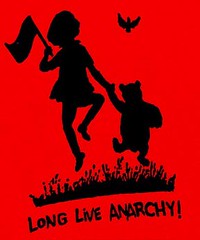
It’s been a busy week for our heroes. After successfully antagonising police in Los Angeles on May Day, 40 Kiwi Anarchists have flown into Paris in order to cynically exploit naïve locals, whose disgust at the Presidential victory of sociopathic Yanqui neo-con Nicolas Sarkozy has been both ‘turned into’ and ‘marred’ by violence. Thus in addition to distributing flags and masks to concerned parents in Paris, in a new development which worries experts at the Homeland Security Research Centre, the crazy New Zealanders arranged for the ritual burning, dismemberment and even stamping upon of an effigy of Monsieur Sarkozy (see below). Scienticians agree that this new tactic is clearly a signal, and possible evidence of a thawing in relations between the Kiwis and Iranian authorities (who like nothing better than a good effigy burning, especially if it’s accompanied by a good stomping). However, making funding avenues too obvious to the West may create antagonisms with the Kiwis’ erstwhile comrades among the jet-setting hordes of English, German and Swedish football hooligans, currently on sabbatical in Oslo, but previously hard at work blighting protests in Berlin and a number of other European cities with their presence…

Paris riots follow Sarkozy victory
Reuters / The Age
May 7, 2007

Thousands of extra police were drafted in to patrol sensitive suburbs today and a Reuters correspondent saw two cars burning [in] a tough neighbourhood north of Paris. Police said four cars and a bus were torched in another neighbourhood.

Youths also clashed with police in Paris’s Bastille Square and security forces fired repeated rounds of tear gas to try to break up the crowds. Disturbances were also reported in the southern cities of Toulouse and Lyon…

Riots in central Paris after election results
By staff writers and wires
NEWS.com.au
May 7, 2007

CLASHES between police and protestors have been reported in central Paris and the southeastern city of Lyon after conservative leader Nicolas Sarkozy was elected French President overnight.

In the Place de la Bastille in Paris riot police fired tear gas and at least one burst of water cannon after hundreds of rioters – some wearing masks – began throwing bottles, stones and other missiles.

Earlier, a small crowd brandishing black and red anarchist flags set fire to an effigy of Mr Sarkozy before tearing it limb from limb and then stamping on it. Demonstrators chanted “police everywhere, justice nowhere”…

Police clash with protesters after French presidential win
Radio Australia
May 7, 2007

Riot police have fired tear gas at stone-throwing protesters who gathered in central Paris to demonstrate against the presidential election victory of right-winger Nicolas Sarkozy.

The clashes took place on the Place de la Bastille where about 5,000 supporters of the defeated Socialist candidate Segolene Royal had gone to await the election results.

Up to 300 rioters, some of whom were masked, made running attacks on riot police who took up positions at the entrance to boulevards leading onto the square.

Earlier a small crowd of protesters, brandishing black and red anarchist flags, set fire to an effigy of Mr Sarkozy in the square before tearing it limb from limb and then stamping on it.

Elsewhere in the capital the president-elect appeared before cheering crowds and promised to be “president for all the French without exception.”

Mr Sarkozy beat Ms Royal by 53 per cent of the vote to 47 per cent, according to projections.

Posted in !nataS, Anarchism, Media, State / Politics, War on Terror | 4 Comments

G20: Protest, Politics & Policing (& Protest)

    This coming Friday, May 11, @ 10am, is when approximately two dozen people will be having their committal mentions @ the Melbourne Magistrates’ Court, courtesy of Victoria Police Crime Task Force 400. (A committal mention is a hearing in which the court decides if there’s sufficient evidence to go to trial.) And who knows, there may well be a solidarity gathering outside the Court @ 233 William Street (Cnr. William & Lonsdale Streets).

Protest, Politics and Policing
Victoria Stead and Shane Reside
Arena Magazine
April–May 2007

In the aftermath of last November’s protests against the G20 summit in Melbourne, Victorian Police have conducted a massive operation against individuals allegedly involved in the three day mobilisation. Under the banner of Taskforce Salver, dozens of houses have been raided, undercover snatch squads have been used to grab people from the streets, and photos of individuals deemed ‘persons of interest’ have been published in newspapers and on Crime Stoppers. At the time of writing, over 35 people have been arrested and charged with offences including riot, affray and conduct endangering persons. Some of these charges carry sentences of up to ten years imprisonment. The Police operation over the last few months suggests disturbing shifts in the policing of protest and dissent. Particularly, the response to the G20 mobilisation highlights the dangerous relationship between ‘community policing’ and more authoritarian tendencies within the Victorian Police force.

Compared to the policing of the demonstrations against the World Economic Forum in Melbourne in 2000, the police response to the G20 protest has been markedly different. When tens of thousands of people converged at the Crown Casino [seven] years ago to successfully disrupt the summit of the World Economic Forum, police responded with a massive display of violent force. Unprovoked charges, overhead baton strikes and outright brutality left scores of demonstrators injured, many of them seriously. In the lead up to the G20 protest, Police Chief Commissioner Christine Nixon publicly made it clear that the policing operation this time was not going to be a repeat performance. Instead, she employed a range of tactics including: a centrally controlled and staged increase in police force ‘appropriate’ to the context; low barriers instead of high security fences around the summit site; and the use of ‘crowd safety officers’ whose role was to circulate amongst demonstrators handing out cards recommending the suitability of alternate protest venues which were, not surprisingly, out of sight of the G20 delegates, inner-city businesses, and pretty much everyone else in Melbourne.

Nixon’s ‘softly, softly’ approach fits within the model of ‘community policing’ which has been advocated by the Victorian Police command since the early 1980s while facing ongoing resistance from the bulk of the Police rank and file. Studies conducted in the 1990s showed that community policing continued to be viewed by the majority of officers as primarily a public relations exercise. Instead, rank and file officers have tended to support the more authoritarian approach advocated by the powerful Police Association. The tension between these two approaches – community policing and authoritarian policing – is in turn deeply rooted in the ongoing power play between the Police Association and the Victorian Police command.

The recent policing of protests such as the G20 needs to be seen within the context of this struggle within the Victorian Police force. Increasingly, the approach to the policing of political dissent is being shaped by a dangerous combination of elements from both of the tendencies within the force. As Jude McCulloch has argued, community policing has become the ‘velvet glove that covers the iron fist’ of increasingly repressive and authoritarian policing in Victoria. While this has long been evident in over-policed Indigenous and working class communities across the state, the G20 mobilisation and its aftermath provides a case in point of the dangers of this twin-bladed approach.

Based on a community policing framework, Nixon’s ‘softly, softly’ approach hinged on containing the mobilisation. Protest was to be allowed, so long as it remained non-contentious, passive and preferably out of sight. Given these parameters, a confrontation between police and protestors was always going to be highly likely. While there is a wide diversity of opinions amongst protestors regarding tactics, a belief in the need for direct action has long been a hallmark of progressive social movements. And the space for action offered by the community policing approach simply does not allow this.

As it happened, there were attempts by demonstrators to breach the police cordons and disrupt the G20 summit meeting on the first day of the mobilisation. Clashes with police ensued, and it quickly became clear that the Chief Commissioner’s approach did not enjoy the support of the rank and file officers who were there. Nixon had been scheduled to appear at a fundraising dinner that Saturday evening, performing a rendition of ‘It’s Raining Men’, no less. Instead, she was forced to cancel her appointment and rush to the barricades to appease her surly troops.

It would appear that in the face of rank and file unrest, a green light was given for police to utilize all the force at their disposal for both the remainder of the mobilisation and the days and months following. Certainly, there appears to have been a significant and rapid turn around in police tactics. When a small group of protestors gathered at the Melbourne Museum the next day – where G20 delegates were enjoying a little cultural respite from the hard work of summit negotiations – police launched without warning into an unprovoked baton charge. One woman was so badly injured that she required hospitalisation.

The authoritarian policing tactics have continued since. A round up of protestors began on the morning of the 18th, with snatch squads grabbing people off the streets. One man, Drasko Boljevic, was snatched by unidentified men, thrown in the back of an unmarked white van and held for hours. Not only did he have no idea who his assailants were, it later transpired that he had not even been present at the protest. Dozens more have faced intimidation and harassment, regardless of their degree of involvement in any violence. In the backlash against Nixon’s approach, the Police Association has [decried] the ‘lack of appropriate resources’ given to officers, and the ‘grave OH&S dangers’ they faced. And in a style that ex-Queensland Premier Joh Bielke-Peterson would be proud of, it has even gone so far as to suggest a blanket ban on the right to protest. Unsurprisingly, mainstream media commentators and politicians have jumped into the fray, bemoaning the decay of law-and-order and going all out to demonise those involved in the mobilisation as violent thugs.

Regardless of the debate over the use of property damage, the policing of the G20 and the continuing actions of the Salver Taskforce should be a cause for concern for everyone who believes in the need for grassroots movements to organise in opposition to the neoliberal agenda being pushed by institutions such as the G20. The twin-bladed approach of community policing and authoritarian tendencies, arising from the tensions and power struggles within the Victorian Police force, has potentially grave implications for the right of ordinary people to dissent. The space for protest is shrinking for us all. As we come up against the barrage of neoliberalism, militarism, environmental destruction, racist border controls and draconian IR legislation, the right to protest is something we all need to defend.

Posted in State / Politics | 1 Comment

Good triumphs over Evil

COLLINGWOOD 11.20 (86)
Adelaide 9.8 (62)

Posted in Collingwood | 2 Comments

Combet bumped into Parliament

Australian working class united in joy

Greg Combet confirmed his entry into Parliamentary politics in 2000, when he was appointed ACTU Secretary — his appointment a reflection of his many promotional efforts on behalf of the ALP (efforts which peaked recently with the ACTU-sponsored ‘Vote Labor’ campaign). Formal notification of his finding a comfortable seat (in Charlton, NSW), however, has been delayed by media until today. Combet knows a lot about Charlton, just as he knew much about being a dockworker before beginning his career with the WWF in 1987. Further, while a seat in Parliament has long been assured, Combet’s future Cabinet role was in doubt until Rupert Murdoch consecrated a change in Government during Kevin Rudd’s audience with him in April. Media, however, are again expected to delay the announcement until some time in November, when formal ceremonies are expected to have been completed.

Posted in State / Politics | 2 Comments

Neo-Nazis in Fitzroy?

[Update : See also Stateline (ABC TV) transcript of May 4, 2007; ‘Violence at public housing estate calls for State Government to help Sudanese community’.]

According to (a troll called) V on Indymedia, neo-Nazis in Fitzroy have recently been harassing Sudanese folks living in the Fitzroy Housing Commission flats. Apparently “over many consecutive nights there have been confrontations between the neo-Nazis and the Sudanese community there.” As a result, a public gathering is being held @ 7pm tonight @ the flats (Gertrude Street).

Blah blah blah… in reality, somebody’s been trolling the newswire, presumably inspired by the following:

Teen charged over triple stabbing | ABC Online | April 29, 2007

A teenager has been charged over a triple stabbing during an alleged break-in at a Melbourne high-rise.

Police allege up to six people forced their way into the Fitzroy flat around 1.30am AEST today.

It is alleged two teenage boys and a man were stabbed during the confrontation.

A 16-year-old boy is facing 10 charges, including intentionally causing serious injury, false imprisonment and aggravated burglary.

He has been remanded in custody and is expected to appear in a children’s court tomorrow.

Posted in Uncategorized | 4 Comments

Three mines is good; four mines is better

In a stunning turn of events — and despite Midnight Oil‘s ‘fourteen extraordinary albums with combined international record sales of more than 12 million units’ — the ALP has recently decided to abandon its ‘cynical, hypocritical, illogical and failing no-new-mines policy on uranium that was forever undermining Labor’s economic credibility’ for a doubleplusgood policy of expanding the industry beyond BHP Billiton‘s Olympic Dam project in South Australia, Rio Tinto controlled Energy Resources of Australia Ltd‘s Ranger mine in the Northern Territory and US-based General Atomics‘ Beverley mine in South Australia. Since joining his new band, Peter Garrett — current Shadow Minister for Climate Change, Environment, Heritage (& the Yartz) and former warbler for the Oils — has also changed his tune, and is now singing of his new-found love for number 92 on the elemental chart, stating in a powerful speech to Federal Parliament that:

I see the Labor Party as the natural place for me to continue my engagement with the uranium mining industry. Labor has a proud history, a proud record as the primary party of reform and social justice on the Australian political landscape. And I am confident in the party’s capacity for renewal and enriching this landscape with whichever number of new mines market forces will determine will maximise a profitable return to investors. Labor has always mattered for Australia and it matters to me, as does uranium mining. Labor has an abiding commitment to fairness, to insisting that government does have a primary role in protecting the wellbeing of people, to having a foreign policy which espouses an independence of thought and action in international affairs, and to increasing the amount of uranium on the global commodities market. We in Labor are willing to put ideals as well as ideas into the political mix, and we’ll even even add in a little radioactive waste for good measure. All these components of the modern Labor Party are important to me, and I reckon they are important to Australia — and, of course, the Australian stock market.

Endorsing Garrett’s passionate view — and following the ALP’s decision at its annual conference last weekend — support for uranium stocks rose during subsequent trading sessions, particularly stocks which have deposits in South Australia and the Northern Territory, where there is no opposition to new uranium mining at a state level. Stocks to benefit included Deep Yellow Ltd, which has a deposit in the Northern Territory, Nova Energy Ltd, which has uranium interests in South Australia, Western Australia and the Northern Territory and PepinNini Minerals Ltd which has deposits in South Australia. Indeed, according to The Age, Garrett’s rendition of ‘Wind Beneath My Wings’ has been hailed a triumph by the mining sector: “Uranium miner Energy Resources of Australia Ltd added 74 cents, or 3.02 per cent, after the news to close at $25.22. Several explorers also made significant gains, including Nova Energy Ltd, which put on 15 cents to $4.05, PepinNini Minerals gained eight cents to $2.73, Deep Yellow Ltd gained four cents to 67.5 cents and Toro Energy Ltd picked up three cents to $1.28.”

And the company takes what the company wants
And nothing’s as precious
As a hole in the ground

See also : Mike Head, ‘Australian Labor Party conference: a right-wing stampede for office’, wsws.org, May 1, 2007

Posted in State / Politics | Leave a comment

Dr. Cam on Helen Coonan’s fascist flirtation

Crikey! Dr. Cam writes:

“The Jewish and Croatian communities of Australia are, according to a report in today’s [April 26] Australian Jewish News, angry and outraged that Communications Minister Helen Coonan, Liberal Senator Concetta Fierravanti-Wells and NSW Upper House MP David Clarke attended a commemoration of Croatia’s inglorious independence on 10 April:

    The Howard Government has been embarrassed by the appearance of a cabinet minister at a Croatian independence function linked to a murderous neo-Nazi regime.

    Jewish groups are outraged at Communications Minister Helen Coonan’s attendance at the Sydney commemoration earlier this month, which marked Croatia’s independence following the fascist Ustase regime’s rise to power during World War II.

    Liberal Senator Concetta Fierravanti-Wells and NSW Upper House MP David Clarke were also guests at the April 10 event, held at the Croatian Club in Punchbowl.

    NSW Jewish Board of Deputies (NSWJBD) CEO Vic Alhadeff described the celebration as “offensive” to Australians, while it is understood Croatian embassy officials are also angered at the involvement of a senior government minister.

The Jewish and Croat communities have every reason to be outraged when members of government are breaking bread with anti-Semitic extremists — and so should we all be. Coonan and Fierravanti-Wells’ attendance at an event celebrating one of the most evil moments in Yugoslav history can probably be put down to ignorance. Clarke has no excuse, having been involved with the Ustase since the ’70s, he is surely well aware of their violent tactics. Nor is this the first time he has celebrated the Nazi takeover of Croatia. In 2005, he feigned surprise at being connected to the Ustase … after he was caught out celebrating the exact same event at an Ustasi function. The Liberal Party needs to do to Clarke what it never managed to do to Urbancic — Clarke must be excommunicated from the party and assigned a Brian Burke-esque pariah status, even if the Christian right faction loses a few of its precious numbers.

Bigotry has no place in 21st century Australian politics.

It’s an outrage the roots of which are 66 years in the making. On 10 April, 1941, the royal dictatorship of Croatia was overthrown and replaced by the brutal Nazi-aligned Independent State of Croatia, led by a group called the Ustase. The Ustase quickly got around to the business of murdering hundreds of thousands of Serbs, Jews, Romani, anti-fascists and pretty much anyone that didn’t approve of wholesale murder. Hundreds of thousands of people were also forcibly deported or forcibly converted to Catholicism as the Ustase played their role in the wider Holocaust.

Following the conclusion of World War II a number of these active collaborators resettled in Australia — authorities turning a blind eye to those with murky Nazi pasts as their attentions turned towards fighting the Communist threat — and formed groups dedicated to the reformation of Independent Croatia, through terrorist activity, with the tacit support of the conservative end of Australian politics. In 1963, after the Yugoslav Government formally complained about Australian Ustase captured waging a guerilla war in Yugoslavia, Robert Menzies responded by praising the Ustase insurgents. A few years later [November 30, 1968], as Ustase laid waste to the Yugoslav consulate in Sydney, Billy McMahon (who would soon become Prime Minister and ‘just happened to be there’) described the Ustase as “a good bunch” with “a good cause”.

Throughout the ’60s and ’70s, the Ustase continued an unchecked campaign of terror (assaults, bombings, murders etc) against the local Yugoslav community which only ceased when several bystanders were injured by a bomb in Sydney and public outcry forced Australian intelligence operations to recognise that a violent terrorist network was operating in Australia. But why were the Ustase allowed to operate with free rein for so long? It surely had nothing to do with the fact that a member of the Ustase, Nazi propagandist Ljenko “Little Goebbels” Urbancic, was a senior powerbroker within the Liberal Party. Urbancic remained an influential member of the far-right faction of the Liberals until his death in 2006, alongside his protege … David Clarke. Which brings us to today.

(Those interested in the history of the Ustase in Australia should check out Sanctuary: Nazi Fugitives in Australia by Mark Aarons [Heinemann, Melbourne, 1989] and Radical Melbourne 2 by Jeff & Jill Sparrow [Vulgar Press, Melbourne, 2004])”

See also : Joan Coxsedge, Ken Coldicutt and Gerry Harrant’s Rooted in Secrecy: the clandestine element in Australian politics, esp. ‘One, Two, Three — Ustasha Are We!’, pp.43-59.

Posted in Anti-fascism, History, State / Politics | 5 Comments

Boneheads. Kiwi. Czech. German…

    the blob writes:

“It seems a bit funny that a group of neo-Nazi skinheads in New Zealand should celebrate Hitler’s birthday like the Hammerskins did in Wellington the other weekend. FDB! decided to do a bit of digging to see what Der Fuhrer thought of New Zealand. What we found was, well, rather disappointing. He was obviously not very well informed on geography or ethnography. Take a look at this; it’s excerpts from a speech given by Hitler on July 15, 1925, explaining Nazi racial doctrine. He started by using dogs as an example, declaring that although dogs were indeed dogs, not all dogs were alike and some were better than others. Sheer genius there, but it gets better…

You say ‘a human being is a human being’. No doubt! But between the individual human beings there is after all a certain differentiation. For example: many New Zealanders live in trees and many still climb around on all fours, very different from a European who walks on two legs and does not live in trees but wanders on streets.

Now you might say: ‘That is the effect of climate’. My friend, if all Europeans left the Continent and the New Zealanders slipped in here, you will surely not believe that the climate will make a European out of the New Zealander, however great the influence of climate, that influence will not reach beyond certain characteristics…

It’s almost beyond comprehension that the leader of a political party could be so stupid, but obviously Party officials didn’t think so. In fact, the whole of Hitler’s speech was considered to be significant enough for official publication in pamphlet form by the Nazi Party and widely distributed.

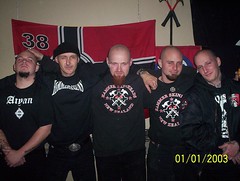
Here’s a photo of some of the Hammerskins:

Cheer up boys, bananas are available all year round in New Zealand now. We hear the Hutt Valley has some pretty fancy trees. Perhaps you could hold the next celebrations for Hitler’s birthday in one?”

    the media reckons:

In Brno, hundreds of boneheaded members of the neo-Nazi National Resistance tried to hold a march on May Day; emboldened, presumably, by the lack of opposition to their goosestepping antics at last year’s May Day, a day on which local police paid their own special tribute to the workers by beating up a woman protesting against the scum. This year, however, the boys in uniform — normally kept busy trying to avert clashes between local anarchists and their pinheaded opposition — received orders to stop the march after permission for it was withdrawn; shortly before the geese started stepping. According to Radio Praha:

Elsewhere in Prague, anarchists clashed with right-wing extremists while the police, out in force for the day, struggled to maintain law and order. Around two hundred anarchists marched along the banks of the Vltava to Strelecky Island where ultra-right supporters were congregating. The two groups came face to face at Legionaries Bridge, separated by two lines of police in riot gear. Isolated skirmishes were quickly brought under control and several dozen people were detained. The situation is reported to have been rather more serious in the Moravian city of Brno where some 500 neo-Nazis clashed with police in the centre of town, throwing stones and bottles. Several people are reported injured, among them two policemen and one journalist.

    buzz or howl under the influence of heat:

And finally, in highly-photogenic scenes that would make some local ‘working class’ punks piss their pants — and their comrades in the bourgeois media jump, yet again, on their overused broomsticks — punks, skins ‘n’ herberts in Berlin have celebrated May Day in fitting fashion, while antifa in Dortmund have expressed their very understandable frustration at not being able to extend very special May Day greetings to members of the NPD and other prancing neo-Nazis (‘Rioters set fire to train tracks, vandalize buses, trams in western Germany’, AP, International Herald Tribune, May 1, 2007):

The riots in Dortmund were among several outbreaks of violence on May Day in Germany. In the eastern town of Erfurt, several protesters were injured during a right-wing demonstration and various counterprotests, police reported. About 1,300 members of the far-right NPD party marched through the city center, and some hurled bottles and cobblestones at police. Left-wing protesters also caused “severe damage of property,” a police spokeswoman said. She would not give details on damage or the number of arrests.

In cities all over Germany, demonstrators marched against right-wing extremism, but most protests remained peaceful…

As, of course, will the neo-Nazis.

Posted in Anti-fascism, State / Politics | Leave a comment

Happy May Day!

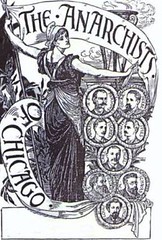
At MTV, of all places, it’s noted that “If you happen to be an anarchist, you probably observe May Day, which commemorates a number of historical revolts worldwide and is also known as International Workers’ Day”. So thank your mother for the rabbits, thank you Marta for the sandwiches(!), thank you aketus for hosting slackbastard on anarchobase — for one year now — and happy May Day to all my comrades in Barricade, in Melbourne, Australia, and to those around the world, especially to the comrades in Sofia, Bulgaria, Berlin, Germany and Istanbul, Turkey.

“IF YOU CANNONADE US

we shall dynamite you.” You laugh! Perhaps you think, “You’ll throw no more bombs;” but let me assure you that I die happy on the gallows, so confident am I that the hundreds and thousands to whom I have spoken will remember my words; and when you shall have hanged us, then, mark my words, they will do the bomb-throwing! In this hope do I say to you: “I despise you. I despise your order; your laws; your force-propped authority.” HANG ME FOR IT!

~ Louis Lingg, October 1886

Posted in Anarchism | 4 Comments

“I get so emo, I could die” / Drop the attitude, fucker / In music, nothing happens…

[Update : Jack Sargeant writes about suicide, girls, and the difficulties involved in giving all your love to just one genre in ‘It’s hard to be emo and be respected’, The Australian, May 3, 2007.]

::: I GET SO EMO, I COULD DIE :::

    I know what you’re thinking. “What are the roots of the musical genre known as emo?” Well, to tell you the truth, in all this excitement I kind of lost track myself. But being as this blog is a .44 Magnum, the most powerful handgun in the world, and would metaphorically blow your head clean off, you’ve got to ask yourself a question: Do I feel emotional? Well, do ya, punk?

Some hack called Chris Johnston has a regular column called ‘The Crate’ in EG — the ‘entertainment’ consumption guide published with each Friday’s edition of The Age — in which he writes about ‘classic’ albums (columns which will presumably, one day, be published collectively as the aural equivalent to The Age Good Food Guide). Last Friday (April 27), in his most recent column, Chris wrote about Hüsker Dü‘s Candy Apple Grey album (1986). After noting that the recent joint suicide of two local girls has been linked to the supposed fact that they liked ’emo’, Chris opines that Fugazi and Hüsker Dü were the genre’s true pioneers. Thus according to Chris, music giveth, not taketh away, especially:

…the pained, cathartic wailings — the railing against the world, the wondering why — of the best “emotional hardcore” music, or emo. Emo has now been appropriated by corporations, so it’s kind of the pop version. The same thing happens to every decent underground uprising. But 20 years ago, there was no name for it — it was just the most intense music on the planet. Fugazi and Hüsker Dü, the greatest, who set the most desperate odes to freedom and pain and the sense of being captured within the world to the most hardcore, transcendent guitar music of the era. It took you right out of yourself, as the newest generation still does, despite being corporate. As such, it was, and is, and can be, a saviour, not a killer.

Uh-huh.

A few comments:

1) The notion that Hüsker Dü was somehow an emo pioneer is one that Chris first proposed elsewhere, in a review (March 29) of The Pixies recent tour. There, Chris argues that “Hüsker Dü, the other bookend to a nascent Pixies, were somewhat different. They were the abrasive post-punk trio led by Bob Mould who, with Fugazi, the Minutemen and Black Flag, pioneered the whole American ’80s hardcore scene, which in many ways was the original emo”.

Hmmm.

Don’t ask me why, but it seems that in the intervening weeks, Chris has decided that maybe the Minutemen and Black Flag weren’t so emo after all. This may have something to do with the fact that the whole American ’80s hardcore scene, in many ways, had bugger-all to do with ’emo’. Certainly Black Flag and the Minutemen never did… although I do recall many years ago a mate describing Henry Rollins as a hardcore Morrissey. And like, Morrissey has been known to express his emotions on occasion…

So yeah, good point Chris.

2) Candy Apple Grey was Hüsker Dü’s fifth studio album, and the first to be released on a major label. It therefore makes very little sense to refer to the ‘corporate appropriation’ of emo by way of an album actually produced and distributed by one of the six corporations that dominated the industry 20 years ago, and even less in reference to a band whose signing was much-remarked upon at the time as being evidence of a renewed corporate interest in ‘punk’ and ‘alternative’ music.

3) The term itself is kinda stoopid — as its current, dominant use as a marketing device by the marketing departments of the handful of corporations that continue to dominate the music industry might otherwise suggest. And if the term once held any relevance, it was really only as a means to distinguish the musical subject matter, lyrical content and general attitude, approach and feel of certain US hardcore bands of the mid-80s from that of others. (Elsewhere, two other hacks, Ben Cubby and Larissa Dubecki, helpfully add that “With roots in the goth movement, emo is short for “emotional” and is known for its angst-ridden music and moody introspection”.) In this context, ’emotional hardcore’ was to be distinguished not merely from ‘political’ hardcore, but the macho bullshit bands — precisely like Black Flag — tended to perpetuate (and which a number of punk poseurs continue to perpetuate under the false notion that selfish indifference to others is somehow a quintessentially ‘working class’ — not middle class — attitude).

4) In any case, Embrace and Rites of Spring — not Fugazi and Hüsker Dü — are usually considered to be the first ’emo’ bands. Not that it matters much:

Mark Prindle : Okay so, whether you like it or not, you’re basically considered to be the creator of “emo.” And I was just wondering – why have you always thrown yourself so emotionally into your music?

Guy Picciotto : Well, first of all, I don’t recognize that attribution. I’ve never recognized “emo” as a genre of music. I always thought it was the most retarded term ever. I know there is this generic commonplace that every band that gets labeled with that term hates it. They feel scandalized by it. But honestly, I just thought that all the bands I played in were punk rock bands. The reason I think it’s so stupid is that – what, like the Bad Brains weren’t emotional? What – they were robots or something? It just doesn’t make any sense to me.

But anyway, when I was young, I was always over the top because I was so fucked up. Not “fucked up” as in “wasted” but more mentally “fucked up”. And I was really jacked up. So it came out of that. I mean, before I was in Rites of Spring, I was in a band called Insurrection with Brendan, the Fugazi drummer who I’ve played with in every band I’ve been in. And our music was like Motörhead and Discharge and Venom – shit like that. That was what the band sounded like. And we weren’t very good! But nobody was calling THAT “emo”. Then when we started Rites of Spring, I guess we got more serious about what we were trying to do. But I didn’t actually sing in Insurrection. In Rites of Spring, I decided to sing and that’s what came out. Because when I was young, I was nuts.

5) I hate myself & I want to dye my hair : I don’t know shit about the two girls who killed themselves, but if anything, the music which Chris purports can ‘take you right out of yourself’ in this case, sadly, only managed to take them out of this world; and probably because, rather than despite, its being ‘corporate’. But until such time as rates of youth suicide begin to seriously imperil the continued reproduction of labour, it’s unlikely to be treated seriously by state authorities.

6) As an aside, the supposed link between music and suicide has been made before, only 20 years ago it was the !cinataS influence of heavy metal over impressionable young minds that had particular groups worried, Christians in the US in particular. Thus:

During the late 1980s, a pair of well-publicized cases involved claims filed by the parents of children who had injured or killed themselves after listening to heavy metal music.

In 1988, John McCollum, a 19-year old, shot himself in his bedroom after listening to songs of John “Ozzy” Osbourne, from Blizzard of Oz, and Diary of a Madman. The plaintiffs claimed that one of the songs, ‘Suicide Solution’, preached that suicide is the only way to solve one’s problems. They also alleged negligence and incitement to suicide.

Once again, the court said no.

In its ruling, the court noted that entertainment, like political and ideological speech, is subject to First Amendment protection…

A 1989 case, Vance v. Judas Priest, dealt with the issue of actions that the plaintiffs claimed were the result of subliminal messages contained on the group’s Stained Class album.

Raymond Belknap, 18, and James Vance, 20, had barricaded themselves in Vance’s bedroom, where they sat for five hours, drinking beer, smoking pot and listening to the group’s music. When Vance’s mother knocked on the bedroom door, the boys jumped out the window and went to a nearby church playground, where they shot themselves.

Belknap died immediately, but Vance survived after blowing most of his face off. A wrongful death action followed.

When the case went to trial, the judge ruled in favor of Judas Priest, noting that the plaintiffs failed to prove that the group had intentionally placed subliminal messages on the album or that the messages were indeed the cause of the suicide and attempted suicide. The judge did rule, however, that while song lyrics are protected by the First Amendment, subliminal messages are not…

~ Jerry Rhodes, Professor examines issues of free speech rights, media accountability, UDaily (University of Delaware), November 15, 2002

::: DROP THE ATTITUDE, FUCKER :::

On Saturday, SBS screened Don Letts‘ documentary Punk : Attitude, a film which was voted the most popular documentary @ the 2005 Melbourne Film Festival, and which I naturally missed seeing. But that was then and this is now, and now I’ve seen it. I’ve also read Letts’ synopsis, which is odd, and his filmography, which is exciting: — at least, exciting in the sense that I’ve also now discovered that he’s made a film about one of my favourite artists, Gil Scott-Heron: The Revolution Will Not Be Televised (2003). But as for Punk : Attitude, I thought it was a reasonably entertaining and informative film, heavily weighted in favour of the UK and US, but slightly more expansive in terms of its list of interview subjects than might otherwise be expected. Thus Roger Miret (Agnostic Front) makes a brief appearance, and Henry Rollins refers to Fugazi — both useful, if for no other reason than their ability to remind audiences that, whether or not punk was born in the mid-’70s in London or New York, its legacy and its tradition transcended these times and places. Blah blah blah. Letts: “With hindsight we are able to recognise [punk] as part of an ongoing movement of counterculture. It is in that spirit that I made this film. Not as a nostalgic look back but rather a way to move forward. After all, if it happened before it can happen again.” In reality, it’s history, and history is what’s happening. But according to some…

::: IN MUSIC, NOTHING HAPPENS :::

ACMI is screening a series of films which focus on punk in a coupla weeks (May 11 — May 20):

In the midst of a current punk revival [sic] criticised for being more ‘mall core’ than hard core, rediscover the real thing at ACMI. Curated by Jack Sargeant… inspired by No Focus: Punk on Film edited by Chris Barter and Jack Sargeant. Incidentally, this book’s available from the ACMI Shop. Some of us have got to live as well, you know. Who do you think pays for all this rubbish? They’ll never make their money back, you know. I told him. I said to him, “Punk”, I said, “They’ll never make their money back”.

Unfortunately, in this case, the operative meaning of ‘punk’ is musical events occurring in the vicinity of London in the late ’70s (Jubilee / Punk and the Pistols / The Great Rock ‘n’ Roll Swindle) and the United States in the early ’80s, loosely documented in the shape of Penelope Spheeris‘ first film Suburbia — which is fucking awfulLadies and Gentlemen, the Fabulous Stains and Repo Man. (Another film included for its Camp Quality is Desperate Living by John Waters.) The other films included in the series are a documentary on The Gun Club, Alan Clarke‘s Made in Britain (starring Tim Roth as a bonehead in Fatcher’s Britain) and various shorts by Billy Childish and a bunch of wankers from New York… So basically, punk as a cultural phenomenon, born in England and the United States in the late ’70s, and dying there in the early ’80s.

The same old story, in other words, and one that goes on like a broken record…

    recuperation : consolidated : 1994

    the grunge industrial and tekno folk genres have been recuperated colonized sanitized if the jazz music of the sixties was the refuge of a violence without a political outlet it was followed by an implacable ideological and technical recuperation bob dylan is replaced by kurt cobain neil young is replaced by dinosaur jr. nina simone by queen latifah lightning rod by bushwick bill the most rudimentary meaningless themes pass for successes if they are linked to the mundane preoccupations of the consumer the rhythms of exceptional banality are often not that different from miltary rhythms in music nothing happens and in forty years it has seen only marginal or cyclical movement change occurs through minor modifications of a precedent each series repeated with slight changes enabling it to parade as an innovation the singers of the seventies [eighties] are back in fashion in the nineties [noughties] and today’s kids enjoy their parent’s music at times however the quality improves song becomes critical and heralds a new subversion by musicians cramped by censorship who stand alone

Posted in Film, Music, Television | 4 Comments