“The Black Rose Syndicat” : D’oh!

Update (January 11, 2014) : Black Rose Syndicat (Addendum), January 7, 2014.

Update (December 23, 2013) : OK so I reckon I gotta bit of a handle on it, and the moral of this story is: drugs are bad, mmmkay?
I first encountered the bizarr0 ‘Black Rose Syndicat’ back in May: a Facebook page of that name was published on May 3 and a few indymedia articles appeared on May 10 and 16. Because of the craptastic nature of the posts which announced the fictional group’s existence, its adoption of the name ‘Black Rose’, and its claim to be located in the same suburb, I wrote to Black Rose infoshop in Newtown, Sydney asking if they knew anything more about these semi-literate keyboard warriors. I never received a reply, but over the course of the next few months I asked several anarchists I knew in Sydney the same question. None were able to provide me with any information to suggest that the Syndicat was anything other than a weird-arse ~jk~ — a local anarchist version of Crimer Show, perhaps — a phantasist looking for attention and/or to sell some merch, or even a badly-composed attempt by forces hostile to anarchism (and friendly to the G20) to gather infos on local anarchist organising and/or to ensnare some teenage wanna-be insurrectionists in some rather dickheaded fun …

In any case, given the derisory nature of the Syndicat’s online antics, and the fact that six months later its Facebook page had only managed to attract a little over a dozen likes, I decided to let sleeping dogs lie. Last week, however, the Courier Mail decided to splash the name of the Syndicat across its pages, taking its idiotic outpourings on indymedia and elsewhere as serious attempts by ‘anarchists’ to create “CAOS and Mayhem” at the G20 summit in Brisbane next year. As evidence, the article referred to two seven-month old indymedia posts (one of which was written by the group posing as a critic: the non-existent “Sydney University Socialist Club”) and two posts on the Syndicat’s Facebook page, also dating from around the same time.

The propaganda function of the mass media is hardly remarkable, nor its capacity to reflect elite concerns over potential troublemakers, but given the shift by international law enforcement to entrapment of activists in violent plots, the recent introduction of highly repressive laws in Queensland and weak opposition, the silly antics of the “Syndicat” may be worth taking a little more seriously than they would if they were just a reanimated Jonny Hammerlock.

On repression of opposition: G20 in Toronto, June 2010 see Over 9000 arrests @ G20 in Toronto (June 29, 2010) and elsewhere | G20 in Pittsburgh, September 2009 see Charges against Elliot Madison (and Michael Wallschlaeger) dropped… (November 3, 2009) and elsewhere | G20 in Melbourne, Pittsburgh, London see G20 : Sunil & Tim (& Co.) (July 30, 2009) and elsewhere …

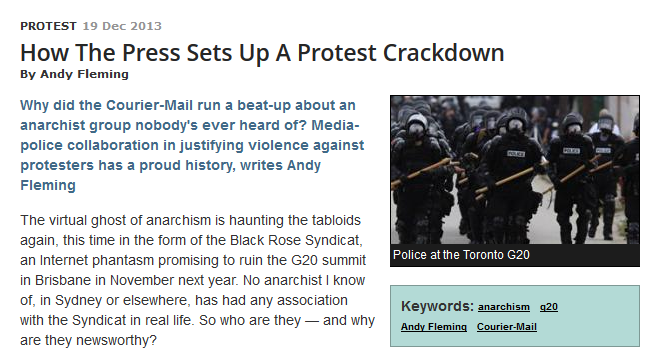
In the meantime, enjoy How The Press Sets Up A Protest Crackdown, newmatilda.com, December 19, 2013. See also : Anarchist group to target G20, Brisbane Times/Nine News, December 9, 2013.
Posted in !nataS, Anarchism, Broken Windows, History, Media, State / Politics, That's Capitalism!, War on Terror | Tagged , | 9 Comments

antifa notes (december 19, 2013) : Australia First Party

Briefly:

According to media reports, the Australia First Party (AF) helped organise a small rally at the Greek consulate in Sydney on the weekend in support of comrades in the Greek Golden Dawn (GD) party. AF has previously issued declarations of support for GD and welcomed its rise in popularity. Locally, a Facebook page for Golden Dawn Melbourne was established in March 2010 but closed in 2012; it remains active in other areas.

Support for GD within Greece appears reasonably steady but it’s currently subject to state prosecution, with party leaders facing charges of belonging to a criminal association, state funding being suspended, and two members currently facing trial for the murder of a Pakistani migrant in January 2012.

In other news, in Penrith, Maurice Girotto, the second AF representative to be voted on to local council has, like the first, Bruce Preece in Adelaide, resigned from the party. In neither case is it clear how ZOG managed to convince them to leave party fuehrer James Saleam behind. Posting as ‘radnat’, Dr Jim keeps the world up to date on the party’s political progress on the White supremacist website Stormfront.

Posted in Anti-fascism, State / Politics | Tagged , , , , | 10 Comments

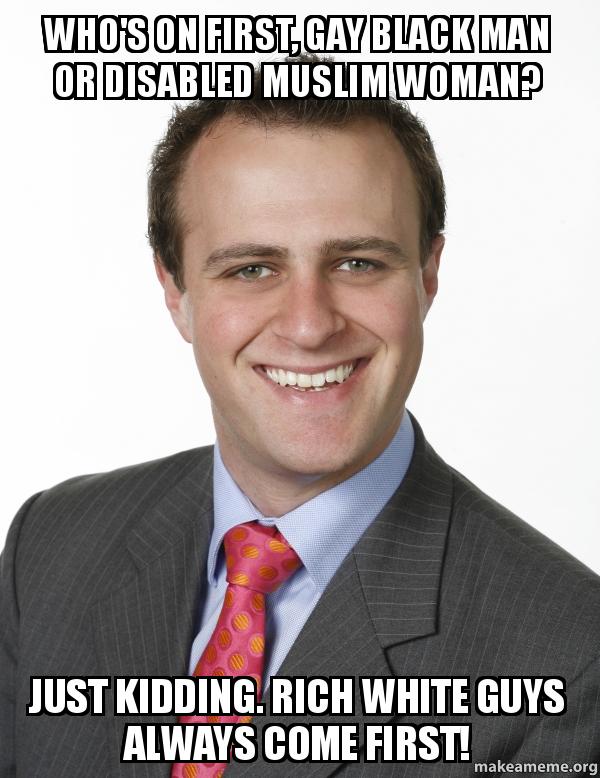
Who’s on first, gay black man or disabled Muslim woman?

Posted in !nataS, History, Media, Sex & Sexuality, State / Politics, Student movement, That's Capitalism! | Tagged , , , | Leave a comment

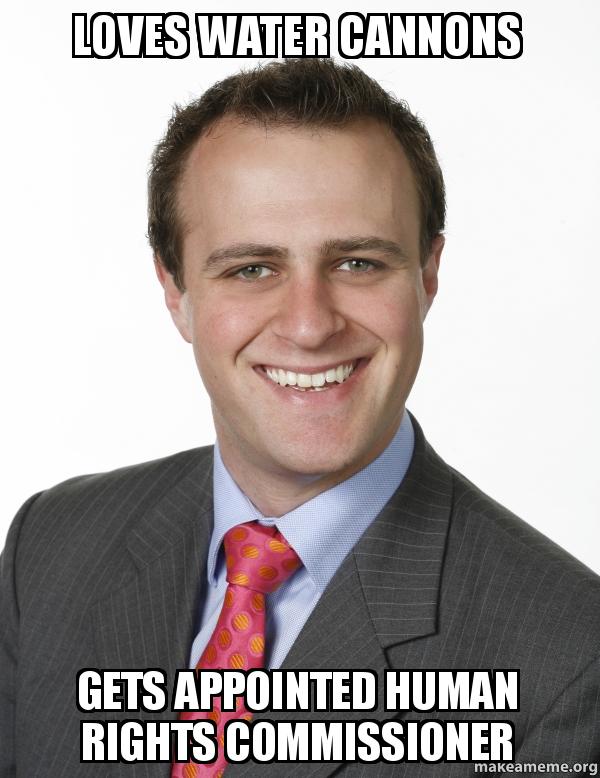
Tim Wilson, Australian Human Rights Commissioner, ♥s Water Cannons

For the $325,000-a-year record:

Otherwise:

1. I picked the wrogn side in the class war.
2. I’m available for hire at a fraction of Tim’s salary.

Posted in !nataS, Broken Windows, History, Media, State / Politics, Student movement, That's Capitalism! | Tagged , , , | Leave a comment

My First Little Boob Job

Posted in Art | Leave a comment

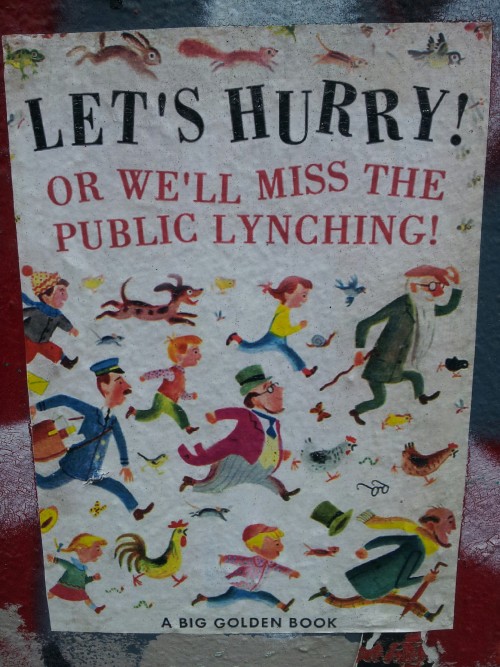
Let’s Hurry! Or We’ll Miss The Public Lynching!

Posted in Art | 1 Comment

Zippy Denies The Holocaust

Posted in Art | Leave a comment

movement beyond borders forum redux

Update (December 12, 2013) : Don’t take my word for it: you can watch a video of the forum here.

Last Saturday I attended a public forum on movement beyond borders, organised by the ‘beyond borders’ collective, a group of local ne’er-do-wells. The forum was recorded for later broadcast on 3CR but I made a few notes and thought I may as well share them, despite being hopelessly incomplete and probably of most use to me when, in n months or years time (assuming I’m still alive), I wonder WTF I was doing in December 2013.

*sigh*

In any event, there were five speakers on the panel — Lia Incognita, Dawood, Ruben Blake, Kaneez Raza and Angela Mitropoulos — and maybe 50 (?) or so in the audience. Several other speakers were invited but were unable to attend …

Lia spoke first and inter alia made a distinction between the nation as private and collective property, described HoWARd’s nationalism as adolescent, and identified one of the weaknesses of some ‘pro-refugee’ rhetoric as its failure to properly address the question of the government’s legitimacy, especially in terms of its colonial status. Lia also invoked the notion that the project of the colonial state was never complete and referred to the work of Meaghan Morris on the question of … something-or-other-which-my-notes-fail-to-disclose-and-I-can’t-remember … so like, yeah.

Dawood addressed four main issues in his presentation. First, he provided an historical account of war and the refugees it creates, paying particular attention to migration patterns in Afghanistan, Iraq and Syria and arguing that the Cold War played a critical role in determining the attitude of Western governments to those fleeing from the official enimy. He then attempted to explain the emergence of the especially punitive migratory regimes since its end, partly by reference to the rapid entrenchment of global inequalities and the popular force of right-wing politics in the West. Thirdly, Dawood contrasted the commitment within Australia to multiculturalism and the general ignorance of many Australians with regards the conditions from which refugees escape and the treatment they receive upon arrival. Finally, he made reference to the damaging psychological effects of ‘Temporary Protection Visas’.

Ruben spoke next, and provided an account of and reflection upon the Freedom Flotilla to West Papua, which ended in September; having successfully helped to place, however briefly, the issue of the Indonesian state’s control of the territory on the political map. The Flotilla was memorably described by former Foreign Affairs minister and hard-workin’ Labor man Bob Carr as perpetrating “a cruel hoax on the people of the Papuan provinces by suggesting that Papuan independence was on the international agenda”. Not also that ‘Police brutality payout helps subsidise West Papua Freedom Flotilla’ (Joel Magery, The Australian, September 17, 2013).

Kaneez provided an account of the situation of minority, mostly Shiite Muslim Hazaras in the Pakistani city of Quetta. She also outlined some of the many problems confronting those on ‘Temporary Protection Visas’, the economic and personal insecurity and psychological damage temporary protection fosters, and drew some parallels with the damaging effects similar policies have had on individuals and families in the past (including, if memory serves, the Stolen Generations).

The final speaker was Angela. Angela made reference to xborder and its development in the context of various campaigns around ‘anti-globalisation’ in the late 1990s and early 2000s, including the Woomera protests of 2002 (later the subject of a video game called Escape from Woomera) and, echoing Lia, drew attention to the concept of borders in relation to notions of citizenship and sovereignty. Finally, Angela highlighted the fact that: a) while much of the political campaigning around refugees and attendant issues has as its focus the electoral arena, the assemblage of the materials required to police the borders is also vulnerable to subversion and; b) Australia f(n)s as a kind of political and technical laboratory for Western regimes, with various of the techniques and policies developed here being exported o/s for political fun and economic profit.

A few notes, questions and comments: what’s the difference between a colonial and a non-colonial state in terms of its regulatory functions? While there’s a requirement for The Border to be constantly reimposed, is it not possible for the colonial state to succeed insofar as extinguishing the lives and cultures of ‘indigenous’ populations is concerned (cf. Foley on future of Aboriginal peoples in Australia)? How does ‘shame’ operate, which audiences does it affect, and what are the dangers of attempting to employ it on an already resentful mass?

Bonus Decolonizationalizings!

Posted in Anti-fascism, Broken Windows, Death, History, Media, State / Politics, Student movement, That's Capitalism!, War on Terror | Tagged | Leave a comment

Libertarian Anthology IV : ‘The negativity of Anarchism’ by David Thoreau Wieck

A new issue of Libertarian Anthology by a local group of anarchists known as the Grupo Cultural de Estudios Sociales de Melbourne was published this week. You can download a copy here [PDF]. I’ve republished the ‘Introduction’ below. You can find previous anthologies elsewhere on the blog: Libertarian Anthology Volume 3 : Trade Unionism, Councilism and Revolutionary Syndicalism (November 2012); Libertarian Anthology II : The Ancient Greeks and the Anarchist tradition (September 2012) [PDF]; Libertarian Anthology I : Anarchism: Aims, Principles, Historical Development and Objections (July 2012) [PDF].

Libertarian Anthology IV | Edited, Published and Produced by: Acracia Publications with the co-operation of Grupo Cultural de Estudios Sociales de Melbourne | December 2013

Introduction

An investigation into anarchism always directs the researcher towards progressive and freedom seeking events recorded through the centuries onto the pages of history, opening up new social outlooks of negating institutionalised authority and replacing it with the concepts of solidarity, mutualism and self management.

Yet, we must also recognise that at the same time, authority, be it a tradition, a custom, a law or arbitrary has since the evolvement of the human species, placed its claws upon a number of human interrelationships, an incident that undoubtedly derives from an even more pre-historic and animalistic era. Despite the consequences, history records through the ages, a continuous effort of struggles by humanity to liberate itself from the claws of authority.

The advents of those struggles were so varied, the battles so cruel and rigid that relatively few have reached an anarchist outlook. The majority of the struggles fought for partial freedoms and often tried to reconcile their new freedoms with the maintenance of ancient authorities believing they could never evolve into autocratic authoritarianism, or innocently believed authority to be useful in their endeavours to maintain and defend the new freedoms. In modern history many individuals have struggled for constitutional or democratic freedom, unfortunately this freedom has always been confined to the custody of a government. Such misunderstanding in the complexity of social evolvement has produced social statism; that is socialism imposed authoritatively and deprived of the
fundamental concept which gives it life.

Comprehending that socialism can only flourish in an environment of complete freedom, the editorial collective of Libertarian Anthology has subsequently decided to devote this fourth issue to an essay written in the 1970’s by David Thoreau Wieck, The negativity of Anarchism.

The members of this editorial collective were first exposed to this essay by Wieck in the pages of the multilingual magazine “interrogations” in 1976, produced in Paris, France. “interrogations” was an international magazine of anarchist research, publishing articles in French, English, Italian and Spanish incorporating a resumé of the essay in the alternative languages.

In September of 1977 we once again came across this essay, this time translated into Spanish by compañero Eduardo Vivancos from Canada, published in number 32 of “Ruta”, an anarchist publication produced in Venezuela by exiled Spanish anarchist compañeros.

It could be said that by republishing this essay we are positioning ourselves within a certain heterodoxy. Nothing new for us, for we have previously incurred these type of accusations. None the less, we are well aware that it is necessary to occasionally shake the social bodies of doctrine if we do not want to paralyse the continuous transition and evolvement required particularly within anarchism ensuring it does not stagnate as an ideal and that it cannot be misrepresented. Anarchism by its own definition and condition of permanent confrontation is obliged to question itself every day by testing the soundness of its structures, the foundations of its ideals, given that it progresses from within the confines of a permanently evolving egoistical and suicidal society.

For these reasons we thought it would be worthwhile to publish this philosophical examination, because to read David Wieck is to travel along a new road of the libertarian ideal.

Posted in Anarchism, Media | Tagged , , , , | Leave a comment

FORUM : movement beyond borders : Saturday, November 30, 6pm

The ‘beyond borders collective’ has organised a public forum to be held at Trades Hall next Saturday. It looks really interesting … so I’ll have to try hard to find an excuse not to attend:

It seems like every day we hear of some new tragedy at sea. We hear about Operation Sovereign Borders extending into Indonesia and Malaysia. We see slave-like conditions created by cruel visa rules. Every day people’s hopes and attempts at a future are destroyed by Australia’s shifting border practices. These are moments in an ongoing and brutal assertion of sovereignty by a regime built on stolen land and the ongoing dispossession of Indigenous peoples. A lot of us are feeling hopeless about the state of politics around the Australian border.

It is now, in this moment, that we want to organise, think, and speak together. The border is not a natural or inevitable thing. What can a cross-border, a no-border, a pro-refugee and migrant politics look like in Australia, today? Whose actions have come to count as political? Which actions, movements, and struggles are being ignored? How can we break from the language that defines the discussion now? – ‘genuine refugees’ ‘economic migrants’ ‘dodgy international students’ and ‘457 workers taking Aussie jobs’

We don’t have the answers: this forum is about discussing these questions and building solidarity and the potential for resistance.

SPEAKERS:

Lia Incognita is a Shanghainese/Melburnian writer, performer and mediamaker who co-hosts Queering the Air on 3CR Community Radio.

Kaneez Raza is a student from Pakistan. She is here on a scholarship (endeavour award) from the Australian government and is now studying Nursing. She is a Hazara by ethnicity.

Angela Mitropoulos (University of Sydney) was a founding member of xborder in 2000, and involved in producing noborder media for Woomera2002 and the Flotilla to Nauru in 2004. She has written extensively on borders and some of her most recent writings can be found in Contract and Contagion: From Biopolitics to Oikonomia (London: Minor Compositions/Autonomedia). Her current book project is titled Infrastructures of Uncommon Forms.

Dawood arrived in Australia in 2011, having lived illegally in Quetta, Pakistan, for many decades, where he was a politically active Marxist. Dawood is an Afghan Hazara who arrived in Australia by boat and was subsequently recognised as a refugee.

More to be announced…

Posted in Broken Windows, Death, History, Media, State / Politics, Student movement, Television, That's Capitalism!, War on Terror | Tagged , , | Leave a comment