See also : From Meta-Politics To Mass Murder – A New Right-Wing Extremism, anarkisterna.com, August 25, 2011.
Open Letter to Friends and Comrades on the Struggle against Racism amongst the Class
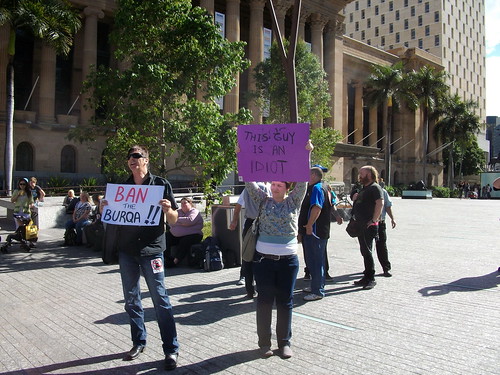
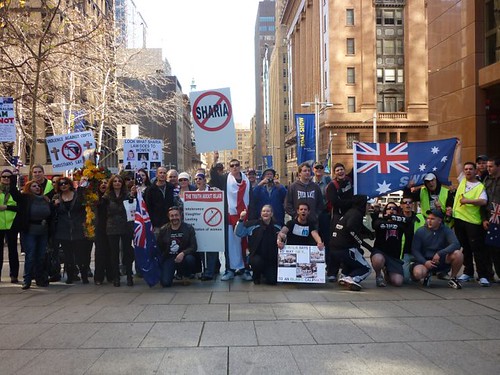
After a few years of relative hiatus right-wing populist politics has re-emerged again on the streets of Australian cities. The largest mobilisations of this new born right-wing populism has been seen in protests against the so-called ‘Carbon Tax’ yet there has been considerably smaller but controversy hungry protest calling for a ban on the burqa and expressing a larger opposition to immigration and refugees under the rhetoric of opposition to Islam and Sharia law. The forms that this right-wing populism takes are pretty sloppy and open ended. Unlike the Joh for PM campaign or Pauline Hanson’s One Nation there is no central figure with electoral ambitions that hold them together. In the case of the opposition to the Carbon Tax the Liberal National Coalition has certainly supported to some extent these demonstrations thus perhaps explaining their relative popularity, whilst the opposition to Islam is being organised by much smaller groups and are gathering only handfuls of people. One of the organisations behind these protests the Australian Protectionist Party is a project lead by the old neo-Nazi milieu. The Australian Defence League is a pretty piss poor imitation of the English Defence League; but without similar football casuals in Australia they have not been able to find a similar success. In Brisbane there has been a similar phenomenon in the shape of the Australian Patriots Defence Movement. Unsurprisingly there has been a mobilisation of Left and progressive opposition to these groups and rallies, but are the tactics and the thinking behind them actually usefully to produce a free and just society? What is the nature of this new right-wing populism and what is the best way to oppose it?
Fascism/AntiFascism
The opposition to the ADL and the APDM often sees them as being forms of fascism, comparable to the National Front or National Action. Undoubtedly there are white supremacists and possible ex-members of fascist groups that hang around these milieus (though notable overt neo-Nazis oppose them due to their pro-Israel stance and their use of opposition to anti-Semitism to frame their anti-Islamic politics). The classic strategy used against fascisms is one of direct confrontation. The NF and NA were militant and violent formations and opposition had to confront them on the streets often physically to deny them space to organise. They had clearly fascist and racist politics and were making serious inroads (the NF at least, NA was always a bit shit) in various white working class communities hit by the collapse of social democracy and Fordism. However the Left opposition thought of the fascists of the ’70s (and I heard this analysis during the opposition to Pauline Hanson) as being sociologically similar to the fascism of the ’30s – largely a middle class movement. Caught between big labour and big capital they were supposedly the little shop owner with dreams of being Fuehrer. This had a political effect – as being seen as exterior to the working class there was no point talking to them. They were an enemy to be smashed. However those who spent the most time confronting fascists in England from the ’70s on often argued that fascism was developing a working class base and need to be confronted politically (hence the formation of organisations such as the Independent Working Class Association).
The ADL and the APDM are not fascists and should not be thought of as such. The APDM has not produced much in the way of public statements of their politics beyond this. It is pretty classic right-wing populism with some weirdness about taxation and currency, demands to try “traitors” and an understanding of the separation of powers which actually doesn’t fit well with the Australian version of the Westminster system in which legislative and executive power overlap – as the cabinet is composed of people from parliament. But over half the document is focused on banning the burqa, and this is certainly what is the main point. So what is this all about?
The spokesman of the APDM Darren “Beatle Bailey” Morris is almost a Basil Faulty like character. His speeches and writings are a stream of self-aggrandisement and paranoia. Almost obsessed with talking about gays and lesbian and paedophilia he struggles to stay on script but rather veers off on numerous tangents, makes wild claims as “FACT!”, and veers between claiming he is being silenced and threatening violence through his connections with outlaw bikie gangs and ex-army personnel. His speeches are a stream of right-wing nuttery where he often states that for reasons of tactics the APDM need to shed the racist image and then stating he is happy to be labelled one. But it is not clear that many, if any, of the other APDM leadership nor the handfuls of people they mobilise shares such views. In my conversations with them at the rally and reading what many write on Facebook most have various oppositions to what they perceive as elements of the Islamic faith and various cultural practices. Most perceived themselves as being anti-racists and pro-immigration ‘if they assimilate’ and seem otherwise politically pretty reasonable: they display a mixture of social democratic and liberal ideas that make up the common sense ideology of contemporary Australia. A quick Facebook stalk shows that most have friends and family of many ethnicities and interests in culture and music that would enrage your standard neo-Nazi. Even Scott Neale, one of the other key organisers, was pretty reasonable in person.
Now of course the views expressed by the APDM can be and should be seen as forms of bigotry. They are based on a wild series of claims that essentialise Muslims as some unified global conspiracy theory. It is important to challenge these ideas. But the tactics that the Left used during the counter-demo in Brisbane, tactics of shouty confrontation premised on silencing the APDM (based on seeing them as fascists) were not very effective or productive.
Racism
Racism is structural in society and the globe. The history of capitalism has been a history of producing global populations and resistance to this process. This has created complex hierarchies of power amongst the global population and multiple complex lines of identity and belonging. Global capitalism relies on a global workforce and this workforce (and those who were discarded yesterday or might be used tomorrow) is organised through these divisions. Capitalism commonly malfunctions and is riven with crisis. This throws millions of people into movement. Tensions in society around immigration and cultural clashes are often produced by these dynamics and are used by both the system as a whole and by crafty politicians and media personalities to create their careers.
Many people understand the problems of capitalist society as not originating from within it but a problem that comes from without. Thus if you look at the rhetoric that appears on the Facebook pages of those who support this reactionary populism you find an understanding of the collapse of social democracy where immigrants are seen as the cause: there isn’t enough money for hospitals because refugees get all the money etc.
Equally the positive vision of this rhetoric speaks to people’s desire for community – but expressed through a lens of identity. In this sense this reactionary politics shares something with progressive identity politics – a positive vision of community is only imaginable through uniting those who share some common denominator (in this case being “Aussies”) and excluding those who don’t share this denominator to a sufficient degree.
Thus what animates the appeal of at least some of the rhetoric of the ADL/APDM is an understanding that society is deeply unfair and a desire for community. My essential point is to say we should support these intuitions whilst arguing that the forms of their expression and the world view they are crafted in is wrong.
Obviously all this is very complex. I suspect that the APDM expresses a particularly Australian series of paranoias. This is a fear of the world. It is obvious to anyone that things are difficult and challenging in the world we live in. Ten years of a supposed “war on terror”, three years of economic crisis, ecological problems and an impression of general global violence, dislocation and decay. Australia’s social democratic inheritance and the mining boom have shielded the Australian economy somewhat, and the high work, higher credit, high consumption deal capital has offered has allowed a high material standard of living – yet a stressful and insecure seeming life. Immigration and refugees in particular become symbols of the chaos of the rest of the world imposing onto the relative tranquillity in Australia. There is a form of social-psychological transference where worries about the condition of the world, conscious or not, become associated with migration. The mobilisations of the ADL and APDM are a kind of ineffectual acting out of these paranoias. (That said much of the behaviour of the Left is also an ineffectual acting out which compensates for the Left’s actual inability to transform society at the root – 20 APDM protestors become substitutes for an unequal society.)
Winning Arguments
Racisms and bigotries are objectionable on a purely intellectual basis- they stand in contradiction to any concept of human equality. They also work to mystify and obscure an understanding of the actual sources of the problems we face. Racisms and bigotries (as well as a host of other ideologies) displace the blame for the crises and exploitation of capitalism onto others in the social hierarchy who also suffer from it. Thus these ideologies need to be challenged as part of the struggle to transform society.
Revolutionaries want to contribute to the development of a real movement to transform society. This involves challenging the ideas that dominate society and mystify it. We want to do this and do it well. The tactics that the Left displayed in opposing the APDM in Brisbane aren’t helpful. The shouting and confrontational tactics only confirm the Left’s own illusions – it neither unsettles the reactionary ideas nor convinces passers-by.
A far more effective strategy would be an attempt to create debate and spread ideas in a manner that is humourous, good-natured and endearing. Part of this should be aimed at those who have come along for the rally but don’t form the ADL/APDM hard-core. It is important to remember no one has ever had their ideas changed by being yelled at. Rather it is important to be straightforward and fair. Listen to what they are saying, take their ideas seriously, and present yours in an open and calm manner. On the Saturday rally I found that most of the APDM people wanted to talk, wanted to argue about the world. As revolutionaries we should support debate within the class even when the ideas expressed are wrong. Too many people have a life of being told constantly that they are wrong, that they are idiots, to shut up. Part of what revolutionaries should be doing is creating spaces within the class where debates happen, and seriously listen to what people are saying. If we have confidence in our own ideas why should we be afraid of arguing out in the open?
What ideas should we argue, what points should we try to make? Since this right-wing populism is based on strange and weird clichés about Muslims the first response seems to just disprove these claims. That is important work and should be done. I am unsure how effective this argument is. What might be a better strategy is to make an argument – both through conversations, through openly debating their spokespeople, and through leaflets distributed at the rally – that whatever one thinks of any religion the demand to ban the burqa is a demand for the state to have the power to tell people how to dress and thus undermines everyone’s freedom. Many of the people I talked to felt that there was an injustice that hoodies couldn’t be worn in shops in Wynnum so it is unfair that people can wear burqas. The appropriate response seems to be to argue that people should be free to wear whatever they want. A defence of religious freedom and the secular nature of society undercuts much of their argument and seemed to be listened to.
The more serious argument is to say that this is a non-issue and a distraction from the real problems in the world. The insecurity these people feel is real, the causes they attribute it to are wrong. The real problems come from a world organised on the endless accumulation of value. Finding a way to say this in a clear yet thorough way is a necessary challenge.
Ultimately the best way to challenge racism is to build collective struggles that challenge capitalism on the terrain of our daily lives, that build common bonds of solidarity that unite people. Racism will be made irrelevant rather than ‘smashed’. The most effective way to defeat racism is to build a real class movement, to build a common project and an open community as we transform daily conditions. Many people are trying different ways to do this yet none of us can claim to have found ‘the answer’ with any real confidence. However the dominant form of Left intervention – shrill moralism – seems unlikely to be a useful as a way to talk with, to listen to and work together with those around us. I was very lucky to spend many years in Wollongong and witness excellent long term communist militants organise in their communities. What was so remarkable about these comrades was how much they cared for people as real humans. Political debates they had carried weight because they have weight in their communities. The dominant ideas of our society, its ideological common-sense, are some mix of social democracy and liberalism with a heavy nationalist and racialised content. How are we going to argue these ideas with people that we want to work with, that express elements of these views? Will we just yell racist at them? How will we contribute to a mass, popular, social movement to change our society if we can’t win the debate?
At the moment the ADL/APDM remain minuscule manifestations of ideas that are common through the society – and the above strategy is premised on this. If a genuine fascist street movement arose then of course other tactics would be necessary.