The idea that mankind is descended from the monkey tribe has never thoroughly satisfied those of us who wish to take a pride in our ancestry. Still, the theory has seemed in many ways so plausible that it has met with very general acceptance, and, as a consequence, monkeys, instead of being, as they once were, the chief attraction of zoological gardens and traveling menageries, are now shunned with as much care as we shun the rest of our poor relations.
An eminent Italian anthropologist, who has recently made a thorough study of the modern Anarchist, has come to the conclusion that man is not an improved monkey, but that the monkey is a degenerate man. This new theory fully explains all the facts which Darwin sought to explain by the hypothesis that man has been developed from the monkey, and it also saves our pride from the painful necessity of acknowledging the monkey as our ancestor. There can be no doubt that the new theory will meet with immediate and almost enthusiastic welcome, and even the old-fashioned New England deacon, who considers it blasphemy to suggest that his remote ancestor was an ape, will find no difficulty in accepting the theory that men who differ from him in opinion may at some future time degenerate until they become the very meanest of monkeys.
If we study the photographs of French, German and Italian Anarchists we cannot fail to be struck by their resemblance to baboons. It is true that this resemblance is moral rather than material. The Anarchist does not as yet possess the peculiar facial angle of the baboon, but his expression immediately reminds us of of that undesirable animal. It was this fact that suggested to the Italian anthropologist the thought that monkeys descended, through Anarchists, from men who had imbruted themselves by accepting and practicing the doctrines of Anarchy, and his hypothesis is set forth in a most convincing way.
Let us suppose that centuries ago Anarchists became so numerous and powerful that they succeeded in exterminating their opponents and establishing Anarchy all over the earth. Now, in a state of Anarchy, no man will work for any other man, and will do as little work himself as is compatible with supplying himself with food. Soon after Anarchy became universal, tailors and manufacturers of cloth ceased to exist, and, as a consequence, man ceased to wear clothing. At the same time, carpenters abandoned their tools, for no self-respecting Anarchist would degrade himself by building houses for other men. As one by one the existing houses fell in pieces, man was compelled to take up his residence in the forest, where the trees afforded him some little protection from the rain. He had no arms with which to protect himself, for there were neither capitalists to furnish the money to manufacture guns and spears nor workmen to labor at the forge and the lathe. Hence man, soon after he took up his abode in the forest, found it necessary to seek shelter in the treetops from the wild beasts that multiplied without hindrance and preferred to dine on Anarchists than on wild pigs or other kindred animals. Obviously it was impossible to build fires in the branches of trees, and the arboreal Anarchists not only ceased to eat cooked meat, but in course of time they entirely lost the art of kindling a fire. they subsisted exclusively upon vegetable food, and learned to drink water instead of unattainable whisky and beer. As they found it more and more difficult to remember the German, French and Italian, which they had formerly spoken, the Anarchists finally invented a universal language of their own, in which they could discuss Anarchy while lounging on the limbs of trees. Thus the monkey language came into existence, and no one who has listened to the chatter of a wagonload of monkeys can have the slightest doubt that the doctrines of Anarchy form the chief theme of their conversation.
Nature always lends a helping hand to any animal who desires to transform himself into some new style of animal. When nature found the forests full of naked Anarchists she kindly set to work to provide them with fur as a protection against cold and wet. Noticing, also, that the Anarchists lived in trees and that numbers of the more clumsy Anarchists frequently lost their hold of the branches and fell to the ground, nature thoughtfully provided them with prehensile tails. Thus, after thousands of centuries had accomplished the perfect work of development, the monkey as we know him now, took his place among the inhabitants of the earth, and has ever since remained to remind us of what the inevitable result of universal Anarchy must be.
The learned anthropologist holds that the present race of men are either the descendants of a few decent persons who were overlooked in the massacre of all intelligent and honest people which followed the triumph of Anarchy or else that they are descended from repentant Anarchists who early became disgusted with the working of the system, and fleeing from their Anarchical associates, founded a new community of men. One or the other of these theories must be true, and it is not a matter of much consequence which one of them we adopt.
“The situationist arch-rebel has finally been recognised as a ‘national treasure’ in France – but would he have appreciated it?”
Who cares. He’s dead. And the nature of Monkey is… irrecuperable!
(See also : Crack Open the Shells, Hal Foster, London Review of Books, March 12, 2009.)
When he wasn’t dead, Debord was drinking. “Among the small number of things that I have liked and known how to do well, what I have assuredly known how to do best is drink. Even though I have read a lot, I have drunk even more.” He thus managed to combine the ‘social’ and the ‘lifestyle’.
One of Murray Bookchin’s best-known works is Social Anarchism or Lifestyle Anarchism: An Unbridgeable Chasm. In it, he argues that two quite distinct and incompatible currents have traversed the entire history of anarchism. He labels these two divergent tendencies “social anarchism” and “lifestyle anarchism,” and contends that between them “there exists a divide that cannot be bridged.”
The idea that there is an “unbridgeable chasm” between two viewpoints that share certain common presuppositions and goals, and whose practices are in some ways interrelated, is a bit suspect from the outset. It is particularly problematic when proposed by a thinker like Bookchin, who claims to hold a dialectical perspective. Whereas nondialectical thought merely opposes one reality to another in an abstract manner, or else places them inertly beside one another, a dialectical analysis examines the ways in which various realities presuppose one another, constitute one another, challenge the identity of one another, and push one another to the limits of their development. Accordingly, one important quality of such an analysis is that it helps those with divergent viewpoints see the ways in which their positions are not mutually exclusive but can instead be mutually realized in a further development of each.
Nevertheless, Bookchin contends that there is an absolute abyss between two tendencies within contemporary anarchism. One is what he depicts as an individualist and escapist current that he sees as increasingly dominating the movement, while the other is a communally oriented and socially engaged form of anarchism, which he sees as in a process of continual retreat. Bookchin argues that this stark dichotomy has its roots in the history of anarchism, and that certain flaws in the very mainstream of historical anarchism have contributed to the ways in which the contemporary movement has gone astray. He presents his “unbridgeable chasm” thesis as follows: “Stated bluntly: Between the socialist pedigree of anarcho-syndicalism and anarcho-communism (which have never denied the importance of self-realization and the fulfillment of desire), and the basically liberal, individualistic pedigree of lifestyle anarchism (which fosters social ineffectuality, if not outright social negation), there exists a divide that cannot be bridged unless we completely disregard the profoundly different goals, methods, and underlying philosophy that distinguish them.”
It will be argued here that this analysis is based on a fallacious reading of the history of anarchism. It will be shown that the anarchist tradition has been investigating the dialectic between the individual and social dimensions of freedom with considerable seriousness throughout its history. An apt depiction of the anarchist view of the relation between the personal and social dimensions is found in Alan Ritter’s concept of “communal individuality.” Ritter, a careful student of classical anarchist thought, explains that in espousing communal individuality, the anarchist tradition asserts that personal autonomy and social solidarity, rather than opposing one another, are inseparable and mutually reinforcing. He sees the theoretical defense of this synthesis to be “the strength of the anarchists’ thought.” One might add that one of the great achievements of anarchist practice has been the actualization of this theoretical synthesis in various social forms, including personal relationships, affinity groups, intentional communities, cooperative projects, and movements for revolutionary social transformation. In the analysis that follows, Bookchin’s critique of the record of anarchism in these areas will be assessed…
*Oh yeah. Call me Un-Australian, but Robert Graham’s blog is an excellent resource, weaving together as it does a vast array of anarchist writers, from all over this bright green dying globe. Further:
The metaphor of anarchism as a current of theory and practice ever changing and flowing like a river, with different sources, tributaries, eddies and currents, has been used by a variety of writers, such as George Woodcock and Peter Marshall. I think it’s an apt metaphor, and that’s one reason I’ve chosen it as the subtitle for Volume Three of Anarchism: A Documentary History of Libertarian Ideas. It’s also a play on words meant to indicate that this Volume will be documenting current or contemporary trends in anarchist thought. Here is a tentative table of contents…
How excitement! I also look forward to stealing borrowing PEte’s copy of Black Flame: The Revolutionary Class Politics of Anarchism and Syndicalism, CounterPower Vol. I by Michael Schmidt and Lucen van der Walt (AK Press, 2009).
At least as early as the 1840s (“Australia” having only been settled by white Europeans in 1788), the term “anarchist” was used as a slander by conservatives against their political opponents; for example, by W. C. Wentworth against Henry Parkes and J. D. Lang for speaking in favor of Australian independence from Britain. This opportunistic blackening of reputations has continued to the present day. What has also continued is that Australian attempts to express the philosophy positively have reflected other countries’ concerns or global rather than local issues.
For example, the first positive public expression of the philosophy was the Melbourne Anarchist Club (MAC) which, established in 1886, consciously reflected the Boston Anarchist Club’s approach to strategy and philosophy, having a secretary, a chairperson, speakers’ rules, and prepared papers which the public were invited to hear. The club was also a response to the 1884 call by the Federation of Organized Trades and Labor Unions of the US and Canada for a celebration of May 1, 1886 as an expression of working-class solidarity. The first MAC meeting was held on that day at the instigation of Fred Upham from Rhode Island, the two Australian-born Andrade brothers, David and William, and three other discontented members of the Australasian Secular Association (ASA) based in Melbourne.
Australian labor activists had been involved in Eight Hour Day agitations since 1871 and in deliberately associating themselves with the overseas movement for May Day the MAC organizers exposed their lack of involvement in local labor politics and their vulnerability to the rise or fall of distant agendas. Their first meeting, of course, almost coincided with the Haymarket explosion in Chicago, and the longer and more colorfully that tragedy and its aftermath held world attention, the more difficult it was for less sensational views to be put.
In the absence of more detailed and considered research, it also seems reasonable to argue that the infamous arrests, mistrial, and execution of self-proclaimed anarchists for the explosion set the scene for the next century. Not only did short-term conflict between supporters of local Eight Hour Days and those in favor of the more international May Day approach bedevil labor politics for some years, but, in the long term, libertarianism of all forms has been greatly handicapped and on the defensive ever since. This comment can probably be made about much anarchist endeavor around the world, but the close identification of the MAC with “the Haymarket” has possibly had a longer-lasting and deeper negative impact. This is despite the fact that it was, during our own “Reign of Terror,” a focal point for local agitators: “With one possible exception, the trial of the eight Chicago anarchists is the most dramatic in all labour history” (Lane 1939: 16).
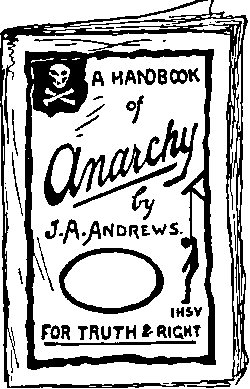
In what was a period of great social upheaval, many well-known union leaders and labor spokespeople actually declared their support in the decade, 1886–96. But they had to do so from behind pseudonyms or in private. Years later they could publically acknowledge having being influenced by propagandists from the MAC, in particular by Jack Andrews, a major figure, who, among other things, believed he was the first anywhere to articulate a theory of communist-anarchism.
One of the earliest members of the MAC, Andrews had to overcome a severe stutter and depression brought on by a tormented childhood, an above-average intelligence, and a fragmented cultural background. He developed skills as an inventor, a poet, and a linguist, and was prepared to push his beliefs to the extremes of sleeping rough, refusing payment for work, and living off the land. Renouncing respectability, such as the yoke of collar and tie, and devoting himself entirely to “the cause,” he impressed his comrades with his learning and sincerity, but was easily picked off by the authorities on trumped up charges when the police failed to involve him in sham dynamite plots. He gave up mass agitational work in 1895, but continued writing, including for overseas journals such as Freedom and Revolt, and moving in labor circles, becoming editor of Tocsin in 1901. He died of consumption in 1903.
Under internal and external pressures, the MAC had by 1890 already fractured into “voluntary-communist,” communist-anarchist, and individualist anarchist factions, the last specifically following Benjamin Tucker and other US writers.
Writer and publicist David Andrade, who wrote the club’s constitution, developed what would be later called lifestyle anarchism. In the 1890s this meant vegetarianism and hydrotherapy and agitation against organized religion and medical interventions such as vaccination and fluoride. He left Melbourne for Gippsland, where he attempted self-sufficiency along the lines of a scheme he’d set out in his book The Melbourne Riots (1892). In 1895 his family lost everything in a bushfire. Andrade succumbed to the loss and was institutionalized, where he died in 1929.
Perhaps the best known of all labor organizers in the period when the Australian Labor Party was born, 1890–5, William Lane, brother of Ernie, came to Australia from England in the 1880s. He quickly established himself as a journalist, and as editor of the Brisbane Worker, “John Miller,” he espoused libertarian communism under the guise of “mateship” and “cooperation.” Disillusioned with labor politics and convinced useful gains could not be made, he left the paper in 1892. After producing a documentary novel Working Man’s Paradise, he helped galvanize a mass emigration of hundreds of labor stalwarts in 1893 to Paraguay. “New Australia” foundered on a lack of preparation and over his leadership, which was veering to the authoritarian. In the early twentieth century he edited a conservative newspaper in New Zealand in which he opposed all labor-based initiatives.
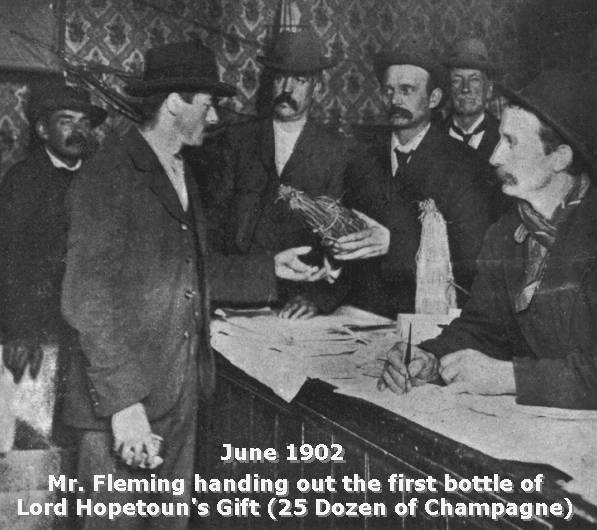
John “Chummy” Fleming was a local agitator attracted to the MAC but never seduced by it. He initiated the first May Day procession in Melbourne, in 1892, and in later years felt that it was his, even when the organizers, political laborites, told him he was not wanted. With a cow bell and his black flag he would start well ahead, slowing down gradually until it appeared he was leading the march. Among Emma Goldman’s correspondents, he continued to speak, rain, hail, or shine, in public parks until his death in the 1950s.
Its international focus and the conservative, even authoritarian nature of Australian society has meant that between that “revolutionary” period and the 1970s “youth movements” anarchism has been kept alive only by individuals or small scattered groups, a number of whom have been part of the continued emigration flow from Europe. Few have been researched in detail – a selection follows:
• A Spanish-language bulletin produced in Innisfail, Queensland by cane cutters and described as “the best anarchist newspaper produced at the time anywhere in the world” deserves mention here, with an Italian-language anti-fascist newspaper, Il Risveglio, produced in 1927 in Sydney. [See also : The Proletarian Migrants: Fascism and Italian Anarchists in Australia, Gianfranco Cresciani, The Australian Quarterly, March, 1979.]
• A school, “Koornong,” which flourished from 1939 to 1948 is just one of numerous examples of efforts for libertarian education.
• The Kleber-Claux family, from France, who energized the nudist movement in Sydney and elsewhere in the 1930s and 1940s and established one of the first communes in north Queensland.
• Harvey Buttonshaw, from Victoria, went to Spain to fight with the Syndicalists in 1936, and told George Orwell to pull his head in, or he’d get shot, just before exactly that happened. He is among the group shown on the front cover of Orwell’s Homage to Catalonia.
• K. J. Kenafick [1904–?] campaigned for world peace largely on his own in the 1940s and 1950s, but did not live long enough to meet John Zube who articulated a theory he called Panarchy, or anarchism for peace, in the 1960s through to the 1990s.
• English gay man and anti-fascist refugee from Nazi retribution, John Olday [1905–1977] developed a cabaret, “Immortal Clown,” for his Café La Boheme in 1959 Sydney. His LP record “Roses and Gallows” might have been picked up by the Sydney Libertarians who made a splash from the late 1950s into the 1960s, but they were more interested in free love, personal freedom, and betting systems.
• Australia also provided a haven for Bulgarian, Spanish, Italian, and other European anarchists after World War II, Bulgaria being one of the few places where an anarchist government held office for a period between the retreating Nazis and the Soviets. Some of these were instrumental in setting up the long-running Jura Bookshop [est.1977] in Sydney in the 1970s, from which Red Fern Black Rose [est. 1981/2] was a subsequent breakaway. Again, the split was largely between syndicalist and “lifestyle” anarchisms.
The Sydney Libertarians, or The Push as they were locally known, were survived by Germaine Greer, Clive James, Wendy Bacon, and Frank Moorhouse among others, who went on to establish themselves in the “alternative” 1970s and beyond.
In the mid-1970s, Alternative Canberra, instigated by Bob James, helped organize “Confests” (a combination of conference and festival) after Graeme Dunstan and others ‘liberated’ Nimbin on the north coast of New South Wales. The Anarcho-Surrealist Insurrectionary Feminists (ASIF) was a South Australian group which developed political street theater to insist that theoretical gender equivalence among anarchists was not good enough; Pio [П O; 1951–] and his sister Thalia were Greek-born performance poets; Vince Ruiz [1912–1998] was involved with Melbourne’s Free Legal Service and the Free Store movement; Digger, Living Daylights, and Nation Review were important magazines to emerge from the ferment.
With the major events of the 1960s and 1970s so heavily influenced by overseas anarchists, local libertarians, in addition to those mentioned, were able to generate sufficient strength “down under” to again attempt broad-scale, formal organization. In particular, Andrew Giles-Peters [?–2009], an academic at La Trobe University (Melbourne) fought to have local anarchists come to serious grips with Bakunin and Marxist politics within a Federation of Australian Anarchists format which produced a series of documents. Annual conferences that he, Brian Laver, Drew Hutton, and others organized in the early 1970s were sometimes disrupted by Spontaneists, including Peter McGregor [1947–2008], who went on to become a one-man team stirring many national and international issues.
Community Radio was an important libertarian channel for numerous grouplets and individuals as feminism and green thinking in all their forms took hold. The not-so-green Libertarian Workers group in Melbourne, led by medico Joe Toscano, has since been a major force. He was instrumental in attempting exorcism of the “Haymarket effect” in May 1986 with the Australian Anarchist Centenary Celebrations. Held over four days and nights, it brought locals and international visitors together but failed in its long-term purposes, perhaps for the same reasons that William Lane failed.
James, B., (Ed.) (1979) A Reader of Australian Anarchism. Canberra: Bob James.
James, B., (Ed.) (1983) What is Communism? And Other Essays by JA Andrews. Prahran, Victoria: Libertarian Resources/Backyard Press.
James, B., (Ed.) (1986) Anarchism in Australia — An Anthology. Prepared for the Australian Anarchist Centennial Celebration, Melbourne, May 1–4, in a limited edition. Melbourne: Bob James.
James, B. (1986) Anarchism and State Violence in Sydney and Melbourne, 1886–1896. Melbourne: Bob James.
Lane, E. (Jack Cade) (1939) Dawn to Dusk. N. P. William Brooks.
Lane, W. (J. Miller) (1891/1980) Working Mans’ Paradise. Sydney: Sydney University Press.
“The past is another country.” ~ L. P. Hartley
An interesting account by Bob.
A few comments:
Local &/Or General
Bob notes that, right from the start, anarchism in Australia has been subjected to the same slander as anarchist movements everywhere, and further notes that this “opportunistic blackening of reputations has continued to the present day” (See : ‘Hard Cash: John Dwyer and his Contemporaries, 1890-1914’, M. G. Hearn, August 2000. Chapter 5: Before the Law: The Sydney Anarchy Trials, 1894-95, PDF). A useful recent examination of the impact of the former in late-nineteenth and early-twentieth century America is available in William M. Phillips, Nightmares of Anarchy: Language and Cultural Changes 1870–1914, Bucknell University Press, 2004; contemporary examples of the latter continue to abound.
Bob also laments the pernicious influence of what he terms the “Haymarket effect”, which has hounded anarchism in Australia for over a century. Combined with “the conservative, even authoritarian nature of Australian society”, an “international” — rather than local, Australian — outlook has doomed anarchism in Australia to the political margins.
There is some substance to this argument, but I believe it to be exaggerated, and the reasons anarchism in Australia has never emerged as a mass movement has a good deal more to do with, on the one hand, its fate in other islands, and, on the other hand, the peculiar nature of Australia as a white colonial outpost in the Asia-Pacific region.
In regards to the first, the historian George Woodcock (1912–1995) (in)famously remarked in the first edition of his Anarchism: A History of Libertarian Ideas and Movements (1962) that anarchism was dead, and its bullet-ridden corpse could be found among the hundreds of thousands of casualties of the Spanish Civil War (1936–1939). Like other such pronouncements (cf. former RAND corporation analyst Francis Fukuyama’s ridiculous essay on ‘The End of History?’ 1989/1992), this too proved to be something of an exaggeration.
The other key historical event which placed anarchism on the back foot was the Bolshevik Revolution: Bob makes no reference to this disaster, but if the murder of a handful of anarchists in Chicago in 1886 had a major international impact on Western workers’ movements, then the triumph of Communism in first Russia, and then throughout Eastern Europe, and later China, had an (almost) incalculable one. As such, in order to in some way understand the political marginalisation of anarchism, I think it makes more sense to speak of the combined effects on anarchism as a global movement of the triumph, first, of Bolshevism, and then of fascism, than it does Haymarket. (On a related note, see: ‘Left communism in Australia: J.A. Dawson and the ‘Southern Advocate For Worker’s Councils’, Steve Wright, Thesis Eleven, No.1, 1980; also Reason in Revolt archived issues of the Southern Advocate for Workers’ Councils.)
Contemporary &/Or Historical
Approximately 2/3 of Bob’s account is dedicated to events, personalities and projects of the late nineteenth and early twentieth centuries; another 1/3 references other items from this period through to the 1980s. Of these, The Push is more-or-less dismissed, and the remainder summarises the impact of the generation of the ’60s and ’70s on the broader cultural environment. (See, for example, ‘ON ANARCHISM’, John Kinsella interviewed by Tracy Ryan, overland, November 24, 2008.)
and suddenly we were interrupted
by
crash, bang, ring, ring, ring,
ring, ring, ring,
ring, ring, ring,
Jesus Christ!
Go away! but it was pi, so he came in
anyway.
and it was
Hey turn up the stereo and
Hey turn down the stereo
I can’t hear myself read
And wait till you hear this
and look at this
and wait till you hear that
and this is the most Reichian poem
i ever wrote
all the time using his smile
like a battering ram.
what’s all this?
– my friends said.
it’s ok – it’s pi, i told them
He’s an anarchist poet.
~ Andrew Stein
The history of The wining/dining/loving/gambling/losing Push is examined in Anne Coombs’ Sex and Anarchy, Viking, 1996; the fates of the other figures Bob mentions varies: Brian Laver is inactive (although I did have the privilege of witnessing the reception of a critical paper of his on sado-masochism at the 1995 Visions of Freedom conference in Sydney) while Drew Hutton is a Green (the Greens seemingly being a natural home for many disillusioned anarchists of that and later eras). To describe the indefatigable Dr Joe Toscano as having been a “major force” in Australian anarchism since 1986 is a matter for debate.
In the academy, ‘anarchism’ is largely regarded as the poorer, slightly retarded, and generally obstreporous cousin of Marxism — although this is slowly changing, as change it must, given the pivotal role anarchists have played in social movements of the post-Communist era. A few recent works which take anarchism seriously are 21st Century Dissent: Anarchism, Anti-Globalization and Environmentalism by Giorel Curran (Palgrave Macmillan, 2006) and From Bakunin to Lacan: Anti-authoritarianism and the Dislocation of Power by Saul Newman (Lexington Books, 2001). (On post-anarchism, see: Saul’s editorial by the seashore in Anarchist Studies, Vol.16, No.2, 2008; postanarchism clearinghouse; ‘Anarchism and Poststructuralism’ by Paul Nursey-Bray, 2003 [PDF].) In March 2000, Michael Vaux produced a bibliography of texts on Anarchism & Syndicalism in Australia & Aotearoa / New Zealand.
An autobiographical account of his adventures in the anarchist wasteland of Australia is available in ‘A Personal Journey Through Anarchism in Australia’ (1997). (See also : Verity Burgmann, ‘One Hundred Years of Anarchism’, Arena, No.74, 1986.)
…I finally determined (if you’ve got this far, THIS IS THE IMPORTANT BIT) that the question I needed to answer whatever anyone else thought about it – was what was it in the history of western civilisation that was so powerful that no matter what someone’s intention was or the ideal they said they were living by, they were invariably afraid of being an autonomous adult? I wasn’t thinking anymore about genes, or family conditioning, because it seemed to me that they had to be grappled with as part of a lived historical phenomenon – fear of conflict, of a lack of order and of a lack of rules and discipline, how was it that these attitudes had become part of your actual, real Australian society, and seemed to be everywhere, no matter what people labelled themselves, no matter how many thought they were ‘grown-up’…
It’s sometimes said the major distinction which divides ‘anarchists’ in Australia is that between the ‘class conscious’ ones and the ‘lifestylers’. Nah – the important distinction is between those people who think they already know enough and those who believe that they will never know enough and therefore must always hold themselves open to new experiences, new learning, which of course means that they are less likely to commit themselves to a hard and fast position such as going to the barricades to kill or be killed. Unfortunately, members of these two groups think they’re on the same side and, along with lots of posturing and defensiveness, argue incessantly with one another.
No agreement between these two approaches is possible and, in my view, should never be attempted. Believers in one can become believers in the other and the diffident should never be dismissed by those who like to see themselves as committed militants. Someone will have to drive the ambulances, after all, and feed the horses.
It seems to me that the class war approach is a particularly virulent attempt to keep the dark at bay, by claiming to be able to predict the future, and by believing that the necessary decisions have aleady been made. I prefer to keep my power-analysis dry. But at least the class-warriors have something to say, and at least they show signs of listening, and responding in a language that bears some resemblance to reality.
[See : Anarchism In Australia Today, A survey of current debates in the Australian anarchist movement. Revised and Edited by Leigh Kendall. First published by Melbourne anarcho-syndicalists April 1986. Second edition published by Scam Publications March 1997.]
At the bottom of all the argy-bargy are some mandatory questions – if you are going to use the word, what is to be the test of ‘anarchism’? who applies the test? If it’s to be the person providing the definition, how did that person or person get to be the judge? what happens, in real life, if they are questioned/opposed? in other words how does this definition of ‘anarchism’ deal with conflict? And what does anarchic ‘success’ actually look like?
It would seem to me that the most flattering comparison between anarchism and other ideologies is gained when anarchism is seen as a dynamic process, one to which each of us can contribute but one which no single person can control. And that anarchism is best described as a situation wherein power relationships most closely approach to equivalence. But because it is a dynamic situation, and because there are so many influential factors, there will never be any static position which is ‘ANARCHISM.’ It will always be ‘weakening’ or ‘strengthening.’ Which brings me back to History. But not just any history.
I’d argue today for a very strong attachment to one’s local place as a necessary ingredient for anarchist attitudes, and that involvement in one’s local history society was a significant thing for people aspiring to anarchism to do.
But anyone who wants to see where the racism, sexism, etc, actually came from, how it got to be inside our heads along with a pronounced regard for anyone higher-up than us, I suggest the convergent histories of trade unions / freemasons / friendly societies is where to look – and there’s no better view of the process in happening colour than from the inside.
‘Al-Qaeda and Anarchism: A Historian’s Reply to Terrorology’ by James L. Gelvin is available on my blog and as a PDF. Gelvin’s main argument is that, based on a comparative analysis, Al-Qaeda is a contemporary form of anarchism.
D’oh!
In the real world, anarchists around the world face state persecution as terrorists. One recent case involves eight folks charged with ‘Conspiracy to Riot in Furtherance of Terrorism’:
The RNC 8 are: Luce Guillen Givins, Max Specktor, Nathanael Secor, Eryn Trimmer, Monica Bicking, Erik Oseland, Robert Czernik and Garrett Fitzgerald. All were preemptively arrested prior to the RNC and have been falsely charged with Conspiracy to Riot in Furtherance of Terrorism under the Minnesota PATRIOT act in response to their political organizing. This site contains news updates, press releases, biographies and information for donating to their legal support fund and defending the RNC 8.
It’s possible that the RNC 8 were planning on hijacking some planes and flying them into buildings, but apparently that’s already been done.
Well, sorta.
The Twin Towers were brought down by pulsed energy scalar weapons launched by US airforce weapons platforms that operate in sub-orbital earthspace and which are protected from earthly observers by cloaking technology back-engineered from the Roswell UFO crash of 1947 (see the photos of John Walson for rare images of these craft). These platforms also projected holograms of the planes onto the sky beforehand – the real planes and passengers were teleported shortly after takeoff to the secret underground US military base at Montauk on Long Island using technology developed in the Philadelphia experiment of 1941. The passengers and crew were there reprogrammed by MKULTRA operatives to forget their past lives and used as pawns in the military experiments in time travel taking place in Montauk based upon the ‘unified field’ technologies developed by Nikola Tesla and confiscated by the US government in WW2.(ref the work of Montauk whistleblower Al Bielek and others). Doutre, Gage, Jones and other 9/11 ‘truthers’ are disinformation agents whose ideas of ‘controlled demolition’ distract the populace from the ‘real’ truth as to the US military/Draco-Reticulan alliances’ attempts to control the very fabric of time and space itself.
Also in the U$A, Marie Mason is currently serving the longest sentence of any environmental activist (aka terrorist) — 21 years and 10 months. Marie is one of dozens of individuals to have fallen victim to George II’s ‘Green Scare’.
In France, Sarkozy has declared war on members of the ‘anarcho-autonomous milieu’, and to this end nine folks from Tarnac — in particular Julian Coupat — are facing charges. Most recently:
Le Monde has reported that the 4th appeal for the release on remand of Julian Coupat failed on April 29. Earlier the 8 other defendants announced that they would no longer respond to any of the judge’s questions in order to “collectively protest a process of individualization that has been continually increasing in this case”. Meanwhile a member of the Parisian support committee was recently detained by anti-terrorist police.
Coupat has been targeted as the presumed author of a text called ‘The Coming Insurrection’ (extract below).
For other examples of state repression, see links on the sidebar under ‘War On Dissent’.
In Australia, building workers are, via the coercive and investigatory powers of the Australian Building and Construction Commission, subjected to laws which render them without rights, including the right to silence. See : THE AUSTRALIAN BUILDING AND CONSTRUCTION COMMISSION: AN APPROPRIATE USE OF PUBLIC POWER?, Forum on Industrial Laws Applying in the Australian Construction Industry, National Press Club, Canberra, 25 August 2008, George Williams, Anthony Mason Professor of law, University of New South Wales (PDF). Established under HoWARd, and continuing to enjoy the full support of the KRudd Government, there is nevertheless an ongoing campaign to abolish the ABCC.
The ABCC — and the Royal Commission which preceded it — has proven to be a failure in terms of its declared aims (Howard’s construction inquiry bore little fruit, Andrew West, The Age, March 5, 2009), but in terms of its real aims — which are to tame a ‘militant’ union (as part of a more generalised attempt to rollback workers’ rights and crush working class dissent) — the outcome remains uncertain.
“I AM WHAT I AM”
“I AM WHAT I AM.” This is marketing’s latest offering to the world, the final stage in the development of advertising, far beyond all the exhortations to be different, to be oneself and drink Pepsi. Decades of concepts in order to get where we are, to arrive at pure tautology. I = I. He’s running on a treadmill in front of the mirror in his gym. She’s coming back from work, behind the wheel of her Smart car. Will they meet?
“I AM WHAT I AM.” My body belongs to me. I am me, you are you, and something’s wrong. Mass personalization. Individualization of all conditions – life, work and misery. Diffuse schizophrenia. Rampant depression. Atomization into fine paranoiac particles. Hysterization of contact. The more I want to be me, the more I feel an emptiness. The more I express myself, the more I am drained. The more I run after myself, the more tired I get. We cling to our self like a coveted job title. We’ve become our own representatives in a strange commerce, guarantors of a personalization that feels, in the end, a lot more like an amputation. We insure our selves to the point of bankruptcy, with a more or less disguised clumsiness.
Meanwhile, I manage. The quest for a self, my blog, my apartment, the latest fashionable crap, relationship dramas, who’s fucking who… whatever prosthesis it takes to hold onto an “I”! If “society” hadn’t become such a definitive abstraction, then it would denote all the existential crutches that allow me to keep dragging on, the ensemble of dependencies I’ve contracted as the price of my identity. The handicapped person is the model citizen of tomorrow. It’s not without foresight that the associations exploiting them today demand that they be granted a “subsistence income.”
The injunction, everywhere, to “be someone” maintains the pathological state that makes this society necessary. The injunction to be strong produces the very weakness by which it maintains itself, so that everything seems to take on a therapeutic character, even working, even love. All those “how’s it goings?” that we exchange give the impression of a society composed of patients taking each other’s temperatures. Sociability is now made up of a thousand little niches, a thousand little refuges where you can take shelter. Where it’s always better than the bitter cold outside. Where everything’s false, since it’s all just a pretext for getting warmed up. Where nothing can happen since we’re all too busy shivering silently together. Soon this society will only be held together by the mere tension of all the social atoms straining towards an illusory cure. It’s a power plant that runs its turbines on a gigantic reservoir of unwept tears, always on the verge of spilling over.
“I AM WHAT I AM.” Never has domination found such an innocent-sounding slogan. The maintenance of the self in a permanent state of deterioration, in a chronic state of near-collapse, is the best-kept secret of the present order of things. The weak, depressed, self-critical, virtual self is essentially that endlessly adaptable subject required by the ceaseless innovation of production, the accelerated obsolescence of technologies, the constant overturning of social norms, and generalized flexibility. It is at the same time the most voracious consumer and, paradoxically, the most productive self, the one that will most eagerly and energetically throw itself into the slightest project, only to return later to its original larval state.
“WHAT AM I,” then? Since childhood, I’ve passed through a flow of milk, smells, stories, sounds, emotions, nursery rhymes, substances, gestures, ideas, impressions, gazes, songs, and foods. What am I? Tied in every way to places, sufferings, ancestors, friends, loves, events, languages, memories, to all kinds of things that obviously are not me. Everything that attaches me to the world, all the links that constitute me, all the forces that compose me don’t form an identity, a thing displayable on cue, but a singular, shared, living existence, from which emerges – at certain times and places – that being which says “I.” Our feeling of inconsistency is simply the consequence of this foolish belief in the permanence of the self and of the little care we give to what makes us what we are.
It’s dizzying to see Reebok’s “I AM WHAT I AM” enthroned atop a Shanghai skyscraper. The West everywhere rolls out its favorite Trojan horse: the exasperating antimony between the self and the world, the individual and the group, between attachment and freedom. Freedom isn’t the act of shedding our attachments, but the practical capacity to work on them, to move around in their space, to form or dissolve them. The family only exists as a family, that is, as a hell, for those who’ve quit trying to alter its debilitating mechanisms, or don’t know how to. The freedom to uproot oneself has always been a phantasmic freedom. We can’t rid ourselves of what binds us without at the same time losing the very thing to which our forces would be applied.
“I AM WHAT I AM,” then, is not simply a lie, a simple advertising campaign, but a military campaign, a war cry directed against everything that exists between beings, against everything that circulates indistinctly, everything that invisibly links them, everything that prevents complete desolation, against everything that makes us exist, and ensures that the whole world doesn’t everywhere have the look and feel of a highway, an amusement park or a new town: pure boredom, passionless but well-ordered, empty, frozen space, where nothing moves apart from registered bodies, molecular automobiles, and ideal commodities.
France wouldn’t be the land of anxiety pills that it’s become, the paradise of anti-depressants, the Mecca of neurosis, if it weren’t also the European champion of hourly productivity. Sickness, fatigue, depression, can be seen as the individual symptoms of what needs to be cured. They contribute to the maintenance of the existing order, to my docile adjustment to idiotic norms, and to the modernization of my crutches. They specify the selection of my opportune, compliant, and productive tendencies, as well as those that must be gently discarded. “It’s never too late to change, you know.” But taken as facts, my failings can also lead to the dismantling of the hypothesis of the self. They then become acts of resistance in the current war. They become a rebellion and a force against everything that conspires to normalize us, to amputate us. The self is not some thing within us that is in a state of crisis; it is the form they mean to stamp upon us. They want to make our self something sharply defined, separate, assessable in terms of qualities, controllable, when in fact we are creatures among creatures, singularities among similars, living flesh weaving the flesh of the world. Contrary to what has been repeated to us since childhood, intelligence doesn’t mean knowing how to adapt – or if that is a kind of intelligence, it’s the intelligence of slaves. Our inadaptability, our fatigue, are only problems from the standpoint of what aims to subjugate us. They indicate rather a departure point, a meeting point, for new complicities. They reveal a landscape more damaged, but infinitely more sharable than all the fantasy lands this society maintains for its purposes.
We are not depressed; we’re on strike. For those who refuse to manage themselves, “depression” is not a state but a passage, a bowing out, a sidestep towards a political disaffiliation. From then on medication and the police are the only possible forms of conciliation. This is why the present society doesn’t hesitate to impose Ritalin on its over-active children, or to strap people into life-long dependence on pharmaceuticals, and why it claims to be able to detect “behavioral disorders” at age three. Because everywhere the hypothesis of the self is beginning to crack.
Huh: an Australian court has ruled that involving children in the promotion of neo-Nazism is not in the children’s best interests. “Sometimes it’s hard to be a woman / giving all your love to just one mandead foreign incestuous coprophiliac dictator“.
Court puts ban on pro-Nazi mum
ninemsn staff
May 6, 2009
A neo-Nazi mother has been banned from taking her young son to right-wing political rallies or teaching him her fascist views, a court has ruled.
The German-born woman, known only as Ms Hoover, and her estranged Australian partner, known as Mr Hoover, are also forbidden from inciting racial hatred when in the presence of the six-year-old boy, Family Court Deputy Chief Justice John Faulks ruled in a judgement delivered in Canberra last month.
The woman, was once a bonehead like her former partner, is also banned from viewing pro-Nazi websites when the child is in her care.
In a separate hearing last year, the father was requested not to take the couple’s twin five-year-olds to any political rallies or marches.
FAMILY LAW – CHILDREN – best interests of the child – where Court ordered restraint on parent from doing any act or saying anything in the presence of child or permitting any other person to do so in the presence of child that is likely in all the circumstances to offend, insult, humiliate or intimidate another person or group of people because of that person’s or that group’s race, colour or national or ethnic origin – where Court ordered restraints against parent for acts and saying of things which are contrary to certain anti-vilification provisions at State/Commonwealth discrimination legislation while child is in the parent’s care – where Court ordered restraint of parents from actively encouraging or teaching child to hold any particular political viewpoint of the parent – where Court ordered restraint of parents from taking or permitting child to be taken to rallies or political gatherings with an overt political purpose – where Court ordered restraint of parent accessing internet material promoting Nazism, neo-fascism or websites that advocate racial vilification or which may advocate or support acts which may be in breach of State/Commonwealth discrimination legislation while the child is in their care
Al-Qaeda and Anarchism: A Historian’s Reply to Terrorology
James L. Gelvin Terrorism and Political Violence
Vol.20, No.4, 2008 (563–581)
This article situates al-Qaeda and similar jihadi movements within the category of anarchism. In so doing, it challenges the central pillar of the terrorology paradigm: the notion that terrorism is useful as an independent unit of analysis. The article takes a two-fold approach; in the first part, it offers a five-part definition of anarchism, based on the literature in the fields of history, political science, and sociology. Anarchism is distinguished by five characteristics: First, anarchism is an episodic discourse which provides its adherents with a prescription for action and which has been consistently available to, but only sometimes adopted by, political actors in the modern world. Second, anarchism makes for itself the claim of being defensive in nature. Third, anarchism is anti-systemic; i.e., the target of anarchist grievances is the very system (the nation-state system, capitalism) anarchists view as the source of oppression. Fourth, by “othering” the source of oppression, anarchists delineate, either implicitly or explicitly, an ideal counter-community. Finally, unlike the disarticulated domain of, for example, scientific socialism, the discursive field of anarchism draws heavily from the specific cultural milieu from which it springs. The second part of the article examines al-Qaeda and similar movements in terms of these five characteristics, contrasts al-Qaeda with other organizations (Hamas, Hizbullah) which have often been conflated with al-Qaeda under the terrorist rubric, and argues that, based on those characteristics, al-Qaeda does not represent a new or sui generis phenomenon, but rather fits squarely into the anarchist mold.
According to an apocryphal story, Henry Kissinger/Andre Malraux/an unidentified journalist once asked Chinese premier Zhou Enlai about the significance of the French Revolution. Zhou reportedly replied that it was still too early to tell. Taking this story in its intended spirit, one might reasonably ask the following question: If it is too early to determine the significance of a phenomenon that had occurred a century and a half earlier, is it at all reasonable to attempt to determine the significance of one that is a mere two and a half decades old? More specifically, is it possible for historians and other social scientists writing six years after the attacks of 9/11 (when most turned their attention to the problem) to typologize and historicize the phenomenon of jihadi movements such as al-Qaeda?
Zhou’s reported caution aside, it is not as if the freshness of the phenomenon has prevented everyone from journalists to historians to specialists in the newly reinvigorated field of “terrorology” from weighing in on the issue. Some have chosen to view contemporary jihadi movements as a phenomenon sui generis; for others, they are variations on one or another historical theme. Putting aside for the moment the ‘‘what went wrong’’ school of analysis, which presents jihadi movements as a manifestation or the logical culmination of a civilization gone bad,1 two styles of sui generis narrative appear with some regularity. First, there are those accounts that focus on the genealogy of jihadi movements by applying a traditional history of ideas methodology. In these accounts, ideas evolve one from the other in a linear and progressive manner, somehow radiating their influence across time and generations. Thus, the family tree of contemporary jihadi movements most frequently begins with ibn Taymiyya and runs through Muhammad ibn Wahhab, Mawlani Abul A’la Mawdudi, Sayyid Qutb, Muhammad al-Faraj and ‘Abdullah ‘Azzam, until it reaches ‘Umar ‘Abd al-Rahman (“the blind sheikh”), Ayman Zawahiri, and Osama bin Laden.2 Like all traditional history-of-ideas narratives, this one attempts to make up for what it lacks in sufficiency with an overabundance of necessity. (As will be seen below, a stronger case might be made for replacing the progressive chronological sequence with one that starts with bin Laden and continues back in time through ibn Taymiyya, and substituting the words “selected and drew from” for “influenced”.)
Others have attempted to address this shortcoming by affixing to their narratives contingent external events that, they claim, have increased the availability of or receptivity to proto-jihadi or jihadi ideas. Thus, the now-familiar stories of a drunk American woman’s abortive shipboard seduction of Sayyid Qutb (and the Cairene’s reputed and less than convincing shock at the loose, small-town American values of the late 1940s [!]), the petrodollar-backed spread of Wahhabi doctrines, the hothouse atmosphere of Nasser’s and Mubarak’s jails and America’s covert support of Arab-Afghan mujahidin fighting the Soviet Union.3 Unfortunately, accounting for the resonance of jihadi ideology (instead of, say, the Islamo-nationalism represented by Hamas or Hizbullah or a more “traditional” Islamist ideology such as that espoused by the Muslim Brotherhood in Egypt) remains a problem here as well. And just what is the point of social science if every phenomenon belongs to its own distinct category?
If, on the other hand, contemporary jihadi movements are to be put into an already existing social science category, what category might that be? “Islamofascism” has achieved a certain cachet in right-wing political circles, but if one were to set aside the superficial and normative attributes contemporary jihadi groups and genuine fascist movements hold in common (i.e., their shared propensity for violence and general nastiness), it soon becomes apparent that the rubric “Islamo-fascism” is polemic masquerading as analysis and that the only ones who would make a connection between the two disparate phenomena are those who know little about either Islamic movements or fascism. There is a similar problem of confusing the glitter with the gold when it comes to transforming “terrorism” from a tactic into a category of analysis (a problem matched only by the perennial dilemma of defining “terrorism” in the first place4), and the attempt to save terrorism as a transhistorical category by differentiating among “waves of terrorism” or between the “old terrorism” and the “new terrorism” only serves to demonstrate why political scientists and habitues of think-tanks should study more history.5 In the end, one must agree with the assessment made by Walter Laqueur, of all people, thirty years ago that “a good case can be made for the comparative study of terrorism, but it should [be] apparent that not everything can be compared with everything else”.6
There is, however, one comparative category that has achieved somewhat of a cult status that begs for further investigation: the jihadism promoted by al-Qaeda and its ilk, on the one hand, and anarchism, on the other. Soon after the events of 9/11, I began making the comparison myself in talks and written works. For example, in the Introduction to my The Modern Middle East: A History, I drew the distinction between al-Qaeda and mass-based Islamist groupings such as Hamas and Hizbullah and wrote of the former,
The preference of the leaders and adherents of al-Qaeda for action over ideology, their single-minded focus on resistance, their lack of programmatic goals, their pursuit of violence for its own sake, their use of a highly decentralized structure built upon semi-autonomous cells—all these factors align al-Qaeda with a type of movement that historically has had nothing to do with Islam at all: anarchism. Like other anarchist movements, al-Qaeda is reactive. It focuses solely on resisting what it considers to be an intrusive alien order and preserving a culture and lifestyle and the homeland of that culture and lifestyle its members believe to be under attack. And unlike other movements whose discourse al-Qaeda shares, al-Qaeda does not operate as a cog within the international state and economic systems. Rather, it wars on those systems.7
Although I have changed my mind about some of the particulars of my argument, overall I still think it stands.
In all modesty, I must add that I was hardly alone in viewing al-Qaeda in this way. Others also drew the comparison between al-Qaeda and anarchist organizations, particularly those anarchist organizations that emerged during the period between 1880 and 1920, the so-called heyday of anarchism: The Economist (‘For Jihadist, Read Anarchist’); Graham Stewart for the Times of London (‘Al-Qaeda, Victorian Style’); Niall Ferguson (who refers to al-Qaeda-style jihadism as “Islamonihilism . . . in the Nechaevan tradition”); John Gray (“The strategy [of al-Qaeda] is the same [as Conrad’s Secret Agent]—to remake the world by spectacular acts of terror”); the Rand Corporation’s James Dobbins (“If Al Qaeda has a historic antecedent that one can usefully point to, it’s probably the anarchist movements of the nineteenth and early twentieth century”); Lee Harris in Policy Review (who speaks of the “Sorelian myth” guiding al-Qaeda’s tactics); Ted Galen Carpenter for the McClatchy-Tribune News Service (“The closest historical analogy for the radical Islamic terrorist threat is neither the two world wars nor the Cold War . . . It is the violence perpetrated by anarchist forces during the last third of the nineteenth century”); Malise Ruthven (“The [jihadi] message of revolutionary anarchism that ‘every system that permits some people to rule over others be abolished’ owes more to radical European ideas going back to the Jacobins than to classical or traditional ideas about Islamic governance”) and so on.8
Where I differ from most of the aforementioned, however, is what I mean by the term “anarchism”. Most of those listed above do not use the term to delineate a distinct type of political phenomenon; rather, most adopt the assumptions of terrorology and compare the seemingly mindless violence perpetrated by the proverbial black-clad, bearded, bomb-wielding nineteenth-century anarchist of legend with the proverbial white-clad, bearded, bomb-wielding al-Qaeda operative of present. Hence, articles explaining the acts of 9/11 in terms of nineteenth-century anarchism almost inevitably include a list of what might literally be taken as anarchism’s greatest hits, such as the following:
Beginning in the 1880s . . . the world community of nations considered anarchism to pose the greatest threat to the internal political and economic order, and to international stability. Between 1894 and 1900, anarchist assassins had killed the President of France, the Empress of Austria and the King of Italy. In Russia, anarchists would assassinate numerous government ministers. In September 1901, anarchist Leon Czolgosz assassinated President William McKinley. McKinley’s assassination came after a wave of anarchist terrorism in Europe. The political (and to some extent social and economic) consequences were similar in
many respects to those of the 9/11 attacks.9
That the concept of anarchism is so easily shorn of any analytical utility in articles such as the above cannot just be blamed on the kudzu-like effect of the terrorology paradigm. Responsibility must also be borne by those social scientists who have studied the phenomenon and who cannot seem to agree on an acceptable definition. They, in turn, might point to the difficulty of defining a phenomenon whose self-professed adherents have included William Godwin and Pierre-Joseph Proudhon, Peter Kropotkin and Mikhail Bakunin, Georges Sorel and Errico Malatesta, Noam Chomsky and Howard Zinn, Emma Goldman and Sacco and Venzetti, Leo Tolstoy and Annie Besant, Alexander Berkmann and Sergei Nechaev. No wonder, then, that even normally eloquent spokesmen for the cause such as Daniel Guerin have been reduced to defining anarchism affectively as a “visceral revolt”.10 As anarchist and convicted terrorist Emile Henry put it (quite ironically, in light of the argument of this paper) on the way to the guillotine,
Beware of believing anarchy to be a dogma, a doctrine above question or debate, to be venerated by its adepts as the Koran by devout Moslems. No! the absolute freedom which we demand constantly develops our thinking and raises it toward new horizons (according to the turn of mind of various individuals), takes it out of the narrow framework of regulation and codification. We are not ‘‘believers”!11
Since no commonly-accepted definition of anarchism currently exists, perhaps the following, culled from the literature of history and political science, might suffice:
Anarchism, in the broadest sense, is an episodic discourse. In other words, it is a mode of conceptualizing the world which provides its adherents with a prescription for action and which has been consistently available to, but only sometimes adopted by, political actors in the modern world.12 This last point, while not entirely necessary for a definition of anarchism, deserves to be underscored: the notion that anarchism is “consistently available to, but only sometimes adopted by, political actors in the modern world” makes it possible for us to restore agency to its rightful owner. It also helps us avoid the problematic attempt to carve up the periodic eruptions of anarchism into discrete waves: Although in such a reckoning the first wave [1880–1920] might be uncontroversial and the contemporary wave [say, 1989-present] might prove arguable, the wave theory falls short when it comes to dealing with Spain during the 1930s, the overly-romanticized events of 1968 and countless other localized and/or fleeting eruptions.
To continue with our definition: Like similar discourses—racial anti-Semitism, for example—anarchism makes for itself the claim of being defensive in nature. Unlike racial anti-Semitism, however, anarchism is after a much bigger fish than society’s outcasts: Anarchism targets the very system that is, for anarchists, the wellspring of subjugation. (In this alone anarchism differs from nationalism, whose very raison d’eˆtre is the assertion of the right of a self-proclaimed “nation” to participate in the system.) That system has historically been identified with the oppression of nation-states, capitalism, or (more recently) globalization and neo-liberal economics, and the operant oppressor that is the immediate target of anarchist antipathy might be the state, the bourgeoisie, “the establishment”, or multinational corporations and the International Monetary Fund.13
This brings us to the final two parts of our definition. Anarchism has commonly been identified with the adage (attributed to Eduard Bernstein), that “the goal is nothing, the movement is all”. This is not really the case. While the goal does play second fiddle to the movement, the very structure of the world as constituted by anarchists requires them to delineate the contours of some sort of ideal “countercommunity”, either explicitly or implicitly.14 Of course, those contours, and the tactics for bringing the counter-community into being (if, indeed, it does not already exist in some inchoate, unselfconscious form), have hardly been consistent over time.
And so the final point: Anarchism differs from discourses like scientific socialism in one very fundamental way. Scientific socialism creates for itself an enclosed, “disarticulated” domain, complete with a language and worldview that is as at home in nineteenth-century Germany as it is in twentieth-century Cuba. This is not the case for anarchism. Anarchism rarely strays far from the cultural milieu in which anarchists are embedded. Thus, nineteenth-century European and New World anarchist movements drew their rationale, vocabulary, and visions for the ideal society from a variety of sources that today’s anarchists might view as “quaint”, including Christian communitarianism, Romanticism, socialism and Liberalism. As Noam Chomsky has put it,
There have been many styles of anarchist thought and action. It would be hopeless to try to encompass all of these conflicting tendencies in some general theory or ideology. And even if we proceed to extract from the history of libertarian thought a living, evolving tradition . . . it remains difficult to formulate its doctrines as specific and determinate theory of society and social change. . . . One might, however, argue rather differently: that at every stage of history our concern must be to dismantle those forms of authority and oppression that survive from an era when they might have been justified in terms of the need for security or survival or economic development, but that now contribute to—rather than alleviate—material and cultural deficit. If so, there will be no doctrine of social change fixed for the present and future, nor even, necessarily, a specific and unchanging concept of the goals toward which social change should tend.15
In other words, for anarchism it might be said, “the particulars are nothing, the structure is all”.
A short while ago I republished the editorial from the very first issue of Black Flag. Forty years later…
NEW
As Black Flag brings out its May 2009 issue, we proudly present all three of the pre-2009 issues produced by the current collective, for free download from the libcom.org website.
But that’s not all! For a sneaky peak at our cover story for the new issue, check out our sneaky preview.
Alongside a look at Greece in the aftermath of the riots, Black Flag is covering:
In focus: In the first of a three-part series, Tom Gaynor looks at New Labour’s time in power. News: Laura Norder enters the Sparrow’s Nest, Nottingham’s archive of liberty. Interview: Black Flag talks to Irish anarchist Andrew Flood about his recent journey into the weird and wonderful world of US activism. Investigation: Paul Stott on media attempts to link Islamist terror to 19th century anarchists.* Interview: Rob Ray talks to a member of the Legal Defence and Monitoring Group about protest and policing. Theory: The Anarchist Federation bring their perspective to the economic crisis. Analysis: Iain McKay remarks on the tendency of writers to impose their own prejudices on anarchist theory in defiance of reality. History: Continuing our look at anarchists past, Ade Dimmick writes on Simone Weil. Radical Reprint: Malatesta explains why anarchism is not a destructive creed but a creative one. History: Glasgow’s Bloody Friday in 1919. Interview: Mark Leir on his new biographical account of Mikhail Bakunin. Review: Live Working or Die Fighting by Paul Mason. Review: The Anarchist FAQ. Reviews column: Hob’s Choice, rounding up some of the best new pamphlets available.
Black Flag is stocked in radical bookshops across the UK and available from AK Distribution and Active Distro. The editorial address is Black Flag, BM Hurricane, London, WC1N 3XX, UK. Each issue costs £3 + £1 p&p. UK cheques payable ‘Black Flag’. Email blackflagmag AT yahoo.co.uk for more information.
…aka, an excuse to dump some of the hundreds of sites I have bookmarked…
Politricks
Promissory Notes : From Crisis to Commons
Midnight Notes Collective & Friends
April 2009
[PDF]
Huh. Something new from Midnight Notes.
An Invertebrate Left
Perry Anderson on Italy’s Squandered Heritage London Review of Books
March 12, 2009
Perry provides a potted history of the post-WWII Italian (Marxist) left, “once the largest and most impressive popular movement for social change in Western Europe”, now up shit creek without a paddle… or is it? Naturally, Anderson ignores anarchism, but curiously avoids referencing Operation Gladio or the ‘strategy of tension’.
Bloggy
A neat-o blog I recently discovered is called Poumista, ‘Against Stalinism and Fascism’, written from the perspective (one assumes) of a follower of Nin who escaped 1930s Spain via his/her own personal TARDIS and is now wreaking their revenge by blogging furiously. Poumista’s first blog entry (June 2008) concerns Communist hack Claud Cockburn: I still gotta copy of his writings on the conflict in Spain lying around somewhere.
Reading the Maps. Great stuff from some islands to the south-west (I think). In March, the fine volk @ Reading had a red-hot go at the conspiracy cranks associated with Uncensored zine. Whether excoriating anti-Semitic propaganda or examining history, literature or politics, Reading is hours of fun for the whole family!
“The vast majority of people in Britain eat meat but have little knowledge of how that meat ends up on their table. In a powerful observational documentary, Slaughterhouse: The Task of Blood reveals the day-to-day workings of a small, family-run abattoir and attempts to get inside the minds of the people who work there. It’s a hidden part of British life, but the reality is that thousands of animals are slaughtered every day in abattoirs. This film shows the process of meat production as animals are killed, butchered and stored in fridges before being transported to retail outlets. It reveals the attitudes of the workers to their task, their colleagues and life. Slaughterhouse: The Task Of Blood is produced by BAFTA award winning film-maker, Brian Hill.”
Speaking of films, radicalfilms.co.uk is a good resource for all kindsa moving images.
Finally, hello to my readers from Cayman Islands, Tonga, Botswana, Mauritania, Falkland Islands (Malvinas), Cook Islands, Swaziland, Lesotho, Kyrgyzstan, Chad, Tajikistan, Djibouti, Grenada, Saint Vincent and the Grenadines, Cape Verde, Mali, Suriname, Samoa, Turks and Caicos Islands, Mayotte, Belize, Andorra and Madagascar.
“Organisers of this afternoon’s May Day rally through the streets of Melbourne are expecting a big turnout.” ~ ABC, May 3, 2009
Coverage of May Day in Melbourne by the corporate/state media has been minimal. In the blogosphere, see : may day… pagan and political, HERSTORY = Ponderings, Passions & Politics, May 2, 2009 & … May Day on Sunday 3 May, MelbourneProtests Weblog, May 4, 2009:
The Melbourne May Day Committee held its annual march, concert and family festivities at Trades Hall on Sunday 3 May. Attendance seemed smaller than last year, to begin with at least, but still amounted to a respectable showing on the march through the city. Children were especially well catered for this year, with not only the usual rides and slides, but also a splendid miniature train to ride on the march. Most prominent was a large contingent of the Tamil community, but many others will be seen in the following images, and in this slideshow on YouTube:
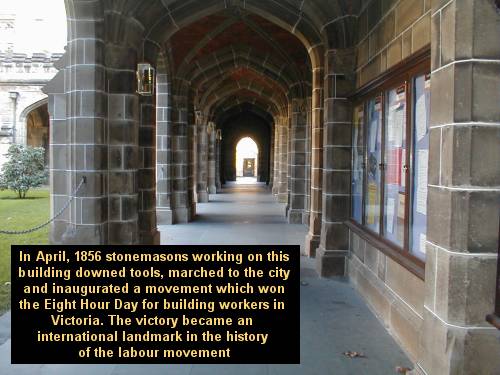
April 21, 1856 : “Stonemasons lead a protest march from University of Melbourne to Parliament House, calling out workers at building sites on the way… Melbourne’s building workers, generally without loss of pay or other conditions, had gained an unprecedented widespread and sustainable victory. Their achievement established a national and international standard to which working people everywhere could aspire. It was widely celebrated as a world first and formed the basis of Australia’s reputation as a ‘workingman’s paradise’. However, only a minority of workers initially won the Eight Hour Day. Most workers, including women and children, generally worked longer hours for less pay. It was common to work twelve to sixteen hours a day.”
“In the immediate aftermath of the Eight Hour Day victory, the Victorian trade union movement began to plan for the future by organising a permanent location. They were granted land on the corner of Lygon and Victoria Streets in 1858 and, after occupying a temporary structure, started work in 1874 on the Trades’ Hall and Literary Institute of Melbourne, which still occupies this site. It was the world’s first Trades Hall building.”
“Eight Hour Day processions were held annually on April 21 and in 1879 the Victorian government declared it a public holiday. The processions became the largest public celebrations for decades, as workers marched with elaborate banners, floats and bands through Melbourne and country towns, watched by tens of thousands of people. In 1934 the Eight Hour Day was renamed Labour Day. The 1930s Depression and Second World War brought about the decline of the marches, the final occurring in Melbourne in 1951. In 1955 Moomba was introduced to replace what had begun a century earlier as a celebration of the Eight Hour Day.”
See also : Melbourne Celebrates the 150th Anniversary of its Eight Hour Day, Peter Love, Labour History, Vol.91, 2006: “The program of public events began with a formal opening ceremony in the cloisters of the Old Law Quad at the University of Melbourne where the building workers downed tools in 1856. Hosted by Glyn Davis, it was addressed by leading trade unionists and the Minister for the Arts. Descendants of the Eight Hour Day pioneers admired the restored union banner on display and listened to rousing songs from the Trade Union Choir.”
In this Victoria, our dear land,
The first that dared be free,
To show the world what freedom meant
In new lands ‘cross the sea
– Ode to the Eight Hours’ Pioneers
Hamilton Mackinnon
April 21, 1896
May 4, 1886 : The Haymarket Riot, Chicago, Illinois. Seven police officers were killed when a bomb exploded on a busy city street during a workers’ rally as part of the US labour movement’s agitation for the 8-hour day. Eight local anarchists are framed: George Engel, Samuel Fielden, Adolph Fischer, Louis Lingg, Oscar Neebe, Albert Parsons, Michael Schwab and August Spies. Seven of the accused were condemned to death and one (Oscar Neebe) was given twenty years’ imprisonment. The death sentence of two, Samuel Fielden and Justus Schwab, was subsequently commuted by Governor Oglesby to life imprisonment, but executive clemency was extended in 1893 by Governor Altgeld to all three of those serving terms in the penitentiary. Of those condemned to execution, one (Louis Lingg) committed suicide in the county jail by exploding between his teeth a small dynamite bomb. The remaining four (Spies, Parsons, Engel and Fischer) were hanged in the county jail at Chicago on November 14, 1887.
“The time will come when mankind will look back upon the execution of the anarchists as we of this day look back upon the burning of the witches in New England.” ~ -ex-Senator Trumball at the 1887 funeral.
May 1, 1890 : “…The first to follow the example of the Australian workers were the Americans. In 1886 they decided that May 1 should be the day of universal work stoppage. On this day 200,000 of them left their work and demanded the eight-hour day. Later, police and legal harassment prevented the workers for many years from repeating this [size] demonstration. However in 1888 they renewed their decision and decided that the next celebration would be May 1, 1890.
In the meanwhile, the workers’ movement in Europe had grown strong and animated. The most powerful expression of this movement occurred at the International Workers’ Congress in 1889. At this Congress, attended by four hundred delegates, it was decided that the eight-hour day must be the first demand. Whereupon the delegate of the French unions, the worker Lavigne from Bordeaux, moved that this demand be expressed in all countries through a universal work stoppage. The delegate of the American workers called attention to the decision of his comrades to strike on May 1, 1890, and the Congress decided on this date for the universal proletarian celebration…
The first of May demanded the introduction of the eight-hour day. But even after this goal was reached, May Day was not given up. As long as the struggle of the workers against the bourgeoisie and the ruling class continues, as long as all demands are not met, May Day will be the yearly expression of these demands. And, when better days dawn, when the working class of the world has won its deliverance then too humanity will probably celebrate May Day in honor of the bitter struggles and the many sufferings of the past.” ~ Rosa Luxemburg, ‘What Are the Origins of May Day?’ (1894).
In Melbourne, anarchists like Chummy Fleming played a leading role in early May Day celebrations/protests, organising the first in 1890. Bob James writes: “Yet another initiative for which Fleming is credited is the first collection in Victoria for the relief of the striking London dockers, eleven pounds. The movement spread and it is a matter of history how many thousands of pounds were sent from Australia.
One of the most surprising pieces of evidence for Fleming having a wider view and, most importantly, a recognition of the part played by individuals in mass reform, is his concentration in MAC (Melbourne Anarchist Club) debates on women’s rights and the need for sexual freedom. Not a great paper giver, he is first recorded leading a debate in September, 1886 and in October he spoke for ‘Free Love’. The debate had been adjourned from the previous week so that ‘ladies’ could participate in what had proved to be a ‘stimulating discussion’. On the Sunday preceding 27 February, 1887 he spoke on ‘The Subjection of Women’, and continuing his interest, on ‘Marriage, Prostitution and the Whitechapel Murders’ on 15 December, 1888.
The as-yet-unsighted ‘Liberty’ pamphlet ‘Free Love – Explained and Defended’ issued by the Club without the author’s name in 1886 or 1887, may therefore be Fleming’s, or a resume of the discussion in September-October, 1886, but is most likely to be David Andrade’s as all the others but one are.”
As a bootmaker, ‘Chummy’ campaigned for better work conditions and the right to organize. He was elected as delegate of the Victorian Operative Bootmakers’ Union to the Trades Hall Council in 1890. Next year he was president both of the bootmakers’ union and of the Fitzroy Progressive Political League. His union activities were important to him but it was only in the early 1890s that he was not considered an outsider by the dominant protectionist group of union officials. In 1890 he helped to organize the first Victorian May Day meeting and in 1892 chaired the first public May Day meeting. For his part in the growing militancy of the unemployed, Fleming was beaten up by paid thugs and isolated from mainstream politics. He continued to support co-operatives and the village settlement movement.
Particularly after the death of Andrews in 1903, Fleming publicly emphasized his anarchism. No theoretician, he left few written statements, but corresponded with overseas journals until late in life. In 1904 he was expelled from the T.H.C. for his attacks on Labor politicians. He was active in the anti-conscription movement during World War I but afterwards his public activities declined.
Fleming continued to march on May Day and to address the public from his Yarra Bank stand. A gentle man, affectionately regarded by later generations, he looked forward to a millenium in which happiness and brotherly love would prevail. He suffered from a duodenal ulcer before his death some time on 25 or 26 January 1950 at his home in Carlton, where he had carried on his own bootmaking business for many years. He was cremated.
“A representative of The Age asked Mr Fleming why the wine had not been sold and the money distributed. His reply was perhaps characteristic. He said: “We are tired of the inequalities among the people. The rich drink champagne and the poor small beer. Besides, it would have been a breach of faith to his Lordship to have sold the wine”. When The Age reporter pointed to the drunken mob outside, and asked if that was the equality he meant, Mr Fleming could only say that such a thing as the distribution of champagne had never occurred before in Australia, and that champagne was not intended only for dainty stomachs. On Tuesday Mr Fleming was the secretary of the unemployed. Yesterday he was seeking by beer and champagne to create the effervescent equality of the Socialist.” ~ The Age, June 26, 1902.
When May Day celebrations were recommenced in 1928, Chummy, although not part of the official organising committee, led the May Day March in Melbourne until his death. He normally started marching 30 minutes before the official march and waited for the main march to catch up with him.
May 1, 2000 : In anticipation of and in order to publicise upcoming demonstrations (S11) against the Asia-Pacific meeting of the World Economic Forum, anarchists and others organise a rally and march. See : An Activists Diary: The Battle Of Melbourne, Monday, 18 September 2000, a compilation of postings from [email protected].
May 1, 2001 : “For the first time in more than 50 years, thousands of workers, students and community activists marched and protested against capitalism and corporate exploitation.” One of the organising groups for this event, which included a ‘blockade’ (sic) of the stock exchange and a tour of corporate Melbourne, was the leftist ‘M1 Alliance’. The ‘M1 Alliance’ was launched as a continuance of the ‘S11 Alliance’, one of the two main organising bodies for the S11 protests (the other being S11-AWOL: Autonomous Web of Liberation).
In response to the influx of young radicals and in pig ignorance of its history, Peter Lewis wrote a superb editorial on ‘The Hijacking of May Day’ (Workers Online, No.134, May 3, 2002). Peter is now working as a Director for PR firm Essential Media Communications. On EMC, see : ‘Iron fist of irony’, Elisabeth Wynhausen, The Australian, May 24, 2008: “Lewis, the one director based in Sydney, has worked as a journalist on Sydney’s The Daily Telegraph and a press officer for a [former] NSW government minister. When Michael Costa, then secretary of the NSW Labor Council, hired him as his media officer – a consultant position he holds to this day – Lewis set up his own company, Rivet Media in the Labor Council offices. The Labor Council has been rebadged Unions NSW and Costa is now [sic] a senior minister in the Iemma Government. Lewis, who is said to be close to Costa’s successor, Unions NSW secretary John Robertson, has the EMC office in the building next door to Trades Hall…”
Unlike Chummy Fleming, who died in poverty after a lifetime of dedication to the labour movement, it seems unlikely Peter Lewis will depart this wonderful world penniless.
NB. Local anarchists have been commemorating May Day on May 1 each year for the last 30–40 years, meeting @ the 8 Hour Monument (opposite Trades Hall) at midday.
‘The Melboume Anarchist Club Manifesto’
D.A. Andrade, May, 1886.
‘To the People of Australasia
The Melbourne Anarchist Club extends its greetings to the liberty loving citizens of these young colonies and appeals to them to assist its members in their efforts to remove those public sentiments and public institutions, which have been transplanted here from the northern hemispheres, retard social progress and happiness; and to substitute in their place the enabling principles of Liberty, Equality and Fraternity!
The objects of the Melbourne Anarchist Club are:
1. To foster public interest in the great social questions of the day, by promoting inquiry in every possible way; to promote free public discussions of all social questions; and to circulate and publish literature, throwing light upon existing evils of society, and the methods necessary for their removal.
2. To foster and extend the principles of Self-Reliance, Self-Help and a spirit of Independence amongst the people.
3. To uphold and maintain the principles of Liberty, Equality and Fraternity. By Liberty we mean ‘the equal liberty of each, limited alone by the equal liberty of all.’ By Equality we mean ‘the equality of opportunity for each individual.’ And by Fraternity we mean ‘that principle which denies national and class distinctions, asserts the brotherhood of Man, and says ‘The World is my country.’
4. To advocate, and seek to achieve, the abolition of all monopolies and despotisms which destroy the freedom of the individual and which thereby check social progress and prosperity.
5. To expose and oppose that colossal swindle, government, and to advocate abstention from voting, resistance to taxation, and private co-operation or individual action.
6. To foster mutual trust and fraternity amongst the working people of all ranks, and to turn their attention to the common foes: the priests and the politicians, and their co-adjutors, attacking principles rather than individuals.
7. To unite the co-operation of all who have realised the innate evils of our governing institutions, and desire their speedy dissolution for the general benefit of humanity.
8. To promote the formation of voluntary institutions similar to the Melbourne Anarchist Club throughout Victoria and the neighbouring colonies, and, with their consent, to eventually unite with them forming the Australasian Association of Anarchists.’
Boneheads in Dortmund attacked a trade union rally: “In the western city of Dortmund, police opened an inquiry against 280 neo-Nazis who attacked a parade of trade unionists with stones and clubs Friday. A police union [?] said neo-Nazis assaulted people and police in five other cities on May Day.” Berlin can has pictures.
Organisers of this afternoon’s May Day rally through the streets of Melbourne are expecting a big turnout.
Workers are gathering outside Trades Hall in Lygon Street, Carlton and will march down Swanston, Bourke and Russell Streets, before returning to Lygon Street, from 1:00 pm.
Trades Hall secretary Brian Boyd says they will be calling on governments to do more to protect jobs during the economic downturn.
“There will be a couple of speeches along the way, we will definitely be calling on both the State and Federal Government to take the impact on job losses from the financial crisis far more seriously than they are already,” he said.
“We think there’s a lot more governments can be doing to make sure that Victorian jobs are saved.
“Both the state and federal budgets are coming out at the moment, even though they’ve got some stimulus packages, they aren’t targetted enough to protect our manufacturing base that is slowly being eradicated by overseas markets, we need to concentrate on our manufacturing base.”
Makes me wanna shoop listen to some Kraftwerk Kreator.
Brutal riots left and right
Out to destroy, willing to die
Honour killing, blood is shed
A cruel reality in empires built on sand
Dark war, more gruesome than ever before
Supports this decadence galore
A tyrant’s feast on shoulders
Of the poorest of the poor
The necrologue for the elite
The rise of heartless bourgeoisie
While flags are waving
Everywhere they scream…
Bonus!
A special tip of the hat to the-professional-chatterers-formerly-known-as-revolutionary-communists @ spiked: ‘A caricature of a riot’ by Frank Furedi (April 2) and ‘Turning Ian Tomlinson into the Princess Diana of protest’ by Brendan O’Neill (April 14) are both exquisite pieces. Oh, and not content with their current stable of front groups, RCP/LM/spiked have established another called Modern Movement.
Two Greek anarchists are making molotov cocktails. One says to the other: "So who will we throw these at then?" The other replies: "What are you, some kind of fucking intellectual?"