Blockbuster Video: Wow! What a difference!

[Update : Hoon hunt targets ringleaders, Catherine McAloon, The Age, January 15, 2007: “Police say they are determined to catch 40 to 50 ringleaders of a violent rampage that followed an illegal burn-out meeting in Melbourne’s south-east early on Saturday… Detective Senior Constable Mark Robertson of Dandenong Criminal Investigation Unit (CIU) said the intensity of the violence was unprecedented [sic] in Melbourne. “The streets of Melbourne have just never seen anything quite as extensive as this. We’ve had the G20 issues and obviously the WEF (World Economic Forum) issues three or four [ie, seven] years ago, but as far as suburban violence is concerned, certainly to my knowledge this is the first that we’ve seen anything of this nature,” Detective Robertson said.” Peter Brown (councillor, Keysborough South ward, City of Greater Dandenong) has offered support to Mick Armstrong‘s theory regarding the completely foreign nature of the violence, speculating that the 40 or 50 babies in prams are from the Sudan. Or possibly New Zealand. Or England. Or Germany. Or Sweden. Certainly not Australia. And even then, probably from interstate. Or, at least, the north-western suburbs. Armstrong added that “Middle class students who attend The University of Melbourne should offer no comfort to these crazies. We should do whatever we can to isolate them. They are wreckers. If they grow in Australia it will simply make it harder to build a revolutionary organisation that can participate in mass struggles, draw lessons from past victories and defeats and convince the working class of the way forward to socialism. As well as illegally race cars.”]

Inspired by the sight of G20 protesters racing cars in the CBD last November, yoof in Noble Park went on a wild rampage Friday night. Police believe that babies in prams acted as ringleaders in the orgy of violence, and Mick Armstrong‘s knee has issued a statement identifying the babies as being foreign in origin, part of an international ‘baby bloc’ that has caused mayhem in cities throughout Europe. Marxist University students — should they be aware of its existence — have been advised to steer well clear of the area, and medical authorities have issued health warnings advising the general public to report immediately to their local police station should they show any signs of the ‘hoon plague’.

Independent investigators have since confirmed the link between local hooligans and the filthy fucking foreigners, believed to have their secret headquarters, naturally enough, somewhere overseas. Other revolutionary socialist parties have speculated that the trigger for Friday night’s violence was the result of the fact that ‘Someone spray-painted graffiti on the basketball court wall in Noble Park [USA] on December 12 [2006]. The scrawlings read “CCUG”, “West Side 4 Life”, “DOPE!” and “Camo Classic Underground”.’ Counter-terrorism experts at the Australian Homeland Security Research Centre have also since confirmed that the likely motivation for the assault on Blockbuster was the company’s notorious decision in 1989 to refuse to stock Martin Scorsese’s award-winning film The Last Temptation of Christ, and have requested further Federal Government funding to explore the link between this decision and the riots in Seattle at the meeting of the World Economic Forum in 1998.

Mobs go on wild rampage
Carly Crawford and Kellie Cameron
Sunday Herald Sun
January 14, 2007

AUTHORITIES will launch a blitz against hoons in Noble Park in response to a night of violence and destruction.

Senior police last night unveiled plans to smash out-of-control mobs which have taken over streets and shop strips.

Chief Inspector Brian Graham said extra surveillance cameras and traffic obstacles would be installed, illegal parkers forcibly moved on and hoons’ cars seized.

The Sunday Herald Sun exposed the hoon plague in Noble Park last week.

About 50 police were undermanned and outgunned when they were attacked with bottles, rocks and flares in the outer southeastern suburb early [Saturday morning, January 13].

The officers had gone to the corner of Princes Highway and Elonera Rd where they tried to stop drag racers and move on a crowd of more than 1500 — some with babies in prams.

In the ensuing chaos, louts climbed traffic lights, rammed light poles and signposts, burned rubbish bins and went on a rampage that resulted in a video-rental shop being trashed and its products looted.

Police yesterday arrested six men and seized five cars. The plan to combat the anarchy was devised after officers met VicRoads and local councillors.

Chief Insp Graham warned that police would not hesitate to lock away cars.

“Have a think about whether you can afford to lose your car and have a think about whether, as a spectator, you want to put your life at risk standing there,” he said.

Victoria Police sent urgent reinforcements, including the dog squad, in a bid to quell the violence about 1am at the local McDonald’s. Management locked staff inside until the mayhem subsided.

Gail Harbour, who has lived in Noble Park for 18 years, said the hoons were doing “doughnuts” in high-powered cars.

“There was smoke everywhere,” she said.

“Everyone was clapping, people standing on a bus shelter, then someone started throwing flares into a passing car and on to the shelter itself.”

Ms Harbour compared the scenes with the recent G20 riots in the CBD.

“There was nothing police could do about it, the police just sat in their cars with their windows up.”

Police Association secretary Sen-Sgt Paul Mullet demanded a probe into the deployment of police resources.

See also : Police furious as illegal drags turn violent (ABC, January 12); Illegal burnout ‘show’ turns ugly (NEWS.com.au, January 12); Five face charges over burnout gathering (The Age, January 13); Burn-out crowd goes on the rampage (The Age, January 14).
Posted in !nataS, State / Politics | 4 Comments

Louis Adamic, Dynamite

CHAPTER ONE : Impudent Conduct

The struggle of the have-nots against the haves in the United States was first referred to as ‘class war’ in New York City by Frances Wright, “that bold blasphemer and voluptuous preacher of licentiousness”, as a conservative writer of that day called her; but at that time, and for some while afterward, the war was merely verbal. The fiery Fanny, with other reformers and uplifters then haranguing the young republic, contented herself with fierce and frequent blasts of eloquence denouncing the social and economic evils of the period.

There were, in the first quarter of the 19th century, a few strikes for higher wages and for the recognition of worker organizations, such as they were. The walkouts usually involved a dozen or a score of people, but they were, without exception, tame, peaceful affairs. So far as any records tell us, not a fist was lifted in any of them; strikers, it appeared, got even with scabs by calling them ‘rats’ and other bad names. Strikes were considered ‘conspiracies’ or ‘malicious enterprises’, coming under the old common law of England against interference with trade which continued in force in the United States after the revolution; and, more often than not, strikers were straight away arrested and fined or jailed and replaced by unorganized workers.

But that was no serious matter to the strikers. The country was young and vast beyond conception, and one could move on and very likely better oneself. The frontier lured the adventurous who found themselves at odds with the new industrialism in the east. In the west, land was to be had for the asking, at no expense save that of a journey, a few implements, and a beast or two. There was no sense in fighting for a job. And if one wanted excitement, the wilderness was full of Indians still to be killed.

Toward the end of the 1830s, however, immigrants — for the most part Germans, the Irish and the Dutch — began coming to the land of promise in considerable numbers, and thenceforth incidents of working class violence were frequent.

Conditions in Europe at that time were bad, and rising American industrialists who found native workers too independent in regard to wages and working hours sent agents to Ireland and to the Continent to lure the poor to the United States with fantastic tales of mountains of gold and unbounded freedom and opportunities. The Voice of Industry, a leading union and reform paper of that day printed in Massachusetts, editorialized indignantly against the “importation of strikebreakers” and charged the employers with providing themselves “against walkouts by creating a numerous poor and dependent populace… whose abject condition in their own countries made them willing to work 14 and 16 hours a day for what capital sees fit to give them”.

This indignation was justified. The majority of immigrants then, as later, were unskilled or lowly peasants. American employers, with the development of machinery and ever greater specialization of tasks in the shops, could use them advantageously, paying them low wages and working them before sunrise till after dark, to no small detriment of the native mechanics. American workers naturally resented the presence of these low Europeans — ‘dung’, they called them. Some of the trade unions, which were then coming into existence in Pennsylvania, New York and the New England States, eyed them with deeper dislike than the employers who were directly responsible for this class of immigration.

Foreign workers were employed in large numbers in construction gangs upon canals in New Jersey, New York, Maryland, and Pennsylvania at from $5 to $12 a month… They worked, too, at slightly higher wages, on railroads under construction. Often, when some overseer absconded with their money, they lost even these meagre earnings, and in such cases they had no legal redress. The canals and railroads passed through marshy regions, and the workforce often died of malaria and other diseases. But contractors found no difficulty in replacing the sick and the dead, for nearly every ship that arrived from Europe brought in more ‘dung’.

During the second quarter of the 19th century frequent ‘riots’ occurred, as the press called the disturbances. Most of them were spontaneous, unorganized, leaderless strikes for higher wages and better working conditions by these wretched foreign workers who were driven to desperation. The militia was often called out to quell the outbursts; people were killed and property destroyed or damaged.

In most of the riots the Irish predominated. The Germans, the Dutch and other immigrants were comparatively patient sufferers.

2

In 1836, a gang of Irish dock workers in New York City rioted for higher wages and for their “impudent conduct”, as a local newspaper put it, the police distributed among them “some severe and probably dangerous wounds”.

The Irish also took part in the riot at Allegheny City in the summer of 1814. The Pennsylvania reformers had just succeeded in inducing the legislators of the State to pass an act limiting the working day to 10 hours and forbidding the employment of children under 12 years of age in cotton, woollen, silk, paper and flax mills. This had displeased the up-and-coming manufacturers of Allegheny City very much. They immediately laid off 2000 operatives, who, living from hand to mouth as they did, could not afford to be jobless. Within two weeks most of them starved, or were on the verge of starvation.

One day, in their desperation, several hundred men, women and children tried to return to work on the old 12 hour basis, or upon any terms whatever. Such was their eagerness to get back to their machines and benches that they attempted virtually to break into the mills. The armed guards repulsed them; but before they returned home, a riot occurred at one of the factories in which several people were injured and some property was damaged. About 20 arrests were made; 13 of the rioters — five of them Irish — were convicted and fined, but the majority, unable to pay the fines, went to prison. A few days after the riot a settlement was made on the new 10 hour basis with a 16% reduction in wages.

The high-toned New York Journal of Commerce referred to the riots as “an exotic phenomenon in this country which has been imported with the dregs and scum of the Old World that we so much covet” and the supercillious Pennsylvanian called the rioters “foolish and hot-headed foreigners”.

3

Such were the extremely mild beginnings of violence in the class struggle in the United States — mild as compared with the violence that flared up with great frequency in the later decades of the 19th and early in the 20th.

Ignorant immigrants were ‘dung’ and ‘dregs and scum’, and were treated accordingly. They spoke with a variety of tongues; there were other important racial differences among them; and even if native union leaders and reformers had had any sympathy with their lot, which they lacked completely, organization among them would have been impossible.

In consequence, hunger and general wretchedness drove them to sporadic impudent conduct, which the fully American citizens of that day were perhaps justified in characterizing as a foreign phenomenon in the sense that only — or largely — immigrants were guilty of it. But the conditions which provoked them to riots were quite American; it was the American industrialists who imported these foreigners and then treated them inhumanly.

    Louis Adamic, Dynamite: A Century of Class Violence in America (1830–1930), Rebel Press, London, 1984 (1934)
Posted in History, State / Politics | Leave a comment

What are you, Deaf or something?

On Leftwrites, Jeff Sparrow has drawn my attention to an article by Lennard J. Davis, ‘Deafness and the Riddle of Identity’ (The Chronicle Review, January 12, 2007). It raises a number of interesting questions (see below) in relation to notions of identity, community, and (dis)ability; questions made all the more poignant by the recent production of a film, Welcome 2 My Deaf World, (nominated for an AFI Award in 2006 for Best Documentary) which chronicles the lives and experiences of two local deaf youths. (The film had its world premiere at ACMI in February 2006 — G’day James and Jen! — and screened on SBS in September; read Larissa Dubecki’s review.)

Bethany Rose and Scott Masterson are schoolmates, a pair of energetic and charming teenagers who share three things – adolescence, school, and deafness. We (the hearing) might see deafness as a disability to be cured. But to Bethany and Scott, their deaf world is a rich culture of human possibility, with its own language, rules, challenges and inspirations. Welcome 2 My Deaf World follows Bethany and Scott through the last few months of their schooling at the Victorian College for the Deaf (VCD), Australia’s first school [1860] for deaf kids, and now the only school that teaches in sign language from Prep to Year 12. With dreams of creative, sporting and academic success, both teenagers appear eager to move beyond their sheltered lives and enter the wider world. This documentary follows two teenagers on the edge of change, but it is also a story about what it means to be deaf in contemporary Australia. It is an exploration of a culture with its own language and history.

In reflecting on the making of the film (Paul Kalina, Listening in on the lives of deaf teens, The Age, September 7, 2006) the director, Helen Gaynor, says:

…she had never met a deaf person before making the documentary. The experience has prompted her to reassess how members of any mainstream group try, and often fail, to understand those who don’t belong to that group.

“I was shocked at how ignorant I was, and still am, about so-called disabilities. I was shocked at how little I knew about people who are considered disabled by mainstream Melburnians. I think what we can learn is that you need to tread very carefully when you’re interacting with people who come from a background that’s different from your own in terms of assuming that you understand their experience of the world.”

Deafness and the Riddle of Identity

Davis commences his essay by referring to recent (successful) student demonstrations at Gallaudet University — a ‘liberal’ arts university for the deaf and hard of hearing in Washington — regarding the unpopular choice of Jane K. Fernandes as President. As a result of their efforts — which culminated in the shutdown of the University, and which Davis writes “evoked in many people’s minds the student revolution of the 60s” — Fernandes was eventually given the arse (while students who participated in the protests face disciplinary actions on the part of University authorities, natch).

One of the issues Davis identifies in relation to the protest is the question of what actually constitutes a ‘deaf identity’; while Fernandes was criticised for a range of alleged failures, not being ‘deaf enough’ was, arguably, one of them.* As such:

…it might be useful to examine what deaf identity might be and how that identity fits in with current notions of other identities based on race, gender, sexual orientation, and so on. Even with all the recent hoopla about deaf issues, most people probably aren’t paying a lot of attention to what goes on within the deaf community. But the discussions there can point the way to a new and better understanding of identity in our postmodern world.

Davis then proceeds to explain the manner in which the deaf — based on a) the establishment of sign as a “genuine language” in the late 1950s and early 60s, and b) the adoption by some deaf of an activist model of community life (drawing on the legacy of the US civil rights movement) — came to constitute a distinct community (and culture). As a result of these and related developments:

The definition of the deaf as a colonized, ethnic, linguistic minority has in turn been widely accepted in deaf circles and taught for more than a decade in deaf-studies programs and at institutions like Gallaudet and the National Technical Institute for the Deaf.

He further argues that it was this conception, and its related practices — as embodied in institutions such as Gallaudet — that deaf students were defending. And while the existence of such a community brings advantages, it also brings problems: this “minority model of deaf identity is too crude, too rigid, too limiting”; it requires policing, and can lend itself to exclusionary politics and practices. Thus:

If deaf people are defined as only those who are native users of ASL [or its equivalents], you have to define all nonusers of ASL as “other”. That excludes, or at least marginalizes, deaf people who are orally trained… [those who] have cochlear implants; or never had the chance to learn sign language… [and other ‘others’, which in the end] brings us back to some notion of deafness as a biological impairment.

So much for the ‘linguistic model’ (language-centred conception) of deaf identity; but the ‘ethnic model’ (kinship) too, has problems: “In this ethnic-group model, just as in the linguistic model, there is an in-group and an out-group”, and a hierarchy of deafness is established. “Those most ‘in’ are deaf-on-deaf people, that very small percentage (perhaps only 5 percent of all those born deaf) who come from a deaf family, that is, whose parents were born deaf.” The existence of modern, digital communications technology also complicates matters, effacing the divide between the deaf and the non-deaf;** so too, the absence or presence of stereotypical modes of behaviour associated with ‘being deaf’, and the incommensurability of the notion of being deaf as constituting an ethnic group in the absence of an ethnos:

…an ethnos, a people, is the idea of an extended kinship system. People within an ethnic group are related not only by language, history, and culture, but also by a family structure that passes along a genetic inheritance. But the vast majority of deaf people do not come from deaf families.

After noting some of the other, more properly ‘political’ problems with the ethnic model of deaf identity (ones revolving around the law and strategies for securing rights), Davis, appropriately enough, welcomes us to the concept of deaf identity in relation to the existence of a deaf world or culture; however the “problem with [such] terms is that they are too general and too elastic”.

So, where does all this leave us? In conclusion, Davis writes:

I am arguing that defining the deaf or any other social group in terms of ethnicity, minority status, and nationhood (including “deaf world” and “deaf culture”) is outdated, outmoded, imprecise, and strategically risky. We would be better off expanding our current notions of identity by being less Procrustean and more flexible. Rather than trying to force the foot into a glass slipper, why not make a variety of new shoes that actually fit?

In that scenario, for example, people who are “one generation thick” could find commonality. So people with disabilities, deaf people, gay people, and children of deaf adults could say: We represent one potential way out of the dead end of identity politics. We are social groups that are not defined solely by bodily characteristics, genetic qualities, or inherited traits. We are not defined by a single linguistic practice. We need not be defined in advance by an oppressor. We choose to unite ourselves for new purposes. We are not an ethnic or minority group, but something new and different, emerging from the smoke of identity politics and rising like a phoenix of the postmodern age.

Omnia sint communia

    “What we are dealing with on campus is anarchy and terrorism.”

    Jane K. Fernandes in an email to the Gallaudet Board of Trustees, October 2006

In many ways, Davis’ essay is a rehearsal — a valuable one — of several decades of debate regarding the nature of identity; one informed by post-modernist insights, but one taking place on the somewhat unusual stage of contemporary debates in relation to deaf identity and deaf politics. And, in some ways, he ends at the same point at which he starts: inconclusively. Nevertheless, I think that the suggestion that who ‘we’ are is a reflection or a product of the way/s in which “we choose to unite ourselves for new purposes” is a highly productive means by which to examine identity. The political implications of such a perspective are also obviously the subject of much debate, but from my own, broadly anarchist perspective, I think that it points to the centrality of social struggle to the establishment of not only identity — conceived of as being centred on the individual subject — but, moreover, the communities which you-and-I inhabit and, through our individual and collective efforts, attempt to transform according to our perceived needs and desires.

For example, the struggle of students at Gallaudet regarding who is to assume the position of President at their University I find to be an inspirational one, not only because of the degree of political militancy and consciousness it expresses — a factor which hearing students, including those in Australia, could actually learn from, should they choose to open their hearts and minds — but also the manner in which it raises vital questions of democracy and political representation. In that sense, questions regarding who is ‘deaf’ and who is not, who is ‘in’ and who is ‘out’, are ‘political’ not only in the sense that they revolve around ‘identity’ but, moreover, in the sense that they raise questions regarding the political terrain on which they take place: broadly speaking, terrain we might refer to as ‘the commons’:

The commons are the universal heritage of people and all living things. They are everything needed to support healthy life on earth: air, water, food, shelter, health care, energy sources, and our genes. They are what is needed to sustain culture: our multicultural heritages, education, information and the means to disseminate it, essential human services, public spaces, and political space. They are equally the land, its forests, the oceans, and all ecosystems. In sum, the commons are everything that we inherit jointly and freely, and hold in trust for future generations.

And I raise my hands in support.

To be continued…

* Fernandes, according to Davis, learned to sign later in life, and is a user of (American) Pidgin Signed English; a rough equivalent to speaking the English language, but with a thick or heavy accent (think Borat).

** “Further complicating definitions of deafness are all things digital. Deafness ‘disappears’ in cyberspace. While using the Internet or pagers, for example, deaf people do not use language much differently from anyone else. In the blogosphere, we are all bloggers, whether we are deaf or not.”

    See also : DEAF IN THE CITY (Joseph Rainmound) on the Gallaudet protest | Deaf Blogs (Australia) | Rants Of A SlakBasterd [!] | Sound and Fury: 2001 US film by Joseph Aronson exploring the controversy surrounding cochlear implants: “Cochlear implants may provide easier access to the hearing world, but what do the devices mean for a person’s sense of identity with deaf culture?”
Posted in Film, State / Politics, Student movement, Television | 13 Comments

Huh?

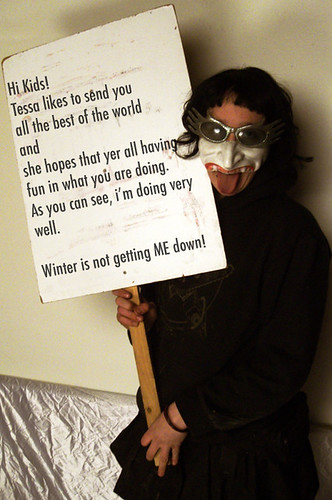
Hey Tessa!

Posted in Uncategorized | 1 Comment

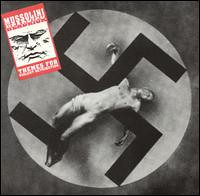
Granddaughter Of Upside-Down Corpse Heils The Dawn Of A New Europe

Fascist parties in the European Parliament have declared their intention to form a bloc on January 15, called “Identity, Sovereignty and Transparency (IST)”. According to the EUObserver: “Under EU rules, there need to be at least 20 MEPs from six different member states for a political group to be formed”; a prospect secured by the recent entry (January 1, 2007) of BULGARIA and ROMANIA into the EU.

The new kids on the block — Национален съюз Атака (National Union Attack, one member) and the Partidul România Mare (Greater Romania Party, five members) — are likely to be joined by:

    AUSTRIA (Freiheitliche Partei Österreichs / Freedom Party of Austria, one member);
    BELGIUM (Vlaams Belang / Flemish Interest, three members);
    FRANCE (Front National / National Front, seven members);
    ITALY (Azione Sociale / Social Action, one member; Fiamma Tricolore / Tricolour Flame, one member);
    and the UNITED KINGDOM (the ‘independent’ Ashley Mote).

Some of the political flavour of the new grouping may be found in The Guardian‘s report (Romania’s first gift to the European Union – a caucus of neo-fascists and Holocaust deniers, Ian Traynor, January 8, 2007):

In France, the group’s prospective leader [Bruno Gollnisch] has been barred from teaching at his university and is awaiting a court verdict for questioning the Nazis’ mass murder of Europe’s Jews.

His Bulgarian colleague brags that his country has the “prettiest Gypsies” and says he knows where to buy 12-year-old Gypsy brides for “up to €5,000” (£2,250).

Then there is the Polish professor [from the Liga Polskich Rodzin / League of Polish Families, nine members] who uses public office to pay tribute to General Franco, the late Spanish dictator.* Or the intellectual strategist of an Austrian party whose ideology, according to a Vienna court, is similar to that of Hitler’s “national socialism”.

Why a bloc?

“It is more a technical than a political group,” Alessandra Mussolini, the granddaughter of the upside-down corpse, told APA.

“We are mainly getting together out of necessity. Survival is only possible in a political group,” she added, referring to the fact that groups have a right to more funds and political positions in the European Parliament, something non-attached MEPs do not have.

On a brighter note, Jon Mooallem (Over My Dead Body, The Nation, October 19, 2005 (November 7, 2005 issue)), reflecting on the cultural and political uses to which celebrity corpses, such as those of Il Duce and Marliyn Monroe, are put, writes that:

Those who wanted to preserve Il Duce‘s majesty had their work cut out for them. The image of his capture was not a flattering one. He’d hidden under a blanket, disguised in a Luftwaffe overcoat, and was dashing off to Switzerland with purses full of several currencies — “not to mention his girlfriend,” one anti-Fascist noted, who “had stuffed precious stones into the seams of her underwear.”

Undermining Mussolini’s legacy, by contrast, wasn’t very difficult. Mussolini’s corpse was an emblem, after all, a hunk of bloated flotsam washed up as the political tide swiftly changed. Fascism and Nazism were in their death throes everywhere. An entire political system was being discredited and regretted. Luzzatto notes how the killing in Piazzale Loreto proved a canny perversion of Il Duce’s fervent mass rallies in Rome’s Piazza Venezia — an adoring mob now a vicious mob, the taunt of “Let’s hear your speech now” calling up his extraordinary prowess as an orator, and “a body attacked with fury both equal and opposite to the passion it inspired when alive.” After hanging there like a side of meat, Italy’s Ox was suddenly rumored to have been syphilitic, impotent and meagerly endowed between the legs. “When the leader dies,” Luzzatto writes, “the myths so vital in his lifetime are turned upside down; the charisma is transformed into a deep flaw.”

*Speaking of Poland, the Polish Prime Minister, and member of the virulently homophobic League, Jaroslaw Kaczynski — also the identical twin brother of Polish President Lech Kaczynski — was outed as a homosexual in major Polish media in October, 2006. According to The Gully (November 10, 2005):

Not to be surpassed by his twin brother, Party boss and presumed closet case Jaroslaw recently announced that “homosexuals should not be allowed to teach.” Earlier he had told the weekly Ozon: “The affirmation of homosexuality will lead to the downfall of civilization. We can’t agree to it.”

The source of the allegations regarding Jaroslaw’s homosexuality (and presumed desire to destroy ‘civilization’), interestingly enough, is the same agency Bishop Stanislaw Wielgus once worked for: the (gasp!) Communist Secret Police (Służba Bezpieczeństwa Ministerstwa Spraw Wewnętrznych / Security Service of the Ministry of Internal Affairs). As is seemingly routine for members of the cloth, Wielgus first denied (December 21) ever having worked for the Polish Secret Police, but just a few weeks later (January 7, 2007) was forced to admit the truth and to resign his position as the newly-appointed Archbishop, especially as the evidence was both undeniable and — moreover — threatened the Church hierarchy as a whole. Since then, according to Craig S. Smith, writing in The New York Times (January 10, 2007), ‘In Poland, New Wave of Charges Against Clergy’:

Most researchers who have delved into the archives of the Sluzba Bezpieczenstwa, or Security Service, estimate that thousands of the country’s priests, monks and nuns at the time — as many as 10 percent of the total — collaborated with the secret police to some degree [but]…

Perhaps the most explosive assertion by people in the church is that the taint of collaboration was known for decades but kept quiet out of respect for — or perhaps even at the behest of — the Polish-born Pope John Paul II, who died in 2005.

Fucking hypocrites.

Open your mouth, and speak up for the dumb,
Against the suit of any that oppose them; open your
Mouth and pronounce just sentence, and give
Judgment for the wretched and the poor.

Proverbs 31: 8,9

Posted in !nataS, Anti-fascism, History, Sex & Sexuality, State / Politics | 7 Comments

Deregistered Political Parties

Huh. The death of political parties is good news in the context of a social revolution; not-so-great news in the context of a constitutional monarchy / parliamentary democracy…

On Crikey, Stephen Mayne reports that the AEC has recently de-registered a whole swag of political parties, by reason of the ‘Application of Schedule 3 of the Electoral and Referendum Amendment (Electoral Integrity and Other Measures) Act 2006‘. Mayne reckons that this “must surely go down as one of [HoWARd’s] lowest acts”, which should give you some idea of his priorities, as well as his attachment to People Power. Anyway, for what it’s worth, the parties that — as of December 27, 2006 — have been de-registered are:

1) Christian Democratic Party (Fred Nile Group);
2) Citizens Electoral Council of Australia;
3) Citizens Electoral Council Australia (NSW Division);
4) Help End Marijuana Prohibition;
5) Hope Party Australia;
6) liberals for forests;
7) New Country Party;
EIGHT) No Goods and Services Tax Party;
9) Non-Custodial Parents Party;
10) One Nation Queensland Division;
11) One Nation Western Australia;
12) People Power;
13) Progressive Labour Party;
14) Queensland Greens;
15) Republican Party of Australia;
16) Socialist Alliance;
17) The Australian Shooters Party;
18) The Fishing Party;

and last, but by no means least

19) The Great Australians.

The AEC helpfully provides an infosheet on its site, which purports to explain the legal gobbledygook found in the Act. In plain English then:

Schedule 3 of the Electoral and Referendum Amendment (Electoral Integrity and Other Measures) Act 2006 (the Amendment Act) operates to de-register those political parties without current or past representation in Federal Parliament

What is the rationale for de-registration?

The Parliamentary Joint Standing Committee on Electoral Matters made a number of recommendations for change to the Act in its ‘Report of the inquiry into the Conduct of the 2004 federal Election and Matters Related thereto’.

Chapter 4 of the Report included recommendations to address apparent confusion on the part of electors over party names. The recommendation for de-registration of certain parties was adopted by Parliament…

Posted in State / Politics | 7 Comments

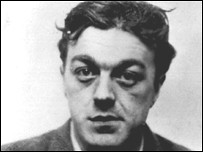
Harry Roberts, Harry Roberts, Roberts Roberts, Harry Harry

Why they chant the cop killer’s name
Ryan Kisiel
icSarfLondon
January 9, 2007

AFTER four decades in prison, a human rights group [?!?] is campaigning for the release of infamous cop-killer Harry Roberts.

Jailed for the murder of three police officers, Roberts is a man who would seem unlikely to garner much sympathy – but the Kennington-born prisoner has become a cult figure. RYAN KISIEL investigates.

COP killer Harry Roberts has become a South London cult hero even though he is one of the country’s longest-serving prisoners.

His name is regularly chanted at football grounds, has appeared in pop songs and is used by people to wind up the police.

Now, four decades after he shot dead three cops, campaigners are urging Home Secretary John Reid to release him.

A candlelit vigil was held outside Peckham police station in December to try to have the 70-year-old released before Christmas.

The “Let Harry Out For Christmas Campaign” was set up after the 10th anniversary of the day Roberts’s 30-year tariff expired.

Artist Mark McGowan organised the vigil with a dozen supporters.

He said: “Obviously he got sentenced to a minimum of 30 years and he has served 40. It seems as if it’s a political decision because he hasn’t had a parole hearing in 10 years. Whether or not we sing about it at football matches, there hasn’t been a hearing in 10 years. I grew up going to the terraces at Millwall and I was very familiar with who Harry Roberts was. I think the fact he has become a cult hero and a way that people can get at the police means that they don’t want to release him. Christmas is a time of forgiving and that’s why we decided to hold the vigil as we thought it was a time to let Harry out.”

    Mark McGowan is one of the UK’s most exciting artistes. His many works include ‘strapping a 27lb turkey to his head and walking backwards for eleven miles, circumnavigating south and central London, while using a loud hailer, with one of those walkie talkies attached, through which he asked fat people to eat less crisps, chips, sausages, hamburgers, pizza and coke and to try to eat more salad’; ‘marching through the streets of Camberwell and Peckham with a solo trumpet player playing a sad lament and holding ten foot high bamboo sticks with little cocktail umbrellas on top before petitioning Southwark Council for ‘no sky’ on the grounds that it’s too big’; and ‘lying down on the pavement at the Elephant and Castle, and rolling on his side, down to Borough High Street, over London Bridge, the Monument, down Gracechurch Street, on to Bishopsgate, Liverpool Street, and down to Bethnal Green Road, then all the way to the other end, down a side street, then on to Old Bethnal Green road and the gallery’.

    Genius or madman?

Born in Kennington in 1936, Roberts became infamous as the instigator of the Massacre of Braybrook Street when he shot dead three policemen in 1966.

Roberts and two accomplices were pulled over in East Acton after an armed robbery in Shepherd’s Bush.

PC Geoffrey Fox, Detective Sergeant Christopher Head and Detective Constable David Wombwell were all shot after Roberts feared they would find his handgun.

A huge manhunt followed and Roberts hid out in Epping Forest, Essex, and then headed for Bishop’s Stortford.

He was a soldier during the Malayan Emergency – a guerrilla war conducted by the Malayan National Liberation Army against British, Malayan and Commonwealth [including Australian] forces from 1948 to 1960. Roberts used the military skills he had learnt to avoid capture.

He was familiar with the Bishop’s Stortford area because he had spent part of his time there as a child evacuee during the Second World War.

Roberts eluded police for three months but was finally captured while he was sleeping in a barn at Blounts Farm near Bishop’s Stortford.

Convicted of the three murders, Roberts was sentenced to life imprisonment with a recommended minimum of 30 years.

The murders made him a folk hero to football supporters who clashed with the police in the 1970s. They often chanted his name to antagonise the police, singing: “Harry Roberts he’s our friend, he’s our friend, he’s our friend. Harry Roberts he’s our friend, he kills coppers. He kills the coppers two by two, two by two, two by two. He kills the coppers two by two, HARRY ROBERTS.”

Millwall FC historian Chris Bethell said: “Harry Roberts lived near to the club in Lambeth and some fans chanted his name as a way of winding up coppers. His name has often been chanted and he has some kind of local hero status to some supporters.”

Anarchists also adopted Roberts as a hero for killing policemen. His name features in anarchist band Chumbawamba‘s lyrics in Happiness Is Just A Chant Away.

The character of Billy Porter in the hit book He Kills Coppers [Soho Press, New York, 2001] by Jake Arnott is also based on Roberts.

This sub-culture of folk hero status is thought to have added to parole board and Home Secretary decisions not to release him.

In July 2005, he lost an appeal to the House of Lords over the use of secret evidence during his trial.

Currently in a low-security prison in Devon, he is considering appealing to the European Court of Human Rights to have his case heard.

One of Sgt Head’s surviving sisters, Edna Palmer, 83, said she “felt better” knowing he is being kept behind bars.

She said: “I don’t think anyone should be let out of jail if they have killed someone.”

When asked about the decision not to release Roberts, a Parole Board spokesman said: “With all life-sentence prisoners, the statutory test on whether or not to release them is whether it is necessary for the protection of the public that the prisoner be detained.”

Posted in !nataS, History, State / Politics | 21 Comments

G20: Three more arrests

Three charged over G20 protests in Australia
Associated Press
International Herald Tribune
January 9, 2007

MELBOURNE, Australia: Australian police arrested three people on Tuesday for participating in violent street protests that marred last year’s meeting of global finance chiefs in Melbourne.

Victoria state police said the three, who cannot be identified for legal reasons, were charged with rioting, affray and criminal damage for joining the violent skirmishes that ground much of central Melbourne to a halt during the November meeting of finance ministers and central bankers from the Group of 20 leading economies.

Two of the suspects — a 19-year-old man and a 25-year-old woman — were released on bail and ordered to appear before the Melbourne Magistrates’ Court on Thursday, Victoria police said in a statement. The third suspect, a 17-year-old boy, was bailed to appear before a children’s court in April.

Including Tuesday’s arrests, 11 people have been charged over the November riots [which means I’ve missed one?], in which 10 police officers were injured, including one who was bitten by a protester.

More charges laid over G20 clashes
[AAP]
News.com.au
January 9, 2007

THREE people, including a teenager, have been charged following the violent G20 protests in Melbourne in November.

Detectives charged a 17-year-old youth, a 19-year-old East Brunswick man and a 25-year-old Moonee Ponds woman with riot, affray, conduct endangering persons and criminal damage.

The 17-year-old was bailed to appear in a children’s court in late April and the man and woman were bailed to appear in the Melbourne Magistrates Court on January 11.

The arrests bring to 11 the number of people charged over violence outside the meeting of G20 finance ministers in Melbourne’s Grand Hyatt hotel.

At least 10 police were injured in the street clashes on November 18.

No comfort to crazies
Mick Armstrong
Socialist Alternative
November 19, 2006

These people are simply provocateurs that open up protests to police repression. In Europe their ranks have been riddled by police agents and fascists. What gave them a certain critical mass at the G20 was the presence of considerable numbers of anarchists from overseas. One of our members from New Zealand said he recognised at least 40 NZ anarchists. He knew at least 20 of them by name. There were also a considerable number of black bloc anarchists from Europe. We know of people from Sweden, Germany and England. These people are like football hooligans who travel the world looking for violence. The left should offer no comfort to these crazies. We should do whatever we can to isolate them. They are wreckers. If they grow in Australia it will simply make it harder to build future protests and movements.

More information from* arushandapush: discussion on politics from the g20 protests in melbourne:

we’ve gotten a central phone that people can contact to get in touch with some of the people that have gotten together to organise support for those arrested and a political campaign surrounding the arrests.

the phone number is 0408 307 722.

for anyone that has information regarding arrests, or has been arrested themselves, we are trying to create a fact sheet about what has happened so far, for background that will go towards a political campaign, and also to attempt to learn from what has happened, and build up information that may help people that may be arrested in the future.

if you have been or know someone who has been arrested, you can call this phone for contact numbers and assistance with obtaining legal representation.

please pass the number on to as many people as possible who may not have internet access.

thanks x

POSTED BY Administrator ON 01.09.07 @ 7:07 am

yesterday’s arrest occurred around 2pm, at the person’s home. plain clothes police with id tags attempted to push into his home, until he left quietly. he was taken to the st kilda police station, put into an interview room, and left there for some time before he was interviewed. he was charged with two counts of riot, two affray, criminal damage, and endangering others, and has been released on bail.

this morning, rosalie delaney, already on bail, had her home searched in conjunction with one of this morning’s arrests also.

police are searching the homes of those arrested and taking clothes, diaries, computers and files, accessories, etc. it is really important that people consider what they might have in their homes, or in the homes of friends that may not be safe either, and that we keep reminding people of this, especially those without access to internet that may not have received information about ways to protect themselves or about their rights.

we are currently compiling information about the arrests that have occurred and charges that have been laid so far. this will be posted on this blog. we will also soon have a central number people can call with information about arrests, or for assistance with obtaining legal support if they have been or might be arrested. i will also post this on the blog.

POSTED BY Administrator ON @ 4:31 am

more arrests and a call for information

a second comrade was arrested this morning at 7am. police came to her home, and confiscated her passport, earrings and a necklace. she has been charged with criminal damage, riot and affray, and released on bail. also just had word that someone else was arrested yesterday, and another taken in for questioning. will update with further details when i get them. apparently police are still looking for another two people today.

if anyone has any information regarding arrests etc, please email afterg20[at]gmail[dot]com.

POSTED BY Administrator ON @ 1:25 am

another arrest

A comrade got a visit from the cops at 7.30 this morning but he was not at his house. They called his girlfriend and dad. He is with his dad now, has legal advice from fitzroy legal & is going to st kilda cop shop now.

POSTED BY Administrator ON 01.08.07 @ 11:00 pm

*arushanadapush: crazy, ultra-violent, exploitative, hostile, contemptuous, disruptive, abusive, threatening, ultra-sectarian, provocative, hooliganistic wreckers… or maybe not.

This is a forum to expand on and explore ideas that have come out of A Space Outside and the protests and experiments of the G20 weekend.

What went on in Melbourne was inspiring, exciting, confusing and scary. There was a space opened up in the discussions and protest actions, and we want to keep it open.

It can be hard to make sense of what we did, saw and felt when faced with disorienting reflections of our actions from the corporate media and others seeking to present segments of the protest as either heroes or villains. There is not just one version of what happened: sharing our stories is important

We are hoping to publish a zine of experiences and reflections. In the meantime please email your tales to afterg20 at gmail dot com to be published here.

Posted in Anarchism, State / Politics | 5 Comments

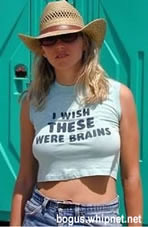
Racism, rednecks, and if only these were brains

Lisa Pryor has written an article (‘Flying the flag for an upside-down kind of patriotism’, Sydney Morning Herald, January 6, 2007) decrying racism, in particular that which she assigns to ‘rednecks’: the kind of people who — in addition to despising “Lebs, wogs, chinks, do-gooders, elites and hippies” — allegedly dream that, one day, “Every child will grow tall and white on a diet of chicken nuggets, cordial and potato gems. There will be baby bonuses for all, to be spent on smokes, beer, video-shop fines, expensive surfwear and a big telly for the lebensraum [‘living room’]”.

Rednecks

I’m not sure if Pryor realises it, but the term ‘redneck’ is not even Australian. So, where does it come from? My dictionary says the term refers to “a working-class white person from the southern US, especially a politically conservative one”. Another source states, in what I think is a reasonable summary:

In modern usage, redneck predominantly refers to a particular stereotype of whites from the southern United States. The word can be used either as a pejorative or as a matter of pride, depending on context.

The redneck stereotype:

The term redneck is seen by some people to be both racist and classist, as it was originally used to describe a person of pale skin that has been sunburned doing outdoor work or field work, and disproportionately applies to the poor. Today, a redneck is a stereotypical southern United States socially conservative, fiscally liberal, rural, working class white person with northern [? or just plain] European ancestry.

The popular etymology says that the term derives from such individuals having a red neck caused by working outdoors in the sunlight over the course of their lifetime. The effect of decades of direct sunlight on the exposed skin of the back of the neck not only reddens fair skin, but renders it leathery and tough, and typically very wrinkled by late middle age. Another popular theory stems from the use of red bandanas tied around the neck to signify union affiliation during the violent clashes between United Mine Workers and owners between [sic] 1910 and 1920.

Some historians claim that the term redneck originated in 17th century Virginia, when indentured servants were sunburnt while tending plantation crops.

In other words, if my parents had been born in the southern United States, rather than rural Victoria, they’d have been considered ‘rednecks’. And in an angry outburst ten years ago, Jim Goad wrote The Redneck Manifesto: How Hillbillies Hicks and White Trash Becames America’s Scapegoats:

Culture maverick Jim Goad presents a thoroughly reasoned, darkly funny, and rampagingly angry defense of America’s most maligned social group — the cultural clan variously referred to as rednecks, hillbillies, white trash, crackers, and trailer trash. As The Redneck Manifesto boldly points out and brilliantly demonstrates, America’s dirty little secret isn’t racism but classism. While pouncing incessantly on racial themes, most major media are silent about America’s widening class rifts, a problem that negatively affects more people of all colors than does racism. With an unmatched ability for rubbing salt in cultural wounds, Jim Goad deftly dismantles most popular American notions about race and culture and takes a sledgehammer to our delicate glass-blown popular conceptions of government, religion, media, and history.

Well, something like that. It’s been quite a few years since I read the thing, and while it has its flaws, it’s an entertaining and frequently informative rant about matters often — as the publisher’s blurb suggests — left unspoken by ‘mainstream’ (corporate/state) commentators. Of which, Pryor — in her well-meaning but, I think, ultimately misguided attack on Australian working-class (‘redneck’) racism — is merely a very recent example.

Rednecks (with guns)

The story of the other ‘rednecks’ — armed UMW members who in the 1920s fought police and scabs — is also a fascinating one, with an equally obvious class dimension, and constituting an equally neglected episode in working class resistance to oppression:

Despite being the second largest armed insurrection in American history (exceeded only by the Civil War), the Battle of Blair Mountain [August, 1921] is one of labor’s most neglected episodes. Robert Shogan, author of The Battle of Blair Mountain, blames the neglect on what he calls a “dominant middle-class” perspective that “discourages attention to struggles to achieve economic and social justice, if they threaten the sanctity of property values and the maintenance of law and order.” The author concludes, “As a result, the significance of class conflict in the making of America is overlooked and misunderstood.”

Though happily, the miner’s struggles have been also been the subject of a terrific film, Matewan (1987), written and directed by John Sayles:

“You want to be treated like men? You want to be treated fair? Well, you ain’t men to the coal company, you’re equipment. They’ll use you till you wear out or you break down or you’re buried alive under a slate fall and then they’ll get a new one, and they don’t care what color it is or where it comes from.”

(See also the equally terrific North Country (2005); West Virginia’s Mine Wars.)

Upside-down flags

Generally speaking, flying a flag upside-down, especially on a ship, is intended to signal distress. (Well, that appears to be the popular understanding. For an interesting discussion of the meaning and significance of this practice, see Timberwoof.) Anarchists and other radicals, as well as ‘ordinary folk’ (shit, maybe even that bloke at the Meredith Music Festival Pryor refers to in her article), have done so in order to register protest and dissent. In July of last year, for example, a woman in the US was reported to have done so after her son, an Iraq War veteran, committed suicide upon his return home:

Terri Jones lost her son Jason Cooper just over a year ago. He was an Army Reservist in the Iraq War. On July 14, 2005, four months after returning home to Iowa, he hanged himself.

He was 23.

Since then, Jones flies her American flag upside down, though someone came on her property once and turned it right side up, and another person stole it…

(‘Mother of Iraq War Vet Who Committed Suicide Flies Flag Upside Down’, Matthew Rothschild, The Progressive, July 18, 2006; also ‘Arrest, Death Threat, for Farmer with Upside Down Flag’, Matthew Rothschild, The Progressive, July 19, 2006.)

Besides

Besides, while I may be a vegetarian, I don’t surf (even though I live in Torquay) and I don’t own a big television… I like potato gems, I’ve been known to drink cordial, I smoke, I drink beer, and I’m always returning videos late!

Fuck racism.

Arm the poor.

Smash the state.

No war but the class war!

Posted in Anti-fascism, History, Media | 20 Comments

Anarchist U!

    Most of the time, in a wowserish city in which most amusements closed on Sundays, the Yarra Bank simply provided a form of free entertainment. For those interested in ideas, though, the forum offered what Labor Prime Minister John Curtin (himself no slouch on the stump) rightly described as Melbourne’s ‘university of the working class’.

    — Jeff Sparrow and Jill Sparrow, Radical Melbourne: A Secret History, The Vulgar Press, Carlton North (Melbourne), 2001, p.84 | Image : Dole Diary

At Anarchist U, it’s all about structure
Bert Archer
The Globe & Mail
January 6, 2007

The four-year-old free school has survived partly because it’s, um, well organized…

[Hurr hurr hurr.]

As the kids go back to school and the rest of us try to figure out how to make ourselves better people in the new year, thoughts often turn to taking some kind of course… A quick Google jog tells us we could learn [lots of stuff what costs $; especially if, like me, you have to fly to Canada first].

Or we could study Latin American Politics for free at Anarchist U.

About 60 people signed up for the three courses offered by Anarchist Free University this term (the other two are Questioning Masculinity and Politics of Addiction). But the mere fact that it’s entering its fourth year without an address or a registrar, and with total operating expenses of about $50 a year (most of which is the fee for hosting its website), is something of a milestone.

[It also evokes Michel Onfray‘s Université populaire de Caen, (2002); which in turn echoes the experience of the popular universities of the late nineteenth and early twentieth centuries.]

Much of the original plan — an orientation picnic, an end-of-term party, even a discussion of handing out certificates — has fallen away in the years since its creation in the summer of 2004.

However, the school’s basic principle, which Alan O’Connor describes as giving “people the intellectual and social experience of university for those who either couldn’t afford to go or didn’t want to go,” is what current organizer Erik Stewart, a.k.a. “Possum,” figures has kept the school going.

“It offers community,” Mr. Stewart says. “It’s a tight-knit group in some ways. Everyone’s welcome, but people usually end up being part of the community, running courses, or running the school in general.”

Since it uses only volunteer labour and donated spaces and often gets even its photocopying free (from donors like the Ontario Public Interest Research Group), there is no need for funding and therefore no worries about funding running out. Another recent experiment in free education, the Free School in Kensington Market, collapsed when a two-year donation of a storefront space expired.

What may ultimately be the secret of Anarchist U’s modest success is that, despite its name, it has a degree of structure not often found in these sorts of community-based alternative education models.

“We’re not an anarchist university in the way that The Marxist Institute [now defunct?] teaches Marxism; we were not trying to teach anarchism,” says Dr. O’Connor, a Trent University professor who left Anarchist U shortly after its birth to write a book on punk record labels. “We were organized on anarchist principles” — consensus decision-making, decentralized organizing and a non-hierarchical structure in classes and meetings, according to the school’s website.

[O’Connor is also the author of an interesting article, ‘Punk Subculture in Mexico and the Anti-globalization Movement: A Report from the Front’, New Political Science, Vol.25, No.1, 2003. In a textbook example of the problems associated with the commodification of knowledge, however, to gain access to the online version you must either be an enrolled student at a University or, as an individual citizen, pay $ to informa… Of course, if you wrote Alan directly, he’d probably email you a copy! Preferably while listening to Los Crudos… even if they’re on fucking myspace… and not Mexican… Y la juventud es una amenaza / porque atraves de sus venas corre la sange de rebellion.]

“Our classes have a fair amount of structured content,” Mr. Stewart says. “This tends to give a higher quality of experience in that it forces the facilitator to seriously consider precisely what they’re teaching, it gives people at an Anarchist U meeting the chance to review and make suggestions, and it allows people coming to the class to know what they are going to learn.”

Accompanying that structure is the dismantling of the traditional relationship between teacher and student.

“There’s less of an idea that one person is an expert and other people are there to have their empty heads filled with the boundless knowledge of one expert,” says Jason Dippel, who has taken seven courses with Anarchist U (including the The Psychedelic Century and Radical Perspectives on Media[?]), and this term is teaching Questioning Masculinity at Bike Pirates, a communal bicycle-repair space on Bathurst Street.

His course features texts by people like transsexual theorist Kate Bornstein and Brown University gender scholar Anne Fausto-Sterling that would not look out of place on a graduate school curriculum. Mr. Dippel himself has a BA in history and is a volunteer with the Ontario Coalition Against Poverty. His last job was as a dishwasher.

Andrew Pinto, who will be teaching the course on Latin America starting Wednesday in a Cabbagetown community centre, shares Mr. Dippel’s passion for education and left-leaning political awareness. He is a recent U of T medical school graduate whose knowledge of his subject is entirely extracurricular, though his co-teacher, [K]ris Orantes, is from Guatemala.

“The main thing that attracted me to it was the idea of free education,” Dr. Pinto says, adding that most of his fellow med-school students graduated with as much as $100,000 in debt.

“We’ve lost the idea of education being accessible.”

Anarchy is Order. Government is Chaos.

Anarchist movements — whether in Canada or Cataluña, the twenty-first century or the nineteenth — have always placed a great deal of emphasis on education. Kai Malloy writes that:

Between the 1820s and the end of the 1900s hundreds of men and women on both the North American and European continents, as well as parts of Asia, developed an amazing set of pedagogical theories and ideas that can be called “libertarian” in their form and content… Among the contributors to such endeavors have been many famous figures from the radical and artistic world, including Robert Owen, Henry David Thoreau, Ralph Waldo Emerson, Bronson Alcott, Josiah Warren, Benjamin Tucker, Rudolf Rocker, Voltairine de Cleyre, Emma Goldman, Alexander Berkman, Margaret Sanger, Carlo Tresca, Walt Whitman, Eugene O’Neill, Upton Sinclair, Robert Minor, Robert Henri, George Bellows, Man Ray, Rockwell Kent. Their object during times of war and peace, social unrest and stability, government repression and pardon, and economic depression and progress, has been to create not only new types of schools, but also new cultural forms, new lives, and ultimately, a new social order.

‘Toward a Historical Perspective of Libertarian and Anarchist Education in the United States’, Harbinger, Vol.2, No.1

A tall order, yes, but as Ken Knabb has observed:

What is needed, I believe, is a worldwide participatory-democracy revolution that would abolish both capitalism and the state. This is admittedly a big order, but I’m afraid that nothing less can get to the root of our problems. It may seem absurd to talk about revolution; but all the alternatives assume the continuation of the present system, which is even more absurd.

Unfortunately, in Australia, many of the institutions established by the working class in the late nineteenth century in order to provide workers with an independent education have been reabsorbed by the state: either directly, or through the determined efforts of ‘social democrats’ to bring autonomous expressions of radical working class culture under the control of the ALP (the party). Still:

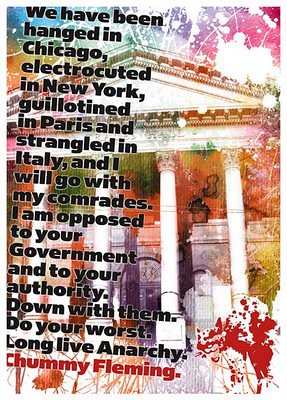
The difficulties which confronted working-class readers made the discovery of that ‘truly worthwhile book’ all the more rewarding. Chummy Fleming, a Melbourne bootmaker, is a vivid example [and a deadset anarchist… to boot!]. His father an Irish weaver, his mother a factory hand, Fleming had a scant and indifferent schooling. At the age of 10 he was sent to work in a boot factory; there a 14-hour day left little time for reading. Only when he was ‘laid up with sickness’, ‘broken by confinement and toil’, did Fleming begin to wonder at the world around him. ‘It was like a flash of light’, he remembered, ‘one summer’s morning’ when he began his reading. [William] Lane used the same image to describe his ‘discovery’ of Byron and Shelley.

These and a few other radical books . . . [kept me] in touch with the growing progressive thought that was emerging from the long dark night of ignorance and despair. Thus did I, like many others, find the light and embark upon a life long [sic] crusade against the capitalist exploiter.

For the working-class autodidact, books were [and remain] much more than a source of ‘joy and enlightenment’. With romantic poets, dead for over half a century, Lane developed an intensely personal relationship. ‘Throughout my life’, he declared, ‘Shelley has been with me, not only as a great revolutionary . . . but as a dearest friend and comrade.’ In books were ‘a source of inspiration that has never deserted me’. Through reading, Lane ‘felt comradeship with all the great ones of the earth’ . . .

Bruce Scates, “Knowledge is Power”: Radical Literary Culture and the Experience of Reading, paper presented to the Second History of the Book in Australia (HOBA) Conference, State Library of NSW, 10-11 August 1996

Posted in Anarchism, History, Student movement | 3 Comments