G20: Gertrude & Fuchsia (Arterial Bloc)

A first communiqué from two uncitizens of Arterial Bloc
Gertrude and Fuchsia
November 22, 2006

There have been many calls for Arterial Bloc to come forward and ‘justify’ their tactics during the G20 protests. The following statement is not a justification of specific actions; it is an exploration of politics. This statement has not been written for or on behalf of the Bloc; it has been written from within the Bloc. None of us can be leaders or spokespeople for each other.

We apologise for the delay. We were not able to head straight from the streets to the Internet. We have been dealing with the consequences of achieving more than perhaps we thought we would, and the aftermath of repression. We have been caring for each other, talking to each other, trying to find out what happened to those arrested and injured; remembering to breathe and sleep and eat.

The demonising [“Crazies! Foreign crazies!”] of Arterial Bloc by other sections of the Left (a demonising that only seems to have escalated in the last few days) has been cowardly, hysterical and, in the deepest sense, uncomradely. A willing eagerness to blame violence on “interstate” or “foreign” agitators is both false and xenophobic. Why must the militant protestor always be an other, both geographically and philosophically distanced from us? Why should struggle respect national or state borders? There has been a belief expressed not only by the corporate media but also by the Left that such actions as occurred at the G20 could not and should not be possible here in Australia. By extension, those involved are not “genuine” protestors but false provocateurs; or, if those involved were indeed “local”, their protest was immature and apolitical.

We did not come out of nowhere and we are not strangers. We do not have “contempt” for “ordinary protesters”; we are ordinary protesters. What was Arterial Bloc? It was a call-out, a costume, and an attempt at internal democracy and communication. It was joined and accompanied on the day by many people who chose, for that time, to work together. Arterial Bloc is not an organization or a party; it is not a homogenous group or a faceless, rootless mob. We are female, male and in between; workers, unemployed, students, union members. We have been on union picket lines; we have created squatted social centres; we have blockaded in forests and cities; we have cooked and distributed free meals; we have leafleted, rallied, called meetings; we have lived together and apart, and tried to love each other. We are ordinary: as scared and as alienated as everybody else. We do not have magical solutions; we have desire that will not be governed.

The fear displayed towards members of the Bloc seems grounded largely in the Bloc’s tactics of masking and disguise. Most criticism of the tactic centres on the idea that “disguise” is somehow sinister; that it leaves the movement open to infiltration by police and/or fascists, and that not knowing or not recognising fellow protestors is a bad thing.

Unpacking the semiotics of disguise is complicated. What follows is an attempt to do so.

Firstly, some history. Contrary to general belief, the G20 protests are not the first time that a “disguised” Bloc has appeared at an Australian protest. Orange Bloc pursued a similar tactic at the 2003 WTO protests in Homebush and the Sydney CBD; orange boilersuits and bandanas were chosen for their visual resonance with the “war on terror” and the ensuing “state of emergency” across the globe, a state of emergency which, as Walter Benjamin once noted, is not an exception but the rule.

White overalls also have a particular historical resonance within the contemporary anti-capitalist movement, having been for many years the disguise of choice for the Tute Bianche, an autonomist group of largely Italian origin who began organising in 1994. Now is not the time or place for an extended discussion of the Tute Bianche, but a decent quote from one of their many documents (freely available on the internet) may help to illuminate the political arguments in favour of disguise:

    The white overalls are not a movement, they are a tool which was devised in the context of a broader movement (the social centers of the Charta of Milan) and made available to an even broader movement (the global one). Nowadays the white overalls exist in many countries. The white overalls are neither an institution nor a political current, nor are they to be strictly identified with Ya Basta! or the social centers of North-East Italy […]

    One of our soundbites is: “We’re wearing the white overall so that other people wear it. We’re wearing the white overall so that we can take it off someday”.

    The white overall is not a “uniform” […] It hasn’t got militaristic origins. Back in Autumn 1994 the Mayor of Milan evicted the Leoncavallo squatted centre and stated: “Squatters are nothing other than ghosts now!” His description was accepted ironically, and thousands of people dressed in white stormed the streets of the city and rioted for hour. That was the real debut of the white overalls […]

    After that debut, the imagery of the white overall was enriched by ironic references to the “blue overalls”: nowadays labour has changed […] “flexibility”, part-time and precarious jobs have made exploitation less visible, there’s a new “ghostly” working class.

A white overall or similar disguise is a refusal to claim a space of “citizenship”, as the original Arterial Bloc call out (widely distributed) makes clear. Contemporary capitalism makes ghosts of us all, because it leeches us of our own precious and unique desires – and the embodiment of those desires – in favour of a homogenous “discipline” and “order”. We cease to be human beings; we are mere machinery and leftovers. For those of us who are ostensibly “free” there is the discipline of the workplace; of welfare, police and state surveillance (one must be the “grateful” and “well behaved” poor or be nothing); of educational institutions; and not least the discipline of the average protest. For those who face the brunt of state repression, there is the detention centre, the jail, the ghost prison of an unknown country. These forms of repression and enclosure are all connected: in solidarity with those who are refused citizenship and freedom of movement we also refuse citizenship; as a rebuttal to the fact that we are targeted and profiled on an everyday basis for visible difference – ethnicity, poverty and class, gender and sexuality – we choose to disguise that visibility. We will not “stand up and be counted” as citizens within this false democracy. Capitalism haunts us, and it makes us haunted; we will haunt it.

Socialist Alternative (among others) has claimed that the tactic of disguise “can only be justified in situations of extreme state repression”, and that until such time, we must continue to be “ordinary”. The basic fact is that over the past five years, the “war on terror” has been used as the overarching excuse for extreme state repression, both in Australia and elsewhere. “Ordinary” people have been raided, beaten, locked up, charged with crimes that they never committed; it is time for us to stop claiming the space of “ordinary” and “innocent” as a space of safety. If those of us who attend rallies and public protests are only doing so “on behalf” of those who have been denied the presumption of innocence, what power and privileges are we thereby claiming for ourselves? If we as protestors are always “innocent”, who is “guilty”: rioters in Redfern, Iraqi insurgents, Guantanamo prisoners, Tongan youth?

Capitalism does not tolerate serious, revolutionary dissent; it never has and it never will. The state will do everything in its power to crush revolutionary movements, and it will not care to distinguish between the “innocent” and the “guilty”, between the “good” and the “bad” protestor. Are we revolutionaries, or not? If we are, then we are already enemies of the state. Let us not be afraid of being called so.

“The same people who are murdered slowly in the mechanized slaughterhouses of work are also arguing, singing, drinking, dancing, making love, holding the streets, picking up weapons and inventing a new poetry.” (Raoul Vaneigem)

We reclaim the radical ordinary. We do not feel the need to pitch a “central message” through the filter of the corporate media to the mythical “ordinary person” who, apparently, can only comprehend or sympathise with managed dissent.

A false dichotomy is set up between the role of the “disciplined”, politically mature protestor and the inarticulate other. The other is positioned as a person or a group too worn out by oppression to resist tactically. This other is protested for, or on behalf of, but we must never indulge in their tactics. Both property damage and any spontaneous, emotional embodiment of resistance are seen as apolitical, as reactions to be left (pun intended) behind as we attain proper political maturity. “Oppressed others” (in Redfern, Macquarie Fields, Palm Island, Lakemba) who are perhaps never expected by those who call for disciplined protest to reach the requisite levels of political maturity have been rhetorically defended for their “justified” anger. But those who set Macquarie Fields on fire are never presumed to be part of a mass resistance to capitalism; and those who are presumed to be a part of “the movement” are therefore seen as outside of the system that produces such anger.

Property damage can be tactical, and as a tactic it has a long history. As peasant saboteurs and early industrial workers made clear, property damage was a direct disruption of capitalism’s machinery, and of its discipline of lives and bodies in the workplace:

    I am not going to attempt to justify sabotage on any moral ground. If the workers consider that sabotage is necessary, that in itself makes sabotage moral. Its necessity is its excuse for existence. And for us to discuss the morality of sabotage would be as absurd as to discuss the morality of the strike or the morality of the class struggle itself. In order to understand sabotage or to accept it at all it is necessary to accept the concept of class struggle. If you believe that between the workers on the one side and their employers on the other there is peace, there is harmony such as exists between brothers, and that consequently whatever strikes and lockouts occur are simply family squabbles; if you believe that a point can be reached whereby the employer can get enough and the worker can get enough, a point of amicable adjustment of industrial warfare and economic distribution, then there is no justification and no explanation of sabotage intelligible to you. — Elizabeth Gurley Flynn (Sabotage, Cleveland, Ohio, 1916)

Almost 100 years later, sabotage and property damage can still be used to disrupt the efficient functioning and discipline of capitalism, not only in the workplace, but in each area of our lives where this discipline has reach, which is to say, all of our lives, every day. The machinery of war and of welfare; the militarisation of public space and the containment of protest within sanctioned zones – all these things need to be dismantled. When barricades are destroyed, streets are opened.

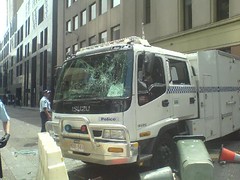
Beyond tactics and planning is the exhilaration of embodying refusal – even if only for a moment, and these moments are not without politics. Why should politics and protest be disciplined spaces, spaces without emotion and desire? To be caught up in the moment, in a collective energy, is a rare rupture of the alienation, isolation and powerlessness of our everyday lives. These moments show us what we are capable of; but we are capable of much more. We must preserve a movement of resistance to capitalism that is made up of many different acts of refusal and creation. However, we genuinely fail to understand how anyone who calls herself a revolutionary can fail to find at least some beauty in the sight of a smashed police van.

We can and will discuss tactics and their consequences; a more detailed response to specific events during the G20 protests is being prepared.

With love and solidarity,

From two people who will be known as Gertrude and Fuchsia.

Neat.

Posted in State / Politics | 2 Comments

The “Great” Australian Bikini March

More weird shit. Melbourne-based, sweatshop-supporting, foreign commodity-importing small business — with ties to organised fascism — True Blue Productions has announced that the ‘Great Australian Bikini March’ “will start at Clifton Park in Brunswick (Melways Reference 29|E7) near Brunswick train station” at 2pm on Saturday December 9th, and terminate at 19 Michael Street, Brunswick, at the Islamic Information and Support Centre.

    Hey True Blue: PO Box 9, Endeavour Hills, VIC, 3802 // [email protected] // 0404 790 393 // 0408 531 095 (Christine Hawkins) // 0438 244 283 (Chris Smith)
Posted in !nataS, Anti-fascism, Sex & Sexuality, State / Politics | 4 Comments

G20: And ‘revolutionary Marxism’

Below are six samples of the response of the authoritarian left to last weekend’s G20 protest. For the record, like, and to be critiqued in good time…

1) Bob Gould, ALP, November 21:

Morgan: A Suitable Case for Treatment was a funny movie, but 100 Morgans running around is a political pain in the neck.

The old movie, Morgan: A Suitable Case for Treatment, starring a very young Vanessa Redgrave, is one of my personal all-time favourite movies. The penultimate scene, with the whole world chasing Morgan in his monkey suit all over London, is very funny indeed.

One Morgan is okay, but a hundred or so southern-hemisphere Black Bloc wannabes trashing police vehicles at an otherwise peaceful but relatively small Melbourne demonstration, in the current reactionary Australian political climate, is something essentially quite different to Morgan’s monkey suit.

The essential question [?] is the fact that these irresponsible political adventurers disguise their faces. I agree strongly with Mick Armstrong’s post on this matter on Leftwrites [below], and I defer to his knowledge, based on his investigation as to who these people were. The very act of people from outside a city invading a demonstration in another city with the clear intention of launching a semi-military attack on the cops, with their faces covered, irrespective of the consequences for the rest of the demonstrators, is a calculated political act directed against the bulk of the demonstrators.

People with covered faces who attack the cops, unless they are rather unlucky and their covering falls off, are very dangerous to everybody else at the demonstrations, and quite possibly include fascists and agents provocateur… real agents provocateur certainly do exist, and organised contingents with covered faces clearly facilitate the [activities] of real agents provocateur…

…There is also, obviously, a new set of factors. I attended some demonstrations in Sydney over the past couple of years, several of which had the rubric of closing down some capitalist institutions such as the stock exchange. Despite declaring to myself that, at 67, I wasn’t going to get too close to the physical action, of course I did, and was the one greybeard among many young people squeezed by police horses around the corner from the Market St building, which was effectively closed for a few hours by the demonstration.

I had strategic misgivings about rhetoric on closing down the city with small forces, but those protests went off without too much difficulty. A striking feature of those protests was the appearance of a new breed, at least in Sydney, of obviously specially trained crowd control police wearing distinct blue or grey uniforms, physically as tough as nails, and drawn up in semi-military formation.

To people round about I described them as pit-bull terriers, which raised a bit of a laugh. Incidentally, for no reason that I could fathom, they all seemed to be pretty short. I tried to chiak [?] them a bit, but they weren’t having any, and remained grim-faced and hostile.

These cops weren’t obvious at the protests against the recent Lebanon invasion, which seemed to be policed by more or less ordinary coppers. At the first of those protests there was a very large police presence compared with the size of the protest.

I gave a bit of cheek to one of the commanders in front of his underlings, about why they needed so many coppers for a small protest. He was stony faced, and refused to respond except in monosyllables, but the ordinary coppers around him were cracking little grins. I don’t doubt that some police are hostile to “people of Middle Eastern appearance”, indigenous Australians and others, partly out of prejudice and partly because of the day-to-day contradictions of policing in some areas.

None of these realities seem to me a sound reason for ignoring the contradictions among the police, and instead treating them as a homogenous reactionary mass. Politically, what does that achieve?

Ha ha ha — nice one Bob. But as far as I’m concerned, the truly “essential question” is: was Bob’s choice of filmic revery a coy reference to my own good self? Aside from that, I’m sure that Mick appreciates Bob’s endorsement of his ‘investigative’ skills for — as far as I’m aware — nobody else does.

Like Mick, Bob makes a number of other claims which are, in the end, more akin to slander than analysis, though their shared hostility towards “black bloc wannabes” invading Melbourne is, in Bob’s case at least, hypocritical, at best. (Maybe next we’ll be treated to exhortations for such foreign no-goodniks to ‘Go back to Russia’?) Then again, at least Bob, unlike Mick, has the excuse that he wasn’t actually present.

Finally, the ‘new factors’ Bob discerns as being most germane to a discussion of the activities of the ‘paramilitary’ ‘Arterial Bloc’ — invading towns, trashing cop cars, endangering innocent civilians and acting as a pole of attraction for fascists and agents provocateurs — are neither new, nor particularly relevant. The militarisation of the police, for example, has been well-documented elsewhere, and its history extends well beyond the May Day events in Sydney in 2001/2 that Bob refers to in his post.

    …So we must fly a rebel flag,
    As others did before us,
    And we must sing a rebel song
    And join in rebel chorus.

    We’ll make the tyrants feel the sting
    O’ those that they would throttle;
    They needn’t say the fault is ours
    If blood should stain the wattle!

2) Jonathon Collerson, International Socialist Organisation (Melbourne), November 24:

‘Our enemies are Paul Wolfowitz and Peter Costello, not Akim Sari’

1. The G20 is part of the global offensive responsible for wars in Iraq and Afghanistan, sustaining world poverty, undermining labour rights and accelerating climate change. The immense harm their policies inflict on our planet and its people put cosmetic damage to one police truck at the 18 November StopG20 rally in Melbourne in perspective. These criminals — and their media allies — attempt to hide their culpability by creating hysteria about protester violence. Their aim is to discredit all militant protest action and, by extension, the legitimate concerns expressed by demonstrators. Criminalising protest will be an important weapon for the Howard Government in convincing the public of the need for an extraordinary state of security at next year’s APEC summit in Sydney. Responding to this is a major challenge for the Left.

2. Unfortunately, certain organisations –- particularly Socialist Alternative and the Democratic Socialist Perspective -– have completely misunderstood the challenge, lining up with the state and the corporate media to publicly denounce Arterial Bloc. In formal terms, the argument made by these groups –- that mass mobilisation is the most effective form of collective action -– is correct. However, they have elevated this principle to a dogma, meaning they have missed the key issue in this debate, which is the Right’s attack on militant protest in general. The first task of socialists is to take a side. In the present situation, a number of groups have taken the wrong side and reinforced the arguments of the media and the state.

3. At the same time, the StopG20 rally demonstrates that the autonomist or decentralised organising tactic is not the way forward. The largest part of last Saturday’s rally lacked direction at the critical moment when we massed at police barricades on Little Collins and Russell Streets. The real possibility of mass civil disobedience was abandoned in the street with neither the socialist Left, the autonomists, or anyone else taking it up. The vacuum was filled by the fragmented actions of autonomist groups, including Arterial Bloc. Our criticism is not their use of direct, militant action. It is that their politics exclude the need to organise mass collective action. They focused instead on organising relatively small groups of experienced activists to confront the police. The scarves and overalls symbolise this exclusion. Breaching police exclusion zones in Genoa or blockading the World Economic Forum in Melbourne are highlights of the anti-capitalist movement. But the way to turn situations like last Saturday’s rally into this is to involve the greatest number in mass democratic decision-making and arguing for this sort of militant, direct collective action. If 3000 protesters had breached the barricades we would not be concerned with minor damage to one police truck.

4. Even with the debate over tactics, the G20 mobilisation was a real step forward for the social movements in Australia. The mood on the rally was positive, confident and militant. It was diverse and the numbers exceeded the organisers’ expectations. It is to the credit of all the groups and individuals making up the StopG20 committee that such a broad ensemble came together to express a radical critique of the systemic roots of war, poverty and climate change. In this way the G20 protest was in the tradition of the great anti-capitalist mobilisations that began seven years ago in Seattle. As we turn our attention to building a massive mobilisation for the APEC summit, it is vital that we do not exclude, isolate or denounce any part of this movement. Disagreements over strategy and tactics should be dealt with by discussion and debate within the movement, not by one part of the movement publicly denouncing the actions of another part. We need to organise in a democratic and inclusive way and seek to win a consensus for mass, militant collective action.

3) Paddy and Shannon, Socialist Action Group and Solidarity, November 21:

Statement on the G20 demonstrations

The recent G20 protests in Melbourne posed some political questions that are now being explored by different sections of the left. Firstly, and quite immediately[,] is the question of how to relate to the confrontations with police. Second[ly]… the political isolation of the anti-G20 demonstrations from the ongoing campaign work of the activists involved.

Confrontations with police

The fact of the matter is that right now our comrades are being grabbed off the street by undercover thugs. The Victorian Police Commissioner has “vowed to hunt down protestors” and set up a Task Force including the AFP and “other Federal Agencies” to identify and arrest activists involved in the riot. Police have told press about a list of 200 names of suspects associated with the protest who could be arrested. At least one man arrested has not been granted bail. A number of activists have been stopped and searched at the airport attempting to leave Melbourne. One man not even associated with the demonstration was detained by undercovers, tied and beaten in an unmarked van before being released. A small demonstration at the Melbourne Museum on Sunday was baton charged, leaving a woman hospitalised.

It is vital in these circumstances that the left speak out against this repression and help defend those targeted. Many have been involved quite centrally in environment, student and anti-war movements. Comrades need to feel supported to continue being active with or without charge. Moves to increase state power need to be resisted. In the climate of the recent “anti-terror” legislation, there is a real move to curtail democratic rights to dissent and we have to confront this. Arguments about the nature of what happened here are secondary: we support the right of people to protest even when we may disagree with the tactics that they employ.

Contrary to some reports posted in the media and on some leftwing websites, participants in the “violence” were not all “from overseas”, but were overwhelmingly Australian activists, including large contingents from Melbourne. It should go without saying that, on top of this, we encourage people from overseas to join us in protest and defend their right to do so. The response by sections of the left has been shameful. Deploying the racist rhetoric of the media about foreign agitators and ‘mindless violence’ is helping the police to isolate, divide and victimise. It is also undermining attempts to build a radical analysis of how the demonstrations could have been more effective.

The real violence

Over the course of the afternoon, more than 500 people left the main demonstration to either participate in or support pushes on police lines. Much of this action, such as removing barricades and forcing police retreat towards the Hyatt, was inspiring in the context of a showing of police force that kept the warmongers of the G20 miles away from the protestors.

We know well the arguments about the real source of violence. We know that the people sitting in the Hyatt are responsible for the 650,000 dead in Iraq, the bombing currently happening in Palestine, deaths in the Australian workplace, Aboriginal deaths in custody.

We know well that the police are not kind, nor that they were acting with any kind of restraint on Saturday. We know that the police were there to protect the killers sitting behind the doors. Whether or not we think that the actions taken by the “Arterial Bloc” were the way to confront this power – we know that it exists, and that fundamentally this is what needs to be challenged.

Tactics on the day of the G20 demonstrations

People from many radical political tendencies either joined or supported the “arterial bloc”. The action was certainly not confined to the ‘hardcore anarchists’, as the media would have it. With a lack of leadership coming from the other elements of the demonstration, the “Arterial Bloc” led a large section of the demonstration in direct action. This leadership, whilst inspiring in the context of the demonstration, had some serious weaknesses.

The attire of the bloc, dressed in masks and white suits[,] and their secretive practice on the day[,] did little to encourage broader sections of the rally to participate in direct action. Most importantly, not enough effort was made to communicate either to the movement or the media the politics that justify confrontation with police lines at such summit meetings, contributing to the political isolation which is now being exploited by the state.

There was no real attempt to lead the direct action on a mass or explicitly political basis. At no point before, after or during the demonstration did the bloc communicate to the mass of people at the demonstrat[ion] or to the spokescouncils about the reasoning behind their actions. The “Arterial Bloc” gave direction to the mood of the demonstration, but it wasn’t willing to take the political responsibility for doing the hard work that is necessary to make these actions more effective and with a real, broad base in the demonstration.

Leadership from the organised left

The fact remains however that no other section of the demonstration seemed to be offering any kind of political lead… Following directly from this, the other tendencies were unable and even unwilling to engage with what was a (perhaps surprisingly) militant mood on the day. There was no attempt from any other section of the demonstration to argue for or organise any kind of direct action against the conference.

Liz Thompson said on the Leftwrites blog that ‘It was almost farcical that I was chosen to speak on behalf of StopG20 at the rally – so little political discussion seemed to occur that I was unclear exactly who everyone was.’ The lack of political analysis and coherence coming from those involved in planning the day meant that many people – including those involved in or supporting the actions of the “Arterial Bloc” – felt a sense of frustration that their actions were not more effective, more targeted or more widely supported. There clearly needed to be an attempt [to] cohere and direct the militant mood of the demonstration.

The relationship between summit demonstrations and social movements

The results of the lack of leadership and the isolation of the demonstration on the whole are demonstrated clearly by the actions of the contingent from the Sydney Uni left. They believed the G20 meeting called for more than a simple protest outside the conference and, arriving quite late in town and with little organisation, saw supporting “Arterial Bloc” as the best way to do this. But the fact that Sydney Uni, which this year has successfully defended its SRC from VSU, was represented in comparatively big, militant numbers also points some way to the kind of activism that can strengthen strong ranks at the summits.

Stop G20 was built in an extremely abstract fashion, disconnected from social struggles challenging the Howard Government. While the platform at the opening rally featured some good speakers from different movements; a member of the TCFUA, a Muslim cleric, an indigenous activist to name a few; this seemed forced and unrepresentative of the crowd. Perhaps most stark was that in a city with the most active and combative working-class movement in the country there [were] no union banners.

This is a far cry from S11, with its 20,000 people. Off the back of the struggle over the MUA, a success at Jabiluka, the defeat of VSU legislation through mass action and in the context of a growing global anti-capitalist movement, it made sense for activists from strong broadly-based movements to take their struggle to the World Economic Forum. However, even during and out of S11[,] many on the left have demonstrated a tendency to focus too squarely on building the radical “event” of the summit.

The political climate today is substantially different to the time of S11, granted. But the basics are no different. These demonstrations can politicise people, and they can act as the catalyst for ramping up campaigns against Howard. But that will only come to fruition if the demonstrations are built on a solid political basis, from the campaigns and networks where we are active day-to-day.

We need to use these demonstrations to strengthen and generalise the analysis and organisation of our movements. To effectively challenge APEC next year in Sydney we will need ten times this week’s numbers. This will not come however through “building APEC” in the abstract. We need to rebuild the student movement, bringing thousands into confrontation with neo-liberal reforms on campus. We need an anti-war movement which can grow and effectively respond to the barrage of racism and militarism coming so consistently from the Howard Government. We need to build rank-and-file strength in our unions and support growing instances of strike action against the IR reforms.

When we come to APEC it needs to be with wide layers of people in these movements who we work with consistently and have convinced of a more generalised opposition to capitalist globalisation. A connection to the campaigns would make discussions about tactics on demonstrations real and grounded in a more thorough assessment of the political situation, rather than an abstract question. APEC itself needs to be a demonstration that can politicise and harden up these networks.

4) Margarita Windisch, Socialist Alliance / Democratic Socialist Perspective, November 19:

Margarita Windisch, Socialist Alliance candidate for Footscray who spoke at the Stop G20 protest on behalf of the Stop the War Coalition, condemned Sunday’s media coverage of the protest which [focused] on the actions of a small group of masked individuals, who were separate from the protest.

“Over three thousand people took part in a peaceful rally, march and street festival,” she said, “Placards, banners and a platform of 7 speakers gave a powerful message condemning the role of the G20 in promoting policies that cause horrific poverty and threaten the world with ecological catastrophe. Unfortunately this message was lost in coverage that portrayed the protesters as mindless vandals.”

She stressed that the white-clad, masked individuals were separate from the protesters towards whom they had displayed “a surly and hostile attitude.”

She added that their actions were “self-indulgent and parasitic in that for the sake of some macho fantasies, they enabled those who do not want our message to get across to portray us as mindless idiots.”

Windisch was particularly annoyed with a commercial TV news report that had footage of her urging protesters to take their message to the streets and then cut to scenes of the masked people brawling with police.

“We did take our message to the streets,” she said, “We had a vibrant, militant but peaceful march which ended with a peaceful street festival next to the barricades that the police had set up near the Grand Hyatt. There were no clashes on the march or at our festival. The clashes shown on TV had nothing to do with us or our protest and involved people whose identity we don’t know.”

Letter to The Age:

Contrary to claims made by Michael Burd in his letter to The Age (Monday November 20) not a single Socialist Alliance member was involved in the senseless violence that took place on Saturday. Neither did the people in white overalls who perpetrated these irresponsible acts carry Socialist Alliance banners. As a matter of fact these people hate socialists. It is also important to point out that this group of people calling themselves ‘the arterial block’ were not involved in the organising of the actual demonstration – they acted separately and outside the rally and march. Socialist Alliance helped organise the StopG20 rally and was proudly present alongside many other organisations and individuals. It is disappointing that the media focused on a tiny group of individuals who had no political message instead of showing the wonderful 3000 strong crowd which was entirely peaceful.

5) Mick Armstrong, Socialist Alternative, November 19:

I was one of the organisers of the G20 demo from the [Melbourne?] Stop the War Coalition and I am also in Socialist Alternative.

The anarchist crazies involved in the ultra-violence were in no serious sense part of the demo. Just like their black bloc mates in Europe they simply exploited the demo for their own purposes.

Right throughout the lead-up to the demo they made clear their hostility to and contempt [for] other protestors. On the day they did all they could to disrupt the demonstration and were hostile, abusive, threatening [and] ultra-sectarian towards people on the demo.

Australia[,] fortunately[,] has not previously been blighted by the sort of black bloc anarchist activities which [have] had such a disastrous impact on demonstrations in Europe. These people are simply provocateurs that open up protests to police repression. In Europe their ranks have been riddled by police agents and fascists.

What gave them a certain critical mass at the G20 was the presence of considerable numbers of anarchists from overseas. One of our members from New Zealand said he recognised at least 40 NZ anarchists. He knew at least 20 of them by name. There were also a considerable number of black [bloc] anarchists from Europe. We know of people from Sweden, Germany and England. These people are like football hooligans who travel the world looking for violence.

On top of that there were also a considerable number of anarchists from interstate.

Because of the behaviour of these provocateurs the media [and…] the law and order brigade are having a field day.

The left should offer no comfort to these crazies. We should do whatever we can to isolate them. They are wreckers. If they grow in Australia it will simply make it harder to build future protests and movements.

Easily the stupidest and most provocative response, Armstrong’s mirrors that of the Australian political establishment: from repeated references to anarchist ‘crazies’, to absurd characterisations of what occurred as ‘ultra-violence’, to (bizarre) allegations of ‘foreign agitators’ secretly masterminding proceedings. Worse yet, Armstrong even claims that he has it on good authority that there were 40 anarchists from Aotearoa/New Zealand present at the demonstration, 20 of whom his Kiwi comrade could actually name — a prospect which will no doubt bring joy to the Victoria Police taskforce (Police vow to find G20 ‘thugs’, Sydney Morning Herald/AAP, November 19) dedicated to hunting down the ‘crazies’ and ‘thugs’ responsible for the awful carnage of “The Battle of Collins Street” (Gary Tippet, Mark Russell and Chantal Rumble[!], The Age, November 19). (And let’s not forget the (non-existent) Swedish, German and English football hooligans!)

Still, like Armstrong’s fraudulent claims regarding the supposed activities and composition of black blocs at demos in Europe (of which, more later), such profound ‘insights’ into the G20 demo should be taken with a grain of salt, and Armstrong’s ‘crazed’, ‘sectarian’ outburst should probably not be taken too seriously: though its resemblance to the rantings and ravings of a right-wing editorialist after one too many beers does not exactly inspire confidence in his critical faculties…

(A recapitulation of Armstrong’s view — minus his absurd claims and concentrating on establishing a clearer political line — is available here.)

6) The Socialist Party, November 19:

Over 3,000 demonstrators attended the main protest against the G20 in Melbourne on Saturday. The demonstration began at the State Library to hear a series of speeches and then marched through the city centre towards the Grand Hyatt Hotel where the G20 summit was being held.

Whilst the press coverage of the event was overwhelmingly negative the gathering at the State Library and the march were both peaceful and vibrant in character. Unfortunately due to the behavior of a small group of mostly anarchists, the media pounced on images of protesters in white jump suits smashing police vans and engaging in minor clashes with police.

The Socialist Party distances itself from this behavior. Our opinion is that this behavior does not take us forward in the struggle. In fact it takes us back as it plays into the hands of the ruling class and the media. The capitalist press will almost never give us favorable coverage but the footage that these fringe groups gave the press yesterday was a right wing editor’s dream.

These actions repel the mass of ordinary people still yet to be convinced [of what? Presumably “that it is the capitalist system that breeds poverty and it is in fact capitalism that needs to be made history”] and play into the hands of the state, justifying their security budget and anti-democratic laws; provoking sympathy for the police; and diverting attention away from the issues of world poverty and the system that creates it.

Treasurer Peter Costello could barely contain himself as he denounced the protesters as ‘crazy’. “Who knows what drives these people” he said. Other right wing commentators argued that the protesters were driven by hate and anger, not politics.

Due to the lack of trade union involvement in the anti globalisation movement the nature of these protests is very loose and lacked proper leadership and direction. It is a disgrace that the G20 forum was not even commented on by the trade union leadership. The policies that this forum pushes will have dire consequences for working people even in the advanced capitalist world.

The G20 delegates would not just [have] used this meeting to discuss the oil crisis and the World Bank but this would have been an opportunity for them to discuss all aspect[s] of their neo-liberal agenda including further privatisations, free trade, and IR laws.

Apart from the negative effects of the clashes, we should take inspiration from the fact that thousands of people turned out for a demonstration that was clearly against the capitalist system. Also[,] whilst on a much lower level[,] 15,000 young people came out on the Friday night to the ‘Make Poverty History’ concert. It is this layer that we need to convince that it is the capitalist system that breeds poverty and it is in fact capitalism that needs to be made history.

If you already agree that capitalism is a system that does not serve the needs of the majority of the people, and that we need to change the system[,] [t]he next question needs to be ‘which forces in society are going to do that’.

The Socialist Party believes that working people are the most powerful force in society. If workers don’t work society grinds to a halt. Therefore we try to draw in these powerful layers into the struggle against the system. Small actions by handfuls of individuals can never be a replacement for mass working class organisation and action.

The task for the anti globalisation movement is not to alienate working people from the struggle against the system but to find ways of drawing them in. This is the task the Socialist Party will take on in the next period.


Posted in !nataS, State / Politics | 16 Comments

G20: With experts like these…

Luke Howie is a Research Intern at the Australian Homeland Security Research Centre and a lecturer in the School of Political and Social Inquiry at Monash University. He’s also the expert the ABC’s PM turned to today in order to help explain the origins of the groups Marcus Greville of Stop G20 (and the Democratic Socialist Perspective / Socialist Alliance) has publicly-identified as being “responsible for the violence at G20”.

LUKE HOWIE: It’s most likely that this group has come out of student clubs and societies at universities as violent groups often do, as they did during the Cronulla riots.

They often unify along some collective ideology, which on this occasion seems to be anti-globalisation.

What they tend to do is tag themselves on to the edge of non-violent protests and they have the safety of the crowd then.

And indeed, I heard Arterial Bloc were shedding their uniforms at any appropriate opportunity and disappearing into the crowd, which is a very effective tactic.

JOSIE TAYLOR: Do you believe that this group had international links, or were they copying movements overseas?

LUKE HOWIE: They probably most resembled the Seattle riots, what’s now called the Battle of Seattle, from 1998, with the World Economic Forum riots there, where anarchists from Oregon had come to Seattle dressed in blue anoraks and gas masks so they couldn’t be identified.

Leaving aside Howie’s flawed understanding of the ideology and practice of the ad-hoc formation known as the ‘Arterial Bloc’…

1) The idea that those responsible for the racist mob violence at Cronulla last year “c[a]me out of student clubs and societies at universities” is — like the furphy about anarchists from other islands acting as ‘generals’ in a civil-insurrection-in-a-teacup — complete and utter nonsense, for which there exists not a single shred of evidence.

2) The state is the most violent ‘group’ in Australia, and it didn’t originate in a student club, but as a penal colony for the British Empire.

3) The “Battle of Seattle” took place in 1999, not 1998.

4) There were no World Economic Forum (WEF) riots in Seattle in either 1998 or 1999. In fact, the WEF has never met in Seattle. Although it has met in New York. Which is, like, on the same continent. (Even if it was in 2002.)

5) The World Trade Organisation, on the other hand, did meet in Seattle, from November 28 through to December 3, 1999.

6) Attributing responsibility for the damage to property that occured during the “Battle of Seattle” to a group of “anarchists from Oregon” is false, whatever tabloid headlines happened to scream at the time, and however much this myth remains in circulation among commentors, whether in the media or scholarship. Why Howie believes that this mythical group “had come to Seattle dressed in blue anoraks” I’ve absolutely no idea — it’s the one aspect of his claims that is novel — but the use of “gas masks” might better be understood, not as a means of obscuring one’s identity, but of avoiding the debilitating effects of inhaling the gas / pepper spray (oleoresin capsicum) the police did in fact use during the course of the “Battle”.

Members of the black — not ‘blue’ — bloc in Seattle responded to this kind of nonsense at the time: “While a few may be anarchists from Eugene, we hail from all over the United States, including Seattle. In any case, most of us are familiar with local issues in Seattle (for instance, the recent occupation of downtown by some of the most nefarious of multinational retailers).”

JOSIE TAYLOR: They’ve obviously had a huge amount of negative publicity now.

Is that what they actually set out to achieve?

LUKE HOWIE: They have had widespread negative publicity, but this will still lead to people wanting to join their group.

Their membership will swell in the aftermath such as this. So any publicity is good publicity in such a context.

A better glimpse into the motivations of some of those who assembled at G20 to form an ‘Arterial Bloc’ is freely available on the Internet, but is otherwise available in a previous blog entry.

Finally, another terrific example of the confused and hysterical (in more ways than one) commentary which the corporate media has produced in response to protest at the G20 may be found in Mark Dunn’s scribbled thoughts on the ‘Hard-core gang intent on violence’ (Herald Sun, November 19). According to Dunn, “The gang was inspired by a notorious international anarchy movement known as Black Bloc”.

Uh-huh.

But the Australian Arterial Bloc group appears to have chosen its white uniforms based on another militant European [sic] group called the WOMBLES — an acronym for White Overall Movement for Building [Libertarian…] Effective Struggles.

WOMBLES and Black Bloc have been responsible for much of the ugly violence at May Day marches in the UK, G8 summits in Scotland and Canada, and the fiery World Trade Organisation protests in Seattle in 1999.

Black Bloc originated in Germany in the 1980s, but is a movement of diverse groups based on tactics rather than a specific organisation.

Serious students of the anti-capitalist movement, on the other hand, would recognise the white overalls as having their origins in Italy among the Tute Bianche (White Overalls) in 1994, a product of Italy’s recent history of autonomous social struggle:

>> September >> Italy’s infamous Tute Bianche [white overalls] movement is born, when the neofascist mayor of Milan orders the eviction of the squatted social centre, Leoncavallo, saying: “From now on, squatters will be nothing more than ghosts wandering about the city!” Activists respond humourously, dressing in ghostly white overalls and taking to the streets; riots ensue, and the squat is saved. The white overalls, symbols of the invisibility of those excluded from capitalism, spread across the world, from Finland to Mexico…

Posted in !nataS, Anarchism, State / Politics, War on Terror | 8 Comments

G20: A less hysterical account

On the ground at the G20 protests

By Cam Smith, riot reporter and campaigner with the anti-racism group Fight Dem Back!

Halfway through the riot I began to worry that I’d never be able to write about it. It’s not that I thought I was going to die out there on Russell Street – it’s just that the protest was quite lame. My fears were averted some hours later when I picked up the first editions to see that there had actually been total chaos on the streets as warriors of hate chased their slice of infamy.

The Herald Sun managed to stretch the single exciting incident of an innocent divvie van having its windows knocked out across six pages. The Age had it on the front page. When I tried to take a photo I got a baton in the guts.

According to the [Herald Sun], we marched from the State Library up to Russell Street where a tense 15 minute stand-off ensued, then fled around the corner to converge on the police cordon from Collins Street.

I don’t remember a tense stand-off, though I do recall standing around looking suave while some people drummed and chanted. “Do you want us to take over so you can have a bit of a rest?,” I asked a friendly officer. He assured me that the current set-up would suffice.

We then ambled nonchalantly around to Collins Street to see how the state-smashing was progressing there – ballerinas were dancing to NWA. On the corner of Flinders Lane and Exhibition the aforementioned truck was moved back down the lane, looking decidedly worse for wear.

The mother of a toddler asked the riot squad if they would hurt her child. “It’s your f-cking choice, lady” explained a helpful officer. She remarked that all involved had a choice, but decided to retreat with child to safer ground. We had a chat with one of the riot squad about whether he was being paid extra for donning all the gear. He wasn’t, but still didn’t feel it was appropriate to join the protest.

The police retreated down the lane. Some young ruffians remarked upon the shades of defunct currencies and one bloke was arrested when he scaled a fence for reasons unknown. One of us got a bloody nose when pushed into police by snappers and we decided to head back up to Collins Street. Our path was blocked by another line. “Can we come through?” asked one scallywag. We were told to exit at Flinders Street. “That’s a long way,” I interjected, “You need to understand that as protesters we are inherently lazy.”

Moments later bottles began to smash around us and we decided to leave. Our path was blocked by more riot police who had made a new line behind us. I was told to “GET BACK!” “They said we had to come through here,” I informed him. “F-ck off,” he replied. About an hour after The Age reported the protest was broken up, we headed home.

All in all, Christine Nixon’s professional agitators from Europe didn’t do a very good job and the sinister anarchist cabal who funded their airfares should demand their money back. The opportunity for real chaos was present but not exploited – the police constantly left large gaps in their lines and were surprised on a number of occasions to find people on the wrong side of them: on one occasion naive pedestrians wandered up an alley and had been standing outside the “secret” command central for a while when they were finally noticed.

No apparent plan was in place in the event that the protesters turned heel and began to smash up the Bourke Street Mall (where shopping continued unabated), nor was anyone posted in the empty Collins Street Plaza, the perfect location for serious rioters to take the back of two of the police lines by complete surprise. The fact that the Red Army didn’t storm the Hyatt and bring Peter Costello’s head out on a pike had less to do with flawless policing and more to do with a largely benign and disorganised crowd.

Posted in Media, State / Politics | 3 Comments

G20 and 60,000 dead children

Well well, bloody hell.

The G20 has done come and gone. Despite impassioned begging by thousands of young people (and a handful of rock *s and other ideologues) at the Make Poverty History gala on Friday night, ‘poverty’ — deemed responsible for the deaths of 30,000 children every day — and its alleviation was not on the agenda of the 200 or so politicans and bureaucrats who assembled at the Hyatt on the weekend of November 18/19.

No surprises there then, for to seriously address such problems would entail, first and foremost, the G20’s dissolution.

Having enjoyed two days wallowing in corporate luxury, the key statement released by the hard-working G20 at the end of their Melbourne junket takes the form of a communiqué [PDF]. It makes a few passing references to the ‘problem’ of ‘climate change’ and ‘poverty’, but the ‘solution’ to such entrenched and devastating realities is assumed, quite explicitly, to be the inevitable outcome of the (further) expansion of global market dominance. A task which the G20 is quite happily pursuing… even if it is, literally, over the dead bodies of the world’s children.

Notwithstanding millions of dead children, the G20’s General Outlook, then, paints a fairly rosy picture of the current state of the global economy: we live in a period of sustained ‘growth’, low inflation, and — given wise management by technocratic institutions such as the G20, IMF, World Bank and WTO — with excellent prospects for continued growth and restrained levels of inflation.

Thus, rather than contributing to ‘making poverty history’ by abolishing itself, the G20 has, quite properly, focused on potential problems associated with the huge and growing energy and mineral markets in the emergent capitalist economies of China and India. In essence, the problem is one of demand exceeding supply, and the resultant high prices for such commodities placing inflationary pressures on the global economy.

In addition to energy and minerals, the G20 also considered the potential economic impact of an ageing population on state revenues; the means by which forms of transnational labour mobility conducive to profit-making might be encouraged; ‘reform’ of the Bretton Woods system; and, in general, ensuring ‘fiscal accountability’ of economic institutions (including member states) and ‘good governance’ of the masses.

Well, those that survive, anyway.

As for coverage of protest, the corporate/state media has provided lashings, although sifting through it to obtain facts about what actually happened is quite a task… stay tuned.

ARGENTINA

Capitalism has plastered the working-class for decades. Nationwide in Argentina, thousands of factories have closed and millions of jobs have been lost in recent years. Working conditions have been deteriorated. Many workers that still have jobs must work under the table with no restrictions over how long is the work day, no minimum wage and unsafe conditions. Many compañeros have stood up to resist against this destiny. Argentina is living a moment of a resurgence of struggle inside the workplace, using methods that the working class had lost access to: the strike, sabotage and the factory takeover. Most importantly, these struggles in the subway, public hospitals and recuperated enterprises have resulted [in] new visions and victories for [the] working class…

AUSTRALIA

This is what we want: Lives worth living, lives of dignity and autonomy and we want to work together against capitalism and the state to achieve this. We want to develop collective power and collective communication. Not to follow, not to lead, but to work out how we can organise ourselves.

We believe that an effective bloc is made up of many people who have many different skills and capacities. Sometimes the most crucial skills (such as the ability to care) can get forgotten when the focus is on more “exciting” things. But we all have something to offer, and we are equals. None of us are heroes; together we can help each other to be brave, happy and rebellious.

This is what we’re planning: To confront the G20 more directly: to go to the Grand Hyatt Hotel the morning of its meeting, Saturday November 18, prepared for radical disobedience. We want our disobedience and our creation of other ways of living to be [as] effective as we can make it. We have no time for violent macho fantasy or delusions about [Gandhi]. Our bodies, our lives, our desires, are too precious to fuck with. We want to be smart, joyful and defiant, not martyrs.

This is what we’re planning: To carry, as a bloc, white overalls and bright bandanas to cover our faces and to be ready, if we decided collectively, to wear them. We encourage those that want to struggle with us as part of the Arterial Block to organise this equipment.

By having the option of becoming clandestine we are refusing the rules of the game of civil protest, the containment of the ‘good protester’. We are choosing not to be compliant citizens who make their wishes, and show their faces, to ‘their representatives.’ Rather we are relying only on our own disobedience and our co-operative power.

We are constantly subjected to the surveillance of the state and yet made invisible by the simulated reality of power, their media, their ideology, a world of things and their prices. By having the choice to become invisible, we can subvert this. They may not see our faces but we shall show our anger, our creativity and our ungovernable desires.

BRAZIL

Brazil’s Landless Workers Movement, or in Portuguese Movimento dos Trabalhadores Rurais Sem Terra (MST), is the largest social movement in Latin America with an estimated 1.5 million landless members organized in 23 out [of] 27 states. The MST carries out long-overdue land reform in a country mired by unjust land distribution. In Brazil, 1.6% of the landowners control roughly half (46.8%) of the land on which crops could be grown. Just 3% of the population owns two-thirds of all arable lands…

CANADA

OCAP has its roots in a struggle around welfare reform in the late 1980s. At that time, the Liberal Government of David Peterson was under considerable pressure to introduce some improvements to the Province’s welfare system. As a stalling tactic, it set up a review committee that held extensive public hearings and, finally, recommended a number of measures that included an increase in welfare rates (depending on the category of recipient) of between 10% and 20%. During this period the London and Toronto unions of unemployed workers had been campaigning for a 25% increase in the rates. After the release of the review committee’s report, a broader formation came together and decided to press for the Government to implement the proposals of its own committee. A three pronged march from Windsor, Sudbury and Ottawa was organized on the Ontario Legislature to fight for this…

CHINA

“What the hell have you come here for? We’ve got nothing here! The mines have shut down and those bastards in their offices are corrupt to the bone! We had a strike, but there’s no way of controlling them. It’s not like the USA where everyone’s rich and you’ve got democracy. Shulan Town? It’s a joke.”

“The system in our state-owned enterprise is different from your factories in America. The machinery we have imported from Germany and Belgium has boosted production and we are now the third largest brewery in China, but such modernisation does not mean we will lay-off workers just to increase profits. [Large-scale] nationalised industry has to make money for sure, but we also have a responsibility to society and can’t just lay people off – though this is also changing.”

Two opposing views on the political backdrop against which the current wave of industrial unrest is unfolding in China. The angry comparison with America came from one of a group of laid-off workers sitting in the square in front of Shulan train station in the northeastern province of Jilin. The second view came from a trade union official in the state-owned Zhujiang Brewery in Guangzhou in answer to a question from a delegation of American students. It is hoped that this article will provide a brief analysis of labour unrest in China and look beyond the figures to what is actually happening on the ground…

FRANCE

Your newspapers and televisions and radios describe us as spoiled brats who are foolishly rejecting the “necessary changes” decreed by the kings of the so-called “free-enterprise” economy.

In reality, we are fighting against a law aimed at totally destroying the rights of working people, rights won long ago through the struggles of our ancestors. We are fighting against a law enabling bosses to fire us at any moment without justification or compensation. We are fighting against the so-called modernization currently being implemented by most governments, a “modernization” designed to take us back to the conditions of near slavery suffered by workers and unemployed people in the nineteenth century before the proletarian movement succeeded in imposing a certain number of social reforms.

In so doing, we are fighting not only for ourselves and our children, but for the well-being and dignity of all humanity.

Don’t believe the caricatural image of us presented in your mass media. Challenge it.

They are upset by what we are doing because they are afraid it might give you ideas. They’re afraid that you might end up rebelling like we are. And they’re right, because we’re all in the same boat.

We refuse to stand by while this boat is capsized by the present rulers of the world, whose never-ending accumulation of money reduces more and more people to poverty and misery. We are mutineers against those destructive captains, trying to turn the boat toward a better world.

Support us. Join us.

Posted in Anarchism, Media, State / Politics, War on Terror | 4 Comments

Police evict/ing aspaceoutside and the wake

As if they don’t own enough of the world already!

Make Property History!

Police evict aspaceoutside and the wake
by @ndy Friday November 17, 2006 at 10:23 PM

Hey folks! The police are currently in the process of evicting aspaceoutside and the wake squats!

G20 eh?

aspaceoutside is on the corner of johnston street and trennery crescent, abbotsford. the wake is on 170 sydney road, brunswick.

end the rot — squat the lot!

slackbastard.anarchobase.com

add your comments

Posted in !nataS, Anarchism, Anti-fascism, State / Politics | Leave a comment

Good riddance to bad rubbish

Milton Friedman is dead.

Posted in Uncategorized | Leave a comment

Accountant recommends political passivity

Treasurer urges peaceful protest
Dewi Cooke
The Age
November 16, 2006

TREASURER Peter Costello has called for peaceful demonstrations at this weekend’s G20 meeting.

He urged protesters not to disrupt the meeting of finance ministers and central bankers at Melbourne’s Grand Hyatt Hotel.

“It’s perfectly legitimate to make your point on any of these issues, but the important thing is that they are non-violent,” he told Southern Cross radio. Up to 10,000 people are expected to protest against the meeting, which has been criticised for its “neo-liberal” agenda. Police said they had been talking to protest organisers and will be there to avoid the violence that erupted in 2000.

Mr Costello said: “There are some socialists, there are some anarchists, there are some people that want to disrupt world trade. What do you want the international footage to be of? People trying to disrupt world leaders or a warm, friendly, welcoming city?”

Er…

Posted in !nataS, Anarchism, Media, State / Politics | 1 Comment

The G20 According to The Corporation

Following a very tired old script, the overpaid hacks in the corporate sector that abuse the term ‘journalist’ have been working overtime, busy providing a skeptical Australian public with an ideological framework within which the forms of police violence on riotous display in Melbourne six years ago — when repeated on the weekend — may receive political justification. One standard trope of such reportage, dating back to the late 1800s, is the presence of ‘foreign agitators’. Australians apparently require the presence of comrades from other islands to think, act and (who knows?) to even breathe and stand upright. Then it was a plane-load of British anarchists; now it’s “a dozen international activists considered potential trouble-makers”: the International Communist Conspiracy has obviously had to resort to some fairly savage budget cuts in the intervening period…

G-20 trouble-makers fly in
Michael Harvey, Mark Dunn and Matt Cunningham
Herald-Sun
November 17, 2006

POLICE will closely watch a dozen international activists considered potential trouble-makers at this weekend’s G20 summit.

But they don’t believe there is an increased threat of terrorism.

Several agitators are known to have flown to Melbourne from Europe and elsewhere to disrupt the summit.

“There is about a dozen who are very experienced organisers and co-ordinators of protests at international political summits,” a source said.

Treasurer Peter Costello, who will chair the meeting of the world’s most powerful bankers, confirmed intelligence reports that professional agitators were arriving in Melbourne.

“I say to them that we want this to be a successful summit,” he said.

“We do not like violence and disruption in Australia.”

Protesters are expected to stage sit-ins in the foyers of several big companies around the city today…

See also : The Corporation | Manufacturing Consent : Noam Chomsky & The Media

Posted in Anarchism, History, Media, State / Politics, War on Terror | 1 Comment