Celebrate Ten Years of the Black Star!


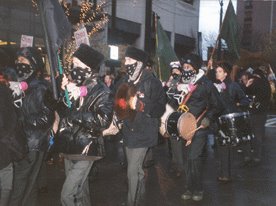
The Black Star PA Kolektiv will be celebrating its ten year anniversary this coming Saturday (March 4) @ The Arthouse, 616 Elizabeth St, Melbourne (Phone:(03) 9347 3917). Playing @ the gig will be:

Combat Wombat
Curse ov Dialect
Defiance Report
Pisschrist
&
Straight Jacket Nation

Doors open 8pm. Barricade Books // @ Infoshop & Global Warning muzak distro will have stalls on the night, and you get all this for a measly $10!

See you there!

[Update : I did! Celebrate, that is. Missed the first band; Terror Firma (?) were good; Pisschrist kicked arse; Combat Wombat too; dunno ’bout Curse — too drunk! Oh and hello to everyone I saw there and ¡viva la estella negra!]

Posted in Anarchism, Cats, History, Media, Music | Leave a comment

Pies in 2006! (#2)

COLLINGWOOD : 2.8.8 (74)
St. Kilda : 1.9.10 (73)

Posted in Collingwood | Leave a comment

Burn baby burn?

Recently, left-wing ALP maverick Bob Gould has weighed in on the subject of the DSP/Resistance and the burning of flags. From Bob the (Socialist Movement) Builder’s perspective, “It would be easy to dismiss this initiative as a dopey student prank, but as it’s clearly sponsored by the new DSP leadership it’s rather more than that”. (Er, not necessarily Bob. After all, it could be that the new DSP leadership has little more political sophistication than your average “dopey student”. But be that as it may…)

Bob reckons that this DSP “initiative” / publicity stunt can be most easily explained by the party’s decreasing ability to recruit “dopey students”; a field that Socialist Alternative has apparently come to dominate. (Although where this leaves the International Socialist Organisation is unclear.) Equally obviously, although not to Bob, is the political capital attached to the media attention generated by the DSP/Resistance member formerly known as the radical artist Azlan McLennan, whose last presumably ‘primitive’ and ‘ultraleftist’ work, featuring a burning Australian flag, was censored by police.

Speaking of flags, Gould gets it wrong, and Boyle gets it right, when referring to the appeal of the Eureka flag; popularly, but also — and most significantly — in the labour movement. According to Bob:

The main proponents of the Eureka flag in Australia in recent times were the Maoists in the 1970s and 1980s, who associated it with an exaggerated Australian nationalism versus US, Russian and British imperialism in whichever order the current Maoist political line then dictated — it changed several times. In those days the DSP quite validly used to polemicise against that sort of Australian nationalism. The Eureka flag has also been used extensively by the same fascists who also from time to time wrap themselves in the existing Australian flag.

Symbolic possession of the Eureka flag has been fought over by both left- and right-wing nationalists. At present, however, it appears to me that the left is winning. The Australian flag is often viewed as an imperial one; the Eureka flag a symbol of rebellion. Its adoption by contemporary left-wing trade unions is certainly more in keeping with its history than its use by the (radical) right. In any case, the Maoists of the 1970s and 1980s have thankfully disappeared up their own (virtual) arseholes; while National Action is dead and buried.

Still, while decrying the “ultraleft adventure” that is flag-burning, Bob’s real point is this:

What’s required in current Australian conditions is the maximum united front of the working class and the progressive sections of the middle-class and the labour movement, and the socialist groups to mobilise against the industrial laws of the Howard Government, and to rebuild a movement against the Iraq War, both difficult tasks.

Standard leftist fare, in other words. And personally, I prefer a well-balanced diet.

Although Western leaders pretended to welcome the recent Stalinist collapse as a natural victory for their own system, none of them had seen it coming and they now obviously have no idea what to do about all the problems it poses except to cash in on the situation before it totally falls apart. The monopolistic multinational corporations that proclaim “free enterprise” as a panacea are quite aware that free-market capitalism would long ago have exploded from its own contradictions had it not been saved despite itself by a few New Deal-style pseudosocialist reforms.Those reforms (public services, social insurance, the eight-hour day, etc.) may have ameliorated some of the more glaring defects of the system, but in no way have they led beyond it. In recent years they have not even kept up with its accelerating crises. The most significant improvements were in any case won only by long and often violent popular struggles that eventually forced the hands of the bureaucrats: the leftist parties and labor unions that pretended to lead those struggles have functioned primarily as safety valves, coopting radical tendencies and greasing the wheels of the social machine.

As the situationists have shown, the bureaucratization of radical movements, which has degraded people into followers constantly “betrayed” by their leaders, is linked to the increasing spectacularization of modern capitalist society, which has degraded people into spectators of a world over which they have no control — a development that has become increasingly glaring, though it is usually only superficially understood.

Taken together, all these considerations point to the conclusion that a liberated society can be created only by the active participation of the people as a whole, not by hierarchical organizations supposedly acting on their behalf. The point is not to choose more honest or “responsive” leaders, but to avoid granting independent power to any leaders whatsoever. Individuals or groups may initiate radical actions, but a substantial and rapidly expanding portion of the population must take part if a movement is to lead to a new society and not simply to a coup installing new rulers.

Posted in Anarchism, Art, History, Poetry, State / Politics, Trot Guide | Leave a comment

Thomas found guilty of receiving $3,500, a plane ticket, and having a dodgy visa

Thomas found guilty of receiving Al Qaeda funding
ABC News Online
Sunday, February 26, 2006. 2:57pm (AEDT)

A Victorian man has been found guilty of receiving funds from a terrorist group.

Joseph Terrence Thomas, 32, of Werribee, near Melbourne, was charged with receiving funds from and providing resources to Al Qaeda.

His lawyer told the Victorian Supreme Court there was no evidence Thomas provided himself as a resource while training at the Al Farooq camp in Afghanistan, or that he had agreed to work for Osama bin Laden in Australia.

The jury cleared him of those allegations but found him guilty of receiving a plane ticket home and $US3,500 from the terrorist group.

He was also found guilty of having a Pakistan visa changed to disguise how long he had been in the region.

His lawyer asked that he be allowed to continue his bail until his plea hearing on Thursday, but the request was denied.

Posted in State / Politics, War on Terror | Leave a comment

The Gospel According to Peter

After careful consideration, polling, the opinions of his advisers, a quick check with a physician and a priest (to confirm that he remains without a beating heart or a living soul) and, last but by no means least, a corruption scandal at the Australian Wheat Board, Australian Treasurer Peter Costello has declared war on Australia’s Muslims:

“Vote Liberal or go home!”

Or words to that effect:

“People come to Australia and become Australian citizens because they want to embrace the things this country stands for. We should be proud that people from all over the world come here looking for Australian values – our values – and want to embrace them. Values like economic opportunity, security, democracy, personal freedom, the physical environment and strong physical and social infrastructure.”

Apart from demonstrating that our state’s principal bean-counter is illiterate — “the physical environment and strong physical and social infrastructure” aren’t moral values Peter — in the gospel according to Peter, the state is God, the government its Church, and Muslims are the Jews under Roman rule: bearers of an alien culture and religion which threatens to infect its host with illiberalism and anti-democratic notions.

But is Peter Costello really just Pauline Hanson in drag?

Hanson: Libs steal my view
AAP
February 24, 2006FORMER One Nation leader Pauline Hanson says Treasurer Peter Costello’s comments that people who come to live in Australia should show loyalty to its values are a vindication of her own views.

Ms Hanson said she was “crucified” and called a racist during her political career.

“I could foresee what was happening to our country,” Ms Hanson told ABC Radio.

In a speech last night to the Sydney Institute, the treasurer said people who wanted to live under Islamic sharia law should move to a country where they would feel “more at ease”.

He said anyone not prepared to accept Australian values, and who had citizenship of another country, should not remain an Australian citizen.

Ms Hanson called on Mr Costello to follow through with his claims.

“If Peter Costello is wanting to be a future prime minister of this country he needs to take a tough stand on this,” she said.

“He needs to deal with it harshly.

“He needs to throw these people out of this country who do not embrace Australia.”

But what, precisely, is this ‘Australia’ to which recent Australian citizens must pledge their undying allegiance to, or fuck off? The values Costello purports to champion — in essence, liberal democracy — are hardly uniquely ‘Australian’. In reality — as opposed to the fairy tale world Costello pretends to believe in — such ‘values’ have their origins in Western Europe. Historically speaking, one variant or another of the modern, liberal democratic state has been adopted or, largely, imposed upon the rest of the (majority) world since. Further, the degree to which the modern capitalist state is either ‘liberal’ or ‘democratic’ has been determined not through the fatuous observations of politicians, but through many centuries of determined struggle; struggle against the kinds of powerful economic and political interests Costello does his best to represent in the Australian Parliament.

A final observation: in addition to its purely formal aspects, Australian citizenship often involves participation in a ceremony or ritual: “The Affirmation of Australian Citizenship is based on the Australian Citizenship Pledge made by new citizens and reads:

As an Australian citizen,
I affirm my loyalty to Australia and its people,
Whose democratic beliefs I share,
Whose rights and liberties I respect,
And whose laws I uphold and obey.”

And yet, ‘ironically’, it’s Costello’s mob that is doing its level best to remove any real content from Australian democracy, to undermine our rights and liberties and to demonise those who object.

Peter needs a clip ’round the ears.

Posted in Anti-fascism, History, State / Politics, War on Terror | Leave a comment

To burn or not to burn, that is the question


OK, so the antiwar movement may not have quite turned out to be the wild-orgasm-of-anarchists-sweeping-across-the-country-like-a-prairie-fire all right-thinking, political moderates such as myself were hoping for, but… Heated debate has erupted on University campuses. Well, kinda.

Yesterday a few people shouted profanities (‘Vote Liberal!’, ‘Join Resistance!’), some people pushed some other people, and fists were well-and-truly clenched. The reason? The authoritarian socialist youth group Resistance is selling ‘flag burning kits’ (yours for only $5 each), ostensibly in order “to protest against the Federal Government”, but more obviously for publicity during ‘O’ week.

“You want to burn our flag, I want to burn your table,” said one man. What response his philosophical enquiry into the nature of desire and retributive notions of justice received is not recorded, unfortunately, in Leigh Lalonde’s account of the altercation between students on a University of Queensland campus.

Is burning a table a rational response to burning a flag?

Discuss.

See also:

Tempers flare over flag burning

TEMPERS have flared after youth socialist group Resistance began selling Australian flag burning kits at the University of Queensland (UQ).Resistance members were jostled and abused by a man who took exception to the group setting up a stall to sell the $5 flag burning kits in the Great Court of the University of Queensland’s St Lucia campus today.

Calling himself a “patriot”, the man screamed at the group members “who fought for your freedom? You’re joking”.

Socialist students give out [sic] flag burning kits in Orientation Week

A Queensland member of Resistance, Stella Riethmuller, says the kit was inspired by a Victorian member’s artwork which was confiscated from a gallery by police.But she admits the campaign goes much deeper.

STELLA RIETHMULLER: There’s a whole range of issues that, you know, we think are really urgent, like the occupation of Iraq and, you know, locking up refugees and our continued and ongoing oppression of Aboriginal people.

Yeah, we know. But here’s to the rebel sound of shit and failure anyway.

Posted in Art, State / Politics, Trot Guide, War on Terror | Leave a comment

“Aunty” Paul & “Uncle” Al


The people at the Danish Consulate & Embassy in Egypt are nice.

Last week, I sent them an email requesting confirmation that the Danish Ambassador to Egypt, Bjarne Sørensen, had indeed read an issue of Al Fagr at the time it was published. I received the following reply:

Dear Mr. Andy,

In reply to your question in email dated 17 February 2006 of how Ambassador Sørensen knew that the cartoons were published in October 2005; the Ambassador saw the 6 cartoons in Al Fagr on 17.10.2005.

Yours sincerely,
Vicki Hamza

A straight-forward answer to a straight-forward question.

So much for ‘Uncle Al’. Now for ‘Aunty Paul’.

Two weeks ago, Paul Reynolds, ‘World Affairs correspondent’ for the BBC News website, wrote a piece on blogging for the BBC titled Bloggers: an army of irregulars. Hundreds (if not thousands) of others in the blogosphere have already responded to Reynolds’ article, each in their own unique fashion, but what the hell: I gotta bone to pick with Paul, so here are some comments of my own.

For many in the “mainstream media”, as bloggers call us, weblogs are at best a nuisance and at worst dangerous. They are seen as the rantings and ravings either of the unbalanced or the tedious. My experience over the past few months has led me to an opposite conclusion. I regard the blogosphere as a source of criticism that must be listened to and as a source of information that can be used. The mainstream media (MSM in the jargon) has to sit up and take notice and develop some policies to meet this challenge. Most big organisations, whether in news or in business, have no policy towards blogs. They might, as the BBC has, develop a policy towards their own employees setting up such sites (no political opinions etc), but they have nobody monitoring the main blogs and have little idea how to respond to any criticism on them.

For many anarchist bloggers, corporate/state control over information flows (which employees of such conglomerations of economic and political power tend to delude themselves constitutes ‘the mainstream’) tends to function as little more than another mechanism for the reproduction of capitalist ideology. Such ideology is replete with the generally tedious and, by definition, unbalanced rantings and ravings of a literal army of concerned liberals, as well as sadistic reactionaries, and perhaps even one or two points in-between. Nevertheless, the corporate/state media also functions as a source of information that can be used by anarchists (and others!) as more than just a guide to the latest trends in consumption. The BBC’s Colombus-like discovery of the blogosphere, and the emerging though necessarily stunted realisation that this new form of media may well have serious repercussions for the corporate/state media industry, is thus useful for the insight it gives, both into the ideological workings of dominant institutions such as the BBC, but also the thinking of the class it serves.

Reynolds’ seperates his military analysis into three divisions. First, blogs as alternative source for news and information. Secondly, blogs as social power. Finally, blogs as political polemic.

1) Raw material

This portion is fairly straight-forward: Reynolds the journalist has found blogs a useful source of ‘news’. Interestingly, much of the raw material that Reynolds exploits is produced by critical assessment of government and business propaganda. Criticism such as this is, obviously, hardly new (and even more rarely ‘news’). What is novel is that the Internet, and blogging, allows individuals who possess such extraordinary talents (which is almost everyone) to make their critiques directly, immediately, and — crucially — very cheaply available, and to a theoretically vast audience. In other words, in this model, the forms of mediation of knowledge that the media represents are circumvented, and new flows of information allowed to circulate. In doing so, the Internet is functioning precisely as it was designed to, only instead of military data being circulated between geographically isolated US military installations, a truly vast range of human experience, thought and emotion is circulated between hundreds of millions of ‘users’ (that is, human beings).

In support of his argument that blogs constitute a useful resource for journalists, Reynolds lists a number of examples, “examples [which] show the collective strength of blogs”. One helped him to conclude that “blame should be shared at all levels of government” for the inept handling of emergency relief efforts following Hurricane Katrina. Another that the Pentagon was lying when it denied the use of white phosphorus as a weapon by the US military in Iraq. Why such a useful resource? And who are these bloggers anyway? According to Reynolds:

They have an army of what Sherlock Holmes called his “Baker Street Irregulars,” that is an almost unlimited number of people around the world, many of them expert on the subject under discussion, scouring sources and sending information in to an easily accessible central site which can disseminate it instantly.

Reynolds is here presumably referring to Daily Kos, a ‘liberal’ Democrat blog. As a model of blogging, it’s interesting, but not typical I suspect. As for the remarkable ability of expert liberal bloggers to “scoure… sources and send… information in to an easily accessible central site which can disseminate it instantly”…

On Staying Informed and Intellectual Self-Defense

By Noam Chomsky

There’s no way to be informed without devoting effort to the task, whether we have in mind what’s happening in the world, physics, major league baseball, or anything else. Understanding doesn’t come free. It’s true that the task is somewhere between awfully difficult and utterly hopeless for an isolated individual. But it’s feasible for anyone who is part of a cooperative community — and that’s true about all of the other cases too. Same holds for “intellectual self-defense.” It takes a lot of self-confidence — perhaps more self-confidence than one ought to have — to take a position alone because it seems to you right, in opposition to everything you see and hear. There’s even evidence about this: under experimental conditions people deny what they know to be true when they are informed that others they have reason to trust are doing so (Solomon Asch‘s classic experiments in social psychology, which were often held to show that people are conformist and irrational, but can be understood differently, to indicate that people are quite reasonable, and using all the information at hand).

More important than any of this is that a community — an organization — can be a basis for action, and while understanding the world may be good for the soul (not meant to be disparaging), it doesn’t help anyone else, or oneself very much either for that matter, unless it leads to action. There are also many techniques for penetrating the veil of propaganda that should become second nature in dealing with the output of doctrinal institutions (media, journals of opinion, scholarship). For example, it is quite common for the basic framework of an article or news report to be hopelessly misleading, conforming to doctrinal requirements. But within it one can often discover hints that something else is going on. I often recommend reading the mainstream press beginning with the final paragraphs. That’s no joke. The headline, the framing, the initial paragraphs, are designed (consciously — you learn these things in journalism school) to give the general picture, and the whole story for almost all readers, who aren’t going to take the trouble to look at the small print, to think much about it, and to compare it with yesterday’s tales. One discovers this all the time.

Of course, another story Reynolds refers to in his article as providing evidence of the useful role of bloggers in verifying stories is that concerning Al Fagr. “I also have to say that bloggers found out that the Danish cartoons were in fact published in an Egyptian newspaper last October. See link to WorldNetDaily on the right.” I’ve written a number of entries on my blog concerning this story (1, 2, 3, 4). In fact, I even wrote to Reynolds asking him for details regarding the BBC’s presumed verification of the story. He informed me that the BBC’s ‘Arabic-speaking Middle East editor checked the story and had even read the text from the newspaper’. When pressed for further information, Reynolds replied that the BBC’s ‘Arabic-speaking Middle East editor [who had] checked the story and had even read the text from the newspaper’ “was not Jeremy Bowen! We established to our satisfaction that the pictures were printed. If you can show this to be wrong, then good luck to you.” Which I believe is a semi-polite way of saying ‘piss off’.

And all I asked for was some co-operation. Strewth!

2) The Power of Blogs

“The other role of the blogs is to criticise and attack.”

Fair enough. Don’t claim you never asked for it but.

To begin with, the ‘power of blogs’ appears confined to ‘bringing down’ or ‘damaging’ the reputations, even the livelihoods, of journalists and corporate executives, including VIP ‘journalists’ such as Dan Rather and executives such as CNN’s Eason Jordan. As a result, ‘big media should take notice’.

Leaving aside the facts regarding Rather’s presumed embarrassment at the “unravelling” of one of his stories on “60 Minutes Wednesday” and Eason Jordan’s chagrin at being forced to resign as a result of his having made “some remarks at a discussion in Davos in January 2005 about journalists being possibly targeted by US troops”, what does this role of ‘criticising’ and ‘attacking’ involve I wonder?

Well, while Reynolds’ concern for his colleagues in the US is touching, I’d argue that the power of blogs can only be multiplied if one keeps in mind Sylvester’s dancefloor classic “You make me feel mighty real”. Less cryptically, bloggers need to keep it real. And by that I mean delving much deeper into the political economy of the mass media, and responding accordingly.

3) Political agendas

“Of course, one has to remember that most blogs have political agendas. Many of them are on the right of the spectrum. But it is not that hard to discount the opinionating and pick out the facts.”

Huh?

This final section of Reynolds’ article is in some ways the most problematic. That blogs have political agendas is a basic banality; as banal as stating that one has to remember that Paul Reynolds and the BBC too have a “political agenda” (as almost any student of Politics or Media 101 should be able to inform you). This section also concentrates on outlining the views of three right-wing critics of the BBC, as well as one from the left.

Ho-hum.

[Medialens criticised

among others, The Independent [British newspaper]: “The Independent is feeling the heat from public criticism of its adverts pushing foreign travel, cars and endless consumerism.” In fairness, it also quoted an Independent editor who dismissed such critics as “a curmudgeonly lot of puritans, miseries, killjoys, Stalinists and glooms.” So, unlike some sites, it does seek debate.”

Ho ho ho.]

In conclusion, Reynolds notes that

I have taken to intervening in some of these sites if and when I am personally criticised and sometimes to defend the BBC in a general way. Otherwise the comments go unanswered. I found that one rapidly develops a very thick skin and I can now understand how politicians can cope with criticism. If the mainstream media does not respond, it will suffer. The same is even truer of businesses, whose products can be disastrously damaged by web-based attacks.

This appears to be the main motivation for Reynolds’ article: defence of himself as a journalist and of the BBC as a media organisation from ‘attacks’ by bloggers. But the last word goes to

Richard Sambrook, head of the BBC World Service and Global News Division… “The BBC should proactively engage with bloggers. This is a new issue for us. Some departments look at blogs, though haphazardly. But it pays dividends. The BBC is a huge impersonal organisation. It needs to come out from under its rock,” he says. As for using blogs as a source he says: “The key is careful attribution. It would be a big mistake for the [state/corporate media] to try to match the blogs, but they can teach us lessons about openness and honesty. The [state/corporate media] should concentrate on what it can do – explain, analyse and verify.”

“Proactive engagement”.

“Careful attribution”.

“Openness and honesty”.

Explanation. Analysis. Verification.

Or as Reynolds summarises: The ‘mainstream media’ establishes to their own satisfaction that news stories are credible. If you can show this to be wrong, then good luck to you.

(Now piss off.)

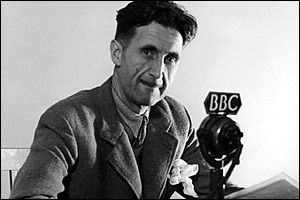
Some things which Orwell experienced at the BBC did eventually prove useful to him when he was able to draw on them for inspiration in the creation of the nightmare bureaucracy of the Ministry of Truth. Compared to this fictional monstrosity, the BBC was as harmless as Orwell implied when he joked that ‘its atmosphere is something halfway between a girls’ school and a lunatic asylum’. But in his time as one of its employees he learned enough about the workings of large organisations to understand how they can create justifications for meaningless activity, and how they can persuade so many of their workers to take this work seriously. And he was reminded of how stultifying it can be to work in an atmosphere where the threat of censorship is ever present. He felt that way in Burma, of course, where a kind of unofficial censorship was imposed by pressure from the empire builders straining under the loads of their white men’s burdens. But it was the routine, institutionalised nature of the censorship at the BBC which Orwell found intriguiging, and depressing.

— Michael Shelden, Orwell : The Authorised Biography, Heinemann, London, 1991, p.380.

Posted in History, Media, State / Politics, War on Terror | Leave a comment

Sue Bateman is a bit like a drunken arsehole at a dinner party

Well, she’s not exactly a wordsmith now is she?

09-01-2005, 10:38 AM
Re: The reason WN orgs are unsuccessful
For an argument to be debatable it must contain the words and meanings that broaches a decision between the people you would like to influence and or plants the seed for further debate and ongoing communications.

I see.

Translated into English, I think what Sue is struggling, but failing absymally to say, is that it’s important to try and make yourself understood. Hence statements have to contain things like “words” and “meanings”. Sue also appears to be concerned at the possibility of a hostile reaction to white supremacism by the public, and that the open expression of such unpopular views may even threaten any hope of an “ongoing dialogue” with civil society. As the current candidate for the seat of Victoria Park in Western Australia, and the former State President of the far-right One Nation Party, Sue Bateman is asking members of that society, her local citizens, to represent their views in Parliament. But how should the citizens of Victoria Park view Sue Bateman?

There are colourful words that are used that could still be used constructed with well meaning sentences along with well meaning statements.Okay [if] other type terms, the blunt language will not cut it with the majority of trash and average persons in the street. And if you want to win then you have to sway their opinions.

Rule #1: When addressing the “majority of trash and average persons in the street”, avoid the use of blunt language.

Unfortunately, come election time, obtaining power depends on more than just choosing the right words. Thus the ability of a white supremacist to sway the opinions of the “majority of trash” and “average persons”, otherwise known as ‘fellow citizens’, also depends on their ability to disguise their racism.

Rule #2: When communicating with the public, disguise your true “meanings” by using “colourful”, “well-meaning” language (for the simple-minded like Sue, for ‘language’, read: “words” and “meanings”). For example:

Instead of “Jewish scum” – Jewish religion. Jewish culture. Jewish faith.A bit like communicating with your best manners at the dinner table.

Here’s some more fine words from Stormfront Sue:

09-10-2005, 01:10 AM
Default Re: Momma Bush (Shrub) Speaks On Evacuees.
She was quiet racist and pompous.Going by the statistics of the white minority in Texas, it was a day at the “Zoo” for her.

And finally, here’s some words of warning for the benefit of Australia’s communist schoolchildren: beware Sue Bateman kids!

08-30-2005, 03:18 PM
Default Re: Communist spat in my face.
I would have made sure my goozy was a nice drawn, green one and spat back in his face, hair is even better because he can wipe it from his face, hair is a little harder.I would try a turd in a brown paper bag and put it in his school bag or in his locker. Now that should get his attention.

Posted in Anti-fascism, Media, State / Politics | Leave a comment

Aussies bringing a msg of peace, goodwill… denial and stupidity

Recently, two Aussies have been caught doing their level best to change the world, one stupid public appearance at a time. First, accountant Simon Patkin. To the bemusement of a few security guards protecting a local McDonald’s restaurant from the hungry (and poor), just prior to the WTO meeting last December in Hong Kong, our globe-trotting number-cruncher “staged a peaceful hour-long protest, which [was] interrupted only by a phone call from his concerned wife. He… hung up signs reading “We love free trade” and “Rationality not rioting”, and harangued passers-by.”

Onya mate!

A second case is that of Lady Susan Renouf:

Lady Renouf – a former wife of the late New Zealand financier Sir Frank Renouf – has long been an advocate of right-wing views. She arrived at the trial of the British historian on Monday and made her views plain to assembled media, calling for the bodies of “so-called Holocaust victims to be exhumed to see whether they died from typhoid or gas”… Renouf, born plain Michele Mainwaring, was crowned Miss Newcastle in 1968. She acquired her title through being the third wife of Sir Frank Renouf. The marriage ended shortly after Sir Frank discovered her father was not dead as she had claimed but a truck driver from The Entrance, and that she was not the former wife of a Russian count.

Posted in Anti-fascism, Media, State / Politics | Leave a comment

Mr. Irving Goes to Jail

Gentleman, scholar and Nazi apologist David Irving has finally been granted his wish for political martyrdom, an Austrian court on Monday sentencing him to three years in jail for denying the Holocaust. Bizarrely, The Guardian reports that “Irving had pleaded guilty to denying the Holocaust in two speeches on a visit to Austria in 1989, but said at the trial that he had later changed his views”.

The Guardian has a copy of the indictment which cites copiously from the speeches Irving made in 1989. “There were no extermination camps in the Third Reich,” he declared. “Is it not time once and for all to put an end to this fairy tale of the gas chambers.” Adolf Hitler “held out his hands to protect the Jews”, and knew nothing of the Final Solution. Thirty thousand people were murdered at Auschwitz in Nazi-occupied Poland – as opposed to the accepted figure of 1.5 million. After the war, the Poles fabricated the gas chamber evidence at Auschwitz to match the “fantasies” of survivors. The billions paid in reparations after the war by Germany to the state of Israel were unwarranted. “That is, of course, embarrassing. It was all a huge swindle … Why does the German people let itself be slandered thus?”

Dunno David, but it looks like it’s the Austrians who really don’t take kindly to strangers and their slanderous lies. Which is unfortunate, as Deborah Lipstadt points out in relation to the issue of free speech, the law and Holocaust denial:

Lipstadt says the reason she is generally opposed to outlawing Holocaust denial is not because she fails to recognise how deeply offensive it is but because such laws tend to turn cranks into martyrs. “I am not interested in debating with Holocaust deniers,” she says. “You wouldn’t ask a scientist to debate with someone who thinks the Earth is flat. They are not historians, they are liars. Debating them would be nonsensical. But we also should not allow them to become martyrs. Nothing is served by having David Irving in a jail cell, except that he has become an international news issue. Let him go home and let him continue talking to six people in a basement. Let him fade into obscurity where he belongs.”

Well, either that, or send him to jail and ensure that he becomes a fascist pin-up boy.

Oh wait…

Posted in Anti-fascism, History, State / Politics | Leave a comment