“The great majority of the Basij, seemingly ever-patient and self-controlled, stood for hours as kids baited and yelled, shoved and provoked. A handful of officers used well-placed elbows while batons were raised only in response to the vandalism.”
“No offence but honestly who gives a shit about some woman in Tehran.” Nowave | “If Iranians are so interesting to you, move to Tehran.” ~ Fruitsalad | Melbourne Punx Forum, June 2009
“The nationalist not only does not disapprove of atrocities committed by his own side, but he has a remarkable capacity for not even hearing about them.” ~ George Orwell, ‘Notes on Nationalism’ (1945)
According to the boffins @ The Official String Theory Web Site “it seems safe to estimate that the age of the Universe is at least 15 billion years old, but probably not more than 20 billion years old”.
“The origins of life on Earth bristle with puzzle and paradox” writes Nicolas Wade (New Glimpses of Life’s Puzzling Origins, The New York Times, June 15, 2009), while “rocks that formed on Earth 3.8 billion years ago… contain possible evidence of biological processes”.
4.
The first animal life on Earth may have been the comb jelly. Thus:
A new study mapping the evolutionary history of animals indicates that Earth’s first animal–a mysterious creature whose characteristics can only be inferred from fossils and studies of living animals–was probably significantly more complex than previously believed.
The study, which was funded by the National Science Foundation (NSF), is the cover story of the April 10, 2008 issue of Nature. Using new high-powered technologies for analyzing massive volumes of genetic data, the study defined the earliest splits at the base of the animal tree of life. The tree of life is a hierarchical representation of the evolutionary relationships between species that was introduced by Charles Darwin.
5.
“It may be more than 570 million years old and look like a knobbly rope, but scientists believe they have discovered the first animal on earth ever to have sex“: funisia dorothea.
6.
The pointy-heads @ the Lunar and Planetary Institute in Houston, Texas write that: “Fossils of the earliest mammals are more than 200 million years old. These small, shrew-like animals probably lived in caves or burrows and hunted insects and small reptiles at night.”
7.
C. David Kreger @ Archaeology Info writes: “Most researchers currently accept the statement that “modern” humans can be considered to date to approximately [200-250,000 years]. Others (such as Milford Wolpoff), take the view that our species extends as far as approximately 2.0 [million years], subsuming H. erectus, H. ergaster, and H. heidelbergensis. There are two polarizing camps on the issue of our species origin (though there is varying degrees of compromise between the two stances as well as various alternative positions): the multiregional (or continuity) camp, and the Out of Africa (replacement) camp.”
On Saturday June 20, on the eve of the second anniversary of the Federal Government’s implementation of its ‘Northern Territory National Emergency Response’ — aka ‘The Intervention’ — there were protests in a number of urban centres, including Melbourne (also Adelaide, Brisbane, Darwin, Perth and Sydney). Pics of the rally are available courtesy of (the irrepressible) Sina.
Following the protest, there was a public meeting @ Trades Hall, with a panel presentation featuring Adam Bandt, Valerie Napaljarri Martin, Aletha Penrith and Robbie Thorpe.
I didn’t take notes, but here, for what it’s worth, are my recollections. (These are not intended to be exhaustive.)
Adam Bandt
The first speaker was Adam Bandt. He outlined Greens’ policy on The Intervention, which the Greens oppose. He made note of the fact that The Intervention has required the suspension of the Racial Discrimination Act. This fact is referred to in an article in Saturday’s edition of The Age (by Dan Harrison and Orietta Guererra and titled, interestingly enough, ‘Fresh food sales up since intervention’):
…Tomorrow [June 21] marks the second anniversary of the HoWARd government’s intervention in the territory purportedly to stamp out child sexual abuse in indigenous communities. The current Government has committed to reinstate the suspended Racial Discrimination Act as part of planned changes to the policy. One of the proposed changes is to allow welfare recipients to apply for income management exemption.
A review of the intervention led by Kimberley indigenous leader Peter Yu last year criticised the blanket imposition of income management, but Indigenous Affairs Minister Jenny Macklin has said she is in favour of continuing compulsory income management.
Measures deemed beneficial to a particular racial group can be exempt from the Racial Discrimination Act.
As Adam stated, and as expressed by Greens Senator Rachel Siewert (‘Speech on Alice Springs Town Camps in Federal Parliament’, June 17, 2009):
However, it [Siewert is here referring to the ‘Future Directions for the Northern Territory Emergency Response – Discussion Paper’, May 21, 2009] leaves out a critical piece of information on how laws that apply on the basis of race can be deemed ‘special measures’ that are beneficial to the community on which they are imposed. Given that the ‘Future Directions’ discussion paper is meant to form the basis of community consultation necessary to continue the NTER, the Northern Territory Emergency Response, and implement its minor reforms, we believe it is disingenuous to leave out this important information. I cannot see how this could be an accidental oversight on this issue, as [it] has been discussed at length in this chamber, particularly by me; in the NT review report; and by the Human Rights Commission in its submissions.
This is an important piece of information. For any of the Northern Territory restrictions, such as compulsory income quarantining or mandatory leases, to qualify as a special measure, the government must be able to show strong evidence that the communities involved believe the measures are beneficial and support them. The UN Convention on the Elimination of All Forms of Racial Discrimination, commonly called CERD, is very clear in this regard, as are the provisions of the Racial Discrimination Act. Special measures need to be positive measures that give additional rights or preferential treatment — so-called affirmative action — designed to achieve equality of outcomes.
Where a special measure requires a community to waive one of its existing rights — a negative measure — it can only ever be a special measure with the support and informed consent of the group concerned. Negative measures can only ever be temporary. In addition to informed consent, they require periodic assessment against specific, measurable outcomes. Special measures must also be necessary and proportionate.
I cannot see how 40-year leases and compulsory acquisition are necessary for the delivery of essential housing services and improvements. There is no logical link or evidence base to justify compulsory acquisition. The government simply has not made this case. Australian case law is very clear on the need for informed consent. Justice Brennan’s findings in Gerhardy v Brown [February 28, 1985; see also : Australian Human Rights Commission, Federal Discrimination Law, Chapter 3 : The Racial Discrimination Act, 3.3 Exceptions, 3.3.1 Special measures, (a) Gerhardy v Brown] are very clear.
He stated:
“Advancement” is not necessarily what the person who takes the measure regards as a benefit for the beneficiaries.
It —
… is not established by showing that the branch of government or the person who takes the measure does so for the purpose of conferring what it or he [sic] regards as a benefit for the group if the group does not seek or wish to have the benefit.
So the minister’s continued assertion that she believes these to be a beneficial measure is in fact irrelevant if that belief is not shared by town camp residents wanting decent housing or communities who do not want blanket income quarantining.
We believe it is extremely strange. There is a strange description of ‘special measures’ in the Future directions discussion paper, which is why the failure to clearly explain this in the discussion paper is, in fact, very disturbing. It would seem logical to assume that the intent of the discussion paper and the consultations associated with it is to provide a basis for arguing that the communities consulted support the minor reforms to the NTER for that purpose. However, if the communities are not explicitly told the purpose of this consultation and informed of their rights up front, this clearly does not qualify as informed consent. (Time expired)
Valerie Napaljarri Martin
Note that Liam Jurrah (Yuendumu Magpies) made his AFL debut for the Melbourne Demons on Friday night, the first footballer from a remote Central Australian community to play in the competition. Overall, indigenous players make up approximately 10% of listed players in the league. One day, hopefully, Liam will abandon his Melbourne guernsey and play, once again, for the Mighty Magpies!
The second speaker was Valerie Napaljarri Martin. She outlined the effects of The Intervention upon her community in Yuendumu. Her presentation echoed sentiments she expressed at the public rally earlier in the day (which chllptr has kindly made available on YouTube):
Valerie’s determination to resist the seizure of Aboriginal lands and to maintain her culture was made very clear, despite the conditions which have been attached to the forms of financial and other ‘assistance’ that the Federal Government has included in its Intervention (in a manner which brings to mind earlier state policies to ‘smooth the dying pillow’). One especially pernicious aspect of this program is the Government’s decision to dismantle ‘remote homelands’, which Valerie maintains is one of several measures which will successfully sever the intimate relationship between local peoples and their land and culture.
On this subject in particular, after having noted what it believes to have been the generally positive nature of The Intervention (facts which themselves are subject to dispute), the editorialists in Saturday’s edition of The Age write (What intervention has wrought, June 20, 2009):
…Against these indicators, however, must be set a tendency on the part of both the federal and Territory governments to disregard — and sometimes even reject — what indigenous people have achieved on their own initiative. The most conspicuous example has been the Territory Government’s decision, with federal support, to concentrate indigenous services in 20 “hub” communities, a move that will undermine the remote homelands revived by the outstation movement of the 1970s. It is demonstrable fact that the homelands have promoted health, well-being, and social pride and cohesiveness. If the two governments hope to win majority indigenous support for the next phase of intervention, that is precisely the kind of progress they cannot ignore.
Of course, the support of indigenous peoples for Government programs has never halted ‘progress’ in the past, and — to put it mildly — ‘land rights’ have always, and without exception, been accorded to the Crown and the corporate sector ahead of others. The current process of enclosure in the Northern Territory is proceeding on the basis of strategies which have proved successful at other times and in other places, and follow upon a more general trajectory of colonial rule. One key feature of this project has been the necessity of dividing subject peoples so as to erode their sense of solidarity and capacity to resist colonialist impositions: Theodore W. Allen argues — quite successfully, I think — in his survey of British rule in Ireland and the institution of racialised forms of oppression in Anglo-America that stable control often necessitated the formation of a social buffer; this social buffer is also in the process of creation in Australia.
Ireland and General Principles of Colonial Social Control
The English efforts to establish social control in Ireland that are noted in this chapter present a variation on the general principles of the social control problems and policies of colonizing powers and their relationship to the option for racial oppression. After first establishing commanding authority, colonizers pursued one of two general lines of policy, according to circumstances as they found them. Where they found a developed and well-defined system of classes, the new rulers sought to adapt the pre-existing social structure to their own needs, coopting amenable elements of the old order into their colonial administration as a buffer and social control stratum over and against the masses of the super-exploited wealth-producing laboring classes. Such was the case of the Spanish in Peru and Mexico; of the Portuguese in India and the East Indies; of the English in India; and of the Dutch in the East Indies.
Where, on the other hand, the conquerors encountered a society with no previously developed significant class differentiation, and therefore with no available social handle to serve their rule, they employed a policy tending to the complete elimination of the indigenous population by slaughter and expulsion. The Spanish in the Carribean, the Portuguese in Brazil, the English in St Vincent, and the English and Anglo-Americans in North America demonstrated this approach. In such cases, the colonizers found themselves obliged to seek foreign supplies of commodity-producing labor, and were obliged to invent and establish an intermediate social control stratum for each colony by promoting elements of the imported laboring class.
With regard to the extermination option, English military and economic policies from the sixteenth to the eighteenth century produced in Ireland episodes of mass extermination, as we have noted, which in absolute numerical terms and ferocity were possibly a match for those chronicled by Las Casas in the West Indies. But it would have been impossible for the English to have perpetrated such complete extermination of the Irish people as that executed upon the Caribs and Arawaks by the Spanish in the Caribbean in the sixteenth century. Unlike the situation of the Spanish in the Caribbean, there was in Ireland a much more substantial general English hostage population subject to retaliation for any such attempt. Although the English achieved an overwhelming military advantage over the Irish, still they at no time enjoyed the degree of practical invulnerability possessed by the Spanish vis-a-vis the indigenous peoples of the Americas. Moreover, but one Las Casas arose to deplore genocide in the Caribbean, and then only after the deed was done. But the Catholic Irish and Anglo-Irish had as allies popes, potentates and powers, sworn antagonists all of the English Protestant “heretics”. In the struggle against their English rivals, the hopes of these powers depended, militarily and morally, on the preservation of the Irish resistance to the English, though not necessarily upon Irish independence. Finally, even if the English colonialists could have safely undertaken a Caribbean-style extermination of the Irish, it would have been detrimental to their own interest. Unlike the Spanish, the English were sixty years away from secure access to African sources of labor. And England could not supply English agricultural laborers for Ireland at a cost matching that of Irish labor already in place.
On the other hand, the English option for religio-racial oppression in Ireland at the end of the sixteenth century eliminated the possibility of recruiting an indigenous intermediate social control stratum. This would remain the central problem of British rule in Ireland for more than two centuries. To the partial extent, namely in Ulster, that they succeeded in establishing an intermediate stratum, they were able to maintain racial oppression “without sending an army to do it”. Outside Ulster, they would in time be forced to abandon rule by racial oppression. These developments and their Anglo-American parallels will be the subject of other chapters.
~ Theodore W. Allen, The Invention of the White Race: Volume One, ‘Racial Oppression and Social Control’, Verso, 1994, pp.69–70.
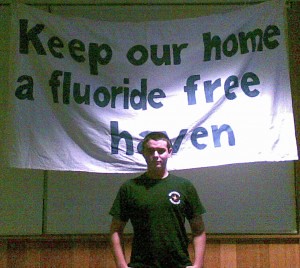
Curiously, Scott the ‘national anarchist’ (sic) has thrown his puny weight behind the campaign, attending a rally against fluoridation on June 13, and remarking that: “Overall, the rally was a success and the fight goes on. The BAFF group and its supporters have made clear that the date fluoridation commences is not the end of the campaign, it is the date the fight rams [sic] up a level and goes on stronger than ever before! We will be there till the end, for our freedom to choose and the health of our future generations.”
Sieg Heil!
This article [mathaba.net/news/?x=620688] was published on the nutty mathaba site — see : mathaba.net : last words, May 1, 2008 — the publishers of which, in collaboration with local nutzis belonging to the New Right/’national anarchists’ — attempted to bring down my blog last year.
Unsuccessfully, obviously.
Scott’s most recent foray into the world of student politics was sponsored by Donna Yan and Bonita Silva of Vertigo, the student zine of the University of Technology Sydney. See : National Anarchism (Again) (May 30, 2009) and A is for Anarchy. B is for Bullshit. (May 24, 2009).
Anti-fluoride extremists have threatened to kill a Victorian government minister and blow up a regional water authority.
As anger over fluoridating Geelong’s water supply mounted today, Labor minister Lisa Neville has been targeted along with water and health officials.
A death threat was left with a bottle of water on the verandah of Ms Neville’s house on Saturday night, a government spokeswoman said.
Anti-fluoride activists have also threatened to blow up Barwon Water’s treatment plants as the authority begins on Monday adding fluoride to the water supply in Geelong, 70 kilometres southwest of Melbourne.
The Department of Human Services (DHS) received a threatening letter in the mail last week.
All three threats are being investigated by police.
A government spokeswoman said Ms Neville, who is the member for Bellarine, returned home on Saturday night to find the bottle of water and a note on her front verandah.
A blog called ‘Iran in the Gulf’ has provided translations of Khiaban (‘The Street’) newspaper, which is apparently circulating among oppositional elements. “Long live popular sovereignty! Long live resistance to the Coup D’état! Death to dictatorship!”
In the meantime, the dictatorship seems to be managing to bring death to the ‘resistance’:
“At 19:05 on June 20 on Karekar Avenue, at the corner crossing Khosravi and Salehi Streets, a young woman who was standing beside her father watching the protests was shot by a basij member hiding on the rooftop of a civilian house… I am a doctor, so I rushed to try to save her. But the impact of the gunshot was so fierce that… she died in less than 2 minutes. The protests were going on about 1 kilometer away in the main street and some of the protesting crowd were running from tear gas… towards Salehi Street.”
Also on that subject, Henry McDonald (The Observer, June 21, 2009) quotes a nice poem written by someone associated with nutzi groupuscule ‘Combat 18’:
“Romanian gypsies beware beware
Loyalist C18 are coming to beat you like a baiting bear
Stay out of South Belfast and stay out of sight
And then youse will be alright
Get the boat and don’t come back
There is no black in the Union Jack
Loyalist C18 ‘whatever it takes’.”
…Although those behind this latest outbreak of racist violence are not being directed by any loyalist paramilitary group, their actions last week took the world’s focus away from what is a positive, developing story within Ulster loyalism… [that is, the de-commissioning of arms].
The fear within the loyalist paramilitary leaderships is that, as they leave the scene, a vacuum within their communities could be filled by the far right.
“We have a job on our hands now persuading an entire generation that grew up looking up to men who took up arms for the loyalist cause that violence is not the answer,” one senior UDA member told the Observer yesterday. “I don’t believe this gang behind these latest attacks are that well organised, but the danger from now on is that these teenagers and young people could be manipulated and used by these neo-Nazi groups who are trying to organise in Ulster.”
Taking time off from negotiations with the British government about moves by the UDA to disarm, the loyalist leader said he believed the gang were “copycat racists” who were adopting Combat 18’s name to instil fear into the immigrant community. “They [the BNP, UBPP and other neo-Nazi parties] have been stirring things up at time when the loyalist groups are trying to transform our communities,” he added…
On the other hand, the British far right has almost invariably supported Loyalism, including Loyalist paramilitaries. With regards C18 (and Charlie Sargent), the link is particularly strong between it and UDA/UFF and the ‘Loyalist Volunteer Force’ (and Johnny Adair).
C18 has a tiny presence here in Australia, and was until very recently promoting itself by way of terrormachine.net. This now appears to have been taken down. Before it was, it claimed to have the heartfelt support of local nutzi bands ‘Indigenous Hate’ and ‘Southern Storm’. Sadly, Southern Storm’s pop hit ‘We’re Southern Storm’ (“Niggers Jews and Communists / Look out scum you’re on our list!”) is no longer available for your viewing pleasure on YouTube, and neither, even more sadly, is the musical powerhaus known as Indigenous Hate. On the bright side — and speaking of hatred for Australia’s indigenous peoples — ‘Oh No Here Comes An Abo’ continues to Master Race up the YouTube charts:
Note that vocalist Jesse and scores of his short-haired mates will be prancing on stage in Melbourne on September 12, and “Abos” are definitely not welcome to join them.
As for terrormachine.net, the site was most recently registered to a Perth bloke named ‘Jake’. ‘Jake’, oddly enough, was also responsible for ensuring that ashes belonging to US nutzi criminal David Lane were scattered in Perth: seenutzis are W E I R D : David Lane’s Ashes (February 13, 2009).
* For some reason, and I’m not entirely sure why, the last line of the final poem has been rejected by YouTube / my technical incompetence has ensured it was not uploaded. In any case, it is: “I will give them food”.
Thus, two fuckwitted lowlife bums in the US, Hugh Farrell and Gina “Tiga” Wertz, have been arrested and charged with racketeering — under RICO (Racketeer Influenced and Corrupt Organizations) laws originally introduced in 1970 ostensibly in order to target criminal associations such as The Mafia — for allegedly “conspiring” to engage in tree sits, participate in non-violent civil disobedience, and make an inflammatory blog post against the I-69 NAFTA superhighway. Worse yet, Hugh Farrell “has been observed advocating literature and materials which advocate anarchy, property destruction and violence, including Ecodefense: A Field Guide to Monkeywrenching [and] Recipes for Disaster: An Anarchist Cookbook.”
Decent, law-abiding, tax- mortgage- and rent-paying citizens everywhere agree that these books should be burned, not read. Sadly, such dangerous texts are also available in Australia. (Recipes, for example, which shouldn’t be but often is confused with the tract The Anarchist Cookbook — and one zillion versions thereof — may be purchased from Barricade infoshop or viaBeating Hearts distro.)
Obviously, if you were a punk rock music fanboy, you might react by way of stating “No offence but honestly who gives a shit about some fuckwitted lowlife bums in the US?”; or possibly by suggesting that if one cares about US state repression, the only logical conclusion is to immediately apply for a Green Card.
Be that as it may, as observed by the editors of The Sun in 1990, THE ANARCHISTS are out to disrupt public order by manipulating people with genuine grievances — they are parasitical wreckers who hijack rallies. Anarchism is, “by definition, imported. The immigration authorities should find out whether any of its adherents who are not Australian born are, through their actions, in breach of the permits under which they remain here. If so, let’s send them home. They are not welcome!”
These sentiments were echoed sixteen years later by leading Australian Marxist theoretician Mick Armstrong who, with an eagle-eye for detail, remarked that ‘THE ANARCHISTS’ who attended the protest rally against the G20 were crazy, ultra-violent and silly, “they simply exploited the demo for their own purposes”, and during preparations for protest at the summit were hostile towards and contemptuous of others. On The Big Day itself, “they did all they could to disrupt the demonstration and were hostile, abusive, threatening and ultra-sectarian”.
With similar political acuity, Mick notes that what gave these scum “a certain critical mass… was the presence of considerable numbers of anarchists from overseas”. Worse yet: “one of our members from New Zealand said he recognised at least 40 NZ anarchists” and “at least 20 of them by name”. Worst of all perhaps, there “were also a considerable number of black bloc anarchists from Europe… people from Sweden, Germany and England. These people are like football hooligans who travel the world looking for violence.”
This desperate search for masses of people to manipulate into performing outrageous acts of violence has been the stock-in-trade of anarchist scum since at least the late 1800s, evidence for which is readily available in bourgeois media reportage, police intelligence briefings, and the ideological pronouncements of the leadership of Socialist Alternative.
As for what might be the best response to these foreign scum stirring up trouble, the courts — thankfully — decide to gaol Akin Sari for 28 months. In an earlier era, he may well have been hanged (and judging by the enormous danger the presence of anarchists in any city has to the maintenance of law and order, perhaps should have been). Mick Armstrong, on the other hand — being a theoretician with many years of experience in the student movement — opts for a more liberal approach: “The left should offer no comfort to these crazies. We should do whatever we can to isolate them. They are wreckers.”
For those of you who are crazy or stupid enough not to take Mick’s advice, please note that on Friday, June 26 from 7.30pm you can enjoy a “Trivia Fun Night With Friends!” @ the Princes’ Park Bowling Club in Carlton. The organisers have promised not to subject those in attendance to ultra-violence, but do point out that those with delicate constitutions are warned that individuals born in places other than Australia may well be present at some point during the evening.
Note that, in an attempt to dissuade their colleagues at the University of Melbourne from attending the Trivia Night, the SAlt Film Unit have produced the following short documentary based on their recollections of the carnage enacted on the streets of Melbourne in November 2006, as foreign anarchists attacked SAlt paper sellers and invaded their parents’ tastefully-decorated apartments:
Final confirmation of the innate wickedness of anarchism and anarchists is revealed through an examination of the origins of May Day, where anarchists once again revealed their violent nature, and the ugly manner in which this violence is deployed against legitimate businessman and the police — with disastrous consequences for the contemporary student left and its ability to chant slogans and sell newspapers to other students in peace and quiet.
Haymarket Martyrs–Origins of International Workers Day Pt 1
Haymarket Martyrs–Origins of International Workers Day Pt 2
The Chicago Times called the workers “ragtag and bob-tailed cuthroats of Beelzebub from the Rhine, the Danube, the Vistula and the Elba”. Labour’s largest paper called them “wild beasts”. The respected Albany Law Review called them “long-haired, wild-eyed, bad-smelling, atheistic, reckless foreign wretches”.
Haymarket Martyrs–Origins of International Workers Day Pt 3
See also : Great Expectations… (May 4, 2009) | Haymarket: A Novel by Martin Duberman (Seven Stories, 2003). A novelisation by a US labour historian of The Haymarket Affair (1886), a torrid period in US history what gave birth to the modern May Day, an occasion the significance of which persists despite over 120 years of denial and historical revisionism. In addition to providing an account of the class war in late nineteenth century Chicago, Martin, moreover, imagines the lives of two of its key players: Albert Parsons and Lucy Gonzalez (Lucy Parsons).
Historical note:
…in December 1879, when thousands of Exodusters were making their way overland from Texas to Kansas, the Socialist Labour Party, of which [Frederick A. Sorge, Marx’s friend and correspondent and National Labour Union activist] was a chief founder, held its national convention in Pittsburgh, Pennsylvania. Albert Parsons, himself a Texan driven out for his equalitarian views, introduced a resolution “concerning land grants”. The whole country by that time was aware of the Exodus, but the records do not show whether Parsons made any mention of it in his talk and resolution. In any case, the convention as a whole ignored it; the resolution was referred to the Committee on Platforms and is not heard of again.
The South Revisits the Problem of Social Control
I have noted how the Protestant tenants, their exclusive Ulster Custom tenant-right eroded by structural economic changes and drained by reduction of the size of their holdings, indicated for a brief period a readiness to make common cause with the Catholic peasants to secure the legal enactment of a tenant-right law for all Ireland. Radical Reconstruction had likewise shown that there were some Southern whites who were ready to make common cause with the black population to establish a society based on racial equality of constitutional rights.
They dared, and some died as John Brown had done, struggling side-by-side with African-American freedom fighters for their common cause, the end of racial oppression. They are not so well known as they should be; here is a selected list of ten of them:
• A. P. Dostie, described by one historian as “animated by a fanatical ambition to subdue rebels and elevate slaves” (Shugg, Class Struggle in Louisiana, p.217), killed in a mob attack on the New Orleans Black and White Convention in July 1866; his dying words: “Let the good fight go on!” (Proceedings of the Southern Loyalist Convention, September 1866, printed in the Reporter, no.33, Washington, DC, 17 September 1866).
• Calvin Pepper of Virginia, the only white person on the delegation which Fredrick Douglass led to present a petition to the President on behalf of Negro suffrage (Black, Home-made Yankees, p.189. John Richard Dennett, The South As It Is, 1865–1866 [New York, 1866], pp.6–7).
• James W. Hunnicutt of Virginia, who “campaigned vigorously against the vagrancy laws, for racial equality, and against voting and office-holding by ‘rebels'” (Black, p.250, citing Union League Club of New York, Aid for Virginia [New York, 1867]).
• George W. Ashburn of Georgia, murdered “for consorting with Negroes” (Black, p.30).
• J. W. Smith, of Texas, killed for “organizing Negroes” (ibid.).
• Thomas J. Mackey of South Carolina, “one of the few white men to attend the state labor convention in Columbia in 1869” (ibid., p.34).
• William Wallace Chisolm and John P. Gilmer, killed in Mississippi in 1877 in order that “confidence [be] restored between the races” (James D. Lynch, Kemper County Vindicated: A Peep at Radical Rule in Mississippi [New York, 1879], p.319).
• Alexander Boyd, murdered in Eutaw, Alabama, “for too earnest enquiries into outrages committed against freedmen” (Black, pp.47–8, citing the Greensboro, North CarolinaRepublican, 28 April 1870).
• John Walter Stephens of North Carolina, poor farmer, uncompromising activist in the struggle against white supremacy, whose lynching and the manner of it are described in Chapter 30 of Albion W. Tourgée’s novel A Fool’s Errand (1879; New York, 1961).
The ruling class strangled Reconstruction by sheer terror, but they could not forget the time when the impossible happened and a part of the European-American population arrayed itself against white supremacy. The consensus is that the proportion of this defection from this white-race function was insignificant. If it was so insignificant why the reign of terror against it? Was the terror not simply a new edition of the gag rules, the tar and feathers, and the interdiction of abolitionist mail that had been produced by the fears of abolitionism in the South in the pre-war decades? And, in the end, had not those forebodings proved valid? Given the decision to continue the system of racial oppression, given the self-limiting advantages of rule by mere terrorism, given the dilemma-dictated reliance on African-American labor, given the constitutional leverage, actual or potential, now in the hands of the African-Americans — the matter of the intermediate stratum remained in urgent need of attention.
~ Theodore W. Allen, The Invention of the White Race: Volume One, ‘Racial Oppression and Social Control’, Verso, 1994, pp.150–151.
AUSTRALIA has very few anarcho-capitalist [sic] bloggers like Paul Staines of Guido Falkes [sic] fame, reformed raver libertarians with an eye for scandal (and another on the latest market moves).
And we have no political bloggers who break stories. What we have on our political blogs is analysis. And talk. Endless talk.
Some are sharp. Sometimes. Others are the online equivalent of soapbox speakers. Then there is the group that provides the cyberworld’s answer to the sad sacks you see on the street holding intense conversations with no one in particular.
And there is one final type of political blog: the online shit-sheet, the internet equivalent of the anonymous lies, smears and distortions that get peddled in the parties, particularly the ALP and particularly at pre-selection time.
Australia’s most notorious practitioner of this blogging is a Melburnian with impeccable links to the local ruling right, John Brumby’s Unity faction.
Rumour says powerful Labor figures keep him going, but everyone concerned has plausible deniability — for now.
If someone wants to claim the first scalp of the Australian political blogosphere, perhaps they should dig deeper.
Where to begin?
At the start I guess.
1. Paul Staines of Guido Falkes [sic] fame
I’m not surprised Christian The Christian champions Paul Staines. After all, they have a lot in common, having both carved out careers as Tories-for-hire, relied upon their fellow Tories for leaks to ‘break’ stories, and consumed illegal drugs (how naughty!): cocaine/ecstasy in the case of Christian the Christian, XTC/LSD/MDMA in the case of Mister Staines. Both champion self-interest, and appear to base their views on a dull form of ‘libertarianism’ (most familiar to a North American audience), one made famous by its espousal by philosophes such as von Hayek, Friedman, and Cartman.
A confession: I’d never heard of Mumble, and have read the other blogs on only a handful of occasions. The first three listed concentrate on examining the entrails of the members of The Johns Party; Club Troppo defines itself as expressing “Politics, economics, law and life from a ‘radical centrist’ perspective, defined by Noel Pearson as “the intense resolution of the tensions between opposing principles” — to which I can only reply ‘What-ever‘ — and its disco on ‘politics’, law and ‘life’ reads very much like such things do when interpreted by a commerce studies graduate (the kind best avoided at parties); Catallaxy is startlingly similar. The dull earnestness of both is… well… dull.
3. one final type of political blog: the online shit-sheet
Which, though Christian The Christian fails to name it, is rather obviously a reference to Andrew Landeryou’s ‘THE OTHER CHEEK’, now known as ‘vexnews’. Famous for his legal battles with businessman Solomon Lew and involvement in the scandal which destroyed the Melbourne University Student Union, Landeryou comes from pedigree Labor stock — Daddy was a Victorian State Government Minister — and uses his blog to attack factional rivals in the ALP. Several years ago (May 23, 2006), he was declared a bankrupt — which, as it happens, appears to have been a fate shared by Paul Staines of Guido Falkes [sic] fame.
Come to think of it, Landeryou’s Blog(s) of Freedom really isn’t that far removed from Paul Staine’s Guido. (Falkes.)
Two Greek anarchists are making molotov cocktails. One says to the other: "So who will we throw these at then?" The other replies: "What are you, some kind of fucking intellectual?"