‘In May 2007, the battle between Fatah al-Islam and the Lebanese army broke out in Nahr al-Bared Refugee Camp in northern Lebanon. Amidst heavy fighting, the Lebanese army had systematically destroyed the entire camp by September 2007. Two years later, nearly all the rubble has been cleared from the “old camp”, the core of Nahr al-Bared. However, though the displaced residents grow increasingly desperate, reconstruction has yet to begin.
Not only does the Lebanese army keep people away from the old camp, but it also controls movement in and out of the surrounding area known as the “new camp”. Anyone entering the new camp requires a valid permit issued by the army. Refugees and NGOs working to revitalize the once robust economy of the camp face crippling isolation, as the marketplace of Nahr al-Bared is totally cut off from the surrounding villages. A flailing economy and soaring unemployment are only a few of the consequences of the destruction and ongoing siege of the camp.
This 26-minute film follows a father and his son as they attempt to deal with their unemployment. The two have been living in metal barracks for more than a year, waiting to return to their camp. By documenting issues of reconstruction, temporary housing, economy, unemployment and despair, the film touches on the daily experience of life in Nahr al-Bared Camp.
(IsraelNN.com) Public Security Minister Yitzchak Aharonovich promised a fellow minister that the police would make sure that anarchist rioters in Na’alin and Bilin are brought to justice. Aharonovich was replying to a query on the matter by Ayub Kara, Minister for Development of the Galilee and Negev.
Aharonovich assured Kara that many of the participants in the ongoing riots have been arrested and interrogated, and some have been tried. “Some of those involved have been subjected to restrictions on entering Judea and Samaria, and others, who are not Israeli citizens, were expelled from Israel, or their entry into Israel was prevented.”
“Among Free’s supporters and detractors in Eugene, there is consensus that his stiff sentence was meant to send a message. But those 22 years also reflect the idiosyncrasies and bad luck that marked his legal odyssey. Free’s arrest came at a time when some in Eugene were growing tired of the city’s reputation as an anarchist-haven, a reputation that was seared into the national consciousness at the 1999 WTO protests in Seattle. As Detective Holland put it: “During Seattle, you had this image on TV of a bare-chested, black-hooded guy anarchist, jumping on a car, while a mother and daughter in the car looked on, terrified. That symbolized Eugene.” Since then, one former district attorney has said authorities adopted a get-tough-on-anarchists policy.” ~ Gayle Forman, The Killing Fields, February, 2002.
1. Paul Mullett has maintained his integrity and had all charges against him dropped: “FORMER police union chief Paul Mullett will walk from the Supreme Court free of criminal accusations today when perjury charges against him are withdrawn, in a massive blow to the Office of Police Integrity” (All Mullett charges to be dropped, Selma Milovanovic, The Age, June 25, 2009). The lesson: Don’t mess with the Mullett.
2. In news that will bring a smile to the face of Mick Armstrong, Cops foil anarchists helping asylum seekers storming Channel Tunnel says The Sun (UK): “The “No Borders” activists, who come from all over Europe — including BRITAIN — have threatened to rip down fences to help migrants across.” Welsh football hooligans belonging to the terrorist cell ‘noborderswales’ have taken their cues from Iranian terrorists and are busy twittering about their evil schemes.
The wreckers.
3. In the Czech Republic, Czech police are pressing charges against Roma, but not nutzis, according to some foreign news source: ‘One Roma man who will be in court tomorrow yelled the following at Lucie Šlégrová, a DS member who regularly participates in neo-Nazi events: “What are you doing here? What are you doing here? Get out of here, you dirty Czech cunt! Why are you playing at being a fascist?” The DS provocateurs subsequently left the housing estate.’ On the other hand: ‘Local non-Roma residents openly supported the attack on the Roma and yelled racist insults at them such as “black fuckers” or “black swine”, which according to the state prosecutor is not a crime.’
Hurrah! for free speech!
4. In that bog of ignorance known as Ireland, members of the Romanian/Hungarian fascist groupuscule known as the ‘Szekler Legion’ have been kicking arse and taking names on behalf of the caring sharing community known as $hell (see also : Fascist group worked as Shell guards, John Donovan, Royal Dutch Shell plc .com, May 5, 2009).
Now, The Bad News:
1. Only three Aryan Warriors attended a protest in defence of the right of a proud White Canadian to educate her daughter to appreciate Time magazine’s 1933 ‘Man of the Year’: “The rally was intended to show support for the mother of two children seized by CFS after the daughter was sent to school with Nazi symbols inked on her body” (Protest by alleged neo-Nazi group fizzles, Lindor Reynolds, Winnipeg Free Press, June 24, 2009). Protest organiser Paul Fromm toured Australia in 2005, the outspoken Freedom Actionist addressing the League of Rights and the Australia First Party.
2. With CIA sponsorship, right-wing elements in Venezuela are continuing to undermine the reputation of Dear President Chávez, to discredit the Big Ideas of philosophical superstars, and to hamper t-shirt sales in Australia by continuing to publish their antiquated views, most recently by way of an interview with criminal elements from Spain: Interview with El Libertario (Venezuela – June 2009).
3. “Figures cited in a federal parliamentary estimates hearing this week revealed that about 3000 Australians had their phone calls intercepted every year” — what about the other 21,000,000?!? (ASIO bugs 3000 calls a year, Natalie O’Brien, The Australian, May 29, 2009).
4. Rod Coronado is not in prison. He should be. He is a TERRORIST. Now he is the subject of a book. Written by a TERRORIST SYMPATHISER named Dean Kuipers. For further disgusting details, see : Firebrand: Rod Coronado’s Flame War, Jeffrey St. Clair, Counterpunch, June 19–21, 2009.
“Here I stand; I can do no other. God help me. Amen!” ~ Martin Luther (1483-1546)
On Saturday June 20, on the eve of the second anniversary of the Federal Government’s implementation of its ‘Northern Territory National Emergency Response’ — aka ‘The Intervention’ — there were protests in a number of urban centres, including Melbourne (also Adelaide, Brisbane, Darwin, Perth and Sydney). Pics of the rally are available courtesy of (the irrepressible) Sina.
Following the protest, there was a public meeting @ Trades Hall, with a panel presentation featuring Adam Bandt, Valerie Napaljarri Martin, Aletha Penrith and Robbie Thorpe.
I didn’t take notes, but here, for what it’s worth, are my recollections. (These are not intended to be exhaustive.)
The third and fourth speakers on the panel on June 20 @ Trades Hall were Robbie Thorpe and Aletha Penrith.
Robbie Thorpe provided some of the historical context for The Intervention, the latest in a series of incursions upon indigneous peoples’ lands, rights, and cultures. In this context, Robbie drew attention to (that ass called) the law, both international and British. Robbie made particular note of the fact that the ideological foundation of the British penal colony later called ‘Australia’ was the doctrine of terra nullius; that this legal fiction was only overturned in 1992 after a long legal battle (the Mabo case); and that the legal status of Aboriginal and Torres Strait Islander peoples as Australian citizens (a form of political recognition which Robbie rejects) was only secured in 1967, following a successful national referendum and the re-categorisation of indigenous peoples as human (as opposed to, say, fauna).
Beyond this, Robbie also drew attention to Australia’s status as an international pariah, which has yet to ratify — by way of introducing into Australian law — the UN Convention on the Prevention and Punishment of the Crime of Genocide (1948). Robbie listed the various criteria by which the crime of genocide is defined in the Convention, all of which apply to Australian Settlement.
In concluding, Robbie remarked that justice might be obtained by way of recognising these facts; of acknowledging genocide (an ongoing process, not an historical event which took place at some point in the distant past) and Aboriginal sovereignty, and the negotiation of an end to the war on the indigenous peoples of Australia by way of a treaty (or treaties). These three proposals form the basis of The Black GST (see : The Black GST, a short doco produced by Undergrowth and directed by Tim Parish & Krusty; Melbourne 2006 Stolenwealth Games Corporation; camp sovereignty blog. www.blackgst.com is now defunct.)
Note that Robbie Thorpe has been the subject of a slanderous campaign by the neo-conservative hack Andrew Bolt (the Herald Sun‘s resident vaudeville performer), in a manner not dissimilar to that launched upon US academic Ward Churchill by Bolt’s North American equivalents. Both men have been prominent critics of exterminationist and assimilationist state policies — their success predictably generating racist responses (which, as a general rule, it does in the case of all other such figures). See : Ferals run amok, April 12, 2006; Smoke and mirrors, April 19, 2006; TRACEEEE SMOKED, Timmeh! Blair, April 16, 2006; Flame still burns despite blue from the Bolt, Graham Ring, National Indigenous Times, April 20, 2006. The racist bottom-feeders at white supremacist websites like Stormfront — including one Darrin Hodges — naturally responded with glee to Andrew’s half-baked notions.
The fourth and final panel speaker to address the meeting was Aletha Penrith. Aletha expressed her opposition to The Intervention, her support for those resisting its imposition, but primarily addressed the situation of contemporary young black radicals (or rather, this portion of her presentation is the one what left the strongest impression on me at any rate). Thus, while acknowledging the efforts of The Greens (and other non-indigenous institutions) to address The Intervention and related matters, Aletha’s principal concern was the manner in which indigenous peoples, especially young indigenous peoples, might organise, both now and in the future, to secure ‘self-determination’ and its embodiment in a variety of political projects. To this end, Aletha voiced support for a renewed effort on the part of young black radicals to gather and to determine their own political agenda into the future — if possible, with the financial support of sympathetic non-indigenous groups and individuals. (One individual — and I don’t remember who — directly asked Adam Bandt if the Greens would be amenable to some such proposition.)
One final, impromptu speaker to address the meeting was Gary Foley, who temporarily joined the panel (and partly in response to Aletha’s presentation) to address the question of ‘self-determination’ for indigenous peoples, especially in the context of White Australia’s resistance to such a project, and in light of both more recent and historical debates within the contemporary Aboriginal movement. Some of his remarks echoed those he voiced at an earlier rally (see : Gary Foley @ Melbourne anti-intervention rally, June 20, 2009, June 21, 2009); in both cases, I think, Gary was at pains to emphasise the importance of arriving at a) a critical analysis of political developments within the Australian body politic vis-a-vis indigenous ‘issues’ and b) within this context, a greater knowledge base from which to produce such a critique. Gary also expressed the importance of non-indigenous Australians seeking both to educate themselves about such matters but also taking whatever opportunities present themselves to educate others — family, friends, work colleagues and the general public — regarding the practice of race and racism within contemporary Australian society.
By way of (temporary?) conclusion, as noted, these are merely my own recollections of the meeting, I did not take notes, and I’m unaware of any other accounts — although I understand that the panel presentations were recorded for possible later broadcast on 3CR(?). Secondly, the only response that I’m aware of to my previous post is by way of the Working Group for Aboriginal Rights (Australia) — which, as it happens, is an excellent resource. Finally, please to remember that, as Jock The Interpretative Dancer once reminded me during a fit of pique: Nobody Likes a Thinker.
Bonus Kelly!
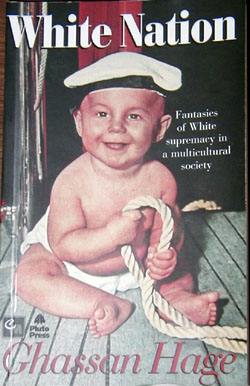
Bonus Hage!
This work deals with the highly topical issue of multiculturalism and, as such, a warning is necessary. It is written for those who are, or aspire to be, members of the intellectual elite. These are the people who believe that knowledge is the product of hard labour; the people who believe that you need to do a great deal of time-consuming research, read a lot of books and reflect on many difficult philosophical, empirical and theoretical issues to produce intelligent knowledge.
In John HoWARd’s Australia, there seem to be many individuals who feel ‘relaxed and comfortable’ in talking about issues about which they haven’t bothered to read a single researched article, let alone a book. Apparently, ‘life taught them’. In fact, such people are so ‘relaxed and comfortable’ that they believe that the more someone works at trying to learn about an issue, the more they become part of an ignorant and arrogant lot: the intellectual elite. The role of this elite is apparently simply to put down naturally intelligent people and find ways to stop them from expressing the truth they capture so effortlessly by merely living.
When I used to visit my grandmother in Bathurst in the late 1970s, she would often make comments such as ‘You’ve been reading too much’ or, even more explicitly, ‘People who go to university become mad.’ Although such comments helped me reflect on how and why university knowledge clashed with everyday knowledge, I resented pronouncements such as ‘You have read books, but life has taught me.’ I used to say, ‘But Granny, I have a life as well you know, and it teaches me too. Can’t you see that books and research provide me with extra knowledge.’ I was naive even to try.
The so-called ‘intelligentsia’ always looks down with a really limitless condescension on anyone who has not been dragged through the obligatory schools and had the necessary knowledge pumped into him. The question has never been: ‘What are the man’s abilities?’ but ‘what has he learned?’ To these ‘educated’ people the biggest empty-head, if he is wrapped in enough diplomas, is worth more than the brightest boy who happens to lack these costly envelopes.
This is neither my granny, nor any of Australia’s anti-intellectual populists speaking, but Adolf Hitler. And I cannot help thinking of him when people start abusing intellectuals. Hitler was the classic anti-intellectual: a man who had enough intellect to be a mediocre intellectual and enough also to realise that he wasn’t a member of the intellectual elite. Like many mediocre intellectuals, he thought he had a natural talent for knowledge, rather than realising how much hard work is put into whatever knowledge people end up gathering.
Hitler was not, however, the sort of person who would just sit there and take it. He was too motivated by dreams of social, political and intellectual mobility to allow himself to just sulk and do nothing. So, he found the time-honoured way to ‘beat’ the intellectual elite. This is the road often chosen by people who want to be recognised as intellectuals, but who are either not socially equipped to be so or feel they have better things to do than putting in the hard labour necessary to achieve such a status. These people compensate for their lack of knowledge by speaking in the name of ‘the people’. ‘The people’ becomes such a formula of success for mediocre intellectuals that they make themselves — and some others, too — believe that they actually are ‘the people’.
The mechanism is very simple: 1) ‘The people’ already know everything there is to know: ‘life taught them’. 2) Consequently, anything that the ‘intellectual elite’ says which is not known by the people is superfluous knowledge, if not actively against the people. 3) Therefore, any attack on the knowledge of the intellectual elite is a defence of the knowledge of the people. And who else is better at defending the instinctive knowledge of the people if not the instinctively intelligent, mediocre intellectual? In reality, ‘the people’ are too busy living. In addition, one can be certain that anyone who uses the concept of ‘the people’ is already someone who distinguishes himself or herself from them…
~ Ghassan Hage, White Nation: Fantasies of White supremacy in a multicultural society, Pluto Press, 1998, Preface, pp.7–9.
Bonus Alston!
Some of our ideas about who we are as a people hamper our struggles. For example, the Black community is often considered a monolithic group, but it is actually a community of communities with many different interests. I think of being Black not so much as an ethnic category but as an oppositional force or touchstone for looking at situations differently. Black culture has always been oppositional and is all about finding ways to creatively resist oppression here, in the most racist country in the world. So, when I speak of a Black anarchism, it is not so tied to the color of my skin but who I am as a person, as someone who can resist, who can see differently when I am stuck, and thus live differently…
As a Panther, and as someone who went underground as an urban guerrilla, I have put my life on the line. I have watched my comrades die and spent most of my adult life in prison. But I still believe that we can win. Struggle is very tough and when you cross that line, you risk going to jail, getting seriously hurt, killed, and watching your comrades getting seriously hurt and killed. That is not a pretty picture, but that is what happens when you fight an entrenched oppressor. We are struggling and will make it rough for them, but struggle is also going to be rough for us too.
This is why we have to find ways to love and support each other through tough times. It is more than just believing that we can win: we need to have structures in place that can carry us through when we feel like we cannot go another step. I think we can move again if we can figure out some of those things. This system has got to come down. It hurts us every day and we can’t give up. We have to get there. We have to find new ways.
Anarchism, if it means anything, means being open to whatever it takes in thinking, living, and in our relationships—to live fully and win. In some ways, I think they are both the same: living to the fullest is to win. Of course we will and must clash with our oppressors and we need to find good ways of doing it. Remember those on the bottom who are most impacted by this. They might have different perspectives on how this fight is supposed to go. If we can’t find ways for meeting face-to-face to work that stuff out, old ghosts will re-appear and we will be back in the same old situation that we have been in before.
You all can do this. You have the vision. You have the creativity. Do not allow anyone to lock that down.
There was a hint on anarchy on the breeze over the waters of Lough Neagh recently with the scattering of the ashes of an American man. They belonged to Harold Thompson, who died in jail last October at the age of 66 after being sentenced to life plus 50 years for murder and robbery in 1979. His parents were from Ireland and had emigrated to the United States after the troubles of the first half of the 20th century. After a stint in Vietnam he became involved in anti-war protests and anarchism, notching up run-ins with the authorities before the killing that would see him spend the rest of his life behind bars. His supporters describe the man he was convicted of killing as a police informer who had killed the mother of one of Mr Thompson’s children and threatened the life of another. His robberies are described as “expropriation activities” on an anarchist support website…
I am an anti-authoritarian, anti-racist, anti-sexist, anarchist revolutionary of proud Irish heritage. I am also a vegetarian and strongly support the animal liberation movement. I stand for civil/human rights and will not break, bend nor be intimidated. I stand in solidarity with all people struggling against oppression but most particularly with my brothers and sisters in the anarchist movement. ~ Harold Thompson
NIKOS KOUNTARDAS
Greek anarchist held over British diplomat’s guard murder, Reuters, June 23, 2009 [?] Nikos Kountardas to be released on Thursday morning, Occupied London, June 18, 2009 [?] So… Nikos was released on bail (after being charged with setting a bank on fire in Thrace on October 4, 2007)… then a few days later confessed to police he was responsible for the murder in December 2004 of Haralambos Amanatidis? Hmmm. Ekatherimini (June 23, 2009): “…police are said to be questioning the credibility of another claim of responsibility, by known anarchist Nikos Kountardas, regarding the fatal shooting of a special guard outside the British attache’s residence in 2004. Officers are said to be skeptical about Kountardas’s claim to have killed Haralambos Amanatidis with the help of an accomplice who is now dead. Police are looking into cases of recently deceased anarchists to see whether they shed any further light on Kountardas’s claims.” Very odd.
See also : 325, an insurgent anti-prison zine of social war & anarchy.
THOMAS SHEPHERD aka IAN JOHNSON aka TIMOTHY SHEARER aka RORY THOMAS aka ….
Harold Thompson died at the age of 66, of a heart attack, and only a few years after having been almost beaten to death by neo-Nazis in prison, an assault which not only left him with permanent damage, but which took place with the collusion of prison authorities.
On Sunday, the Sunday Herald Sun reported that Thomas Shepherd — “AKA Ian Johnson, Timothy Shearer, Rory Thomas etc” — at the age of 66, has announced that he spent two decades of his life as an ASIO spook spying on leftists — a thoroughly routine and completely normal activity for an ASIO employee. The only odd aspect of the article — apart from the fact that a former operative has gone public, contrary to laws pertaining to ASIO — is that Shepherd nominates two of the VIPs he spied on as being union boss Jennie George and academic Marcia Langton; the compilation of dossiers on ‘persons of interest’ and the infiltration of leftist groups — Shepherd names the Communist Party of Australia (RIP) and the Socialist Workers Party (now known as the DSP) — is standard practice, and dates back to the early twentieth century.
In the spying game, the more things change, the more they stay the same… although now ASIO has an absolutely massive budget in comparison to when Timothy was assessing Jennie George’s culinary skillz.
Again, I don’t get it. (I didn’t realise spooks were also named ‘sparrows’ but!) Actually, now that I think about it, I could’ve sworn I’ve come across this story before…
A FORMER ASIO spy has revealed he was made to snoop on prominent Australians, including former ACTU chief Jennie George.
Thomas Shepherd said he believed that in the 1970s and ’80s, ASIO compiled dossiers on hundreds of leading Australians, including Bob Hawke, Gough Whitlam and Peter Garrett.
He said the list of those being watched included judges, entertainers and business figures.
Mr Shepherd, 66, risks prison for revealing details of his life as a spy, but said his life had been destroyed by his experiences and he felt betrayed by the agency.
“It was an age of paranoia. Anyone slightly left of centre was viewed with suspicion by ASIO,” Mr Shepherd said.
Mr Shepherd was recruited by ASIO as an 18-year-old student in the 1960s and worked for it for 20 years, spying on Left-wing organisations within Australia.
He said life as a spy cost him his marriage and his peace of mind and threatened his sanity.
He said he was a regular visitor to Ms George’s home, having meals there.
“ASIO wanted to know everything about her, personal details, the lot, right down to what was served for dinner,” Mr Shepherd said.
“The important thing was I never discovered anything about her that could damage her in any way,” he said.
Mr Shepherd said he also spied on one of Australia’s most renowned Aboriginal leaders, Marcia Langton, in the mid-1970s.
He became a member of the Communist Party and the Socialist Workers Party of Australia in the 1970s in order to gather information and pass it to ASIO.
“Lies and deceit became my way of life. Vigilance was required at all times. This was stressful and socially alienating,” Mr Shepherd said.
After he left ASIO he was given little or no assistance to rebuild his life, despite the post-traumatic stress disorder he was suffering.
As recently as last April, ASIO took out an order against him and threatened him with a lengthy prison sentence if he co-operated in the writing of this article.
The Sunday Herald Sun attempted to contact ASIO for comment, but the organisation did not return calls.
I was a dedicated ASIO Operative (spy) for almost 20 years and now I [have] been thrown to the wolves.
I was an Arts student at Sydney University in 1961 when I was approached by an ASIO Officer and Handler, —–. I was asked to serve God, Queen and Country during the rabid anti communist Cold War era. The Petrov affair was still reverberating and Prime Minister Menzies’s fantasies of Reds under the bed and the Red Invading Hand of communism coming from SE Asia was a popular political poster and integral to the politics of the time.
I was recruited as one of ASIO’s Operatives over a few beers with —– at the Rushcutters Bay Hotel under the name of Ian Johnson.
Under instruction from —–, the communist milieu was targeted. I was instructed to join the Earlwood Branch of the Communist Party of Australia. The objective was to infiltrate the Young Communist Movement and in particular observe the Flowers Family.
This was to be in association with the infiltration of the Teachers Federation and to target the supposed communist leadership. In particular people such as Jenny [sic] George who much later was to become Secretary of the ACTU and Marcia Langton Professor of Aboriginal Studies Melbourne University[.]
The then obligatory pilgrimage overseas, England, France, Italy and Greece to gain some experience of the International and the strengthening Socialist League was undertaken. Embassy contacts such as Bill in Rome, Tony in England were supplied by ASIO in case of need.
When I returned to Australia my target [was] changed to the Socialist Workers Party of Australia, in particular Jim and John Percy. Any international affiliates were of supreme importance as sources of finance, beginning of [sic] the tumultuous Arab world and the influence of Russia. This was permeated with the constant interest in the Socialist International Organisation[?]
This required my activities in such places as New Zealand, USA, UK, Belgium and France. This was all directed by various ASIO and overseas handlers.
There was fear, drama, tension and anxiety [aplenty], for example, with the Murphy “invasion” of the ASIO Offices in Canberra. Along with the everyday subterfuge, double identities and concealment here and overseas. Craft skills were taught in meagre sessions and basically one was left to one’s abilities.
I worked from 1962 to 1977 on a “payment for services” basis although later ASIO denied I was an employee. This was the case except for the period 1977 to 1979 where a contract was signed and an annual wage was determined.
In 1979 my cover was questioned. The SWP instituted a formal tribunal which included house arrest, abuse, supervision, and intensive search of all my possessions. My membership was terminated and delivered by John Percy on the grounds of suspect religious beliefs and appreciation of religious classical music. They were unable to establish any link to ASIO.
A period of extreme fear and rejection of both ASIO and SWP overwhelmed me and I fled my home. I then fled Australia with my future wife because of both fear and retribution.
Before departure and on return I rejected “debriefing sessions” from ASIO. (Debriefing is totally discredited by the international medical profession[.]) Previous sessions had always been farcical both here and in New Zealand.
I left Sydney in 1980 for Hillville and later Green Point to live in seclusion fearing to return to Sydney
In 2006 I appealed for medical assistance from ASIO after my wife divorced me as she could no longer support my erratic and irrational behaviour. I met with B– and L– at the Mercure Airport Hotel for a day’s assessment by L– an ASIO psychologist. She was never permitted to make her report available to me even after her assurances and promises. She expressed her deepest concern about my psychiatric state and recommended 3 Sydney psychiatrists. ASIO under pressure paid the Medicare gap for 3 visits.
I visited one of these psychiatrists for six months on a regular basis. Dr R Juratowitch has subsequently disappeared with his records.
I made a Comcare application as suggested by Mr I Carnell of IGIS and was referred to a psychiatrist whom they appointed and the conditions of PTSD, Anxiety Disorder, severe [d]epression, paranoia and constant resolve to suicide were confirmed. My current psychiatrist also confirms these conditions.
ASIO has delayed and hampered the assessments by Comcare and even after Mr I Carnell’s (IGIS) astonishment at my treatment by ASIO.
Comcare has rejected any help for my re insertion into society.
This matter is now before the Administrative Appeals Tribunal.
While the UK has R.E.S.P.E.C.T. — Respect, Equality, Socialism, Peace, Environmentalism, Community, and Trade Unionism — Australia has F.R.E.E — Freedom, Rights, Environment, Educate.
Educate… not ‘Education’… mmmkay?
Serious and Organised Crime (Control)
The F.R.E.E. Australia Party (not to be confused with the Nuclear Free Australia Party [1985–]) was formed in late 2008/early 2009, and was formally registered with the Electoral Commission of South Australia, its state of origin, on March 19, 2009. The party also appears to be branching out into New South Wales (Free Australia Party holds membership drive in Sydney, ABC, April 18, 2009) and Queensland. The party’s chairperson is Peter Sendy, and its slogan is ‘When injustice becomes law, resistance becomes duty’ (a slogan allegedly coined by South American revolutionary Ernesto ‘Che’ Guevara).
The party was formed in response to the South Australian Government’s passage (September 4, 2008) of the Serious and Organised Crime (Control) Act 2008 [PDF], a piece of legislation which allows it to designate particular groups as constituting criminal organisations. (Similar legislation has also been introduced in NSW.) Or:
An Act to provide for the making of declarations and orders for the purpose of disrupting and restricting the activities of criminal organisations, their members and associates; to make related amendments to the Bail Act 1985, the Criminal Law Consolidation Act 1935, the Freedom of Information Act 1991 and the Summary Offences Act 1953; and for other purposes.
Further:
4—Objects
(1) The objects of this Act are—
(a) to disrupt and restrict the activities of—
(i) organisations involved in serious crime; and
(ii) the members and associates of such organisations; and
(b) to protect members of the public from violence associated with such criminal organisations.
(2) Without derogating from subsection (1), it is not the intention of the Parliament that the powers in this Act be used in a manner that would diminish the freedom of persons in this State to participate in advocacy, protest, dissent or industrial action.
In fact, on March 23, 2009, the SA Premier Mike Rann even went so far as to claim that “On evidence presented by the Police Commissioner, our laws allow us to proscribe criminal bikie gangs the same way we do terrorist groups”.
Of course, ‘intention’ is one thing, and practice another. For this reason, in addition to attracting opposition from bikies, the Act has also drawn criticism from other quarters, even (Victorian) police: “Doubts have been expressed by the federal Attorney-General’s Department, the Australian Crime Commission, the Law Council of Australia and academics and civil libertarians” (Roar of disapproval thunders against anti-bikie laws, Greg Ansley, The New Zealand Herald, May 30, 2009).
In addition to opposing the criminalisation of “1%ers”, the party is also supporting the establishment of an Independent Commission Against Corruption, much to the delight of Democrats in SA (Call to give FREE Australia party ‘a fair go’, ABC, March 31, 2009); the Communist Party of Australia has also taken note (NEW BIKERS LAWS: Latest front in civil liberties war, The Guardian, April 8, 2009). The party is also opposed to the ABCC (see : ABCC, John Holland, West Gate Bridge, May 13, 2009). In general, an examination of the party’s ‘Policy Directives’ reveals a fairly ‘progressive’ politics, including support for long-term solutions to the water crisis, a ‘Bill of Rights’, freedom of association, reproductive rights, prisoners’ rights and various reforms aimed at securing housing for the poor and the homeless.
On a spotterly note, the party has drawn attention to the contradiction between the ALP’s support for the Act and its membership of the Second International, and in particular the International’s ‘Ethical Charter’ (to which the ALP, by way of its membership, is a signatory).
Background
In May 2008, Mike Rann paid a visit to FBI headquarters in Washington DC, “acknowledging the influence the US federal law enforcement agency had on his intent to tackle bikie gangs in South Australia” (Rann uses FBI visit to talk tough on bikies, Michael Owen, The Daily Telegraph, May 20, 2008; According to Tony Wright and David Lague — Waging war on the outlaws, The Age, March 28, 2009 — these sentiments were echoed by PM KRudd: “In far-away Washington, no less a 99 percenter than Prime Minister Kevin Rudd vowed that a zero-tolerance policy would be harnessed to bring the bikie gangs to heel”). Mike’s visit was preceded by a declaration by Assistant Commissioner (Crime) Tony Harrison in October 2007 that bikies would be ‘wiped out’ (Colin James, The Advertiser, October 30, 2007).
An essential part of the FBI’s War on Terror Crime is the ‘Racketeer Influenced and Corrupt Organizations’ (RICO) statute. RICO was passed by the US Government in 1970, ostensibly in order to combat The Mafia. In the almost 40 years since, however, its use has been extended in a wide variety of contexts, implicating individuals, groups, businesses and a range of other social institutions. Most recently, RICO has even been employed against environmental activists.
The bikie gangs/terrorist organisations identified by police as being of particular concern are the Bandidos, Black Uhlans, Coffin Cheaters, Comanchero, Finks, Fourth Reich, Gladiators, Gypsy Jokers, Hells Angels, Highway 61, Life & Death, Lone Wolf, Mobshitters, Nomads, Notorious, Odin’s Warriors, Outcasts, Outlaws, Phoenix, Rebels and Satan’s Soldiers. Currently, the SA Government is attempting to outlaw the Finks OMC — an attempt which is the subject of ongoing court action (Finks free of control orders for now, ABC, June 12, 2009).
See also : Bikers, violence and justice, John Smith, Eureka Street, May 14, 2009 | United Motorcycle Council of New South Wales (Hell’s Angels / Finks / Rebels / Nomads / Bandidos / Comanchero / Lone Wolf / Black Uhlans / Life & Death / Vietnam Vets / Outcasts / Phoenix / Brotherhood CMC / Bikers for Christ CMC / God Squad CMC / Ambassadors / Diggers) | Misunderstood bikies, Jeff Gosford, The Newcastle Herald, June 16, 2009 | Search Results for ‘bikie’ @ slackbastard.
Bonus for Dr. Cam!
Serial pest disrupts NSW Parliament
AAP
June 18, 2009
Serial pest Peter Hore is at it again, this time jumping into NSW Parliament’s bear pit, disrupting the start of question time.
Hore jumped from the public gallery into the back of the chamber of the Legislative Assembly yelling he was a member of the “Free Australia Party.”
A number of MPs sitting on the back benches were clearly startled by Hore’s interjection, but he was quickly removed from parliament by security.
Hore has previously interrupted the funeral of rock singer Michael Hutchence and ripped the goal net during Australia’s crucial World Cup soccer qualifier against Iran in Melbourne in 1997.
He has also invaded the South Australian parliament and once charged supermodel Sarah O’Hare on stage during a lingerie launch at Brisbane.
“As great as the name Slack Bastard is maybe you should consider changing it to Misinformed Twat. I’m off to play a set of Jamaican and Two-Tone ska [@ The Birmy] right now, I’m sure I’ll speak to you soon when you find some other way to twist truths into bullshit.” ~ Reverend Jack Petty (The Beefeaters), February 8, 2008
THE BIRMY : NOW UNDER NEW, NON-FASCIST SYMPATHISING MANAGEMENT : SOON TO CELEBRATE ITS FIRST ANNIVERSARY WITH A WEEKEND OF FREE GIGS : 4PM : SATURDAY JUNE 27 : TWO STAGES : 12 BANDS & DJs
“You would have to call that a pretty unsuccessful boycott.” ~ Doug Smith (Bulldog Spirit / Marching Orders / Skin Heads Neither For Nor Against Racial Prejudice), December 7, 2007
Also on Iran, see : News from the struggles in Iran, Hands Off the People of Iran: “State organs such as Press TV have described the murdered protesters as ‘terrorists’.”
…On Kristallnacht, Schmeling took an enormous risk and hid the two teenage sons of a Jewish friend in his Berlin hotel room. The boxer claimed to be sick and did not allow any visitors. When the opportunity presented itself, Schmeling smuggled the two boys out of the country. Henri Lewin, who became a Las Vegas hotelier, credits Schmeling with his life; characteristically, the modest Schmeling made no mention of this episode in his own autobiography.
Further:
Invited to referee a bout in Milwaukee in 1954, Schmeling first flew to New York to visit Joe Jacobs’ grave. On the same trip, he drove to Chicago and found Joe Louis at home. They reminisced and renewed an acquaintance that lasted until Louis’ death. The two even appeared on a popular television program, “This is Your Life,” which reunited Louis with a host of people from his past. When Louis died in 1981, Schmeling helped pay for the funeral. In his later years, Max Schmeling continued to live outside his hometown of Hamburg, Germany, until his death in February 2005 at the age of 99. “I had a happy marriage and a nice wife,” he would tell an interviewer before his death. “I accomplished everything you can. What more can you want?”
I will be facing a jury trial on the 30th of June in the Melbourne County Court for charges relating to the G20 protests in Melbourne 2006. So this will be my final post until the completion of the trial.
If you can please come to the trial to support or wherever you are raise awareness about the implications of a neoliberal agenda will mean to the peoples of the Pacific.
She will be joined by two other comrades on July 13. They are facing charges of aggravated burglary (which can carry a 25 year jail term) for allegedly walking into offices on ‘Corporate Engagement Day’ with nothing more than glitter and water pistols!
Also:
Trivia Fun Night With Friends!
Come along for a fun night full of entertainment, laughs, fun and trivia amongst friends!
Princes Park Bowling Club-Carlton
@ Bowen Crescent, North Carlton, 3054
Melways Map 29 H10
Friday the 26th of June 2009
at 7pm till midnight
Games start at 7:30 pm
$5 @ the door or book a table for 6 at $25 call 0408317732 (Tina)
cheap drinks, raffles and lots and lots of fun!
“The great majority of the Basij, seemingly ever-patient and self-controlled, stood for hours as kids baited and yelled, shoved and provoked. A handful of officers used well-placed elbows while batons were raised only in response to the vandalism.”
“No offence but honestly who gives a shit about some woman in Tehran.” Nowave | “If Iranians are so interesting to you, move to Tehran.” ~ Fruitsalad | Melbourne Punx Forum, June 2009
“The nationalist not only does not disapprove of atrocities committed by his own side, but he has a remarkable capacity for not even hearing about them.” ~ George Orwell, ‘Notes on Nationalism’ (1945)
According to the boffins @ The Official String Theory Web Site “it seems safe to estimate that the age of the Universe is at least 15 billion years old, but probably not more than 20 billion years old”.
“The origins of life on Earth bristle with puzzle and paradox” writes Nicolas Wade (New Glimpses of Life’s Puzzling Origins, The New York Times, June 15, 2009), while “rocks that formed on Earth 3.8 billion years ago… contain possible evidence of biological processes”.
4.
The first animal life on Earth may have been the comb jelly. Thus:
A new study mapping the evolutionary history of animals indicates that Earth’s first animal–a mysterious creature whose characteristics can only be inferred from fossils and studies of living animals–was probably significantly more complex than previously believed.
The study, which was funded by the National Science Foundation (NSF), is the cover story of the April 10, 2008 issue of Nature. Using new high-powered technologies for analyzing massive volumes of genetic data, the study defined the earliest splits at the base of the animal tree of life. The tree of life is a hierarchical representation of the evolutionary relationships between species that was introduced by Charles Darwin.
5.
“It may be more than 570 million years old and look like a knobbly rope, but scientists believe they have discovered the first animal on earth ever to have sex“: funisia dorothea.
6.
The pointy-heads @ the Lunar and Planetary Institute in Houston, Texas write that: “Fossils of the earliest mammals are more than 200 million years old. These small, shrew-like animals probably lived in caves or burrows and hunted insects and small reptiles at night.”
7.
C. David Kreger @ Archaeology Info writes: “Most researchers currently accept the statement that “modern” humans can be considered to date to approximately [200-250,000 years]. Others (such as Milford Wolpoff), take the view that our species extends as far as approximately 2.0 [million years], subsuming H. erectus, H. ergaster, and H. heidelbergensis. There are two polarizing camps on the issue of our species origin (though there is varying degrees of compromise between the two stances as well as various alternative positions): the multiregional (or continuity) camp, and the Out of Africa (replacement) camp.”
On Saturday June 20, on the eve of the second anniversary of the Federal Government’s implementation of its ‘Northern Territory National Emergency Response’ — aka ‘The Intervention’ — there were protests in a number of urban centres, including Melbourne (also Adelaide, Brisbane, Darwin, Perth and Sydney). Pics of the rally are available courtesy of (the irrepressible) Sina.
Following the protest, there was a public meeting @ Trades Hall, with a panel presentation featuring Adam Bandt, Valerie Napaljarri Martin, Aletha Penrith and Robbie Thorpe.
I didn’t take notes, but here, for what it’s worth, are my recollections. (These are not intended to be exhaustive.)
Adam Bandt
The first speaker was Adam Bandt. He outlined Greens’ policy on The Intervention, which the Greens oppose. He made note of the fact that The Intervention has required the suspension of the Racial Discrimination Act. This fact is referred to in an article in Saturday’s edition of The Age (by Dan Harrison and Orietta Guererra and titled, interestingly enough, ‘Fresh food sales up since intervention’):
…Tomorrow [June 21] marks the second anniversary of the HoWARd government’s intervention in the territory purportedly to stamp out child sexual abuse in indigenous communities. The current Government has committed to reinstate the suspended Racial Discrimination Act as part of planned changes to the policy. One of the proposed changes is to allow welfare recipients to apply for income management exemption.
A review of the intervention led by Kimberley indigenous leader Peter Yu last year criticised the blanket imposition of income management, but Indigenous Affairs Minister Jenny Macklin has said she is in favour of continuing compulsory income management.
Measures deemed beneficial to a particular racial group can be exempt from the Racial Discrimination Act.
As Adam stated, and as expressed by Greens Senator Rachel Siewert (‘Speech on Alice Springs Town Camps in Federal Parliament’, June 17, 2009):
However, it [Siewert is here referring to the ‘Future Directions for the Northern Territory Emergency Response – Discussion Paper’, May 21, 2009] leaves out a critical piece of information on how laws that apply on the basis of race can be deemed ‘special measures’ that are beneficial to the community on which they are imposed. Given that the ‘Future Directions’ discussion paper is meant to form the basis of community consultation necessary to continue the NTER, the Northern Territory Emergency Response, and implement its minor reforms, we believe it is disingenuous to leave out this important information. I cannot see how this could be an accidental oversight on this issue, as [it] has been discussed at length in this chamber, particularly by me; in the NT review report; and by the Human Rights Commission in its submissions.
This is an important piece of information. For any of the Northern Territory restrictions, such as compulsory income quarantining or mandatory leases, to qualify as a special measure, the government must be able to show strong evidence that the communities involved believe the measures are beneficial and support them. The UN Convention on the Elimination of All Forms of Racial Discrimination, commonly called CERD, is very clear in this regard, as are the provisions of the Racial Discrimination Act. Special measures need to be positive measures that give additional rights or preferential treatment — so-called affirmative action — designed to achieve equality of outcomes.
Where a special measure requires a community to waive one of its existing rights — a negative measure — it can only ever be a special measure with the support and informed consent of the group concerned. Negative measures can only ever be temporary. In addition to informed consent, they require periodic assessment against specific, measurable outcomes. Special measures must also be necessary and proportionate.
I cannot see how 40-year leases and compulsory acquisition are necessary for the delivery of essential housing services and improvements. There is no logical link or evidence base to justify compulsory acquisition. The government simply has not made this case. Australian case law is very clear on the need for informed consent. Justice Brennan’s findings in Gerhardy v Brown [February 28, 1985; see also : Australian Human Rights Commission, Federal Discrimination Law, Chapter 3 : The Racial Discrimination Act, 3.3 Exceptions, 3.3.1 Special measures, (a) Gerhardy v Brown] are very clear.
He stated:
“Advancement” is not necessarily what the person who takes the measure regards as a benefit for the beneficiaries.
It —
… is not established by showing that the branch of government or the person who takes the measure does so for the purpose of conferring what it or he [sic] regards as a benefit for the group if the group does not seek or wish to have the benefit.
So the minister’s continued assertion that she believes these to be a beneficial measure is in fact irrelevant if that belief is not shared by town camp residents wanting decent housing or communities who do not want blanket income quarantining.
We believe it is extremely strange. There is a strange description of ‘special measures’ in the Future directions discussion paper, which is why the failure to clearly explain this in the discussion paper is, in fact, very disturbing. It would seem logical to assume that the intent of the discussion paper and the consultations associated with it is to provide a basis for arguing that the communities consulted support the minor reforms to the NTER for that purpose. However, if the communities are not explicitly told the purpose of this consultation and informed of their rights up front, this clearly does not qualify as informed consent. (Time expired)
Valerie Napaljarri Martin
Note that Liam Jurrah (Yuendumu Magpies) made his AFL debut for the Melbourne Demons on Friday night, the first footballer from a remote Central Australian community to play in the competition. Overall, indigenous players make up approximately 10% of listed players in the league. One day, hopefully, Liam will abandon his Melbourne guernsey and play, once again, for the Mighty Magpies!
The second speaker was Valerie Napaljarri Martin. She outlined the effects of The Intervention upon her community in Yuendumu. Her presentation echoed sentiments she expressed at the public rally earlier in the day (which chllptr has kindly made available on YouTube):
Valerie’s determination to resist the seizure of Aboriginal lands and to maintain her culture was made very clear, despite the conditions which have been attached to the forms of financial and other ‘assistance’ that the Federal Government has included in its Intervention (in a manner which brings to mind earlier state policies to ‘smooth the dying pillow’). One especially pernicious aspect of this program is the Government’s decision to dismantle ‘remote homelands’, which Valerie maintains is one of several measures which will successfully sever the intimate relationship between local peoples and their land and culture.
On this subject in particular, after having noted what it believes to have been the generally positive nature of The Intervention (facts which themselves are subject to dispute), the editorialists in Saturday’s edition of The Age write (What intervention has wrought, June 20, 2009):
…Against these indicators, however, must be set a tendency on the part of both the federal and Territory governments to disregard — and sometimes even reject — what indigenous people have achieved on their own initiative. The most conspicuous example has been the Territory Government’s decision, with federal support, to concentrate indigenous services in 20 “hub” communities, a move that will undermine the remote homelands revived by the outstation movement of the 1970s. It is demonstrable fact that the homelands have promoted health, well-being, and social pride and cohesiveness. If the two governments hope to win majority indigenous support for the next phase of intervention, that is precisely the kind of progress they cannot ignore.
Of course, the support of indigenous peoples for Government programs has never halted ‘progress’ in the past, and — to put it mildly — ‘land rights’ have always, and without exception, been accorded to the Crown and the corporate sector ahead of others. The current process of enclosure in the Northern Territory is proceeding on the basis of strategies which have proved successful at other times and in other places, and follow upon a more general trajectory of colonial rule. One key feature of this project has been the necessity of dividing subject peoples so as to erode their sense of solidarity and capacity to resist colonialist impositions: Theodore W. Allen argues — quite successfully, I think — in his survey of British rule in Ireland and the institution of racialised forms of oppression in Anglo-America that stable control often necessitated the formation of a social buffer; this social buffer is also in the process of creation in Australia.
Ireland and General Principles of Colonial Social Control
The English efforts to establish social control in Ireland that are noted in this chapter present a variation on the general principles of the social control problems and policies of colonizing powers and their relationship to the option for racial oppression. After first establishing commanding authority, colonizers pursued one of two general lines of policy, according to circumstances as they found them. Where they found a developed and well-defined system of classes, the new rulers sought to adapt the pre-existing social structure to their own needs, coopting amenable elements of the old order into their colonial administration as a buffer and social control stratum over and against the masses of the super-exploited wealth-producing laboring classes. Such was the case of the Spanish in Peru and Mexico; of the Portuguese in India and the East Indies; of the English in India; and of the Dutch in the East Indies.
Where, on the other hand, the conquerors encountered a society with no previously developed significant class differentiation, and therefore with no available social handle to serve their rule, they employed a policy tending to the complete elimination of the indigenous population by slaughter and expulsion. The Spanish in the Carribean, the Portuguese in Brazil, the English in St Vincent, and the English and Anglo-Americans in North America demonstrated this approach. In such cases, the colonizers found themselves obliged to seek foreign supplies of commodity-producing labor, and were obliged to invent and establish an intermediate social control stratum for each colony by promoting elements of the imported laboring class.
With regard to the extermination option, English military and economic policies from the sixteenth to the eighteenth century produced in Ireland episodes of mass extermination, as we have noted, which in absolute numerical terms and ferocity were possibly a match for those chronicled by Las Casas in the West Indies. But it would have been impossible for the English to have perpetrated such complete extermination of the Irish people as that executed upon the Caribs and Arawaks by the Spanish in the Caribbean in the sixteenth century. Unlike the situation of the Spanish in the Caribbean, there was in Ireland a much more substantial general English hostage population subject to retaliation for any such attempt. Although the English achieved an overwhelming military advantage over the Irish, still they at no time enjoyed the degree of practical invulnerability possessed by the Spanish vis-a-vis the indigenous peoples of the Americas. Moreover, but one Las Casas arose to deplore genocide in the Caribbean, and then only after the deed was done. But the Catholic Irish and Anglo-Irish had as allies popes, potentates and powers, sworn antagonists all of the English Protestant “heretics”. In the struggle against their English rivals, the hopes of these powers depended, militarily and morally, on the preservation of the Irish resistance to the English, though not necessarily upon Irish independence. Finally, even if the English colonialists could have safely undertaken a Caribbean-style extermination of the Irish, it would have been detrimental to their own interest. Unlike the Spanish, the English were sixty years away from secure access to African sources of labor. And England could not supply English agricultural laborers for Ireland at a cost matching that of Irish labor already in place.
On the other hand, the English option for religio-racial oppression in Ireland at the end of the sixteenth century eliminated the possibility of recruiting an indigenous intermediate social control stratum. This would remain the central problem of British rule in Ireland for more than two centuries. To the partial extent, namely in Ulster, that they succeeded in establishing an intermediate stratum, they were able to maintain racial oppression “without sending an army to do it”. Outside Ulster, they would in time be forced to abandon rule by racial oppression. These developments and their Anglo-American parallels will be the subject of other chapters.
~ Theodore W. Allen, The Invention of the White Race: Volume One, ‘Racial Oppression and Social Control’, Verso, 1994, pp.69–70.
Two Greek anarchists are making molotov cocktails. One says to the other: "So who will we throw these at then?" The other replies: "What are you, some kind of fucking intellectual?"