With Y: The Last Man wrapping up and turning into a movie, the science fiction cliche of the female-dominated planet is red-hot once again. The cosmos is safe for our red-blooded spacemen to venture to worlds where there are no men, or where men are subjugated and the women wear funny headgear. But what about the subset of gynarchic cultures where everyone’s a lesbian? It turns out science fiction is full of those, too, and it’s time they got the appreciation they deserve.
Many, many thanks to Liz Henry with the Feminist SF blog for helping me put together this exhaustive list of lesbian-dominated cultures in science fiction. Smug Sappho! There are way more than I’d expected…
In December last year, some anarchists from Sydney floated a proposal to form a regional anarchist federation in Oceania. In brief, the proposal was made out of a desire to create closer links between anarchists in the region.
The following are some of my own thoughts in response.
Note that a gathering of anarchists interested in discussing the proposal will take place over Easter (Friday March 21–Monday March 24) @ the International Workers’ Club in Northcote, Melbourne. For more details, read the blog.
To begin with, there are some obvious definitional issues. The first is “what is anarchism?” The second is “what is a federation?” And the third is to do with what is meant by ‘Oceania’.
Anarchism
As for the first question, the proposal contains a statement of ‘common politics’. These are contained in five points. Thus according to the proposal’s authors, anarchists:
1) Seek to abolish capitalism and class society;
2) Support libertarian forms of organisation;
3) Oppose all forms of oppression;
4) Believe an anarchist society is possible, desirable (and necessary) and;
5) Oppose the state and support internationalist struggle.
Or something like that. (The above is a summation.) The five points are elaborated upon at some length in the proposal, and the following section is a response, both to these further reflections, and the five points which are presented as forming the core of an anarchist politic.
So, in respect of 1): Capitalism is a form of class society — but not the only one, obviously. In which case, it may be simpler to state that anarchists seek to abolish class society. On the other hand, to my mind, the most obvious and first principle of an anarchist politic is opposition to hierarchy; that is, anarchists wish to create anarchy, a society without rulers. In which case 4) would assume the highest priority. That is, in terms of arriving at a definition of ‘anarchism’, anarchists are those who maintain an anarchist society is both possible and desirable (the question of whether or not it is ‘necessary’ is a question of secondary importance in my opinion). From this commitment also flows the other points: opposition to capitalism and all forms of domination and exploitation, whether their bases are economic, racial or sexual. Beyond this, I think it would be worthwhile committing the federation to an explicitly revolutionary political framework.
Federation
The roots of anarchist federalism lie in the late nineteenth century, in particular debates within the IWMA (The First International, 1864). Those debates are relevant only insofar as they concerned, in part, the question of the relationship between an organisation and its parts; in this case, the International and its (largely) national branches. One of the central features of this debate was the question of state power and the relationship of workers’ movements towards its conquest. For the anarchists — sometimes also referred to as the autonomists — the ‘economic’ struggle always took precedence over the ‘political’ one. In the end, the differences between the (broadly) Marxist position and that of the (broadly) anarchist position proved too great to be reconciled within the one organisation, and the International dissolved (1872).
In essence, the theory and practice of federation developed in opposition to the theory and practice of political centralisation. That is, federation developed as a means by which such conflicts, in the absence of a central authority, could be best resolved — or perhaps left unresolved — while minimising the effects upon the pursuit of common interests. Instead, decisions made by a federation require the agreement of each of its member parts. By one definition, then, federalism means “free agreement of individuals and organizations upon collective endeavour geared towards a common objective”. In Australia, the last attempt to create such a structure was the Federation of Australian Anarchists, or FAA, established in January 1975.
The FAA lasted several years before collapsing. The reasons for this are many, but it’s notable that the structure of the FAA allowed membership by both groups and individuals (see below).
Process
There are a number of arguments in favour of allowing both existing groups of anarchists and unaffiliated individuals to participate in and to form part of an anarchist ‘federation’. The first and most obvious is that, of the hundreds if not thousands of people who describe themselves as being anarchist (or highly sympathetic to anarchism), the majority are not members of any anarchist group. In which case, excluding individuals from joining and participating in a federation (if not a discussion concerning its merits), is to effectively exclude the majority of (self-described) anarchists from the organisation. To the extent that the purpose of the federation is to overcome the political, social and even geographical isolation of anarchists, this is obviously a problem.
One reason why the inclusion of individuals (as individuals) within the federation is problematic proceeds from an understanding of the distinctive nature of a federation. In general usage, a federation is composed of groups which nominate delegates — authorised representatives of the group’s collectively-determined position(s). Delegates meet with delegates from other groups, and do so with a mandate. That is, with a clearly-defined purpose in meeting and in order to address specific questions. Further, whatever agreements are reached by delegates are not confirmed until such time as groups then proceed to ratify those decisions. That is, delegate agreements require ratification by the groups which comprise the federation. This process is intended to limit the potential for the abuse of authority granted to delegates, and to ensure that ultimate decision-making authority rests with the groups which form the federation’s organisational basis.
In the context of a federation comprised of groups and individuals, such a process is obviously unworkable. Rather, either individuals assume the same authority as groups, or decisions made by the federation as a whole are made as a result of the deliberations of each of the individuals which comprise its membership. In which case, the federation more closely resembles a political party than it does a federation of groups in the anarchist sense of the term.
As it stands, the following groups have expressed some interest in and might possibly comprise the groups from which a federation is drawn: Alarm Youth Anarchist Collective, Black Rose, Jura, Mutiny, Wollongong Autonomous Collective (NSW); Anarchist Direct Action, Barricade, Melbourne Anarchist Club (Victoria). To the best of my knowledge, there are no functioning anarchist groups in the ACT, Northern Territory, South Australia or Tasmania. In Queensland, Bastard, Beating Hearts and/or Black & Green infoshop exist as functioning collective(s), and may (or may not) be interested in the federation, but have yet to formally express any; in Western Australia, the Black Dove collective appears to have dissolved, and I’m unaware of any other functioning groups. (As an aside, the sites of both the Brisbane and Perth Social Forums have lapsed, while those for Melbourne and Sydney remain.) On a geographical basis then, and assuming the federation is a federation of groups, a more appropriate title for it might be the East Coast Anarchist Federation.
Questions of political accountability are often thorny ones. To whom should one account for one’s actions in any case?
In my experience, but also that of many others, ‘anarchism’ attracts more than its fair share of cranks. That is, individuals for whom ‘anarchism’ functions as a kind of shelter or substitute for therapeutic treatment. This is not a new phenomenon, and its occurrence is closely-related both to the political marginality of anarchism to contemporary Australian politics and social life, and also its strong associations with various (largely antiquated) cultural avant-gardes (eg, punk). In The Road to Wigan Pier, George Orwell famously (and humorously) wrote:
One sometimes gets the impression that the mere words ‘Socialism’ and ‘Communism’ draw towards them with magnetic force every fruit-juice drinker, nudist, sandal-wearer, sex-maniac, Quaker, ‘Nature Cure’ quack, pacifist, and feminist in England…
We have reached a stage when the very word ‘Socialism’ calls up, on the one hand, a picture of aeroplanes, tractors, and huge glittering factories of glass and concrete; on the other, a picture of vegetarians with wilting beards, of Bolshevik commissars (half gangster, half gramophone), of earnest ladies in sandals, shock-headed Marxists chewing polysyllables, escaped Quakers, birth-control fanatics, and Labour Party backstairs-crawlers…
If only the sandals and the pistachio-coloured shirts could be put in a pile and burnt, and every vegetarian, teetotaller, and creeping Jesus sent home to Welwyn Garden City to do his yoga exercises quietly!
Before I’m accused of opposition to drinking fruit juice, nudism, wearing sandals, sex, Quakers, pacifism, feminism or even quackery, I’ll make two points: first, some of my best friends are fruit juice-drinking, naked, sandal-wearing, sex-addicted, pacifistic, feministic Quakers, and I love them all dearly. Secondly, my point is that if anarchists wish to have their ideas examined more seriously by a broader range of people, then the inessential aspects of contemporary anarchist practice — so-called ‘lifestylism’ — should not be allowed to prevent this discussion taking place. In other words, the idea that a commitment to certain fashions or lifestyles is an essential requirement for effective anarchist politics needs to be addressed, and shown, in both theory and practice, to be incorrect. In this context, I’d suggest that one of the ways of doing so is to take the idea that anarchism is or rather can be a genuinely popular movement more seriously. (As an aside, I think at least some of Orwell’s apparent hostility to various forms of social deviance may be related to his being an Old Etonian; but that’s another story.)
In any case, the question of accountability is also a useful one in terms of the requirement to have some idea of goals, and also political — meaning organisational — structure. That is, accountability has at least two dimensions: one may be described in terms of an individual’s relationship to the collective of which she is a member (the micro-political); another is the relationship between the individual, group or project, and the broader movement, one composed of elements with similar if not identical political and organisational perspectives (the macro-political). In the first case, I think it’s possible to establish (more) formal arrangements; in the second, accountability — and the extension of solidarity to others — is a more flexible concept.
Based on my reading of the online discussions that’ve taken place, including those based on meetings in Sydney and Brisbane, one other concern is the naming of the federation, and the question of political prescription. In other words, whether or not a project of this kind should be explicitly anarchist, and whether or not it should be a requirement of those wishing to participate that they identify themselves and/or the groups to which they belong as anarchist.
My feeling is that the politics of the federation should be designated as being anarchist, and so too the groups of which it is composed. In explaining why I think this, I think it also useful to consider some common objections.
First, such a demand is exclusionary. More than this, it excludes those who share the same politics (at least insofar as these are expressed in some form of minimum definition, whatever its precise contents) but who, for whatever reason, choose either to assign some other label to their political perspective or who eschew, or who claim to eschew, labels altogether. To my mind, this is a problem, but one of most relevance to those committed to such a political perspective, but who at the same time refuse its (otherwise) obvious debt to anarchism.
To put it another way: anyone can assign any meaning they like to the term ‘anarchism’, and many use it in a manner far removed from its actual meaning as employed by self-defined anarchists and anarchist movements, both contemporary and historical. The political purpose of proclaiming anarchism to be composed of x, y and z, in the case of an anarchist federation, is to claim a certain political heritage, in a manner not unlike that which other ‘anarchists’ have been doing for several centuries, and irrespective of its bourgeois distortions (including Marxist-derived impositions). And for those who identify as Marxist, there’s no shortage of groups which they may consider joining.
Incidentally by way of example of a group assuming an ‘anarchist’ identity, it’s possible to cite the “national anarchists”. Assuming the agreement of such individuals with the draft expression of common politics, it would be unfair to exclude them on the basis of their presumed racism (an accusation which is of course denied by them).
But leaving aside such matters, I think the purpose of having an anarchist federation speaks to a real need on the part of those who already consider themselves as belonging to this historical tradition and who feel a greater affinity to this political philosophy than they do others. As such, and in keeping with the notion of political autonomy, it makes sense, to me at least, for those of us who feel similarly inclined to seek ways and means of working more closely together, and thereby making our politics more effective.
Conclusion
Regarding the relationship between those who consider themselves anarchist and those who do not, I think it’s worth reiterating the fact that, if some kind of anarchist federation does emerge, this by no means precludes the emergence or establishment of other forms of political cooperation, whether these remain purely an ‘anarchist’ affair or comprise a range of different groups, individuals or projects. In other words, I think it would be mistaken to seek a consensus from all those who have an opinion on these and other questions regarding what is to be done. Rather, I think the gathering in Melbourne should be viewed in the same manner as a spokescouncil might: that is, as a forum in which different possibilities for action are presented, and those who feel drawn towards one form of action or another be free to pursue this course.
By way of further conclusion
I wanted to join the Spartacist League. True, we used to laugh at them; in fact everyone laughed at them, but in their isolation lay their appeal. The Spartacist League was this bad-tempered Trotskyist group that had probably no more than twenty — no, make that thirty — members throughout the country mainly based on campuses like LaTrobe and Sydney. We occasionally had run-ins with them, although they tended to keep their distance because they imagined that we were out to kidnap them individually and dump the bodies in shallow graves off Rye backbeach. We wouldn’t have done; there were plenty of leftist groups clamouring for that opportunity.
Since the early 1970s, the Australian left had been more gauche than sinister, despite what groups like People Against Communism said. That was the appeal of the far-right, I guess: groups like the League and the Nazis were either nutty or offensive, both of which amused me no end; or it spoke such unambiguous commonsense (like the British NF or the Alliance) that you couldn’t help but identify with it. Well, at least I couldn’t. Most of the left, on the other hand, was dull and earnest and out of touch. You just had to read the left’s papers or, even better, look at the miserable faces of the people selling them. How they ever recruited was beyond me. I certainly didn’t fancy spending my Saturday afternoons in draughty meeting rooms discussing Marx’s Theory of Surplus Value. If I’d wanted to learn that sort of thing I’d have paid attention in fourth form economics classes.
That was the beauty of the Spartacist League. They had this paper, Australasian Spartacist, and virtually every issue had at least one page devoted to sectarianism. Yes, they were Marxists, and yes, they also ran pages of boring leftist tripe that they no doubt thought had some appeal to the working masses — the very same working masses who would never buy their paper, week after week after week — but they specialised in airing the dirty laundry of all the other rival left groups around: the Maoists, the Eurocommunists of the CPA, the Send In the Tanks Stalinists of the Socialist Party, and all the other cheek-by-jowl rivals to the title of Trotsky’s heirs — the Socialist Workers’ Party, the Socialist Labour League, the Communist League (were they still going?), the InternationalSocialists, etc. etc. No wonder they were generally considered to be police agents.
And they had a great writing style — snotty and sneering and puffed-up. It was pretty much like ours, actually. If you could hear what you read, they’d be saying it from the corners of their mouths, then laughing at you. They insulted other leftitsts worse than we insulted other leftists. They insulted other leftists worse than they insulted us. That was no doubt why they kept getting bashed by other Trotskyists. Technically, though, we were the Great Satan, because we were Fascists with a capital F, and the other left groups were part of the workers’ movement.
The politics would have taken a bit of getting used to, but that certainly wasn’t beyond the realms of possibility. I envied them. They knew what they believed. They knew who they hated, and why, and it was all footnoted and there was never any room for error and they could pick up deviationism from the most innocuous slip of the tongue and they were as hard on their own people as they were on everyone else and by Christ they were hard on everyone else. No one was good enough for them.
The line was laid down, probably in the US, and you’d know pretty much from the start what you could like and dislike and it would all be explained and there’d be references and cross-references in all the back issues of Australasian Spartacist so no one could just make it up as they went along…
~ David Greason, I was a teenage fascist (1994)
See also : Brian Martin, Activists and “difficult people”, Social Anarchism, Number 30, 2001, pp. 27-47. In the meantime, keep on keep on keep on dancin’ all through the night… ¡HASTA LA VICTORIA SIEMPRE!
ORGANISATIONAL PLATFORM
Membership
The Federation consists of those groups and individuals in Australia who:
1. are opposed to both capitalism and state socialism,
2. accept the possibility and desirability of libertarian socialism, ie a co-operative and egalitarian social economy without the State,
3. reject the view that the State – ie police, army, parliament and bureaucracy – is the decisive instrument for the achievement of a libertarian social order, and
4. accept the necessity of co-operation, planning and organisation for the achievement of anarchist aims.
Aims
1. to struggle against statist, sexist, ageist, and authoritarian conceptions in all spheres of social life,
2. to prepare the theoretical, ideological-cultural, moral, and material-organisational prerequisites for effective and permanent popular self-government in future crises,
3. to propagate the general idea of libertarian socialism,
4. to initiate, assist and participate in practical struggles for partial objectives on the basis of their relationship to libertarian socialist aims and objectives,
5. to foster the development of the world anarchist movement both through building a strong Australian section and through mutual aid and discussion with other national sections.
Structure
1. Affinity Groups
The basic units of the organisation are cells or affinity groups composed of either:
1. persons engaged in a common occupation, working in a common institution or having a common status, eg, shop stewards groups, student and teacher groups, women’s groups, etc
2. persons engaged in common specialised work for the movement or having common interests, eg publishing groups, research groups, prisoners aid groups, etc.
3. persons living or working in a common locality.
2. Regional Associations
The cells or affinity groups in a given geographical region should form a regional association for purposes of mutual aid and discussion and for organising general propaganda. In areas where there are not functionally differentiated groups, regional associations should be formed in order to bring anarchists and sympathisers together and in this and other ways facilitate the emergence of affinity groups.
3. National Sub-Sections
Affinity groups may also unite nationally, or regionally on the basis of common occupation, interest, status or program, to form sub-sections of the federation.
4. Corresponding Members
Each group – affinity, regional or national – should designate a member for correspondence with the rest of the movement. If the names and addresses of such corresponding members cannot be published openly they should still be held by the group producing the internal bulletin and also the corresponding member of each regional association or national sub-section within the federation should keep the names and addresses of the corresponding members of its component cells or affinity groups.
5. Individual Members
Although it is desirable that members belong to an affinity group, (or several), they may be attached directly to either a regional association, a national sub-section or the federation itself in the absence of suitable local groups.
6. Any individual member or component group can contact any component group of the Federation either directly or if necessary through the medium of the internal bulletin or system of corresponding members.
7. Any individual member or component group may place articles or statements in the internal bulletin, or – in case of space limitations – have articles or statements distributed together with the internal bulletin.
8. Any component group may call a conference of all federation members, of all anarchists in a particular region, or of all anarchists active in a particular type of affinity group, and have the conference advertised through the internal bulletin or invitations issued through the system of corresponding members.
9. Any affinity group may hold meetings with other affinity groups, or between its delegate and the delegates of other affinity groups and have the invitations issued through the system of corresponding members.
Conferences and Meetings
1. No decision can be made or statements, issued in the name of the federation. All statements and decisions are made in the name of the conference of individuals or meeting of group delegates making them.
2. National and regional anarchist conferences are open to all members and decisions have only the force of recommendations, being not binding on members or component groups.
3. Meetings between revocable delegates with a mandate from their affinity group may make decisions binding on the groups they represent on the specific matters for which they have a mandate.
Federation of Australian Anarchists Bulletin, No.3, Jan-Feb, 1975; also Rabelais, Vol.9, No.1.
This is a worthwhile document, but flawed. As I see it, what is being envisioned in the recent proposal is the creation of a means by which to facilitate communication and cooperation between existing anarchist groups. The FAA, on the other hand… is another matter, one which is probably not worth my while discussing at any greater length at this point in time.
GERMANY’S MAIN NAZI organisation, the National Democratic Party (NPD), set itself the objective for 2008 of entering both the Hessen and Niedersachsen regional parliaments. But despite an unprecedented campaign, especially in Niedersachsen, the party failed badly in both regions. The result was a serious setback for the NPD, which has seats in two east German regions but none in the west.
This was only the latest in a series of problems confronting the NPD. Since last summer the party has had to grapple with the so-called Autonomous Nationalists (ANs) who belong to the wider spectrum of militant nazism that goes under the name Freie Kameradschaften.
The ANs notably try to copy the radical left Autonomen, both in their dress style and by skirmishing with the police on demonstrations in an effort to look militant. This behaviour irritates the more sedate law-and-order enthusiasts of the NPD which declared in August 2007 that it did not want people who look like “left anarchists” and frighten the public on its demonstrations.
The NPD’s banishment of these pseudo-radicals sparked outrage, prompting the ANs and some groups of the wider Freie Kameradschaften to denounce the NPD as “bourgeois”. The NPD was so surprised at the ferocity of the response that parts of the party leadership tried to dampen the debate, afraid of endangering its relations with the Freie Kameradschaften, which provide it with much-needed muscle on the street. The dispute remains unresolved and there is a tense relationship between the NPD and the Freie Kameradschaften in many parts of the country.
The NPD is also suffering internal rows. One of the worst stems from a concert held after the nazi Day of Honour ceremony in Budapest on 10 February 2007 at which Norman Bordin, chairman of the NPD’s youth wing, the Junge Nationaldemokraten, in Bavaria, gave a Hitler salute on stage. When Bordin’s act was shown on German television, the party leadership was furious. According to NPD insiders, Udo Voigt, the party leader, drafted an emergency public declaration denouncing Hitler salutes and antisemitic views as not compatible with both the spirit and the letter of the party’s platform and warning that any violations would lead to disciplinary measures, including expulsion.
Although Holger Apfel, the NPD’s deputy leader, watered down the public statement, Klaus Beier, the NPD’s press officer, Frank Schwerdt, its legal spokesman, and Adreas Molau, its educational organiser, felt even that was too much, arguing that the party should only have issued an internal memo about “deviance”.
According to one report, Beier, Schwerdt and Molau commanded majority support on the NPD executive. This enraged Apfel, a moderniser who has been angry for some time about the executive’s soft line towards the nakedly nazi flank of the NPD and has called for drastic measures against “idiots” like Bordin engaging in so-called “NS nonsense”…
Locally, yuppie idiot Welf Herfurth, a former member of the NPD and a current leader of the Sydney-based New Right/National Anarchist groupuscule, is in the process of organising a number of other local fascists to join him on his regular tours of Asia. Otherwise, Herfurth continues to host Dr James Saleam’s annual Sydney Forum, which functions as an annual BBQ for the Australia First Party and assorted other riff-raff. In this capacity he has also attempted, unsuccessfully, to bring into the country other German imports, Udo Voigt (2003) and Gerd Finkenwirth (2005). Fortunately, Australia has some rather strict laws on the importation of toxic materials.
Of course, Herfurth, the amateur Holocaust denialist — along with professional Holocaust denialist Richard Krege — is also notorious for being too much of a Nazi even for Pauline Dancin’ Hanson, who cancelled her scheduled address at last year’s Inverell Forum on the basis of their well-groomed presence. Dr Helen Caldicott, on the other hand, thinks the Inverell Forum — the rural equivalent of Herfurth and Saleam’s Sydney Forum — to be just swell, and spoke there last weekend. While Herfurth didn’t address the masses this year, the New Reich/Notional Anarchists did have a presence, and other speakers included Andrew ‘There’s too many blackfellas’ Fraser and Greg ‘I agree’ Clancy.
See also : Nicht sanktionsfähig. “Die NPD führt das »Volksfront-Bündnis« mit den freien Kameradschaften zwar an, verfügt jedoch nicht über die Stärke, um ihr nicht genehme Kräfte aus der Bewegung zu drängen. Die Partei versuchte, den »NS Black Block« auszugrenzen, scheiterte jedoch an der Kritik aus der Kameradschaftsszene und musste sich schließlich vom eigenen Beschluss distanzieren” as they say. And ah, Anti-German Translation.
Above : James Leshkevich (1955–2008), aka “Yankee Jim”, former National Alliance member, VNN radio show host, neo-Nazi murderer … On the other hand, maybe not.
#129 of the Southern Poverty Law Centre’s Intelligence Report (Spring 2008) has just been published and as usual is well worth a read. (As is Searchlight magazine, the March # of which apparently contains an article on notional anarchism in Germany which I look forward to reading.) Included in the latest # is a profile of bizarro Bill White, leader of the American National Socialist Workers’ Party (and millionaire landlord); an interview with supposed former bonehead Sean Gaines (currently on trial for the murder of Mark Mathes); and a discussion of the situation facing net-Nazi and amateur radio ham Hal Turner. In connection with the latter, SPLC quotes another net-Nazi named “Yankee Jim” to the effect that Hal most likely is — as he’s been accused of being — an FBI informant.
More recently, the same “Yankee Jim” — a neo-Nazi named James Leshkevich — killed both himself and his wife Deborah. The last entry on his blog, ‘The Hudson Valley Freeman’ (since closed by Blogger/Google), is titled ‘I Caught My Wife Sleeping With Another Man…’ and dated February 18, 2008. The next day, Leshkevich committed his final act…
A PET cockatiel was beheaded because it had been “singing too much”, a cat was hung by a leash, another cat was put in a microwave and other pets were shot, stabbed, kicked and thrown.
As horrific as these stories are, what is worse is the fact that the men who abused animals like this were also harming their own loved ones.
And the fear that pets will be harmed means one in three women delay leaving an abusive relationship.
In more than half of cases where women are abused, family pets are also attacked.
The findings are from a Monash University paper, ‘The Relationship Between Family Violence and Animal Abuse: An Australian Study’. The research is the first of its kind in Australia and will be published this year.
Researchers interviewed 102 women with a history of family violence, recruited through the Eastern Domestic Violence Outreach Centre [03 9870 5939], and a control group of 102 women with no history of violence.
Co-author and psychology department associate professor Eleonora Gullone said that actual or threatened harm to pets was one of the ways abusive partners kept women in relationships.
“One of the concerns is that women stay in the violent situation longer, endangering themselves and their children, because they are afraid to leave the pets,” Dr Gullone said.
The study found that 53% of women in violent relationships reported their pets had also been abused. By comparison, only 6% of the sample group had pets who were harmed, and in most of those cases the harm was accidental.
The study found that 33% of women had delayed leaving the relationship by up to eight weeks out of concern for the welfare of their pets.
Pets were killed in 17% of households where there is family violence, including fish, birds and farm animals. In some instances, multiple pets were killed.
No pets had been killed in the control group.
Children were witness to the abuse in 29% of cases, leading to concerns that they had an increased likelihood of growing up to be abusive adults because of the proven links between witnessing abuse and engaging in it, said Dr Gullone.
She also said previous research had found many murderers and hard criminals had histories of animal abuse, meaning animal abuse could be used to track perpetrators of human crime.
The research recommended that the public be made aware that in instances of pet abuse, there was a likelihood that people in the household were also being abused, and for neighbours to be alert.
RSPCA Victoria spokesman Ray Lord said the society had a long-running program designed to help victims of domestic violence. The non-profit organisation will take care of pets when necessary, making the step of leaving an abusive relationship easier.
“We take in pets through our welfare boarding program for many different reasons, one of which is to help people escaping domestic violence,” he said.
Cases of pet abuse seen by vets include a dog whose leg was broken when it was thrown off a balcony during an argument.
A social worker reported that one woman’s partner would hold the family dog to the phone and make it whimper to manipulate the woman into returning home.
More information is available by phoning [03] 9224 2222.
The Forum that was considered too kooky and racist even for Pauline Hanson (see below) is apparently considered a thoroughly worthwhile event by others. Thus it is that Helen Caldicott, known as an anti-nuclear activist, has this weekend lent her name to the Inverell Forum — along with the Sydney Forum, one of the two main annual gatherings of the far right in Australia.
Other speakers at this year’s Forum, in addition to the usual assortment of conspiracy theorists, opponents of Big Gub’mint, and advocates of alternative medical practices, included Greg Clancy — who denounced the multicultural menace — and an anxious Anglo-Saxon named Andrew Fraser (who also spoke at the 2006 Forum).
Oddly enough, last year’s Inverell Forum was to feature Pauline Hanson, but she withdrew after being informed she was to share a platform with a neo-Nazi, Welf Herfurth. Herfurth spoke on the subject of the German NPD, of which he was once a member. (Herfurth also spoke at the 2003 Forum on the same topic.)
This year, the political organisation for which Herfurth is the local fueher, the New Right/National Anarchists, held a stall at the Forum.
In 2007, Herfurth was joined by Richard Krege, another Holocaust denialist, who spoke of his experience (in the company of Frederick Toben, currently the subject of legal proceedings) at the infamous conference in Tehran on the subject of the Holocaust. Krege, an engineer, maintains that only 5,000 people died at the death camp at Treblinka, of disease, rather than the 800,000 historians estimate.
In 2006, in addition to Fraser, the Inverell Forum featured convicted criminal Dr James Saleam, who spoke in praise of what he and his white supremacist party, Australia First, terms the ‘Cronulla uprising’.
Still, Caldicott is also going to Sydney to address the 911TruthNow conference, where on March 14 she’ll be speaking on the subject of the use of depleted uranium in weapons, in the Middle East in particular, where millions have served as unwilling guinea pigs in US military experiments. Speaking of which, last year’s Sydney Forum featured a Palestinian speaker, Rihab Charida. She spoke on the subject of Palestine. However, she notes that:
I was not asked to speak at this event by the organisers. Three days prior to the event, a friend who was scheduled to speak asked if I could replace him, as he had other commitments. Stupidly, I agreed without investigating who the Sydney Forum was organised by and for. Therefore, I prepared my talk as a standard presentation about Palestine and went to deliver it with no understanding of the purpose of the Forum…
[Tomislav Sunic’s] talk had my friends and myself feeling sick. We realised that we were surrounded by fascists and rednecks. Even then, I didn’t click that the entire event was held for white supremacists. I thought that maybe this was a forum attracting different people (right leaning), including rednecks. Obviously, I now realise it is a forum organised exclusively by and for white supremacists.
To all but the most naive, the function of inviting speakers such as Helen Caldicott and Rihab Charida to address such events as the Inverell and Sydney Forums is to lend them an air of credibility, and to allow their organisers to claim that such events go ‘beyond left and right’ and aren’t the gatherings of the rural and urban-based far right, composed of the kinds of audiences who remark — in reference to Rihab — that ‘She would have been of much better use as a mud flap for my car’. That, and the remnants of an older generation of right-wing letter-writers, precisely the kind who found a home in One Nation.
Dr Helen Caldicott enjoyed mainstream media respect from about the mid-’80s until it became obvious her nuclear devastation fantasies were never going to come true, some time around, oh, 1989. Thereafter she’s largely been limited to the ABC and similarly inclined outlets.
Lately things have become even worse. Next month lefty Helen – one of our new cultural overlords, remember – is listed to speak at a Sydney meeting of the global 9/11 truth movement, which holds that the events of September 11 2001 were somehow faked or the result of a conspiracy led by the US Government.
In the universe of modern crazy, your truthers are at the top of the list. Where normal people see footage of massive jets piling into the World Trade Centre towers, truthers see all manner of clues hinting at unmanned aircraft, substitute flights (where did the passengers go?) and controlled demolition.
Even noted engineering and physics scholars are sometimes drawn in by truther theories on building collapse. Willie Nelson, for example.
So Caldicott, if not actually signing on to the truther fable – and we’re yet to see her speech; she may well do – is at least prepared to lend this group whatever credibility she has left after warning us for decades that all nuclear plants are as unreliable and prone to Aeroflot-style commie bungling as Chernobyl. It’d be sad, except for the fact that Caldicott is possibly the only person on earth whose support might detract from the truther cause.
Get used to it, people. The war is over. We now live in a Helmichael Caldinig country. Say sorry to your atomic duck.
ONE Nation founder Pauline Hanson plans to share a platform with a prominent denier of the Holocaust and a well-known neo-Nazi activist.
Ms Hanson will be a special guest next month at the Inverell Forum, an annual talkfest in the NSW country town that has long been associated with right-wing extremist groups.
Ms Hanson announced in December that she hoped to resurrect her political career by standing as a candidate in this year’s federal election.
She will share the Inverell platform with Richard Krege, an Air Services Australia engineer who recently attended the Holocaust Conference in Tehran. The Iranian government-sponsored conference attempted to disprove the accepted historic fact that six million Jews were murdered by the Nazis during World War II.
Mr Krege is regarded by fellow Holocaust deniers as an expert on the notorious Treblinka concentration camp, in Poland. Although 800,000 Jews and others died there, he claims just 5000 perished of disease and none were killed.
The Inverell Forum website said the gathering would discuss the “current Zionist propaganda campaign designed to condition the public to accept the inevitable first attack on Iran”.
Ms Hanson will also share the platform with Welf Herfurth, a long-time activist with Germany’s neo-nazi National Democratic Party before he moved to Sydney.
Mr Herfurth will address the forum on “what other nationalists outside Germany can learn from the NPD’s practical approach to politics and creating a parallel society”.
Other speakers at the forum include James Cook University academic Bob Carter, a leading global warming sceptic.
Ms Hanson could not be reached for comment yesterday.
The forum will hear how “recent events in Australia have galvanised her once more into taking up the cudgel for patriotic Australia”.
Ms Hanson served a term in federal parliament when she was elected as the MP for Oxley in 1996.
On June 24, 1978 in Sydney, a thousand or so people gathered to attend the first Gay Mardi Gras, held on the ninth anniversary of Stonewall, declared a day of international gay solidarity. The day’s events consisted of a rally and march at Sydney Town Hall in the morning, a public meeting at Paddington Town Hall in the afternoon, and a festival that night at Taylor Square. Despite having obtained a permit to hold a rally in the streets, police decided to join in the celebrations by attacking those attending that night’s party, which in turn became a protest over such repressive acts. Or as Aysha Leo and Will Temple (Is it time to say sorry?, NEWS.com.au, February 29, 2008) put it:
The Mardi Gras had started as a legal pride parade down Sydney’s Oxford St for a few hundred people in commemoration of the Stonewall riots that marked the start of the fight for gay liberation in the US a decade earlier. But when the marchers arrived at Hyde Park at the bottom of the street police confiscated the sound system. The gathering, which was now numbered about 2000, started marching towards neighbouring Kings Cross until police blocked two ends of the main thoroughfare – Darlinghurst Rd – and started arresting those involved. 53 marchers – including Peter Murphy – were charged variously with being in an illegal procession, hindering police and resisting police from the night of June 24, 1978.
gaymatchmaker paid tribute to the boys and grrls of ’78, but it appears that politics is about appearances, and the situation facing a Pakistani man, Ali Humayun, is apparently “too political” for the hundreds of thousands of people who now watch the passing parade in Sydney each year. Sadly, because he has come out as a queer man, Ali, who is currently imprisoned in Villawood, faces being murdered by members of his own family should he be deported to Pakistan. Given the recent change in Federal Government, one might expect a change in policy with regards the imprisonment of asylum seekers, but as yet, despite the official abandonment (February 8, 2008) of the $300 million ‘Pacific Solution’, the HoWARd Government’s decision to excise islands from Australia’s territory remains seemingly in place, as well as the policy of mandatory detention of asylum seekers — first introduced, of course, by the previous ALP Government.
Community Action Against Homophobia Press Release
Tuesday 4th March Ali Humayun banned from Mardi Gras Parade
New Mardi Gras banned a “Free Ali Humayun” banner from being shown on Saturday’s Mardi Gras parade. The banner was a large professionally produced colour picture of Ali Humayun, a queer Pakistani man who has been locked up in Villawood Detention Centre for over three years. The banner had the words “Free Ali Humayun” emblazoned on it, the Community Action Against Homophobia website and was placed on the front of CAAH’s truck.
A representative from the New Mardi Gras board told CAAH to take the banner down because it was “too political”. CAAH complied, thinking the banner would be able to be presented while walking. This was not the case.
An ex-detainee of Villawood detention centre was holding the Ali banner high and five minutes into walking off into the parade, a New Mardi Gras representative grabbed the banner from his hands and told CAAH “you will not come back to Mardi Gras if you show this banner”. CAAH tried to convince the NMG representative that showing the banner was a democratic right, only to be told “this comes from the head of the Mardi Gras board.”
Ali Humayun is out to his Muslim family in Pakistan. His father and brother have told him they will kill him if he returns home. It is clear Ali will be persecuted if he is deported back to Pakistan. Instead of accepting the danger Ali Humayun will be in if he returns home and giving him refugee status the Australian government has locked Ali Humayun up for over three years. The Federal Ombudsman has recommended his release, along with many other long term detainees. Rudd was elected into office promising detainees were not to be locked up for more than 90 days. Yet there are detainees who’ve been locked up for more than 1000, and still no action comes from Rudd.
“It is deplorable that New Mardi Gras banned Ali Humayun’s presence at the Mardi Gras parade.” said Allan Priestly, CAAH Co-convenor. “It was the only way he could have a voice at the parade, given the Rudd government still has him locked up.”
Rachel Evans, CAAH-Co-convenor said “We call on New Mardi Gras to support queers in Pakistan – support freeing Ali Humayun and give assurances to the lesbian, gay, bi-sexual, transgender and intersex (GLBTI) community that this racist censorship will not happen again. Mardi Gras was born out of the queer communities refusal to accept the closet or the censorship bigoted governments and police foisted upon us. Thirty years on and New Mardi Gras is trying to censor solidarity actions with the most oppressed queers in our community. Shame New Mardi Gras, shame” concluded Evans.
“We want to free Ali Humayun,” said Alan Priestly. “We want New Mardi Gras to support this campaign and help us. Together, united we can do this”.
Mark Goudkamp from Sydney’s Refugee Action Coalition said “The Ali Humayun case is one all in Australian should know about. The censorship of New Mardi Gras is an outrage. We request that all gay and lesbian support organizations come on board and support the immediate release of Ali Humayun.”
Call Rachel Evans 0403 798 420 or Alan Priestly 0410 879 068 for more info…
See also : Sasha Soldatow, What is this gay community shit? The Sydney Gay Mardi Gras and the Left, 1983. In some respects, Soldatow’s observations apply equally to other times, places and communities, including the contemporary anarchist movement, where notions of ‘community’ are constantly invoked, and to suit different and often conflicting agendas.
In that pamphlet I wrote that the emerging gay community was dismantling a whole history of radical political action. So-called community aspirations were taking over from the preceding debates of sexual politics, debates that involved both women and men attempting to renegotiate and reinvent the temperament of gender. Simply put, the whole gay community thing was twaddle; it was a matter of emerging gay capitalists smelling the dollars that could be milked from men’s cocks…
How do I fit in this rainbow machine?
Pride and waves of flags in this beauty-boy scene
Shaved bodies, tight tummies all ’round
I am such a lost queer walking down the streets of boys’ town
Fashion dictates if you’re wrong or right
Abercrombie Fitch Gap what a fright
Versace Prada Diesel and many more
Label flashing shit what a bore
Punk queers shit let’s put it where it’s at
Bald or hairy thin or thick you know I like that fat
Pull off your punk shirts and let’s not hide
Let’s rework that thing they call pride
Update : First with Faux News! “NEW YORK — Investigators believe the bicyclist who bombed the Times Square military recruiting station is a local man with ties to chaos-crazed anarchy groups, a high-ranking law-enforcement source said yesterday…”
Awesome.
Yeah so apparently the city that never sleeps got woken up by some bloke on a bicycle, who apparently threw some kind of explosive device at a military recruitment centre in Times Square. It went boom, and the centre’s window got broke.
A month earlier, a vehicle got stopped at the US-Canada border, and authorities suspect that the five ‘suspicious’ individuals involved in the crossing — five (or possibly four?) men, two French, one Italian and two Canadian — may have something to do with the boom-boom. As a result, Brian Ross and the investigative team at ABC-TV reckon:
They report “The pictures and other materials found in connection with the men stopped in Canada may not ultimately be directly linked to the bombing, but they represent part of what one senior official called “concentric, overlapping circles” of anti-war protest, what another called “part of a buzz on an anarchist uptick,” and what still a third confirmed as a growing concern to authorities”; you decide what it means. For some reason, it makes me think of film, and one film in particular.
[At the big conclave/street gang meeting, Cyrus, the boss of the street gang appears] Cyrus: [yelling] Can you count, suckers? I say, the future is ours… if you can count!
[A couple of soldiers cheer for Cyrus] Cyrus: Now, look what we have here before us. We got the Saracens sitting next to the Jones Street Boys. We’ve got the Moonrunners right by the Van Cortlandt Rangers. Nobody is wasting nobody. That… is a miracle. And miracles is the way things ought to be.
[Few more soldiers cheering for Cyrus] Cyrus: You’re standing right now with nine delegates from 100 gangs. And there’s over a hundred more. That’s 20,000 hardcore members. Forty-thousand, counting affiliates, and twenty-thousand more, not organized, but ready to fight: 60,000 soldiers! Now, there ain’t but 20,000 police in the whole town. Can you dig it? Gang Members: Yeah. Cyrus: Can you dig it? Gang Members: Yeah! Cyrus: Can you dig it? Gang Members: YEAH!
[Shouting and cheering]
The attack took just a few minutes. Times Square was aglow in the morning darkness but nearly deserted as a shadowy figure on a bicycle pedaled in and planted a small bomb that shattered the glass facade of the military recruiting station on Broadway just north of 43rd Street.
The blast was heard in nearby buildings and roused tourists from their hotel beds, but caused little damage and no injuries. Still, the aftershock was felt all day. Streets and subway lines leading into and out of Times Square were closed for several hours. Two presidential candidates weighed in. Recruiting stations around the United States went on higher alert. The F.B.I joined the New York Police Department in a search for witnesses and surveillance video, and went back to the files to see if the bombing fit into a pattern of similar attacks, on the British and Mexican Consulates, in 2005 and 2007.
“Any time there is an explosion of a bomb we have to be concerned, regardless of where it is,” said the police commissioner, Raymond W. Kelly. “Certainly Times Square is the crossroads of the world, and we are concerned about that.”
In Washington, the F.B.I and the Capitol police gathered letters delivered on Thursday to at least four congressional offices that contained a photograph of the Times Square recruiting station before it was bombed and a note saying: “We did it. Happy New Year.”
A law enforcement official, speaking on the condition of anonymity, said the letters were more than 30 pages long, with serial numbers indicating that each was one of several hundred printed. The contents were described as ramblings about politics.
Each letter included a photograph of a person posing with outspread arms outside the recruiting station, law enforcement officials said. One official said the letter contained a return address from California.
The letters, sent through the mail, were received mainly by Democrats, apparently including some who have criticized the war in Iraq, law enforcement officials said. A man whose name was signed to the letters has acknowledged sending them, and officials said the comment “We did it” was probably a reference to a political victory. And late Thursday, officials said they increasingly believed there was no connection between the letters and the bombing.
Mr. Kelly said the authorities were trying to clarify video from a private security camera at 1501 Broadway, at 43rd Street, that showed a timeline of the explosion and would perhaps yield clues about the bomber. With Times Square one of the most photographed and videotaped areas in the city, the police were “methodically going through” possible sources of other surveillance, Mr. Kelly said.
At 3:37 a.m., according to the security video, the bicyclist, barely illuminated by the marquee lights and neon signs of Broadway, pedaled up to the station, between 43rd and 44th Streets, reaching the door at 3:38. A few cars and trucks rumbled by, pinpointed in the darkness by their red taillights.
At 3:39, the bicyclist rode off.
Then, signs of the blast. At 3:40:43 on the video’s time stamp — though the police said it was closer to 3:43 — a fat cloud of white smoke billowed out at the entrance of the station and then rose into a thick column before wafting away, partially obscuring the flashing neon signs.
A man walking by on his way to buy a newspaper on 42nd Street noticed a bicyclist outside the station acting suspiciously just before the explosion, Mr. Kelly said. He heard the explosion, as did a police officer at the small police substation opposite the recruiting office.
While the witness described the bicyclist as large, he did not see the person’s face, and the officer never saw the bicyclist at all, Mr. Kelly said.
The commissioner said that about four hours later, a 10-speed bicycle in good condition was found in or near trash receptacles at Madison Avenue and 38th Street, and investigators were checking to see if it was the same bike used in the bombing. A surveillance camera captured video of a man in the area where the bicycle was found, and technicians were working to enhance the images.
At some point before the explosion on Thursday, anarchist writings and photographs of various spots around New York City — including the military recruiting station and police station in Times Square — were discovered in one of several bags recovered by the authorities, an official said.
The contents “raised suspicions,” the official said, and detectives visited every location depicted in the photographs to “tell them to be on their toes.”
An official said Thursday night that the authorities were taking a new look at a recent incident at a Canadian border crossing in which two of four men in a car got out and fled. When the car was inspected at the checkpoint, bags were found that contained passports for four people. In one of the bags were those writings and photographs, the official said.
Streets and subway lines through Times Square were reopened around 6:30 a.m. to handle the thousands of cars and commuters arriving with the morning rush. Hours after the blast, the pavement in front of the recruiting center was splashed with glass shards, which also clung to the window frame, revealing a glimpse of a poster of Uncle Sam. The adjacent door was ajar, its frame twisted.
Bashir Saleh, 51, a coffee vendor who works on the corner of 43rd Street and Seventh Avenue each morning, said he arrived at his spot about 3:45 a.m. “I was getting ready to set up the cart, and then I heard a very loud explosion,” said Mr. Saleh. “Very, very loud. It was the first time I ever heard such a thing.”
“I saw a cloud of smoke, then I saw the police rushing towards it. In a matter of minutes there were 10 to 15 police cars. It was a scary experience.”
A woman visiting from Florida, Mercy Sepulveda, said she heard the blast from the 11th floor of the Marriott Marquis Hotel, between 45th and 46th Streets. “I felt the building shaking,” she said. “And then a second after, I heard the explosion. It sounded like a gas tank exploding.”
The country’s 1,650 recruiting stations were ordered to assume a “higher level of awareness,” said Harvey Perritt, a spokesman for the United States Army Training and Doctrine Command, in Fort Monroe, Va., though he would not give details about what measures were being taken, citing security concerns.
Campaigning in West Palm Beach, Fla., Senator John McCain said: “My friends, a bad thing happened in Times Square this morning, and that is some idiot tried to harm a recruiting station there in Times Square where we recruit men and women who serve in the military.” He added, “We have to track down and prosecute and put in jail people that commit acts of that nature.”
Senator Hillary Rodham Clinton, a Democratic candidate for president, struck a similar note in Washington. “I’m grateful that there were no injuries and minimal damage done,” she said, adding, that “it is imperative to remain vigilant as we continue to face threats at home and abroad.”
The British Consulate in 2005. The Mexican Consulate last year. And on Thursday, the Times Square military recruiting station.
Three bombings with similar devices at three high-profile locations in Manhattan, each occurring at nearly the same time of day, in the predawn hours; each inflicting little damage; none injuring people.
And in each case, someone — most likely a man — seen pedaling away on a bicycle with a hooded jacket or sweatshirt hiding his face.
These are the similarities that police detectives and federal agents are exploring as they investigate whether these blasts, so seemingly similar, were the work of the same person or group, and what the motive was.
Law enforcement officials stopped short on Thursday of definitively linking the explosions — or of trying to divine the significance of the latest, most visible target: the island at the center of the pinball-game brightness of Times Square.
“The fact of the matter is that all three incidents happened within a 30-minute span, a 25-minute span,” Police Commissioner Raymond W. Kelly said at a news conference at 1 Police Plaza, where he played a video surveillance tape that showed the blast occurring at 3:40:43, although he said police believed it was closer to 3:43. The May 5, 2005 bombing at the British Consulate occurred at 3:55 a.m.; the bombing last year at the Mexican Consulate was at 3:40 a.m. on Oct. 26.
The device used on Thursday was “roughly similar” to those in the two earlier bombings, Mr. Kelly said. No one has directly claimed responsibility for the explosions, another similarity.
Late Thursday, investigators analyzed letters received by members of Congress with pictures taken before the blast of someone in front of the recruiting station with the words “We did it. Happy New Year.” As the night wore on, investigators increasingly believed the letters had no connection to the bombing, but were probably a strange coincidence, one official said.
The bombings in 2005 and last year involved two devices each, each packed with black gunpowder. One was modeled after the “lemon” type of grenade used in the Vietnam War, the other was scored like the rough “pineapple” grenade used during World War II. This time, the explosives were packed in a metal ammunition box, the kind that can be bought at a military surplus store. The authorities have yet to determine whether the explosive was black gunpowder.
“I read an intelligence briefing this morning that there is a pattern of similarity in the modus operandi, specifically the delivery of the improvised explosive devices to the target,” said Kevin B. Barry, who retired in 2002 as a detective in the New York Police Department’s Bomb Squad and is now an official with the International Association of Bomb Technicians and Investigators.
“The question now is: Are the forensics similar in nature? Are they able to link the three together in any way?” he said. “And, will they declare it a serial bomber if they link the three I.E.D. components forensically?”
The Times Square blast drew the attention of the national news media, the involvement of the Federal Bureau of Investigation and comments from presidential candidates. Experts tried to glean motives from the similarities.
“What you have here is a very frustrated individual, someone who is trying to send a message, but it is a very confused message,” said Ray Pierce, a retired New York City detective who now works as a criminal profiler.
The use of a bicycle, the early-morning hours of the attacks and the improvised nature of the devices, as well as the low-grade or low-velocity explosive, suggest the perpetrator might be a young person who is more focused on sending a message than hurting anyone, Mr. Pierce added.
The bombing at the British Consulate, at 845 Third Avenue between 51st and 52nd Streets, occurred on an election day in Britain. The one outside the Mexican Consulate, at 27 East 39th Street near Madison Avenue, came on the first anniversary of the fatal shooting of Bradley Roland Will, 36, a journalist from New York who often traveled to Latin America to chronicle little-known disputes.
And the explosion on Thursday occurred on the 38th anniversary of the day when three members of the revolutionary group Weather Underground accidentally blew themselves up in their town house in Greenwich Village while making bombs. The significance of these dates, if any, is unknown.
People move in ways they are comfortable with, even when carrying out violence, analysts said. Police officers, for example, often use guns to commit suicide, because that is familiar.
“He feels comfortable on the bicycle,” Mr. Pierce said of the bomber, suggesting the person could be a bike messenger.
Several analysts said that the forensics of an explosive device can tell investigators much about what they are dealing with. Bombers tend to have signatures.
Mr. Barry described the components of a bomb that investigators “will be looking for.” He said they are: a power source, such as an AA battery or a fuse; an initiator, like the fuse itself or a cellphone or a timing device; an explosive; and a switch.
Another prime piece of forensic evidence would be the ammunition box fashioned into the bomb and any remnants of it.
In this case it was a metal box used for banded machine gun bullets, the authorities said. Mr. Barry said such a device would easily fall apart.
“They will pick up every scrap they can find,” Mr. Barry said. “They might be able to get powder, they might be able to get a fingerprint and they might be able to get DNA, from sweat, for instance, and they might be able to make a match with any of those other two devices.”
Mark J. Mershon, the assistant F.B.I. director who heads the bureau’s New York office, said the physical evidence would be taken to the agency’s laboratory in Quantico, Va., for analysis, where evidence from the bombings in 2005 and 2007 were also sent.
Reporting was contributed by Christine Hauser, Colin Moynihan, William K. Rashbaum and Carolyn Wilder.
Briana Waters, 32 and “a devoted, loving mother and partner, a dedicated musician and violin teacher, and a caring friend to many” has been found guilty by a jury of two counts of arson on the basis of her acting as a lookout for others while they set fire to the Center for Urban Horticulture at the University of Washington in 2001. She faces up to five years in prison on each count.
Briana’s trial is the latest chapter in the FBI’s ‘Operation Backfire’, also referred to as the Green Scare. (Details of crimes and sentencing as of August 2007 are available via the FidelityBravery and Integrity website: Final Sentencing Hearing Held in Case of Earth Liberation Front (ELF) and Animal Liberation Front for Acts of Eco-Terrorism in Five Western States.) Prior to the attacks on New York and Washington in September 2001, the Earth Liberation Front had been dubbed Domestic Terrorist Public Enemy #1 by the Bureau, and recent prosecutions are in some ways a return to and a culmination of earlier efforts. (A good analysis of the Green Scare — ‘Green Scared? Preliminary lessons of the Green Scare’ — and its implication for dissent is available in the latest issue of Rolling Thunder.) It’s interesting to note that much of the Government’s case has been based on the testimony of collaborating defendants and, in the case of Eric McDavid (due to be sentenced on April 3), the use of a Government plant.
Tacoma, WA – A federal jury was unable to reach a decision on conspiracy and transportation of a destructive device but convicted Briana Waters, a 32-year-old mother and violin teacher and former resident of Olympia of arson. The government charged her with being a lookout in connection with the May, 2001 arson of the Center for Urban Horticulture at the University of Washington in Seattle. If convicted on all counts, Waters would have faced a sentence of 35 years. The two informants [Lacey Phillabaum and Jennifer Kolar] who testified against her in the case, who admitted to participating in the arson, face between three and seven years. Ms. Waters’ sentencing is set for May 30.
Without any physical evidence linking Ms. Waters directly to the arson, the government built its case on the testimony of the two informants, and a number of pieces of circumstantial evidence. The defense argued that the informants falsely accused Waters in order to avoid 35-year prison sentences themselves, and that their testimony was demonstrably false.
Among the pieces of circumstantial evidence introduced by the government was a folder with a note on the cover from Waters to one of the informants, Jennifer Kolar, containing various radical pamphlets and publications. Prosecutors highlighted the most sensationalist passages in the articles, and sought to ascribe these views to Ms. Waters. Waters testified that she did not write the materials, did not agree with them, and did not pass them to Kolar. The defense argued that the informant must have substituted other articles for the ones that Waters actually put in the folder. While Waters’ fingerprints were on the folder, they were not on any of the articles. The government countered that Waters’ boyfriend’s fingerprints were on the articles, and that he is a “fugitive” suspected of one or more arsons. The defense pointed out that the boyfriend is not on trial.
“The government’s case was primarily based on character assassination and guilt by association,” said civil rights attorney Ben Rosenfeld, a member of the Board of Directors of the Civil Liberties Defense Center. “Evidence of other people’s writings … should never have been allowed to be used against her.”
Briana Waters has maintained her innocence to all the charges. An appeal is likely.
This trial is another chapter in the federal government’s “Operation Backfire,” also dubbed the “Green Scare,” in which the government has hounded the environmental activist community, overcharged a number of individuals with a federal firearms enhancement applying to bombs and missiles, and branded them as terrorists, even though none of the events resulted in a single injury.
Central to the jury’s consideration of two of the charges against Ms. Waters was the question whether she was responsible for helping to build or transport explosive devices. The jury deadlocked on these charges. During the first stages of the investigation of the “Street of Dreams” fires in a housing development in Snohomish County, WA, officials falsely reported that explosive devices were found. Later, BATF Spokesman Kelvin Crenshaw [stated] that no such devices were found. “It is inconceivable that officials could have made such a mistake. It raises the question of deliberate jury tampering by the government, and also calls into question the reliability of the government’s information in general,” said Rosenfeld.
Briana Waters has steadfastly maintained her innocence.
Copies of a press packet with current related articles and background information are available from civilrightsoutreach(at)gmail.com. For more information, go [here].
29 year-old student Akin Sari was today sentenced by Judge Roy Punshon to 28 months jail, with a 14 month minimum before becoming eligible for parole (and having already served 7) after Sari plead guilty to nine charges. He was also fined…
G20 rioter jailed
Emily Power Herald Sun
March 8, 2008
A PROTESTER involved in the violent G20 riots has been jailed for 14 months after denouncing his own actions.
Akin Sari was among a group of demonstrators who stormed a city office, attacked a police brawler van, rammed police lines with plastic barricades and hurled rocks, rubbish bins and milk crates.
Judge Roy Punshon said it was to Sari’s credit that he had acknowledged his behaviour during the November 2006 riots was unacceptable.
Judge Punshon said Sari’s change of attitude sent an important message to the public and others who protested the Group of 20 nations summit, held in Melbourne.
“You are entitled to hold the views you have — the crimes concern your behaviour,” the judge said.
Defence barrister Dermott Dann earlier told the court Sari, 29, believed extreme measures were required but now understood they were unacceptable.
Sari was sentenced to 28 months’ jail, with a minimum of 14, and was ordered to pay $8310 compensation for damage to a police brawler van.
He has already served 215 days in custody after he was detained for fleeing to Sydney last year while on bail.
The court heard Sari was one of 20 protesters who barged into the Defence Recruiting Centre on Swanston St on November 17, tearing down posters and graffiti-ing walls.
The next day Sari, disguised in a white jumpsuit, menaced two traffic event controllers with a metal pole and smashed the front window of their car.
Sari was part of a group who confronted police at Collins St, where officers were pelted with bottles and stones.
One policeman broke his wrist and another tore the tendons in her elbow.
“They tried to hide behind a brawler van,” Judge Punshon told Sari.
“A DVD shows you throwing objects at police.”
Sari, of no fixed address, pleaded guilty to aggravated burglary and theft, two counts of common assault and riot, and three counts of criminal damage.
Prosecutor Chris Beale said 10 of 23 accused protesters would plead guilty this month.
A protester who threw a metal bar through a police van window and hurled rocks and bottles at police as part of a series of anti-G20 riots was today jailed for 28 months.
Akin Sari, 29, had pleaded guilty to nine charges including aggravated burglary, riot and common assault for his role in the anti-G20 protests in November 2006.
County Court Judge Roy Punshon said Sari had acted in a manner that had “terrorised” his victims.
“You grabbed the female victim by the arm at one stage and menaced both victims with a metal pole,” he said.
Sari was part of a group of protesters who entered an Australian Defence Force recruitment office on November 17, 2006 and vandalised the reception area.
The next day a group of protesters – some wearing white jumpsuits and head scarves in an attempt to avoid identification – rioted twice in designated protest areas, hurling bottles and rocks at police and grabbing barricades and poles to use as weapons, Judge Punshon said.
“I readily accept that the uniformed police involved would have been very frightened … each incident was relatively brief. However, it would have seemed to last much longer.”
Sari will serve a non-parole period of 14 months and has been ordered to pay compensation for damage caused.
In sentencing, Judge Roy Punshon told the court Sari had serious, genuine, and longstanding political views and had provided the court with a two-page letter, outlining his opposition to the economic summit. Judge Punshon said Sari was entitled to hold those views but it was his behaviour he was being sentenced for. ~ G20 protester jailed, ABC, March 7, 2008
The essential question is the fact that these irresponsible political adventurers disguise their faces. I agree strongly with Mick Armstrong’s post on this matter on Leftwrites [below], and I defer to his knowledge, based on his investigation as to who these people were. The very act of people from outside a city invading a demonstration in another city with the clear intention of launching a semi-military attack on the cops, with their faces covered, irrespective of the consequences for the rest of the demonstrators, is a calculated political act directed against the bulk of the demonstrators.
People with covered faces who attack the cops, unless they are rather unlucky and their covering falls off, are very dangerous to everybody else at the demonstrations, and quite possibly include fascists and agents provocateur… real agents provocateur certainly do exist, and organised contingents with covered faces clearly facilitate the [activities] of real agents provocateur…
…stressed that the white-clad, masked individuals were separate from the protesters towards whom they had displayed “a surly and hostile attitude.” She added that their actions were “self-indulgent and parasitic in that for the sake of some macho fantasies, they enabled those who do not want our message to get across to portray us as mindless idiots.”
I was one of the organisers of the G20 demo from the [Melbourne] Stop the War Coalition and I am also in Socialist Alternative.
The anarchist crazies involved in the ultra-violence were in no serious sense part of the demo. Just like their black bloc mates in Europe they simply exploited the demo for their own purposes.
Right throughout the lead-up to the demo they made clear their hostility to and contempt [for] other protestors. On the day they did all they could to disrupt the demonstration and were hostile, abusive, threatening [and] ultra-sectarian towards people on the demo.
Australia[,] fortunately[,] has not previously been blighted by the sort of black bloc anarchist activities which [have] had such a disastrous impact on demonstrations in Europe. These people are simply provocateurs that open up protests to police repression. In Europe their ranks have been riddled by police agents and fascists.
What gave them a certain critical mass at the G20 was the presence of considerable numbers of anarchists from overseas. One of our members from New Zealand said he recognised at least 40 NZ anarchists. He knew at least 20 of them by name. There were also a considerable number of black [bloc] anarchists from Europe. We know of people from Sweden, Germany and England. These people are like football hooligans who travel the world looking for violence.
On top of that there were also a considerable number of anarchists from interstate.
Because of the behaviour of these provocateurs the media [and…] the law and order brigade are having a field day.
The left should offer no comfort to these crazies. We should do whatever we can to isolate them. They are wreckers. If they grow in Australia it will simply make it harder to build future protests and movements.
IT WAS obvious on the first day of Chris Hurley’s manslaughter trial that the police officer was unlikely to go to jail over the death of Mulrunji Doomadgee.
No matter that it wouldn’t have taken much for the 200-centimetre, 115-kilogram senior sergeant with the short fuse to fell the drunk, barefoot 74-kilogram Aboriginal man. No matter that three doctors testified that a knee to the abdomen most likely split Mr Doomadgee’s liver in two and caused him to bleed to death. No matter that Mr Doomadgee had provoked Hurley by resisting arrest and punching him.
With no other witnesses to the event, it was always going to be difficult for the jury to decide beyond reasonable doubt that Senior Sergeant Hurley deliberately caused Mr Doomadgee’s fatal injuries… ~ A predictable result three years in the making, Cosima Marriner, The Age, June 21, 2007
Diarrhea is a leading cause of childhood morbidity and mortality in developing countries. It is caused by ingesting certain bacteria, viruses or parasites present in water or food, and can be spread by utensils, hands or flies. Diarrheal disease causes considerable dehydration, which may quickly lead to death when not promptly treated.
Cholera, one of the most severe diarrheal diseases, is a significant cause of illness and death in developing countries. An acute bacterial infection of the intestine, cholera is spread the consumption of contaminated food or water. Cholera symptoms include acute watery diarrhea and vomiting, which can result in severe dehydration and rapidly lead to death. Other diarrheal disease pathogens include rotavirus, escherichia coli, salmonella, shigella and giardia.
Diarrheal diseases can be prevented through access to clean, safe drinking water and through proper sanitation measures, including hand washing and safe disposal of human waste. While diarrhea generally can be easily treated using oral rehydration solution (ORS), a combination of glucose and sodium dissolved in water that replaces essential electrolytes lost through diarrhea, long-term prevention solutions require investments in water and sanitation, as well as changes in behavior to prevent unnecessary transmission of disease agents.
Diarrhea, known medically as gastroenteritis, is a major cause of children’s death in the world–second only to acute respiratory infections (ARI). One out of every four childhood deaths is from diarrhea, which drains the life out of at least 3 million infants and young children every year. Of these deaths, 99.6% occur in the Third World, where one in ten children dies of diarrhea before the age five… ~ David Werner & David Sanders, Questioning the Solution, Chapter 6: Diarrhea: A Leading Killer of Children, 1997
PROTESTERS at this week’s G20 summit should be cheering efforts to eradicate poverty, Treasurer Peter Costello said yesterday. “If you’re concerned about aid and poverty and the developing world, this is a summit you should be demonstrating for,” he said. ~ November 13, 2006
Peter Costello has also kept his head down. Friends say he is firming to join Goldman Sachs in London. His relationship with Gordon Brown, forged when both were treasurers, is a valuable commodity in Britain where Brown is now Prime Minister. ~ March 7, 2008
Two Greek anarchists are making molotov cocktails. One says to the other: "So who will we throw these at then?" The other replies: "What are you, some kind of fucking intellectual?"


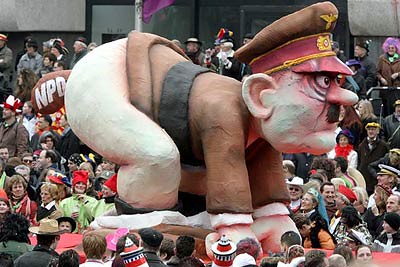

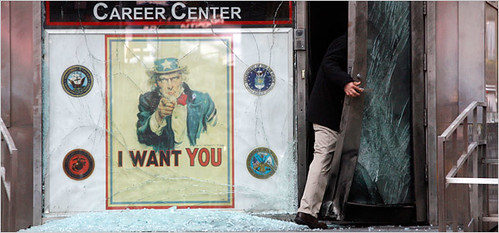
.png)