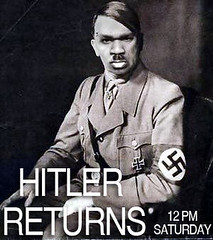
Dr James Saleam : ‘The extreme white’

A blast from the past.

Note that Saleam is a key speaker at the Sydney Forum (September 18/19). Also scheduled to speak is Canadian Holocaust denialist and neo-Nazi (“free speech activist” according to his friends and Uncle Rupert’s Fox News) Paul Fromm. Fromm’s most recent stalking horse has been (‘Boo! Hiss!’) Tamil refugees: presumably, Fromm would look with envy upon the KRudd Government’s decision in April to suspend refugee applications from Sri Lanka for three months — and for those from Afghanistan for six.

The two key organisers of the event are Nicole Hanley and Welf Herfurth. Both Hanley and Herfurth are involved in the local franchise — ‘Volksfront Australia’ — of the US-based Volksfront. (A member of the group, Corey J. Miller, got into some minor trouble in July; in May, one of his kameraden, John Edward Grogan, got sentenced to 5 years jail for defacing a synagogue in April 2009.) Peter Spencer, a farmer who hates trees and loves property (and sitting on poles), will also be speaking. Both Fromm and Saleam intend to address a meeting in Melbourne on September 25 — the date of the annual ‘Ian Stuart Donaldson’ memorial gig. Brendan Gidley, the middle-aged leader of the Eureka Yoof League, will chair the meeting.

The extreme white
Malcolm Brown
The Sydney Morning Herald
November 26, 1988

Jim Saleam initially wanted to study Bolshevist movements but today, Malcolm Brown reports he heads the extreme right National Action group.

National Action is not ashamed that it recognises the role of radical force to overcome reactionary force… “We are arguing for street action, militancy … we must be prepared to struggle, sacrifice and … dare we say it? … kill or be killed.”

These are the words of James Saleam, MA, chairman of the extremist National Action.

For years Mr Saleam has been a front man for a shadowy group of people, linked to groups in other states, who specialise in direct action against nominated individuals.

National Action does not claim responsibility for violent acts – firebombings, shotgun blasts, bricks through the windows at night – but it admits it has produced literature that has nominated people (sometimes with address and phone numbers) who later became targets.

Mr Saleam is, by far, the most articulate leader of the extreme Right in recent years. He is a prolific writer. He does not reveal what he does for a living and resents being asked.

The periodicals he has written for and edited, under various names – Audacity, Ultra, National Action – have the same message: a general opposition to liberal ideas, opposition to a multiracial Australia and warning of a world conspiracy that will disadvantage Australia.

Mr Saleam says he is dedicated to the principle of an independent, non-aligned, more or less racially homogeneous Australia.

He believes National Action will one day be accepted into the main-stream of Australian politics, although the group did poorly when it contested two Federal seats in 1984 (Mr Saleam stood for one) and the state seat of Rockdale this year.

Mr Saleam denies National Action is a Nazi or extreme Right organisation. It was formed in April 1982, combining a so-called Immigration Control Association and other organisations.

Its policy, Mr Saleam said, was consistent with the aims of groups overseas such as the National Front in Britain, the Third Way in France and sections of the National Democrats in Germany.

Mr Saleam admits using the words attributed to him about street fighting and militancy. They were in his booklet Australia’s Road to National Revolution, published four years ago, he claims, to invoke the spirit of World War II nationalism.

Slightly-built, 33 and recently married, Mr Saleam began his higher-degree studies at Sydney University by reading up on British Fascism. For his Master of Arts degree, he elected to study American Nazism. In 1981, the university’s history department suddenly realised that young James was so keen on the subject he has formed his own party, then called the Progressive Nationalist Party, whose platform included restricting Asian immigration.

“It came as quite a shock,” said the then associate professor of history, Richard Bosworth. “Nobody knew he was getting up to all this.” Dr Bosworth, now Professor of History at the University of Western Australia, said Mr Saleam, an arts graduate from Queensland University, had come to Sydney University wanting to do a qualifying course for his MA. “He came to see me, wanting to [do] a dissertation on the Italian Neo-Fascist Party,” Dr Bosworth said. “I said, ‘can you read Italian?’ He said no, and that was the end of the meeting.”

Dr Graham White, a senior lecturer in history at Sydney University, was reluctant to discuss Mr Saleam as a student: “I did not know till halfway through his MA course that he has formed a party of his own. Saleam rang me at one time and said: ‘I owe an explanation.’ But I said: ‘No, you don’t.’ I did not want to discuss it with him. I told him our relationship was strictly an academic one and I was not interested in other dimensions of the subject. His political activities were not a factor in the decision whether or not to award him a MA.”

Jim Saleam got his MA in 1985. The same year, coincidentally, that Dr Bosworth who was publicly speaking against racism in Australia had a brick through the window of his terrace home in Annandale.

Jim Saleam was born in Maryborough, Queensland, son of a commercial property owner in the town. The family has mixed ethnic origns. Some of Mr Saleam’s father’s forbearers were ethnic Greeks living in Turkey; others came from Ireland in colonial times. His mother’s side was British.

Young Saleam went to school at Maryborough, got interested in a Maoist movement, the Worker-Student Alliance, and went to Queensland University in 1973. From the start, he was interested in radical political movements – a Maoist group on the university campus and the right-wing League of Rights.

Another group, the Radical Nationalists, opposed to liberal migration policies and left-wing politics, also attracted his attention and, apparently, his enthusiasm. In 1973 he was convicted and put on a good-behaviour bond for an attack on a Maoist bookshop.

But Mr Saleam was having other troubles: “Special Branch wanted me to break into the Queensland University Students’ Union and steal their activities list and documents relating to what they were going to do in Brisbane in 1974.”

“They told me I was on this bond and I had better co-operate. I just disappeared out of Brisbane for a while. It took me an extra year to get my degree.”

Jim Saleam arrived at Sydney University in 1977. He planned to study Bolshevist movements in Europe, but switched to the other end of the political spectrum.

He became actively involved in fringe politics. The first group was National Resistance, formed in July 1977. It changed its name to National Alliance in 1978. In 1981 he formed a new group, the Progressive Nationalist Party, which sought to home in on growing dissatisfaction in some areas, particularly the outer-western regions of Sydney, to recruit members.

He became associated with Sydney’s home-grown Nazis, but claims he never joined them. Nazi members included the shaven-headed heavy weight Ross “The Skull” May, who invariably opted to handle “security” matters for the party.

A photo of Mr Saleam wearing a Nazi uniform at a rally still haunts him. He told the Herald: “I was only infiltrating the Nazi Party to find out something about them. I was at the place where I was photographed because Robert Cameron told me that if I did not stay there, The Skull would bash me.”

Mr Saleam, despite his assuredness, has lived a long time with uncertainty. He has been convicted in more recent times of a fraud offence and spent about two weeks in jail, but he is appealing against the conviction. Perhaps inevitably, he said there has been a conspiracy against him.

See also : Dr James Saleam ~versus~ Good Weekend (August 3, 2010).

Posted in Anti-fascism, History | Tagged | Leave a comment

anarchist notes (september 2, 2010)

minus one

AK Press has just published In the Crossfire: Adventures of a Vietnamese Revolutionary, an English translation of Ngo Van’s Au pays de la Cloche fêlée (Paris: L’Insomniaque, 2000) and of excerpts from Ngo Van’s Au pays d’Héloïse (L’Insomniaque, 2005). From the ‘Introduction’ by one of the translators (Ken Knabb):

“History is written by the victors.” With the increasing spectacularization of modern society, this truism has become truer than ever. The most radical revolts are not only physically crushed, they are falsified, trivialized, and buried under a constant barrage of superficial and ephemeral bits of “information,” to the point that most people do not even know they happened.

Ngo Van’s In the Crossfire is among the most illuminating revelations of this repressed and hidden history, worthy of a place alongside such works as Voline’s The Unknown Revolution and Harold Isaacs’s The Tragedy of the Chinese Revolution. It is also a very moving human document: dramatic political events are interwoven with intimate personal concerns, just as they always are in reality. In this respect Van’s book is perhaps more akin to Orwell’s Homage to Catalonia or Victor Serge’s Memoirs of a Revolutionary.

The two-stage Vietnam war against French and then American occupation (1945-1975) is still fairly well known; but almost no one knows anything about the long and complex struggles that preceded it, including the fact that many of those struggles were inspired by an indigenous Trotskyist movement that was often more popular and more influential than the rival Stalinist movement under Ho Chi Minh. While Ho’s Communist Party slavishly followed the constantly shifting policy lines ordered by his masters in the Kremlin (which often called for alliances with the native landowners and bourgeoisie in the name of “national unity,” or at times even with the French colonial regime when France happened to be allied with Russia), the Vietnamese Trotskyists expressed more consistently radical perspectives. The situation was somewhat analogous to what was going on in Spain during the same period. In both cases a radical popular movement was fighting against foreign and reactionary forces while being stabbed in the back by the Stalinists. One significant difference was that in Spain the popular movement was predominantly anarchist, whereas anarchism was virtually unknown in Vietnam. Many Vietnamese rebels thus understandably saw the Trotskyist movement as the only alternative, the only movement fighting simultaneously against colonialism, capitalism and Stalinism…

[h/t : Viola]

She said the proposal was “akin to running Queensland as an anarchist collective”.

zero

one

    “It is said that the history of peoples who have a history is the history of class struggle. It might be said with as much truthfulness, that the history of peoples without history is a history of their struggle against the state.” ~ Pierre Clastres (1934-1977), French anthropologist, Society Against the State (1974)

V V reviews The Art of Not Being Governed: An Anarchist History of Upland South East Asia (Yale University Press, Orient Blackswan reprint) @ The Business Standard (India).

two

The World that Never Was: A True Story of Dreamers, Schemers, Anarchists, and Secret Agents by the English writer Alex Butterworth is reviewed by the Yanqui scribbler Matthew Price here. “For all the mayhem — alleged and actual — of the anarchists, they existed on the fringe. They experienced very little of what it was actually like to rule.” Which is kinda, like, the point.

three

Yanqui crackademic Arthur Versluis asks have we witnessed the death of the Left?. He’s a bit of a dumbass, but it’s sometimes useful, and often amusing, to keep an eye on what ‘conservatives’ understand to be their opposition.

four

Versluis makes reference to the IWA in his essay; of similar vintage is the Pittsburgh Proclamation, adopted by the Founding Congress of the American Federation of the International Working People’s Association on October 14, 1883.

five

The Canadian ‘New Socialist Group’ has produced another short essay on the subject of ‘Anarchism versus Marxism Today’. The NSG was formerly a member of the iSt, and continues to espouse a ‘socialism from below’.

See also : Leninist critiques of anarchism (March 25, 2010).

six

I thought I already done linked to this before, but obviously not: History and Actuality of Anarcha-feminism: lessons from Spain (Marta Iniguez de Heredia, Lilith, No.16, 2007).

seven

The figure of Nestor Makhno (1888–1934) continues to generate disco among historians of early twentieth-century Russia and Ukraine. A recent essay by Volodymyr Horak compares the mob Makhno assembled beneath the black flag of anarchy with that gathered around the blue and yellow flag of Petliura’s nationalists.

Otherwise, and as ever, Poumista continues to kick historical butt.

See also : The Russian Revolution in the Ukraine (March 1917 – April 1918) by Nestor Makhno (Foreword by Daniel Guerin / Introduction by Alfredo M. Bonanno / Translated by Paul Sharkey). Speaking of which…

eight

Digital Elephant is an excellent resource, containing online versions of the many and varied and highly subversive texts Elephant Editions has published over the last 30 years or so.

nine

Peter Gelderloos complains What’s Missing is Solidarity: The Decline of Resistance from the Red Scare to the War on Terror (Counterpunch, August 23, 2010). I suggest he looks under the kitchen sink.

ten

Blaggers ITA. Not anarchist, but apropos.

Posted in Anarchism | Tagged | 2 Comments

I support the Darwin Breakout!


Prisoners celebrate life behind bars in Curtin prison in March 2001.

Update : Hopes of copycat escape bids after asylum-seekers’ breakout, Lex Hall and James Madden, The Australian, September 2, 2010: “SCORES of Afghan asylum-seekers spent last night in the Darwin watchhouse after a dramatic mass breakout from the city’s immigration centre, amid hopes the incident could spark copycat escape bids from other detention facilities.” Those involved in the break-out are gonna be transferred to the Curtin prison in Western Australia. The prison was closed in 2002 “following a series of riots and incidents of self-harm by prisoners”, and re-opened in June 2010.


[h/t jewonthis]

Asylum seekers stage break-out protest (David Coady, ABC): ‘More than 90 Afghan asylum seekers have broken out of the Darwin detention centre and are holding a mass protest on the side of a busy road. The asylum seekers are holding signs which read: “Please help us”, “Show us mercy”, and “We are homeless, defenceless and we seek protection”…’

I support the Darwin Breakout, and so did Sham 69. In 1978, in fact, when they wrote a song in anticipation of its occurence. And do did Extreme Noise Terror when they covered Sham 69’s musical contribution to prison liberation in 1991 (see below).

Incidentally, following the Woomera Breakout of March 29, 2002, police in Melbourne searched Barricade infoshop looking for escapees. They didn’t find any, however, as a kindly wizard from New Zealand had cast an Invisibility Spell upon them.

True story.

Refugee advocates say the men are Shia Muslims, a minority group often targeted for violence in Afghanistan because of their beliefs.

The break-out follows disturbances at the center in Darwin Saturday and Sunday involving a group of Indonesians accused of smuggling asylum seekers into Australian waters.

Darwin Detention Centre, the prison from which the 70 or so men briefly escaped, is one of many prisons to be owned and operated by a private company: Serco Australia Pty Ltd. Serco is “a joint venture company formed in 1993 between two global service support companies”, the multi-billion dollar Serco Group (UK) and Sodexo (France). Serco won the much-coveted ‘War Profiteer of the Month’ in February 2009; Sodexo has to be content with a website called Clean Up Sodexo.

Note that the policy of sticking asylum seekers in prison commenced in 1992, under then Minister for Immigration and Ethnic Affairs, Gerry Hand (Hand has since gone on to enjoy a career in the mining industry). The policy enjoys the support of both Labor and the Coalition (although renegades occasionally make squeaking noises in protest), so it’s unlikely that the prison gates will be thrown open any time soon. Rather, the major parties have been engaged in relentless squabbling over who’s toughest on crime / seeking asylum in Australia — thereby seeking to capitalise upon widespread paranoias — and their kinky behaviour doesn’t look like it’s gonna come to a climax any time soon…

Posted in Broken Windows, State / Politics | Tagged , | 2 Comments

Gramsci and Left Managerialism : Kees van der Pijl

Gramsci and Left Managerialism

Kees van der Pijl
Critical Review of International Social and Political Philosophy
Vol.8, No.4
December 2005

Abstract

This essay argues that one way of understanding Gramsci today is as an organic intellectual of a class of managerial cadre which develops in advanced capitalism. With the growth of monopolistic structures and a deepening state role in capitalist society, a separate class of mediating functionaries emerges, entrusted with managerial tasks in running the economy and the state. The problems of conquering power from the perspective of this ‘new middle class’ that concerned Gramsci, were also those of the neo-Machiavellian thinkers, Mosca, Michels, Pareto and Sorel around the turn of the twentieth century. From opposed political angles, they and Gramsci shared the concern with occupying the centre ground and mediate the extremes in a complex society. Today’s Gramscianism appeals to the same set of concerns.

Continue reading

Posted in History, State / Politics, That's Capitalism! | Tagged , | 3 Comments

William Cooper ~versus~ Richard Wolstencroft

From the Department of Destroy All Yuppies!

Over 70 years ago, a small group of local Aborigines, led by William Cooper, protested the beginnings of the genocidal Nazi assault upon European Jewry.

Indigenous anti-Nazi protests recognised
Luke Waters
SBS
August 26, 2010

The final chapter in a 72-year old Australian story of oppression, protest and pride is finally set to be written.

It involves formal recognition of an Aboriginal elder who led a march against Nazi attacks in the 1930s.

William Cooper was one of the few voices to formally rebuke what became known as ‘Kristallnacht’ and his stand is about to be recognised…

“When he arrived at the German consulate in South Melbourne in 1938 he delivered a petition condemning the Nazi’s behaviour.”

It’s widely considered a visionary act. Just a few weeks after Kristallnacht, it is a gesture for which William Cooper is only now being recognised.

But his great-grandson Kevin Russell insists the story still resonates…

In 2007, on the anniversary of Kristallnacht/Pogromnacht in Prague, neo-Nazis attempted to hold a rally in the Jewish quarter. It didn’t quite go according to plan (see also : Dear Mister Ambassador, February 2, 2010).

So much for William Cooper. As for Richard Wolstencroft…

I’ve kind of always distrusted Richard Wolstencroft, filmmaker, Melbourne Underground Film Festival director, and tedious bore, partly because of his avowed fascist tendencies. Now that I’ve paid money for and sat through his fucking film [Pearls Before Swine], I just want to beat the cunt senseless.

Ouch.

The transcendental fascist has been the subject of renewed criticism recently, by way of a blog titled ‘Richard Wolstencroft’s Unconcealedness’. The blog documents a number of the silly things Wolstencroft has been posting on his Facebook account “and elsewhere”. For example:

There needs to be WW2 films were [sic] the German army are portrayed as heros [sic] as indeed they were in many battles. On a larger scale the Nazis only wanted a united Europe like the EU, anyway, in essence. They were a little excesses [sic]. But that can be forgiven now given some historical distance…

Forgiven? Maybe. Maybe not. Many leading Nazis were certainly forgiven their crimes: Hans Eisele, the German doctor and SS officer who worked at Nazi concentration camps at Sachsenhausen, Natzweiler, Dachau and Buchenwald, was merely one of thousands whose punishments were minimal. In any case, any discussion of films in which Nazis are the “heros” would be incomplete without some acknowledgment of Alois Von Eichberg’s 1944 classic Stolz der Nation:

Putting to one side this admittedly minor quibble, while somewhat unusual (most agree that the Nazis, “in essence”, wanted something other than “a united Europe”, and that the Holocaust and other German war crimes were more than a little ‘excessive’), such sentiment is hardly unique to the Z-grade filmmaker. Generally speaking, however, these sorts of opinions are normally confined to kooky sites such as Stormfront; they tend not to emanate from the director of an ‘underground’ film festival, however awful and stupid. That Wolstencroft is still getting away with it suggests that the problem lies elsewhere.

The yuppies who attend Wolstencroft’s annual film festival typically don’t care much for politics, so further confirmation of the nature of his views, if any were truly needed, signifies little. (Wolstencroft has been publicly advocating fascism for some years now.) Further, Wolstencroft has built a career upon catering to the naughty desires of the middle class, whether sexual, cinematic, or both. As Wolstencroft remarks of Master Satirist or Yuppie Clone? Bret Easton Ellis: “For Ellis the superficial is all that matters. There is nothing beyond the surface, no inner depths, no hidden meanings. If you think about it this idea is paradoxically rather deep.”

LOL.

So much for the market. As for the rest, the major sponsor of the 2010 MUFF was Japanese corporation Canon.

Canon’s corporate philosophy is founded on a responsible approach to working. We believe that each step we take in trying to work for the common good – as individuals and as an organisation – does make a real difference.

We aim to act morally, in accordance with our own code of conduct and our worldwide ethical compliance framework; but more than this, we aim to make a positive difference to all we come into contact with and, through our behaviour, contribute to positive change.

I’m unsure if Canon agree with Wolstencroft that MUFF is “aggressive, transgressive, cutting edge, hip oh and fucking out there, baby” but, presumably, their “worldwide ethical compliance framework” would make it difficult to reconcile apologias for Nazism with ‘positive change’. As for the other, minor, MUFF sponsors, they are the crazy funky zany madcap and in no way annoying bunch at noise merchants gasinc; the “cutting-edge music distributor sourcing international product” aka Inertia; the “daily email News and Jobs service for people working in the Australian film and television industries” (Screen Hub); Grolsch beer (a Dutch brand owned by SABMiller); and some mob called Movie Extra. Helping Wolstencroft deal with The Controlled Media are 3RRR and Spook zine. Curiously, Spook‘s ‘Film Editor’ Luke Buckmaster also writes for Crikey on the subject of film — and MUFF, but Spook‘s promotion of MUFF goes unmentioned.

As for Wolstencroft’s hosts, in agreeing to screen films just around the corner from the Jewish Holocaust Museum and Research Centre, the owners of the Elsternwick Cinema have demonstrated that they have a rather odd sense of humour. Well, perhaps: much more likely, the proximity of the two is an unhappy coincidence, and the franchise holders are completely unaware of Wolstencroft’s espousal of fascism. In reality, it’s unlikely that either Reading Cinemas (a US-based cinema exhibition and real estate company) or the managers of the Elsternwick Cinema know much about Wolstencroft’s political views, and even if they did, in these crazy, topsy-turvy times, who’s to say what’s right or wrong?

See also : MUFF 777 (July 6, 2006) | More on MUFF 777 (July 11, 2006) | Southern Cross Soldiers, Tyler Cassidy and the far right (December 16, 2008).

Posted in Anti-fascism, Broken Windows, Death, Film, History, State / Politics | Tagged , | 1 Comment

On the evening of 29 August 1952 a crowd of avant-garde aficionados and local music enthusiasts filed into the Maverick Concert Hall near Woodstock to hear a piano recital by the young virtuoso David Tudor. That they should be here, tucked away in the Catskills, was already extraordinary. The Maverick is more hermitage than concert hall: a wooden, barn-like structure, set – in 1952 at least – in several acres of woodland. Water Music by John Cage, a Californian composer whose recent work had been feted in New York, opened the programme and baffled its audience. It involved Tudor performing various actions at seemingly random intervals: blowing a duck-call, tuning a radio, shuffling and dealing playing cards. After subdued applause, Tudor sat back down at the piano. He played pieces by Christian Wolff, an 18-year-old student of Cage’s, and by Morton Feldman, Cage’s friend; and thundered through Pierre Boulez’s fiendishly difficult first sonata. The penultimate piece on the programme was Cage’s latest, 4’33”. Tudor shut the piano and sat still. The wind rustled in the maples. Half a minute later he reopened the lid, then shut it. The summer rain could be heard falling on the Maverick’s wooden roof. Another couple of minutes – Tudor opened and shut the lid again – and muttering broke out in the hall. People began shuffling towards the exit. Four minutes and 33 seconds without a note played and Cage had stamped himself on music history with the most radical contribution of his generation. At the end of the concert, a local artist drew himself up and bellowed: ‘Good people of Woodstock, let’s drive these people out of town.’

Posted in History, Music, Poetry | Leave a comment

Neo-Nazi skinheads murder 14-year-old girl in Russia

*Russian authorities/media deny early reports (Russian state-run news channel Rossiya-24) that a girl was killed in the attack. Mind you, they deny a lot of things… Avtonom has an English translation of an account published in local media here.

    you have to treat them nice & gentle
    do nothing rash, they’re sensitive
    you must be somewhat sentimental
    respectful of the way they live
    don’t let your dogs attack them on the street
    embrace the fascists where you may meet

    if they should call for hate or violence
    just let them talk, it is their right
    & keep your protestations silent
    you wouldn’t want to start a fight
    for fighting is what they do best
    embrace the fascists & you’ll be blessed

    & if they fire their guns upon you
    is life so precious in your eyes?
    you would be sheep with wolves around you
    why not be gladly victimized?
    & if you feel inside your guts
    the Nazi dagger’s blade
    embrace the fascists that you have made

    ~ kurt tucholsky, 1931

Yeah so, during the course of an assault upon concert-goers in Miass (a city 1400km east of Moscow) a group of “bare-chested” boneheads in Russia have apparently injured scores and killed a 14-year-old girl. Some reports suggest that there may be moar victims, but accurate information will be difficult to obtain while the Russian state goes into damage control mode.

Report: 100 Russian skinheads attack concertgoers
David Nowak
AP

MOSCOW — Scores of bare-chested skinheads attacked a crowd of about 3,000 people at a rock concert in central Russia on Sunday, beating them with clubs, media reports said.

Dozens of people were left bloodied and dazed in the attack, television and news agencies reported, and state news channel Rossiya-24 said a 14-year-old girl was killed at the concert in Miass, 900 miles (1,400 kilometers) east of Moscow…

Not surprisingly — or incredibly, if you prefer — other reports suggest that police stood aside as the boneheads went about their bloody business:

According to local media reports, shooting was also heard as a crowd of angry bare-chested boneheads, armed with batons, sticks and iron rods, forced their way through security cordons.

“Police and security guards were either inactive or ran away. Some attackers snatched truncheons from police officers and started beating the visitors,” the Chelnovosti reported citing eyewitnesses.

Photos made by the portal’s correspondent at the event show police standing aside while people are being beaten up.

The non-intervention by police makes sense if the context for such (in)actions — and the long history of elites utilising violent, pea-brained fascists to crush dissent — is understood. So too, the hostility of police and other authorities to grassroots resistance to fascist violence (which violence includes hundreds of extra-judicial executions over the course of the last few decades). Thus the attack upon the Tornado rock festival in Chelyabinsk comes a month or so after another attack upon a protest camp near the Khimski forest in Moscow (The attack on forest defenders Khimki, avtonom, July 23, 2010). The forest is currently slated to be destroyed to make way for a road to Saint Petersburg, although the appearance of Saint Bono in Moscow has given Russian President Medvedev an opportunity to claim otherwise.

Fitzroy yuppies have expressed skepticism at reports coming outta Russia of fascist involvement in the cleansing of the camp. Spokesperson Dion stated that, even if correct, the environmentalists are liars, hypocrites and no better than the neo-Nazi elements that his Russian equivalents frequently employ to destroy their encampments. The Russians have also come to the attention of Freya Powell, who has conducted an interview with ‘Anarchist Street Artists’. The Artists singularly fail to understand the importance of shitting on anti-fascists, and are thus liars and hypocrites.


Above : Novaya Gazeta reporter Anastasiya Baburova and human rights lawyer Stanislav Markelov, murdered January 2009. Their alleged murderers are currently on trial.

Last weekend, activists organised a pop concert in support of the struggle to preserve Khimki forest. The attitude of authorities to the event was rather different to that adopted towards the event at which boneheads were given license to maim and kill children.

Battle of the bands
Andy Potts
The Moscow News
August 23, 2010

Up to 3,000 people crowded onto Pushkin Square on Sunday for an environmental protest-cum-concert in defence of Khimki forest.

In a strange quirk of policing policy, the rally was allowed to go ahead but musicians were barred from using amplifying equipment – meaning the acoustic sounds of guitars had to compete with the noise of city-centre traffic.

The police’s door policy was as intimidating – and seemingly arbitrary – as at any Moscow nightclub, with burly uniformed officers ready to pounce at the first whiff of an amp.

They manned airport-style security scanners at every entrance to the square, and were eager to direct would-be protesters to any other way in, ideally the one from which they had just been turned away…

Earlier, Reporters Without Borders were shocked — shocked — to discover that Russia’s Interior Ministry had cracked down on independent media attempts to report on the struggle, and of damage to a Government building in Khimki following a protest on July 28 (see : Journalists interrogated, photos seized after protesters attack official building in Khimki, August 12, 2010).

See also : Unplugged protesters defy Moscow authorities [23/08/2010] | Banned bands will play on in Moscow [20/08/2010] | Protest gig aims to highlight discord over Khimki Forest plans [19/08/2010].

NB. Neo-Nazi skinheads will be assembling in Melbourne on September 25 to attend a pop concert in memory of dead bonehead Ian Stuart Donaldson. It will be the 17th year in a row that they’ve done so, apparently. On the same day, Canadian Holocaust denialist Paul Fromm and Australia First Party leader Dr James Saleam are scheduled to address a meeting.

Bonus Bottles!

Posted in Anti-fascism, Death, Music, State / Politics, War on Terror | Tagged , , , | 3 Comments

…a debate on Afghanistan

Let’s debate Afghanistan, but give us the facts first
Tom Hyland
The Age
August 29, 2010

Where there is no information, there is no hope of a meaningful discussion.

IT HAS taken nine years, the deaths of 21 Australian soldiers and a hung parliament, but now our politicians agree: they will have a debate on Afghanistan. The Greens have long called for one; so have former and serving soldiers. Now Julia Gillard and Tony Abbott reluctantly concur…

What about degrees of responsibility and shared burdens of guilt on an individual level? What can we learn about how one views oneself often in positions of power or authority?

You almost never find anyone, whether it’s in a weapons plant, or planning agency, or in corporate management, or almost anywhere, who says, ‘I’m really a bad guy, and I just want to do things that benefit myself and my friends.’ Almost invariably you get noble rhetoric like: ‘We’re working for the benefit of the people.’ The corporate executive who is slaving for the benefit of the workers and community; the friendly banker who just wants to help everybody start their business; the political leader who’s trying to bring freedom and justice to the world—and they probably all believe it. I’m not suggesting that they’re lying. There’s an array of routine justifications for whatever you’re doing. And it’s easy to believe them. It’s very hard to look into the mirror and say, ‘Yeah, that guy looking at me is a vicious criminal.’ It’s much easier to say, ‘That guy looking at me is really very benign, self-sacrificing, and he has to do these things because it’s for the benefit of everyone.’

Or you get respected moralists like Reinhold Niebuhr, who was once called ‘the theologian of the establishment’. And the reason is because he presented a framework which, essentially, justified just about anything they wanted to do. His thesis is dressed up in long words and so on (it’s what you do if you’re an intellectual). But what it came down to is that, ‘Even if you try to do good, evil’s going to come out of it; that’s the paradox of grace’. And that’s wonderful for war criminals. ‘We try to do good but evil necessarily comes out of it.’ And it’s influential. So, I don’t think that people in decision-making positions are lying when they describe themselves as benevolent. Or people working on more advanced nuclear weapons. Ask them what they’re doing, they’ll say: ‘We’re trying to preserve the peace of the world.’ People who are devising military strategies that are massacring people, they’ll say, ‘Well, that’s the cost you have to pay for freedom and justice’, and so on.

But, we don’t take those sentiments seriously when we hear them from enemies, say, from Stalinist commissars. They’ll give you the same answers. But, we don’t take that seriously because they can know what they’re doing if they choose to. If they choose not to, that’s their choice. If they choose to believe self-satisfying propaganda, that’s their choice. But it doesn’t change the moral responsibility. We understand that perfectly well with regard to others. It’s very hard to apply the same reasoning to ourselves.

In fact, one of the—maybe the most—elementary of moral principles is that of universality, that is, if something’s right for me, it’s right for you; if it’s wrong for you, it’s wrong for me. Any moral code that is even worth looking at has that at its core somehow. But that principle is overwhelmingly disregarded all the time. If you want to run through examples we can easily do it. Take, say, George W. Bush, since he happens to be president. If you apply the standards that we applied to Nazi war criminals at Nuremberg, he’d be hanged. Is it an even conceivable possibility? It’s not even discussable. Because we don’t apply to ourselves the principles we apply to others.

There’s a lot of talk about ‘terror’ and how awful it is. Whose terror? Our terror against them? I mean, is that considered reprehensible? No, it’s considered highly moral; it’s considered self-defense, and so on. Now, their terror against us, that’s awful, and terrible, and so on.

But, to try to rise to the level of becoming a minimal moral agent, and just enter in the domain of moral discourse is very difficult. Because that means accepting the principle of universality. And you can experiment for yourself and see how often that’s accepted, either in personal or political life. Very rarely.

…Let’s take the Iraq war. There’s libraries of material arguing about the war, debating it, asking ‘What should we do?’, this and that, and the other thing. Now, try to find a sentence somewhere that says that ‘carrying out a war of aggression is the supreme international crime, which differs from other war crimes in that it encompasses all the evil that follows’ (paraphrasing from Nuremberg). Try to find that somewhere—I mean, you can find it. I’ve written about it, and you can find a couple other dozen people who have written about it in the world. But is it part of the intellectual culture? Can you find it in a newspaper, or in a journal; in Congress; any public discourse; anything that’s part of the general exchange of knowledge and ideas? I mean, do students study it in school? Do they have courses where they teach students that ‘to carry out a war of aggression is the supreme international crime which encompasses all the evil that follows’?

So, for example, if sectarian warfare is a horrible atrocity, as it is, who’s responsible? By the principles of Nuremberg, Bush, Rumsfeld, Cheney, Wolfowitz, Rice—they’re responsible for sectarian warfare because they carried out the supreme international crime which encompasses all the evil that follows. Try and find somebody who points that out. You can’t. Because our dominant intellectual culture accepts as legitimate our crushing anybody we like.


Brother Ali – Uncle Sam Goddamn
Uploaded by Hip_Hop_Videos. – See the latest featured music videos.

Posted in Broken Windows, Death, History, State / Politics, That's Capitalism!, War on Terror | Tagged | 5 Comments

S11 + 10

The term ‘September 11’ is now forever associated with the terrorist attacks upon New York and Washington in 2001; in 2000, however, ‘S11’ was the name given to ‘three days of protest + carnival’ against the Asia-Pacific Economic Summit of the World Economic Forum, held at Crown Casino in Melbourne. (For others, ‘September 11’ will be remembered for other reasons.) EngageMedia is gonna throw up video in the weeks and months ahead, but you can also watch S11: This is What Democracy Looks Like (Actively Radical TV) online and the remnants of the S11-AWOL (Autonomous Web of Liberation) site may be found here. s11.org is archived at the NLA here.

S11 done got written about quite a bit at the time (including by myself, in a fairly cringe-worthy manner), and I’ll probably throw up moar links in future, but in the meantime it’s worth noting that it was only seven years later that Slater & Gordon (& Co.) were able to secure a fat payout for themselves — and as long as law-talking guys are happy, who could ask for anything moar? Well, apart from a whitewash, of course.

Posted in Anarchism, Broken Windows, Film, History, Media, Poetry, Student movement, Television, That's Capitalism!, Trot Guide, War on Terror | Tagged , , , | 1 Comment

Paul Howes

I keep getting hits to my blog from users either searching for the term ‘Paul Howes’ or clicking on a link from his Wikipedia entry. Both lead to a post dated February 1, 2008, and titled Would the real anarchists / Trotskyists… (Et cetera). It explores the wonderful world of radikal yoof: “If a man is not a socialist in his youth, he has no heart. If he is not a conservative by the time he is 30 he has no head”. And so on and so forth, in a number of variations, and with various attributions. Visits spiked considerably when PM KRudd got knifed, and again, sharply, following the 2010 Australian federal election, and Howes’ profile on Australian Story earlier this week (with almost 300 visits to the page in question).

After drawing the short straw and fronting ABC’s Lateline in June in order to effectively assume, on behalf of the Labor Right, credit for Julia Gillard’s coup (“Boo! Hiss!”), Howes was the subject of Australian Story: one called, appropriately enough, ‘Labor of Love’. It aired just one week after the same show done a piece on Van Rudd, the Social Revolutionary Revolutionary Socialist Party member, artiste, and ‘nephew to the stars’. The RSP being, of course, the recent (2008) split from the Leninist party which Howes joined as a teenager, and which helped both introduce him to the wonders of Castro’s Cuba and to thereby deprive him of his illusions:

I attended a 3 hour speech from Fidel whilst there – it played a key part in my decision to become an avowed anti-communist.

Having watched the Lovely story of Howes’ transformation from homeless-teenage-Trotskyite to youngest-boss-of-Australia’s-oldest-and-arguably-worst-Union, I don’t know that it contained any revelations. The question was asked how is it that someone so young so-young-and-so-gone, let’s-chase-the-dragon, oh could assume a position of such authority. But if the trade union movement is understood to be the property of the ALP — and it is — then the answer is not very hard to find.

The disavowal of political ambitions at the end of the piece was an especially nice, comic touch.

Beyond this, the irony in Howes’ recent scribblings on the threat posed to Australia by watermelons is made rather obvious by his own dilly-dallying with the DSP. It also demonstrates a central political weakness. After all, the ALP remains, formally at least, committed to ‘democratic socialism’. “The Australian Labor Party is a democratic socialist party and has the objective of the democratic socialisation of industry, production, distribution and exchange, to the extent necessary to eliminate exploitation and other anti-social features in these fields.”

LOL.

In eulogising Laurie Short, another former-Trotskyist-turned-Labor-icon, Howes writes: “Though there may be many generations between me and Laurie I feel great affinity with him, not least because we have held the same office but because we both began our political lives on the far-Left and ended as committed democrats – hostile to the authoritarian Stalinist model which dominated the communist ideal.” Billionaire amateur Marxologist Clive Palmer argued in relation to the KRudd Government’s Resource Supercalifragilisticexpialidocious Profit Tax (a tax which Howes, on behalf of the AWU/ALP, was highly vocal in supporting): “I think it comes from Das Kapital in 1868. The super tax comes about by Marx and Engels and their famous work which inspired the Russian Revolution.”

The political potential/threat of Fabianism may only be taken seriously by billionaires, Fabians, and other members of the chattering classes, but conflating it — and the redistributive effects of a tax increase on mining super-profits — with the various ‘Stalinist’ regimes that were the end-products of Bolshevism, is a bit silly. Further, it’s worth recalling that resistance to state tyranny has been a part of Western workers’ movements since their inception, and that the authoritarian models which have dominated the communist ideal have also generated moar radical, libertarian forms of opposition to this domination. In other words, Howes’ argument that the consumer/citizen has only two choices — Coke or Pepsi, Democracy or Communism — is mistaken. As a keen student of history, Howes would know this.

The terminology of political and social discourse is vague and imprecise, and constantly debased by the contributions of ideologists of one or another stripe. Still, these terms have at least some residue of meaning. Since its origins, socialism has meant the liberation of working people from exploitation. As the Marxist theoretician Anton Pannekoek observed, “this goal is not reached and cannot be reached by a new directing and governing class substituting itself for the bourgeoisie,” but can only be “realized by the workers themselves being master over production.” Mastery over production by the producers is the essence of socialism, and means to achieve this end have regularly been devised in periods of revolutionary struggle, against the bitter opposition of the traditional ruling classes and the ‘revolutionary intellectuals’ guided by the common principles of Leninism and Western managerialism, as adapted to changing circumstances. But the essential element of the socialist ideal remains: to convert the means of production into the property of freely associated producers and thus the social property of people who have liberated themselves from exploitation by their master, as a fundamental step towards a broader realm of human freedom.

As for stories of radical sons and daughters… they are indeed numerous. By way of explanation, I prefer the crass, the gross and the vulgar, material explanations to be found in any Economics 101 class.

And Hell hath no fury like a vested interest masquerading as a moral principle.

See also : Who Are They? Jenny Turner reports from the Battle of Ideas, London Review of Books, Vol.32, No.13, July 8, 2010.

Posted in History, State / Politics, Student movement, That's Capitalism!, Trot Guide | Tagged | 20 Comments