
Jew-hatin’ Duke arrested in Prague

    Update : Boofhead has been released by Czech police and told to leave the country.

Leading anti-Semite, Stormfront ideologue, and former Grand Poobah of the KKK David Duke has undergone a re-awakening in the Czech Republic. Invited to talk shit by local nutzis belonging to ‘National Resistance’ (Narodni Odpor), The Duke got himself arrest by Czech police.

Ex-Louisiana KKK chief arrested in Prague: police

PRAGUE (AFP) — A former US Ku Klux Klan chief was arrested Friday in a Prague restaurant while he was on a speaking tour here, Czech police said.

Former Grand Wizard of the Louisiana-founded Knights of the Ku Klux Klan, David Duke, was arrested on suspicion of promoting movements seeking the suppression of human rights, police spokesman Jan Mikulovsky told local media.

The arrest, in a tourist area of picturesque old Prague, took place in “quite confused” circumstances, said David Janda, the head of an anti-extremism unit of the city’s police force.

Janda said Duke — who had been due to give three lectures in the Czech Republic — was guarded at the restaurant’s entrance by militants belonging to a known far-right group “Narodni Odpor,” which means national resistance.

Duke, a US citizen, is suspected of denying or approving of the Holocaust and other Nazi crimes, according to the CTK news agency. This crime is punishable by up to three years in prison in the Czech Republic.

Czech Interior Minister Ivan Langer and Human Rights and Minorities Minister Michael Kocab had each expressed disapproval of the visit earlier in the week.

The Ku Klux Klan was founded in 1866 by a group of US Civil War veterans from the defeated Confederacy, a group of southern states that upheld slavery and maintained African Americans were inferior to whites.

It is notorious the world over for terrorising black Americans through lynchings, cross burnings and other hate crimes.

The group enjoyed a peak membership of about five million in 1925, including politicians and even a member of the US Supreme Court.

But the Klan went into virtual bankruptcy as early as the late 1920s and since the late 1970s, its membership has varied between 3,000 and 6,000.

Prior to this incident, on April 21, the nutzi Resistance enjoyed taking part in a jackboot parade — protected by Czech police — through the towns of Ústí nad Labem and Krupka in order to demonstrate their desire to rid the Republic of Roma (‘Gypsies’) (Online: The Neo-Nazi march is over, police took harsh action only against the anti-fascists, Romano Vodi). See also : Czech Republic becoming a paradise for racists and neo-Nazis, former Ku Klux Klan head to visit, April 10.

The nutzi Resistance, along with other far right groupings such as the Workers Party and Free Youth Brno, is also planning on holding a rally and march on May Day in the Moravian capital of Brno. In the meantime, Czech Antifascist Action (AFA) are busy preparing for a May Day Festival Against Racism.

With the actual name May Day, we want to take up the tradition of 1st May again. This tradition devise to anarchist movement of the end of 19th century. May Day is a reminder of the fact that there are not many things for free in this world and that most of the things we take for granted had to be fought for in the past. The idea of free and equal society is also still inspiring.

Even though 1st May was depreciated by fascist or nazi regimes or the catholic church during the last century, its tradition of the fight for social equity is still viable far behind the borders of the western Europe. 40 years of Bolshevistic regime stigmatized 1st May in the Czechoslovakia as well.

It is characteristic that there’s been another battle over this date in Czech rep. since the 1990s. The neo-nazi groups are the loudest in attempts to usurp 1st May, and on this date, part of the society (often called anarchistic) is protesting against these neo-nazi attempts. Usually, the protesting part of society consist of young people who live their lives actively and who refuse to be a passive stand-byers in the machinery of capitalism. Nowadays, under pressure of the fall of neo-liberal paradise, it is becoming more common to hear that reckless race for economic growth is not the almighty god and the inspiration by anarchist ideals is becoming a natural thing.

The 2009 May Day festival would like to contribute to determination and positive social changes.

In our eyes, May Day is mainly a festival of all the open-minded people. The event is prepared on voluntary basis again, therefore the entrance is free.

:::::: Czech Antifa ::::::

AFA in the Czech Republic

Antifascist Action (AFA) – by all means, together against fascism!

Antifascist Action is focused on promotional, informational and practical ways of struggle with all authoritian ideologies and groups which promote any kind of oppression, particularly against neo-Nazism and right-wing radicals.

AFA is open to everybody who wants to take an active part in the struggle against fascism, Nazism and Bolshevism in all their forms — even if anti-fascism is considered ‘extremism’ by some. In the same way, we are not satisfied with the current system, which assumes more control over peoples lives, destroys nature, and entrenches social and economic inequalities.

AFA is an association of radical antifascists, who create local autonomous groups around the whole Czech Republic. Antifascists are mainly involved in their local groups. At the same time, these local groups are voluntarily joined together in federative structures according to area or type of activities. The internal structures of autonomous groups are based on the natural equality of all of their members, without artificial authorities or leaders.

AFA does not cooperate with the state authorities, political parties and repressive units. There is cooperation only with groups and individuals, whose activities are not in contradiction with our principles and objectives.

If you share our principles, join Antifascist Action!
Posted in Anti-fascism | 9 Comments

Dirka Dirka! Durban! Hate-fest! Racism!

The Durban Review Conference / Festival of Hate Against Israel and the West (April 20–24, 2009) done come and gone… more or less. It took place without the participation of a number of member states, chief among them the United. On the eve of the conference on April 19 the UN High Commissioner for Human Rights Navi Pillay expressed “shock” at this decision — why, I dunno.

The US statement cites, as its main stumbling block, the current text’s reaffirmation of the Durban Declaration and Programme of Action (DDPA), the outcome document agreed by consensus at the end of the 2001 World Summit against Racism in Durban, South Africa – but not agreed by the US or Israel which had both left the Conference before it reached its conclusion.

The Australian Government — which continues to function under KRudd, as it did under HoWARd, as the US’ deputy sheriff in South-East Asia and the world stage — also decided to boycott the event. Minister for Foreign Affairs, Stephen Smith, April 19:

…Australia, however, cannot support a document which reaffirms the 2001 Durban Declaration and Program of Action in its entirety – as is currently the case. The 2001 Declaration singled out Israel and the Middle East. Australia expressed strong concerns about this at the time. The Australian Government continues to have these concerns. Regrettably, we cannot be confident that the Review Conference will not again be used as a platform to air offensive views, including anti-Semitic views.

Of additional concern are the suggestions of some delegations in the Durban process to limit the universal right to free speech.

In recent weeks, I have spoken to a number of my foreign ministerial colleagues who share these concerns about the process. Canada (January 23, 2008), Israel, Italy and the United States have already indicated that they will not participate.

As noted by Smith, other states to boycott the event include Canada, Germany, Italy, the Netherlands, New Zealand/Aotearoa, Poland, Sweden and, of course, Israel. Ten states in total (including Australia and the US).

The KRudd Government’s decision to boycott the conference was applauded by Zionist groups in Australia, and criticised by others: see, for example, Opportunity to end racism goes to waste, John Langmore, The Age, April 21; Rudd UN boycott a ‘lost chance’ to fight racism, Daniel Flitton, The Age, April 23.

One of the main arguments put forward as to why UN member states should boycott the event is based on the characterisation of the Durban conference in 2001 as an ‘anti-Semitic hatefest’ (Greg Sheridan in The Australian: “It degenerated into a vile and hateful anti-Semtitic jamboree.”). This appears to be quite wrong, a fact pointed out on December 12, 2008 by Rupert Colville, Spokesperson of the Office of the UN High Commissioner for Human Rights, partly in response to an earlier editorial in The Australian:

A Google search on 10 December, using “fest” in conjunction with ‘Durban’ and ‘hate’ or ‘anti-Semitic,’ produced 49,900 web-page hits.* “Hate-fest” is not a common phrase, but it has been used in connection with the Durban process by people ranging from the Canadian Prime Minister to other politicians, academics, journalists, anti-Durban NGOs and a huge number of bloggers and other commentators.

The 2001 World Conference was indeed marred by the grotesque behaviour of some anti-Israel NGOs at the parallel NGO forum. Their inexcusable anti-Semitic actions, coupled with some difficult debates at the state level, have unfortunately cast the entire 2001 Conference and next year’s review in a negative light that is, by and large, unmerited.

Next year’s conference will focus on the 2001 outcome document, known as the Durban Declaration and Plan of Action (DDPA), which was adopted by consensus at the end of the 2001 World Conference. The DDPA consists of 341 paragraphs, of which six refer to the Middle East, anti-Semitism and directly related issues.

The first of those says: “We recall that the Holocaust must never be forgotten.” The second says “We recognize with deep concern the increase in anti-Semitism and Islamophobia in various parts of the world, as well as the emergence of racial and violent movements based on racism and discriminatory ideas against Jewish, Muslim and Arab communities.”

The remaining four paragraphs include references to “the plight of the Palestinian people” and “the right to security for all States in the region, including Israel,” as well as calling upon “Israel and the Palestinians to resume the peace process, and to develop and prosper in security and freedom.”

The contents of the DDPA were agreed by all the states present at the end of the 2001 conference. It is a fundamental, thorough and very wide-ranging framework document on racism and related issues. It takes a vivid imagination to turn it into the manifesto of a “hate-fest.”

At the conference itself, Iranian President Mahmoud Ahmadinejad gave a ‘controversial’ speech, in the name of God, the Merciful, the Compassionate, and in which the war hero with a wonky leg denounced Zionism and Security Council support for Israel (“the most cruel and repressive racist regime”), provided a potted history of Western imperialism, blamed Zionists for the US invasion and occupation of Afghanistan and Iraq, and opined that:

Mr President, ladies and gentlemen, the true root of racism is the lack of human understanding as God’s chosen creatures and deviation from the true path of human life and human missions in creation. Due to negligence in worshipping God with awareness and pondering on the philosophy of life and the path towards human perfection – which leads to the natural outcome of being committed to divine values and mankind – the horizon of human insight has declined. And limited and temporary interests became the criteria of evaluation and actions by human beings. Therefore, the seeds of evil power took their shape and by neglecting fair chances for others’ growth, it added to the boundaries of its development.

And so on: the President made no reference to racism inside Iran, which I can therefore only assume does not exist.

A few comments:

The campaign to boycott the event was about as successful as it was ever going to be. Israel, the United States, and a handful of their international allies did not attend: scores of other states did send delegates, as did many NGOs.

All this fuss over God & the State naturally brought to mind dead Russian anarchist Mikhail Bakunin. In addition to expressing vile anti-Semitism, Bakunin also had some more interesting thoughts on this subject. Contra Ahmadinejad, Bakunin wrote “All religions, with their gods, their demi-gods, and their prophets, their messiahs and their saints, were created by the prejudiced fancy of men who had not attained the full development and full possession of their faculties”; “In a word, we reject all legislation, all authority, and all privileged, licensed, official, and legal influence, even though arising from universal suffrage, convinced that it can turn only to the advantage of a dominant minority of exploiters against the interest of the immense majority in subjection to them. This is the sense in which we are really Anarchists.”

Notwithstanding the boycott by Aotearoa/New Zealand, Australia, Canada, Germany, Israel, Italy, the Netherlands, Poland, Sweden and, the United States, the outcome document of the Durban Review Conference was adopted by consensus on April 21 [PDF]. It makes no reference to Israel or the Middle East.

The response of Zionists and other critics of Durban II are surveyed by the blog ‘Muzzlewatch’; Australian blogger Antony Lowenstein also has some comments; while the Israeli group Gush Shalom issued the following statement:

Iranian Farce and Israeli grotesque
April 20, 2009

A conference against racism attended by Iranian President Ahmedinajad is a farce – but the campaign against this conference, conducted by Israeli Foreign Minister Lieberman, is grotesque. Ahmedinajad and Lieberman are twins, perfectly fit for each other’s company, both of whom built a political career upon the dissemination of hatred, the constant issuing of inflammatory racist statements designed to arouse the darkest of passions. The Netanyahu-Lieberman government is completely unable to respectably represent Israel in the international arena and defend the country’s most basic interests.

See also : Blasphemy! Bolt! Hate-fest! Dirka Dirka! (March 14, 2009).

Posted in Anti-fascism, State / Politics | 26 Comments

Argentine police arrest 36 boneheads belonging to Blood and Honour

Silly old boneheads!

36 of the short-haired losers got themselves arrest in Buenos Aires while celebrating the recent birthday of a dead, incestuous, coprophiliac, foreign dictator (see below).

In Perth (most likely a scout hall in some rural location) this Saturday April 25, the local, Australian franchise of Blood & Honour will be celebrating the deaths of Australian and New Zealand soldiers in WWII. Meanwhile, in their spiritual homeland of Germany, ‘Neo-Nazi crimes in Germany soared last year by 16 per cent, according to new government figures’ (Allan Hall, The Daily Telegraph, April 22, 2009). Finally, the struggle for justice for Nicole Hanley goes from strength-to-strength, as over two dozen nutzis — including Derrick McThomas, Alex Fogerty, Nathan Clarke (Australia First Party), Dr James Saleam (AF) and Jim Perren (AF) — sign their names to a rather poorly-worded petition appealing to French TNC Thales to reinstate her post-haste.

D’oh!

BUENOS AIRES (AFP) — Argentine police arrested 36 boneheads at an event celebrating the 120th anniversary of the birth of Nazi leader Adolf Hitler, officials told AFP on Wednesday.

The Sunday arrests came after a “prolonged and meticulous investigation,” said Daniel Perez, the second in command of the Federal Police unit in charge of investigating hate crimes.

Police broke into the Central Argentine Club, in the town of San Martin, in Buenos Aires province, while a recital [?!?] was being held by the local chapter of the neo-Nazi group “Blood and Honour,” Perez said.

Police found Nazi-related material, including flags with swastikas, films and CDs of music with racist and anti-semitic lyrics, Perez said.

“Blood and Honour,” which is based in Britain, has chapters across Europe and the Americas and is aimed at promoting Nazi ideology.

The arrests are “an important success in the struggle to eradicate these groups of Nazi ideology that are a threat to Argentine society,” the Delegation of Israeli Associations in Argentina said in a statement.

Argentina has the largest Jewish community in Latin America.

Two deadly anti-Jewish attacks were carried out in Buenos Aires in the past years: the 1992 bombing of the Israeli Embassy of Israeli that killed 22 and wounded 200, and the 1994 bombing of a Jewish community center that killed 85 and wounded 300.

Posted in Anti-fascism, Music, State / Politics | Leave a comment

Ian Tomlinson & G20 @ The Age

A brief survey of the response of a ‘liberal’ Melbourne institution to the public protests in London which accompanied the April G20 Summit.

To begin with, ‘Man died of heart attack in G20 protest’ reads the article of April 4 (produced by AFP).

The article places Ian Tomlinson’s death in the context of the “epicentre” of “violent protests” which lead to 86 arrests, repeats police claims that Ian died of a heart attack, and notes that “Scotland Yard had previously said that police medics had bottles thrown at them by protesters as they tried to save Tomlinson”.

All lies, as it happens.

On April 3, The Age (re-)published another AFP report, ‘UK police detain dozens over G20 riots’ by Prashant Rao. It describes what has become standard police practice before/during/after major anti-summit protests: raids, arrests, sometimes jailings and sometimes beatings, of individuals in ‘convergence’ spaces. (Perhaps the worst example of this took place during the G8 summit in Genoa in 2001.)* It also repeats police claims regarding the circumstances surrounding Ian’s death. Thus: “One resident died during Wednesday night’s violence after suffering a heart attack, with the authorities saying they came under attack while they tried to help him… The police said demonstrators rained a hail of missiles on officers trying to revive a dying man who collapsed at the protest site on Wednesday.”

    *The Diaz school was the place of residence for the Genoa Social Forum, which had coordinated the demonstrations. After midnight the school was raided by 150 heavily armed and disguised police officers, who proceeded to systematically assault the hundreds of sleeping youth. They were beaten for hours by clubs, with many later requiring hospital treatment. The group’s computers were destroyed, hard disks confiscated and many arrests were made. The actions of the police at the school have long since been confirmed by testimonies from a number of sources. ~ State violence at 2001 G8 summit in Genoa goes unpunished, Marianne Arens, wsws.org, July 25, 2008

On April 9, The Age (re-)published an article from The Guardian and AFP by Paul Lewis: ‘London man who died at G20 protest attacked by police, video shows‘. The production of video footage of a police assault upon Ian minutes before his death marks the beginning at which the police version of events began to unravel.

::::::::::::::::::::::::::::::::::::::::::::::::::::::::::::::::::::::::::::::::::::::::::::::::::::

The chief Europe correspondent for The Age (and the Fairfax corporation as a whole) is Paola Totaro. Paola authored a dozen or so articles prior to and during the summit — most of which concentrate upon the plans world leaders have to deal with the financial ‘crisis’ — but only returned to the subject of G20 — and Ian’s death — several weeks after the event.

Of the protest at which Ian died, Paola writes: “The great majority of the police, seemingly ever-patient and self-controlled, stood for hours as kids baited and yelled, shoved and provoked. A handful of officers used well-placed elbows while batons were raised only in response to the vandalism” (G20 protesters strike at London’s heart, Paola Totaro, April 2, 2009).

News Corporation blogger Tim Blair took note of Paola’s report, and especial, and sadistic, delight in reports that police had given protesters ‘A Bit of Stick’. In addition to police bashings, Tim also seizes upon another aspect of Paola’s reportage, which is that some protesters urinated in public:

[Paola] Unfortunately, the walls of the banks and every available corner were also used as urinals.

[Tim] Typically, these carbon-hating clean-earth types trashed the place:

[Paola] Protesters were still in the square burning effigies as night fell. The cesspool they would leave behind, however, was probably the worst damage of the protest.

[Tim] That cesspool says more than a million essays.

As previously noted, Paola’s reportage on G20 is seriously flawed, demonstrating an acceptance of police claims as fact, ignorance of police procedure (and law), and the infantilisation of protesters. It raises questions of perspective, bias, and selectivity. But it is in many ways unexceptional, and serves to illustrate the more general functioning of the mass media as a source of corporate/state propaganda. Reliance upon the pronouncements of authority, for example, is standard, and a systematic feature of the production of ‘news’:

Robert McChesney, a professor of communications at the University of Illinois at Urbana-Champaign, points out that ‘Professional journalism relies heavily on official sources. Reporters have to talk to the PM’s official spokesperson, the White House press secretary, the business association, the army general. What those people say is news. Their perspectives are automatically legitimate.’ Whereas, according to McChesney, ‘if you talk to prisoners, strikers, the homeless, or protesters, you have to paint their perspectives as unreliable, or else you’ve become an advocate and are no longer a “neutral” professional journalist.’ Such reliance on official sources gives the news an inherently conservative cast and gives those in power tremendous influence over defining what is or isn’t ‘news’. McChesney, author of Rich Media, Poor Democracy, warns: ‘This is precisely the opposite of what a functioning democracy needs, which is a ruthless accounting of the powers that be.’

As for Paola’s later reportage, on April 18 she writes ‘G20 death result of police attack: report’. On April 19, ‘Tests finger police over G20 bashing death’.

In both of these articles, Paola fails to mention that, while the existence of ‘independent’ video footage has been crucial to uncovering the truth of the circumstances surrounding Ian’s death, in February the UK Government introduced legislation which makes it a criminal offence to document police action. (She also fails to note that the first police post mortem was conducted by a pathologist with a record of (unofficial) police service: Pathologist in Ian Tomlinson G20 death case was reprimanded over conduct, Paul Lewis, The Guardian, April 11, 2009.)

Is it a crime to take pictures?
Victoria Bone
BBC News
February 16, 2009

From today, anyone taking a photograph of a police officer could be deemed to have committed a criminal offence.

That is because of a new law – Section 76 of the Counter Terrorism Act – which has come into force.

It permits the arrest of anyone found “eliciting, publishing or communicating information” relating to members of the armed forces, intelligence services and police officers, which is “likely to be useful to a person committing or preparing an act of terrorism”.

That means anyone taking a picture of one of those people could face a fine or a prison sentence of up to 10 years, if a link to terrorism is proved.

The law has angered photographers, both professional and amateur, who fear it could exacerbate the harassment they already sometimes face…

See also : Printing Police Lies, George Monbiot, Dissident Voice, April 22, 2009.

Posted in Media | 1 Comment

Books!

Books are a funny thing. I love ’em; always have. But sometimes, when I walk into a (good) library or a (good) second-hand bookshop, I have a momentary feeling, and that feeling is that I could wander forever in the Vast Realms of human knowledge contained in these millions upon millions of precious pages — and still remain a slack, dumb, bastard.

Ah well. As US philosopher Mike Brady famously put it, ‘Wherever you go, there you are’. And here I am.

And I can has…

one

Haymarket: A Novel by Martin Duberman (Seven Stories, 2003), made available to this slackbastard courtesy of PEte (and by way of Owen). A novelisation by a US labour historian of The Haymarket Affair (1886), a torrid period in US history what gave birth to the modern May Day, an occasion the significance of which persists despite over 120 years of denial and historical revisionism.

In addition to providing an account of the class war in late nineteenth century Chicago, Martin, moreover, imagines the lives of two of its key players: Albert Parsons and Lucy Gonzalez (Lucy Parsons).

The relationship of Albert and Lucy forms the centre of the novel. Even without the drama of the Haymarket affair, theirs is a remarkable story: An ex-Confederate soldier who first became a Republican, then labour agitator and anarchist, and an African-American woman who forever maintained she was of Spanish and Native American origin, a political militant in her own right who was prepared to call for class violence against the rich. So, there are plenty of political arguments in the book, along with debates on sex and, inevitably, race. The radical culture of the Chicago anarchist movement, from beer halls to workers’ militias, is also shown.

May 1, 1886 also marks the birth of the anarchist movement in Australia with the formation of the Melbourne Anarchist Club. In 1894, Red Rosa wrote:

The happy idea of using a proletarian holiday celebration as a means to attain the eight-hour day was first born in Australia. The workers there decided in 1856 to organize a day of complete stoppage together with meetings and entertainment as a demonstration in favor of the eight-hour day. The day of this celebration was to be April 21. At first, the Australian workers intended this only for the year 1856. But this first celebration had such a strong effect on the proletarian masses of Australia, enlivening them and leading to new agitation, that it was decided to repeat the celebration every year.

‘May Day’ is still ‘celebrated’ in Australia, although it might be fairer to characterise the assembly — in Melbourne, by the trades union movement and the remnants of the left, on the first Sunday following the First of May — as more closely resembling a funeral procession.

(See also : The ONLY Spies I trust!, May 9, 2006.)

two

After several years of pestering by LK, I also finally gots me a copy of Talkin’ Up to the White Woman by Aileen Moreton-Robinson (University of Queensland Press, 2000) (reviewed by Carolyn Hughes). In the period since its publication, an ‘Australian Critical Race and Whiteness Studies Association’ (an academic network) has been established, which further explores the relationship of feminism to whiteness, indigenous women, and — obviously — much more besides. Like, whiteness. (See also : Why Whiteness Studies?, b o r d e r l a n d s e-journal, Vol.3, No.2, 2004).

Both Michael Connor @ Quadrant and the meatheads on Stormfront Down Under hatesss the nasssty ACRAWSA, which is a big plus in my book. Curiously, an article in the ACRAWSA e-journal (Vol.4, No.2, 2008) by Denise Cuthbert on ‘FORBIDDEN KNOWLEDGE? THE POLITICS OF VOICE, WHITE PRIVILEGE AND THE ETHICS OF RESEARCH’ cites my blog [PDF].

three

Speaking of race and stuff, Constituent Imagination: Militant Investigations // Collective Theorization (Edited by Steppven Shukaitis + David Graeber with Erika Biddle, AK Press, 2007) gots an essay by Ashar Latif + Sandra Jeppesen what looks ‘Toward an Anti-Authoritarian Anti-Racist Pedagogy’ and n-n-n-n-nineteen other explorations of the rocky road ‘from the ivory tower to the barricades’ (and back again).

four

Speaking of anarchy, I also picked up a copy of 21st Century Dissent: Anarchism, Anti-Globalization and Environmentalism by Giorel Curran (Palgrave Macmillan, 2006). I haven’t penetrated the text much further than the back cover, but as elsewhere it raises what, to me, is the rather thorny question of the relationship between the anarchism of crazy kids like Albert and Lucy and the more recent wave of ‘post-ideological’ anarchy.

five

‘Classical anarchism’ is well and truly buried, it seems, and certainly not for the first (or the last) time by Julián Casanova in Anarchism, the Republic and Civil War in Spain: 1931–1939 (Routledge, 2004 (1997)); or: ‘classical anarchism’ rendered as an unhealthy excursion, propelled by Latin temperaments, and constituting a detour in the otherwise implacable progress of capitalist development in (a temporarily backwards) Spain. Funnily enough, the scientific socialists of the wsws.org have a crack at Professor Paul Preston (who may be blamed for the publication) as:

British Trotskyists challenge falsification of Spanish Civil War history
April 21, 2009

The Spanish Civil War “remains very much a burning issue of contemporary political significance,” an audience at the British Academy heard Professor Paul Preston of the London School of Economics say introducing an evening discussion entitled “Civil War and Foreign Intervention in Spain” on April 2.

Professor Preston was chairing a panel made up of Professor Angel Viñas of the Universidad Complutense de Madrid and Professor Helen Graham of Royal Holloway College, London. The meeting was to commemorate the end of the Spanish Civil War on March 31, 1939.

“Political debate today in Spain still rages around issues of the Spanish Civil War and particularly,” Professor Preston noted, “that has been the case over the last six or seven years.”

“The generation of what one might call the grandchildren of the Civil War have started to ask questions,” he stressed. Scarcely a village in Spain is now without a Group for the Recovery of Historical Memory who are excavating unmarked mass graves. (See video: “‘So many thousands of unknown nameless people’—Franco’s mass graves”.)

“The controversy,” he continued, “has been an important part of the political tension that surrounds elections in Spain and it’s as burning today as it was at the death of Franco.”

From the start, the discussion at the British Academy took on an explicitly political character and reflected the highly polarised character of contemporary Spanish politics.

Preston set the tone by condemning George Orwell’s Homage to Catalonia, a book which gives an account of the Spanish Civil War based on Orwell’s personal experiences in Spain and particularly of the May Days or May Events in Barcelona. Orwell wrote his book to expose the role that the Stalinists were playing in suppressing the Spanish revolution. The Stalinists and their allies tried to prevent the book’s publication at the time. Over half a century later, the discussion at the British Academy demonstrated that the question of Stalinism’s role in Spain and the events in Barcelona remain as controversial as ever…

Two things.

One, on this question, both Stuart Chrsitie’s We The Anarchists!: A Study Of The Iberian Anarchist Federation (FAI) 1927–1937 (AK Press, 2008 (2000)) and the rather lengthy section of the Anarchist FAQ on ‘Marxists and Spanish Anarchism’ are useful:

In this appendix of our FAQ we discuss and reply to various analyses of Spanish anarchism put forward by Marxists, particularly Marxist-Leninists of various shades. The history and politics of Spanish Anarchism is not well known in many circles, particularly Marxist ones, and the various misrepresentations and distortions that Marxists have spread about that history and politics are many. This appendix is an attempt to put the record straight with regards the Spanish Anarchist movement and point out the errors associated with the standard Marxist accounts of that movement, its politics and its history.

Hopefully this appendix will go some way towards making Marxists (and others) investigate the actual facts of anarchism and Spanish anarchist history rather than depending on inaccurate secondary material (usually written by their comrades).

With the crowd of commonplace chatterers, we are already past praying for: no reproach is too bitter for us, no epithet too insulting. Public speakers on social and political subjects find that abuse of anarchists is an unfailing passport to popular favour. Every conceivable crime is laid to our charge, and opinion, too indolent to learn the truth, is easily persuaded that anarchy is but another name for wickedness and chaos. Overwhelmed with opprobrium and held up to hatred, we are treated on the principle that the surest way of hanging a dog is to give it a bad name. ~ Élisée Reclus (March 15, 1830–July 4, 1905)

Woof!

six

Also: my bro gave me a copy of what is now certainly the biggest book in my library: a copy of George Orwell’s Nineteen Eighty-Four: The Facsimile of the Extant Manuscript, edited by Peter Davison (Secker & Warburg, 1984). Apparently, it’s one of only 275 copies published by the company.

Woof! Woof!

Posted in Media | 4 Comments

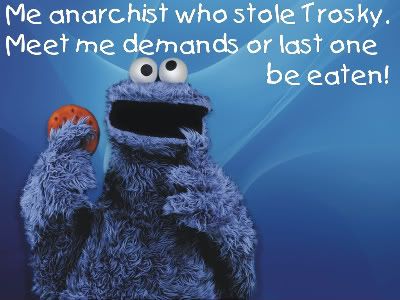
Anarchist can has Trosky cookie?

‘Struth!

Posted in !nataS | Leave a comment

Abel Paz (August 12, 1921–April 13, 2009)

The writer and historian Abel Paz (Diego Camacho Escámez) died yesterday (April 13) in Barcelona at the age of 87. Paz was born in 1921. He was fifteen when the Spanish Revolution began. After the revolution’s defeat, he spent several years in exile, returning to Spain in 1942 as a guerilla fighter against the Franco regime. He spent most of the subsequent eleven years in prison.

Fallece Abel Paz, militante e historiador libertario
CNT-AIT
April 14, 2009

El escritor e historiador Abel Paz falleció ayer en Barcelona a los 87 años. Sus restos mortales permanecerán hasta mañana en el tanatorio barcelonés de la calle Sancho de Ávila, junto al puente de Marina, donde a las 16 horas, se celebrará un acto de despedida en el que se leerán varios comunicados. Además, poetas y cantautores recordarán a un compañero que militó en el Movimiento Libertario desde niño.

Diego Camacho Escámez, su auténtico nombre, nació en Almería el 12 de agosto de 1921 y se crió entre jornaleros del campo. Desde muy joven, se aproximó al anarquismo, entrando a formar parte de la Federación Ibérica de Juventudes Libertarias (FIJL), la Confederación Nacional del Trabajo (CNT) y a la Federación Anarquista Ibérica (FAI). Durante la Revolución Española, combatió en Lérida en los grupos de defensa confederales del Clot.

En 1939, fue internado en los campos de concentración de Saint-Cyprien, Argelès-sur-Mer, Le Barcarès y Bram y fue sometido a trabajos forzados por el partido nazi. Tras escaparse, regresó a España, donde fue encarcelado dos veces. Exiliado en Francia, no volvió a España hasta 1977, cuando se estableció hasta el final de su vida en el barrio de Gràcia, en Barcelona.

Su paso por el frente en las milicias confederales y libertarias, dio a Abel Paz la sabiduría necesaria para terminar escribiendo obras imprescindibles en el Movimiento Libertario como Durruti, en la revolución española, Crónica de la Columna de Ferro o Entre la niebla, una autobiografía publicada en 1993.

Además, a lo largo de su vida participó en numerosas conferencias relacionadas con el anarquismo y la Revolución de 1936, el mundo libertario y cenetista.

La historia de Diego Camacho Escámez es ejemplo de la lucha y vida de los libertarios españoles que, con el tiempo, se van marchando. Su legado, sin embargo, vivirá siempre.

“Soy anarquista y ser anarquista es ser una persona coherente (paz espiritual, la tranquilidad, el campo, trabajar lo menos posible, el suficiente para poder vivir, disfrutar de la belleza, del sol. Disfrutar de la vida con mayúsculas, ahora se vive en minúsculas). Tener una conducta personal. Llevar las ideas a la práctica al máximo, sin esperar que haya una revolución. Eso se puede hacer ahora. Es una concepción filosófica, es un estado de espíritu, una actitud ante la vida. Pienso que esta sociedad está muy mal organizada, tanto socialmente, como políticamente, como económicamente. Hay que cambiarlo todo. El anarquismo invoca una vida completamente diferente. Trata de vivir esta utopía un poco cada día.”

~ Secretariado Permanente del Comité Nacional, CNT-AIT

See also : Barcelona in Flames — Excerpt from Abel Paz’s Durruti in the Spanish Revolution (AK Press, 2006), December 22, 2008.

Posted in Anarchism, Anti-fascism, Death, History | 9 Comments

Bound for Europe

Readers,

“ZOG”* has ordered that I attend a very important meeting at midnight in a cemetery in Prague, after which I will be going to London to table a report to The International Anarchist Conspiracy at its central headquarters. A brief stop-over in Paris (where I will be entertained by the girls of Les Folies Bergère) is also mandated, so: no blogging for a week or so I’m afraid. In the meantime, a hot new comic title has hit the stands! I reckon it’s gonna be a bestseller.

*”The word “ZOG” is commonly used by Revolutionary Nationalist Socialists today but for the uninitiated, ZOG is an acronym for Zionist Occupation Government. The term is used to describe the assortment of traitors and Zionist lackeys who control most of the White nations on this planet. A typical example is the Blair KRudd Government in the “United Kingdom” “Commonwealth of Australia” and their willing collaborators in the police, media, civil service and local councils who enforce their anti-White laws on the British Australian People. What we are seeing in our respective Aryan Nations today is a struggle for the control of White people’s minds from the highest government levels down to the lowliest civil servant.

Although the Zionist Occupation Governments appear to operate independently, they are merely puppets of the International Financiers who stealthily coordinate their agendas. These governments rule our lives with a common aim: to institute tyrannies which can suppress any criticism of their treasonous policies. Their aim is the establishment of a nationless world devoid of races and cultures populated by mindless grey automatons who pose no threat to their illegally acquired wealth and privilege.”

Posted in !nataS | Leave a comment

Leon Trotsky & The Cookie Monsters

An unlikely story…

Supposedly, some hungry anarchists (?) in Mexico recently broke into The Trotsky Museum (Museo Casa de León Trotsky) in Coyoacán on the outskirts of Mexico City. Once there, they expropriated Trotsky’s ashes, took them home, and made some cookies.

Inside the Museum (Trotsky’s former residence and the location of his murder by a Russian agent) a stone monument engraved with a hammer and sickle marks the spot where Trotsky’s ashes are interred. According to the baking brigade, what they stole was “a silver large vase that bears the inscription of his name, wrapped in the red scarf that he carried around the neck, containing the ashes of the corpse inside”.

Time magazine, Letters, Monday, October 7, 1940:

Sirs:

WHAT THE H —? TIME SEPT. 9, P. 32, SAYS TROTSKY’S ASHES WEIGHED 1.76 LB. LIFE, P. 26, SAYS THE SAME ASHES WEIGHED ABOUT 6 LB. WHAT THE H —?

RODERICK M. MONTGOMERY

Houston, Tex.

≫ Reader Montgomery doesn’t know the worst. A recheck shows Trotsky’s ashes weighed 1,200 grams (2.64 lb.). —ED.

Hmmm…

Posted in !nataS, Trot Guide | 1 Comment

Franklin Rosemont (October 2, 1943–April 12, 2009)

Franklin Rosemont RIP April 12th, 2009

Long-time activist and author Franklin Rosemont died suddenly yesterday evening in Chicago.

Franklin and his wife, Penelope Rosemont, who survives him, have been the driving force behind the Charles H. Kerr Publishing Company since the early 1970s, were co-founders of the Chicago Surrealist Group in the late 1960s, and have been active in the IWW, the Chicago chapter of Earth First!, the Chicago Labor History Society, Students for a Democratic Society, and many, many other projects. Plans for a memorial have not been finalized.

Franklin Rosemont, SmallTalk, April 14, 2009 | Labor Beat: I Never Died, Says He, Joe Hill lecture by Franklin Rosemont at Chicago’s Sulzer Library in 2003.

Posted in Death | 3 Comments