Briana Waters found guilty of two charges of arson

Briana Waters, 32 and “a devoted, loving mother and partner, a dedicated musician and violin teacher, and a caring friend to many” has been found guilty by a jury of two counts of arson on the basis of her acting as a lookout for others while they set fire to the Center for Urban Horticulture at the University of Washington in 2001. She faces up to five years in prison on each count.

Briana’s trial is the latest chapter in the FBI’s ‘Operation Backfire’, also referred to as the Green Scare. (Details of crimes and sentencing as of August 2007 are available via the Fidelity Bravery and Integrity website: Final Sentencing Hearing Held in Case of Earth Liberation Front (ELF) and Animal Liberation Front for Acts of Eco-Terrorism in Five Western States.) Prior to the attacks on New York and Washington in September 2001, the Earth Liberation Front had been dubbed Domestic Terrorist Public Enemy #1 by the Bureau, and recent prosecutions are in some ways a return to and a culmination of earlier efforts. (A good analysis of the Green Scare — ‘Green Scared? Preliminary lessons of the Green Scare’ — and its implication for dissent is available in the latest issue of Rolling Thunder.) It’s interesting to note that much of the Government’s case has been based on the testimony of collaborating defendants and, in the case of Eric McDavid (due to be sentenced on April 3), the use of a Government plant.

Tacoma Jury Convicts Woman of Arson; Hangs on Other Counts
Civil Rights Outreach Committee
For immediate Release: March 6, 2008
Contacts: Kassey Baker, 360-561-5261 / Lauren Regan, Atty, Civil Liberties Defense Center, 541-687-9180

Tacoma, WA – A federal jury was unable to reach a decision on conspiracy and transportation of a destructive device but convicted Briana Waters, a 32-year-old mother and violin teacher and former resident of Olympia of arson. The government charged her with being a lookout in connection with the May, 2001 arson of the Center for Urban Horticulture at the University of Washington in Seattle. If convicted on all counts, Waters would have faced a sentence of 35 years. The two informants [Lacey Phillabaum and Jennifer Kolar] who testified against her in the case, who admitted to participating in the arson, face between three and seven years. Ms. Waters’ sentencing is set for May 30.

Without any physical evidence linking Ms. Waters directly to the arson, the government built its case on the testimony of the two informants, and a number of pieces of circumstantial evidence. The defense argued that the informants falsely accused Waters in order to avoid 35-year prison sentences themselves, and that their testimony was demonstrably false.

Among the pieces of circumstantial evidence introduced by the government was a folder with a note on the cover from Waters to one of the informants, Jennifer Kolar, containing various radical pamphlets and publications. Prosecutors highlighted the most sensationalist passages in the articles, and sought to ascribe these views to Ms. Waters. Waters testified that she did not write the materials, did not agree with them, and did not pass them to Kolar. The defense argued that the informant must have substituted other articles for the ones that Waters actually put in the folder. While Waters’ fingerprints were on the folder, they were not on any of the articles. The government countered that Waters’ boyfriend’s fingerprints were on the articles, and that he is a “fugitive” suspected of one or more arsons. The defense pointed out that the boyfriend is not on trial.

“The government’s case was primarily based on character assassination and guilt by association,” said civil rights attorney Ben Rosenfeld, a member of the Board of Directors of the Civil Liberties Defense Center. “Evidence of other people’s writings … should never have been allowed to be used against her.”

Briana Waters has maintained her innocence to all the charges. An appeal is likely.

This trial is another chapter in the federal government’s “Operation Backfire,” also dubbed the “Green Scare,” in which the government has hounded the environmental activist community, overcharged a number of individuals with a federal firearms enhancement applying to bombs and missiles, and branded them as terrorists, even though none of the events resulted in a single injury.

Central to the jury’s consideration of two of the charges against Ms. Waters was the question whether she was responsible for helping to build or transport explosive devices. The jury deadlocked on these charges. During the first stages of the investigation of the “Street of Dreams” fires in a housing development in Snohomish County, WA, officials falsely reported that explosive devices were found. Later, BATF Spokesman Kelvin Crenshaw [stated] that no such devices were found. “It is inconceivable that officials could have made such a mistake. It raises the question of deliberate jury tampering by the government, and also calls into question the reliability of the government’s information in general,” said Rosenfeld.

Briana Waters has steadfastly maintained her innocence.

Copies of a press packet with current related articles and background information are available from civilrightsoutreach(at)gmail.com. For more information, go [here].

Posted in War on Terror | Leave a comment

Two Girls One Cup : The Sequel

Posted in !nataS | 3 Comments

G20 : Akin Sari sentenced to 28 months

29 year-old student Akin Sari was today sentenced by Judge Roy Punshon to 28 months jail, with a 14 month minimum before becoming eligible for parole (and having already served 7) after Sari plead guilty to nine charges. He was also fined…

G20 rioter jailed
Emily Power
Herald Sun
March 8, 2008

A PROTESTER involved in the violent G20 riots has been jailed for 14 months after denouncing his own actions.

Akin Sari was among a group of demonstrators who stormed a city office, attacked a police brawler van, rammed police lines with plastic barricades and hurled rocks, rubbish bins and milk crates.

Judge Roy Punshon said it was to Sari’s credit that he had acknowledged his behaviour during the November 2006 riots was unacceptable.

Judge Punshon said Sari’s change of attitude sent an important message to the public and others who protested the Group of 20 nations summit, held in Melbourne.

“You are entitled to hold the views you have — the crimes concern your behaviour,” the judge said.

Defence barrister Dermott Dann earlier told the court Sari, 29, believed extreme measures were required but now understood they were unacceptable.

Sari was sentenced to 28 months’ jail, with a minimum of 14, and was ordered to pay $8310 compensation for damage to a police brawler van.

He has already served 215 days in custody after he was detained for fleeing to Sydney last year while on bail.

The court heard Sari was one of 20 protesters who barged into the Defence Recruiting Centre on Swanston St on November 17, tearing down posters and graffiti-ing walls.

The next day Sari, disguised in a white jumpsuit, menaced two traffic event controllers with a metal pole and smashed the front window of their car.

Sari was part of a group who confronted police at Collins St, where officers were pelted with bottles and stones.

One policeman broke his wrist and another tore the tendons in her elbow.

“They tried to hide behind a brawler van,” Judge Punshon told Sari.

“A DVD shows you throwing objects at police.”

Sari, of no fixed address, pleaded guilty to aggravated burglary and theft, two counts of common assault and riot, and three counts of criminal damage.

Prosecutor Chris Beale said 10 of 23 accused protesters would plead guilty this month.

Jail for G20 protester who ‘terrorised’ victims
Sarah-Jane Collins
The Age
March 7, 2008

A protester who threw a metal bar through a police van window and hurled rocks and bottles at police as part of a series of anti-G20 riots was today jailed for 28 months.

Akin Sari, 29, had pleaded guilty to nine charges including aggravated burglary, riot and common assault for his role in the anti-G20 protests in November 2006.

County Court Judge Roy Punshon said Sari had acted in a manner that had “terrorised” his victims.

“You grabbed the female victim by the arm at one stage and menaced both victims with a metal pole,” he said.

Sari was part of a group of protesters who entered an Australian Defence Force recruitment office on November 17, 2006 and vandalised the reception area.

The next day a group of protesters – some wearing white jumpsuits and head scarves in an attempt to avoid identification – rioted twice in designated protest areas, hurling bottles and rocks at police and grabbing barricades and poles to use as weapons, Judge Punshon said.

“I readily accept that the uniformed police involved would have been very frightened … each incident was relatively brief. However, it would have seemed to last much longer.”

Sari will serve a non-parole period of 14 months and has been ordered to pay compensation for damage caused.

In sentencing, Judge Roy Punshon told the court Sari had serious, genuine, and longstanding political views and had provided the court with a two-page letter, outlining his opposition to the economic summit. Judge Punshon said Sari was entitled to hold those views but it was his behaviour he was being sentenced for. ~ G20 protester jailed, ABC, March 7, 2008

Bob Gould, Australian Labor Party, November 21, 2006:

The essential question is the fact that these irresponsible political adventurers disguise their faces. I agree strongly with Mick Armstrong’s post on this matter on Leftwrites [below], and I defer to his knowledge, based on his investigation as to who these people were. The very act of people from outside a city invading a demonstration in another city with the clear intention of launching a semi-military attack on the cops, with their faces covered, irrespective of the consequences for the rest of the demonstrators, is a calculated political act directed against the bulk of the demonstrators.

People with covered faces who attack the cops, unless they are rather unlucky and their covering falls off, are very dangerous to everybody else at the demonstrations, and quite possibly include fascists and agents provocateur… real agents provocateur certainly do exist, and organised contingents with covered faces clearly facilitate the [activities] of real agents provocateur…

Margarita Windisch, Democratic Socialist Perspective, November 19, 2006:

…stressed that the white-clad, masked individuals were separate from the protesters towards whom they had displayed “a surly and hostile attitude.” She added that their actions were “self-indulgent and parasitic in that for the sake of some macho fantasies, they enabled those who do not want our message to get across to portray us as mindless idiots.”

Mick Armstrong, Socialist Alternative, November 19, 2006:

I was one of the organisers of the G20 demo from the [Melbourne] Stop the War Coalition and I am also in Socialist Alternative.

The anarchist crazies involved in the ultra-violence were in no serious sense part of the demo. Just like their black bloc mates in Europe they simply exploited the demo for their own purposes.

Right throughout the lead-up to the demo they made clear their hostility to and contempt [for] other protestors. On the day they did all they could to disrupt the demonstration and were hostile, abusive, threatening [and] ultra-sectarian towards people on the demo.

Australia[,] fortunately[,] has not previously been blighted by the sort of black bloc anarchist activities which [have] had such a disastrous impact on demonstrations in Europe. These people are simply provocateurs that open up protests to police repression. In Europe their ranks have been riddled by police agents and fascists.

What gave them a certain critical mass at the G20 was the presence of considerable numbers of anarchists from overseas. One of our members from New Zealand said he recognised at least 40 NZ anarchists. He knew at least 20 of them by name. There were also a considerable number of black [bloc] anarchists from Europe. We know of people from Sweden, Germany and England. These people are like football hooligans who travel the world looking for violence.

On top of that there were also a considerable number of anarchists from interstate.

Because of the behaviour of these provocateurs the media [and…] the law and order brigade are having a field day.

The left should offer no comfort to these crazies. We should do whatever we can to isolate them. They are wreckers. If they grow in Australia it will simply make it harder to build future protests and movements.

See also : G20: And ‘revolutionary Marxism’ | G20

IT WAS obvious on the first day of Chris Hurley’s manslaughter trial that the police officer was unlikely to go to jail over the death of Mulrunji Doomadgee.

No matter that it wouldn’t have taken much for the 200-centimetre, 115-kilogram senior sergeant with the short fuse to fell the drunk, barefoot 74-kilogram Aboriginal man. No matter that three doctors testified that a knee to the abdomen most likely split Mr Doomadgee’s liver in two and caused him to bleed to death. No matter that Mr Doomadgee had provoked Hurley by resisting arrest and punching him.

With no other witnesses to the event, it was always going to be difficult for the jury to decide beyond reasonable doubt that Senior Sergeant Hurley deliberately caused Mr Doomadgee’s fatal injuries… ~ A predictable result three years in the making, Cosima Marriner, The Age, June 21, 2007

    Diarrheal diseases

    Diarrhea is a leading cause of childhood morbidity and mortality in developing countries. It is caused by ingesting certain bacteria, viruses or parasites present in water or food, and can be spread by utensils, hands or flies. Diarrheal disease causes considerable dehydration, which may quickly lead to death when not promptly treated.

    Cholera, one of the most severe diarrheal diseases, is a significant cause of illness and death in developing countries. An acute bacterial infection of the intestine, cholera is spread the consumption of contaminated food or water. Cholera symptoms include acute watery diarrhea and vomiting, which can result in severe dehydration and rapidly lead to death. Other diarrheal disease pathogens include rotavirus, escherichia coli, salmonella, shigella and giardia.

    Diarrheal diseases can be prevented through access to clean, safe drinking water and through proper sanitation measures, including hand washing and safe disposal of human waste. While diarrhea generally can be easily treated using oral rehydration solution (ORS), a combination of glucose and sodium dissolved in water that replaces essential electrolytes lost through diarrhea, long-term prevention solutions require investments in water and sanitation, as well as changes in behavior to prevent unnecessary transmission of disease agents.

Diarrhea, known medically as gastroenteritis, is a major cause of children’s death in the world–second only to acute respiratory infections (ARI). One out of every four childhood deaths is from diarrhea, which drains the life out of at least 3 million infants and young children every year. Of these deaths, 99.6% occur in the Third World, where one in ten children dies of diarrhea before the age five… ~ David Werner & David Sanders, Questioning the Solution, Chapter 6: Diarrhea: A Leading Killer of Children, 1997

PROTESTERS at this week’s G20 summit should be cheering efforts to eradicate poverty, Treasurer Peter Costello said yesterday. “If you’re concerned about aid and poverty and the developing world, this is a summit you should be demonstrating for,” he said. ~ November 13, 2006

Peter Costello has also kept his head down. Friends say he is firming to join Goldman Sachs in London. His relationship with Gordon Brown, forged when both were treasurers, is a valuable commodity in Britain where Brown is now Prime Minister. ~ March 7, 2008

Posted in State / Politics, War on Terror | 66 Comments

For reasons of state #6,322

Gaza Militants Kill 1 Israeli Soldier
Yaniv Zohar / AP
The Guardian
March 7, 2008

KISSUFIM CROSSING, Israel (AP) — Palestinian militants ambushed an Israeli army jeep patrolling the Gaza border, then attacked a rescue crew that rushed to the scene, killing one soldier and wounding three in a brazen cross-border attack, according to military and witness accounts.

The attack raised the possibility of a fresh round of violence in Gaza, just two days after Israel ended an offensive that killed more than 120 Palestinians. Senior Israeli military officers held an emergency meeting to plot a response, officials said…

Gaza’s ordeal ‘its worst in 40 years’
Tim Butcher
The Age (The Daily Telegraph)
March 7, 2008

GAZA’S humanitarian crisis is more acute now than at any time since Israel took control of the territory in the 1967 war, aid agencies have said. More Gazans are dependent on food aid than ever before, hospitals suffer the longest power cuts yet experienced, record levels of raw sewage are being pumped into the sea daily and the economy has never been worse… The data was collated before the recent escalation in Hamas rocket fire and Israel’s incursion, which killed 106 Palestinians, at least half of them civilians, in five days alone. One Israeli civilian and two Israeli soldiers were killed in the same period…

Israeli minister vows Palestinian ‘holocaust’
Tim Butcher
The Daily Telegraph
March 1, 2008

A senior Israeli politician provoked controversy today when he warned that Palestinians firing rockets from Gaza would be punished with a “bigger holocaust” from Israeli armed forces.

The use of the Hebrew word for holocaust, “shoah”, tends to be used exclusively in Israel to describe the Nazi persecution of Jews.

Palestinian activists routinely claim to be suffering a “shoah” at the hands of Israel, but the Jewish state normally denies any moral equivalence between the suffering of Palestinians today and European jewry under the Nazis.

Matan Vilnai, deputy defence minister, broke that taboo when he used the term “shoah” during interview on Army Radio.

“The more qassam fire intensifies and the rockets reach a longer range, they (the Palestinians) will bring upon themselves a bigger shoah because we will use all our might to defend ourselves,” he said…

    29.9.2000-31.1.2008

    Occupied Territories / Israel

    Palestinians killed by Israeli security forces 4419 / 66
    Palestinians killed by Israeli civilians 43
    Israeli civilians killed by Palestinians 234 / 471
    Israeli security force personnel killed by Palestinians 239 / 87
    Foreign citizens killed by Palestinians 17 / 37
    Foreign citizens killed by Israeli security forces 10
    Palestinians killed by Palestinians 575

Posted in State / Politics | 7 Comments

yeah

Posted in Uncategorized | Leave a comment

Don’t know what i want, But i know how to get it

    Or, You don’t need a a dialectical-materialist philosopher and psychoanalyst, To know which way the wind blows.

    Or, What you mean ‘we’, paleface?

Resistance Is Surrender
Slavoj Žižek
London Review of Books
November 15, 2007

One of the clearest lessons of the last few decades is that capitalism is indestructible. Marx compared it to a vampire, and one of the salient points of comparison now appears to be that vampires always rise up again after being stabbed to death. Even Mao’s attempt, in the Cultural Revolution, to wipe out the traces of capitalism, ended up in its triumphant return.

Today’s Left reacts in a wide variety of ways to the hegemony of global capitalism and its political supplement, liberal democracy. It might, for example, accept the hegemony, but continue to fight for reform within its rules (this is Third Way social democracy).

Or, it accepts that the hegemony is here to stay, but should nonetheless be resisted from its ‘interstices’.

Or, it accepts the futility of all struggle, since the hegemony is so all-encompassing that nothing can really be done except wait for an outburst of ‘divine violence’ – a revolutionary version of Heidegger’s ‘only God can save us.’

Or, it recognises the temporary futility of the struggle. In today’s triumph of global capitalism, the argument goes, true resistance is not possible, so all we can do till the revolutionary spirit of the global working class is renewed is defend what remains of the welfare state, confronting those in power with demands we know they cannot fulfil, and otherwise withdraw into cultural studies, where one can quietly pursue the work of criticism.

Or, it emphasises the fact that the problem is a more fundamental one, that global capitalism is ultimately an effect of the underlying principles of technology or ‘instrumental reason’.

Or, it posits that one can undermine global capitalism and state power, not by directly attacking them, but by refocusing the field of struggle on everyday practices, where one can ‘build a new world’; in this way, the foundations of the power of capital and the state will be gradually undermined, and, at some point, the state will collapse (the exemplar of this approach is the Zapatista movement).

Or, it takes the ‘postmodern’ route, shifting the accent from anti-capitalist struggle to the multiple forms of politico-ideological struggle for hegemony, emphasising the importance of discursive re-articulation.

Or, it wagers that one can repeat at the postmodern level the classical Marxist gesture of enacting the ‘determinate negation’ of capitalism: with today’s rise of ‘cognitive work’, the contradiction between social production and capitalist relations has become starker than ever, rendering possible for the first time ‘absolute democracy’ (this would be Hardt and Negri’s position).

These positions are not presented as a way of avoiding some ‘true’ radical Left politics – what they are trying to get around is, indeed, the lack of such a position. This defeat of the Left is not the whole story of the last thirty years, however. There is another, no less surprising, lesson to be learned from the Chinese Communists’ presiding over arguably the most explosive development of capitalism in history, and from the growth of West European Third Way social democracy. It is, in short: we can do it better. In the UK, the Thatcher revolution was, at the time, chaotic and impulsive, marked by unpredictable contingencies. It was Tony Blair who was able to institutionalise it, or, in Hegel’s terms, to raise (what first appeared as) a contingency, a historical accident, into a necessity. Thatcher wasn’t a Thatcherite, she was merely herself; it was Blair (more than Major) who truly gave form to Thatcherism.

The response of some critics on the postmodern Left to this predicament is to call for a new politics of resistance. Those who still insist on fighting state power, let alone seizing it, are accused of remaining stuck within the ‘old paradigm’: the task today, their critics say, is to resist state power by withdrawing from its terrain and creating new spaces outside its control. This is, of course, the obverse of accepting the triumph of capitalism. The politics of resistance is nothing but the moralising supplement to a Third Way Left.

Simon Critchley’s recent book, Infinitely Demanding, is an almost perfect embodiment of this position.[*] For Critchley, the liberal-democratic state is here to stay. Attempts to abolish the state failed miserably; consequently, the new politics has to be located at a distance from it: anti-war movements, ecological organisations, groups protesting against racist or sexist abuses, and other forms of local self-organisation. It must be a politics of resistance to the state, of bombarding the state with impossible demands, of denouncing the limitations of state mechanisms. The main argument for conducting the politics of resistance at a distance from the state hinges on the ethical dimension of the ‘infinitely demanding’ call for justice: no state can heed this call, since its ultimate goal is the ‘real-political’ one of ensuring its own reproduction (its economic growth, public safety, etc). ‘Of course,’ Critchley writes,

    history is habitually written by the people with the guns and sticks and one cannot expect to defeat them with mocking satire and feather dusters. Yet, as the history of ultra-leftist active nihilism eloquently shows, one is lost the moment one picks up the guns and sticks. Anarchic political resistance should not seek to mimic and mirror the archic violent sovereignty it opposes.

So what should, say, the US Democrats do? Stop competing for state power and withdraw to the interstices of the state, leaving state power to the Republicans and start a campaign of anarchic resistance to it? And what would Critchley do if he were facing an adversary like Hitler? Surely in such a case one should ‘mimic and mirror the archic violent sovereignty’ one opposes? Shouldn’t the Left draw a distinction between the circumstances in which one would resort to violence in confronting the state, and those in which all one can and should do is use ‘mocking satire and feather dusters’? The ambiguity of Critchley’s position resides in a strange non sequitur: if the state is here to stay, if it is impossible to abolish it (or capitalism), why retreat from it? Why not act with(in) the state? Why not accept the basic premise of the Third Way? Why limit oneself to a politics which, as Critchley puts it, ‘calls the state into question and calls the established order to account, not in order to do away with the state, desirable though that might well be in some utopian sense, but in order to better it or attenuate its malicious effect’?

These words simply demonstrate that today’s liberal-democratic state and the dream of an ‘infinitely demanding’ anarchic politics exist in a relationship of mutual parasitism: anarchic agents do the ethical thinking, and the state does the work of running and regulating society. Critchley’s anarchic ethico-political agent acts like a superego, comfortably bombarding the state with demands; and the more the state tries to satisfy these demands, the more guilty it is seen to be. In compliance with this logic, the anarchic agents focus their protest not on open dictatorships, but on the hypocrisy of liberal democracies, who are accused of betraying their own professed principles.

The big demonstrations in London and Washington against the US attack on Iraq a few years ago offer an exemplary case of this strange symbiotic relationship between power and resistance. Their paradoxical outcome was that both sides were satisfied. The protesters saved their beautiful souls: they made it clear that they don’t agree with the government’s policy on Iraq. Those in power calmly accepted it, even profited from it: not only did the protests in no way prevent the already-made decision to attack Iraq; they also served to legitimise it. Thus George Bush’s reaction to mass demonstrations protesting his visit to London, in effect: ‘You see, this is what we are fighting for, so that what people are doing here – protesting against their government policy – will be possible also in Iraq!’

It is striking that the course on which Hugo Chávez has embarked since 2006 is the exact opposite of the one chosen by the postmodern Left: far from resisting state power, he grabbed it (first by an attempted coup, then democratically), ruthlessly using the Venezuelan state apparatuses to promote his goals. Furthermore, he is militarising the barrios, and organising the training of armed units there. And, the ultimate scare: now that he is feeling the economic effects of capital’s ‘resistance’ to his rule (temporary shortages of some goods in the state-subsidised supermarkets), he has announced plans to consolidate the 24 parties that support him into a single party. Even some of his allies are sceptical about this move: will it come at the expense of the popular movements that have given the Venezuelan revolution its élan? However, this choice, though risky, should be fully endorsed: the task is to make the new party function not as a typical state socialist (or Peronist) party, but as a vehicle for the mobilisation of new forms of politics (like the grass roots slum committees). What should we say to someone like Chávez? ‘No, do not grab state power, just withdraw, leave the state and the current situation in place’? Chávez is often dismissed as a clown – but wouldn’t such a withdrawal just reduce him to a version of Subcomandante Marcos, whom many Mexican leftists now refer to as ‘Subcomediante Marcos’? Today, it is the great capitalists – Bill Gates, corporate polluters, fox hunters – who ‘resist’ the state.

The lesson here is that the truly subversive thing is not to insist on ‘infinite’ demands we know those in power cannot fulfil. Since they know that we know it, such an ‘infinitely demanding’ attitude presents no problem for those in power: ‘So wonderful that, with your critical demands, you remind us what kind of world we would all like to live in. Unfortunately, we live in the real world, where we have to make do with what is possible.’ The thing to do is, on the contrary, to bombard those in power with strategically well-selected, precise, finite demands, which can’t be met with the same excuse.

See also : Lettuce to the Cabbage : TJ Clark: Chris Harman: André Bénichou (December 13, 2007) | David Graeber (January 3, 2008) | Slavoj Žižek (January 24, 2008) | Simon Critchley’s review of Violence by Slavoj Žižek

REFERENDUM ON ZIZEK?
David Graeber

Slavoj Žižek is a delightful provocateur and an extraordinarily gifted intellectual comedian. One day he’s denouncing do-gooder capitalists like George Soros by insisting capitalism is an irredeemable system of structural violence; a few weeks later, he’s informing the Left there’s no chance of ever overcoming capitalism, but they should take hope in the fact that “we can do it better”. One day he’s embracing Lenin as a man whose aim was to destroy all states forever, the next he’s arguing the state must be maintained as the only possible remaining bulwark against capitalism. To respond to such statements as if they educed a consistent political position seems slightly oafish. Still, if you choose someone like this as a book reviewer, your readers are unlikely to learn much about the book. Worse, “Resistance is Surrender,” which purports to be a review of Simon Critchley’s Infinitely Demanding, is clearly intended less as a review than as a political intervention aimed to head off any possibility that LRB’s readers might give serious consideration to its message.

That would be unfortunate.

Critchley’s book is important, it seems to me, because it is a kind of overture. It is almost unheard of for professional intellectuals—philosophers, no less—to engage seriously with radical social movements. The reason is simple enough: it requires listening. The last decade has seen a profound change in world politics, as social movements from Argentina to Japan increasingly reject the very idea of seizing state power, of creating freedom at the point of a gun, and began instead concentrating on the reinvention of new forms of democracy, sociality, and exchange. The intellectual classes have never known quite what [to] make of it. Most reacted with condescension when the global justice movement first appeared on the horizon around 2000; some soon switched to giddy enthusiasm, followed by a sense of hurt dismay on discovering the movement wasn’t looking for a vanguard. Over the last few years, as it has become apparent that revolutionary transformation of the sort the movement aims to achieve is going to take a great deal of time and patience, former intellectual allies have begun tumbling over each other to abandon ship, and find some “progressive capitalists” to whom to sell their souls (though so far, without a great deal of success).

Critchley is one of the few who has made a serious effort to listen, to entertain the possibility, in effect, that those who are actively engaged in fighting capitalism and its empires might themselves have something relevant to say, to try to understand what they are trying to achieve, and how the intellectual tools at his disposal might be helpful. The book does not simply propound a Levinasian ethics, understood as an infinite responsibility towards otherness, it is in itself an attempt to practice it. Žižek appears to object to this project on principle (rather oddly, considering he endorses the book in precisely these terms on his blurb on the back cover). When you shave away the posturing, his real message to LRB’s reviewers is simple: you are intellectuals. Intellectuals have always been, and always must be, whores to power in some form or another. Obviously, Žižek can’t quite out and say this: so he conveys it in the form of a series of rather dishonest rhetorical maneuvers, mostly revolving around deployment of the term “we”. “We” are intellectuals, “we” are the Left (since the Left apparently consists primarily of intellectuals), but we also seem to include anyone from Tony Blair and the Democratic Party to the current rulers of the People’s Republic of China. As a result “we” obviously cannot stand opposed on principle to cruise missiles and interrogation chambers because our real brothers and sisters are not those being blown up by or strung up in them, but rather, those pushing the buttons and calculating stress positions.

Well, of course we can make that choice if we like. For most of human history, those who made their livings by writing mostly have. Still, I’d offer two points readers might wish to consider:

First, capitalism will not really be around forever. An engine of infinite expansion and accumulation cannot, by definition, continue forever in a finite world. Now that India and China are buying in as full players, it seems reasonable to assume that within at most 50 years, the system will hit its physical limits. Whatever we end up with at that point, it will not be a system of infinite expansion. Therefore it will not be capitalism. It will be something else. However, there is no guarantee that this something will be better. It might be considerably worse. Might we not do well to at least consider what something better might be like? If nothing else it seems an odd moment to call off all speculation about alternatives. And if one does wish to think about alternatives to capitalism, how better to do this than to engage with those building such alternatives in the present?

Second, to be able to do this, we will probably have to learn to get over ourselves a little. This is the eventuality against which Žižek seems to be making his heroic stand. After all, why choose Chavez? Why not, say, Evo Morales, who unlike Chavez really was placed in power by, and remains answerable to, genuine social movements? Obviously: for that very reason. Could we really imagine someone like Žižek, even in his fantasies, patiently listening to the demands of the directly democratic assemblies of El Alto? Chavez, on the other hand, is precisely the political figure such an intellectual would wish himself to be: a virtuoso performer and political comedian holding power with no real responsibilities to anyone except the pleasure of his audience. Sure, it’s a seductive fantasy. But it’s precisely the fantasy we have to get past if we want to make a genuine difference in the world.

Check it out now! A funk soul rebel: BOOKSURFER : Books & Internet Resources | Scott McLemee, Zizek Watch, The Chronicle of Higher Education, February-July 2004

    Žižek

    “Yes, he’s married. His wife, the filmmaker and writer Astra Taylor, did a documentary about Slavoj Žižek. How cool is that?” (Ten Years Of In The Aeroplane Over The Sea, stereogum.com, February 8, 2008)
    “Since the deaths of Jacques Derrida in 2004 and Jean Baudrillard in 2007, the Slovenian critic Slavoj Žižek has quickly cemented his position as the world’s most prominent philosopher and cultural theorist.” (Heart of darkness, Matthew Taunton, New Statesman, January 31, 2008)
    “Žižek leaves no social or cultural phenomenon untheorized, and is master of the counterintuitive observation.” New Yorker
    “Unafraid of confrontation and with a near-limitless grasp of pop symbolism.” The Times
    “Žižek is one of the few living writers to combine theoretical rigor with compulsive readability.” Publishers Weekly
    “I prefer to think of myself as some[one] who, so as not to offend others, pretends that he is human. In fact, I am a monster.” Žižek

Posted in Anarchism | 14 Comments

Pssst. Wanna Manifesto? Awesome new front group for LM

For a dead parrot, the Revolutionary Communist Party (RCP) continues to display a great deal of life; the bizarros gotta new front group: Manifesto Club. It joins:

1) Africa Direct — genocide? What genocide? (defunct);
*Association of British Drivers — just say no to speed limits;
2) Audacity.org — “Let’s build!” (awesome);
3) Campaign Against Militarism (defunct — begat the London International Research Exchange);
3) Campaign for Internet Freedom (defunct);
4) Channel Cyberia (defunct);
5) Families for Freedom (defunct);
6) Feminists for Justice — date rape? (defunct);
7) Freedom & Law (defunct);
EIGHT) Future Cities Project (awesome);
Genetic Interest Group
9) Global Futures (defunct);
10) Institute of Ideas (awesome);
11) Irish Freedom Movement (defunct);
12) Libero! — established by (Doctor) Carlton Brick* as a support group for libertarian football fans / a weird-arse attempt at cornering the football market (defunct);
13) Litigious Society (defunct);
14) London International Research Exchange (defunct);
15) Parents Against the Charter ? (defunct);
Progress Educational Trust GM is cool!
Science Media Centre GM is cool!
16) Sense about Science (awesome);
17) Sp!ked Online (awesome);
18) Transport Research Group — cars are good (defunct — begat the Future Cities Project);
19) WORLDwrite (awesome);
20) (East London) Workers Against Racism (defunct);

and

21) the magazine NOVO (Germany).

*Links with but not established by.

Established in 1978 as a split from the IS, the RCP — according to James Heartfield (James Hughes) — was disbanded over a fairly long period. Thus the last time the RCP stood in an election was 1992, while the last public campaign it was involved in was the Campaign Against Militarism (1992–1995); the RCP sold LM to Helene Guldberg at the end of 1996.

Living Marxism, the monthly magazine of the RCP, was launched in 1988. It later (1996) changed its title to LM — which met polite titters — but what got the Godless Communists into heap ’em big trouble was an article by Thomas Deichmann, published in LM #97 (February 1997), and titled ‘The picture that fooled the world’. “This image of an emaciated Muslim caged behind Serb barbed wire, filmed by a British news team, became a worldwide symbol of the war in Bosnia. But the picture is not quite what it seems”, wrote Doubting Thomas (LM issued a press release at the time to ensure maximum publicity for his startling claims). Accused of manufacturing lies, Ed Vuillamy, one of the journalists responsible for producing the story, denied Deichmann’s allegations. A few years later, in March 2000, ITN won a libel case against LM, and it was forced to close. See David Campbell, Atrocity, memory, photography: imaging the concentration camps of Bosnia – the case of ITN versus Living Marxism | Also Alexander Cockburn, Guardian Fabricates Chomsky Quotes in Bid to Smear World’s Number One Intellectual: Storm Over Brockes’ Fakery, Counterpunch, November 5/6, 2005 | David Pallister, John Vidal and Kevin Maguire, Life after Living Marxism: Fighting for freedom – to offend, outrage and question everything, The Guardian, July 8 2000 | Dave Walker, Libertarian Humanism or Critical Utopianism? The Demise of the Revolutionary Communist Party, New Interventions, Vol.8, No.3, 1998 | George Monbiot, Far Left or Far Right?: Living Marxism’s interesting allegiances, November 1, 1998

*Three speakers focused on David Beckham, among them Carlton Brick, from the university [of Paisley, Scotland], whose address was intriguingly titled “Father, why hast thou forsaken me? Postmodernism, desire and dissatisfaction: a case study of David Beckham’s meaning”. Explaining how Beckham’s career has been littered with Christian symbolism, Brick said redemption, resurrection, and salvation “are the narratives that tell his story”. The footballer’s perception of himself seems to concur: he has appeared in magazines adopting a Christ-like pose, has a crucifix tattoo and named one of his sons Cruz, Spanish for cross. But Brick’s paper said reading Beckham as postmodern religious icon, a new god of the global consumer culture, was insufficient. “Rather, Beckham’s celebrity speaks to the paradoxical desire to attribute meaning in a culture which is increasingly defined as meaningless …” ~ Beyonce, Becks and me me me, Sydney Morning Herald, September 17, 2005

Also awesome : Revolutionary Communist Party of Britain (Marxist-Leninist) | Revolutionary Communist Party (USA) | Revolutionary Communist Party (Canada)

Posted in !nataS, Trot Guide | 8 Comments

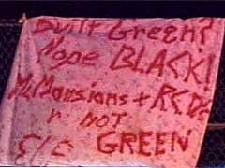
Not-so-sustainable houses burn. Naughty Elves @ work in Seattle again?

“Built Green? Nope BLACK!” the sign said.

First with Faux News:

Suspicious Fire Burns Luxury Homes in Seattle Suburb; Explosives Found and ELF Suspected
(Monday) March 3, 2008

WOODINVILLE, Wash. — Explosive devices were found inside luxury houses set ablaze Monday morning outside of Seattle, and police suspected that a well-known eco-terrorism group ignited the fires. Meanwhile, a developers association offered a $100,000 reward for information leading to those who committed the apparent arson…

History repeats. In the weeks before Jeff Luers’ trial in 2001 — who, incidentally, has just won an appeal to reduce his original sentence from 22 years and eight months to 10 years — a fire broke out at the same Chevrolet dealer he was convicted of sabotaging, this time causing $1 million in damage. Now, with Briana Waters on trial, someone’s done gone and committed another arson. (See also Green Scare Update, July 14, 2007).

It’s terrorism says the government, media and developers: ‘$2 million homes burn in ‘act of terror,’ developer says’, CNN, March 3, 2008. “Fire engulfed five luxury homes Monday morning at a subdivision north of Seattle in what could be a case of ecoterrorism, officials said… Seattle’s Street of Dreams is “the most popular and highest attended single site luxury home and garden tour in the U.S.,” according to the event’s Web site.” “We are saddened by this senseless act. Such actions to destroy the property of others by this means are criminal and counterproductive” said the President.

The display homes, sold as clean and green, were built by Centex Homes, a little ol’ company from Texas:

Dallas-based Centex (NYSE: CTX), founded in 1950, is one of the nation’s leading home building companies. In addition to its home building operations, Centex’s related business lines include mortgage, title and insurance services and integrated pest defense systems. These businesses provide operational or financial support to the company’s home building operations and are leaders in their respective industries. Centex ranks No. 1 in its industry on FORTUNE magazine’s list of “America’s Most Admired Companies,” and leads the industry in customer satisfaction.

For the third quarter of fiscal year 2008 ended December 31, 2007, the company reported the following results: revenues for the quarter of $1.91 billion and a net loss of nearly $975 million, or $7.94 per diluted share.

For fiscal year 2007, Centex reported revenues of $12 billion, and net earnings of $268 million, or $2.23 per diluted share.

See also : Green radicals suspected in US luxury homes fire, AFP | Luxury Homes Burn in Apparent Eco-Attack, Elizabeth M. Gillespie, AP | Seattle fires may be linked to radical eco-group, Reuters

Video : FBI investigating ‘Street of Dreams’ fires, March 3, 2008, KING Staff and wire reports, King5

Watch out you might get what you’re after
Cool babies strange but not a stranger
I’m an ordinary guy
Burning down the house

Hold tight wait till the party’s over
Hold tight We’re in for nasty weather
There has got to be a way
Burning down the house

Here’s your ticket pack your bag: time for jumpin’ overboard
The transportation is here
Close enough but not too far, Maybe you know where you are
Fightin’ fire with fire

All wet hey you might need a raincoat
Shakedown dreams walking in broad daylight
Three hun-dred six-ty five de-grees
Burning down the house

It was once upon a place sometimes I listen to myself
Gonna come in first place
People on their way to work baby what did you except
Gonna burst into flame

My house S’out of the ordinary
That’s right Don’t want to hurt nobody
Some things sure can sweep me off my feet
Burning down the house

No visible means of support and you have not seen nuthin’ yet
Everything’s stuck together
I don’t know what you expect staring into the TV set
Fighting fire with fire

Posted in !nataS | Leave a comment

Wtf is it with Newcastle and !@#$%^& Nazis? Or: “Hello, my name is Nathan Clarke. You’re not Jewish, are you?”

Is it something in the water?

For a town its size (140,000+), Newcastle seems to have been blessed with more than its fair share of neo-Nazis — whether it’s Douglas Schott and the boys of Blood Red Eagle warbling Viking tunes at the Hamilton Hotel, teenage fascists (and their considerably older partners) organising BBQs for fellow members of teh Master Race, or Saleam’s mob pestering locals about the dangers of blackfellas doing what they do best (y’know… stealing jobs and women from under the nose of The White Man) — there appears to be no shortage of nutty racists in town. Now some real estate agent called Nathan Clarke has been exposed as being a net-Nazi: FDB! having just published the alleged profile of yet another user of the white supremacist Stormfront website, one using (although probably not for much longer) the pseudonym ‘nafe’. Ironically, this same person only recently denounced the Jew (sic) Joe Hildebrand for writing on the subject of a supposed plot for Race thugs to hijack Australia Day (January 9, 2008).

Mr Clarke said (October 17, 2007):

We are delighted to be joining Australia’s fastest growing real estate group. Harcourts are a modern and progressive company who place great emphasis on training and systems and we feel these will be of great benefit to our clients.

Mr Clarke also said (January 10, 2008):

Just a little misrepresentation. He [deliberately] misquoted the man. He [blatantly] lied to the whole of The Daily Telegraph [readership]. He has not [substantiated] the [article] and it would be tough to find anything truthful in the whole ****ing article.

Joe [you’re] … scum, [you’re] a typical [J]ew, [you] try and stand over anything that doesn’t fit your agenda. Trying to ruin a man[‘]s life, career, friends, family is a low act.

If you were [truly] wanting to write a piece on white “nationalism” with some truth, come here and discuss [it] with us, not write your hate filled [J]ew[ish] bull****.

I’m going to stop right here before [I] take my coments [too] far… misquote that you scum ****.

So if you’re in the market for real estate in Newcastle, be sure and contact Nathan Clarke on 0402 674 815 or Harcourts New South Wales State Office, Level 11, 100 Williams Street, East Sydney, New South Wales on (02) 9380 8665.

Just don’t be a bullying, hate-filled scumbag Jew, because Jews are bad, mmmkay?

Posted in !nataS, Anti-fascism, Media | 44 Comments

Media Alert Transmission Hub Advanced Broadcast Application // Mathaba.Net // What The Fuck

Media Alert Transmission Hub Advanced Broadcast Application What The Fuck

The word ‘mathaba’ apparently means ‘centre’; ‘Al Mathaba’ was the name given to Libya’s spy network. Mathaba.net is also the name of an ‘independent news agency’, based in the UK. Just recently, the ‘news agency’ published an interview, ‘Doing the New Right thing by people’, with a local fascist, Welf Herfurth. Although the article fails to mention it, Herfurth is one of the handful of regular contributors to the site. It does inform the reader, however, that “This interview was [originally] published by Destiny magazine, a leading Australian nationalist magazine”, published by the fascist Australian Protectionist Party, a recent (September 2007) split from the Australia First Party, led by Doctor James Saleam.

Obtaining details of the origins and purposes of the mathaba.net site has proven to be a little difficult. Alexa states that the address for the ‘Mathaba News Network’ is BCM Mathaba, 27 Old Gloucester St, London, England WC1N 3XX, UK, the location of a number of other businesses and groups of one sort or another. It also states that the site has been online since October 19, 1999; it was apparently designed by GreenNet, which describes it as “a Pan African and Alternative News portal”, and which is also designated as being the African Mathaba Network. According to another source:

At Mathaba we provide an example that people can be united in their goals while maintaining healthy differences of culture, nationality and opinion. We encourage the search for alternative solutions to realize human rights and freedom, and evolve those ideas into concrete living works that benefit our world…

Uh-huh.

In addition to Herfurth, among the other regular contributors to Mathaba are:

    Sahib Mustaqim Bleher (UK);
    Walter M. Brasch (USA);
    Harris Brio (USA);
    Karen Dabrowska (UK);
    Deborah Gabriel (UK);
    Flávio Gonçalves (Portugal);
    Diana Lee (USA);
    Stephen Lendman (USA);
    Nicola Nasser (Isratine);
    Kuumba Chi Nia (USA);
    Ardeshir Ommani (USA);
    Tony Ryan (Australia) and;
    Satya Sagar (India).

Brio is “a non follower of the Holocoustian faith” according to one blog comment, while Karen Dabrowska is the author of a travel guide to Iraq(!). Deborah Gabriel is a journalist, the author of a book called Layers of Blackness: Colourism in the African Diaspora (2007), and a Pan-Africanist.

Flávio Gonçalves, on the other hand, is another member of the New Right, and like Herfurth maintains a blog. Kuumba Chi Nia is a sometime member of the All-African People’s Revolutionary Party, a Pan-Africanist micro-sect established by Ghanian politician (Prime Minister and President) Kwame Nkrumah (1909–1972), allegedly described as the ‘Lenin of Africa’ by CLR James. Ardeshir Ommani is a co-founder of the American-Iranian Friendship Committee, and has written extensively on Iran/US relations.

Tony Ryan is the other Australian, in addition to Herfurth, who contributes to mathaba.net; at one point, Ryan was a member of something called ‘Australia Independent’s Alliance’, apparently a creature closing resembling the ‘Save Australia Alliance’, one of right-wing maverick Tony Pitt’s innumerable political projects. On the site of Israel Shamir, Satya Sagar is described as ‘our friend’. Preliminary investigation would seem to suggest that what unites the regular contributors to Mathaba is anti-Semitism and/or some form of anti-US imperialism.

Or perhaps not.

Sahib Mustaqim Bleher is an interesting bloke; he refers to the Holocult on his blog, and doesn’t appear to be particularly well-disposed towards Jews or their presumably exaggerated claims to persecution by the Nazis. A German-born Muslim convert, Bleher lives in England, and until recently was General Secretary of The Islamic Party of Britain, when in June 2003 the Party suspended its activities. The Islamic Party was founded by Bleher and another convert, David Musa Pidcock, in the wake of the Rushdie affair of 1989.

Both The Party and Bleher get a mention in the February 2007 edition of Searchlight in an article by Gerry Gable about Troy Southgate’s “New Right Group”:

…Not only did [the audience at a New Right meeting] listen dutifully to [Michele] Renouf’s usual ranting but, with only a slight ripple of resentment, they sat through another anti-Jewish tirade from Dr Sahib Mustaqim Bleher, the German-born convert to Islam who is now the general secretary of the Islamic Party of Britain. He supported Renouf’s views of Jews, saying that Muslims were not the root of the world’s problems, Jews were.

Bleher, who describes himself as a “flying Imam” has his own blog in which he describes the Holocaust as the Holocult and the recent Holocaust denial conference in Iran as “the most important milestone in their [the Iranians’] history since the Islamic Revolution under Khomeini”…

A Good Muslim, (like Dazza the Good Christian), neither Bleher nor his Party like homosexuality much either:

Question Forum : Islamic View On Homosexuality (March 9, 2002)

Would an Islamic nation in Britain tolerate homosexuality? By tolerate I mean allow people to live their lives this way without state interference. Christianity does not tolerate homosexuality but it is not punishable by death. Would an Islamic state therefore ‘condemn to death’ Britain’s 6.6 million homosexuals?

To start with, the figure of 6.6 million (or more than 10% of the population) sounds propagandistic. Whilst few dare speak out against the practice of homosexuality due to the pressure exerted by gay rights groups and echoed in the media, the majority of the population do not regard it as an acceptable way of life. Islam condemns and outlaws homosexuality. As far as Islamic law is concerned, the rules are that the state does not interfere in the privacy of people’s homes, but it would need to safeguard public decency by preventing any public advocacy for homosexuality. Such activity would come under the heading of public incitement. The death penalty the questioner mentions only applies to a public display of lewdness witnessed by several people.

The best account of the bizarro current represented by Herfurth, Gonçalves and chief national anarchist ideologue Troy Southgate remains that of Graham D. Macklin, ‘Co-opting the counter culture: Troy Southgate and the National Revolutionary Faction’, Patterns of Prejudice, Vol.39, No.3, 2005 [PDF]. Also of relevance is Alan Wolfe, ‘A Fascist Philosopher Helps Us Understand Contemporary Politcs’, The Chronicle of Higher Education, April 2, 2004 [PDF]. More generally, Kevin Coogan’s Dreamer of the Day: Francis Parker Yockey and the Postwar Fascist International (Autonomedia, New York, 1999) remains the definitive account of the post-war fascist politics which inform Southgate and others in their wanderings in the political wilderness. In Australia, the tendency’s enormous weakness is perhaps best symbolised by the involvement of individuals such as Darrin Hodges, aka the Anglo-Australian National Community Council.

Although Southgate’s impact on left-wing counter-cultural concerns has been completely negligible, this case study of the NRF’s wanton intellectual cannibalism shows that groupuscular fascism poses a clear danger, particularly for ecological subcultures whose values are profoundly different from the ecological agenda mooted by the far right. The increasing ability of groupuscules like the NRF to absorb and mirror left-wing and environmental causes, effortlessly refracting their concerns about globalization and liberal democracy through their own antisemitic and racist framework, creates a dangerous conflation between ecology and anti-immigration as a way of restoring the ‘organic balance’ of nature. If this article is anything to go by, then anarchist, ecological and global justice movements need to remain on their guard in order to ensure that the revolution will not be national-Bolshevized.

See also : APEC : New Reich / “National Anarchists” (September 8, 2007) | APEC : Neo-Nazis (September 14, 2007) | All Heil the New Reich* (September 18, 2007) | Anarchist statement on the New Right (October 21, 2007) | “Pathetic Australian anarchist statement on the New Reich” (January 16, 2008)

Posted in !nataS, Media | 15 Comments