Poem for B, C, D, D, D & J

This work deals with the highly topical issue of multiculturalism and, as such, a warning is necessary. It is written for those who are, or aspire to be, members of the intellectual elite. These are the people who believe that knowledge is the product of hard labour; the people who believe that you need to do a great deal of time-consuming research, read a lot of books and reflect on many difficult philosophical, empirical and theoretical issues to produce intelligent knowledge.

In John HoWARd’s Australia, there seem to be many individuals who feel ‘relaxed and comfortable’ in talking about issues about which they haven’t bothered to read a single researched article, let alone a book. Apparently, ‘life taught them’. In fact, such people are so ‘relaxed and comfortable’ that they believe that the more someone works at trying to learn about an issue, the more they become part of an ignorant and arrogant lot: the intellectual elite. The role of this elite is apparently simply to put down naturally intelligent people and find ways to stop them from expressing the truth they capture so effortlessly by merely living.

When I used to visit my grandmother in Bathurst in the late 1970s, she would often make comments such as ‘You’ve been reading too much’ or, even more explicitly, ‘People who go to university become mad.’ Although such comments helped me reflect on how and why university knowledge clashed with everyday knowledge, I resented pronouncements such as ‘You have read books, but life has taught me.’ I used to say, ‘But Granny, I have a life as well you know, and it teaches me too. Can’t you see that books and research provide me with extra knowledge.’ I was naive even to try.

The so-called ‘intelligentsia’ always looks down with a really limitless condescension on anyone who has not been dragged through the obligatory schools and had the necessary knowledge pumped into him. The question has never been: ‘What are the man’s abilities?’ but ‘what has he learned?’ To these ‘educated’ people the biggest empty-head, if he is wrapped in enough diplomas, is worth more than the brightest boy who happens to lack these costly envelopes.

This is neither my granny, nor any of Australia’s anti-intellectual populists speaking, but Adolf Hitler. And I cannot help thinking of him when people start abusing intellectuals. Hitler was the classic anti-intellectual: a man who had enough intellect to be a mediocre intellectual and enough also to realise that he wasn’t a member of the intellectual elite. Like many mediocre intellectuals, he thought he had a natural talent for knowledge, rather than realising how much hard work is put into whatever knowledge people end up gathering.

Hitler was not, however, the sort of person who would just sit there and take it. He was too motivated by dreams of social, political and intellectual mobility to allow himself to just sulk and do nothing. So, he found the time-honoured way to ‘beat’ the intellectual elite. This is the road often chosen by people who want to be recognised as intellectuals, but who are either not socially equipped to be so or feel they have better things to do than putting in the hard labour necessary to achieve such a status. These people compensate for their lack of knowledge by speaking in the name of ‘the people’. ‘The people’ becomes such a formula of success for mediocre intellectuals that they make themselves — and some others, too — believe that they actually are ‘the people’.

The mechanism is very simple: 1) ‘The people’ already know everything there is to know: ‘life taught them’. 2) Consequently, anything that the ‘intellectual elite’ says which is not known by the people is superfluous knowledge, if not actively against the people. 3) Therefore, any attack on the knowledge of the intellectual elite is a defence of the knowledge of the people. And who else is better at defending the instinctive knowledge of the people if not the instinctively intelligent, mediocre intellectual? In reality, ‘the people’ are too busy living. In addition, one can be certain that anyone who uses the concept of ‘the people’ is already someone who distinguishes himself or herself from them…

Ghassan Hage, White Nation: Fantasies of White supremacy in a multicultural society, Pluto Press, 1998, Preface, pp.7–9.

Posted in Poetry | 12 Comments

Kosovo, Serbia… and Melbourne (with BONUS! swastikas)

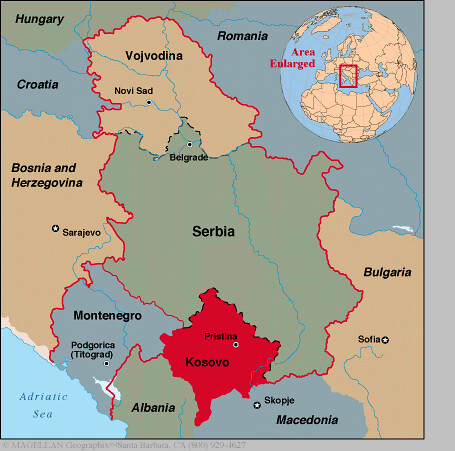
Poor old Yugoslavia. First Croatia, Slovenia and (the Former Yugolsav / Republic of) Macedonia (1991), then Montenegro (June 3, 2006), now Kosovo. The recent declaration of the Kosovo state (February 17, 2008) — approved by the US and NATO, rejected by Russia and its Eastern European allies — has been greeted with widespread protest by Serb nationalists, including in Melbourne.

For fascists, Kosovar independence is a product of a ZOG/NWO (Zionist Occupation Government/New World Order) conspiracy, to divide the White, Christian West, so as to render it less able to resist the impositions of ZOG/NWO. Or at least, that’s what the local tinfoil helmet brigade thinks: “KOSOVO IS SERBIAN! SAY NO TO ILLEGAL ZIONIST SPONSORED ISLAMIC STATES IN EUROPE!”

Reaction on the left has ranged from largely supportive to extreme wariness if not outright opposition. In Australia, the DSP reckons Kosovars are an oppressed nation, so that an independent state might be supported on that basis; in the UK, the SWP is far more cautious, emphasising the limited nature of the supposed political autonomy of the newly-formed state, and the role of the US and the UN in seeking to weaken Russia’s ally Serbia by supporting its creation (Kosovo is a pawn on the imperial chessboard, Vladimir Unkovski-Korica, Socialist Worker, March 1, 2008).

The KRudd Government has already indicated it will give diplomatic recognition to the new state, despite protests here (see below) and there: ‘Bosnian Serbs try to storm U.S. Consulate during Kosovo protest’, Reuters / The Associated Press, February 26, 2008: “The police fired tear gas at Bosnian Serb rioters Tuesday to prevent them from storming the U.S. Consulate during a rally to protest Kosovo’s declaration of independence… The protest Tuesday began with participants gathering peacefully at the main square in central Banja Luka, carrying Serbian flags, pictures of President Vladimir Putin of Russia and banners reading “No America.” At least one U.S. flag had a swastika drawn on it.” The body of one young protester, Zoran Vujovic, was later found among the debris caused by a fire at the US Embassy in Belgrade.

Poor bastard.

Elsewhere in the diplomatic world…

An end to Balkan national states
Jean-Arnault Dérens
Le Monde diplomatique
February 4, 2008

Kosovo is likely to declare unilateral independence this month, to which the probable EU response will be an agreed statement accepting the change and allowing individual European countries to recognise Kosovo if they want to. The Serbian government intends to break off diplomatic relations with those who do. There are proposals to redraw the border maps, but another round of conflicting aspirations could cause worse chaos

When Kosovo declares independence, as seems likely, there will be serious consequences for the whole region. The Serbs of Bosnia and Herzegovina will regard the event as a precedent that confirms their own right to secede from a state that has never really functioned. Independence will also disrupt neighbouring states, especially Macedonia and Montenegro, and play havoc with the map of the Balkans.

Despite this prospect Balkan specialists and diplomats now suggest that it is time to break the taboo of untouchable borders. The conflicts of the 1990s were waged in the name of Greater Serbia and Greater Croatia, and Kosovo’s claims to independence raise the ghost of a Greater Albania. Has the time come to re-examine territorial grievances, and define new, fairer borders, more representative of ethnic geography? A lasting peace in the area may require a new map for the Balkans, indeed for Europe. The idea is not new, but it won’t go away.

During the troubles in Macedonia in 2001, the French writer Alexandre Adler called for “surgery rather than homeopathy” (1) and suggested the division of the post-Yugoslav republic into distinct Albanian and Macedonian regions. That year David Owen, co-chairman of the International Conference on the Former Yugoslavia, also made proposals in Le Monde for redefining Balkan frontiers (2). These were echoed by a key figure in the Albanian nationalist movement in Macedonia, Arben Xhaferi, who called for the creation of “ethnic” states (3).

The failure of the negotiations on Kosovo’s future and the impossibility of an Albanian-Serbian compromise have resuscitated old ideas of partition, though this has long been considered taboo by the international community. Last August Germany’s Wolfgang Ischinger, the European Union’s envoy on the diplomatic troika leading the talks, said that any option capable of uniting the parties would have to be taken seriously; if Belgrade and Pristina could reach an agreement on the division of Kosovo – it hasn’t happened – the EU would have to endorse partition.

The idea seems logical: if people do not want to live together, why not let them live separately, even if that means displacement as populations reshuffle to adjust borders to ethnic distribution in the area? Imagine that, by waving a wand, an international conference led to a peaceful agreement on new frontiers for the western Balkans, drawn up on lines of ethnicity.

Unite and truncate

Plans would need to be made to unite the areas with an Albanian majority – Albania, Kosovo, and the northwest part of Macedonia, as well as the Presevo Valley in the south of Serbia and the eastern fringes of Montenegro, around Vusanje and Ulcinj. (However, none of these redivisions of territory and people will deal with such practical matters as power generation and distribution, which will remain cross-border in many cases: the Serbian government has already threatened to cut electricity supplies should Kosovo become independent and is hardly likely to offer any resources to a Greater Albania.)

This would leave Macedonia truncated and barely recognisable as a state, unless the pro-Bulgarian lobby succeeded in attaching the country to its eastern neighbour. Then there would be the question of minorities in Albania: the Greeks in the south could claim attachment to Greece, while Albanians expelled from Epirus in the north of Greece after 1945 (Çamëria as it is known in Albania) would also stand up for their long-neglected rights. Montenegro could seek compensation in the Shkoder region where there are still Serbian-Montenegran minorities, and Macedonia could reclaim the Slav villages around Lakes Ohrid and Prespa.

Bosnia and Herzegovina’s Serbs would return to their mother country. This would destroy Bosnia, especially if the Croats in western Herzegovina, central Bosnia and Bosanska Posavina (Orasje, Odzak) returned to Croatia. What remained would be a microstate, Muslim Bosniak, centred around Sarajevo, Zenica and Tuzla. This would be just like the famous plan to divide up Bosnia and Herzegovina devised in 1991 by Franjo Tudjman and Slobodan Milosevic (4). Bosnia would make efforts to defend the eastern enclave of Gorazde, and would claim the Sanjak of Novi Pazar, today shared between Serbia and Montenegro (5).

The state of Montenegro would no longer exist within its present borders. Apart from the secession of its Albanian and Bosniak regions, it would also be likely to lose its Serbian regions in the north. As Bosniaks and Serbs in this area are totally intermingled, a period of conflict would be inevitable, as the different communities reorganised and new borders took shape. Croatia would gain the Bay of Kotor, which has a long Catholic tradition and only became a part of Montenegro in 1918. Montenegro would soon find itself back at its mid-19th century borders, although it might have a hope of a maritime outlet at Budva.

Serbia’s position would be equally strange. Although it would have lost its Albanian and Bosniak regions, it would have gained Bosnia and Herzegovina’s Republika Srpska, as well as the Serbian areas in the north of Montenegro. It would also have to deal with Vojvodina. This autonomous region in the north of Serbia is home to some 20 different minorities, nearly 50% of the overall population. Its largest community is Hungarian (some 350,000) and the communes of Subotica, Senta and Kanjiza would return to Hungary, unless Vojvodina decided to declare independence and become the only island of multiethnicity remaining in the Balkans.

Countries within the EU would also be affected by the reorganisation. There are minorities in Greece, and not just the Albanians: the Muslims of western Thrace (Turks and Pomaks) would demand their return to Turkey and Bulgaria, cancelling the Lausanne treaty of 1923 (6). The issue of the Slav population in Greek Macedonia would also need attention, although this has always not been spoken about in the country. Slovenia would finally obtain satisfaction in its micro-territorial conflicts with Croatia (7). It would demand the cancellation of the 1918 plebiscites (8) and expand its territory into Austria’s Carinthia where there are still a number of Slovenian communities. Slovenia could also be awarded a part of Italy’s Friuli, given the positive attitude it has shown in its management of the region’s conflicts – perhaps it would get the town of Gorizia (which is currently crossed by the border), or even Trieste (9).

This reorganisation would not satisfy everyone – the Gorani of Kosovo, the Ruthenians in eastern Croatia’s Slavonia, or the Aromanians in Macedonia, Albania and Greece. And the 3,000-4,000 Roma in the western Balkans would remain (as they have always been) a people without a state.

It is unlikely that such changes would come about peacefully. The emergence of armed conflicts of medium intensity seems more than probable and a regional task force would be required to command EU troops with a mandate to keep the peace. But population displacement could not be seen as collateral damage as it would be the whole point. The UN High Commission for Refugees would supervise the operation, assisted by NGOs. The emergency aid budget available for the western Balkans would have to surpass by far the funds raised after the Asian tsunami in December 2004.

Not so farfetched

This scenario may seem far-fetched but parts of the script have already been written, as far as Bosnia and Herzegovina or the Albanian nationality questions are concerned. The proponents of independence for Kosovo stress that it should not set a precedent; even so, it is inevitable that any solution to the issue will be seen as a precedent if those with a grievance, in the Balkans or elsewhere, feel they can use it as such. The main problem with the proposals submitted by the UN’s special envoy, Martti Ahtisaari, early in 2007 is that they detach the Kosovo issue from its regional context: there can be no lasting solution for the region if no mention is made of the Albanian communities in Macedonia or the south of Serbia.

The idea that nationality issues can be solved by rearranging borders is based on the illusion that borders can be accurately redefined along ethnic lines. All national borders are historical artefacts, the legacy of political and military manoeuvre. Borders are no more fair and accurate than they are natural.

The use of the term “Balkans” spread in the 19th century. As the Ottoman empire began to break up, the irreconcilable claims of its former subject peoples shook this region of Europe. The Balkans became synonymous with nationalist sentiment, complex conflict, upheaval and fragmentation – “balkanisation”. “The Balkans” was an ideological concept, not a geographical location. In this melting pot of cultures, contradictory claims and aspirations, border conflicts were bitter.

The emergence of states and the definition of their borders marked the entry of the Balkans into modern politics. The new states were generally nationalist, based on and adapted from the models provided by the specific history of western Europe. In the early 19th century Greece and Serbia established themselves through ethnic cleansing, organising the expulsion or assimilation of populations considered exogenous (on religious grounds: the Turks, meaning Muslims, whether Slav, Albanian or Turkish-speaking, were expelled from both states).

The definition of borders gave the impression that the confusion in the Balkans was being managed, that it could be transformed into a European ideal of order, based on the coincidence of a people, its national borders and the state. The diversity that had characterised the Ottoman era, the multiple identities of language, “nationality” and religion, began to fade.

The process accelerated during the wars in Yugoslavia in the 1990s: the Serbian population in Croatia dropped from 12% to about 4%, and the Bosnian mosaic was reorganised into broad mono-ethnic zones under the control of one of the three communities.

Remains of empire

In the 19th and 20th centuries Austria-Hungary and Russia, also France, Great Britain and Italy, battled to extend their zones of influence over what remained of the Ottoman empire. They supported and encouraged the national aspirations of the Balkan peoples. The politics of these states were relayed by journalists or travellers. In the 1930s the British writer Rebecca West chided the “humanitarians and philanthropists” supporting the nationalist causes (10).

There have been key moments in the definition of the borders since 1878. The “great Eastern crisis” was first settled with the Treaty of San Stefano, providing for the creation of a Great Bulgaria under Russian protectorate. The plans caused ructions in London, Paris and Vienna, neglecting as they did Serbia and Romania. They were reversed a few months later at the Congress of Berlin, when Austria-Hungary gained control over Bosnia and Herzegovina and the Sanjak of Novi Pazar.

The 1912-13 Balkan wars and the first world war are key episodes, too. In 1918 Serbia and Romania were handsomely rewarded for their fidelity to the Allies: the Serbian House of Kara-or-evi was able to proclaim the Kingdom of the Serbs, Croats and Slovenes (later to become Yugoslavia), while Bucharest established Greater Romania.

Despite Wilsonian principles announced after the first world war, none of these states recognised the rights of the individual peoples to any autonomy. They enclosed a large number of communities within their new borders and transformed them into national minorities. In the 1920s the Comintern denounced the kingdom of Yugoslavia as a new “prison of the peoples”. It is true that the centralised state created by the Karadordevic bore little resemblance to the romantic dream of a unified state for the Slav peoples of the south (the Yugoslavs) (11).

The internal borders drawn up in 1945 for the Socialist Federal Republic of Yugoslavia were the least bad of all compromises according to the principal politician responsible for them, the Montenegro-born dissident, Milovan Djilas. The system depended on maintaining a clear distinction between citizenship and nationality and had its origins in Austrian Marxist thinking (12). Yugoslavs were citizens of the federal republic in which they lived (and of the Socialist Federation), but they remained free to choose their national community: there was no obligation in the Yugoslav census.

The Balkan experience shows that the demands of the different peoples cannot be presented in terms of statehood without engendering strife and confrontation. In Kosovo there can be only two solutions to the mutually exclusive demands of those sharing the same territory: either the victory of one people over the other, with frustrations and quests for revenge, or the invention of new forms of political coexistence and co-sovereignty. The European context could surely generate new political opportunities capable of surpassing these territorial conflicts.

The great powers have always played an essential role in determining Balkan borders: Kosovo is now a pawn in the planetary battle between Russia and the United States, so little attention will be paid to the real interests of the Albanians, Serbs and others living in Kosovo.

Any attempt to settle the problems with new plans for partition would affect the whole of Europe. It is time for a better response than just redrawing lines on the map.

TRANSLATED BY ROBERT CORNER
________________

Jean-Arnault Dérens is editor of the Courrier des Balkans and author with Laurent Geslin of Comprendre les Balkans: Histoire, sociétés, perspectives, Non Lieu, Paris, 2007

(1) Alexandre Adler, “Pour les Balkans, chirurgie ou homéopathie?”, Courrier international, Paris, 12 April 2001.

(2) David Owen, “Redessiner la carte des Balkans”, Le Monde, 21 March 2001.

(3) Arbën Xhaferi, “Les États multiethniques ne sont pas une solution”, Le Courrier des Balkans, 28 April 2003

(4) The Serbian president Slobodan Milosevic and his Croatian counterpart Franjo Tudjman agreed on a secret plan for the division of Bosnia as early as 1991.

(5) See “Le Sandjak de Novi Pazar”, Le Courrier des Pays de l’Est, 1058, November-December 2006.

(6) The treaty signed on 24 July 1923 provided for major population exchanges between Greece and Turkey, and the recognition of the existence of a “Muslim” minority in Greek western Thrace.

(7) These conflicts concern the Gulf of Piran, where Slovenia’s land border determines its access to international waters, and the small region of Prekmurje.

(8) The votes determined the attribution of disputed border territories to either Austria or Slovenia.

(9) The Free State of Trieste was established in 1947 and only divided in 1954. Zone A and the town was given to Italy, Zone B to Yugoslavia. It is part of Slovenia today.

(10) Rebecca West, Black Lamb and Grey Falcon, Macmillan, London, 1942.

(11) The Yugoslav concept was first developed by Croatian intellectuals, notably Ljudevit Gaj (1804-1872) and the bishop Josip Strossmayer (1815-1905).

(12) This distinction was set out by Otto Bauer in The Question of Nationalities and Social Democracy, University of Minnesota Press, 2000.

Meanwhile, in Melbourne:

Storming the streets
Christopher Bantick
Herald Sun
February 27, 2008

WHEN the city square used to be on the corner of Collins and Swanston streets, a group of anti-immigration protesters in Hitler’s storm trooper uniforms were holding forth. Suddenly, two elderly men, their coat tails flying, ran across Collins St and tried to rip the swastika armbands from the protesters. The resultant scuffle ended up with one old man receiving a cut head and the protesters scattering after an angry crowd gathered.

The swastika and the intimidating dog returned to Melbourne’s streets on Friday night in an anti-independence rally over Kosovo separating from Serbia. The irony was inescapable.

Seventy-five years ago, Hitler came to power and his swastika-wearing bovver boys crushed dissent. The swastika is a symbol of terror and totalitarianism. Therefore, it is difficult to see how the Serb protesters can appropriate the swastika and expect public support.

To understand the convoluted logic of the Serbs who took to Melbourne’s streets is a challenge.

An Australian flag and placard covered in swastikas was confiscated by police. To besmirch an Australian flag with swastikas is not only an act of breathtaking ignorance, but inflammatory.

I wonder what my late father, a World War II veteran, would have thought. He fought under the Australian flag. He watched his mates die under the Australian flag. He would have been outraged that the Australian flag was desecrated with symbols of hate.

Melbourne is a city with an international reputation for its racial harmony, and was ranked third in a UN report last year as the most desirable country in which to live.

Peter Schneemann, from Switzerland’s Berne University, was in Melbourne last month for the 32nd International Committee of the History of Art Congress. He praised the city’s “extremely open and tolerant culture”.

As a mark of this democracy and tolerance, Serbian demonstrators are free to march and chant in Melbourne’s streets.

But what they are protesting about bears closer examination.

At its heart, this protest was about nationalism and the Serbian refusal to accept Australia’s recognition of the now independent Kosovo.

What do we make of the veiled threat contained in the words of Father Milan Milutinovic of Melbourne’s Serbian Orthodox Church?

He asked Prime Minister Kevin Rudd to reverse Australia’s decision to recognise Kosovo independence from Serbia. “Countries, unfortunately including Australia, have recognised Kosovo unilaterally as a sovereign state,” said the cleric. “This is something we cannot accept and we are here to protest what’s going on.”

But, while such nationalistic claims directed at the Australian Government are cause for unease, Father Milutinovic was partly correct when he added: “I don’t know what connection Australia really has to Kosovo — it’s a European problem.”

Kosovo’s independence is accepted by the United Nations Security Council and the council universally condemned Nazi-like violence in Belgrade.

But there’s the rub. European ethnically derived hate has no place on Melbourne’s streets, and I’m with Father Milutinovic when he says: “It’s a European problem.”

But not when Serbian bullying is crystallised in the mark of a swastika.

It is a symbol that destroys whatever cause the Serbs may declare.
See also : The case of Kosovo: “Self-determination” as an instrument of imperialist policy, Peter Schwarz, wsws, February 20, 2008: “The support of the US and the major European powers for Kosovo’s unilateral secession from Serbia, in the face of fierce opposition from Serbia and Russia, as well as China, marks a turning point in international politics…” | Freedom Fight (English) | Andrej Grubacic, an anarchist from Serbia, seems to have some interesting stuff to say about politics in the Balkans

Posted in Anti-fascism, History, State / Politics | 5 Comments

Jock Palfreeman : Update

Bulgarian Expertise Piles up Pressure on Australian Stabber
Sofia News Agency
February 24, 2008

Australian national Jock Palfreeman, accused of stabbing to death a 20-year-old in Bulgaria, has acted in full consciousness, experts have concluded.

The psychiatric expertise shows that the defendant was aware of the consequences of his actions and does not have grounds to plead insane, the Bulgarian News Agency reported, citing sources from the prosecutor’s office.

Paul “Jock” Palfreeman, 21, is behind bars in a Bulgarian jail after being charged with murder after an alleged street brawl in the capital Sofia at the end of December. Palfreeman also faces a charge of attempted murder over the alleged stabbing of a 19-year-old man during the fight.

The deadline for collecting materials on the case expires on February 28.

Bulgarian court experts claim Palfreeman’s defence, who says he was acting in self-defence, is not backed by any evidence, with no further details of the case revealed so far.

Palfreeman, who is a trainee soldier in the British army, wanted British defence officials present to ensure a fair and transparent hearing because of fears that police and witnesses are not being objective.

But British army officials rejected the request, saying that because the man was not in Bulgaria for official defence purposes the matter was being treated as a consulate matter.

Australian stabber in Bulgaria was aware of his actions – report

Alex Bivol
Sofia Echo
February 25, 2008

Australian Paul “Jock” Palfreeman, accused of the stabbing murder of Andrei Monov and attempted murder of Anton Zahariev, was fully aware of his actions, Bulgarian News Agency (BTA) reported on February 24 2008, quoting unnamed sources in the Prosecutor’s Office.

Monov died on his way to the hospital on December 28 2007, after he was stabbed in the back with a knife by Palfreeman. Zahariev was injured in the same incident.

Court experts said the Australian could not claim temporary insanity as his defence, BTA said. Palfreeman has denied the accusations, claiming he acted in self-defence when the men turned on him after he intervened in a fight between the men and a Roma.

The court denied bail on the basis of the severity of the case, for which the accused could be sentenced to between 10 and 20 years in jail or life imprisonment with or without the possibility of commutation. Additionally, Palfreeman did not have a permanent address and the court considered there was a risk he would hide, mediapool.bg has said.

Prosecutors have until February 28 to collect evidence for their bill of indictment and are confident of meeting the deadline, BTA reported.

Palfreeman, a trainee soldier in the British army, had asked British defence officials to be present at his hearings to ensure a fair and transparent trial, fearing that police and witnesses are not being objective. But since he was not in Bulgaria for official defence purposes the matter “is being treated as a consulate matter”, the British Ministry of Defence said at the time.

Andrei Monov, 20, was the son of known psychologist and Sofia University professor Hristo Monov. His funeral was attended by 250 guests, including school friends, members of the Levski fanclub and government officials, mediapool.bg said.

Posted in State / Politics | 39 Comments

Uh-oh… troubled times ahead for anarchists in Venezuela // Bombings in Caracas

Over the last fortnight, there’s been a spate of bombings in Caracas, Venezuela. Originally attributed to ‘foreign agitators’ in the pay of the CIA (aka the Grupo Venceremos de la Izquierda Central Unida), it now appears that Venezuelan authorities are blaming ‘anarchists’ for the blasts, whose targets have reportedly included a statue of George Washington (February 13), the apostolic nunciature (February 14) and a mercantile court and congressional offices in the Jose Maria Vargas building (February 18). Ominously, while the latest blast, the fourth or possibly fifth (according to AP) in a series, is the first to have claimed a life — ostensibly that of the man responsible for planting the bomb — authorities claim to be searching for the “intellectual authors” of the blasts. (Note that a report on venezuelanalysis (One person dead after explosion at Fedecamaras, February 24, 2008) also refers to “an explosive in front of the administrative offices of the National Assembly, on the corner of Pajaritos, which occurred in the early hours of February 18”.)

FARC Prisoners in Same Camp
Prensa Latina
February 26, 2008

Caracas, Feb 25 (Prensa Latina) Venezuelan Interior Minister Ramon Rodriguez said on Monday that the four Colombians hostages due to be released by the Revolutionary Armed Forces of Colombia (FARC) are together in the same camp.

Rodriguez denied they are in separate places, as Colombian officials stated.

He also accused the Colombian military of obstructing the release of the four hostages by carrying out operations in the area where they are due to be handed out to Venezuela.

Rodriguez stressed the four Colombian citizens are in danger because of “powerful operations in the area”.

The Venezuelan Interior minister informed at the press conference that the material authors of Caracas recent bombings were identified as members of an anarchist group.

Our investigations are now focused on identifying the intellectual authors, he said.

nm/ccs/tac/ml

Venezuela Bombing: ‘Anarchists’ Blamed

AP
February 26, 2008

CARACAS, Venezuela (AP) — Venezuela’s justice minister on Monday blamed “anarchists” for an explosion that killed one man [Hector Armando Abreu — Reuters] at the offices of Venezuela’s leading business chamber, and he vowed to capture those responsible.

“We know who they are and we know the game they want to play,” Justice Minister Ramon Rodriguez Chacin told reporters. “We’re going to capture them.”

The blast near the entrance of the Fedecamaras business chamber headquarters in Caracas killed a 44-year-old [40-year-old — Reuters] man suspected of trying to plant the bomb and shattered windows early Sunday.

Rodriguez said the man was found with an expired card identifying him as an “honorary” police inspector but that he was not an active police officer.

Sunday’s explosion was the fifth reported this month in the Venezuelan capital. In several of them, authorities found scattered pamphlets linking the bombings to a group identified as “Venceremos of the United Center-Left.”

Rodriguez blamed a “small group of anarchists who are looking for political interests.”

“We know who they are by first and last name,” he said.

Also!

Venezuelan off-duty police officer killed in bomb attack
Xinhua
February 25, 2008

CARACAS, Feb. 24 (Xinhua) — An off-duty police officer was killed on Sunday by a bomb that exploded outside Fedecamaras, Venezuela’s chamber of commerce, director of the forensic police Marcos Chavez said.

Scattered leaflets handed out by a group called the People’s Left-Wing Army were found at the site that read “Bolivarian Republic of Venezuela. The guerilla front will win. The People’s Left-wing Army. Caracas. Feb. 24.”

The group claimed responsibility for the attack saying that Fedecamaras is conspiring against the government and is responsible for the food shortages in the country.

Chavez said a document found on the dead man identified him as a Metropolitan Police officer, but declined to comment on whether the officer might also be responsible for detonating the bomb.

A senior official from Fedecamaras Lope Mendoza condemned Sunday’s attack saying he was saddened that the private sector is being blamed for food shortages across the country.

A bomb exploded at the Venezuelan legislature, the National Assembly, last Monday, and on Feb. 13, another explosion occurred close to the statue of George Washington in a Caracas square.

Previously…

No one hurt in blast at Venezuelan courthouse
EFE
February 18, 2008

Caracas, Feb 18 (EFE).- No one was injured when a small bomb went off early Monday outside the building in downtown Caracas that houses the commerical courts, media outlets reported.

The blast follows similar attacks here last week at the Vatican mission and at a statute of George Washington, which likewise caused no casualties and only minor damage.

Globovision TV broadcast images showing the impact of the explosion on doors and windows at the courthouse. The network said that unlike last week’s bombings, the latest attack was not accompanied by leaflets bearing the names of two hitherto unknown groups, Venceremos (We Will Prevail) and Izquierda Central Unida (United Center Left).

Police have yet to issue a statement about the explosion at the courthouse.

On Sunday, leftist President Hugo Chavez repeated earlier allegations that Colombia and the United States were engaged in a plan to infiltrate paramilitaries into Venezuela as part of efforts to destabilize his government.

He did not offer any evidence for the charges against Bogota and Washington, which provides Colombia with around $500 million a year in mainly military aid.

Graffiti and leaflets left at the scene indicated that last Thursday’s bombing at the Caracas offices of the papal nuncio was intended to protest the Vatican mission’s decision to extend asylum to an opposition activist accused of attempted murder. EFE

ar/dr

See also : Prosecution Investigates Bombs in Caracas, Prensa Latina, February 14 (“In both cases leaflets were found reivindicating [sic] the attacks in the name [of an] alleged group unknown to this moment, identified as Venceremos de la Izquierda Unida“) | Blast kills one at Venezuela business chamber, Reuters UK, February 24, 2008. This report identifies the dead man as Héctor Armando Abreu, 40. Oddly, “Héctor Armando Abreu, representante de la Comisión Estadal Moral y Luces de Miranda, municipio Zamora” appears in a recent report on the site of the Ministerio del Poder Popular para la Cultura.

Posted in Anarchism, State / Politics | Leave a comment

Blood & Honour / C18 in Australia

They’re a weird mob, these Nutzis.

A while ago I referred to the splits in Ian Stuart‘s painful legacy of bad muzak, otherwise known as ‘Blood & Honour’, but also as C18 (Combat 18: 1=A; 8=H; AH=Adolf Hitler). In Australia, the local franchise is loyal to B&H, and allied with the Hammerskins. So too, the tiny B&H/Hammerskins mob in Aotearoa/New Zealand. In Australia, B&H/Southern Cross Hammerskins organise an annual gig to commemorate Ian Stuart’s death; in Aotearoa/New Zealand, B&H/NZ Hammerskins organise an annual gig to celebrate Hitler’s birthday.

C18, on the other hand, exists only in Patrick O’Sullivan‘s fertile imagination.

Background

The Skrewydriver’s overdue death in 1993 resulted in a battle over his financial and political legacy. Initially, B&H came under the control of C18, a small mob of Nutzi headcases initially part of the BNP, but soon operating independently of it. C18 was established in the early ’90s, and led by a violent crank named Paul (‘Charlie’) Sargent. Charlie was a fascist, drug-dealing football hooligan, and good mates with Chris (‘Chubby’) Henderson, later lead shouter with Combat 84 (available locally through Deadset Music), as well as the former manager of the 4-Skins, Gary Hitchcock. All three were well-known faces in the Chelsea Headhunters, a fascist football firm.

In 1992, Neil Parish, the main bonehead behind B&H in the UK, was in all sorts of trouble — legal, drug, alcohol and familial. Good ol’ Charlie offered to take over operations while Neil did a spell, on the understanding that when he got out, things would revert to normal.

Duh.

Instead, with Neil safely tucked away behind bars, Charlie quickly moved to consolidate control of the business. In addition to discrediting poor ol’ Neil (an alleged “low-life thief and Jew informer”), C18 made its first public appearance at a Skrewydriver Xmas show, where Ian Stuart quickly accepted their presence. C18 then proceeded to rapidly replace the British Movement (BM) as thugs-of-choice on the neo-Nazi muzak scene. The final nail in the coffin occurred when Ian skidded off a road and to his death, and with it Ian’s ability to hold competing factions together.

The BM had been in decline for many years, and it was a relatively simple matter for C18 to end its association with B&H, one maintained most closely by Paul Burnley, lead shouter with the band No Remorse. Burnley himself was attacked in the squabbling over Ian’s lucrative legacy. Charlie’s sidekick Will Browning played a crucial role in these shenanigans, and it was him what established ISD Records in January 1994. Gary Hitchcock, the man credited with coming up with the name Combat-18, wasn’t happy with this development, as he’d secretly been appointed British distributor of the German neo-Nazi label Rock-O-Rama — which has since been transformed into the Belgian label Pure Impact (available locally through Deadset Music). Hitchcock eventually dropped out of the race for Nutzi $, and his place taken by Browning’s ISD Records…

Since then, there have been many ups and downs for the bloody, dishonourable criminals associated with B&H, C18 and ISD — notably, in 1998, Charlie Sargent’s conviction and sentencing to life imprisonment for murdering another Nutzi — but the schism between the ‘musical’ and the ‘political’ B&H remains.

    http://www.bloodandhonourworldwide.co.uk/ The ‘musical’ mob. Closely tied to the Hammerskins and the only B&H group in both Australia and Aotearoa/New Zealand. Also Austria*, Belgium, Canada, Croatia, Czech Republic, England, Finland, France, Germany*, Greece, Holland, Hungary, Italy, Portugal, Serbia, Slovenia, Spain*, Switzerland, Ukraine, United States. * = Subject of a legal ban.
    http://www.bloodandhonour.com/ The ‘political’ C18 mob. In Argentina, Brazil, Bulgaria, Chile, Czech Republic, England, Holland, Lithuania, Poland, Russia, Serbia, Slovakia, Sweden, Ukraine and United States.
    Note that both tendencies appear to be present in the Czech Republic, England, Holland, Serbia and the United States.
Posted in !nataS, Anti-fascism, History, Music | 11 Comments

Neigh

    The thrill of playacting as Darcy wears off pretty quickly for Ana as she begins to realize that the idyllic farm is a cover for sinister activity. In fact, nothing there is what it appears to be. A nearby bird sanctuary is actually a shooting range. Julius is a paranoid heavily armed control freak, demanding complete allegiance from Megan and the two homeless teenagers he picked up from a Portland squat, and muttering about “The Big One” as he obsessively prunes his hazelnut trees…

BOOK REVIEW
Judas Horse by April Smith
FBI Special Agent Ana Grey goes after ecoterrorists in the Pacific Northwest.
By Donna Rifkind, Special to The Times
February 22, 2008

IN two previous thrillers, FBI Special Agent Ana Grey stalked criminals through the same neighborhoods around Santa Monica where she’d been raised by her grandfather. Among the highlights of those books — North of Montana and Good Morning, Killer — were the spot-on observations about daily Los Angeles life, the keen glimpses of parallel cultures that coexist on the same streets without much connection.

The third novel in the series by April Smith, Judas Horse, also begins in Los Angeles, but its narrative propels Ana out of her native territory into a dizzying new world. This time the bureau is sending her on an undercover assignment to infiltrate a terrorist cell in the Pacific Northwest. The agent previously assigned to the case, a golden boy of the department named Steve Crawford, with whom Ana was once romantically involved, has been blown to bits by a bomb detonated on a remote alpine trail in the Oregon Cascades. Ana’s job is to find out who killed him.

It’s been only seven months since Ana was caught up in an emotionally devastating shooting incident — events that provided the climax for Good Morning, Killer — and she’s still recovering from post-traumatic stress. But the news of her colleague’s murder energizes her to seek justice on his behalf.

After a rigorous stint in undercover school at the FBI Academy in Quantico, Va., Ana assumes a new identity: that of a scruffy, down-and-out animal rights sympathizer named Darcy DeGuzman. As Darcy, armed only with a phony driver’s license and a specially designed Oreo-sized cellphone for contact with former partner Mike Donnato, who will serve as her “handler”, she heads to Portland to begin her mission.

Agent Crawford had been working undercover to infiltrate a radical group called FAN, for “Free Animals Now”. It’s a covert collection of ecoterrorists, linked to increasingly violent anarchist activity throughout the Northwest and probably serving as a front for a larger, looser amalgamation of assorted extremists. FAN operates through intimidation, with a particular fondness for firebombing institutions that insult its live-free-or-die ideology. The FBI’s latest intelligence suggests that FAN’s current target is a mid-level bureaucrat at the Bureau of Land Management named Herbert Laumann, whom FAN accuses of mismanaging herds of wild mustangs protected by federal law.

Searching for Laumann’s harassers turns out to be fairly simple for Ana, who shows up at the Portland bar where Crawford was last seen before his murder. Omar’s Roadhouse is a serious dive, “one of those everlasting beacons of alcoholic wretchedness that through the ages have drawn the outcasts of the world — those who suffer, shuffle, buy or sell.” There, among the bikers, meth addicts, hookers, Mexican gangbangers and female neo-Nazis, Ana meets a graying hippie in her 50s named Megan Tewksbury and her craggy, ponytailed boyfriend, Julius Emerson Phelps. Together, the couple operates a small farm outside Portland, growing hazelnuts and providing shelter for hundreds of rescued animals.

To convince her new friends that she’s a dedicated believer in animal rights, Ana (posing as Darcy) tags along on several protests, including a failed attempt to interfere with a “gather” — a government round-up of wild mustangs for the purpose of culling the weak ones. After spending a night in jail, she persuades Megan and Julius to let her stay with them at the hazelnut farm.

The thrill of playacting as Darcy wears off pretty quickly for Ana as she begins to realize that the idyllic farm is a cover for sinister activity. In fact, nothing there is what it appears to be. A nearby bird sanctuary is actually a shooting range. Julius is a paranoid heavily armed control freak, demanding complete allegiance from Megan and the two homeless teenagers he picked up from a Portland squat, and muttering about “The Big One” as he obsessively prunes his hazelnut trees. It isn’t long before Ana discovers that he too is operating undercover: He’s a former FBI agent named Dick Stone, who, after infiltrating the Weather Underground in the 1970s, “went over to the other side,” dedicating his life to terrorism and never looking back.

In this unpredictable environment, Ana soon becomes as paranoid as Stone. Has he known all along that she’s a federal agent and planned to use her as a bargaining chip in the event of a Waco, Texas-like standoff with the authorities? Can she trust her partner, Donnato, or has he intentionally sacrificed her as the only way to get to Stone? And what role does Peter Abbott, the deputy director of the FBI with political aspirations and influential Oregon family connections, play in the whole affair?

Smith has produced a genuinely scarifying thriller with a consistently vertiginous, through the looking glass mood. Every character is a hologram of sorts and every episode has the momentum of a theme-park ride. One of Smith’s cleverest tricks here is her unsettling depiction of unlikely alliances: Ana turns out to have more in common with the villain, Stone, than she might ever have imagined, and animal rights activists and white supremacists find common ground in their mutual hatred of the government.

The book’s nervous, paranoid energy is at once its greatest strength and most significant weakness. Important plot elements — the fate of the mustangs, hints of a cult-like religion Stone has imposed at the farm — fall away too quickly, replaced by an oncoming rush of pop-up perils. The reader has nothing to latch onto, no emotional hand-rail to clutch during the wild ride — which is doubtless part of the point. Judas Horse is not so much an entertaining read as a headlong, unnerving thrill.

Donna Rifkind, a Los Angeles-based reviewer, also writes for the Washington Post and the New York Times.

Judas Horse, An FBI Special Agent Ana Grey Mystery
April Smith
Alfred A. Knopf: 318 pp., $23.95US

Meanwhile, in the real world, Jeff ‘Free’ Luers, imprisoned since June 2001 and currently serving a 22 and a half year sentence (266 months) for ecotage (burning three SUVs), has had his appeal for a resentencing hearing pushed back from February 21 to sometime this week.

See also :

Support for Daniel McGowan: an environmental and social justice activist from New York City, charged in federal court on counts of arson, property destruction and conspiracy, all relating to two actions in Oregon in 2001.
Support Eric McDavid!: Eric was found guilty of conspiracy to commit crimes, partly on the basis of testimony provided by a government agent. He is being sentenced on March 6, 2008, and faces a term of between 5–20 years. Eric is also a vegan, a fact which authorities are naturally using against him, and which forced Eric to undergo a hunger strike in order to be provided with adequate meals.

Obviously, these three cases are merely the tip of the iceberg in terms of government repression. For more general information on the US state’s war on radical environmentalists, see GreenScare.org. For more information on US Political Prisoners, see Political Prisoners in the US (current as of March, 2007).

Speaking of informants, in Aotearoa/New Zealand, a “private investigation firm” named Thompson & Clark Investigations Ltd (TCIL) — “New Zealand’s leading security, corporate intelligence and protection agency” — appeared before the Registrar of Private Investigators and Security Guards in the Christchurch District Court on Wednesday 20th and Thursday 21st February. The company employed a man named Ryan Paterson-Rouse to infiltrate the Save Happy Valley Coalition (SHVC) and a woman named Somali Young to infiltrate the Wellington Animal Rights Network (WARN) and Peace Action Wellington (PAW). (Paterson-Rouse was apparently given a cellphone and paid over $3700 by TCIL for providing information.) TCIL was in turn contracted by Solid Energy, and elements of the NZ biotech industry and NZ Defence Industry Association. Not unexpectedly, TCIL boss, Gavin Clark, hasn’t been the most co-operative of witnesses, and is far from being a happy camper.

On Anna the FBI informant, see The Raw Story, FBI confidential informant also said to be provocateur, Jennifer Van Bergen, June 8, 2006 | Have Wire, Will Travel — “Anna the Medic, one of the FBI’s top informants, has cut a wide swath through the antiwar and animal rights movements” — New Times: Broward-Palm Beach, June 22, 2006 | “My name is Anna, and I’m an FBI informant.” “Hi Anna!” (September 25, 2007) | Eric McDavid found guilty; ecoterror plot foiled; US citizens and planet breathe easy (September 28, 2007)

RESOLUTION FOR THE 1990’s:
BOYCOTT COP CULTURE!!!

IF ONE FICTIONAL FIGURE can be said to have dominated the popcult of the eighties, it was the Cop. Fuckin’ police everywhere you turned, worse than real life. What an incredible bore.

Powerful Cops–protecting the meek and humble–at the expense of a half-dozen or so articles of the Bill of Rights–“Dirty Harry.” Nice human cops, coping with human perversity, coming out sweet ‘n’ sour, you know, gruff & knowing but still soft inside–Hill Street Blues–most evil TV show ever. Wiseass black cops scoring witty racist remarks against hick white cops, who nevertheless come to love each other–Eddie Murphy, Class Traitor. For that masochist thrill we got wicked bent cops who threaten to topple our Kozy Konsensus Reality from within like Giger-designed tapeworms, but naturally get blown away just in the nick of time by the Last Honest Cop, Robocop, ideal amalgam of prosthesis and sentimentality.

We’ve been obsessed with cops since the beginning–but the rozzers of yore played bumbling fools, Keystone Kops, Car 54 Where Are You, booby-bobbies set up for Fatty Arbuckle or Buster Keaton to squash & deflate. But in the ideal drama of the eighties, the “little man” who once scattered bluebottles by the hundred with that anarchist’s bomb, innocently used to light a cigarette–the Tramp, the victim with the sudden power of the pure heart–no longer has a place at the center of narrative. Once “we” were that hobo, that quasi-surrealist chaote hero who wins thru wu-wei over the ludicrous minions of a despised & irrelevant Order. But now “we” are reduced to the status of victims without power, or else criminals. “We” no longer occupy that central role; no longer the heros of our own stories, we’ve been marginalized & replaced by the Other, the Cop.

Thus the Cop Show has only three characters–victim, criminal, and policeperson–but the first two fail to be fully human–only the pig is real. Oddly enough, human society in the eighties (as seen in the other media) sometimes appeared to consist of the same three cliche/archetypes. First the victims, the whining minorities bitching about “rights”–and who pray tell did not belong to a “minority” in the eighties? Shit, even cops complained about their “rights” being abused. Then the criminals: largely non-white (despite the obligatory & hallucinatory “integration” of the media), largely poor (or else obscenely rich, hence even more alien), largely perverse (i.e. the forbidden mirrors of “our” desires). I’ve heard that one out of four households in America is robbed every year, & that every year nearly half a million of us are arrested just for smoking pot. In the face of such statistics (even assuming they’re “damned lies”) one wonders who is NOT either victim or criminal in our police-state-of-consciousness. The fuzz must mediate for all of us, however fuzzy the interface–they’re only warrior-priests, however profane.

America’s Most Wanted–the most successful TV game show of the eighties–opened up for all of us the role of Amateur Cop, hitherto merely a media fantasy of middleclass resentment & revenge. Naturally the truelife Cop hates no one so much as the vigilante–look what happens to poor &/or non-white neighborhood self-protection groups like the Muslims who tried to eliminate crack dealing in Brooklyn: the cops busted the Muslims, the pushers went free. Real vigilantes threaten the monopoly of enforcement, lèse majesté, more abominable than incest or murder. But media(ted) vigilantes function perfectly within the CopState; in fact, it would be more accurate to think of them as unpaid (not even a set of matched luggage!) informers: telemetric snitches, electro-stoolies, ratfinks-for-a-day.

What is it that “America most wants”? Does this phrase refer to criminals–or to crimes, to objects of desire in their real presence, unrepresented, unmediated, literally stolen & appropriated? America most wants . . . to fuck off work, ditch the spouse, do drugs (because only drugs make you feel as good as the people in TV ads appear to be), have sex with nubile jailbait, sodomy, burglary, hell yes. What unmediated pleasures are NOT illegal? Even outdoor barbecues violate smoke ordinances nowadays. The simplest enjoyments turn us against some law; finally pleasure becomes too stress-inducing, and only TV remains–and the pleasure of revenge, vicarious betrayal, the sick thrill of the tattletale. America can’t have what it most wants, so it has America’s Most Wanted instead. A nation of schoolyard toadies sucking up to an elite of schoolyard bullies.

Of course the program still suffers from a few strange reality-glitches: for example, the dramatized segments are enacted cinema verité style by actors; some viewers are so stupid they believe they’re seeing actual footage of real crimes. Hence the actors are being continually harassed & even arrested, along with (or instead of) the real criminals whose mugshots are flashed after each little documentoid. How quaint, eh? No one really experiences anything–everyone reduced to the status of ghosts–media-images break off & float away from any contact with actual everyday life–PhoneSex–CyberSex. Final transcendence of the body: cybergnosis.

The media cops, like televangelical forerunners, prepare us for the advent, final coming or Rapture of the police state: the “Wars” on sex and drugs: total control totally leached of all content; a map with no coordinates in any known space; far beyond mere Spectacle; sheer ecstasy (“standing-outside-the-body”); obscene simulacrum; meaningless violent spasms elevated to the last principle of governance. Image of a country consumed by images of self-hatred, war between the schizoid halves of a split personality, Super-Ego vs the Id Kid, for the heavyweight championship of an abandoned landscape, burnt, polluted, empty, desolate, unreal.

Just as the murder-mystery is always an exercise in sadism, so the cop-fiction always involves the contemplation of control. The image of the inspector or detective measures the image of “our” lack of autonomous substance, our transparency before the gaze of authority. Our perversity, our helplessness. Whether we imagine them as “good” or “evil,” our obsessive invocation of the eidolons of the Cops reveals the extent to which we have accepted the manichaean worldview they symbolize. Millions of tiny cops swarm everywhere, like the qlippoth, larval hungry ghosts–they fill the screen, as in Keaton’s famous two-reeler, overwhelming the foreground, an Antarctic where nothing moves but hordes of sinister blue penguins.

We propose an esoteric hermeneutical exegesis of the Surrealist slogan “Mort aux vaches!” We take it to refer not to the deaths of individual cops (“cows” in the argot of the period)–mere leftist revenge fantasy–petty reverse sadism–but rather to the death of the image of the flic, the inner Control & its myriad reflections in the NoPlace Place of the media–the “gray room” as Burroughs calls it. Self-censorship, fear of one’s own desires, “conscience” as the interiorized voice of consensus-authority. To assassinate these “security forces” would indeed release floods of libidinal energy, but not the violent running-amok predicted by the theory of Law ‘n’ Order.

Nietzschean “self-overcoming” provides the principle of organization for the free spirit (as also for anarchist society, at least in theory). In the police-state personality, libidinal energy is dammed & diverted toward self-repression; any threat to Control results in spasms of violence. In the free-spirit personality, energy flows unimpeded & therefore turbulently but gently–its chaos finds its strange attractor, allowing new spontaneous orders to emerge.

In this sense, then, we call for a boycott of the image of the Cop, & a moratorium on its production in art. In this sense . . .

MORT AUX VACHES!

Posted in Anarchism, State / Politics, War on Terror | 2 Comments

Urewera 16 + 3. “We have your avocadoes, now we want your Hawaiian shirt”

This just in from the New Zealand Department of All Right. Come Out With Your Hands Up, Two Cups Of Coffee, An Auto Freshener That Says Capricorn, And Something With Coconut On It!

Three more men have been arrested for firearms offences in the Bay of Plenty area targeted in last year’s anti-terrorism raids. Police said the arrests involved two men aged 44 and 46 from Maketu and a 24-year-old Ruatoki man… (New Zealand Herald, February 18)

One of the three, a 24-year-old Ruatoki man, appeared in Whakatane District Court today facing nine charges related to the Ruatoki police raids in October last year. The man was remanded for a depositions hearing in Auckland District Court on March 5 and granted name suppression and bail… Raunatiri Hunt, a 44-year-old security guard, and Tekaumarua Wharepouri, 46, a nurse, both from Maketu, 30km southeast of Tauranga, each faced seven counts of unlawfully possessing a range of guns… (Waikato Times, February 19)

Ruatoki Arrests – No Mistake This Time
Wednesday, 20 February 2008, 8:33 am
Press Release: The Maori Party

Te Ururoa Flavell, MP for Waiariki 20 February 2008

“The outrage continues in Ruatoki and, second time round, people are not likely to accept that police behaviour was any sort of mistake.”

Raided for library card
Stephen Cook
Herald on Sunday
February 24, 2008

Police handling of the anti-terror raids is again under fire after officers stormed the home of an Auckland businessman in search of a library card, a Hawaiian shirt, a pair of khaki shorts and a copy of the leaked terror affidavit.

A dozen plainclothes detectives raided the Whangaparaoa property of Vince Siemer on Thursday morning looking for anything connecting him with those accused of taking part last year in IRA-style training camps in the foothills of the Urewera Ranges.

Siemer’s wife, Jane, and 13-year-old daughter, Stephanie, were home at the time of the raid and both had their cellphones confiscated.

Siemer claims to have never met any of the accused – who include high-profile Tuhoe activist Tame Iti – but has admitted circulating copies of the 156-page police affidavit to sections of the media and “a couple of political people”.

“It [the affidavit] was a bunch of crap. These people were not terrorists. That’s why I circulated the affidavit,” Siemer said.

“I’m one of probably 5000 people who have this affidavit. Are we all going to be targeted? I’m not a terrorist. This is just Nazi-ism.”

NB. FYI, the affidavit remains available at the NZCLU site, as well as elsewhere online…

Posted in State / Politics, War on Terror | Leave a comment

Accused ‘spoke of killing Howard’; has ‘common touch’

    Dear Readers: If you are connected to the Internet or near a telephone or cell-phone, U.$. spies can track you and maybe even see you visually. Keep that in mind as you read slackbastard and other anti-Amerikkkan websites.

    Check your security first.

Accused ‘spoke of killing Howard’, Karen Kissane, The rAge, February 20, 2008…

In other news:

Kimbo!

Kimbo Slice made very short work (43 seconds) of Tank Abbott.

Chairman Mao!

The Rural People’s Party (Marxist-Leninist-Maoist) continues to speak the truth in a manner that the Revisionists at LastSuperPower.net can only dream of, and while the MIM continues to be a w e s o m e, the RPP is a w e s o m e r: “Rural People’s Party and its Central cell are not comprised of privileged bourgeois, liberal-minded middle-class college students. RPP is comprised of actual lumpenproletariats, including rural and criminal elements, who by our upbringing and continued existence amongst the poor and repressed have a legitimate class hatred towards the bourgeois infrastructure and bourgeois societal superstructure and desire the realization of instruments of state repression utilized against the capitalist class enemy.”

Provocateurs! Wreckers! Librarians!

Someone claiming to be an anarchist and a librarian (but in all likelihood a right-winger and a football hooligan intent on wrecking stuff) asks “Why does the concept of property so thoroughly infuse our understanding of rights? Are our conceptions of privacy dependent on owning one’s individual “self”? If we own our identity, is our public persona a form of intellectual property, as a trademark is?” (Barbara Fister, ‘Face Value’, Inside Higher Ed, February 18, 2008). This is clearly intended to simply make it harder to build future protests and movements rather than constitute an interesting insight into issues of copyright and intellectual labour.

Lenin! Infants!

“Such is the general mechanism of the proletarian state power viewed “from above”, from the standpoint of the practical implementation of the dictatorship. We hope that the reader will understand why the Russian Bolshevik who has known this mechanism for twenty-five years and has seen it develop out of small, illegal and underground circles, cannot help regarding all this talk about “from above” or “from below”, about the dictatorship of leaders or the dictatorship of the masses, etc., as ridiculous and childish nonsense, something like discussing whether a man’s left leg or right arm is of greater use to him.”

Bizarros! Spiked!

The British Bizarros formerly known as the Revolutionary Communist Party (RCP) now operate Spiked! Online (as well as a quite lengthy list of front groups), and A Drink-Soaked Trotskyiste Popinjay For War is vewy angwy with them, the precise reasons for which escape me… which is to say, what else is new?

Ugliness

Last night I caught the tail-end of a neat doco on SBS. Unfortunately, I didn’t catch the ad for Stiff & Stiff, or the one for men with weak or leaking bladders. Mister Brown, a local SBS executive attending a conference in the Bahamas probably feels the same way.

    Hot Docs: The Anatomy Of Evil

    This documentary, directed by Danish filmmaker Ove Nyholm, lets us meet the perpetrators of the worst war crimes committed over the last fifty years. The film is the result of research carried out by Nyholm, who has travelled the world in order to find the answer to the question: What makes ordinary people commit mass slaughter and indulge in genocide during war time? And how do they get on with their everyday life with having hundreds of killings on their conscience? A number of executioners speak about their personal history and their involvement in the most cruel genocides in Europe during the last fifty years – from the Holocaust to the recent tragedy in the Balkans. A Serbian paramilitary says he would go crazy if he tried to recall every murder while a former Einsatz commander during World War Two explains how they executed people most efficiently: women were forced to hold their children against their chest, so two people could be killed with a single bullet. (From Denmark, in Danish, German, Albanian, English and Serbian, English subtitles) (Rpt) M (V,A) CC WS

Chairman Miaow!

Cats are a w e s o m e and should be looked after properly. The Scottish Government’s Department of Cats has produced an informative guide to looking after the welfare of Felis silvestris catus. The duty of care placed on an animal owner or keeper is based on the ‘Five Freedoms’ and include:

* its need for a suitable environment;
* its need for a suitable diet;
* its need to exhibit normal behaviour patterns;
* any need it has to be housed with, or apart from, other animals;
* its need to be protected from suffering, injury and disease.

Celtic Anarchy!

CelticAnarchy.org is a new site, the seeming brainchild of MC Lynx, and decsribes itself as “an open-source journal for anarchists, anti-imperialists, anti-authoritarians, anti-racists, internationalists, libertarian socialists, indiginists, and fellow travelers from across the Celtic nations and in the diaspora community. Our goal is to explore the connections between politics, history, culture, music, language, identity, & spirituality. This is not an exclusive community, we welcome contributions from everyone regardless of ethnicity or political affiliation, as long as that participation is constructive.” It hosts an article on nationalism and anarchism, which I may respond to later.

Nazis To Invade South-East Asia!

On another bizarro note, the bizarro racists of the New Reich are seeking interested parties to join with Welf Herfurth in May/June as the yuppie heads off on another one of his trips to south-east Asia.

Rebel Music!

We Want Rebel Music has republished an interview (Profane Existence, Winter 2007/2008) with Canadian punk rockers The Fallout. One of the band members was apparently featured on a Canadian version of Redwatch as a result of the band’s active support for anti-racist activism.

Redwatch Poland

null

Redwatch Poland has been in trouble recently, with hackers apparently being able to (briefly?) disable the site. (Redwatch Poland is an outgrowth of the original, UK-based Redwatch — largely the work of Tony Foy, Simon Sheppard, Kevin Watmough and Carol White.) Redwatch Poland has a long history of harrassment of anarchists, feminists, leftists, people of colour and queers in Poland, but more recently, in January, Danielas Michalski, a Polish activist campaigning against homophobia, was featured on the site, along with calls for him to be shot. In May 2006, a Polish anarchist and antifa (‘Maciek D.’) was featured on the site, and subsequently stabbed. Jewish Poles have also been the target of Redwatch’s ire, but it was only when Poland’s Chief Rabbi was assaulted by a racist nutter that authorities acted. Thus in 2006, in response to public exposure, and national and international diplomatic pressure, a handful of Polish neo-Nazis responsible for the site were arrested by police. On the other hand, legal proceedings against them have apparently yet to commence, and the site itself remains active.

Well, until very recently. Currently, the site — redwatch.info — is down (Internauci kilują portal neonazistów, Jowita Kiwnik, [Electoral], February 18, 2008). Where Polish police and the American FBI have tried and failed a bunch of geeks — especially hardcore punks — have succeeded.

Note that Redwatch was a project of Blood & Honour Poland — part of the same neo-Nazi network The Birmingham Hotel in Fitzroy and the Melbourne Croatia Social Club in Sunshine have happily provided real as opposed to virtual hosting. It’s also noteworthy that, in terms of the reaction to Blood & Honour, gumby punks in Melbourne and hardcore punks in Poland are, literally, poles apart.

Boom boom…

See also :

Posted in !nataS, Anarchism, Anti-fascism, Cats, Media, State / Politics, Television, Trot Guide, War on Terror | 1 Comment

#1,001 : Music & Politics

slackbastard top ten in no particular order and chosen at seeming random from among the many that would otherwise qualify for inclusion in such a list

1) Pennywise — “Fuck Authority” (2001). Pop punk. Southern California. Epitaph. Bring on the Bro Hymn Choir dude. “A new album, Reason To Believe, will be released on March 25, 2008 free through Myspace, and in stores through Epitaph.”

2) Nicolette — “No Government” (1995). Yeah man. Great song, low-quality video. No government is a way of life / No government means to trust your friends / I know who I am, and you know who you are / If everybody knew what they wanted / There’d be nothing, nothing left / People would do what they wanted / And there’d be no government / There’d be no government / There’d be no government / People would do what they wanted / And there’d be no government…

3) Boltthrower — “Cenotaph” (1991). See, this is what happens when you have governments: you have wars. And when you have wars, you have cenotaphs. And when you have cenotaphs, you have bands like Boltthrower, who writes songs called “Cenotaph”. Oh… wait…

4) Boris Vian“Le Deserteur” (1954). Ooh la la! So Frenchy! So chic! Mr. President / I’m writing you a letter / that perhaps you will read / If you have the time. // I’ve just received / my call-up papers / to leave for the front / Before Wednesday night. // Mr. President / I do not want to go / I am not on this earth / to kill wretched people. // It’s not to make you mad / I must tell you / my decision is made / I am going to desert…

5) Los Fastidios — “We Wanna Be” (2007). I wanna be watching bands like this in Australia… *sigh*

6) I’d like to have included The Isley Brothers — “Fight The Power” (and there’s another cover version of this on YouTube) but “Embedding disabled by request” (and while those crazy Japanese cats are pretty damn funky anyways) I decided to go with Doberman — “Bella Ciao”. Then I changed my mind. And thought I’d include Chumawamba‘s version instead. Then I realised the video was shit… *sigh* So instead of a song, here’s the first part of a documentary: Well Done, Now Sod Off.

7) Gil Scott-Heron — “Message to the Messengers” (1994). I saw Gil play live @ The Lounge in 1995. I had to borrow a mate’s shoes to get through the door. Gil was brilliant. “…But if you’re goin’ be teachin’ folks things, make sure you know what you’re sayin’ / Older folks in our neighborhood got plenty of know-how / Remember if it wasn’t for them, you wouldn’t be out here now / And I ain’t comin’ at you with no disrespect / All I’m sayin’ is that you damn well got to be correct…”

EIGHT) Phil Ochs — “Love Me I’m A Liberal” (1966). Liberal as in liberal, not Tory. Gotta love ’em.

9) Leadbelly — “Bourgeois Blues” (1938). Every town is a bourgeois town. Except for Barcelona in July 1936 maybe.

10) Hüsker Dü — “Don’t Want to Know if You are Lonely” (1986). 80s music. Flannel. Bob played Melbourne solo in ’91. He was really, really good.

Posted in Music, State / Politics | 6 Comments

Three Cheers & A Loud “Huzzah!” for slackbastard! Post #1,000!

Bloody hell, I think it may be safely said that, as far as slackbastard the blog is concerned, anarchy has well and truly triumphed over apathy. That said, I’m thinking of going into a new line of work. Care to join me, comrades?

ASIO : Recruiting Now!

A Career With Meaning… If You Want To… Protect Australia… We’ll Pay… Attention To You… ASIO Is Recruiting… ASIO

The Australian Security Intelligence Organisation (ASIO) is Australia’s national security service.

ASIO’s main role is to gather information and produce intelligence that will enable it to warn the government about activities or situations that might endanger Australia’s national security. The ASIO Act defines “security” as the protection of Australia and its people from espionage, sabotage, politically motivated violence, the promotion of communal violence, attacks on Australia’s defence system, and acts of foreign interference.

ALL APPLICATIONS FOR EMPLOYMENT WITH ASIO ARE HANDLED IN THE STRICTEST CONFIDENCE. IT IS ESSENTIAL THAT YOU MAINTAIN A SIMILAR LEVEL OF CONFIDENTIALITY, AND THAT YOU NOT DISCUSS YOUR APPLICATION WITH OTHERS [especially not slackbastard].

Current Vacancies (February 15, 2008)

The Australian Security Intelligence Organisation (ASIO) provides advice to protect Australia and its people from threats to national security.

Border Security Assessors
ASIO Central Office Canberra
ASIO Officer Grade 3
Salary range: $49,280 – $53,100 (plus superannuation and shift allowances)

[Et cetera]

Show. Me. The Money.

See also : Private sector spies an opening, Karen Dearne, Australian IT, January 22, 2008 | Australia ‘knew Habib would go to Egypt’, Amy Coopes/AAP, Herald Sun, February 1, 2008 (“THE first Australian official to gain access to former terror suspect Mamdouh Habib after his arrest in Pakistan says his transfer to Egypt [and torture] was a known possibility from the outset…”) | Australian police chief calls for media blackout on terrorism cases, Mike Head, wsws.org, February 4, 2008 (“Immense powers already exist to shroud police and ASIO operations in secrecy. Anyone can be secretly detained and questioned simply on suspicion that they may have “information” about terrorism. They can be jailed if they alert the media or even report their detention to their loved ones. Terrorist trials can be held behind closed doors, and secret evidence can be used, with the prisoner denied the elementary right to know its contents…”) | 30 years since Sydney’s Hilton Hotel bombing—the unanswered questions, Mike Head, wsws.org, February 13, 2008:

The bombing became a vehicle for the government to implement a sweeping build-up of the police-intelligence apparatus, the basis for which had been laid by the Whitlam government. Facing hostility in the labour movement over the openly right-wing activities of ASIO and the police Special Branches, Whitlam had commissioned a royal commission headed by Justice Robert Hope. In a series of reports, ultimately published in 1977, Hope essentially proposed legalising most of ASIO’s legally dubious phone-tapping and other surveillance operations, while recommending that the intelligence agencies focus their work more on socialist organisations rather than Labor Party and trade union figures, who posed no real threat to the political establishment.

In the meantime, however, Whitlam’s government had been removed and the dismissal fuelled further concerns about the role of the security services. In November 1977, Premier Don Dunstan’s Labor government in South Australia commissioned an inquiry by Justice White, which reported that the state’s police Special Branch, with the assistance of ASIO, maintained files on 40,000 people, including Labor MPs, union members, civil libertarians and peace protestors. Just four days before the Hilton bombing, NSW Premier Wran was forced to announce an inquiry into the links between ASIO and the NSW Special Branch. As a result of the bombing, Wran dropped the inquiry.

Three weeks after the explosion, an ASIO Bill was introduced into federal parliament. As proposed by Hope, the legislation authorised ASIO to intercept mail and telecommunications, use bugging devices, and carry out searches and seizures. Disclosure of the identity of ASIO agents became a criminal offence. Within two months of the bombing, former British police chief Sir Robert Mark completed a report to the Fraser government calling for the establishment of the Australian Federal Police and the creation of police para-military units.

These measures, the greatest expansion of the powers and resources of the police-intelligence apparatus since World War II, helped lay the foundations for the even more draconian police-state provisions introduced since 2001 on the pretext of combating terrorism…

No sorry for cleared terror suspect
AAP
Sydney Morning Herald
February 18, 2008

The federal government won’t say sorry to a Sydney man cleared of taking part in terrorist training. Neither will the government offer compensation to Sydney medical student Izhar Ul-Haque. “The government has no plans to make an apology or offer compensation,” Attorney-General Robert McClelland said in a message read to a Senate estimates committee today… Justice Adams accused ASIO officers of kidnapping, false imprisonment and violating Mr ul-Haque’s civil rights. He found the officers’ oppressive conduct had a flow-on effect in influencing admissions to the Australian Federal Police…

Secret policemen’s bill: $7.5m
Jonathan Pearlman
Sydney Morning Herald
February 19, 2008

MORE than 600 security officials around the nation have worked on the Mohamed Haneef case and the related British bombings in an investigation which cost more than $7.5 million, collected 300 witness statements and examined 349 forensic samples. And the result so far: one charge against the doctor that was dropped within a fortnight…

Posted in !nataS, Anarchism, Media | 15 Comments