From Putin to Prague and back again

Neo-Nazis on The March In Moscow
Simone Schlindwein
Spiegel Online
November 5, 2007

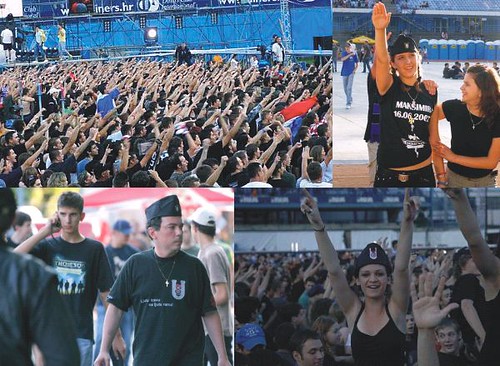
Thousands of Russian neo-Nazis marched through Moscow on National Unity Day this weekend, joined by pensioners, students and families. Experts believe Russia’s far right gives President Vladimir Putin a welcome justification for his authoritarian political style.

Russian [boneheads], hooligans, nationalists, fascists and racists gathered on Moscow’s Kutosovsky Prospect to mark National Unity Day on Sunday. They waved flags as they marched in single file along the banks of the Moskva River and to the Ukraina Hotel, across from the White House, the seat of Russia’s government.

“Russia for Russians!” the demonstrators shouted in unison, followed by slogans such as “For a Slavic, Russian nation!” or “Slavic, Russian, Powerful!” The demonstrators stretched out their arms in the Hitler salute between slogans. Their loud shouts of “Slavic Russia!” were followed by the sound of drum rolls…

With a nod and a wink from the Russian state. An indication of the political degeneracy of Russian neo-Nazis is given by the fact Hitler’s contempt for the Slavs of Eastern Europe fails to prevent them from adopting his Party’s symbology. Meanwhile, this coming weekend sees Czech neo-Nazis assembling in Prague to commemorate Pogromnacht (aka Kristallnacht) by marching through the (former) Jewish quarter of the city… well, maybe.

Posted in Anarchism, Anti-fascism, History, State / Politics, War on Terror | 15 Comments

Trot Guide 2007 #2.0 : 2007 Federal Election

It’s Melbourne Cup Eve, and despite the title of this blog, we’re Racing! into 2007 with the Trot Guide 2007 #2.0 : 2007 Federal Election. This year, Murdoch’s Choice has set a cracking pace, easily dictating terms to its principal rival, HoWARd’s Way. In a field that is exceedingly well strung out, bringing up the rear are the minor parties, which on the left include:

1) The Socialist Alliance

Essentially now an electoral front for the Leninist Democratic Socialist Perspective (nee Party), and barely pretending otherwise, SA is fielding a total of 27 losing candidates, in all states and territories except the Northern Territory, and in both Lower and Upper House seats. Like every other SA electoral campaign, this one will witness little support for the SA, and simultaneously be reported as a triumph by its press (the Green Left Weekly). In NSW, Lower House seats being contested by the SA are Blaxland, Cunningham, Grayndler, Newcastle and Parramatta; in Queensland, Brisbane, Griffith and Moncrieff; in Victoria, Corio, Gellibrand and Wills; in WA, Fremantle, Pearce and Perth; in Tasmania, Denison and Franklin; and in the ACT, Fraser.

In the 2004 Federal Election, SA fielded 34 candidates in total, contesting many of the same seats. For example, in Victoria, in the seat of Corio, SA candidate (and Geelong Trades Hall Secretary) Tim Gooden beat the LaRouchites into last place, gaining 505 votes for the SA; in Gellibrand, Linda Waldron also beat the LaRouchites into last place, gaining 508 votes; while in Wills, David Glanz (a member of the ISO, a Trotskyist sect which has since left the Alliance) scored 867 votes, thereby completing the trifecta of defeats for the terminally unpopular followers of Lyndon ‘Genius or Madman?’ LaRouche.

2) The Socialist Equality Party

Obviously not composed of triskaidekaphobes, the SEP is running 13 candidates this election, hoping to sweep to power on “A socialist program to fight war, social inequality and the assault on democratic rights”. Most SEP candidates are running in NSW and Victoria: in NSW, Terry Cook for Charlton, James Cogan for Chifley, Patrick O’Connor for Grayndler, Alex Safari for Kingsford Smith (SA contested this seat in 2004, only to be rejected by 99.6% of voters), Noel Holt for Newcastle and Chris Gordon for Parramatta; in Victoria, Frank Gaglioti for Calwell and Will Marshall for Melbourne. In WA, Joe Lopez is in the running for Swan. In summary, in addition to Senate seats from NSW and Victoria, the SA will be competing with the SEP in the unpopularity stakes in three seats: Grayndler, Newcastle and Parramatta. Whose Ideology Will Reign Supreme?

3) The Progressive Labour Party (Klaas Woldring and Max Bradley)

Klaas and Max are appealing for the support of voters in NSW in an ambitious attempt to join the Senatorial class, made all the more so by the fact that the name of the PLP will not appear on the ballot: “The Progressive Labour Party was registered on 19 January 1998 and deregistered on 27 December 2006″.

4) The Socialist Party

…is standing a grand total of one candidate, Kylie McGregor, in the seat of Melbourne. This will mean the Socialist vote will be s p l i t between the SP and the SEP. (Note that the SP has the unique distinction of being the only member of Trot Guide to penetrate the bowels of Government.)

5) The Communist League

A late entry: Ron Poulsen of the Communist League is one of six candidates for the very safe Labor seat of Watson in Sydney, NSW. According to Soviet Man, the CL have contested a number of elections in recent years. For example, in 2004, Ron also stood for Watson. Unfortunately, Ron received just 335 votes, or 0.5% of the total — on the bright side, 13 votes more than his previous effort in 2001. In 1996, Ron stood for the seat of Grayndler, gaining 208 or 0.3%. Ron has also stood for the Senate, in 1998 and 1993 (receiving an initial count of 86 votes). Incidentally, Antony Green notes that “John Howard’s origins are in this electorate, growing up in the family home at Earlwood. Unfortunately for those who cherish national heritage, the house where the Prime Minister spent his earliest years has been replaced by a Kentucky Fried Chicken store”, which I think is comically appropriate.

In the meantime, the Committee for a Revolutionary Communist Party in Australia, the Communist League,* the National Preparatory Committee of the Marxist-Leninist Communist Party of Australia, the New Era Communist Party of Australia, the October Seventh Socialist Movement, Socialist Appeal and the Socialist Labor Party of Australia are all complete non-starters, yet to even make it on to the track.

Probably ‘cos they all remain dead.

Further, while the World Socialist Party of Australia maintains a PO Box in North Richmond, the Freedom Socialist Party has gone into meltdown online, making it very difficult to ascertain which party, if any, either advocates proletarian voters support. Direct Action (nee the Marxist Solidarity Network), while also appearing to be in limbo, at least for the time being, would likely advocate a vote for SA. On the other hand, the Communist Party of Australia advocates Communists vote Green, as does the Communist Party of Australia (Marxist-Leninist), the Trotskyist International Socialist Organisation and Socialist Alternative.

Finally, note that, alongside the FSP, the websites of both Socialist Action and Solidarity appear to be down, although whether this means that the organisations themselves are too I dunno.

Posted in State / Politics, Trot Guide | 43 Comments

The NZ state acting like it’s “suppressing terrorism”

My Kiwi comrade Asher has written a summary of the situation facing the Urewera 16, the sixteen people currently facing charges for a number of alleged arms offences and, potentially, for crimes under the Terrorism Suppression Act (2002). Note that Section 67 of the Act states that the Attorney General must authorise the commencement of prosecutions under the Act. Rather than accept responsibility for this decision, the current Attorney General, Michael Cullen (who “enjoys music, reading, golf, and house renovation”) has hand-passed the political hot potato to the Solicitor-General (Solicitor-General to decide on terror charges, NZPA, October 29, 2007).

The work of a social democratic government is never done. The natural way of the world is to move in the opposite direction to the way we wish to go, towards greater inequality. For out of chaos, disorder, conflict, repression, and injustice we seek to create a better world in which we can give full expression to a belief in innate equality and social justice. And as soon as we stop then all begins to move back again to a state of nature. That is why we go forth from here reconfirmed in our resolve to continue the struggle for a better New Zealand, the struggle to build on what we have already done…

Please also note that two members of the Aotearoa Indymedia editorial collective are among those facing charges, and that the collective really needs support. If you’re interested in taking an active role in the collective, email imc-aotearoa-ed (at) lists.indymedia.org.

All 16 people arrested and charged with arms offences on Monday October 15th in nationwide raids appeared in the Auckland District Court on November 1st and 2nd. A 17th person arrested during the raids was charged with cannabis related charges and will appear separately. During the hearings, a number of the prisoners had name suppression dropped (some willingly, some not) and two more were bailed on top of those who were already out. Loud cheers greeted those bailed and others, and many cries of “We love you!” echoed through the court over the two days.

On Thursday November 1st, a few new pieces of information were revealed and confirmed. Firstly, that there will be two trials — one for the arms charges, and one for the charges under the Terrorism Suppression Act (if consent to lay them is granted by the Solicitor-General). Also, the details of which prisoners have had their files referred to the Solicitor-General by the Police was confirmed (12 of the 16). It was inferred by counsel for the Crown that there could be a decision by the Solicitor-General by the end of next week.

Cases heard on November 1st

1) A 38 year old Auckland man has interim name suppression, and is remanded in custody until December 3rd. The Police have applied to charge him under the Terrorism Suppression Act (‘the Act’).

2) Marama Mayrick, 24, of Hamilton, had her bail extended to December 3rd, although her attendance is excused on that date as long as she is represented by counsel. The Police have not applied to charge her under the Act.

3) Jamie Lockett, 46, of Auckland, is remanded in custody until November 12th, when he will apply for electronic bail (aka home detention). The Police have applied to charge him under the Act.

4) Tame Iti, 55, of Ruatoki, is remanded in custody until December 3rd, although he will have a bail appeal in the Rotorua High Court on November 7th. If bail is granted, his attendance on December 3rd will be excused as long as he is represented by counsel. The Police have applied to charge him under the Act.

5) Ira Bailey, 28, of Wellington, was granted bail (not opposed by the Crown) to a Wellington address until December 3rd. His attendance on December 3rd will be excused as long as he is represented by counsel. His bail conditions include not to go to Ruatoki, a 10pm – 6am curfew and not to obtain any firearms. The Police have not applied to charge him under the Act.

6) A male from Ruatoki was granted bail to Ruatoki (not opposed by the Crown) to reappear on December 3rd. His attendance on December 3rd will be excused as long as he is represented by counsel. His conditions include reporting to the Whakatane Police Station every Friday and a 10pm – 6am curfew. The Police have not applied to charge him under the Act.

7) A second male from Ruatoki was remanded in custody until December 3rd. He will have a bail appeal in the Rotorua High Court at an as-yet undecided date before then however. The Police have applied to charge him under the Act.

EIGHT) A 23 year old male from Wellington was remanded in custody until December 3rd. The Police have applied to charge him under the Act.

9) Moana Winitana, 53, of Palmerston North, had his bail extended until December 3rd. His attendance on December 3rd will be excused as long as he is represented by counsel. The Police have not applied to charge him under the Act.

10) A 59 year old male from Auckland is remanded in custody until December 3rd. He may have a bail application on that date. The Police have applied to charge him under the Act.

11) A 32 year old Auckland woman had her bail extended until December 3rd. The bail conditions were also changed, with a lessening of the curfew amongst other changes (against the Crown’s wishes). The Police have applied to charge her under the Act.

Cases heard on November 2nd

12) Rongomai Bailey, 28, of Auckland, had his bail extended through until December 3rd. The Police have applied to charge him under the Act.

13) Omar Hamed, 19, of Auckland (an Aotearoa Indymedia activist), had a bail application which took up most of the day. It was denied by the Court for reasons which are suppressed. He also applied for a fresh order of name suppression, which was also denied. He is remanded in custody until December 3rd. The Police have applied to charge him under the Act.

14) Rawiri Iti, 29, of Hamilton, made a fresh application for bail due to a change in circumstances since his initial application was denied. The Judge ruled that there had been no change in circumstances, and so no application for bail was heard. He is remanded in custody until November 23rd, when he will apply for electronic bail (home detention). The Police have applied to charge him under the Act.

15) Emily Bailey, 30, of Wellington, did not make a bail application and is remanded in custody until December 3rd. The Police have applied to charge her under the Act.

16) Valerie Morse, 36, of Wellington, did not make a bail application and is remanded in custody until December 3rd. The Police have applied to charge her under the Act. Rebel Press, who published Morse’s recent book Against Freedom (on the “War On Terror” in Aotearoa / New Zealand), have put out a press release in support of her.

Finally, in a rare piece of welcome news, attorneys for the West Memphis 3 — Jessie Misskelley, Damien Echols and Jason Baldwin — have submitted a Second Amended Petition for Writ of Habeas Corpus on the basis of new DNA evidence which allegedly proves that the three were not responsible for the slaying in 1993 of three eight-year-old boys in West Memphis, Arkansas: Chris Byers, Steve Branch, and James Michael Moore.

Posted in !nataS, Anarchism, Media, State / Politics, War on Terror | Leave a comment

The Joy Of Fools

    “A change of rulers is the joy of fools.”

November 24 is The Day.

Joe Toscano of the Anarchist Media Institute / ‘Anarchist World This Week’ / Defend & Extend Medicare Group / Direct Democracy Not Parliamentary Rule (nee Vote Informal Today, Direct Democracy Tomorrow) / Libertarian Workers For A Self-Managed Society / People for Constitutional Human Rights / Reclaim the Radical Spirit of the Eureka Rebellion / Sedition Charter is running for the Victorian Senate again, urging voters not to. For either himself, or his running mate, Jude Pierce. The Age gossip columnists provide the good citizens of Victoria with this profile of the good doctor’s campaign:

FINALLY, an election candidate with a real point of difference between John and Mr Me Too, Kevin.

3CR’s left of left broadcaster Joseph Toscano, 55, host of ‘Anarchist World this Week’ and frequent letter writer to The Age and Phil Ruddock (they’re not exactly penpals), is standing as an independent in the Senate with Jude Pierce.

How’s this: Joe has never voted and is not even enrolled but he damn well knows his rights: “My favourite bedtime reading is the Australian constitution and the Commonwealth Electoral Act,” Joe told us. “Under the constitution, anybody who is entitled to vote is entitled to stand.”

Jude isn’t so bolshie because she votes. Joe, a veteran anarchist, has tried to become a senator seven or eight times — “I have lost count” — but it’s only a matter of time before his platform resonates with the weary public. The biggest selling point is The Power of Recall where voters can call elections to turf out “non-performing” MPs by signing a petition. The other planks are Citizen Initiated Referendum, and Direct Democracy not Parliamentary Rule, where voters make the decisions and elect delegates, who can be sacked for “non-performance”, with a fixed mandate to run the show.

As to where you’ll find Joe ‘n’ Jude on the ballot paper, that’s tricky. Because they’re not a registered political party and standing as a group, they’ll have a box above the line but it won’t have their name. Look out for their mystery space. Joe wanted “Independent” next to their box but the AEC said that’s illegal. To have “Independent” they have to stand individually and those candidates can only have a box below the line, where voters have to number every box.

To make it even more confusing, Joe ‘n’ Jude’s names will be below the line but given Joe’s research reveals only 5 per cent of people can be bothered numbering the boxes, they’re unlikely to be making victory speeches. That’s a shame. Imagine all the pollies who could have been booted out.

Pffft.

Tiocfaidh ár lá!

In any case, the winner was declared back in April: Rudd. The rest is just for show, and, with a few noteworthy exceptions, a pretty dull one at that. Thus as Dean Jaensch (semi-)correctly observes: “The fact that there is no sign of any favourable change to the Liberal Party in the polls suggests that the one distinguishing policy – WorkChoices – is looming large, and that personality, and the “new leader/team” approach of Labor is having an important effect” (Me-too tactics risk ‘why you?’ effect, ABC, October 31). In other words, while sharing the same fundamental political commitments and policy perspectives, Labor is identified as being opposed to an unpopular new IR regime, and is therefore attracting more support. Plus, HoWARd’s getting even more old and boring, so “It’s Time” Australian Politics received a new image. In summary, the only real, political opposition to the Tories is The Greens, and how they fare, especially in the race for Senate seats, is one of the only really consequential issues. Nonetheless, there are some questions remaining, most of which concern those on the margin of the margins. For example:

    Which right-wing Christian fundamentalist will the ALP back in the Senate?
    Just how badly will the Socialist Alliance fare?
    In WA, will a Socialist student and a laboratory assistant outpoll a racist consultant, company director, director and supply officer?
    What do Women Want, and is It What Voters Want too?
    Are the bizarros belonging to the Conservatives for Climate and Environment more or less popular than the bizarros belonging to the LaRouche cult Citizens Electoral Council? (Is the CEC’s message that “Greenies promoting windmills and solar cells would send us back to the Stone Age” actually getting through to the voting public, or not?)
    Who will win the battle for last place in Murray: Diane Teasdale, Rob Bryant, Jeff Davy or Paul Merrigan?

Stay tuned!

Posted in !nataS, State / Politics | 13 Comments

“…the possibility of being not only labelled a terrorist in the media, but prosecuted as one, is a reality.”

Valerie Morse, a 36 year-old anarchist from Wellington, is one of four more of the Urewera 16 (nee 17) whose names were released to the public yesterday, the others being Moana Hemi Winitana and Ira and Emily Bailey. (Of the 16, police have applied to the Solicitor-General to prosecute 12 under anti-terror laws.) This means that ten people have so far been named: Emily Bailey, 30, Ira and Rongomai Bailey, 28, Omar Hamed, 19, Rawiri Iti, 29, Tame Iti, 55, Jamie Lockett, 46, Marama Mayrick, 24, Valerie Morse, 36, and Moana Hemi Winitana, 53. “Six names remain suppressed, including that of a Wellington man who had not been able to tell his mother in Europe of the charges. Two are fighting lifting of name suppression in the High Court. Eleven of the accused are still in custody. The remainder have been freed on strict bail conditions. Tame Iti’s nephew, Rawiri Iti, is due to appear in court today, while the 17th person arrested during the raids faces cannabis charges only and will appear separately.”

Suspect Previously Published Book On War On Terror
Friday, 2 November 2007, 12:05 pm
Press Release: Rebel Press

Alleged Terror Suspect Previously Published Book On ‘War On Terror’

2 November 2007

Valerie Morse, a well-known Wellington anarchist activist and one of the 17 arrested in the police ‘anti-terror’ raids, previously published a book on the effects of the ‘war on terror’ just six months prior.

Against Freedom: The war on terrorism in everyday New Zealand life was published in June and is a prophetic survey of the raft of anti- terror legislation passed in New Zealand since 2001 and of the dangers posed for activists – especially those involved in anti-war, environmental and Tino Rangatiratanga movements – as well as migrants and refugees. It also covers the rise of State surveillance by the Security Intelligence Service (NZSIS) and the media complicity in its reporting on the ‘war on terror’ in the Pacific and further abroad.

A prophetic passage from the book reads as such: “It is clear that political dissent is now more perilous and more treacherous than before September 11th. Given the new counter- terrorism laws, the possibility of being not only labelled a terrorist in the media, but prosecuted as one, is a reality. By casting political dissent as terrorism, the government, its agencies, the media, and other vested interests assault our freedom of expression” (82).

The book is freely available as PDF on the Rebel Press website, as a hard copy directly from the publisher, or from a number of popular book stores including Unity Books and The Freedom Shop in Wellington.

Valerie Morse had name suppression lifted yesterday but remains detained by the State. Her publisher offers her their unconditional support and solidarity, and demand all charges against the 17 be dropped immediately.

Rebel Press / PO Box 9263 / Te Aro / Wellington [email protected]

In other news, “An independent survey [of a representative sample of 750 people] has shown that only a small proportion of New Zealanders think police overreacted in recent nationwide raids – with most reserving judgement”, according to Radio New Zealand (November 2, 2007). See also : The Urewera 16 appear in court together, Beck Vass, NZ Herald, November 2, 2007

Posted in Anarchism, Media, War on Terror | 6 Comments

USA Today: More trouble on tour for Tommy

    Update : According to Reuters (Controversial Croat band locked out of Canada venue, Solarino Ho, November 2) Thompson has had one venue pull the plug on his/their concert scheduled for November 4 in Toronto, forcing him/them to find an alternative, less public platform.

Jewish groups protest Catholic church’s decision to host Croat musician

Jewish groups are calling on Catholic leaders to ban a controversial Croatian musician whose band is scheduled to perform Friday at a church-owned concert hall in New York City.

The ADL and Simon Wiesenthal Center say Marko Perković, who performs under the stage name Thompson, has glorified the pro-Nazi regime that is blamed for the deaths of thousands of Jews during World War II. A report in the Daily News says members of Thompson “extol ethnic cleansing – and their fans often greet them with the Nazi salute.”

The newspaper reports that Thompson has been banned in Canada and the Netherlands. His website says the band is scheduled to play Friday at the Croatian Center in Manhattan, which is linked to St. Cyril & St. Methodius Croatian Church.

This prompted Mark Weitzman of the Wiesenthal Center to demand action from Edward Cardinal Egan, the city’s top Catholic.

“Any glorification of the Ustashe regime, with its murderous record against Jews, Serbs and other Croats, especially one that uses popular culture to appeal to a new generation, must be firmly rejected,” Weitzman writes in a letter. “I urge you to take the lead on this issue, and to reaffirm the Church’s commitment against antisemitism, intolerance and violence by making sure that there is no connection between the Church and Perkovic that could in any way imply support of his hateful positions.”

This morning, church officials responded to Weitzman’s letter. He wouldn’t give us a copy, but he did say that the local pastor has assured the archdiocese that Thompson “doesn’t engage in inappropriate behavior.”

Weitzman says he plans to take the church up on its invitation for the Wiesenthal Center to provide additional information about the parts of Thompson’s performance that they find objectionable. “Am I satisfied with that response? I think that it could have gone a little deeper … it really warranted a really significant investigation,” he says.

USA TODAY has requested comment from a spokesman for the Archdiocese of New York. As for the critics, they’re not planning to hold protests outside the concert venue.

“I’m not organizing anything, I’m not calling for anything. I don’t want to make a bad situation worse,” Weitzman says. If Perković and his fans live up their reputation, Weitzman says it will be “a deep shame for all involved — those who performed, those who attended and those who allowed it to happen.”

Update at 6:04 p.m. ET: On Deadline just heard from Joseph Zwilling, a spokesman for the Catholic Church in New York City. Here’s an excerpt from the letter Zwilling sent to the Wiesenthal Center:

We have been attempting to carefully investigate Marko Perkovic, also known as Thompson. The pastor of the local Croatian parish has assured us that Mr. Perkovic does not engage in inappropriate behavior, and that he will speak with Mr. Perkovic prior to any appearance in New York to make certain that such will be the case during his scheduled upcoming concerts. I myself have done what investigating I could, which has been hindered because much of the information on him is in Croatian. However, I have not found anything that would indicate that he has engaged in objectionable behavior.

Zwilling says the Wiesenthal Center sent him more information today that was “inconclusive.”

We received an e-mail this afternoon from a Thompson supporter who claims the allegations are “blatant propaganda and outrageous lies.”

We can’t confirm the authenticity of the quotes attributed to the singer in that message, but they do match up with what Perković said during a concert in June. “I’ve had enough of the unjustified attacks!” the Associated Press quotes him as saying in Zagreb. “I’m a musician not a politician. At my concerts I sing about love, God and the homeland — only about that and nothing else.”

In June, a New York Times reporter attended one of Thompson’s concerts.

See also : Australians protesting Croat’s concert, JTA, October 31, 2007

Posted in Music | 10 Comments

mad props 2 zamboni

October 31, 1926 — In Bologna, Mussolini survives an assassination attempt by 15 (16?) year old anarchist Anteo Zamboni.

“Anarchical Communists”, Time, September 17, 1928:

Only once has a Fascist mob lynched an assailant of Signor Benito Mussolini. The single instance occurred at Bologna (TIME, Nov. 8, 1926). There the Dictator sat implacable and silent, in his limousine, after a bullet had ripped through his sash of the Grand Cordon of the Order of St. Maurice and St. Lazarus, barely skirting the abdomen.

The mob, interpreting Il Duce‘s silence as a command, put 14 stiletto strokes into the assailant, one Anteo Zamboni, and pummeled his remains into a pulp.

Since then Law has been slowly enlarging the circumference of Signor Mussolini’s vengeance. Last week the father and mother of Lynchee Zamboni were sentenced at Rome to 30 years in Jail as instigators and accomplices.

Father Momolo Zamboni vigorously denied all guilt, but produced a very bad effect upon the Court by remarking with candor and simplicity: “We are Anarchical Communists. Anarchical because we do not want any government. Where there is government there is authority, and where there is authority there is not that true liberty which we desire. We are Communists because we wish that everything which exists or which is produced be shared by everybody.”

Counsel for the defense submitted that his clients were not really “Anarchical Communists” but just “idealistic anarchists.”

The vast difference between an “anarchical communist” and an “idealistic anarchist” is, of course, that between a resolute, active borer from within Society, and a dreamy yearner after millennium. But the Court, a military tribunal, seemed unimpressed by even so glaring a disparity.

Posted in Anarchism, Anti-fascism, History | 1 Comment

What do you mean Thompson isn’t touring?

Posted in Uncategorized | 4 Comments

Until someone gets killed…

By way of introduction…

A few weeks ago, the Melbourne Croatia Social Club played host to a group of neo-Nazis, numbering somewhere between 40 and 200. They’d assembled to hear Final War from the US — proudly supported, along with literally thousands of other fascist schmucks, by myspace — sing about killing Jews (which is apparently a far less serious crime than smoking marijuana), among other wholesome family entertainment. Last year, and in years previous, the annual gig organised by local neo-Nazi networks was held at The Birmingham Hotel in Fitzroy, otherwise known as a punk rock venue. This year, the gig also starred a band called Quick & the Dead, from Perth. They’ve recently reformed, and are now playing gigs alongside of punk bands such as The Homicides. In Melbourne, The Birmy continues to be supported by bands like The Worst. According to one source, in November, UK punks Beerzone are scheduled to play The Birmy on Friday November 23 with The Beefeaters, Distorted Truth, RUST and The Worst.

In Russia, anarchy is a dead fag.

A Killing in Siberia Injures Russia’s Green Movement; Environmentalist’s Son Confesses Role in Attack; Preserving a Sacred Sea
Alan Cullison
Wall Street Journal
October 29, 2007

IRKUTSK, Russia — Marina Rikhvanova is a mother of Russia’s green movement. Last year, she led thousands of protesters into the streets of this Siberian city against an oil pipeline that would have skirted the pristine waters of Lake Baikal. Afterwards, President Vladimir Putin scrubbed the plan.

This spring Ms. Rikhvanova put together new rallies against Kremlin plans to turn the Irkutsk region into a center for processing nuclear fuel. She helped protesters plan a tent bivouac near the fuel plant, and printed leaflets for campers to hand out to locals, warning of the dangers of radioactive leakage.

One morning in late July she got a phone call telling her the campers had been attacked in their sleep by masked men armed with metal pipes and wooden clubs. One camper was beaten to death.

What happened afterwards has shaken the environmental community and Ms. Rikhvanova’s role as its leader. Authorities arrested her 19-year-old son, who confessed to a role in the attack.

Ms. Rikhvanova’s defenders say she was set up by Russia’s security services, who they say lured her son, a sometime security guard who had recently fallen in with nationalist skinheads [sic], into the attack on the campers. Authorities dismiss that charge as absurd, and say the 46-year-old Ms. Rikhvanova should have spent more time with her family.

In any case, the incident has diminished the stature of one of Russia’s most influential environmental leaders. Until now, Ms. Rikhvanova’s group in Siberia was able to pull together scientists, ecologists and common folk into a populist groundswell that forced the government to pay attention. Her agenda of unspoiled air and water was seen as transcending politics. In the increasingly authoritarian era of President Putin, she and other environmentalists have comprised one of the few respected alternative voices to the Kremlin on public policy.

Now, some erstwhile allies are keeping their distance. “The attack and the arrest afterwards have been a tremendous blow to the environmental movement, and divided it like never before,” said Mikhail Kulekhov, a local journalist who had worked with Ms. Rikhvanova previously but now has backed off. “We all now have to think closely about whom we work with.”

After the fall of the Soviet Union in 1991, Russia’s green movement had a strong footing in Irkutsk because of Lake Baikal, a 25-million-year-old Russian national treasure.

Known to locals as the Sacred Sea, the lake is 400 miles long and more than a mile deep, and holds nearly a quarter of the world’s unfrozen fresh water and an abundance of unique animal life.

Ms. Rikhvanova studied biology in Irkutsk under the Soviet system, she said, “because I didn’t have to lie in the sciences.” She married a fellow biologist, and wrote a thesis on the effects of effluent being dumped into the lake by a Soviet-built pulp and paper plant.

The group she co-founded, Baikal Ecological Wave, started as a kind of tea society, but quickly gathered strength and members. In the early 1990s, Baikal Wave began collecting grants from the likes of the U.S. Agency for International Development and Germany’s Green Party, bought its own headquarters and started a newsletter.

Soon the group was locking horns with the federal government and Moscow’s newly minted energy barons. Ms. Rikhvanova probed the work of a nuclear fuel enrichment plant in the nearby city of Angarsk, and lined up experts to testify against plans of state and newly privatized oil companies to build pipelines skirting the lake.

In 2002, federal agents raided Baikal Wave’s offices, seized its computers and accused the group of acquiring secret maps of the nuclear enrichment plant in Angarsk.

But the group’s persistence paid off. When the Kremlin tried to push through a plan to build one pipeline through a seismically active area within about 900 yards of the lake, Baikal Wave helped organize street protests. One rally in central Irkutsk in March last year drew 5,000 people in freezing temperatures. Baikal Wave also organized “flash mobs” that deposited bottles of blackened water in front of administrative buildings that they labeled “Baikal Water”.

The Kremlin made an about-face the next month. At a news conference on national television, Mr. Putin ordered the pipeline moved 25 miles away from the lake.

The pipeline victory made Ms. Rikhvanova “a messiah,” said Igor Ogorodnikov, an organizer in a leftist [?] youth group, Autonomous Action. The American magazine Condé Nast Traveler flew her to New York and feted her at an annual awards dinner.

Born in 1988, just as his mother’s career as an activist began to take off, her son Pavel had trouble, as did millions of young Russian men, navigating the penury of post-Soviet Russia.

He wanted to study business at a private institute, but his parents had little money to help him. Ms. Rikhvanova and her husband made no more than $1,000 a month between them, and still lived in the same two-room apartment with Pavel and his sister that they had inherited in Soviet times.

While selling books to pay for business school, Pavel was hit over the head by a mugger who stole the books and money he was carrying. Then he got out of the hospital only to be hit in October of 2005 by a car while crossing the street, shattering his knee.

For most of last year he lay on the family couch recovering from an operation that put pins in his leg. When he was able to walk again, he reveled in his freedom by going to soccer matches. “I didn’t think there was anything wrong with it — I was happy that he was happy,” said his father, Yevgeny Rikhvanov.

But in Russia, racist gangs have often congealed around soccer fan clubs. Pavel began coming home from games drunk, his father said, and “speaking in racist ways that I had never heard before.”

In April of this year, Pavel told his parents that a new friend, named Stepan, had found him a job as a security guard working for a local businessman. His parents were alarmed — security firms are often closely tied to law enforcement in Russia. Ms. Rikhvanova thought it strange that Pavel, sickly and asthmatic from childhood, would be offered a job usually reserved for burly toughs.

She said she asked her son not to take the job, fearing it would draw him into trouble. But the salary — about $400 a month — seemed enormous to him.

The family had to worry in part about pressure from the government because Ms. Rikhvanova had just announced plans to oppose the nuclear fuel plant in Angarsk, a top-secret complex in Soviet times that lately had figured in Kremlin plans to make Russia a key player in the world energy market.

At a meeting of the G-8 in St. Petersburg in 2006, Mr. Putin announced Russia would create an international center for processing nuclear fuel, so that countries such as Iran could develop civilian nuclear power without having the technology to make nuclear weapons.

Ms. Rikhvanova said an official advising the local government told her that she risked her reputation by opposing the plant. Some of Ms. Rikhvanova’s former allies shied away from opposing expansion plans that were backed by the Kremlin and would have been a big source of new jobs in the region.

One group that was willing to help fight the plant was Autonomous Action, a loose coalition of mostly youths who call themselves anarchists and radical ecologists.

Mr. Kulekhov, the journalist, calls its members troublemakers because many dub themselves “antifa” — radical antifascists who have a history of clashing with [boneheads] at soccer matches.

Ms. Rikhvanova defends her work with Autonomous Action, which she said was vital to demonstrations against the pipeline last year. Each year the group has set up a tent camp somewhere in Russia that has doubled as a sort of discussion forum on ecological issues. When members said they wanted to set up the camp this year near the Angarsk nuclear facility, Ms. Rikhvanova agreed to help.

Yuri Mishutkin, injured in the July attack, was released from the hospital in September.

They chose a campsite at the edge of Angarsk, in a public forest of mixed pines and birch trees about three miles from the nuclear plant. Tensions simmered from the start: Police officers confiscated some notebooks and music discs from early arrivals. Police also blamed them for spraying antinuclear graffiti on the buildings of the city administration, and the pro-Putin political party, United Russia.

After visiting the camp, a local journalist wrote a scathing article suggesting the campers were living off foreign grant money, and hinted they could be “ecological spies” trying to collect information about secret nuclear installations in the area.

The campers held pickets in town, and handed out thousands of leaflets that Ms. Rikhvanova helped them print warning of the dangers of the plant. She arranged for a physicist to visit the camp and explain the technical side of nuclear enrichment.

On July 20 some officers walked into the camp and told the activists to hand over any cans of spray paint that might have linked them to the graffiti. Police also demanded to see the passports of people staying in the camp. Several campers who refused to surrender their passports were taken to the police station. Ms. Rikhvanova said she went to the police station to help them, and headed home after they were released.

That evening campers gathered around the fire. They were tired from a day of picketing, but worried about a report from a local youth who said he received a text message on his mobile phone, inviting him to take part in an attack on the camp that night, Mr. Ogorodnikov said.

The group decided that three volunteers should stay awake and stand guard. One was Ilya Borodayenko, 26, a lanky typesetter who had arrived that afternoon by train from the far east port city of Nakhodka. Mr. Borodayenko was an experienced fighter.

Alexei Sutyuga also volunteered to stay up that night, and sat by the fire with the others, drinking tea and talking to keep one another awake.

At about 5 a.m., he said, young men with scarves covering their faces ran into the firelight. Mr. Sutyuga said he rose to meet them but someone hit him over the head from behind with a bottle. He said several men beat Mr. Borodayenko with metal bars and he staggered away towards the woods.

Mr. Ogorodnikov said he woke up to screams, and opened the flap of his tent to see more than a dozen young men rampaging through the camp. They slashed open tents with knives and beat those inside.

The attackers poured out the campers’ drinking water on the ground and made a bonfire with their banners, leaflets and camping gear.

They left after about 10 minutes, he said. Campers found Mr. Borodayenko near the edge of the woods, unconscious and bleeding. Ambulances began to arrive 30 minutes later, and took him and eight others to the hospital with broken bones and bruises. He died of a cracked skull shortly after dawn.

Ms. Rikhvanova learned of the attack hours later. Her son, who came home from Angarsk later in the day, seemed preoccupied, she said. He was arrested later that week while at work.

Police arrested 17 other men, but identified only one of them, Ms. Rikhvanova’s son, by name. Ms. Rikhvanova says her son was assigned with the task of tearing down the anarchist flag that was flying over the encampment.

Police said the attack stemmed from hurt feelings over a fight at a soccer game two weeks before. Mr. Sutyuga dismisses the claim, and said no one from the camp had been involved in any fights — most had just arrived in Angarsk from different regions of Russia.

Allies have closed ranks around Ms. Rikhvanova, but they say the attack and Pavel’s arrest have badly dented the image of Irkutsk’s environmental movement.

“In Russia, there is a feeling that in an ordinary family, children support their parents,” said Maksim Vorontsov, a member of the National Bolshevik Party, which has worked closely with Ms. Rikhvanova. “Now people are wondering why children might be attacking their parents. They are saying [ecologists] must be abnormal.”

Ms. Rikhvanova set out her own views on the attack in a letter she wrote to erstwhile allies in the ecology movement. She said she later learned that the security company that hired her son, called Continent, was owned by a top official in the Union of Right Forces, a political party that was once headed by the man who now runs Russia’s atomic-energy agency.

Today she says she suspects that Stepan and possibly her son’s employer had some kind of link with the security services, and that her son was lured into the attack to help ruin Baikal Wave.

Igor Kokourov, the cigarette magnate who owns Continent, calls the accusation nonsense, saying he never met Pavel. “I have too many workers here to act like a parent,” he says, adding that minding Pavel is “her job, not mine.”

Ms. Rikhvanova said she communicates with her son today mainly by letters passed through his lawyer as he awaits trial in a local prison. “I am sorry for what has happened — I should never have gone there,” he wrote to her on a sheet of graph paper last month. “But I swear I never hurt anyone.”

He still has not explained to her how he got involved in the attack, she said.

Posted in Anti-fascism | Leave a comment

“The Serbs can say what they like.” Heil Thompson!

Croatian star’s gig sparks outrage
Greg Roberts
The Australian
October 31, 2007

SERBIAN and Jewish community leaders are outraged that the social arm of the Melbourne Knights Soccer Club is hosting a concert by a Croatian rock star with a strong following among neo-Nazi sympathisers.

The revelation follows the club’s apology for staging a concert for neo-Nazi skinheads at its North Sunshine complex this month.

A concert by Marko Perkovic will be hosted by the Knights-affiliated Melbourne Croatia Social Club at the complex on December 28.

Perkovic, Croatia’s top rock star, uses the stage name Thompson, in honour of the American-issued submachinegun of the same name that he carried as a soldier in Croatia’s war of independence against Yugoslavia in the early 1990s.

George Markovic, the publisher of Melbourne’s Serbian Voice newspaper, said the Knights should steer clear of extremist elements.

“People in our community are thinking of the Knights as the Gestapo Club,” Mr Markovic said.

Mr Markovic said Perkovic had been granted visas for previous visits to Australia, while Serb singer Ceca Raznatovic has been denied a visa in 2005. “It’s double standards,” he said.

B’nai B’rith Anti-Defamation Commission director Manny Waks said Perkovic’s visit reflected badly on the Knights and the Croatian community. “It is unacceptable,” Mr Waks said.

The Weekend Australian reported on Saturday that Melbourne Knights chairman Matt Tomas had censured his club’s social arm for providing a venue for the October 13 concert by skinhead [that is, bonehead] rock bands.

Mr Tomas yesterday again expressed exasperation at the Croatia Social Club.

“I can understand why people are upset and just wish the social club would focus on its football identity,” he said.

Croatia Social Club committee member [and former Football Federation Victoria VIP] Ivan Skunca said the club was not concerned about outside criticism.

“The Serbs can say what they like. It doesn’t bother us,” Mr Skunca said.

Immigration Minister Kevin Andrews said Perkovic had yet to submit a visa application, but it would be carefully considered.

Posted in Anti-fascism, Music | 27 Comments