Campus Watch

Last month, Dateline ran a story on the US-based Campus Watch, “a project of the Middle East Forum, [which] reviews and critiques Middle East studies in North America, with an aim to improving them”. Established by one of Australian President George Dubya’s favourite academic poodles, Daniel Pipes, the Watch functions to help silence dissenting voices within the US academy in relation to US foreign policy in the region.

DANIEL PIPES, DIRECTOR, MIDDLE EAST FORUM: I have a feeling that universities have been hijacked. In other words, the people I went to school with in the late ’60s, early ’70s, my contemporaries, who were the revolutionaries as students, did not achieve their goals of taking over and changing the country, but they did take over and change the universities.

ASSOC. PROFESSOR JOSEPH MASSAD, COLUMBIA UNIVERSITY: Remember, there’s a right-wing effort across America today to silence any criticism of Israel and of the US Government. So the Israel lobby found this an opportune time to enter the university and silence the critics of Israel because of this prevailing mood. And therefore the real attack is on academic freedom.

More hereSee also Vincent/Danby Interview with George Negus (November 8, 2006); Defend our universities!; ‘Mideast studies accused’, Rebecca Weisser, The Australian, November 22, 2006; ‘Watching the Watchers’, Jamie Hyams, Australia/Israel Review, December 2006; ‘It’s Academic: Anti-Zionism in Australian academia’, Ted Lapkin, Australia/Israel Review, August 2006; ‘Intellectuals, democracy and empire’, Robert Blecher, Evatt Foundation, May 2003.

And on a somewhat related note: ‘The Seductions of Islamism: Revisiting Foucault and the Iranian Revolution’, Janet Afary and Kevin B. Anderson, New Politics, Vol. 10, No. 1, Summer 2004:

IN THE TWO AND A HALF DECADES since 1979, the tremors set off by the Iranian Revolution helped in no small way to spark an international series of Islamist movements. Radical Islamists have taken power or staged destructive civil wars in a number of countries, from Algeria to Egypt and from Sudan to Afghanistan, in the latter case with U.S. support. These regimes and movements have been responsible for hundreds of thousands of deaths and for numerous setbacks to women’s rights throughout the Muslim world. Islamism gained such power and influence during a period when equally retrogressionist Christian, Hindu, and Jewish religious fundamentalist movements were also on the rise, all of them inimical to women’s rights. The September 11 attacks were a dramatic and horrific example of the dangers of such religious fanaticism…

Posted in !nataS, State / Politics, Student movement | 7 Comments

Michel Onfray : Militant Atheist

Religion is the sigh of the oppressed creature, the heart of a heartless world, just as it is the spirit of a spiritless situation. It is the opium of the people.

— Karl Marx, Critique of Hegel’s Philosophy of Right

Some French bloke — oh alright, philosophe — called Michel Onfray has written a book called Traité d’Athéologie (Grasset, 2005), to be published in English early next year as Atheist Manifesto: The Case Against Christianity, Judaism, and Islam. Doug Ireland has written an introduction to Onfray’s work for the journal New Politics (Vol.10, No.4, Winter 2006) and you can read it online.

A radically libertarian socialist, a self-described “Nietzschian of the left”, Onfray’s philosophical project is to define an ethical hedonism, a joyous utilitarianism, and a generalized aesthetic of sensual materialism that explores how to use the brain’s and the body’s capacities to their fullest extent — while restoring philosophy to a useful role in art, politics, and everyday life and decisions. All this presupposes, in Onfray’s philosophy, a militant atheism and the demasking of all false gods…

Sweet coffee and hot jam donuts!

See also : Ken Knabb’s ‘The Realization and Suppression of Religion’ (1977); ‘Agent provocateur’, Brad Spurgeon, Toronto Star, December 17, 2006

I reverse the phrase of Voltaire, and say that if God really existed, it would be necessary to abolish him.

— Mikhail Bakunin, God and the State

Posted in !nataS, Anarchism, State / Politics | Leave a comment

G20: Arrest #7

Police have been busy in Goongerah this week… and today laid charges against a seventh protester:

Man faces court over G20 protests
Catherine McAloon
The Age
December 15, 2006

A man has appeared in Melbourne Magistrates Court to face charges over violent protests at last month’s G20 meeting of financial leaders.

David Caldwell, 29, of Goongerah, has been charged with affray, rioting and reckless conduct endangering serious injury.

Caldwell is the sixth [sic] person to be charged with offences relating to the protests. Police allege that Caldwell threw and rammed barricades and rubbish bins.

He was not required to enter a plea and did not apply for bail. The case has been adjourned until Tuesday.

Seventh person charged over G20 riot
Herald Sun [AAP]
December 15, 2006

POLICE have charged a seventh person over the G20 riots in Melbourne last month.

David Caldwell, 29, of Goongerah, in far east Victoria, has been charged with affray, reckless conduct endangering [serious?] injury and rioting.

Mr Caldwell will spend the weekend in custody while he waits for his mother to travel from Adelaide to provide surety for his bail, Melbourne Magistrates’ Court was told today.

His lawyer, Marita Altman, said her client would live in Adelaide if released, while he waits for the case to proceed through the courts.

Magistrate Daniel Muling adjourned the matter until next Tuesday…

The other six people facing charges are: Akin Sari (arrested November 19th, and the only one of the accused so far to have been denied bail); Julia Dehm (arrested December 11th while attending a court appearance in support of her friend); Danya Bryx (arrested December 8th); and Rosalie Delaney, Dominic Richardson and David Vakalis (December 6th).

NB. A few days ago, ASIO Director-General Paul O’Sullivan claimed that “there were about 70 individuals who sought to use the lawful G20 protests to engage in violent acts and confrontations with police”. If correct, according to my calculations, we may therefore expect about another 63 arrests to take place. And if Mick Armstrong of Socialist Alternative and Peter Blunden (editor) of the Herald Sun are correct, the majority of these arrests will be of psychotics from Aotearoa/New Zealand and football hooligans from England, Germany and Sweden. Revolutionary socialists should contact Operation Salver immediately if they hear anyone with a funny accent extolling the virtues of football-related violence or ordering “fush ‘n’ chups”.

Posted in State / Politics | 8 Comments

The Urge to Destroy: G20

Below is a text by one of the estimated 40 or so “anarchist crazies” from Aotearoa whom — along with English, German and Swedish “football hooligans who travel the world looking for violence” — Mick Armstrong of Socialist Alternative claims were responsible for the awful acts of “ultraviolence” at the G20 protest on November 18, 2006.

Violent fucking foreigners. (See also : Hanson unhappy about ‘sick Africans’, The Age, December 6, 2006.)

For the benefit of Operation Salver, the names of at least 20 of these “hostile, abusive, threatening and ultra-sectarian” “wreckers”, whose “ranks have been riddled by police agents and fascists”, are freely available from Socialist Alternative:

The Urge to Destroy is Also a Creative Urge
by An Aotearoa Anarchist
Friday December 15, 2006

Thoughts on the Arterial Bloc at the counter-G20 protests from one of the Herald Scum‘s “professional agitators from overseas”.

Reflections on the Arterial Bloc at the Counter-G20 Convergence

Normally, I would shy away from quoting anti-Semites, but in this case, the title quote from Bakunin seems eerily appropriate.

In the capitalist media’s reports on the counter-G20 convergence, creation has been subsumed and silenced in the images of destruction they have so enthusiastically plastered all over, and yet it is perhaps in that destruction that the most potent messages of all were sent.

For a new world will not be ushered in through niceties or needless martyrdom, but rather through collective action towards, for want of a more eloquent term, smashing capitalism, the state and all of their apparatus of control.

In refusing to play by their rules, in refusing to accept their definitions of what constitutes legitimate protest, we begin to approach what is necessary – a form of active dissent which by-passes the social control and co-optation which has been laid out and which has been so effective at defeating many real revolutionary prospects in modern society.

So then, if, at least for the purposes of this article, we can accept a framework of attempting to move beyond conceptions of spectacular protest, we can begin to critically examine the role of the Arterial Bloc at the counter-G20 protests. Perhaps the most important part is examining how democractically the Bloc functioned in two senses: within the bloc itself, and within the wider protest.

Within The Bloc

Prior to the G20, the Arterial Bloc engaged in extensive discussion (both formally in meetings and in informal chats) about how we would function as a bloc and how our internal practices could best embody the practices we hope to see in a (post) revolutionary society.

In adopting a method containing autonomous affinity groups working together towards common goals via spokescouncils and larger forums, we envisioned a future society where people work together on a basis of affinity, not compulsion.

So, how well did this model work? The main problem encountered undoubtedly was when the bloc was on the move. At strategic points when we needed to decide what to do next, often while the spokes were still meeting, some bloc members would end up forcing a de-facto decision by charging off, forcing the rest of the bloc to follow out of solidarity.

Despite this, however, I still feel that overall, democracy within the bloc was at a fairly high level, and regardless of whether every decision went through our formalised process, generally there was a high level of consultation within the bloc on most matters. However, even this consultation poses some interesting patterns, as it was almost always a limited few (and generally the same limited few) who were running around the larger mobilisation talking to the rest of the bloc – ie, those who were most passionate about keeping our internal democracy and communication flowing.

The Arterial Bloc meetings and spokescouncils outside the protests were another period where our internal democracy was tested, and perhaps the place where it came through the best. An all-in discussion of options, followed by a split into affinity groups to decide on our preferences, before a spokes meeting to test for consensus amongst the affinity groups and, where needed, re-breaking into the affinity groups for further discussion.

One hardship to get through was the lack of established affinity groups prior to the G20 – with a few notable exceptions, most affinity groups were formed specifically for the G20, leading to a lack of real cohesion within many of the affinity groups themselves. Further thoughts on this topic already exist in the excellent article ‘Affinity Beyond The Barricades’ located in the equally excellent zine Mutiny, so I won’t go on too much further, but suffice to say that if we had had even a large majority of the affinity groups as pre-existing and therefore used to working together, our communication and internal democracy would have likely improved massively.

Within The Wider Protests Against The G20

Prior to the G20, the Arterial Bloc also conducted several discussions about how we as a bloc desired to interact with the wider protest.

Being aware that of the groups who had plans for what they wanted to do on the day, we were fundamentally different, we pondered a number of options for engaging with the rest of the protest without dragging anyone into a confrontation that they weren’t prepared for and didn’t desire to be a part of. However, we were also fully aware that despite our best efforts, it was also a matter that was fundamentally out of our hands, with the police just as willing and able and, it seemed, possibly even more willing, to target other groups where they felt they would receive less resistance (the disgusting, although not surprising, police violence at the pink Cadillac action on Saturday night and at the Museum on Sunday are perhaps the two most vivid examples of this).

I believe we made what I have stated in the previous paragraph perfectly clear at the wider spokescouncils to the other groups – I can recall in great detail the lengthy discussion we had simply to come up with a single paragraph message to send to one spokescouncil meeting. And yet, despite this, most other groups and individuals involved have been falling over each other to denounce the Arterial Bloc and deny any foreknowledge of our intentions. Groups that support the Make Poverty History campaign (which, of course, can never do anything of the sort) have joined with supposedly “revolutionary” socialist groups in attacking the Arterial Bloc, and, in some cases, so-called “internationalists” have joined the corporate media in their xenophobic (and false) claims that the blame for the so-called violence lies with overseas anarchists, or at most interstate.

On the day, as we arrived at the first barricade, we made some effort to attempt to break through it. Some way behind us were the various Socialist groupings, Greens and others, with those who saw what we were doing and wanted to join in moving towards the front. Unfortunately, thanks to the media, who occupied almost the entire front line, we were unable to get any sort of movement going. At this point, after a spokescouncil, the Arterial Bloc decided to move to a different area to test the barricades there. We spent approximately 5-10 minutes informing those around us of what we planned to do and inviting them to join us, and then, we moved. In doing this, we in effect created two zones of protest – one consisting of the Arterial Bloc, supporters and others who wished to confront the G20 actively, the other consisting of Socialists, Greens and others who wished to have a street party and simply voice their dissent. This was exactly what we had stated at the wider spokescouncils that we would attempt to do – have some geographical space between ourselves and the rest of the carnival. Whether that space would make any difference in terms of police response was up to the police, not us.

In choosing our costumes of white coveralls and masks, some have accused us of elitism, saying that this only went to show that we did not want to work with anyone else. Once again, a simple glance at photos or video footage of the day proves this claim to be false, with Arterial Bloc members freely mixing and working with clowns, cheerleaders, and a large and diverse group of other protesters, some masked, some not. Our costumes made it easier for us to identify each other in larger groups and for us to hide our identity in an effort to protect us from state repression post-G20.

Yes, we wanted to work together, based on common understandings (see the Arterial Bloc callouts for those understandings). That is why we linked our affinity groups together into a bloc, and I would recommend the same for any other group. However, those who wished to join us on the day were more than welcome, and they were able to (and frequently did) participate on their own terms. The size of the space that was reclaimed in central Melbourne on the Saturday meant that people were able to choose what they wanted to do, and that this could change limitlessly – from dancing around the pink army truck to pushing back police lines, from chalking on the road to dance-offs with radical cheerleaders, clowns and zombies, from relaxing in the sun to throwing bottles at a police riot van (or the police themselves).

Active and Passive Resistance

The fetishisation of martyrdom amongst much of the left bewilders me. In any part of life, we must support those who are oppressed and repressed to fight back and reclaim power over their [/our] own lives. The concept of civil disobedience, of passive resistance, only reinforces the idea that it is our responsibility to simply sit back and take abuse, and if we take enough of it, the benevolent powers above (who are often the ones abusing us in the first place!) will come to the realisation that it isn’t right and correct their behaviour. Fuck that. Direct action, active resistance to abuse, enables us all to reclaim our own lives, to demand freedom and take it. It acknowledges that any freedoms granted by the powerful can also be taken away by those same powerful, and that it is our responsibility to take and defend what freedoms we can, ever expanding our horizons and broadening our liberty.

It is my position that one of the most important realisations to come out of the counter-G20 protests was the knowledge that we could fight back, and, in certain situations, we could win. The idea that we no longer have to sit screaming as we are trampled by horses to blockade a road, but rather can use the police’s own barricades against them. That we no longer have to watch our comrades get dragged off into paddy wagons, but rather can actively confront the police and bring our comrades back into our reclaimed space. This is a realisation that those in other parts of the world have long known, but has now well and truly reached downunder.

Our aim now should be to ensure the lessons we learnt at G20 are not forgotten – and not just for APEC, not just for smaller protests between now and then, but for our everyday lives. For when we can fully engage with the concepts and lessons of direct action beyond political protest, we will truly be well on the path towards revolution.

Posted in Anarchism, State / Politics | Leave a comment

I Was A Teenage Tory : John Hyde Page

    Some people might say my life is in a rut
    But I’m quite happy with what I got
    People might say that I should strive for more
    But I’m so happy I can’t see the point
    Something’s happening here today
    A show of strength with your boy’s brigade
    And I’m so happy and you’re so kind
    You want more money – of course I don’t mind
    To buy nuclear textbooks for atomic crimes
    And the public gets what the public wants
    But I want nothing this society’s got
    I’m going underground (going underground)
    Well the brass bands play and feet start to pound
    Going underground (going underground)
    Well let the boys all sing and let the boys all shout for tomorrow

    Some people might get some pleasure out of hate
    Me, I’ve enough already on my plate
    People might need some tension to relax
    Me, I’m too busy dodging between the flak
    What you see is what you get
    You’ve made your bed, you better lie in it
    You choose your leaders and place your trust
    As their lies wash you down and their promises rust
    You’ll see kidney machines replaced by rockets and guns
    And the public wants what the public gets
    But I don’t give a … what this society wants
    I’m going underground (going underground)
    Well the brass bands play and feet start to pound
    Going underground (going underground)
    So let the boys all sing and let the boys all shout for tomorrow

    We talk and we talk until my head explodes
    I turn on the news and my body froze
    There’s braying sheep on my TV screen
    ‘Make this boy shout, make this boy scream!’

    Going underground, I’m going underground!

John Hyde Page‘s autobiographical account of his seven years membership (1997 — 2004) of the NSW Young Liberals, The Education of a Young Liberal (MUP, 2006) is — as Dr. Cam has observed — very reminiscent of another work in the same vein: I Was A Teenage Fascist (McPhee Gribble, 1994) by David Greason.

Most of Page’s account is taken up with detailing the manner in which his political ambitions — in particular, assuming the Presidency of the NSW Young Liberals — has to contend with the rather tawdry, everyday machinations of the two factions which dominate the Young Tories, the ‘Right Wing’ and the ‘Moderates’. Nominally a ‘Moderate’, Page spends seven years trying to screw over his political opponents, while his political opponents, naturally enough, attempt to do the same to him.

Eventually, Page loses, and his final humiliation is losing control, not only of the ‘Moderate’ faction, but even that of his own local branch. This last event is what apparently cemented in Page’s mind his nagging suspicion that maybe there was indeed a better life awaiting him outside of the Party than within it, and that maybe now (mid-2004) was the time to start living it.

As a lawyer.

Aside from their eventual organisational loyalties, one of the main differences between the two writers, Page and Greason, is their respective social origins. Page is the “good [ie, upper-middle class] kid from the leafy eastern suburbs” of Sydney; Greason, on the other hand, is the working-class migrant from Preston, Melbourne, where “the streets are clean and the gardens are big and most of the time it’s sunny” (well, at least in comparison to the ‘English shithole’ he and his parents left when Greason was aged seven). And while Page attended Cranbrook, and then the University of Sydney, Greason attended Lakeside, and then LaTrobe University.

But while Page’s political trajectory seems fairly unremarkable to me — an ignorant, privileged young man with no discernible political beliefs, outside of or apart from the defence of privilege, joins a political Party with no discernible political philosophy outside of or apart from a defence of same — Greason’s descent into the gutter politics of local neo-Nazi organising (especially in the shape of James Saleam‘s National Action) is far more compelling, revealing and… well… educational. In fact, while Page appears to spend the bulk of the seven years he endured in the NSW Young Liberals being a hack — and demonstrating that ‘From Private School Boy To Hardened Political Hack’ is indeed a very brief journey — Greason explores much more interesting, and neglected, political territory; one replete with the kind of flakes previously immortalised in John Harcourt‘s Everyone Wants to be Fuhrer (1972).

According to David Humphries:

[Page’s] general thesis, however, is indisputable. Organisational politics, regrettably, is disillusioning because idealism is subverted in the name of winner takes all. Up goes the cry: crush the rival first, then we’ll turn to policy. For too many, the fun is in the former. And it’s so exhausting, there’s little energy for the latter.

Page elaborates on this thesis — first articulated in the closing pages of his book — in an opinion piece published in the Sydney Morning Herald (July 21, 2006) as a response to a column by Miranda Devine. Page argues:

Essentially the black arts are driven by two forces. The declining membership of political parties means that the stacking in of a couple of hundred tame voting drones can often be decisive in a preselection. Increasingly it also means there is no middle ground of decent, independent-minded people in political parties to react with disgust to the act of stacking itself, as well as other bad behaviour. Brutal factionalism thus pays many dividends, and does not entail significant costs for those who practise it.

The other key force has been the emergence, since the 1970s, of large taxpayer-funded staffing budgets for MPs. This has created a raft of sinecures for the young men and women I describe as factional hacks, and allows them to spend almost every hour of the day engaging in factional activity and pursuing destructive politics. It is the interactions of these people that give the interior of the Liberal Party its revolting texture.

The solution must involve getting more genuine, independent-minded people into the party to dilute the power that comes from stacking branches.

That, and cutting away the economic support for people who undertake factional activity: activity that some are keen to justify, but which is unjustifiable.

On the student ‘Left’, “the raft of sinecures” for young factional hacks within the ALP has traditionally been supplemented by the flatulent corpse of the NUS, and the Liberals desire to see it, and other, sub-national (and grossly mis-named) ‘student unions’ destroyed has recently met with success in the form of Voluntary Student Unionism or VSU (also known, somewhat less flatteringly, as Anti Student Organisation Legislation or ASOL). On December 9, 2005, the Higher Education Support Amendment (Abolition of Compulsory Up-front Student Union Fees) Bill 2005 [PDF] was passed in the Senate (with the crucial support of far right Christian Senator Steve Fielding), and received the ‘Royal Assent’ (Australia is technically speaking a ‘constitutional monarchy’) two weeks later, on December 19, 2005. As a result, since July 1, 2006, Australian universities have faced fines of $100 per student for compelling payment for any non-academic good or service…

For more on the Young Tories, see Let’s do the Kutasi! | A Tory perspective on VSU is provided by Edwin Dyga in ‘The NUS versus Freedom of Association’, Quadrant, Vol.49, No.5, May 2005 | On VSU, see also Dude, where’s my student union?; Voluntary Student Unionism (VSU); VSU cont.; discipline & punish | On Page’s Education, see also fellow Liberal Andrew Welder‘s caustic review; John Griffiths describes the book as not “just a great book about modern politics in Australia, [but] also a great book about modern Australians”; Dr John Hewson‘s speech at the launch of Page’s book (August 3, 2006 at Parliament House) is offered up for the gnawing criticism of virtual mice here; while Tom Richardson (State political reporter for Nine News Adelaide), has some reflections on the manner in which ‘Part hack-packs inflict terrible damage’.

As for Greason, an interview from the Environmental Leninist (No.163, October 19, 1994), which took place shortly after the publication of his book, contains the following reflection on anti-fascism and ‘the Left’:

What role do you see the left playing in any anti-fascist movement?

It’s vitally important for the left to be involved because, apart from the Jewish community, the left is the only group active in anti-fascist politics. The Jewish community focuses more on intelligence and monitoring. The left are the only ones to confront the fascists on the streets. If the left wasn’t there, who would be?

The two things that are needed are, firstly, no sectarianism, not only amongst the left but also moving out into gay groups and women’s groups. When we talk about fascism, people automatically think of attacks on people of other races, but it’s anti-racist activists or gays who are often the brunt of violence by these groups. That doesn’t mean that Asians don’t get attacked; they do. But the brunt of fascist attacks is borne by anti-Nazis.

When Nazis operate in a particular community, like Brunswick, it is important to get the rest of that community active against them. People don’t like Nazis. The Brunswick thing [an anti-Nazi demonstration in March] was brilliant. I noticed some correspondence in Green Left criticising the egg throwers, but National Action haven’t come back since, nor will they.

Two curious facts concerning this demonstration: one, the eggs (and tomatoes) were provided by friendly local shopkeepers; two, footage of the egg which landed in NA Fuhrer Michael Brander‘s mouth was featured as the ‘Goal of the Week’ later that week on The Footy Show, to much laughter and applause. Of course, Brander himself has since been welcomed with open arms into the Quadrant fold (perhaps as a nod and a wink in the direction of the magazine’s historical affiliation to ‘Anti-Communism’, who knows?).

    It’s not important for you to know my name –
    Nor I to know yours
    If we communicate for two minutes only
    It will be enough!

    For knowing that someone in this world
    Feels as desperate as me –
    And what you give is what you get!

    It doesn’t matter if we never meet again –
    What we have said will always remain
    If we get through for two minutes only
    It will be a start!

    For knowing that someone in this life
    Loves with a passion called hate
    And what you give is what you get!

    If I never ever see you –
    If I never ever see you –
    If I never ever see you – again

    And what you give is what you get!

Posted in State / Politics, Student movement | Leave a comment

Russia : Two more anarchists stabbed by fascists

At around 6:30pm on December 10, in Furshtatskoy Street in the Russian city of St. Petersburg, a group of around twenty fascists attacked a group of seven anarchists. Most of the fascists had their faces covered, and shouted “Russians forward!” before launching their assault. The anarchists resisted, but eventually fled when the fascists brandished knives. Two anarchists were stabbed and wounded. One, a teenager known as ‘V.G.’, is in a hospital in Raufus; another, ‘O.S.’, was taken to Aleksandrovsky hospital from the metro Chernishevskaya. ‘V.G.’ has seven stab wounds, and his kidneys have been damaged. ‘O.S.’ is in a more serious, critical condition.

On anarchy in Russia : Avtonom.org (English)

Posted in Anarchism, Anti-fascism | 3 Comments

Tasneem Khalil : Justice, Bangladesh style

Dhaka-based journalist Tasneem Khalil has written “An investigative report on Rapid Action Battalion — a merciless death squad in Bangladesh that has tortured and killed more than 900 to date — published in the December, 2006 issue of the Forum magazine”. Note that in Bangladesh, “A lot of death threats are issued. Journalists are forced to keep quiet. There is a lot of pressure on them from local persons with links to higher authorities who want journalists to keep quiet.” See Bangladesh : Human rights defenders under attack, Amnesty International, August 23, 2005.

Weeks after their brother was killed in “crossfire” Rubi and Giashuddin visited the RAB-7 headquarters in Steel Mill, North Potenga. Belongings of Mohammad Mohimuddin Mohim, killed in RAB custody on November 29, 2004 were returned to his family with an unofficial and off-record apology from the RAB boss. “They have a license to abduct anyone, brutally torture, kill and throw the dead body right beside the highway. That’s justice, Bangladesh style,” Giashuddin told me as his weeping mother sat next to a portrait of her dead son.

Mohim — a central leader of BCL — is one of the 900 plus victims of an extra-judicial killing frenzy that is going on strong in Bangladesh, with absolute impunity.

***

A merciless death squad — clad in black: paramilitary uniform, bandana, wraparound sunglasses — was the Independence Day gift of Khaleda Zia and her 4-party alliance government to Bangladesh in 2004. March 26, 2004, Rapid Action Battalion was formed, weeks later, on the eve of the Bengali New Year, April 14, 2004, RAB started operating on the streets…

Posted in Media, State / Politics, War on Terror | 1 Comment

APEC 2007, ASIO… and CHOGM 1978

Spy chief issues APEC summit warning
By Nick Butterly
The Australian
December 11, 2006

AUSTRALIA’S top spy has warned of possible violent protests and terrorist attacks at next year’s APEC summit of world leaders in Sydney.

[Australian] President George W Bush, Russian President Vladimir Putin and 18 other leaders will attend the Asia-Pacific Economic Cooperation (APEC) leaders meeting on September 8-9 next year.

The meeting will see unprecedented security measures put in place, with parts of the city in lock-down and New South Wales given an extra public holiday to make parts of the city easier to secure.

Addressing a security conference in Sydney today, ASIO director-general Paul O’Sullivan revealed [sic] the spy agency believed the meeting was likely to spark huge demonstrations.

“Certainly, in the context of the APEC meetings and events we can expect to see large-scale protests on a range of issues, including anti-globalisation, the environment and climate change, the Iraq war and a number of other matters,” Mr O’Sullivan said.

“While the threat of protest action in connection with APEC is certain … there is also an overarching and persistent threat of terrorism which inevitably has an impact in the conduct of events such as APEC, either in general or directed at some of the individual leaders.”

Mr O’Sullivan said ASIO was expected to carry out 30,000 accreditation checks for APEC as part of attempts to keep trouble makers out of Australia.

“There are individuals in Australia, and some who have sought to come here from overseas, who are not prepared to limit their protest activities to those that are lawful and peaceful,” Mr O’Sullivan said.

This is presumably a coy reference to Scott Parkin, arrested on September 10 and deported on September 15 last year on the basis of an ASIO assessment designating him a ‘national security risk’. The authorities are currently appealing his successful application to the courts for his assessment (marked ‘Top Secret’) to be released.

Curiously, portions of this assessment were made available to sections of the Australian media — well, if Greg Sheridan may be considered a journalist rather than a vulgar propagandist — at the time of his deportation: ‘Deported activist was to teach tactics of violence’ screamed the front-page headline (September 22, 2005). The Australian‘s Foreign Editor, Greg Sheridan, and co-author, John Kerin, reported claims from anonymous intelligence sources that Parkin’s civil disobedience training was “likely to increase violence” at demonstrations.

This is not the first time Sheridan has breathlessly reported spin from an intelligence source. On July 12, 2003, he wrote that “well-informed sources” told him U.S. troops had discovered what they believed to be “decisive proof of Iraq’s weapons of mass destruction programs”. And Sheridan is, of course, well-known as an apologist for Suharto’s genocidal regime.

(For further discussion on Parkin’s (ongoing) case, see Brian Martin, ‘The Parkin backfire’, Social Alternatives, Vol. 24, No. 3, Third Quarter 2005, pp. 46-49, 70.)

A few years prior to Parkins’ deportation, another US activist, Doyle Canning, was denied entry to Australia. In July 2002, Canning was informed by the Australian Embassy in Washington that she had been denied a visitor’s visa because she did not pass a “Character Test”. Section 501 (“Refusal or cancellation of visa on character grounds”) of the Migration Act defines the ‘Character Test’ in this manner:

    Character test

    (6) For the purposes of this section, a person does not pass the character test if:

    (a) the person has a substantial criminal record (as defined by subsection (7)); or

    (b) the person has or has had an association with someone else, or with a group or organisation, whom the Minister reasonably suspects has been or is involved in criminal conduct; or

    (c) having regard to either or both of the following:

    (i) the person’s past and present criminal conduct;

    (ii) the person’s past and present general conduct;

    the person is not of good character; or

    (d) in the event the person were allowed to enter or to remain in Australia, there is a significant risk that the person would:

    (i) engage in criminal conduct in Australia; or

    (ii) harass, molest, intimidate or stalk another person in Australia; or

    (iii) vilify a segment of the Australian community; or

    (iv) incite discord in the Australian community or in a segment of that community; or

    (v) represent a danger to the Australian community or to a segment of that community, whether by way of being liable to become involved in activities that are disruptive to, or in violence threatening harm to, that community or segment, or in any other way.

Political carte blanche, in other words. Others denied entry to Orstralia include Ruhal Ahmed, a former Guantanamo Bay concentration camp inmate (last month) and Italian Marxist Antonio Negri (2005). But to return to ASIO’s PR campaign:

“These individuals and groups actually plan for violent protest and seek to develop tactics that will bring them into conflict with police and other authorities.

“They also seek to involve others in their activities with a view to causing widespread disruption and havoc to events or individuals whose views they oppose.”

Mr O’Sullivan said recent violence at the G20 protests in Melbourne were a good guide to the sorts of protests APEC was likely to spark.

He said there were about 70 individuals who sought to use the lawful G20 protests to engage in violent acts and confrontations with police.

“As they are identified they will be charged with a range of criminal offences and will be dealt with through the legal system,” Mr O’Sullivan said.

He said that where ASIO had any specific and credible information about a potential terrorist attack it would communicate details to the public “in a timely and appropriate manner”.

What, like ASIO did at the CHOGM meeting in 1978?

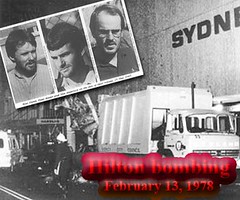
“On the 13th of February 1978 at 12:40 am, a massive bomb which had been placed in the rubbish bin outside the Sydney Hilton Hotel exploded, devastating a whole city block. Three people were killed and seven seriously injured. The noise of the explosion could be heard as far way as Bondi Beach. At the time, the Australian Prime Minister [Eminent Person Malcolm Fraser] and eleven visiting heads of state were resident in the Hilton Hotel. Right from the beginning the police said it was a terrorist conspiracy. They claimed the Ananda Marga religious sect was responsible. But for ten years, no person or group claimed responsibility, and the police by their own admission could find no evidence — not even enough to question anybody. At the same time, former police constable Terry Griffiths, a victim of the bomb blast, campaigned for a full and open inquiry. While recovering from his horrific injuries Griffiths received information which alleged it was the security forces themselves who were responsible for the blast, part of a sinister official conspiracy.

Through a series of stylised re-enactments and studio interviews Conspiracy tells the gripping and dramatic story of the Sydney Hilton Hotel bombing. A huge security operation had been mounted for what was the first Commonwealth Heads of Government Regional Meeting and yet the bombers somehow slipped through the cordon. Was the bomb itself made in a commonwealth government laboratory? Was a bomb disposal unit waiting nearby as part of a pre-arranged plan? Why were the Army bomb sniffer dogs called off just a few days before? Was there a police observation vehicle watching the hotel and did someone from that vehicle make the bomb warning call? Why were almost all of the bomb fragments simply swept up and thrown away? And why was a rubbish bin in a high security area left unchecked and unguarded?”

Enquiries to Paul O’Sullivan, Director-General, c/o ASIO, ASIO Central Office, GPO Box 2176, CANBERRA, ACT, 2601.

The spy agency is working with other federal agencies, state police and foreign intelligence agencies to weed out [?] trouble-makers… ahead of the meeting.

Prime Minister John HoWARd and NSW Premier Morris Iemma have both warned APEC will be a very big security concern.

Security for the event will cost Australian taxpayers a staggering $143 million, with the entire cost of the event estimated at more than $300 million.

NB. From the final day of the G20 Summit (November 19, 2006) to the first day of the APEC Summit (September 8, 2007) is 292 days. The number of children expected to die of poverty-related causes during this period is 8,760,000: their needless deaths are not expected to be at the top of the APEC agenda.

But honestly, who gives a shit?

Let them eat yellowcake!

See also : Pip Wilson on Lies, Spies and the Sydney Hilton Bombing. Published on February 13, 2003, to commemorate the 25th anniversary of the bombing. On ASIO, see Jenny Hocking’s Terror Laws: ASIO, Counter-Terrorism and the Threat to Democracy (UNSW Press, 2003). On APEC and protest, see, for example, David Webster’s analysis, The People’s Summit Challenges Asia-Pacific “Economies” (1997), recording events at the 1997 Summit, held in Vancouver, Canada.

Posted in !nataS, History, Media, State / Politics, War on Terror | 3 Comments

G20: Sixth protester charged

An oldie but a goodie: police have arrested and charged an individual attending court in support of a friend.

Alleged G20 protester caught at court
The Age [AAP]
December 11, 2006

Police have arrested another alleged G20 protester today after spotting her in Melbourne Magistrates Court, where she was supporting a friend.

Julia Dehm, 24, of Brunswick West, was arrested outside court and taken by police to be interviewed, while her friend, alleged G20 protester Danya Bryx, 22, made a successful bail application.

Bryx, an arts-law student at Monash University, is facing two charges of rioting, two of affray and two of reckless conduct endangering injury [/person?].

Police allege that as part of the protest, Bryx threw and pushed barricades at them, charged towards them and threw a metal pole.

Taskforce Salver Detective Senior Constable Paul Topham told the court that although Bryx was not charged with injuring anyone, she was there when a police officer’s wrist was broken.

He said Bryx wore a bandana over her face during the protest, and he gave a picture of a woman he claims is Bryx, to the court.

Bryx’s lawyer Gerard Lethbridge said his client would fight the charges, and that her identity would be an issue.

Magistrate Sarah Dawes released Bryx on bail on the condition that she live with her parents in Caulfield North and not leave the state or the country.

The court heard Bryx had been due to begin a scholarship overseas next year.

A police spokesman said Dehm was expected to appear in the same court this afternoon, charged with the same six offences [Hmmm. Seems to be a pattern: riot; affray; reckless conduct endangering persons].

She is the sixth person arrested in relation to the protest in Melbourne’s CBD on November 18.

The protests occurred on November 18 in streets surrounding the city’s Grand Hyatt Hotel, which was hosting the G20 summit of finance leaders from 19 countries plus the European Union.

Other protesters facing charges over the riot include Aki[n] Sari, 28, David Vakalis, 19, of East Brunswick, Rosalie Delaney, 19, of Parkville, and Dominic Richardson, 24, of Brunswick.

AAP

Posted in State / Politics | Leave a comment

Flames of Dissent

How excitement! The Eugene Weekly has published the fourth installment of Kera Abraham’s series on anarchists in Eugene…

PART IV : THE BUST

The dog’s barking punctuated a steady bang bang bang on the front door. It was 7 am, and Heather Coburn was not in the mood for this. She swung open the door to encounter dark-suited federal agents, who stoically informed her that they wanted to talk to her about her housemate, Jake Ferguson. When she refused, they flashed a search warrant and said they were going to tow her truck.

It was spring 2001, a peak time in Eugene’s eco-radical scene. The vandalism at the fall 1999 WTO protests, summarily blamed on “Eugene anarchists,” and the rowdy anti-establishment protests that followed — confrontations between black-clad anarchists and cops, broadcast by a pulse of locally based radical green media — had catapulted this damp little city to international infamy. Some of the more extreme [radical?] activists were calling for revolution against “Earth-raping” [Would “Earth-loving” be more appropriate?] corporations and the government by any means necessary, and a surge of arsons claimed by the Earth and Animal Liberation Fronts told the world that they were serious…

“Check back on December 21 for Part V : The Aftermath“. For previous installments, see : Careful With that Axe, Eugene.

Posted in Anarchism, History, State / Politics, War on Terror | Leave a comment