The Inconvenient Death of Brad Will

Sarah Ferguson
Village Voice
November 14, 2006

The last time I saw independent journalist and activist Brad Will was in September in an East Village yoga studio. I turned my head and found him lying on the mat next to me in the darkened room, his pale, flat stomach rising and falling serenely with the rhythm of his breathing. So on October 27, when I saw the photos posted on the Internet showing the 36-year-old Will’s mortally wounded body laid out on a street in Oaxaca, Mexico, I cringed. There was that same pale, flat stomach now punctured by a bullet.

Around the world, activists and friends who knew Will—and many people who didn’t—were having the same visceral reaction. Within hours of his shooting by plainclothes gunmen firing on a group of striking demonstrators, images of his murder ricocheted around the Web. There were photos of Will’s limp body being carried through the streets by frantic demonstrators screaming for help. Equally shocking were the pictures posted by El Universal and other Mexican media showing his alleged killers firing brazenly into the crowd, as if aiming at the cameras. The same gunmen who shot Will also wounded a photographer for the Mexico City daily Milenio, who was at Will’s side.

When images of the shooters aired on Mexican TV, viewers began phoning in to identify the gunmen. They have since been confirmed in the media as the police chief and two officers from Santa Lucia del Camino, the municipality where Will was shot, along with the town councillor for the state governing party, his chief of security, and the former head of a neighboring barrio.

Then came the most horrifying evidence of all: Will’s final videotape, uploaded on the Web the next day. In his zeal to capture the state-backed repression of the popular uprising that has rocked Oaxaca for the last five months, Will succeeded in recording his own murder.

Armed with an HD camera he had picked up on eBay, Will went to Oaxaca to document the broad-based movement of striking teachers, peasants, urban residents, and left-wing forces that had seized control of government offices and taken over the central square to demand the removal of governor Ulises Ruiz.

But by becoming the first American journalist killed in the unrest, Will became a pretext for Mexican president Vicente Fox to send in 4,000 federal police officers to put down the revolt, which Fox characterized as “radical groups, out of control,” who “had put at risk the peace of the citizenry.” Since then at least two more protesters have died in the heavy clashes with federal police, who stormed the barricades with tear gas and water cannons, and more than 80 demonstrators have been arrested as the federales continue to vie for control of the city…

Read more.

Posted in Anarchism, Media | Leave a comment

Go Jeff!

Win, lose or draw, Jeff “The Snowman” Monson is a fuckin’ champ…

Monson Keeping Things in Perspective before the Big Fight
Thomas Gerbasi
[http://www.ufc.com]
November 13, 2006

These days, each interview begins the same for Jeff Monson. Every one, without fail, starts with a question about the 11 inch height discrepancy between the 5’9″ Monson and his 6’8″ opponent this Saturday [November 18], UFC heavyweight champion Tim Sylvia. That can get tiring.

“Oh my God, I’m very tired,” he chuckles. “It’s the first question everybody asks. It’s like they have a sheet out and it’s the same question over and over.”

So. I guess I’ll have to re-phrase a bit. Is fighting an opponent close to a foot taller for the heavyweight championship much ado about nothing?

“No, it’s definitely something,” admits Monson, whose height hasn’t stopped him from compiling a pro MMA record of 24-5 that includes a 16 fight winning streak. “If he (Sylvia) didn’t use it to his advantage, then it wouldn’t be that big a deal, but he’s good at keeping people away and striking [at?] them, so it’s definitely a task, but it’s something where if I’m in tight, it could be to my advantage to be shorter.”

Then, if Monson can get inside and nullify Sylvia’s long distance striking, it’s anybody’s fight, since The Snowman‘s speed and world class grappling can then have a chance to be displayed. Have his advantages been ignored while Sylvia’s strengths are amplified?

“I think some people realize it and some people don’t,” said Monson. “It’s one of those things where who knows what’s gonna happen in a fight. I’ve just prepared well and I’m sure he’s prepared well, so I’ve just got to take the fight where my strengths are and I think the winner will be determined by where the fight plays out more.”

It’s a simple deduction, but then again, a lot of aspects of the fight game which seem complex can be boiled down to simpler terms when two fighters of a high level clash, and many times, the difference between winning and losing can come down to who ran the extra mile or who is on point mentally once the bell rings. In this case, it may come down to who had the better camp – Sylvia with Iowa’s famed MFS Elite squad, or Monson with Florida’s highly regarded American Top Team. Monson agrees that when it comes to his success, his training team plays a huge role.

“There’s really no secret,” he said, when asked how he’s been able to stay at a high level in a fickle sport like MMA and win 16 fights in a row. “It’s just hard work, forgetting about ego. I’m working with a great team in American Top Team, and I’m put in a position where I’m getting beat up, kicked, punched, or submitted in practice all the time, so it makes you better. That degree of skill and aptitude in the room just makes you better.”

Like most mixed martial artists, Monson is quick to deflect praise from himself while humbly giving credit to others for his success – something you rarely see in other sports, where it’s always ‘me, me, me’. In the culture of this sport though, it’s very team-oriented – despite the fact that the athletes compete alone – and even those who are fighting each other have an odd respect and camaraderie. It’s just another way the stereotypes of prizefighters are being shattered each time people get to interact with or listen to them.

Take Monson for example. As imposing as the tattooed heavyweight title challenger may appear, he is a holder of Master’s and BA degrees in Psychology, and is one of the most – if not the most – politically active athletes competing today. Yet his anti-war stance has drawn fire in the past, and even recently, Saturday’s opponent, Sylvia, told FoxSports.com‘s Dave Doyle, “He (Monson) disrespects our soldiers and our country and our President. I’ve been out to talk to soldiers and they deserve all the support they can get. I want to go out and teach this guy a lesson.”

Monson begs to differ though.

“Everyone knows I’m against the war, but hopefully I can win and use it as a platform to say let’s come together and support our troops in a way to get them home, and take care of one another and use our money for education and that type of thing, instead of necessarily bashing certain institutions or people in government,” he said. “I want to promote a positive message.”

And strangely enough, given the recent election results, Monson’s views may find wider acceptance now.

    The angry electorate

    According to the New York Times‘ exit polls, six in ten voters said their vote was based on national, not local, issues. The same percentage disapproved of the war in Iraq and said the war had not increased the security of the United States. Six in ten voters also disapproved of the way Congress was handling its job. Six in ten voters who described themselves as “independents” voted Democrat, while two-thirds said they were dissatisfied or angry with Republican leaders.

    There was also a class component to the Democrats’ victories. About half of all voters said they had just enough money to continue at their present standard of living (otherwise known as living a paycheck or two away from poverty), while one-fifth said they were falling behind financially…

“I think people are more receptive to it, but the thing I think though is that a lot of times – and everybody’s different – if you have someone who goes to work for 40 hours a week, comes home, watches a little TV, puts the kids to bed, and all that, they probably want to hear a more positive message. I just want to send a message that we can do this thing ourselves. Let’s put the pressure on and get together, not to just focus on this one guy, but on the fact that we want our soldiers home. Let’s support them that way.”

It’s not what you usually expect from a pre-fight interview, but then again, that’s precisely the point that was made a few paragraphs back. These guys aren’t strictly about what happens during competition, and the various views and interests of each athlete in the sport is what makes it worth covering.

“I know the guys on my team are really smart individuals that have a lot of good things to say and I’m not talking about things in support of what I’m doing, because I haven’t talked to a lot of fighters about these issues,” said Monson. “But I know there are a lot of smart guys out there that have families and careers outside of fighting, and to be able to show that we’re not just gladiators or fighters out there entertaining is a good thing. We do have other parts of our lives that are important. So if I can contribute in some way to that, even in a little way, I think that’s good. I know a lot of guys are involved in charities as well, and there are a lot of standup guys. I have a friend with cancer and a lot of guys came forward out of the woodwork, signing shorts and offering support – guys I had never met, some I did know, and there was really a lot of support and it touched me and touched him. A lot of people don’t know that, and we’re real people and have real concerns and if I can contribute in some way to get the guys known as more than just fighters, then I’m all for that.”

The mainstream has responded, with Monson making a recent appearance in Rolling Stone magazine [the 2006 ‘Hot List’?!?] and appearing on a talk show with Audioslave‘s Tom Morello and System of A Down‘s Serj Tankian.

“It’s just part of the job really,” he said. “I do like talking to people and I’ve got to meet a lot of different people, and you get to talk about other things besides just fighting, which I like. So it’s been a good experience.”

Now all he has to do is win the UFC title on Saturday night and his journey will be complete. Or will it? Don’t bet on hearing that from Monson, who admits that he’s “never satisfied.”

“It means a lot, but a lot of it is what people put on it,” said Monson of winning the belt. “To be the UFC heavyweight champ would be a dream come true – it would be great, and it’s not just another fight, but in a way it is just another fight and it’s an event that I don’t want to lose. I can go to the NAGA and have four little matches against guys I don’t know, but I don’t want to lose there either. This is the same thing and I don’t want to lose and I’m gonna do everything I can to prevent that from happening because I can’t deal with losing. It’s big, but I try to keep it in perspective.”


Posted in Anarchism | Leave a comment

G20 (and other professional foreign agitators)

Ask and ye shall receive: Rich businessmen and politicians have succeeded where poor environmentalists have failed, Government authorities yesterday (November 14) declaring — in preparation for the G20 meeting this weekend — the Melbourne CBD off-limits to (parked) cars (ABC; The Australian). Yet another reason to applaud the G20 — which, according to Peter Costello, seeks to eradicate poverty. On this subject, Costello (and Abbott) would do well to give serious consideration to the WTO’s recent proposals with regards grossly inefficient African workers. The new industrial relations regime — yesterday, as expected, given the official stamp of approval by the High Court — is certainly a step in the right direction, but it would be mistaken for The Man Who Will Never Be PM to rest on his WASP laurels, and making Australian workers more productive is — let’s face it — a never-ending and largely thankless task.

Well, apart from the large sums of filthy lucre.

A typical example of the dull, routine analysis which serves to obscure both fabulous wealth and the grinding poverty it depends on for its generation is provided by technocrat Tim Harcourt, ‘New world order comes to Melbourne’, The Age, November 15, 2006; some token acknowledgement of the death and destruction being crafted by neo-liberal forums such as the G20 may be found in a ‘Call for debt relief, financier [?] reform’, Andra Jackson, The Age, November 15, 2006.

Another party which cannot afford to rest on its laurels is Dr. James Saleam‘s Australia First Party. Following its success in Adelaide, the party party party has announced its candidate for the NSW state electorate of Cronulla: John Moffat. Like Bruce Preece, this is the second time Moffat has stood for the AFP, the last occasion being in March 2003. Then Moffat got 814 votes.

Posted in Uncategorized | Leave a comment

‘Compassionate Slavery’ Market for Africa: WTO

November 13, 2006
FOR IMMEDIATE RELEASE

WTO ANNOUNCES FORMALIZED SLAVERY MARKET FOR AFRICA

US Trade Representative to Africa, Governor of Nigeria Central Bank, weigh in at Wharton…

Philadelphia – At a Wharton Business School conference on business in Africa, World Trade Organization representative Hanniford Schmidt announced the creation of a WTO initiative for “full private stewardry of labor” for the parts of Africa that have been hardest hit by the 500 years of Africa’s free trade with the West.

The initiative will require Western companies doing business in some parts of Africa to own their workers outright. Schmidt recounted how private stewardship has been successfully applied to transport, power, water, traditional knowledge, and even the human genome. The WTO’s “full private stewardry” program will extend these successes to (re)privatize humans themselves.

“Full, untrammelled stewardry is the best available solution to African poverty, and the inevitable result of free-market theory,” Schmidt told more [than] 150 attendees. Schmidt acknowledged that the stewardry program was similar in many ways to slavery, but explained that just as “compassionate conservatism” has polished the rough edges on labor relations in industrialized countries, full stewardry, or “compassionate slavery,” could be a similar boon to developing ones.

The audience included Prof. Charles Soludo (Governor of the Central Bank of Nigeria), Dr. Laurie Ann Agama (Director for African Affairs at the Office of the US Trade Representative), and other notables. Agama prefaced her remarks by thanking Schmidt for his macroscopic perspective, saying that the USTR view adds details to the WTO’s general approach. Nigerian Central Bank Governor Soludo also acknowledged the WTO proposal, though he did not seem to appreciate it as much as did Agama.

A system in which corporations own workers is the only free-market solution to African poverty, Schmidt said. “Today, in African factories, the only concern a company has for the worker is for his or her productive hours, and within his or her productive years,” he said. “As soon as AIDS or pregnancy hits–out the door. Get sick, get fired. If you extend the employer’s obligation to a 24/7, lifelong concern, you have an entirely different situation: get sick, get care. With each life valuable from start to finish, the AIDS scourge will be quickly contained via accords with drug manufacturers as a profitable investment in human stewardees. And educating a child for later might make more sense than working it to the bone right now.”

To prove that human stewardry can work, Schmidt cited a proposal by a free-market think tank to save whales by selling them. “Those who don’t like whaling can purchase rights to specific whales or groups of whales in order to stop those particular whales from getting whaled as much,” he explained. Similarly, the market in Third-World humans will “empower” caring First Worlders to help them, Schmidt said.

One conference attendee asked what incentive employers had to remain as stewards once their employees are too old to work or reproduce. Schmidt responded that a large new biotech market would answer that worry. He then reminded the audience that this was the only possible solution under free-market theory.

There were no other questions from the audience that took issue with Schmidt’s proposal.

During his talk, Schmidt outlined the three phases of Africa’s 500-year history of free trade with the West: slavery, colonialism, and post-colonial markets. Each time, he noted, the trade has brought tremendous wealth to the West but catastrophe to Africa, with poverty steadily deepening and ever more millions of dead. “So far there’s a pattern: Good for business, bad for people. Good for business, bad for people. Good for business, bad for people. That’s why we’re so happy to announce this fourth phase for business between Africa and the West: good for business–GOOD for people.”

The conference took place on Saturday, November 11. The panel on which Schmidt spoke was entitled “Trade in Africa: Enhancing Relationships to Improve Net Worth.” Some of the other panels in the conference were entitled “Re-Branding Africa” and “Growing Africa’s Appetite.” Throughout the comments by Schmidt and his three co-panelists, which lasted 75 minutes, Schmidt’s stewardee, Thomas Bongani-Nkemdilim, remained standing at respectful attention off to the side.

“This is what free trade’s all about,” said Schmidt. “It’s about the freedom to buy and sell anything–even people.”

Posted in State / Politics | 4 Comments

The Great Australian Bikini March

Weird shit.

‘Nationalist’ Australian clothing company True Blue Productions — which, while claiming to be “100% Aussie”, uses t-shirts manufactured overseas by Gildan Activewear* — is engaged in a guerilla advertising campaign called ‘The Great Australian Bikini March’. According to ‘Christine Hawkins’, “outraged Australian women and their male supporters will reassert Australian values by taking to the streets in a bikini march on… mosques on Saturday December 9, 2006”. In Melbourne, Christine claims that “the march will end at the Islamic Information & Support Centre of Australia in Brunswick, headquaters of Sheik Mohammed Omran“.

The march follows hot-on-the-heels of another attempt (by the same company) to cash-in on Sheik Hilaly‘s well-publicised comments likening women to ‘uncovered meat’:

‘Uncovered meat wear’
The Daily Terror
November 9, 2006

WOMEN are being encouraged to “show the Sheik how things really are and Sheik your booty in this quality infidel clothing”.

An entrepreneurial Sydney man is cashing in on the controversy surrounding outspoken cleric Sheik Hilaly by flogging a range of “uncovered meat” t-shirts, aprons and g-strings.

Sold through US online site cafepress.com, the apparel [boasts] a pink cat embossed with the words “uncovered meat”.

Even if the event flops, which it will (who the hell wants to march to a mosque in a bikini?), it’s certain to draw attention to the fledgling business, contribute to economic growth, and be welcomed by all Right-thinking columnists.

    *True Blue reckon Gildan Activewear sell fair dinkum ‘non-sweat’ apparel, the company having received the tick of approval from WRAP. In reality, the Worldwide Responsible Apparel Production Certification Program (WRAP) is an industry controlled initiative of the American Apparel and Footwear Association, and has little support or credibility among human rights, faith, women, labour or non-governmental organizations. Such initiatives take the lowest common denominator approach on labour standards to gain buy-in from all member companies, and provide no information to the public on where products are made or the results of factory audits.

    Recent news on Gildan Activewear is available via the labour rights monitoring project the US-based Workers Rights Consortium: Final Update Report on Gildan Activewear (Honduras), 27 July, 2006 [PDF].

Posted in !nataS, Sex & Sexuality, State / Politics | 12 Comments

Commie chief inherits £20.5m

The Sun
November 11, 2006

The leader of Britain’s Communist Party has become a multi-millionaire — inheriting a £20.5 million painting that had been stolen by the Nazis.

Anita Halpin’s huge windfall came when Berlin Street Scene, by German artist Ernst Kirchner, was sold at auction.

It was snatched from the home of her German grandparents in 1936, but was returned to her as sole surviving heir under Nazi restitution laws.

Ms Halpin, 62, lives in Bow, East London. Asked how she would spend the cash, Ms Halpin, whose party believe in spreading wealth equally, said: “It’s too early to call — let’s leave it at that”.

The picture sold to New York’s Neue Galerie after frenzied bidding at Christie’s in Manhattan.

See also : ‘Communist chief joins the rich list with £20.5m for masterpiece’, The Times, November 10, 2006; ‘Comrades, fellow tankies, let’s not fall out over £20m’, The Sunday Times, November 12, 2006

Posted in !nataS, Trot Guide | Leave a comment

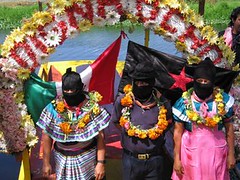
¿Qué está sucediendo en América Latina?

What’s happening in Latin America?

Stories and films in a friendly environment — music by DJ Mono.

Featuring:

+ Rosa del Carmen Curihuentro : journalist and Mapuche indigenous activist from Chile + Heriberto Salas : ‘People for the Defence of the Earth’ and ‘the other campaign’, Mexico + Maria de Lourdes Vicente da Silva : Landless Workers’ Movement (MST), Brazil

When: Friday, 17th November, 7:00 pm
Where: Lentil as Anything, Abbotsford Convent, 1 St Heliers St., Abbotsford
Entry: $5
Food: Pay as you feel
More Info: 0402 754 818 // 9419 6444
Organisers: Lentil as Anything and the Latin American Solidarity Network

From the foundation of Via Campesina in 1993 and the Zapatista uprising a year later in 1994, to the birth of the World Social Forum in 2001 and the current electoral swing against neo-liberalism, Latin America has been a crucible for international movements against market globalism. This Forum brings together three members of these movements – from Mexico, Chile and Brazil – to share stories and insights.

Heriberto Salas is a representative from ‘People for the Defence of the Earth’, which has spearheaded the resistance against the forced removal of the community to make way for a new airport in Mexico City. Recently this movement has engaged with ‘the other campaign’, initiated by the Zapatistas, and been met by massive police repression and killings.

Rosa del Carmen Curihuentro is a journalist and a Mapuche indigenous activist who is heavily involved in the struggle against the theft of Mapuche lands by transnational corporations in the south of Chile.

Maria de Lourdes Vicente da Silva is an organiser with the Landless Workers Movement (MST) in Brazil, which has seen the distribution of millions of acres of land to landless workers across the country.

See also : incendio (wildfire) : una publicación de solidaridad y teórica Latinoamericana (a bilingual journal of Latin American theory & solidarity)

The Melbourne Social Forum has also organised an event — a ‘G20 Alternative’ Forum — for Sunday, November 19:

The open public meeting is a democratic alternative to the closed G20 meeting that will be held in Melbourne at the same time. The G20 Alternative Forum will focus on open space workshops promoting alternative policy, and addressing debt relief, poverty reduction, climate change, and more generally renewing strategies of the global justice / alter-globalisation movement. There will also be an opportunity to hold workshops.

Location: Royal Melbourne Institute of Technology (RMIT)
Speakers / large group dialogues: RMIT’s Casey Plaza (Bowen St, off La Trobe St)
Workshops: RMIT Building 37 (corner Swanston St. and A’Beckett St)
Food: RMIT’s Student Union Function Room (off Swanston St.) provided by Lentil as Anything

Posted in Film, History, Music, Poetry, State / Politics | Leave a comment

Relaxed… comfortable… ASIO

ASIO has just released its Annual Report to Parliament for the (financial) year 2005-06. Dale Mills (Green Left Weakly, November 10, 2006) has courteously provided the public with a brief summary, relaxedly and comfortably titled ‘ASIO steps up surveillance of activists’. Under the rubric of ‘local politically motivated violence'(!), the report refers to ASIO’s role in monitoring protests at last year’s Forbes conference, the disruption of “Australian Defence Force recruitment stalls at universities in Queensland and Victoria” this year, and identifies the upcoming G20 protests in Melbourne (November 18/19) and expected protests at the APEC conference in Sydney next year (September 8/9) as being of particular concern to it. (As well it might, given the APEC conference’s designation as being “the most significant security event ever held in Australia”.)

The bulk of the report, however, goes on (and on and on) about Islamic terrorism, and the measures ASIO is taking to prevents its irruption in Australia.

Also of interest is the fact that while the Kurdistan Workers’ Party (PKK) may now be the nineteenth organisation proscribed (December 2005) by ASIO as ‘terrorist’, it’s still got a pretty snazzy website. Decidedly unimpressed by their creative design skills and lack of English, the Attorney-General, Montgomery Burns, nevertheless pronounced the PKK a terrorist group one week after the visit of the Turkish Prime Minister, Recep Erdogan, to Australia.

This was, of course, a complete coincidence. Further, the Turkish state has a long history of defending the rights of ethnic Kurds, Carlton is a great football club, and I’ll be voting for Family First next weekend.

In other, um, ‘news’, the report by Ian Carnell, Inspector-General of Intelligence and Security, November 29 2005, into Scott Parkin‘s arrest and deportation makes for fun reading; especially in light of the recent decision by a meddling judge to allow him access to documents purporting to demonstrate that his presence in Australia was a ‘threat to national security’. Carnell notes that “it is important that most, if not all, of the substance of security assessments not be put in the public domain”. In more detail, under ‘Methodology’:

18. One of the difficulties of inquiring into intelligence and security matters and reporting outcomes is that much material is, by its nature, very sensitive. The protection of collection methodologies and various sources means that there are appropriately circumstances in which disclosure cannot be made. In balancing security aspects against natural justice considerations, there are circumstances where it has traditionally been accepted that it is in the overall public interest for security considerations to be given precedence. The current situation is one such occasion.

19. While the precepts of natural justice would point to providing Mr Parkin with the details of the security assessment and allowing him to respond and suggest ways in which the evidence and considerations might be tested, security considerations of the kind described above would appear to reasonably preclude this. Even to attempt to allude in general terms to the elements of the security assessment would be problematic in this way.

20. I appreciate that Mr Parkin and others with doubts about his treatment will most likely find this vexing, but it is inevitable given the nature of the matter being examined.

Actually Ian, it’s not ‘inevitable’. But such an attitude on the part of an office which is ostensibly committed to overseeing ASIO’s operations does suggest that, in the contemporary political climate, intelligence agencies really do think that they’re above the law. And, generally speaking, they are. But not always

    Kent Brockman: Professor @ndy, without knowing precisely what the danger is, would you say it’s time for our viewers to crack each other’s heads open and feast on the goo inside?
    Professor @ndy: Yes I would, Kent.
Posted in State / Politics, War on Terror | Leave a comment

Trot Guide to Victorian State election (November 25)

Exciting times at Trot Guide!

1) The DSP-dominated Socialist Alliance is fielding a grand total of four candidates this election: Margarita Windisch in Footscray; Vannessa Hearman in Brunswick; and Sue Bull and Rowan Stewart in the Western Victoria (Upper House) region. All four are members of the DSP. NB. In 1998, Hearman ran for the Victorian Senate on a joint ticket with Jo Williams; Williams got 2,264 votes, Hearman 30 | Sue Bull is a veteran campaigner: in 1993 she received 763 votes (01.1%) for the Federal seat of Prospect in NSW; in 1996, 1,508 votes (02.3%) for the Federal seat of Canberra in the ACT; and in 1998, 1,214 votes (01.3%) for the Federal seat of Fraser, also in the ACT.

2) The Socialist Party is only half as good as the Socialist Alliance, and is therefore only (allegedly) standing two candidates: Steve Jolly in Richmond and Andrew Calleja in the Northern Metropolitan (Upper House) region. NB. Calleja does not appear to appear on the ballot… Jolly stood for the Federal seat of Melbourne in 2001, gaining 1,260 votes (01.5%); and in 2005, the State seat of Richmond, gaining 544 votes (02.0%).

3) Jorge Jorquera (ex-DSP, es-MSN, DA // W&CF) is standing for the seat of Derrimut. NB. In 1999, Jorquera stood for the seat of Melbourne and gained 1,986 votes (05.7%), coming third of three candidates; while in 1998, Jorquera contested the Federal seat of Gellibrand, receiving 963 votes (01.3%).

4) The Socialist Equality Party also has a candidate: Will Marshall for the Melbourne electorate of Broadmeadows. NB. In 1998, Will stood for the Victorian Senate alongside his comrade Sue Phillips. Phillips got 1,368 votes and Will… 24. Making a grand total of 0.0034%.

Hooray!

And in good news for the fascist Australia First Party, its candidate in local council elections for the St Johns Wood Ward of Prospect in Adelaide, South Australia, Bruce Preece, obtained 341 votes this weekend, and appears to have won a seat on the local council. A tremendous boost in his and the AFP’s quest to help keep Australia White, one local council at a time.

Congratulations church-going citizens of Adelaide! Two Wongs don’t make a White!

Posted in State / Politics, Trot Guide | Leave a comment

Treaty a real Downer for West Papua

Fishnet-stocking wearing Adelaide private schoolboy and Australian League of Rights alumnus turned Foreign Minister Alexander Downer has taken the courageous step of securing Australia’s territorial integrity by signing a treaty with the Indonesian Government.

So much for the People’s Republic of Brunswick.

*sigh*

But wait, there’s more!

According to Mark Forbes (‘Security pact to aid Indons with nuclear power’, The Age, November 8, 2006):

AUSTRALIA will help Indonesia to develop a nuclear program, conduct joint border-protection patrols, expand military and intelligence ties and agree to suppress Papuan independence supporters under a historic security treaty to be signed on Monday [November 13].

The Australian Government’s gross hypocrisy in signing “The Indonesia and Australia Framework for Security Cooperation” is perhaps rivalled only by the notorious act of bastardry committed by former Foreign Minister Gareth Evans (“Professor Genocide”) in signing a treaty in 1989, dividing up the spoils of East Timor‘s oil reserves with the then Indonesian Foreign Minister, Ali Alatas. In 2004, reflecting on the making of his documentary film Death Of A Nation (1994), John Pilger commented that:

For me, the most telling and shocking sequence in Death of a Nation had been filmed five years earlier on board an Australian air force plane. A party was in progress; champagne corks popped and there was much false laughter as two fawning men in suits toasted each other. One was Gareth Evans, then Australia’s foreign minister. The other was Ali Alatas, his Indonesian equivalent and Suharto’s mouthpiece. “This is an historically unique moment,” waffled Evans, “that is truly, uniquely historical.” Flying over the Timor Sea, they had just signed the Timor Gap Treaty, which allowed Australian and other foreign companies to exploit the seabed belonging to the land of black crosses and to their victims. The ultimate prize, as Evans put it, could be “zillions” of dollars.

In a denial that’s as good as an admission, Defence Minister Brendan Nelson has stated (The Age, November 12, 2006) that the treaty will not result in the Australian Government being in any way, shape or form complicit in the routine acts of political repression that take place within Indonesia’s claimed boundaries. Sources close to the Tory Party, however, suggest that even teenaged neo-conservatives are sceptical, but remain rock-solid in their support for their political master’s latest attempts to reassure Indonesian elites that 43 is simply 43 too many, and that the people of West Papua can go fuck themselves.

    New Internationalist (April, 2002) provides some background information on the struggle for West Papuan autonomy here; FREE WEST PAPUA provides ongoing accounts; the Australian section of The International Commission of Jurists are Not Happy, John!; while The Age (October 26, 2006) carries a report on the fate of those who disobey HoWARd and question his Divine Right to determine who comes to this country, and the manner in which they are subsequently tortured.
Posted in History, State / Politics, War on Terror | Leave a comment