imminent rebellion : kiwi @ zine : #9 : may 2008

imminent rebellion is an anarchist journal that seeks to provide a space for thoughtful, critical and well-researched writing that illuminates struggles and projects otherwise overlooked in the South Pacific, that delves deeper into the anarchist project, and that seeks to illuminate the operations of Power [It’s a quack who’s gone to the dogs]. It is also a space for creative responses to our contemporary situation — poetry, photography, firsthand accounts.

The focus of the journal is to provide an intelligent yet accessible interrogation that is relevant to our region.

imminent rebellion started in December 2003 as a small ‘zine and continued bimonthly, changing its name to Aotearoa Dissident Voice for issue 6, until going into hibernation in early 2005. It has since been relaunched in May 2008 in a more substantial journal format.

Inlcuding articles about ‘Operation 8’ and from the perspective of some of those arrested, an analysis of the 2006 Tongan riots, a critique of Identity Politics and another of NGOism-style politics. Also a consideration of what an anarchist design practice could look like, an attempt to reconsider how to better support survivors of abuse, and a critique of activism, and others still.

Download the journal body (PDF 9.7mb) or buy online.

Individual articles are also available as simple HTML:

* My 15th October
* Ballad of an Ungrateful Immigrant
* The Tongan Riots
* Know your Rights, These are your Rights
* Operation 8 — How the Police Watched Us
* Fuck Me Like The Whore I Am
* From the Streets, to the Cells, and Back Again
* A Critique of NGOism
* Lake Waikaremoana — Back in Tuhoe Hands
* For Revolutionary Struggle, Not Activism
* Why is it so Hard to Support Survivors?
* Towards an Anarcho-Design Practice
* Behind German Borders
* Dangerous Foundations: An argument against the ‘Identity’ in Identity Politics

… go you good thing …

Posted in Anarchism | 1 Comment

Shock horror et cetera… Privatisation is good for working families*

As expected, the NSW Labor caucus has (again) approved the privatisation of the NSW electricity system, against the wishes of the great majority of delegates to the recent Party conference, and without even a a whimper of dissent (Electricity dissidents face expulsion from party: Iemma, Andrew Clennell and Brian Robins, The Sydney Morning Herald, May 16, 2008). Australian Manufacturing Workers’ Union (AMWU) NSW Secretary Paul Bastian reckons “All the unions are united in their opposition to this and we know we have the support of the public. Eighty-five per cent of the people of NSW are opposed to this sale” (Unions stand strong against power sell-off, The Guardian, May 14, 2008). Meanwhile, Morris has pissed off to China, presumably to help flog off state assets (Iemma denies power sell-off behind China trip, ABC, April 17, 2008). “Unions NSW boss John Robertson reckons “a state-wide day of protest is being planned and communities will be asked to vigorously lobby their MPs”, while Greens ‘John Kaye thinks there is still a chance of defeating the legislation. “We only need three ALP backbenchers to cross the floor,” he said’.

The moral of this story? Don’t fuck with Costa.

The Labor Party is Australia’s oldest and largest political party.

Established in 1891, Labor has a proud history of achievement for the working families of Australia. Today the Party plays an important role in providing greater opportunity and a fair go for all Australian working families.

The Australian Labor Party is a political Party which aims to improve the lives of working families and to protect working families from exploitation. Perhaps what Labor stands for is best expounded by that greatly loved Labor Australian Prime Minister, Ben Chifley when he spoke to the NSW ALP Conference in 1949.

“…the job of getting the things the working families of the country want comes from the roots of the Labour movement – the working families who support it because they believe in a movement that has been built up to bring better conditions to working families. I try to think of the Labour movement, not as putting an extra sixpence in the pockets of working families, or making working families Prime Minister or Premier, but as a movement bringing something better to working families, better standards of living, greater happiness to working families. We have a great objective – a new fluro bulb on the hill – which we aim to reach by working for the betterment of working families not only here but anywhere we may give working families a helping hand. If it were not for that, the Labour movement would not be worth fighting for. If the movement can make working families more comfortable, give some working families a greater feeling of security for their children, a feeling that if a depression comes there will be work, that the Government is striving its hardest to do its best for working families, then the Labour movement will be completely justified.

Did I mention working families?”

~ The Fluro Bulb Powered By A Privatised Electricity System On the Hill Speech

*Transnational capitalist ruling class.

Posted in State / Politics | Leave a comment

Resistance is Utile: Critchley responds to Zizek (Harper’s Review, May 2008)

For what it’s worth, and ‘cos I mentioned it previously, I thought I might as well post the letter Simon Critchley sent to Harper‘s regarding Slavoj Žižek’s review of his latest treatise, Infinitely Demanding. The review, along with a response by David Graeber, can be read here.

Here ’tis (by way of Eric H):

Letter to Harper’s Magazine, May 2008

Oddly enough when I read Slavoj Žižek’s critique of my book Infinitely Demanding [“Resistance is Surrender”, Readings, February], a copy of Lenin’s State and Revolution was sitting on my desk at home. One of the striking features of Lenin’s text is that for all the venom he spews at liberals, social democrats and the bourgeoisie, it is nothing compared to what he reserves for his true enemy, the anarchists.

As Carl Schmitt reminds us — and we should not forget that this fascist jurist was a great admirer of Lenin’s — there are two main traditions of non-parliamentary, non-liberal left: authoritarianism and anarchism. If Žižek attacks me with characteristically Leninist violence for belonging to the latter, it is equally clear which faction he supports. Žižek begins his essay by listing various alternatives on the left for dealing with the behemoth of global capitalism. This list initially seems plausible — indeed some of it appears to have been lifted unacknowledged from the conclusion of my book — until one realizes what it is that Žižek is defending; namely, the dictatorship of a military state.

In State and Revolution, Lenin cleverly defends the state against anarchist critiques in favor of its replacement with a form of federalism. He appears to agree with anarchists in stating that we should destroy the bourgeois state, then subsequently asserts that a centralized workers’ state should be implemented in its stead. The first notion is faithful to Marx and Engel’s idea of the withering of the state, but Lenin diverges from their line of thinking when he argues that this can only be achieved through a transitional state (somewhat laughably called “fuller democracy” by Lenin in one passage and “truly complete democracy” in another). Lenin sees an authoritarian interlude as necessary in order to realize the possibilities of communism, but as history has shown, this “interlude” was a rather long and bloody one.

For authoritarians such as Lenin and Žižek, the dichotomy in politics is state power or no power, but I refuse to concede that these are the only options. Genuine politics is about the movement between these poles, and it takes place through the creation of what I call “interstitial distance” within the state. These interstices are neither given nor existent but created through political articulation. That is, politics itself is the invention of interstitial distances. I discuss various examples of this phenomenon, such as civil-society groups and indigenous-rights movements in Mexico and Australia, in Infinitely Demanding. I would now also mention Bolivian President Evo Morales, who is directly answerable to certain social movements in his country. I am even sympathetic to the alternative-globalization and antiwar movements so despised by Žižek for their alleged complicity with established power, because, despite their flaws, they remain crucial to the articulation of a new language of civil disobedience. In the coming decades, as we experience massive and unstoppable population transfers from the impoverished south to the rich north, we will require this language to address the question of immigrant-rights reform in North America and Europe.

For Žižek, all of this is irrelevant; these forms of resistance are simply surrender. He betrays a nostalgia, which is macho and finally manneristic, for dictatorship, political violence, and ruthlessness. Once again, he is true to Lenin here, as when the latter calls for the bourgeoisie to be “definitively crushed” by the violent armed forces of the proletariat. Listen to Žižek’s defence of Chávez’s methods, which must be “fully endorsed”:

Far from resisting state power, [Chávez] grabbed it (first by an attempted coup, then democratically), ruthlessly using the Venezuelan state apparatuses to promote his goals. Furthermore, he is militarizing the barrios and organizing the training of armed units there. And, the ultimate scare: now that he is feeling the economic effects of capital’s “resistance” to his rule (temporary shortages of some goods in the state-subsidized supermarkets), he has moved to consolidate the twenty-four parties that supported him into a single party.

Here we observe the basic obsessive fantasy of Žižek’s position: do nothing, sit still, prefer not to, like Melville’s Bartleby, and silently dream of a ruthless violence, a consolidation of state power into one man’s hands, an act of brutal physical force of which you are the object or the subject or both at once. Perhaps I should remind Zizek, who considers himself a Lacanian, of what Lacan said to the Leninist students who heckled him at Vincennes in December 1969: “What you aspire to as revolutionaries is a master. You will get one.”

There is a serious debate to be had with Žižek about the question of violence, the necessity of the state, and the evolution of radical politics, given the seeming permanence of capitalism. Perhaps when Žižek gets beyond windy rhetorical posturing and his misapprehension of my position as “post-modern leftism” (I defy anyone to find a word in favor of postmodernism in anything I have written), we can begin to have that debate. I am not holding my breath.

Simon Critchley
The New School for Social Research
New York City

Oh yeah… I just discovered that Counago & Spaves already done gone published Critchley’s letter.

Grrr.

Anyway… Dunno if I agree with Critchley entirely on the question of whether or not, and to what extent, Lenin, “when he argues that [the withering of the state] can only be achieved through a transitional state”, actually departed from the road Marx and Engels set out on. For example:

“…no credit is due to me for discovering the existence of classes in modern society, nor yet the struggle between them. Long before me bourgeois historians had described the historical development of this struggle of the classes, and bourgeois economists the economic anatomy of the classes. What I did that was new was to prove: 1) that the existence of classes is only bound up with particular historical phases in the development of production; 2) that the class struggle necessarily leads to the dictatorship of the proletariat; 3) that this dictatorship itself only constitutes the transition to the abolition of all classes and to a classless society.” ~ Marx in a letter to Weydenmeyer (1852)

I’m also not convinced that “Bolivian President Evo Morales… is directly answerable to certain social movements in his country”; the relationship between President and people seems a little more conflictual than this might suggest. On the other hand, Morales’ government appears to have acted quite differently with regards grassroots social movements than the Chávistas have, and the anarchist content of these movements in Bolivia also appears to be reasonably strong (see ‘Anarchism and Indigenous Resistance in Bolivia: Interview with Silvia Rivera Cusicanqui’, October 16, 2007). Certainly, Morales is yet to blame ‘anarchists’ for ‘terrorist’ acts, which is what the Venezuelan government did in February. (On Bolivia, see also Mujeres Creando; on Venezuela, El Libertario).

Posted in Anarchism, State / Politics | 24 Comments

Seig Heil, Mrs Robinson!

Sorry. Couldn’t help myself. A x-post from FDB!

A little birdy in Gosnells, WA has chirped a little gossip in our ear.

What kind of gossip? Tawdry gossip, of course! The best kind.

According to our Gosnells gossip, after the unfortunate break-up of one Baron von Hund and his dear Lilith in late 2007, the aforementioned Lilith has hooked up with Scumfront Downunder poster Sirino.

Is there any truth to this rumour, dear readers? And is homewrecking an appropriate action for someone who claims to subscribe to traditional Aussie values?

The answers, please, to the usual address.
Fight dem back · 13 May 2008

Posted in !nataS, Anti-fascism | 13 Comments

The Punk Years

Huh. Just stumbled upon The Punk Years, a UK doco. Here’s Part One of the first episode:

And here’s Part Three of Episode Four, ‘A Riot of Our Own’, which examines more closely the emergence of ‘anarcho-punk’, and in particular the influence of CRASS:

Posted in Anarchism, Music, State / Politics | Leave a comment

Eric McDavid : Twenty Years Jail

‘Eco-terrorist’ gets 20 years for plotting bombing campaign
AFP

SAN FRANCISCO (AFP) — An “eco-terrorist” convicted of plotting to blow up or firebomb government and commercial buildings across California was on Thursday jailed for nearly 20 years, justice officials said.

Eric McDavid, 29, who was found guilty in March on conspiracy to damage or destroy property by fire and an explosive, was sentenced to roughly 19 and a half years prison at a hearing in Sacramento, northern California.

Two other co-conspirators, Zachary Jenson and Lauren Weiner, have already pleaded guilty in the case and are awaiting sentencing later this year.

Prosecutors said the three environmental militants had planned attacks on the US Forest Service’s Institute of Forest Genetics, a dam and fish hatchery, cellular telephone towers and electric power stations.

Bomb-making expertise was acquired from a book — “Poor Man’s James Bond” — which contains details of how to create home-made explosive devices, justice officials said. The three extremists were arrested in January 2006 after buying materials for the explosives and finalizing their targets, prosecutors said.

“Today’s severe punishment of nearly 20 years in federal prison should serve as a cautionary tale to those who would conspire to commit life-threatening acts in the name of their extremist views,” US Attorney McGregor Scott said.

Weiner will be sentenced on May 15, followed by Jenson on August 7.

Note that Eric’s conviction relied in large measure on the testimony of his two co-accused and, crucially, the testimony of a paid FBI infiltrator named “Anna”, whose spirited contribution to combating subversion was recently celebrated in Elle magazine.

Posted in War on Terror | Leave a comment

Leninist Party Faction vs. Democratic Socialist Party Perspective Alliance

    Update : For Bolsheviks, notes Trotsky, “there can be no contradiction between personal morality and the interests of the party, since the party embodies in his consciousness the very highest tasks and aims of mankind”.

    “DURING AN EPOCH OF triumphant reaction, Messrs. democrats, social-democrats, anarchists, and other representatives of the “left” camp begin to exude double their usual amount of moral effluvia, similar to persons who perspire doubly in fear. Paraphrasing the Ten Commandments or the Sermon on the Mount, these moralists address themselves not so much to triumphant reaction as to those revolutionists suffering under its persecution, who with their “excesses” and “amoral” principles “provoke” reaction and give it moral justification. Moreover they prescribe a simple but certain means of avoiding reaction: it is necessary only to strive and morally to regenerate oneself. Free samples of moral perfection for those desirous are furnished by all the interested editorial offices.

    The class basis of this false and pompous sermon is the intellectual petty bourgeoisie. The political basis – their impotence and confusion in the face of approaching reaction. Psychological basis – their effort at overcoming the feeling of their own inferiority through masquerading in the beard of a prophet.”

    “…Trotsky was commanding during the Civil War from his armored train. He traveled 100,000 kilometers in it over three years. It had mounted machine-guns, light artillery, a printing press, a radio for broadcast and a flatbed for his Rolls Royce command car. He carried a large amount of tobacco and a brass band on the train to heighten morale of the troops.” On a lighter note, Trotsky also expressed his distaste for the use of ‘foul language’ by the railwaymen who transported him hither and thither: “I consider that a Red warrior, as a fighter for lofty aims, should behave on an armoured train as befits a place of lofty service, and not as though he is in a low tavern” (Order to the Red Army, August 7, 1919, No.140, Konotop).

¡La Lucha Continúa!

Not unexpectedly, the recent split from / expulsion of the Leninist Party Faction (LPF) has produced a flurry of activity on teh Interwebs, both among the parties (and factions) concerned, leftist trainspotters, and er, concerned communists citizens. A sample:

Are you obsessed with sects?, Larvatus Prodeo
Australian DSP divides, Ozleft
AUSTRALIA – DSP SPLITS, SOCIALIST UNITY (UK)
and of course
GreenLeft_discussion

In essence, the central question concerning the reasons for the split/expulsion is the utility of the Socialist Alliance (SA). A secondary question concerns the manner in which the Democratic Socialist Perspective — “Formerly the Democratic Socialist Party. Leninist, but not Stalinist and not Trotskyist, the DSP is enthusiastic about Cuba and Third World revolutions” — is, or was, capable of continuing to function as an effective political organisation while maintaining within it a conflict over such an apparently pivotal question. This, in turn, leads to further questions over the structure of the Party/Perspective, and the manner in which its ‘democratic centralist’ structure is able to manage dissenting perspectives without endangering the functioning of the Perspective/Party as a whole.

Or causing a split.

On a broader, ‘political’ level, the apparent failure of the SA — apparent, that is, to everyone bar the remaining 150 or so (240 according to Party/Perspective leader Peter Boyle) members of the DSP — has been interpreted by some as evidence of the essential bankruptcy of attempting to build a left-wing electoral alternative to the ALP. This may be so — and not merely because of the Greens‘ occupation of much of the political space to the left of the ALP — but, given the involvement of the notoriously opportunist DSP, it’s difficult to tell.

The SA was established with much fanfare in early 2001, barely six months after the protests at, and attempted blockade of, the World Economic Forum summit in Melbourne in September 2000, and in an explicit attempt to capitalise upon the ‘upsurge in struggle’ it was understood to embody:

    The Socialist Alliance was formed on February 17, 2001, by eight socialist groups and parties that saw an urgent need for greater left unity in Australia at a time of escalating government attacks on the rights and living conditions of workers and the poor, in Australia and overseas. The founding conference of the Socialist Alliance took place in Melbourne on August 4-5, 2001.

‘S11’ was read as constituting evidence of an important political development, and the emergence of both a new layer of young people — from which it was possible to recruit — and the existence a broader, dissenting population — from which it might be possible to develop a left-wing electoral alternative. As it happens, SA was wrong on both counts. In general, the perhaps 30,000 or so individuals engaged in the S11 protests proved, on the whole, to be uninterested in joining their comrades in the various Leninist groupuscules. And the SA’s electoral performances — at Federal elections in 2001, 2004 and 2007, and a number of State elections — have been desultory.

The writing on the wall became apparent, if it hadn’t already, in late 2002–mid-2003, when the DSP resolved to transform the alliance into a ‘multi-tendency socialist party’ (‘MTSP’), renaming itself the ‘Democratic Socialist Perspective’. In 2005, Greg Adler, a former national executive member of the SA, took a look at the dispute within the DSP over this shift (DSP split over future, Weekly Worker, 603, December 1, 2005). As part of this rather damning assessment, he quoted from the DSP’s internal bulletin, and the opinion of one of its then-leaders (since expelled as one of the LPF):

Remember what was the actual initiating event that prompted us to think about this tactic? The decision by the British Socialist Workers Party [SWP] to contemplate election work after two decades of abstaining totally from it. We thought, ‘Here’s an opportunity to make an approach to the local International Socialist Organisation [ISO], for joint work, joint election campaigns and a regrouping of the left.’ They either had to respond positively, or suffer a political blow and organisational losses.

In that respect, our tactic worked: they’re certainly a lot weaker than they were in 2001, suffering splits and attrition. And at their Marxism conference in September, they had half the attendance of recent years, with just 40 at their final session. We’ve suffered also, but not as much as them. (John Percy, ‘Party-building report to October 2005 DSP national committee on behalf of national executive minority’, The Activist, Vol.15, No.12, October 2005).

Which appears to be a fairly accurate assessment, at least as far as the DSP’s then-principal rival on the Leninist left, the ISO, is concerned. Further, it’s only with the recent re-amalgamation of the ISO with two other iSt groupuscules — the Socialist Action Group and Solidarity — that the (former) ISO has returned to anything like its previous standing. In the meantime, the other principal Leninist groupuscule, Socialist Alternative, has managed to occupy much of the space temporarily abandoned by both the DSP and the ISO, and continues to carve a swathe through the campuses. The British SWP, on the other hand, and unlike the ISO, which only formally abandoned SA in 2007, abandoned the Socialist Alliance (UK) reasonably early (it participated from 1999 to 2003) to enter Respect. Respect itself split late last year, into two separate parties; one, Respect: The Unity Coalition, dominated by the SWP, the other, Respect Renewal, not. The recent results for both Respect (Renewal) and Respect (The Left List) in local council elections — especially in London, where the fascist British National Party (BNP) leapfrogged the far left into the London Assembly — suggest that both have a long, hard road to travel.

Another important interruption to the process of corralling into Leninist political formations the animals of the ultra- or other-leftist zoo was George II’s declaration of War on Afghanistan, Iraq, and Terror.

But that’s another story.

Posted in Trot Guide | 1 Comment

Mills on May ’68

Demanding the Impossible, Jennifer Mills, newmatilda, May 2008.

Choice quotes:

“The movement’s strengths were its diversity and spontaneity, which is why it’s so often quoted by anarchists when they’re trying to tell people what to do. But those strengths are also what makes soixante-huit hard to pin down as a piece of history, to slot neatly into our [sic] narrative of post-war European development as tending inexorably toward democracy.”

“A quick look at the APEC and G20 protests will illustrate that technologies of surveillance have altered the policing of protest movements. Police at G20 had the media-savvy trick of making no [sic] arrests on the day then rounding up protesters across the country for months afterwards on painstakingly collated evidence. I’m not sure how much all this is costing the taxpayer but it’s costing the protesters a packet – it seems like there’s a new benefit gig every week – and now the Victorian Police will be compensated for their losses.

[“By the time it was all over, police had about 10,000 photographs and 3500 hours of footage to scan for malefactors. The white paper overalls worn by so many “persons of interest” presented a challenge. Police had to rely on glimpses of shoes, bandanas, glasses, earrings, moles, teeth and T-shirts to identify suspects. When the raids began around Melbourne and later in Sydney, police headed straight for clothes cupboards. The 109-page official Summary of Offences reads like a rag-trade inventory.”]

The methods of ‘68 have certainly been influential – if we remember nothing else, we remember the slogans. Many of the aesthetic techniques of the Situationists which infected the revolutionary attempt have since been seized upon by artists and media makers – the popularity of culture jamming, including shows like The Chaser, owes its existence to the Situationist International and intellectuals such as Guy Debord and Raoul Vaneigem.

As Naomi Klein has pointed out [sic] in No Logo, corporations are also appropriating the aesthetics and tactics of street artists and jammers. But for a generation which grew up after punk these double ironies are a fact of culture.

Perhaps the hardest thing of all about continuing the anarchist project is the art of navigating its tired language. Take crimethinc, at its best a movement which breaks revolutionary ground for a new generation of youth, at its worst a set of dirgeful instruction manuals for emos. It is part of the pleasure of youth to be alienated from the mainstream, but it is also true that times have changed. Information and choice are everywhere, and you can get a bottle of chardonnay for seven bucks. But are we any more free or merely saturated in images of freedom?”

On “corporations… appropriating the aesthetics and tactics of street artists and jammers“, see Anne Elizabeth Moore, Unmarketable: Brandalism, Copyfighting, Mocketing, and the Erosion of Integrity, The New Press, 2007.

On “punk”, “double ironies” and “facts of culture”, see Nike Web Site Is Taken Over By Protesters, Matt Richtel, The New York Times, June 22, 2000; The Empire Strikes Back… for a while anyway. There’s a million other examples. Go create some more. (That’s an order.)

Posted in Anarchism, History | 2 Comments

Let’s Play (Quasi-)Celebrity Anarchy!

It’s not fair. I’ve noted that Michael Costa, Keith Windschuttle and Paul Owens are ex-Trots, but what about all those ex-anarchists? Well, when I write ‘ex-anarchist’, I really mean those-who-may-once-have-called-themselves-anarchists but who now… well, no longer do. I think.

Here’s a sample:

Wendy Bacon (1946?–) : Thirty years go, Wendy allegedly wrote ‘The Question is not ‘Organisation or no organisation?’ but ‘what sort of organisation?’. And the same goes for structure’. A veteran of The (Sydney) Push, after having battled censors, bosses, developers and more, the structure Wendy currently contends with is UTS.

Van Badham (1978–) : Another student radical and a member of a fraction known as the Non-Aligned Left (NAL), in 1998 Van was also President of the New South Wales branch of the National Union of Students (NUS). Now Van subverts authority by writing plays: “distinctive voice, uncompromising political themes and razor-sharp wit… have become trademarks of her work”.

Michael Duffy (?) : a hack journo, Michael once worked at either Black Rose or Jura Books in Sydney. Well, that’s his story anyway. Nowadays he’s content being a right-wing Phillip Adams for the Pink Mafia at the ABC and an opinionist for the SMH.

John Flaus (1934–) : Another Push veteran, John is “The barefoot anarchist from working class Sydney who once went to the drive-in without a car.” A w e s o m e. After a long stint as a film buff on 3RRR (and a lot more besides), John’s gravelly voice can now be heard flogging stuff on TV (“Ah McCain, you’ve done it again!”). “I do quite a few voice-overs but I rarely get the opportunity to say something I entirely believe in,” he told the Herald. “I spoke from the heart. I didn’t need to enter into a sort of emotional state other than my own, which is what an actor must do when he or she prepares for a role.” Flaus, 72, left school in 1950. He says he has seen the battles the trade union movement has waged over the years to secure recognition, workplace safety and “the thing our current Prime Minister talks about – he likes to use the expression ‘a fair go'”.”

Germaine Greer (1939–) : You may remember Germaine from such seminal texts as The Female Eunuch (1971), The Obstacle Race (1979), Sex and Destiny (1984), Shakespeare and The Madwoman’s Underclothes (1986), Daddy, We Hardly Knew You (1989), The Change (1991), Slip-Shod Sibyls (1995), the whole woman (1999) and last — but by no means least — The Beautiful Boy (2003). Cranky and opinionated, Germaine was once associated with The Push; a far cry from “the flabby intellectual atmosphere of the Melbourne Drift”, apparently. Recently, Germaine sunk the boot into Steve Irwin, to popular, ah, acclaim.

Drew Hutton (1947–) : In the 1960s and ’70s, Drew was a Brisbane libertarian socialist (‘anarchist’). In 1984, he was one of the founders of the Brisbane Green Party, the second party of its kind in Australia. Worse things happen at sea.

Paddy McGuinness (1938–2008) : *groan* Paddy once hung around The Push. Then in 1963 he pissed off to Europe and got a job working for the KGB-front Moscow Narodny Bank, followed by a stint with the OECD. He returned to Australia and spent decades writing dribble.

Frank Moorhouse (1938–) : Author, but not a grave security risk: “By his own admission, writer Frank Moorhouse has benefited from almost every kind of government patronage – grants, awards, “soft diplomacy” jaunts overseas, even an Order of Australia. So he might have been peeved to find the government meanwhile had ASIO watching him, checking who came to his barbecues, what campaigns he mounted, which motions he moved at fringe meetings – exploring whether he was “an enemy of the state”. Not so. What left him “gravely disappointed” as he leafed through the thick file during his research at the National Archives of Australia was that his youthful anarchist activities ultimately weren’t taken seriously enough to make him a “grave security risk”. “I was furious,” he huffs. “They gravely underestimated the Sydney anarchists movement.”

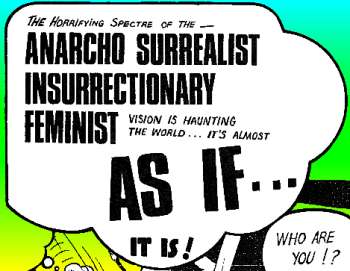
Margot Nash (?) : Winner of the 1973 Award for Best Title for a Political Organisation, Margot was once a member of the Anarcho-Surrealist-Insurrectionary-Feminist (AS IF) collective. Now she’s a screenwriter and a director with a background as a cinematographer, a film editor and an actor. And an academic.

Richard Neville (1941–) : Another product of The Push, Richard is known for his having started (along with Richard Walsh and Martin Sharpe) Oz in Sydney in 1963. It played a very important role in disseminating ‘counter-cultural’ ideas. He’s also known for having appeared on The Mike Walsh Show (1973–1985), and being a ‘futurist’.

Paul Norton (?) : Used to be a young anarchist; turned into a not-quite-so-young Green… academic.

Jamie Parker (?) : A student activist and student union official (Chairperson) at Macquarie University and NUS (NSW State President, 1995; National Environment Officer, 1996), Jamie has since gone on to forge a career with the Greens, and sits on the Leichhardt Council. (He’s also been known to flog Horny Goat Weed.)

Christos Tsiolkas (1965–) : Christos barracks for Richmond. Despite this handicap, he’s somehow managed to become a writer, among a number of other titles co-authoring Jump Cuts (1996) with Sasha Soldatow (1947–2006). “Soldatow had been drawn to Sydney specifically by the anarchist libertarian tradition, which didn’t exist in Melbourne…”.

Marcus Westbury (1974–) : Culture vulture, TV personality and festival organiser extraordinaire, as a student Marcus was a member of the NAL, whose glorious victory in NUS elections in 1996 was trumpeted in the Workers’ Solidarity Movement paper (No.47, Spring 1996), much to the bemusement of local anarchists.

Posted in Anarchism, History | 14 Comments

Bad BAD Blogger: When Tories Attack!

More blah : Reasons You Will Hate Me, The happiest place on earth. | triple j’s hack: Undermining your boss [mp3] | gatewatching, Victorian Liberal staffers sacked for blogging | Christian Kerr, Blogs help Libs divide and conquer themselves

Sheesh. You’d think that Simon Morgan and John Osborn were the first yuppie functionaries to have criticised the Tory Party leadership, not the latest. In any case, the editorial brains at the Herald Sun are unhappy: “Rather than confronting what he admits are “genuine deep-seated problems” in his own party, Mr Baillieu should be tackling the Brumby Government with both hands and positioning the Liberals for the best possible tilt at the 2010 election”. Osborn isn’t taking things lying down, however, releasing an email in which Tory state campaign manager Susan Chandler allegedly made an unflattering reference to Tory candidate Adam Held: “The email referred to Mr Held as a “greedy fucking Jew” after he asked for more campaign material” (Disgust at Liberal’s anti-Semitic email, news.com.au, May 12, 2008).

Unfortunately for Susan, as a result of Osborn’s leak, she’ll be desperately seeking a new employer (hopefully not another greedy fucking Jew). The cheeky young Tory continues:

“I am comprehensively appalled at the clearly anti-Semitic nature of Ms Chandler’s email.

“There is no place in the Liberal Party for that sort of base prejudice. I call on the state president (David Kemp) to terminate her employment immediately.”

Mr Osborn also lashed out at the investigation into the blog activity he was involved in.

He said the investigation was “a sham” after other internal Liberal emails, in which Mr Morgan describes federal Liberal MP Fran Bailey as a “stupid fat bitch” were published in The Age today.

“By releasing selected internal Liberal Party emails to the public, Mr Baillieu and (retiring state director Julian) Sheezel have demonstrated at best incompetence and at worst a disingenuous cover-up,” Mr Osborn said.

“Furthermore, Ms Chandler’s involvement as an investigator has tainted the process irrevocably and her involvement in the federal by-election campaign for Gippsland is a concern,” he said.

Yeah: Osborn is deeply concerned for the future of the Tory Party. Furthermore, Ted Baillieu Must GO!

See also : Liberal bad blood, Paul Austin, The Age, May 12, 2008: “Spiteful blogs and damaging emails have laid bare the factional warfare crippling the Victorian Liberal Party. Paul Austin reports.”

Young Tories: Recruiting now! (January 31, 2007) | Let’s do the Kutasi! (July 22, 2006) | I Was A Teenage Tory : John Hyde Page (December 13, 2006) | Many Young Liberals are racist, sexist, homophobic nerds. And proud. Who knew? (July 19, 2006) | HoWARd’s South Park “pals” (April 10, 2006)

Posted in Media, State / Politics | Leave a comment