Bikini-clad fascists in Cronulla. And Brunswick?

[Update : Radio National‘s ‘The World Today’ has published the online transcript of the interview with march organiser Christine Hawkins which Liam kindly mentioned previously: ‘Women protest Sheikh’s comments with bikini march’ (Monday, November 27, 2006, 12:46:00, Reporter: Sabra Lane). A claim is made that the website for the march — in reality, a hastily cobbled-together wiki — was ‘hacked’ by White supremacists. As far as I’m aware, this is false, as the history of the page demonstrates. Further, the ‘White supremacists’ referred to in the report are Perth-based Ben Weerheym and various members of Scumfront, a number of whom have expressed support for both ‘chicks in bikinis’ and ‘Muslims out’.]

Murdoch’s Daily Terror — by way of Luke McIlveen — has today ‘revealed’ the fact that the fascist Australia First Party — under the leadership of Lebanese-Australian Dr. Jamahl Saleam — has finally ‘revealed’ its candidate for the upcoming NSW state election in March, 2007: aged care worker John Moffat. The article comes just under two weeks away from the first anniversary of the notorious outburst of racial violence that occurred last year in Cronulla, and for which local racists and fascists are organising a commemorative ‘Great Australian Bikini March’ on Saturday, December 9 in Brunswick, Melbourne. It also appears just a month after the AFP experienced its first electoral success in some years with the election of Bruce Preece to the Prospect City Council in Adelaide. Moffat himself previously stood for the AFP in March 2003, and received 814 votes for his trouble.

NSW Premier Morris Iemma has warned the ‘racist’ and ‘extremist’ AFP to pull their chicken-heads in prior to their intended celebration of the ‘White Uprising’, intimating that the NSW police may not look all that favourably on the presence of fascist groups intent on stirring up racism in the local community. Speaking to the press shortly after the events in December, local Melbourne fascist, and former leader of the now defunct Patriotic Youth League Luke Connors (young_soldier on the White supremacist website Scumfront) stated that “about 15 League members handed out literature to the Cronulla crowd, as well as buying drinks for some participants”. Meathead also claimed that his group ‘predicted further racial violence, naming the Melbourne suburbs of Heidelberg, Preston, Reservoir and Springvale as potential “hot spots”‘.

And Brunswick?

Posted in Anti-fascism, State / Politics | 20 Comments

G20: Observing human rights…

Pt’chang!

The ‘G20 Human Rights Observers’ team has released their preliminary report into the G20 protest last weekend. It’s available as a PDF.

The 3-page statement is an initial summary of observations made by Human Rights Observers over the three days.

A team of 28 Human Rights Observers monitored interactions between police and members of the public during the protest actions around the G20 meeting from early on Friday 17 to late in the afternoon on Sunday 19 November…

The report is highly critical of protester behaviour and describes a high level of aggression and deliberately provocative behaviour toward the police from some protest groups and individuals.

It also states that there was a “high level overall of police discipline and restraint in the face of deliberately provocative actions by some protesters, lasting many hours.”

However, the statement points out that this initial discipline and restraint declined as the protests wore on and numerous concerning incidents involving police use of force occurred. The team highlights the police baton charge against a non-threatening crowd at the Melbourne museum on the Sunday afternoon.

“Our timeline analysis points to a decline in police restraint over a period of time” Mr Kelly said. “Whilst it is understandable that stress and provocation would cause a decline in police discipline, the maintenance of appropriate police protocols, lawful actions and consideration of human rights is even more important during times of stress.”

The statement also points to the arrest of Mr Drasko Boljevic by plain clothes police officers. The statement calls on the Victorian and Federal Police forces involved in ‘Taskforce Salver’ to exercise careful observation of the law when undertaking any further arrests.

Mr Kelly admits that both police and some protest groups are likely to be critical of this initial statement. “Whenever there is an escalation of political violence, the human rights of citizens become increasingly difficult to protect. It would be regrettable if protest groups, the police or the public missed this point.”

The Federation of Community Legal Centres (Vic) Inc, with the support of Pt’chang Nonviolent Community Safety Group Inc. and the Human Rights Law Resource Centre (HRLRC) co-ordinating the Observer Team. A detailed report will be compiled with the assistance of experienced human rights lawyers and released by the end of the year.

In other news, Australian Attorney-General Montgomery Burns and ASIO have won the right to appeal the disclosure of documents knowledge of which threatens to destroy the foundations of the Australian state and send otherwise decent, law-abiding, tax-paying citizens into a crazed frenzy of violent acts and jay-walking. “Lawyer Charles Gunst, for the Director-General of Security [Paul O’Sullivan], told the court its judgment in this case could set a precedent and cause irreparable harm to national security.” The freedom (non-incarceration) of the two men deemed by ASIO to constitute a risk to national security, meanwhile, is verboten, and the two left to rot:

‘Rotting’ on Nauru

The Age reported in September that Mr Faisal was medically evacuated to Brisbane after becoming suicidal. It said Mr Sagar remains the last asylum seeker kept on Nauru.

Outside court today, the men’s solicitor, Maurice Blackburn Cashman partner Anne Gooley, accused ASIO of delaying their case by pursuing the appeal.

She said an appeal before a full bench of the Federal Court was not likely to be heard until next year.

“In the meantime, (one of my clients) is in a psychiatric institution, not knowing what’s going to be happening to him, and (another) is on Nauru, ‘rotting’ as we speak,” she said.

“He’s obviously going to be disappointed at this latest delay … he’s been on Nauru for five years now.

While the rest of us can sleep safely in our beds.

Posted in State / Politics, War on Terror | 3 Comments

US Political Prisoners

New York Indymedia journalist Brad Will was murdered by the Oaxacan regional government in Mexico late last month, and you can read a short tribute by imprisoned videojournalist Josh Wolf here. Josh himself is a political prisoner in the United States:

    Josh Wolf, freelance journalist and independent videographer, is currently in “coercive custody” at the Federal Detention Facility in Dublin, California. He has never been charged with any crime. Wolf was incarcerated for contempt earlier this year after refusing to provide a Federal Grand jury with unedited video of a 2005 G-8 protest in San Francisco. His incarceration is virtually unprecedented for a journalist refusing to give information to a Grand Jury. It is widely believed he will likely become the longest held journalist in U.S. history.

Which is not long enough to interest the Australian media, apparently.

Imprisoned eco-activist Jeff Luers will celebrate his 28th birthday on December 5th, the seventh time he’ll have celebrated his birthday behind bars. Two days later, December 7th, is An International Day of Solidarity with Green Scare Indictees, Detainees, and Political Prisoners.

Stay tuned…

More generally : Political Prisoners in the US | Earth Liberation Supporters Network | FBIWitchHunt.Com | Anarchist Black Cross (Brighton, UK)

Posted in Anarchism, Media, State / Politics, War on Terror | Leave a comment

Join in the chorus? Socialism vs. 2006 Victorian state election

[Updated : Monday]

Oh dear.

Trot Guide fears for the future of socialist electioneering in the state of Victoria.

1) In the safe Labor seat of Broadmeadows, Will Marshall stood for the horribly-named Socialist Equality Party (nee Socialist Labour League). Preliminary results suggest that he came last of seven candidates, receiving just 425 first-preference votes, or 1.53%.

2) In the safe Labor seat of Brunswick, Vannessa Hearman stood for the mighty Socialist Alliance. Hearman did slightly better than Marshall, gaining 549 first-preference votes, or 1.97%: enough to beat Family First (442 votes / 1.59%) and People Power (433 votes / 1.56%).

3) In the safe Labor seat of Derrimut, Jorge Jorquera of the Marxist-Solidarity-Direct-Action-Workers-&-Community-First Network-Party has failed to capture the electorate’s imagination: No son Chavistas en Derrimut. (Jorquera came last of six candidates, receiving 262 first-preference votes or 0.97%).

4) Margarita Windisch‘s bogus attempt to arrest Paul Wolfowitz last Saturday didn’t seem to endear her terribly to the good, Labor-voting people of Footscray; as the other Socialist Alliance candidate for a Lower House seat in the state of Victoria, Windisch came last of six candidates, receiving 406 first-preference votes or 1.45%.

5) Of all the socialist candidates in the election, Steve Jolly of the Socialist Party did best: he got 1,632 votes or 6.09% in Richmond. But despite this and a significant Greens vote, the seat remains safely in Labor’s hands.

6) Finally, in the Upper House seat of Western Victoria, Socialist Alliance candidates Sue Bull and Rowan Stuart got something like 0.28% of first-preference votes (985).

All in all, another nail in the coffin for the unfortunate SA.

    [See also : ‘Vote for the socialists!’ (except Will Marshall), The DSP/SA Candidates, Green Left Weakly, November 22; ‘Labor returned in Vic election’, Selena Black, GLW, November 25; ‘Obscuring the violence inherent in the system’, Tony Iltis (with apologies to Monty Python), GLW, November 24: “More than three thousand people had a somewhat surreal experience on November 18. They attended a rally, called by the Melbourne Stop the War Coalition and Stop G20, to oppose the genocide by poverty being promoted by the finance ministers’ meeting, and the warfare that makes the corporate plunder of the Third World possible… What made the experience surreal was turning on the evening news, or opening the next day’s papers, to see what coverage the protest had received. They were confronted by scenes quite different from anything they’d witnessed at the rally, involving people in strange white outfits and masks battling it out with police.”]
Posted in State / Politics, Trot Guide | 2 Comments

G20: Resistance vs. Socialist Alternative

Wearing my leftist train-spotting hat while clothed in white overalls, vegan boots, leading a dog on a string, listening to Loikaemie, and reading a copy of the Australasian Spartacist, I give you the wonderful mess that is: Resistance vs. Socialist Alternative!

Statement on G20 protest
Resistance
November 25

On November 18, upwards of 3000 people marched through the streets of Melbourne to protest the meeting of the G20. The rally was organised by the StopG20 Collective and the Stop the War Coalition, in which Resistance participated both in organising and publicising.

The protest was directed at some of the biggest war criminals in the war in particular Paul Wolfowitz, president of the World Bank, Gordon Brown, UK Chancellor of the Exchequer, and Treasurer Peter Costello, key figures in the Coalition of the Killing, and directly responsible for the deaths of over 650,000 in Iraq alone.

Their discussions, carried out in secret behind closed doors, were aimed at further enforcing pro-corporate policies which have been responsible for the starvation and impoverishment of millions around the world and the increasing endangerment of humanity as a whole, particularly through policies that perpetuate environmental destruction.

The size and mood of the rally is testament to the growing opposition to the policies of the rich G20 nations.

This was despite the corporate media beat-up in the week leading up to the protest about the likelihood of violence, and attempts to derail it – including multi-millionaire Bono whose concert message was focussed on charity not change, and the Make Poverty History events that were specifically aimed at providing a nice gloss to the attempts by the G20 to look like it was doing something for the world’s poor.

Unsurprisingly, the corporate media covered none of this. Instead, as always it preferred to focus on a small group – Arterial Bloc – and the so-called riots which, at most, amounted to a few broken windows.

The corporate media hypocrisy is clear – focus on the tiny bit of damage to private property and ignore the policies of death beginning discussed behind closed doors.

The reason why is also clear – since the Seattle protests in 1999, which prevented the World Trade Organisation from reaching agreement on a new set of trade rules to impoverish the Third World, the global justice movement has grown. The S11 blockade of the World Economic Forum in 2000 and the M1 blockades of stock exchanges in 2001 spurred on this movement in Australia, helping to discredit these capitalist institutions and their “solutions” to global poverty.

‘Global justice movement’ is one of a number of terms used to describe the movements which have arisen in opposition to neo-liberal globalisation. It’s a ‘nice’ term, but competes with others such as ‘alter-globalisation’, ‘anti-capitalist’, ‘anti-globalisation’ and ‘counter-globalisation’. As for ‘its’ history, most would consider its origins, at least in Western countries, as emerging from the jungles of Chiapas, Mexico, and the Zapatista revolt against NAFTA (North American Free Trade Agreement), formally launched on the same day as NAFTA’s official implementation: January 1, 1994. The links, both ideological and practical, between this, ongoing civil uprising, and opposition in the West to neoliberal institutions such as (GATT/) the WTO, IMF and World Bank, have been well-documented elsewhere.

Still, one of the key characteristics of N30 (or ‘The Battle of Seattle’ — starring Charlize Theron, and coming soon to a local sinema) was precisely the absence of the authoritarian (Marxist, Leninist, Trotskyist, Maoist) left. So too, J18, an event almost completely ignored by this tendency and — not coincidentally — one of the reasons for its relative success. The fact is that ‘the Trots’ only jumped on the bandwagon following ‘Seattle’.

In Australia, the (authoritarian) left’s Colombus-like ‘discovery’ of a global movement in opposition to neo-liberalism triggered a partial recomposition of the extra-parliamentary left in the shape of… an electoral platform: the Socialist Alliance. During the course of its almost six years of existence, SA’s establishment has been of benefit to one party and one party only: the DSP (for which Resistance functions as a not-very-successful recruitment base in the ‘youth’ market).

As for S11 and ‘M1’ — that is, May Day — fuck it: no one cares about the real story anyway.

That is why the media refused to cover the protest, or report on what went on inside (where it was largely barred) and why it kept a low profile of the key warmongers such as Wolfowitz. It is little wonder that an 67% of people responded “no’’ to an Age poll question, “Did the G20 summit achieve anything’’ two days after the protest.

Resistance rejects the corporate media and government arguments against the protest. Importantly we must defend all activists against the campaign of victimization and sweeping up of activists post-rally. All those arrested must be supported, particularly the extremely worrying case of Aki[n] Sari, who has been denied bail until a court hearing next February. This sets a very dangerous precedent.

The brutal attacks by the police against peaceful protesters on the night of November 18, and the following day against peaceful protests outside the Museum, demonstrate on which side the real violence lies.

But this shouldn’t stop the movement from having an honest discussion about tactics. Having played a part in initiating and organising the G20 protest, we do not think Arterial Bloc played a constructive role. Covering their faces, acting in an undemocratic manner and isolating themselves from the majority at the rally, their decision to skirmish with the police played into the hands of the right-wing media and G20 spokespersons, such as Costello.

Resistance is also not opposed to civil disobedience. In fact we, along with many others, helped make the S11 blockade the success that it was, and initiated the M1 protests. But civil disobedience is only a tactic, and its usefulness, or otherwise, has to be judged on whether or not it helps or hinders in building the movement. That is the reason why we criticize the actions of the Arterial Bloc.

Because if we’re serious about building a movement to overthrow the system that G20 wants to prop up – capitalism – we have to win the working class majority to our side, and we’re some way from that.

Carrying out tiny “militant” actions such those of the Arterial Bloc, give a free kick to the real thugs – those holed up inside the G20 meeting.

We have no control over the corporate media, but we are not so naive as to not take into account that the coverage will have an impact on working people, and whether they will be prepared to join us at the next protest or not. We know that the corporate media will always seek to marginalise us, and that scuffles with the state will take priority in their reporting over a peaceful protest of working people against the corporate rich. Similarly, the government will use such actions to push through more draconian state terror laws.

This is not an argument against civil disobedience: as a tactic it can be indispensable when used correctly – when it helps build and inspire a mass protest to become even bigger. In this particular instance the actions Arterial Block did nothing of the sort.

The global justice movement is naturally going to be diverse; but the movement also has to take some responsibility for its actions and work out what helps its growth and what doesn’t. The debate over tactics is useful as long as it stays concrete, and lessons can be learnt from G20 that can be carried into the discussion that has already started about the Stop Bush protest at APEC in Sydney next year.

The left must take a stand against the elitist violence of the “Arterial Bloc”
Socialist Alternative
November 21

The lively G20 rally of 3,000 in Melbourne on Saturday 18 November was a moderate success. It was a small step on the road towards building a genuine mass movement capable of involving not just a few thousand, but the masses which can offer a serious challenge to the capitalist neo-liberal agenda.

However, the activities organised and led by the so-called “Arterial Bloc” were counterposed to this aim. The media were able to not just ignore the protest (we’re used to that), but to imply that those at it were responsible for, or at least involved in, the rampage. This is not like S11 six years ago when a peaceful protest with widespread support was attacked numerous times by the police. Then, the Bracks government experienced a backlash of outrage. People watching TV, reading the print media are not idiots. They can tell when protesters are being attacked simply for protesting. It is telling there has been mostly bewilderment at best, or revulsion at the actions of this bloc and its followers. How will this encourage wide layers of people to come to future protests?

The actions of the Arterial Bloc illustrate clearly that they have absolutely no interest in building a mass movement. They made it clear during the organising period that they were intent on their own, small actions. When they marched to the rally they were sneering and abusive towards activists with whom they disagree. If that wasn’t clear enough, they graffitied the city with “kill the socialists”.

Coming to demonstrations with your faces masked can only be justified in a situation of severe state repression. In the present political climate all it does is indicate to workers, students and the oppressed that they have to be involved in something sinister to attend rallies. This and things like whole militarised blocs in gear like chemical suits sends a very elitist message: you are only welcome if you’re in the in-group/s who were organised before the event. They do not just add to images of “diversity” – particularly when those dressed in them behave like apolitical hooligans. Anyone who is committed to building a widely based movement needs to reject such negative theatricals.

Such irresponsible provocation of the police opens up not just the tiny numbers involved in the rampage, but potentially the rest of the rally and others to state repression. There is some suggestion that peaceful protesters on the Sunday at the Museum were the victim of this logic.

For this reason, we need to take a clear and unambiguous stand against these provocateurs. This bloc and those who support it in any way need to be isolated by the left because actions such as this will make it increasingly difficult to build on the growing discontent that clearly exists – reflected in the regular rallies which attract sizeable numbers such as the Environment Day rally, those during the war on Lebanon, Global warming and the G20 to name just some. Hundreds of thousands of workers have mobilised to defend union rights. Actions like those at G20 by the Arterial Bloc will make it difficult to build the necessary links between organised workers and the smaller, social issue campaigns. Anything which weakens our ability to build such a movement makes it that much more difficult to deal with state repression.

The violence at the weekend did not combat that repression, but opens up the left to increased militarisation of policing when we do not have the mass grass roots organisation and support capable of repelling it.

This is not just speculation. We have lessons of very recent history from which we should learn, in particular the experience of the anti-capitalist movement in Europe. British socialist Tom Behan who has strong links with the Italian revolutionary left documented how the Black Bloc, which was known for similar actions as those at G20, gave openings to police violence, police provocateurs and even fascists. They organised around the same combination of mindless violence, contempt for the mass of demonstrators and hostility to the socialist left. They are known for melting into peaceful crowds only to emerge to attack the police, bringing a violent response against the whole crowd. At the Genoa Social Forum protest in July 2001, in one peaceful contingent after another, the arrival of the Black Bloc was similar to what happened in a rank and file labour contingent: “organisers were unable to stop Black Bloc provocations which quickly led to a police charge”. Their provocations opened up a debate on violence. Behan concluded:

    The fact that a small minority of demonstrators were intent on violence is an issue which cannot be ignored. The anti-capitalist movement needs to do all it can to engage with genuine protesters and try to convince them of the futility of random acts of destruction. Another related issue is that of the ‘non-genuine’ Black Bloc. There is now overwhelming evidence that not only were the Black Bloc allowed to engage in widespread destruction, the police often used their activities as a pretext to attack peaceful demonstrators. Furthermore, it is now certain that some of the Black Bloc were in reality police agents provocateurs, although it is equally likely that some Nazi and fascist groups pretended to be part of the Black Bloc.

    [Source: ‘Nothing can be the same again’, International Socialism, #92, Autumn 2001]

Yeah. Tom Behan: “British socialist”; “strong links with the Italian revolutionary left”; friend to the animals. More to the point, a member of Socialist Alternative’s closest equivalent in the UK — and parent grouping for both SocAlt and the ISO — the Socialist Workers’ Party (SWP). At the time of writing, Behan was also a leading member of the SWP front group “Globalise Resistance”, and it was in this capacity that Behan first wrote about how ‘the black bloc were really fascists’ (‘Behind the provocations’, Weekly Worker, #394, Thursday, July 26, 2001). He wasn’t alone in denouncing the spoilsports who ruined Genoa for everyone:

    Marginalizing Language in the Movement Post-Genoa : After Genoa, there has been a noticeable increase in marginalizing language in the Left press. Most of this language has been directed at the anarchist black bloc, but some of it has been directed at “militant” elements.

In fact, Behan — when he’s not offering his insights into the ‘anti-capitalist’ movement and the ways in which the SWP might best suck its blood — is the SWP’s “expert” on all things Italian. An example of his historical-revisionism-in-the-service-of-Trotskyism is The Resistible Rise of Benito Mussolini (Bookmarks, 2003). A crazy, ultra-violent, hostile, abusive, threatening, ultra-sectarian, provocative, fascist-sympathising, football hooligan and bloody foreigner intent on wrecking all that is good and profaning all that is holy wrote a review of Behan’s book. And, despite labouring under harsh conditions (such as not having attended a local private school or Melbourne University), they reckoned somewhat different:

As will be discussed, it was only the anarchists and anarcho-syndicalists who supported [the militant antifa movement in Italy in the 1920s] wholeheartedly. Not, of course, you would know that from Behan’s account. Which is the reason for this review, namely to reclaim anarchist and working class history from those, like the SWP, who seek to misuse it for their own ends. Behan’s account of the Italian labour movement, the near revolution after the war, the resistance to fascism and the lessons to be learned are all skewed in favour of the SWP’s very peculiar version of anarchism and the needs to justify its non-revolutionary practice and ideology.

So this review is an attempt to reclaim anarchist history by exposing the phoney revolutionary politics and scholarship of the SWP. A thankless task, of course, but an essential one. Anarchists need to care about our history and defend it against those more than willing to distort it as no one else will. To grow our movement needs to learn from and build upon the successes and failures of the past. And that will never happen if we do not know and understand our own history, how our ideas were applied in the past and why the likes of the SWP feel the need to lie about both…

For example:

In the 1970s the Italian left suffered increasing state repression when student revolutionaries turned in frustration to small-group violent guerrilla-type actions against the state. Rather than dealing with the lack of a mass response which pushed them in this direction, it accelerated the decline of the mass movements as workers, students, the oppressed turned away in disgust at assassinations and mindless violence. Luca Casarini, the main spokesperson of Ya Basta! – a movement which is descended from the autonomism of the 1970s – spelled out the problem of the “professionalisation” of demonstrations, i.e. activists coming in protective clothing ready for provocations etc: “To accept the logic of military clashes would be both crazy and political suicide. Our movement cannot match their [the state’s] military power. We would be crushed”.

This might seem like a big step beyond what happened at G20. But the actions of the Autonomists in Italy began with isolated violent attacks. The irresponsible provocations of the Arterial Bloc have all the hallmarks of the same destructive dynamic. It is the logic of the actions of tiny numbers lashing out with no reference to the mass of people.

That’s why the left who want to reach out to masses of people need to:

1. Politically oppose anyone coming to protest rallies wearing masks or other forms of disguise. We need openness and accountability in the movement. Such dress creates a sinister atmosphere, breeds distrust, and makes police infiltration more likely.

2. Make it clear that there is a sharp dividing line between those involved in the violent provocations at G20 and the genuine left who want to relate to masses of people in order to change the world.

3. Make no concessions to the idea that this is just a form of “diversity”, just another difference of opinion. These tactics are completely counterproductive and the left will pay the price if we make concessions to them.

These questions are urgently in need of discussion as we are about to begin organising for the APEC forum next September in Sydney which Bush is expected to attend. If we are to maximise our ability to mobilise significant numbers, we have to take this clear stand and prepare to organise on the basis of genuine mass protest with no role for the kind of violent provocation we saw at G20.

“If the anarchists are not careful, their enemies will write their history”Gaetano Salvemini

Posted in Anarchism, History, Media, State / Politics, Student movement, Trot Guide, War on Terror | 2 Comments

G20: Destination South Africa

The next G20 Summit will be held in Cape Town, South Africa. Speaking of which, Southern African anarchists in platform boots have re-launched their website: Zabalaza.Net

RESISTANCE

Resistance has been hampered by political confusion prevailing within COSATU. Many union officials, and ordinary members, retain their loyalty to the ANC, and so fail to correctly grasp the class agenda and class nature of the ANC. There has been no co-ordinated response to GEAR, or even an official review of COSATU’s ongoing alliance with that party.

By failing to understand the role of the ANC in the war on the working class, COSATU has been unable to formulate a coherent and effective response, and has instead [fallen] back on pleading with the ANC to “consult” the unions more when developing policy. This is a far cry from the revolutionary and [combative] COSATU of the 1980s, which fought the apartheid State to a standstill.

COSATU’s failure to give a lead to other sections of the working class in the fight against neo-liberalism has undermined the possibility of a countrywide, working class-based campaign against neo-liberalism.

However, there have been a number of important local struggles that clearly demonstrate the willingness of workers to fight privatisation and austerity. A wave of new community organisations has sprung up to fight against neo-liberal attacks by local municipalities. In Chatsworth township near Durban, African and Indian workers and their families have fought back against evictions and service cut-offs. In Soweto, the Electricity Crisis Committee has mobilised resistance to electricity cut-offs and outrageous service charges.

At the University of the Witwatersrand, militant academics, students, and above all, workers in the National Education Health and Allied Workers Union (NEHAWU) fought a courageous, but ultimately unsuccessful, six-month battle against 613 retrenchments in 2000. In Johannesburg and other cities, the mainly African South African Municipal Union (SAMWU) and the mainly white and coloured Independent Municipal and Allied Trade Union (IMATU) have campaigned against the privatisation of municipal services. Despite being a COSATU affiliate, SAMWU has taken a principled stand against GEAR and privatisation, and has not been afraid to tackle the ANC directly.

The most important recent development has been the unification of anti-neo-liberal campaigns in Soweto, at the University of the Witwatersrand, and in Johannesburg in the Anti-Privatisation Forum in July 2000. The new coalition – to which Bikisha Media Collective is also affiliated – has sought to link union and community struggles through joint actions and strike support; a rolling campaign will also be launched in 2001…

See also : Resistance to Neoliberalism: A View from South Africa (1997); Africa, neo-liberalism and anarchism (Chekov, WSM); What ‘Appen To South Africa? 1976-2005: Defiance to Apartheid, Neoliberalism, And Recuperators Of Defiance

Posted in Anarchism, State / Politics | Leave a comment

G20: Police response

While the corporate/state media bays for (more) blood, to this date there have been only a relatively small number of arrests of G20 protesters reported in the press, and just one name has been released to the public. Today, for example, the Herald Sun claims that there has been a total of seven arrests, although whether or not that includes Akin Sari and Drasko Boljevic is unknown. (Akin Sari’s non-incarceration was deemed to be an ‘unacceptable risk’ to the state at a court hearing on November 22. On that basis Sari was denied bail by Magistrate Sarah Dawes, and was remanded in custody until February 12, 2007. He faces four charges — criminal damage, theft, riot and affray — and is the only person to have appeared before the courts in relation to events at G20.) On Saturday, November 18, The Age reported two arrests, while on Sunday, November 19, The West Australian reported that:

Police have arrested four G20 protesters for assault after they chained themselves to a car near the Victorian parliament in central Melbourne. Police said the protesters caused a crowd disturbance near Spring Street and officers were called about 10pm (AEDT). After protesters scuffled with police, four people were arrested and questioned. One person was drunk, police said. No charges have been laid.

Reporting on the Police vow to find G20 thugs, The Age / AAP (November 19) records Chief Commissioner Christine Nixon as claiming seven arrests in total, including that of Akin Sari, with more to come, and the establishment of a police taskforce, Operation Salver, to vigorously pursue further potential prosecutions.

Today (November 24), ‘The Human Rights Observer Team’ has expressed concern over police violence at G20, in particular the unprovoked assaults committed by police against a peaceful gathering of protesters on Sunday night at Melbourne Museum. (Police G20 behaviour ‘alarming’ — report, The Australian; Concerns over police conduct at G20, The Age: both are AAP reports.)

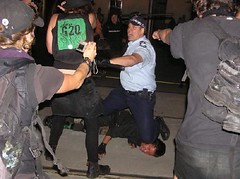
    Sunday afternoon a group of 50 demonstrators were beaten and trampled by police during a peaceful anti-G20 protest inside the foyer of the Melbourne Museum. A woman was severely injured after police used batons and fists to disperse the small group of singing, dancing demonstrators. Several hundred police, including two divisions of riot police, were deployed in the incident… Video | engagemedia

John HoWARd, in the meantime, has reportedly expressed confidence in the ability of state authorities to effectively contain any demonstration at the upcoming APEC Summit in Sydney in 2007 (September 6/7) — an event described by ASIO as being the most important summit of its kind to ever take place in Australia, being graced with the presence of no less a figure than the Australian President, George W. Bush. In other news:

Police ignored key data
Mark Buttler
Herald Sun
November 24, 2006

SENIOR police have been accused of not acting on key intelligence about the intentions of anti-G20 protesters.

Sources [– presumably right-wing mavericks –] have told the Herald Sun important details of the masked demonstrators’ plans were made known to top police but not factored into the response.

A police taskforce has been set up to track down those responsible for ugly scenes in which police were bitten, spat on kicked and punched.

Every window in a brawler van was smashed in what Chief Commissioner Christine Nixon called “guerilla tactics”.

But the police sources said the taskforce would not have been necessary if there was a better preparation based on what was known of the protesters’ intentions.

A Victoria Police spokeswoman said the force was satisfied with the approach taken based on available intelligence.

Police in recent days have visited Melbourne media outlets to track down every possible image of those responsible.

At least seven arrests have been made and more are expected over violence as the world’s financial leaders met at the Grand Hyatt.

There has been no shortage of criticism of the policing at G20, largely centring on police tactics: the bloke they call Mullet reckoned they were ‘too soft’, apparently. But if the main objective of the police on the day was to prevent disruption to the conference itself, they certainly succeeded: no protester was able to get within coo-ee of the Hyatt; the assaults upon police barricades were limited and sporadic; and the damage to police vehicle/s an opportunistic act amounting to $1,000. As for injuries to police, possibly 9 or 10 have been reported as suffering some, the main injuries being a suspected broken wrist — presumably incurred by flying debris — and some bitemarks on one unlucky constable incurred during the course of the four arrests on Saturday night outside Parliament.

Posted in State / Politics | Leave a comment

G20: And an unlawful police abduction

On Sunday, November 19th, a worker by the name of Drasko Boljevic was unlawfully assaulted and abducted by members of the Victoria Police operating as a plainclothes snatch squad. According to the one press report on the incident (Dan Oakes, ‘Student held on damage and stealing charges’, The Age, November 20, 2006):

Food worker Drasko Boljevic, who was not involved in the protests, said he was “abducted” and released by plain clothes police about… two hours later.

Mr Boljevic said he was grabbed in a convenience store near RMIT University and thrown into a white van by men who swore at him and failed to identify themselves.

He said he was tied up and one of them sat on his head as he was driven around the city.

After being taken from the van near Flinders Street station, he was forced to kneel and was told he had been arrested.

“I was just frightened, I wanted to know what was going on. Who are these people?”

“Later, detectives came, handcuffed me and took me to the (police) station, but nobody explained anything before I got there.” Mr Boljevic said he was in Malmsbury, about 100 kilometres north-west of Melbourne, on Saturday during the protest. He said money he was carrying had gone missing and that police cut open his bag.

“I just think it’s really bad what’s been done to me, because I just feel traumatised. I thought I was going to die because you don’t know who these people are,” he said.

Police eventually released Mr Boljevic, but said they were studying further photographs of the protest.

Chief Commissioner Christine Nixon confirmed that a man had been mistakenly arrested.

“We certainly had resources out there looking for particular individuals,” she said.

“We have taken individuals into custody today and in one case the person was released because he wasn’t the person we thought he was.”

On the Leftwrites site, Jill Sparrow has uploaded an email account of the incident written by Eleonor Palacio, Boljevic’s partner:

[Sometime] between 12 midday and 12.15pm, Sunday [19th] November 2006, Drasko Boljevic, my partner, was paying for a drink at Foodworks minimart, 408 Swanston Street, in front of RMIT, whilst his friend Oakis was inside the store. Drasko was abducted by three bouncer-looking men dressed in casual clothes and violently taken into an unidentifiable white van, where another 5 of them help[ed] hold… Drasko down and handcuffed him with special plastic cuffs. [Oakis] heard some screams and went outside to see Drasko’s feet being carried into the unidentifiable van. He asked the abductors if they were policemen and they [replied] ‘Get the fuck out of here, get the fuck out of this city.’

The men did not identify themselves or inform… Drasko why he was being abducted. He was told to ‘Shut the fuck up’… that he was a ‘Fucking bastard’ and [that] they [would] ‘Bash him up and smash his face’, whilst violently holding his legs [behind] his back and pushing his head against the floor of the van and sitting on it. They drove around the city for about 10 minutes continuously terrorising him with [these] type[s] of comments and physical force. They pulled his pants down, searched him and cut his backpack [off] his back. ‘I thought I was going to die, I could hardly breathe and I didn’t know who these people were’, Drasko said later.

They [stopped] at an [alleyway] behind Flinders St Station and made him lie on the floor, with his pants still down, and [instructed him to] look down, still shouting at him to ‘Shut the fuck up’.

Some police detectives in casual clothes [then] arrived and identified themselves. It was not until then, about 25 minutes after his abduction, that he was informed [that] he was [being] arrested[:] no reasons for the arrest were given. They took some photos of his face, front and profile with a mobile. Then, they took him into an unidentified car and he was taken to the 412 St Kilda Rd Police Station.

When at the police station, they asked him if he would behave violently [and] bite policemen or if he would cooperate, and took his handcuffs off. He started being interrogated and for the first time since the abduction he was told he was arrested for assaulting a policewoman at the G20 protest on Saturday.

Drasko was not in Melbourne on Saturday, he was on his way to Malmsbury, 1 hour away from Melbourne, [where] he played the part of an ‘emu’ in a cabaret show at the Town Hall. Police said later that he was arrested ‘on the basis of his physical similarity with a suspect’.

At this point, about 2.00[pm,] it was apparent that they [had] got the wrong person, and the constable interrogating him told him he was about to be released, and that ‘If this was Croatia he wouldn’t be so lucky’. He was finally released at 2.35pm.

After getting home in a state of shock and fear, Drasko realised he had a [bruise above his] right eyebrow (which is likely to become a black eye) and discomfort of the neck as immediate physical consequences of the violent way he was dealt with in the van.

Drasko contacted the [Victoria Police – Ethical Standards Department], under the supervision of Senior Constable Neil Curtis (who dealt with the case in the last instance) to inform [him] of his physical state. They told him that ‘He should understand that in these circumstances they (the abductors) can’t take any risks’ and that ‘They need to apply considerable force when dealing with violent suspects’.

    Victoria Police – Ethical Standards Department

    The Victoria Police Ethical Standards Department (Police Conduct Unit, Compliments and Complaints) is responsible for enhancing and further promoting a culture of high ethical standards throughout Victoria Police through the effective prevention, deterrence and investigation of unethical behaviour, thereby ensuring a continued respect and confidence of the community.

    Address: Police Conduct Unit, Ethical Standards Department, Level 2, Flinders Tower, 637 Flinders Street, Melbourne VIC 3005
    Phone: 1300 363 101 (Monday-Friday 8am-4pm, answering machine available for leaving a message)
    Fax: (03) 9247 3498
    Email: [email protected]
    Web: www.police.vic.gov.au

    Office of Police Integrity (OPI)

    OPI is an independent body that ensures the highest ethical and professional standards in the police force. OPI investigates police conduct, police corruption and police policies and procedures. They aim to improve police service, management, integrity and morale.

    Address: Level 3, 459 Collins Street (South Tower), Melbourne VIC 3000
    Phone: (03) 8635 6188, 1800 806 314 (non-metropolitan callers only)
    Fax: (03) 86356185
    Email: [email protected]
    Web: www.opi.vic.gov.au

Dear friends, state terrorism exist[s] in Australia. We can say that this was a ‘bad mistake’ or that this ‘mistake’ can happen to any of us any day. This task force operation replicates… tactics used [during The Dirty War] in Argentina or in war time in Croatia, just to name a few.

What kind of liberties do we have as individuals? Is this a democracy gone with the wind? We should have the right to peacefully protest, if we believe it a way to demonstrate a view [about a particular] state of affairs. But above all, we shouldn’t be terrorised by a policy of ‘tough hunt’[?]. Protesters or not, we are all people and I would like to believe that this country [‘state authorities’?] can still [display] some [respect] towards its citizens and residents.

With love, thank you for your support…

Eleonor Palacio.

Posted in Anti-fascism, State / Politics, War on Terror | Leave a comment

G20: And balloons filled with… urine?

In search of the elusive G20 urine bombers
Katherine Wilson
Crikey!
November 20, 2006

According to Treasurer Peter Costello at the weekend, demonstrators at the G20 forum in Melbourne were “throwing balloons filled with urine at police”.

[“They have been throwing balloons filled with urine at police, throwing bottles, throwing road signs, damaging vehicles and otherwise engaging in violence,” Mr Costello said. “Who knows what motivates them? Who knows why they try to engage in violence? Who knows what misguided politics they have?” : ‘G20 protesters throw urine’, Marc Moncrief and Dan Harrison, The Age, November 18, 2006.]

So who were these people? Were they caught on camera? Were they arrested? With a heavy media presence and every other person wielding a camera, why does no snapshot or witness of these urine-throwing thugs exist?

So in search of the urine-bombers, we went to the police themselves. This morning police media spokesperson told Crikey: “We’re not aware of any specific incidents of urine-throwing.”

Where, then, did the Treasurer get his information? Costello said the urine-throwers at G20 were “a hardcore militant and violent” group “organised for violence, who have been trained for violence.” If the Federal Treasurer knew of an “organised … militant” group “trained” for “violence”, why hasn’t it been charged under terror laws?

Or was the Treasurer fantasising? “Urine-filled balloons are to contemporary protests what bayoneted babies were to the First World War,” says Radical Melbourne author Jeff Sparrow. “The ‘urine-filled-balloons’ fantasy seems to have originated after a protest against Pauline Hanson, at which people tossed water bombs at [boneheads] going into her rally. Some of the balloons had been filled from a hot water tap … thus sparking the first report of flung urine.”

“Thereafter, it became a staple of demo journalism. Without fail, each time a protest caused controversy the urine balloons (or condoms) would appear. Of course, if you think about it for a minute, the whole idea is ridiculous. I mean, how do you fill a balloon full of urine — drink a lot of coffee and beer, and then attach a balloon to the relevant appendage, in the middle of a crowd?”

It’s possible the Federal Treasurer, like The Australian and Herald-Sun reports, confused persistent fables of urine-throwers with actual G20 “demonstrators” who threw street signs and smashed a police vehicle for television cameras[?]. Reportedly unknown to protest organisers, the group’s tactics have been condemned by moderate [sic] demonstrators, with eleven reported arrests.

But why, in the Federal Treasurer’s mind, were there ”no reported arrests” of those unshakable urine-grenaders who, like vampires, never appear on camera? The Treasurer’s office was contacted, but didn’t provide a response in time for this article.

Posted in !nataS, State / Politics | 2 Comments

G20: Bolt, the big girl’s blouse, at his brilliant best

‘Our cops go girlie’
Andrew Bolt
Herald Sun
November 22, 2006

Pardon me for asking, but are these the police you say will help protect us against gangsters and terrorists?

Thanks, Christine Nixon, for giving us the feminised police force you’d always promised.

See it now at work in these pictures from the anti-capitalist riot in Melbourne on Saturday.

See, Chief Commissioner, how even the tiniest woman in a tutu can now wrestle a baton from one of your well-armoured officers.

That’s success in your gender war! After all, you couldn’t get better proof that your force has gone girlie.

But pardon me for asking: are these the police you say will help protect us against gangsters and terrorists?

Let’s first go through more pictures from the protest outside the G20 meeting of world finance ministers.

Hey, there’s tutu woman again, this time monstering your riot police with her new baton, without a single officer daring to arrest her.

And here’s one of your police standing meekly in a line, not defending themselves or their dignity, while some hooligan on the roof gives them a long, humiliating drenching with a hose.

See how few risk lifting a baton with striking intent, even when being spat on, bitten, hit with rubbish bins, pelted with garbage and rammed with plastic barriers? I’ve seen punching bags with more fight…

Blah blah blah; whinge whinge whinge. The Dutch Oven’s on fire this week.

Posted in !nataS, Media, Sex & Sexuality, State / Politics | Leave a comment