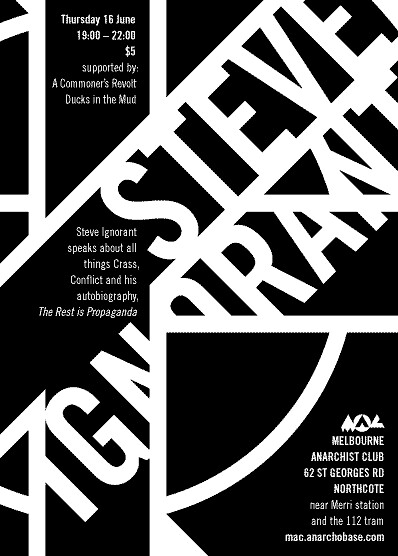
Steve Ignorant speaks about all things Crass, Conflict, his new-found love of the Collingwood Football Club and his new autobiography, The Rest is Propaganda, before taking to the stage at the Tote the following evening. Supported by A Commoner’s Revolt and Ducks in the Mud.
In Canada, two members of the Western European Brotherhood (aka the White European Brotherhood/White European Bloodline or WEB), Robert David Reitmeier and Tyler William Sturrup, have been arrested and charged with the murder in October 2010 of Mark Mariani. Anti-Racist Canada blog has heaps more on the Canuckistanian nutzis.
The WEB split from the ‘Aryan Guard’ several years ago; both groups have participated in various ‘White Pride World Wide Day’ activities, an annual event with origins in the Australian neo-Nazi milieu and also celebrated by nutzis in New Zealand organised under Kyle Chapman‘s various banners.
In Russia, another neo-Nazi activist, Darya Tikhanova, has been arrested and charged with taking part in the murder of a Dagestani man in Moscow in June 2007. Also in Moscow, Peter Tatchell writes on the repression of the 2011 Gay Pride march: “Either the police were actively facilitating the right-wing extremists with transport to the protest or many of the neo-Nazis were actually plainclothes police officers. They did to us what their uniformed colleagues dared not do in front of the world’s media: give many of us a good beating.”
In the UK, occult publisher ‘Scarlet Imprint’ has issued a statement on ‘Occultists and Fascists’ (June 10, 2011), distancing them from fascist bizarro and ‘national anarchist’ Troy Southgate.
We were approached recently to contribute to Troy Southgate’s Black Front Press whose last published work was a Crowley anthology.
After a little research, we were disturbed to find their rather murky history hidden beneath the anti-corporate, anti-capitalist and permaculture ideals.
Though we are very happy to promote the independent esoteric and occult authors and publishers whose work and dedication invigorate and stimulate our community, it is entirely another matter to contribute our energy to a project which would seem to be attempting to use a multiplicity of voices from the occult scene to promote the ideas of the so-called New-Right.
See also : The Big Neo-Nazi Crib, antifa.cz, March 1, 2011: Have you noticed the shift in image of some neo-Nazis – a shift from the skinhead-look to an anarchist/antifascist image? Whether or not you’ve noticed, you can learn more about this recent strategy of certain factions of the neo-Nazi movement from the following analysis.
Also in the UK, Andrew Brons is challenging Nick Gri££in to become leader of the British National Party as the BNP gets ready to rumble (Nick Lowles, June 11, 2011).
Earlier this year, the anti-Muslim group the ‘Australian Defence League’ (ADL) splintered in two. The new ADL is organising an anti-Muslim rally in Sydney on Saturday, July 30.
In summary, the attempt to import the EDL into Australia–and to mobilise Australians in opposition to Islam under its umbrella–failed; the ADL’s street presence apparently existing in inverse proportion to the volume of hot air its supporters generated on sites like Facebook.
Yaxley-Lennon & Martin Brennan
At the beginning of 2011, however, former BNP member, convicted criminal, tanning salon owner and leader of the ‘English Defence League’, Stephen Yaxley-Lennon, appointed fellow Englishman Martin Brennan to lead a reinvigorated ADL. It was this 2011 version of the ADL that organised a small rally at Federation Square in Melbourne last month, and is organising an anti-Muslim rally to take place in Sydney on July 30.
In an interview with Martin King on Melbourne radio station MTR following the rally Brennan, inter alia, identified the Sydney Islamist group ‘Shariah4Australia’ as a target, claimed that 70% of Australian meat is halal, that sales of this meat funds terrorism, complained about Clayton pool being made available for use by Muslim women, stated that the keffiyeh is a symbol of Hamas and that England is now an ‘Islamist hellhole’ (which presumably explains his migration Down Under). Also, that the ADL is not racist. (Note that Brennan’s ADL has also won the approval of the leader of the EDL’s ‘Jewish Division’, Roberta Moore.)
…and the Australian Protectionist Party
While their foreign leader has proven slightly more adept at generating support among the convicts than the (other) “Official”, “2009” ADL, it still putters along. Last month, the group/network organised meetings in Brisbane and Sydney. In Sydney, just eight people attended the meeting, most of them members of the White nationalist ‘Australian Protectionist Party’ (APP).
The APP, established as a 2007 splinter from the ‘Australia First Party’ (to be confused with The Mad Katter’s latest party-political incarnation; Katter being “the greatest federal minister for Aboriginal affairs Australia never had” according to Noel Pearson) has won some small degree of support online, but failed to attract more than a tiny handful of supporters to its numerous public protests. Joining in support of the ADL will therefore help to boost its public profile (and perhaps even vice versa).
In general, marginal groups such as the ADL and the APP serve to reinforce but are also in competition with the more mainstream anti-Muslim sentiment expressed by Tory politicians such as Cory Bernardi and members of the Christian right. Revulsion at the Muslim presence in Australia is also often combined with skepticism at anthropogenic global warming.
Finally, in ‘Where Have All The Progressive Atheists Gone?’ (New Matilda, June 8, 2011), Jeff Sparrow argues that It’s getting hard to tell a New Atheist from a neo-fascist; Adam Brereton replies in ‘Atheists Who Scramble The God Egg’ (New Matilda, June 9, 2011), noting that The neo-conservative politics of individual atheists aren’t necessarily the product of their non-belief.
I’m going to be taking a break from blogging over the next few weeks (Ph’nglui mglw’nafh Cthulhu R’lyeh wgah’nagl fhtagn, the Annunaki are angry and ZOG has demanded I attend some important meetings in Tel Aviv), so this will be one of my last posts for a while. When I get back I may (or may not) publish an interview with Propagandhi (or maybe some other band).
While AF’s ruling triumvirate provide a potted history of groups on the far right and their inter-relationships (mainly focused on Sydney), they make one especially interesting reference to a group in Melbourne they call ‘Men in Black’, and a campaigning group called ‘Defend and Extend Medicare Group’, established in mid-2003 and terminating at the time of the 2004 Federal election. Tony Abbott, Australia’s next Prime Minister, denounced the Group as comprised of anarchists and communists and such, his denunciation being a feature of several articles published in the Murdoch press at the time (Radicals ‘seize health debate to panic public’ / Government accuses DEMG of having anarchist agenda, Charles Miranda and Keith Moor, The Daily Telegraph / Herald Sun, December 5, 2003; PM accuses Labor MP of anarchy link, Keith Moor, Herald Sun, December 6, 2003; Health activists on file, Keith Moor and Charles Miranda, Herald Sun, December 6, 2003; Activists reject ‘extreme’ tag, Keith Moor and Charles Miranda, Herald Sun, December 8, 2003). My vote for best line in the reportage goes to Keith Moor (PM accuses Labor MP of anarchy link): “Acting Prime Minister John Anderson yesterday accused Labor frontbencher Martin Ferguson of supporting a bizarre activist group controlled by an anarchist.”
Asked in Federal Parliament a series of questions regarding the DEMG, in early 2004 The Mad Monk (then Minister for Health and Ageing) denied the existence of any investigation. A subsequent article in The Age (Inquiry on health group dossiers, Paul Robinson, December 13, 2003) states that “The Inspector-General of Intelligence and Security will be asked to investigate whether the Federal Government used police and intelligence agencies to discredit a campaign to defend Medicare”.
The Inspector-General made the obvious conclusion.
ASIO will be able to engage in industrial and economic espionage as well as spying on groups such as WikiLeaks on behalf of Australia’s two foreign spy outfits, under one of the most significant widening of its powers in a decade…
PRIME Minister Julia Gillard’s department has revealed that WikiLeaks and its founder, Julian Assange, were the subject of Australian intelligence reporting last year as the government anticipated the whistleblower website would spill ”highly sensitive and politically embarrassing” secrets…
THE killing of Osama bin Laden was a symbolic victory but will not diminish the terrorist threat to Australia, even as the dangers posed by cyber espionage and cyber theft continue to grow, the head of Australia’s most powerful spy agency says…
…What are the likely consequences of the killing of bin Laden? For the Arab world, it will probably mean little. He had long been a fading presence, and in the past few months was eclipsed by the Arab Spring. His significance in the Arab world is captured by the headline in the New York Times for an op-ed by Middle East/al Qaeda specialist Gilles Kepel; “Bin Laden was Dead Already.” Kepel writes that few in the Arab world are likely to care. That headline might have been dated far earlier, had the US not mobilized the Jihadi movement by the attacks on Afghanistan and Iraq, as suggested by the intelligence agencies and scholarship. As for the Jihadi movement, within it bin Laden was doubtless a venerated symbol, but apparently did not play much more of a role for this “network of networks,” as analysts call it, which undertake mostly independent operations.
The most immediate and significant consequences are likely to be in Pakistan. There is much discussion of Washington’s anger that Pakistan didn’t turn over bin Laden. Less is said about the fury in Pakistan that the US invaded their territory to carry out a political assassination. Anti-American fervor had already reached a very high peak in Pakistan, and these events are likely to exacerbate it.
Pakistan is the most dangerous country on earth, also the world’s fastest growing nuclear power, with a huge arsenal. It is held together by one stable institution, the military. One of the leading specialists on Pakistan and its military, Anatol Lieven, writes that “if the US ever put Pakistani soldiers in a position where they felt that honour and patriotism required them to fight America, many would be very glad to do so.” And if Pakistan collapsed, an “absolutely inevitable result would be the flow of large numbers of highly trained ex-soldiers, including explosive experts and engineers, to extremist groups.” That is the primary threat he sees of leakage of fissile materials to Jihadi hands, a horrendous eventuality.
The Pakistani military have already been pushed to the edge by US attacks on Pakistani sovereignty. One factor is the drone attacks in Pakistan that Obama escalated immediately after the killing of bin Laden, rubbing salt in the wounds. But there is much more, including the demand that the Pakistani military cooperate in the US war against the Afghan Taliban, whom the overwhelming majority of Pakistanis, the military included, see as fighting a just war of resistance against an invading army, according to Lieven.
The bin Laden operation could have been the spark that set off a conflagration, with dire consequences, particularly if the invading force had been compelled to fight its way out, as was anticipated. Perhaps the assassination was perceived as an “act of vengeance,” as Robertson concludes. Whatever the motive was, it could hardly have been security. As in the case of the “supreme international crime” in Iraq, the bin Laden assassination illustrates that security is often not a high priority for state action, contrary to received doctrine…
slut • noun a slovenly or promiscuous woman.
– DERIVATIVES sluttishadjective.
– ORIGIN of unknown origin.
Yeah so there’s a ‘SlutWalk’ in Melbourne next weekend (1pm, Saturday May 28), inspired by an event in Toronto earlier in the year, organised in response to a Canuckistanian cop’s comment that “women should avoid dressing like sluts in order not to be victimized” (see : ‘Sluts’ take to the streets, Michelle Griffin, The Age, May 10, 2011).
The SlutWalk takes place at the same time as the Feminist Futures conference (May 28/29), ‘Melbourne’s Largest Feminist Conference In Over A Decade’.
Anyway, the SlutWalk has obviously provoked a fair massive amount of debate–which I guess is a good thing. Paula Matthewson reckons it’s not a Good thing; Gail Dines also thinks it’s unhelpful. A coupla days ago, there was some disco on ABC radio on the subject, featuring co-organiser Clem Bastow. Clem has a few moar thoughts on the subject here too.
While Slutwalk may like to present itself as a movement, I would argue that it isn’t. Rather, it is simply one part of a broader movement to end violence against women. Similarly, my reflection is just that — one person’s rant in a wider spectrum of opinion. It does not (pejoratively) imply that I am a “sister who fell for Slutwalk,” nor does it imply my uncritical endorsement. As Berthold Brecht said: “In the contradiction lies the hope.” Whether or not Slutwalk is around, there are hundreds of thousands of us who continue to live and organize every day to eliminate heteropatriarchy, white supremacy, capitalism and colonialism.
punk • noun 1 (also punk rock) a loud, fast form of rock music characterized by aggressive and anarchic lyrics and behaviour. 2 (also punk rocker) an admirer or player of punk music. 3 informal, chiefly N. Amer.: a worthless person; a thug or criminal…
– DERIVATIVES punkish adjective punky adjective.
– ORIGINS perhaps, in some senses, related to archaic punk ‘prostitute’, also to SPUNK.
Anarchism and Poststructuralism
by Paul Nursey-Bray
Discipline of Politics
University of Adelaide
Conventional anarchism relies too heavily upon categories that are politically and epistemologically suspect. These include scientific discourse, humanism and rationalist semiotics. As long as anarchists continue to employ this suspect thinking it is extremely unlikely that they will be able to develop a revolutionary theory or praxis that will provide meaningful challenges either to capitalism or the state apparatus that sanctions that economic system.
~ Lewis Call [1]
There have been a number of attempts in recent year to achieve a meld of anarchism and poststructuralism. These attempts have been based on perceived similarities between the two bodies of theory, particularly with respect to the iconoclastic approach of anarchism to the state, authority and accepted norms, and its proposal, as an alternative to centralised power, of diffused networks of local empowerment. Such attempts have received added impetus from a desire to render anarchism more relevant to the current age. The traditional anarchism of nineteenth century origin is held to be an anachronism in the contemporary world, a hoary, theoretical remnant from the days when dreams of reason, revolution and progress could still be entertained and applauded. As Lewis Call comments;
It is becoming increasingly evident that anarchist politics cannot afford to remain within the modern world. The politics of Proudhon, Bakunin and Kropotkin — vibrant and meaningful, perhaps, to their nineteenth century audiences — have become dangerously inaccessible to late twentieth century readers. [2]
Thus, the argument runs, in a postmodern society, where ‘metanarratives’ such as anarchism are, as Jean-François Lyotard insisted, to be regarded with ‘incredulity’, [3] anarchism has no purpose or immediacy unless it can be reworked to make it appropriate to the age. The tools for this job are to be found it seems, somewhat paradoxically, in the very theories, of poststructuralism and postmodernism, that its critics have claimed reveal its deficiencies and irrelevance.
The shape of the argument is very similar to that pursued by Ernesto Laclau and Chantal Mouffe in their Hegemony and Socialist Strategy: Towards a Radical Democratic Position, [4] where they argue for a reworking of Marxism in the light of poststructuralism. The post-Marxist debate that this engendered was fast and furious. The parallel attempt at reformulation in anarchist theory has occurred later, and has occasioned nothing like the clamour. But it is worth noting in this context that the term ‘post-anarchism’ has been used. [5]
The present paper will survey a number of approaches taken to anarchism from a poststructuralist standpoint, and develop a critique of the various arguments presented. While there will not be as vehement a reaction to post-anarchism as that of Norman Geras [6] or Ellen Meiksins Wood [7] to post-Marxism, nevertheless it will be contended that, just as Geras and Meiksins Wood argued that a poststructuralist Marxism was simply not Marxism, so a poststructuralist anarchism has lost those essential characteristics that go to make up a distinctly anarchist view of the individual and society. Indeed, it ends not so much as a political theory as an extension of the poststructuralist critique. At the same time the historical or traditional form of anarchism will not be defended without reservation. The call for contemporary relevance has some force, and poststructuralist scepticism towards the legacy of the Enlightenment can be instructive in the framing of approaches that may address the issue.
The Divine Miss M has had an interesting column on Sharia published today. Maybe I’ll look at it a little more closely later–or maybe not. Two things in particular caught my eye, however, one being a reference to the ‘Australian Defence League’, the other the fact that the European Court of Human Rights ruled in 2001 that sharia law is “not compatible with democracy”. Miss M writes:
The court made special mention of the sneaky methods used by political Islam to work with the existing legal order in order to replace it with sharia: It is called “takiyye, which consisted in hiding its beliefs until it had attained that goal”.
The ruling and subsequent appeals make for interesting reading, but what I found especially interesting is the fact that Stephen Yaxley-Lennon, leader of the ‘English Defence League’–which Miranda describes as “a racist British group”–invoked the same (2003) ruling in his interview with Jeremy Paxman; which fact suggests that the Court’s decision has had a particular impact upon critics of Islam.
Aside from the applicability of the ruling outside of Turkey, however, the other point worth making in this context is that the passage Miss M quotes inre takiyye was not a ruling of the Court but a summary of the Turkish Government’s position:
59. The Government observed at the outset that the principle of secularism was a precondition for a pluralist, liberal democracy. A State which adhered to the principle of secularism was a political community which refused to organise society according to religious precepts. In such a community the State kept an equal distance from all religions and beliefs. Moreover, there were certain circumstances which made the principle of secularism particularly important for Turkey in relation to other democracies. The Republic of Turkey had been founded as a result of a revolutionary process which had changed a theocratic State into a secular State, and reactionary Islamic tendencies were still a danger in the present day. Political Islam did not confine itself to the private sphere of relations between the individual and God but also asserted the right to organise the State and the community. In so doing, it showed the characteristics of a totalitarian regime. In order to attain its ultimate goal of replacing the existing legal order with sharia, political Islam used the method known as “takiyye”, which consisted in hiding its beliefs until it had attained that goal.
Otherwise:
…there was a protest against sharia law in Melbourne by a new anti-Islamic group called the Australia Defence League, modelled on a racist British group. The protest turned violent when a larger group of Left-wing activists arrived.
This statement is somewhat inaccurate. Leaving aside the question of whether or not the EDL is racist as she claims, at the ADL protest there was little violence, nobody was injured (there were certainly no arrests), and the two groups noisily co-existed for at least an hour before the counter-demonstrators/Left-wing activists decided to push the ADL off the Square.
Having watched the Muslim comic’s performance, I thought his comments were quite reasonable. Having now read rival comic Chris Kenny’s response, I’m beginning to think that maybe Hussain used the method known as “takiyye”, and…
Well anyway. Like Devine, Kenny makes a number of highly questionable statements, the point of my interrogating with a keyboard is dubious (if legal). I mean, he gets it wrogn right from the start. Asked to comment on the ethical and legal dimensions of bin Laden’s murder, Hussain states–accurately–that the official story has changed over time, that the legal framework for the killing is extraordinary, and that it’s uncertain that the US (government) actually wanted to bring the Saudi multi-millionaire to trial.
Kenny characterises these quite mundane observations as follows:
Hussain insults us all by defining the age of terror not through this insidious evil and its consequences but through a list of anti-American grievances.
This is a moral backflip that instantaneously converts the terror campaign from being a savage and unprovoked attack against western people, their supporters and their values into a tale of western wrong-doings fomenting resentment and violence.
What is the point of these words if not an attempt to provide excuses for terrorism?
One could just as easily and with greater relevance ask ‘What is a trollumnist?’
Kenny also complains that Hussain refers to history as a means of understanding the development of Islamic (non-state) terrorism and failed to express sufficient distaste for bin Laden’s presumed actions: this latter point somewhat ironic given that a trial and a guilty verdict is precisely what his killing rendered impossible.
But like, whatevah.
Here’s another curly question:
We might ask ourselves how we would be reacting if Iraqi commandos landed at George W. Bush’s compound, assassinated him, and dumped his body in the Atlantic.
In Berlin (Germany) on May 14, antifa successfully prevented a small march of several hundred neo-Nazis (‘autonomist nationalists’) from getting very far; German police, however, did allow a number of the fascists to attack migrants and leftists and the day overall seems to have been quite eventful:
The police lost the control as the Nazi activists tried to force their march outside the second exit of the subway station. But here several hundred people blocked the route. Bottles, fire crackers as well as vegetables where thrown from both sides, several people got injured. The riot police finally managed to surround the Neo-Nazis but were themselves surrounded by left protesters. The situation was very chaotic and every few minutes scuffle broke out.
Speaking of neo-Nazi aping of alt.culture, antifa.cz on ‘The Big Neo-Nazi Crib’ is useful: Sydney-based neo-Nazi and ‘national anarchist’-turned-Volksfront organiser Welf Herfurth has gamely tried to advance the notion in Australia, but without much luck; the tiny, Melbourne-based student groupuscule ‘Nationalist Alternative’ flirts with the same model. Otherwise, ‘Australian Protectionist Party’ leader Darrin Hodges formed part of the ‘national anarchist’ ‘black bloc’ back in 2007. Sadly, his new political formation is being dubbed the ‘Australian Pathetic Party’ after its derisory performance in the NSW state election in March, and several recent demos that were tiny even by local fascist standards:
Newcastle, December 2010
Sydney, April 2011
Of course, the other noteworthy event of late was the slightly truncated ADL rally in Melbourne on Sunday (video here). Fair play to the whinging pom and his barmy army: as a result of the protest, ADL leader Martin Brennan has twice been given the opportunity to air his views on radio, first by Neil Mitchell on 3AW on Monday and then by Martin King on MTR on Tuesday. Neither were especially sympathetic admittedly, but I suppose it’s better than being zapped by Muslamic Ray Guns.
In the US, the 10-year-old son of neo-Nazi Jeff Hall has been charged with his murder. Shortly before he was shot dead, Jesse McKinley conducted an interview with the NSM organiser: Domesticity and Radicalism Clash in a Neo-Nazi Home, The New York Times, May 12, 2011.
In Athens (Greece), fascists have been conducting pogroms against migrant workers; together with police, they have met resistance from anarchists and other anti-fascists. As ever, From the Greek Streets provides regular, ongoing coverage. ‘From the social trench of Villa Amalias’ is “a statement by the Villa Amalias squat in Athens regarding the events of the past days” (mid-May), and makes for typically sharp commentary:
For the past three days the wider area around Villa Amalias has seen events that any intelligent being living in the year 2011 would have thought to come out of a science fiction scenario. But this is not the case. This has been the reality for the past three years more or less: some have not experienced it, some do not want to see it, some are [stupefied] and refuse to see it, some become complacent — and yet some seem to seek it.
Under the pretext of the condemnable —by all of us— murder of the 44 year old Manolis Kantaris on the junction of Tritis Septemvriou and Ipirou street, some people decided the time had come for them to cleanse the area from those strange and grubby creatures (according to them), the migrants, launching an indiscriminate pogrom.
From the very first moment TV stations stepped into a dance around the dead body, ballooning all the wrongdoings of this case, and our well-known “neighbours” made an appearance once again to help the scared residents step out of their doorsteps. Could it be that “golden dawn” [Greek fascist organisation] is the new name of an entire area of Athens, not yet set because of some bureaucratic issues with its naming? All of a sudden, the death of a man by persons unknown with robbery as its motivation turned into the murder of an entire “nation” by “illegal migrants who act uncontrollably”. The ideal story for the fascist TV scenario writers who long [for] a greek purity they have lost for at least half a millennium (if it ever existed at the first place that is) in order to organise feasts, with their trophy being any migrant that would happen to cross their way.
In a blink, the rules of the game are overturned and from the point where all enraged greeks would condemn criminality and uncontrollable violence in their neighbourhoods, we now reached the point where anything is allowed as long as it is committed by greeks. Mobbing is allowed and so are mass beatings, stabbings, exemplary and throughout likeliness murders — like the one of the 21 year old Bangladeshi migrant [in the neighbourhood of Kato Patisia, trans.] Everything is allowed in the name of fear, survival, imposition and revenge. Cannibalism is allowed, too.
Social cannibalism. The result of dissolved society which refuses, whether willingly or not, to acknowledge the source of all this. To understand that the poverty and squalor never came, nor will it ever come from those from below in this world. Those from [below] are the recipients of a situation that is eternally fed by those above, those holding capital and power, because this is how they safeguard their continuity. The manipulation and subjugation of the world, with social, economic and class criteria, holds for them the balance of the base of the capitalist pyramid…
Perhaps most alarming, analysts here say, has been the resurgence of an anarchist movement, one with a long history in Europe. While militants have been disrupting life in Greece for years, authorities say that anger against the government has now given rise to dozens of new “amateur anarchist” groups, whose tactics include planting of gas canisters in mailboxes and destroying bank ATMs.
Some attacks have gone further, heightening concerns about a return to the kind of left-wing violence that plagued parts of Europe during the 1970s and 1980s. After urban guerrillas mailed explosive parcels to European leaders and detonated a powerful bomb last year in front of an Athens courthouse, authorities here have staged a series of raids, arresting dozens and yielding caches of machine guns, grenades and bomb-making materials.
The anarchist movement in Europe has a long, storied past, embracing an anti-establishment universe influenced by a broad range of thinkers from French politician and philosopher Pierre-Joseph Proudhon to Karl Marx to Oscar Wilde. Defined narrowly, the movement includes groups of urban guerillas, radical youths and militant unionists. More broadly, it encompasses everything from punk rock to WikiLeaks.
“Many of these are just a few frustrated high school students with a Web site,” said Mary Bossi, one of Greece’s leading terrorism experts. “But as we continue to see, others have the potential to be dangerous.”
A bit daft really, and factually mistaken (among other things, Faiola attributes to “anarchists” the assassination of Richard Welch, a CIA station chief in Athens; in reality, his death was one of a number of murders committed by the Marxist urban guerilla group ‘November 17’), but there you have it.
Anyway, finally… Raybon Kan’s Op Ed on NZ race relations (The Dominion Post, May 13, 2011) is interesting (word on the street is that a member of the neo-Nazi Kiwi Kyle Chapman’s family will soon be providing further public insight into Why Good Mormons Go Bad) and I really love this song!
Two Greek anarchists are making molotov cocktails. One says to the other: "So who will we throw these at then?" The other replies: "What are you, some kind of fucking intellectual?"