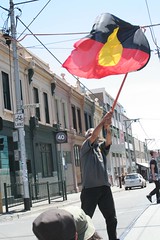
Anarchism : an ideology for fuckwits, bums & lowlifes

Melbourne (…Australia!)

Squatters, fuckwits, bums, lowlifes
Published by @ndy January 20th, 2009 in State / Politics, History

A reply to John Surname, principally, but also an opportunity to review some of the recent history of squatting in Australia. S is for SHACking Up, Soul Train & Squatting (January 16, 2009) was a previous post responding to some criticisms of SHAC, but on squatting, property and housing issues more generally. John wrote on the subject of Diddly-Squatters on January 14…

Mexico

[Word on la calle is that LASNET gonna be organising something about the Zaps over the weekend of February 20–21–22. Stay tuned for more deets.]

Beyond Resistance: EVERYTHING! An Interview with Subcomandante Insurgente Marcos by El Kilombo Intergalactico

According to what the Zapatistas have stated, one can never ascertain a belief in or vision of the future by looking at a situation from the position of “neutrality” provided for you by the existing relations of power. These methods will only allow you to see what already is, what the balance of the relations of forces are in your field of inquiry. In other words, such methods allow you to see that field only from the perspective of those who rule at any given moment. In contrast, if one learns to harness the power of the periscope not by honing in on what is happening “above” in the halls of the self-important, but by placing it deep below the earth, below even the very bottom of society, one finds that there are struggles and memories of struggles that allow us to identify not “what is” but more importantly “what will be.” By harnessing the transformative capacity of social movement, as well as the memories of past struggles that drive it, the Zapatistas are able to identify the future and act on it today. It is a paradoxical temporal insight that was perhaps best summarized by “El Clandestino” himself, Manu Chao, when he proclaimed that, “the future happened a long time ago!”

Given this insight afforded by adopting the methodology of the inverted periscope, we are able to shatter the mirror of power, to show that power does not belong to those who rule. Instead, we see that there are two completely different and opposed forms of power in any society: that which emerges from above and is exercised over people (Power with a capital “P”), and that which is born below and is able to act with and through people (power with a lower case “p”). One is set on maintaining that which is (Power), while the other is premised on transformation (power). These are not only not the same thing; they are (literally) worlds apart. According to the Zapatistas, once we have broken the mirror of Power by identifying an alternative source of social organization, we can then see it for what it is—a purely negative capacity to isolate us and make us believe that we are powerless. But once we have broken that mirror-spell, we can also see that power does not come from above, from those “in Power,” and therefore that it is possible to exercise power without taking it—that is, without simply changing places with those who rule. In this regard, it is important to quote in its entirety the famous Zapatista motto that has been circulated in abbreviated form among movements throughout the world: “What we seek, what we need and want is for all those people without a party or an organization to make agreements about what they don’t want and what they do want and organize themselves in order to achieve it (preferably through civil and peaceful means), not to take power, but to exercise it.” Only now can we understand the full significance of this statement’s challenge.

It is important to note how this insight sets the Zapatistas apart from much of the polemics that has dominated the Left, be it in “socialist” or “anarchist” camps, throughout the 20th century. Although each of these camps has within itself notable historical precedents that strongly resemble the insights of Zapatismo (the original Soviets of the Russian revolution and the anarchist collectives of the Spanish Civil War come most immediately to mind), we must be clear that on the level of theoretical frameworks and explicit aims, both of these traditions remain (perhaps despite themselves) entangled in the mirror of Power. That is, both are able to identify power only as that which 6 comes from above (as Power), and define their varying positions accordingly. Socialists have thus most frequently defined their project as the organization of a social force that seeks to “take [P]ower.” Anarchism, accepting the very same presupposition, can see itself acting in a purely negative fashion as that which searches to eliminate or disrupt Power—anarchist action as defenestration, throwing Power out the window. 18 Thus, for each, Power is a given and the only organizationally active agent. From this perspective, we can see that despite the fact that Zapatismo contains within itself elements of both of these traditions, it has been able to break with the mirror of Power. It reveals that Power is but one particular arrangement of social force, and that below that arrangement lies a second—that of power which is never a given but which must always be the project of daily construction.

In sum, according to the Zapatistas, through the construction of this second form of power it is possible to overcome the notion (and the practice which sustains it) that society is possible only through conquest, the idea that social organization necessitates the division between rulers and ruled. Through the empowerment of power, it is possible to organize a society of “mandar obedeciendo” (rule by obeying), a society that would delegate particular functions while ensuring that those who are commissioned to enact them answer to the direct voice of the social body, and not vice-versa. In other words, our choices now exceed those previously present; we are not faced with the choice of a rule from above (we would call this Sovereignty), or no rule at all (the literal meaning of Anarchy). The Zapatistas force us to face the imminent reality that all can rule—democracy (as in “Democracy, Liberty, and Justice”).

Nepal

Crack Pot Kin, May 2nd, 2008 at 7:10 pm

So how is ‘Anarchy’ doing these days…which revolution are you lot leading in the world, must be everyone is too dumb for ANARCHISM?!

I notice you didn’t mention Nepal – but reality doesn’t really suit you does it?

What a pity that the Nepalese haven’t taken up your ‘First World’ petty bourgeois Anarchism and instead have opted for “Authoritarian, Stalinist, Leninist, blah, blah, blah”.

Nepal: victory turns sour
Submitted by Ret Marut on Jan 22 2009

Paris (France… apparently)

Eating without paying? Scum!

French left pioneers a radical new tactic: the picnic protest
Activists take food off the shelves and invite shoppers to dine with them to highlight the plight of ‘Generation Y’
Jason Burke in Paris
The Observer
January 25, 2009

In exactly a week’s time, in a supermarket somewhere in or around Paris, a couple of dozen young French activists are going to choose an aisle, unfold tables, put on some music and, taking what they want from the shelves, start a little picnic. The group “L’Appel et la Pioche” (The call and the pick axe) will have struck again – fruit and veg, dairy or the fish counter will have been transformed into a flash protest against global capitalism, rampant consumerism, bank bail-outs, poor housing, expensive food, profit margins and pretty much everything else that is wrong in the world.

The “supermarket picnic” will go on for as long as it can – before the security guards throw the activists out or the police arrive. Shoppers will be invited to join in, either bringing what they want from the shelves or just taking something lifted lightly from among the crisps, sweets or quality fruit already on the tables.

“L’Appel et la Pioche” have struck four times so far and have no intention of stopping what they claim is a highly effective new way of protesting.

“Everyone is bored of demonstrations. And handing out tracts at 6am at a market is neither effective nor fun,” said Leïla Chaïbi, 26, the leader of the group. “This is fun, festive, non-threatening and attracts the media. It’s the perfect way of getting our message across.”

Linked to a new left-wing political party committed to a renewal of politics and activism, Chaïbi’s group represents more than just a radical fringe and has been gaining nationwide attention.

    The New Anticapitalist Party (Nouveau parti anticapitaliste, NPA) is a French political party launched on June 29, 2008. Its current name is temporary; a decision on the party’s name is expected at a founding congress that is being planned for February 6-8 2009.

A veteran of fights to get pay and better conditions for young people doing work experience, Chaïbi claims to represent millions of young Frenchmen and women who feel betrayed by the system.

“We played the game and worked hard and got a good education because we were told we would get a flat and a job at the end of it. But it wasn’t true,” said Victor, 34, another member of the group. “We have huge difficulty getting a proper job and a decent apartment.”

Chaïbi, who works on short-term contracts in public relations and is currently looking for work, told the Observer that the group’s aspirations were limited. “I am not asking for thousands and thousands of euros a month as a salary or a vast five-room apartment. Just something decent.”

In recent years, the problems of France’s “Generation Y” or “babylosers” have made headlines. As with many other European societies, after decades of growth, this is the first set of young people for centuries who are likely to have standards of living lower than their parents. According to recent research, in 1973, only 6% of recent university leavers were unemployed, currently the rate is 25-30%; salaries have stagnated for 20 years while property prices have doubled or trebled; in 1970, salaries for 50-year-olds were only 15% higher than those for workers aged 30, the gap now is 40%. The young are also likely to be hard hit by the economic crisis.

New ways of working mean new ways of demonstrating, too. “We are already on precarious short-term contracts, so there’s no point in going on strike,” said Chaïbi. “But a supermarket is very public and we make sure the media are there to cover our actions.”

So far reactions have been good, the group claims. In one supermarket in a suburb of Paris, the activists say they got a spontaneous round of applause from the checkout workers. Elsewhere, security guards have been “friendly”. Everywhere in France, the problem of a weakening “pouvoir d’achat” – the buying power of static wages – is a cause for resentment.

The economic crisis is further fuelling anger. Though not yet as badly hit as the UK, thanks to tighter regulation and much lower levels of personal borrowing, French businesses have still been laying off staff amid predictions of a massive rise in unemployment this year. Unions have been largely passive in the face of threatened redundancies, accepting go-slows to preserve jobs.

With the French Socialist party in disarray, alternative forms of political protest on the left, particularly a breakaway communist faction led by charismatic postman Olivier Besancenot, have made inroads. Protests about the homeless or against the expulsion of immigrants have largely taken place independently of the Socialist party, which is mired in feuds and ideological incoherence.

One new group is the Jeudi Noir, which organises heavily publicised squats of vacant buildings in Paris. Named Black Thursday after the day classified advertisements for flats appear, activists recently took over a clinic that has lain empty at the heart of the Left Bank for nearly five years.

“This is not just about finding myself somewhere to live,” said Julien Bayou, 28, who is now living in one of the former clinic’s offices. “We are making a political point. We just think it is wrong that a building in perfect condition should be empty for years when so many people need somewhere to live.”

Chaïbi sat in the kitchen of the former clinic. “It’s not just about the supermarkets,” she said. “It’s about fighting the system.”

Posted in !nataS, Anarchism | 9 Comments

Boys will be boys…

Manly erupts in violence on Australia Day
Justin Vallejo
The Daily Telegraph
January 26, 2009

…In Manly hundreds of youths draped in “Aussie pride” livery wore slogans declaring “f–k off we’re full” as they smashed up to three cars and ran up the famous Corso. A 18-year-old Asian female in one of the cars was showered with shattered glass, giving her numerous cuts to her arms. She was treated on the scene by ambulance officers. Groups of men jumped up on cars chanting race hate to the terrified passengers within. What started as chants of “Aussie Aussie Aussie” at 1pm had in an hour had developed an ugly overtone. By 3.30pm Manly police called in the public order and riot squad and PolAir in an attempt to control the crowd, made up of a core group of troublemakers estimated by police about 80 drunk teenagers from out of town… By the end three cars were damaged, one 16-year-old boy was charged with assaulting police, two 16-year-olds were cautioned for offensive behaviour and one cautioned for jumping into the water in front of the ferry… [SMH: police “arrested five 16-year-old males before the mob dispersed nearly two hours later.” Further: ‘Supt Darcy said the incident was just “exuberance” gone wrong by a handful of people. “The assaults were not racially motivated and police had observed people of all different ethnic backgrounds walking past this group and not being challenged,” he said.’]

As Manly narrowly escaped the potential of going off like a cracker, police were being called out all over NSW to break up brawls between Australia Day revellers. Police were called to a report of a 30-person brawl on Shelly Beach Road at Port Macquarie while another 30 people were reportedly fighting on Towns St in Shellbarbour. Ambulance crews were called to a fight at Sutherland train station with reports of a 10-person brawl, with a glassing and a female with a fractured finger. One person was taken to Sutherland Hospital while another has been arrested.

…on the other hand…

Manly mob rampages through Corso
Geesche Jacobsen
Sydney Morning Herald
January 26, 2009

Police are investigating reports that a mob of 80 youths ran amok in Manly on Australia Day today, jumping on car bonnets. The youths were seen running up and down The Corso this afternoon. The group of teenagers, many of whom appeared to know each other, ran down the pedestrian street, hitting overhead shop signs as they went. Once they reached the western end, they were seen jumping and climbing over car bonnets near Manly wharf, damaging several cars. They appeared to have been drinking, but it did not seem to be a fight, “perhaps more like high jinx”, a witness said.

That a group of drunken, obnoxious, teenage boys jumped on a few cars, waved flags, and shouted xenophobic and racist slogans @ strangers does not mean that ‘Manly erupted in violence’. Instead, what this suggests is that, given the opportunity, some boys will act like bullies. That an incident such as this took place on Australia Day is hardly surprising. Nor is it unexpected that one target of these ‘youthful hijinx’ should have been an Asian girl.

The Cronulla ‘riot’ has not been re-enacted, and one of the key reasons why is the absence of a campaign to resurrect it on the part of the corporate/state media.

Alcohol + adolescents = dickheadedness. Who knew? Doctor James Saleam thinks their efforts are praiseworthy — ‘Australia First Party Praises Youth For Australia Day Mass Action In Manly’ — but the convicted criminal — ‘Cautions Against Breaking Criminal Law’.

http://ausfirst.alphalink.com.au/manlyaction.html

Row Down Under: Australia Day or Invasion Day?
The Associated Press
January 26, 2009

SYDNEY, Australia: An Aboriginal leader named Australian of the Year on Monday said the government should consider changing the date of Australia’s national holiday because many indigenous people view it as celebrating the invasion of their homeland…

As for the Australian Army Southern Cross Soldiers, I think Roger Franklin may have joined Liam Houlihan on their shit-list…

No soldiers in fool’s army
Roger Franklin
Herald Sun
January 27, 2009

THERE are all sorts of words for a group of soldiers – troop, platoon, squad, take your pick.

But not one of them works for the strike force of simpletons that set out from Flinders St station on Australia Day to invade Mordialloc beach.

Public nuisances, obnoxious adolescents, big-lunged buffoons – they all do the trick. But the very best way to describe the self-styled patriots who call themselves the Southern Cross Soldiers is the simplest of them all.

Fools, every single one.

You could tell it would be an exercise in idiocy from the moment the first little troopers arrived under The Clocks and began casting anxious eyes over the Australia Day parade rolling down Swanston St.

Chinese marchers with their dragons, Turkish dancers, new arrivals from Africa – the sort of people your typical Southern Cross Soldier wants to send back where they came from.

But outnumbered as they were, there wasn’t a peep out of these heroes, whose ranks swelled gradually to about 30.

That was enough for the smarter ones to find the collective courage to stand in line and buy their tickets.

The defenders of White Australia behaved themselves on the train too.

And at Mordialloc’s multicultural melting pot, well you just had to laugh. They congregated for a while at the foot of the pier like virgins at an orgy, glancing anxiously down the beach and at all those non-Anglo faces, who paid them no heed whatsoever.

When a couple of brawny Pacific Islanders ambled past, their silence was deafening.

And then, perhaps because even nitwits understand that discretion is the better part of valour, they shuffled quietly back to the station, where the platforms were deserted – where it was safe to be offensive because there was no one around to offend.

They tried singing the national anthem, but that petered out after a few lines.

The pint-sized patriots evidently have a hard time remembering the words, so they settled on a few choruses of “Aussie, Aussie, Aussie – Oi! Oi! Oi!”

When a Herald Sun photographer tried to snap their pictures, that was the moment to demonstrate courage. Fifteen on one, those are the sort of odds cowards like best.

There was a bit of pushing and shoving and lens-blocking, and one big kid struck a boxing pose and offered to punch some heads.

He didn’t and they drifted away on a cloud of obscenity to have another go at remembering the words to Advance Australia Fair.

Then a single, solitary copper strode into their midst and you should have seen them look the other way when he booked one of their members for drinking in public.

When the train came they piled aboard in a hurry to escape that solitary walloper, who wasn’t even all that big.

An army in retreat?

Not on your life. More like a flock of very silly geese.

Posted in !nataS, State / Politics | 7 Comments

Chomsky on Obama

Noam Chomsky interviewed by Afshin Rattansi, January 23, 2009.

See also : politube.org:

politube.org is a video and audio sharing website that distributes media from independent media outlets and activists on real subjects like politics, society and the environment.

politube.org is a non-profit website, therefore it only serves the interests of the community. Towards this goal, we need and greatly appreciate your help. You can help us in the following ways:

* Use the website by watching, listening and uploading media.
* Give us your feedback.
* Websites are successful when many people visit and use them; please promote politube.org by telling others about it.
* Help us generate funding for the operation and development of the website.

Posted in State / Politics | Leave a comment

X : ‘I Don’t Wanna Go Out’

From their debut album X-Aspirations, 1979. Produced by Lobby Lloyde [RIP]. Re-released on Amphetamine Reptile, ‘Aspirations Noise Archives Volume 1’ (AmRep 013, 1993).

To be confused with the Yanqui band of the same name.

Posted in Music | Leave a comment

“Talking About Surrender”, with your hosts, Geert Wilders & Janet Albrechtsen

Poor old Geert. Last week, the nutty Dutch politician and amateur filmmaker was informed by a Dutch court that his shit-talkin’ was law-breakin’.

“The Amsterdam appeals court has ordered the prosecution of member of parliament Geert Wilders for inciting hatred and discrimination, based on comments by him in various media on Muslims and their beliefs,” the court said in a statement. “The court also considers appropriate criminal prosecution for insulting Muslim worshippers because of comparisons between Islam and Nazism made by Wilders,” it added.

Geert has compared the Koran to Mein Kampf, wants it to be banned in the Netherlands, and believes the “sick, cancerous ideology” of Islam is fundamentally a religion of ‘terror’, bent on destroying Western civilization. He also demands an end to Muslim immigration and a halt to any further construction of mosques in the land of clogs and windmills (Islam film Dutch MP to be charged, BBC, January 21, 2009).

In March 2008, Geert released the craptastic film Fitna, which effort helped secure him the title of ‘Man of the Year’ courtesy of US neo-con zine Frontpage. He has also come to the attention of local neo-cons, including yuppie scribbler Janet Albrechtsen, who shares Geert’s deep concern over Islamisation. In fact, such were the depths of Janet’s concern, in 2002 the former crackademic deliberately and maliciously distorted others’ work to suit her crackpot argument.

The former corporate lawyer turned corporate hack was rewarded by HoWARd for her good work by being appointed to the ABC Board.

Janet on Geert:

Talk about surrender
Janet Albrechtsen
The Australian
December 31, 2008

…When Somalia-born Ayaan Hirsi Ali arrived in Australia in early August to talk about free speech and her right to criticise Mohammed, she was still accompanied by security to protect her from those who regard violence as a legitimate response to words and ideas.

Hirsi Ali won’t be silenced. Neither will Dutch MP Geert Wilders, who is also surrounded by security. The release in March of his short film Fitna, which is critical of Islam, was followed by a fatwa from al-Qa’ida, boycotts against Dutch products, and attempts by Muslim countries to censor the film from the internet.

In the face of real threats, the tendency to curtail free speech even before threats arrive rather than offend minority sensibilities is spreading like a virulent cancer. Recall the case of the controversial Dutch cartoonist who was arrested in May and interrogated for his cartoons that mocked Islam. At least Gregorius Nekschot did not suffer the fate of Shafeeq Latif, who was sentenced to death in June by a Pakistani judge for insulting Mohammed.

But the West is killing free speech slowly – by more subtle means – through state-sponsored censorship under the grand name of protecting human rights…

Janet on the pack-rape of white girls by young Muslim men, driven by their ‘ethnicity’, eventually resulting in the collapse of Centre-Left government in France, and now (2002) polluting Australia.

I kid you not.

Talking race not racism
Janet Albrechtsen
The Australian
July 17, 2002

THE French call it tournantes or “take your turn” — the French term for the pack-rape of white girls by young Muslim men.

For 20 years the French ignored the ethnic causes of these barbaric crimes for fear of offending multicultural man. Along the way, more innocent young girls were pack-raped. Xenophobia divided communities. And finally, voters punished a Centre-Left government for assuming that the electorate was not grown up enough to discuss race without being racist.

Last year Sylvie Lotteau, a magistrate from Bobigny, a northern Paris suburb, described tournantes: “Their technique was to pick up a young girl — a white girl — and once she had become the girlfriend of one of the members, he would allow his mates to make use of her.”

Now it’s in Australia. Last week two Muslim brothers were found guilty of the gang-rape of a young Australian girl. The victim knew one of the brothers. She was invited for a drive but taken to a secluded park and gang-raped while 14 Muslim boys watched.

Racially motivated gang-rape first hit the radar screen in August last year. After the first trial, ethnic leaders such as Sheik Tajedinne Hamed el Hilaly, imam at Lakemba mosque, said the ethnicity of the rapists was irrelevant and simply incited racist attacks on Muslims.

But the Muslim community flogged the wrong racists — those Muslim rapists played the race card in the most horrific and demeaning way, taunting victims with “you deserve it because you’re Australian” and threats to “f— you Leb style”.

[Taunts noted by Janet and also exploited by the fascist Australia First Party in a bizarre electoral campaign video:

See : Bikini-Nazis hit the beaches and stir the pot, Joe Hildebrand, The Daily Telegraph, March 4, 2007.]

And when the judge in the first trial, Megan Latham, tried to douse the flames in an increasingly heated debate about ethnic crime with her gratuitous comments about there being “no racial element”, she simply turned up the heat.

Since then, evidence on ethnicity-based gang-rapes has mounted. Horrific attacks across Sydney’s southwest reveal the same modus operandi as the French tournantes. Our reaction? Like the French, we pander to sensitivities about race and cultural issues. And so we extend the social and political nightmare of race-based gang-rape.

A year ago the barbaric French phenomenon looked vaguely relevant. Now it looks scary and prophetic. When 11 young Muslim men were accused of pack raping a 14-year-old French girl in a cellar, politicians, judges and sociologists finally began to expose and explore the terror of tournantes.

“It’s the group effect. They can’t let themselves down in front of their friends, who are urging them to commit the act,” said a police commander of a northern Paris suburb.

Pack-rape of white girls is an initiation rite of passage for a small section of young male Muslim youth, said Jean-Jacques Rassial, a psychotherapist at Villetaneuse University. “Fraternal bonding now dominates. It is the law of the gang, shorn of any sexual morals,” he said.

Denmark presents a similar story. Last year, Flemming Balvig, a criminologist at Copenhagen University, confirmed the French experience of this barbaric rite of passage into manhood for some of these young men.

French and Danish experts say perpetrators of gang-rape flounder between their parents’ Islamic values and society’s more liberal democratic values falling back on the most basic pack mentality of violence and self-gratification. The progressive Danes offer immigrants advice about the nature of Danish culture and how Denmark’s liberal sexual attitudes cannot be equated with Danish girls “asking for it”.

Even the wider Arab world is confronting the costs of a culture that can treat women as second-class citizens. Two weeks ago a ground-breaking report by Arab scholars, commissioned by the UN, revealed that half of all Arab women can neither read nor write. The Arab Human Development Report 2002 found that Arab women’s participation in political and economic life rates the lowest in the world.

Transplanted to countries such as Australia, a culture which places so little value on gender equality was always going to have problems when faced with women who not only read and write but think and assume control of their lives. Each of those barbaric gang-rapists showed utter disdain for their young Western victims.

Yet in Australia racially motivated gang-rape is met by gutless censorship from multicultural man. And like our Muslim leaders, Australian feminists have been unusually quiet on this gender issue.

Ignoring it exacerbates it. A large group of Muslim boys involved in these gang-rapes is still at large. The Muslim community’s refusal to acknowledge cultural issues spells disaster for more innocent young women terrorised by Muslim boys hiding behind their ethnicity. Silence also spells disaster politically. Suppressing frank discussion gives a free kick to the next Jean-Marie Le Pen or Pauline Hanson.

At the community level, ignoring the link between crime and ethnicity raises the red flag to rednecks who wish to blame all Muslims for the barbarity of a few. This undermines a peaceful, tolerant future for the vast majority of immigrants who embrace Australian values.

Discussing race or ethnicity is neither racist nor xenophobic. Tackling problems head on can only encourage further immigration; ignoring them will be immigration’s death knell. Our tolerance of these Muslim pack-rapists simply feeds their intolerance of us. It took the French 20 years to work that out. How long will it take us?

Posted in !nataS, Film, Media, Sex & Sexuality, State / Politics | Leave a comment

Happy Invasion Day!

Celibate Rifles do ‘Killing Time’, live at Sedition Festival, Trade Union Club, Sydney, 1983. Introduced by Donnie Sutherland on the After Dark TV show, 1984(?). The Festival also featured Severed Heads, which noisy bastards run amok is quite taken with…

British Empire’s convict labour
Minor crime sent to Australia
Kill the blacks, inferior race
Killing time take over the place

After Dark, December 18, 1982, w/- John Cooper Clarke. His poem is dedicated to the Southern Cross Soldiers, who are playing a gig @ Flinders Street Station midday today.

Bonus!

Posted in History, Music, Poetry, Television | Leave a comment

Anarchist press in Australia?

There are exactly two — or perhaps three — regular ‘anarchist’ publications in Australia. They are:

Anarchist Age Weekly Review
Mutiny &
Rebel Worker.

The first two are explicitly anarchist; Rebel Worker is an anarcho-syndicalist publication. I’ve no idea what the circulation is of any of the three, but presumably it numbers in the hundreds, not thousands.

Anarchist Age Weekly Review

The Anarchist Age Weekly Review began publication in 1991, and has been produced consistently since then; the edition of January 12, 2009 is No.819 of the Weekly to be published. The Weekly‘s format is usually a photocopied, double-sided, folded A3 sheet of four B&W pages, with occasional supplements.

Since its inception, the Weekly has been almost entirely the work of one person, Dr. Joe Toscano, a veteran activist, and provider of almost all of the Weekly‘s contents (based on those of his weekly radio show, Wednesday, 10–11am, on local community radio station 3CR).

The January 12 edition of AAWR contains Joe’s thoughts on:

    the Israeli war on Gaza;
    the significance of Barack O’bama’s election for US/Israel relations;
    the failure of state governments to address climate change;
    PM KRudd’s claim that, like the Coke ad, ‘we’re all in this together’;
    why a journalist is wrong to describe the current situation in Somalia as ‘anarchy’;
    anarchism and education;
    the importance of remembering Tunnerminnerwait and Maulboyheenner;
    William Dampier’s piracy and inadvertent ‘discovery’ of the Kimberley coast in January, 1688;

a book review, a personal observation, a short poem by Stephen Roberts, and a series of advertisements for Joe’s other political projects (Sedition Charter, Direct Democracy Not Parliamentary Rule, Reclaim the Radical Spirit of the Eureka Rebellion and the Anarchist Media Institute). In addition to these, Joe has recently campaigned for Mayor of Melbourne (unsuccessfully), to Defend & Extend Medicare (DEMG), and is also the Libertarian Workers For A Self-Managed Society (LWSS) and People for Constitutional Human Rights (PCHR).

While the DEMG and PCHR groups are moribund, the LWSS is still existant, although it appears to have been largely subsumed by the AMI (Joe). In 1998, the LWSS (Joe) declared “The Libertarian Workers for a Self-Managed Society have been active in Melbourne, Australia since 1977. The group was formed to act as a focus for Anarchist activity in Melbourne.” Over the last three decades, I’m unaware of anyone other than Joe speaking on behalf of the AMI/LWSS at any point, so it might be more accurate to state that, for whatever reason(s) the group was initially formed, it acts as a focus for Joe’s activity in Melbourne.

Anarchy now!

IN ALL the media ownership machinations, why is it that the Anarchist Age Weekly Review fails to attract buy-out offers from the big players?

The weekly journal of the Anarchist Media Institute is humble in appearance, but punches above its weight as it decries the corporate world, the military machine and politics of pretty much every persuasion.

What an infinitely better world we would have, says Joseph Toscano, the public face of the institute and enthusiastic dispatcher of missives to letters editors, if people took to the streets and demanded direct democracy…

~ Diary, The Age, June 30, 2008

Mutiny

Mutiny is a monthly zine, which began publication in April 2006, and is produced by an anarchist collective of the same name based in Sydney.

We started this zine to explore different avenues of disobedience & resistance, & to encourage people to write about their ideas, actions & experiences. Mutiny is currently exploring ways to resist gentrification, in particular the ‘redevelopment’ proposed in the Redfern area by the Redfern Waterloo Authority. We’re keen to work with other people opposed to this redevelopment & the displacement, rent hikes & ugliness it involves…

The zine is produced in Sydney and distributed in paper format in lots of places.

It is B&W, photocopied, A4-folded, and generally around 20 pages in length.

Formed in 2003 in order to employ direct action against Australia’s involvement in George II’s Coalition of the Killing, the group consists of a number of layers of trust and information management according to police intelligence. “These are feral, low-life people that want society to be in a state of near anarchy for their own perverse pleasure. Let’s not mince words here. People who say they are anti-war but resort to violence and destruction to put their case are clearly a bunch of people who are dangerous to society. These are just anarchists that enjoy disrupting civil society. They do not have one fig of credibility” according to the Deputy Premier of South Australia.

The December 2008 edition (#35) contains:

    an article on ‘Militant Research and Organisation’ by Bad Robot;
    two texts on the uprising in Greece;
    20 Theses Against Green Capitalism by Tadzio Mueller (Turbulence) and Alexis Passadakis (ATTAC);
    news briefs (Aotearoa/New Zealand, Australia, Gaza, Greece, Iceland, Thailand, United States) and;
    reviews (Wai Quarterly, Quantum of Solace).

I may interview the Mutiny collective at some point in the near future…

Rebel Worker

The first issue of Rebel Worker is dated February/March 1982, and was published by the Australian IWW. In 1983 the Sydney IWW was disbanded, and RW — now an ‘anarcho-syndicalist’ paper — was published by the ‘Rebel Worker Group’. In 1986, the RWG became the Anarcho-Syndicalist Federation Sydney (another group existed in Melbourne), and RW a publication of the ASF. In 1992, the ASF Sydney left the ASF, and (eventually, in 1995) adopted the name Anarcho-Syndicalist Network (ASN). From 1982 through to today, Mark Maguire has been its editor.

Currently, RW is produced several times a year. Four issues were produced in 2008, the issue of July/August being the 200th.

At various points, RW claims, somewhat bizarrely, that “We are a revolutionary labour movement”, rather than what it is — an occasional publication of the ASN “for the propogation [sic] of anarcho-syndicalism in Australia”.

The latest edition of RW available online (Vol.27, No.3, July/August 2008) is B&W, printed and 20 pages long. The issue contains a range of material typical of most issues produced since the ASN’s formation:

    a June 27 statement from the Socialist Party on a recent court case (minus its conclusion);
    an anonymous report on a union ballot seeking approval for industrial action;
    a brief statement on the importance of workplace health and safety for shift workers;
    an interview with an anonymous bus driver at the Port Botany depot;
    another interview with an anonymous wharfie at Port Botany;
    a report by Liz Thompson on a taxi drivers’ meeting in Melbourne on June 19 (originally published on the Leftwrites blog);
    a brief report on a postal workers strike in Melbourne (originally published on Libcom, June 13, 2008);
    an interview with an anonymous employee of V/Line;
    two brief articles on events in the UK (one by Brian Bamford and the other from Freedom);
    a report by Laure Akai on a bus strike in Poland (originally published in STRIKE! No.3, the newsletter of the Warsaw ZSP (Związek Syndykalistów Polski/Union of Syndicalists);
    another, slightly longer report, also by Laure Akai, concerning the unfair dismissal of a worker by the Warsaw office of Lionbridge Poland;
    a book review of Social Ecology and Communalism by Murray Bookchin (AK Press, 2007) by Graham Purchase;
    an article by ‘PJS’ on the recent split in the DSP;
    an article — Oil tanker drivers’ strike: Solidarity fuels the struggle — originally published in World Revolution, No.316, July/August 2008;
    an article (July 9, 2008) — One worker killed as security guards attack Indian diamond workers strike — also taken from Libcom;

and finally Mark’s reflection on 200 issues of RW:

We have reached an important milestone in the history of anarcho-syndicalism in Australia with the 200th edition of Rebel Worker. We who stand before the masthead of RW, have come a long way, but still we have a way to go in regard to assisting the emergence of mass syndicalist unions and the transitional steps to achieve such bodies.

While many are excited by the possibility of spectacular protests and exotic antics during the Pope’s visit to Sydney during World Youth Day, the ASN has been busy on the unglamorous industrial front. Entailing assisting militant rail workers to expose a nefarious con-trick by the union hierarchy in league with the bosses and the media regarding the current RailCorp Enterprise [Bargaining] Agreement [EBA] negotiations. It involves the union hierarchy falsely claiming a victory in the negotiations in regard to preventing job losses in the CityRail station network.

Currently, the ASN is assisting a nationwide effort by militants to uproot the ALP fat cats which dominate the Rail Tram & Bus Union and achieve grass roots control of the union. Associated with this push is a move to orient the union away from its current path of constant cave-ins to the [Government] and the bosses’ demands and privatisation, toward the pursuit of direct action and the achievement of workers control of industry.

To say that there is a long way to go before there are mass syndicalist unions/a revolutionary labour movement in Australia is no exaggeration. Mark has been publishing RW for almost three decades now: so what progress, if any, has been made? I may discuss this question at a later point, but I’m reasonably convinced that any detailed discussion would be a waste of time given that there is minimal interest in the subject. More generally, nothing has changed since I wrote the following:

Like the numerous Marxist organisations anarchism in contemporary Australia is a fringe movement, and in terms of its organisational framework and popularity, even more so. Anarchism also has far fewer allies in the academy and the media, no regular journals of any standing, and fewer historical roots. To the extent that ‘anarchism’ has influence within contemporary Australia, therefore, it’s largely through culture, and the adoption of broadly ‘anti-authoritarian’ ideas and practices within other social movements — the environmental, peace and women’s movements in particular, but also on the fringes of the labour movement.

Having said this, there are a small number of formal, self-consciously ‘anarchist’ groups and projects currently in existence, almost all concentrated in the two major cities of Melbourne (Pop. 3,850,000) and Sydney (Pop. 4,300,000). Further, individual anarchists are involved in a broad range of campaigns, groups and projects: animal liberation/rights, anti-racist and anti-fascist, ecological/environmental, feminist, media, queer, indigenous and prisoner solidarity, squatting, student, and union, among others.

In any case, the basic political orientation of the ASN is expressed, quite painfully, in the 2005 document ‘Anarcho-Syndicalism – Catalyst for Workers’ Self Organisation Not Leftist Sect Building’.

(See also : Rebel Worker and Accountability, John Englart, July 2002.)

*Sparks

In essence, the strategy of the ASN may be described as follows: workers outside of the transport industry agitating for the emergence of an anarcho-syndicalist union (“democratic unionism”) within it. The means (tactic) to achieve this is publishing a zine for public transport workers. This zine is called Sparks, and several issues have appeared over the last few years — September/October 2007 (#127), March/April 2008 (#128) and October/November 2008 (#130). (An edition, #129, somewhat mysteriously dated December/January 2008, is also available.)

In terms of content, Sparks is very similar to RW, only where RW includes items other than interviews, Sparks consists almost exclusively of these, with the addition a few news items regarding public transport (in Australia and overseas) and a few cartoons.

Note that Sparks was originally published by a group of anarcho-syndicalist transport workers in Melbourne; the first issue appearing in May 1986. Takver writes:

A small number of anarchists had been working in public transport for some time. In 1985 a small group of rail workers put out a news sheet called Stopping All Stations. This transformed into a broader journal, called Sparks, covering public transport workers in rail, tram and buses. The Melbourne local of the Anarcho Syndicalist Federation (ASF) published the first issue of Sparks in May 1986. In February 1987, the Public Transport Workers Association was admitted to the ASF and continued to publish Sparks, which became the most popular publication in Melbourne’s public transport industry, with a circulation of over 5,000. A core group of four to seven people published and distributed Sparks, with many more contributing news and donations to cover its free distribution.

Sparks provided transport workers with a means to communicate with each other. The tone of the journal was down to earth, humorous, and always willing to take the piss out of management and union factions and officials. The journal advocated direct democracy and anarcho-syndicalism, and built up a substantial readership by workers in the public transport industry in Melbourne. In fact, the journal had far more street credibility than the official union journals. This was dramatically demonstrated when just before a tramways division union election, one union faction republished an entire issue of Sparks with the addition of a middle page election insert – no other text or graphics were changed. This just highlighted the bankruptcy of the traditional union factions.

The influence of anarcho-syndicalism became most apparent during the 1990 tramways occupation, when workers occupied their depots and ran the service for free — before the government cut the power to the system. The ASF initiative of establishing ‘passenger support groups’ was another major innovation, and allowed members of the community to show their support for the trammies.

One tram depot during the dispute, South Melbourne, at one stage even seriously debated leaving the [Australian Motor Omnibus and Tramway Employee Association] and joining the ASF. The fact that such a motion was seriously considered and debated by 100 odd workers in a depot indicates the degree of cynicism of the ATMOEA union leadership; the attraction of syndicalist ideas of direct union democracy and solidarity; and the influence Sparks and the ASF had on the militancy of the dispute.

The last issue of Sparks, #27, came out in early 1991. By the end of 1991, the anarchist militants had all left, or been forced out of, the public transport industry.

A New South Wales version of Sparks is still published as a “rank-and-file transport workers’ paper”, one which advocates anarcho-syndicalism [‘democratic unionism’]. This magazine, while informative, is very serious, and lacks the humour and inspiration of the Victorian Sparks.

Further discussion on the 1990 tramways dispute may be found in ‘The end of the line: an examination of the 1990 Victorian tram dispute’ by Drew Cottle, Angela Keys and Kristie Martin (University of Western Sydney), a paper presented to ‘The Past is Before Us’, Australian Society for the Study of Labour History conference, June 30–July 2, 2005, University of Sydney.

This paper is an examination of the 1990 Melbourne tram dispute. A fiscal crisis generated by colossal financial failures led the Cain Labor government in Victoria to attempt to rationalise the workforce of Melbourne’s tramways. Such a move followed the dictates of the Federal Labor government’s Accords which enforced union amalgamations. The attempt to introduce a new ticketing system threatened the jobs of the trams’ conductors. The tramway union’s refusal to comply with the new ticketing led to a lockout and the struggle to save the conductors’ jobs. Depot occupations and a tram blockade ensued. Throughout the dispute, the government refused to negotiate with the union. The dispute left the tramways’ union divided and defeated. While conductors’ jobs were eventually eliminated, the government remained in debt.

The paper does not mention the ASF or Sparks, but does reference Kristie Martin, ‘Derailing the Trammies: A Study of the 1990 Tram Strike’ (BA Honours Politics thesis, University of Western Sydney, 2004), which presumably refers to these at least once. The paper is also “dedicated to Dick Curlewis, life-long labour activist, advocate of workers’ control, and supporter of tram workers during the dispute”. Dick [1917 – 2002] wrote an essay on the subject: ‘Melbourne Tram Dispute and Lockout January–February 1990: Anarcho-Syndicalism in Practice’ (Jura Media, 1997). (Another account of the dispute occurs in Jeff Sparrow and Jill Sparrow, Radical Melbourne 2: the enemy within (Vulgar Press, 2004), which similarly ignores Sparks and the ASF.)

Unlike the earlier Sparks, the NSW edition is also produced by workers outside of the industry.

It’s extremely difficult, if not impossible, to gauge what effect, if any, 130 editions of Sparks has had on the ‘morale’ of public transport workers in NSW. To the best of my knowledge, its influence has not been remarked upon anywhere outside of the ASN. Thus Mark writes that “In March 1998, wildcat action broke out at Waverley bus depot and other STA bus depots [on] the [North Shore of Sydney] — where many drivers are regular Sparks readers — over issues related to the Sydney Harbour Bridge — [issues] raised in Sparks — and different issues in regard to Waverley”. Further, following a one-day strike by railway workers in September 1999, “Sparks appears [?] to have assisted the agitation of militants at [a] meeting via its [previous] exposure of union officials who collaborate with management and [by] assisting militants in presenting a critique…”. Finally, in 2002, “the Sparks network assisted militant bus drivers to distribute leaflets at mass meetings of the Bus Division of the RTBU to oppose an enterprise agreement”.

Of more interest, I think, is Vigilance, produced by Marxist Shane Bentley. Shane wants the Maritime Union of Australia to be under rank ‘n’ file control, and the industry to be nationalised “under workers’ control”. (See ‘the Vigilance Bulletin maritime action program’.) Shane has produced 39 issues of Vigilance, the latest being dated November 3, 2008.

Also of note in this context are the very short-lived zines Dishrag (for dishpigs) and On Call (for call centre workers). The following is an account of dishpig involvement in the 1998 MUA dispute:

On April 7th 1998 MUA workers were run off the Swanston Docks of Melbourne by balaclavaed thugs with dogs… in a military and brutal manner… as part of an attempt by the company [Patrick] to break the union hold on the waterfront by sacking the union workforce and using scab labour from the ranks of the desperate and stupid. Earlier in January a similar event happened on Webb Dock to facilitate the setting up of an “alternative” workforce.

The immediate response of the union was to set up picket lines bringing the transit of goods from the main docks of Melbourne (and around Australia) to a halt…

With the threat of forceful breaking of the picket line on April 18th the call went out and by the time Victoria’s Finest arrive to do their duty they find 4–5000 people gathered in support of the MUA dockers determined that it wasn’t gonna happen…

Totally outnumbered the police stand off, making a few optimistic feints towards the crowd, but never really seriously trying it on…

The feeling is electric… spiky punks stand and links arms with burly wharfies on one side and grannies on the other… searchlights try and pick their way through the swathes of thick smoke pouring from the fires lit to warm ourselves as the news and police choppers circle overhead…

With the arrival of several hundred building workers at 7am on the Saturday morning the police finally admit defeat and withdraw to lick their figurative wounds and wait for further orders…

As the day goes on people come and people go… the numbers up and down but never less than a few thousand with the comforting promise of doubling that again at the first sign of trouble… barricades are fortified, awnings and tents spring up about the place as people settle in to wait it out…

After a day of false alarms and drill after drill of linking arms to hold the line we (Dishpigs and others) leave with the general call for food ringing in our ears… promising to return the next day.

So come noon Sunday a few of us arrive in the (now dead but fondly remembered) Food Not Bombs van… equipped with a huge pot of soup and enough to make another…

Quickly setting up a table and and setting to on the vegies it was not long before the delicious aroma of the soup drew takers… cold and hungry from the long night…

From such small beginnings grew Food Not Scabs, a collective made up of DishPigs, Food Not Bombers and others, which fed that multitude of unionists and supporters 24 hours a day for going on 4 weeks.

We soon got into the swing of it… churning out delicious soup after delicious soup along with a few vege stews and with considerable respectful remembrance to Rocky who in that first 24 hours ran a marathon of stir fries without pause…

Amazed at our ability to operate non-stop providing good sustaining food the wharfies and other unionists and supporters couldn’t do enuff for us… from a rickety trestle table with a single burner and a handful of bowls and cups, Food Not Scabs soon found itself in a fully-equipped kitchen tent with a new burner and as much cooking materials and utensils as we wanted… Having a solid base became more and more important and most of us decided to move in for the duration with some living in the dead van whilst other slept under the cover of the infamous PTU tent which tended to act more like a windsock cum weather balloon than a shelter… nevertheless it did keep the sun off heh heh.

As time went on FNS very quickly became a well-organised force with a loose roster, regular supplies being brought in by the unions or donated by supporters, and enuff structure to be able to organise daily food drops to the other smaller pickets holding the lesser gates around the docks, as well as sending a bit of food to Webb Dock from time to time…

For three and a half weeks we fed people from all walks of life… wharfies, retired, kids, unemployed and professionals… all coming down to stand beside the MUA; to fight for their own right to organise and be unionised… through supporting the rights of the waterside workers. As it was in the 1930s people were quick to see the significance of the waterside dispute and recognise that a defeat for the wharfies would mean a long-ranging defeat for us all…

And throughout it all Food Not Scabs cooked
and cooked
and cooked
…and even took up organising entertainment with various gigs put on over the time to entertain the picketers and keep up the public awareness as well as attract people to come down in support.

We marched beside the MUA at the May Day rally (with much cynical humour) listening to the brown-nosing politicians always found at the picket line looking for cheap points. We linked arms at the sight of trouble and attended the drills. We even mounted a campaign against the use of disposable utensils… but ALWAYS our biggest concern was whether there was any soup.

Sadly what should have been a resounding victory for workers that would have sent the company dogs howling to their respective kennels was twisted, manipulated and finally sold out, with an agreement to sell off another 600 jobs and allow non-union labour into the maintenance and cleaning positions… the thin edge of a malicious wedge which will eventually destroy one of the last remaining stronghold of militant unionism…

    “Perhaps our greatest challenge and achievement has been the successful reform of the Australian waterfront: Patrick’s employees now embrace the new culture of productivity and service. Continuous improvements in work practices will remain our primary focus – a happy workforce equal better performance and better client service.”

Regardless of the abysmal sellout, many good and encouraging things came from the 30 odd days we gathered at the docks… the feeling of unity, the breaking down of false barriers between sections of the community, and even different unions themselves, and the level of autonomous co-operation that grew from the dock gates occupation is something not seen since the days of the tramways dispute or the deregistration of the BLF. Strong bonds were forged between union and community… employed and unemployed… bonds that will last and add further strength to the struggles that surely lay ahead…

Food Not Scabs itself was hilarious… an ever-evolving experiment in a return to propaganda by deed… it grew faster than we could ever have imagined… from a symbolic pot of soup on a old grey Sunday, Food Not Scabs became one of the central meeting points for cold weary and hungry picketers… marathon soup sessions would take place overnight… pots steaming in the midnight hours and rumours of cooks that never slept…

Incredibly successful in it own right, providing essential food to the picket line… Food Not Scabs was also a demonstration of spontaneous collectivity… providing ourselves with a chance to practice what we preach… and others an example of our ideas in action…

Food Not Scabs also provided food to picketers during an industrial dispute at the Australian Dyeing Company in 1999: the Clifton Hill factory closed its doors at the end of 2006, and the factory was demolished at the end of 2007.

Posted in Anarchism, History, Media | 5 Comments

Invasion Day Rally // Share the Spirit

January 26, 1788 : The day Captain Arthur Phillip and the First Fleet arrived at Port Jackson (landing at Camp Cove), in order that King George III’s loyal servant might declare the establishment of a British penal settlement. Arfur arrived with 717 convicts on board (of whom 180 were women), “convicted of crimes in the Country of England since 1783 and … sentenced by His Majesty’s Judges to be sent to that part of New Holland known as New South Wales”, guarded by 191 marines under 19 officers. (NB. Accounts vary as to exact numbers.)

Three cheers and a loud huzzah for King George!

Long may He reign!

Invasion Day Rally

A march will start from the front of the Fitzroy Stars Gym (184 Gertrude Street, Fitzroy) @ 11am on Monday, and make its way to the Share the Spirit concert @ Treasury Gardens (Spring Street, City).

BYO banners, loudhailers and seditious chants…

Invasion Day 2008

Share the Spirit

The Treasury Gardens is set to come to life with a musical explosion of rock, roots, reggae and hip hop at Melbourne’s premiere Aboriginal and Torres Strait Islander Music Festival, Share the Spirit, on Monday 26th January.

The line-up includes Australian music legend Bart Willoughby; one of the country’s most powerful singer-songwriters, Archie Roach; Deadly award-winning performer, Ruby Hunter; Jazz aficionado, Liz Cavanagh; and the multifaceted musical melting pot that is Sol Nation. Sharing the stage will be a group of young Indigenous artists – including Little G, Rakia and DJ Deadly – from the independent Indigenous hip hop label, Payback Records.

Payback Records was established by Essendon footballer Nathan Lovett-Murray twelve months ago to create opportunities for young and talented indigenous hip hop artists to make their way in the music industry. At Share the Spirit, Melbourne audiences will have the unique opportunity of catching some of Australia’s best underground hip hop musicians on the one stage.

The festivities will kick off at 2pm with a Welcome to Country and Healing Ceremony, which will be followed by a spectacular fire dance performance by the Koori Youth Will Shake Spears and a smorgasbord of non-stop music.

Share the Spirit also plays host to the colourful Koori Market – where Indigenous artists and designers will be selling their locally made crafts, boomerangs, traditional artefacts, t-shirts, bags, CDs, homewares, photography, art and much more.

Once the sun goes down and the music stops, festival goers can continue to kick their heels up at the official after party at Section 8 in the city.

Presented by Songlines Aboriginal Music Corporation and proudly supported by the City of Melbourne, Share the Spirit is a day that has been created by Aboriginal People for all Australians to come together and celebrate the beginning of the post-Apology era.

See also : The Black Arm Band : presents music of the Australian indigenous experience. Koorie Heritage Trust : a not-for-profit Aboriginal community organisation that aims to protect, preserve and promote the living culture of Aboriginal people of south-eastern Australia. The Koori History Website.

The Clayton’s Promise: If elected, Labor will move Australia Day
Chris Graham
National Indigenous Times

NATIONAL, January 22, 2009: Astute media watchers may have noticed that over the weekend, the Rudd government began hastily promoting Australia Day 2009 as having ‘special significance’ to Indigenous people.

On Sunday, CEO of the Australia Day Council, Warren Pearson hit the media hustings with a message of unity: “We’re calling on all Australians to reflect on what we’re getting right as a nation and to get to know other cultures in the nation, particularly Indigenous culture, because Australia Day can be an important process in the reconciliation movement,” he said.

Which is of course complete horsesh*t. Reconciliation has as much to do with Australia Day as cancer does with snips and snails and puppy dog tails.

The official spin (and it’s quite a stretch but bear with me) goes something like this: Because the national apology to the Stolen Generations was delivered in February last year, and this Australia Day will be the first one since, that makes it a really, really special day for black people.

For reasons that should be blindingly obvious, January 26 is never a ‘special day’ for Aboriginal people, and never will be. Regardless, the story got a small run in mainstream media this week. And here’s why it has suddenly emerged as an issue…

Australia, IMPORTED FKN SIMIAN PIECE OF NEGRESS CRAP, and lets get the ovens raised in melbourne (January 27, 2008) | Australia Australia Australia (January 11, 2008) | Have A Slack Invasion Day… You Bastards (January 26, 2007) | John HoWARd, Fun-da-mentalist, Playing with Fire (January 21, 2007) | Racist attacks on Australia Day (January 29, 2006) | Happy 218th Birthday Australia! (January 18, 2006)

Posted in Art, History, Music, State / Politics | 11 Comments

Young Liberals embrace Southern Cross Soldiers

Young Liberals call for national service
John Stapleton
The Australian
January 24, 2009

THE Young Liberals are proposing nine months of compulsory national service to be completed before the age of 24 and which people will not be able to dodge by going to university.

Participants would receive a social security payment and an accommodation allowance if their service required them to live away from home. The plan, to be put at the Young Liberals’ national conference in Canberra this weekend, is not restricted to the military. Young Australians could complete their service in overseas aid programs. Or they could serve in hospitals, old-age homes and other community organisations.

Young Liberals president Noel McCoy said the aim was to provide a sizeable low-cost workforce that would help to offset the impact of the financial crisis. At the same time it would help to instil a work ethic and sense of national pride, he said…

Compulsory national service is an assault upon the free enterprise system, one which can only discourage the young entrepreneur; punish, rather than reward, risk-taking; disable workplace flexibility; and stifle productivity and skill development. Government should stick to its core business and not compete with the private sector; its intervention in the labour market is an Evil which must be avoided at all costs if the individual’s liberty — including his liberty to dispose of his labour as he sees fit — is to be preserved. Thus if the Young Liberals really believe in the importance of voluntary effort and voluntary organisations, then they must also reject the introduction of policies which render national service compulsory.

Rather than force young people to serve their country — and in order to demonstrate their own commitment — the Young Liberals would be much better advised to make it a condition of membership in their own organisation that the individual perform nine months of compulsory national service.

Adopting this policy would bring the Young Liberals numerous benefits.

In addition to enabling them to wean themselves off welfare, it would also provide a social benefit by developing in the Young Liberals an even deeper appreciation of Australian society and its traditions (especially its military ones), as well as a solid work ethic, a true sense of patriotism, mateship, camaraderie and self-sacrifice. At the very least, making nine months of national service compulsory for office-bearers would inspire many within the ranks of the Young Liberals, and they in turn young Australians: a win-win situation. (Unfortunately, being 30, Noel McCoy would be ineligible for such a program.)

On the other hand, young people do have a mutual obligation to society, and there are a large number of patriotic young Australians who are simply itching to become soldiers, so…

    And what is war, what is needed for success in war, what are the morals of the military world? The object of warfare is murder; the means employed in warfare — spying, treachery, and the encouragement of it, the ruin of a country, the plunders of its inhabitants… trickery and lying, which are called military strategy; the morals of the military class — absence of all independence, that is, discipline, idleness, ignorance, cruelty, debauchery, and drunkenness.

    ~ Leo Tolstoy, War and Peace, 1872

Posted in State / Politics, Student movement | Leave a comment

Marxism: Last Gasp of the Bourgeoisie?

The Nepali revolution has not won, but neither has it lost. Historical materialism can explain and shed light on all periods of human history. Historical materialism does not seem able, however, to explain itself. Trotsky’s criticisms against Stalin seem correct, but Stalin’s criticisms of Trotsky also seem correct. They both seem correct and both seem incorrect. International revolution was impossible and socialism in one country was impossible. Otto Ruhle, a German Marxist of the early 20th century, in a provocative essay entitled ‘The struggle against Fascism begins with the struggle against Bolshevism’, argued that Hitler and Mussolini only copied the Bolshevik model for their Fascist ideology, because the party and state structure of Fascism bears remarkable similarities, in form, to the Bolshevik party and state. When the Peruvian state captured Chairman Gonzalo and other central committee leaders of the PCP (Communist Party of Peru), their entire struggle collapsed. Even now, the remnants of the Shining Path go on and on about the great leader Chairman Gonzalo, even though Gonzalo now resides in a top security prison and cannot even lead himself to the toilet. From tragedy we move to farce, and the strange behaviour of Chairman Bob Avakian, the leader of the Revolutionary Communist Party of the USA. Even though Chairman Avakian has not led any kind of Peoples War or any major revolutionary struggle, he has declared a ‘new synthesis’ that goes beyond Marx, Lenin and Mao. RCP USA comrades describe Chairman Avakian as ‘the American Lenin’ (which, I presume, would make Lenin the Russian Avakian). An unquestioned assumption behind this kind of argumentation in the Communist movement is the belief that Marx and Lenin were unquestionably right, simply because Marx is Marx and Lenin is Lenin, and the Russian revolution ‘succeeded’. Frankly speaking, the longer and longer the Bolshevik revolution fades into the past, the less and less convincing the tales and legends of the great Lenin will seem. Now, in the 21st century, we can see that Marx’s criticisms of Bakunin were correct, but Bakunin’s criticisms of Marx were also correct. Both are correct and both are incorrect.

Roshan Kissoon is both correct, and incorrect.

Posted in !nataS, Anarchism, State / Politics | 11 Comments