G20: Legal Centre response to government/corporate smears

Bruised and sore at G20
Hugh De Kretser
Herald-Sun
February 2, 2007

PICTURE this. You’re in the city. There’s a fair bit of commotion because of the G20 summit, but you’re not interested in that.

You’re in town with a friend. You stop at a small supermarket on Swanston St to pick up a drink.

As you walk to the counter, three to six big men approach. Suddenly, and without warning, they surround you and say threateningly, “We’ve been looking for you”.

You say you haven’t done anything, but they grab you and drag you outside.

You start calling for help. There is a white van outside. Your friend runs out and asks what’s going on. The men tell him, “Get the f— out of here.”

They throw you in the van and close the doors. The men are not wearing uniforms and their van is unmarked.

They force you to the floor of the van, hold your legs behind your back, handcuff you and sit on your head.

You can hardly breathe. They cut your backpack off your back. They are swearing at you and abusing you.

They refuse to answer your questions about who they are. The van drives for about 10 minutes before it stops and someone tells you that they are police officers.

They take you to St Kilda Rd station and only then say they have arrested you for assaulting an officer in the G20 protest the day before.

You tell them that the day before you were in Malmsbury, about 100km away, but they don’t listen.

Finally, after two hours, they realise you had nothing to do with the incident and let you go. You are bruised, sore and in shock.

If this happened to you, what would you do?

Drasko Boljevic decided to complain. He alleges this is precisely what happened to him on the weekend of the G20 protests.

It is this incident, and others, that has led to complaints about police behaviour during the G20 summit.

The Federation of Community Legal Centres co-ordinated a team of volunteer human rights observers to attend the G20 protests. The team was there to monitor the protest and the police response and to ensure that the right to peaceful protest was respected.

It was not there to support any of the protest causes and its work was to assist all parties, including the police.

The federation does not support or endorse violent protest.

Violence, by protesters or by police responding to a peaceful protest, is contrary to human rights protections.

The violent protests that took place over the G20 weekend undermined and alienated those who peacefully supported causes such as the Make Poverty History campaign and Falun Gong.

Just after the summit, the federation released a report based on the team’s observations over the weekend.

The report noted “a high level of aggression and deliberately provocative behaviour toward the police from some protest groups and individuals”, including “verbal abuse, property damage, the throwing of missiles and assault”.

The report noted “a high level overall of police discipline and restraint in the face of deliberately provocative actions by some protesters”.

Premier Bracks is generally right to say the police “deserve our praise and support” for their role. However, there were a number of concerning reports of police incidents against people not involved in violent protest.

One of these was the incident involving Drasko Boljevic. Another involved the failure by police to issue warnings before a baton charge on a peaceful group of protesters.

There were also numerous reports of overhead baton strikes against non-resisting protesters, aimed towards the head, face, back and neck.

Baton blows like this carry a serious risk of injury and, according to police documentation, “should only be used when lethal force is justified”.

Police in Victoria are generally highly disciplined and professional and constantly review and improve their practices.

Monitoring and complaint processes help ensure police accountability and promote better policing practices and greater safety for officers and members of the community.

These processes are vital in securing public trust and confidence in our police force.

The investigations into the G20 incidents may find police acted appropriately, or they may recommend important changes to police procedures.

Community legal centres provide free legal services to more than 60,000 Victorians every year.

We respond to requests for legal assistance from a wide range of members of the public, many of whom have nowhere else to go for help.

A small but important aspect of our work is to ensure police use their powers properly and to promote respect for the right to peaceful protest. The federation’s work at the G20 summit was directed to this end.

HUGH de KRETSER is executive officer of the Federation of Community Legal Centres (Vic)

(Andrew Bolt flogs the Federation with a limp lettuce leaf in ‘Your cash pays G20 probe’, January 31, 2007.)

Posted in State / Politics | Leave a comment

Wolf to remain caged

[Update : Opinion piece by Ann Woolner, ‘Reporter Today Is Prosecution Witness Tomorrow’, Bloomberg.com, February 2, 2007:

    … “The rules are changing,” says Kirtley, who until 1999 ran the Reporters’ Committee for Freedom of the Press in Arlington, Virginia.

    It’s a trend likely to escalate given the prominence of the Libby trial and the impotence of the nation’s top First Amendment lawyers to find legal shelter for reporters and their sources.

    It is sure to embolden law enforcers around the country. If Fitzgerald can force The New York Times to reveal sources, predicts Kirtley, “They’ll say, ‘Why can’t we do this with the Podunk Daily Journal?'”

    Uncomfortable Choice

    Increasingly, whether the question is steroid use in baseball or an anarchist protest in San Francisco, journalists are being forced to choose between helping law enforcement or going to jail …]

    Above : Glenn Milne drunkenly attempts to bring Josh Wolf’s predicament to the attention of fellow scribblers at last year’s Walkley Awards. Tragically, Milne’s courageous (if slightly wobbly) stand was widely misinterpreted by the assembled hacks as being motivated by a certain animus towards Stephen Mayne: “Milne pushed Mayne in the chest and repeatedly referred to Josh’s jailing as “a disgrace”. Mayne jumped off stage as Milne, slurring his words, continued to abuse the US legal system

JUDGE DENIES JOSH WOLF’S RENEWED BID FOR RELEASE
SAN FRANCISCO (BCN)
January 30, 2007

A freelance journalist who has been in prison for more than five months for refusing to give a videotape to a grand jury lost a renewed bid for release today.

Josh Wolf, 24, will have been jailed for civil contempt of court longer than any other journalist in U.S. history as of February 6.

In a motion filed in San Francisco last week, he asked U.S. District Judge William Alsup to release him from the Federal Correctional Institution in Dublin on the ground that he will never comply with the grand jury’s request, no matter how long he is confined.

Alsup turned down the request in a one-paragraph ruling today, saying that suggestions of compromise by one of Wolf’s lawyers reveal “a realistic possibility that Mr. Wolf’s confinement may be having its coercive effect.”

Alsup said he agreed with U.S. prosecutors’ argument that continued imprisonment may force Wolf to comply with the federal grand jury’s subpoena.

Pondra Perkins, one of Wolf’s lawyers, said the attorneys need to confer with their client and have not decided on their next steps in the case.

Perkins said the suggestions referred to by the judge, which were made by attorney Martin Garbus, were merely “exploratory questions to present options to the client” and were taken out of context.

The federal grand jury is seeking unaired sections of a videotape Wolf made of an anarchist demonstration in San Francisco on July 8, 2005, in which a police officer was injured. The panel is investigating a possible attempted arson of a police car that was partly paid for with federal funds [and hence comes under US federal anti-terror laws, while at the same time circumventing California state laws providing minimal legal protection for journalists — neat eh?].

Wolf contends that handing over the tape would make him into a spy for the government and impede his ability to work as a journalist.

He told the judge in a statement filed with his request on January 22 that complying with the subpoena “would obliterate my credibility as a reporter.”

Assistant U.S. Attorney Jeffrey Finigan said in a brief filed Monday that Garbus’s suggestions included a proposal that Wolf could hand over the tape but not identify individual demonstrators.

Finigan argued that those suggestions and the possibility of an additional year in prison were both reasons for concluding that continued imprisonment might lead Wolf to comply with the subpoena.

The federal attorney wrote that Wolf could be kept in prison until the grand jury’s term expires in July and possibly for an additional six months if the term is extended.

Wolf was found in contempt of court and ordered to prison by Alsup on August 1. He was jailed at the Dublin facility from August 1 to September 1, was freed for three weeks during an unsuccessful appeal and then was imprisoned again from September 22 until the present.

The 2005 demonstration was a protest of an economic summit [G8] in [Gleneagles] Scotland. Wolf sold some parts of the videotape to local television stations and posted some sections on his Web site.

See also : Court denies video blogger’s motion for release, The Reporters Committee for Freedom of the Press, January 31, 2007 and Attorneys for jailed blogger file motion for his release, January 25, 2007 | Australian Journalists’ Association expresses solidarity with jailed videoblogger

Posted in Anarchism, Media, State / Politics, War on Terror | Leave a comment

White Australia: AFP says let’s start with Tamworth

Dr James Saleam‘s Australia First Party has recently attempted to capitalise on racialised conflict in the capital of Australian country music, Tamworth. ABC reported on January 29 that ‘Leaflets attack Tamworth over refugee resettlement’:

Tamworth has been targeted in a leaflet drop attacking the council’s decision to launch a trial refugee resettlement program.

The leaflet drop comes only weeks after the council’s backflip on its decision to reject a Commonwealth plan to resettle refugees from Sudan in the district.

The leaflets, with contact details for the Australia First Party, say refugees bring violence, sexual assault, disease and other crimes to the country…

Note that Newcastle-based Stormfront member AustralianEuro reported his group’s participation — ie, the Newcastle branch of AFP — in the leaflet drop on January 28, claiming that the response to their distributing 2,000 copies of the leaflet was uniformly positive (see also ‘White radicals hit Tamworth’, The Daily Terror, January 30, 2007). Note also that racists and fascists on Stormfront had previously expressed tremendous annoyance at Tamworth Council’s decision. Further, in an audacious (and in my opinion somewhat comical) attempt to shed some of its neo-Nazi baggage, AFP has also declared its intention to try and capture a segment of the Aboriginal vote (‘Australia First in bid for indigenous vote’, Tracy Ong, The Australian, January 30, 2007):

Australia First founder [sic — the party was founded in 1996 by Graeme Campbell, whom the party claims remains a patronising presence behind-the-scenes] Jim Saleam said the party would “love to” field an Aboriginal candidate in upcoming state and local elections if one willing to run under the party’s banner stepped forward.

“Aborigin[e]s are special people, we look forward to courting Aboriginal people and Aboriginal votes,” he said.

But ALP national president Warren Mundine said Mr Saleam was “completely nuts” if he thought he could court Aboriginal support. “It’s an idiotic viewpoint.”

“Nuts”, yes, “idiotic”, of course, but in invoking the ‘special’ status of Aboriginal people, Saleam is also undoubtedly invoking the memory of their ‘special treatment’.*

In general media reportage, AFP has been variously described as a “political party” — subsequently amended to read “right-wing nationalist” — and a “nationalist anti-immigration” party (AAP/News), and a “White Australia group” (Fairfax). The ABC reports that AFP could be the subject of legal complaints over their distribution of the racist leaflet (HRC mulls legal action over Tamworth anti-refugee leaflets, January 29, 2007), while the Northern Daily Leader carries a report (widely-syndicated by the regional and rural press) by David Ellery on the political complexion (pale skin, brown shirts) of the AFP: ‘Anti-refugee leaflets circulate in Tamworth’.

Ellery notes that AFP is an unregistered party, and that its leader, variously described as “secretary and chairman”, James Saleam, is “a right wing figure who has spent time in prison after being implicated in a shotgun attack on an African politician”. Curiously:

When asked about the time he spent in prison between 1991 and 1995 after being convicted of firearms charges stemming from a shotgun attack on Eddie Funde, a member of the African National Congress [NB. Funde was not merely a member, but the ANC’s official representative to Australia and Aotearoa/New Zealand from 1983–1991], Saleam threatened The Leader editor, David Ellery, with the wrath of the Press Council.

This was followed up with a faxed letter to that effect — and also foreshadowing the possibility of libel action — late yesterday afternoon. Saleam, who said his conviction had been the result of his being framed by police, claimed an officer involved in the case had subsequently been found guilty of perjury on another matter. He claimed this effectively overturned the court’s finding.

No court has yet ruled against the original conviction stemming from the attack on Eddie Funde…

Running to the Press Council is Saleam’s standard response to unflattering news items concerning himself, especially any which refer to his criminal or neo-Nazi past. Unfortunately for him, thus far, every single one of his complaints have been dismissed by the Council.

Ellery seems to have relied on the contents of a Wikipedia article on Saleam for much of his information, an entry Saleam describes as being “compiled by anti-racist enemies of his who were using it to discredit him”. In reality, the entry is quite brief and — apart from a few spelling errors — states a number of relatively uncontroversial facts, the only real points of contention being Saleam’s ethnicity (he says Greek; others say Lebanese), when he was awarded his PhD, and his relationship to the Patriotic Youth League (now seemingly the singular domain of a middle-aged racist from Brisbane called John Drew) and AFP (Saleam is described as Secretary of the Sydney branch).

Finally, ABC Radio reports that Australia First Party wants to ‘divide and conquer’ (Tanya Nolan, The World Today, January 31, 2007):

ELEANOR HALL: The group responsible for a leaflet drop on Tamworth which warned residents that Sudanese migrants would bring crime, violence and disease to the New South Wales centre, has said its Tamworth action was only the start of a national campaign.

The Australia First Party has declared it will pursue a policy of ‘divide and conquer’ and will field candidates in local elections around the country.

The Party’s founder, Dr Jim Saleam, says the group’s aim is to split all Australian communities on racial issues, as Tanya Nolan reports…

JIM SALEAM: Our intention is most certainly to divide all towns between those who in our opinion have an Australian view and those who have the anti-Australian view…

Saleam, as well as a number of other AFP members, is also a member of Stormfront, where he posts under the alias ‘radnat’. It is official Stormfront policy that ‘the Jew’ is The White Man’s #1 Enemy. As for The White Man’s Burden, interested parties need only refer to the Stormfront website to gain some idea of the hatred and contempt AFP’s social base has for Aborigines. In one thread (‘The real racists in Tamworth’), responding to a newspaper report on the assault of a man in Tamworth in which two of his assailants are described “as being of Aboriginal appearance”, Carl D. Thompson (‘Wodensvolk’) writes:

Typical Abo behaviour: cowardly scum, vicious pack animals. There were reasons that the graziers used to go on black hunts from time to time. It was the only way to ensure that their wives and children were not raped and murdered while the men were away from the homestead. The last ‘permit to shoot blacks’ as they were called was issued in Queensland in 1925. What a pity that the permit system is not still available.

ruthlesstoothless chimes in with:

Dirty rotten filthy sub-human scum should be hunted down and shot like the filth that they are.

ben_hall opines:

Aboriginals [sic] are PRIMITIVE SCUM that are lucky not to be rounded up and placed in a zoo for students to study the world’s most backward animal at a safe distance…

ladyfuro reckons:

Abo or Sudanese… same in the dark in the eyes of the elderly. Take them all out… that is the only appropriate response. Where [the fuck] was the church when this elderly gentleman needed accom[m]odation… oh sorry, it was taken up by ethnics.

While Mithrandir23 says:

I’m surprised these neanderthals weren’t carrying clubs.

“White nationalists” are not what you’d call supple thinkers.

* Special Treatment (Paul Kelly)

    Grandfather walked this land in chains
    A land he called his own
    He was given another name
    And taken into town

    He got special treatment
    Special treatment
    Very special treatment

    My father worked a twelve hour day
    As a stockman on a station
    The very same work, but not the same pay
    As his white companions

    He got special treatment
    Special treatment
    Very special treatment

    Mother and father loved each other well
    But together they could not stay
    They were split up against their will
    Until their dying day

    They got special treatment
    Special treatment
    Very special treatment

    My mother bore a stranger’s child
    A child she called her own
    Strangers came and took away that child
    To a stranger’s home

    She got special treatment
    Special treatment
    Very special treatment

    I never spoke my mother’s tongue
    I never knew her name
    I never heard the songs she sang
    I was raised in shame

    I got special treatment
    Special treatment
    Very special treatment

Posted in Anti-fascism, State / Politics | 13 Comments

G20: State declares whitewash imminent

Victoria Police — renowned for being almost Zen-like in their usual meditative state — are reportedly “furious” at the prospect of some kind of investigation by the Office of Police Integrity (OPI) into police conduct at the G20 protests in Melbourne last November. True to form, the Herald Sun reports the revelation under the title ‘Public back police actions’ (Mark Buttler and Matthew Schulz, January 30, 2007). Apparently, 75% of readers voted ‘Yes’ when asked “From what you can see on our video, were police actions justified?” According to The Hun, “Our videographer was caught in the centre of the pitched battle in which several police suffered broken bones, and others claimed they were bitten, punched and kicked.”

Leaving aside the corporate media-generated hysteria, that the OPI should have informed lawyers from the Federation of Community Legal Centres that it would be passing along complaints into alleged police misconduct to the Victoria Police Ethical Standards Department is in reality completely unremarkable (G20 officers may be disciplined, Mark Buttler, Herald Sun, January 30, 2007). In fact, this is simply standard procedure, and presumes innocence on the part of the accused officers. That the bloke they call Mullet should be angry and upset is also not-exactly-unexpected: it’s his job, after all, to deflect any criticism of members of his union. So too, the reaction of working-class man (and Victorian Premier) Steve Bracks who — with a nod-and-a-wink in the direction of the union — stated that:

“I thought [police] handled themselves extremely well, and I think controlled a very difficult situation and I think they deserve our praise and support,” he said.

“Anyone can make a complaint, doesn’t mean the complaint will be followed through, it may ultimately be thrown out.”

In other words, Bracks’ reaction is exactly the same as it was when allegations of police misconduct were made following S11 in 2000. And the results of any inquiry will also, naturally enough, be exactly the same: police did no wrong. In any event, the OPI has made its intentions quite clear:

G20 policing investigation not major, OPI says
ABC
January 30, 2007

Victoria’s Office of Police Integrity (OPI) says police generally behaved professionally at Melbourne’s G20 riots late last year, despite a number of complaints about them using excessive force.

The police Ethical Standards Department is investigating the claims in a probe that the OPI will review.

OPI assistant director Graham Ashton says it is not a major investigation.

“[The claims] have to be investigated by ESD in the usual manner but I think overall, for an event of that size, we thought that there was a very small number of complaints,” he said.

“Literally, we have received only five or six complaints.”
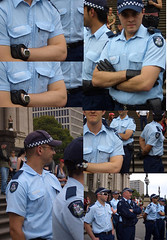
The two key events which police may focus particular attention on excusing are the wrongful arrest and assault of Drasko Boljevic on November 19, and the inappropriate and excessive use of force by police in dispersing a small protest outside of the Melbourne Museum on the same night. Further, judging by the complete absence of any criticism by the state/corporate media of the fact that police violated their own procedures by removing their ID at G20, this tactic should now be considered routine, and continue to receive the support of not only police and government authorities but the corporate/state media as well.

La lucha continúa.

Speaking of which, Australia’s #1 bean-counter has taken the opportunity afforded him by Rupert Murdoch to engage in some cheap political point-scoring:

Bracks fails his own force
Peter Costello
Herald Sun
January 31, 2007

WHEN the world’s finance ministers and central bankers met in Melbourne last year at a G20 summit, violent thugs attempted to disrupt the meeting.

In carefully planned attacks, they threw broken glass and urine-filled balloons at police while smashing private and taxpayer-funded property.

Wow Peter: you saw all that from the window of your luxury room at the Hyatt? Or are you just talking out of your arse, as usual, while planning further attacks on Australian workers’ wages and conditions? The “urine-filled balloons” is an old one, but a good one, and a complete furphy… that is, if one assumes that Peter isn’t referring to the heads of the architects of global finance gathered at G20.

Now the police are being attacked again, this time by activist lawyers who contrived to send a human rights observer team to observe the premeditated attacks, so they could intimidate and harass police officers performing their duty.

Hmmm. It seems that our Treasurer has a slippery grasp not only of the facts, but of the law too. The existence of a group of individuals, some with legal training, committed to observing public protest is obviously a cause of great concern to Tories, and Peter is no exception. But to assemble such a group is not a matter of ‘contrivance’, but planning. And to hold (or to at least attempt to hold) police accountable for their actions is actually quite sensible — especially given the record of Victorian (and other) police in this regard.

Victorian police at G20 behaved with courage and professionalism.

But their task was made harder by the Bracks Government law and order policies.

Now that police are under attack again, it is time for the Victorian Government to give them the unequivocal support they deserve.

For ‘attack’, read ‘OPI fulfilling its statutory obligations by referring complaints to the appropriate body — whereupon they will be excused, to nobody’s surprise’.

Under Steve Bracks and Chief Commissioner Christine Nixon, the focus of the Victorian Police has changed from preventing damage to people and their property to preventing negative media coverage.

For which claim Peter provides no evidence.

One symptom of this was the tiny handful of arrests made outside G20, despite the appalling violence and damage to property.

Yes indeed. Why aren’t global financial leaders held to account for their systematic failure to address the mass murder of the world’s children? Send your entries, including a stamped self-addressed envelope, to: PO Box 199, East Brunswick, VIC, 3057.

Police were forced to stand by while the law was breached, then browse media footage in a bid to identify culprits.

Bracks and Nixon may think these tactics were a success.

By adopting a strategy of refraining from making arrests in the heat of the protest, police top brass may have been hoping they would avoid allegations of excessive force dreamed up by lawyers.

But the primary function of police is not media management. It is law enforcement.

Police were not ‘forced’ to do anything: they were paid (the starting salary for a constable is $45,773 per annum — the base rate for a Federal MP is $118,950 per annum) to obey orders from their superiors: which they did. The principal strategic objective of police was to prevent protesters from drawing any closer to Peter and his friends wallowing in luxury at the Hyatt than security experts advised: this they also did. In a pre-emptive attempt to whip up public hysteria over possible police prosecutions, Peter cynically pretends not to have some very basic knowledge regarding policing methods.

Not a good look; one reinforced by his permanent smirk.

To allow dozens of police to be injured, a police vehicle torched and property smashed, without any attempt to arrest the culprits at the scene, is to make a mockery of the rule of law.

Moreover, to do so is to allow oneself to engage in a complete phantasy: dozens of police were not injured; no police vehicle was torched; there have been no reports of property damage (outside of $1,000 damage to one police vehicle); police did attempt to make arrests… including, of course, Drasko Boljevic.

Ooops.

It is also an insult to the police on the ground, who were the victims of vicious and cowardly assaults.

Police deserve the resources and political support necessary to enforce the law and retaliate against attacks.

When making split second decisions in the heat of mob violence, they need to know their judgment calls will be backed by political leaders and senior officers.

Steve Bracks and Christine Nixon should make it absolutely clear that attempts to arrest criminals are not provocation, but a case of a conscientious officer doing their duty.

Whether and to what extent police were subjected to assault will obviously be determined by the courts. To imagine that Bracks and Nixon do not, or will not, give police their unequivocal support, however, simply flies in the face of all the available facts. One might also note that Victoria Police employs more than 13,600 people, the 2006/7 State Budget was the largest in the state’s history, and $109 million was dedicated to ‘preventing terrorism, and organised crime’.

If anyone else committed a brazen crime in the middle of the street, onlooking police would move in to make an arrest. Motorists get zero tolerance for breaking the speed limit even by 3km/h.

Sure. Just ask Jeff Kennett.

Protesters get maximum tolerance for assaults on property or person.

For which claim Peter provides no evidence.

The problem with responses like the one we saw at G20 is that they provide encouragement for future mob violence. They send a message to criminals that law officers will appease, rather than confront them, so long as the criminals use sufficient force to create a fear of negative media coverage.

The message is not just heard by criminals.

It is also heard by the millions of law-abiding Victorians, who justifiably expect the law will be applied equally to all.

The rights of the business owners whose property was vandalised and the rights of the taxpayers, who must now pay to replace damaged police vehicles, have been trampled.

The Bracks Government went soft when the broken glass started flying. It should not go soft now that the writs are flying.

Sadly, the police may find it hard going in a state justice system increasingly stacked with judges who have a civil libertarian background.

The problem with Peter’s analysis is that it, like his liberalism, is completely unfounded. The extent of ‘future mob violence’ will not be determined by police response to protest at the G20, but general economic and social conditions. As they, in conjunction with the state of the natural environment, continue to deteriorate, so the likelihood of violent social conflict with the state will increase. Besides which, individuals who are motivated solely by financial gain and social status care little for throwing bottles at police, and would do much better by joining the Tories — and thereby enjoy the company of a much better class of criminal.

From next year, the situation will be even worse, when the Bracks Government Charter of Rights requires all government agencies, including police, to comply with its ideological agenda.

It is time for the Bracks Government to restore the focus of its law and order policies on promoting law and order, not on protecting the rights of thugs and criminals.

That means taking an aggressive approach to arresting violent demonstrators who attack police. It means providing police with the resources they need to confront these thugs.

It also means creating a legal system that does not allow police to be persecuted for just doing their job.

It means not only defending police in the courts and complaints tribunals, but pursuing costs orders against the activists responsible and reviewing the funding of taxpayer-funded lawyers involved, which the Commonwealth is already doing.

It means showing whole-hearted public support for the police officers, who are the true defenders of our human rights.

I want to express my gratitude to the hard-working men and women of Victoria Police.

I hope to hear the Victorian Government and ministers join me in thanking them for their wonderful efforts in protecting our city from the anti-G20 thugs.

Blah blah blah blah blah blah blah…

And if anyone had yet failed to realise on which side Newscorpse butters its bread, the Herald Sun also has an editorial, ‘Defending the police’:

THE G20 riot in Melbourne last November saw a revival of the notorious tactics of the rent-a-crowd brigade. Their modus operandi is to hijack an otherwise peaceful protest, break the law, attack the police trying to enforce that law, then cry “police brutality”…

The point is further rammed home in a ‘news’ item:

Tax-funded cop bashing
Ellen Whinnett, Craig Binnie and Mark Buttler
Herald Sun
January 31, 2007

COMMUNITY legal bodies such as the one behind complaints of police brutality at the G20 protests are pocketing $10.29 million in government funding.

The State Government tips $5.59 million into the centres and the Federal Government contributes $4.7 million annually.

The Herald Sun yesterday revealed that the Office of Police Integrity had received a complaint from the Federation of Community Legal Centres of excessive police violence at the G20.

The OPI referred the matter to the Victoria Police ethical standards department for investigation, sparking widespread community anger…

Meanwhile, arushandapush (January 28) reports that:

in recent days there have been further arrests and house raids. on thursday [january 25], a 21 year old man from glenhuntly was arrested. another man was arrested on friday [january 26] at the invasion day march to the concert in the city. 2 houses were also raided on friday, one during the day and one later that night, one for the second and the other for the third time, by 10 undercover police. both times police had a warrant for an arrest, but no arrests were made.

More commentary later…

Posted in State / Politics | 4 Comments

Young Tories: Recruiting now!

Do YOU think Aboriginal and Torres Strait Islander culture is rubbish?
Do YOU believe high schools spend too much time force-feeding their students black-armband history?
Are YOU outraged that Australia is full of rubbishy old “sacred” sites?
Are YOU sick and tired of poor people luxuriating on welfare payments while their unruly children avoid being properly schooled in loving obedience to the state?
Are YOU disturbed at the absence of advertisements promoting the virtues of the largest single preventable cause of death and disease in Australia?
Do YOU seriously maintain that global warming is a conspiracy theory?

So do WE! Yes, join the party to party!

[At the 2007 Federal Young Liberal Convention] …the Young Liberals likened Aboriginal culture to rubbish and said 40,000 years of Aboriginal history could be “taught in one lesson”.

The comments were made in opposition to a motion from Tasmanian Young Liberals that called for a special Aboriginal studies unit at the secondary school level.

The motion was carried, although several Victorian Young Liberals, including president Alexander Lew, vigorously opposed it.

Mr Lew said it was one of the most “politically correct motions” to come out of a Liberal convention.

“Aboriginal history is important and should be taught at our schools, but you can squeeze 40,000 years into one lesson,” he said.

Another Victorian Young Liberal, Miranda Airey-Branson, asked why it was necessary to learn more about Aboriginal history and culture, saying some Aboriginal historical sites were little more than refuse disposed of years ago.

“You go to Rome you see the Colosseum . . . if you come to Australia, we have got really old rubbish,” she said.

[Miranda also said: “I like horses. I don’t like hairy-legged lesbians, although I did give Rowena a peck on the cheek at the last Young Liberals convention. Alex said it turned him on.” How utterly, utterly marvellous!]

The convention unanimously supported a “no school — no welfare” motion to withhold welfare payments from parents whose children were not regularly attending school.

A motion rejecting the teaching of intelligent design in science classes was also passed.

Other motions called for an “end to government legislation prohibiting tobacco advertising” and for the Young Liberal Movement to recognise “the lack of scientific consensus regarding both the existence and impact of man-made global warming”.

The Young Liberal Movement of Australia is considered the breeding ground for future leaders. Its alumni include Federal Treasurer Peter Costello, former defence minister Peter Reith, one-time Liberal leader Andrew Peacock and the deputy Liberal leader in Victoria, Louise Asher.

Coy ambassador hints over troop pullout, Reid Sexton, Jason Dowling, The Age, January 28, 2007

Three years ago, Alexander and Miranda were embroiled in a minor scandal involving the distribution of false how-to-vote cards in the seat of Melbourne Ports during the last Federal election. Apparently, the pair falsely posed as ‘Greens’, and distributed cards urging voters to vote Tory (The Young Lib, the green T-shirt and the how-to-vote card, Misha Schubert, The Age, November 3, 2004). Miranda was also one of the editors of the University of Melbourne student zine Farrago in 2004, and it was in this capacity that she penned an article lauding the journalistic insights of “lovely” right-wing tabloid columnist Andrew Bolt. So when Miranda came under fire in the blogosphere for her duplicity, Andrew decided to write a column in her defence, and in order to attack some of her critics, especially Marieke Hardy… the whole debacle eventually earning the title ‘Pandagate’ (Miranda/Panda).

Ho hum.

Now Miranda’s back, and while she probably still loves horses, she doesn’t appear to have much respect for human culture, especially that of Australia’s indigenous peoples: an attitude which, unfortunately, also appears to be fairly uniform in the ranks of the Young Tories.

Posted in !nataS, History, State / Politics, Student movement | Leave a comment

Greek protest culture baffles people who still call themselves “journalists”

Yesterday, suspicious and superbly stylish Greek anarchists reportedly exploded bombs in Athens, outside a Citibank branch, and Thessaloniki, outside an office of New Democracy, in what authorities believe to be the acting out of a playful rivalry between anarchists in Greece’s two largest cities (Arsonists attack Citibank branch in Greece, [AP], International Herald Tribune, January 29, 2007). Not all Greeks appreciate the rivalry, however: according to ekathimerini, almost all (99 percent) of the 301 adult Greeks polled last week by some mob called VPRC “agreed that destroying public property and going on destructive rampages are unacceptable ways of showing opposition” to the Greek government’s sabotage of the higher education system. And it seems an ignorant journalist wants to know how the cradle of democracy could tolerate such behaviour:

In Greece, the culture of protest
Nicole Itano
The Christian Science Monitor
January 29, 2007

From nuns on strike to grenades in the ambassador’s bathroom, a squall at the cradle of democracy.

ATHENS – I was just a few blocks from home earlier this month when I saw the trouble, or rather smelled it: Ahead, black, acrid smoke spiraled into the air. As fire trucks raced to the scene, sirens blaring, a series of loud explosions shook surrounding buildings.

“A bomb,” shrugged one young woman, who minutes before had been marching in a phalanx formation of thousands of university students and teachers. She pointed to several cars on fire a block away. The TV crews were already there, jostling for the best view of flames, while employees at a nearby sandwich stall watched, smoking cigarettes to blunt the smell of burning rubber.

“That’s Greece for you,” laughed the woman’s friend as the march faded into the distance, and the group set off in search of a cafe.

As Chris Bailey might say — in a voice equal parts drawl and sneer — Alright. Athenians are a laid-back mob, it seems, with sensible priorities. Imagine, for a moment… “That’s Australia for you,” laughed the woman’s friend as the march faded into the distance, and the group set off in search of a Greek cafe in Lonsdale Street.

Greece has a long history of leftist political violence; the notorious November 17 killed 23 people, including US and British diplomats, between 1975 and its [sic] capture in 2002. By the time I arrived, though, November 17 had been dismantled. At first, it seemed somehow quaint to me that there were people who still called themselves “anarchists” — after an 18th-century philosophy that imagines an ideal stateless society — who threw petrol bombs at the relatively safe midnight hour at banks and the occasional [friends don’t let friends drink at] Starbucks, charring buildings but rarely [ie, never] causing death or injury. Most Greek radical groups have only a handful of members and serve a largely social function, [former US diplomat] Mr. Kiesling says, comparing them more to football hooligans than to Al Qaeda.

But why so much anarchy in Greece, a developed and stable member of the European Union?

“I think it’s easier to be an anarchist in a good climate,” Kiesling suggests.

[Making Kiesling a worthy (former) representative of the King, but not much of a Philosopher.]

But there’s a brutal side to these groups, and living amid the constant protest tests the mildest temper. The same week as the student march in my neighborhood, for example, there were also protests by [people who still call themselves] “Pakistani immigrants” and [people who still call themselves] “phone company operators”. [People who still call themselves] the city’s “doctors” were on strike. A tax office and three banks were bombed. Anarchists clashed with [people who still call themselves] “police”, exploding at least 60 Molotov cocktails. And someone sent a rocket-propelled grenade through a window at the US Embassy at 6 a.m., blowing up the ambassador’s private bathroom. The group claiming responsibility [Revolutionary Struggle, according to The New York Times, anyway] said the attack was a response to US involvement in Iraq. (Greece ranks no travel warning on the US State Department website, which says “violent civil disorder is rare” here.)

Nicholas Giannetos, a silver-haired tailor who dresses [people who still call themselves] “Athens’ elite”, works out of a shop on Stadiou street, a main protest route. He’s philosophical about [people who still call themselves] “his countrymen” [and their] penchant for taking to the streets. While [people who still call themselves] his “neighbors” — mostly shops selling diamonds and other luxury goods — quickly shutter their windows when the first chants of a protest can be heard in the distance, he keeps his doors open. Sure, he admits, they drive away business. But so does rain.

“We think it’s important for this country to remain democratic,” he says, dismissing with a flick of his hand the small number of protests that turn violent. “They’re just doing it to make a show.”

Mr. Giannetos has been running his shop in [what people still call] “central Athens” for more than two decades. After only a year here, I’m still green. But I’ve learned to recognize the sound of a tear-gas canister exploding. I know that [people who still call themselves] “marchers” wearing gas masks and carrying red flags are looking for trouble. And when the [people who still call themselves] “garbage men” go on strike in the heat of summer, I know it’s best to dump rubbish in a bin as far from your own house as possible.

One day earlier this month, I went into the belly of the beast to ask protestors what drove them to the streets.

[I think this means that the hack in question actually travelled to parts of Athens where protesters live and work… but maybe ‘Belly of the Beast’ / η κοιλιά του κτήνους is an Athens suburb, who knows?]

“This is a culture of protest,” explained Petros Constantinou, a man I met up with at another recent student march [and a member of the Trotskyist SEK party]. In the aftermath of the country’s oppressive 1967-74 military dictatorship, he said, [people who still call themselves] “Greeks” won’t accept any limits on the right to protest. “We will defend it very seriously, with our blood.”

Mr. Constantinou wasn’t a student; he was, in fact, something of a professional agitator. Officially, he was a spokesman for the Stop [the] War Coalition, but he joined the protests of groups allied with his.

Over the loud speaker, which had been blasting local bands performing bad Greek rap and heavy metal, a man announced that some protestors had been arrested in a scuffle with police. Nearby, the clean white walls of a Hermès store were decorated with giant anarchy symbols, and the ground was littered with fliers pontificating about everything from the death of Saddam Hussein to animal rights.

[Haiku time:

Bad music plays loud,
interrupted by arrests,
white walls painted black.
]

I asked why so many protests turned violent.

“Most of the time it’s not the anarchists that are the problem, it’s the police,” Constantinou insisted. I wasn’t entirely convinced. I’d seen the marchers spoiling for a fight, masked and clutching nasty-looking clubs. In TV footage later, these militant protestors could be seen charging rows of police, who sprayed tear gas and held their ground, seeming remarkably restrained.

Most protestors, like 16-year-old Polydefkis Kyriakakis, a pony-tailed high school student who’d ditched school with friends, had no desire to tussle with the police. They were only there to show solidarity with university students. Her parents, she said, approved. In their day, they’d protested too.

“It’s our right to protest,” she said, lounging with friends on banners with revolutionary slogans laid out like blankets. The march was over, but no one seemed inclined to move and unblock the street. “The fact that we can close the city center each time there is a protest like this, it makes it so that people have to listen.”

Constantinou agreed. Each protest, he said, gives strength to “the movement” — a vague coalition of groups with left-wing causes.

How many protests has he gone to in the past year? He laughed.

“These days I only go to the ones that we’re organizing,” he said.

And how many times had he been tear gassed? He chuckled.

Posted in Anarchism, Media, State / Politics, War on Terror | 1 Comment

A pained reaction to a wanker

    Of any two options, choose the third.

    If God really existed, it would be necessary to abolish Him.

Some bloke called Jef was in Melbourne last November to attend the 2006 Australian Skeptics Convention. When not confronted by the quizzical stares of other convention-goers, Jef imagined attempting to have A Socratic dialogue with an anarchist (November 22, 2006). Sharp as a razor, Jef notes that as well as his own skeptical self “Many others were in Melbourne as well. All were there for a good time — especially the anarchists engaging in running skirmishes with the police”. In a back-handed compliment to the organisers of the Skeptics Convention, “The anarchists were having a great time” reckons Jef, as “they appeared to be angry, and the press described them as such, but they were only feigning anger while experiencing joy”. Odd that a skeptic should also be a mind-reader, but stranger things have happened (I guess). As a stick-in-the-mud, Jef “decided to spoil a young woman anarchist’s fun by expressing sincere interest in their agenda.”

Ho ho ho.

Jef: I see you want to abolish capitalism.
She: Yes.
Jef: I’m very interested and perhaps I might join your group — but I need to know more about your program. How do you propose to abolish capitalism?
She: By revolution.
Jef: That’s interesting, how will you organise yourselves to bring about such a revolution?
She: Well, when we have enough like-minded people, we can organise ourselves to subvert capitalist institutions by undermining them from within.

He: Rudi Dutschke‘s brain-child, The Long March Through The Institutions, as well as being a) a favourite hobby-horse of right-wing critics of socialistical gub’mint and b) largely discredited, is a distinctly un-anarchist proposition… Unless, perhaps, the ‘fun-filled young woman anarchist’ who is the unfortunate subject of Jef’s peculiar line of questioning is in some way referring to the notion of prefigurative politics.

As for the concept of The Long March, according to George Katsiaficas:

Entering the Bundestag as a committed but loyal opposition corresponded to a strategy dubbed the “long march through the institutions” in the 1960s by Rudi Dutschke [1940–1979]. According to this idea, when possible, a revolutionary movement should introduce its values and ideas within established political forms, thereby reaching millions of people and setting in motion new possibilities for change. The continuing process of reforms unleashed by this strategy is supposed to encourage popular participation and to raise consciousness and expectations. If the existing institutions can be shown to be incapable of creating, in this case, an ecologically viable society, then many people might be persuaded of the need for a whole new system with reasonable economic and political policies (or at least of the need to vote Green).

It should be noted that socialist student leader Rudi’s grand strategy for radically transforming German society developed after an assassination attempt, outside his apartment on April 11, 1968, by a RiGhT-wInG-nUt: a house-painter named Josef Bachmann. Bachmann called Dutschke a “filthy communist swine” before shooting him three times, and was supposedly inspired by reading Deutsche National Zeitung, a neo-Nazi periodical, “a cutting from which is later found on his person, proclaiming ‘Stop Dutschke Now!’.” (Note further, that “After the attempted assassination in 1968, Rudi and his family went to the United Kingdom in the hope that he could recuperate there. He was accepted at Cambridge University to finish his degree in 1969, but in 1971 the Tory government under Edward Heath expelled him and his family as an “undesirable alien” who had engaged in ‘subversive activity’.”)

An emotional meeting is held at the Technical University and the blame laid to rest on the shoulders of the right-wing Springer press. From the university the students march on the Springer building in Kochstr. chanting ‘Springer out of Berlin! Bild fired the gun too!’

Ulrike Meinhof, who’s at the SDS centre, drives her konkret colleague [Stefan] Aust [now editor-in-chief of Der Spiegel] to the Springer compound. When they arrive at the compound gates a student comes up to them and says more cars are needed to stop the Springer trucks getting out. Ulrike isn’t too keen on her car being part of a barricade, but Aust tells her to park it on the pavement, so it will still be part of the barricade but won’t block the road. However, the police still make sure the trucks get through and Meinhof is one of those charged with using force. Aust then comes to Ulrike’s assistance once again by managing to prove that her car wasn’t causing an obstruction.

During the Springer siege molotovs used to set trucks alight are supplied by one Peter Urbach, who is later revealed to be an agent-provocateur in the employ of the government. In the same weekend a student and a press photographer are killed in vicious street-fighting in Munich; and Bommi Baumann is arrested for slashing tyres and sentenced to nine months imprisonment. The Meinhof column in the May konkret is entitled ‘From Protest to Resistance’.

televisionaries: the red army faction story : 1963-1993 (tom vague, 1994)

Speaking of Bommi, here are his thoughts on Rudi:

At the time of the attempt on Rudi, I was completely immersed in the political scene and saw myself as a political activist, very consciously, and considered revolution an alternative…

At Easter, I had known Rudi from SDS and just about everywhere. Rudi was different from the students. I was often with him at the university cafeteria, where we’d sit around at a table — it was cheaper than anywhere else — and shoot the breeze, or later, watch his child. I always had a good relationship with Rudi. He was a really amazing guy.

Rudi’s talks were always pretty abstract, and not everyone understood him — at least, I didn’t — but if you just talked to him, he was a perfectly normal human being, natural, just like everyone else; and really, that’s the most important thing. But he had the power — you could see it right away: that man was no bookworm or rhetoric spouter, he was really on top of his thing. If you saw him upstairs in the SDS office, in his apartment, he always cleaned up and took care of things. With that guy, you knew he wouldn’t lie to you.

That’s an important thing, too: it’s why a lot of workers didn’t get involved with the student movement. Instinctively you can see that that’s actually the guy at the top you’re always having trouble with. It’s that healthy mistrust. And that mistrust is still rooted — it’s actually the last bit of class consciousness that’s still intact in the workers. That they didn’t get involved in the student thing, in this APO [extra-parliamentary] number, is really a question of class consciousness.

The German working class has been sold out by everybody, be they socialists or mad Hitler. Everyone came and just shit on them, all the way through, from red to black, from Communists to Nazis. It just didn’t happen like this in any country like it did in Germany, so there’s good reason why they’re not getting involved anymore.

But with Rudi, a guy like that, you noticed right away, he’s all right, he’ll go through fire with you. He won’t just split when things get heavy. With the other students, I checked the thing out for myself, emotionally: ‘how will he act in another situation?’

Today when I think about how I saw people, emotionally or instinctively, everything is verified. There was a certain kind of arrogance with many of these students. So the mistrust was justified. I just listened at first, and checked it out, because first of all, I had to think myself into these things, into these processes. I never had much to say there.

— Bommi Baumann, Wie Alles Anfing [How it all began], translated by Helene Ellenbogen and Wayne Parker, Pulp Press, Munich / Vancouver, 1975 / 1977.

Where were we? Oh yeah…

Jef: It seems to me that you are on dangerous ground here. Once you start organising yourselves then you will need leaders, processes for makng decisions, allocation of roles by a central authority, punishment of those who don’t accept that central authority… won’t your organisation turn into a sort of proto-state within a state?
She: We can avoid that by keeping to a collectivist agenda.

He: Obviously, for Jef, organisation implies hierarchy: organisation, by very definition, requires hierarchy.

Anarchists, among others, disagree. In addition, anarchists maintain that non-hierarchical relationships should be generalised. In other words, anarchists wish to create an-archy: a society without rulers (or, by definition, a class of ruled subjects).

At least, such is one ideological expression of a movement ‘of movements’ which has its roots in nineteenth century Europe, one which Jef sees — or thinks he sees — in action at G20. The idea that anarchists have somehow failed to consider the considerable obstacles practical questions of social organisation place on this particular road to freedom is false. Moreover, anarchist thought is historical and materialist; but not in the same sense as Marxism or other doctrines are. Historical in the sense that it is informed by (and has helped to shape) the history of human society; and materialist in the sense that… well, Wetzel describes a kind of “minimal materialism” thusly:

…the idea that class structure, based on power relations between groups of people in social production, is the most fundamental or basic structuring in society. The class structure is the basic structure of control over social production, the basic economic structure, according to minimal materialism. This structure is supposed to be the background against which everything else about society is to be explained or understood…

As KJ Kenafick, in Marxism, Freedom And The State (“Dedicated to the memory of JW (Chummy) Fleming who, for nearly sixty years upheld the cause of freedom at the Yarra Bank Open Air Forum, Melbourne, Australia”; Freedom Press, London, 1984 [1950]) wrote:

It is obvious of course that Marxism and Bakuninism despite these differences have much in common and Bakunin himself has not failed to point this out in the pages that follow. Both systems were founded on the idea of Historical Materialism, both accepted the class struggle, both were Socialist in the sense of being opposed to private property in the means of production. They differed in that Bakuninism refused to accept the State under any circumstances whatever, that it rejected Party politics or Parliamentary action, and that it was founded on the principle of liberty as against that of authority: and indeed, it is this spirit of liberty (not Individualism) that distinguishes Bakunin, and in the light of which his criticisms of Marx and Marxism must be read. He had the true instinct that no man can be really emancipated except by himself.

And speaking of men with sound political instincts:

Jef: I may still be interested in joining your group. Assuming you are successful, and as you start to develop into a proto-state, I can form a core group of real anarchists dedicated to overturning your pseudo-anarchist but actually fascist proto-state. Of course, I must be ever-watchful that a more radical subversive group doesn’t develop within my group in order to overthrow us.
She: That’s bullshit, you’re just stirring.

He: That is bullshit. But Jef’s just taking his own daft argument to its logical extreme. (And by doing so, probably owing more to Aristotle than to Plato.) Strictly speaking, it makes sense if one accepts his initial proposition, and firm but irrational belief that Organisation is Man’s (/A Young Woman Anarchist‘s) Original Sin. Jef’s stirring, but it’s a very old pot.

Finally, to pretend to be able to speak about anarchism without being able at the same time to recognise one of its central political strategies — the rejection of state power — suggests little, if any, serious analysis. But then, we already knew that — making Jef not only an ignorant fool, but a painful one at that.

Jef: No I’m not, honestly… just one last question, are those Nike trainers you’re wearing? Hey everybody, look, she’s wearing Nike trainers, she’s a capitalist stooge and maybe a police plant… look out, she’s got a camera, she’s taking pictures of us… come and see the violence inherent in the system… come and see the violence inherent in the system… I’m being repressed!

He: Whatever mate. By the way, nice cardigan.

Jef: Of course, this isn’t really a Socratic dialogue. Socrates allowed his respondents to develop extended responses to his finely judged questions. As they responded to Socrates they developed insights into the anomalies in their position, and their perceptions inexorably moved towards more truthiness. All I did was amuse myself, and the cretin I was talking to was incapable of insight.

Of course, this isn’t really a skeptic: more of a pompous arsehole, really. And Socrates’ dialogues — to be precise, Plato’s imaginative reconstructions of Socrates’ philosophy via the use of Socratic discourse — probably functioned more simply in order to demonstrate what a clever-toga he was.

Posted in !nataS, Anarchism | 2 Comments

Have A Slack Invasion Day… You Bastards

Koalas sleep for approximately 18 hours out of 24.

Posted in Uncategorized | 11 Comments

When Does Green Rage Become…

…ECO-TERRORISM?

… “Terrorism is terrorism — no matter the motive,” FBI director Robert Mueller said in January 2006, after the Bush administration announced indictments in an investigation it calls Operation Backfire. “The FBI is committed to protecting Americans from all crime and all terrorism, including acts of domestic terrorism on behalf of animal rights or the environment.”

Many were appalled. How could anyone possibly use that singularly loaded word to describe these acts? Where is the moral equivalence between burning an SUV in the dead of night (and doing as much as you can, given the nature of the business at hand, to see that no one gets hurt) and ramming a 767 into a skyscraper? When Eugene’s daily newspaper, the Register-Guard, used the word eco-terrorism to describe the investigation, at least one reader took its editors to task, writing that the paper “appears to confuse arson occurring within the context of a nonviolent campaign with terrorism.” The paper opted for the softer-sounding eco-sabotage thereafter …

‘When Does Green Rage Become Ecoterrorism?’, Matt Rasmussen, Orion Magazine, January 25, 2007: “Are radical environmentalists wackos, terrorists, or prophets warning against environmental catastrophe?”

Further Questions :

1) How many roads must a man walk down… before you call him a man?
2) Who will decide who comes to this country… and the circumstances under which they come?
3) If six turned out to be nine… would you mind?
4) If all the hippies cut off all their hair… would you care?
5) The average arson sentence in Oregon in 2001 was just under six years, rapists averaged 10 years and murderers 14 years.

Jeffrey “Free” Luers is a skinny kid from suburban Los Angeles who is serving his [seventh] year in prison. In 2000, when he was twenty-one, Luers and an accomplice were arrested for setting fire to three SUVs in the middle of the night at a car lot near the University of Oregon (a separate action from those included in the Operation Backfire indictment). A Eugene judge sentenced Luers, who refused all of the government’s plea bargain offers, to nearly twenty-three years in prison. The authorities say they made an example of Luers to forestall further crimes; activists say they made a martyr of him. Luers remains unrepentant. In a recent message to his supporters, he said, “I got careless, I got sloppy. I slipped up. I got caught.” …

[Answers : 1) Dunno. But join John and Ken as they explore whether men and women are really from different planets after all. 2) Hmmm, yes: who decides? 3) TBA. 4) TBA. 5) Smash the state.]

    Today is my six year anniversary. I almost didn’t notice to tell you the truth. It isn’t just because one day blends into another in here. Right now I just don’t really care that much that I’m in prison. I know how that sounds but that’s brutally honest. I got careless, I got sloppy. I slipped up. I got caught.

    But, over the years something happened. I got stronger. I got louder. I became more powerful than the state ever wanted me to be. You see, I was supposed to be a message to you all out there that would dare resist. But not enough people listened. Some kept fighting back. They kept liberating animals. They kept burning things down.

    Now the state wants to send a more powerful message. They sent in agents and infiltrators. They bought off activists and turned others into traitors with threats. The message is simple: the government sees this movement as a threat. And they are telling you that if you challenge them they will try and lock you away for life. It’s a powerful message. It’s down right intimidating, to be honest.

    But, this last weekend (June 9-11) another message was sent by 43 cities around the world. That message was very clear: we will not disappear. Yeah, some of us are going to end up in prison. That’s a fact. Some of the weaker individuals might break under that threat. That’s a fact, too. And that is intimidating. Why sugarcoat it?

    However, when an international solidarity event, in which 43 cities participate, can be organized from a maximum security prison… That’s not just intimidating. That’s a threat.

    There’s no denying the authorities have a lot of power. But so do we and we have to recognize that. We have to harness that energy. Every time we are pushed we must push back twice as hard. Thank you for not being silent. Thank you for standing up for the “green scare” victims, the earth liberation prisoners and for me. I am so grateful, so very grateful I can’t wait to read and hear about all the events. We have shown that we are united, that we can and will support our prisoners.

    Now let us show our might. They have heard your words. Make them feel your actions. The earth, the animals, the future, our children, your freedom, the people of Iraq, your very own community needs you to fight back. You are all we have. Your resistance is our only weapon, our only defense. You are the only protection we have left.

    PLEASE do EVERYTHING you can to help.

    — Prison dispatch from Jeff “Free” Luers (June 16, 2006)

    Lesley Stahl on U.S. sanctions against Iraq: We have heard that a half million children have died. I mean, that’s more children than died in Hiroshima. And, you know, is the price worth it?

    Secretary of State Madeleine Albright: I think this is a very hard choice, but the price — we think the price is worth it.

    60 Minutes (May 12, 1996)

Posted in State / Politics, War on Terror | Leave a comment

Greek anarchists running Monkey marathon

In the world before Monkey, primal chaos reigned. Heaven sought order, but the phoenix can fly only when its feathers are grown. The four worlds formed again and yet again, as endless aeons wheeled and passed. Time and the pure essences of Heaven all worked upon a certain rock, old as creation. It became magically fertile. The first egg was named “Thought”. Tathagata Buddha, the Father Buddha, said, “With our thoughts, we make the world”. Elemental forces caused the egg to hatch. From it came a stone monkey…

The nature of Monkey was… irrepressible!

Persistent anarchist attacks in Greece force new police attention
[AP]
International Herald Tribune
January 22, 2007

ATHENS, Greece: Greek law enforcement leaders, alarmed by renewed [sic] outbreaks of anarchist violence, met Monday seeking ways to end increasingly frequent firebombings and vandalism in the country’s two largest cities.

The country’s police chief met with the head of the Supreme Court after a prosecutor last Friday ordered an investigation into the violence and why police had failed to make any arrests.

The meeting followed further attacks in Thessaloniki, with assailants early Monday throwing firebombs at a bank and outside a university building. Nobody was hurt…

[Such attacks have been an almost daily occurrence in Greece for f’n years: January 3, 2006: a diplomatic car is set on fire in Mets, Athens; branches of governing party ND in Kipseli, Athens, set on fire; two cars owned by the Mayor of Therisos Canon, Crete, are set on fire; January 4: branch offices of Apsis Bank in Athens are set on fire; branches of ND in Exarchia, Athens, molotoved; police CCTV box in Zogafrou, Athens set on fire; January 9: branch offices of National Bank in Varkiza, Athens, set on fire; January 14: branch offices of National Bank are again set on fire, this time in Thessaloniki; January 26: Branch offices of PASOK set on fire in N. Smirni, Athens… etcetera, etcetera, etcetera. Source: @ News, No.34, January–June 2006.]

The sight of youths on foot, their faces obscured by masks, prowling the streets in unruly packs and wreaking nightly havoc is menacing but also familiar. Stylish anarchists have been around in Athens and Thessaloniki for more than 20 years and now have reappeared with a vengeance.

Thanos Veremis, head of the national council for education, an advisory body, said these individuals were taking advantage of anti-government protests to cause trouble.

“(It’s) a predictable reaction of the minority that would rather not see any changes,” he said in an interview.

The extremists “have nothing to do with university, but fall in with the demonstrations and usually make the entire affair more dramatic, at the expense of shopkeepers and policemen.”

Two anarchists [Tarasio Zadorozni and Gerasimos Kiriakopulos] awaiting trial in prison near Athens have been on hunger strike for more than a month over allegedly forced police confessions last May. Last fall, a Cypriot student in Thessaloniki was hospitalized after a police beating that was shown on national television…

Ooops.

Posted in Anarchism, State / Politics, War on Terror | 2 Comments