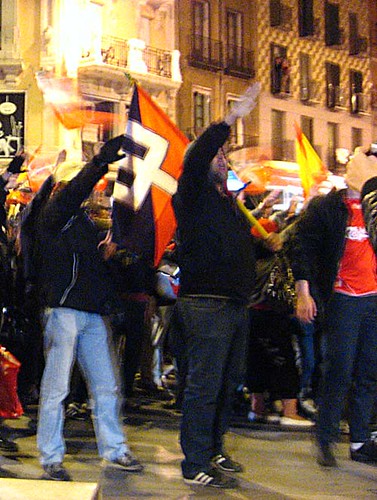
“Taxi!” I mean: “Seig Heil!” Fascist twats in Tirso de Molina, Madrid

On Friday evening, February 29, in Tirso de Molina, a few hundred metres from Madrid’s main square, fascist dingbats de los grupos nazis Nación y Revolución y Combat España (Nation & Revolution and Combat Spain) safely seig heil from behind police lines, part of a small contingent of racist nutters protected from an estimated 1,000 antifa by a large contingent of police. Having been authorised by local authorities, police tried to ensure a safe presence for the rallying neo-Nazis through the use of tear gas and rubber bullets. Accounts vary, with English-language corporate/state media claiming few casualties, Reuters noting that “A spokesman for Madrid’s ambulance service said nobody had been injured though left-wing media said one protester had been blinded in one eye”. The same or similar “left-wing” sources claim at least two youths were injured and required hospital treatment.

Fascist groups in Madrid and elsewhere in Spain are mobilising in anticipation of national elections, due to be held on March 9. The election will pit Spain’s ruling party, the Spanish Socialist Workers’ Party (PSOE), led by José Luis Rodríguez Zapatero, against the (less) right-wing People’s Party (PP) of Mariano Rajoy. One of the key election issues will be immigration. Over the last decade, the immigrant population in Spain has grown significantly, and there exists obvious scope for using this fact to boost the popularity of anti-immigrant forces among the right-wing and lower middle classes. According to a recent report in The Guardian:

…10% of the 45 million inhabitants are foreign-born. Rajoy accused Zapatero of ignoring the rising phenomenon: “You are not interested in talking about immigration, but I am … 34% of prisoners in jail are foreign. We have to establish some order and control and your party does not want to.” Rajoy has made this a central plank in the PP’s campaign, targeting lower and middle class families worried about competing for increasingly scarce jobs with Spain’s immigrant population. Zapatero retorted that when he came to power in 2004 there were 700,000 illegal immigrants. “We have given them contracts, with the agreement of companies and unions, while all your party did was give them a bus pass,” he said.

The same journalist adds that “…as the economy starts to slow down, particularly in the construction industry, where so many immigrants have found work, there are concerns about social unrest. There are now more than 400,000 unemployed foreigners in Spain – a cause of concern to those who fear ghettoisation. Rajoy has chosen to make this issue a key part of his electoral campaign, arguing that new immigrants should sign a pledge to respect Spanish customs and values, and that they should be forcibly removed from the country if they fail to find work within a year.”

As if to reinforce the point the Spanish fascists, upon leaving Tirso de Molina, attempted to enter the neighbouring area of Lavapiés, an area with a relatively high concentration (approximately 1/3) of immigrant workers. Despite the best efforts of police reinforcements, the few barricades thrown up by antifascist counter-demonstrators seemed to have kept the area relatively clean. El País claims there were five injuries and seven antifa arrested, indicating that the fascists got away without injury or arrest.

Perhaps the police, in addition to acting as bodyguards, also drove the fascists home?

Ellos se enteraron de la protesta por carteles en el barrio, aunque páginas web como nodo50.org, kaosenlared.net y otromadrid.org suelen publicitar las convocatorias. La del viernes la organizaba la plataforma Madrid Antifascista. “Los disturbios no estaban organizados”, repetía Raúl. “Pero es normal que reaccione si empiezan a lanzarme pelotas de goma”. Empezó la policía, asegura. Ayer quedaron en libertad los dos menores, de 14 y 17 años, detenidos tras los altercados. Los otros cinco pasan hoy a disposición judicial.

Fotos la Plataforma | Fotos de Agencias

As an aside — and because, in case you hadn’t already guessed, this blog frequently functions as my scrapbook — in Mother Russia, Andrew Meier has written an interesting account of Eduard Limonov, the leader of the National Bolshevik Party cum personality cult, and his failed attempt at the Russian Presidency, currently occupied by one of Putin’s numerous puppets (Maverick populist is enlivening opposition to Putin, International Herald Tribune, March 1, 2008).

Posted in Anti-fascism, State / Politics | Leave a comment

Fuck Shit Up / Friends Stand United / Finance Sector Union

    Update (November 1, 2008) : Three men convicted in 2006 beating death of Corona man, Sonja Bjelland, The Press-Enterprise, October 27, 2008: Three Corona men were convicted of second-degree murder Monday in a beating death connected to a national gang. Richard James Dugan, 27, Jonathan Richard Morgan, 24, and Travis Daniel Westly, 25, face sentencing Dec. 12 after the jury found all three guilty of second-degree murder for the benefit of a street gang. Sean Gardhouse, 19, of Corona, was beaten June 23, 2006, in the parking lot of the Jack in the Box on Ontario Avenue in Corona and died five days later. His death focused attention on two gangs, Friends Stand United and El Cerrito Boys. Friends Stand United, a national gang, was written about in Rolling Stone in 2007. The group attracted attention with a DVD called “Boston Beatdown,” featuring footage of fights and music from hard-core punk bands…

Yeah so anyway. Anti-racists, thugs, or both, I dunno.

But so much for the Finance Sector Union.

*boom–tish*

FSU is “a fairly new phenomenon here and we’re still in the beginning stages of figuring out what these guys are all about,” Seattle police spokeswoman Debra Brown said. I say: following on from a string of other incidents (Friends Stand Charged: FSU Members Arrested for Weapons, Drugs Outside Local Club by Megan Seling, The Stranger, March 2–8, 2006, details one such incident), news that someone, allegedly a member of FSU, was charged with manslaughter back in January last year triggered a small amount of reflection on the gang’s (crew’s) past and present. Its past is fairly clear: the crew (gang) emerged as a response to the desire to rid Boston hardcore of boneheads and other racists; presently, the name has been adopted by a large range of others, in and outside of Boston, whether affiliated in some way to the original crew or not. Despite the overtly-hostile title, ‘Violent group spoils party for segment of music scene’ by Sara Jean Green (Seattle Times, March 7, 2006) provides a useful overview of the history of FSU, noting that the handful of arrests detailed in Seling’s report was more likely to have been of SHARPs than it was the Seattle FSU crew. Interestingly, Green notes that some of the friction in the scene is:

A matter of economics

The schism that’s occurring in the hardcore scene is at least partially due to economics, with a growing number of middle-class suburban kids getting involved in hardcore… Many don’t understand the etiquette or history of the scene, which has always had violent undercurrents, Collins said.

“I grew up in a trailer park with no money. A lot of guys in my crew, we grew up hard,” said Collins, originally from a rural area near Bremerton. Kids who grew up in places like Bellevue or Redmond “had to deal with tennis practice — we had to deal with not getting beat up on the way home from the [school] bus,” he said.

Though police have characterized FSU assaults as “random acts of violence,” Collins said that’s not the case. If FSU gets into a fight, there’s always a reason, he said.

“We’re civil people — we just don’t beat people ’til we can’t beat them anymore,” he said. “If I fight them, I’m going to fight them ’til I think they got what they deserved.”

But others worry that violence associated with FSU members could have a lasting impact beyond bruises and bloodied noses.

David Meinert, a former president of the Northwest chapter of the Recording Academy who manages the Seattle band Presidents of the United States of America, said FSU’s propensity for violence “is a negative black mark” on Seattle’s otherwise healthy hardcore scene. Meinert, who spent 10 years working to have the city’s Teen Dance Ordinance rescinded, worries that FSU’s reputation could prompt more police attention at all all-ages shows.

Speaking of economics, the producers of hardcore DVD Boston Breakdown offer an unnecessarily laboured response to accusations they unfairly profit from violence associated with the scene in Boston on their website. A not very posi review of the documentary is here; David King reflects on some hardcore issues here. Good, bad or indifferent, Alexander J. Franklin, the person charged with committing manslaughter in January 2007, has been acquitted.

Charges dropped in fatal fight at Asbury club
APP.com
February 29, 2008

FREEHOLD — A Monmouth County grand jury on Wednesday refused to indict a Brooklyn man on manslaughter charges that had been lodged against him in the death of a Bass River man last year, the Prosecutor’s Office said.

Alexander J. Franklin, 34, a tattoo artist with reputed gang affiliations, had been accused in the beating death of James Morrison, 25, on Jan. 14, 2007.

Morrison died of blunt force trauma after an altercation at Club Deep, an Asbury Park nightclub, where he was allegedly punched in the head and later died of his injuries.

“A very thorough investigation was conducted at the time this crime occurred,” Monmouth County First Assistant Prosecutor Peter E. Warshaw said. “That information was presented to the grand jury in a thorough and comprehensive manner, and the grand jury declined to return any indictments.”

The grand jury’s vote means the police charges against Franklin are now dismissed, prosecutors said.

Franklin was initially arrested three weeks after the fight. At the time, police said Morrison hit his head on concrete after being felled by a blow to the head.

Morrison and his friends had allegedly been involved in an altercation inside the club over a T-shirt worn by one of Morrison’s friends. Show attendees said someone took offense that the shirt depicted a Confederate flag.

Prosecutors said Franklin was associated with the FSU gang — an acronym standing for Friends Stand United or two profanities followed by the word “up.” The group is reported to be responsible for driving neo-Nazi elements out of the Boston hard-core punk scene in the mid-1980s.

Warshaw said he could not comment further on the matter because of court rules that require grand jury proceedings to be kept secret.

Staff writer Matt Pais contributed to this story.

Posted in Anti-fascism, Music, State / Politics | 103 Comments

Jeff Luers: Now with more Free!

    Check it out now: Green Scared? Preliminary Lessons of the Green Scare: “…What we know of the early Backfire investigation points to a strategy of generalized monitoring and infiltration. While investigators used increasingly focused tools and strategies as the investigation gained steam—for example, sending “cooperating witnesses” wearing body wires to talk to specific targets—they started out by sifting through a whole demographic of counter-cultural types. Activist and punk houses as well as gathering spots such as bars were placed under surveillance—anarchists who drink should be careful about the way alcohol can loosen lips. Infiltrators and informants targeted not only the most visibly committed anarchists, but also bohemians who inhabited similar cultural and social spheres. Police accumulated tremendous amounts of background information even while failing to penetrate the circles in which direct action was organized. The approximately 30,000 pages of discovery in the Oregon cases contain a vast amount of gossip and background information on quite a few from the Eugene community…” Et cetera et cetera et cetera. Neat article.

Jeffrey “Free” Luers Sentence Reduced to 10 Years
Source : Civil Rights Outreach Committee Press Release [PDF] c/o @-Infos

This morning at 9:00am in Lane County Circuit Court the re-sentencing hearing for Jeffrey Luers took place in front of Judge Billings. This followed an Oregon court of appeals ruling in February 2007 that Luers original sentence of 22 years 8 months by Judge Lyle Velure was illegal, and the appeals court remanded the case back to Lane County Circuit Court for re-sentencing. Following the appeals court decision, negotiations have resulted in the decision today to reduce Luers sentence to 10 years, bringing his release date to late December 2009.

In June 2001, then 23 year-old Jeffrey “Free” Luers was arrested for the burning of three trucks at a Eugene car dealership. His stated purpose was to raise awareness about global warming and the role that SUVs and trucks play in that process. Despite the fact that this action hurt no one, caused only $28,000 in damages and the cars were later resold, Luers received the draconian sentence imposed by Velure.

Luers gained support locally as well as all over the world as a political prisoner. It is widely believed that Luers received such a drastic sentence because of the political nature of the action he took. Following his original sentence, Amnesty International and the Eugene Human Rights Commission (EHRC) issued letters of support citing that the sentence appeared to be politically motivated. During the course of his trial, statements were made by the police and prosecuting attorney that indicated it was Luers’ political views on trial, not merely his actions. His defense successfully proved that evidence had been tampered with, officers had lied and that the prosecutor had manipulated evidence to get a legal search warrant at his residence. Luers was given a sentence that attempted to send the message to environmental and social justice activists that even a merely symbolic act of property destruction could be punished more harshly than many crimes against persons.

Prior to his imprisonment, Luers was a very well respected community activist in Eugene, Oregon involved with forest defense and cooking free food for the city’s homeless population. He has remained active from prison, often writing news articles and monthly dispatches to his growing list of supporters. With a release date on the horizon, Luers future is bright and he plans to pursue courses and looks forward to sharing quality time with his family and loved ones.

Statement from Jeffrey Luers [PDF]:

“Today I feel a great weight lifted off of me, and my loved ones. While I believe my new sentence is still more of a reflection of my activism and my dissent than my actual crimes; I am looking forward to my much closer release date.

I am proud of the many things I have accomplished while incarcerated, including reaching beyond oceans and borders to help raise awareness about global warming and to help combat social injustice.

I am thankful of my family, friends and the thousands of supporters and fellow activists from around the world who have stood by me since day one. And I’d especially like to thank my attorneys, and friends. Lauren Regan, Misha Dunlap and Shawn Wiley for never giving up on getting me out sooner than 22 years.

I am happy to say this journey is almost over and I’ll be coming home soon.”

For more information, go to: Civil Liberties Defence Center | Free Jeff Luers! | See also : Green Scare Update

Sentence cut in half for Oregon environmental activist
William McCall / The Associated Press
February 28, 2008

PORTLAND, Ore. (AP) — The only environmental activist sentenced in state court after a series of arson fires around the West could be released from prison next year after a judge reduced his sentence by more than half. Jeffrey “Free” Luers, 29, was resentenced to 10 years of his original sentence of nearly 23 years for burning three SUVs at a car dealership and trying to set fire to an oil company in Eugene in 2000.

The Oregon Supreme Court ordered the resentencing after Luers won his appeal of the sentence imposed by Lane County Circuit Judge Lyle Velure, who recently retired. Luers could be released by December 2009, with credit for time served.

In a statement to Lane County Circuit Judge Jack Billings during his resentencing on Thursday, Luers said he remains committed to political activism but will pursue it through legal means. “I can now say with all honesty that I was wrong to think that arson would inspire social change,” Luers said.

He said he is looking forward to his release, continuing his education and working on environmental issues, including global warming, offering a warning about potential ecological disaster and urging cooperation to prevent it.

“We are all in this together, whether we are labeled radical, conservative or liberal,” Luers said. “And together is the only way we are going to solve this problem.”

Ten other radical environmentalists were sentenced to various terms last year in federal court in Eugene for their role in a series of arsons that caused $40 million in damage across five Western states from 1996 to 2001.

The longest sentence imposed in those cases was 13 years.

Those now serving federal prison sentences were involved with a secretive Earth Liberation Front cell known as “The Family.” One of the arsons by ELF members was another attack on the same Eugene car dealership where Luers burned the SUVs. They said it was carried out as revenge for the long sentence originally imposed on him. Luers expressed support for those activists from the Oregon State Penitentiary, saying he considered them political prisoners, like himself.

Lauren Regan, executive director of the Civil Liberties Defense Center in Eugene and one of the attorneys for Luers, said supporters were pleased with the resentencing despite unsuccessful efforts to negotiate an immediate release for time served. Regan said the original sentence took “into account politics rather than the law and the facts of the case.”

Another environmental activist associated with the Earth Liberation Front, Briana Waters, is on trial in federal court in Seattle on charges of serving as a lookout while her friends planted a fire bomb at the University of Washington in 2001.

On Briana Waters’ case, see also Accused Arsonist Denies Wash. Fire Role, Gene Johnson/AP, February 28, 2008. Note that one of Waters’ lawyers, Robert Bloom, “said prosecutors are pinning their case on the testimony of [Lacey] Phillabaum and Jennifer Kolar, who are expected to receive more lenient sentences in exchange for their cooperation. Waters claimed on the witness stand that the two are trying to frame her: Phillabaum because she had a relationship with Waters’ boyfriend at the time, and Kolar because Waters spurned her sexual advances. The former boyfriend, Justin Solondz, is a fugitive in the case. William “Avalon” Rodgers, who also was indicted, committed suicide in jail. Waters’ defense attorneys rested their case Wednesday. Closing arguments are expected by the end of the week”. Phillabaum is due for sentencing on March 21, 2008. Other co-operating defendants in the so-called Green Scare trials are Chelsea Gerlach, Stanislas Meyerhoff, Suzanne Savoie, Kendall Tankersley, Darren Thurston and Kevin Tubbs, all of whom have been sentenced to various terms in jail. Non-cooperating defendants Nathan Block, Daniel McGowan, Johnathan Paul and Joyanna Zacher received sentences of 7 years and 8 months (Block), 7 years (McGowan), 4 years and 3 months — subject to further legal negotiation (Paul) and 7 years and 8 months (Zacher). Another Green Scare victim, Eric McDavid, is being sentenced on March 13.

Note that none of these cases (with one exception — Jeff Luers, by SBS Dateline‘s Olivia Rousset) has been covered by Australian state or corporate media.

Posted in Anarchism, State / Politics, War on Terror | Leave a comment

Poem for B, C, D, D, D & J

This work deals with the highly topical issue of multiculturalism and, as such, a warning is necessary. It is written for those who are, or aspire to be, members of the intellectual elite. These are the people who believe that knowledge is the product of hard labour; the people who believe that you need to do a great deal of time-consuming research, read a lot of books and reflect on many difficult philosophical, empirical and theoretical issues to produce intelligent knowledge.

In John HoWARd’s Australia, there seem to be many individuals who feel ‘relaxed and comfortable’ in talking about issues about which they haven’t bothered to read a single researched article, let alone a book. Apparently, ‘life taught them’. In fact, such people are so ‘relaxed and comfortable’ that they believe that the more someone works at trying to learn about an issue, the more they become part of an ignorant and arrogant lot: the intellectual elite. The role of this elite is apparently simply to put down naturally intelligent people and find ways to stop them from expressing the truth they capture so effortlessly by merely living.

When I used to visit my grandmother in Bathurst in the late 1970s, she would often make comments such as ‘You’ve been reading too much’ or, even more explicitly, ‘People who go to university become mad.’ Although such comments helped me reflect on how and why university knowledge clashed with everyday knowledge, I resented pronouncements such as ‘You have read books, but life has taught me.’ I used to say, ‘But Granny, I have a life as well you know, and it teaches me too. Can’t you see that books and research provide me with extra knowledge.’ I was naive even to try.

The so-called ‘intelligentsia’ always looks down with a really limitless condescension on anyone who has not been dragged through the obligatory schools and had the necessary knowledge pumped into him. The question has never been: ‘What are the man’s abilities?’ but ‘what has he learned?’ To these ‘educated’ people the biggest empty-head, if he is wrapped in enough diplomas, is worth more than the brightest boy who happens to lack these costly envelopes.

This is neither my granny, nor any of Australia’s anti-intellectual populists speaking, but Adolf Hitler. And I cannot help thinking of him when people start abusing intellectuals. Hitler was the classic anti-intellectual: a man who had enough intellect to be a mediocre intellectual and enough also to realise that he wasn’t a member of the intellectual elite. Like many mediocre intellectuals, he thought he had a natural talent for knowledge, rather than realising how much hard work is put into whatever knowledge people end up gathering.

Hitler was not, however, the sort of person who would just sit there and take it. He was too motivated by dreams of social, political and intellectual mobility to allow himself to just sulk and do nothing. So, he found the time-honoured way to ‘beat’ the intellectual elite. This is the road often chosen by people who want to be recognised as intellectuals, but who are either not socially equipped to be so or feel they have better things to do than putting in the hard labour necessary to achieve such a status. These people compensate for their lack of knowledge by speaking in the name of ‘the people’. ‘The people’ becomes such a formula of success for mediocre intellectuals that they make themselves — and some others, too — believe that they actually are ‘the people’.

The mechanism is very simple: 1) ‘The people’ already know everything there is to know: ‘life taught them’. 2) Consequently, anything that the ‘intellectual elite’ says which is not known by the people is superfluous knowledge, if not actively against the people. 3) Therefore, any attack on the knowledge of the intellectual elite is a defence of the knowledge of the people. And who else is better at defending the instinctive knowledge of the people if not the instinctively intelligent, mediocre intellectual? In reality, ‘the people’ are too busy living. In addition, one can be certain that anyone who uses the concept of ‘the people’ is already someone who distinguishes himself or herself from them…

Ghassan Hage, White Nation: Fantasies of White supremacy in a multicultural society, Pluto Press, 1998, Preface, pp.7–9.

Posted in Poetry | 12 Comments

Kosovo, Serbia… and Melbourne (with BONUS! swastikas)

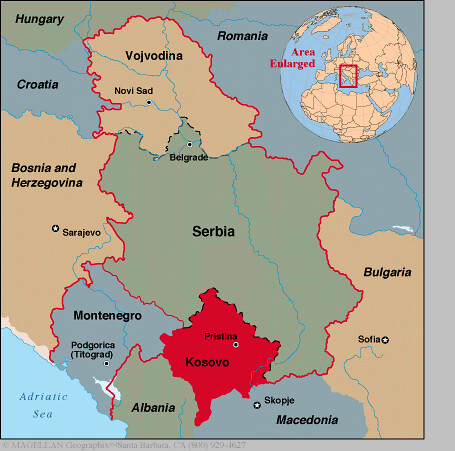
Poor old Yugoslavia. First Croatia, Slovenia and (the Former Yugolsav / Republic of) Macedonia (1991), then Montenegro (June 3, 2006), now Kosovo. The recent declaration of the Kosovo state (February 17, 2008) — approved by the US and NATO, rejected by Russia and its Eastern European allies — has been greeted with widespread protest by Serb nationalists, including in Melbourne.

For fascists, Kosovar independence is a product of a ZOG/NWO (Zionist Occupation Government/New World Order) conspiracy, to divide the White, Christian West, so as to render it less able to resist the impositions of ZOG/NWO. Or at least, that’s what the local tinfoil helmet brigade thinks: “KOSOVO IS SERBIAN! SAY NO TO ILLEGAL ZIONIST SPONSORED ISLAMIC STATES IN EUROPE!”

Reaction on the left has ranged from largely supportive to extreme wariness if not outright opposition. In Australia, the DSP reckons Kosovars are an oppressed nation, so that an independent state might be supported on that basis; in the UK, the SWP is far more cautious, emphasising the limited nature of the supposed political autonomy of the newly-formed state, and the role of the US and the UN in seeking to weaken Russia’s ally Serbia by supporting its creation (Kosovo is a pawn on the imperial chessboard, Vladimir Unkovski-Korica, Socialist Worker, March 1, 2008).

The KRudd Government has already indicated it will give diplomatic recognition to the new state, despite protests here (see below) and there: ‘Bosnian Serbs try to storm U.S. Consulate during Kosovo protest’, Reuters / The Associated Press, February 26, 2008: “The police fired tear gas at Bosnian Serb rioters Tuesday to prevent them from storming the U.S. Consulate during a rally to protest Kosovo’s declaration of independence… The protest Tuesday began with participants gathering peacefully at the main square in central Banja Luka, carrying Serbian flags, pictures of President Vladimir Putin of Russia and banners reading “No America.” At least one U.S. flag had a swastika drawn on it.” The body of one young protester, Zoran Vujovic, was later found among the debris caused by a fire at the US Embassy in Belgrade.

Poor bastard.

Elsewhere in the diplomatic world…

An end to Balkan national states
Jean-Arnault Dérens
Le Monde diplomatique
February 4, 2008

Kosovo is likely to declare unilateral independence this month, to which the probable EU response will be an agreed statement accepting the change and allowing individual European countries to recognise Kosovo if they want to. The Serbian government intends to break off diplomatic relations with those who do. There are proposals to redraw the border maps, but another round of conflicting aspirations could cause worse chaos

When Kosovo declares independence, as seems likely, there will be serious consequences for the whole region. The Serbs of Bosnia and Herzegovina will regard the event as a precedent that confirms their own right to secede from a state that has never really functioned. Independence will also disrupt neighbouring states, especially Macedonia and Montenegro, and play havoc with the map of the Balkans.

Despite this prospect Balkan specialists and diplomats now suggest that it is time to break the taboo of untouchable borders. The conflicts of the 1990s were waged in the name of Greater Serbia and Greater Croatia, and Kosovo’s claims to independence raise the ghost of a Greater Albania. Has the time come to re-examine territorial grievances, and define new, fairer borders, more representative of ethnic geography? A lasting peace in the area may require a new map for the Balkans, indeed for Europe. The idea is not new, but it won’t go away.

During the troubles in Macedonia in 2001, the French writer Alexandre Adler called for “surgery rather than homeopathy” (1) and suggested the division of the post-Yugoslav republic into distinct Albanian and Macedonian regions. That year David Owen, co-chairman of the International Conference on the Former Yugoslavia, also made proposals in Le Monde for redefining Balkan frontiers (2). These were echoed by a key figure in the Albanian nationalist movement in Macedonia, Arben Xhaferi, who called for the creation of “ethnic” states (3).

The failure of the negotiations on Kosovo’s future and the impossibility of an Albanian-Serbian compromise have resuscitated old ideas of partition, though this has long been considered taboo by the international community. Last August Germany’s Wolfgang Ischinger, the European Union’s envoy on the diplomatic troika leading the talks, said that any option capable of uniting the parties would have to be taken seriously; if Belgrade and Pristina could reach an agreement on the division of Kosovo – it hasn’t happened – the EU would have to endorse partition.

The idea seems logical: if people do not want to live together, why not let them live separately, even if that means displacement as populations reshuffle to adjust borders to ethnic distribution in the area? Imagine that, by waving a wand, an international conference led to a peaceful agreement on new frontiers for the western Balkans, drawn up on lines of ethnicity.

Unite and truncate

Plans would need to be made to unite the areas with an Albanian majority – Albania, Kosovo, and the northwest part of Macedonia, as well as the Presevo Valley in the south of Serbia and the eastern fringes of Montenegro, around Vusanje and Ulcinj. (However, none of these redivisions of territory and people will deal with such practical matters as power generation and distribution, which will remain cross-border in many cases: the Serbian government has already threatened to cut electricity supplies should Kosovo become independent and is hardly likely to offer any resources to a Greater Albania.)

This would leave Macedonia truncated and barely recognisable as a state, unless the pro-Bulgarian lobby succeeded in attaching the country to its eastern neighbour. Then there would be the question of minorities in Albania: the Greeks in the south could claim attachment to Greece, while Albanians expelled from Epirus in the north of Greece after 1945 (Çamëria as it is known in Albania) would also stand up for their long-neglected rights. Montenegro could seek compensation in the Shkoder region where there are still Serbian-Montenegran minorities, and Macedonia could reclaim the Slav villages around Lakes Ohrid and Prespa.

Bosnia and Herzegovina’s Serbs would return to their mother country. This would destroy Bosnia, especially if the Croats in western Herzegovina, central Bosnia and Bosanska Posavina (Orasje, Odzak) returned to Croatia. What remained would be a microstate, Muslim Bosniak, centred around Sarajevo, Zenica and Tuzla. This would be just like the famous plan to divide up Bosnia and Herzegovina devised in 1991 by Franjo Tudjman and Slobodan Milosevic (4). Bosnia would make efforts to defend the eastern enclave of Gorazde, and would claim the Sanjak of Novi Pazar, today shared between Serbia and Montenegro (5).

The state of Montenegro would no longer exist within its present borders. Apart from the secession of its Albanian and Bosniak regions, it would also be likely to lose its Serbian regions in the north. As Bosniaks and Serbs in this area are totally intermingled, a period of conflict would be inevitable, as the different communities reorganised and new borders took shape. Croatia would gain the Bay of Kotor, which has a long Catholic tradition and only became a part of Montenegro in 1918. Montenegro would soon find itself back at its mid-19th century borders, although it might have a hope of a maritime outlet at Budva.

Serbia’s position would be equally strange. Although it would have lost its Albanian and Bosniak regions, it would have gained Bosnia and Herzegovina’s Republika Srpska, as well as the Serbian areas in the north of Montenegro. It would also have to deal with Vojvodina. This autonomous region in the north of Serbia is home to some 20 different minorities, nearly 50% of the overall population. Its largest community is Hungarian (some 350,000) and the communes of Subotica, Senta and Kanjiza would return to Hungary, unless Vojvodina decided to declare independence and become the only island of multiethnicity remaining in the Balkans.

Countries within the EU would also be affected by the reorganisation. There are minorities in Greece, and not just the Albanians: the Muslims of western Thrace (Turks and Pomaks) would demand their return to Turkey and Bulgaria, cancelling the Lausanne treaty of 1923 (6). The issue of the Slav population in Greek Macedonia would also need attention, although this has always not been spoken about in the country. Slovenia would finally obtain satisfaction in its micro-territorial conflicts with Croatia (7). It would demand the cancellation of the 1918 plebiscites (8) and expand its territory into Austria’s Carinthia where there are still a number of Slovenian communities. Slovenia could also be awarded a part of Italy’s Friuli, given the positive attitude it has shown in its management of the region’s conflicts – perhaps it would get the town of Gorizia (which is currently crossed by the border), or even Trieste (9).

This reorganisation would not satisfy everyone – the Gorani of Kosovo, the Ruthenians in eastern Croatia’s Slavonia, or the Aromanians in Macedonia, Albania and Greece. And the 3,000-4,000 Roma in the western Balkans would remain (as they have always been) a people without a state.

It is unlikely that such changes would come about peacefully. The emergence of armed conflicts of medium intensity seems more than probable and a regional task force would be required to command EU troops with a mandate to keep the peace. But population displacement could not be seen as collateral damage as it would be the whole point. The UN High Commission for Refugees would supervise the operation, assisted by NGOs. The emergency aid budget available for the western Balkans would have to surpass by far the funds raised after the Asian tsunami in December 2004.

Not so farfetched

This scenario may seem far-fetched but parts of the script have already been written, as far as Bosnia and Herzegovina or the Albanian nationality questions are concerned. The proponents of independence for Kosovo stress that it should not set a precedent; even so, it is inevitable that any solution to the issue will be seen as a precedent if those with a grievance, in the Balkans or elsewhere, feel they can use it as such. The main problem with the proposals submitted by the UN’s special envoy, Martti Ahtisaari, early in 2007 is that they detach the Kosovo issue from its regional context: there can be no lasting solution for the region if no mention is made of the Albanian communities in Macedonia or the south of Serbia.

The idea that nationality issues can be solved by rearranging borders is based on the illusion that borders can be accurately redefined along ethnic lines. All national borders are historical artefacts, the legacy of political and military manoeuvre. Borders are no more fair and accurate than they are natural.

The use of the term “Balkans” spread in the 19th century. As the Ottoman empire began to break up, the irreconcilable claims of its former subject peoples shook this region of Europe. The Balkans became synonymous with nationalist sentiment, complex conflict, upheaval and fragmentation – “balkanisation”. “The Balkans” was an ideological concept, not a geographical location. In this melting pot of cultures, contradictory claims and aspirations, border conflicts were bitter.

The emergence of states and the definition of their borders marked the entry of the Balkans into modern politics. The new states were generally nationalist, based on and adapted from the models provided by the specific history of western Europe. In the early 19th century Greece and Serbia established themselves through ethnic cleansing, organising the expulsion or assimilation of populations considered exogenous (on religious grounds: the Turks, meaning Muslims, whether Slav, Albanian or Turkish-speaking, were expelled from both states).

The definition of borders gave the impression that the confusion in the Balkans was being managed, that it could be transformed into a European ideal of order, based on the coincidence of a people, its national borders and the state. The diversity that had characterised the Ottoman era, the multiple identities of language, “nationality” and religion, began to fade.

The process accelerated during the wars in Yugoslavia in the 1990s: the Serbian population in Croatia dropped from 12% to about 4%, and the Bosnian mosaic was reorganised into broad mono-ethnic zones under the control of one of the three communities.

Remains of empire

In the 19th and 20th centuries Austria-Hungary and Russia, also France, Great Britain and Italy, battled to extend their zones of influence over what remained of the Ottoman empire. They supported and encouraged the national aspirations of the Balkan peoples. The politics of these states were relayed by journalists or travellers. In the 1930s the British writer Rebecca West chided the “humanitarians and philanthropists” supporting the nationalist causes (10).

There have been key moments in the definition of the borders since 1878. The “great Eastern crisis” was first settled with the Treaty of San Stefano, providing for the creation of a Great Bulgaria under Russian protectorate. The plans caused ructions in London, Paris and Vienna, neglecting as they did Serbia and Romania. They were reversed a few months later at the Congress of Berlin, when Austria-Hungary gained control over Bosnia and Herzegovina and the Sanjak of Novi Pazar.

The 1912-13 Balkan wars and the first world war are key episodes, too. In 1918 Serbia and Romania were handsomely rewarded for their fidelity to the Allies: the Serbian House of Kara-or-evi was able to proclaim the Kingdom of the Serbs, Croats and Slovenes (later to become Yugoslavia), while Bucharest established Greater Romania.

Despite Wilsonian principles announced after the first world war, none of these states recognised the rights of the individual peoples to any autonomy. They enclosed a large number of communities within their new borders and transformed them into national minorities. In the 1920s the Comintern denounced the kingdom of Yugoslavia as a new “prison of the peoples”. It is true that the centralised state created by the Karadordevic bore little resemblance to the romantic dream of a unified state for the Slav peoples of the south (the Yugoslavs) (11).

The internal borders drawn up in 1945 for the Socialist Federal Republic of Yugoslavia were the least bad of all compromises according to the principal politician responsible for them, the Montenegro-born dissident, Milovan Djilas. The system depended on maintaining a clear distinction between citizenship and nationality and had its origins in Austrian Marxist thinking (12). Yugoslavs were citizens of the federal republic in which they lived (and of the Socialist Federation), but they remained free to choose their national community: there was no obligation in the Yugoslav census.

The Balkan experience shows that the demands of the different peoples cannot be presented in terms of statehood without engendering strife and confrontation. In Kosovo there can be only two solutions to the mutually exclusive demands of those sharing the same territory: either the victory of one people over the other, with frustrations and quests for revenge, or the invention of new forms of political coexistence and co-sovereignty. The European context could surely generate new political opportunities capable of surpassing these territorial conflicts.

The great powers have always played an essential role in determining Balkan borders: Kosovo is now a pawn in the planetary battle between Russia and the United States, so little attention will be paid to the real interests of the Albanians, Serbs and others living in Kosovo.

Any attempt to settle the problems with new plans for partition would affect the whole of Europe. It is time for a better response than just redrawing lines on the map.

TRANSLATED BY ROBERT CORNER
________________

Jean-Arnault Dérens is editor of the Courrier des Balkans and author with Laurent Geslin of Comprendre les Balkans: Histoire, sociétés, perspectives, Non Lieu, Paris, 2007

(1) Alexandre Adler, “Pour les Balkans, chirurgie ou homéopathie?”, Courrier international, Paris, 12 April 2001.

(2) David Owen, “Redessiner la carte des Balkans”, Le Monde, 21 March 2001.

(3) Arbën Xhaferi, “Les États multiethniques ne sont pas une solution”, Le Courrier des Balkans, 28 April 2003

(4) The Serbian president Slobodan Milosevic and his Croatian counterpart Franjo Tudjman agreed on a secret plan for the division of Bosnia as early as 1991.

(5) See “Le Sandjak de Novi Pazar”, Le Courrier des Pays de l’Est, 1058, November-December 2006.

(6) The treaty signed on 24 July 1923 provided for major population exchanges between Greece and Turkey, and the recognition of the existence of a “Muslim” minority in Greek western Thrace.

(7) These conflicts concern the Gulf of Piran, where Slovenia’s land border determines its access to international waters, and the small region of Prekmurje.

(8) The votes determined the attribution of disputed border territories to either Austria or Slovenia.

(9) The Free State of Trieste was established in 1947 and only divided in 1954. Zone A and the town was given to Italy, Zone B to Yugoslavia. It is part of Slovenia today.

(10) Rebecca West, Black Lamb and Grey Falcon, Macmillan, London, 1942.

(11) The Yugoslav concept was first developed by Croatian intellectuals, notably Ljudevit Gaj (1804-1872) and the bishop Josip Strossmayer (1815-1905).

(12) This distinction was set out by Otto Bauer in The Question of Nationalities and Social Democracy, University of Minnesota Press, 2000.

Meanwhile, in Melbourne:

Storming the streets
Christopher Bantick
Herald Sun
February 27, 2008

WHEN the city square used to be on the corner of Collins and Swanston streets, a group of anti-immigration protesters in Hitler’s storm trooper uniforms were holding forth. Suddenly, two elderly men, their coat tails flying, ran across Collins St and tried to rip the swastika armbands from the protesters. The resultant scuffle ended up with one old man receiving a cut head and the protesters scattering after an angry crowd gathered.

The swastika and the intimidating dog returned to Melbourne’s streets on Friday night in an anti-independence rally over Kosovo separating from Serbia. The irony was inescapable.

Seventy-five years ago, Hitler came to power and his swastika-wearing bovver boys crushed dissent. The swastika is a symbol of terror and totalitarianism. Therefore, it is difficult to see how the Serb protesters can appropriate the swastika and expect public support.

To understand the convoluted logic of the Serbs who took to Melbourne’s streets is a challenge.

An Australian flag and placard covered in swastikas was confiscated by police. To besmirch an Australian flag with swastikas is not only an act of breathtaking ignorance, but inflammatory.

I wonder what my late father, a World War II veteran, would have thought. He fought under the Australian flag. He watched his mates die under the Australian flag. He would have been outraged that the Australian flag was desecrated with symbols of hate.

Melbourne is a city with an international reputation for its racial harmony, and was ranked third in a UN report last year as the most desirable country in which to live.

Peter Schneemann, from Switzerland’s Berne University, was in Melbourne last month for the 32nd International Committee of the History of Art Congress. He praised the city’s “extremely open and tolerant culture”.

As a mark of this democracy and tolerance, Serbian demonstrators are free to march and chant in Melbourne’s streets.

But what they are protesting about bears closer examination.

At its heart, this protest was about nationalism and the Serbian refusal to accept Australia’s recognition of the now independent Kosovo.

What do we make of the veiled threat contained in the words of Father Milan Milutinovic of Melbourne’s Serbian Orthodox Church?

He asked Prime Minister Kevin Rudd to reverse Australia’s decision to recognise Kosovo independence from Serbia. “Countries, unfortunately including Australia, have recognised Kosovo unilaterally as a sovereign state,” said the cleric. “This is something we cannot accept and we are here to protest what’s going on.”

But, while such nationalistic claims directed at the Australian Government are cause for unease, Father Milutinovic was partly correct when he added: “I don’t know what connection Australia really has to Kosovo — it’s a European problem.”

Kosovo’s independence is accepted by the United Nations Security Council and the council universally condemned Nazi-like violence in Belgrade.

But there’s the rub. European ethnically derived hate has no place on Melbourne’s streets, and I’m with Father Milutinovic when he says: “It’s a European problem.”

But not when Serbian bullying is crystallised in the mark of a swastika.

It is a symbol that destroys whatever cause the Serbs may declare.

See also : The case of Kosovo: “Self-determination” as an instrument of imperialist policy, Peter Schwarz, wsws, February 20, 2008: “The support of the US and the major European powers for Kosovo’s unilateral secession from Serbia, in the face of fierce opposition from Serbia and Russia, as well as China, marks a turning point in international politics…” | Freedom Fight (English) | Andrej Grubacic, an anarchist from Serbia, seems to have some interesting stuff to say about politics in the Balkans

Posted in Anti-fascism, History, State / Politics | 5 Comments

Jock Palfreeman : Update

Bulgarian Expertise Piles up Pressure on Australian Stabber
Sofia News Agency
February 24, 2008

Australian national Jock Palfreeman, accused of stabbing to death a 20-year-old in Bulgaria, has acted in full consciousness, experts have concluded.

The psychiatric expertise shows that the defendant was aware of the consequences of his actions and does not have grounds to plead insane, the Bulgarian News Agency reported, citing sources from the prosecutor’s office.

Paul “Jock” Palfreeman, 21, is behind bars in a Bulgarian jail after being charged with murder after an alleged street brawl in the capital Sofia at the end of December. Palfreeman also faces a charge of attempted murder over the alleged stabbing of a 19-year-old man during the fight.

The deadline for collecting materials on the case expires on February 28.

Bulgarian court experts claim Palfreeman’s defence, who says he was acting in self-defence, is not backed by any evidence, with no further details of the case revealed so far.

Palfreeman, who is a trainee soldier in the British army, wanted British defence officials present to ensure a fair and transparent hearing because of fears that police and witnesses are not being objective.

But British army officials rejected the request, saying that because the man was not in Bulgaria for official defence purposes the matter was being treated as a consulate matter.

Australian stabber in Bulgaria was aware of his actions – report

Alex Bivol
Sofia Echo
February 25, 2008

Australian Paul “Jock” Palfreeman, accused of the stabbing murder of Andrei Monov and attempted murder of Anton Zahariev, was fully aware of his actions, Bulgarian News Agency (BTA) reported on February 24 2008, quoting unnamed sources in the Prosecutor’s Office.

Monov died on his way to the hospital on December 28 2007, after he was stabbed in the back with a knife by Palfreeman. Zahariev was injured in the same incident.

Court experts said the Australian could not claim temporary insanity as his defence, BTA said. Palfreeman has denied the accusations, claiming he acted in self-defence when the men turned on him after he intervened in a fight between the men and a Roma.

The court denied bail on the basis of the severity of the case, for which the accused could be sentenced to between 10 and 20 years in jail or life imprisonment with or without the possibility of commutation. Additionally, Palfreeman did not have a permanent address and the court considered there was a risk he would hide, mediapool.bg has said.

Prosecutors have until February 28 to collect evidence for their bill of indictment and are confident of meeting the deadline, BTA reported.

Palfreeman, a trainee soldier in the British army, had asked British defence officials to be present at his hearings to ensure a fair and transparent trial, fearing that police and witnesses are not being objective. But since he was not in Bulgaria for official defence purposes the matter “is being treated as a consulate matter”, the British Ministry of Defence said at the time.

Andrei Monov, 20, was the son of known psychologist and Sofia University professor Hristo Monov. His funeral was attended by 250 guests, including school friends, members of the Levski fanclub and government officials, mediapool.bg said.

Posted in State / Politics | 39 Comments

Uh-oh… troubled times ahead for anarchists in Venezuela // Bombings in Caracas

Over the last fortnight, there’s been a spate of bombings in Caracas, Venezuela. Originally attributed to ‘foreign agitators’ in the pay of the CIA (aka the Grupo Venceremos de la Izquierda Central Unida), it now appears that Venezuelan authorities are blaming ‘anarchists’ for the blasts, whose targets have reportedly included a statue of George Washington (February 13), the apostolic nunciature (February 14) and a mercantile court and congressional offices in the Jose Maria Vargas building (February 18). Ominously, while the latest blast, the fourth or possibly fifth (according to AP) in a series, is the first to have claimed a life — ostensibly that of the man responsible for planting the bomb — authorities claim to be searching for the “intellectual authors” of the blasts. (Note that a report on venezuelanalysis (One person dead after explosion at Fedecamaras, February 24, 2008) also refers to “an explosive in front of the administrative offices of the National Assembly, on the corner of Pajaritos, which occurred in the early hours of February 18”.)

FARC Prisoners in Same Camp
Prensa Latina
February 26, 2008

Caracas, Feb 25 (Prensa Latina) Venezuelan Interior Minister Ramon Rodriguez said on Monday that the four Colombians hostages due to be released by the Revolutionary Armed Forces of Colombia (FARC) are together in the same camp.

Rodriguez denied they are in separate places, as Colombian officials stated.

He also accused the Colombian military of obstructing the release of the four hostages by carrying out operations in the area where they are due to be handed out to Venezuela.

Rodriguez stressed the four Colombian citizens are in danger because of “powerful operations in the area”.

The Venezuelan Interior minister informed at the press conference that the material authors of Caracas recent bombings were identified as members of an anarchist group.

Our investigations are now focused on identifying the intellectual authors, he said.

nm/ccs/tac/ml

Venezuela Bombing: ‘Anarchists’ Blamed

AP
February 26, 2008

CARACAS, Venezuela (AP) — Venezuela’s justice minister on Monday blamed “anarchists” for an explosion that killed one man [Hector Armando Abreu — Reuters] at the offices of Venezuela’s leading business chamber, and he vowed to capture those responsible.

“We know who they are and we know the game they want to play,” Justice Minister Ramon Rodriguez Chacin told reporters. “We’re going to capture them.”

The blast near the entrance of the Fedecamaras business chamber headquarters in Caracas killed a 44-year-old [40-year-old — Reuters] man suspected of trying to plant the bomb and shattered windows early Sunday.

Rodriguez said the man was found with an expired card identifying him as an “honorary” police inspector but that he was not an active police officer.

Sunday’s explosion was the fifth reported this month in the Venezuelan capital. In several of them, authorities found scattered pamphlets linking the bombings to a group identified as “Venceremos of the United Center-Left.”

Rodriguez blamed a “small group of anarchists who are looking for political interests.”

“We know who they are by first and last name,” he said.

Also!

Venezuelan off-duty police officer killed in bomb attack
Xinhua
February 25, 2008

CARACAS, Feb. 24 (Xinhua) — An off-duty police officer was killed on Sunday by a bomb that exploded outside Fedecamaras, Venezuela’s chamber of commerce, director of the forensic police Marcos Chavez said.

Scattered leaflets handed out by a group called the People’s Left-Wing Army were found at the site that read “Bolivarian Republic of Venezuela. The guerilla front will win. The People’s Left-wing Army. Caracas. Feb. 24.”

The group claimed responsibility for the attack saying that Fedecamaras is conspiring against the government and is responsible for the food shortages in the country.

Chavez said a document found on the dead man identified him as a Metropolitan Police officer, but declined to comment on whether the officer might also be responsible for detonating the bomb.

A senior official from Fedecamaras Lope Mendoza condemned Sunday’s attack saying he was saddened that the private sector is being blamed for food shortages across the country.

A bomb exploded at the Venezuelan legislature, the National Assembly, last Monday, and on Feb. 13, another explosion occurred close to the statue of George Washington in a Caracas square.

Previously…

No one hurt in blast at Venezuelan courthouse
EFE
February 18, 2008

Caracas, Feb 18 (EFE).- No one was injured when a small bomb went off early Monday outside the building in downtown Caracas that houses the commerical courts, media outlets reported.

The blast follows similar attacks here last week at the Vatican mission and at a statute of George Washington, which likewise caused no casualties and only minor damage.

Globovision TV broadcast images showing the impact of the explosion on doors and windows at the courthouse. The network said that unlike last week’s bombings, the latest attack was not accompanied by leaflets bearing the names of two hitherto unknown groups, Venceremos (We Will Prevail) and Izquierda Central Unida (United Center Left).

Police have yet to issue a statement about the explosion at the courthouse.

On Sunday, leftist President Hugo Chavez repeated earlier allegations that Colombia and the United States were engaged in a plan to infiltrate paramilitaries into Venezuela as part of efforts to destabilize his government.

He did not offer any evidence for the charges against Bogota and Washington, which provides Colombia with around $500 million a year in mainly military aid.

Graffiti and leaflets left at the scene indicated that last Thursday’s bombing at the Caracas offices of the papal nuncio was intended to protest the Vatican mission’s decision to extend asylum to an opposition activist accused of attempted murder. EFE

ar/dr

See also : Prosecution Investigates Bombs in Caracas, Prensa Latina, February 14 (“In both cases leaflets were found reivindicating [sic] the attacks in the name [of an] alleged group unknown to this moment, identified as Venceremos de la Izquierda Unida“) | Blast kills one at Venezuela business chamber, Reuters UK, February 24, 2008. This report identifies the dead man as Héctor Armando Abreu, 40. Oddly, “Héctor Armando Abreu, representante de la Comisión Estadal Moral y Luces de Miranda, municipio Zamora” appears in a recent report on the site of the Ministerio del Poder Popular para la Cultura.

Posted in Anarchism, State / Politics | Leave a comment

Blood & Honour / C18 in Australia

They’re a weird mob, these Nutzis.

A while ago I referred to the splits in Ian Stuart‘s painful legacy of bad muzak, otherwise known as ‘Blood & Honour’, but also as C18 (Combat 18: 1=A; 8=H; AH=Adolf Hitler). In Australia, the local franchise is loyal to B&H, and allied with the Hammerskins. So too, the tiny B&H/Hammerskins mob in Aotearoa/New Zealand. In Australia, B&H/Southern Cross Hammerskins organise an annual gig to commemorate Ian Stuart’s death; in Aotearoa/New Zealand, B&H/NZ Hammerskins organise an annual gig to celebrate Hitler’s birthday.

C18, on the other hand, exists only in Patrick O’Sullivan‘s fertile imagination.

Background

The Skrewydriver’s overdue death in 1993 resulted in a battle over his financial and political legacy. Initially, B&H came under the control of C18, a small mob of Nutzi headcases initially part of the BNP, but soon operating independently of it. C18 was established in the early ’90s, and led by a violent crank named Paul (‘Charlie’) Sargent. Charlie was a fascist, drug-dealing football hooligan, and good mates with Chris (‘Chubby’) Henderson, later lead shouter with Combat 84 (available locally through Deadset Music), as well as the former manager of the 4-Skins, Gary Hitchcock. All three were well-known faces in the Chelsea Headhunters, a fascist football firm.

In 1992, Neil Parish, the main bonehead behind B&H in the UK, was in all sorts of trouble — legal, drug, alcohol and familial. Good ol’ Charlie offered to take over operations while Neil did a spell, on the understanding that when he got out, things would revert to normal.

Duh.

Instead, with Neil safely tucked away behind bars, Charlie quickly moved to consolidate control of the business. In addition to discrediting poor ol’ Neil (an alleged “low-life thief and Jew informer”), C18 made its first public appearance at a Skrewydriver Xmas show, where Ian Stuart quickly accepted their presence. C18 then proceeded to rapidly replace the British Movement (BM) as thugs-of-choice on the neo-Nazi muzak scene. The final nail in the coffin occurred when Ian skidded off a road and to his death, and with it Ian’s ability to hold competing factions together.

The BM had been in decline for many years, and it was a relatively simple matter for C18 to end its association with B&H, one maintained most closely by Paul Burnley, lead shouter with the band No Remorse. Burnley himself was attacked in the squabbling over Ian’s lucrative legacy. Charlie’s sidekick Will Browning played a crucial role in these shenanigans, and it was him what established ISD Records in January 1994. Gary Hitchcock, the man credited with coming up with the name Combat-18, wasn’t happy with this development, as he’d secretly been appointed British distributor of the German neo-Nazi label Rock-O-Rama — which has since been transformed into the Belgian label Pure Impact (available locally through Deadset Music). Hitchcock eventually dropped out of the race for Nutzi $, and his place taken by Browning’s ISD Records…

Since then, there have been many ups and downs for the bloody, dishonourable criminals associated with B&H, C18 and ISD — notably, in 1998, Charlie Sargent’s conviction and sentencing to life imprisonment for murdering another Nutzi — but the schism between the ‘musical’ and the ‘political’ B&H remains.

    http://www.bloodandhonourworldwide.co.uk/ The ‘musical’ mob. Closely tied to the Hammerskins and the only B&H group in both Australia and Aotearoa/New Zealand. Also Austria*, Belgium, Canada, Croatia, Czech Republic, England, Finland, France, Germany*, Greece, Holland, Hungary, Italy, Portugal, Serbia, Slovenia, Spain*, Switzerland, Ukraine, United States. * = Subject of a legal ban.
    http://www.bloodandhonour.com/ The ‘political’ C18 mob. In Argentina, Brazil, Bulgaria, Chile, Czech Republic, England, Holland, Lithuania, Poland, Russia, Serbia, Slovakia, Sweden, Ukraine and United States.
    Note that both tendencies appear to be present in the Czech Republic, England, Holland, Serbia and the United States.
Posted in !nataS, Anti-fascism, History, Music | 11 Comments

Neigh

    The thrill of playacting as Darcy wears off pretty quickly for Ana as she begins to realize that the idyllic farm is a cover for sinister activity. In fact, nothing there is what it appears to be. A nearby bird sanctuary is actually a shooting range. Julius is a paranoid heavily armed control freak, demanding complete allegiance from Megan and the two homeless teenagers he picked up from a Portland squat, and muttering about “The Big One” as he obsessively prunes his hazelnut trees…

BOOK REVIEW
Judas Horse by April Smith
FBI Special Agent Ana Grey goes after ecoterrorists in the Pacific Northwest.
By Donna Rifkind, Special to The Times
February 22, 2008

IN two previous thrillers, FBI Special Agent Ana Grey stalked criminals through the same neighborhoods around Santa Monica where she’d been raised by her grandfather. Among the highlights of those books — North of Montana and Good Morning, Killer — were the spot-on observations about daily Los Angeles life, the keen glimpses of parallel cultures that coexist on the same streets without much connection.

The third novel in the series by April Smith, Judas Horse, also begins in Los Angeles, but its narrative propels Ana out of her native territory into a dizzying new world. This time the bureau is sending her on an undercover assignment to infiltrate a terrorist cell in the Pacific Northwest. The agent previously assigned to the case, a golden boy of the department named Steve Crawford, with whom Ana was once romantically involved, has been blown to bits by a bomb detonated on a remote alpine trail in the Oregon Cascades. Ana’s job is to find out who killed him.

It’s been only seven months since Ana was caught up in an emotionally devastating shooting incident — events that provided the climax for Good Morning, Killer — and she’s still recovering from post-traumatic stress. But the news of her colleague’s murder energizes her to seek justice on his behalf.

After a rigorous stint in undercover school at the FBI Academy in Quantico, Va., Ana assumes a new identity: that of a scruffy, down-and-out animal rights sympathizer named Darcy DeGuzman. As Darcy, armed only with a phony driver’s license and a specially designed Oreo-sized cellphone for contact with former partner Mike Donnato, who will serve as her “handler”, she heads to Portland to begin her mission.

Agent Crawford had been working undercover to infiltrate a radical group called FAN, for “Free Animals Now”. It’s a covert collection of ecoterrorists, linked to increasingly violent anarchist activity throughout the Northwest and probably serving as a front for a larger, looser amalgamation of assorted extremists. FAN operates through intimidation, with a particular fondness for firebombing institutions that insult its live-free-or-die ideology. The FBI’s latest intelligence suggests that FAN’s current target is a mid-level bureaucrat at the Bureau of Land Management named Herbert Laumann, whom FAN accuses of mismanaging herds of wild mustangs protected by federal law.

Searching for Laumann’s harassers turns out to be fairly simple for Ana, who shows up at the Portland bar where Crawford was last seen before his murder. Omar’s Roadhouse is a serious dive, “one of those everlasting beacons of alcoholic wretchedness that through the ages have drawn the outcasts of the world — those who suffer, shuffle, buy or sell.” There, among the bikers, meth addicts, hookers, Mexican gangbangers and female neo-Nazis, Ana meets a graying hippie in her 50s named Megan Tewksbury and her craggy, ponytailed boyfriend, Julius Emerson Phelps. Together, the couple operates a small farm outside Portland, growing hazelnuts and providing shelter for hundreds of rescued animals.

To convince her new friends that she’s a dedicated believer in animal rights, Ana (posing as Darcy) tags along on several protests, including a failed attempt to interfere with a “gather” — a government round-up of wild mustangs for the purpose of culling the weak ones. After spending a night in jail, she persuades Megan and Julius to let her stay with them at the hazelnut farm.

The thrill of playacting as Darcy wears off pretty quickly for Ana as she begins to realize that the idyllic farm is a cover for sinister activity. In fact, nothing there is what it appears to be. A nearby bird sanctuary is actually a shooting range. Julius is a paranoid heavily armed control freak, demanding complete allegiance from Megan and the two homeless teenagers he picked up from a Portland squat, and muttering about “The Big One” as he obsessively prunes his hazelnut trees. It isn’t long before Ana discovers that he too is operating undercover: He’s a former FBI agent named Dick Stone, who, after infiltrating the Weather Underground in the 1970s, “went over to the other side,” dedicating his life to terrorism and never looking back.

In this unpredictable environment, Ana soon becomes as paranoid as Stone. Has he known all along that she’s a federal agent and planned to use her as a bargaining chip in the event of a Waco, Texas-like standoff with the authorities? Can she trust her partner, Donnato, or has he intentionally sacrificed her as the only way to get to Stone? And what role does Peter Abbott, the deputy director of the FBI with political aspirations and influential Oregon family connections, play in the whole affair?

Smith has produced a genuinely scarifying thriller with a consistently vertiginous, through the looking glass mood. Every character is a hologram of sorts and every episode has the momentum of a theme-park ride. One of Smith’s cleverest tricks here is her unsettling depiction of unlikely alliances: Ana turns out to have more in common with the villain, Stone, than she might ever have imagined, and animal rights activists and white supremacists find common ground in their mutual hatred of the government.

The book’s nervous, paranoid energy is at once its greatest strength and most significant weakness. Important plot elements — the fate of the mustangs, hints of a cult-like religion Stone has imposed at the farm — fall away too quickly, replaced by an oncoming rush of pop-up perils. The reader has nothing to latch onto, no emotional hand-rail to clutch during the wild ride — which is doubtless part of the point. Judas Horse is not so much an entertaining read as a headlong, unnerving thrill.

Donna Rifkind, a Los Angeles-based reviewer, also writes for the Washington Post and the New York Times.

Judas Horse, An FBI Special Agent Ana Grey Mystery
April Smith
Alfred A. Knopf: 318 pp., $23.95US

Meanwhile, in the real world, Jeff ‘Free’ Luers, imprisoned since June 2001 and currently serving a 22 and a half year sentence (266 months) for ecotage (burning three SUVs), has had his appeal for a resentencing hearing pushed back from February 21 to sometime this week.

See also :

Support for Daniel McGowan: an environmental and social justice activist from New York City, charged in federal court on counts of arson, property destruction and conspiracy, all relating to two actions in Oregon in 2001.
Support Eric McDavid!: Eric was found guilty of conspiracy to commit crimes, partly on the basis of testimony provided by a government agent. He is being sentenced on March 6, 2008, and faces a term of between 5–20 years. Eric is also a vegan, a fact which authorities are naturally using against him, and which forced Eric to undergo a hunger strike in order to be provided with adequate meals.

Obviously, these three cases are merely the tip of the iceberg in terms of government repression. For more general information on the US state’s war on radical environmentalists, see GreenScare.org. For more information on US Political Prisoners, see Political Prisoners in the US (current as of March, 2007).

Speaking of informants, in Aotearoa/New Zealand, a “private investigation firm” named Thompson & Clark Investigations Ltd (TCIL) — “New Zealand’s leading security, corporate intelligence and protection agency” — appeared before the Registrar of Private Investigators and Security Guards in the Christchurch District Court on Wednesday 20th and Thursday 21st February. The company employed a man named Ryan Paterson-Rouse to infiltrate the Save Happy Valley Coalition (SHVC) and a woman named Somali Young to infiltrate the Wellington Animal Rights Network (WARN) and Peace Action Wellington (PAW). (Paterson-Rouse was apparently given a cellphone and paid over $3700 by TCIL for providing information.) TCIL was in turn contracted by Solid Energy, and elements of the NZ biotech industry and NZ Defence Industry Association. Not unexpectedly, TCIL boss, Gavin Clark, hasn’t been the most co-operative of witnesses, and is far from being a happy camper.

On Anna the FBI informant, see The Raw Story, FBI confidential informant also said to be provocateur, Jennifer Van Bergen, June 8, 2006 | Have Wire, Will Travel — “Anna the Medic, one of the FBI’s top informants, has cut a wide swath through the antiwar and animal rights movements” — New Times: Broward-Palm Beach, June 22, 2006 | “My name is Anna, and I’m an FBI informant.” “Hi Anna!” (September 25, 2007) | Eric McDavid found guilty; ecoterror plot foiled; US citizens and planet breathe easy (September 28, 2007)

RESOLUTION FOR THE 1990’s:
BOYCOTT COP CULTURE!!!

IF ONE FICTIONAL FIGURE can be said to have dominated the popcult of the eighties, it was the Cop. Fuckin’ police everywhere you turned, worse than real life. What an incredible bore.

Powerful Cops–protecting the meek and humble–at the expense of a half-dozen or so articles of the Bill of Rights–“Dirty Harry.” Nice human cops, coping with human perversity, coming out sweet ‘n’ sour, you know, gruff & knowing but still soft inside–Hill Street Blues–most evil TV show ever. Wiseass black cops scoring witty racist remarks against hick white cops, who nevertheless come to love each other–Eddie Murphy, Class Traitor. For that masochist thrill we got wicked bent cops who threaten to topple our Kozy Konsensus Reality from within like Giger-designed tapeworms, but naturally get blown away just in the nick of time by the Last Honest Cop, Robocop, ideal amalgam of prosthesis and sentimentality.

We’ve been obsessed with cops since the beginning–but the rozzers of yore played bumbling fools, Keystone Kops, Car 54 Where Are You, booby-bobbies set up for Fatty Arbuckle or Buster Keaton to squash & deflate. But in the ideal drama of the eighties, the “little man” who once scattered bluebottles by the hundred with that anarchist’s bomb, innocently used to light a cigarette–the Tramp, the victim with the sudden power of the pure heart–no longer has a place at the center of narrative. Once “we” were that hobo, that quasi-surrealist chaote hero who wins thru wu-wei over the ludicrous minions of a despised & irrelevant Order. But now “we” are reduced to the status of victims without power, or else criminals. “We” no longer occupy that central role; no longer the heros of our own stories, we’ve been marginalized & replaced by the Other, the Cop.

Thus the Cop Show has only three characters–victim, criminal, and policeperson–but the first two fail to be fully human–only the pig is real. Oddly enough, human society in the eighties (as seen in the other media) sometimes appeared to consist of the same three cliche/archetypes. First the victims, the whining minorities bitching about “rights”–and who pray tell did not belong to a “minority” in the eighties? Shit, even cops complained about their “rights” being abused. Then the criminals: largely non-white (despite the obligatory & hallucinatory “integration” of the media), largely poor (or else obscenely rich, hence even more alien), largely perverse (i.e. the forbidden mirrors of “our” desires). I’ve heard that one out of four households in America is robbed every year, & that every year nearly half a million of us are arrested just for smoking pot. In the face of such statistics (even assuming they’re “damned lies”) one wonders who is NOT either victim or criminal in our police-state-of-consciousness. The fuzz must mediate for all of us, however fuzzy the interface–they’re only warrior-priests, however profane.

America’s Most Wanted–the most successful TV game show of the eighties–opened up for all of us the role of Amateur Cop, hitherto merely a media fantasy of middleclass resentment & revenge. Naturally the truelife Cop hates no one so much as the vigilante–look what happens to poor &/or non-white neighborhood self-protection groups like the Muslims who tried to eliminate crack dealing in Brooklyn: the cops busted the Muslims, the pushers went free. Real vigilantes threaten the monopoly of enforcement, lèse majesté, more abominable than incest or murder. But media(ted) vigilantes function perfectly within the CopState; in fact, it would be more accurate to think of them as unpaid (not even a set of matched luggage!) informers: telemetric snitches, electro-stoolies, ratfinks-for-a-day.

What is it that “America most wants”? Does this phrase refer to criminals–or to crimes, to objects of desire in their real presence, unrepresented, unmediated, literally stolen & appropriated? America most wants . . . to fuck off work, ditch the spouse, do drugs (because only drugs make you feel as good as the people in TV ads appear to be), have sex with nubile jailbait, sodomy, burglary, hell yes. What unmediated pleasures are NOT illegal? Even outdoor barbecues violate smoke ordinances nowadays. The simplest enjoyments turn us against some law; finally pleasure becomes too stress-inducing, and only TV remains–and the pleasure of revenge, vicarious betrayal, the sick thrill of the tattletale. America can’t have what it most wants, so it has America’s Most Wanted instead. A nation of schoolyard toadies sucking up to an elite of schoolyard bullies.

Of course the program still suffers from a few strange reality-glitches: for example, the dramatized segments are enacted cinema verité style by actors; some viewers are so stupid they believe they’re seeing actual footage of real crimes. Hence the actors are being continually harassed & even arrested, along with (or instead of) the real criminals whose mugshots are flashed after each little documentoid. How quaint, eh? No one really experiences anything–everyone reduced to the status of ghosts–media-images break off & float away from any contact with actual everyday life–PhoneSex–CyberSex. Final transcendence of the body: cybergnosis.

The media cops, like televangelical forerunners, prepare us for the advent, final coming or Rapture of the police state: the “Wars” on sex and drugs: total control totally leached of all content; a map with no coordinates in any known space; far beyond mere Spectacle; sheer ecstasy (“standing-outside-the-body”); obscene simulacrum; meaningless violent spasms elevated to the last principle of governance. Image of a country consumed by images of self-hatred, war between the schizoid halves of a split personality, Super-Ego vs the Id Kid, for the heavyweight championship of an abandoned landscape, burnt, polluted, empty, desolate, unreal.

Just as the murder-mystery is always an exercise in sadism, so the cop-fiction always involves the contemplation of control. The image of the inspector or detective measures the image of “our” lack of autonomous substance, our transparency before the gaze of authority. Our perversity, our helplessness. Whether we imagine them as “good” or “evil,” our obsessive invocation of the eidolons of the Cops reveals the extent to which we have accepted the manichaean worldview they symbolize. Millions of tiny cops swarm everywhere, like the qlippoth, larval hungry ghosts–they fill the screen, as in Keaton’s famous two-reeler, overwhelming the foreground, an Antarctic where nothing moves but hordes of sinister blue penguins.

We propose an esoteric hermeneutical exegesis of the Surrealist slogan “Mort aux vaches!” We take it to refer not to the deaths of individual cops (“cows” in the argot of the period)–mere leftist revenge fantasy–petty reverse sadism–but rather to the death of the image of the flic, the inner Control & its myriad reflections in the NoPlace Place of the media–the “gray room” as Burroughs calls it. Self-censorship, fear of one’s own desires, “conscience” as the interiorized voice of consensus-authority. To assassinate these “security forces” would indeed release floods of libidinal energy, but not the violent running-amok predicted by the theory of Law ‘n’ Order.

Nietzschean “self-overcoming” provides the principle of organization for the free spirit (as also for anarchist society, at least in theory). In the police-state personality, libidinal energy is dammed & diverted toward self-repression; any threat to Control results in spasms of violence. In the free-spirit personality, energy flows unimpeded & therefore turbulently but gently–its chaos finds its strange attractor, allowing new spontaneous orders to emerge.

In this sense, then, we call for a boycott of the image of the Cop, & a moratorium on its production in art. In this sense . . .

MORT AUX VACHES!

Posted in Anarchism, State / Politics, War on Terror | 2 Comments

Urewera 16 + 3. “We have your avocadoes, now we want your Hawaiian shirt”

This just in from the New Zealand Department of All Right. Come Out With Your Hands Up, Two Cups Of Coffee, An Auto Freshener That Says Capricorn, And Something With Coconut On It!

Three more men have been arrested for firearms offences in the Bay of Plenty area targeted in last year’s anti-terrorism raids. Police said the arrests involved two men aged 44 and 46 from Maketu and a 24-year-old Ruatoki man… (New Zealand Herald, February 18)

One of the three, a 24-year-old Ruatoki man, appeared in Whakatane District Court today facing nine charges related to the Ruatoki police raids in October last year. The man was remanded for a depositions hearing in Auckland District Court on March 5 and granted name suppression and bail… Raunatiri Hunt, a 44-year-old security guard, and Tekaumarua Wharepouri, 46, a nurse, both from Maketu, 30km southeast of Tauranga, each faced seven counts of unlawfully possessing a range of guns… (Waikato Times, February 19)

Ruatoki Arrests – No Mistake This Time
Wednesday, 20 February 2008, 8:33 am
Press Release: The Maori Party

Te Ururoa Flavell, MP for Waiariki 20 February 2008

“The outrage continues in Ruatoki and, second time round, people are not likely to accept that police behaviour was any sort of mistake.”

Raided for library card
Stephen Cook
Herald on Sunday
February 24, 2008

Police handling of the anti-terror raids is again under fire after officers stormed the home of an Auckland businessman in search of a library card, a Hawaiian shirt, a pair of khaki shorts and a copy of the leaked terror affidavit.

A dozen plainclothes detectives raided the Whangaparaoa property of Vince Siemer on Thursday morning looking for anything connecting him with those accused of taking part last year in IRA-style training camps in the foothills of the Urewera Ranges.

Siemer’s wife, Jane, and 13-year-old daughter, Stephanie, were home at the time of the raid and both had their cellphones confiscated.

Siemer claims to have never met any of the accused – who include high-profile Tuhoe activist Tame Iti – but has admitted circulating copies of the 156-page police affidavit to sections of the media and “a couple of political people”.

“It [the affidavit] was a bunch of crap. These people were not terrorists. That’s why I circulated the affidavit,” Siemer said.

“I’m one of probably 5000 people who have this affidavit. Are we all going to be targeted? I’m not a terrorist. This is just Nazi-ism.”

NB. FYI, the affidavit remains available at the NZCLU site, as well as elsewhere online…

Posted in State / Politics, War on Terror | Leave a comment