Something old, something new… (and G20)

…old…

Local non-profit anarchist fundraising label Love & Rage has folded. During its three years of existence, the label released a number of compilation albums — Love and Rage Vol I (2003); Love and Rage Vol II: Warnography (2004); A Poke In the Eye With A Burnt Stick (2006) — as well as sold a range of other CDs, badges, patches and even Attack International‘s anarchist (?) parody of Tintin: Breaking Free (1989/1999). The label raised an unknown amount of money, some of which was donated to Barricade ($80.00) and some to the Anarchist Media Institute (?). While promoted as a means to raise money for anarchist projects, remaining funds have, oddly enough, been donated to the non-anarchist Free West Papua Campaign group and the Asylum Seekers Resource Centre.

…new…

In the wake of the G20 protests, a blog has been established by English, German and Swedish football hooligans in order to promote discussion of the event and its aftermath: see arushandapush

…G20…

Speaking of which, tomorrow night there is a discussion at Trades Hall on the subject:

…with more speakers to be announced, presumably moments before they take to the stage. For further details : Jonathon Collerson, 0438 136 093 or jonathoncollerson[at]gmail[dot]com.

You can also peruse the reader produced by A Space Outside here [PDF]. And er, speaking of… books… and ah… G20… and stuff… a nice person / fucking foreigner recently sent Barricade a number of copies of Shut Them Down! the G8, Gleneagles 2005 and the Movement of Movements (David Harvie, Keir Milburn, Ben Trott and [I wish I could be like] David Watts, editors, Dissent! and Autonomedia, 2005). Among many others, the book includes an essay by Rodrigo Nunes called ‘Nothing Is What Democracy Looks Like: Openness, Horizontality and the Movement of Movements’, and s0metim3s has some thoughts on the matter, which you can read here.

…I think it’s symptomatic that such debates become increasingly abstract the more they become repetitive and ritualised – in the sense that the debates about violence or forms of organisation seem bereft of much, if any, connection to the substantives. In other words, the anti-summit ritual is increasingly marked by opportunism, and of the least interesting kind…

(Not a new development, in my opinion, but one triggered by the Seattle protests in 1999.)

And last but not least, here’s Dave’s thoughts on the G20 protests to which s0metim3s refers to in their response to Nunes. (Collect them all! I am.)

In the Wake : After G20

So what happened at the G20 in Melbourne? On one hand it was business as usual. The G20 met and seemed to function as planned with both agreement and disagreement amongst the assembled representatives of the global capitalist order. Predictably, despite the boosterism of groups like Make Poverty History, the G20 did nothing to ameliorate even the most horrific consequences of capitalism.

Yet something happened outside: a relatively small group of protesters produced a political event, a moment of rupture that is full of possibilities and dangers. What we do now, after that event, how we trace the lines of struggle that it opened up, is crucial. There are both opportunities and pitfalls ahead and the telling of the tale, the reflection on our experiences, and the sharing of stories, is important. Because there is not just one version of what happened: indeed, part of the power and joy of experiencing something like this mobilization is being part of a collective moment that has many points of origins and many experiences. In the normal daily life of capitalism we have only two views: that of the machinery of public opinion, and that of the isolated individual. In moments of upsurge something different happens. Let’s find a richness in this and continue to enrich this difference.

But there are forces that work to close down the possibilities that have been opened up by such an event. In this case they are police repression, the implementation of a simulation of the events by the media, and division and recrimination amongst those that took part. It is understandable that those that have gone beyond the law want to protect themselves; it is also understandable that the power of the media is so great that even those who took part in the actions can feel disorientated by the way their own participation is reflected back to them; and in a movement that is both small and diverse, that lacks a common language of communication, differences can often become divisions — especially when so much is on the line. This does not take away from how important it is to resist these things, to keep the space open, and try to connect it with others and other struggles.

I want to deal with two points here:

Firstly, violence. It is clear that violence happened: both “sides” used force. But it is wrong to reduce all that happened to violence or to see the violence as only an aberration. It needs to be placed in perspective. From media reports the force used by protestors — despite appearing “spectacular” — was actual very minimal. The most intense use of force was directed at objects: the destruction of [/$1,000 damage to] a police van, the dismantling of barricades and so on. The physical attacks on police officers, according to media reports, seem to have produced only one real injury — a [suspected] broken wrist. Obviously this is unpleasant to the officer, but it is not more substantial than a serious bar fight. The violence of the police, which has been largely ignored by the corporate media, was the reverse. Armed with batons and sanctioned by the state, the police violence was direct at living bodies. It is obscene to see these things as equivalents.

But [in this context,] the usual rhetorical defence of the use of force by protestors as ‘self-defence’ cannot be applied.

“For us the oppressed are always in a state of legitimate defence and are fully justified in rising without waiting to be actually fired on; and we are fully aware of the fact that attack is often the best means of defense…”

Errico Malatesta, Anarchism and Violence, 1920 [PDF]

“Violence is never the answer.”

Ricki Lake

It is clear that some sections of the carnival did pre-emptively use force on the barriers, the police lines and the now infamous police van. Each of the actions that made up these moments of confrontation cannot be reduced to each other. Rather, they have to be judged soberly and critically. Which actions were attempts to generate creative disturbances, which cemented our co-operation, and which were escalations that were counter-productive? Did the emotional euphoria of attacking the property of the state sometimes detract from subverting the social relations that made up the state? How are we going to deal with the consequences?

It is also important that the seemingly “exciting” nature of the use of force does not detract from the other actions and the other manifestations of creativity that people mobilised. If there was value in Saturday’s actions (and I believe there was) it was the combination of people experimenting with co-operation, horizontal and autonomous organising and a militant attitude to the state. Whilst again each moment cannot be made equivalent to the other — throwing a garbage bin is not the same as locking on to a car is not the same as playing music or dressing as a clown and so on — the points of inter-relationship were rich and important. It is also crucial to remember what came before the actions. The attempts at creating moments of alternative social relations at things such as a_space_outside and the multitude of conversations and debates that went on are just as important as any moment of confrontation. They are in many ways the way we give substance to our dreams.

Second, the Arterial Bloc. It is crucial to refuse either a romanticisation or demonisation of this group. At best, they seemed to have been a handful of affinity groups that, with a minimum of preparation and internal organisation, attempted a number of the more confrontational initiatives. But so too did many others. Perhaps the only really difference is that the Arterial Bloc had a public name that the media and police could hang on to. It would be a mistake to see any group as homogenous internally or exercising hegemony over other elements of the mobilisation. If anything, the actions taken by this or that section just opened up a space for others to fill. The media attempt to portray the Arterial Bloc as some kind of international paramilitary association is not only totally wrong, and an attempt to establish the grounds for the repression of those involved, it also works to create hierarchies within the movement: a hard-core that leads others. Refuse this attempt.

Security analyst and chief executive at Intelligent Risks, Neil Fergus, said national and international anarchists were identified as being behind most of the trouble.

“Several out of 12 to 15 key organisers were from overseas, part of an international, committed group of anarchists,” Mr Fergus said.

Police will investigate radical Left-wing internet chat rooms to track down members of the violent Arterial Bloc protest group. Police are also investigating tip-offs about key trouble makers given to Crime Stoppers from members of the public who identified individuals in newspaper photographs.

So what to do now? I think firstly, care for each other. Obviously this means establishing consistent and on-going solidarity with those that face charges or suffered police violence. Some very [important?] tasks of support will appear over the next few weeks. Don’t back down from these.

Truck driver at G20 protest needs urgent help : During the G20 protests, a 6-tonne flatbed truck with a PA system allowed bands to play for the people. The driver of that truck has been booked by the po-lice and faces the loss of his license and a $2000 fine. He needs our help urgently. Please contact Cookie : [email protected]

But care in the more general sense is also important. Understand that sometimes, after such an event, we may feel a range of emotions — some good, some bad — and creating the space to relax and share love for each other is crucial. But more than this, in the face of the state and media, we should not close inwards. Rather, we can make many public spaces to reflect on and debate what happened in a way that is critical but not blaming, nuanced and open minded. Also the energy, the rebellion, the determination and militancy we experienced shouldn’t be thrown away. Continue to organise, in whatever forms you choose, on whatever scale. The more the daily projects of creating alternatives and resistances flow into big mobilisations and vice versa, the better.

I hope to see, and I hope to see it soon, many different stories being told, many threads of experiences, of criticism, of celebration, of differences that can weave together something great. Possibilities have been opened, forces of repression are being organised. I feel if we base ourselves in a democratic, horizontal, autonomous and open praxis of resistances then perhaps we can grasp these possibilities.

With love and solidarity,
Dave.

Posted in Anarchism, Media, Music, State / Politics | Leave a comment

The future of policing?

Last month, members of the Ocean Grove Football Club yelled “‘F— off Jews’ and ‘Go the Nazis’ before motioning as if they were shooting a machine gun” at an Orthodox Jewish bloke and his two children; the trio, presumably, being judged by the team as being ‘guilty’ of the crime of walking-in-Caulfield-while-Jewish (a not uncommon offence). The 20 or so footballers very much in question were on a bus, returning from Caulfield and a day at the races; Menachem Vorchheimer‘s children, “aged 6 and 3, were screaming and crying during the [subsequent] attack that left him with cuts and bruises to the face”. Thankfully, witnesses “surrounded the bus and stopped it from driving off until police arrived”. Which is kinda ironic, given that ‘the police’ were already there: the bus was actually being driven by an off-duty — and possibly drunken — policeman:

Race abuse man in talks on cop’s future
Mark Buttler
Herald Sun
November 25, 2006

A JEWISH man assaulted and abused for his faith has met with senior police over the future of an officer who saw the incident.

The policeman was off duty and driving a bus whose passengers stole Mr Vorchheimer’s hat, attacked him and made racial insults.

He said the officer, driving members of the Ocean Grove Football Club, did nothing to stop the assault and tried to drive off before being cut off.

Mr Vorchheimer yesterday met acting Chief Commissioner Kieran Waishe and two other senior members to discuss what would happen with the bus-driving officer.

He said he told them the officer should not still be on normal duties six weeks after the incident.

“He should be disciplined. I rely on the police force to protect me,” Mr Vorchheimer said.

He said he was doubly disgusted the officer had not been in touch to apologise about what had happened and that he was not breath-tested by other members who arrived at the scene…

Source: Fightdemback! | See also : Jill Rowbotham and Dorothy Illing, ‘Rise in attacks on Jews tests forgiveness’, The Australian, November 29, 2006

…and Judaism?

As the Israeli repression of the Second Intifada intensified, with the Army routinely using live ammunition against Palestinian youths throwing stones, I got involved with a Toronto group called Jewish Youth Against the Occupation. I was determined to stop Zionism from speaking in the name of Jewish liberation, and the only form of Jewish identity I could associate with was one in opposition to Zionism.

The reaction I faced from my family and community was harsh and vitriolic at times. I recall being compared by family members to the Jewish police force in the Warsaw Ghetto that forced Jews onto the trains to Auschwitz. I was repeatedly called a self-hating Jew, while being scolded as a traitor to my people and history. As terrible as this was, it had the opposite effect than the intended one. Instead of keeping me in line, it showed me just how stifling ethno-nationalist identity is and how colonial ethno-nationalism maintains its support by commanding family and community loyalties to the state…

My Jewish identity comes from understanding that this is not the path to our liberation and that the tools of anti-Semitism are wrapped up in the tools that we are using to “liberate” ourselves. My Jewish identity comes from recognizing my people’s historic oppression and their natural affinity with those who now face similar exploitation and denigration. My Jewish identity comes from an understanding that freedom is not an ethno-nationalist state in my name but a destruction of the forces that are responsible for our historic oppression and the continued oppression of people around the world.

What our history, the radical Jewish theorists, and Fanon showed me was that we cannot find liberation in the allies of our oppressors. We must embrace our history in the context of global history and not forget its lessons. To be Jewish is to embrace our culture, embrace our history, and resist.

‘Jewish Like Me’, Jesse Rosenfeld, The McGill Daily, November 27, 2006 | See also : Asher’s reflections on Judaism | Antony Loewenstein | Orthodox Anarchist (Daniel Sieradski)

Posted in Anti-fascism, State / Politics | 2 Comments

The Great Australian Bikini March. Again.

Bikini eh?

    They Can Have My Bikini When They Pry It From My Cold, Dead Fingers…

‘Bikini line to march on Brunswick streets’
Glenn Fisher
Moreland Leader
November 27, 2006

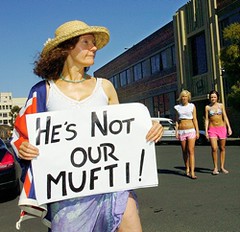
BIKINI-CLAD women and their male supporters will take to the streets when The Great Australian Bikini March descends on a Brunswick Muslim [?] mosque next weekend.

The Saturday, December 9 march has been organised by Melbourne grandmother Christine Hawkins as a peaceful protest against recent reported comments by Sheik Mohammed Omran and Sydney Mufti Sheik Taj el-Din el-Hilaly about the sexual assaults of women.

During a recent religious sermon, Sheik el-Hilaly compared immodestly dressed women to “uncovered meat”, suggesting they provoked attacks.

Ms Hawkins said the march was designed to “show our opposition and go home” and was not politically motivated.

The march will start at Brunswick’s Clifton Park in Victoria St at 2pm and progress to the Islamic Information and Support Centre of Australia at 19 Michael St, Brunswick, the headquarters of Sheik Omran.

“Our fathers and forefathers fought to have the freedom we enjoy now,” Ms Hawkins said.

“We do not want conflict with the Islamic community. Australians know how to be tolerant, but we will not tolerate the intolerable.”

Ms Hawkins said the protest had a serious message, but it was hoped to be a fun event, because “fun in the sun has always been an inherent part of Australian culture”.

Bikinis are encouraged on the day, but any swimwear, summer skirts, tops, shorts or sarongs were also appropriate, Ms Hawkins said.

“I am a veteran bikini wearer and I want my children and grandchildren to be able to do the same,” she said.

The article provides the following number for more details — 0404 790 393 — and requests that interested parties phone between the hours of 6 and 10pm.

This is the third number used by Christine’s mob as a contact for the march: the other two, previously-advertised numbers, being 0408 531 095 (Christine Hawkins) and 0438 244 283 (Chris [Gemmell-]Smith).

While Hawkins has attempted to distance herself from ‘politics’, the sponsor of the march remains True Blue Productions, a local “Aussie” business importing sweatshop apparel from Honduras (by way of the USA). True Blue operates out of a PO Box in Endeavour Hills, an outer eastern suburb of Melbourne, while the True Blue website is registered to Chris Gemmell-Smith.

Hawkins’ “serious” message — sexism is bullshit — is obvious. What is less obvious is the reasons for her decision to combat sexism by marching on a mosque, in Brunswick, on the anniversary of the Cronulla ‘riot’.

Some may interpret it as a deliberate fascist provocation.

Hawkins’ attempt to position herself as an ‘apolitical’ Australian grandmother, one who (as is the natural prerogative of every Australian politician) invokes the sacrifices of previous generations of Australian men in order to preserve our freedom (in this case, to wear bikinis), may be both self-serving and nauseating, as well as slightly silly, but it — and the promise of ‘chicks in bikinis’ — helps to explain why the far right is attracted to her absurd expedition into the wilds of multi-cultural Melbourne. That, and the deliberate targeting of Muslims.

As many commentators have noted, John Howard’s humanitarian argument [for war] is even less convincing when one recalls how he won the last [2001] election. His newfound compassion for the people of Iraq — ‘There is no chance of normalcy in a nation where torture and rape and genocide and killing are standard practice‘ — was conspicuously absent from his view of those onboard the Tampa. In this contradiction, the Prime Minister shows that to justify his war all the distancing effects must be kept in place. These separations allow a politically safe recourse to the suffering of distant others while they make politically useful the ruthless control and hiding from view the suffering of more proximate others. In this we see Howard’s paranoid form of nationalism as the force that has displaced logic in his justifications. It explains the apparent contradiction of his past exploitation of populist xenophobia against his recent and deeply unpopular falling-in behind George Bush. Paranoid nationalism constructs the nation primarily as controlled territory, emphasising the border at the cost of community. The nation becomes a grouping bound by fear. In such an understanding of the nation, the views of the populace can only be heard when they speak the language of the borderland: exclusion, fear, control. When the people speak of community — inclusion, hope, cooperation — there is incomprehension on the part of the paranoid nationalist. The dominance of this paranoid discourse within the government can be seen in the complete absence of dissent within the coalition. But the evidence of massive anti-war rallies signals that the culture of fear has not displaced hope as the bond of community…

–Matthew Ryan, ‘The Logic of Fear’, Arena magazine, No.64, April/May 2003

Posted in !nataS, Anti-fascism, Sex & Sexuality, State / Politics | 3 Comments

@ in Indonesia

Foreign. Bloody. Agitators. They’re everywhere!

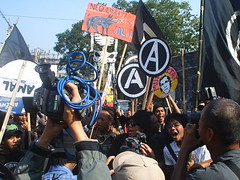
    Above : Indonesian anarchists protest George II’s flying visit to Jakarta, November 20

See also : Jakarta Anarchist Resistance | Anarch[Oi!] : Anarchy, Love, and PUNX | Autonomous Media (Manila, Philippines) | Anarchism in Asia : Anarchist Yellow Pages

Posted in Anarchism, Media, State / Politics | 2 Comments

Bikini-clad fascists in Cronulla. And Brunswick?

[Update : Radio National‘s ‘The World Today’ has published the online transcript of the interview with march organiser Christine Hawkins which Liam kindly mentioned previously: ‘Women protest Sheikh’s comments with bikini march’ (Monday, November 27, 2006, 12:46:00, Reporter: Sabra Lane). A claim is made that the website for the march — in reality, a hastily cobbled-together wiki — was ‘hacked’ by White supremacists. As far as I’m aware, this is false, as the history of the page demonstrates. Further, the ‘White supremacists’ referred to in the report are Perth-based Ben Weerheym and various members of Scumfront, a number of whom have expressed support for both ‘chicks in bikinis’ and ‘Muslims out’.]

Murdoch’s Daily Terror — by way of Luke McIlveen — has today ‘revealed’ the fact that the fascist Australia First Party — under the leadership of Lebanese-Australian Dr. Jamahl Saleam — has finally ‘revealed’ its candidate for the upcoming NSW state election in March, 2007: aged care worker John Moffat. The article comes just under two weeks away from the first anniversary of the notorious outburst of racial violence that occurred last year in Cronulla, and for which local racists and fascists are organising a commemorative ‘Great Australian Bikini March’ on Saturday, December 9 in Brunswick, Melbourne. It also appears just a month after the AFP experienced its first electoral success in some years with the election of Bruce Preece to the Prospect City Council in Adelaide. Moffat himself previously stood for the AFP in March 2003, and received 814 votes for his trouble.

NSW Premier Morris Iemma has warned the ‘racist’ and ‘extremist’ AFP to pull their chicken-heads in prior to their intended celebration of the ‘White Uprising’, intimating that the NSW police may not look all that favourably on the presence of fascist groups intent on stirring up racism in the local community. Speaking to the press shortly after the events in December, local Melbourne fascist, and former leader of the now defunct Patriotic Youth League Luke Connors (young_soldier on the White supremacist website Scumfront) stated that “about 15 League members handed out literature to the Cronulla crowd, as well as buying drinks for some participants”. Meathead also claimed that his group ‘predicted further racial violence, naming the Melbourne suburbs of Heidelberg, Preston, Reservoir and Springvale as potential “hot spots”‘.

And Brunswick?

Posted in Anti-fascism, State / Politics | 20 Comments

G20: Observing human rights…

Pt’chang!

The ‘G20 Human Rights Observers’ team has released their preliminary report into the G20 protest last weekend. It’s available as a PDF.

The 3-page statement is an initial summary of observations made by Human Rights Observers over the three days.

A team of 28 Human Rights Observers monitored interactions between police and members of the public during the protest actions around the G20 meeting from early on Friday 17 to late in the afternoon on Sunday 19 November…

The report is highly critical of protester behaviour and describes a high level of aggression and deliberately provocative behaviour toward the police from some protest groups and individuals.

It also states that there was a “high level overall of police discipline and restraint in the face of deliberately provocative actions by some protesters, lasting many hours.”

However, the statement points out that this initial discipline and restraint declined as the protests wore on and numerous concerning incidents involving police use of force occurred. The team highlights the police baton charge against a non-threatening crowd at the Melbourne museum on the Sunday afternoon.

“Our timeline analysis points to a decline in police restraint over a period of time” Mr Kelly said. “Whilst it is understandable that stress and provocation would cause a decline in police discipline, the maintenance of appropriate police protocols, lawful actions and consideration of human rights is even more important during times of stress.”

The statement also points to the arrest of Mr Drasko Boljevic by plain clothes police officers. The statement calls on the Victorian and Federal Police forces involved in ‘Taskforce Salver’ to exercise careful observation of the law when undertaking any further arrests.

Mr Kelly admits that both police and some protest groups are likely to be critical of this initial statement. “Whenever there is an escalation of political violence, the human rights of citizens become increasingly difficult to protect. It would be regrettable if protest groups, the police or the public missed this point.”

The Federation of Community Legal Centres (Vic) Inc, with the support of Pt’chang Nonviolent Community Safety Group Inc. and the Human Rights Law Resource Centre (HRLRC) co-ordinating the Observer Team. A detailed report will be compiled with the assistance of experienced human rights lawyers and released by the end of the year.

In other news, Australian Attorney-General Montgomery Burns and ASIO have won the right to appeal the disclosure of documents knowledge of which threatens to destroy the foundations of the Australian state and send otherwise decent, law-abiding, tax-paying citizens into a crazed frenzy of violent acts and jay-walking. “Lawyer Charles Gunst, for the Director-General of Security [Paul O’Sullivan], told the court its judgment in this case could set a precedent and cause irreparable harm to national security.” The freedom (non-incarceration) of the two men deemed by ASIO to constitute a risk to national security, meanwhile, is verboten, and the two left to rot:

‘Rotting’ on Nauru

The Age reported in September that Mr Faisal was medically evacuated to Brisbane after becoming suicidal. It said Mr Sagar remains the last asylum seeker kept on Nauru.

Outside court today, the men’s solicitor, Maurice Blackburn Cashman partner Anne Gooley, accused ASIO of delaying their case by pursuing the appeal.

She said an appeal before a full bench of the Federal Court was not likely to be heard until next year.

“In the meantime, (one of my clients) is in a psychiatric institution, not knowing what’s going to be happening to him, and (another) is on Nauru, ‘rotting’ as we speak,” she said.

“He’s obviously going to be disappointed at this latest delay … he’s been on Nauru for five years now.

While the rest of us can sleep safely in our beds.

Posted in State / Politics, War on Terror | 3 Comments

US Political Prisoners

New York Indymedia journalist Brad Will was murdered by the Oaxacan regional government in Mexico late last month, and you can read a short tribute by imprisoned videojournalist Josh Wolf here. Josh himself is a political prisoner in the United States:

    Josh Wolf, freelance journalist and independent videographer, is currently in “coercive custody” at the Federal Detention Facility in Dublin, California. He has never been charged with any crime. Wolf was incarcerated for contempt earlier this year after refusing to provide a Federal Grand jury with unedited video of a 2005 G-8 protest in San Francisco. His incarceration is virtually unprecedented for a journalist refusing to give information to a Grand Jury. It is widely believed he will likely become the longest held journalist in U.S. history.

Which is not long enough to interest the Australian media, apparently.

Imprisoned eco-activist Jeff Luers will celebrate his 28th birthday on December 5th, the seventh time he’ll have celebrated his birthday behind bars. Two days later, December 7th, is An International Day of Solidarity with Green Scare Indictees, Detainees, and Political Prisoners.

Stay tuned…

More generally : Political Prisoners in the US | Earth Liberation Supporters Network | FBIWitchHunt.Com | Anarchist Black Cross (Brighton, UK)

Posted in Anarchism, Media, State / Politics, War on Terror | Leave a comment

Join in the chorus? Socialism vs. 2006 Victorian state election

[Updated : Monday]

Oh dear.

Trot Guide fears for the future of socialist electioneering in the state of Victoria.

1) In the safe Labor seat of Broadmeadows, Will Marshall stood for the horribly-named Socialist Equality Party (nee Socialist Labour League). Preliminary results suggest that he came last of seven candidates, receiving just 425 first-preference votes, or 1.53%.

2) In the safe Labor seat of Brunswick, Vannessa Hearman stood for the mighty Socialist Alliance. Hearman did slightly better than Marshall, gaining 549 first-preference votes, or 1.97%: enough to beat Family First (442 votes / 1.59%) and People Power (433 votes / 1.56%).

3) In the safe Labor seat of Derrimut, Jorge Jorquera of the Marxist-Solidarity-Direct-Action-Workers-&-Community-First Network-Party has failed to capture the electorate’s imagination: No son Chavistas en Derrimut. (Jorquera came last of six candidates, receiving 262 first-preference votes or 0.97%).

4) Margarita Windisch‘s bogus attempt to arrest Paul Wolfowitz last Saturday didn’t seem to endear her terribly to the good, Labor-voting people of Footscray; as the other Socialist Alliance candidate for a Lower House seat in the state of Victoria, Windisch came last of six candidates, receiving 406 first-preference votes or 1.45%.

5) Of all the socialist candidates in the election, Steve Jolly of the Socialist Party did best: he got 1,632 votes or 6.09% in Richmond. But despite this and a significant Greens vote, the seat remains safely in Labor’s hands.

6) Finally, in the Upper House seat of Western Victoria, Socialist Alliance candidates Sue Bull and Rowan Stuart got something like 0.28% of first-preference votes (985).

All in all, another nail in the coffin for the unfortunate SA.

    [See also : ‘Vote for the socialists!’ (except Will Marshall), The DSP/SA Candidates, Green Left Weakly, November 22; ‘Labor returned in Vic election’, Selena Black, GLW, November 25; ‘Obscuring the violence inherent in the system’, Tony Iltis (with apologies to Monty Python), GLW, November 24: “More than three thousand people had a somewhat surreal experience on November 18. They attended a rally, called by the Melbourne Stop the War Coalition and Stop G20, to oppose the genocide by poverty being promoted by the finance ministers’ meeting, and the warfare that makes the corporate plunder of the Third World possible… What made the experience surreal was turning on the evening news, or opening the next day’s papers, to see what coverage the protest had received. They were confronted by scenes quite different from anything they’d witnessed at the rally, involving people in strange white outfits and masks battling it out with police.”]
Posted in State / Politics, Trot Guide | 2 Comments

G20: Resistance vs. Socialist Alternative

Wearing my leftist train-spotting hat while clothed in white overalls, vegan boots, leading a dog on a string, listening to Loikaemie, and reading a copy of the Australasian Spartacist, I give you the wonderful mess that is: Resistance vs. Socialist Alternative!

Statement on G20 protest
Resistance
November 25

On November 18, upwards of 3000 people marched through the streets of Melbourne to protest the meeting of the G20. The rally was organised by the StopG20 Collective and the Stop the War Coalition, in which Resistance participated both in organising and publicising.

The protest was directed at some of the biggest war criminals in the war in particular Paul Wolfowitz, president of the World Bank, Gordon Brown, UK Chancellor of the Exchequer, and Treasurer Peter Costello, key figures in the Coalition of the Killing, and directly responsible for the deaths of over 650,000 in Iraq alone.

Their discussions, carried out in secret behind closed doors, were aimed at further enforcing pro-corporate policies which have been responsible for the starvation and impoverishment of millions around the world and the increasing endangerment of humanity as a whole, particularly through policies that perpetuate environmental destruction.

The size and mood of the rally is testament to the growing opposition to the policies of the rich G20 nations.

This was despite the corporate media beat-up in the week leading up to the protest about the likelihood of violence, and attempts to derail it – including multi-millionaire Bono whose concert message was focussed on charity not change, and the Make Poverty History events that were specifically aimed at providing a nice gloss to the attempts by the G20 to look like it was doing something for the world’s poor.

Unsurprisingly, the corporate media covered none of this. Instead, as always it preferred to focus on a small group – Arterial Bloc – and the so-called riots which, at most, amounted to a few broken windows.

The corporate media hypocrisy is clear – focus on the tiny bit of damage to private property and ignore the policies of death beginning discussed behind closed doors.

The reason why is also clear – since the Seattle protests in 1999, which prevented the World Trade Organisation from reaching agreement on a new set of trade rules to impoverish the Third World, the global justice movement has grown. The S11 blockade of the World Economic Forum in 2000 and the M1 blockades of stock exchanges in 2001 spurred on this movement in Australia, helping to discredit these capitalist institutions and their “solutions” to global poverty.

‘Global justice movement’ is one of a number of terms used to describe the movements which have arisen in opposition to neo-liberal globalisation. It’s a ‘nice’ term, but competes with others such as ‘alter-globalisation’, ‘anti-capitalist’, ‘anti-globalisation’ and ‘counter-globalisation’. As for ‘its’ history, most would consider its origins, at least in Western countries, as emerging from the jungles of Chiapas, Mexico, and the Zapatista revolt against NAFTA (North American Free Trade Agreement), formally launched on the same day as NAFTA’s official implementation: January 1, 1994. The links, both ideological and practical, between this, ongoing civil uprising, and opposition in the West to neoliberal institutions such as (GATT/) the WTO, IMF and World Bank, have been well-documented elsewhere.

Still, one of the key characteristics of N30 (or ‘The Battle of Seattle’ — starring Charlize Theron, and coming soon to a local sinema) was precisely the absence of the authoritarian (Marxist, Leninist, Trotskyist, Maoist) left. So too, J18, an event almost completely ignored by this tendency and — not coincidentally — one of the reasons for its relative success. The fact is that ‘the Trots’ only jumped on the bandwagon following ‘Seattle’.

In Australia, the (authoritarian) left’s Colombus-like ‘discovery’ of a global movement in opposition to neo-liberalism triggered a partial recomposition of the extra-parliamentary left in the shape of… an electoral platform: the Socialist Alliance. During the course of its almost six years of existence, SA’s establishment has been of benefit to one party and one party only: the DSP (for which Resistance functions as a not-very-successful recruitment base in the ‘youth’ market).

As for S11 and ‘M1’ — that is, May Day — fuck it: no one cares about the real story anyway.

That is why the media refused to cover the protest, or report on what went on inside (where it was largely barred) and why it kept a low profile of the key warmongers such as Wolfowitz. It is little wonder that an 67% of people responded “no’’ to an Age poll question, “Did the G20 summit achieve anything’’ two days after the protest.

Resistance rejects the corporate media and government arguments against the protest. Importantly we must defend all activists against the campaign of victimization and sweeping up of activists post-rally. All those arrested must be supported, particularly the extremely worrying case of Aki[n] Sari, who has been denied bail until a court hearing next February. This sets a very dangerous precedent.

The brutal attacks by the police against peaceful protesters on the night of November 18, and the following day against peaceful protests outside the Museum, demonstrate on which side the real violence lies.

But this shouldn’t stop the movement from having an honest discussion about tactics. Having played a part in initiating and organising the G20 protest, we do not think Arterial Bloc played a constructive role. Covering their faces, acting in an undemocratic manner and isolating themselves from the majority at the rally, their decision to skirmish with the police played into the hands of the right-wing media and G20 spokespersons, such as Costello.

Resistance is also not opposed to civil disobedience. In fact we, along with many others, helped make the S11 blockade the success that it was, and initiated the M1 protests. But civil disobedience is only a tactic, and its usefulness, or otherwise, has to be judged on whether or not it helps or hinders in building the movement. That is the reason why we criticize the actions of the Arterial Bloc.

Because if we’re serious about building a movement to overthrow the system that G20 wants to prop up – capitalism – we have to win the working class majority to our side, and we’re some way from that.

Carrying out tiny “militant” actions such those of the Arterial Bloc, give a free kick to the real thugs – those holed up inside the G20 meeting.

We have no control over the corporate media, but we are not so naive as to not take into account that the coverage will have an impact on working people, and whether they will be prepared to join us at the next protest or not. We know that the corporate media will always seek to marginalise us, and that scuffles with the state will take priority in their reporting over a peaceful protest of working people against the corporate rich. Similarly, the government will use such actions to push through more draconian state terror laws.

This is not an argument against civil disobedience: as a tactic it can be indispensable when used correctly – when it helps build and inspire a mass protest to become even bigger. In this particular instance the actions Arterial Block did nothing of the sort.

The global justice movement is naturally going to be diverse; but the movement also has to take some responsibility for its actions and work out what helps its growth and what doesn’t. The debate over tactics is useful as long as it stays concrete, and lessons can be learnt from G20 that can be carried into the discussion that has already started about the Stop Bush protest at APEC in Sydney next year.

The left must take a stand against the elitist violence of the “Arterial Bloc”
Socialist Alternative
November 21

The lively G20 rally of 3,000 in Melbourne on Saturday 18 November was a moderate success. It was a small step on the road towards building a genuine mass movement capable of involving not just a few thousand, but the masses which can offer a serious challenge to the capitalist neo-liberal agenda.

However, the activities organised and led by the so-called “Arterial Bloc” were counterposed to this aim. The media were able to not just ignore the protest (we’re used to that), but to imply that those at it were responsible for, or at least involved in, the rampage. This is not like S11 six years ago when a peaceful protest with widespread support was attacked numerous times by the police. Then, the Bracks government experienced a backlash of outrage. People watching TV, reading the print media are not idiots. They can tell when protesters are being attacked simply for protesting. It is telling there has been mostly bewilderment at best, or revulsion at the actions of this bloc and its followers. How will this encourage wide layers of people to come to future protests?

The actions of the Arterial Bloc illustrate clearly that they have absolutely no interest in building a mass movement. They made it clear during the organising period that they were intent on their own, small actions. When they marched to the rally they were sneering and abusive towards activists with whom they disagree. If that wasn’t clear enough, they graffitied the city with “kill the socialists”.

Coming to demonstrations with your faces masked can only be justified in a situation of severe state repression. In the present political climate all it does is indicate to workers, students and the oppressed that they have to be involved in something sinister to attend rallies. This and things like whole militarised blocs in gear like chemical suits sends a very elitist message: you are only welcome if you’re in the in-group/s who were organised before the event. They do not just add to images of “diversity” – particularly when those dressed in them behave like apolitical hooligans. Anyone who is committed to building a widely based movement needs to reject such negative theatricals.

Such irresponsible provocation of the police opens up not just the tiny numbers involved in the rampage, but potentially the rest of the rally and others to state repression. There is some suggestion that peaceful protesters on the Sunday at the Museum were the victim of this logic.

For this reason, we need to take a clear and unambiguous stand against these provocateurs. This bloc and those who support it in any way need to be isolated by the left because actions such as this will make it increasingly difficult to build on the growing discontent that clearly exists – reflected in the regular rallies which attract sizeable numbers such as the Environment Day rally, those during the war on Lebanon, Global warming and the G20 to name just some. Hundreds of thousands of workers have mobilised to defend union rights. Actions like those at G20 by the Arterial Bloc will make it difficult to build the necessary links between organised workers and the smaller, social issue campaigns. Anything which weakens our ability to build such a movement makes it that much more difficult to deal with state repression.

The violence at the weekend did not combat that repression, but opens up the left to increased militarisation of policing when we do not have the mass grass roots organisation and support capable of repelling it.

This is not just speculation. We have lessons of very recent history from which we should learn, in particular the experience of the anti-capitalist movement in Europe. British socialist Tom Behan who has strong links with the Italian revolutionary left documented how the Black Bloc, which was known for similar actions as those at G20, gave openings to police violence, police provocateurs and even fascists. They organised around the same combination of mindless violence, contempt for the mass of demonstrators and hostility to the socialist left. They are known for melting into peaceful crowds only to emerge to attack the police, bringing a violent response against the whole crowd. At the Genoa Social Forum protest in July 2001, in one peaceful contingent after another, the arrival of the Black Bloc was similar to what happened in a rank and file labour contingent: “organisers were unable to stop Black Bloc provocations which quickly led to a police charge”. Their provocations opened up a debate on violence. Behan concluded:

    The fact that a small minority of demonstrators were intent on violence is an issue which cannot be ignored. The anti-capitalist movement needs to do all it can to engage with genuine protesters and try to convince them of the futility of random acts of destruction. Another related issue is that of the ‘non-genuine’ Black Bloc. There is now overwhelming evidence that not only were the Black Bloc allowed to engage in widespread destruction, the police often used their activities as a pretext to attack peaceful demonstrators. Furthermore, it is now certain that some of the Black Bloc were in reality police agents provocateurs, although it is equally likely that some Nazi and fascist groups pretended to be part of the Black Bloc.

    [Source: ‘Nothing can be the same again’, International Socialism, #92, Autumn 2001]

Yeah. Tom Behan: “British socialist”; “strong links with the Italian revolutionary left”; friend to the animals. More to the point, a member of Socialist Alternative’s closest equivalent in the UK — and parent grouping for both SocAlt and the ISO — the Socialist Workers’ Party (SWP). At the time of writing, Behan was also a leading member of the SWP front group “Globalise Resistance”, and it was in this capacity that Behan first wrote about how ‘the black bloc were really fascists’ (‘Behind the provocations’, Weekly Worker, #394, Thursday, July 26, 2001). He wasn’t alone in denouncing the spoilsports who ruined Genoa for everyone:

    Marginalizing Language in the Movement Post-Genoa : After Genoa, there has been a noticeable increase in marginalizing language in the Left press. Most of this language has been directed at the anarchist black bloc, but some of it has been directed at “militant” elements.

In fact, Behan — when he’s not offering his insights into the ‘anti-capitalist’ movement and the ways in which the SWP might best suck its blood — is the SWP’s “expert” on all things Italian. An example of his historical-revisionism-in-the-service-of-Trotskyism is The Resistible Rise of Benito Mussolini (Bookmarks, 2003). A crazy, ultra-violent, hostile, abusive, threatening, ultra-sectarian, provocative, fascist-sympathising, football hooligan and bloody foreigner intent on wrecking all that is good and profaning all that is holy wrote a review of Behan’s book. And, despite labouring under harsh conditions (such as not having attended a local private school or Melbourne University), they reckoned somewhat different:

As will be discussed, it was only the anarchists and anarcho-syndicalists who supported [the militant antifa movement in Italy in the 1920s] wholeheartedly. Not, of course, you would know that from Behan’s account. Which is the reason for this review, namely to reclaim anarchist and working class history from those, like the SWP, who seek to misuse it for their own ends. Behan’s account of the Italian labour movement, the near revolution after the war, the resistance to fascism and the lessons to be learned are all skewed in favour of the SWP’s very peculiar version of anarchism and the needs to justify its non-revolutionary practice and ideology.

So this review is an attempt to reclaim anarchist history by exposing the phoney revolutionary politics and scholarship of the SWP. A thankless task, of course, but an essential one. Anarchists need to care about our history and defend it against those more than willing to distort it as no one else will. To grow our movement needs to learn from and build upon the successes and failures of the past. And that will never happen if we do not know and understand our own history, how our ideas were applied in the past and why the likes of the SWP feel the need to lie about both…

For example:

In the 1970s the Italian left suffered increasing state repression when student revolutionaries turned in frustration to small-group violent guerrilla-type actions against the state. Rather than dealing with the lack of a mass response which pushed them in this direction, it accelerated the decline of the mass movements as workers, students, the oppressed turned away in disgust at assassinations and mindless violence. Luca Casarini, the main spokesperson of Ya Basta! – a movement which is descended from the autonomism of the 1970s – spelled out the problem of the “professionalisation” of demonstrations, i.e. activists coming in protective clothing ready for provocations etc: “To accept the logic of military clashes would be both crazy and political suicide. Our movement cannot match their [the state’s] military power. We would be crushed”.

This might seem like a big step beyond what happened at G20. But the actions of the Autonomists in Italy began with isolated violent attacks. The irresponsible provocations of the Arterial Bloc have all the hallmarks of the same destructive dynamic. It is the logic of the actions of tiny numbers lashing out with no reference to the mass of people.

That’s why the left who want to reach out to masses of people need to:

1. Politically oppose anyone coming to protest rallies wearing masks or other forms of disguise. We need openness and accountability in the movement. Such dress creates a sinister atmosphere, breeds distrust, and makes police infiltration more likely.

2. Make it clear that there is a sharp dividing line between those involved in the violent provocations at G20 and the genuine left who want to relate to masses of people in order to change the world.

3. Make no concessions to the idea that this is just a form of “diversity”, just another difference of opinion. These tactics are completely counterproductive and the left will pay the price if we make concessions to them.

These questions are urgently in need of discussion as we are about to begin organising for the APEC forum next September in Sydney which Bush is expected to attend. If we are to maximise our ability to mobilise significant numbers, we have to take this clear stand and prepare to organise on the basis of genuine mass protest with no role for the kind of violent provocation we saw at G20.

“If the anarchists are not careful, their enemies will write their history”Gaetano Salvemini

Posted in Anarchism, History, Media, State / Politics, Student movement, Trot Guide, War on Terror | 2 Comments

G20: Destination South Africa

The next G20 Summit will be held in Cape Town, South Africa. Speaking of which, Southern African anarchists in platform boots have re-launched their website: Zabalaza.Net

RESISTANCE

Resistance has been hampered by political confusion prevailing within COSATU. Many union officials, and ordinary members, retain their loyalty to the ANC, and so fail to correctly grasp the class agenda and class nature of the ANC. There has been no co-ordinated response to GEAR, or even an official review of COSATU’s ongoing alliance with that party.

By failing to understand the role of the ANC in the war on the working class, COSATU has been unable to formulate a coherent and effective response, and has instead [fallen] back on pleading with the ANC to “consult” the unions more when developing policy. This is a far cry from the revolutionary and [combative] COSATU of the 1980s, which fought the apartheid State to a standstill.

COSATU’s failure to give a lead to other sections of the working class in the fight against neo-liberalism has undermined the possibility of a countrywide, working class-based campaign against neo-liberalism.

However, there have been a number of important local struggles that clearly demonstrate the willingness of workers to fight privatisation and austerity. A wave of new community organisations has sprung up to fight against neo-liberal attacks by local municipalities. In Chatsworth township near Durban, African and Indian workers and their families have fought back against evictions and service cut-offs. In Soweto, the Electricity Crisis Committee has mobilised resistance to electricity cut-offs and outrageous service charges.

At the University of the Witwatersrand, militant academics, students, and above all, workers in the National Education Health and Allied Workers Union (NEHAWU) fought a courageous, but ultimately unsuccessful, six-month battle against 613 retrenchments in 2000. In Johannesburg and other cities, the mainly African South African Municipal Union (SAMWU) and the mainly white and coloured Independent Municipal and Allied Trade Union (IMATU) have campaigned against the privatisation of municipal services. Despite being a COSATU affiliate, SAMWU has taken a principled stand against GEAR and privatisation, and has not been afraid to tackle the ANC directly.

The most important recent development has been the unification of anti-neo-liberal campaigns in Soweto, at the University of the Witwatersrand, and in Johannesburg in the Anti-Privatisation Forum in July 2000. The new coalition – to which Bikisha Media Collective is also affiliated – has sought to link union and community struggles through joint actions and strike support; a rolling campaign will also be launched in 2001…

See also : Resistance to Neoliberalism: A View from South Africa (1997); Africa, neo-liberalism and anarchism (Chekov, WSM); What ‘Appen To South Africa? 1976-2005: Defiance to Apartheid, Neoliberalism, And Recuperators Of Defiance

Posted in Anarchism, State / Politics | Leave a comment