Hitler’s Ghost by Christopher Hitchens

Hitler’s Ghost
Christopher Hitchens
Vanity Fair
June 1996

Cherry blossoms are bursting over the Tidal Basin and the Jefferson Memorial as I ascend the steps of the United States Holocaust Memorial Museum. There is to be a learned seminar today, on the newest interpretation of the Final Solution. Daniel Jonah Goldhagen, a 36-year-old assistant professor at Harvard, is to defend his thesis in Hitler’s Willing Executioners: Ordinary Germans and the Holocaust, a book which has been a spring sensation.

Having immersed myself in this volume for a weekend, I am eager to ask one big question that cries to heaven for an answer. It is this: Who on earth does Goldhagen think he is arguing with? He comes to tell us there was a good deal of state- and church-sponsored anti-Semitism in German culture. He adds that the Nazis made great use of Jew hatred in their propaganda. He goes on to say that many Germans took part in beatings, killings, and roundups not because they were coerced but because they liked the idea. He announces that not many Germans resisted the persecution of their Jewish countrymen.

Excuse me, but I knew this and so did you. Moreover, the sarcastic phrase about “obeying orders” is not even a well-known explanation, only a well-known excuse. All the way through Goldhagen’s presentation, which is one tautology piled on another, I wait to make my point. And then the two big scholars present come to the podium with their comments, and I realize I have been wasting my time.

Sophomoric, meretricious, unoriginal, unhistorical, a product of media hype by Knopf (the book’s publisher), contradictory, repetitive, callow… I’m just giving you the gist of what they said about Hitler’s Willing Executioners. It must have been quite an ordeal for Goldhagen, who looks about 12, to sit through this kind of thing from revered seniors. Professor Yehuda Bauer of Hebrew University, for example, is effectively the academic founder of the Yad Vashem Holocaust archives in Jerusalem and the author of at least three of the dozen or so standard works on the subject. Professor Konrad Kwiet is no lightweight, either. He is the scholar-in-residence at the Research Instituite at the Holocaust Museum and the adviser to the government of Australia on war crimes.

I watch Goldhagen being ground between these heavy millstones and two things happen to me. First, I feel a rush of sympathy for the kid. Sixty-three percent of German electors voted against Hitler in the last free election in Weimar, says Bauer witheringly, and there were vicious Jew-baiters in Germany in the early 19th century. So how come, Mr. Clever Young Historian, that one time it ends in blood and another time not? If you don’t know, you shouldn’t talk. This big-time book of yours should have remained a doctoral thesis and maybe those supervisors at Harvard could try harder. (I’m paraphrasing the scholars only slightly.)

The second thing that happens is that I feel a new respect for the Research Institute at the Holocaust museum. It can’t have been easy, this trashing of an attractive and earnest young man. How was he to know that there is more to the Holocaust than meditations on cruelty and the German character, or that he was supposed to have a deep theoretical knowledge of Fascism? Doesn’t almost every Hollywood and pulp outlet make the Final Solution seem like a sort of morality tale? Did not The New Republic‘s Leon Wieseltier–whose remarks closed this seminar–once observe mordantly that “there’s no business like Shoah business”?* So, good for the Institute.

There is, of course, another answer to the question I never asked. Goldhagen is involved in an argument with an unseen opponent, and so are all the other experts on the platform, including Christopher Browning, whose book Ordinary Men anticipated Goldhagen by four years. This unseen opponent is David Irving, a British historian with depraved ideas about the whole narrative.

Irving does have a rounded and developed theory of Fascism, which is to say that he has studied it a lot and it’s had a bum rap. He’s even been quoted as calling himself a “mild Fascist” or “a moderate Fascist”–oxymoronic if true. In the week that I went to the Holocaust-museum seminar, Irving was hastily dumped by St. Martin’s Press, which had undertaken to produce his book on the papers of Hitler’s minister of propaganda, Joseph Goebbels, the choreographer for the Nuremberg style, and had then, at the very threshold of publication, taken fright. Book canceled, author disowned, tearful statements from the top brass about how if only they had known…

Encountering Tom Dunne of St. Martin’s that very week, I told him I was going to criticize him in print, and he replied, “If you want a title for the article, call it ‘Profiles in Prudence.'” A good joke from a good man. But at whose expense?

I have thought about this a lot and I feel the need to say, very clearly, that St. Martin’s has disgraced the business of publishing and degraded the practice of debate. David Irving is not just a Fascist historian. He is also a great historian of Fascism. But you would never have known this from the way that the controversy was written up.

HITLER’S SPIN ARTIST was the headline on a typical column, by Frank Rich in the New York Times, raising the alarm about the mere idea of Irving’s being published. The Washington Post was not laggard, saying that Irving “routinely refers to the Holocaust as a hoax.” Jonathan Yardley, a cultural critic of some standing, wrote a whole article that positively sighed with satisfaction at the idea that, having neither read nor seen the book, he could now safely counsel others to do likewise. Nary a voice was raised, in American publishing or academe or journalism, to ask if David Irving had anything to contribute as a chronicler.

Things were rather different in my country of birth, which doesn’t even have a First Amendment. More than 120 book sections of English magazines and newspapers have requested copies from Irving’s British publisher, and reviews are pouring in. I might mention Robert Harris, author of Fatherland and Enigma, who wrote in the London Evening Standard on April 1 that “in the words of the military writer John Keegan: ‘No historian of the Second World War can afford to ignore Irving.’ Few contemporary scholars have his depth of knowledge, virtually none has met as many of its leading figures and nobody, surely, has unearthed more original material–a private archive known as the ‘Irving Collection,’ always generously made available to other researchers, which weighs more than half a ton.”

Harris could have added that his own brilliant book Selling Hitler–describing the 1983 forgery of “the Hitler Diaries,” which hoodwinked a large chunk of the British establishment (including historians of the caliber of Hugh Trevor-Roper, author of The Last Days of Hitler)–was made possible in part by Irving’s finding that those nasty papers were indeed a fake. Irving rendered another service by unmasking some spurious documents connecting Churchill and Mussolini. He speaks faultless German. He has, in the most recent case, been the first historian to see some 75,000 pages of diary entries by Joseph Goebbels, held in secrecy in Moscow from 1945 to 1992. His studies of the Churchill-Roosevelt relationship, of the bombing of Dresden, of the campaigns of Rommel and others, are such that you can’t say you know the subject at all unless you have read them. And, incidentally, he has never and not once described the Holocaust as a “hoax.”

I have caught David Irving out, just by my own researches, in one grossly anti-Jewish statement and one wildly paranoid hypothesis and several flagrant contradictions. But I learned a lot in the process of doing so. It’s unimportant to me that Irving is my political polar opposite. If I didn’t read my polar opposites, I’d be even stupider than I am. But what did I get when I went round that Holocaust seminar? Professors Bauer and Kwiet and Browning, asked if they agreed with the St. Martin’s decision, shrank as if I had invited them to a Witches’ Sabbath. None of them would say that Irving should never be published, but all of them said that if it were up to them he would not be.

Deborah Lipstadt, author of the standard text Denying the Holocaust, told The New York Times that one wouldn’t and shouldn’t publish David Duke on race relations, and (varying her pitch a bit) told The Washington Post that one wouldn’t and shouldn’t publish Jeffrey Dahmer on man-boy love. What is this vertiginous nonsense? These are supposedly experienced historians who claim to have looked mass death in the face, without flinching. And they can’t take the idea of a debate with David Irving? Quite apart from the fact that many publishers would have rushed to promote a Jeffrey Dahmer manuscript, what are we afraid of here?

I have now read the exchange of correspondence between Irving and St. Martin’s. For a long time, everything was hunky-dory. The manuscript was read seven times in 15 months (and understandably, since it contained amazing new material). The Military Book Club chose it as a main selection. Sales representatives made ethusiastic noises. And then, after a few hysterical and old-maidish articles in the press (Eek–a Nazi!), Irving is told that his contract is void. He is told this not by the publishers but by members of the press telephoning him for his reaction.

I remember when my friend Aryeh Neier, of the American Civil Liberties Union (whose parents got out of Berlin just in time), made the decision to uphold the right of the American Nazi Party to mount a demonstration in Illinois in 1978. The A.C.L.U. lost a lot of donors and subscribers that time. In a fine book entitled Defending My Enemy, Neier explained soothingly that the law on free expression covers everybody, and thus that in defending it for anybody you defend it for everybody.

After weeks of general acquiescence on the Irving suppression, Steve Wasserman of Times Books was moved to push Neier’s point with his colleagues at Random House. In a contentious meeting, it was agreed they would actually read the book. Someone will no doubt pick up where St. Martin’s left off; until then, one will have to seek David Irving on some ghastly Brownshirt Web site, which will parade its bravery in making the occult facts into revealed truth. Is this what the established experts want?

A little depressed at this last thought, I made a late-night call to Professor Raul Hilberg at the University of Vermont. Professor Hilberg’s book The Destruction of the European Jews was the original text on the Holocaust, published in 1961. He is acknowledged as an ancestor on the matter. He sighed a bit when I mentioned Irving, whom he regards as a slippery customer but with whom he has had correspondence about documents and details. A very good man in footnotes and archives, allowed Hilberg, but you had to suspect his motives. However: “If these people want to speak, let them. It only leads those of us who do research to re-examine what we might have considered as obvious. And that’s useful for us. I have quoted Eichmann references that come from a neo-Nazi publishing house. I am not for taboos and I am not for repression.”

Currently, though, there is a taboo. And who really believes that if it were lifted any honest person would be the loser?

Posted in Anti-fascism, Death, History, State / Politics | Tagged , , | 3 Comments

Torture in West Papua

I am shocked.

Shocked and stunned.

Last week a video surfaced in which a West Papuan man is filmed being tortured by Indonesian soldiers.

    WARNING : GRAPHIC CONTENT.

Clearly, the man is a terrorist.

And if torturing a terrorist will save lives, who are we to judge?

It’s a question every right-thinking person has reason to ponder.

Perhaps these and other acts of (arguably) justifiable torture are necessary in order to sustain the many benefits of effective and real autonomy the people of West Papua enjoy?

Besides which:

a) 13,000 (or was it 30,000?) people die every day of not getting enough to eat and stuff (in fact, between the end of the G20 conference in Melbourne on November 19, 2006 and today, an estimated 43,170,000 children under the age of 5 will have died of preventable causes–hunger, malnutrition, disease–aka ‘poverty’);
b) if there were any problems in West Papua then Foreign Minister Kevin Rudd would surely do or have at least said something about it and;
c) the 31st, 32nd and 33rd Pacific Island Forums (2000–2002) expressed concern about violence in the area, urged the relevant parties to pursue peace, and welcomed the special laws on autonomy the Indonesian government eventually passed (see also : Rudd to examine details of Indonesian treaty, Mark Colvin, PM, November 8, 2006).

Presumably, Prime Minister Julia Gillard (and Foreign Minister Rudd?) will take the opportunity presented by the Fifth East Asia Summit later this week to broach the subject of a burning stick being applied to a man’s genitals by an illegal occupying force. With, like, ‘Indonesia’. But on the other hand, what’s a little matter of exhibiting behaviour not-quite-up-to-Australian-standards between mates? (“A former head of the Australian Security Intelligence Organisation, Mr Richardson made the comments in a Senate hearing after being asked about alleged abuses of Malukan activists by Indonesia’s counter-terrorism unit, Detachment 88, which Australia helps fund and train.”)

Then again, maybe it’s true what they say: nothing’s as precious as a hole in the ground.

Indonesia is the largest bilateral recipient of Australian development assistance. The department worked closely with AusAID and other relevant agencies in the development of a new, five-year development partnership with Indonesia—the Australia–Indonesia Partnership (AIP) Country Strategy 2008–13. This $2.5 billion Strategy was announced by Prime Minister Rudd in Jakarta in June 2008. The Strategy builds on the Australian Government’s development priorities in Indonesia, and is directed towards reducing poverty and promoting regional peace, stability and prosperity. It will target assistance to the country’s poorest provinces, including Aceh, West Papua, Papua, East Nusa Tenggara (NTT) and West Nusa Tenggara (NTB).

~ DFAT Annual Report 2007–2008

See also : Editorial: Civilised Society Has No Place for Torture, Jakarta Globe, October 23, 2010 | West Papuan protests voice discontent with Indonesian rule, John Braddock, wsws.org, July 20, 2010 | Arrests in Jayapura (March 24, 2010) | Treaty a real Downer for West Papua (November 12, 2006) | Where’s Wally? (March 18, 2006) | Below a Mountain of Wealth, a River of Waste, Jane Perlez and Raymond Bonner, The New York Times, December 27, 2005 | Report claims secret genocide in Indonesia, Virginia Gawler (University of Sydney), August 19, 2005.

Posted in Media, State / Politics, That's Capitalism!, War on Terror | Tagged | 2 Comments

The more things change the more things change

Again.


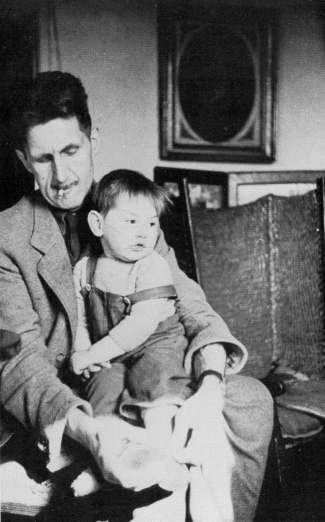
George Orwell (Eric Blair), ‘As I Please’, Tribune, May 19, 1944

A SPECIMEN of Tribune’s correspondence:

TO THE JEW-PAID EDITOR, TRIBUNE, LONDON.
JEWS IN THE POLISH ARMY.
YOU ARE CONSTANTLY ATTACKING OUR GALLANT POLISH ALLY BECAUSE THEY KNOW HOW TO TREAT THE JEW PEST. THEY ALSO KNOW HOW TO TREAT ALL JEW-PAID EDITORS AND COMMUNIST PAPERS. WE KNOW YOU ARE IN THE PAY OF THE YIDS AND SOVIETS.
YOU ARE A FRIEND OF THE ENEMIES OF BRITAIN! THE DAY OF RECKONING IS AT HAND. BEWARE. ALL JEW PIGS WILL BE EXTERMINATED THE HITLER WAY—THE ONLY WAY TO GET RID OF THE YIDS.
PERISH JUDAH.

Typed on a Remington typewriter (postmark S.W.), and, what is to my mind an interesting detail, this is a carbon copy.

Anyone acquainted with the type will know that no assurance, no demonstration, no proof of the most solid kind would ever convince the writer of this that Tribune is not a Communist paper and not in the pay of the Soviet Government. One very curious characteristic of Fascists—I am speaking of amateur Fascists: I assume that the Gestapo are cleverer—is their failure to recognize that the parties of the Left are distinct from one another and by no means aiming at the same thing. It is always assumed that they are all one gang, whatever the outward appearances may be. In the first number of Mosley’s British Union Quarterly, which I have by me (incidentally, it contains an article by no less a person than Major Vidkun Quisling), I note that even Wyndham Lewis speaks of Stalin and Trotsky as though they were equivalent persons. Arnold Lunn, in his Spanish Rehearsal, actually seems to suggest that Trotsky started the Fourth International on Stalin’s instructions.

In just the same way, very few Communists, in my experience, will believe that the Trotskyists are not in the pay of Hitler. I have sometimes tried the experiment of pointing out that if the Trotskyists were in the pay of Hitler, or of anybody, they would occasionally have some money. But it is no use, it doesn’t register. So also with the belief in the machinations of the Jews, or the belief, widespread among Indian nationalists, that all Englishmen, of whatever political colour, are in secret conspiracy with one another. The belief in the Freemasons as a revolutionary organization is the strangest of all. In this country it would be just as reasonable to believe such a thing of the Buffaloes. Less than a generation ago, if not now, there were Catholic nuns who believed that at Masonic gatherings the Devil appeared in person, wearing full evening dress with a hole in the trousers for his tail to come through. In one form or another this kind of thing seems to attack nearly everybody, apparently answering to some obscure psychological need of our time.

Fighting Fascism in 1930s Britain
1958: Beating back Mosley in Notting Hill
The Battle of Lewisham, 1977

Posted in !nataS, Anti-fascism, History, State / Politics | Tagged | 1 Comment

Two shoes one HoWARd

LOL.

Television.

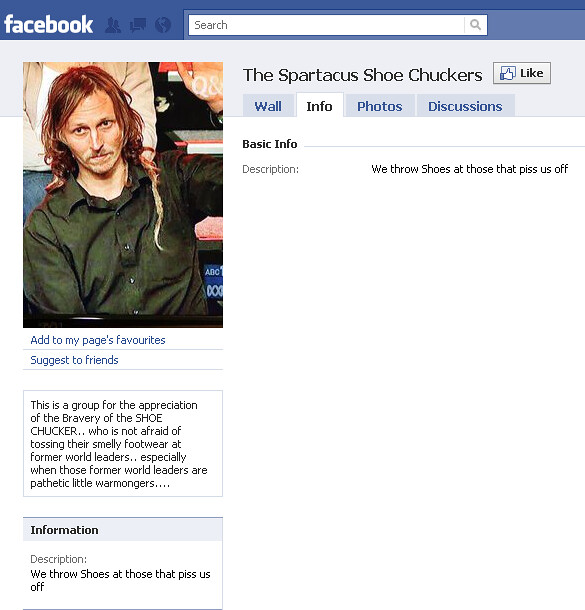
Angered at his poor answers to some questions, poor rich old John HoWARd had some bloke chuck shoes at him for his trouble — one for the Iraqi dead, and one for the Iraqi living, apparently. “Host Tony Jones ordered security to remove the long-haired young man and apologised to Mr Howard” — which is moar than John HoWARd ever offered The Stolen Generations.*

In other news…

The weapons of mass destruction HoWARd lied about were never found.

The hippy missed.

Such is life.

*Tony Jones done much better with Trent I reckon…

Posted in !nataS, Death, History, State / Politics, Television, That's Capitalism!, War on Terror | Leave a comment

Tyler Cassidy, Southern Cross Soldiers and ‘skinheads’

Last week, the inquest into Tyler Cassidy’s death heard evidence regarding Tyler’s membership of the ‘Southern Cross Soldiers’ (Tyler Cassidy had been kicked out of an Australian pride group, inquest told, AAP, October 21, 2010).

The SCS have been variously described as “an anti-immigration group” (Alison Caldwell, ABC, October 19), a “Right-wing nationalist youth group” (Paul Anderson, Herald Sun, October 22) and an “ultra-nationalist group” (Farah Farouque, The Age, October 22). The status of Tyler’s membership in the group has been somewhat obscure, with contradictory claims being made. For example:

…Aaron McGenniskin told the inquest… Tyler had been left very upset when he was kicked out of the nationalist organisation Southern Cross Soldiers in the months before he died.

“He was pretty shattered,” Mr McGenniskin said.

But Mr McGenniskin, who has a tattoo of the Southern Cross on his arm, said Tyler was reinstated in the group after there were a lot of complaints.

Mr McGenniskin rejected suggestions the organisation, which he said he left shortly after Tyler died, was a white supremacist group.

“It’s really just a place to meet with people of any race that are proud to be Australian,” he said.

~ Tyler ‘depressed’ before shooting: court, Daniel Fogarty, The Age (AAP), October 22, 2010.

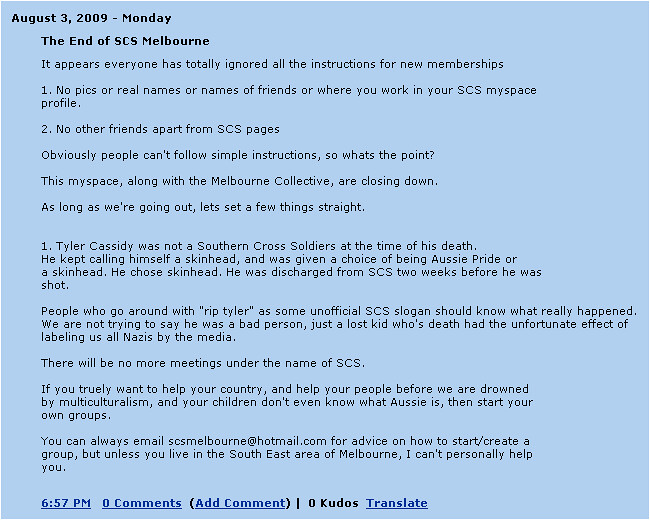
On the other hand, the ‘Southern Cross Soldiers Melbourne Collective’ blogged on August 3, 2009:

A commentator on a White nationalist discussion forum (belonging to the Australian Protectionist Party) and a self-described SCS claims:

Leaving aside the question of whether or not it matters, the problem of whether or not Tyler was a ‘Southern Cross Soldier’ is intimately related to the amorphous nature of the group, its status as an online networking tool for young nationalists, and the broad nature of its appeal to (overwhelmingly but not exclusively White) Aussie yoof.

To produce an accurate account of the network’s evolution would be very difficult. To the best of my knowledge, the first time that the SCS received any media attention was approximately a month before Tyler’s death when, on November 23, Liam Houlihan wrote about police concern over “a Cronulla-style anti-immigrant gang” and their intention to prevent any similar racist monkey-business taking place on Melbourne beaches (Victorian police vow crackdown to stop ‘another Cronulla’, Sunday Herald Sun). According to Houlihan, the police vow followed “boasts by the 200-strong Melbourne chapter of the Southern Cross Soldiers, who admit having criminals and neo-Nazis in their ranks, that they will converge on bayside beaches this summer”. Liam cites ‘Adds’ as his source — he’s since deleted his MySpace page, as have many others.

At the time, SCS on MySpace numbered in the hundreds, and included ‘chapters’ in Melbourne, the Gold Coast, Tasmania, NSW South Coast, South Brisbane, SA, NSW, Mackay (NSW), Perth, Ballarat (VIC) and, presumably, elsewhere.

As for ‘skinheads’, in this context the appropriate term is ‘bonehead’ — the derogatory term popular in punk and skinhead subcultures to describe racists who ape skinhead fashion (a trend which began in England in the late 1970s and early 1980s and was spearheaded by the now dead bonehead Ian Stuart, vocalist for the band Skrewdriver). Roddy Moreno of Welsh skinhead band The Oppressed explains the distinction here.

See also : Tyler Cassidy : Inquest (October 19, 2010) | Justice for Tyler.

Posted in !nataS, Death, History, Media, State / Politics | Tagged , | 10 Comments

Brown Pride Velasquez v Lesnar the Republican

[For Eddie]

Posted in Broken Windows, History | Leave a comment

…mucking about…

I’m gonna be mucking about with the design and content of the blog over the next few days.

Abnormal service will resume shortly.

Posted in Broken Windows, Media | 6 Comments

Kevin Bracken and 9/11 conspiracy theories

*sigh*

Kevin Bracken — Maritime Union of Australia Victorian Branch Secretary and Victorian Trades Hall President — has been claiming that 9/11 is a conspiracy for years. Last year, he helped to organise the Melbourne leg of ‘The Hard Evidence Tour Down Under’, dedicated to exposing the troof about 9/11. The conference was held at Trades Hall, and featured US troofer and founding member of ‘Architects and Engineers for 9/11 Truth’ Richard Gage; the event’s MC was John Bursill, who just two months earlier addressed the fascist gathering known as the Sydney Forum on the subject of troof.

Perhaps it’s time Brian Boyd imposed some S11 style “working class discipline” on his 9/11 President?

LOL.

Posted in !nataS, Broken Windows, Death, History, State / Politics, War on Terror | Tagged | 19 Comments

Blockading Public Roads: Anarchy and Reactionary?

Benson ka-Ngqentsu, Brian Bunting District (Cape Town Metro, Western Cape Province) Secretary of the South African Communist Party (SACP), recently released a statement condemning the Abahlali baseMjondolo organisation and claiming that ‘blockading public roads’ — one of the tactics employed by the organisation — is ‘anarchy and reactionary’.

The SACP is a partner in the Tripartite Alliance — consisting of the SACP, the African National Congress (ANC) and the Congress of South African Trade Union (COSATU) — which dominates the state and much of civil society in post-apartheid South Africa. It has a colourful history: in 1922, white miners were mobilised by the Party using the slogan “Workers of the world, unite and fight for a white South Africa!” In 1993, its then leader, Chris Hani, was assassinated. (Fascist bizarro Arthur Kemp has been linked to Hani’s murder: see nutzis are W E I R D : Arthur Kemp / BNP, August 30, 2009.) Its current leader / General Secretary (since 1998) is Blade Nzimande, who’s also the Minister for Higher Education and Training.

In reference to the SACP, Richard Pithouse (‘Solidarity, Co-option and Assimilation: The necessity, promises and pitfalls of global linkages for South African movements’ [PDF]) writes:

The South African Communist Party’s long standing authoritarianism, mechanistic economism and current willingness to work to legitimate the ANC’s project of deracialising domination make the party the necessary enemy of people seeking to reconstitute anti-capitalist projects in South Africa. The cultish fundamentalism of other established left sects that don’t involve themselves in mass movements renders them irrelevant. In the political space that has emerged from these realities it is perhaps not surprising that many young left intellectuals have uncritically embraced the practice of the anti-capitalist movements in the North and the ideas of their key philosopher Antonio Negri. Of course this mistake is not of the same order as the previous generation’s attraction to Stalinism. On the contrary the anti-capitalist movements in the North have often developed innovative forms of non-vanguardist democratic organisation that allow for internal diversity and a large degree of spontaneity. We have much to learn from them. But, nevertheless, a narrative fashionable in the metropole is again being imposed on actual histories and modes of struggle (and non-struggle) by people with privileged access to the metropole. The result of this is always to disregard the agency and experience of the dominated even in the very moment of insurgency. We need to become militant in our insistence that theory be subordinated to the lived experience of political life in the way that the tool is subordinated to the artist.

To which it might be possible to add that: the ideas of the ‘key’ philosopher Antonio Negri have been uncritically embraced, critically examined, ignored and/or rejected by many young left intellectuals in the North, as well as the social movements in, through and by which their ideas are often articulated; the “innovative forms of non-vanguardist democratic organisation” that Pithouse identifies as being a property of these movements arguably owe quite little to Negri outside of these articulations; fashions, whether intellectual or otherwise, come and go.

Blah blah blah who cares.

Back to Abahlali baseMjondolo:

Blockading Public Roads: Anarchic and Reactionary?
Abahlali baseMjondolo
October 18, 2010

We have noted the statement by the South African Communist Party that declares that blockading public roads is “anarchy and reactionary.”

If road blockades are anarchistic and reactionary then it is clear that anarchy and reaction are very popular in South Africa. Communities, organizations and movements across Cape Town and across South Africa have been blockading roads for years. We are not the only people that have blockaded roads in Cape Town in the last days. Many of the road blockades in Cape Town in recent days are not organized by us. But our campaign does endorse the road blockade as a legitimate tactic. We think it is quite significant that new communities are supporting our campaign all the time. We have already been invited to visit four new communities that want to join our campaign during this weekend. The rebellions that use road blockades as an important tactic are spreading everywhere. There is real popular support for disrupting business as usual in a system that oppresses the poor. When the SACP condemn us they condemn the struggles of the people across the country. That philosopher called Karl Marx once wrote that communism is the real movement that abolishes the state of things. He didn’t write that communuism is the vanguard that disciplines and condemns the real struggles of the people.

We also note that:

When we have been evicted the SACP has been silent.

When we have have been arrested the SACP has been silent.

When we have suffered in fires and floods the SACP has been silent.

Yet when we take to the streets the SACP condemns us!

What kind of communism is this? What kind of solidarity is this?

To make matters worse everyone knows that the SACP supported the struggles in Khutsong which were much more militant in their tactics than the struggle that we are now waging in Cape Town. Clearly for the SACP the real problem that they are having with Abahlali baseMjondolo of the Western Cape is not our tactics but the fact that we are organizing outside of the ANC and that we refuse to vote for the ANC or for any political party. Local government elections are coming and the ANC is panicking about the fact that while there is tremendous popular anger and protest in Cape Town they have lost control of it. The popular anger and protest in Cape Town is under the control of ordinary people and no political party likes that.

The SACP say that they are on the side of the poor but we don’t see them struggling with the organizations of the poor. We only see them trying to discipline our organizations from above and telling us to vote for the ANC!

Everybody knows that around the world Stalinist Communist parties always function to defend states against popular struggles. This was true in Budapest in 1956, in Paris in 1968 and its true right now in Kolkata. We are not anti-communist. We are for a living communism. We are for a communism that emerges from the struggles of ordinary people and which is shaped and owned by ordinary people. We are for a communism built from the ground up. We are for a communism in which land and wealth are shared and managed democratically. Any party or groupuscle or NGO that declares from above that it is the vanguard of the people’s struggles and that the people must therefore accept their authority is the enemy of the people’s struggles. Leadership is earned and is never permanent. It can never be declared from above. It only lasts for as long as communities of struggle decide to invest their hope in particular structures. Often there are many legitimate and democratic structures involved in the same broad movement of struggle at the same time. This is why we always insist that the autonomy of all democratic poor people’s organizations must be respected and welcomed.

We […] know that many ordinary members of the SACP live the same challenges as us and that we have a common interest in the same struggles. Like everyone in their right mind we support some of the positions that the SACP has taken in the battles within the ANC – like their position against the tenderpreneurs and before that their position against AIDS denialism. But we are critical of their hostility to freedom of expression. We are also aware that some people in the SACP, like Dominic Tweedie, have, in alliance with the most regressive faction of the middle class left, supported and propagandized for the repression against our movement. We have no choice but to condemn those members of the SACP that support the repression of autonomous struggles.

We are happy to meet with the SACP but our autonomy as an organization is non-negotiable. That includes our autonomy to refuse to support the ANC in the coming elections.

We note that while they condemn our endorsement of the road blockade as a tactic they also say that they will support our march on parliament. We welcome their support on our march but they will need to understand that we do not allow political parties to take over our protests. We are very clear that we will be protesting and not voting when the local government elections come.

~ Statement issued by Abahlali baseMjondolo of the Western Cape, October 16, 2010. See khayelitshastruggles.com or www.abahlali.org for more infos.

Abahlali baseMjondolo, or AbM, is a shack-dwellers’ movement in South Africa. It campaigns to improve the living conditions of poor people and to democratize society from below. The movement refuses party politics and boycotts elections. It’s key demand is that the social value of urban land should take priority over its commercial value and it campaigns for the public expropriation of large privately owned landholdings. For more infos see R Patel, ‘A Short Course in Politics at the University of Abahlali baseMjondolo’, Journal of Asian and African Studies, Vol.43, No.1, 2008 (PDF) | Richard Michael Pithouse, ‘Abahlali baseMjondolo and struggle for the city in Durban, South Africa’, Cidades, Vol.6, No.9, 2009 (PDF).

And here’s the Trololo that started it all:

Abahlali BaseMjondolo’s tactics reactionary – SACP
Benson ka-Ngqentsu
October 15, 2010

Benson ka-Ngqentsu calls on organisation stop vandalising public property

Blockading Public Roads is anarchy and reactionary

As the SACP in the Brian Bunting District (Cape Metro), we are serious outraged about the attitude and protesting method used by Abahlali Basemjondolo in the area of Khayelitsha. If this is the modus operand they use in their struggles, their campaigns will always be characterised as opportunistic, anarchist and populist and that they are using genuine concerns of the workers and the poor of Khayelitsha.

As the SACP, the vanguard of the working class and the poor, ours amongst other things is to fight for decent houses, decent jobs, health, clean drinking water, free and quality education etc. And we must therefore campaign for what we do not have and defend what we already got.

Our struggle is also to defend state property such as public roads, libraries, schools, clinics, police station etc. In our view all these properties are meant to benefit the workers and the poor direct, and destroying them when you wage your struggle is total reactionary and anarchist.

Against this background, as the SACP we call on Abahlali Basemjondolo under the leadership of Mr. Poni to refrain from using these kinds of tactics when they wage in their struggles because amongst other things they are playing in the hands of the enemy. As the working class and the poor we should at all times direct our struggles to our oppressors and its administration and public roads are neither our oppressor nor our enemy.

As the SACP we shall always be in the forefront of fighting for service delivery and we will always condemn all those who are anarchist and reactionary and vandalise the already existing infrastructure in our communities. Lastly, the SACP’s doors are open for engagements with any forces or organisation in society and we have [learnt] that there is a service delivery march planned to Western Cape government and we shall support that march.

~ Statement issued by Benson ka-Ngqentsu, SACP Brian Bunting District Secretary, October 15, 2010.

See also : anarchy is a fag! (September 25, 2007).

Posted in Anarchism, Broken Windows, History, Media, State / Politics, That's Capitalism! | Tagged , , , | 9 Comments

Tyler Cassidy : Inquest

15 year old Tyler Cassidy was shot dead by police in the Melbourne suburb of Northcote on December 11, 2008. An inquest into his death has just opened. Note that, a week or so after the shooting, the White nationalist political party ‘Australia First’ declared that its members “will demonstrate at the Coroner’s Court when an investigation is held into Tyler’s Cassidy’s death”. It also claimed that:

A submission to the Coroner will state that the police who attempted to arrest Tyler Cassidy were undermined in their duty of care by inflammatory and inaccurate intelligence contained ‘on line’ for use by police. This false information directly contributed to his death. This information must be revealed in full to the public.

No doubt the media and the coroner will sit up and take notice…

See also : Interested Party Ruling – Tyler Cassidy (Coroners Court of Victoria) | 4 Corners : Lethal Force (October 26, 2009) | Tyler Cassidy (August 31, 2009).

Posted in Death, State / Politics | Tagged | 4 Comments