The public be damned! I work for my stockholders.
–William H. Vanderbilt, 1879
Break the rules. Stand apart. Keep your head. Go with your heart.
–TV commercial for Vanderbilt perfume, 1994
Capitalism is changing, obviously and drastically. From the moneyed pages of the Wall Street Journal to TV commercials for airlines and photocopiers we hear every day about the new order’s globe-spanning, cyber-accumulating ways. But our notion about what’s wrong with American life and how the figures responsible are to be confronted haven’t changed much in thirty years. Call it, for convenience, the “countercultural idea.” It holds that the paramount ailment of our society is conformity, a malady that has variously been described as over-organization, bureaucracy, homogeneity, hierarchy, logocentrism, technocracy, the Combine, the Apollonian. We all know what it is and what it does. It transforms humanity into “organization man,” into “the man in the gray flannel suit.” It is “Moloch whose mind is pure machinery,” the “incomprehensible prison” that consumes “brains and imagination.” It is artifice, starched shirts, tailfins, carefully mowed lawns, and always, always, the consciousness of impending nuclear destruction. It is a stiff, militaristic order that seeks to suppress instinct, to forbid sex and pleasure, to deny basic human impulses and individuality, to enforce through a rigid uniformity a meaningless plastic consumerism.
As this half of the countercultural idea originated during the 1950s, it is appropriate that the evils of conformity are most conveniently summarized with images of 1950s suburban correctness. You know, that land of sedate music, sexual repression, deference to authority, Red Scares, and smiling white people standing politely in line to go to church. Constantly appearing as a symbol of arch-backwardness in advertising and movies, it is an image we find easy to evoke.
The ways in which this system are to be resisted are equally well understood and agreed-upon. The Establishment demands homogeneity; we revolt by embracing diverse, individual lifestyles. It demands self-denial and rigid adherence to convention; we revolt through immediate gratification, instinct uninhibited, and liberation of the libido and the appetites. Few have put it more bluntly than Jerry Rubin did in 1970: “Amerika says: Don’t! The yippies say: Do It!” The countercultural idea is hostile to any law and every establishment. “Whenever we see a rule, we must break it,” Rubin continued. “Only by breaking rules do we discover who we are.” Above all rebellion consists of a sort of Nietzschean antinomianism, an automatic questioning of rules, a rejection of whatever social prescriptions we’ve happened to inherit. Just Do It is the whole of the law.
A few months ago a friend of mine bought some beer.
No wait.
The interesting thing about this particular beer was that it had been made to appear as tho’ it had been brewed by squatters or some shit. From like, (OMGOMGOMG) New York. The beer was called ‘Doss Blockos’, and it came armed in a brown paper bag (adorned with a squatting symbol) and accompanied by a rather dubious back-story…
I filed it for later reference, and then promptly forgot all about it. Then Last Thursday I saw the same beer for sale at hip underground venue Dan Murphy’s.
So I thought I’d do a little more digging.
Dos Blockos
Once Upon A Time, ‘Dos Blockos’ was the name of a squat in New York City. Located at 713 East 9th Street, Dos Blockos was squatted for many years before being evicted on April 27, 1999 (Steve Wishnia, ‘Pigs Evict Dos Blockos Squat on Lower East Side’, The Shadow). Among its former residents was Brad Will, an independent journalist murdered by police in Oaxaca in 2006.
So far, so good marketing gimmick.
Doss Blockos
Fast forward to February 2011 and ‘Dos Blockos’ has undergone a transmogrification, from evicted squat to ‘Doss Blockos’, a brand name for a beer.
Why?
According to Springwise (“required brain food for entrepreneurial minds!”):
Compelling product stories have long been a selling point for alcohol brands, who often conjure nostalgic imagery in an effort to capitalize on their heritage. Now, hoping to draw upon a more unconventional story, we recently came across Doss Blockos and their paper bag-wrapped beers inspired by the New York squat scene.
The story in this case is like, completely unconventional and totally cool. According to the manufacturer, Doss Blockos was:
… born from the underground squatting fraternity that came about in New York in the [1990s]. It was a time when squatters in the infamous Dos Blockos building were renovating with every tooth and nail they could find to make vacant buildings habitable […] whilst shark-like developers were throwing around their fat-corporate weight to force the squatters further down into the discarded underground.
Tough living wasn’t tough when it was what people believed in. It was art and music and party and the beer that developed was bare of anything but the essential taste. The speciality pale malt and cascade hops were used because that’s what was available.
The Doss Blockos that is getting drunk now still comes in the brown paper bag that everyone knows beer had to be drunk from when people needed to be able to keep the law out [of] their face. Each one of these has been wrapped in brown paper bags by hand, then pushed into the distinctive hand-constructed six-pack basket.
That’s quite some handiwork eh.
The bRanes behind both Doss Blockos and its brewer are Stephen Wools and Josh Lefers (aka the Free Sh!t Men) of local company ‘Big Dog’ (2006–). The deep affinity between the housing struggles of the 1980s and 1990s on New York’s Lower East Side and their Prahran-based advertising and marketing agency is further commemorated in the name given the ostensible brewer: ‘East 9th Brewing Company’. Both Big Dog and East 9th are located at 20–28 Chatham Street, tho’ how on Earth a brewery manages to squeeze into a building already bursting with a legion of fabulously creative people beats me.
In any case, the precise composition of the “fat-corporate weight” that Stephen and Josh imagine forced New York squatters (literally) underground is unknown, but it’s certainly the case that Big Dog does its best to lift other fat-corporate weights, their client list including such obese companies as “Unilever, AMP, Red Bull, Ministry of Sound, Domaine Chandon, McDonald’s, AEG, Keep Australia Beautiful, Top Gear, Channel V and beyond”. According to Big Dog, these companies and projects “approached us because we are experts in communicating to youth and young adult markets”.
As noted, Doss Blockos is ostensibly produced by the ‘East 9th Brewing Company’, which would appear to be one of many legs belonging to Big Dog, along with ‘Killrockstar Big Dog Entertainment’. In 2011, KrBde organised something called ‘The Boroughs Festival’, *ing (surviving members of) The New York Dolls. Their tour caused some minor controversy when it was revealed that the Dolls were also gonna play some shows sponsored by Big Tobacco, shows which were not arranged by Big Dog (and which would appear to have been subsequently cancelled). Whatever the degree of success experienced by the Dolls and the other groups (including Aqua and The Dead Kennedys) KrBde have brung out, the campaign to promote Doss Blockos won Big Dog the Silver Pentaward 2011 in the ‘Beverages: Beer, cider and low alcohol’ category.
A fitting tribute to Brad Will and all the other New York squatters amirite?
The Hammered Festival takes place in Brizvegas this weekend. The event celebrates the birth of a (misunderstood) dead, foreign, incestuous, coprophiliac dictator in 1889 and the 20th anniversary of the Hammerskins Down Under. An assortment of neo-Nazi pinheads will be gathering somewhere in the city to get drunk, sweaty and shirtless and sing along with a bunch of racist, sexist homophobic nerds. The Festival generated some heat a few months back and in the days prior two news items: a short piece on JJJ’s Hack and an article in Fairfax.
(From) Aotearoa/New Zealand (to Sweden)
‘Right Wing Resistance New Zealand’ (RWRNZ) is the name indefatigable Mormon racist Kyle Chapman has given to one of his newest organising projects. To celebrate WPWW Day — aka the International Day for the Elimination of Racial Discrimination — Kyle and some 80 or so of his followers marched through Christchurch. The relative degree of success experienced by the group, along with its snazzy name, has generated some online support, with Right Wing Resistance X springing up in several different countries including Australia. In Sweden, RWR recently attended a rally called by neo-Nazis belonging to the National Democrats.
two men and a woman in black bomb jackets and inspects the fountain in the square. Peter Kremer says he leads the Swedish part of a new right organization.
– We are from the Right Wing Resistance. We belong to the extreme right. What we stand for? To preserve the white race. You will hear of us.
Peter Kremer says that they support the National Democratic Party demonstration. That he “knows all” in ND. He says:
– The problem is immigration. Those who bear the greatest responsibility is our Prime Minister who allowed that we get all the crap here. The government is in charge. There is no liability. Just scoop up with immigrants and then they do not take care of the problem. I’m so sick of this shit.
…Bara några minuter senare kommer två män och en kvinna i svarta bomberjackor och inspekterar fontänen på torget. Peter Kremer säger att han leder den svenska delen av en ny högerorganisation.
– Vi är från Right Wing Resistance. Vi tillhör extremhögern. Vad vi står för? Att bevara den vita rasen. Ni kommer att höra talas om oss.
Peter Kremer säger att de stöder Nationaldemokraternas demonstration. Att han “känner alla” i ND. Han säger:
– Problemet är invandringen. De som bär största ansvaret är vår statsminister som har tillåtit att vi får in all skit här. Regeringen är huvudansvarig. Det finns inget ansvar. Bara ös in med invandrare och sen tar de inte hand om problemet. Jag är så less på den här skiten.
RaHoWa!
Canada
Canuckistan is the only other place on this bright green globe where WPWW Day was publicly celebrated this year, with tiny rallies in Edmonton (Alberta) and London (Ontario). A month later, and some of the boneheads belonging to the Canadian branch of ‘Blood & Honour’, including Kyle McKee, have been arrested and charged with assault.
On March 24, two males were attacked and assaulted late at night outside of a Mill Woods liquor store. One of the males was assaulted with a bottle of liquor.
The attack occurred on the heels of a White Pride Rally held in Edmonton on the same day. Just after noon, between 15 and 20 balaclava-wearing demonstrators belonging to the group Blood and Honour began marching along Jasper Avenue waving a huge white flag that read “White Pride Worldwide.”
The funeral last month of murdered Chilean Daniel Zamudio attracted thousands of mourners.
Daniel Zamudio, 24, was beaten on March 3 during a six-hour ordeal. Pictures released by his family show the attackers beat the openly gay man in the head, burned him with cigarettes and carved Nazi symbols and slogans on his body. He died from his injuries 25 days later. The four suspects who have been arrested in the case are thought to belong to a neo-Nazi group. Aged 19 to 25, they deny allegations of attacking Zamudio and of being neo-Nazis.
Sounds familiar.
Germany
German hackers driving the virtual panzers behind #OpBlitzkrieg have been interviewed by Brian Whelan for The Local. Or one of ’em, anyway. The naughty German’s hackery-dackery-do has really annoyed some, “so much that messages have been posted on the right-wing Altermedia site offering a reward for any information about the identity of the hackers”. (Chances are, those responsible will much moar likely be unveiled by the German state and/or Interpol than via Altermedia.) According to the Anon hacker: “Operation Blitzkrieg was founded in February 2011 and went public in May. We have access to many fascist email accounts we haven’t released yet… For a while we will gather that data and when we have what we want, we will release it for the public. Expect us!”
Shazam!
Norway
Deeply patriotic Norwegian Anders Breivik has gone on trial for mass murder. Or for seeking to protect Norway from the Mulsamic invaders. Or something. Guy Rundle (Crikey, April 17, 2012) reckons that, while Anders may have a bit of roof damage, his murderous rampage can only really be understood by reference to his political environment.
From relentless attacks on Roma people in eastern Europe and Italy — now state-sponsored by the Northern League and Hungary’s Jobbik party — to the “Casa Pound” neo-fascist groups in Italy who attack, sometimes lethally, isolated African migrants, to neo-Nazi attacks in East Germany, homophobic attacks in Poland, and menacing “demonstrations” by the EDL in the UK, Breivik’s targeted, lethal attacks swim in a sea of violence, much of it fuelled by a calculated right-wing hysteria pumped out by “respectable” authors such as Mark Steyn and Daniel Pipes.
Oddly enough, ‘casapound’ was the handle adopted by former Patriotik Yoof Leauge spokesd00d Luke Connors; the crazy-talk about Mooselems saturates online social networks as well as the rhetoric of large segments of the Australian far right (tho’ the Australian Defence League is pretty much pants at the moment).
Despite police harassment, on (Sunday) April 15, several hundred anti-fascists marched in Bialystok. The rally was called in response to recent fascist violence. According to ZSP Warsaw:
On the night of April 8-9, a band of fascists in Bialystok went on a spree of violence, attacking people in some clubs, screaming about killing gays and leftists. Some people were stabbed, one guy was beaten to death. Many of the attackers were related to the group Blood and Honor. In response to this, antifascists called for a mobilization on April 15. As there are not many in that city, they asked people from Warsaw to support.
A jealous lover of human liberty, and deeming it the absolute condition of all that we admire and respect in humanity, I reverse the phrase of Voltaire, and say that, if God really existed, it would be necessary to abolish Him.
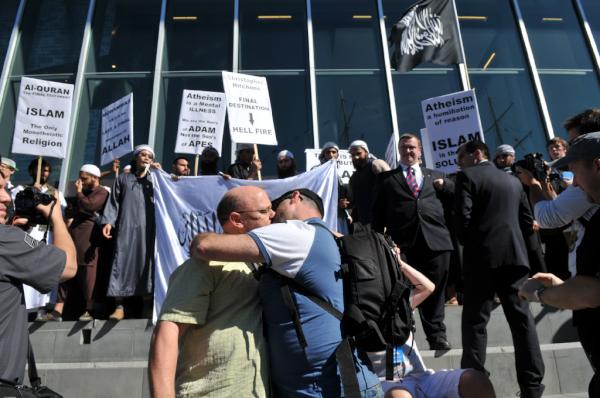
I think one of the more interesting aspects of the conference was the attendance of a small group (apparently from Dandenong Mosque) of protesting Muslim men. In and of itself, this incident wasn’t that remarkable. After all, atheism is a damanable crime in the eyes of some religiously-minded folk, whether Muslim or Christian or neither (and Christians too expressed vocal opposition to the Convention). But three things make their shouty noteworthy.
First, the reaction to it — especially the decision by two same-sex couples to kiss in front of the protesters — prompted some disco on my Twitter account. Secondly, the incident raises the question of the political flavour of the GAC, especially in light of Jeff Sparrow’s argument concerning ‘The Weaponization of Atheism’. Finally, the protest, Jeff’s writing (and of course much other commentary) and the content of the GAC itself begs the question of whether or not there are, in fact, any particular political implications associated with or proceeding from atheism, whether ‘New’ or ‘Old’.
Go To Hell!
So, to begin with, here’s the text of the placards that the protesters waved:
• Al-QURAN The FINAL TESTAMENT ISLAM The Only Monotheistic Religion
• Athiesm [sic] is the CANCER Islam is the ANSWER
• Christopher Hitchens FINAL DESTINATION > HELL FIRE
• Atheism is humiliation of reason ISLAM is the only SOLUTION
• Every creation has a CREATOR
• Atheism is a Mental ILLNESS We are the Son’s of ADAM Not the Son’s of APES
• Message to INFIDEL Ayaan Hirsi Ali BURN IN HELL FOREVER
• Atheism = HELL FIRE Islam = PARADISE
• MOHAMMAD P.B.U.H. the LAST & FINAL Messenger of ALLAH
• THERE IS NO GOD BUT ALLAH
Among the few chants I was able to hear and understand were ‘Allahu Akbar!’ (‘God is great!’) and ‘Christopher Hitchens, burn in Hell!’
Now, on the one hand, I’m not rationally convinced that God exists, let alone is great and so big, so absolutely huge, so strong and, well, just so super, that He requires constant reminders of same; on the other hand, I doubt even if he were still alive, Hitchens would mind being condemned in this fashion.
So, in response to Twitter critic Benjamin Solah’s observation that “Muslims are hardly the people to target” and that a protest outside of the GAC may be considered appropriate “given the Islamophobes and pro-war, pro-torture figure-heads inside”, I think it would be more accurate to observe that: a) on this occasion, it was a small group of Muslim men who had elected to target a gathering of atheists, and; b) their reasoning, rather than animated by a concern for ending state violence or promoting, say, the UN Convention Against Torture, was entirely religious, condemnatory and triumphalist.
The Four Horsemen
Be that as it may, The Four Horsemen Three Horsemen (and One Horsewoman) who spoke at the Convention do express the opinion that while Islam, like other religions, is fundamentally flawed, the nature of its doctrines pose particularly serious problems for liberal society/Truth, Justice, and the American Way. This analysis is contained in numerous equine productions; the filmed discussion between Richard Dawkins, Daniel Dennett, Sam Harris and Christopher Hitchens in September 2007, later released as The Four Horsemen, is a case in point.
Gathered together at the New York apartment of the Drink-Soaked Ex-Trotskyite Popinjay For War, at one stage in the discussion, Daniel Dennett asks his fellow riders what they consider to be their priorities in terms of combating irrational belief. He then suggests that they look at Islam. “Is there any remote chance of a reformed, reasonable Islam?”, he asks. Dawkins reacts by expressing some confusion over Wahabbism and its relationship to Islam; Harris states that the religion is in fundamental opposition to modernism, while Hitchens points out that there have been Islamic regimes, in the past, which have been relatively liberal. He then adds that, like all religions, there is a totalitarian impulse in Islam, one which is compounded by the fact that it claims, unlike Christianity and Judaism, that it is — as the sign carried by one of the Muslim counter-protesters read — THE FINAL TESTAMENT. And an end to inquiry is an end to freedom.
For Jeff Sparrow, this concentration upon Islam — and the policy recommendations which would seem to flow from it — is deeply objectionable. Thus “Today, we can identify an atheism that’s not so much militant as weaponised – that is, deployed, all too often, in the service of the extreme Right… [in] arguments for war and state repression, tricked out as scepticism”. As Jeff notes, these arguments were often deployed with great relish by Hitchens, as in the case of this tribute (Adam Shatz, ‘The Left and 9/11’, The Nation, September 5, 2002) to the use in Afghanistan of cluster bombs by the US armed forces:
If you’re actually certain that you’re hitting only a concentration of enemy troops…then it’s pretty good because those steel pellets will go straight through somebody and out the other side and through somebody else. And if they’re bearing a Koran over their heart, it’ll go straight through that, too. So they won’t be able to say, ‘Ah, I was bearing a Koran over my heart and guess what, the missile stopped halfway through.’ No way, ’cause it’ll go straight through that as well. They’ll be dead, in other words.
Further: “Cluster bombs are perhaps not good in themselves, but when they are dropped on identifiable concentrations of Taliban troops, they do have a heartening effect” (‘It’s a good time for war’, The Boston Globe, September 9, 2002). Jeff also draws attention to another of Hitchens’ speeches of November 2004, of which Mike Ludders (Columnist Hitchens lectures on political dissent, The Kenyon Collegian, November 18, 2004) wrote:
Hitchens unequivocally endorsed the recent siege of Fallujah, saying at the podium “the death toll is not nearly high enough … too many [jihadists] have escaped.” He continued on this path for some time, later saying that his “hatred” of fundamentalists, whom he characterized as being the majority of anti-U.S./U.K. forces in Iraq, is “much more pure, much more rational, and much more enduring” than their hatred for him or the West. Hitchens elaborated that this was because “[the jihadist’s] hate is irrational, it’s at all of life. He wants to destroy his own and others[.]” Hitchens contrasted this with his sentiment to love his own life and respect those of others, which he said “will more surely see me through” than the rage of the enemy.
Jeff also points out that such attitudes are shared by two other mounted scholars: Sam Harris and Ali Ayaan Hirsi:
Sam Harris… thinks that atheists have a special insight into the war on terror, which should, he says, [be] understood as a conflict against ‘a pestilential theology and a longing for paradise’. Most liberals, he continues, fail to understand ‘how dangerous and depraved our enemies in the Muslim world are’. Indeed, ‘the people who speak most sensibly about the threat that Islam poses to Europe are actually fascists.’
‘We are at war with Islam,’ she says bluntly. ‘And there’s no middle ground in wars.’ ‘All Muslim schools. Close them down. Yeah, that sounds absolutist. I think 10 years ago things were different, but now the jihadi genie is out of the bottle.’
Now and Then
In seeking an explanation for the emergence of this New, ‘weaponised’ atheism, Jeff argues that “a comparison with the past is instructive”. By way of illustration, in the late nineteenth century, things in Melbourne — the location of the 2012 Global Atheist Convention — were very different. At that time, he relates, Christianity dominated public life, and atheism was a minority doctrine adherence to which entailed real risk of persecution; like Islam today, atheism was “organizationally and socially a fringe sect, proselytizing ideas that the mainstream found foreign and threatening”. But atheists also cultivated allies among the poor and, having disassociated itself from the liberal, elitist vision of men like Symes, became more strongly linked to the labour movement, anarchism and socialism: “In a few decades time, the Russian revolution cemented an association between atheism and social reform, to the extent that, for many reactionaries, ‘godless’ and ‘commie’ became almost synonymous”.
In essence, then, where atheism once formed part of a broader radical arsenal, it is now an elite pursuit, and reflects the interests of those who usually propagate it: an educated, white, male population, not only content with secular authority but seeking its extension and amplification on a global scale. By force, if necessary, but (of course) only in self-defence, and always at the behest of locals (especially women).
In terms of political prescription, then, The New Atheists would appear to depend upon a belief in the work of social scientists such as Samuel Huntington. Unlike a good natural scientist, however, his theses regarding The Clash of Civilizations™ are seldom put to the test by these scienticians, and the means by which (religious) ideology is given expression left largely unexamined. That is, whereas these members of the atheist calvary are happy to denounce religious belief as stoopid, and the behaviour of religious folk stoopid to the same degree:
The traditional Left approach to belief begins with a recognition that religion is not simply a set of ideas. Religion is a cultural identity; it’s also simultaneously an aesthetic, a system of feeling, a guide to social and sexual conduct, an organizational framework and many other things besides. These different functions contradict and complement each other in all sorts of ways.
That’s why the same holy texts can, in different social settings, give rise to entirely different behaviours and attitudes; it’s why both the Anabaptists and Pat Robertson can claim inspiration from the New Testament.
And so on and so forth. Further: “Even put as schematically as that, the argument suggests a particular political response. Atheists and others seeking to fostering secularism in the Arab world might do so by, first and foremost, ending the military interventions that have brought so much suffering.” As Chomsky puts it:
The U.S. has always supported the most extreme fundamentalist Islamic movements and still does. The oldest and most valued ally of the U.S. in the Arab world is Saudi Arabia, which is also the most extremist fundamentalist state. By comparison, Iran looks like a free democratic society – but Saudi Arabia was doing its job. The enemy for most of this period has been secular nationalism. U.S.-Israeli relations, for example, really firmed up in 1967 when Israel performed a real service for the U.S. and Saudi Arabia. Namely, it smashed the main center of secular nationalism, (Gamal Abdul) Nasser’s Egypt, which was considered a threat and more or less at war with Saudi Arabia at the time. It was threatening to use the huge resources of the region for the benefit of the population of the countries of the region, and not to fill the pockets of some rich tyrant while vast profits flowed to Western corporations.
Q. Is it racist to argue that the social emancipation of the Muslim is the emancipation of society from Islam?
Bonus Said!
See also : Jeff Sparrow, Unholy Enthusiasm, Meanjin, Vol.69, No.1, 2010 | #atheistcon, War and Words, April 18, 2012.
PuSsY RiOt is a kick-arse group of anarchist/feminist/punk malcontents from Russia. Formed in October last year, their creative acts of resistance to the plutocracy in that country has made them, like so many others, targets of state repression.
Currently, three alleged members of the group–Maria Alekhina, Ekaterina Samucevich and Nadezhda Tolokonnikova–have been arrested, charged with “hooliganism”, remanded in jail, and face up to a further 7 years imprisonment if found guilty.
Their crime?
To allegedly take part in the following prank (February 21):
On April 19 the trio are in court in Moscow; April 19 is also a global day of protest. In Melbourne, supporters are being asked to rally on Friday, April 20 from 4pm outside Parliament House. Feel free to bring musical instruments and brightly coloured balaclavas, or make your own at the event, courtesy of Craft Cartel. MC Izzy will be blasting out hip-hop beats during the balaclava making; speakers include Karen Pickering (Cherchez La Femme/Slutwalk Melbourne), Marisa (Anarchist Black Cross Melbourne), Dale (3CR Girls Radio Offensive) and a glittering array of others, with MC Sean Bedlam.
On the April 16 episode of Q&A, Australian Attorney-General Nicola Roxon, in response to a question regarding ASIO spying on coal protesters, revealed that there are “a growing number of links across some sort of groups who are anarchist, others who meld into some religious, sometimes, and intent with committing a terrorist offence that might link in with other protest groups”.
Catfish?
Tony Jones:
But just to confirm, you’re saying ASIO proactively is not allowed to go and visit people it potentially thinks might commit a crime? Nicola Roxon:
It can proactively visit people within its remit: politically-motivated violence, espionage, counter-terrorism… Tony Jones:
Coal protesters who say they might break the law, is that in that category? Nicola Roxon:
It depends what… I think there is always going to be a boundary. Peaceful protest is one thing, and sometimes peaceful protest can break the law, but there is also a lot of industrial sabotage, which gets to a point where it is actually the commission of quite a serious crime. So there might be people who were involved in that, and I would expect that the contact if there was any of that behaviour, would be police, both state and federal, rather than ASIO. But there may be people and unfortunately we do see a growing number of links across some sort of groups who are anarchist, others who meld into some religious, sometimes, and intent with committing a terrorist offence that might link in with other protest groups — you do see a little bit of merging, but there are a lot of people who are involved individually in those that cause and intend to cause absolutely no harm, and would have no reason to fear that ASIO is in any way monitoring what they were doing.
Update : A small group of maybe 25 or 30 Muslim protesters rocked up to the Convention on Sunday, chanting and waving signs and condemning those in attendance to Hell. They inspired these two men (“Adam & Steve”?) to kiss.
Briefly:
Peter Singer‘s presentation was fairly standard, essentially liberal (& even idealist) account of human history, w reason as handmaiden to progress & state as progressive social formation (accompanied by various other problematic claims); Leslie Cannold provided some useful infos re Constitutional law & religion (ie non-/separation of church+state) in Australian context w appeal for political engagement; Dan Barker was amusing, personable & gently subversive; Political Panel was OK (v ABC) but sadly lacked genuwine fire-breathing anarchist (“God being everything, the real world and man are nothing. God being truth, justice, goodness, beauty, power, and life, man is falsehood, iniquity, evil, ugliness, impotence, and death. God being master, man is the slave.”) w seemingly most outspoken member being self-confessed & altogether chirpy Xtian Marion Maddox; Daniel Dennett was funny & philosophical (& obv addressing a much wider audience) but towards end compressed a series of arguments & concepts (esp inre epistemology) into too-brief a passage of time; AC Grayling was AC Grayling, meaning I still dunno what’s next for atheism; Lawrence Krauss was neat — & I feel like I now got moar bRanes (cf. Singer) merely having had the opp to listen to him — but otoh could have been making it all up AFAIK; Geoffrey Robertson was… Geoffrey Robertson, & v good on Catholic Church v Catholic children (note to self: read his book on subject); Ayaan Hirsi Ali articulated familiar critique of North African/Middle East politics (& I think prolly managed to induce some white liberal guilt at the same time) but mostly ignored historical context & finally; Richard Dawkins celebrated intelligent design (as part of wider attempt to problematise language) but I still fail to see why Professor fails to appreciate the vast literature on moral philosophy…
CONFIDENTIAL police reports have detailed the suicides of at least 40 people sexually abused by Catholic clergy in Victoria, and have urged a new inquiry into these and many other deaths suspected to be linked to abuse in the church.
In a damning assessment of the church’s handling of abuse issues, the reports say it appears the church has known about a shockingly high rate of suicides and premature deaths but has “chosen to remain silent.”
Written by Detective Sergeant Kevin Carson, the reports state that while conducting lengthy inquiries into paedophile clergy, investigators have discovered “an inordinate number of suicides which appear to be a consequence of sexual offending”…
In any case, the call for some kind of government inquiry into Church abuse and its effects has been made many times in the past — in fact, for almost the last two decades. In other words, since the early- to mid-1990s, during which time Cardinal Pell was famously photographed (August 1993) lending his support to paedophile priest Gerard Ridsdale outside Melbourne Magistrates Court — a comradely act which Pell is yet to live down.
In Ireland (see also : Philadelphia), the investigatory response by government has seemingly been quite thorough, and therefore quite distinct from that of governments in Australia, and especially Victoria. On the other hand, only one or two MPs (the Member for Oakleigh, Ann Barker, and Greens MP Colleen Hartland) appear to have registered public concern, and the great mass of Catholics in the state are silent, as is the clergy (with one or two exceptions). In terms of authorising a genuine inquiry then, and in the absence of significant public concern, the main consideration for the Baillieu government will presumably be not wanting to alienate the Church or conservative opinion. Further, given only marginal public concern, it would seem that only marginal political advantage would be obtained through paying such matters serious attention. Finally, such an inquiry risks uncovering misdeeds in very high places…
Unfortunately for both Church and State, the Cummins Report (of the Protecting Victoria’s Vulnerable Children Inquiry) — intended to examine general conditions faced by vulnerable children rather than Church abuse specifically, and tabled in Parliament on February 28 — made numerous recommendations, among them:
48. A formal investigation should be conducted into the processes by which religious organisations respond to the criminal abuse of children by religious personnel within their organisations. Such an investigation should possess the powers to compel the elicitation of witness evidence and of documentary and electronic evidence.
The most recent major case involving a Catholic paedophile was that of Robert Best. In May last year it was publicly disclosed that “Best was found guilty at trial of 21 charges, including the rape of a nine-year-old disabled boy, and later pleaded guilty to a further six”. (Best is currently appealing against the 21 charges.) His conviction was of course a public relations nightmare for the Church, requiring significant and ongoing additional expenditure on top of the massive sums already invested in his legal defence. Broken Rites:
When Best’s lawyers suddenly lodged Best’s guilty plea in court on 30 May 2011, the Christian Brothers Order was ready with a public statement which it immediately sent to media outlets. The Order issued the statement through a public relations firm that handles publicity for the Catholic Church in Melbourne. The statement said that it was being issued on behalf of the Christian Brothers Oceania (that is, Australia and the Pacific). It said:
“The Christian Brothers Oceania have offered a sincere and unreserved apology to several former students sexually abused by a member of their Order.
“It was revealed in the County Court of Victoria this afternoon that, as a result of trials lasting over several months, Christian Brother Robert Best was found guilty on several counts of sexual abuse involving a total of eight complainants and pleaded guilty to several such counts in relation to a further three complainants…”
The statement gave the phone numbers of the church’s public relations firm, where the media could make any further inquiries.
The apology was specifically limited to those complainants who managed to convict Best in the 2010-2011 trials. The apology did not mention the victim in the 1996 conviction and it did not extend to any other boys who had been harmed by Best.
Of which there have almost certainly been hundreds.
In general, like any smart businessmen, Church authorities have sought to minimise or avoid legal liability and fiscal responsibility for their company’s crimes. (The legal status of paedophile priests has effectively been that of independent sub-contractors.) Thus the processes which the Catholic Church instituted in Melbourne (1996–) to address child sexual assault by its priests are widely-acknowledged (outside of the Church) as being flawed, at least in terms of obtaining justice for victims. The outcome for the Church, however, has been relatively positive, with the details of many cases effectively suppressed and at relatively low (financial) cost. (For most of its existence, the so-called Pell Process (‘Melbourne Response’) capped compensation claims at $50,000. From 1996 to 2002, the Pell Process paid 126 victims a total of $3 million, an average of $24,000 each.) Further, the Church has typically conducted vigorous legal defences of alleged paedophiles — a fact which, when combined with the fact that such cases are notoriously difficult to prove in court, makes for a pretty neat bulwark against accounting for all the dead bodies.
Chrissie Foster writes (Hell on the Way to Heaven, Bantam, 2010, pp.149–150):
By the mid-1990s, although many people had tried, no-one in Australia had ever successfully sued the Catholic Church. One particular solicitor… was David Forster. He tried to take the Church to court with civil claims of negligence and found it extremely frustrating.
‘The difficulties are enormous’, Mr Forster expressed in 1996. ‘There’s an argument being run by the Catholic Church lawyers that the Church doesn’t exist as a legal entity. That’s the legal position. They’re not a company; they’re not a registered incorporated body in the usual sense. It’s saying it’s above the law and [with] that approach it’s acting as though it’s above the law.’
The lawyer and many other solicitors could see no way around it. ‘What the Church is effectively saying to victims is sorry… we’re sorry it all happened, we know it happened but we’re not going to pay any damages, we’re not going to be responsible for it.’
And that was why the Pell Process was so effective for the Church. So many victims felt compelled by impossibility of choice to take whatever one-off payment the Church panel offered, even if it did stipulate it was ‘for any amount of abuse, by any number of priests for the rest of their lives’.
See also : Suffer the Children : Sexual Abuse and the Catholic Church (August 5, 2011) | The Case Of The Pope (Terry Eagleton’s review of Geoffrey Robertson’s book of the same title, The Sydney Morning Herald, October 1, 2010). *Australian readers seeking support and information about suicide prevention can contact Lifeline on 13 11 14 or Suicide Call Back Service on 1300 659 467.
Assuming God or a bus doesn’t strike me down between now and then, I’m gonna go to the 2012 Global Atheist Convention this weekend. In preparation I’ve been reading and watching some stuff about atheism, or to be precise The New Atheism™. Most recently, Jeff Sparrow’s article The Weaponization of Atheism (Counterpunch, April 9, 2012). It’s a neat article and includes one or two things that kinda struck me — not like a lightning bolt cast by an angry God but more like… I dunno, a gentle tap on the shoulder from a friendly cat or something.
First, money. To be precise: a) “These days, it is religion, not atheism, that correlates with poverty” and; b) “There’s an obvious rightward dynamic in tremendously wealthy authors ([Sam Harris‘s] fee is $25,000 which includes airfare.’) regaling audiences of the well-educated and the well-to-do about the ignorance and stupidity of immigrants and the poor”.
Secondly, history. Or rather, Jeff’s thesis regarding the political divorce of The New Atheism of the early twenty-first century from the atheism of late nineteenth century Melbourne. (See also Gary Bouma.) In essence, the movement from left to right.
I don’t have the time or the inclination to explore these and the other questions Jeff raises now, but I’ll probably return to them later: that is, after the show. Briefly: I’m not sure the relationship between wealth and belief is at all straightforward, tho’ certainly anybody seeking to hold the Catholic Church to account for the rape and sexual assault of children by some of its clergy will be forced to agree that the Church’s apparent prosperity is seemingly impossible to ascertain legally. Secondly, if the atheist agitators of the late nineteenth and early twentieth centuries advanced a broader and more radical critique of Australian society, they were also able to draw upon a combative labour movement, a movement which is as absent in reality now as God was in their imaginations then.
Oh, and the episode of Q&A in which Pell battled Dawkins for ideological supremacy? Apart from displaying Dawkins’ ability to put the fear of God into those of us who find laughter refreshing, it naturally brought to mind the name of another holy man: Father Gerard Ridsdale.
In the meantime…
Why have a Global Atheist Convention? asks one of its chief organisers, David Nicholls; Jason Ball on 3CR is what happened when Dr Cam, John Safran and myself invited the Convention’s media guy on to ‘The SUWA Show’ to talk about celebrating reason; Sam Harris on Economics reveals more about Sam’s view that, inter alia, taxes should be raised on billionaires; Lunging, Flailing, Mispunching (London Review of Books, Vol.28, No.20, October 19, 2006) is where (former?) Marxist and cultural theorist Terry Eagleton takes Richard Dawkins to task for the er, philistinism on display in The God Delusion (Bantam, 2006) while finally a radical critique of religion is available in Ken Knabb’s 1977 essay The Realization and Suppression of Religion and more specifically of Islam in Al-Djouhall’s The Misery of Islam (1989).
[Below is a contribution from a health worker addressing negotiations between the Health and Community Services Union (HACSU) (a Victorian branch of the Health Services Union (HSU)) and the Baillieu state government regarding a new Enterprise Bargaining Agreement (EBA) for workers in the public health sector.
As noted previously, the HSU, its current and former leadership, is today in the news for all the wrong reasons. Otherwise, note that in February in Greece, Kilkis General Hospital was occupied by workers. On February 26, the Hospital’s General Assembly issued a statement which read in part:
“This occupation is not only about us, the physicians and the workers at the Kilkis Hospital. Neither is it only about the Greek National Health System, which is collapsing, indeed. We are in this fight because what is in real danger now is the human rights and our lives. And this threat is not against just a nation, or against a few countries, or a few social groups, but against the low and middle classes in Europe, America, Asia, Africa, in the whole world. Today’s Greece, is tomorrow’s picture of Portugal, Spain, Italy and the rest of the countries worldwide.”]
WTF – What The Fuck?
My workplace is awash with radical fervour right now.
Actually, no it isn’t.
Apparently, I’m The Hard-Hitting Union Guy at my workplace. If true, this is an indictment on the state of collective action at the clinic where I work, as I mostly post faxes the union sends and forward their emails to a mostly disinterested staff.
Mostly.
For the last seven months, the Health and Community Services Union (HACSU) has been negotiating on behalf of its members with the Baillieu government for a new Enterprise Bargaining Agreement (EBA), arguing for more than the offered 2.5% pay “rise” (which is really a pay cut given that the current rate of inflation is 3.6%) and better working conditions for nurses and allied health workers across the entire mental health sector. (As opposed to management claims for conditions such as split shifts and worker redeployment to other locations without notice.) HACSU tells its members that they’ve been “fighting” for them and have covered the legal aspects of the industrial action with Fair Work Australia. In my view, this union-run EBA campaign exemplifies the key failings of Australian unionism. In the following article I articulate some of the reasons why I think this, and argue for the need to facilitate actual workers’ control of our workplaces.
The ANF and Mental Health Nurses
In March this year, the Australian Nurses Federation (ANF) concluded six or so months of negotiations. It obtained the same employment conditions that HACSU is still bargaining for.[1] A decisive factor in obtaining this outcome was nurses taking “unprotected” industrial action. These actions supplemented the failing, formal negotiations conducted by the ANF with the government.[2]
Now, if you believe what HACSU state secretary Lloyd Williams had to say about the matter, HACSU was working rigorously alongside ANF throughout this period. This display of solidarity has not, however, been reciprocated now that the ANF has concluded negotiations for its membership, many of whom are employed in the mental health sector. In other words, the ANF finished negotiations without ensuring its entire membership was included in the agreed settlement. Indeed, allied health workers (such as Occupational Therapists and Social Workers) had no idea about what ANF’s success meant for them. This may seem like a strange statement — why would nurses’ bargaining relate to allied health? — but the perception among workers in the sector has rightly been that ‘we’re all in this together’ and precisely because we service the same or similar cohort: the acutely unwell.
I don’t know for sure, but I presume that the ANF was negotiating in regard to awards that do not cover mental health (for nurses). I do know that many nurses in my workplace felt stiffed when it was brought to their attention that the ANF’s so-called “victory” constituted no such thing for them. It’s certainly hard to see how concern for all nurses affected by Baillieu’s unreasonable proposed conditions is being practiced here, and the ANF does not appear to support HACSU’s EBA campaign in any meaningful way at present, despite it mirroring their own. This further demonstrates a lack of solidarity for allied health mental health workers who, again, service the same cohort but in a different manner and not necessarily in the same locus (ie. community clinics and “Thomas Embling”, the prison/hospital/psych ward).
HACSU and HSU – East
To further complicate matters in the sector, confusion reigned last year when HSU–East actually settled negotiations with the Baillieu government, most notably accepting the proposed 2.5% pay rise over the next four years, reportedly for fear that continuing to argue for a greater — and entirely reasonable — pay increase could somehow lead to further loss of pay. This has greatly hampered mental health nurses’ and allied (mental) health workers’ access to reasonable pay increases and work conditions, as the Victorian Hospitals Industrial Association (VHIA) opportunistically took this poorly-represented union’s settlement and ran with it all the way to Fair Work Australia (FWA) (which arbitrates industrial negotiations such as the present EBA one).
Consequently, HACSU and the Australian Council of Trade Unions (ACTU) repudiated HSU’s involvement in EBA negotiations specifically, and their capacity to represent allied health workers in mental health in Victoria more broadly.[3] Thus, many workers who had been keeping HSU staff in good coin for no good reason were stiffed. In fact, all of us workers were stiffed by their actions because it’s made it that much more difficult for our representatives in HACSU to argue our case: I had confused staff asking me what this all meant, both when HSU settled for a terrible EBA but also when the ACTU barred them from the bargaining table. Fortunately, HACSU has been successful in repealing HSU’s settlement through FWA.[4]
Now, as if all this wasn’t bad enough, the HSU has been suspended from the ACTU due to alleged misappropriation of members’ funds and other corrupt practices.
What I conclude from all this is that, whatever their historic role, unions in general have become yet another bureaucratic layer between workers’ efforts to attain greater control over their workplaces and the state. Unions attempt to justify lining their coffers with workers’ money to suit their own cushy ends by complying with increasingly mediated and bureaucratic means of negotiating with employers. FWA arbitration, for example, requires unions to apply for “protected” industrial action, rather than workers directly fighting for better conditions. It’s hard to see how such complicated arrangements are in the interests of workers, who are understandably confused by all of these machinations and who meekly vote “yes” to whatever resolutions they’re spoon-fed at union rallies.
This is not how I define industrial democracy.
Where it’s at
HACSU is now repeating the process undertaken by the ANF in an effort to force through the conditions they’d like to see in the EBA: namely, by conducting work stoppages. However, HACSU doesn’t want workers to “disadvantage” patients and so the stoppages will be two hours long and will roll out variously at different mental health wards and clinics around Victoria. This seems backward to my mind. In reality, it’s the state that’s responsible for adversely affecting patients by a) woefully under-resourcing the mental health sector and b) attempting to stiff workers out of reasonable pay increases and working conditions. Taking such a softly, softly approach and suggesting to workers that we don’t want to inconvenience or place the health and welfare of our clients at risk induces workers to accept the blame for an unacceptable state of affairs in the mental health sector.
Regardless, on the 18th of April, St Vincent’s Mental Health wards and clinics will stop work at 9am and again at 3:30pm for two hour periods. Workers will don their orange campaign t-shirts and walk out on the job to rally out the front of the acute inpatient service at 64 Nicholson St, Fitzroy: it would be nice to see some black-and-red in amongst the crowd.
The slogan for the HACSU EBA 2011 (sic) campaign is, “WTF – Where’s The Funding?”.
Two Greek anarchists are making molotov cocktails. One says to the other: "So who will we throw these at then?" The other replies: "What are you, some kind of fucking intellectual?"