Atheist Foundation websites down.
http://www.atheistconvention.org.au/
Cyber attacks smite atheist websites
Asher Moses
[Fairfax]
October 21, 2009
Atheist Foundation websites down.
http://www.atheistconvention.org.au/
Cyber attacks smite atheist websites
Asher Moses
[Fairfax]
October 21, 2009
In February 2009, a few boys from the elite Auckland Grammar Skool — for reasons best known only to themselves — went to Auckland Museum and, rather foolishly, had some photos of themselves taken while posing in front of and kissing Nazi flags. Even moar foolishly, these they then posted on ‘social networking’ site Facebook. Eight months later, the photos came to the attention of New Zealand (and international) media.
And the rest, as they say, is History.
(Perhaps the boys thought Hitler embodied the skool’s motto — ‘Through difficulties to greatness’?)
In any case, the boys later apologised to veterans at the Museum, and are now apparently rather embarrassed by their behaviour which, it seems, was simply daft (rather than malicious).

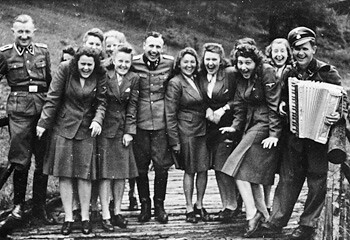
The Auckland boys’ antics remind me of the comments of another teenage boy, this one from Geelong in Victoria, who in September 2007 on the white supremacist ‘Stormfront’ forum, and upon viewing newly-discovered photographs of Nazi camp guards frolicking at Auschwitz, made a very funny joke:
Today, 05:35 AM
NoCrusties
Australian NationalistJoin Date: Nov 2006
Location: Australia
Posts: 460Re: New photos of Nazis having fun in the sun
They are celebrating the girls graduation from Jewish strangulation school?
Haha, jokes, haha!
Regards
NoCrusties.In the shadow of horror, SS guardians frolic
International Herald Tribune
September 18, 2007…The photos provide a stunning counterpoint to what up until now has been the only major source of preliberation Auschwitz photos, the so-called Auschwitz Album, a compilation of pictures taken by SS photographers in the spring of 1944 and discovered by a survivor in another camp. Those photos depict the arrival at the camp of a transport of Hungarian Jews, who at the time made up the last remaining sizable Jewish community in Europe. The Auschwitz Album, owned by Yad Vashem, the Israeli Holocaust museum, depicts the railside selection process at Birkenau, the area where trains arrived at the camp, as SS men herded new prisoners into lines.
The comparisons between the albums are both poignant and obvious, as they juxtapose the comfortable daily lives of the guards with the horrific reality within the camp, where thousands were starving and 1.1 million died…
Note that, the same boy (now 18 and a student at Gordon TAFE) was in attendance at a gathering on Saturday, September 26 at Petersham RSL in Sydney, which played host to the ‘Sydney Forum’: an opportunity for perhaps 50 or so racists, fascists and neo-Nazis — belonging to ‘New Right’, ‘Australia First’, ‘One Nation’, ‘National Anarchists’, ‘Volksfront’ and ‘Blood and Honour’ — to meet and to organise their rather ambitious plans to cleanse Australia of non-Whites.
Less than a week later, on Friday, October 1, 2009, the NSW Humanist Society played host to another neo-Nazi gathering — a meeting of ‘Klub Naziya’ (established in 2003 by local neo-Nazis Jason Rafty and Daevid Palmer) — at the Society’s property in Chippendale.
Neither the Petersham RSL’s hosting of the ‘Sydney Forum’ nor the NSW Humanist Society’s hosting of ‘Klub Naziya’ have drawn any media attention.
Lest We Forget — arf arf.

See also : F1 boss Max Mosley has sick Nazi orgy with 5 hookers (March 31, 2008).
BNP’s Griffin on BBC’s Question Time (October 22, 2009). BBC Profile | Question Time 22/10/2009 Part 1…
Analysis of a party – what the BNP list says about its members
Robert Booth, Simon Rogers and Paul Lewis
guardian.co.uk
October 20, 2009
Typical member is named David or John, has a job, lives in East Midlands and, if married to a BNP member, has a wife called either Patricia, Joanne or Karen.
BNP membership list appears on Wikileaks
Robert Booth
guardian.co.uk
October 20, 2009
List of thousands of names of BNP members, along with addresses and phone numbers, published on Wikileaks.
BNP hit by second leak of ‘members database’
Robert Booth, Helen Pidd and Paul Lewis
guardian.co.uk
October 19, 2009
The BNP is bracing itself for potentially fresh embarrassment tomorrow when details of the party’s rank and file UK membership are expected to be posted on the internet.
See also : BNP ~versus~ Sadie Graham (August 28, 2009) | BNP vs. Indymedia (December 1, 2008) | BNP Top Ten (November 27, 2008) | Moaron Nick Griffin, the BNP and the APP (November 24, 2008) | Evil paedos are secret BNP thugs!!!1!!; Uncle Adolf is Not. Happy. Nick. (November 23, 2008) | BNP : Roly Poly Fish Heads; BNP vs. 4chan; The Good Ship BNP is a Leaky Vessel (November 20, 2008).
part o n e
I’ve had my fill of bagels, and I simply couldn’t eat another piece of lemon cheesecake, so in that spirit — and in anticipation of being drowned in latkes — I bring you the following links:
Contested Terrain is a relatively new (to me) blog what is:
…a collaborative platform for analyzing and opposing contemporary antisemitism from a radical Left perspective. It provides space for the sharing of activist and academic resources, reports on contemporary news and events, and fosters the development of critical analyzes of the current situation.
Seeking a broad emancipatory perspective, attention is given to such topics as reactionary anti-capitalism, nationalism, populism, left-right overlap, anti-globalization, anti-imperialism, conspiracy theory and anti-zionism. But it will not be limited to these subjects.
The website is not a campaign for specific positions, but rather reflects the various perspectives of its contributors, and provides space for the posting of fragmented thoughts and their collaborative development.
Flat 7 is a blog by ‘Ana Australiana’ (possibly a pseudonym). The writer has clearly read far too many books than is good for them, and is animated by such hot-button topics as solidarities, fetishism, urbanism, nuns, begging, privilege, faith, reading, chickens, tomatoes and of course football, meat pies, kangaroos and Holden cars. Cars, incidentally, kill lots of animals, including kangaroos, on Australia’s roads.
Gathering Forces is another blog what I think I’ve referred to before — but, now that I search for it, actually haven’t, I don’t think — that raises some interestink questions. If anything I wrote made the slightest difference to the success of their project, I’d wish them luck. It doesn’t, so I won’t.
The Institute for Anarchist Studies has a blog, as well as a world to win, and very little time. (Or so it seems to me anyways.) Joel Olson has contributed his thoughts on ‘Between Infoshops and Insurrection U.S. Anarchism, Movement Building, and the Racial Order’, which formalises a number of discussions I’ve had on this subject with comrades in the past — all to no avail.
Poumista is a blog I’ve referred to before, but as it’s totally neat-o, I thought I may as well do so again. It draws together a phantastic array of sauces on anarchist / Marxist / socialist history, and, like any good library, infoshop or second-hand bookshop, invites you to become lost in its wares, only to realise years have passed, and you’ve wasted your life reading. (And then you die.)
Stalin’s Moustache is all about Stalin and his moustache. Rather cleverly, the writer’s obsession with the facial hair grown on the upper lip of Uncle Joe is disguised by his authorship of various blogposts, articles and even books, seemingly dedicated to exploring such notions as socialism, biblical studies, politics, theology, philosophy “and so on”, but which the discerning reader, armed with the relevant machinetranslation, will soon discover are really all about Stalin (and, moreover, his moustache).
Stalin is alleged to have remarked that ‘Everybody has a right to be stupid, but some people abuse the privilege’. ‘There’s a sucker born every minute’ is a phrase often credited to P.T. Barnum (1810–1891), an American showman. ‘Never give a sucker an even break’, said W. C. Fields.
In 1937, when the first German prisoners were assembled on the Ettersberg to cut down the beech forest, the system of the corrective labor camps, the Gulag, in other words, the great hurricane of that terrible year, was about to be unleashed on the USSR.
There have been different stages of the terror in the USSR. Certain thresholds were crossed before the terror reached its heights under Stalin. The year 1937 is undoubtedly one of those thresholds.
Shalamov’s book, which I was reading yesterday — I mean, the day before the day that I am now reconstituting through writing, that day in 1969, in London, when I suddenly found myself opposite a building where Karl Marx had once lived, which gave rise to this apparent digression — the chapter in Kolyma Tales that I was reading yesterday, and whose title was ‘How It All Began,’ deals specifically with the threshold crossed in 1937 in the historical world of the terror, in the very history of the Gulag.
‘In the whole of 1937,’ Varlam Shalamov writes, ‘two men, out of an official work force of two to three thousand, one prisoner and one free man, met their death in the Partisan mine (one of the mines in the Kolyma zone). They were buried side by side, under a tumulus. Two vague obelisks — a slightly smaller one for the prisoner — were erected over their graves … In 1938, an entire brigade worked permanently digging graves.’ For the whirlwind struck the Kolyma camps, and the whole of Soviet society, at the end of 1937. On orders from Colonel Garanin, who was eventually shot as a ‘Japanese spy,’ just as his master, Yezhov, who replaced Yagoda (also shot) as head of the NKVD, was eventually to be shot, and replaced by Beria, who, in turn … Colonel Garanin, as I was saying, unleashed over the Dalstroy, the concentration-camp zone of Kolyma, the insane whirlwind of 1937.
On orders from Colonel Garanin, the prisoners in the camps of the Great North were shot in the thousands. They were shot for ‘counter-revolutionary agitation.’ And what exactly does counterrevolutionary agitation consist of in a Gulag camp? Varlam Shalamov tells us: ‘To say aloud that the work was hard, to murmur the most innocent remark about Stalin, to remain silent when the crowd of prisoners bawled out: ‘Long live Stalin!” … shot! Silence is agitation.’ One was shot ‘for committing an outrage against a member of the guard.’ One was shot for ‘refusing to work.’ One was shot ‘for stealing metal.’ But, says, Shalamov, ‘the ultimate offense, the one for which prisoners were shot in waves, was for not meeting the norms. This crime took entire brigades into a common grave. The authorities provided the theoretical basis for this strict regime: throughout the country the five-year plan was broken down into precise figures for every factory, for every work team. At Kolyma, requirements were drawn up for each placer, each barrow, each pick. The five-year plan was law! Not to carry out the plan was a counterrevolutionary crime! Those who failed to carry out the plan were soon got rid of!’
The Plan, then, the tangible proof, it was said, of the superiority of Soviet society, the Plan that made it possible to avoid the crises and anarchy of capitalist production, the Plan, then, an almost mystical notion, responsible not only in civil society, so to speak, but also in that quite uncivil case of a despotism of unremitting labor — because it bound the worker to his place of work, whether this was a factory or a penal colony — the Plan was simultaneously the cause of a refined doubling of terror within the Gulag camps themselves. The Plan was as lethal as Colonel Garanin. In fact, you couldn’t have one without the other.
But, Shalamov tells us, ‘the eternally frozen stone and soil of the merzlota rejects corpses. The rock has to be dynamited, hacked away. Digging graves and digging for gold required the same techniques, the same tools, the same equipment, the same workers. An entire brigade would devote its days to cutting out graves, or rather ditches, where the anonymous corpses would be thrown fraternally together … The corpses were piled up, completely stripped, after their gold teeth had been broken off and recorded on the burial document. Bodies and stone, mixed together, were poured into the ditch, but the earth refused the dead, incorruptible and condemned to eternity in the perpetually frozen earth of the Great North …’
Yesterday, when I read those lines — that is, not yesterday, but the day before that spring ten years ago in London — when I read those lines yesterday, that image burned itself into my eyes: the image of those thousands of stripped corpses, intact, trapped in the ice of eternity in the mass graves of the Great North. Graves that were the construction sites of the new man, let us not forget!
In Moscow, at the Mausoleum at Red Square, incredible, credulous crowds continue to file past the incorruptible corpse of Lenin. I even visited the mausoleum myself once, in 1958. At that time, Stalin’s mummy kept Vladimir Ilyich company. Two years before, during a secret session of the Twentieth Congress of the Soviet Party, Nikita Sergeevich Khrushchev set fire to the idol, which, like all his peers, he had worshipped and venerated. And in 1960, in Bucharest, Khrushchev suggested to Peng Chen that Stalin’s bloody mummy be taken to China. It was finally removed from the mausoleum after the Twenty-second Congress of the Soviet Party. But in the summer of 1958, Stalin was still in his red marble tomb beside Lenin. I can testify to that. I saw them both. At peace, intact, incorruptible: all they lacked was the power of speech. But, fortunately, they did not have the power of speech. They just lay there, the two of them, silent, lit up like fish in an aquarium, protected by members of the Guards, standing motionless like bronze statues.
Ten years later, in London, after reading that passage in Varlam Shalamov’s book, I remembered the tomb in Red Square. It occurred to me that the true mausoleum of the revolution was to be found in the Great North, in Kolyma. Galleries might be dug through the charnel houses — the construction sites — of socialism. People would file past the thousands of naked, incorruptible corpses of prisoners frozen in the ice of eternal death. There would be no guards; those dead would not need guards. There would be no music, either, no solemn funeral marches playing in the background. There would be nothing but silence. At the end of the labyrinth of galleries, in a subterranean amphitheater dug out of the ice of a common ditch, surrounded on all sides by the blind gazes of the victims, learned meetings might be organized to discuss the consequences of the ‘Stalinist deviation,’ with a representative sprinkling of distinguished Western Marxists in attendance.
And yet the Russian camps are not Marxist, in the sense that the German camps were Nazi. There is a historical immediacy, a total transparency between Nazi theory and its repressive practice. Indeed, Hitler seized power through ideological mobilization of the masses and thanks to universal suffrage, in the name of a theory about which no one could be in any doubt. He himself put his ideas into practice, reconstructing German reality in accordance with them. The situation of Karl Marx, vis-à-vis the history of the twentieth century, even that made in his name, is radically different. That is obvious enough. In fact, a large segment of the opponents of the Bolsheviks, at the time of the October Revolution, claimed allegiance to Marx no less than did the Bolsheviks themselves: it was in the name of Marxism that not only the Mensheviks, but also the theoreticians of the German ultra-left criticized the authoritarianism and terror, the ideological monolithism and social inequality that spread over the USSR after the October victory.
The Russian camps are not, therefore, in an immediate, unequivocal way, Marxist camps. Nor are they simply Stalinist. They are Bolshevik camps. The Gulag is the direct, unequivocal product of Bolshevism.
However, one can go on a little further and locate in Marxist theory the crack through which the barbaric excesses of Correct Thought — which produces the corrective-labor camps — were to flood, the madness of the One, the lethal, frozen dialectic of the Great Helmsmen.
On March 5, 1852, Karl Marx wrote to Joseph Weydemeyer, who published in New York Die Revolution, a periodical of uncertain frequency, because of financial difficulties, like most of the socialist journals of the time. It was for Weydemeyer’s journal that Marx was finishing, in those rainy days at the end of the London winter, his articles on the Eighteenth Brumaire, which were to appear in an issue of Die Revolution under the title slightly altered by Weydemeyer — Der 18te Brumaire des Louis Napoleon, instead of Bonaparte — published at the Deutsche Vereins-Buchhandlung von Schmidt und Helmich, at 191 William Street.
So, on that March day in 1852, Karl Marx was writing to Weydemeyer. Two days before, he had received five pounds sent him by Frederick Engels, from Manchester. The Marx family must have eaten more or less their fill that week, after paying off their most pressing debts to the grocer and doctor. Now Karl Marx glanced out of the window of his flat. He looked absent-mindedly over at the narrow doorway of the building across the street. He saw nothing of particular interest. Indeed, there wasn’t anything of particular interest at that time: the film company had not yet moved in. He went down to sit at his desk. In his almost indecipherable writing, he wrote the date at the top right-hand corner of the sheet of paper. Under the date, he added his address, 28 Dean Street, Soho, London.
It was in this letter to Joseph Weydemeyer that Marx explained his own contribution to the theory of classes and of the class struggle. After admitting that bourgeois historians had already described the historical development of this class struggle, and bourgeois economists the economic anatomy of classes, Marx went on to explain what was new in his contribution: was ich neu tat. ‘What I did that was new was to prove: 1) that the existence of classes is only bound up with particular historical phases in the development of production, 2) that the class struggle necessarily leads to the dictatorship of the proletariat, 3) that this dictatorship itself only constitutes the transition to the abolition of all classes and to a classless society.’
This is an extremely well-known passage, one that has been interpreted this way and that, which generations of learned commentators have dissected, which brilliant polemicists have thrown in one another’s faces for over a century. And yet one can still come back to it. It still provides matter for reflection. One can still find something new in it: etwas Neues.
What, then, is the contribution that Marx declares he has made in this theory, at the concrete level of history and of the class struggles that make history? It is to have shown (or demonstrated: Marx uses the verb nachweisen, which may be interpreted in both senses; but in both senses it is used wrongly by Marx, who never showed or demonstrated what he advanced, as we shall see) a certain number of points.
Let us leave to one side the first, that concerning the historicity of the very existence of classes. This question belongs to a philosophy of history with which I am not concerned for the moment. The idea that mankind, in order to pass from a classless society, to that of primitive Communism, to another society of the same kind, but in a developed form, swimming in the butter of abundance, is destined to go through a long historical purgatory of ruthless, indecisive class struggles — always producing, moreover, real effects different from those that Marxist theoreticians, beginning in this case with Marx himself, had foreseen — such an idea leaves me completely cold. It no longer excites anybody, the idea that there was once, and that therefore there will be again, in the depths of history, ideal idyllic societies, communities without states. I am well aware that to set this idea, expressed concisely enough in Marx’s first point, to one side is somewhat arbitrary. I am well aware that the sub-Hegelian philosophy of history that underlies the idea contained in Marx’s first point also underlies the other two points. But one may, nevertheless, for purely methodological reasons, exclude this first point from our present analysis, temporarily bracket it out.
Whatever one may think, therefore, of the question of the historicity, of the relativity of classes, it is easy to see that the next two points listed by Marx do not belong to historical science — if science it be — but to prediction. Or even to prophetic teaching. That the class struggle should necessarily lead to the dictatorship of the proletariat is no more than a hypothesis, perhaps a pious wish. But neither the hypothesis nor the pious wish has been verified or fulfilled anywhere by real history. The dictatorship of the proletariat, in the Marxist sense, has never existed anywhere. A century after Marx’s letter to Weydemeyer, it still hasn’t come about.
At this point, of course, I can hear the indignant cries from the distinguished Marxists at the back of the hall. (There are only two or three fools in the whole world who haven’t realized that when one writes, one always puts oneself on public display, whether one likes it or not. And if one is putting oneself on public display, one can imagine the hall in which it takes place.)
The Marxists all squawk at once.
‘What about the Paris Commune?’ someone yells out. I was waiting for that one. In a tone suggesting that nothing more is to be said on that matter, someone quotes Frederick Engels: ‘Well, gentlemen, do you want to know what a dictatorship is like? Look at the Paris Commune. That was the dictatorship of the proletariat.’ Well, gentlemen, look at the Paris Commune, but look at it carefully. You will see some very fascinating, very instructive things, but you will never see the dictatorship of the proletariat. Forget Engels and the high-flown words with which, twenty years after the events, he ends his introduction to Marx’s The Class Struggles in France, forget Engels’s literary fabulations, come back to the harsh truths of history, and you will not find the dictatorship of the proletariat. Read the writings of the period, beginning, of course, with the contemporary accounts of the sessions of the Commune itself, and you will see that the attempted coup of the Paris Communards, at once grandiose and pitiful, heroic and petty, seeped in a just vision of society and shot through with the most confused ideologies, has got nothing to do with the dictatorship of the proletariat.
But I am not allowed to continue my demonstration (Nachweisung, Marx would say: yet I have the advantage over him of speaking with my back to history, of trying to explain it; I have no need to fantasize, and can therefore demonstrate, or show, what history has demonstrated). I am interrupted: voices rise up on all sides.
Very well, I shall continue at another time, perhaps in another place. But above the din of Marxist voices, I shall say just a few words, even if I have to raise my voice, on Marx’s third point, namely, that the dictatorship of the proletariat is a mere transition — a state that would be already an antistate — toward a classless society, toward the suppression of all classes.
Here, too, we are confronted with a mere postulate: a petitio principii. Real history has demonstrated — nachgewiesen — quite the contrary. It has shown the continual, implacable reinforcement of the state, the brutal exacerbation of the struggle between the classes, which not only have not been suppressed, but, on the contrary, have crystallized still further in their polarization. Beside the veritable civil war unleashed against the peasantry in the USSR in the early 1930’s, the class struggles in the West are gala dinners. Compared with the stratification of social privileges in the USSR — functional privileges, certainly, bound up with the status and not, or not necessarily, with the individual — real social inequality, that is to say, relative to the national product and to its distribution, is in the West nothing but a fairy tale.
In brief, what Marx claims is new in his contribution to the theory of classes and of the struggle between them has nothing theoretical about it, nothing that throws light on reality and enables one to act on it. It is no more than prediction, wishful thinking, an expression that must have been used quite often at 28 Dean Street.
And it is here, on this precise point of the Marxist theory of the dictatorship of the proletariat as an inevitable transition towards [a] classless society, that the lethal madness of Bolshevism took root and nourished the terror. It was in accordance with these few points dryly listed by Marx one day in 1852 — listed, moreover, as if they were self-evident — that all the Great Helmsmen have begun to think — and, worse still, to dream at night — as if inside the heads of the proletarians. It was in the name of this historic mission of the proletariat that they have been crushed, deported, dispersed, through labor — free or forced, but always corrective — millions of proletarians.
An idea underlies these points — these theoretical novelties — which Marx pedantically enumerates: the idea of the existence of a universal class that will be the dissolution of all classes; a class that cannot be emancipated without emancipati[ng] itself from all other classes of society and without, consequently, emancipating them all. One might have recognized the trembling voice of the young Marx announcing, in 1843, in an essay that he wrote, not on Dean Street, but on the Rue Vaneau in Paris, ‘Contribution to the Critique of Hegel’s Philosophy of Right: Introduction’; the epiphany of the proletariat. But this universal class does not exist. The lesson of the hundred years that separate us from Marx is, if nothing else, that the modern proletariat is not this class. To continue to maintain this theoretical fiction has enormous practical consequences, for it paves the way for the parties of the proletariat, the leaders of the proletariat, the corrective labor camps of the proletariat: that is to say, it paves the way for those who, in the silence of the gagged proletariat, speak in its name, in the name of its supposed universal mission, and speak loud and clear (to say the least!).
So the first task of the new revolutionary party that would not speak in the name of the proletariat, but would regard itself only as a temporary structure, constantly disintegrating and being reconstructed, as a focus of receptivity and awareness which would give organic weight, material strength, to the voice of the proletariat — its first task would be that of re-establishing the theoretical truth, with all the consequences that this involves, about the nonexistence of a universal class.
But this blind spot in Marx’s theory, through which it is linked to the aberrational realities of the twentieth century, is also its blinding spot: the focal point at which the entire grandiose illusion of the revolution shines. Without this false notion of a universal class, Marxism would not have become the material force that it has been, that it still partly is, profoundly transforming the world, if only to make it even more intolerable. Without this blinding, we would not have become Marxists. We would not have become Marxists simply to demonstrate the mechanisms of the production of surplus value, or to reveal the fetishisms of mercantile society, an area in which Marxism is irreplaceable. We would have become teachers. It was the deep-seated madness of Marxism, conceived as a theory for universal revolutionary practice, that gave meaning to our lives. To mine, in any case. As a result, there is no longer any meaning in my life. I live without meaning.
But this is no doubt normal enough. In any case, isn’t it dialectical?
~ Jorge Semprun, What A Beautiful Sunday!, Translated from the French by Alan Sheridan, Abacus, London, 1984. Originally published in French under the title Quel beau dimanche! in 1980 by Editions Grasset et Fasquelle.
So there you have it. Enjoy, or ignore. In the end, it makes no difference either way. You’ll still end up dead.
part t w o
26 years for man found guilty of Madrid metro murder
Typically Spanish
October 19, 2009
The court considered ideological hate motivated the killing of a young anti-fascist protestor
The soldier on trial for the murder of a young anti-fascist demonstrator at a Madrid metro station two years ago will spend the next 26 years in prison: 19 years for the fatal stabbing of 16 year old Carlos Palomino and another 7 years for the attempted murder of the teenager’s friend who came to his aid.
While the accused, Josué Estébanez, denied that he was a neo-Nazi during his trial, the provincial court in Madrid considered, as the prosecutor had argued in the case, that ideological hate was behind his motives for the stabbing, giving him a lengthier sentence for the murder.
Carlos Palomino died on 11th November 2007 when the train was stationed at Madrid’s Legazpi station. He was travelling with others to protest at a far right demonstration in Usera when he was stabbed, and there were reports that his killer gave a Nazi salute when he inflicted the fatal wound. The accused claimed when he was questioned in court that he was acting out of instinct and fear for his life when he saw himself surrounded, describing himself as just a patriot who likes to see the Spanish team win at football.
However, witnesses to what happened gave evidence in court that they saw him with his knife already prepared for use when they entered the stationary train at Legazpi. In addition to the lengthy prison term, he must now pay the victim’s family 100,000 € compensation.
See also : Condenan a Josué Estébanez de la Hija a 26 años de cárcel, lahaine.org, October 19, 2009 (y Sección especial en La Haine sobre el juicio contra el asesino de Carlos: Ni olvido ni perdón).

Amadeu Casellas is a Spanish prisoner who has spent more than 25 years in jail as a result of his participation in dozens of bank robberies in the late 1970s, money which was then used to fund worker’s struggles. Unlike Estébanez — who has been sentenced to 26 years for murder and attempted murder — none of Amadeu’s expropriations involved bloodshed. Throughout his life, Amadeu has been a committed and active person, participating in many actions: in the streets, as well as in the prisons.
In 1973, when he was a 14-year-old factory worker, Amadeu discovered anarchism. He believed in the armed struggle, and the necessity and desirability of social revolution. In 1976, he robbed the Banco Mercantil de Manresa. During the next two-and-a-half years, he robbed more than 50 other banks. In 1979, he entered prison (where he was ‘welcomed’ with a severe beating).
During his imprisonment, Amadeu has undertaken many hunger strikes, as well as engaged in other forms of protest, and worked tirelessly against injustice: concerning prices inside prison; against the irregularities in and super-exploitation of prison labour; in opposition to grossly sub-standard medical treatments and the issuing of falsified reports on prison conditions. Such activities have resulted in his being severely punished, and classified as a ‘Grade One’ prisoner — to be placed in isolation — and he has been systematically transferred from one prison to another: punishments intended to break his spirit. Despite this, he has continued to report abuses of prisoners’ rights, and to document and to expose brutalities inside of and forming a fundamental part of the Spanish prison system.
Last year (2008), after undertaking a 76-day hunger strike, Amadeu won a seeming victory against prison authorities, gaining the right to be re-classified as a ‘Grade Three’ prisoner (thus making possible weekend release, the procurement of work outside of prison and, thus, some more genuine ‘rest’ and productive labour) and thereby hastening his release.
Sadly, his ‘victory’ has been ignored by prison authorities.
On July 15, 2009, Amadeu once again went on a hunger strike, which has now (October 20) lasted almost 100 (97) days. This latest hunger strike was prompted by additional punishments he was subjected to after having written various communiqués in which he detailed — using actual names — some facts relating to the people in charge of the Catalonian prison system.
Since July 2008, Amadeu has spent more then 200 days on hunger strike.
Since September 25, Amadeu has been force-fed. His family and lawyers find it extremely difficult to talk to him. Many “prison workers” and jail unions have tried to sanction his lawyers. He is also being kept in isolation: when Amadeu wants to smoke, all other inmates in the penitentiary wing of the Terrassa Hospital are forced to return to their rooms (/cells).
As well as the hunger strike, Amadeu has recently felt forced to go on a ‘thirst’ strike — this so as to be able to receive visits from his family and lawyers. This (first) thirst strike has been successful. From October 4, he has, however, commenced another, as prison authorities are again trying to transfer him to another prison (on the basis that “his health has improved”).
Actions and demonstrations in support of Amadeu have taken place, in Spain as well as in other countries, and a call for decentralized actions has been made, at least until such time as his status as a ‘Grade Three’ prisoner is recognised, and he is no longer on hunger strike. It should be noted that Amadeu’s position depends solely on the decisions of the Catalonian prison and political system (not that of Spain’s).
See : Amadeu Casellas : 95 días en huelga de hambre, rojo y negro, October 17, 2009 | Amadeu Casellas: llibertat!.
This video comes to me by way of Anti-German Translation by way of Fires Never Extinguished (Phoenix Class War Council) by way of the Institute of Anarchist Studies by way of Buddhagem at Bluestocking Books in New York City on Tuesday September 22, 2009.
Uri got blog here.
Kick arse!
From the Department of Talking With The Taxman About Poetry:
A dose of libertarianism would enhance our democracy
Tony Moore
The Australian
October 5, 2009
Social democracy
In theory (according to Tony): “Social democracy ensures collective intervention in the marketplace to enhance structural equality and advance the full development of our potential as human beings”. In practice, social democracy is as social democracy does.
Libertarianism
As for ‘libertarianism’, while its contemporary adherents may well “cultivate a sceptical attitude” to the state, its roots are in anarchism, and the amplification of that bad attit00d into a political philosophy seeking the overthrow or dismantling of ‘the state’.
On the origins of the term ‘libertarian’, see ‘150 years of Libertarian’, Anarchist Writers, December 11, 2008. On the origins of ‘social democracy’, see, ‘Radicals, Exiles and Socialist Beginnings’, Chapter 1, The Slow Burning Fuse: The lost history of the British Anarchists, John Quail (Paladin Books, London, 1978):
…One measure of the differences between the [Manhood Suffrage League, est.1875] and its predecessor [Democratic and Trades Alliance Association, est. 1874], however, lies in the more positive attitude to the Paris Commune which caused the League to come into being. Fairly advanced Radicals like Bradlaugh, for example, baulked at the ‘unconstitutional’ nature of the Commune. He was reported as saying in a speech that ‘The Commune asked for the recognition and consolidation of the Republic. But he denied their right to do it by force of arms ( … ).’ Radicals might be sickened at the slaughter – some 30,000 people were massacred when the Commune was crushed – but for them the Commune was not a heroic beginning of a new world. The Manhood Suffrage League thought differently. Kitz writes: ‘Freed from obstruction and opposition, we cordially cooperated with our foreign comrades in holding an international meeting at the Cleveland Hall to celebrate the Commune. It was a most enthusiastic demonstration and marked the beginning of the revival’ [i.e. of socialism]. A large number of English working men attended. But whether because of the incomplete commitment to revolution of the League or the pressure of new ventures, by 1877 Kitz was no longer secretary of the Manhood Suffrage League. He mentions no particular break in his memoirs, so it is likely that he retained a connection with it that gradually atrophied over the years. Certainly by 1877 Kitz was working for the formation of a specifically socialist, revolutionary and internationalist movement in London. The international element was important. As he says ‘the socialist movement in England owes its origins largely to the propagandist zeal of foreign workmen’. More specifically, they were German exiles. Kitz spoke fluent German and was in close contact with them. The Social Democratic Party was growing in Germany and was an increasingly influential example internationally. It should not be assumed, however, that ‘social democracy’ meant then what it means now. Kitz was committed to revolutionary rather than electoral action and by his use of the phrase he clearly meant a revolutionary democratic socialism. The distinction was between a total social democracy and a partial political democracy. At that time ‘social democracy’ was not reducible to parliamentary reformism.
See also : The Radical Tradition: A Study in Modern Revolutionary Thought, Richard Gombin (1979). On The Paris Commune, see : ‘Peter Kropotkin and People’s Uprisings: From the Paris Commune to Gwangju’, George Katsiaficas, 2002 (PDF).
Orstralian social democracy
In Australia in 2009, however, ‘social democracy’ — despite various rhetorical flourishes (see, for example, From wise counsel good works shall come, Greg Combet, Arena Magazine, December 2002) — is largely reducible to parliamentary reformism. Moore imagines a happy marriage between ‘social democracy’ and ‘libertarianism’ which: “[t]aken together… can promote alter[n]ative ways for us [to] re-imagine the old Westminster public service as a democratic commons more accountable to grassroots communities”. Sadly, “[m]any Australians, especially in traditional Labor areas, have lost faith in the capacity of government to deliver even the most basic services, and restoring faith in the public is a key challenge for the Left”.
At which point, I hope I’m excused my impertinence, but I feel compelled to add:
In any case, according to Moore: “Wariness of the state has deep roots in the Western and Australian Left, though it has found less fertile ground in the ALP”.
Which — when you think about it, as I and others are cursed to do — kinda makes sense, especially given that the ALP is a political party whose explicit aim is to form governments.
As for the former, I’m unconvinced: ‘anti-statist’ perspectives certainly have roots in the ‘Western Left’, but on my reading, the Australian Left has, as a whole, taken a contrary view. Thus, while William Morris may have been “appalled by the Marxist and Fabian obsession with the state as the agent of reform or revolution” (and critical of the Webbs in particular), and while the IWW may have “advocated a syndicalist socialism based on unionism”[?], their hopes and aspirations were crushed by labourism on the one hand and Bolshevism/Communism on the other.
As for the rest of Moore’s account — which proceeds by way of the Sydney intellectual Left / the Push / the Libertarian Society / John Anderson; the sexual and cultural revolution; the critique of managerialism; state reformation under Whitlam (with BONUS! free education — dismantled under Dawkins) / and again under Hawke/Keating / privatisation/corporatisation of state services — it terminates in an appeal to the young.
Of sorts.
Thus “we on the Left” should make the state nicer: accountable, democratic, decentralised, open to “citizen participation”. By the same token, the ALP should be nicer too. In this respect, Moore notes that the “ALP does have a counter-tradition. Many of its founding generation were practical in the face of business indifference to their needs, and set up mutual building societies so they could borrow for a home, or co-operatives for the provision of food.”
Conclusion
Such social service institutions were controlled by members living locally rather than unseen bureaucrats or arrogant ministers in far-flung capitals. Just as Labor has come to appreciate the value of markets to economic prosperity, so too can it enlarge its concept of the commons beyond the old colonial idea of the crown, ministers and public service. Whereas government services such as schools and police in the US and Britain are often accountable to local communities through direct or municipal elections, in Australia the crown dispatched its officers from the centre to administer a people who could not be trusted. Here a shift to a republic becomes important as a means of enhancing democratic accountability and citizenship.
The Rudd government should build on the governance work of Carmen Lawrence and John Faulkner and accompany the campaign for a republic with democratic reforms to the operation of parliaments and quangos. Perhaps we should consider the election of public boards and significant local officials. At the very least the Left should debate alternatives to the bureaucratic state that would enhance our say over services that affect our lives.
The Left protests when ministers and officials favour business mates or cruelly lock up refugees, but many of us have a vested interest in the status quo. As compensation for its authoritarian streak, the state has become a generous benefactor to progressives, either employing us to manage its utilities and programs for the marginalised, or making everyone from artists to community groups and scholars jump through hoops of red tape in a scramble for the next grant. But the state is more tar baby than magic pudding, leaving a residue of compromise and passivity on those too dependent on its patronage.
Hmmm. Sounds a bit like ‘libertarian municipalism’ (see : Libertarian Municipalism: An Overview, Murray Bookchin, April 3, 1991). As with Bookchin’s brainchild, there’s a few problems with Moore’s approach.
Can you spot them all?
See also : Democratic Audit of Australia | The Museum of Australian Democracy | The Australian Centre For Fraternalism, Secret Societies and Mateship | The Life and Death of Democracy, John Keane, 2009 | The Society of the Different: Part 1: The Center of the World, Interview with Gustavo Esteva (September 6/7, 2005), In Motion Magazine. On forms of “syndicalist socialism based on unionism” (and anarchism), see : Still fanning the flames: An interview with Michael Schmidt and Lucien van der Walt (by kate), Revolution by the Book, October 15, 2009.
Sorry to bother you,
Citizen taxman! Continue reading
After a series of defeats, the Socialist Alliance have won their first match!
Victory for Sam by 100 votes
Sam for Hilton
October 18, 2009Sam Wainwright won 438 votes (33.44%) – over 100 more votes than Sam’s nearest competitor and enough to put him over the line for the Hilton Ward of Fremantle Council.
Official election results are [below].
At a victory celebration last night, Sam told supporters that this victory was for the whole Socialist Alliance and the diverse supporters of his campaign. He was proud that this campaign had been successful while being fully open about his socialist, environmentalist and unionist convictions.
Sam is the first Socialist Alliance member to be elected to a local government position in Australia.
Sam joins Steve Jolly as being one of two openly ‘socialist’ local council members in the country.
Results
HUME, Dave : 337 : 25.73% [ALP]
SMITH, Bob : 160 : 12.21%
ACOCELLA, Frank : 183 : 13.97%
MOENS, Gabriel Adelin : 192 : 14.66%
WAINWRIGHT, Sam : 438 : 33.44%
The New Green: Inside activist bootcamp
Brigid Delaney
ninemsn.com
October 19, 2009
…This cellular approach is similar to the manner in which terrorist cells such as Al Queda [sic] organise. Writer John Arquilla looked at the structure in his book Networks and Netwars: The Future of Terror, Crime and Militancy [2001]. He wrote “with many groups actually being leaderless — they are quick in coming together in swarming attacks.”…
The use of a ‘cell structure’ by social movements dates back to (at least) the late 1800s — which, I’m pretty sure, pre-dates the Saudi Arabian billionaire’s embrace of terrorism by some years, if not decades; Arquilla wrote his book — actually, co-wrote the book with David Ronfeldt — on behalf of the RAND Corporation — a cuddly institution established by peaceniks belonging to the USAF in 1948. (See also : Computer-Linked Social Movements and the Global Threat to Capitalism, Harry Cleaver, 1999.) It is thus considered one of the grand-daddys of the think-tanks that have proliferated since then, and which form part of the ideological core of the contemporary military-industrial-entertainment complex.
…At the G20 rally in Pittsburgh, protesters revealed police locations on Twitter, while at the UK Climate Camp, police set up their own Twitter page to outwit the protesters. The day of the protest I watched the action via Twitter from 40 kilometres away in Sydney…
Re: G20. For this crime two anarchists from New Yawk are being charged with ‘terrorist’ offences.
RRTAA!
The Refugee Review Tribunal has been subjected to various forms of criticism over the years, despite the fact that the law-talking guys appointed to it have provided correct and preferable decisions for visa applicants and sponsors through independent, fair, just, economical, informal and quick merits reviews of migration and refugee decisions.
One correct and preferable decision by the law-talking guys (and girls, and technocrats) — made by way of an independent, fair, just, economical, informal and quick process — occurred in 1999, when two men from Bangladesh were denied refugee status, claimed on the basis of their supposed homosexuality.
But are they really?
Quick-thinking on the part of the Tribunal suggests not, when one of the pair refused to answer the fair and just question: ‘what brand of personal lubricant do you use when having sex with your partner?’
Judge blasts ‘biased’ refugee tribunal, Michael Pelly, The Australian, September 28, 2009.
Note that Bangladesh is also a great place for journalists — provided, of course, that they are “discreet about such matters” as human rights abuses by the Bangladeshi military (see : Bangladeshi anarchist, human rights activist and journalist, Tasneem Khalil: arrested and released, May 12, 2007). By the same token, Bangladesh is also a great place for workers — provided, of course, that they are “discreet about such matters” as wages and conditions, exploitation and oppression, liberation and revolution.
See also : White Power! (October 16, 2009) | Closing concentration camps makes GSL cry (July 30, 2008) | Kevin Andrews : Tool of the Week (June 2, 2008) | Boundless plains to share… (May 8, 2008) | Refugees join indigenous peoples on Lifestyles of the Rich & Famous (March 22, 2008) | Australian Citizenship Test (October 13, 2007) | They’re killing us all // To make the world safe (December 21, 2006) | One down, 1,011 to go! (July 10, 2004).