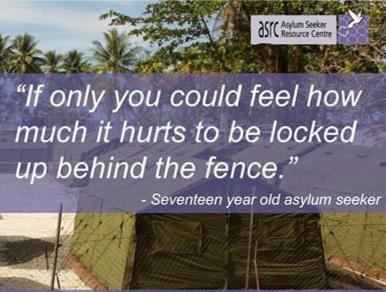
#HESTAdivest campaign : HESTA divest from #Transfield + #ManusIsland concentration camp

hestadivest

HESTA — the industry super fund for health and community service workers — is a major shareholder in Transfield.

You may remember Transfield from such campaigns as Boycott the Biennale of Sydney.

Then and now, Transfield makes money from running Manus Island, the prison camp for asylum seekers.

For further details, please see : #HESTA, divest from Transfield & the detention industry | #Manus #Nauru, Operational Matters, January 23, 2015.

Many healthcare workers are unaware that their super funds are being invested in the illness factory that is Manus Island prison camp. Consequently, there is a campaign to raise awareness of this fact and to demand HESTA divests from Transfield.

Australian unions with representation on the HESTA board include the Australian Nursing and Midwifery Federation (ANMF), Australian Services Union (ASU), Health Services Union (HSU) and United Voice.

The Australian Council of Trade Unions (ACTU) is also on the HESTA board.

The ASU made some noise about the issue back in March 2014 — it appears to have had little effect, with HESTA increasing its shares in Transfield late last year; HESTA is at present listed as owning 26,375,345 shares in Transfield Services.

The campaign has a Facebook page here.

Enough sick jokes.

manusisland

Posted in Anti-fascism, Broken Windows, Death, State / Politics, That's Capitalism! | Tagged , , , , , , , , , | Leave a comment

After the Paris killings (Le Monde Diplomatique) #CharlieHebdo

After the Paris killings
Le Monde Diplomatique
February 2015

1)

The guys from the ghetto
Laurent Bonelli

Once people are over the shock of the killings, once the feelings of indignation and powerlessness have dissipated and the only people still hurting are the victims’ immediate circle, the question remains — how, in a time of peace, can young Frenchmen have carried out such violent acts, choosing targets for their opinions, presumed religion or uniform? From the murders by Mohamed Merah in 2012 and the attack by Mehdi Nemmouche on the Jewish museum in Brussels last May, to the killings this January by Said and Cherif Kouachi, and Amedy Coulibaly, 28 people have been shot dead.

The sketchy information the press has gleaned about the killers gives some idea of lives in which social services and the juvenile justice system intervened early on, when family environments were judged inappropriate or inadequate; most spent time in hostels and foster families. Their education was of a pattern common among the least skilled of the working class: they gravitated towards technical courses (CAP, BEP, vocational baccalaureate) — which they did not always complete — though the general baccalaureate is now recognised as a minimum qualification.

To compensate for this educational relegation, some joined street gangs and got involved in their petty disorder. Stealing cars or scooters, driving without a licence, physical assault, verbal abuse, burglary and robbery with violence drew the attention of the police and courts, and Merah, Coulibaly and Nemmouche all went to prison for the first time when they were 19. Fresh offences after release led to the revocation of suspended sentences and longer prison terms; they spent a good part of their twenties in jail. The Kouachi brothers, who grew up in a village in the department of Corrèze, seem to have come only later to delinquency (receiving stolen goods or selling drugs, combined with precarious or black-market employment), when they moved to the Paris area in the early 2000s. Cherif went to prison in 2005-06 at the age of 23 for his involvement in an organisation sending volunteers to fight in Iraq.

All five espoused a vision of an Islam of heroic warriors (mujahideen), grand exploits and distant theatres of war. Some travelled to Syria, Pakistan, Afghanistan or Yemen. Propaganda, preaching and initiation camps gave them a relatively simple worldview that made a coherent whole of their own experience of subjugation and that of other peoples (in Mali, Chechnya, Palestine), and a civilisational narrative blaming Jews and unbelievers for these ills. This idea of religion was attractive because it both made them aware of their situation and offered liberation from it, giving their lives a “higher” purpose.

Not unusual

The similarity of the killers’ lives has already prompted experts to try to classify their actions as “lumpen-terrorism” and “gangster-terrorism”. But the characteristics of those lives do not seem unusual, corresponding to those of the “suburban ghetto generation” to which the killers belong (they were all born in the 1980s), marked by exclusion, harder access to unskilled jobs, spatial segregation and police checks, social relations limited to their own ethnic group and diminishing interest in the political commitments of their elders.

What surprises is not so much the decision to commit such acts of violence as its rarity. “If radicalisation is a process,” write political sociologist Annie Collovald and political scientist Brigitte Gaïti, “we must trace it before we can explain it. That means moving away from why and asking how” (1). The exhortations of jihadist leaders to strike at France, the West or the Jewish community may have inspired those aspiring to rebellion, but did not trigger their actions. Sociologist Howard S Becker points out that the final decision to act is the last in a long series of decisions, none of which, in isolation, seem strange (2). Like historian Christopher Browning, who shows by what mechanisms (group conformity, depersonalisation of victims) the “ordinary men” of Germany’s 101st reserve police battalion were transformed into cold-blooded killers between July 1942 and November 1943 (3), we need to reconstruct the experiences particular to the lives of those who carried out the attacks and to the world they live in.

The attacks used skills these individuals had already learned: how to steal a car or procure, handle and use firearms is transferable knowledge. The method also reflected habits formed when they were mere delinquents: the reconnoitring was rough, the getaway plans only covered getting home, and when that was not possible, they wandered aimlessly. The only real requirements seemed to be the composure necessary to attack and the ability to drive fast. Even seeking a martyr’s death by firing at police was like the fate of Scarface in the Brian de Palma film, an idol of young ghetto-dwellers; or that of armed robber Jacques Mesrine, whose biography Merah was reading a few weeks before his death. Understanding the familiarity of these modes of action and their legitimacy in the eyes of those who use them is a major step towards understanding how they can be transferred to other targets, though it is not enough. Coulibaly’s desire to “get the police”, while the Kouachi brothers were attacking Charlie Hebdo, relates to his hatred for the organisation that killed his best friend, Ali Rezgui, in front of him in 2000, when the two men were loading a van with stolen motorbikes.

This political violence can be traced back to the Algerian civil war. The conflict triggered in 1991 by the cancellation of a general election in which the Islamic Salvation Front (FIS) had won the first round was extremely violent. By the early 2000s, clashes between the army and the Armed Islamic Group (GIA) had killed tens of thousands and led to mass displacement. The war also affected Algerian families living in France, to which Merah, Nemmouche and the Kouachi brothers belonged. Abdelghani Merah, Mohammed’s elder brother, has written a book in which he describes holidays at Oued Bezzaz where their father’s family, who supported the GIA, showed off firearms and sometimes “a gendarme or a civilian with his head cut off”. He also describes pressure from an uncle in Toulouse for his sisters to “leave school, put on the Islamic veil and stay at home” (4). In France, religious injunctions can be at once a way of bringing children who are too liberated (in where they go, their choice of friends or the way they dress) back into line, and an expression of political support for armed groups, such as that of Djamel Beghal, whom Cherif Kouachi and Coulibaly met at the Fleury-Mérogis remand centre in 2005; he is said to have been their mentor. Born in 1965, Beghal was a member of the GIA’s support network in France, and was arrested for this in 1994. With Coulibaly and Cherif Kouachi, he was one of 14 suspected of having planned the failed prison escape in 2010 of Smain Ait Ali Belkacem, a munitions expert behind the 1995 Paris metro bombing. While in prison, Kouachi also met Farid Melouk, serving a sentence for providing logistical support to that attack.

To the lands of jihad

These meetings link the different generations of Islamic political militants, and make their choices part of a longer history of feats of arms, defeats and changes of direction (5). In 1995 the GIA hoped for military and political victory in Algeria. The bombing of public transport in Paris was intended to force the French government to reduce its support for the military regime. A few years later, the situation had changed. The GIA was defeated and the Salafist Group for Preaching and Combat, founded in 1998, was weakening under the onslaught of the Algerian army — a political and territorial decline that explains its decision to merge with Al-Qaida in 2007, under the name Al-Qaida in the Islamic Maghreb, and to change its strategy. It now focuses on operations in the Sahara, and Mali or Niger, such as the abduction of westerners. For militants living in France or other European countries, the cause has survived but takes a different route, with a shift to (or sometimes departure for) the “lands of jihad” or a switch to the “propaganda of the deed”.

The anarchists at the London conference of 1881 took this approach. The principle was simple: insurrectional acts (bombings, assassinations, sabotage, robbery) “are the most effective form of propaganda, and the only one capable of … penetrating the deepest layers of society” (6). It was used in Europe, the US and Russia to target government figures, police, judges, religious, political opponents and anonymous “bourgeois”. It aimed to punish those responsible (for judgments, torture) and to avenge fallen comrades or destroy symbols so as to awaken the masses. Some 130 years before Inspire, the magazine published by Al-Qaida in the Arabian Peninsula, called for the death of Stéphane “Charb” Charbonnier, La Révolution sociale, La Lutte and Le Drapeau Noir published columns dedicated to bomb-making. In 1884 Le Droit Social launched an appeal for funds “for the purchase of a revolver to avenge the death of comrade Louis Chaves”, killed by French gendarmes.

Propaganda of the deed did not rouse the masses. Some acts were perceived favourably but failed to mobilise, and even distanced the working class from anarchist movements at a time when these were mercilessly repressed. The approach was abandoned in the early 20th century in favour of more collective action. It was later used with a similar lack of success by far-left movements (Action Directe in France, Red Army Faction in Germany, Red Brigades in Italy), and by supporters of the far right (Organisation Armée Secrète in France, Timothy McVeigh, the Oklahoma City bomber in the US in 1995, and Anders Behring Breivik, responsible for the Utøya massacre in Norway in 2011).

The attacks in France confirm the pattern. Despite Coulibaly’s exhortations in a posthumous video (“What do you do when they continue to insult the Prophet? What do you do when you see your brothers and your sisters starving?”), his “Muslim brothers” have overwhelmingly rejected his acts; subsequent attacks on mosques and physical assaults have made them collateral victims.

Not a war

Politicians forget the lessons of history when they adopt a warlike stance, as did France’s prime minister Manuel Valls, who told the National Assembly on 13 January: “France is at war with terrorism, jihadism and radical Islam.” Though tragic, the situation is not a war. It remains under the control of the police and judiciary. The perpetrators and accomplices were quickly neutralised or arrested, and it is reasonable to suppose that the same will happen if other acts of terrorism follow. There has never been a time when the risk was zero — even in the harshest police states, such as Pinochet’s Chile or Franco’s Spain.

Warlike talk assumes polarisation, since it rests on popular mobilisation against a common enemy. Though it can resonate when foreign armies attack national borders, it does not do so in times of peace. The difficulty some teachers in France had in making their pupils observe a minute’s silence on 8 January, and the social makeup of the huge demonstrations the following Sunday, show that the population was not unanimous. This is not surprising: the experience of the working class, particularly the young, is far closer to that of the killers than that of the politicians, or of the educated middle class who demonstrate. Discrimination (social, religious, racial or chauvinistic), social and spatial relegation, and police checks make it unlikely that a single movement will unite those who experience them, those who organise them and those who deplore them without worrying about it too much. Disruptive schoolchildren in Germany have claimed to be Nazis to shock their teachers; verbal support for the January attacks has given their French counterparts an excuse to protest against an educational and social order that excludes them.

Polarisation is counterproductive. There are two opposing discourses: that of the authorities (you’re either with us or with the “terrorists”) and that of the perpetrators of political violence (you’re either with us or you’re a bad Muslim/nationalist/revolutionary). But the “terrorist relationship” implies three participants: the clash between the first two takes place in front of the (often indifferent) majority, who become spectators thanks to the media. This distancing prevents the violence from spreading, especially when radical groups do not have a strong social or territorial base. Yet pressure to express unanimous condemnation can, by reaction, encourage a minority of spectators to sympathise with the objectives of the organisations targeted, or even join them. The risk increases if the exhortation is backed by legal or administrative measures to punish those who refuse.

Footnote
(1) Annie Collovald and Brigitte Gaïti (eds), La Démocratie aux extremes: Sur la radicalisation politique, La Dispute, Paris, 2006.
(2) See Howard S Becker, Tricks of the Trade, University of Chicago Press, 1998.
(3) See Christopher Browning, Ordinary Men: Reserve Police Battalion 101 and the Final Solution in Poland, HarperCollins, New York, 1992.
(4) Abdelghani Merah with Mohamed Sifaoui, Mon frère, ce terroriste (My Brother the Terrorist), Calmann-Lévy, Paris, 2012.
(5) Similar mechanisms can be seen at work in other clandestine movements. See Laurent Bonelli, “The secret lives of terrorists”, Le Monde diplomatique, English edition, October 2011.
(6) Letter from Carlo Cafiero to Errico Malatesta, quoted in Bulletin de la Fédération jurassienne, no 49, Sonvillier, Switzerland, 3 December 1876.

Continue reading

Posted in !nataS, Anti-fascism, Art, Broken Windows, Death, History, Media, State / Politics, That's Capitalism!, War on Terror | Tagged , , | 2 Comments

Reclaim Australia & The Great Aussie Patriot : Shermon Burgess

‘Reclaim Australia’ is the name given to a series of public rallies planned for Saturday, April 4 — three weeks before the multi-million dollar ANZAC Day celebrations.

Untangling the threads of the big ball of resentment that is Reclaim Australia is a depressing game. In addition to expressing otherwise mundane white colonial anxieties, it appears to be animated chiefly by herp derp Islamophobia. It may thus be understood as a rough equivalent to the PEGIDA movement in Germany and a rallying point for the lost legions of the Australian Defence League (ADL) and Patriots Defence League Australia (PDLA). Indeed, the removal of several popular ADL pages on Facebook has meant that the thousands of xenophobes who previously expressed support for right-wing loons like Ralph Cerminara (who reportedly remains in jail) have a new home at Reclaim Australia. Reclaim Australia has also attracted the support of The Usual Suspects on the far right, from neo-Nazis to the semi-pro Islamophobes of Restore Australia (Mike Holt has accepted an invitation to speak at the rally planned for Sydney) and everything in-between.

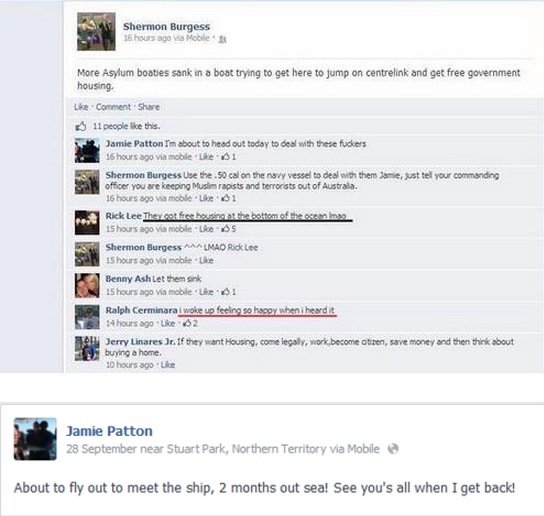
The most prominent advocate of the rallies is Shermon Burgess, aka ‘The Great Aussie Patriot’. A member of the ADL, Burgess is also the bRanes behind ‘Eureka Brigade’, a God-awful studio project that briefly came to media attention via the songs ‘Border Patrol’ (supporting naval operations against asylum seekers) and ‘ADL Killing Machine’ (see : Far right targets Muslims with hate campaign, Greg Ansley, The New Zealand Herald, April 26, 2014) and his vocal support for killing asylum seekers aka ‘Muslim rapists and terrorists’ (see : Who Are The Australian Defence League?, New Matilda, January 29, 2014).

sbkillkillkill

When he’s not wishing death on asylum seekers, Burgess can also be found expressing fear and hatred of Indigenous peoples — the one group which might be thought to have some grounds for ‘reclaiming Australia’ from its current rulers — describing them as mostly comprised of resentful, drug-addicted “dickheads”:

Burgess is also a fan of neo-Nazi music. In general then, his views express a basic commitment to fascism and White supremacy draped in the Australian flag. Ian Adams:

The common elements of fascism — extreme nationalism, social Darwinism, the leadership principle, elitism, anti-liberalism, anti-egalitarianism, anti-democracy, intolerance, glorification of war, the supremacy of the state and anti-intellectualism — together form a rather loose doctrine. Fascism emphasises action rather than theory, and fascist theoretical writings are always weak …

It’s therefore appropriate, given also his support for neo-Nazi groupuscule ‘Squadron 88’, that Burgess should be the face of and have assumed chief responsibility for promoting ‘Reclaim Australia’.

Posted in Anti-fascism, Media, Music, State / Politics | Tagged , , , , , , | 13 Comments

Solidarity with #OccupyDandenong : Family & Community BBQ : Saturday, January 31

UPDATE (February 3) : Dandenong factory workers claim ‘significant win’ after four-day lunchroom protest, Nick Toscano, The Age, January 30, 2015 | In the factory and in the street, Labor [/labour] is learning again that there is power in a union, Van Badham, The Guardian, February 3, 2014.

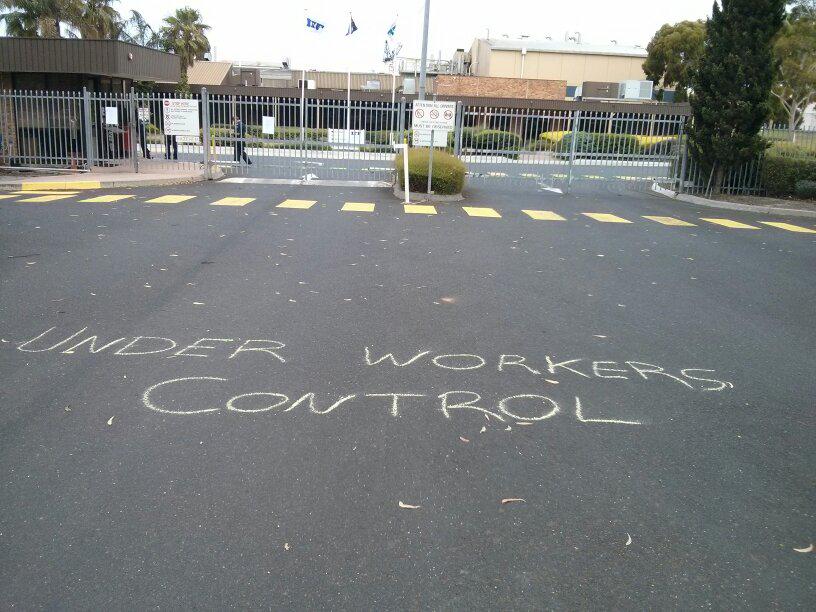
On Saturday, January 31 there’s a solidarity BBQ/picnic/rally at ‪#‎IFF‬ (International Flavors & Fragrances) in Dandenong (310 Frankston-Dandenong Road, Dandenong South) from noon to 4pm.

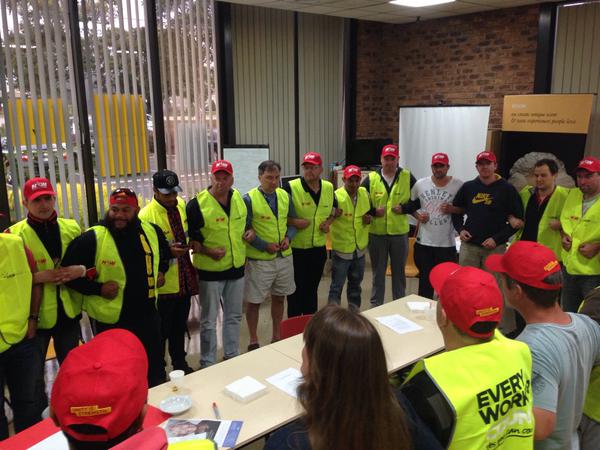
#‎OccupyDandenong‬ workers have been occupying the site since Tuesday morning — over three days now — following an attempted lockout by #IFF management.

Workers are demanding that they (and all other workers):

• receive a fair wage;
• do not have their working conditions degraded;
• be treated with respect;
• have the right to organise;
• enjoy job security;
• get their fair share of social goods;
• are free to express themselves;
• are able to express solidarity with other workers +;
• work without employer intimidation.

#IFF management reckon these minimal demands are excessive — at the same time, #IFF annual profit increased 28.24% to $354 million last reporting period + management are demanding Australian workers take a pay cut + endure worse conditions.

#IFF stink!

Call ’em up and support #OccupyDandenong strikers:

in the UK, phone: 44-208-392-4000;
in the US phone: 1-212-765-5500;
in AU phone: 61-2-9425-3100.

Sign the petition:

Australian workers at food flavours TNC fight lockout with lockin!

Keep up-to-date by following the #OccupyDandenong hashtag on Twitter or via the National Union of Workers Facebook page.

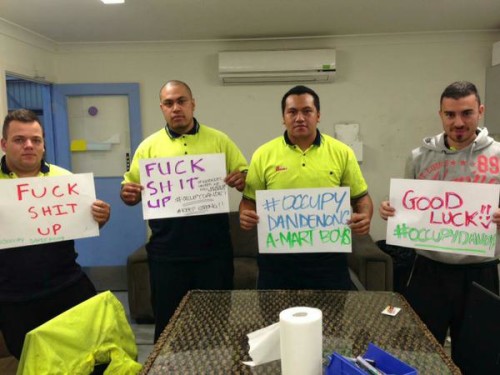
[Below: Super A-Mart workers w msg of solidarity for #IFF workers.]

fsu

Posted in State / Politics, That's Capitalism! | Tagged , , , , | Leave a comment

#OccupyDandenong: Support occupying workers at International Flavours & Fragrances!

UPDATE (February 3) : Dandenong factory workers claim ‘significant win’ after four-day lunchroom protest, Nick Toscano, The Age, January 30, 2015 | In the factory and in the street, Labor [/labour] is learning again that there is power in a union, Van Badham, The Guardian, February 3, 2014.

UPDATE : Social media campaign to #OccupyDandenong gathers steam with IFF workers locked in pay dispute, Melissa Townsend, Dandenong Leader, January 27, 2015 | Dandenong flavour factory pay dispute escalates to lock-in, Lucy Battersby, The Age, January 27, 2015 | Workers occupy Melbourne factory, Jerome Small, Red Flag, January 27, 2015.

nuwdandenong

Yo!

BREAKING!

Several dozen workers @ International Flavours & Fragrances (310 Frankston-Dandenong Road, Dandenong South, VIC, 3175; phone: (03) 9788 9200) have initiated a factory occupation in response to the company’s pushing thru a pay cut and locking them out. Management and scabs have left the building; a dozen police are in attendance.

SUPPORT IS NEEDED NOW!

If you can, please attend the community picket at the factory in support of the occupying workers. Bring food, drink, chairs etc and get on down!

nuw2

For more information, call Bob on 0429 030 436.

Please share and spread the word!

Workers stage sit-in at Melbourne factory
AAP
January 27, 2015

Workers have occupied a Dandenong factory lunch room in a dispute over a new workplace agreement.

The strike is taking place at International Flavors and Fragrances Inc (IFF) and is supported by the National Union of Workers.

Union delegate Arthur Ingles told AAP that workers had been in talks with the company about a new workplace agreement, but IFF “made an offer that gutted our conditions”.

“And in all the discussions we have been unable to get any movement from them, we’ve been prepared to negotiate,” he said.

Workers decided to take protected action and stopped all paperwork starting on Tuesday morning, but when they arrived at work before 6am, they were given notices of an indefinite lockout.

More than 50 staff had a meeting in the lunch room, and have been there since.

“Good faith should not be a concept. It should be a reality,” Mr Ingles said.

“We are now negotiating with police about whether we should leave or stay here.”

Workers have given a manifest to Fair Work Australia that lists their demands, including no erosion of conditions and a right to work without intimidation.

Those inside the lunch room have taken to Twitter to get their message across using the hashtag #occupydandenong.

Posted in State / Politics, That's Capitalism! | Tagged , | 2 Comments

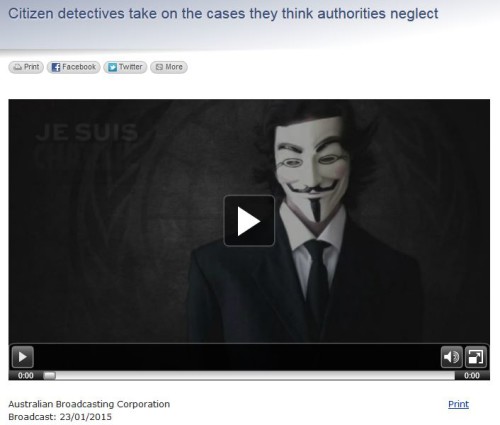
Citizen slackbastard is a detective (The 7.30 Report)

FTR, I make a brief appearance in this item from The 7.30 Report (January 23, 2015):

citizendetectives

ALISON CALDWELL, REPORTER: In May last year, a neo-Nazi rally in Brisbane was interrupted.

A group of construction workers from a building site nearby had been tipped off about a demo supporting Greece’s Golden Dawn party. Without warning, a counter-rally sprang into action.

The counter-rally wasn’t the unionists’ idea. It was organised by a man on a computer nearly 2,000 kilometres away.

‘ANDY FLEMING’, CYBER ACTIVIST: What I do is try and monitor the activities of the far-right in Australia and the events that they organise.

ALISON CALDWELL: ‘Andy Fleming’ is a cyber activist who trawls the web for information and cultivates sources inside the organisations he’s targeting. That’s how he found out about the planned neo-Nazi demonstration.*

‘ANDY FLEMING’: I published a Facebook page asking for people in Brisbane to go along to oppose their rally. Fortunately, a number of unions had a presence of several hundred of their members. I was able to provide them and others with information about who Golden Dawn was, an anti-union neo-Nazi organisation. They agreed that it was in their interest to oppose them, so they did. I think what happened in the end is the Nazis had to escape in a taxi driven by an Indian taxi driver from the event.

ALISON CALDWELL: ‘Andy Fleming’ is one of thousands of online activists around the world who are using the internet to right the wrongs they see in society. He says he’s received death threats and doesn’t want to appear on camera.

It’s not enough for him to write letters to the newspapers or lobby politicians for change.

‘ANDY FLEMING’: I found it useful to obtain information about these groups which can be used at opportune moments when and where it becomes necessary.

ALISON CALDWELL: Do you find that it’s more effective, a much more effective way to achieve what you’re after?

‘ANDY FLEMING’: I think so. I think I’ve been a disruptive influence. And I should also add that I’m working with a range of other people who belong to a kind of loose network of people who do the same kinds of work.

* Correction: the joint Australia First Party/Golden Dawn rally was a public affair; the first time GD in Australia had openly declared they would hold such an event (they have not done so again).

Posted in Anti-fascism, Media, State / Politics, Television | Tagged , , , | 2 Comments

Letter from asylum seekers in “Foxtrot” compound at #ManusIsland internment camp

[via RISE]

foxtrot

18th January 2015
From: Foxtrot Compound
To: Mr. Peter Sutton

We would like to say today about your policy that if you do not wish us to come to Australia, then that’s okay. It’s your country. But it does not mean you have the right to settle us in PNG.

We can tell you today this is enough, 18 months of suffering here. You claim humanity and justice, but there is none of this here.

We want to ask what kind of case takes more than 18 months to resolve?

We are not toys for you to play with and not animals to imprison us here.

We can say that when we woke up today, we are resolved to die here in order to bring back our dignity and our freedom.

It does not concern us what our destination is, but we did not come to PNG as our choice. If you send us back to where you found us, it is better for us to live with sharks and sea whales than to stay one more day with inhumane people – animals can eat humans, but here we have people who are likely to do the same.

So this is a promise Mr. Dutton we will keep going with our peaceful protest until we gain our freedom. And after all this time, force will never work with us.

And finally to all people who are sympathetic with us, we ask you to help us because here [we] witness a slow death every day.

We ask the Australian people to raise this question with their government – why does your government hide everything about Manus OPC, and not allow any of you to visit?

Could it be that the Australian people will find this place unfit for human beings to live[?]

We undertook a dangerous boat journey to escape torment and murder. We did not come ask Australia to open your doors to us, only to find more suffering and trauma. Now our biggest hope is for a solution as quick as possible, because we are all weary of [this] place.

Posted in Anti-fascism, Broken Windows, Death, Media, State / Politics, That's Capitalism! | Tagged , , | Leave a comment

antifa notes (january 16, 2015)

Squadron 88

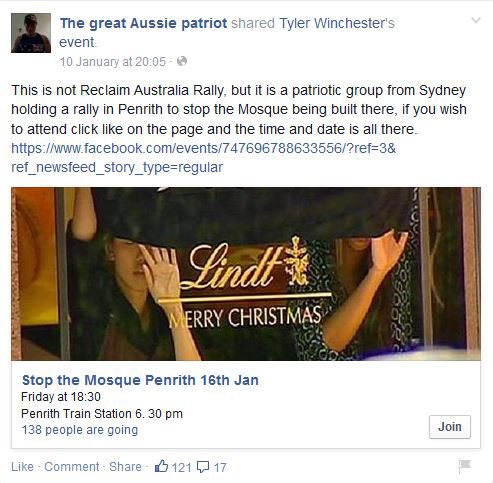
Sydney-based neo-Nazi groupuscule Squadron 88 (88 = HH = Heil Hitler) organised a protest to take place at Penrith station this evening at 6.30pm. The purpose of the rally was to oppose the construction of an Islamic community centre (‘mosque’) in Penrith which, despite some opposition, was approved by council late last year. The rally has now been postponed until next Friday (January 23).

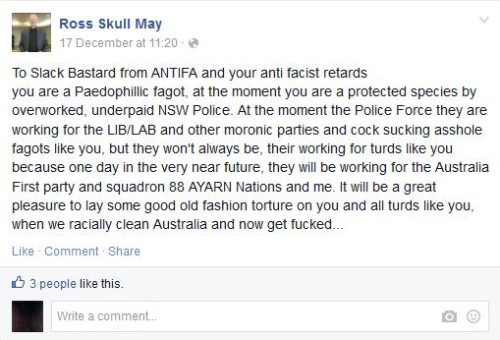
S88 has adopted as its mascot veteran neo-Nazi Ross ‘The Skull’ May, who’s featured in several videos the group has uploaded to YouTube (and is not a big fan of my blog):

ross

A recent video showed the elderly AYARN strolling the streets of Ashfield denouncing the number of ‘gooks’ in the area; other smash hits have included one in which he fantasised about the formation of ‘darkie patrols’ to confront black Australians in Sydney (both videos have since been removed from the site).

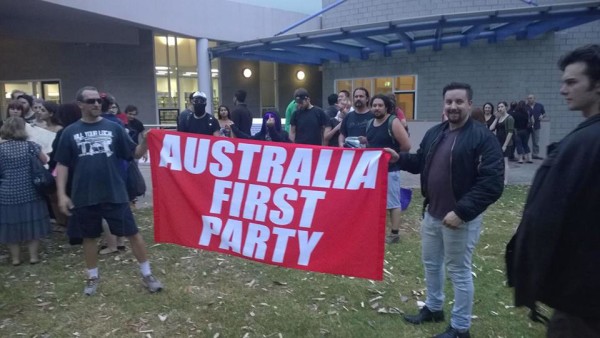
May is a close associate of Dr Jim Saleam, the leader of the Australia First Party, and its members work closely with those belonging to AFP: below is a photo of two members of S88 holding an AFP banner at the anti-Muslim rally outside Penrith council chambers on November 24:

AFPenrith

Reclaim Australia

Reclaim Australia is the banner under which Muslim-hating Australians are being called on to march on April 4. To that end, numerous Facebook pages have been created to promote rallies in capital cities and regional centres.

The bRanes behind Reclaim Australia is Shermon Burgess aka the Great Aussie Patriot aka Eureka Brigade. (You may remember Eureka Brigade from such songs as ‘Border Patrol’. Chorus: ‘We’re sick of your shariah burn your fucking mosques, it’s time to show you muzzrats we’re the fucking boss, you thought you had it easy but you surely lost, Cronulla was Australia’s Muslim holocaust.’) Burgess has been involved in anti-Muslim agitation for several years now, and describes himself as a patriot. Notably, Burgess has also helped to promote S88’s Penrith rally, describing the neo-Nazi group as similarly patriotic:

greataussienazi

Like other political projects which place hatred of Muslims at their centre, Reclaim Australia has attracted widespread support from the far right, and the distinction — not terribly large to begin with — between a ‘mere patriot’ and a racist bigot has effectively collapsed in this domain.

Precisely how many suburban Mums ‘n’ Dads want to join the ranks of the far right at Reclaim Australia will be an interesting outcome to watch.

Posted in Anti-fascism | Tagged , , , , , , , , , , | 3 Comments

A note on Facebook (esp for Strayan #antifa) …

Note : The Facebook profile ‘Astrid Ezard’ is a fake nazi account. Treat accordingly.

===

If you use Facebook and are in any way involved in expressing opposition to racism and fascism then there’s some possibility you will be targeted by the far right. The more active and vocal you are, the more likely you will come to their attention.

As a general rule, it’s a good idea to only publish personal information which you are happy to be made public. Further, do not accept friend requests from people you do not know unless others you know and trust can vouch for them. Fascists have established a number of fake profiles on Facebook which are used to either troll or to befriend and obtain information from targeted individuals. Many of these profiles make a special point of appearing to be ‘anti-fascist’.

There are various means by which to limit the amount of information users make available on Facebook. Facebook privacy settings allow users to moderate the public availability of this information — this feature is especially useful for older accounts. Periodically checking these settings is a good idea, both because Facebook has glitches and because its policies and practices change over time. If your account is used to share photos with family and friends, remember that while your own account may be secure, this doesn’t mean information shared with family and friends can’t be accessed via these other accounts.

Finally, note that fascists are happy to publish information regarding a person’s name, address, photo, description and other personal details including workplace. They are also happy to target a designated person’s family and friends, irrespective of whether or not they share the views of those targeted in this manner.

===

There are three main sites that neo-Nazis use to publish information they obtain about their real or alleged opponents: Stormfront, Whitelaw Towers and Anti-Antifa Australia.

Based in the US, Stormfront is the world’s leading neo-Nazi and White supremacist/nationalist website, run by convicted terrorist and former Klansman Don Black. Whitelaw Towers is a blog jointly written by Peter Campbell and Jim Perren. Anti-Antifa Australia, another blog, was established by Chris Smith. Campbell, Perren and Smith are supporters of the Australia First Party and work in close collaboration with them. Any information obtained by these individuals will be shared with AF and a range of other groups and individuals on the far right as well as with the general public.

Peter Campbell is a middle-aged, Sydney-based neo-Nazi who was one of those responsible for establishing the White Pride Coalition of Australia (WPCA) in 2002, a coalition which brought together neo-Nazis and White supremacists from the Australian Nationalists Movement, KKK, (New Zealand) National Front, National Socialist Party of Australia and World Church of the Creator. The WPCA dissolved in 2004 but in 2014 was revived as a Facebook page and organising project. In 2006, Campbell was responsible for republishing a Combat 18 (C18) document for local distribution called ‘How to build a David Copeland special’ (‘White patriot’ denies violence, Andrew Fraser and Greg Roberts, The Australian, September 16, 2006). David Copeland was an English neo-Nazi responsible for conducting bombings directed at London’s gay and immigrant communities in April 1999. Three people were killed and hundreds more injured as a result of the bombings. (C18 continues to eke out a marginal existence in Australia, largely by way of Creatard Patrick O’Sullivan‘s stickering campaign in Melbourne: a recent sample from Richmond below.)

C18Richmond

Jim Perren is a Queenslander, originally based in Crows Nest outside of Toowoomba (where he worked as a shooter and bouncer) but now apparently living in Brisbane and, presumably, continuing to work in the security industry. Now in his late 40s, Perren has attended Australia First Party events and is also responsible for helping obtain jobs in the security industry for other neo-Nazis, including members of the Hammerskins.

Chris Smith is a bonehead from Penrith, Sydney now based in Brisbane. He has a criminal record for assault and robbery, having been convicted in late 2010. In addition to publishing the Anti-Antifa Australia blog, Smith is the chief organiser of the neo-Nazi skinhead group Volksfront (VF). VF was originally established in Portland, Oregon in the early 1990s but grew rapidly in the US and established a presence in several other countries. The group was declared dissolved by its founder in September 2012 after the mass shooting at a Sikh temple in Wisconsin by Hammerskin and former VF intimate Wade Michael Page. The Australian branch is the only VF branch still active.

Posted in Anti-fascism, Media, State / Politics | Tagged , , , , , , , , , , , , , , , | 4 Comments

Graeber et al on the ‘Rojava Revolution’

Below I’ve republished David Graeber’s recent interview with Pinar Öğünç about his recent (December) trip to Rojava as part of a small international delegation to the area. I’ve also included links to several articles of relevance. A good collection of links on the ‘Rojava Revolution’ is available by way of libcom; there’s also a disco thread on the libcom forum inre Graeber’ views here.

See also :

Syria: Abuses in Kurdish-run Enclaves: Arbitrary Arrests, Unfair Trials; Use of Child Soldiers, Human Rights Watch, June 19, 2014 | International Crisis Group: Flight of Icarus? The PYD’s Precarious Rise in Syria, May 2014 | Syria’s Kurds: A Struggle Within a Struggle, January 2013.

“A revolution in daily life”, Peace in Kurdistan, December 22, 2014 (an account by Becky of the delegation to Rojava which ‘discusses how power is being dispersed among the people in Cizire Canton’).

Impressions of Rojava: a report from the revolution, Janet Biehl, ROAR, December 16, 2014 | Ecology or Catastrophe: Visit to the YPJ, December 7, Amuda (December 22, 2014) / “Poor in means but rich in spirit” (December 30, 2014) / The Revolutionary Days of July 2012 (January 4, 2015).

MACG withdraws from Australians for Kurdistan, Melbourne Anarchist Communist Group, December 7, 2014 | Australians for Kurdistan (Facebook) | Anarchist Federation [UK] Statement on Rojava – December 2014, December 1, 2014 | In Rojava: People’s War is not Class War, International Communist Tendency, October 30, 2014.

• VICE News on Kobane | The Rojava Report (News from the Revolution in Rojava and Wider Kurdistan) | TAHRIR International Collective Network on Kurdistan.

Whose side is Turkey on?, Patrick Cockburn, London Review of Books, Vol.36 No.21 (November 6, 2014) | An Interview with Revolutionary Anarchist Action on Kobanê: “We are Kawa against Dehaks”, October 27, 2014 | In Defence Of Anarchism: Tearing Down The Links To The Butchers Of ISIL, Andy Fleming, New Matilda, October 21, 2014.

KNK : Kurdistan National Congress
KRG : Kurdistan Regional Government
Peshmerga : KRG-aligned military units
PKK : Kurdistan Workers’ Party
PYD : Kurdish Democratic Union Party
PYG : People’s Protection Units
PYJ : Women’s Protection Units
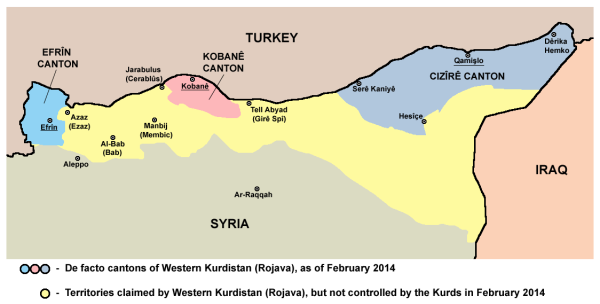
Rojava : self-declared autonomous Kurdish republic in northern Syria, consisting of three non-contiguous cantons, Afrin/Efrîn in the west, Kobani/Kobanê in the centre and Jazira/Cizîrê in the east
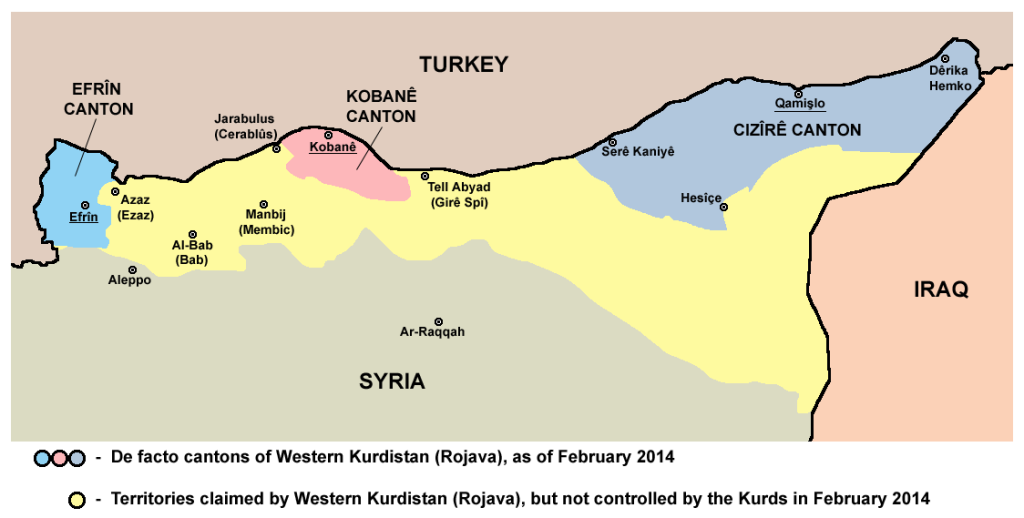
rojavamap

“No. This is a Genuine Revolution”
David Graeber and Pinar Öğünç
Z
December 26, 2014

Professor of Anthropology at the London School of Economics, activist, anarchist David Graeber wrote an article for the Guardian in October, in the first weeks of the ISIS attacks on Kobane (North Syria), and asked why the world was ignoring the revolutionary Syrian Kurds.

Mentioning his father who volunteered to fight in the International Brigades in defence of the Spanish Republic in 1937, he asked: “If there is a parallel today to Franco’s superficially devout, murderous Falangists, who would it be but ISIS? If there is a parallel to the Mujeres Libres of Spain, who could it be but the courageous women defending the barricades in Kobane? Is the world -and this time most scandalously of all, the international left- really going to be complicit in letting history repeat itself?”

According to Graeber, the autonomous region of Rojava declared with a “social contract” in 2011 as three anti-state, anti-capitalist cantons, was also a remarkable democratic experiment of this era.

In early December, with a group of eight people, students, activists, academics from different parts of Europe and the US, he spent ten days in Cizire -one of the three cantons of Rojava. He had the chance to observe the practice of “democratic autonomy” on the spot, and to ask dozens of questions.

Now he tells his impressions of this trip with bigger questions and answers why this “experiment” of the Syrian Kurds is ignored by the whole world.

In your article for the Guardian you had asked why the whole world was ignoring the “democratic experiment” of the Syrian Kurds. After experiencing it for ten days, do you have a new question or maybe an answer to this?

Well, if anyone had any doubt in their minds about whether this was really a revolution, or just some kind of window-dressing, I’d say the visit put that permanently to rest. There are still people talking like that: This is just a PKK (Kurdistan Workers’ Party) front, they’re really a Stalinist authoritarian organisation that’s just pretending to have adopted radical democracy. No. They’re totally for real. This is a genuine revolution. But in a way that’s exactly the problem. The major powers have [committed] themselves to an ideology that say[s] real revolutions can no longer happen. Meanwhile, many on the left, even the radical left, seem to have tacitly adopted a politics which assumes the same, even though they still make superficially revolutionary noises. They take a kind of puritanical “anti-imperialist” framework that assumes the significant players are governments and capitalists and that’s the only game worth talking about. The game where you wage war, create mythical villains, seize oil and other resources, set up patronage networks; that’s the only game in town. The people in Rojava are saying: We don’t want to play that game. We want to create a new game. A lot of people find that confusing and disturbing so they choose to believe it isn’t really happening, or such people are deluded or dishonest or naive.

Since October we see a rising solidarity from different political movements from all over the world. There has been a huge and some quite enthusiastic coverage of Kobane resistance by the mainstream medias of the world. Political stance regarding Rojava has changed in the West to some degree. These are all significant signs but still do you think democratic autonomy and what’s been experimented in the cantons of Rojava are discussed enough? How much does the general perception of “Some brave people fighting against the evil of this era, ISIS” dominate this approval and the fascination?

I find it remarkable how so many people in [the] West see these armed feminist cadres, for example, and don’t even think on the ideas that must lie behind them. They just figured it happened somehow. “I guess it’s a Kurdish tradition.” To some degree it’s [O]rientalism of course, or to put simpl[y] racism. It never occurs to them that people in Kurdistan might be reading Judith Butler too. At best they think “Oh, they’re trying to come up to Western standards of democracy and women’s rights. I wonder if it’s for real or just for foreign consumption.” It just doesn’t seem to occur to them they might be taking these things way further than “Western standards” ever have; that they might genuinely believe in the principles that Western states only profess.

You mentioned the approach of the left towards Rojava. How is it received in the international anarchist communities?

The reaction in the international anarchist communities has been decidedly mixed. I find it somewhat difficult to understand. There’s a very substantial group of anarchists -usually the more sectarian elements -who insist that the PKK is still a “Stalinist” authoritarian nationalist group which has adopted Bookchin and other left libertarian ideas to court the anti-authoritarian left in Europe and America. It’s always struck me that this is one of the silliest and most narcissistic ideas I’ve ever heard. Even if the premise were correct, and a Marxist-Leninist group decided to fake an ideology to win foreign support, why on earth would they choose anarchist ideas developed by Murray Bookchin? That would be the stupidest gambit ever. Obviously they’d pretend to be Islamists or [l]iberals, those are the guys who get the guns and material support. Anyway I think a lot of people on the international left, and the anarchist left included, basically don’t really want to win. They can’t imagine a revolution would really happen and secretly they don’t even want it, since it would mean sharing their cool club with ordinary people; they wouldn’t be special any more. So in that way it’s rather useful in culling the real revolutionaries from the poseurs. But the real revolutionaries have been solid.

What was the most impressi[ve] thing you witnessed in Rojava in terms of this democratic autonomy practice?

There were so many [impressive] things. I don’t think I’ve ever heard of anywhere else in the world where there’s been a dual power situation where the same political forces created both sides. There’s the “democratic self-administration,” which has all the form and trappings of a state -Parliament, Ministries, and so on -but it was created to be carefully separated from the means of coercive power. Then you have the TEV-DEM (The Democratic Society Movement), driven bottom-up directly-democratic institutions. Ultimately -and this is key -the security forces are answerable to the bottom-up structures and not to the top-down ones. One of the first places we visited was a police academy (Asayiş). Everyone had to take courses in non-violent conflict resolution and feminist theory before they were allowed to touch a gun. The co-directors explained to us their ultimate aim was to give everyone in the country six weeks of police training, so that ultimately, they could eliminate police.

What would you say to various criticisms regarding Rojava? For example: “They wouldn’t have done this in peace. It is because of the state of war” …

Well, I think most movements, faced with dire war conditions, would not nonetheless immediately abolish capital punishment, dissolve the secret police and democratise the army. Military units for instance elect their officers.

And there is another criticism, which is quite popular in pro-government circles here in Turkey: “The model the Kurds -in the line of PKK and PYD (The Kurdish Democratic Union Party) -are trying to promote is not actually embraced by all the peoples living there. That multi-[?] structure is only on the surface as symbols” …

Well, the President of Cizire canton is an Arab, head of a major local tribe in fact. I suppose you could argue he was just a figurehead. In a sense the entire government is. But even if you look at the bottom-up structures, it’s certainly not just the Kurds who are participating. I was told the only real problem is with some of the “Arab belt” settlements, people who were brought in by the Baathists in the ‘50s and ‘60s from other parts of Syria as part of an intentional policy of marginalising and assimilating Kurds. Some of those communities they said are pretty unfriendly to the revolution. But Arabs whose families had been there for generations, or the Assyrians, Khirgizians, Armenians, Chechens, and so on, are quite enthusiastic. The Assyrians we talked to said, after a long difficult relation with the regime, they felt they finally were being allowed free religious and cultural autonomy. Probably the most [intractable] problem might be women’s liberation. The PYD and TEV-DEM see it as absolutely central to their idea of revolution, but they also have the problem of dealing [with] larger alliances with Arab communities who feel this violates basic religious principles. For instance, while the Syriac-speakers have their own women’s union, the Arabs don’t, and Arab girls interested in organising around gender issues or even taking feminist seminars have to hitch on with the Assyrians or even the Kurds.

It doesn’t have to be trapped in that “puritanical ‘anti-imperialist’ framework” you mentioned before, but what would you say to the comment that the West/imperialism will one day ask Syrian Kurds to pay for their support[?] What does the West think exactly about this anti-state, anti-capitalist model? Is it just an experiment that can be ignored during the state of war while the Kurds voluntarily accept to fight an enemy that is by the way actually created by the West?

Oh it is absolutely true that the US and European powers will do what they can to subvert the revolution. That goes without saying. The people I talked to were all well aware of it. But they didn’t make a strong differentiation between the leadership of regional powers like Turkey or Iran or Saudi Arabia, and Euro-American powers like, say, France or the US. They assumed they were all capitalist and statist and thus anti-revolutionary, who might at best be convinced to put up with them but were not ultimately on their side. Then there’s the even more complicated question of the structure of what’s called “the international community,” the global system of institutions like the UN or IMF, corporations, NGOs, human rights organisations for that matter, which all presume a statist organisation, a government that can pass laws and has a monopoly of coercive enforcement over those laws. There’s only one airport in Cizire and it’s still under Syrian government control. They could take it over easily, any time, they say. One reason they don’t is because: How would a non-state run an airport anyway? Everything you do in an airport is subject to international regulations which presume a state.

Do you have an answer to why ISIS is so obsessed with Kobane?

Well, they can’t be seen to lose. Their entire recruiting strategy is based on the idea that they are an unstoppable juggernaut, and their continual victory is proof that they represent the will of God. To be defeated by a bunch of feminists would be the ultimate humiliation. As long as they’re still fighting in Kobane, they can claim that media claims are lies and they are really advancing. Who can prove otherwise? If they pull out they will have admitted defeat.

Well, do you have an answer to what Tayyip Erdogan and his party is trying to do in Syria and the Middle East generally?

I can only guess. It seems he has shifted from an anti-Kurdish, anti-Assad policy to an almost purely anti-Kurdish strategy. Again and again he has been willing to ally with pseudo-religious fascists to attack any PKK-inspired experiments in radical democracy. Clearly, like Daesh (ISIS) themselves, he sees what they are doing as an ideological threat, perhaps the only real viable ideological alternative to right-wing Islamism on the horizon, and he will do anything to stamp it out.

On the one hand there is Iraqi Kurdistan standing on quite a different ideological ground in terms of capitalism and the notion of independence. On the other hand, there is this alternative example of Rojava. And there are the Kurds of Turkey who try to sustain a peace process with the government. How do you personally see the future of Kurdistan in short and long terms?

Who can say? At the moment things look surprisingly good for he revolutionary forces. The [KRG: Kurdistan Regional Government] even gave up the giant ditch they were building across the Rojava border after the PKK intervened to effectively save Erbil and other cities from IS back in August. One KNK [Kurdistan National Congress] person told me it had a major effect on popular consciousness there; that one month had done 20 years worth of consciousness-raising. Young people were particularly struck by the way their own Peshmerga fled the field but PKK women soldiers didn’t. But it’s hard to imagine how the KRG territory […] will be revolutionised any time soon. Neither would the international powers allow it.

Although democratic autonomy doesn’t seem to be clearly on the table of negotiation in Turkey, the Kurdish Political Movement [?] has been working on it, especially on the social level. They try to find solutions in legal and economic terms for possible models. When we compare let’s say the class structure and the level of capitalism in West Kurdistan (Rojava) and North Kurdistan (Turkey), what would you think about the differences of these two struggles for an anti-capitalist society -or for a minimised capitalism as they describe?

I think the Kurdish struggle is quite explicitly anti-capitalist in both countries. It’s their starting point. They’ve managed to come up with a kind of formula: One can’t get rid of capitalism without eliminating the state, one can’t get rid of the state without getting rid of patriarchy. However, the Rojavans have it quite easy in class terms because the real bourgeoisie, such as it was in a mostly very agricultural region, took off with the collapse of the Baath regime. They will have a long-term problem if they don’t work on the educational system to ensure a developmentalist technocrat stratum doesn’t eventually try to take power, but in the meantime, it’s understandable they are focusing more immediately on gender issues. In Turkey, well, I don’t know nearly as much, but I do have the sense things are much more complicated.

During the days that the peoples of the world can’t breathe for obvious reasons, did your trip to Rojava inspire you about the future? What do you think is the “medicine” for the people to breathe?

It was remarkable. I’ve spent my life thinking about how we might be able to do things like this in some remote time in the future and most people think I’m crazy to imagine it will ever be. These people are doing it now. If they prove that it can be done, that a genuinely egalitarian and democratic society is possible, it will completely transform people’s sense of human possibility. Myself, I feel ten years younger just having spent 10 days there.

With which scene are you going to remember your trip to Cizire?

There were so many striking images, so many ideas. I really liked the disparity between the way people looked, often, and the things they said. You meet some guy, a doctor, he looks like a slightly scary Syrian military type in a leather jacket and stern austere expression. Then you talk to him and he explains: “Well, we feel the best approach to public health is preventative, most disease is made possible by stress. We feel if we reduce stress, levels of heart disease, diabetes, even cancer will decline. So our ultimate plan is to reorganise the cities to be 70% green space.” There are all these mad, brilliant schemes. But then you go to the next doctor and they explain how because of the Turkish embargo, they can’t even get basic medicine or equipment, all the dialysis patients they couldn’t smuggle out have died. That disjuncture between their ambitions and their incredibly straightened circumstances. And … The woman who was effectively our guide was a deputy foreign minister named Amina. At one point, we apologised [that] we weren’t able to bring better gifts and help to the Rojavans, who were suffering so under the embargo. And she said: “In the end, that isn’t very important. We have the one thing no one can ever give you. We have our freedom. You don’t. We only wish there was some way we could give that to you.”

You are sometimes criticised for being too optimistic and enthusiastic about what’s happening in Rojava. Are you? Or do [your critics] miss something?

I am by temperament an optimist, I seek out situations which bear some promise. I don’t think there’s any guarantee this one will work out in the end, that it won’t be crushed, but it certainly won’t if everyone decides in advance that no revolution is possible and refuse to give active support, or even, devote their efforts to attacking it or increasing its isolation, which many do. If there’s something I’m aware of, that others aren’t, perhaps it’s the fact that history isn’t over. Capitalists have made a mighty effort these past 30 or 40 years to convince people that current economic arrangements –not even capitalism, but the peculiar, financialised, semi-feudal form of capitalism we happen to have today -is the only possible economic system. They’ve put more effort into that than they have into actually creating a viable global capitalist system. As a result the system is breaking down all around us at just the moment everyone has lost the ability to imagine anything else. Well, I think it’s pretty obvious that in 50 years, capitalism in any form we’d recognise, and probably in any form at all, will be gone. Something else will have replaced it. That something might not be better. It might be even worse. It seems to me for that very reason it’s our responsibility, as intellectuals, or just as thoughtful human beings, to try to at least think about what something better might look like. And if there are people actually trying to create that better thing, it’s our responsibility to help them out.

(This interview has been published by the daily Evrensel in Turkish.)
Posted in !nataS, Anarchism, Anti-fascism, Broken Windows, Death, History, Media, State / Politics, That's Capitalism!, War on Terror | Tagged , , , , , , , , , | 3 Comments