Left Unity (You Are My Destiny) [Trot Guide December 2012 Update]

Clenched fist salute to Axeris; here are some links to blah blah blah about unity (RSP+SAlt=SAlt) on the Australian (Marxist) left. Note that at their weekend conference, SAlt agreed that the RSP was tops and could totally join them.

• What politics to unite Australia’s left?, December 8, 2012 (Peter Boyle, Socialist Alliance)
• A response to “What politics to unite Australia’s left?”, December 14, 2012 (Mick Armstrong, Socialist Alternative)
• What can be the basis of unity on the left?, December 14, 2012 (Allen Myers, Direct Action/Revolutionary Socialist Party)
• Building unity and a stronger left [PDF], December 2012 (Solidarity National Committee)

Elsewhere:

• Socialist Alternative Australia: Strange sort of unity, December 13, 2012 (Weekly Worker/Communist Party of Great Britain)
• Australian pseudo-left backs imperialist intervention in Syria, December 14, 2012 (Patrick O’Connor and Nick Beams/Socialist Equality Party)

As for me, I’m still waiting a response from SAlt to this.

See also : Trot Guide November 2012 Update (November 1, 2012).

Posted in Trot Guide | Tagged , | 5 Comments

Students are STILL revolting//The Mad Monk & SPARTA (Defend North Korean Deformed Workers State!)

The Spartacists rejected the claim.

Awesome! Courtesy of AA, I’ve discovered that one of my favourite Tory ex-student politicians/Victorian Liberal Party powerbroker, Michael Kroger, is a leftist trainspotter! The Man About Town has been gracing the pages of Uncle Rupert‘s UnAustralian zine and the ratings #1 smash hit The What’s a Few Aboriginal Children Between Friends?, Anthropogenic Climate Change is A Plot Hatched by Communists to Take Away Our Guns & Phrenology Hour with Dr Andrew Bolt on Aunty Gina‘s TV channel, calling Abbott critic (BOO! HISS!) Barbara Ramjan a liar and stuff (Abbott accuser sues Liberal Party powerbroker, October 24, 2012):

In the ensuing ruckus, Mr Kroger, who was defending Mr Abbott, accused Ms Ramjan of lying about the alleged punching incident, and also another incident which happened on campus in 1978. On the Bolt Report, hosted by conservative pundit Andrew Bolt, and the next day for The Australian, Mr Kroger produced a Trotskyist student political newsletter which he said showed that Ms Ramjan had claimed that members of the rival far-left Spartacists on the University of Sydney campus had threatened to kill her.

The Spartacists rejected the claim.

Then again, The Spartacists reject the claim that Lenin was an arsehole.

See also : “OK well that’s a strongly-held opinion on your part Greg but…” WE ALL HATE CATHOLICS AMIRITE (September 14, 2012).

The Young Need Discipline

In a much more contemporary vein, three students at La Trobe (once a Spartacist stronghold, supposedly), are being prosecuted by University authorities for being all uppity ‘n’ shit. One revolting student writes: “you thought you could forget about the la trobe university vice chancellor [Paul Dewar], didn’t you? BUT HE HAS NOT FORGOTTEN YOU. he’s charged three student protesters with general misconduct and is going to try to expel them before next semester starts.”

I’m not sure precisely what the three students are being accused of, but FYI La Trobe has a colourful history in this regard, one detailed in Barry York’s book Student Revolt: La Trobe University 1967–1973 (Nicholas Press, 1989). In any case, Dewar appears to think that fat blokes pushing kids around is educational; presumably, he’s also trying to kick-start a backfiring student movement by selecting — seemingly at random — a handful to punish for some monkey business back in August. Anyways, if youse wanna find out moar, there’s a meeting at 6pm on Tuesday, December 18 at Trades Hall to discuss how best to respond to Dewar’s latest bRanes storm. Fingers xed a Sparticist will attend — and the cosmic ballet will go on…

NB. Defend North Korean Deformed Workers State!

Posted in !nataS, Broken Windows, History, State / Politics, Student movement, Television, Trot Guide | Tagged , , , , | 1 Comment

Crazy White Boys Go To Jail

Briefly, some Fourth Reich Fighting Men have gone to jail:

Young men jailed for ‘deplorable’ race-hate bashing
Andrea Petrie
The Age
December 12, 2012

Neo-Nazis jailed for attack on Vietnamese student
ABC
December 12, 2012

More later.

Posted in Anti-fascism, State / Politics | Tagged | 13 Comments

When White nationalists attack! New Right @ Gaza solidarity rally, Sydney, November 24

RRTAA!

Two weeks ago in Sydney, a small group of White-nationalists-in-anarchist-drag rocked up to a rally against the latest Israeli attack on Gaza (aka ‘Operation Pillar of Defense’, November 17). Armed with banners, Anonymous masks and bizarro political merch (branded tees and the like), the 10 or so wingnuts were soon identified as hostile by members of the crowd, who proceeded to isolate them outside the Town Hall. Reportedly, an attempt was made to confiscate one of their banners, which was unsuccessful. The White nationalists were then surrounded by police, and remained silent and stationary at the Town Hall for the duration of the rally.

So, who were these wEiRd0eS?

Their propaganda proclaimed them to be ‘national anarchists’. While the term may seem oxymoronic, ‘national anarchism’ is in fact an ideological development on the far right, one whose immediate origins can be traced back to the late 1980s and early 1990s and attempts by racists and fascists to find a place for their activities among anarchists in England. The standard account of this fringe and its evolution during this period is ‘Co-opting the Counter Culture: Troy Southgate and the National Revolutionary Faction’, Graham D. Macklin, Patterns of Prejudice, Vol.39, No.3, September 2005.

Despite having some initial success (fooling a handful of leftists, including the recently-deceased Terry Liddle, into collaborating with them), Southgate and his followers found little real political purchase among radicals. (Of course organising, from the mid-2000s, a talking-shop in London, calling it ‘New Right’, and inviting various extreme-right wing loons — including Holocaust-denialists and other mentalists — to talk shit to other wEiRd0eS doesn’t help any.) In any event, Southgate & Co have sensibly turned to the online world for support and in this realm they’ve been reasonably successful, the milieu specialising in virtual political expressions, seemingly on the basis of Ein Volk, Ein Blog (my favorite being a Hitler-worshipping Afro-punk).

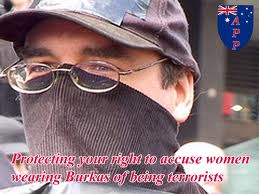
In Australia, the national anarchists (hereafter referred to as gnats) announced their existence back in 2007, when a group of around 20 or so right-wing loons of diverse origins — including Darrin Hodges (above), the (former) leader of the anti-Muslim ‘Australian Protectionist Party’ in NSW, and disgraced academic and White racialist Andrew Fraser — gathered at the APEC counter-protests, also in Sydney. (See : Anarchist statement on the New Right, October 21, 2007.) As in the more recent incident, at APEC the racist wankers were isolated and protected by a large number of police.

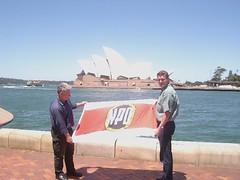
The principal exponent of ‘national anarchism’ in Australia is a Sydney-based small businessman named Welf Herfurth (above, with Adelaide-based Holocaust denialist Fredrick Töben, together holding an NPD flag belonging to German neo-Nazi Horst Mahler), who has been joined in the past by a handful of Victorians (including a young Creatard from Geelong named Scott Harrison), a student from Perth named Nicholas Cole, and more recently several boneheads. Thus for reasons best known to themselves, the members of the Australian franchise of the US-based neo-Nazi Volksfront gang cultivated close links with Herfurth & Co in Sydney; following its formal dissolution in October (seemingly as a result of US pressure on the group in the wake of neo-Nazi skinhead Wade Michael Page’s murderous spree), it would seem reasonable to expect former VF members to increase the level of their activity on behalf of the gnats/New Right. As it stands, it’s difficult to gauge the seriousness with which the gnats in Sydney intend to continue to provoke the left, but a source in Sydney’s Chinatown reckons former VF member Steev Levings [?] is keen, and Steev’s political loyalties find graphic expression on his body:


The recent Gaza intervention is one of just a handful of public manifestations by gnats, who for whatever reason seem to be concentrated in Sydney (as is the Australia First Party and Australian Protectionist Party), while Melbourne can boast of being the centre of B&H and Hammerskin activity and the tiny groupuscule Nationalist Alternative. Further afield, the gnats appear to have only been able to maintain a temporary presence on The Streets of San Francisco — in the shape of a bunch of BANANAs. A beat-down on BANANA leader Andrew White (‘Andrew Yeoman’) on May Day a coupla years ago — and his subsequent denouncement by ideologue Southgate as a psychopath and race traitor — put paid to White’s dream of a Bay Area purged of non-Whites, but not before the racist loser paid a visit to Australia to address AF’s annual conference the (2009) Sydney Forum (at which his kamerad Welf Herfurth performs as MC).

Otherwise, the gnats may be located within a wider attempt by the far right to re-articulate a form of racist nationalism, one which has taken on increasing significance, especially in Europe, over the last few decades. See, for example: Czech Republic : The Big Neo-Nazi Crib (antifa.cz) | Germany : German city battles elusive new-look neo-Nazis (Reuters) | Italy : CasaPound’s First Big Outing in Rome Was a Snooze-Fest, (Giuseppe Pisani, Vice).

Finally, as Durruti put it:

Fascism is not to be debated, it is to be smashed.

Posted in Anarchism, Anti-fascism, State / Politics | Tagged , , , , , , | 18 Comments

West Papua ~versus~ Israel

West Papua

Yesterday Australian media reported a bloke is being charged with being a mercenary or some shit:

Mr Little, 45, was charged with preparatory acts for incursion into foreign states and trained or drilled for incursions into foreign states, under laws which prevent Australian citizens from engaging in hostile acts against other countries.

Mr Little was allegedly preparing to goto West Papua to join nationalist insurgents/terrorists. See : Man faces ‘foreign incursion’ offences, Amy Remeikis, The Age, December 5, 2012 | Alleged would-be mercenary faces Brisbane court, Jason Rawlins, ABC, December 5, 2012.

Today, The Australian (West Papua rebel outed on Facebook, Sarah Elks, December 6) reports that Little was one of umpteen would-be revolutionaries to be let-down by Zuckerberg. Further:

Magistrate Jacqui Payne agreed to deny bail, but ruled that it was because he posed “an unacceptable risk” of reoffending and of fleeing Australia. She said the [C]rown’s case was powerful, backed by his “strong statements of commitment” to West Papuan independence from Indonesia posted on Facebook.

For the record, I think all states are super.

West Papua has been under Indonesian occupation since 1969, when the delightfully named Act of Free Choice took place. As in the case of East Timor, the Australian state has been an enthusiastic supporter of Indonesian colonialism, but some other bloke reckons that’s changing (Australia’s evolving position on West Papua, Tom Clarke, The Australian, November 30, 2012). Of related interest is this article by Bobby Anderson (Living without a state, Inside Indonesia, November 25, 2012):

Indonesian Papua is not a uniform entity. When outsiders think of Papua, they imagine provincial and national-level political conflicts and protests against Indonesian rule. But this is only the reality for a minority of Papuans in the major towns of Jayapura, Wamena, and Timika, and their suburbs. Outside of select groups within these areas, most people do not engage in political issues related to referendum protests, dialogue with Jakarta, or Merdeka (independence).

Instead, local fissures count more in day-to-day politics. In the province, most people’s primary loyalties are not to an idea of ‘Papua’, nor are contending loyalties to ‘Indonesia’. Instead, most people are above all loyal to their clan, with even broader tribal loyalties being secondary. Loyalties to Papua or Indonesia come a distant third, at best. Whilst Jayapura and Wamena host numerous and often competing groups who agitate for independence, and while a few areas such as Puncak Jaya host active insurrectionists, most of rural Papua is an underdeveloped and detached space where political conflicts are entirely local.

In most places outside of the towns, the key issue is not that Papuans reject the Indonesian state: it is simply that the state plays little or no role in their lives, for better or for worse.

Israel

Unlike the Fuzzy Wuzzy Angels, Australia’s commitment to Israel appears to have remained rock-solid over the last few decades, with few if any deviations:–one minor exception being the recent decision by Joolya’s mob to abstain from (rather than oppose) a vote at the UN to allow Palestine to be accorded the same status as Vatican City. Curiously, last week the ABC reported that Australian Zionists have been training to go fight for Israel (including by way of running around Bondi beach: Aussie Zionists training to fight for Israel, Tom Tilley, November 29, 2012).

This kinda training is super, however, because statism.

See also : Fredy Perlman, The Continuing Appeal of Nationalism, 1984.

Posted in !nataS, Broken Windows, History, State / Politics, That's Capitalism!, War on Terror | Tagged , | 1 Comment

Jill Meagher, Reclaim the Night, the political right and Socialist Alternative

Recently (November 22), ‘Socialist Alternative’ published an article by Louise O’Shea titled ‘Jill Meagher, Reclaim the Night and the political right’. The article attempts to mount an argument, seemingly directed at other segments of the Australian left, regarding the public response to the rape and murder of Jill Meagher in Melbourne in September. In essence, Louise argues that ‘the left’ must respond to such events by (re-)emphasising the centrality of class to understanding contemporary forms of oppression — rather than, as in this instance, capitulating to strictly feminist concerns over male violence.

Well, kinda…

There’s a good deal packed into Louise’s 3,000 word essay, and I’m not sure I’m able (or willing) to address all the points at which I believe her analysis falls down. Some of the points she makes are sensible and worthy. Nevertheless, the central thrust of her argument — that, contra ‘the left’, the mobilisations that took place in response to Jill’s death have not been a ‘positive’ political development — is badly flawed, and reflects errors in her general political perspective, as well as her understanding of the reaction to this horrible crime.

Accounts of Jill’s rape and murder are available elsewhere; with regards the subsequent reaction, to begin with, Louise identifies several areas of concern, and elaborates upon two in particular: first, the media treatment of Jill’s fate; secondly, the employment of the rhetoric of ‘community’. Below I respond to these concerns; discuss the notion of class collaboration Louise invokes; the relationship of class to gender and Marxism to feminism in this context; crime; and finally situate her critique within the organisational demands of the local Trotskyist milieu (of which SAlt is a major part).

Media

According to Louise, because Jill fit a particular profile, the media was happy to publicise her case, and did so in a way that reinforced right-wing discourse.

In response, there’s very little to say — and also quite a lot. That is, the crucial role of the media in shaping public consciousness — and hence the reaction to the news first of Jill’s disappearance and then death — is hardly an obscure fact, and leftists are also hardly unaware of the difficulties this presents in terms of their ability to present alternative analyses, narratives and perspectives to the general public. In other words, the trivial fact that the media shapes public discourse, that politicians are happy to jump on a bandwagon if it suits them, or that the police seek to cultivate a positive public image, is indeed banal. For leftists and other political actors, what really matters is the fact that these forces are not wholly dominant, and on some occasions — especially when there are large numbers of people incensed enough to take to the streets in anger and shame at crimes such as these — it’s possible to articulate views which counter these forces, and act to subvert their appeal.

Well, theoretically, anyway.

Of course, the reality is, at the very least, disputed. Thus Louise argues that “interest in and mobilisations around street crime, especially that directed against white women and children, will always tend to lead in a pro-state, pro-authority direction”. Leaving aside the racial dimension of her claim for a moment, even if correct, this reliance upon Big Brother remains a political tendency, and therefore one which is not only vulnerable to challenge, but which is also able to be re-directed in an ‘anti-state, anti-authority’ direction. In any case, to point out that similar outrages (Louise refers specifically to the death of Aboriginal man Mr Briscoe in Alice Springs several days prior to Jill’s and attacks on Indian students in Melbourne in 2009) have not generated the same public outcry does not invalidate the response to Jill’s tragic fate, even if they may reveal something about the nature of the society in which we live, and the propensity of any one such incident to become politically significant (and how). Indeed the claim, often justified, that whichever atrocity one wishes to highlight may be rendered less monstrous by some other, even more horrific crime, is a trope deployed just as often, if not more frequently, by the same ‘right wing scum’ Louise wishes to excoriate in her article.

Communities

The second reactionary aspect of the hysteria around the Jill Meagher case was the endless lauding of the classless “community” and the enthusiasm for its coming together to unite against violence and for peace.

Regarding ‘community’, it’s fairly clear that it’s a concept deployed strategically and Louise is right to interrogate its precise meaning in this context, as well as the implications it has for political organising. But part of this political contestation lies precisely in recognising what it is that otherwise seemingly disparate groups and individuals have in common. Louise writes:

People uniting is … only real and progressive if it is based on shared material interests of exploitation, a shared experience of society and joint struggle to change it. Otherwise, “unity” within the “community” can only be a means by which the exploited and oppressed are encouraged to identify with their rulers.

At the risk of stating the obvious: contemporary Australian society is structured in various ways, including but not limited to class. In the context of the violent sexual exploitation of women by men, the fact that this abuse is systemic, and is accompanied and reinforced by other forms of exploitation and domination, suggests that gender is a crucial factor in understanding such patterns of behaviour. Bluntly put, this society is not only capitalist but patriarchal: it is dominated by men. What Louise is really addressing — or failing to address — I think, is the intersection between class and gender. Equally obviously, this relationship is: a) rarely straightforward and; b) hardly unexamined (see, for example, ‘The Unhappy Marriage of Marxism and Feminism: Towards a more Progressive Union’, Heidi I. Hartmann, Capital & Class, Vol.3, No.2, 1979).

With regards the fact that tens of thousands of people mobilised in order to protest Jill’s murder, it seems to me that this was based upon qualities other than those Louise highlights — Jill was an ‘educated, white, “attractive” woman with a good job and nice-looking husband’ — however much these may explain the reasons the media took a particular interest (note also that Jill was employed by the ABC). That is, the community of feeling that was generated in the wake of Jill’s disappearance can only be understood in terms of the extent to which her fate could have been shared by any number of other women, and as the most dramatic and violent confirmation of the otherwise mundane forms of sexual harassment that women confront on a daily basis. Certainly, Sydney Road, Brunswick is a very popular nightspot, in an area with a high concentration of young women like Jill, used by many thousands of women to socialise, and for whom her death struck a real nerve.

Class Collaborators

One of the more disturbing features of Louise’s article is her description of the reaction by ABC staff to the news that one of their colleagues had been murdered. What I can only assume was the heartfelt expression of grief and loss by presenter Jon Faine is for Louise transformed into ‘the most explicit expression of class collaboration’. The logic employed here by Louise is somewhat convoluted, but even if one concedes that ABC management does not exist in order to facilitate the expression of such sentiments or to provide succour for its employees — and indeed, can be more simply understood as constituting the upper layer of a workplace hierarchy, with all that that entails — the rather obvious proposition that genuine sentiment can, does and indeed must coexist alongside of other, managerial prerogatives seems to escape her entirely. To be precise, whatever political implications Louise believes accrues to such statements, it’s the case that sometimes the workplace is indeed “a place of belonging for people”, a site where caring for one another is real and human bonds of solidarity are formed. The task of a workplace radical, it seems to me, is to encourage such sentiment and its expression, and to allow for its capacity to challenge and to destroy inequality to extend to the whole of the social factory.

But that’s another story.

Crimes

Throughout her article, Louise is at pains to spell out the ways in which Jill’s death, and fear of crime generally, have been used by state and other authorities to underpin their arguments for greater state control over society. Further, she highlights the ways in which this distorted view of reality serves to obscure numerous other injustices; ones for which these same institutions share the bulk of if not the sole responsibility. Exaggerated fear of crimes such as those committed against Jill Meagher, she argues, also corrode (working) class consciousness as they tend to “foster feelings of vulnerability [and] powerlessness” rather than (working class) solidarity.

As I see it, one of the essential problems (and there are many) with this approach is that it ignores the particular and justifiable concerns women have of being the victims of male violence; secondly, the idea that fear of victimisation must always and necessarily lead to support for and the adoption of authoritarian responses. According to Louise, “[i]n part because there is currently no organised mass working class force that can realistically prevent random anti-social behaviour, concern about violence leads virtually inevitably to greater identification with authority”. At this point, one might reasonably ask ‘what would such an organised mass working class force look like?’ and secondly ‘what actions might be taken here and now in order to help bring such a force about?’. It’s at this juncture, I think, that different conceptions of political priorities come into play, especially as these relate to the development of autonomous social movements and organisations. One might also note that women, including working class women, have a long history of mass organising to become a political force.

Reclaiming the Night

The attention dedicated to [Jill Meagher’s] case had about as much to do with fighting women’s oppression as the invasion of Afghanistan did. Socialist Alternative’s central criticism of the Jill Meagher phenomenon and mobilisations around it was that they were a vehicle through which the rich and powerful could push an agenda, and which it was impossible given the level of class struggle and class consciousness in Australia today for the tiny forces of the left to intervene to change, so inherent is the right wing logic of the issue.

It’s a bit difficult to respond to this particular observation by Louise as it’s not only absurd but borders on the downright offensive. Partly, it’s necessary to first distinguish between the political economy of the mass media and its effects, on the one hand, and the justified outrage felt by many over injustice, whether on the streets of Melbourne or those of Kabul, on the other. That is, to acknowledge that the ways in which the media functions is one thing, and public sentiment another. Secondly, to understand, as indicated above, that in a class society the rich and powerful are always able to ‘push their agendas’. Thirdly, that SAlt’s collective opinion regarding the level of class struggle, class consciousness and the opportunities they believe this provides them to successfully intervene in any particular event or project — including, of course, “the Jill Meagher phenomenon and mobilisations around it” — is hardly the only factor determining the logic of struggle. Finally, that many of the thousands who took part in these mobilisations are in reality highly politically-conscious, and indifferent or impervious to the appeal of either right wing logic or SAlt.

Enough.

Socialist Alternative

At this stage it’s important to distinguish between the flaws in Louise’s analysis and its political significance, which as far as I can determine is actually fairly mundane: the need to differentiate and also justify the particular approach SAlt adopts towards feminist organising. So, as I see it, the last few years has witnessed, in Melbourne, the re-emergence or re-invigoration of a more ‘activist’ approach within the women’s movement (broadly understood) but especially insofar as young, University-educated women are concerned. That is, feminist organising has emerged as a rival to SAlt for the political loyalties of that cohort of women which constitute its niche market. Secondly, the recent movement towards incorporating the remains of the ‘Revolutionary Socialist Party’ (RSP) into SAlt may be relevant. Thus of the meaning of the article, SAlty blogger John Passant writes that its publication:

…may have more to do with a National Executive keen to show its differences with the Revolutionary Socialist Party (RSP) in the forthcoming merger and/or to provoke ‘debate’ to show what an open organisation we are. Instead of picking state capitalism or socialism from below as the battle ground, because the NE has capitulated on these issues to the RSP, it has chosen ‘feminism’.

Who knows?

See also : Jill Meagher, Reclaim the Night and sectarianism, John Passant, En Passant, November 23, 2012 | Violence against women is systemic, Kamala Emanuel, Green Left Weekly, December 1, 2012.

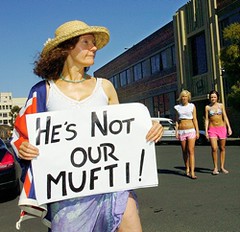
[As a final aside, Louise writes that In addition to helping win support for the invasion of Afghanistan, some feminists have contributed to anti-Muslim racism by advocating a ban on Islamic dress… and have opposed defending Julian Assange against the US government because he has been accused of rape. The mindset that much of the left has, that any attention to “women’s issues” must by definition be a good thing, is wholly inappropriate for the times. Curiously, back in December 2006, Julian Assange’s mother, Christine — who has been a prominent advocate on her son’s behalf — tried to organise a march on the Brunswick mosque by young women clad only in bikinis. #TrueStory]

Posted in Death, Media, Sex & Sexuality, State / Politics, Student movement, That's Capitalism!, Trot Guide | Tagged , , | 10 Comments

Anarchy ~versus~ State Terror

Back in May, five guys in Ohio who thought it would be a Good idea to blow up a bridge got arrested. The government said the plot “was meant to convey a message to the civilian population, the corporate world, the financial system, and all levels of government.” In reality, the Famous Five — Joshua S. Stafford, Anthony Hayne, Brandon L. Baxter, Connor Stevens, and Douglas L. Wright — were actually being set-up by an FBI agent who’d infiltrated their circles (apparently centred on the Occupy movement in Ohio). Now (November 20) the five are being sentenced for their stoopid. Connor Stevens’ Pop complained to the judge that his son had been entrapped. “My son is guilty,” James Stevens said, “and so is the government”, but in sentencing Connor to eight years’ jail and the government to none the judge obviously failed to agree.

Though a strategy with a long history, FBI infiltration and (especially) entrapment appears to becoming more commonplace in recent years (at least as far as this particular milieu is concerned) and seemingly as a result of both (er) difficulties associated with the search + destroy of animal rights and ecological industrial saboteurs and the opportunities provided by radical involvement in Occupy movements in the US.

And ’cause it’s what the state do.

In Melbourne the fact that the Australian Security Intelligence Organisation (ASIO) has recently expressed an interest in teh anarchy has provoked a good deal of disco among local anarks, some serious, some slightly silly. In terms of state shenanigans, probably the most immediately relevant case* is that of Operation 8 in Aotearoa/New Zealand, in which a number of anarchists and indigenous radicals were targeted as part of a state conspiracy to construct a terrorist organisation and to destroy radical activist networks. Well, Operation 8 and the monkey business insurrectionary anarchists on various islands are undertaking…

Some relevant texts made in response to the reportage re ASIO include:

• Rebecca Winter’s response to today’s Fairfax article, Anarchistaffinitymelbourne, November 13, 2012;
• Press Statement, Melbourne Anarchist Club, November 15, 2012;
An open letter to anarchists (and others) in Melbourne (and other places) who feel under attention from the state; or, “Please Don’t Talk To The Cops”, goldenbarleyschool, November 17, 2012;
• Melbourne: Solidarity with grand jury resisters and response to coffee with ASIO, disaccords, November 17, 2012.

The last time I can recall a hullabaloo over similarly spooky goings-on was back in 2007 when another student was approached and invited to spy on activists in Sydney (see Tricksy ASIO wants the nasssty anarchisssts, June 26, 2007). Oddly, the APEC summit which ASIO was one of several agencies responsible for ensuring went smoothly witnessed the first time extreme right-wing activists posing as anarchists went public; the same, slightly smaller mob were at it again last weekend (Saturday, November 24), this time disrupting a ‘pro-Palestinian’ rally (but more on that later).

On November 16 a rally in solidarity with anarchists imprisoned in the US for refusing to cooperate with a Grand Jury took place outside the US consulate on St Kilda Rd. I estimate that somewhere between 50–70 people took part during the course of the afternoon (AA reckons 40–50), and the photographer from the Australian Federal Police (?) obtained a good number of images to add to their files.

In terms of active infiltration, ‘Operation 8’ apparently relied in part on infos provided by a Kiwi fella by the name of Rob Gilchrist; in the UK, police employed Mark Kennedy. (Most recently, Mark has been identified as responsible for infos which brought about French state prosecution of the Tarnac 9.) The massive expansion in mineral resource exploitation, especially coal and uranium, will undoubtedly bring with it a proportional increase in state repression and corporate surveillance and infiltration. Of note in this context is the curious case of Mehmet Ersoy, exposed several years ago in the pages of The Age and, of course, working class stalwart Nicola Roxon’s publicly-expressed fears of Bad people subverting campaigns against the coal and gas industries.

For an historical account of anarchist terror, state violence and public hysteria see The International Campaign Against Anarchist Terrorism, 1880-1930s (Richard Bach Jensen), December 31, 2009.

*Note that ASIO is engaged in some very tricksy business inre refugees, part of a much wider panoply of state powers employed to keep keeping the subhuman tide at bay — to popular applause.

Straya!

Posted in !nataS, Anarchism, Broken Windows, History, Media, State / Politics, That's Capitalism!, War on Terror | Tagged , | 2 Comments

a few notes on things

not really a post so much as a note to self: a SAlt member has written an article examining the public reaction to the rape and murder of jill meagher in melbourne in september. it’s a bit controversial. according to the author:

The horrible rape and murder of Brunswick woman Jill Meagher has been successfully used by the media and authorities to promote a right wing political agenda. Widespread public sympathy has been manipulated in a way that reinforces right wing prejudices, obscures class divisions and encourages identification with authority and the state. The associated mobilisations have likewise not been a positive development, despite what many on the left have argued.

in other spotterly news, SAlt (SA) has issued another thing with the things about unity.

Posted in !nataS, Death, Media, Sex & Sexuality, State / Politics, Student movement, Trot Guide | Tagged | 3 Comments

The Rebirth of Radical Nationalism: Welcome back to the ’30s

[Unsure of authorship but found this via Brian Whelan and thought I may as well republish it here.]

The Rebirth of Radical Nationalism: Welcome back to the ’30s

Warsaw – The past days following the Nationalist riots of November 11, 2012 have been a time of solemn reflection for those of us in Poland and our friends watching around the world. We have awoken to a new reality, not in a hyperbolic or theoretical sense, but to a practical new reality of fascist terror on the streets of our cities, escalating exponentially. With burned out apartments, hospitalized anti-fascists, murders, mass nationalist marches through our cities, and now the formation of nationalist militias, and a call to overthrow the republic, we’re asking ourselves, just as our grandparents asked 80 years ago, ‘how could this be happening in our times?’

Historical Context

The fall of the “communist” dictatorships in the 1990s led to a breeding ground for new political ideologies arising in former one-party states. Where once history was given to the people through Stalinist propaganda, the war over historical truth has returned, and nationalists have done everything in their power to re-envision history to their own sinister benefit. Today we see the trend all across the forgotten side of Europe. In Dresden, the nationalists organize marches to commemorate the victims of Allied bombings; In Hungary, pre-war nationalists (and Nazi allies) are glorified as the true defenders of freedom; In Ukraine, monuments are erected for the terrorist organization UPA and their leaders granted ‘national hero’ status. We are living in extremely uncertain times, and the black and white narrative offered up by the nationalists is resonating with a generation suffering the realities of the modern economy.

In Poland the nationalists have spent the last 20 years co-opting soccer fan clubs in an attempt to take-over working class culture and identity. This is a tactic we’ve seen all over Europe, and the BBC’s documentary criticizing fascist violence in Polish and Ukrainian soccer came as a shock to those outside the region considering a holiday trip to the EURO 2012 tournament. But nationalist culture and ideas are no longer just found around football stadiums, they are creeping more and more into everyday life, into mainstream media, in church sermons, even on university campuses.

The radical nationalists have traded in military garb and football club politics, for suits-and-ties and coalition building. Establishing alliances across the right, including with major media publications, they have gone from Nov. 11 marches of 300 nazi-skinheads in 2009 to 20,000 ‘patriots’ in 2012 ready to ‘overthrow the system’. But we are not only talking about propaganda and marches, we are also confronting a new era of organized and coordinated violence unseen in years. Their strategy being two-fold, to clean up the public image of extreme politics (claiming the narrative of eternal victims, ‘true patriots’ condemned by an oppressive system), while at the same time, creating a culture of violence just below the surface of their organizing. Their strategy culminating this November 11.

We have sat by in horror as gangs of nationalists terrorized Polish cities, and street fighting that accompanied the main march was simply written off by nationalists and their mass of conspiratorial sympathizers as, “provoked by undercover police.” The completely incompetent Polish media began to echo ONR’s claims, matching the long, pitiful history of ‘National victimhood’ which now seems to be the major myth of November 11. Last year’s fairytale of ‘foreign antifascists coming to fight Polish patriots and demolish Warsaw’ has been replaced by a new paranoid theory of ‘undercover police in ski-masks provoking riots in Warsaw.’ The reality remains to be recognized by the mass of society, Polish nationalist violence is spiking and Polish antifascists, immigrants, and LGBT are experiencing it firsthand.

A short summary of the coordinated Nationalist violence in 2012

The wave of violence has not only occurred in recent days, over the past year we’ve seen one murder and dozens if not hundreds of attacks around the country. Easter night in Białystok: A gang of nationalists screaming they would ‘cleanse the city of leftists and faggots’ murdered one student and stabbed several others. Stalking the streets for hours, the police failed to intervene. In Poznań, a children’s art festival hosted by the Rozbrat squat was attacked by groups of men with stones. Opole, a small Kurdish restaurant is attacked by thugs with bats and knives, police ignore repeated complaints from the workers about nationalist threats. In Piła, 2 youths beaten for hanging up posters to a punk concert by 5 men, calling them dirty faggots. In Warsaw, repeated attacks following workers solidarity demonstrations on local labor activists; Attacks on the LGBT-friendly bar “Brave New World” during nationalist marches; Threats against left-wing activists following public demonstrations. In Lublin, an attack on the cultural center Tektura Collective and weeks later on ‘Free Tibet’ demonstrators in the town square. In Sopot, a young man attacked waiting for his train home for ‘wearing colorful pants’ accused of being gay and beaten. In Wrocław, attacks on the equality march by the nationalist “March of Balaclavas”, on the CRK anarchist community center, the local synagogue, etc. A Cuban-Polish soccer player threatened and his motorcycle vandalized with the words “white power” and “KKK.” Attacks on cemeteries, synagogues, monuments, symbols of multiculturalism, cafes, social centers, squats, the list goes on, all in the last 11 months, in towns across the country. And then there is what has happened on November 11.

November 11 was a day the nationalists are triumphing as a great victory; the beginning of a new national front and the beginning of the end of the Polish republic.

The nationalist seizure of power and formation of Nationalist Militias

“We are now living in a new reality – and hardly anyone seems to realize it,” the Antifascist coalition of November 11 has declared. Besides the nationalist riots which rocked Warsaw for the evening of November 11, a range of attacks took place that day to commemorate “National Independence Day.” The Nationalists have announced a new militant strategy against democracy. ONR (Obóz Narodowo Radykalny, the National Radical Camp) and Młodzież Wszechpolska (All Polish Youth) MW, the groups responsible for organizing the march through Warsaw have now officially united and subsequently called for the overthrow of the Republic and the formation of paramilitary groups into a so-called “National Guard.” The call sounds strikingly similar to Hitler’s Brownshirts who patrolled German cities and broke opposition groups in the 1920s and ’30s. Mussolini had similar backing with his “Blackshirts” who took over Rome marching street by street routing political enemies. This is the reality we are talking about, fascist militias coming to a town near you.

We will see how this call is heeded by the Brownshirts of ONR and MW, but if November 11 is any indication, they’re already here. In Wrocław on Sunday night, directly following the “Patriots March” a group of one hundred men forcibly entered the Wagenburg social center and began severely beating people into unconsciousness then fleeing the scene. One man was rushed to the hospital just escaping death, he is currently in critical but stable condition following a number of operations. Cars, houses, and the building itself were also smashed and destroyed. On Facebook, the leader of NOP (another major nationalist organization) congratulated the attackers and cheered for more. The four men arrested following the attack have since been released without charges. In Białystok, the apartment of a Chechen family was firebombed. Also in Białystok, the mayor has now openly said he would like to lobby for ONR. In Warsaw the offices of non-profits were attacked, including those of Lambda as well as attacks on individuals around the city and mass media outlets. In Wieluń a cemetery was vandalized with ONR graffiti. In Ostrołęka, tombs of unknown Russian soldiers were destroyed. These are just some of the attacks we are aware of thus far.

This is an obvious campaign of terror across the country, and we are seeing similar campaigns organized in neighboring countries by neo-fascist groups, some of whom attended Sunday’s March in Warsaw, including Italian, Spanish, Hungarian, Swedish, and Norwegian nationalists. We remember that Anders Breivik, the nationalist who terrorized Oslo in 2011 killing 77 people, cited Polish nationalists as a great “inspiration.”

Apathetic Public, Incompetent Police

With a wave of violence and calls for the overthrow of the government, you may ask yourself where is Polish society and the state in all of this? As mentioned above, it seems as if history is indeed repeating itself. As had happened in pre-Fascist Italy and Spain, the state is arming itself not to protect against a fascist revolution, but repressing left-wing, anarchist, and antifascist organizations that pose more of a threat to economic peace than any fascist takeover could. Furthermore, a culture of apathy and silence has been built in a society which is struggling more to deal with the questions of poverty and identity than the question of Politics. In a system that creates a surplus population of disillusioned poor, it’s no wonder the state would rather see them fighting for the nation instead of fighting for justice. A measurement of just how little the Polish police and government understand of what is happening can be seen by their approach to November 11: harassing antifascists this past week asking ‘if people were planning on any fighting for November 11?’ Of course the antifascist march passed through Warsaw without a hint of violence, while riots raged through the city center in a nationalist show of force, and yet the police spotlight remains against antifascist activists.

And the media? Nationalist and populist ideas are abound in mainstream discourse, ONR has capitalized on the medias uncritical approach to propagate their rhetoric. Even the president, in a populist photo-op, was seen laying wreaths this Independence Day to the Nationalist icon Roman Dmowski. Civil organizations are now open allies with ONR and MW due in large part to the lack of media scrutiny of them or their extreme politics. And any press that does take an active role in criticism? Labeled communist, elitist or Jewish, and attacked in a right-wing media boycott, “I won’t read, I won’t watch.”

And so with all sides covered, it looks to be open season for a new nationalism to spring forth from the ashes of the failed economic experiments of post-communism. The Nationalists are claiming to have the “third road” neither communist nor capitalist, but as they will find, it will be a road riddled with antifascist blockades.

How much longer can we tolerate the growing threat of a nationalist revolution? With nationalist propaganda thriving, and the clever ‘coalition building’ paying off, the shadow of fascism is steadily creeping over this country. As we have seen in the past 2 years the nationalists “third road” will be one paved in our blood. We cannot wait any longer. It’s now or never.

For the memory of our grandparents who liberated the death camps and brought the fascist monster to it’s knees. Let us never again return to that place! No compromise in the struggle against modern fascism ¡No pasarán!

-repost, share, translate freely-

Posted in Anti-fascism, History, State / Politics, That's Capitalism! | 1 Comment

Cardinal Pell, Royal Commissions, dirty cups and whitewashed tombs

“Happily, I think most of Australia was enjoying [and] delighting in the beauty and goodness of these young people and the hope for us doing these sorts of things better in the future, as we saw last night, rather than dwelling crankily, as a few people are doing, on old wounds.” ~ Bishop Anthony Fisher, World Youth Day Coordinator, July 16, 2008, commenting on attempts by victim advocates to use the occasion to draw attention to sexual abuse by clergy.

======

Blah blah blah blah blah… I seem to be losing interest in blogging — at any length. Maybe it’s a temporary lapse or maybe I should just quit.

A few things.

Following Joolya’s announcement on Monday of a Royal Commission into child sex abuse, Cardinal George Pell (above, entering court as a character witness for and alongside of paedophile Catholic priest Gerald Ridsdale in May, 1993) declared that The Media has been engaged in a campaign to demonise The Church by exaggerating the size of such abuse committed by Catholic clergy. His message will no doubt appeal to some among his flock but sadly for Pell it doesn’t appear to have gained much support among the wider population: the 7.30 Report (November 13) provides an excellent summary of his statement and the response. That said:

The truth is, Pell doesn’t need the ear of a prime minister to put his stamp on Australian life. The Catholic Church is by far the biggest non-government organisation in the country, and since he bestrides it like a colossus, he already wields considerable clout. “Australia is 26 per cent Catholic,” he pointed out in a speech he gave in Ireland last year. “We are now the largest denomination, having passed the Anglicans.

“We have a huge network of services: we educate 20 per cent of all Australians in our schools, operate 24 per cent of hospitals, we provide 55 per cent of palliative care … There are also a couple of Catholic universities and an immense welfare system, mostly financed by the government.”

An investigation by BRW magazine in 2006 put the Catholic Church’s revenue in Australia for the previous year near $16.2 billion, all tax-exempt. It is Australia’s biggest private property owner and non-government employer, with more than 150,000 people on its payroll.

Of course, while the Church seemingly possesses enormous wealth and power and enjoys tax-exempt status (“Unlike most other not-for-profit groups, religious groups do not have to file income tax returns and, contrary to the practice in most other countries, they do not have to pay tax on commercial businesses or pay capital gains tax on the sale of assets”) it’s also able to avoid collective legal and financial responsibility for the rape and assault committed by its employees.

And That’s Official.

In 2007 in the case of John Ellis v Cardinal Pell the Catholic Church gained a landmark ruling in the NSW Court of Appeal that effectively meant the church could not itself be held financially responsible for historical sexual abuse committed by its priests.

The Church argued, and the Court held, that the Church’s assets, which are controlled by a set of property trusts, cannot be accessed by victims of sexual abuse. With the accused priest either penniless or deceased, and the Church itself not being a legal entity able to be sued in its own right, victims of sexual abuse are left with no legal remedy.

Which is not to suggest that the Church has not offered victims some token forms of compensation — under processes lauded by its defenders as just and compassionate and which, coincidentally, are cheap and avoid both unnecessary publicity and the necessity of paying for the slightly higher sums needed in order to vigorously defend those accused in the courts. (In which context, see also (former) Detective Chief Inspector Peter Fox’s allegations of sabotage of police investigations by Church and police hierarchy.) Note also that, despite having conducted many hundreds of investigations into such criminality among its priesthood, according to police the Church has failed to alert them to a single instance of such abuse, a practice seemingly in accord with general policy on such matters, examined in some detail by Geoffrey Robertson in his 2010 book The Case of the Pope.

To the best of my knowledge, Royce Communications is responsible for attempting to rehabilitate the Catholic brand (meaning media relations, media training, publicity, marketing, branding, imaging and design, social marketing, government relations, policomms, crisis and issues management, attitudinal research, change management blah blah blah). On Twitter, Reverend Grebo suggested that they promote Father Bob Maguire as the face of The Church. This is not a bad idea, but one obviously not without its problems, not least of which is the fact that Bob’s hardly in a position to influence Church policy, or be regarded as in a position to speak on behalf of the clergy — unlike, say, Cardinal Pell.

In the media, The Usual Suspects — Piers Akerman, Miranda Devine, Gerard Henderson, Greg Sheridan, et al, supplemented by folks like the ABC’s Stephen Scott, perhaps — may be relied upon to launch a counter-attack (and indeed have already commenced doing so), while in politics, The Mad Monk and Joe Hockey — who declared the idea of a Royal Commission “ridiculous” — are in a slightly more difficult bind (for obvious reasons). loon pond provides generally incisive and often amusing commentary on this mob, tho’ perhaps with too frequent resort to ellipses… Otherwise, youse can read what “the only DLP pollie elected to federal parliament for four decades” reckons here.

See also : Church & State & Suicide & Survival (April 13, 2012) | Suffer the Children : Sexual Abuse and the Catholic Church (August 5, 2011).

Posted in !nataS, Broken Windows, History, Media, Sex & Sexuality, State / Politics, That's Capitalism! | Tagged | 6 Comments