Jock Palfreeman is a young Australian currently serving a 20-year sentence for murder in Sofia, Bulgaria. I’ve been following Jock’s case since December 2007 when he was first accused. His account of the events surrounding Andrei Monov’s tragic death has not changed and nothing has been revealed since which has caused me to alter my opinion: Jock is a man unjustly convicted of a crime he did not commit. Recently, I’ve begun reading the book Every Parent’s Nightmare (Allen & Unwin, 2013) by ABC journalist Belinda Hawkins: I would urge anyone with an interest in the case to read it. (I’ll publish a review some time in the next few weeks.)
On Wednesday, July 10, Bulgaria’s chief prosecutor announced that Jock’s bid to serve the rest of his sentence in Australia had been denied on the basis of alleged ‘bad behaviour’ (See : Father urges Kevin Rudd to help Jock Palfreeman secure transfer from Bulgaria to Australian prison, July 10, 2013.) For anyone who’s followed Jock’s case, this announcement was not very surprising: Jock has found himself pitted against the judicial and political system from the start; his ‘bad behaviour’ in prison consisting of attempts to defend the lawful rights of prisoners against abuses by prison authorities. To put it another way, Jock has continued to fight injustice wherever he’s found it, over the last six years from the streets of Sofia to its prison cells.
He needs our support.
You can write to Jock at the following address:
Jock Palfreeman
Sofia Central Prison
21 General Stoletov Boulevard
Sofia 1309
BULGARIA
BHC addresses a letter to Sotir Tzatzarov, in which the organization expresses surprise by the arbitrary motives of the refusal and suspicion about undue external influences on the decision
I’m still Jock Nobody to the Australian authorities, complains Jock Palfreeman, despite the recent publication of a book documenting his case and growing civil support
After years of muck-raking on behalf of the ALP Right, Andrew Landeryou has finally decided to call it quits, publishing a TL;DR statement on his site http://www.vexnews.com/2013/07/the-last-post-landeryou-boned-by-the-faceless-men-of-vexnews/ which, as far as I can tell, boils down to the fact that his rather rudely-expressed opinions have become too burdensome for his better half in her own quest for political power. In any event, Landeryou “will be passing the torch to Leroy Lynch, Nick Mack, Christian Lyons and all the rest of the VEXNEWS team”: and while Leroy appears real, Nick and Christian are seemingly among Andrew’s many pen names; as for “the rest of the team”… who knows?
15 years ago today (July 4), two skinheads — Lin “Spit” Newborn, 24, and Dan Shersty, 20 — were murdered by boneheads in the rocky desert northwest of Las Vegas, USA. They were killed because they were outspoken anti-racists.
In 2001 one bonehead, John Edward Butler, was sentenced to death for the crime (in 2004 his sentence was commuted to life in prison). On March 1, 2012, three more boneheads — Melissa Hack, Ross Hack and Leland Jones — were charged with the murders. Melissa Hack was Butler’s boyfriend at the time of the murders and is accused of luring Dan and Spit into the desert where they were shot; her brother Ross fled the US shortly after the murders using a false passport. He remained overseas for six years. Upon his return he was charged with passport offences and sentenced to three years jail.
The Hacks and Jones have had their trial date set for November 1, 2013.
It pains [Dan’s father] that his son’s sacrifice is unheralded while the media obsesses on the cultural war between liberal and conservative values. It’s a war, he says, that demands no risk whatsoever from its TV-talking head combatants. “Dan died as a soldier who believed in his cause — anti-racism,” says Walter. His son’s ARA troops are still fighting for the cause, though police advised them to leave when rumors surfaced that the Nazis had created a hit list. The cause unites them with something valued in military custom: courage and a code of honor.
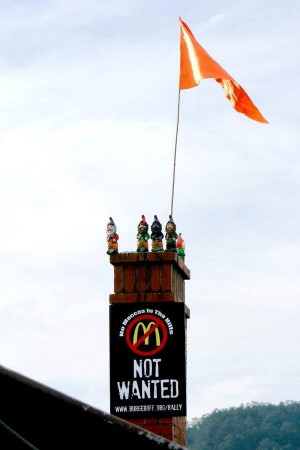
The struggle to save Tecoma and the Dandenongs from colonisation by US fast-food chain McDonald’s appears to be entering its final phase. Earlier in the week McDonald’s mobilised VicPol and private security against locals to evict them from the site of the proposed new franchise (the first of its kind in the area). The state is obviously McHappy to assist the fast-food corporation to do Whatever It Takes to colonise the hills surrounding Melbourne. Ironically, last week the Guardian exposed the fact that UK police employed an undercover agent, Bob Lambert, to infiltrate the campaign against McDonald’s by London Greenpeace, during which time he helped to co-author the famous McLibel leaflet. The campaign was also the subject of a great documentary, produced by Spanner Films.
A couple of people have recently expressed surprise at learning that I do a monthly radio show on Melbourne community radio station 3CR — so I thought I may as well blog about it.
The show is called ‘The SUWA (Squatters’ & Unwaged Workers’ Airwaves) Show’ and I share hosting privileges with my good friend Dr Cam Sexenheimer. We’re on the air every fourth Friday of the month from 5.30-6.30pm and have been (with a few interruptions) since about August 2009; every other Friday SUWA is hosted by other talented folk.
As Dr Cam constantly likes to remind me: our political appetites are enormous but our ambitions are modest; our audience small in number but discerning in taste and beautiful in visage.
3CR has just finished conducting its annual radiothon, aimed at raising $220,000 to ensure the station stays on air for another year. The SUWA Show needs to raise several hundred more dollars in order to meet its goal. If you’d like to help us keep broadcasting, please donate or subscribe to 3CR and let the station know you’re doing it to support The SUWA Show…
Another year, another election, and once again patriots and upright-citizens-with-lower-cognitive-abilities will be appealed to by the far right, while the far left pitch their message to that dreary tribe of high-minded women and sandal-wearers and bearded fruit-juice drinkers who come flocking towards the smell of ‘progress’ like bluebottles to a dead cat.
Or something like that.
R I G H T
For the far right — a mixed bag including Dr James Saleam‘s Australia First Party, a handful of Protectionists, the Freedom-loving, Muslim-hating Nick Folkes, assorted miscellaneous individuals (including some number among the more mainstream Christian parties) and Others — the entry of zillionaire Clive’s ‘Palmer United Party’ and the emergence of the anti-Muslim, anti-multiculturalism Rise Up Australia will sap some energies, as will The Mad Katter in Queensland and Pauline in NSW. And of course, a commitment to Stopping the Boats & Imprisoning their Occupants unites Australia, its voters and its political parties in a way few other issues do (though there are obviously nuances in major and minor party approaches to the question).
But aside, perhaps, from One Nation, which might be more accurately described as right-wing populist, the chief player on the far right is AF. (Late last year Andrew Zammit produced ‘A tentative table on far-right radicalism’ which is especially relevant to this discussion.) AF is standing Alex Norwick in Chifley, Jim Saleam in Cook, John Carbonari in Deakin, Mick Saunders in Lindsay, Tony Pettitt in Macquarie, Michael Chehoff in Newcastle, Terry Cooksley in Port Adelaide, Lorraine Sharp in Riverina and Senate tickets in NSW and Queensland.
Finally, on a related note, the Australian Defence League — now in its third or fourth incarnation on the Internets, the self-appointed leader in this case being some bloke called Ralph Cerminara — appears to be working in close collaboration with the Wilders-inspired micro-Party for Freedom. Both parties are driven by a pathological hatred of Muslims and regularly refer to them as ‘animals’ and ‘scum’.
Ho hum.
L E F T
The Socialist Alliance, Socialist Equality Party and Socialist Party can almost always be relied upon to field candidates, and so too the Communist Party of Australia (although). Fingers xed the Communist League will once again give Ron Poulsen a crack, and who knows, maybe even Trotskyist Platform will throw its hat into the ring. While the SA has yet to announce its full schedule, the SEP has announced it will be fielding “a team of Senate candidates in five states”, though sadly, it seems, none for any Lower House seats. The SP will be hoping Marxist Anthony Main can snatch Melbourne from former Marxist Adam Bandt. In addition, the Progressive Labour Party is contesting a seat in Newcastle.
(Oh and there’s also Pirates and Wikileaks — but that’s another story.)
Thanks to the intelligent use which the German workers made of the universal suffrage introduced in 1866, the astonishing growth of the party is made plain to all the world by incontestable figures …
But, besides, the German workers rendered a second great service to their cause in addition to the first, a service performed by their mere existence as the strongest, most disciplined and most rapidly growing socialist party. They supplied their comrades in all countries with a new weapon, and one of the most potent, when they showed them how to make use of universal suffrage.
There had long been universal suffrage in France, but it had fallen into disrepute through the way it had been abused by the Bonapartist government. After the Commune there was no workers’ party to make use of it. It had also existed in Spain since the republic but in Spain election boycotts had been the rule for all serious opposition parties from time immemorial. The experience of the Swiss with universal suffrage was also anything but encouraging for a workers’ party. The revolutionary workers of the Latin countries had been wont to regard the suffrage as a snare, as an instrument of government trickery. It was different in Germany. The Communist Manifesto had already proclaimed the winning of universal suffrage, of democracy, as one of the first and most important tasks of the militant proletariat …
And if universal suffrage had offered no other advantage than that it allowed us to count our numbers every three years; that by the regularly established, unexpectedly rapid rise in our vote it increased in equal measure the workers’ certainty of victory and the dismay of their opponents, and so became our best means of propaganda; that it accurately informed us of our own strength and that of all opposing parties, and thereby provided us with a measure of proportion second to none for our actions, safeguarding us from untimely timidity as much as from untimely foolhardiness — if this had been the only advantage we gained from the suffrage, it would still have been much more than enough. But it did more than this by far. In election propaganda it provided us with a means, second to none, of getting in touch with the mass of the people where they still stand aloof from us; of forcing all parties to defend their views and actions against our attacks before all the people; and, further, it provided our representatives in the Reichstag with a platform from which they could speak to their opponents in parliament, and to the masses outside, with quite different authority and freedom than in the press or at meetings. Of what avail was their Anti-Socialist Law to the government and the bourgeoisie when election campaigning and socialist speeches in the Reichstag continually broke through it?
With this successful utilisation of universal suffrage, however, an entirely new method of proletarian struggle came into operation, and this method quickly took on a more tangible form. It was found that the state institutions, in which the rule of the bourgeoisie is organised, offer the working class still further levers to fight these very state institutions. The workers took part in elections to particular diets, to municipal councils and to trades courts; they contested with the bourgeoisie every post in the occupation of which a sufficient part of the proletariat had a say. And so it happened that the bourgeoisie and the government came to be much more afraid of the legal than of the illegal action of the workers’ party, of the results of elections than of those of rebellion.
For here, too, the conditions of the struggle had changed fundamentally. Rebellion in the old style, street fighting with barricades, which decided the issue everywhere up to 1848, had become largely outdated …
I’ve been mucking about on Twitter today, trying to track down a story about a poster. It seems that once upon a time, a few months ago, a poster appeared in the window of the Preston KFC (128 Bell Street). The poster contains a really awful sexist joke about Julia Gillard, one which may be traced back a few years. The earliest online example I could find of the poster in question appeared in July 2011…
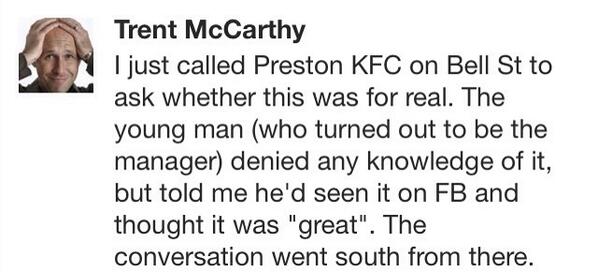
…but the KFC theme has its origins in similar jokes made about Hilary Clinton back in the ’90s (as documented by snopes.com and indirectly referred to in a recent column in The Australian about #menugate). Anyway, to cut a long Twitter story short, the writer Anne Summers assures me that, based on a conversation she had with a journalist who witnessed it, the poster did indeed appear at the KFC in question. The only other detail I think worth adding at this stage is that local (Darebin) Greens councillor/comedian Trent McCarthy apparently contacted the shop and got the following response:
See also : Anne Summers, ‘More in Anger: The politics of gender in Australia in 2013’ (Emily’s List Oration 2013), June 19, 2013 [PDF].
…a good friend of mine was attacked on her bike in Brunswick on Friday night [June 14]. She is OK thank goodness, but very shaken obviously.
She was on Colebrook Street, near Moreland station, just off the Sydney Road bike path. He was wearing a balaclava. He tried to pull her off her bike.
PLEASE BE CAREFUL riding your bike at night in this area. Be on the lookout and avoid areas where there are no people. Carry a whistle with you and have your phone on.
Please also SPREAD THE WORD.
My friend has reported the incident to the police, but they are hopeless with these things…
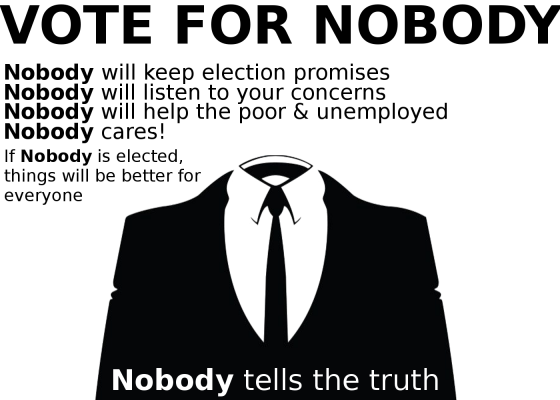
‘If voting changed anything, they’d make it illegal.’
‘Whoever you vote for, government wins.’
‘Don’t vote: it only encourages them.’
‘If you think it’s humiliating to be ruled, how much more degrading is it to choose your master?’
‘A change of rulers is the joy of fools.’
So yeah: there’s an election coming up apparently. In fact, it’s LESS THAN 100 DAYS AWAY (September 14)!
Generally, when it comes to elections, I tend to focus on the margins: who are the kookiestcandidates, which single-issue group has newly-registered, which media celeb or law-talking guy or gel will be the new voice of labour — and just how many votes did the Socialist Alliance get? I’ve also generally assumed that articulating a critique of voting in a democracy such as Australia is unnecessary given that such a critique has been around, in one shape or another, since the beginnings of the modern era and the emergence of mass democratic politics in the late nineteenth century. Certainly, anarchists and other radicals have been banging on about the limitations of ‘democracy’ for long enough. Of course, there’s democracy and then there’s democracy. Of the distinction between representative and delegate democracy, Ken Knabb writes:
In representative democracy people abdicate their power to elected officials. The candidates’ stated policies are limited to a few vague generalities, and once they are elected there is little control over their actual decisions on hundreds of issues — apart from the feeble threat of changing one’s vote, a few years later, to some equally uncontrollable rival politician. Representatives are dependent on the wealthy for bribes and campaign contributions; they are subordinate to the owners of the mass media, who decide which issues get the publicity; and they are almost as ignorant and powerless as the general public regarding many important matters that are determined by unelected bureaucrats and independent secret agencies. Overt dictators may sometimes be overthrown, but the real rulers in “democratic” regimes, the tiny minority who own or control virtually everything, are never voted in and never voted out. Most people don’t even know who they are.
In delegate democracy, delegates are elected for specific purposes with very specific limitations. They may be strictly mandated (ordered to vote in a certain way on a certain issue) or the mandate may be left open (delegates being free to vote as they think best) with the people who have elected them reserving the right to confirm or reject any decision thus taken. Delegates are generally elected for very short periods and are subject to recall at any time.
In the context of radical struggles, delegate assemblies have usually been termed “councils.” The council form was invented by striking workers during the 1905 Russian revolution (soviet is the Russian word for council). When soviets reappeared in 1917, they were successively supported, manipulated, dominated and coopted by the Bolsheviks, who soon succeeded in transforming them into parodies of themselves: rubber stamps of the “Soviet State” (the last surviving independent soviet, that of the Kronstadt sailors, was crushed in 1921). Councils have nevertheless continued to reappear spontaneously at the most radical moments in subsequent history, in Germany, Italy, Spain, Hungary and elsewhere, because they represent the obvious solution to the need for a practical form of nonhierarchical popular self-organization. And they continue to be opposed by all hierarchical organizations, because they threaten the rule of specialized elites by pointing to the possibility of a society of generalized self-management: not self-management of a few details of the present setup, but self-management extended to all regions of the globe and all aspects of life.
But as noted above, the question of democratic forms cannot be separated from their economic context.
Money talks bullshit walks.
Briefly, then: periodic opportunities to vote for parliamentary representatives offers a radically impoverished vision of democracy; the limits of political debate are highly constrained; the reduction of ‘politics’ to the squabbling for power by a small segment of middle-class apparatchiks thrills me now even less than it did when I was a student. Expressed as cynicism, these sentiments are widely shared, but a social movement committed to and capable of realising radical democratic forms — let alone anarchy — is noticeable only by its absence.
Recently, however, I’ve been struck by the importance accorded to the battle between Joolya and The Mad Monk for the title of Prime Minister by some of the folks I follow on Twitter and also by some of the issues raised by Ben Pobjie in his post Seize The Defeat (June 12, 2013). In essence, Ben reckons that those on the nominal ‘left’ should not only adopt lesser evilism (in choosing between X and Y one should choose the better (or less evil) option) but should also (re-)commit themselves to promoting principled policy-making (“let’s rediscover our integrity and commit to standing up, in all circumstances, for what we really believe, for what we think is RIGHT, rather than desperately trying to rationalise support for better-than-Abbott”).
Which is, I suppose, fair enough — as far as it goes.
As far as the True Believers are concerned, one of the few remaining priests outside of the trade union leadership who remains voluble is Bob Ellis — worshipped by Marieke Hardy and also, apparently, responsible for a never-to-be filmed script of Homage to Catalonia — who a few days ago confidently predicted that his party would win in a landslide. Be that as it may, while Labor is represented by Thinkers like Bob and Doers like Paul Howes and Rich0 (below), I can’t see it successfully recapturing that much support between now and its seemingly-inevitable defeat come September.
I’ve never really felt a part of the left, in almost any of its forms, a fact which lends itself to a tendency to be derelict in my democratic duties (aka periodically ratifying in advance the decisions made by politicians). I also think that the contemporary Australian left is a fairly unattractive figure, and the debates over voting — especially insofar as they consist of barracking for Gillard against Abbott — have only made me feel more estranged: if I’m gonna be parochial, I’d rather it be in relation to something silly like sport.
So… to vote, or not to vote?
Each election, for the last 30 years or so, Uncle Joe Toscano has thrown his hat into the ring, not because he has any expectation of winning, but because such occasions provide him with an opportunity to raise the profile of anarchism (just as Engels argued of elections with regards state socialism). Other anarchists (both in Australia and many other countries) have engaged in anti-electoral campaigns, denouncing parliamentary democracy as a sham and proclaiming instead the necessity of social revolution. (If memory serves, former PM Bob Hawke was once pitted by troublemakers against a rat in his seat of Wills.)
In the 1980 federal election the late, great anarchist poet Jas H Duke wrote “Hang Fraser” on the House of Representatives ballot paper, “The Road to Excess Leads To The Palace Of Wisdom” on the (much larger) Senate paper, and then wrote a poem about it. Duke was foremost a boomingly witty poet and a very demonstrative activist, one who sure knew his Blake and his Bakunin.
Apart from Clive Palmer’s Uniting Australia Party, among the other new parties scrambling for your vote in 2013 are the Animal Justice Party, Bank Reform Party, Bullet Train for Australia, Pirate Party and Rise Up Australia Party; the AEC also maintains a list of those parties which have ended, stumbling bleary-eyed into the harsh light of political reality. As far as achieving social reform is concerned, a seat in parliament can be a worthy goal – the election of Julian Assange would be a curious thing – but for those of us who wish to really change things the struggle, as ever, is on the streets.
[TO BE CONTINUED…]
I am not a Labor Leader; I do not want you to follow me or anyone else; if you are looking for a Moses to lead you out of this capitalist wilderness, you will stay right where you are. I would not lead you into the promised land if I could, because if I led you in, some one else would lead you out. You must use your heads as well as your hands, and get yourself out of your present condition; as it is now the capitalists use your heads and your hands.
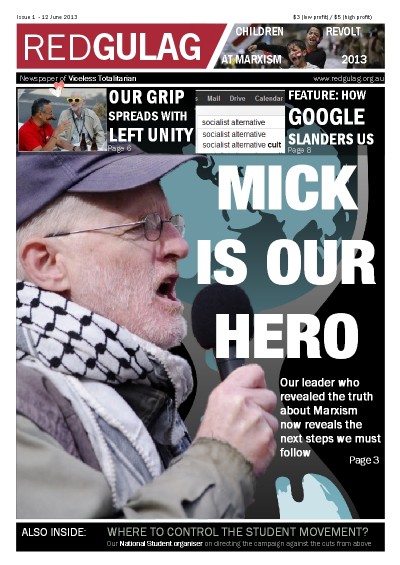
A critic sent me the above image to accompany the launch of a new fortnightly newspaper, Red Flag. Produced by Socialist Alternative, “a revolutionary Marxist organisation” (with many hundreds of members it is, perhaps, apart from Socialist Alliance, the largest such organisation in Australia), the new project represents a major new investment for the party. (For a recent overview of Australian organisations on the revolutionary left, see Trot Guide 2012.) While obviously intended to be a humourous rather than a serious critique of the organisation, the claim that SAlt is in some way equivalent to a cult seems to have some traction on the internets, so I thought I’d see if there’s any substance to it.
There is a dearth of literature documenting the existence of cults in the political sphere. This paper suggests that some left wing organizations share a number of ideological underpinnings and organizational practices which inherently inclines them to the adoption of cultic practices. In particular, it is argued that doctrines of ‘catastrophism’ and democratic centralist modes of organization normally found among Trotskyist groupings are implicated in such phenomenon. A case history is offered of a comparatively influential Trotskyist grouping in Britain, which split in 1992, where it is suggested that an analysis of the organization in terms of cultic norms is particularly fruitful. This is not intended to imply that a radical critique of society is necessarily inappropriate. Rather, it is to argue that political movements frequently adopt organizational forms, coupled with ‘black and white’ political programmes, which facilitate the exercise of undue social influence. This stifles genuinely creative political thought. Issues which this analysis suggests are particularly pertinent for those involved in radical politics are considered.
He writes:
…political cults tend to be characterised by the presence of the following traits.
1. A rigid belief system. In the case of left wing political cults this suggests that all social, natural, scientific, political, economic, historical and philosophical issues can only be analysed correctly from within the group’s theoretical paradigm – one which therefore claims a privileged and all-embracing insight. The view that the group’s belief system explains everything eliminates the need for fresh or independent thought, precludes the possibility of critically appraising past practice or acknowledging mistakes, and removes the need to seek intellectual sustenance outside the group’s own ideological fortress. All such thinking is dismissed as contaminated by the impure ideology of bourgeois society.
2. The group’s beliefs are immune to falsification. No test can be devised or suggested which might have the effect of inducing a reappraisal. The all-embracing quality of the dominant ideology precludes re-evaluation, since it implies both omniscience and infallibility. Methods of analysis which set themselves more modest explanatory goals are viewed as intrinsically inferior. Those who question any aspect of the group’s analysis are branded as deviationists bending to the ‘pressures of capitalism’, and are driven from the ranks as heretics.
3. An authoritarian inner party regime is maintained. Decision making is concentrated in elite hands, which gradually dismantles or ignores all formal controls on its activities. Members are excluded from participation in determining policy, calling leaders to account, or expressing dissent. This is combined with persistent assurances about the essentially democratic nature of the organization, and the existence of exemplary democratic controls – on paper.
4. There is a growing tendency for the leaders to act in an arbitrary way, accrue personal power, perhaps engage in wealth accumulation from group members or in the procuring of sexual favours. Activities which would provoke censure if engaged in by rank and file members (e.g. having a reasonable standard of living, enjoying time off, using the organization’s funds for personal purposes) are tolerated when they apply to leaders.
5. Leader figures, alive or dead, are deified. In the first place, this tends to centre on Marx, Trotsky or other significant historical figures. It also increasingly transfers to existing leaders, who represent themselves as defending the historical continuity of the ‘great’ ideas of Marxist leaders. In effect, the new leaders are depicted, in their unbending devotion to the founders’ ideals, as the reincarnation of Marx, Trotsky or whoever. There is a tendency to settle arguments by referring constantly to the sayings of the wise leaders (past or present), rather than by developing an independent analysis. Even banal observations are usually buttressed by the use of supporting quotations from sanctified sources.
6. There is an intense level of activism, precluding outside interests. Social life and personal ‘friendships’ revolve exclusively around the group, although such friendships are conditional on the maintenance of uncritical enthusiasm for the party line. Members acquire a specialised vocabulary (e.g. they call each other ‘comrade’), which reinforces a sense of distance and difference from those outside their ranks. The group becomes central to the personal identity of members, who find it more and more difficult if not impossible to imagine a life outside their organization.
While some find the presence of SAlt members at public rallies very annoying, and others claim the organisation is unduly hostile to former members or members of rival organisations who operate on the same territory, I don’t see how much of the above can fairly be applied to it. Of course, this may simply be a matter of size — SAlt is considerably smaller than Militant was at the time Tourish examined it — or a sign of the times. In any event:
1. There is a certain degree of ideological rigidity in SAlt – its theoretical productions are rather dull, in my opinion, and hardly represent the best of Marxist-influenced theory — and it subscribes to some variant of ‘revolutionary Marxism’, but I’m not sure it’s so crass as to proclaim its total understanding of Australian or global society. In any case, its most sophisticated ideological output may be found in its journal, Marxist Left Review.
2. This second point — immunity to falsification — is closely related to the first. Certainly, any claims to being avant-garde can be fairly easily refuted by reference to some of SAlt’s less-successful ventures into political activism.
3. I’ve never been a member of SAlt and know few who have been, so I’m not especially familiar with its internal regime. Certainly, the organisation’s Constitution is a public document and seems to embody a reasonable degree of formal democracy.
4. I’m not aware of any evidence to suggest any such corruption — “a growing tendency for the leaders to act in an arbitrary way, accrue personal power, perhaps engage in wealth accumulation from group members or in the procuring of sexual favours” — on the part of SAlt’s leadership.
5. In terms of ideological debate, while Marx and Lenin remain crucially important figures, I’m not aware of any SAlt leaders claiming any such authority or, moreover, who could avoid being widely laughed at if they did.
6. There does seem to be an intense level of activism on the part of SAlt members, though the extent to which its organisational culture as a whole promotes this kind of social and political alienation is an open question (for which anecdotal evidence is insufficient to rely upon for any kind of authoritative answer).
In summary, while their analysis may be fundamentally flawed, their program unattractive, and their politicking sectarian, it doesn’t seem to be either especially accurate or terribly useful to simply dismiss SAlt as a ‘cult’. A useful critique of their underlying political philosophy — since slightly altered by the decision by the Revolutionary Socialist Party to join them — is Marxism, Anarchism, & the Genealogy of “Socialism From Below” by Tom Keefer (Upping the Anti, No.2, 2005). (“At its final congress on 28 March 2013, the RSP voted unanimously to merge with Socialist Alternative.”)
Two Greek anarchists are making molotov cocktails. One says to the other: "So who will we throw these at then?" The other replies: "What are you, some kind of fucking intellectual?"