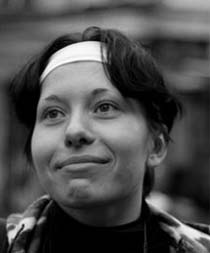
I just got word that Andrew Giles-Peters (below) died earlier this week.
Among other things, Andrew was an anarchist, a student activist in the late 1960s and ’70s, and a philosopher who wrote and taught extensively on revolutionary history and ideology, including developing a libertarian interpretation of Marx (see for example his translation of ‘Ten Theses on Marxism Today’ by Karl Korsch, originally published in Telos, Winter 1975/6, and ‘Karl Korsch: A Marxist Friend of Anarchism’, originally published in Red & Black, No.5, 1973. On Karl Korsch, see Douglas Kellner, editor, Karl Korsch: Revolutionary Theory, University of Texas Press, Austin & London, 1974 [PDF]).
I met Andrew at LaTrobe in the early ’90s, and found him to be friendly, knowledgeable and open-minded — a quiet inspiration.
World Agenda: riots in Iceland, Latvia and Bulgaria are a sign of things to come
But probably not in Australia, which has one of the most docile publics of any Western society.*
GAZA
Joseph K has some interesting thoughts on the subject of ‘Beyond good and evil: the Gaza massacre’. “The left’s response to Israeli atrocities in Gaza provides a case study in ressentiment. If we want to stop such slaughters rather than participate in the spectacle of them, we need to stop fetishising distant victims and start trying to exercise power over our own lives so that meaningful solidarity becomes possible…”
GREECE Anarchists: kind, polite, and considerate
Greek anarchists pay for senior’s torched kiosk
Agence France-Presse
January 20, 2009
THESSALONIKI, Greece – Two months after her kiosk was torched in local riots an elderly woman from Thessaloniki has received an unlikely cash gift from anarchists to rebuild her life, a press report said on Tuesday. “As anarchists, we felt we should support a fellow human victimized by blind violence,” an organization calling itself Anarchist Initiative said in a statement sent to Eleftherotypia daily. The anarchists set up a special bank account to support 74-year-old Harikleia Ananiadou and collected 13,000 euros ($18,000 US) for the cause. “We gave what we could, even beyond our means, because we know that it would be difficult for her to make a new start at her age,” Initiative member Panagiotis Papadopoulos told Angelioforos daily. “It was an act of solidarity to a woman who could be our mother,” he added. Ananiadou’s kiosk burned down in November during clashes between youths and police on the sidelines of a street demonstration. The government recently announced compensation packages for business owners who suffered damage in the wave of violence that swept the country in December following the fatal shooting of a teenage boy. But Ananiadou says she missed out because her kiosk was gutted a month earlier. “I received only empty promises (from the state) … I feel very fortunate that these boys came along to help,” she said.
ICELAND
Wow. Things have really been kicking off in the land of ice. The former Danish colony is at present in the midst of a serious economic crisis, one triggered by the global financial meltdown of last year. In October 2008, its banking system and currency collapsed, the country’s three biggest banks were nationalised, and as a result many have lost their jobs as well as their savings. Thus: “In total are 12.134 persons registered as unemployed at the employment office. There … are 7654 men and 4480 women. In the capital area are 7656 registered as unemployed. In total were 7020 registered unemployed in December which was a 45% increase from November.” NB. As of January 1, 2007, Iceland has a total population of 307.672.
Icelandic News in English is a great new resource which has been documenting some of the people’s struggles in that part of the world. According to one report: “The protests are now the longest and most virulent that have been at Austurvollur [a square in old town Reykjavik surrounded by the Parliament Building] since the membership of Iceland in NATO was protested there in 1949, or 60 years ago.”
There’s anarchists in Iceland too. Or at least one. Here’s a blog. Unfortunately, it’s in Icelandic: maybe it could be translated by the nice people at Icelandic News?
RUSSIA Actions to commemorate Stas and Nastya around Russia
Anastasia “Skat” Baburova murdered : “Our friend and comrade Skat [30.11.1983 – 19.01.2009] was murdered [Monday] in Moscow, shot to head by an assassin. She was studying in evening line of journalist faculty of Moscow State University. She worked a while in “Izvestiya”, but left and worked as a freelancer. She joined Autonomous Action a day before she got murdered. Inside the movement, Nastya got well along with everyone…”
Skat was killed alongside of lawyer Stanislav Markelov.
THAILAND
More wow. An Aussie, Harry Nicolaides, 41, has been sentenced to jail for insulting the Thai monarchy. Harry:
…originally received a six-year sentence, which the court said it reduced because he had pleaded guilty. The book, Verisimilitude [PDF], was published in 2005 and reportedly sold fewer than a dozen copies. The case was brought under the country’s strict lese majeste laws, which call for a jail term of up to 15 years for anyone who “defames, insults or threatens the king, the queen, the heir to the throne or the Regent.” The presiding judge said Monday that parts of the book “suggested that there was abuse of royal power.”
Foreign Minister Stephen Smith says Australians should abide by the rules of the countries they visit.
He said the charge involves a book he wrote about the military coup in September 2006 that ousted former Prime Minister Thaksin Shinawatra. At a news conference last week, he said the law “restricts freedom of speech and expression and does not allow for public accountability and transparency of the institution of the monarchy.” In November, a prominent social critic and Buddhist intellectual, Sulak Sivaraksa, was charged with lese majeste for questioning the need for lavish celebrations of the king’s reign. Last April, an activist named Chotisak Onsoong, was summoned by the police after refusing to stand up during the playing of the Royal Anthem before a movie. And a former government minister under Thaksin, Chakrapob Penkir, has been charged in connection with remarks he made at the Foreign Correspondents Club of Thailand…
Giles writes on his blog that “…it is clear that this lese majeste charge is really about preventing any discussion about the relationship between the military junta and the Monarchy. This is in order to protect the military’s sole claim to legitimacy: that it acted in the interests of the Monarchy.”
Associate Professor Giles Ji Ungpakorn, Faculty of Political Science, Chulalongkorn University, Bangkok, Thailand, Ji.ungpakorn[at]gmail[dot]com
I stand here today humbled by the task before us, grateful for the trust you have bestowed, mindful of the sacrifices borne by our ancestors. I thank President Bush for his service to our nation, as well as the generosity and cooperation he has shown throughout this transition.
Forty-four Americans have now taken the presidential oath. The words have been spoken during rising tides of prosperity and the still waters of peace. Yet, every so often the oath is taken amidst gathering clouds and raging storms. At these moments, America has carried on not simply because of the skill or vision of those in high office, but because We the People have remained faithful to the ideals of our forbearers, and true to our founding documents.
So it has been. So it must be with this generation of Americans.
That we are in the midst of crisis is now well understood. Our nation is at war, against a far-reaching network of violence and hatred. Our economy is badly weakened, a consequence of greed and irresponsibility on the part of some, but also our collective failure to make hard choices and prepare the nation for a new age. Homes have been lost; jobs shed; businesses shuttered. Our health care is too costly; our schools fail too many; and each day brings further evidence that the ways we use energy strengthen our adversaries and threaten our planet.
These are the indicators of crisis, subject to data and statistics. Less measurable but no less profound is a sapping of confidence across our land — a nagging fear that America’s decline is inevitable, and that the next generation must lower its sights.
Today I say to you that the challenges we face are real. They are serious and they are many. They will not be met easily or in a short span of time. But know this, America — they will be met.
On this day, we gather because we have chosen hope over fear, unity of purpose over conflict and discord.
On this day, we come to proclaim an end to the petty grievances and false promises, the recriminations and worn out dogmas, that for far too long have strangled our politics.
We remain a young nation, but in the words of Scripture, the time has come to set aside childish things. The time has come to reaffirm our enduring spirit; to choose our better history; to carry forward that precious gift, that noble idea, passed on from generation to generation: the God-given promise that all are equal, all are free, and all deserve a chance to pursue their full measure of happiness.
In reaffirming the greatness of our nation, we understand that greatness is never a given. It must be earned. Our journey has never been one of short-cuts or settling for less. It has not been the path for the faint-hearted — for those who prefer leisure over work, or seek only the pleasures of riches and fame. Rather, it has been the risk-takers, the doers, the makers of things — some celebrated but more often men and women obscure in their labor, who have carried us up the long, rugged path towards prosperity and freedom.
For us, they packed up their few worldly possessions and traveled across oceans in search of a new life.
For us, they toiled in sweatshops and settled the West; endured the lash of the whip and plowed the hard earth.
For us, they fought and died, in places like Concord and Gettysburg; Normandy and Khe Sahn.
Time and again these men and women struggled and sacrificed and worked till their hands were raw so that we might live a better life. They saw America as bigger than the sum of our individual ambitions; greater than all the differences of birth or wealth or faction.
This is the journey we continue today. We remain the most prosperous, powerful nation on Earth. Our workers are no less productive than when this crisis began. Our minds are no less inventive, our goods and services no less needed than they were last week or last month or last year. Our capacity remains undiminished. But our time of standing pat, of protecting narrow interests and putting off unpleasant decisions — that time has surely passed. Starting today, we must pick ourselves up, dust ourselves off, and begin again the work of remaking America.
For everywhere we look, there is work to be done. The state of the economy calls for action, bold and swift, and we will act — not only to create new jobs, but to lay a new foundation for growth. We will build the roads and bridges, the electric grids and digital lines that feed our commerce and bind us together. We will restore science to its rightful place, and wield technology’s wonders to raise health care’s quality and lower its cost. We will harness the sun and the winds and the soil to fuel our cars and run our factories. And we will transform our schools and colleges and universities to meet the demands of a new age. All this we can do. All this we will do.
Now, there are some who question the scale of our ambitions — who suggest that our system cannot tolerate too many big plans. Their memories are short. For they have forgotten what this country has already done; what free men and women can achieve when imagination is joined to common purpose, and necessity to courage.
What the cynics fail to understand is that the ground has shifted beneath them— that the stale political arguments that have consumed us for so long no longer apply. The question we ask today is not whether our government is too big or too small, but whether it works — whether it helps families find jobs at a decent wage, care they can afford, a retirement that is dignified. Where the answer is yes, we intend to move forward. Where the answer is no, programs will end. And those of us who manage the public’s dollars will be held to account — to spend wisely, reform bad habits, and do our business in the light of day — because only then can we restore the vital trust between a people and their government.
Nor is the question before us whether the market is a force for good or ill. Its power to generate wealth and expand freedom is unmatched, but this crisis has reminded us that without a watchful eye, the market can spin out of control — and that a nation cannot prosper long when it favors only the prosperous. The success of our economy has always depended not just on the size of our Gross Domestic Product, but on the reach of our prosperity; on the ability to extend opportunity to every willing heart — not out of charity, but because it is the surest route to our common good.
As for our common defense, we reject as false the choice between our safety and our ideals. Our Founding Fathers, faced with perils we can scarcely imagine, drafted a charter to assure the rule of law and the rights of man, a charter expanded by the blood of generations. Those ideals still light the world, and we will not give them up for expedience’s sake. And so to all other peoples and governments who are watching today, from the grandest capitals to the small village where my father was born: know that America is a friend of each nation and every man, woman, and child who seeks a future of peace and dignity, and we are ready to lead once more.
Recall that earlier generations faced down fascism and communism not just with missiles and tanks, but with sturdy alliances and enduring convictions. They understood that our power alone cannot protect us, nor does it entitle us to do as we please. Instead, they knew that our power grows through its prudent use; our security emanates from the justness of our cause, the force of our example, the tempering qualities of humility and restraint.
We are the keepers of this legacy. Guided by these principles once more, we can meet those new threats that demand even greater effort — even greater cooperation and understanding between nations. We will begin to responsibly leave Iraq to its people, and forge a hard-earned peace in Afghanistan. With old friends and former foes, we will work tirelessly to lessen the nuclear threat, and roll back the specter of a warming planet. We will not apologize for our way of life, nor will we waver in its defense, and for those who seek to advance their aims by inducing terror and slaughtering innocents, we say to you now that our spirit is stronger and cannot be broken; you cannot outlast us, and we will defeat you.
For we know that our patchwork heritage is a strength, not a weakness. We are a nation of Christians and Muslims, Jews and Hindus — and non-believers. We are shaped by every language and culture, drawn from every end of this Earth; and because we have tasted the bitter swill of civil war and segregation, and emerged from that dark chapter stronger and more united, we cannot help but believe that the old hatreds shall someday pass; that the lines of tribe shall soon dissolve; that as the world grows smaller, our common humanity shall reveal itself; and that America must play its role in ushering in a new era of peace.
To the Muslim world, we seek a new way forward, based on mutual interest and mutual respect. To those leaders around the globe who seek to sow conflict, or blame their society’s ills on the West — know that your people will judge you on what you can build, not what you destroy. To those who cling to power through corruption and deceit and the silencing of dissent, know that you are on the wrong side of history; but that we will extend a hand if you are willing to unclench your fist.
To the people of poor nations, we pledge to work alongside you to make your farms flourish and let clean waters flow; to nourish starved bodies and feed hungry minds. And to those nations like ours that enjoy relative plenty, we say we can no longer afford indifference to suffering outside our borders; nor can we consume the world’s resources without regard to effect. For the world has changed, and we must change with it.
As we consider the road that unfolds before us, we remember with humble gratitude those brave Americans who, at this very hour, patrol far-off deserts and distant mountains. They have something to tell us, just as the fallen heroes who lie in Arlington whisper through the ages. We honor them not only because they are guardians of our liberty, but because they embody the spirit of service; a willingness to find meaning in something greater than themselves. And yet, at this moment — a moment that will define a generation — it is precisely this spirit that must inhabit us all.
For as much as government can do and must do, it is ultimately the faith and determination of the American people upon which this nation relies. It is the kindness to take in a stranger when the levees break, the selflessness of workers who would rather cut their hours than see a friend lose their job which sees us through our darkest hours. It is the firefighter’s courage to storm a stairway filled with smoke, but also a parent’s willingness to nurture a child, that finally decides our fate.
Our challenges may be new. The instruments with which we meet them may be new. But those values upon which our success depends — honesty and hard work, courage and fair play, tolerance and curiosity, loyalty and patriotism — these things are old. These things are true. They have been the quiet force of progress throughout our history. What is demanded then is a return to these truths. What is required of us now is a new era of responsibility — a recognition, on the part of every American, that we have duties to ourselves, our nation, and the world, duties that we do not grudgingly accept but rather seize gladly, firm in the knowledge that there is nothing so satisfying to the spirit, so defining of our character, than giving our all to a difficult task.
This is the price and the promise of citizenship.
This is the source of our confidence— the knowledge that God calls on us to shape an uncertain destiny.
This is the meaning of our liberty and our creed — why men and women and children of every race and every faith can join in celebration across this magnificent mall, and why a man whose father less than sixty years ago might not have been served at a local restaurant can now stand before you to take a most sacred oath.
So let us mark this day with remembrance, of who we are and how far we have traveled. In the year of America’s birth, in the coldest of months, a small band of patriots huddled by dying campfires on the shores of an icy river. The capital was abandoned. The enemy was advancing. The snow was stained with blood. At a moment when the outcome of our revolution was most in doubt, the father of our nation ordered these words be read to the people:
“Let it be told to the future world…that in the depth of winter, when nothing but hope and virtue could survive … that the city and the country, alarmed at one common danger, came forth to meet [it].”
America. In the face of our common dangers, in this winter of our hardship, let us remember these timeless words. With hope and virtue, let us brave once more the icy currents, and endure what storms may come. Let it be said by our children’s children that when we were tested we refused to let this journey end, that we did not turn back nor did we falter; and with eyes fixed on the horizon and God’s grace upon us, we carried forth that great gift of freedom and delivered it safely to future generations.
Thank you. God bless you. And God bless the United States of America.
“From behind the velvet rope of the Melbourne night club scene, two MCs, MervdaPerv^ and Benny “Bugzie” Sinclair, ‘tell it how it is’…” with a style of rhyming “unprecedented in its brutal reality”, and a certain sense of humour that “only real Bouncers could portray”. Their debut album ‘King Hits’ features Niko, Pegz, Billy Bunks, Blades and Eloquor. Also featuring on ‘King Hits’ is Ben Hense from Mr Jigga on bass and guitar. Produced by ARIA-award winning CJ Dolan, two-time Australian DMC DJ champion, the album will feature skits by Dave Hedgcock, King of the Clubs and ex-pro boxer (from the days of T.V. Ringside) Dennis “the Flash” Wittnal. “‘King Hits’ will be a must have album.”
BOUNCER : ‘Bouncer’
*TV RINGSIDE screened from July 1966 till June 1975. 319 Programs and 2870 Bouts (1450 on air). The venues included the Channel 7 studios in South Melbourne, Festival Hall Brisbane, South Sydney Leagues Club, the Southern Cross Hotel and of course Festival Hall in Melbourne. Among the hundreds of fighters that appeared were: Barry Michael and Rocky Matioli — who went on from TV RINGSIDE to win World Championships — Hec Thompson and Tony Mundine — each of whom went on to challenge for world titles — Charkey Ramon, Hec Thompson, Bobby Dunn and Toro George — who all won Commonwealth Titles on the program…”
“…The cigar-smoking, joke-cracking [Mervyn Louis] Williams, whose black-rimmed glasses were pinned by ears thickened from boxing, broadcast his ‘Mervisms’ on radio 3DB’s ‘Sports Forum’, and later on HSV7’s ‘TV Ringside’. Tired and beaten boxers ‘couldn’t run out of sight on a dark night’, ‘swayed like a jelly in a wind’, or ‘had less chance than a crippled prawn in a flock of seagulls’.”
“If Russians are so interesting to you, move to Russia.” ~ Fruitsalad, Melbourne Punx Forum | “No offence but honestly who gives a shit about some [lawyer] in Russia.” ~ Nowave, Melbourne Punx Forum
Top rights lawyer shot dead in Moscow
Michael Schwirtz, Moscow The Age (New York Times)
January 21, 2009
A PROMINENT Russian lawyer who spent almost a decade pursuing contentious human rights and social justice cases has been killed in a daylight assassination in central Moscow.
Stanislav Markelov was shot dead on Monday after holding a news conference at which he said he would continue to fight against the early release of Yuri Budanov, a former Russian tank commander jailed for murdering a young Chechen woman.
[Bella Ciao reports Markelov “was about to give a press conference against neo-fascism in Russia.”]
Anastasia Baburova, a 25-year-old journalist who was with Mr Markelov, was also killed. She worked for the Novaya Gazeta newspaper, which is highly critical of the Government.
Officials said they believed Mr Markelov, 34, was the primary target, having brought cases against the Russian military, Chechen warlords and murderous neo-fascists.
His murder had the characteristics of a contract killing, a not uncommon phenomenon in Russia.
Mr Markelov was the director of the Rule of Law Institute, a civil liberties group. He gained prominence representing the family of Elza Kungayeva, an 18-year-old Chechen whom Budanov admitted strangling in his quarters in March 2000, just as the second post-Soviet war in Chechnya was beginning to rage.
Budanov was sentenced to 10 years in prison but was given early parole for good behaviour.
At the news conference Mr Markelov had told reporters he might file an appeal to the European Court of Human Rights against the early release of Budanov, a decorated colonel of the Russian army before he was stripped of his rank.
The decision to free Budanov sparked protests and outraged human rights groups and Chechen officials.
It reignited tensions years after a decade of intermittent war in Chechnya, the southern Russian republic, was replaced by tenuous stability.
But Budanov was also revered by nationalists for helping to wage a bloody but necessary war against separatist rebels in Chechnya. Some now see Mr Markelov’s murder as revenge for his efforts against a Russian hero.
The lawyer of the Kungayev family, the relatives of a Chechen woman, who was murdered by a Russian army colonel, Yury Budanov, has been killed. Stanislav Markelov was shot dead in the centre of Moscow in broad daylight on Monday.
According to witnesses, a man wearing a ski-mask approached Markelov and Anastasia Baburova, a 24-year-old free-lance journalist for ‘Novaya Gazeta’ newspaper, in the street and took out a gun.
The lawyer was shot dead on the spot, while the woman was fatally injured with a gunshot wound to the head, and died shortly after she was taken to the hospital.
”Today at around 14:20 Moscow time, a man’s body with a wound to the head was found in the centre of Moscow. The ID found on the victim identified him as the lawyer Stanislav Markelov. The second victim, Anastasia Baburova, also with wounds to the head has been critically injured. The ID found on her identifies her as a student of a Journalist’s faculty,” Vladimir Markin from the General Prosecutor’s Office Investigative Committee, said…
See also : Russian Rights Attorney, Reporter Murdered, The Other Russia, January 19, 2009. The Washington Post has the best headline so far: Two More Critics of Vladimir Putin Take Bullets in the Head: “The larger story here is of serial murders of Mr. Putin’s opponents, at home and abroad. Ms. Baburova, 25, is at least the 15th journalist to be slain since Mr. Putin took power. No one has been held accountable in any of the cases — including that of Anna Politkovskaya, a former client of Mr. Markelov who also was murdered execution-style in broad daylight, on Mr. Putin’s birthday in 2006. In London, dissident former KGB agent Alexander Litvinenko was poisoned; so was Ukrainian President Viktor Yushchenko, who survived. Karina Moskalenko, another opposition lawyer who has represented Ms. Politkovkaya’s family, fell ill from mercury poisoning in Strasbourg, France, in October, just before a hearing in the case. Last week in Vienna, a Chechen dissident who had received political asylum was murdered on the street — shot twice in the head.”
Dead lawyer Stanislav Markelov, who represented dead Chechen Elza Kungayeva, also once represented dead journalist Anna Politkovskaya. In November 2008, he represented anti-fascist Aleksey Olesinov; curiously, Russian police apparently attempted to link Aleksey to the murder investigation of dead anti-fascist Fedor [Fyodor] Filatov.
On a brighter note, Russian murderer Yury Budanov is alive and well, as is Russian dictator Alexander Putin.
It’s a funny old world, but as Dion stated on the Bombshell forum, Stanislav, Elza and Anna are were liars, hypocrites and no better than the trash that they fight fought against.
Bah humbug. The chattering classes are at it again: David Burchell in the pages of The Australian and James L Gelvin in the pages of the not-quite-as-popular journal Terrorism and Political Violence (tho’ I imagine Burchell expresses similar sentiments in his crackademic scribblings). So I’m gonna waste some more of my precious time on my way to an early grave by… er… let’s see.
One. Taking note of the fact that Paul Norton once penned a piece for Larvatus Prodeo asking the question ‘Is David Burchell brain-dead?’ (October 2, 2007). Burchell on 1968 and all that (May 28, 2008) tends to suggest that the answer remains a conditional ‘yes’. (Similarly craptastic ideas of Burchell’s are to be found in Stumbling in harmony with history, The Australian, December 29, 2008.)
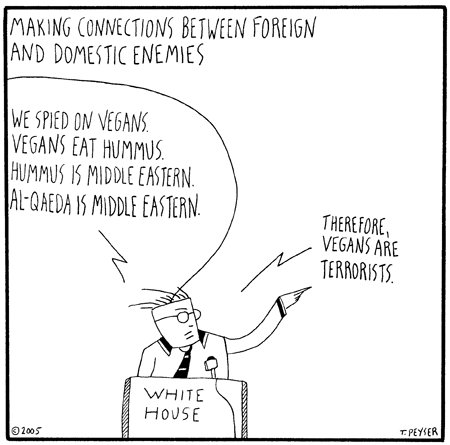
Two. Re-publishing the debate on Gelvin’s thesis that, inre Al-Qaeda, ‘it was the anarchists what done it’… Or something.
Being un anarcholoco fuelled only by mountains of organic hummus and rivers of organic coffee, scarcely more than an adolescent, lacking all experience of real life, my mind confused by ill-digested philosophical, social, political and economic theories, and perplexed by the drab monotony of my everyday life, I make the empty, arrogant, and pathetic claim to pass definitive judgments, sinking to outright abuse, on my fellow-students, their teachers, God, religion, the clergy, the governments, newspapers, academic journals and political systems of the whole world. Rejecting all morality and restraint, I do not hesitate to commend theft, the destruction of scholarship, the abolition of work, total subversion, and a world-wide proletarian revolution with “unlicensed pleasure” as its only goal.
I also already done published three essays from Terrorism and Political Violence, in seemingly random order.
“Brandon Darby of Austin, Texas was an activist in the global struggle against capitalist neoliberalism. Brandon Darby was also working undercover as a snitch for the FBI. Surprisingly, he’s proud to be an informant and has come out in the open about it…”
“An Austin-based activist named Brandon Darby has revealed he worked as an FBI informant in the eighteen months leading up to the Republican National Convention. Darby has admitted to wearing recording devices at planning meetings and wearing a transmitter embedded in his belt during the convention. He is expected to testify on behalf of the government later this month in the trial of two Texas activists who were arrested at the RNC on charges of making and possessing Molotov cocktails.”
A reply to John Surname, principally, but also an opportunity to review some of the recent history of squatting in Australia. S is for SHACking Up, Soul Train & Squatting (January 16, 2009) was a previous post responding to some criticisms of SHAC, but on squatting, property and housing issues more generally. John wrote on the subject of Diddly-Squatters on January 14. The following img, taken from John’s post, graphically portrays the general tone of his writing on the subject of squatting:
And here’s some recent commentary from John (and A.J):
Yeah I read it.Your post is mostly quotes from centuries past, and then you don’t even make any kind of coherent point. Squatting is for bums and lowlifes, and in this day and age is a lifestyle choice. Maybe the students should grow up and actually go and meet some real homeless people.
Why do you support their actions, and squatting in general?
John Surname | Homepage | 01.19.09 – 1:57 pm
“Over a century ago, a Frenchman called Paul (1841-1911) made the following observations on property.”
Fucking lol.
A.J | Homepage | 01.19.09 – 4:15 pm
So to begin…
OK. Yeah: I quoted some peeps: George Orwell’s adaptation of I Corinthians xiii (Keep the Aspidistra Flying: first published by Gollancz in 1936); and Paul Lafargue on ‘Capitalist Property’ (1903).
On the other hand, I also cited Julia Gillard’s speech of March 2008, and half-a-dozen or so media reports from December 2008/January 2009, one from 2004, and two studies (2007 and 2002) both by Richard James, Director of the Centre for the Study of Higher Education and Professor in Higher Education at unimelb.
As for whether or not I made any kind of coherent point, maybe not, but you can’t blame a bloke for trying.
So I’ll try again:
“Squatting is for bums and lowlifes, and in this day and age is a lifestyle choice.”
In reality, squatting is for anyone who chooses to utilise vacant buildings for accommodation or other, social purposes. Leaving aside the emergence of a squattocracy in the nineteenth century, “bums and lowlifes” have been occupying buildings in this manner in Melbourne, Australia, and cities and lands across the world for many, many years.
This paper will consider whether the term patrimonialism can be applied to a particular, keenly contested and racially bifurcated aspect of Australian history: the relations between ‘squatters’ and those with competing civil and property claims. The discussion will draw parallels between Australia and other settler societies.
“Squattocracy” has had a lively currency in Australian political history. It was first used to designate the social, political and economic power of pastoralists who acquired use rights over vast stretches of grazing land in the early years of white settlement. For many 19th century colonial activists, it was the key enemy of ‘closer settlement’, capitalist farming and industry, and democratic reform. Squattocracy was associated with the long domination of upper houses of Australian legislatures by inherited wealth. It has been a periodic target of those determined to achieve the principle of ‘one man, one vote’. Squattocracy also figured prominently in periodic public debates on the class character of early Australia, and on the role of ‘ruling elites’ more generally.
There may be two distinct histories of patrimonialism in Australia. The Australian colonies were among the pioneers of ‘universal’ male and later female franchise in the nineteenth century; Aborigines gained [de jure] full citizenship only in the late 1960s. While the squatter’s patrimonial rule over white settlers was arguably short-lived, that over some groups of Aboriginal people persisted, for good or ill, for more than a century.
I suppose squatting could be described as a ‘lifestyle choice’ for some; then again, some term homosexuality the same thing. In reality, things are a little more complicated. In any case, even if one were to concede (and I’m happy to do so) that squatting is a choice, the fact that a choice has been made does not tell us anything about the legitimacy or validity of that decision. But what I think you’re alluding to is a more general critique of a certain species (stereotype) of student radical, for whom squatting is one of a number of choices (including the adoption of one or more sorts of food faddism) that together add up to the fulfillment of a certain social role (and cliche). Hence, I think, your admonition that “Maybe the students should grow up and actually go and meet some real homeless people”. That is, on the one hand, there are “fuckwits who think they deserve to live in someone’s else property for free because it’s their right to live in the inner city”, and on the other hand, “real homeless people”; and never the twain shall meet.
For what it’s worth, I think that the gulf that separates impoverished students and squatters, on the one hand, and “real homeless people”, on the other, is narrower than you believe. For example, I know many individuals who have squatted, both in Melbourne and other cities, in Australia and overseas, and their relationship to homelessness and to the homeless is a good deal closer than you appear to assume is generally the case. I also know a number of housing and youth workers — some of whom have been homeless and/or squatted properties — who have intimate knowledge of squatting, and are sympathetic to the squatting movement.
There is also a considerable body of scholarship on the subject (mainly concentrating on urban squatting in Europe and urban and rural squatting movements in Africa, Asia and South America), and even some attempts at documenting this history in Australia. For example, Lock Out the Landlords: Anti-eviction Resistance in Australia 1929–1936 (Barricade Library Publishing, 1998; second edition, Homebrew Cultural Association, 2008) examines workers’ attempts to resist eviction during a period of ah, more “robust” political discussion. A good deal more can and has been written about the squatting movements of the 1960s and 1970s — see, for example, Squatters’ Handbook Chapter 11, ‘Squat History’, 2004.
CANBERRA — The Unemployed Workers Union squatted in a house belonging to the ACT Department of Health after discovering that the property, usually reserved for its secretary, had been left vacant for more than six months. [The UWU] organised an open occupation in the hope of providing suitable accommodation for some of the many homeless or needy people in Canberra. Best described as opulent, this residence is set in large, well-kept, leafy gardens on half an acre of land with a northerly aspect next to the Royal Canberra Hospital. The building is two stories and has double brick construction, four bedrooms, two bathrooms, a huge living area, wall to wall carpets and curtains on every window. Power was still connected, as were two telephone lines. The kitchen included a refrigerator and microwave oven…
MELBOURNE — There have been squatters for as long as there has been the concept of owning land. At certain times it has been condoned, but not today. Last century, Australian land was settled by the “squattocracy”, the landed class which grew rich on convict labour. For many people today, squatting is an act of necessity. Students, single parents, unemployed and others not eligible for social security often have little choice. In some cases, squatting is also a political act to deny property owners money for rent, and instead to use this money for clothing, food and other necessities. “Government departments leave buildings empty, yet there is a huge housing list. The logical thing to do is to put your housing [needs] in your own hands”, says Genevieve, a spokesperson for the Squatters Information Service, established earlier this year to provide information on squatting and support for squatters…
SYDNEY — A group of homeless people were abruptly evicted from a disused warehouse here on January 31 by oil giant Shell. The homeless people had been squatting in the warehouse for almost one year. According to the squatters, Shell has no plans to use the heritage-listed building immediately. However, Gavin Sullivan, spokesperson for Sydney Housing Action Collective, said “Shell’s approved development plans indicate the building will eventually be knocked down and replaced by a service station, convenience store and the ubiquitous McDonald’s”.
SYDNEY — On August 23, South Sydney City Council workers armed with sledgehammers and crowbars attempted to evict almost 30 homeless squatters from council-owned buildings at 147-159 Broadway, near Glebe. The squats are less than 100 metres from the office of the Sydney Organising Committee for the Olympic Games. After failing to gain entry, the council officers refused to negotiate with the squatters and called the police to have the squatters evicted…
SYDNEY – The owners’ plan for the Grand Midnight Star would have been nothing like it. Rather than becoming just another block of flats, the enormous Heritage-listed art deco theatre on Parramatta Road in Homebush has become a “social centre” for community activities and political organising. The new occupants, a collection of activists who make up the Social Centre Autonomous Network (SCAN), have reinvented the space. The downstairs bar has been turned into a place where activist groups can meet and where people can eat and chat, the lobby has been fitted with a dozen computers, an empty side room has become an art gallery, the industrial-sized kitchen has been taken over by Food Not Bombs and the cavernous ballroom, complete with chandeliers, will become a venue for gigs and raves…
…In the 1970s, the lack of affordable housing in Redfern drove many Kooris to squat in empty houses, and in response police arrested and charged squatters with trespassing. The local church hall became a home for increasing numbers of homeless, until it was shut down by the South Sydney Council. It was with the help of the NSW Builders Labourers Federation and the plumbers union that houses were brought up to a liveable standard, resulting in 45 Indigenous people residing in three houses in the Redfern Block. When development threatened to displace the residents, the BLF placed a ban on all development in the area and any other work that the construction company was doing. It is this kind of union and community solidarity that is needed to defend the Redfern Block today, 30 years later. A real answer has to involve Indigenous self-determination…
The practice of squatting buildings for ’social’ as opposed to purely ‘private’ (residential) purposes has a long history. To cite one example, on January 1, 1987 (1987 having been designated International Year of Shelter for the Homeless) squatters occupied a disused cafe opposite Princess Pier in Port Melbourne. Subsequent activities included the usual array of meetings, workshops, benefit gigs, film screenings, performances, a cafe (needless to say!), etcetera.
To cite another, more recent example: the Brown Warehouse in Wellington Street, Collingwood (now a yuppie apartment complex). First squatted in the late ’80s as a cafe and performance space, it was re-squatted in the mid-’90s, and used for much the same purposes (Dropdead even played a gig there), at first providing temporary accommodation in the city for forest blockaders, later becoming a more permanent residential and social space.
In a related case, during the 1980s and into the early-’90s, the Squatters Union of Victoria: maintained an office and meeting space (in an abandoned fire station in North Fitzroy); produced a radio show; distributed a bi-monthly zine (Squat It!), conducted a weekly community cafe; operated a telephone advice service; produced leaflets, stickers and various other forms of propaganda (in addition to the bi-monthly zine); organised benefit gigs; resisted evictions; and engaged in various other activities in solidarity with others engaged in workplace (for example, the BLF) and community struggles.
In Williamstown (Melbourne) in 2002 there began a series of art shows called ‘Empty Show’, held in abandoned properties [VIDEO].
Squats have also been established to house conferences. A few examples: in May 2004 over 500 people attended a conference for four days in a reclaimed warehouse in inner city Melbourne. ‘State of Emergency’ was a series of workshops, forums, parties and film screenings that attempted to come to grips with the new forms of state power, war and neo-liberalism that pervade everyday life [VIDEO]. ‘A Space Outside’ was a gathering of educational and creative workshops and direct action training that took place in the lead up to the G20 summit mobilisation in Melbourne from 17th * 19th November, 2006. Over the course of five days, approximately 400 people came through the space before it was busted by seventy police on Friday 17th November, the eve of the main protest. At the same time that ‘A Space Outside’ was being evicted, so too was ‘The Wake’, a squat which served both a residential and social function (gigs, meetings, workshops, etc.).
Currently, hundreds if not thousands of individuals squat in Melbourne, mostly in order to provide themselves with a roof over their heads. I support the actions of SHAC because I support direct action — in this case squatting — in order to solve social issues — in this case housing for the low-waged. Beyond this, the proposal SHAC made with regards establishing a student housing cooperative at 272–278 Faraday Street seems to me to be eminently reasonable, and has numerous precedents, most obviously STUCCO (197–207 Wilson Street, Newtown, Sydney), a student housing cooperative at the University of Sydney, originally established as a squat in the late ’70s and early ’80s, and which currently houses a total of 38 people in 8 self-contained units at low cost (app. $70 per week).
Fuckwits, bums and lowlifes in Victoria Street, Sydney, 1970s
Those who were part of the long drawn-out campaign that followed Arthur King’s disappearance speak of a constant air of danger and intimidation. Roelof [Smilde] says, ‘The number of residents still in the street just kept on dwindling. When Arthur first disappeared there were plenty but gradually they got more isolated and the more isolated they got the worse they felt about it, and finally they’d leave. In the end there was only a handful. When it got to the point where there was literally only two or three left, that’s when we started the squats. That was our final tactic.’
The decision to squat was made when Mick Fowler was the only tenant left in the threatened buildings. It was a last-ditch attempt to prevent the buildings from being vandalised by Theeman’s men.
Squatting was not unique to Sydney but part of a worldwide-trend whereby squatters, often young, usually poor, stymied developers who wanted to pull down the old inner-city residential areas and build luxury high-rise offices and apartments in their place. Squatting has been used as a tactic in Amsterdam for more than twenty years.
A couple of dozen Push people squatted in Victoria Street, joined by a whole range of people, from dedicated conservationists to followers of fringe political groups to the homeless just looking for a place to sleep. The Libertarians had wanted two things: to protect the architecture of Victoria Street and to keep the area for low-cost housing ‘for knockabout students, sailors and all the sorts of people who used to live there’.
‘To bring back low-cost housing to one of the best streets in Sydney?’ Arthur King says. ‘Shit, it had no chance of success.’
Roelof says, ‘It was a battle for the inner-city, for low-income residents to be able to stay there, and that was lost. It wasn’t lost in Woolloomooloo. A lot of the spin-off from Victoria Street was successful — in places like Woolloomooloo, the Rocks and Darlinghurst and Waterloo. But in Victoria Street we lost.’
The Victoria Street group knew that one way to succeed was to send Theeman broke. And they almost did it. By 1974, the hold-up in the Victoria Point development was costing Theeman $16,000 a week in interest payments.
But the squatters were up against a businessman who was getting desperate and a team of heavies with little regard for ethics. The tactics employed against them became more dangerous, including the firing of houses, with or without squatters in them. In one such fire, an Aboriginal girl who was camping in one of the houses died.
Intimidation came not just from hired men but from the police. One night when Wendy [Bacon] was squatting in the street, the door of the flat was broken down in the middle of the night by members of Squad 21, the vice squad.
In January 1974 the squatters were evicted by police, assisted by gangs of men employed by Victoria Point Pty Ltd. These men were organised by Fred Krahe [1919–1981], a former policeman. Video footage from the event shows wild scenes of squatters on roofs, clinging to chimneys, and people being hauled away to paddy vans.
By this time Wendy was living with Roelof at his flat at Darling Point. On Valentine’s Day, she received an orchid from an unknown admirer. Inside it was a bullet an a note: ‘Have a good day but avoid barbers’ shops.’
‘That was the second time I was really frightened. The first time had been after Arthur disappeared. And the next time was when Juanita [Nielsen] disappeared.’
While Wendy became nervous, Roelof wanted to keep going. He was heavily committed. He was financing a lot of the Victoria Street activities and was neglecting his punting. The expensive flat wouldn’t flat much longer. Before long he’d be broke. ‘Not that it mattered,’ he says. ‘I’d been broke before.’
After the squatters were evicted it looked the Victoria Point project would go ahead. Within months Norm Gallagher succeeded in taking over the NSW branch of the BLF; [Jack] Mundey, [Bob] Pringle and [Joe] Owens were expelled, never to work on a building site as builders’ labourers again. Gallagher’s first act was to lift the ban on Victoria Street. The same day, he was seen driving down Elizabeth Street in a car with Frank Theeman.
But just when Theeman thought he’d rid himself of one thorn in his side, there was another. Juanita Nielsen was an unconventional heiress who owned a house on the eastern side of Victoria Street. She had been overseas during the early days of the battle and when she returned she, like other owner-occupiers, was not initially impressed with the squatting campaign, fearing the effect on property values. She published a local newspaper, NOW, that was primarily an advertising rag. But in 1974, Juanita’s position, and her newspaper, began to change. In the months leading up to her disappearance in July 1975 she carried on a single-handed and highly effective battle with developers.
In an article about Juanita at the time of the inquest into her death, Wendy Bacon wrote, ‘The middle-class heiress who had once worried about the effects that green bans and squatters would have on property values was filling NOW with militant phrases such as, “Laws are based around property, not people. Green bans made people more important.”‘
Juanita Nielsen disappeared after a meeting with Edward Trigg at the Carousel Club. Trigg, who ran a club for Jim Anderson, said they discussed an advertisement that he wanted to run in her newspaper. The club was owned by an Abe Saffron company. After absconding, Trigg was eventually caught, pleaded guilty to conspiring to abduct Juanita Nielsen, and spent two years in jail. No one has ever been charged with her murder. At the inquest — where Arthur King first told his story publicly — it emerged that not long before Juanita’s abduction, Frank Theeman had paid Jim Anderson a sum of money, ostensibly for investing in a business.
Not long ago, Tim Bristow, private investigator to the glitterati, said he had been offered the contract to kill Juanita Nielsen, that he had turned it down, and that the man who did it was Freddy Krahe, Roelof’s ‘killer cop’. Krahe died in 1981.
By the time the developers had rid themselves of the Push, the BLF and Nielsen, public and government standards on urban conservation had shifted, aided by the Federal Minister for Urban Affairs, Tom Uren. The Labor Government would soon be thrown out of office, but it had made a difference to Libertarians after all. Theeman never got his forty-storey towers; the Victoria Point development went ahead but on a reduced scale, not providing Roelof’s dreamed-for low-cost housing, but city homes for the urban middle-class.
Today, Victoria Street is peaceful and tree-shaded; a mixture of elegant restored terrace houses, backpacker hotels and trendy cafes, with a few cheap flats in still-unrestored buildings. When Mick Fowler died in 1979, the street was closed as hundreds of people turned out to farewell him: seamen, conservationists, builders’ labourers, university lecturers, musicians, public servants, middle-class trendies, anarchists and activists, demonstrating the extraordinary range of people mobilised in this extraordinary battle.
At the top of the sandstone steps that lead down to Woolloomooloo is a plaque to Mick Fowler: ‘Seaman, musician, green ban activist … for his gallant stand against demolition of workers’ homes … from his friends.’
~ Anne Coombs, Sex and Anarchy: The Life and Death of the Sydney Push, Viking, 1996, pp.296–299.
See/hear also : Mick Fowler – 115 Victoria St, ABC, 1979 | Wendy Bacon, ABC, 1974. The Juanita Nielsen Mystery (ABC): “In 1977 ABC Radio’s Double J produced this radio documentary looking at the conflict between residents of Victoria St in Kings Cross and developers. Double J 1977.” Video: ABC TV 1976, “ABC TV’s This Day Tonight investigates this mystery one year after Juanita’s disappearance. ABC TV, 1976.” ABC TV 2004, “In 2004, ABC TV’s 730 Report investigates fresh allegations about the unsolved Juanita case. ABC TV, 2004.” Killing Juanita: a true story of murder and corruption, Peter Rees, Allen & Unwin, 2004. Rocking the Foundations, 1986: “An outstanding historical account of the Green Bans first introduced by the New South Wales Builders Labourers Federation in the 1970s in response to community demand to preserve inner-city parkland and historic buildings. One of the first women to be accepted as a builders labourer, filmmaker Pat Fiske traces the development of a quite singular union whose social and political activities challenged the notion of what a union should be.” Green Bans, Red Union: Environmental Activism and the New South Wales Builders Labourers’ Federation, Meredith Burgmann & Verity Burgmann, UNSW Press, 1998.
Two Greek anarchists are making molotov cocktails. One says to the other: "So who will we throw these at then?" The other replies: "What are you, some kind of fucking intellectual?"