G20: According to Newscorpse // FN: Internet geeks steal my heart

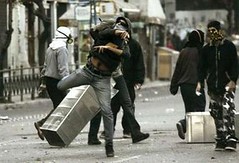
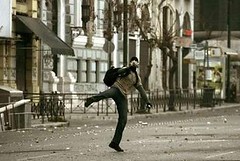
Yanqui citizen (since 1985), champion of journalistic freedoms, and owner of Newscorpse Rupert Murdoch‘s most widely consumed Orstralian newspaper the Herald Sun has an ‘In-depth Report’ on the cowardly thugs who held Melbourne to ransom last November. It also contains reportage on unsuccessful attempts by citizens gathered outside of the Hyatt to have a word or two with some of the leading architects of global capital (de-)regulation gathered in corporate luxury within.

Orstralia

I don’t live this life for me
In Orstralia land so free
Everybody lazing in the sun
Nobody cares so let’s have fun

We got no problems, got no wars
And you don’t need your brain no more
No sir

Orstralia goes in once again
We must remember all our friends
And to make sure all the way
That we support the CIA

We got no problems, got no wars
And you don’t need your brain no more
No sir

Hang your washing on the line
It’s okay, the weather’s fine
Your hubby goes out, don’t commit no crime
He always gets to work on time

We got no problems, got no wars
And you don’t need your brain no more
No sir

You know you’re blah blah blah
In Orstralia
In your own backyard
In Orstralia
So come on, let’s have fun
In Orstralia

… in the land of the hope ‘n’ glory …

See also: Columbia Journalism Review corporate timeline (1910s–2004)

W. James Au has written a really entertaining account (Fighting the Front, January 15, 2007) of a political struggle against attempts by French fascists and members of the Front National to infiltrate the online world of Second Life. It’s fuckin’ hilarious: the FN’s virtual HQ was attacked by good ol’ Thomas the Tank Engine, among others, and “One enterprising insurrectionist created a pig grenade, fixed it to a flying saucer, and sent several whirling into Front National headquarters, where they’d explode in a starburst of porcine shrapnel”! Ha ha ha! The fascist wankers were eventually forced to flee their HQ, and have since set up shop in another quarter (see below).

See also : Exploding pigs and volleys of gunfire as Le Pen opens HQ in virtual world, Oliver Burkeman in Porcupine, The Guardian, January 20, 2007 — note that ‘The Guardian‘s avatar… tracked down the Front National to Axel, another region in Second Life, where they had rebuilt their headquarters and were engaging a handful of opponents in relatively restrained debate. “Le Pen is the son of Hitler,” one protester ventured. “I know lots of people descended from immigrants who vote for the Front National because they’re not ashamed to be French,” a moronic Le Pen supporter countered, “and I think you’ll be surprised at how many people of an… immigrant background vote for Le Pen at the next election”.’ | Second Life bears political protest against right wing group, Mike Bantick, iTWire, January 21, 2007

Posted in !nataS, Anti-fascism, Media, State / Politics | 5 Comments

John HoWARd, Fun-da-mentalist, Playing with Fire

    “I like your Christ, [but] I do not like your Christians. Your Christians are so unlike your Christ.”

    “Those who say religion has nothing to do with politics do not know what religion is.”

    Mahatma Gandhi (1869–1948)

    And Jesus entered the temple and drove out all those who were buying and selling in the temple, and overturned the tables of the money changers and the seats of those who were selling doves.

It seems that that the sheer hypocrisy of HoWARd and his Government really does know no bounds.

Despite constant whinging and whining about the supposedly unique virtues of ‘Australia’ and the preciousness of ‘Australian values’ — coupled with angwy denunciations of those who would supposedly imperil them — in the same week that David Hicks celebrated his fifth year of imprisonment in the torture camp in Guantanamo Bay, Cuba, HoWARd has found the time to pwe-wecord a vewy special message for the benefit of local Christian fun-da-mentalist sect Catch the Fire, whose prosecution and conviction for religious vilification of Muslims, since overturned on appeal, generated much discussion.

Hello there.

I am delighted to send my good wishes to everyone attending the 2007 United Prayer meeting. Today is, of course, Australia Day.

It’s a time when we celebrate the freedom and privileges we enjoy as citizens of a great, prosperous and peaceful nation – so blessed with an abundance of natural beauty.

It’s also a time to reaffirm our commitment to shared values and our abiding loyalty to our nation, Australia. Christianity has been an enormous force for good and has done more than anything else to shape the lives, not only of millions of Australians, but the character of our nation.

I congratulate Catch the Fire Ministries for bringing Christians from many denominations together for this celebration and I wish you all [a] very happy Australia Day.

Your prayers for our nation are deeply appreciated.

But not as much as their votes, of course, or their many other contributions (alongside other fun-da-mentalist sects such as the Exclusive Brethren) as foot-soldiers in a cultural war against the social forces that oppose HoWARd’s political agenda for this “great, prosperous and peaceful nation” — including that “abundance of natural beauty” which HoWARd seeks to completely denude, not least through massively amplifying its uranium mining and — God-willing — nuclear power industries.

Hallelujah!

Peace & Prosperity

One might be forgiven for thinking that Australia was indeed a ‘peaceful’ nation, were it not for the fact that ‘we’ are currently at war: with the people of Iraq. And in this war, the HoWARd Government has distinguished itself by being the most loyal of President Bush’s foreign allies, bar none. Thus while the Australian military presence in Iraq is relatively tiny, on the world’s political stage, HoWARd’s status as loyal lackey to US state power is notorious. So too, the HoWARd Government’s complete and utter abandonment of one its own citizens to continuing torture by foreign soldiers: another case of Australian ‘exceptionalism’ joining with American.

Most recently, Adelaide private schoolboy and Australian League of Rights (ALOR) alumnus Alexander Downer has again been caught with his pants down, in this case for claiming that lies issuing from a US Embassy official in Canberra (Nance Haxtonis, US Embassy official identified as source of Hicks information, PM, January 19, 2007) constitutes firm evidence regarding Hicks’ perilous mental state. Previous to this latest political debacle, Downer distinguished himself by signing a pact (November 13, 2006) with the Indonesian Government intended to further the efforts of both Governments to destroy independence movements within the (claimed) territories of Australia’s northern neighbour: especially those of the (overwhelmingly Christian and Melanesian) population of West Papua.

Natural Beauty

As Jeff Sparrow has documented elsewhere, Pastor Danny Nalliah, like Downer, is an ALOR alumnus, addressing a meeting of the tired old racists in Albury-Wodonga in 2005. His comrades on the podium on that occasion included a vewy special foreign guest: Canadian professional Holocaust denier Paul Fromm. (Whom, incidentally, addressed gatherings of the Australia First Party on the same tour.)
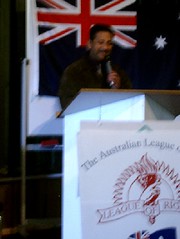
Among its other activities, Nalliah and Catch the Fire specialise in denouncing Islam, their activities in this regard supported by the (no-doubt deeply appreciated) racist and sexist utterances of a number of local Islamic clerics. One, Sheikh Feiz Mohammed, the head of some mob called the ‘Global Islamic Youth Centre’ in Sydney, has recently come under the (national and international) public spotlight for releasing a DVD in which he describes Jews as pigs, and encourages Muslims to wage jihad (Radical Islamic cleric sparks outrage in Australia, AP, International Herald Tribune, January 17, 2007). And, in what is becoming his personal trademark, “Keysar Trad, head of the Islamic Friendship Association, said the jihad remarks might have been misinterpreted, but he conceded that they were not helpful to Australian Muslims”. Duh. (Australia Cleric: Remarks Misinterpreted, Meraiah Foley [AP], The Guardian, January 19, 2007.)

    Pigs are intelligent creatures, by the way. “They are smarter than dogs and every bit as friendly, loyal, and affectionate. When in their natural surroundings, not on factory farms, they are social, playful, protective animals who bond with each other, make beds, relax in the sun, and cool off in the mud.” Yay for pigs!

    An interesting discussion of the history of Islamic ‘anti-Semitism’ (see below) is provided in a paper [PDF] by Matthias Kuntzel (Technical College, Hamburg, and Research Fellow at the Vidal Sassoon Institute, Hebrew University, Jerusalem): ‘Hitler’s Legacy: Islamic Antisemitism in the Middle East’, presented on November 30 last year as part of Yale’s ongoing series of seminars on ‘Anti-Semitism In Comparative Perspective’:

    Anti-Judaism, or the controversial term coined in the 1870s by Wilhelm Marr [1819–1904], Antisemitism, is one of the most complex and, at times, perplexing forms of hatred. It spans history, infecting different societies, religious and philosophical movements, and even civilizations. In the aftermath of the Holocaust, some contend that Antisemitism illustrates the limitations of the Enlightenment and modernity itself. Manifestations of Antisemitism emerge in numerous ideological based narratives and the constructed identities of belonging and otherness such as race and ethnicity, nationalisms, and anti-nationalisms.”

    Note that Andrea Dworkin (1946–2005), in her Scapegoat: The Jews, Israel and Women’s Liberation (Free Press [Simon & Schuster/CBS], New York, 2000) erroneously describes Marr as an “anarchist”. On anarchism in Germany, see in particular the criminally-neglected life and work of Gustav Landauer (1870–1919).

In any case, last December, two Melbourne locals — Christine Hawkins and Chris Gemmell-Smith — ‘inspired’ by another cleric’s comments on women, their (supposed lack of) dress sense and subsequent reduction in status to cat food, decided to organise ‘The Great Australian Bikini March’ on a local Brunswick mosque. Like Tamworth Council’s decision to reject the re-location of a number of Sudanese refugees to their town, the March immediately attracted the interest and approval of local racists and fascists, especially those on Stormfront Down Under. One in particular, Perth-based convicted neo-Nazi criminal Ben Weerheym, grabbed the ball and ran with it (much to everyone’s considerable amusement), and the March, under pressure from local anti-racists, turned into a complete non-event… while the community BBQ organised by members of the mosque proved to be more enjoyable.

But the story doesn’t end there. Upon cancelling the March in December — a decision accompanied by much pissing and moaning about the nefarious role of local media in distorting their oh-so-innocent message — the organisers re-scheduled it for Australia Day, 2007… only to then declare that this March too, was cancelled, and, furthermore, the organisers would be taking their bat-and-ball back home to Endeavour Hills. At which point, others entered the fray, including one David Ross, a local Christian and ‘concerned citizen’; though Ross’ concerns don’t appear to extend much beyond the supposed dangers associated with the presence of Islam in Australia (rather than, say, the role of neo-liberal economics in destroying the social fabric and, hence, ‘the (bourgeois) family’).

While appearing to be a little isolated (to put it mildly) in his attempts to keep the flame of bigotry — first ignited by the anti-Arab and anti-Muslim pogrom in Cronulla in December 2005 — alight, the theme of Ross’ re-framed (non-)event — ONE NATION, ONE CULTURE, ONE RACE — certainly mirrors HoWARd’s eforts to consolidate unthinking submission to the state under the banner of ‘nationalism’. And as Ghassan Hage wrote in ‘Ayatollah John’s Australian Fundamentalism’ (Arena Magazine, February/March, 2001):

To say that John Howard is on the extreme right of the Liberal Party, or that he represents a conservative cultural backlash against what he and his supporters perceive as the excesses of the pro-multiculturalism and pro-Indigenous rights of his predecessor, would hardly be controversial. But to talk about ‘fundamentalism’ would easily lead one to be accused of getting too rhetorical and too carried away, or simply of just exaggerating for political point-scoring. I don’t mind some political point-scoring. But in this essay I would like to initiate the beginning of an analytical claim that there are important elements of John Howard’s politics that can be classified as fundamentalist. As importantly, I want to argue that his fundamentalism is beginning to mark our political culture in a significantly negative way.

In the Western world, fundamentalism is too easily linked with the ‘irrational’ and despotic movements whose highly dramatic visuals have filled the newspapers and televisions of the late twentieth century. To speak of fundamentalism is to almost inevitably conjure up images of politicised religious groupings with affectively charged members marching down the streets bent on re-introducing pre-modern cultural forms into our post-modernity. While there is no doubt that these forms of politics have been historically associated with fundamentalist politics, this link between form and content is not a necessary one. There is nothing that logically stops us from conceiving a rational/bureaucratic/democratic politics from being animated by a fundamentalist ideology.

John Howard and the essence of being Australian

The most basic feature of all fundamentalist ideologies is the belief in the existence of a social essence (core ‘fundamental’ values and beliefs) of which a national society is but an expression. Though such a belief is not in itself sufficient to turn someone into a fundamentalist, it is a necessary one. In Australia, the usage of a notion of ‘Australian values’ is something quite widespread among both the Left and the Right. However, we should begin by noting that no politician has used it as much as Howard does. No politician is as systematic as he is in deploying the concept, and no one positions it as the cornerstone of a holistic political vision of Australia as he does.

Whether addressing school-children or elderly Australians, business groups or immigrant associations, whether speaking on reconciliation or on Australia’s relation to Asia, John Howard’s political discourse is always woven around an explicit notion of Australian values. These values are Australian in a strong sense. That is, they differentiate Australians from other people in the world. They trace what Howard considers a unique ‘Australian way’.

What are these Australian values? There are some values that are constant in Howard’s prime-ministerial discourse, and some that come and go. Just looking at the speeches of 1998 offers us an incredible array of ‘values’. In his Australia Day speech for that year, Howard informs us that ‘the ethnic diversity and tolerance of our community gives Australia a unique standing in the world. This status is underpinned by the traditional Australian values of persistence, mateship, voluntary effort and optimism’. In an address to the Jewish community in Sydney we get another set of values:

    A great strength of the Jewish community has been the promotion of genuine Australian values common to all of us:

    * the primacy of family life and its importance in building strong and enduring communities;

    * the value of enterprise, the work ethic and reward for effort, and;

    * the active recognition of the obligation to give back where benefit has been received. (March 10, 1998, Israel’s fiftieth birthday celebration dinner, Sydney)

In his speech at the reconciliation summit a couple more values are added, ‘the values of decency, tolerance, fairness and down-to-earth common sense’ (May 26, 1997, Australian Reconciliation Convention, Melbourne). Talking to high school students Howard adds to the ever present ‘traditions of mateship’ the tradition of ‘treating people fairly on the basis of their contribution to society’ (July 10, 1998, St Paul’s School, Queensland). On the other hand, the speech to the Federation of Indian Associations stresses ‘the importance within the Australian community of … those enduring Australian values of tolerance and harmony’ (August 15, 1998, Federation of Indian Associations Dinner, Melbourne). And, in addressing a group of Australian business people, Howard urges his audience ‘to hang on to those Australian values of fairness and tolerance and equality and mateship’ (October 8, 1998, Australia Business Limited Annual Dinner, Sydney).

As pointed out above, the belief in ‘national values’ does not, in itself, set someone on the road to fundamentalism. However, the belief that these values constitute a causal essence firmly positions one in that direction. Such a belief supposes above all that values are considered an unchanging core and that they are quasi-genetically acquired by good nationals. As importantly, this belief implies that such values are responsible for giving the nation its enduring character amidst all the changes it can experience. There is little doubt that for John Howard ‘Australian values’ are such an essence. This theme is most developed in his address to the students of St Paul’s School:

    I remember when I left school … the Australia that I lived in in 1956 was a wonderful country … it’s important to understand that there are some things about our country that don’t change, and shouldn’t change, and we should fight hard to stop changing.

    … There are certain enduring Australian values that I still identify and are still as strong and as worthy and as valuable to us as Australians as they were when I left Canterbury Boys High School in Sydney in 1956.

    … There is that continuity, that golden thread of Australian values that hasn’t changed.

    And in turn, the Australia that your children will inherit when they leave school will also be different. But there will be a continuity, there will be a golden thread of basic Australian values that will be there. (July 10, 1998, St Paul’s School, Queensland)

In another of his addresses Howard asserts that Australia has managed to ‘preserve a core set of Australian values … connecting us now, in the last years of the twentieth century, with the early beginnings of the Australian federation almost 100 years ago’ (July 24, 1998, Address to the Chinese Chamber of Commerce, Perth). In fact some of the values go down even further than that:

    We are, as all of you know, a projection of Western civilisation in this part of the world. We have inherited the great European values of liberal democracy.

‘Values’ for Howard constitute an ‘essence’ not only in the sense of a historically unchanging reality but also, and as in all fundamentalist ideologies, in the sense of a causal force. Fundamentalism always offers a classically idealist conception of national society, in the useful Marxist meaning of the term: forget about economic relations, forget about power relations and forget about history, a nation is but an expression of the set of trans-historical values and beliefs upheld by its individual nationals. Furthermore, these values are never imagined to be contradictory. The nation that expresses its values is always ‘united’ by them. Fundamentalism always offers a normative conception of society as a coherent projection of complementary values. Howard refers to ‘the great Australian values that bind us together’ and about being ‘united’ by ‘a common love of Australian values’.

It is easy to give an intellectualised critique of the internal inconsistencies of such a discourse. This would not be about disputing whether specific values are really Australian values. Rather, it would be a questioning of the whole notion of a national people having and sharing distinguishing trans-historical values. The point is not, of course, that there is no such thing as distinct and recognisable Australian cultural tradition. To say that democracy and tolerance or even decency flourish in Australia more so than elsewhere because of how Australia has evolved historically, because of its resources and the wealth it has first managed to colonise and then to produce is one thing. But to see such historical continuities as the product of distinguishing values, something Australians are committed to more so than, or as opposed to, others is not tenable.

The key point about Howard’s values is precisely their current universality. Everyone in the world today would like to share such values. What does it mean to say that decency, or commitment to democracy, or tolerance, are specifically Australian values? It means making the ludicrous claim that there are whole national groupings in the world today who are less committed to them, or actually committed to opposite values. It means arguing that there are people who actually value intolerance, who are committed to being ‘indecent’ and who when faced with democracy freak out and try very hard to change it because it does not fit with their values! Or better still, that there are prime ministers who go to parliament and say ‘My fellow non-citizens we have had yet another great year of living up to our principles of being totally off the air’ (as opposed to Howard’s Australian value of ‘being down to earth’). We have successfully lived up to our principles of intolerance, disharmony, despotism and indecency that we have valued so much throughout the ages and that we hope to continue to value in the future.’

One has to be a lunatic-fringe racist to believe that national groupings who live in non-democratic, or war-torn, societies do so because this corresponds with their cultural values. I am not saying, of course, that Howard is a member of a lunatic racist fringe. I am simply saying that he seems unaware of the intellectual implications of his discourse. Any member of the intellectual elite could have told Howard this, but we know that he does not like or keep such company.

But Howard is not making these statements to be a consistent intellectual but a politician. I want now to move to what is perhaps the more important critique of the specific political effects and ramifications of Howard’s discourse.

Essence war: the archaeological fundamentalism of John Howard

A fundamentalist belief in a causal set of core values which remain unchanged throughout history needs two crucial supplements to transform it as a political project. First, it needs an accompanying prognosis that society and its people are drifting or have drifted away from the core and that there is a need to bring them ‘back’. Like all nationalists, fundamentalists who believe that their society is unproblematically living according to the fundamentals simply eradicate their very reason to exist as political subjects. There is no fundamentalist politics without fundamentalist whinging about some corruption of the core values.

Second, it requires a conviction that these fundamentals are Good. This might sound like stating the obvious, but it is necessary to state this clearly. For fundamentalist politics is always morally driven. The fundamentals, are not pursued just because they are ‘fundamental’ but also because they are worthy of being pursued. Recovering them is a recovering of a good moral society. And since society is but the expression of the beliefs of its people, fundamentalist politics is always about recovering the Good people who are, or the Goodness within people that is, silenced/oppressed/repressed, etc. by the Bad people.

In most fundamentalisms, the Good fundamentals are lost in the past, the political aim is to recover them from the past and re-inject them into the present. Such fundamentalism can be described as historical in the sense of looking at the past for inspiration. It might appear a surprising thing to note at first, but Howard’s fundamentalism is not based on nostalgia for the past. This is not because he does not believe that the past embodies what Australian values are all about. He clearly does. But here we come to the originality of Howard’s fundamentalism. He believes that the present continues to embody Australian values as well. But there is nevertheless a problem with the present. It is that the ‘truth/reality’ of this continuity has been covered up. It is no longer as apparent as it used to be because of the politics that has been pursued by an army of negatively inclined intellectuals and Labor Party politicians, and the anti-Australian-values lifestyle they have chosen to emphasise.

This is where Howard’s Bad people — his Great Satan — make an appearance: what he has famously referred to as the ‘black armband’ intellectuals, and the politicians inspired by them. These are the people who concentrate on the bad things that Australians have done and try, according to Howard, to imply that Australians are essentially Bad rather than Good:

    This ‘black armband’ view of our past reflects a belief that most Australian history since 1788 has been little more than a disgraceful story of imperialism, exploitation, racism, sexism and other forms of discrimination.

    I take a different view. I believe that the balance sheet of our history is one of heroic achievement and that we have achieved much more as a nation of which we can be proud than of which we should be ashamed. (November 18, 1996, Sir Robert Menzies Lecture)

For Howard, even during the reign of the Great Satan, there were people out there (the hidden mainstream) living the Australian way — as it has been initially projected by Western civilisation, of course. However, their non-negligible presence has been buried by a false emphasis on multiculturalism, Asia and Aboriginal land rights. Howard wants to bring back to light — not back from the past — these persisting core Australian values and the people living by them. Unlike the historical fundamentalism we have been used to so far, Howard’s is an archaeological fundamentalism. It is a fundamentalism of recovery and restoration. Here it is important to stress that this restoration is not only a social restoration but a psychological one as well. Howard has always seen himself engaging in a kind of political therapy project. For the black-armband politicians have not only threatened the reality of the enduring presence of Australian values. They have also propagated Guilt, thus attempting to make people living according to Good Australian values feel bad about themselves. As he indicated by his emphasis on making Australians feel ‘relaxed and comfortable’, Howard wanted people to feel good about `being themselves’ again and to regain the pride they ought to have when reflecting on Australia’s essential goodness:

    We are right to be proud of having built one of the most prosperous, most egalitarian and fairest societies in the world.

    We are right to be proud of our tradition of mateship in both peace and war.

    We are right to be proud of living in one of the world’s oldest continuous democracies. (Sir Robert Menzies Lecture)

Howard therefore sees himself as engaged in an Essence War with intellectuals (particularly historians) and politicians who are always concentrating on the Bad aspects of Australian history and society. They pick up on Bad deeds to pronounce Australians as essentially Bad. He picks up on the Good deeds to pronounce Australians as essentially Good. But this does not lead Howard into relativism. He believes that his claim that the essence is Good is a superior claim, and that his vision of Australia is a more objective one:

    The attempted re-writing of Australian political history over recent years by our political opponents should not be countered by an equally politicised re-writing to redress the balance. What is needed is a sense of balance, objectivity and honesty in drawing lessons from our past. (Sir Robert Menzies Lecture)

Constructing the ‘essentially good Australian’ from such past lessons contains some of the more comic elements of Howard’s fundamentalism. But it also points to some of its more detrimental effects so far: the rise of a form of political narcissism, unprecedented in our post-war political history; a numb and dumb sense of self-satisfaction (endlessly celebrated during the Olympics!) and a refusal to hear any voice other than one’s own.

Fundamentalism and the rise of political narcissism

In a well-known 1995 speech on ‘Politics and Patriotism: A reflection on the national identity debate’, Howard, while still Opposition leader argued:

    Inclusion rather than exclusion is also an essential part of the Australian identity. It is a value which featured prominently in pioneering days, although tragically it didn’t extend to Aborigin[es]. Nor was it much in evidence during the gold rushes.

Here we have the unbeatable logic of detecting the essential goodness of Australians in its clearest manifestation. It goes something like this. Essentially we are Good (we like inclusion). It is true that when we were Good we weren’t Good towards everyone (we didn’t include Aboriginal people). It is also true that sometimes we were bad rather than Good (we weren’t very inclusive during the gold rush). But this shouldn’t detract from the fact that we are essentially Good (we are essentially inclusive).

This has been the general structure of Howard’s argument throughout: we are realists. We recognise that we Australians have done good things and bad things. But the bad things we have done are conjunctural. We need not forget that we are essentially Good. Detecting the Good essence becomes an exercise in emphasising the good deeds of Australians and in silencing those who want to emphasise the bad deeds. Howard’s fundamentalism encourages a discourse of confirmation rather than a reflexive critical discourse. This tendency has developed into a pathological inability to listen to any voice other than one’s own.

Of course, all fundamentalist forms of politics do not encourage critical reflexivity. The national self needs to assert its essence and practise it rather than investigate it. As Howard has forcefully put it:

    You don’t indulge in some kind of intellectual exercise in trying to enumerate Australian qualities and Australian values, you practise them. (Address to the Chinese Chamber of Commerce)

Indeed, such critical reflexivity is a priori negative since it implies that the self can be questioned and changed. Fundamentalism is clearly more concerned with the never-changing nature of the Good self. We simply need to remember the Good self we are, and act accordingly. Critical reflexivity has been on many occasions explicitly dismissed by Howard as ‘navel-gazing’:

    We spend an enormous amount of time in this country navel-gazing about what kind of society we are. It seems that, on some occasions, we engage in a form of public fretting about what it really means to be an Australian. It always strikes me as rather unnecessary and rather odd and rather unproductive … You don’t write down what it means to be an Australian. You feel what it means to be an Australian. (Address to the Chinese Chamber of Commerce)

Again, this anti-navel-gazing is common to all fundamentalist ideologies, and commonly leads to forms of political narcissism. However, Howard’s variety has been particularly virulent given its combination with the pseudo-realism of the we-have-been-bad-but-we-are-essentially-Good variety analysed above.

In this political vision where the self ‘courageously’ admits the wrongs of the past but only to re-assert its fundamental goodness, the self is constructed as a know-all that has already submitted itself to a self-criticism. Howard’s discourse is peppered with these pseudo-realist acknowledgements of past wrongs. This discourse has led to the creation of political subjects who have successfully immunised themselves against all forms of criticisms and have become unable to hear any critical voice other than their own: ‘I don’t need someone else to tell me about my wrongs. I’ve already admitted them, but you’re making too much of them’. Thus, any voice that attempts at insisting that the misdeeds committed in Australia’s past and present cannot be so easily dismissed is immediately transformed into a ‘black armband’ voice, the voice of the Bad Other, the one hell bent on undermining the essential goodness of Australia and the pride of its people.

If someone emphasises racism, the Howardist response is that we have been essentially non-racist. If someone emphasises poverty, the response is that we have been essentially a ‘class-free’ society. And as happened lately, if someone emphasises the bad treatment of refugee claimants, the response is that we have an established history of being essentially a welcoming country. Anyone who tries to emphasise a different reality is clearly on the side of the Bad Other. This was to be the well-known fate of the United Nations in this pathetic display of belief in the self: don’t tell us we are bad. We don’t need anyone from the outside to tell us what we are. We know what we are. We are essentially Good. Go and find someone really bad and tell them they are bad. Perhaps, one of the clearest exemplifications of this exceptional state of mind has been Phillip Ruddock’s response to the organisations speaking in favour of the refugees. He threatened to withdraw funding while stating ‘We pay them to know better’.

Ruddock himself is a walking embodiment of this political narcissism. Living off the capital of his past Goodness on race issues — ‘he once crossed the floor against Howard on issues of race’ and ‘he was/is a member of Amnesty International’ — he has introduced some of the worst anti-immigrant-rights legislation. He did so while consistently implying ‘Don’t tell me I am bad, I am essentially good, I have crossed the floor and I am wearing an AI badge’.

‘We pay them to know better’ is a continuation of this tradition. One has to notice that if one is paying someone to know better, this assumes one does not know everything. But Ruddock’s statement assumes that ‘we’ Australians already know better since we are capable of judging whether the ‘better’ they produced is really better. If that is the case why pay them at all! But nothing can beat this self-immunised delusional sense of knowing all one needs to know and an expectation that only a discourse of confirmation of one’s point of view will do.

Of course, the issue in relation to the refugee organisations was not one of ‘knowing better’ but of knowing differently. Such organisations are not paid to know better but to put to the state the position from the refugee claimants’ point of view. The state’s capacity to listen to the tribunal is linked to its capacity to hear a view other than that of our own. It is this inability to encompass the point of view of the other, which is characteristic of our current political culture, that was ultimately re-confirmed.

Ghassan Hage is Senior Lecturer in Anthropology at the University of Sydney. He is the author of White Nation: Fantasies of White Supremacy in a Multicultural Society, Sydney, Pluto Press, 1998, and New York, Routledge, 2000.
Posted in !nataS, History, State / Politics, War on Terror | 3 Comments

Jared Taylor: Speak to the hand

Poor old Jared Taylor. A notorious racist who (somewhat like the scientician J Phillipe Rushton) masquerades as a ‘race relations expert’ and scribbles for American Renaissance zine (among other activities), Taylor was once scheduled to enter into a ‘debate’ with David Divine at Dalhousie University on January 15: ie, MARTIN LUTHER KING JUNIOR DAY! Upon discovering the rather unsavoury nature of his debating opponent, Divine, The James R. Johnston Chair in Black Canadian Studies at the University, sensibly decided to scrap the event (Debater’s views too offensive for Dal: prof, CBC News, December 22, 2006).

This gave his dozens of fans on Stormfront (more) reason to cwy, but no matter: like Taylor, they’re notorious for being racist — ‘the Joos’ are Public Enemy Number One for the fascist twats who populate its diseased forums — and not-too-bright (as well as being vewy vewy sensitive). Undeterred, therefore, the rather s l o w Taylor persisted in making an unwelcome visit to the land of beavers, and brought his racial-surrealist, one-man comedy performance to the town of Halifax, Nova Scotia on January 16.

Well, tried to.

Canadian anti-racist activists, unamused by his pseudo-intellectual race-baiting, staged a successful intervention:

Concerned Halifax citizens prevent twat from delivering racist speech
CBC News
January 16, 2007

HALIFAX (CP) — Protesters have disrupted a speech in Halifax by an American who describes himself as a “race realist” but who critics say is a white supremacist.

Jared Taylor was pushed out the door of a downtown hotel room by a group of about two dozen people who opposed his presence. Police eventually led the protesters away, but Taylor never got to speak.

Taylor, who is with [ie, is editor of] American Renaissance magazine in Virginia, was originally supposed to debate racial issues with a Dalhousie University professor.

The university cancelled the debate after concerns were raised about Taylor’s background and beliefs.

[Nova Scotia] protesters force ‘race realist’ to cancel controversial talk
Melanie Patten
[Canadian Press]
January 16, 2007

HALIFAX (CP) – Shouting “Nazis aren’t welcome here,” a mob of protesters shoved a self-described “race realist” from a Halifax hotel conference room Tuesday night where he was about to give a controversial speech.

A couple of dozen people prevented Jared Taylor, who critics have described as a white supremacist, from speaking. Taylor, who argues against the mixing of races, insists he’s not a racist and doesn’t espouse hatred…

Taylor said he was surprised by the demonstration.

“I fully expected to make my remarks,” he said outside the conference room…

As I said: not-too-bright. Other reportage includes:

Crowd roughs up race speaker: Unruly mob prevents Taylor from delivering talk
Michael Lightstone
The Chronic Herald
January 17, 2007

Note that this article seemingly contradicts others which claim that police did in fact attend the event (Taylor is quoted as expressing his surprise that Halifax police did not provide him with an escort). It also records the fact that: the word ‘fuck’ apparently took wings during the course of the altercation; Taylor wore “a conservative business suit, white shirt and tie” whereas the “room full of rowdies” “hid their faces behind balaclavas or bandanas”; and Jon Goldberg of the Atlantic Jewish Council in Halifax seemingly failed to take his own advice (“The best thing you could have done was to ignore the guy,” he is reported to have said).

In a supplementary article by the same journalist — Taylor: Racism protesters “contemptible” (January 19, 2007) — Taylor, described as “a Yale-educated journalist and author who believes in freedom of association” (while those who interrupted his address are described as “young foul-mouthed demonstrators”), apparently maintains that “racial diversity in Canada, just as it is in the United States, is an ordeal — an agonizing, never-ending ordeal”.

In many ways, then, Jared Taylor may be thought of as an Amerikkkan equivalent — one of a number clustered around the same small number of racist propaganda outlets — to local Australian, University-educated, middle class, white-collar racists such as Andrew Fraser. Incidentally, while Taylor is a Canadian import, Fraser is a Canadian export, who claims that his original attraction to Australia was that it was allegedly populated exclusively by ‘sun-bronzed, blonde, blue-eyed’ people, the supposed virtues of this group often articulated as the ideology of ‘Nordicism’. Not exactly cutting-edge stuff, but the basis for many violent racial outrages. For example:

Progressive-Era America responded with hostility to most immigrants; however, Italians were at the “very bottom rung” because of the “Nordicism” that dominated American social thought. [Nunzio] Pernicone [author of a fascinating biography of Carlo Tresca: Portrait of A Rebel] testifies that Anglo-Protestant Americans often regarded Southern Italians as non-whites, as evidenced by at least 39 reported lynchings of Italians in the United States. Both Sacco and Vanzetti suffered the insults and indignities of this particularly racist period; but they adjusted rather differently to American life…

Curiously, an editorial in Halifax’s Daily Herald invokes the memory of Frederick Douglass (1818–1895) in order to denounce the actions of the two dozen or so protesters who shut down Taylor’s address. Thus:

On more than one occasion, pro-slavery protesters would attempt to stop Douglass from speaking. They would physically assault him, sometimes to the point where his life was in danger. He never allowed his enemies to intimidate him — or silence him…

In this sense, Douglass was ‘lucky’. Many others, however, were not. Included among them were Dangerfield Newby, Lewis Sheridan Leary, Shields Green and John Anthony Copeland, Jr, four members of John Brown’s legendary raiding party of 1859, executed alongside Brown. On his way to the gallows, Copeland Jr was heard to remark: “If I am dying for freedom, I could not die for a better cause — I had rather die than be a slave!” And of course, many blacks did die, and not only as slaves, but also as ‘free citizens’: wage slaves.

According to one source, sixty-one percent of all American slaves — nearly 145,000 — lived in (Taylor’s home state of) Virginia and Maryland, working the tobacco fields in small to medium-sized gangs. (Oh, and apparently a few people died on the way from Africa to America too.)

Best forgotten, really. No point shouting over spilt blood.

Besides…

Not only did the protesters shout Taylor down; they also forcibly removed him from the hotel room. Police were called, and the demonstrators were dispersed. Later, Taylor managed to speak to a few people who did not take part in the protest…

But freedom of speech is not like a garment that can be donned or discarded at whim.

It is one of the bedrock principles of a free society.

Freedom of speech means that even odious opinions have a right to be heard. It also means those opinions are open to criticism.

Freedom of speech means that the demonstrators had a right to heckle and harangue, rebut and refute, question and contradict.

But it does not mean they had a right to commit assault.

Frederick Douglass would not have approved.

In an opinion piece in the same edition, David Rodinhiser writes:

In a way, Jared Taylor represents a far less dangerous form of discrimination – one that’s out in the open and obvious.

Taylor describes himself as a “race realist,” but most of us would probably consider him a “real racist.” His speech, had he had the chance to deliver it, almost certainly would have included offensive opinions.

While I suspect I would have disagreed with almost every word he would have said, I firmly believe he had the right to say them – unless he incited hatred, which would be up to the courts to decide.

The protesters who dragged Taylor from the room he booked at the Lord Nelson should have been charged with assault.

Many masked their faces with bandanas, like cowards and criminals. They compared Taylor to the Ku Klux Klan, but he wasn’t the one wearing the hood.

By not letting Taylor speak, the protesters only drew attention to his cause and fuelled others of his ilk. They should have let him discredit himself through the stupidity of his own words.

As Taylor, himself, argued: “If what I have to say is either wrong or loathsome, it should be very easy to refute.”

I’ll bet it would have been.

Violence can’t defeat racism. Reasoned debate, like Paris has provoked, can.

David Rodenhiser believes Taylor’s attackers are no better than the MLAs who shout down Paris when he speaks in the legislatures.

Notwithstanding the political issues at stake in this debate — freedom of speech and countering racism, among others — it is disingenuous to use Douglass’ life and work in this manner. In what is probably his most famous speech, Douglass said:

Let me give you a word of the philosophy of reform. The whole history of the progress of human liberty shows that all concessions yet made to her august claims, have been born of earnest struggle. The conflict has been exciting, agitating, all-absorbing, and for the time being, putting all other tumults to silence. It must do this or it does nothing. If there is no struggle there is no progress. Those who profess to favor freedom and yet deprecate agitation, are men who want crops without plowing up the ground, they want rain without thunder and lightning. They want the ocean without the awful roar of its many waters.

This struggle may be a moral one, or it may be a physical one, and it may be both moral and physical, but it must be a struggle. Power concedes nothing without a demand. It never did and it never will. Find out just what any people will quietly submit to and you have found out the exact measure of injustice and wrong which will be imposed upon them, and these will continue till they are resisted with either words or blows, or with both. The limits of tyrants are prescribed by the endurance of those whom they oppress. In the light of these ideas, Negroes will be hunted at the North, and held and flogged at the South so long as they submit to those devilish outrages, and make no resistance, either moral or physical. Men may not get all they pay for in this world; but they must certainly pay for all they get. If we ever get free from the oppressions and wrongs heaped upon us, we must pay for their removal. We must do this by labor, by suffering, by sacrifice, and if needs be, by our lives and the lives of others.

Frederick Douglass, 1857

See also : ‘Race realist’ chased from room, Paul Everest, The Daily News, January 17, 2007 | One People’s Project, CANADIAN RENAISSANCE: NOVA SCOTIA ANTIFA PROTECTS THEIR BORDER FROM JARED TAYLOR, January 17, 2007 | Musarium: Without Sanctuary: Lynching Photography in America

Posted in Anti-fascism, State / Politics | 11 Comments

G20: OPERATION SALVER: A CRACKDOWN ON THE RIGHT TO PROTEST (Media release)

[Update : If your photo is in The Age gallery or on CrimeStoppers, these are good places to get legal advice:

Essendon Community Legal Centre: 9376 7929
Fitzroy Legal Service: 9419 3744
Western Suburbs Community Legal Centre: 9391 2244

See also: Police release G20 ‘people of interest’ photos, Dan Oakes, The Age, January 19, 2007: “Australian Council for Civil Liberties president Terry O’Gorman slammed the decision to release the pictures, describing as it as an “impermissible and unfair practice… Because of the longstanding court rules that where identity is an issue, photographs should not be published, the police, in publishing these photographs, have gone beyond what is permissible and should be criticised for it,” he said. But Liberty Victoria vice-president Jamie Gardiner said he believed that the police were entitled to release the pictures if they were acting in good faith in an attempt to identify and find the subjects. However, defence lawyers might have a different view, he said.” | G20 faces in frame, Mark Buttler, Herald Sun, January 19, 2007 | Stop the G20 witch-hunt!, Green Left Weekly, January 13, 2007]

Following today’s announcement of two more arrests in connection to last November’s G20 protest, and the launch of a joint police- and corporate media- sponsored publicity blitz in an attempt to identify 28 individuals police, as part of Operation / Task Force Salver, claim are in some way connected to their criminal proceedings, a collective that has formed in order to support G20 arrestees has released the following statement to local media:

OPERATION SALVER: A CRACKDOWN ON THE RIGHT TO PROTEST
January 19, 2007

Protests are an important part of participatory democracy. The aim of the arrests and house searches that have followed the G20 protests is to intimidate a group of young, politically-engaged people and stifle dissent more generally.

The laying of charges such as riot and affray constitutes a gross over-reaction by police, in the face of what was overwhelmingly a peaceful demonstration. Police have described their investigation — Operation Salver — as being concerned with “the upper end of criminality”. This statement is so exaggerated as to be absurd.

[See, for example, Police make further arrests over G20 protests, ABC, January 18, 2006: Superintendent Richard Grant says it is likely more charges will be laid. “These 28 people of interest are of significant interest to Victoria Police,” he said. “We’re dealing with an investigation that’s at the upper end of criminality. There’s serious offences of riot, affray, injuries to police and the damage to property.”]

In fact, the intimidation and mass arrests which have followed last November’s G20 protests is part of a wider process of the criminalisation of protest and the silencing of political opposition.

The protests surrounding the November meeting aimed to highlight issues discussed at forums such as G20, where decisions are made about war, poverty, labour rights and climate change that impact on the planet and its people.

The G20 protests were widely reported as being a raucous affair that, on occasion, tipped over into violence. Coverage of the protests has often been tinged with hysteria, and rumour has consistently been reported as fact.

In contrast to inflated and often inaccurate depictions of ‘protestor violence’, media coverage has overwhelmingly failed to mention or acknowledge the violence and excessive force used by police over the course of the weekend.

The posting of peoples’ photos along with the caption ‘Taskforce Salver’ and alongside media articles on the violence of the protests implies that those people are guilty or are implicated in actions, where they may not necessarily be facing any charges.

While police have yet to reveal whether the 28 people are witnesses or stated offenders, they are named on the Crime Stoppers website as ‘most wanted’. This implication of guilt has potentially severe consequences for the civil liberties and rights of those identified.

We refute the argument of Detective Superintendent Richard Grant of the Salver Task force that ‘Victoria police respect the rights of individuals and the community to protest and express their opinions lawfully’, as on many occasions peaceful protestors were treated with excessive force and prevented from lawfully protesting outside.

In particular, the peaceful protest outside Melbourne Museum on the Sunday was broken up by police with extreme and well-documented violence that left many injured, with one woman so badly hurt she required hospitalisation.

This media release was written by a collective in support of G20 arrestees.

For further comment contact: Jonathon Collerson on 0438 136 093.

Between November 18, 2006 and January 18, 2007, according to UNICEF estimates, approximately 1,830,000 children under the age of five have died as a result of poverty-related causes — chiefly hunger, malnutrition and disease; largely “easily treated or prevented killers such as pneumonia and diarrhoeal diseases“.

This is a real pity. Even tax-dodging multi-millionaire rock * (Sir) Bono says so. And contemplating the agony millions of children endure as they die each year of such easily-preventable diseases is possibly only matched by the distress he experienced when one of his former employees stole his Stetson hat. Contemplating his misfortune — soon remedied by the forces of law and order — did not, however, prevent Bono from condemning bad people at G20. And in turn, Australian Treasurer Peter Costello ‘said Bono spoke highly of the Australian economy. “He was very complimentary of Australian economic management and the progress that he’s observed in the Australian economy,” Mr Costello said.’

In any case, it’s not all doom and gloom.

Here’s the good — in fact, great — news:

Billionaire Bacchanalia
Edited by Luisa Kroll and Allison Fass
Forbes
March 27, 2006

In its inaugural ranking of the world’s richest people 20 years ago FORBES uncovered some 140 billionaires. Just three years ago we found 476. This year [2006] the list is a record 793, up 102 from last year. They’re worth a combined $2.6 trillion, up 18% since last March. Their average net worth: $3.3 billion…

Bill Gates retains his title as the world’s richest person for the twelfth straight year, proving that while it’s getting easier to make a billion, the same can’t be said for making $50 billion…

“An individual cannot know what he really is until he has realized himself through action … The interest the individual finds in something is already the answer to the question of whether he should act and what should be done.”

— Hegel, The Phenomenology of Spirit

Posted in Media, State / Politics | 3 Comments

G20: ‘riot suspects unmasked’

Identifying crazy, ultra-violent, hostile, abusive, threatening, ultra-sectarian, provocative, fascist-sympathising, foreign fucking football hooligans: a game the whole family can enjoy (even revolutionary Marxists)!

1) Fairfax Corporation:

G20 riot suspects unmasked
[AAP]
The Age
January 18, 2007

Police have released images of 28 “people of interest” as they tighten the net on rioters wanted over the violent G20 protests in Melbourne.

A police officer’s wrist was broken and several were bitten* and injured by broken glass when mobs of protesters clashed with police outside the G20 summit in central Melbourne in November.

Police are reviewing thousands of hours of video footage and more than 10,000 images of the riots as they hunt those responsible.

Images of 28 people, some wearing face scarves, were released today with police calling on the public for help.

Detective Superintendent Richard Grant of the Salver Task Force said 26 people had been arrested and charged with a range of offences including assaulting police, rioting, affray and criminal damage.**

“Victoria Police respects the rights of individuals and the community to protest and express their opinions lawfully, however the right to demonstrate doesn’t given individuals licence to assault police and damage property,” he said.

The Age: G20: Most wanted photo gallery

* The ‘biting’ incidents allegedly took place not during the course of the day’s “riot” but during the course of arrests later that night outside Parliament.

** As mentioned previously, only 10 (see below) or possibly 11 names (if one includes Drasko Boljevic) have been released of persons alleged to have committed crimes (as indicated — riot, affray and criminal damage for the most part), so presumably this total includes both those arrested during the course of the day’s events as well as a number of other arrests that have taken place subsequently (and for a range of alleged crimes either directly or indirectly related to G20).

2) News Corporation:

New faces in G20 hunt
Matthew Schulz
Herald Sun
January 18, 2007

POLICE have released a gallery of “persons of interest” as they continue their hunt for rioting protestors involved in Melbourne’s G20 mayhem last year.

Police are continuing their hunt for protestors who attacked police, destroyed a police van and damaged buildings in a city riot in November.*

So far, 26 people have been arrested on a string of charges linked to the protests.

Among them, a Caulfield North woman, 39, and a Carlton man, 37, were charged today with riot, affray and criminal damage.

Police were bitten and suffered broken bones, every window in a police van smashed and barricades and other objects thrown at officers during the riots in the city on November 18 last year.**

Others had invaded buildings during the mayhem.

Protestors had converged at an anti-globalisation [sic] rally in the city while the world’s financial leaders met at the Grand Hyatt hotel.

Today, a special taskforce released 28 fresh images of people at the protest, including six who they believed could assist police reach further breakthroughs in the investigation.

So far, police had been unable to identify those “key people” associated with the protests, and investigators had given the group nicknames including “balaclava man”, “red tutu lady”, “blonde boy”, “camo man” and “red dress man”[!].

Police would not say whether any of the people they wanted to speak to had broken the law, or were just witnesses to the violence, but most were from Victoria.

Tasforce Salver Det Supt Richard Grant said police continued to review thousands of hours of video footage in the hunt for perpetrators.

“We respect peoples’ right to demonstrate, but the level of violence is unacceptable,” he said.

“The general public were appalled by the anarchy and the violence by some at the demonstration.”

Witnesses with mobile phones and video cameras had so far helped with the investigation, and he urged others with records of the riot to approach police.

He stressed the taskforce’s focus was on “high-level” criminal activities including serious damage to property and attacks on police.

“I would encourage those people (identified in the photographs) to consider their options and contact the Salver Taskforce.

“The taskforce will go for as long as necessary to identify the key perpetrators and bring them before the courts,” he said.

“We’re in this for the long haul,” he said.

* The police van was not “destroyed”; according to initial reports the damage to the van — consisting largely, it seems, of broken windows, but presumably extending to some further damage to the body of the vehicle — was estimated at $1,000. By the same token, there have been no reports thus far of any damage to any buildings as a result of the protest.

** Inre ‘biting’, see above. And that’s one broken wrist, not broken bones.

Posted in Media, State / Politics | 1 Comment

Greek anarchists do what Greek anarchists do be do be do… in styleee

Australian corporate media think Greek anarchists are very stylish:

“GREEK riot police clashed with stylish anarchist youths in Athens today, turning the city centre into a battleground of billowing smoke for hours. The youths hurled hundreds of petrol bombs at police, burning four cars and one shop. Police retaliated with several rounds of teargas that choked up the capital’s streets” (Police clash with anarchists, ‘Correspondents in Athens’ a/k/a Reuters, The Australian, January 18, 2007).

According to a fuller and — presumably — more accurate account than the Reuters report that The Australian (and the Fairfax and Murdoch press generally) have relied upon, the Athens News Agency claims:

…Shop windows, including a cafeteria and a bank, were smashed and four cars were torched along Fillelinon street during collisions between protestors and riot police, while police responded with use of teargas.

The fires were attributed to firebombs lobbed at a car belonging to the Bosnia-Herzegovina embassy by masked anarchist and extreme-left elements, which frequently incite confrontations and clashes with police at protests and demonstrations in Athens. The fire then spread to three adjacent vehicles and a nearby cafeteria.

Fire-engines stationed nearby responded immediately and quickly put out the blaze, while traffic and the protest march were interrupted during the fire-fighting operation.

Minor clashes with police also occurred in the main body of the rally when protesting students attempted to break through a police cordon around Parliament but were repelled with limited use of teargas.

Wednesday’s rally had been organised in advance to coincide with a planned second debate on Article 16 in Parliament, which did not finally take place as the debate was wrapped up on January 10…

Violent incidents, in which riot police officers briefly caught fire when attacked by firebombs, also occurred as the masked protestors withdrew from Syntagma Square and Panepistimiou toward the Athens Metsovian Polytechnic, where they barricaded themselves into the university grounds and threw stones and fire-bombs at police.

Students and workers in the Greek education sector are pissed off by the Greek government’s plans to introduce private Universities (quite a contrast to Australia eh?), and organised a demo — of somewhere between 3,000 (BBC) and 9,000 (The Australian / Reuters) people — in Athens (and other cities, including Thessaloniki) to protest. AP expresses concern over the possibility of previous militancy having ‘spilt over’ into the student demos, simultaneously demonstrating massive ignorance over recent — and not-so-recent — Greek political history (Cars burnt as clashes in Greece make student protest against education sabotage, International Herald Tribune, January 17, 2007).

Both the statist reactionaries currently occupying the Greek parliament, and their ‘Socialist’ opposition, support the proposed sabotage of the higher education sector (quite similar to Australia eh?); ‘reforms’ requiring an amendment to (Article 16 of) the Greek constitution: “The final vote in Parliament is expected in late February. If approved as expected — the reform is also backed by the main opposition Socialists — the change would come into effect after 2008.”

Local Australian ‘socialists’, meanwhile, have placed the blame for the ultra-violence squarely at the feet of approximately 40 or so jet-setting psychotic Kiwis — possibly acting in close co-operation with football hooligans from either England or Germany or Sweden — and demanded that governments the world over initiate an immediate crackdown on border-crossings by such crazed political malcontents.

Posted in !nataS, Anarchism, State / Politics, Student movement | 8 Comments

Go read something

The Southern Poverty Law Centre (SPLC) has released a new issue of their Intelligence Report (No.127, Winter 2007). Among other items of interest, it contains an interview with Anthony Pierpont, the former fuehrer of neo-Nazi record label Panzerfaust Records (1998–2005), which collapsed in 2005 following Pierpont’s drug bust and the discovery by his bonehead comrade and business partner Bryant Cecchini (alias Byron Calvert) of Pierpont’s birth certificate, which revealed that his mum was in fact… Mexican! Cecchini has since gone on to establish Free Your Mind — while Pierpont uses the funds generated by dumbarse boneheads the world over to celebrate his new-found yuppiedom — but before the split the pair was responsible for establishing Project Schoolyard in 2004, which distributed shit racist muzak to schoolchildren… tho’ on the brighter side, also prompted Insurgence Records to release a free sampler of their own: the excellent Project Boneyard. (See also : ‘Hate Rock to Spiritual Revelation — The Transformation of George Burdi: An Interview by Brian W. Blueskye’; David Gergen interviews Ingo Hasselbach)

In other news, the Report reports that Nation of Islam leader Louis Farrakhan — who, since his appointment in the 70s, and in keeping with the teachings of nutty NOI (almost) founder Elijah Muhammad, preached “a belief system that includes the idea that a black scientist named Yacub created whites, seen as inherently evil ‘blue-eyed devils’, in a test tube 6,600 years ago”! — has effectively retired as a result of a deteriorating prostate condition. (See also : Sing-A-Long with Louis Farrakhan; The Malcolm X Project at Columbia University)

Oh yeah. The new edition of Counterpunch — “America’s Best Political Newsletter” according to some zine I’ve never heard of called Out of Bounds — contains a neat article by John Ross (author of ¡Zapatistas! Making Another World Possible: Chronicles of Resistance 2000-2006, Nation Books, New Yawk, 2006) on ‘Oaxaca’s Rising’:

…Still stippling public walls posted with “Do Not Post” warnings and private businesses (a Neurotics Anonymous billboard was an appealing target) is a ubiquitous image of a supermarket-shopping cart filled with rocks and ready for the next march. Anarchist A’s are everywhere. A little girl in a pink dress hugs a large bomb. The machetes of San Salvador Atenco are a repeated icon. A stencil of a protestor aiming a slingshot at a helicopter. A stencil of a kneeling youth spray-painting a wall…

Zapata in a gas mask is still up there just under the whitewash, Benito Juarez with a Mohawk. Mug shots of Gandhi, the old [so old he’s dead] anarchist Ricardo Flores Magon, the martyred guerrillero Lucio Cabanas, the Zapatistas’ Comandanta Ramona. Sometimes the walls functioned as the morning newspaper. One day, Oaxaca arose to find life-sized photo-real figures of three presidential candidates dressed as boxers in a ring. The stolen July 2 election was a touchstone for the street artists…

Go read something. And remember: “[The] Iraqi people owe the American people a huge debt of gratitude.” — Australian President George W. Bush, 60 Minutes interview, January 2007

Posted in !nataS, Anarchism, Anti-fascism, Media, Music, State / Politics | Leave a comment

Stormfront Down Under on Tamworth: Not. Happy. Adolf.

Racist twats on Stormfront Down Under are positively fuming over Tamworth Council’s recent (8:1) reversal (January 16) of an earlier (6:3) decision (December 12, 2006) to oppose the presence of Sudanese refugees in the town, the initial decision arising partly on the basis of Mayor James Treloar’s designation of the refugees as being anti-social, disease-ridden criminals: as it happens, a description of the general character of ‘blacks’ not terribly dissimilar to that constantly reiterated on Florida businessman Don Black‘s site.

(See also Australian town council reverses decision rejecting African refugees, Associated Press, International Herald Tribune, January 16, 2007.)

One pseudonymous member, ‘Aquila Audax’, is vewy upset, and has left a very personal message for the Mayor: “YOU SPINELESS GUTLESS USELESS VILE UN-AUSTRALIAN FILTH”. Another, ‘Standarten’, accuses the Mayor and the other “treasonous” councillors who joined him in reversing the decision as having “committed an act of Genocide against the white population of Tamworth”. (He also describes Tamworth’s Catholic parish priest Father Richard Gleeson (St Nicholas) as being a “piece of filth” for supporting the presence of Sudanese refugees in the town.)

Former spokesperson for the now-defunct Patriotic Youth League, Luke Connors, a/k/a ‘young_soldier’, opines that “We need a bigger organisation. We could have stopped this.” Stopped what? According to aussie_lad, the presence of “filthy criminal Africans” in Australia.

Jim Perren, a/k/a ‘303SMLE’, meanwhile, senses the shadowy influence of (gasp!) Communists in relation to the Council’s reversal: “The people of Toowoomba[,] to put it simply[,] have been the victims of nothing but lies and Marxist treachery”. Carl D. Thompson, a/k/a ‘Wodensvolk’, usefully reminds the reading public that, in reaction to this “disgusting display by [a] bunch of spineless race traitor cowards” regarding “these ugly retarded black savages”: “I have a rope and look forward to using it”.

Another thinker, Skrewdriver fan, Sydney bouncer and Australia First Party member, James Newman, a/k/a ‘JN’, claims that Tamworth Council is “terrified of being called that meaningless word ‘Racist’“. In a statement that is not at all racist, war widows’ retirement village vandal Ben Weerheym, a/k/a ‘Patriot Alliance Down Under’, decries the entry of “Third World Negro life-forms” into Tamworth.

As to ‘What to do?’ in order to forestall the Communist Jews’ dastardly plans to “destroy the unity of White Australia”, ‘mithar’ recommends joining the convicted neo-Nazi criminal Dr. James Saleam‘s Australia First Party — which, incidentally, is fielding John Moffat for the seat of (where else?) Cronulla in the upcoming (March 24) NSW state election.

All in all, they’re not a happy team at Stormfront, and while they ‘love’ their race — and will stoop to doing and saying just about about anything to ‘win’ their imaginary race war — they certainly seem incapable of riding the bumps with a grin!

The council’s original decision to “reject a Federal Government offer to be involved in a one-year trial resettlement program of five Sudanese refugee families” in The Country Music Capital of Australasia was made at a council meeting in mid-December, 2006, and was in response to an initial Federal Government proposal made in July, 2005. As Damien Murphy wrote in December:

Much of the heat is on Treloar, a lucerne farmer whose mercantile family belongs to Tamworth’s ruling class.

The Mayor says he is not against refugees, but fears the Federal Government program would maroon Sudanese in town without adequate support. The trouble is that Treloar keeps talking.

He links concerns about refugees with “Cronulla-style riots” and smears the Sudanese already in town, saying they live in overcrowded conditions, have been charged with eight offences — including driving without licences and assaulting local Aborigines — and fudges around suggestions of sexual assault. When pushed, Treloar says they harass librarians when told to stop hogging the internet.

“You see, in the culture they come from, women are treated abysmally. I mean, we’ve given [sic] women the vote here.”

While Treloar keeps running off at the mouth about resident Sudanese, the Oxley Local Area commander, Superintendent Tony Jefferson, gives the lie to the Mayor’s words.

He says some have been charged with assault, traffic and domestic matters — but “they do not stand out over any other ethnic group in the community”.

Unrepentant, Treloar says: “If this is racist, well so be it. Call me a racist then.”

Er… well yeah, anyway (*whistles*), for whatever reason, Treloar claims to have apologised for his initial outburst and decision — which fact has been reported in the local paper:

Mayor Treloar apologises to Sudanese
David Ellery
The Northern Daily Leader
January 15, 2007

EMBATTLED Tamworth mayor Cr James Treloar has apologised to members of both the local and the national Sudanese communities for negative remarks made as part of the city’s refugee resettlement centre debate.

The remarks, which included allegations of criminal offences and claims local Sudanese posed a health risk to the Tamworth community, were widely reported as racist slurs within Australia and across the world.

Cr Treloar said he had apologised to local and visiting Sudanese on two occasions, the most recent being on Sunday.

The apology revelation came yesterday when The Leader asked Cr Treloar if he felt the local Sudanese — who have been reported as feeling stigmatised by the remarks — were owed an apology.

“I have already given them (Sudanese) an apology,” he said. “I spoke to them in person. This was never about the Sudanese already living in Tamworth.”

Cr Treloar said it was unfortunate that when speaking about previous refugee resettlement program failures he used the existing Sudanese as an example. He regretted involving them in the debate and had acknowledged this at a meeting on Sunday.

“It was never my intention (to target the local Sudanese community),” he said. “I met them to let them know that they are welcome in Tamworth and that they are part of the Australian community.”

Cr Treloar said many of the problems had stemmed from the fact that the media had been running its own agenda…

The mayor did concede the refugee resettlement centre dispute had damaged Tamworth’s reputation in the national and the international marketplace and also expressed concern at the way the issue had been picked up by neo-fascist organisations such as Stormfront.

“It concerns me when I see white supremacy groups — who have no understanding of what the real issues are — support the decision,” he said…

See also : Sudanese Australian Integrated Learning (SAIL) Program: “a volunteer, non-profit, secular organisation that provides free English support & community services to the Sudanese refugee community in Melbourne, Australia” | Sudanese Online Research Association (SORA): “This website is devoted to the issues, journeys, images and stories of the Sudanese Diaspora. Whilst the civil war in Sudan’s South and West has forced many of the country’s inhabitants to flee across the world, there is still limited global awareness of the Sudanese situation. SORA strives to provide an internationally accessible centre for Sudan-related research and to raise awareness in academic and wider circles of the hopes, struggles and realities of the Sudanese people living outside Sudan.” | African Studies Centre: Sudan

Posted in Anti-fascism, State / Politics | 7 Comments

(Under pressure from anarchists) Police end fascist demo: South Moravia, Czech Republic

The Prague Daily Monitor reports that Czech ‘Police terminate demonstration of right extremists’ (January 13, 2007) in the town of Otrokovice in Zlín, South Moravia (incidentally, playwright Tom Stoppard‘s place of birth), allegedly as a result of fighting between the 200 neo-Nazi scum and a comparable number of righteous Czech anarchist comrades. As a result of their efforts, the swine’s public assembly was truncated by two hours.

The demo was organised by a stupid mob called National Corporativism. Their fuehrer, some silly bugger called Martin Bacik, “said that the march was to highlight the problems with extreme leftist movements”; among which, presumably, is their tendency to keep Czech streets clean of scum like him…

Five radicals were detained during the brawls… both camps were throwing bottles and explosive charges [at] one another. One radical was treated with minor [facial] injuries… Afterwards, police… directed the [fascists] to the railway station and watched their departure. Other police… guarded the anarchists gathered some 300 metres from the station. Despite the security measures, [fascists] and anarchists clashed again near the station.

And from a Czech press survey (January 15):

Czech police deserve praise for [their intervention] against a meeting of ultra-right radicals in Moravia this weekend, Petruska Sustrova [ex-Charter 77] writes elsewhere in Lidove noviny (LN), adding that police… have finally realised [sic] that the extremists’ slogan Czech Lands to Czechs does not express love for homeland, but only racism.

Sustrova adds that police should study the real ideas and intentions of these ultra-right movements that are available on their websites, and listen to their supporters’ debate to understand that pure racism and worshipping of German Nazism is hidden behind the… patriotic phrases [they] pronounce in public.

[Shit: that sounds familiar!]

Sustrova recalls that in… past years police often protected neo-Nazis, who announced their meeting officially before-hand, in similar clashes with left anarchists.

National Corporativism is a fascist groupuscule which was established in 2004, and is closely allied to another, larger mob of racist losers called National Resistance. The (mostly teenaged) pinheads who form its membership have previously distinguished themselves by paying tribute to dead Chilean dictator Augusto Pinochet — “a model for all world rulers to follow”, apparently — in December, 2006; dead Spanish dictator Francisco Franco — “They are banned from celebrating Hitler, so they have found a replacement” one astute observer of the fascist dingbats commented — in November, 2006; and rallying in support of professional Holocaust denier Ernst Zundel, in November, 2005.

Completely batshit, in other words.

See also : @-Kontra (Czech anarchist zine); Anarchist Yellow Pages (Czech Republic); Michael Löwy, Franz Kafka and Libertarian Socialism, New Politics, Vol.6, No.3, Summer 1997; Marta Kolářová

Posted in Anarchism, Anti-fascism, State / Politics | Leave a comment

Paladin persecutes Australian photojournalist in Malawi

pal·a·din

n.

1. A paragon of chivalry; a heroic champion.
2. A strong supporter or defender of a cause: “the paladin of plain speaking”.
3. Any of the 12 peers of Charlemagne’s court.
4. A Perth-based uranium mining company, winner of the 2006 Pick the Public Pocket award, persecutor of Australian photojournalists.

[French, from Italian paladino, from Late Latin palātīnus, palatine.]

Uranium Good. Independent journalism Bad. A shake of my protective helmet in the direction of Rowan Cahill and Leftwrites.

Australian Company Uses Malawian Police Against Critics
MUA News
January 15, 2007

Two Malawian NGO members allege that they were ordered to Karonga Police Station by the Chief of Police in northern Malawi on Thursday January 4 and then threatened with arrest for taking an Australian photojournalist sponsored by the MUA [Here to stay!] and the CFMEU (mining) [Dare to struggle; dare to win!] to photograph and interview community members at the controversial Australian uranium mine site.

According to Reinford Mwangonde from Citizens For Justice (CFJ) in Malawi, a police van carrying around 10 police officers went to Foundation for Community Support Services (FOCUS) looking for Kossam Jomo Munthali and ordered that he and Munthali attend Karonga Police Station.

Mwangonde alleges that at the police station Sale, Chief of Police, then told them that [Perth-based] Paladin Resources had called them ‘from a long way away’ and complained that the NGO members had taken an Australian photojournalist to the mine site.

Mwangonde said that he told the police that he had taken the photojournalist Glenn Lockitch* to interview affected community members with the permission of the village headman but did not go to the mine site itself. Munthali said that he told the police that he was not even in the district on that day.

According to Mwangonde “it’s unfortunate that Paladin is harassing us by using the Malawian police to promote its own agenda and protect its own interests at the expense of Malawians”. He said that he told Sale that he had not broken any law and dared Sale to arrest him. Mwangonde said that they were then told that in the future any meeting that the NGO’s hold in regard to uranium should be reported to the police.

The Perth based mining company is waiting for approval from the Malawi Government to mine uranium in the remote northern region where an open pit mine is to be constructed with a tailings waste dam 600m x 300m and 135m deep which will sit just above a local river used by the community.

*Glenn Lockitch is a documentary photographer and activist born in 1968 in Cape Town, South Africa. For well over a decade he has been involved in the arts and media, primarily working as an independent human rights and environmental photojournalist. Read Lockitch’s tribute to anti-apartheid activist Norma Kitson (1933–2002), A beacon of integrity and courage.

Herald Sun photographers are reportedly in the process of composing a letter to Lockitch, advising him to follow their lead and to make his work available to Malawian police so that they may apprehend the criminals responsible for getting in the way of legitimate businessmen making profits for the rich and pollution for the poors.

Some background…

Global capital still volatile, uneven, destructive
Patrick Bond
ZNet
December 24, 2006

…One of the world’s poorest countries, Malawi is under the thumb of Western donor governments — which pay much of the state’s budget and cover the large trade deficit — and the Bretton Woods Institutions, which even gift the local finance minister a top-up salary.

For ordinary people there are no obvious improvements, we’re told, in spite of reduced foreign debt levels, higher prices for some exports and lower prices for Asian manufactured imports, and the prospect of uranium exports after an Australian mining house, Paladin, began a project that it claims could boost GDP by 5%.

When the NGO groundWork and the Centre for Civil Society gave out the Southern African Corpse Awards — an annual mock ceremony for big business — in Durban last month, Paladin took the Pick the Public Pocket prize, thanks to a nomination from the Malawi groups Citizens for Justice, the Centre for Human Rights and Rehabilitation, [FOCUS], Karonga Development Trust and the Uraha Foundation Malawi…

See also : Concern about Australian uranium miner in Malawi, Reinford Mwangonde, Green Left Weekly, November 24, 2006; (Malawian President) Bingu misled on uranium mining—civil society, Juliet Chimwaga, The Nation, November 21, 2006; Concerned civil society organisations query 16-year tax holiday to uranium company, Fatal Transactions, August 28, 2006 | Centre for Human Rights & Rehabilitation (CHRR) | Malawi, BBC country profile

Posted in Media, State / Politics | Leave a comment