Escape to the peace of spacious grounds and mature trees. After spending a busy day visiting the attractions of Wellington, such as Te Papa, the waterfront, cafés, restaurants, theatres, government buildings, and so much more … including waving flags at a neo-Nazi rally at the Cenotaph.
[Neo-Nazis celebrate in 2008 … and 2006] Heil Hitler! Heil Top 10 Holiday Parks!
At the head of everything is God, the Lord of Heaven.
Everyone knows that.
Then comes Prince Torlonia, lord of the earth.
Then come Prince Torlonia’s guards.
Then come Prince Torlonia’s guards’ dogs.
Then, nothing at all.
Then, nothing at all.
Then, nothing at all.
Then come the peasants. And that’s all.
~ Ignazio Silone, Fontamara (1931).
If it’s not The Jew causing trouble, it’s Those Thieving Bloody Gypsies! Still, as Melbourne yuppie Dion stated on the 100% Two Fingers In The Air Punk Rawk Bombshell forum, Roma are liars, hypocrites and no better than the trash who kill them. Anyway, anarchy is a fag. Thanks to the people who’ve supported The Worst, and to the random people letting us know about that anarchist knobjockey Mr Moran…
Yesterday at the Regional Court in Ostrava the proceedings against eight neo-Nazis charged with grievous bodily harm continued. The court heard testimony from defendants Karel Takáč, Michal Šebela, Libor Maceček, Martin Šebest, Josef Navrátil, Milan Kasl, Vlastislav Burda and an eighth defendant who is a minor. Since his name cannot therefore be publicized, Judge Lenka Čechová decided the proceedings would be closed.
While on Monday the court heard from the defendants, yesterday it was the turn of the victim, 17-year-old Jaroslav Horváth, to testify. His testimony was followed by that of his friend Petr Sivák, who succeeded in escaping the attack. Jaroslav Horváth told Romea.cz that prior to the assault the attackers shouted “We have to beat up this nigger” at him. Petr Sivák added that prior to the assailants driving up in their cars he and Horváth had been calmly standing on the sidewalk: “We were not doing anything that could have provoked anyone to attack us.”
…
The defendants are not unknown to the police. ČTK reports they are all aggressive football hooligans or neo-Nazis. They allegedly belong to the Thugs Havířov group, one of the largest fan clubs of the Baník Ostrava football team. One of the defendants is also an active member of the neo-Nazi National Resistance…
See also : Jock Palfreeman : October 2009 Update: Jock Palfreeman is an Australian citizen, currently in prison in Sofia (Bulgaria). He is undergoing trial on a charge of murder and attempted murder, following a clash, in December 2007, between Jock and a group of right-wing football hooligans (the group were assaulting a Roma at the time of Jock’s intervention).
two
German court rules display of Nazi slogans permissible if they’re not in German
AP
August 11, 2009
BERLIN — A federal appeals court ruled Thursday that people can be prosecuted for displaying Nazi slogans in Germany only if they are in the German language.
The Federal Court of Justice overturned a lower court’s ruling convicting a neo-Nazi of transporting a shipment of 100 T-shirts with the slogan, “Blood and Honour,” written in English.
The slogan is a direct translation of the German “Blut und Ehre,” a motto of the Hitler Youth.
The display of Nazi symbols or slogans is forbidden in Germany, but the court ruled that the ban only applied to those written in the German language.
It sent the case back to the lower court and noted that the defendant could still be found guilty, because the shirts also carried banned Nazi symbols.
The defendant’s name was not released.
T-shirts with the slogan, “Blood and Honour,” written in English, are available for just $25 Australian from 9percent productions [http://9percentproductions.com/].
Police have once again taken action against neo-Nazis in various places around the Czech Republic, performing house searches in at least seven apartments since the early morning hours. Attorney Kolja Kubíček, who represents some of the extremists, referred to information on the raid from the Organized Crime Detection Unit (Útvar pro odhalování organizovaného zločinu -ÚOOZ) when speaking to ČTK today. The raid is allegedly related to concerts organized by right-wing radicals…
Song lyrics at these concerts allegedly celebrated the Third Reich, anti-Semitism and racial purity. Police also say the musicians called on the audience to yell the slogans “Heil Hitler” or “Sieg Heil”. Those charged face between three and eight years in prison for supporting and promoting a movement aimed at suppressing human rights and freedoms…
PRAGUE — The head of the Serbian branch of the international neo-Nazi organization Blood & Honour, Dragan Petrović [below], has been arrested in Prague.
Special anti-organized crime police units arrested about ten neo-Nazi activists in simultaneous raids, one of whom was Petrović. Petrović from Jagodina is the head of Blood & Honour in Serbia and Bosnia-Herzegovina.
The 35-year-old, who is listed on the Blood & Honour site as a member of the Serbian neo-Nazi group Nacionalni Stroj, is married to a Czech woman and has lived there for several years.
He organized a neo-Nazi protest in the Czech Republic several days ago in protest at the arrest of Blood & Honour members in Holland [http://www.bloodhonournederland.com/]. He is a regular fixture at neo-Nazi-related concerts and gatherings in the Czech Republic and Slovakia.
Blood & Honour attacks anti-fascists, Searchlight, March 2007: “Blood & Honour thugs armed with iron bars, pepper spray, a black jack, a chain and beer bottles launched a vicious attack on anti-fascists in Uitgeest, northern Holland, on 3 February. The assault occurred as anti-fascists were making their way to a protest at a nazi meeting in the town, organised by the Nationalist People’s Movement (NVB)…”
Petrović’s lawyer Kolja Kubiček claims that at least 28 people were arrested in connection with a recent concert, which came in for public condemnation due to the open promotion of racist and neo-Nazi ideology at the event.
Imperialist lapdogs have misinformed me, it seems. Supposedly, the Democratic People’s Republic of Korea has ‘abandoned’ the Juche idea — I can find no evidence of this. Kim Jong Il is, indeed, a broadminded statesman that moves all people. It is not fortuitous that many people around the world say the land of Korea is too small for his great personality.
“The kids learnt their lesson- will the adults?” Stolen from Fight dem back! The NZNF are gathering in Wellington this weekend to wave flags and to celebrate Kyle Chapman‘s “retirement” from Nazi politics earlier this year.
The publication earlier this week of photographs of Auckland Grammar schoolboys bowing before a swastika flag led to the boys involved having to make an apology to the Auckland War Memorial Museum and WWII veterans.
One wonders if right-wing extremists New Zealand National Front will be making similar apologies? Since 2004 the group has been holding it’s annual rally on or near the Cenotaph in Wellington.
Every year members of the group have sported swastika tattoos, Nazi insignia on their clothing and even performed Nazi salutes. Unlike the aforementioned schoolboys, such antics are more likely a sign of their political leanings rather than a misguided “joke”.
Former NF Secretary Kerry Boltonclaimed in the Dominion Post on 6 July 2009 that he had left the NF in 2004 due to the “neo-Nazi, racist element”. Whilst he was NF Secretary, he always denied members of the NF held such views. Bolton still regularly attends the annual NF rally.
Partying down, Nazi style, at the 2008 NF AGM
Here’s a photo of Bolton at the NF’s Annual General Meeting, held in Lower Hutt immediately after their 2008 rally.
Kyle Chapman, Jim Saleam and Kerry Bolton at the NZ National Front Annual General Meeting, 2008
Kerry Bolton is a 30+ year veteran of extremist groups such as Nationalist Workers Party, National Front and Fascist Union. He is author of the Holocaust-denial booklet “The Holocaust Myth” and a number of his short articles and letters have been published on the website of the Holocaust-denial group The Adelaide Institute.
cinema autopsy is a blog dedicated to dissecting film. i had to go back in time to august to read a review of a film i’d seen and more-or-less agree with thomas’ summary of beautiful kate: “an odd and inconsistent film but overall it is an atmospheric, visually striking and moving piece of cinema”.
eurasian sensation is a blog by a bloke called chris. of race relations, chris writes: “The main question for me was: how does a guy as incredibly annoying as Safran manage to land all those beautiful ex-girlfriends? Sure, he’s funny, but I don’t think I could have a conversation with him without wanting to give him a wedgie or flush his head in the toilet; his uber-geekiness would just bring out my inner bully.” i think maybe it’s ’cause he’s famous… but what would i know. i’m not funny, or famous, and i have beautiful women throwing themselves at me all the time. explaining to them that the revolution is my mistress invariably ends up being really awkward.
kblog : food. vegan food. also stars button the cat, who was BAD recently and killed a bird. bad button. bad. (also : november one is ‘world vegan day’. the 2009 festival of all things vegan — like, gorillas — is being held at abbotsford convent.)
ps. melbournebornandbredfuckyou.
1986
A group calling itself the Australian Cultural Terrorists pulls off possibly Australia’s most famous art heist. A recently-purchased Picasso painting, The Weeping Woman, worth around $2 million, is stolen from the National Gallery of Victoria over the weekend of 2nd-3rd August. The theft is not discovered until Monday 4th, when a ransom note is sent to the Minister for the Yartz, the media, and the gallery, reading:
“We have stolen the Picasso from the National Gallery as a protest against the niggardly funding of the fine arts in this hick state and against the clumsy, unimaginative stupidity of the administration and distribution of arts funding.
Two conditions must be publicly agreed upon if the painting is to be returned:
1. The Minister must announce a commitment to increasing the funding of the arts by 10% in real terms over the next three years and must appoint an independent committee to enquire into the mechanics of funding the arts with a view to releasing money from administration and making it available to artists.
2. The Minister must announce a new annual prize for painting open to artists under 30 years of age. Five prizes of $5,000 are to be awarded. The prize is to be called The Picasso Ransom. Because the Minister of Yartz is also the Minister of Plod we are giving him a sporting seven days in which to try and have us arrested while he deliberates. There will be no negotiation. At the end of seven days if our demands are not met the painting will be destroyed and our campaign will continue.”
The thieves also leave a note in the form of a typed gallery card on the space once occupied by the painting reading, “Removed for renovation”. There are no clues as to their identity and police are dumbfounded. The Minister for Yartz and the Police, Race Matthews, quickly states that Arts funding will not be decided by blackmail, while the gallery’s administrator is left with egg on his face after earlier that year stating, “This face will haunt Melbourne for 100 years. Everyone will come to know it very well indeed, I hope”. After failing to secure their demands the kidnappers return the painting some weeks later, leaving it carefully wrapped in a locker at the Spencer Street [now Southern Cross] train station.
1996
Radio pirates hijack Hitz FM’s signal and broadcast their own show, including talk breaks and music. Police fail to track down the culprits or the source of the signal.
2006
On the first day of protests against the meeting of the G20 demonstrators fan out across the city to take part in actions against companies and organisations involved in the ongoing occupation of Iraq. One crew takes over the offices of the Tenix Corporation for a brief period, debating workers, tossing glitter, and supergluing toy soldiers to various surfaces before moving on to the army recruitment offices, where they put up “I Don’t Know Mate, I Just Work Here” stickers. An attempt by the staff to evict the occupiers via the building’s lift fails after security helpfully turns off all the elevators. The protestors eventually make it out of the building without arrest after a fire alarm is set off, allowing them to blend in with others exiting via the stairs.
Following the occupations, the protestors move on to demonstrate outside a variety of ANZ offices. Although the bank has already done their job by closing all of its city branches in anticipation of such protests, the opportunity is taken to highlight its role in Iraq, and also hassle other war profiteers.
As the day goes on, 100 people occupy the Orica corporation’s chemical services department, protesting its involvement with Barrick’s Lake Cowal Gold Project. Having handed over a document for Chris Avramopoulos, Orica’s General Manager for mining chemicals, the protest disperses. Meanwhile Melbourne’s shoppers are treated to the spectacle of the Radical Cheerleaders spruiking upcoming events.
The second day of the meeting sees the action move to the sealed-off area around the Hyatt Hotel, with police removing a Christian embassy for the poor at around 3:20am. A rally held later in the day sees cross-dressing Tranny Cops lampoon riot police, while G20 lollipop ladies and gentlemen call for an end to neo-liberalism. Members of the Arterial Bloc, wearing white overalls and face masks in the style of the Tute Bianche, get into fisticuffs with the police, charging barricades and trashing a police truck. Later on in the evening the party poopers in blue decide to soothe their bruised egos by mashing up a crowd and removing people dressed as endangered species from a Pink Cadillac parked outside Parliament.
The following day sees police reprisals continue with one man, who hadn’t even been at the protest, being kidnapped off the street and held for around two and a half hours by plain clothes police who assault him and refuse to tell him who they are or why he is being driven around in an unmarked van. Given carte blanche by the State Government to carry on however they see fit, the police go on to snatch other people from the streets before laying into a groups of protestors gathered outside the Melbourne Museum.
MELBOURNE LAUNCH
Thursday 5th November at the Bella Union Bar, Trades Hall, Victoria and Lygon Streets 6pm-8pm with Iain McIntyre and a special guest appearance by the John Howard Ladies’ Auxiliary Fan Club.
This book reveals Australia’s radical past through tales of Indigenous resistance, convict revolts and escapes, picket line hi-jinks, student occupations, creative direct action, media pranks, urban interventions, squatting, blockades, banner drops, street theatre and billboard liberation; including stories and anecdotes, interviews with pranksters and troublemakers, and over 300 spectacular photos documenting the vital history of creative resistance in this country.
Written, compiled and researched by Iain McIntyre.
Additional research and editing by Lou Smith.
Book design and photo editing by Tom Sevil.
If commercial media outlets in Australia start charging for online content, will the public pay? And where does that leave the ABC?
~ Meda Watch (ABC TV), Episode 37, October 19, 2009
“The Philistine phase of the digital age is almost over. The aggregators and the plagiarists will soon have to pay a price for the co-opting of our content.”
~ Rupert Murdoch address at the World Media Summit, Beijing, October 9, 2009
In February 2009, a few boys from the elite Auckland Grammar Skool — for reasons best known only to themselves — went to Auckland Museum and, rather foolishly, had some photos of themselves taken while posing in front of and kissing Nazi flags. Even moar foolishly, these they then posted on ‘social networking’ site Facebook. Eight months later, the photos came to the attention of New Zealand (and international) media.
(Perhaps the boys thought Hitler embodied the skool’s motto — ‘Through difficulties to greatness’?)
In any case, the boys later apologised to veterans at the Museum, and are now apparently rather embarrassed by their behaviour which, it seems, was simply daft (rather than malicious).
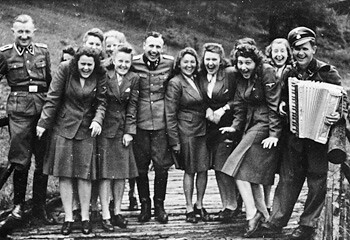
The Auckland boys’ antics remind me of the comments of another teenage boy, this one from Geelong in Victoria, who in September 2007 on the white supremacist ‘Stormfront’ forum, and upon viewing newly-discovered photographs of Nazi camp guards frolicking at Auschwitz, made a very funny joke:
Today, 05:35 AM
NoCrusties
Australian Nationalist
Join Date: Nov 2006
Location: Australia
Posts: 460
Re: New photos of Nazis having fun in the sun
They are celebrating the girls graduation from Jewish strangulation school?
…The photos provide a stunning counterpoint to what up until now has been the only major source of preliberation Auschwitz photos, the so-called Auschwitz Album, a compilation of pictures taken by SS photographers in the spring of 1944 and discovered by a survivor in another camp. Those photos depict the arrival at the camp of a transport of Hungarian Jews, who at the time made up the last remaining sizable Jewish community in Europe. The Auschwitz Album, owned by Yad Vashem, the Israeli Holocaust museum, depicts the railside selection process at Birkenau, the area where trains arrived at the camp, as SS men herded new prisoners into lines.
The comparisons between the albums are both poignant and obvious, as they juxtapose the comfortable daily lives of the guards with the horrific reality within the camp, where thousands were starving and 1.1 million died…
Note that, the same boy (now 18 and a student at Gordon TAFE) was in attendance at a gathering on Saturday, September 26 at Petersham RSL in Sydney, which played host to the ‘Sydney Forum’: an opportunity for perhaps 50 or so racists, fascists and neo-Nazis — belonging to ‘New Right’, ‘Australia First’, ‘One Nation’, ‘National Anarchists’, ‘Volksfront’ and ‘Blood and Honour’ — to meet and to organise their rather ambitious plans to cleanse Australia of non-Whites.
Less than a week later, on Friday, October 1, 2009, the NSW Humanist Society played host to another neo-Nazi gathering — a meeting of ‘Klub Naziya’ (established in 2003 by local neo-Nazis Jason Rafty and Daevid Palmer) — at the Society’s property in Chippendale.
Neither the Petersham RSL’s hosting of the ‘Sydney Forum’ nor the NSW Humanist Society’s hosting of ‘Klub Naziya’ have drawn any media attention.
Typical member is named David or John, has a job, lives in East Midlands and, if married to a BNP member, has a wife called either Patricia, Joanne or Karen.
The BNP is bracing itself for potentially fresh embarrassment tomorrow when details of the party’s rank and file UK membership are expected to be posted on the internet.
I’ve had my fill of bagels, and I simply couldn’t eat another piece of lemon cheesecake, so in that spirit — and in anticipation of being drowned in latkes — I bring you the following links:
…a collaborative platform for analyzing and opposing contemporary antisemitism from a radical Left perspective. It provides space for the sharing of activist and academic resources, reports on contemporary news and events, and fosters the development of critical analyzes of the current situation.
Seeking a broad emancipatory perspective, attention is given to such topics as reactionary anti-capitalism, nationalism, populism, left-right overlap, anti-globalization, anti-imperialism, conspiracy theory and anti-zionism. But it will not be limited to these subjects.
The website is not a campaign for specific positions, but rather reflects the various perspectives of its contributors, and provides space for the posting of fragmented thoughts and their collaborative development.
Flat 7 is a blog by ‘Ana Australiana’ (possibly a pseudonym). The writer has clearly read far too many books than is good for them, and is animated by such hot-button topics as solidarities, fetishism, urbanism, nuns, begging, privilege, faith, reading, chickens, tomatoes and of course football, meat pies, kangaroos and Holden cars. Cars, incidentally, kill lots of animals, including kangaroos, on Australia’s roads.
Gathering Forces is another blog what I think I’ve referred to before — but, now that I search for it, actually haven’t, I don’t think — that raises some interestink questions. If anything I wrote made the slightest difference to the success of their project, I’d wish them luck. It doesn’t, so I won’t.
The Institute for Anarchist Studies has a blog, as well as a world to win, and very little time. (Or so it seems to me anyways.) Joel Olson has contributed his thoughts on ‘Between Infoshops and Insurrection U.S. Anarchism, Movement Building, and the Racial Order’, which formalises a number of discussions I’ve had on this subject with comrades in the past — all to no avail.
Poumista is a blog I’ve referred to before, but as it’s totally neat-o, I thought I may as well do so again. It draws together a phantastic array of sauces on anarchist / Marxist / socialist history, and, like any good library, infoshop or second-hand bookshop, invites you to become lost in its wares, only to realise years have passed, and you’ve wasted your life reading. (And then you die.)
Stalin’s Moustache is all about Stalin and his moustache. Rather cleverly, the writer’s obsession with the facial hair grown on the upper lip of Uncle Joe is disguised by his authorship of various blogposts, articles and even books, seemingly dedicated to exploring such notions as socialism, biblical studies, politics, theology, philosophy “and so on”, but which the discerning reader, armed with the relevant machinetranslation, will soon discover are really all about Stalin (and, moreover, his moustache).
Stalin is alleged to have remarked that ‘Everybody has a right to be stupid, but some people abuse the privilege’. ‘There’s a sucker born every minute’ is a phrase often credited to P.T. Barnum (1810–1891), an American showman. ‘Never give a sucker an even break’, said W. C. Fields.
In 1937, when the first German prisoners were assembled on the Ettersberg to cut down the beech forest, the system of the corrective labor camps, the Gulag, in other words, the great hurricane of that terrible year, was about to be unleashed on the USSR.
There have been different stages of the terror in the USSR. Certain thresholds were crossed before the terror reached its heights under Stalin. The year 1937 is undoubtedly one of those thresholds.
Shalamov’s book, which I was reading yesterday — I mean, the day before the day that I am now reconstituting through writing, that day in 1969, in London, when I suddenly found myself opposite a building where Karl Marx had once lived, which gave rise to this apparent digression — the chapter in Kolyma Tales that I was reading yesterday, and whose title was ‘How It All Began,’ deals specifically with the threshold crossed in 1937 in the historical world of the terror, in the very history of the Gulag.
‘In the whole of 1937,’ Varlam Shalamov writes, ‘two men, out of an official work force of two to three thousand, one prisoner and one free man, met their death in the Partisan mine (one of the mines in the Kolyma zone). They were buried side by side, under a tumulus. Two vague obelisks — a slightly smaller one for the prisoner — were erected over their graves … In 1938, an entire brigade worked permanently digging graves.’ For the whirlwind struck the Kolyma camps, and the whole of Soviet society, at the end of 1937. On orders from Colonel Garanin, who was eventually shot as a ‘Japanese spy,’ just as his master, Yezhov, who replaced Yagoda (also shot) as head of the NKVD, was eventually to be shot, and replaced by Beria, who, in turn … Colonel Garanin, as I was saying, unleashed over the Dalstroy, the concentration-camp zone of Kolyma, the insane whirlwind of 1937.
On orders from Colonel Garanin, the prisoners in the camps of the Great North were shot in the thousands. They were shot for ‘counter-revolutionary agitation.’ And what exactly does counterrevolutionary agitation consist of in a Gulag camp? Varlam Shalamov tells us: ‘To say aloud that the work was hard, to murmur the most innocent remark about Stalin, to remain silent when the crowd of prisoners bawled out: ‘Long live Stalin!” … shot! Silence is agitation.’ One was shot ‘for committing an outrage against a member of the guard.’ One was shot for ‘refusing to work.’ One was shot ‘for stealing metal.’ But, says, Shalamov, ‘the ultimate offense, the one for which prisoners were shot in waves, was for not meeting the norms. This crime took entire brigades into a common grave. The authorities provided the theoretical basis for this strict regime: throughout the country the five-year plan was broken down into precise figures for every factory, for every work team. At Kolyma, requirements were drawn up for each placer, each barrow, each pick. The five-year plan was law! Not to carry out the plan was a counterrevolutionary crime! Those who failed to carry out the plan were soon got rid of!’
The Plan, then, the tangible proof, it was said, of the superiority of Soviet society, the Plan that made it possible to avoid the crises and anarchy of capitalist production, the Plan, then, an almost mystical notion, responsible not only in civil society, so to speak, but also in that quite uncivil case of a despotism of unremitting labor — because it bound the worker to his place of work, whether this was a factory or a penal colony — the Plan was simultaneously the cause of a refined doubling of terror within the Gulag camps themselves. The Plan was as lethal as Colonel Garanin. In fact, you couldn’t have one without the other.
But, Shalamov tells us, ‘the eternally frozen stone and soil of the merzlota rejects corpses. The rock has to be dynamited, hacked away. Digging graves and digging for gold required the same techniques, the same tools, the same equipment, the same workers. An entire brigade would devote its days to cutting out graves, or rather ditches, where the anonymous corpses would be thrown fraternally together … The corpses were piled up, completely stripped, after their gold teeth had been broken off and recorded on the burial document. Bodies and stone, mixed together, were poured into the ditch, but the earth refused the dead, incorruptible and condemned to eternity in the perpetually frozen earth of the Great North …’
Yesterday, when I read those lines — that is, not yesterday, but the day before that spring ten years ago in London — when I read those lines yesterday, that image burned itself into my eyes: the image of those thousands of stripped corpses, intact, trapped in the ice of eternity in the mass graves of the Great North. Graves that were the construction sites of the new man, let us not forget!
In Moscow, at the Mausoleum at Red Square, incredible, credulous crowds continue to file past the incorruptible corpse of Lenin. I even visited the mausoleum myself once, in 1958. At that time, Stalin’s mummy kept Vladimir Ilyich company. Two years before, during a secret session of the Twentieth Congress of the Soviet Party, Nikita Sergeevich Khrushchev set fire to the idol, which, like all his peers, he had worshipped and venerated. And in 1960, in Bucharest, Khrushchev suggested to Peng Chen that Stalin’s bloody mummy be taken to China. It was finally removed from the mausoleum after the Twenty-second Congress of the Soviet Party. But in the summer of 1958, Stalin was still in his red marble tomb beside Lenin. I can testify to that. I saw them both. At peace, intact, incorruptible: all they lacked was the power of speech. But, fortunately, they did not have the power of speech. They just lay there, the two of them, silent, lit up like fish in an aquarium, protected by members of the Guards, standing motionless like bronze statues.
Ten years later, in London, after reading that passage in Varlam Shalamov’s book, I remembered the tomb in Red Square. It occurred to me that the true mausoleum of the revolution was to be found in the Great North, in Kolyma. Galleries might be dug through the charnel houses — the construction sites — of socialism. People would file past the thousands of naked, incorruptible corpses of prisoners frozen in the ice of eternal death. There would be no guards; those dead would not need guards. There would be no music, either, no solemn funeral marches playing in the background. There would be nothing but silence. At the end of the labyrinth of galleries, in a subterranean amphitheater dug out of the ice of a common ditch, surrounded on all sides by the blind gazes of the victims, learned meetings might be organized to discuss the consequences of the ‘Stalinist deviation,’ with a representative sprinkling of distinguished Western Marxists in attendance.
And yet the Russian camps are not Marxist, in the sense that the German camps were Nazi. There is a historical immediacy, a total transparency between Nazi theory and its repressive practice. Indeed, Hitler seized power through ideological mobilization of the masses and thanks to universal suffrage, in the name of a theory about which no one could be in any doubt. He himself put his ideas into practice, reconstructing German reality in accordance with them. The situation of Karl Marx, vis-à-vis the history of the twentieth century, even that made in his name, is radically different. That is obvious enough. In fact, a large segment of the opponents of the Bolsheviks, at the time of the October Revolution, claimed allegiance to Marx no less than did the Bolsheviks themselves: it was in the name of Marxism that not only the Mensheviks, but also the theoreticians of the German ultra-left criticized the authoritarianism and terror, the ideological monolithism and social inequality that spread over the USSR after the October victory.
The Russian camps are not, therefore, in an immediate, unequivocal way, Marxist camps. Nor are they simply Stalinist. They are Bolshevik camps. The Gulag is the direct, unequivocal product of Bolshevism.
However, one can go on a little further and locate in Marxist theory the crack through which the barbaric excesses of Correct Thought — which produces the corrective-labor camps — were to flood, the madness of the One, the lethal, frozen dialectic of the Great Helmsmen.
On March 5, 1852, Karl Marx wrote to Joseph Weydemeyer, who published in New York Die Revolution, a periodical of uncertain frequency, because of financial difficulties, like most of the socialist journals of the time. It was for Weydemeyer’s journal that Marx was finishing, in those rainy days at the end of the London winter, his articles on the Eighteenth Brumaire, which were to appear in an issue of Die Revolution under the title slightly altered by Weydemeyer — Der 18te Brumaire des Louis Napoleon, instead of Bonaparte — published at the Deutsche Vereins-Buchhandlung von Schmidt und Helmich, at 191 William Street.
So, on that March day in 1852, Karl Marx was writing to Weydemeyer. Two days before, he had received five pounds sent him by Frederick Engels, from Manchester. The Marx family must have eaten more or less their fill that week, after paying off their most pressing debts to the grocer and doctor. Now Karl Marx glanced out of the window of his flat. He looked absent-mindedly over at the narrow doorway of the building across the street. He saw nothing of particular interest. Indeed, there wasn’t anything of particular interest at that time: the film company had not yet moved in. He went down to sit at his desk. In his almost indecipherable writing, he wrote the date at the top right-hand corner of the sheet of paper. Under the date, he added his address, 28 Dean Street, Soho, London.
It was in this letter to Joseph Weydemeyer that Marx explained his own contribution to the theory of classes and of the class struggle. After admitting that bourgeois historians had already described the historical development of this class struggle, and bourgeois economists the economic anatomy of classes, Marx went on to explain what was new in his contribution: was ich neu tat. ‘What I did that was new was to prove: 1) that the existence of classes is only bound up with particular historical phases in the development of production, 2) that the class struggle necessarily leads to the dictatorship of the proletariat, 3) that this dictatorship itself only constitutes the transition to the abolition of all classes and to a classless society.’
This is an extremely well-known passage, one that has been interpreted this way and that, which generations of learned commentators have dissected, which brilliant polemicists have thrown in one another’s faces for over a century. And yet one can still come back to it. It still provides matter for reflection. One can still find something new in it: etwas Neues.
What, then, is the contribution that Marx declares he has made in this theory, at the concrete level of history and of the class struggles that make history? It is to have shown (or demonstrated: Marx uses the verb nachweisen, which may be interpreted in both senses; but in both senses it is used wrongly by Marx, who never showed or demonstrated what he advanced, as we shall see) a certain number of points.
Let us leave to one side the first, that concerning the historicity of the very existence of classes. This question belongs to a philosophy of history with which I am not concerned for the moment. The idea that mankind, in order to pass from a classless society, to that of primitive Communism, to another society of the same kind, but in a developed form, swimming in the butter of abundance, is destined to go through a long historical purgatory of ruthless, indecisive class struggles — always producing, moreover, real effects different from those that Marxist theoreticians, beginning in this case with Marx himself, had foreseen — such an idea leaves me completely cold. It no longer excites anybody, the idea that there was once, and that therefore there will be again, in the depths of history, ideal idyllic societies, communities without states. I am well aware that to set this idea, expressed concisely enough in Marx’s first point, to one side is somewhat arbitrary. I am well aware that the sub-Hegelian philosophy of history that underlies the idea contained in Marx’s first point also underlies the other two points. But one may, nevertheless, for purely methodological reasons, exclude this first point from our present analysis, temporarily bracket it out.
Whatever one may think, therefore, of the question of the historicity, of the relativity of classes, it is easy to see that the next two points listed by Marx do not belong to historical science — if science it be — but to prediction. Or even to prophetic teaching. That the class struggle should necessarily lead to the dictatorship of the proletariat is no more than a hypothesis, perhaps a pious wish. But neither the hypothesis nor the pious wish has been verified or fulfilled anywhere by real history. The dictatorship of the proletariat, in the Marxist sense, has never existed anywhere. A century after Marx’s letter to Weydemeyer, it still hasn’t come about.
At this point, of course, I can hear the indignant cries from the distinguished Marxists at the back of the hall. (There are only two or three fools in the whole world who haven’t realized that when one writes, one always puts oneself on public display, whether one likes it or not. And if one is putting oneself on public display, one can imagine the hall in which it takes place.)
The Marxists all squawk at once.
‘What about the Paris Commune?’ someone yells out. I was waiting for that one. In a tone suggesting that nothing more is to be said on that matter, someone quotes Frederick Engels: ‘Well, gentlemen, do you want to know what a dictatorship is like? Look at the Paris Commune. That was the dictatorship of the proletariat.’ Well, gentlemen, look at the Paris Commune, but look at it carefully. You will see some very fascinating, very instructive things, but you will never see the dictatorship of the proletariat. Forget Engels and the high-flown words with which, twenty years after the events, he ends his introduction to Marx’s The Class Struggles in France, forget Engels’s literary fabulations, come back to the harsh truths of history, and you will not find the dictatorship of the proletariat. Read the writings of the period, beginning, of course, with the contemporary accounts of the sessions of the Commune itself, and you will see that the attempted coup of the Paris Communards, at once grandiose and pitiful, heroic and petty, seeped in a just vision of society and shot through with the most confused ideologies, has got nothing to do with the dictatorship of the proletariat.
But I am not allowed to continue my demonstration (Nachweisung, Marx would say: yet I have the advantage over him of speaking with my back to history, of trying to explain it; I have no need to fantasize, and can therefore demonstrate, or show, what history has demonstrated). I am interrupted: voices rise up on all sides.
Very well, I shall continue at another time, perhaps in another place. But above the din of Marxist voices, I shall say just a few words, even if I have to raise my voice, on Marx’s third point, namely, that the dictatorship of the proletariat is a mere transition — a state that would be already an antistate — toward a classless society, toward the suppression of all classes.
Here, too, we are confronted with a mere postulate: a petitio principii. Real history has demonstrated — nachgewiesen — quite the contrary. It has shown the continual, implacable reinforcement of the state, the brutal exacerbation of the struggle between the classes, which not only have not been suppressed, but, on the contrary, have crystallized still further in their polarization. Beside the veritable civil war unleashed against the peasantry in the USSR in the early 1930’s, the class struggles in the West are gala dinners. Compared with the stratification of social privileges in the USSR — functional privileges, certainly, bound up with the status and not, or not necessarily, with the individual — real social inequality, that is to say, relative to the national product and to its distribution, is in the West nothing but a fairy tale.
In brief, what Marx claims is new in his contribution to the theory of classes and of the struggle between them has nothing theoretical about it, nothing that throws light on reality and enables one to act on it. It is no more than prediction, wishful thinking, an expression that must have been used quite often at 28 Dean Street.
And it is here, on this precise point of the Marxist theory of the dictatorship of the proletariat as an inevitable transition towards [a] classless society, that the lethal madness of Bolshevism took root and nourished the terror. It was in accordance with these few points dryly listed by Marx one day in 1852 — listed, moreover, as if they were self-evident — that all the Great Helmsmen have begun to think — and, worse still, to dream at night — as if inside the heads of the proletarians. It was in the name of this historic mission of the proletariat that they have been crushed, deported, dispersed, through labor — free or forced, but always corrective — millions of proletarians.
An idea underlies these points — these theoretical novelties — which Marx pedantically enumerates: the idea of the existence of a universal class that will be the dissolution of all classes; a class that cannot be emancipated without emancipati[ng] itself from all other classes of society and without, consequently, emancipating them all. One might have recognized the trembling voice of the young Marx announcing, in 1843, in an essay that he wrote, not on Dean Street, but on the Rue Vaneau in Paris, ‘Contribution to the Critique of Hegel’s Philosophy of Right: Introduction’; the epiphany of the proletariat. But this universal class does not exist. The lesson of the hundred years that separate us from Marx is, if nothing else, that the modern proletariat is not this class. To continue to maintain this theoretical fiction has enormous practical consequences, for it paves the way for the parties of the proletariat, the leaders of the proletariat, the corrective labor camps of the proletariat: that is to say, it paves the way for those who, in the silence of the gagged proletariat, speak in its name, in the name of its supposed universal mission, and speak loud and clear (to say the least!).
So the first task of the new revolutionary party that would not speak in the name of the proletariat, but would regard itself only as a temporary structure, constantly disintegrating and being reconstructed, as a focus of receptivity and awareness which would give organic weight, material strength, to the voice of the proletariat — its first task would be that of re-establishing the theoretical truth, with all the consequences that this involves, about the nonexistence of a universal class.
But this blind spot in Marx’s theory, through which it is linked to the aberrational realities of the twentieth century, is also its blinding spot: the focal point at which the entire grandiose illusion of the revolution shines. Without this false notion of a universal class, Marxism would not have become the material force that it has been, that it still partly is, profoundly transforming the world, if only to make it even more intolerable. Without this blinding, we would not have become Marxists. We would not have become Marxists simply to demonstrate the mechanisms of the production of surplus value, or to reveal the fetishisms of mercantile society, an area in which Marxism is irreplaceable. We would have become teachers. It was the deep-seated madness of Marxism, conceived as a theory for universal revolutionary practice, that gave meaning to our lives. To mine, in any case. As a result, there is no longer any meaning in my life. I live without meaning.
But this is no doubt normal enough. In any case, isn’t it dialectical?
~ Jorge Semprun, What A Beautiful Sunday!, Translated from the French by Alan Sheridan, Abacus, London, 1984. Originally published in French under the title Quel beau dimanche! in 1980 by Editions Grasset et Fasquelle.
So there you have it. Enjoy, or ignore. In the end, it makes no difference either way. You’ll still end up dead.
Two Greek anarchists are making molotov cocktails. One says to the other: "So who will we throw these at then?" The other replies: "What are you, some kind of fucking intellectual?"