Black Flag: Bulletin of the Anarchist Black Cross

I’ve been reading over some old issues of Black Flag, the English anarchist zine.

Volume 1 Number 1 was published on July 19, 1968 as the ‘Bulletin of the Anarchist Black Cross’, and includes on the front cover the following statement — reminiscent of Australian anarchist Chummy Fleming’s remarks — by Emile Henry:

I know my head will not be the last to fall. You will add other names to the list of the men you’ve killed. You have sent us to the gallows in Chicago, to the block in Germany, you have strangled us in Jerez, sent us before the firing squad in Barcelona, guillotined us in Montbrison and Paris, but you will never be able to destroy anarchy.

Its roots are too deep; it comes out of your rotten society and destroys it, it is a violent reaction against established order. It represents the equalitarian and libertarian aspirations that are rising to crush present-day authority; it is everywhere and it cannot be suppressed. It will end by destroying you.

It also contains an editorial and essay on Makhno’s “Black Cross” by Albert Meltzer. In order to satiate the interests of the one, probably fictional, person in addition to myself who cares, here it is:

It is fifty years since Nestor Makhno organised units of the Black Cross, originally intended as field-working units similar to those of the Red Cross (as used elsewhere in Russia, described in this issue). The Black Cross units in various cities of the Ukraine were for purposes of workers’ self-defence, as well as for purely “ambulance” type activity. The use of Cossacks, the prevalence of White Guards, pogromists, as well as the growing Red Army, made it necessary for city dwellers to be able to protect themselves in the streets.

They wore no particular uniform except that, to enable themselves to be recognised at times of violence in the streets, they wore denim overalls with a recognisable armband. Their job was to organise resistance to sudden pogroms, whether the conventional Czarist pogrom, or the sudden onslaught of Red or White Guards.

Those who think of movements for self-defence purely in terms that we think of them in the West today (largely legalistic, like the Council for Civil Liberties, excellent though such a body is for its specific function) will find it surprising that a body organised solely for defence of prisoners, and for the protection of workers in their homes and factories, should have become one of the major adjuncts to the fighting forces of Makhno’s peasant army. It was, indeed, the first urban army to be formed in the Ukraine; by 1920, when the Whites were an organised body aided by foreign intervention, the city-Makhnovistas, the Black Cross, was the only force in the towns that could organise military self-defence along with the peasants. They faced three enemies, Petliura in the West, the Bolsheviks in the North, and the monarchists in the East and South. But they were able to defend the cities though they were never a mobile force like the peasant army.

Most certainly, in a revolutionary situation such as existed in Germany when the Nazis were rising to power, it is highly necessary to have a movement that is able to resist. The mere provocation of the State by protest, when one can only be crushed by the full powers at the disposal of the State, is not enough. It is necessary, when fighting dictatorship, to be able to oppose a monolithic force to it that can fight back when attacked.

The Ukrainian “Black Cross” arose out of purely defensive needs, in order to protect workers occupying their places of work, to defend demonstrations in the streets, and so on. Its form of organisation might have been that of the Red Cross (even that of the Salvation Army, as one observer sneered!) but it was able to adapt that form of organisation into a fighting force.

“And Kropotkin said that in his view, the Royal Lifeboat Institution and the International Red Cross were examples of Mutual Aid, and presumably, of Anarchism!”

So runs the gentle joke of many a don commenting on Kropotkin’s teachings. And he omits to point out that in the very same paragraph that Kropotkin says this, he grants the fact that “princes of the blood” and others have conferred their patronage on such organisations, after they have shown that they are socially acceptable, but that the actual work done by the lifeboatmen or the Red Cross volunteers is a supreme example of the principle of Mutual Aid between mankind. The lifeboatman does not count the profit; he does not argue with the sinking captain for commercial advantage (though he could, and capitalist morality would justify his doing so?).

The RED CROSS founded by Dunant has saved innumerable lives in warfare between nations. We are far from criticising it; but depending as it does on governmental tolerance, it has its limitations. It can arbitrate as regards the sick and wounded and imprisoned of, say, Germany and England; it cannot help those of Russia and Japan because the governments of those countries do not care a damn about their subjects and (at least in the Second World War) were beyond the point where they need care for public opinion. (Even the Germans would have protested had the Nazis left German POWs to their fate; but the Samurais of Nippon and the Soviet regarded them as “traitors”.)

In the same way, it was always impossible to ask the Red Cross to look after the sick and wounded and imprisoned of the Class War. In a Civil War (e.g. Spain 1936) they might do so; but not in cases where there was no declared civil war. This gap in the Red Cross became particularly noticeable in Czarist Russia. The rulers of that country had in effect declared a civil war against their own subjects. In particular they used the Cossacks to murder the Jews. The Jewish population was a hostage to the revolution. If the Russian workers protested, the Czar diverted their revolutionary aims by organising a pogrom. It was at once an example to the Russian masses, and a warning as to what would happen to those who incurred official displeasure. When the “Black Hundreds” raided the Jewish districts, the police stood by. If ever the Jews resisted (and Anarchists and Bundists at times organised Self Defence Committees that fought back) the police stepped in and fought the defenders, arresting them for violent activity.

International Jewry organised its own committees for relief of the Russian Jews; but such bodies did not extend their help to the Anarchists and Bundists who had — dreadful to relate to the bourgeois sponsors of such committees — had the temerity to fight back. So a committee was formed in America, amongst Russian Jewish workers in particular, called the WORKERS RED CROSS (which changed its title after a few months to ANARCHIST RED CROSS, since the Red Cross Workers, asked them to do so to avoid confusion).

The ANARCHIST RED CROSS, centred in Chicago, raised a large amount of aid not only for the Jewish fighters in Russia but also for the entire Russian revolutionary movement. It sent field workers to Russian prisons, aided deportees and (not being bound by any convention such as the official Red Cross) also sent in illegal propaganda. The existence of such a body meant, too, that aid could speedily be sent to victims of the class war in many countries. Perhaps one day the full story of the Anarchist Red Cross will be told. (Its work was carried on for a long time after its demise by the Free Society Group of Chicago; in particular, comrades Boris Yelensky and Celia Goldberg.)

When the Russian Revolution came, the Anarchists needed their Red Cross units more than ever. The organisation set up, in many ways a continuation of the old A.R.C., was known as the Black Cross (partly to distinguish itself from the Bolshevik “Red” and partly again to save the Geneva organisation, doing good work in general relief, from embarrassment).

The Anarchist Black Cross was overwhelmed with work. The prisoners multiplied; there was no abatement in government tyranny. Alexander Berkman, expelled from Russia to Berlin, tried to cope with the fund for Russian prisoners, when a new demand came in (for the victims of the Fascisti in Italy). The album of Kropotkin’s funeral (the last permitted non-Bolshevik demonstration in Russia, for which Anarchists were especially released from Russian jails, which we may at some time reproduce) was sold to alleviate distress amongst prisoners in Italy and Russia. With repression in Spain, the rise of the Nazis, and depression in the countries from which the money was coming, the Black Cross collapsed.

There were similar organisations from time to time (e.g. Solidaridad Internacional Antifascista, whose secretary in London was Ethel Mannin) which did good work in their time. When, however, our friend Stuart Christie was arrested in Spain, we found the lack of any organisation which could help in such a case. In particular, Amnesty did not want to know. They were prepared to take up the cases of political prisoners provided those prisoners were “innocent”, their ideal prisoner was a University professor charged with liberal thinking, who had never lifted a finger against repression in his life and had still found himself in jail.

Many comrades from many countries sent food parcels and the like to Stuart; from Germany and elsewhere, people who had never met him. (And this gave us particular satisfaction, remembering 1945, when we had organised sending food parcels to Germany, which had come from Britain, USA and even Palestine; a factor helpful in keeping many old militants alive in the post-war period.)

In prison, the Anarchists and some other political prisoners (but not the Moscow-liners, who refused to collaborate) had formed a commune in which they shared their food parcels from outside. Spanish prisons permit food and medical supplies to be sent from outside; if one relied on the prison hospital one would die neglected. But, while parsimonious, it is prepared (unlike British jails) to allow donations from outside. When Stuart returned, he knew who was in difficulties in Spain, he was indeed a “mouthpiece” of the libertarian political prisoners in Spain.

We began to send parcels, and in doing so, revived the idea of the ANARCHIST BLACK CROSS. Some start has been made to making it a permanent organisation.

It is not intended to be a charity.

It is to organise solidarity for victims of the class war.

We are sending food parcels at present but by no means wish to limit what we send (whether to Spain or elsewhere?) merely to food or medical supplies, vital as these are to those concerned. If the governments would recognise our work, we would confine it to humanitarian purposes and relief of prisoners.

As it is, we deem it part of our task to help with other facets of the struggle; in places where we can provide effective solidarity.

In some parts of the world Anarchists are able to work without undue interruption by authoritarian forces; and they can also be isolated geographically from participating in the more active struggle such as exists in Spain.

Their aid is needed. We hope to bridge the gap.

On Stuart Christie, see: ChristieBooks.com.
On Albert Meltzer (1920–1996), read his autobiography, I Couldn’t Paint Golden Angels, AK Press, 1996.
Brighton Anarchist Black Cross (links page).

(I also recently picked up a copy of 325 (#6, January 2009) . . a data network for direct action . . a media framework for social war . . the refusal of fixed territory . . an insurgent anti-prison zine of social war and anarchy . . it’s a neat-o publication which, like most other @ projects, really needs and deserves your solidarity.)

The Italian Effect (c.1980)*

Black Flag Volume VI, Number 6 (1981) contains a brief article on Italy, a letter from ‘Some comrades of Anarchismo‘: ‘Anarchy/Autonomy’. I’ve searched (a little), but I’ve read very little about the relationship between the anarchist movement in Italy and the autonomist movement which emerged there in the 1960s and 1970s, so this snippet is interesting.

Following the various blitz operations carried out by the anti-terrorist divisions of the carabinieri and the police, some of which succeeded and others fortunately failed, the situation of struggle in Italy has become more schematic in recent times.

One of the clamorous attempts that failed was the one against the comrades involved in the review Anarchismo, which began with the arrest of twenty-one comrades and finished with one sentence only (Massimo Gaspari), for possession of explosives. The others, as is known, have all been released and charges dropped due to complete lack of evidence against them. Only in the case of the comrade Alfredo Bonanno has the charge of propaganda against the State remained.

In the article published in No.3 of your paper [‘Italy: Assault on Anarchism’] there appeared to be a certain confusion concerning the Italian revolutionary movement. The reaction against the provocation initiated by the secret services and the Ministry of the Interior and police forces with the Piazza Fontana massacres and teh anarchist-hunt at the end of 1969 pushed many comrades towards an awareness of the problems of revolutionary organization.

In this period Potere Operiao (Worker Power) gave their maximum contribution to the struggles and to the elaboration of an insurrectional theory. Then, followed in this by various other formations of post ’68 origins, they dissolved into the so-called movement, taking with them the contribution of their own experience and their own militants’ actions of struggle.

It is in this period in which Collettivo metropolitano was formed in Milan, from which the first military formations of the Brigate rosse originate.

Revolutionary practice meanwhile (we are around the years 1976–1977, before the Convegno do Bologna, a meeting against repression where over 100,000 comrades were present) expanded with large mass demonstrations and bloody battles with the police.

At the Bologna meeting, where the revolutionary forces confronted each other with all their various differences, but where the last moment of a historic period of the class struggle in Italy was signed, the area of autonomy was present in two different currents:
a) the current of autonomy as a movement, represented by the theses of the comrades of Rome, supporting autonomy as the absence of whatever closed and centralized structure.
b) current of autonomy as a party, represented by the theses of the comrades of Padova and Milan, who supported the formation of an “autonomy party” of a strictly leninist character.

Both of these currents can be defined as being of marxist-leninist observance, even though breaks with the orthodox tradition have become more evident, and re-evaluation of the function of the minority organization including the clandestine one.

Still at the Bologna meeting, the different forces of the anarchist movement were also present, in a more or less bilinear component: on the one side the various expressions of educationism, pacifism, pluralism, individualism, etc.; on the other side a numerically inferior but more competitive side, who insisted on a greater penetration in the reality of the struggles, territorial roots in the interventions made by comrades, and the organization of armed and clandestine struggle, revolutionary violence and insurrection.

But both these tendencies shared suspicions towards all the more or less marxist thesis, and also agreed in the rejection of any ideological identification with the area of autonomy. For both these tendencies in the anarchist movement the theory and practice of struggle continue to be those of the libertarian tradition.

The fact that on the operational level of the struggle anarchists and autonomists may sometimes have acted together should not necessarily lead one to believe that the substantial differences that divide these two parts of the Italian revolutionary movement have been overcome. each has contributed within the limits of their own operative possibilities, remaining independent as organizational structures and, more obviously, as theoretical heritages.

We consider that this clarification is sufficient to show more clearly the relationship existing today between anarchists and the area of autonomy in Italy.

A final clarification seems necessary to us. In the article published by Black Flag on the blitz against Anarchismo reference was made to Alfredo Bonanno’s book La Gioia Armata, translating the title to The Joy of Arms. We think that this translation of the title is not only literally mistaken, but could also create a mistaken impression and distract the interest of comrades from a book which is far from being a hymn to violence but is a thoroughly examined critical inquiry into the problem of armed struggle. The correct translation which we are bringing to comrades’ notice is therefore Armed Joy.

Funnily enough, the 325 collective makes available the English translation of Bonanno’s book on its site [PDF].

*The title given to an academic conference in Sydney in September 2004:

After several decades during which the humanities in Australia and globally have been strongly influenced by French thought, in the new millennium the work of Italian thinkers is having a profound impact upon intellectual activity. The most notable signs of this “Italian effect” are the widespread interest in the work of Giorgio Agamben and the popularity of Antonio Negri and Michael Hardt’s Empire, but this is only to scratch the surface of the productivity of contemporary Italian thought across a wide variety of disciplines.

This conference aims to address the current and potential international impact of radical Italian thought, focusing not only on Negri and Agamben but also on the work of Franco Berardi (Bifo), Paolo Virno, Maurizio Lazzarato and others.

Empire (Harvard University Press, 2000) contains one reference to ‘anarchists’ (p.350):

You are just a bunch of anarchists, the new Plato on the block will finally yell at us. That is not true. We would be anarchists if we were not to speak (as did Thrasymacus and Callicles, Plato’s immortal interlocutors) from the standpoint of a materiality constituted in the networks of productive cooperation, in other words, from the perspective of a humanity that is constructed productively, that is constituted through the “common name” of freedom. No, we are not anarchists but communists who have seen how much repression and destruction of humanity have been wrought by liberal and socialist big governments. We have seen how all this is being re-created in imperial government, just when the circuits of productive cooperation have made labour power as a whole capable of constituting itself in government.

I’m still trying to understand that one.
Posted in Anarchism, History, Media | 11 Comments

Jeff Monson v Sergei Kharitonov

39-year-old pencil-necked geek (and anarchist) Jeff ‘The Snowman’ Monson ~versus~ Sergei Kharitonov:

Monson: ‘I’d Do It Again’ (January 18, 2009) | Them’s Fightin’ Words! (July 15, 2008) | Go Jeff! (November 16, 2006)

Posted in Anarchism | 2 Comments

May Day

The Anarcho-Syndicalist Federation and Melbourne Anarchist Club are putting on a May Day celebration on Friday, May 1st.

There will be an ASF picnic at the 8 Hour Monument, cnr of Lygon and Victoria St, opposite Trades Hall, at 12:00 midday.

Bring food to share.

This will be followed by a social gathering at the Melbourne Anarchist Resource Centre, 62 St Georges Rd, Northcote at 7:00pm.

MAC is also using this event to kick off a regular Friday night anarchist meet-up with drinks and discussion.

[The original ‘Melbourne Anarchist Club’ was launched on May 1, 1886.]

Posted in Anarchism | 1 Comment

NoMeansNo : ‘Going Nowhere’

Posted in Death, Music | Leave a comment

E.On police kick terrorist arse: 114 criminal conspirators arrested

    It seems police have finally lost their patience, and decided to teach those meddling kids a lesson.

Police arrest 114 people in pre-emptive strike against environmental protesters

• Activists held in Nottingham over alleged power station action
• Campaigners fear increase in police surveillance and possible infiltration

Juliette Jowit and Matthew Taylor
guardian.co.uk
April 13, 2009

Police have carried out what is thought to be the biggest pre-emptive raid on environmental campaigners in UK history, arresting 114 people believed to be planning direct action at a coal-fired power station.

The arrests – for conspiracy to commit criminal damage and aggravated trespass – come amid growing concern among campaigners about increased police surveillance and groups being infiltrated by informers.

Nottinghamshire police said the raid on a school in Nottingham was made just after midnight this morning. The force said it seized “specialist equipment” thought to be linked to a planned protest at nearby Ratcliffe-on-Soar power station, a coal plant owned by the utility company E.On [the world’s largest investor-owned power and gas company].

No group has claimed responsibility for the alleged demonstration…

114 Climate Change Protestors Arrested in Nottingham (Earth First! UK) | Moar terra-ists here.

On police and spies, see also : Suspicious Minds & Barking Dogs: Canada, France, Russia (& Australia) (February 3, 2009) | “My name is Brandon, and I’m an FBI informant.” “Hi Brandon!” (January 20, 2009) | Moaron Rob Gilchrist (December 17, 2008) | Rob Gilchrist : Police Informant (December 14, 2008) | Amanda is in your extended network (December 7, 2008) | Victoria Police denounce McDonald’s (Kinda sorta) (November 5, 2008) | Mehmet Ersoy/Osman : Former officer hired to spy (October 17, 2008) | The Age of Spies (October 16, 2008) | “Welease Wodewick!”, Or; The Continuing Adventures of Hakluyt & Co. (October 16, 2008) | The Downer Age : Hakluyt & Co (October 14, 2008) | Hakluyt dons fishnet stockings! (October 13, 2008) | Anarchy! Spies! Private eyes! Libraries! (September 26, 2008) | “Questions emerge”: RNC 2008 & The Spectre of Anarchism/Terrorism (September 17, 2008) | “revolutionaries into secret agents and secret agents into revolutionaries” (August 12, 2008) | Hakluyt (Spies Like Us) (August 5, 2008) | Tricksy ASIO wants the nasssty anarchisssts (June 26, 2007)

Posted in State / Politics, War on Terror | 1 Comment

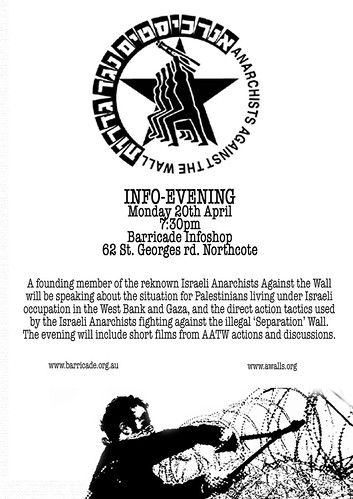
Israeli Anarchists Against the Wall : Monday, April 20

Israeli Anarchists Against the Wall
Info-evening
Monday the 20th of April, 7:30pm
Barricade Infoshop
62 St. Georges Rd. Northcote

The Israeli Anarchists Against the Wall (AATW) were formed in 2003 and have since used direct action tactics in hundreds of actions in response to the construction of the wall Israel is building on Palestinian land in the Occupied West Bank. AATW work in cooperation with Palestinians in the West Bank in actions to remove Israeli road-blocks and to destroy the 700km + wall that separates them.

A founding member of the AATW will be speaking at Barricade Infoshop on Monday the 20th of April about the history of the movement, the direct action tactics employed, and the State repression waged against activists involved, as well as the situation for the Palestinian population living under the shadow of the wall. The evening will include short films from actions and discussions.

PS. The February issue (#35) of Mutiny contains three articles of relevance: ‘Palestinian Solidarity In Australia’ by Rawan Abdul; ‘The Struggle For Freedom Needs To Break With The Illusions of National Liberation & Argue For A No State Solution’ by Dave; and ‘No State For You!: Some Limits Of Radical & Anarchist Analysis Of The Attack On Gaza’ by Liz Thompson & Benjamin Rosenzweig [PDF].

Posted in Anarchism | 1 Comment

Ian Tomlinson & Colin Roach & Liddle Towers & Gurdip Singh Chaggar & Kevin Gately & …

Killed when police charged in 1979…but still no justice
Melissa Thompson
Mirror
April 11, 2009

The shocking images of events leading up to the death of Ian Tomlinson – showing him apparently being knocked to the ground by a policeman – are a chilling reminder of a case exactly 30 years ago.

An inquest has now been opened into the death of newspaper seller Mr Tomlinson, 47, who died on a London street amid last week’s G20 protests. And a police officer has been suspended over the incident.

But the news reports will have seemed too frighteningly familiar to the family and friends of Blair Peach.

Blair, a 33-year old teacher, died while taking part in a demonstration against the National Front in Southall, West London, on April 23, 1979. He was killed when 3,000 policemen attempted to disperse protesters.

One eyewitness said at the time: “I have never seen such unrestrained violence against demonstrators The great majority of the police, seemingly ever-patient and self-controlled, stood for hours as kids baited and yelled, shoved and provoked. A handful of officers used well-placed elbows while batons were raised only in response to the vandalism…”

See also : Kevin Gately (1974: Man dies in race rally clashes, BBC, June 15) | Gurdip Singh Chaggar (Chaggar was murdered by “young fascist thugs in the heart of Southall [one of the centres of the Asian community in London] [that] had led to clashes with the police (who held that the murder was not necessarily racial)… In 1978, Judge McKinnon ruled that the National [Front] leader Kingsley Read’s pronouncement on Chaggar’s murder — ‘one down, one million to go’ — did not constitute incitement to racial hatred… ‘In this England of ours’, the good judge observed, ‘we are allowed to have our own view still, thank goodness, and long may it last.’” ::: “On 13 August 1977, the far-right National Front attempted to march from New Cross to Lewisham in South East London. Local people and anti-racists from all over London and beyond mobilised to oppose them, and the NF were humiliated as their march was disrupted and banners seized”) | Liddle Towers (1976: Towers told his friend: “They gave us a bloody good kicking outside the Key Club, but that was nowt to what I got when I got inside.”) | Colin Roach (1983: “Colin Roach, aged 21 years, died in January 1983 after receiving a fatal gunshot wound in 1983 while in the custody of Stoke Newington police station, London. He is alleged by the police to have shot himself in the mouth. Authorities alleged that he had committed suicide after entering the Stoke Newington Police Station. Many believed that there was reason to doubt this story and instead argued that Roach was murdered by police.” 26 Years On — Colin’s Story, 4WardEver Campaign UK, January 10, 2009) | “Since 1969 there have been over 1,000 deaths in police custody in Britain. No police officers have ever been successfully prosecuted for manslaughter”: Injustice: A film by Ken Fero, Paul Bond, wsws.org, May 31, 2001 | ‘An Institutional State of Denial’, William Bowles, October 27, 2003…

    National Front

    Stuck in a rock and a hard place between the slick professionalism of the BNP, and the street thuggery of the White Nationalist Party. The NF’s ability to steer a path for itself will determine whether it continues as a shadow of its former self, or if it joins the BNP as a party of some significance. A street march in London early in 2004 drew well under 50 marchers…

    Do say: “The National Front is the name most synonymous with fascism in Britain.”
    Don’t say: “Having marches every now and then’s not really working is it?”

If the police officers who witnessed the assault on Ian Tomlinson will not come forward voluntarily, then we ourselves must drag them into the public arena

Bristle’s Blog from the BunKRS
April 11, 2009

Tonight I have been working through all the photographs and video of the attack on Ian Tomlinson that was witnessed shortly before his death.

I have taken as many screengrabs as possible, and attempted to identify what officers were in the shot at any one time. So far, we are told, just four officers in total have come forward. As these pictures show, there are at least eighteen police officers close enough to see what happened last Wednesday on Royal Exchange Buildings by Cornhill.

I hope that these pictures might help jog the memory of someone – anyone – who was in London that day. Perhaps you took a photograph of a policeman whom you think you recognise here – a photograph which is clearer, perhaps even showing a number on an epaulette or a helmet. Please do check through your pictures and compare them with these.

Or maybe you weren’t in London on the 1st of April, but you happen to recognise a relative, or an acquaintance from your local, or a neighbour. If you do, please don’t just leave it be.

If enough people – ordinary people, people like us – take the time and trouble to hold those responsible (through their action or their inaction) for the death of Ian Tomlinson, force them to come forward and be held accountable, then we might – just might – help prevent this happening again, only next time to your father, my mother, our friends, our loved ones. Don’t leave it to the IPCC.

See also : Police ‘assaulted’ bystander who died during G20 protests (April 5, 2009) | Ian Tomlinson…; BIT OF STICK; Riot policeman’s hands viciously assaulted by Ian Tomlinson’s back (April 8, 2009) | G20 : Idiotorial (April 10, 2009) | The World (of G20) According To Paola Totaro (April 11, 2009)

The great majority of the police, seemingly ever-patient and self-controlled, stood for hours as kids baited and yelled, shoved and provoked. A handful of officers used well-placed elbows while batons were raised only in response to the vandalism.

~ G20 protesters strike at London’s heart, Paola Totaro, The Age, April 2, 2009

Posted in History, Music, State / Politics | 2 Comments

MR Floppy – Wuthering Heights

Mr Floppy performing their No.1 Smash Hit ‘Wuthering Heights’, later covered by Kate Bush.

Posted in Music | 7 Comments

Street-Porter was no nun, but she deserved better

Editor-at-Large: Street-Porter was no nun, but she deserved better
Andrew Fleming
The Independent
April 12, 2009

The circumstances surrounding the alleged rape of Janet Street-Porter are only gradually becoming clearer. What has emerged, however, is that Ms Street-Porter was a troubled woman with quite a few problems. I am not trying to diminish her alleged rape, and the outrage felt by her family and friends, but before we put the alleged rapist in the dock, it might be worth considering what Ms Street-Porter was doing that night, what she was wearing, her sexual history (including a long string of failed marriages), and what state of mind she might have been in.

One feminist has said that the “steady drip” of information about her background is intended to undermine her claims. I disagree. Knowing that she had had multiple partners is critical to understanding her apparent promiscuity and her attitude towards her alleged rapist, which might on first viewing of the video footage, seem a bit slutty.

Ms Street-Porter was wearing a short skirt, smoking a cigarette, and she’d had a few drinks. She didn’t look anything like the women the sex industry had corralled into brothels around England that night. They were mostly younger, working class, and worlds apart from a middle-class woman whose face seemed younger than her years after a life of relative luxury. One perfunctory glance ought to have shown her alleged rapist that she was no spring chicken. Witnesses say Ms Street-Porter appeared to be drunk, she wasn’t coherent and couldn’t move very well. Over an hour later, footage shows a man grabbing at her legs with his hands, and she falls to the ground.

It had been a long and trying day for the alleged rapist. Ms Street-Porter wound him up when he didn’t get his way. But she wasn’t a teenage prostitute with an attitude. The fact she didn’t swiftly repel his attention when ordered to have sex should have been just a mild irritant, not something requiring actual sexual assault. Adult males have been educated to understand that rape is wrong, just as they have been educated to understand the same of murder. This woman was not the only fish in the sea. Her life story demonstrates that the only person she ever harmed was herself. I can understand how attractive she might have appeared, but I can’t understand why anyone would want to rape her, especially not in this day and age.

Ms Street-Porter deserved some love and affection, and she clearly didn’t get any that night.

‘Gang-raped girl was glad of the attention,’ says barrister
The Daily Mail
May 18, 2007

A teenage girl who claims she was gang-raped by three 13-year-old boys would have been “glad of the attention”, a woman barrister said.

The 16-year-old and a friend have told how the boys mugged them and then raped them repeatedly in a park while filming the ordeal on a mobile phone.

But Sheilagh Davies, defending the youngest of the three accused, said the girls had consented to sex “maybe to gain attention, maybe to gain affection”.

The barrister told the jury that “things are not the way they used to be” and that girls’ clothes put pressure on them to be sexually attractive “perhaps before their time”.

Miss Davies suggested one of the girls, who has given evidence via video link, had been overweight and had “slimmed down a lot” since the alleged attack in South-East London on November 23 last year.

The barrister said in her closing speech: “She was 12st 6lb – not quite the swan she may turn into.

“She may well have been glad of the attention.”

Posted in !nataS, Media, Sex & Sexuality, State / Politics | Leave a comment

Blood and Honour vs. Blood and Honour

From the Department of Silly-Old-Boneheads:

As noted previously (Blood & Honour / C18 in Australia, February 18, 2008), the international neo-Nazi network known as ‘Blood & Honour’ is split into two, often warring factions.

In Australia, the local franchise is allied with the Southern Cross Hammerskins. So too, the tiny B&H mob in Aotearoa/New Zealand. In Australia, B&H/SCHS organise an annual gig to commemorate Ian Stuart’s death. The nutty mob is also organising a gig to piss on the memory of the ANZACs this year in Perth. In Aotearoa/New Zealand, B&H/NZ Hammerskins organise a (semi-)annual gig to celebrate Hitler’s birthday.

Combat 18 (18 = AH = Adolf Hitler), on the other hand, is even more marginal, largely existing as a figment of Patrick O’Sullivan‘s fertile imagination. Recently, however, B&H/C18 has crawled out from under its rock, poaching one of the bands previously in the B&H/Hammerskins stable. Moaron that later, but first…

Background

The overdue death in 1993 of B&H co-founder (along with similarly dead bonehead Nicky Crane) and Skrewydriver Ian Stuart resulted in a battle over his financial and political legacy. Initially, B&H came under the control of C18, a small mob of Nutzi headcases initially part of the BNP, but soon operating independently of it. C18 was established in the early ’90s, and led by a violent crank named Paul (‘Charlie’) Sargent. Charlie was a fascist, drug-dealing football hooligan, and good mates with Chris (‘Chubby’) Henderson, later lead shouter with Combat 84 (formerly available locally through Deadset Music; now available through PUG Music), as well as the former manager of the 4-Skins, Gary Hitchcock. All three were well-known faces in the Chelsea Headhunters, a fascist football firm.

In 1992, Neil Parish, the main bonehead behind B&H in the UK, was in all sorts of trouble — legal, drug, alcohol and familial. Good ol’ Charlie offered to take over operations while Neil did a spell, on the understanding that when he got out, things would revert to normal.

Duh.

Instead, with Neil safely tucked away behind bars, Charlie quickly moved to consolidate control of the business. In addition to discrediting poor ol’ Neil (an alleged “low-life thief and Jew informer”), C18 made its first public appearance at a Skrewydriver Xmas show, where Ian Stuart quickly accepted their presence. C18 then proceeded to rapidly replace the [now defunct] British Movement (BM) as thugs-of-choice on the neo-Nazi muzak scene. The final nail in the coffin occurred when Ian skidded off a road and to his death, and with it Ian’s ability to hold competing factions together.

The BM had been in decline for many years, and it was a relatively simple matter for C18 to end its association with B&H, one maintained most closely by Paul Burnley, lead shouter with the band No Remorse. Burnley himself was attacked in the squabbling over Ian’s lucrative legacy. Charlie’s sidekick Will Browning played a crucial role in these shenanigans, and it was him what established ISD Records in January 1994. Gary Hitchcock, the man credited with coming up with the name Combat-18, wasn’t happy with this development, as he’d secretly been appointed British distributor of the German neo-Nazi label Rock-O-Rama — which has since been transformed into the Belgian label Pure Impact (available locally through PUG Music). Hitchcock eventually dropped out of the race for Nutzi $, and his place taken by Browning’s ISD Records…

Since then, there have been many ups and downs for the bloody, dishonourable criminals associated with B&H, C18 and ISD — notably, in 1998, Charlie Sargent’s conviction and sentencing to life imprisonment for murdering another Nutzi — but the schism between the ‘musical’ and the ‘political’ B&H remains. The ‘radicals’ have had a strong base in Scandinavia, as well as parts of Eastern Europe, while the ‘moderates’ have tended to dominate the English-speaking world; as with other movements, however, B&H as a whole is in a constant state of flux, and its activities shaped both by internal politicking and broader social forces.

    http://www.bloodandhonourworldwide.co.uk/ The ‘musical’ mob. Closely tied to the Hammerskins and — until recently — the only B&H group in both Australia and Aotearoa/New Zealand. Also Austria*, Belgium, Canada, Croatia, Czech Republic, England, Finland, France, Germany*, Greece, Holland, Hungary, Italy, Portugal, Serbia, Slovenia, Spain*, Switzerland, Ukraine, United States. * = Subject of a legal ban.
    http://www.bloodandhonour.com/ The ‘political’ C18 mob. In Argentina, Brazil, Bulgaria, Chile, Czech Republic, England, Holland, Lithuania, Poland, Russia, Serbia, Slovakia, Sweden, Ukraine and United States.
    Note that both tendencies appear to be present in the Czech Republic, England, Holland, Serbia and the United States.

Detour: Charlie Sargent

The gear is casual, but the faces are hard, sullen, full of mistrust. Angry-looking tattoos poke out from under smart shirt sleeves. Mobile phones lie in a neat row, next to bottles of Bud and pints of Guinness. The talk, in a melting pot of accents from across London’s council estates, is of football ‘firms’, lads and ‘jobs’ [robberies].

“We don’t want to live with Africans and Pakis, we want to live with our own people – don’t we?” quips a large, Humpty Dumpty figure with a receding hairline and a dull leer. Covered in a heavy lace of tattoos and carrying a bulky bag of CDs, Paul David ‘Charlie’ Sargent is a leader not so much by charisma as by force and fear. He has a habit of putting a rhetorical question at the end of his sentences. It leaves little room for discussion. His three companions drag on cigarettes and pull baseball caps down over their tight-cropped hair as they talk of revolution – White Revolution.

“Our kids are learning ‘their’ way of life before their own,” laments Scott, a gruff-faced former squaddie. A clamour of guttural “yeahs”, uttered into pints, supports him.

“They’re taking us over,” adds Charlie in his animated, nasal voice. “The whole of London is just becoming a cesspit.” The solution? “National Socialism.” Which is? “Racism,” he says, with a characteristically challenging look, “the easiest politics in the world.”

To Charlie and the others, ‘they’ – meaning either the state, which they call ZOG (Zionist Occupation Government), or the immigrant communities – are the Enemy. So now they want no part of the system. “I don’t vote. What’s the point? I’m not gonna play their fucking silly little games,” says Charlie.

These are members of a paramilitary struggle, based on punishment beatings, control and fear. “I know perfectly well we’re gonna win. I’m under no disillusions about it. Sooner or later we’re gonna win.” But win what? “The War.” What war? “The war against the government and the people invading this fucking land.”

~ Nick Ryan, ‘Memoirs of a Streetfighting Man’: “This story original appeared in The Independent on Sunday Review 1998; later versions in The South China Morning Post Magazine and other titles. It won a Special Commendation award from the International Federation of Journalists in 1999.”

On collaboration between neo-Nazis and Loyalists, see the wonderfully bizarre tale MacIntyre’s Underworld: Mad Dog and Nazi Nick:

According to the Sutton database of deaths at the University of Ulster’s CAIN project, the Ulster Defence Association/Ulster Freedom Fighters was responsible for 259 killings during the Troubles. 208 of its victims were civilians (predominantly Catholics), 37 were other loyalist paramilitaries (including 30 of its own members), three were members of the security forces and three were republican paramilitaries. The UDA/UFF partly functioned, as did other Loyalist associations, as an extra-judicial killing machine for the British state.

Blood and Honour vs. Blood and Honour

As noted, B&H Australia is organising a gig in Perth for ANZAC Day. Originally, three bands were scheduled to prance about on stage: Indigenous Hate, Quick & the Dead and Ravenous. Sadly, Indigenous Hate has cancelled their performance, and instead declared that they will be playing a gig for C18 in November in Queensland instead. This news was not received well by B&H, who announced that Indigenous Hate was “off the bill for being lying scum”.

Ouchies.

As it happens, Indigenous Hate played a gig with fellow nutzis Southern Storm in Sydney in March. The gig was organised by C18 Australia. (Southern Storm were previously available for purchase via “truly D.I.Y Australian hardcore punk label” Snapshot Records — alongside of Skrewdriver, Blood Red Eagle, Bound For Glory (UK not US), Fortress, Legion of St. George and Retaliator.)

The defection of Indigenous Hate follows warm on the heels of the departure of Blood Red Eagle from the B&H stable, and the decision of Douglas Schott — its diminutive lead shouter — to jump into bed with New Reich fuehrer Welf Herfurth to form ‘Volksfront Australia’. B&H Victoria rep Justin comments: “…we’d have to get to know the guy pretty well before we considered him for anything like a State Rep position. Welf was given the nod before it was really understood (and through no fault of his own, he was just being himself) that he wasn’t suitable for that.”

Thus, despite being judged as being suitable for membership of the German NPD, the Australia First Party, Australian Democrats, One Nation Party, acting as MC for the Sydney Forum, and considering himself as being both an anarchist, a nationalist, and an intellectual, Welf was jackbooted out of B&H, and forced to look elsewhere for a social club. That club is ‘Volksfront Australia’.

Of course, an attempt to establish VF in Australia was originally made several years ago.

In 2004, a young racist named Stuart McBeth (1981–), then the leader of the now defunct ‘Patriotic Youth League’ (PYL) — a risible attempt by Dr James Saleam to extend Australia First Party membership to the under-40s — threw his tinfoil helmet into the ring as an Australian organiser for the United States People’s Front. McBeth resigned as PYL President shortly after being fired, in late January 2005, from his job as a case officer for the Salvation Army. McBeth was replaced by Lachlan Black, also a former ONP member and, like McBeth, a former ONP candidate.

Like the PYL, Volksfront Mk I collapsed in a heap.

As for Volksfront Mk II, according to ‘BlueEyedBlonde’, aka Nicole Hanley (via bloodandhonour.org):

Last year [Volksfront] started a probationary chapter here, which pissed the Hammerskins off big time. Not because they wouldn’t support Volksfront, but because of how it was done. Doug [Schott] from Blood Red Eagle was the first probationary member, and he was allowed [to] start the chapter without having actually met any of the VF guys in the USA. A lot of the HSN guys can’t stand him and think he is a moron, so they were unimpressed with VF bending the prospect rules and letting him prospect sight unseen. Justin (AustMade) was in the scene years ago (I knew him back then), he also left and then has recently come back. He started off prospecting with VF, but then realised he had backed the wrong horse as HSN hated them, so he left and joined B&H Vic. And that’s pretty much where we are… try getting that group of egos to work together!

RaHoWa!

Welf’s own circle is tiny, comprising himself and various refugees from Stormfront and other racist and fascist forums. In Victoria, Welf enjoys the support of a handful of fascist teenyboppers. The most active of these is a boy by the name of Scott. Funnily enough, Scott was also a member of the hacked B&H forum where, posting as ‘Tribalist’, he noted how much he enjoyed attending a neo-Nazi gig — apart from an unfortunate political disagreement which developed among the assembled drunken pea-brains.

Bonus!

THE OPPOSITION

The British far-right is an eclectic bunch, with organisations varying from those like the British National Party and Freedom Party, who hold elected office and have serious pretensions to wield power locally, to organisations like the November 9th Society that could best be described as containing one man and a German Shepherd dog. Developing an exhaustive list is far beyond our timescale (and sanity) but this is a pretty exhaustive guide to what is currently out there, and what to say (and what not to say) before you put the boot in.

Blood and Honour

Founded in 1987, as a vehicle for White-Power music and a cash cow for other fascist groups, by Ian Stuart Donaldson (of Skrewdriver & car crash fame), in response to the activities of Anti-Fascist Action. Rather like football hooliganism, Blood & Honour originated in England, but has gone on to bigger and better things elsewhere. An important player in the development of far-right ideas internationally, Blood & Honour has struggled to retain much of a profile in its homeland. Unable to advertise gigs openly in Britain they’ve recently become even more of a laughing stock after Antifa [twice] hacked their forum and posted the entire thing online. Plus, their music is shit. [Tee hee… tee hee hee! Hackers 1 Blood & Honour 0, August 30, 2008 | Blood & Honour hacked, March 25, 2009.]

Do say: “Ian Stuart’s name will certainly live on with you guys about.”
Don’t say: “Of course all the original Skinheads only listened to Jamaican music.”
Definitely don’t say: “Everyone knows that most skinheads these days are gay.”

Combat 18

Scary Nazi ‘terror machine’ and the pride of Stormfront but rarely sighted these days in England, and considered an endangered species, not seen in public since 2001. C18 now has sister groups in several European countries and the USA but its last national ‘activity’ in the UK seems to have been putting up a sticker or two in a few northern cities. Damaged by the revelation that his number two, Darren Wells, was an informer for Searchlight and the security services, C18 Fuhrer Wilf Browning has had an exceptionally low profile in recent years. Recent raids on C18 in Poland and northern Germany indicate that the authorities still regard C18 as a threat, even if no one else does. Still wheeled out occasionally in the media as a terrifying, psycho Nazi bogey man to scare the gullible.

Do say: “The Blood and Honour scene is much better organised under C18.”
Don’t say: “That’s just a wild stab in the dark Charlie.”

Racial Volunteer Force

Formed after the leadership of C18 had an emotional breakup, this group’s membership struggles to reach double figures. Never the group’s strong point, membership and recruitment was dealt a damaging blow in 2003 when several of them were arrested and imprisoned for inciting racial hatred. These Aryan warriors used to provide ‘security’ (behind the police of course) for the British People’s Party, but again a tiff between leaderships and the BPP informing on its friends for police protection has ended this alliance of the clueless. This group are serious contenders for the Who Can Make The Most Shit Up On Stormfront? Award, recently claiming to have stolen intelligence from “Antifa HQ”, when in reality they had picked up a publically distributed leaflet, available online. Other then these Bond-style intelligence missions, they restrict their activities to releasing poorly spelt statements detailing their feuds with other fascist groups. About as dangerous as a pond of ducks.

Do say: “The spirit of C18 and militant neo-Nazism lives on with the RVF!”
Don’t say: “Do you lot do anything except release statements?”

Added Bonus!

[img deleted]

“Hmmm… knickers!”

Veteran British neo-Nazi Colin Jordan (June, 1923–April 9, 2009) is dead.

Jordan established the ‘National Socialist Movement’ and ‘World Union of National Socialists’ in the UK in 1962. He struck gold in 1963 when he married wealthy heiress Françoise Dior. In addition to being a nutzi, Jordan will most likely be remembered for his rather spectacular fall from grace.

Jordan reorganized the National Socialist Movement itself in 1968 as the British Movement, but by 1974 he has been forced to step down in favor of Michael McLaughlin. The split was far less than amicable. It was Jordan, however, who provided McLaughlin with the sword with which to do in the movement’s founder, and Jordan further obliged his enemies by taking a running start and skewering himself in a manner guaranteed to bring maximum public humiliation. It seems that, for reasons best known only to him, Jordan was arrested on charges of simple shoplifting. Worse, Jordan’s booty was comprised of lingerie — to wit, pairs of women’s panties. Why the financially secure Jordan would resort to this method of shopping was a mystery to the British movement, but soon the internal correspondence of many of the faithful had brought to Jordan the nickname of “Knickers Stealer”, and the McLaughlin faction of the British Movement had a field day with the news. The label stuck, dogging Jordan’s ill-fated campaigns in the 1970s to seize back control of the British Movement and, indeed, to reenter the British National Socialist scene that had, in truth, long since left him behind.

~ Jeffrey Kaplan, Encyclopedia of white power: a sourcebook on the radical racist right, Rowman Altamira, 2000, p.147.

Posted in !nataS, Anti-fascism | 4 Comments