For several years, Russian neo-Nazis have been butchering their enemies — principally dark-skinned Russians, those from neighbouring territories, and anarchists — with relative impunity. Further, given generalised xenophobia on the part of the Russian population as a whole, they’ve done so with relatively little opposition. Crucially, however, their violent repression has taken place with the implicit support of the Russian state. Thus, as is becoming increasingly widely acknowledged, even by the Western media, perpetrators of fascist violence usually escape capture, and when prosecuted, receive relatively light sentences, their crimes often described as mere ‘hooliganism’. The apparent decision by one group of neo-Nazis to video their murderous crime and to broadcast it online represents a relatively (although not entirely; other assaults resulting in death have been broadcast previously) new development. The sentencing of the murderers of Timur Kacharava, on the other hand, does not…
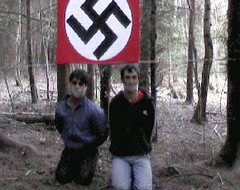
Update : Man who says he posted execution video online turns himself in to police in Russia, AP, International Herald Tribune, August 15, 2007: “ROSTOV-ON-DON, Russia: A man who says he posted a video on the Internet showing the brutal execution of two men from Central Asia and the Caucasus has turned himself in, a police official said Wednesday…”
Neo-Nazi video shows execution
Adrian Blomfield
Daily Telegraph
August 14, 2007
A previously unknown Russian nationalist [sic] group has posted a video on the internet showing the execution of two Muslim men, prompting fears that neo-Nazis are beginning to ape the techniques used by Islamic extremists in Iraq. The footage surfaced on the Russian version of the popular social networking website LiveJournal over the weekend. It was quickly taken down.
The three-minute video, titled “Execution of a Tajik and a Dagestani”, begins with two men kneeling before a masked extremist in combat fatigues. Apparently unprompted, they mumble that they have been taken hostage by “Russian Nationalist Socialists”. The masked man then uses a knife to decapitate one of his prisoners in a grim sequence lasting 90 seconds. The second captive is later forced to kneel in front of a grave before he is shot in the back of his head. The clip, which has a caption claiming to have been filmed by “The National Socialist Party of Rus”, ends with a still image of a red and white flag emblazoned with a swastika.
Police have opened an investigation but said it was too soon to determine whether the video was authentic. But human rights activists who saw the video said it was too realistic to have been staged.
The motive for the attack does not appear to have been revenge for similar executions in Iraq. A Chechen news agency sympathetic to rebels fighting for the republic’s independence from Russia received a “policy statement” yesterday from the group that claims to have carried out the killings. It called for the expulsion from Russian territory of all Asians and people from the Caucasus, the independence of Chechnya and the resignation of President Vladimir Putin.
Attacks on ethnic minorities in Russia have risen dramatically in recent years. More than 50 people have been murdered by ultra-nationalist groups this year alone. Human rights groups have accused Russian authorities of ignoring or even tacitly encouraging the extreme right in the country.
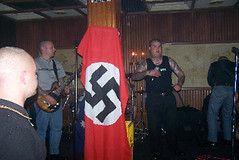
Above : Damien Ovchynik of Bail Up!, performing at the 2006 Ian Stuart Donaldson gig at The Birmingham Hotel, Cnr. Johnston & Smith Streets, Fitzroy; Bail Up! will also be performing at this year’s event
Offline, Russian fascists perform a highly useful police role in Russian society, providing Russian youth a politically acceptable means of channeling their energies (even forming death squads on occasion), but otherwise functioning as a means of quashing dissent, through violence and intimidation, to Putin’s highly authoritarian and corrupt regime. Note that online, the Russian-language LiveJournal is jam-packed with neo-Nazis and fascists of all descriptions. One, which featured the video in question, is http://community[dot]livejournal[dot]com/ns_wp (‘ns’ = ‘national socialism’; ‘wp’ = ‘white power’). Note also that many users are fans of Ian Stuart Donaldson and Skrewdriver, and organise their activities through such groups as Blood & Honour and Combat-18.
Closer to home, Blood & Honour Australia, the Southern Cross Hammerskins and other (foreign) fans of Ian will be assembling in Melbourne on October 13, to commemorate Stuart’s death in a car accident in 1993; a ritual performed each year at about this time. Finally, note that local ‘skinhead’ band Bulldog Spirit features a neo-Nazi named Joel on drums, who regularly collaborates with other neo-Nazi bands and projects including Fortress, the most infamous neo-Nazi band to come out of Australia — and also scheduled to give their final performance at the October 13 rally.
See also : Online video by Russian nationalists shows apparent execution of 2 nonwhite men, The Associated Press, International Herald Tribune, August 13, 2007 | Russia probes ‘executions’ video, BBC, August 14, 2007
Beheading and Shooting by Russian Neo-Nazis on Video
C. J. Chivers
The New York Times
August 15, 2007
MOSCOW, Aug. 14 — The Russian authorities said Tuesday that they were investigating a video recording of what appeared to be the grisly execution of two bound and gagged young men, filmed in a forest beneath a large Nazi flag. At least one of the men was beheaded on camera as he lay in a shallow grave.
The video, which appeared Sunday on several Russian ultranationalist Web sites, circulated on the Internet with a note from a previously unknown organization calling itself the National-Socialist Party of Russia. The note announced that a “military vanguard” had begun an armed struggle against “black colonists and those who support them from the Russian government.”
It demanded the expulsion from Russia of all Asians and people from the Caucasus and the granting of independence to all of Russia’s internal republics in the Caucasus.
The note also called for the resignation of President Vladimir V. Putin and the establishment of a government formed by Dmitri G. Rumyantsev, the leader of the National-Socialist Society, a neo-Nazi group.
It further demanded the release of Maksim Martsinkevich, the leader of Format 18, another Russian neo-Nazi group, who has been held since last month on charges of fomenting ethnic hatred and threatening violence.
It is not clear when or where the video was made.
But Aleksandr Verkhovsky, director of the SOVA Center, a private organization that examines hate crimes in Russia, said the video appeared to be real. Mark Tolchinsky, the acting spokesman for the Interior Ministry of Dagestan, a region in the Russian Caucasus, said investigators there had watched the video and also believed it to be authentic.
Slightly less than three minutes long, the video begins with scenes of the countryside and the title “Operation of the National-Socialist Party of Russia to Arrest and Execute Two Colonists From Dagestan and Tajikistan.” For a date, it gives only 2007.
The video then shows two terrified dark-skinned men kneeling in the forest under a Nazi flag. Each speaks through a gag in accented Russian, saying only, “We were arrested by National-Socialists.” One has been bound with heavy tape, the other with rope.
One of their captors shouts, “Glory to Russia!” and then lunges forward and decapitates one of the men with what appears to be a large knife. Heavy metal music plays throughout.
Later, the second captive is shown kneeling, head lowered. The bolt of a gun is heard to slam closed. The prisoner is shot in the head and falls face down into a grave. The video ends with two men in camouflage uniforms and black masks giving the Nazi salute.
The graphic scenes drew heavy traffic on Russian-language Web sites and prompted intensive commentary on Internet discussion groups. Many viewers, including those who identified themselves as nationalists, expressed horror and denounced the acts.
Nationalist Russian politicians reacted similarly and said the video was meant to discredit them. “This video tarnishes our image most of all,” Yevgeny Valyayev, an assistant to Nikolai V. Kuryanovich, a nationalist member of the lower house of Parliament, said by telephone.
“It’s a provocation, it’s clear,” he added. “In the near future similar things will happen.”
A spokesman for the national prosecutor general confirmed that the federal Interior Ministry and the F.S.B., a successor agency to the Soviet K.G.B. secret police, were investigating, but he provided no further comment.
Irina Zubareva, a spokeswoman for the Interior Ministry, told RIA Novosti, the official Russian news agency, that the video originally had been posted from two foreign Internet domains. That claim could not be confirmed.
Format 18 did not reply to queries sent by e-mail. A court in Moscow on Monday ordered Mr. Martsinkevich, the group’s leader, to be held in pretrial confinement.
Mr. Martsinkevich, who uses the name Hatchet, burst in on a debate between two journalists on the state of democracy in Russia earlier this year with about 20 followers and shouted, “Sieg heil!” and “Slaughter the liberals!” while making Nazi salutes. Since his arrest, his supporters have labeled him a “prisoner of conscience.”
There was no immediate indication whether the video had been made by members of his group, his sympathizers or — as many ultranationalists on Web sites suggested — by people seeking to discredit him and the larger movement he has personified.
Mr. Verkhovsky, who studies hate crimes, said the party claiming to have made the video had never been heard of before and might be a very small number of people, as few as two or three. “Usually such things are not done by members of well-known organizations, but by marginal people, even marginal for such movements,” he said.
Videotaped beheadings and executions, a gruesome propaganda tool used by insurgents in Iraq, have a history in Russia that predates the Iraq war.
Chechen separatists have been accused of beheading captured Russian soldiers since the first Chechen war, which began in 1994, and recordings of such grisly acts have circulated in markets in the Caucasus for years. Three British citizens and a New Zealander working for a British telecommunications company were abducted in Chechnya and beheaded in 1998 after being forced to confess on video to spying.
But Mr. Verkhovsky said the latest video was new ground for Russian ultranationalists and neo-Nazis, and perhaps a “symmetrical reaction to Chechnya.”
Michael Schwirtz contributed reporting.
And ah, speaking of New York, and er, racism, Benita Eisler writes of L’Affaire Némirovsky (New York Sun, June 27, 2007):
Where French anti-Semitism was concerned, there was something for everyone. Jews led an international conspiracy of profiteers and swindlers; at the same time, there was hardly a communist or anarchist who wasn’t a Jew, behind every plot to undermine the social order. For France’s increasingly secularized urban Catholic circles, the accusation of “Christ Killers” would have already been an embarrassment, strictly for peasants. A pastoral mystique had replaced the biblical curse: As rootless inhabitants of cities, Jews had no stake in the land — that inherited community that bound the French to one another, but also to their ancestors who had tilled the same soil. (If you think this one has gone the way of the horse-drawn plow, you haven’t heard the stump speeches of Jean-Marie Le Pen). More immediately, pacifists on the left and right united in accusing Jewish “warmongers” of fomenting hostilities with Hitler’s Germany…
And um, speaking of Jews… In the old joke, two rabbis are sitting in a cafe. One is reading a Jewish newspaper, but the other opens a notorious neo-Nazi rag. The first, stunned, says, “Why would you read that?” The second replies: “In your paper, I read how Jews are being harassed and persecuted and endangered. In this one, I read that Jews are rich! Jews are clever! Jews run the world! I prefer good news.”
So do I. But the world generally only gives me bad.
Kacharava Killer Gets 12 Years
Galina Stolyarova
The St Petersburg Times
August 10, 2007
The killer of 20-year-old antifascist student Timur Kacharava was sentenced to 12 years in prison on Tuesday, with the St. Petersburg City Court also handing down sentences to six accomplices in the murder. Alexander Shabalin was earlier convicted of stabbing to death Kacharava in downtown St. Petersburg in November 2005 and inciting social hatred. The six other defendants received between three years in a penal colony to suspended sentences of two years for inciting social hatred. Another suspect, who Timur’s friends suspect plotted and masterminded the murder, is still at large according a lawyer close to the case.
Kacharava’s mother Irina watched in silence as the defendants, all of them around her son’s age, grimaced at reporters, cheered and waved at their parents and friends from behind the bars of the dock in the St. Petersburg court. Neither the judge nor guards restrained the men as one of the defendant’s mothers shouted, ‘I told you it is going to be just fine!’
The seven convicts were between 17 and 20 years old when the crime was committed.
Defendant Andrei Moskovkin received three years in a penal colony, the Russian equivalent of an open prison. Defendants Sergei Panaskov and Sergei Golovlev were sentenced to two years in a penal colony. The remaining defendants — Valery Yefremov, Kirill Semyonov and Dmitry Kushakov — received suspended sentences of between two and three years.
Shabalin’s lawyers said Shabalin and Moskovkin may appeal.
In court, the sentencing bewildered Kacharava’s friends. “Every member of this gang should have been tried for murder but what happened instead was that the judge conveniently piled everything up on Shabalin and let everyone else have a lucky escape,” said an anti-fascist activist who goes by the alias Sedoi. His face was almost completely covered in a black scarf. “According to this trial, the person who slit Timur’s throat is a murderer but the people holding Timur and preventing him from resisting did not assist in a murder. This is absurd.”
Human rights lawyer Olga Tseitlina, who represented the Kacharava family in the trial, said the convicts’ bravado was consistent with their behavior throughout the trial. “None of them, not once, showed the slightest sign of remorse, regret or compassion,” the lawyer said. “They feel that they are kind of heroes and behaved in a highly insulting manner all the time. For example, they drew swastikas on the bench where they were sitting.”
Tseitlina said Kacharava’s killers had been aggressive during the trial and their lawyers consistently made attempts to present anti-fascists as a radical, extremist youth group. “The defendants’ lawyers almost made it sound as if Timur got what was coming to him and the judge and prosecutors just turned a blind eye,” Tseitlina said. “We were being forced to prove the most obvious things, like the difference between fascism and anti-fascism, so the discussion at times found itself balancing on the brink of the absurd.”
Prior to the fatal attack, Kacharava, who had been targeted by extremists before, complained to his friends that he was being followed. Three days prior to his murder, he told his girlfriend he felt threatened and worried for his life. Prosecutors were unable to prove that Kacharava’s murder was premeditated, and that a planned murder was carried out by a group of people.
Tseitlina said apparently a mistake was made — either deliberately or because of incompetence — when the case was classified during preliminary investigations. “The investigators bought Shabalin’s scenario in which he said he spontaneously suggested beating up an anti-fascist and took the initiative in attacking him, with the whole thing getting out of control,” she said, adding that as a lawyer representing the victims she had no authority to initiate a reclassification of the case. “By the time a case reaches court it is too late to requalify it anyway, and we all have to make do with the articles that have been applied,” Tseitlina said. “The judge squeezed absolute maximum of the articles that applied in each case.”
Svetlana Yefimenko, the state prosecutor in the trial, said the prosecution would not appeal the verdict. “The sentences were fair: most of the culprits were juveniles when the murder was committed, they all were of good standing with their municipalities, most of them pleaded guilty and actively cooperated with the investigation,” Yefimenko said. “These are all factors, and the court is obliged by the law to take them into account when delivering a sentence.”
See also : Galina Kozhevnikova and Alexander Verkhovsky, ‘The Sowing Season in the Field of Russian Nationalism’, July 17, 2007. “We publish the English translation of our new report which was presented on June 20, 2007, in Moscow. The report describes radical nationalism and resistance against it in the spring of 2007.”