An interview with Autonomous Action by Danish Autonom Info Service

How is the situation among leftwing radicals in Russia after the murder of Anastasia “Skat” Baburova?

At first I must point out that there is no consensus amongst Autonomous Action on the question if we are “left” or not. All of us are libertarian communists, most of us are anarchist communists, but question of “leftism” is more controversial. Some of us consider themselves “leftists”, me not because “left” is just identity and symbols, such as Che Guevara T-shirt.

Personally, I do not consider myself “leftist”, I do not really know how their situation has changed, probably not at all — irrelevant Trotskyists keep organising their seminars, I suppose patriotic majority of the “left” is certain that Nastya was murdered by some kind of international Jewish conspiracy.

What comes to anarchists and libertarians, a bit of radicalization has been visible as demonstration the next day after murders was first major anarchist demonstration in Moscow with some property destruction. But many anarchists have been murdered during last years so I do not think a single murder may change situation a lot.

We know that the assassination was aimed at Stanislav Markelov, and that Anastasia was with him by accident, when the hired killer turned up. Rumours say that the clues lead to military circles or to rightwing extremists in Moscow. Has it meanwhile become clear, who stands behind the assassination?

No, and I do not see much reason to speculate. Stas touched interests of many different authorities and groups, not only Nazis or military circles.

Can you shortly characterize the situation of Russian society today?

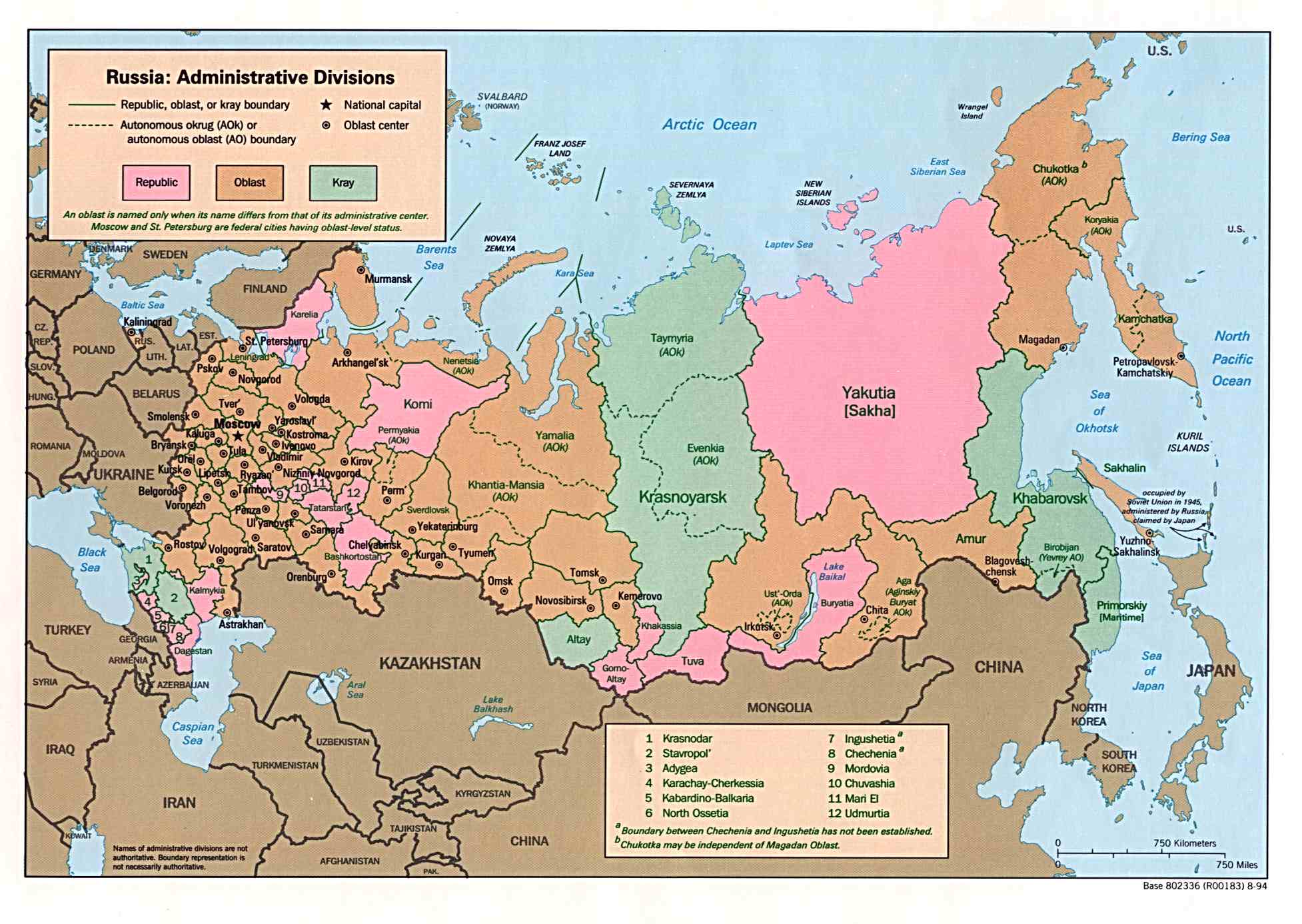
I think this is a bit too wide question. Economic crisis has hit Russia more hard than most of the West, but not as hard as Latvia or Iceland for example. Protest activity is rising, but yet it is hard to see if it will grow to an uprising similar to that of spring 2005. TV is pretty much controlled by the state, but one commercial TV-station is half-independent, there are also independent papers and radio stations but these are not available in all regions. In general, Russia is a huge country and there are huge differences between the regions — some have rather liberal regimes (Moscow, St. Petersburg, Karelia and Perm for example), others are very authoritarian (Chechnya, Ingushetia before recent regime change, Mord[o]via, Bashkorstan, Mari El and Kalmykia for example). There are currently 6 anarchist and anti-fascist political prisoners in Russia, 4 of whom are on remand. As for “leftist” political prisoners, it depends if you count National-Bolsheviks as left for example.

Can you describe the leftwing radical milieu in Russia/Moscow today? Which political tendencies and groups exist and what are their primary activities?

Again, it depends whom do you count as “left”. That word may mean pretty much anything.

Largest “self-described left” force is the Communist Party of the Russian Federation KPRF. They work “inside the system”, and try to curb radical street activity as communist parties do everywhere. Recent electoral restrictions have been useful for them, as all other oppositional parties have been practically excluded from the federal political system. Their main electorate are state bureaucrats and pensioners. They are maybe even more patriotic than communist parties in other countries, they were supporting bloodbath in Chechnya for example. However they have not attempted alliances with outright fascists for a while.

    On Jan. 21, on the 85th anniversary of Lenin’s passing, Communist Party (KPRF) leader Gennady Zyuganov rebuked critics of the mausoleum who think Lenin should be properly buried, saying, “Any attempt to vulgarize the memory of the Soviet era, to rewrite it, to take away monuments to Lenin, is an attack on the Russian Federation itself. (…) It was Lenin himself, who created the modern Russian state.”

“Motherland”-party [Rodina] is a Kremlin-created structure to compete with KPRF vote. They are even more vehemently patriotic than KPRF, although they have sidetracked the outright Nazis who were there when party was founded.

More hardline Stalinists are pretty much marginalized as they never had other strategy than electoral, which is no way these days. Revolutionary Communist Worker’s Party RKRP maybe has some presence still in some alternative trade-unions (such as Zaschita Truda, “Defence of Work”), but hardline anti-semite TR (Working Russia) apparently not.

There are number of Trotskyist (self-described or not) groups, but none of them has more than few dozen people and they are pretty much irrelevant.

In terms of “youth street politics”, it used to be realm of two groups — National-Bolshevik Party and Stalinist AKM (Vanguard of Communist Youth). Both of them are in decline due to repression, and for example in Moscow active anarchists are more than both of them together — however due to lack of commitment, anarchist seldom manage to mobilize more than them.

In Siberia there is Alternative Trade Union Siberian Confederation of Labor, some of their activists are anarchists or syndicalists. They have some 6000 members.

What comes to anarchists (whom I do not consider left personally), movement has been growing constantly during the last 9 years. Anarchist organisations include Autonomous Action, Rainbow Keepers (main activity of which is ecological protest camps). There is not much left from Association of Anarchist Movements ADA, but they still have few active people. In Moscow there are two syndicalist groups — KRAS (Confederation of Revolutionary Anarcho-Syndicalists) and MPST (Inter-Professional Union of Labor).

However majority of anarchists are outside organisations, these networks also involve number of people who consider themselves just anti-fascists for example.

Anarchists are ready to join any current protest initiatives, main activity initiated by anarchists themselves during last years has been joining dwellers’ protests against urban development, other ecological protests, anti-war and anti-army actions, anti-fascism and anti-repression work. At times there are squats as well.

Can you mention some of the most important print- and internet medias for the revolutionary, Russian leftwing?

I do not care about the “left”. What comes to non-authoritarian activists, they are very active in terms of zine publishing, for example in year 2007 alone there were more than 60 different zines published in Russia, however mostly on music and other subcultural themes. What comes to strictly political publications aimed and wider audience, they are few and besides several journals and papers of Autonomous Action, only anarcho-syndicalist papers come out with slightest regularity.

What comes to internet, social networks and blogs have quite a lot replaced anarchist websites — this is good as they make reaching out for the people more easy, but also bad as reaching out for information is sometimes tricky and because there are no anti-authoritarian technical platforms which may really compete with the commercial ones.

For a comprehensive list of contacts, check contact section of Abolishing the Borders from Below-journal or Anarchist Yellow Pages-website. But the following is a selection of most important websites of anti-authoritarian spectrum:

Does there exist feminist and queer groups or networks in Russia/Moscow? If yes, what are their activities?

There are no really inter-regional feminist organisations, but there are some groups and various kinds of networking for example in social networks and between people in academia (who are not many). There are many LGBT organisations, fighting between themselves on the right to present the community towards West and to receive grant money. Otherwise they do whatever such organisations do in all countries — lobbying, education and sometimes small street actions. You may read about our attempts to cooperate with these people in English here and here.

What is your attitude towards the reformist leftwing?

That does not exist much in Russia. Biggest “self-described left” in Russia is the KPRF, which claims that it will return Soviet Union if they will get the power, which I think is a rather radical idea, albeit a stupid one. Social-democrats do not really exist in Russia. But if you ask about likes of KPRF, I do not really care about them as long as they are not an imminent physical threat against us.

How is the composition of the rightwing extremist scene in Moscow? Do they have a connection to political structures of power in the parliament? Is there any documented connection to police or military circles?

Nazis attempt to reach more for the middle class and get rid of their lumpen image, and at times they have some success with this. They have some connections to Duma, where some right-wing deputies may help them by doing enquiries on “terrorist antifa activity” for example. Some individual cops are Nazis and this is well documented, for example with case of our comrade Bychin from St. Petersburg, who was in a fight with two boneheads, and another of them was a cop. I haven’t come across with clear connection to army structures, but for example many of the people who put a bomb to Cherkisovsky marketplace in Moscow were former veterans of special forces. However mainstream of the deputies and cops are against Nazis.

How strong is the anti-fascist resistance and how does it act towards public appearance of the extreme right?

It is not clear if Nazi movement is going down due to general tendency towards welfare, stability and control in Russia, due to state repression or due to Antifa. Probably all of these factors play some role, Antifa being the least significant.

It is not really possible to influence public appearance of the extreme right in Russia. Counter-demonstrations are not allowed, and antifa is not ready to battle hundred of riot cops, which would be result of defying such bans. What anti-fascists may do is to ambush smaller groups of Nazis and sabotage, but these activities do not really influence public appearance of fascists, they only make them more cautious and spread fear amongst the Nazi scene.

Much has been written in English about Antifa in Russia during last years, you may for example make a search in Google with keywords “antifa Russia” and you find much interesting stuff.

Thanks dear comrades, is there anything you want to add?

Nothing at this point, keep up the spirit! Struggle for Ungdomshuset was a big inspiration for Russian anarchists and activists, hope that you may maintain the momentum of struggle in Denmark!

    NB. antifa.net has re-launched; Anti-fascist Attitude — the first ever documentary on the emerging Russian anti-fascist movement made by the activists themselves — is available for download under a Creative Commons License here and here.

We are not afraid
Elena Milashina
Novaya Gazeta
January 21, 2009

On 19 January in the centre of Moscow Anastasia Baburova, a journalist with Novaya gazeta, and the lawyer Stanislav Markelov were shot dead. The killer stood behind them and aimed at the back of the head. He had no reason to fear. Not one such public political assassination has yet led to a trial or conviction.

Stanislav Markelov was an exceptional lawyer.

He took on hopeless and dangerous cases. A Moscow attorney, he was constantly in Chechnya, representing the interests of the victims of extra-judicial punishment and torture. He also dealt with cases elsewhere of those who had been attacked by Russia’s fascist groups.

Stanislav defended those who were killed or humiliated by the State. He was a friend to our newspaper and its legal advisor. He was responsible for the civil cases of Anna Politkovskaya, defending those she wrote about. He represented our journalists in court. Stanislav was attorney for the family of Igor Domnikov, an editor with Novaya gazeta who was murdered in 2000, and tried to force the authorities to open criminal proceedings against those who were behind that killing and who remain, to this day, at liberty.

Anastasia Baburova only joined Novaya gazeta in October 2008.

She very much wanted to work for the newspaper and decided to investigate crimes committed by Russia’s Nazi groups. She had very little time to do her job.

In essence, Stanislav and Anastasia were simply decent people who could not tolerate what the majority in our country has accepted. That was enough for the lords and masters of Russia to issue their verdict, for those who are allowed to kill in our country…

    Nowave: “No offence but honestly who gives a shit about some anarchist in Russia.”
    Fruitsalad: “If Russians are so interesting to you, move to Russia.”
    ~ Melbourne Punx Forum, October 2008

What We Feel was formed in the late November of 2005 by 5 guys from different cities of european part of Russia, who were a good friends, and wanted to play good music with political message together. Since that time we played with bands from different cities of Russia, from Belarus, Ukraine, Finland, Germany, Lituania, USA, Chech Rep., Bulgaria.

In Russia we toured together with such bands like: Tackleberry (Germany), The Force Within (Germany), Last Hope (Bulgaria), Devil Shoots Devil (Belarus), I hope you die (Belarus).

Horrible incident happened on the last day in Moscow in our tour with Tackleberry. Our friend Sasha Rjuhin was murdered [April 16, 2006] by nazi shitheads on his way to the club, were we had to perform. We’ll never forget you bro. RIP. This murder shocked us all as well, as our German friends, and the whole scene as well. Anyway it forced us to keep together, to be closer to each other…

Our music is an explosive mix of melodic punk/hc, with NYHC influences and social/political lyrics, hardcore scene message. All of us are vegetarians or vegans. We always support and take a part in an active antifa, antistate, alf, food not bombs movements and actions, we are against racism, sexism and homophobia. We are friendly to all sXe people, but we are not sXe band (most of us are not).

Our future plans – play as much as possible in different parts of Russia, to support the antifashist movement in this places, and release a third split cd with great band from Bulgaria – Last Hope.

so, see you at our gigs.
take care.
keep on the fight.
wwf

Posted in Anarchism | Leave a comment

Victory for Israeli Right : Bringing the Zionist Dream to Life

Elections to The Knesset (The Israeli Parliament) done come and gone. The ‘right-wing’ have been the big winners, and on that basis will presumably continue to ‘Bring the Zionist Dream to Life’ for some time to come.

Results:

Kadima (Forward) 28;
Likud (Union) 27;
Yisrael Beitenu (Israel Is Our Home) 15;
Labor 13;
Shas (Sephardi Keepers of the Torah, religious-Zionist) 11;
United Torah Judaism (religious-Zionist bloc) 5;
Hadash (The Democratic Front for Peace and Equality, leftist, non-Zionist) 4;
United Arab List-Ta’al (non-Zionist bloc) 4;
National Union (religious-Zionist) 4;
(New Movement–) Meretz (Vitality, left-Zionist) 3;
Habayit Hayehudi (The Jewish Home, religious-Zionist) 3;
Balad (National Democratic Assembly, non-Zionist) 3.

Voter turnout: 65.2%.

Assignations of ‘left’ and ‘right’ are somewhat difficult and not necessarily relevant, at least insofar as the Occupied Territories (the nominally independent Gaza and the West Bank) are concerned. (Note that both Labor and New Movement-Meretz are members of the Socialist International.) No matter which party — Kadima or Likud — eventually cobbles together a coalition to form government, the people of Palestine will lose; in the longer-term, so too will the people of Israel.

As it stands, it appears most likely Likud will form a coalition with some of the other rightist parties.

In general, Israeli voters appear to be tired of the blah blah blah that constitutes ‘the peace process’, and are looking for a more direct solution to the Palestinian problem: “…a clear majority of voters supported parties that regard military force, rather than peace talks, as the best way to safeguard the country” (Israeli Election Reflects Resurgence of the Right, Shift Indicates Frustration With Failed Peace Talks, Griff Witte, Washington Post, February 14, 2009).

…the party of ultra-nationalist Avigdor Lieberman, which scored a third-place finish that vaults him into a king-making role, has promoted the notion of the enemy within. He has warned Jewish Israelis that the nation’s Arab citizens, who make up about 20 percent of the population, are undermining the state. The key to Israel’s long-term security, he has suggested, is to rid it of Arabs — even if that means turning over Israeli land where Arabs are concentrated to a future Palestinian state, in exchange for West Bank settlements…

Uri Gordon:

Gaza: Facts on the Ground
February 8, 2009

The watchword on the streets was: “The landlord’s gone crazy”. The goal of the operation: “To fuck their mothers’ mother”. Calls to erase Gaza rode lightly off people’s lips. Hamas are armed and dangerous. Destroy their buildings, their personnel. Anyone around them is as good as dead.

Since the end of the 2006 Lebanon War, the expectation of a future “big operation in Gaza” that would restore the muddied honor of the Israeli army has been periodically floated in the media, and normalized in Israelis’ consciousness. On the day after the US elections, Israel was the first to break the elapsed ceasefire with Hamas, which in response renewed its own rocket attacks. In truth, Israel had never kept its side of the Egyptian-brokered bargain over the ceasefire, in failing to end the harsh economic blockade.

A Russian joke: “They told me, ‘Relax, it could be worse’. So I relaxed, and indeed it got worse.”

Ben Wedeman:

Palestinian despair deepens ahead of elections
CNN
February 10, 2009

My eyes stung, I was coughing, my nose was running. Along with cameraman David Hawley and freelance producer Kareem Khadder, I had just been tear-gassed — not for the first time last Friday — during a day-long clash between Palestinian kids and Israeli soldiers in the West Bank town of Na’alin, on the West Bank.

We had gone there to gauge the Palestinian view of Tuesday’s Israeli elections. Na’alin, and many other towns and villages like it in the West Bank, are in the forefront of the conflict between Israel and the Palestinians. Here, it all comes down to the most basic element in the century-old conflict: control of the land…

Back in the town of Na’alin, the kids throwing stones at Israeli troops do have some odd companions. Young Israelis, some of them self-described anarchists, also take part in the protests.

They don’t throw stones, but they do offer useful advice. “Laththam! Laththam!” one Israeli with black tattoos on his arms tells a young boy, no older than 12, hurling rocks with a home-made sling.

“Laththam” is Arabic for “cover your face,” the advice imparted because if Israeli troops can identify stone throwers, they arrest them.

There still is cooperation of sorts between Palestinians and Israelis, but it’s an increasingly rare commodity. And this election probably won’t do anything to bridge the growing gap between the two — the curious friendship in Na’alin notwithstanding.

Anarchists against the wall (AATW):

Weekly Demonstrations in Bil’in, Ni’ilin and Um Salmuna
February 6, 2009


Weekly demonstration against the wall, Bil’in. Video by David Reeb.

On Friday, Israeli and international activists joined Palestinians in the West Bank villages of Bil’in, Ni’ilin and Um Salmuna demonstrating against the Apartheid wall built on their lands.

In Bil’in, residents gathered after the Friday prayers and headed out from the village center towards the direction of the wall in a large, energetic march whose message included not only the call to dismantle the wall and end the occupation, but also to lift the siege on Gaza, an ongoing crime which many – in Israel and worldwide – seem able to ignore with the end of the brutal military assault…

The nationalist not only does not disapprove of atrocities committed by his own side, but he has a remarkable capacity for not even hearing about them.

See also : Chomsky on Gaza (January 19, 2009) | Moar later… (January 9, 2009) | Whoops (January 7, 2009) | Lead Casted (January 5, 2009) | Peace process surges further ahead (January 3, 2009) | Kill for peace : “Operation Cast Lead” (December 28, 2008) | For Reasons of (Israeli) State (Policy) (July 25, 2008) | Israel, Jews, the state, anarchism… (May 22, 2008)

Posted in State / Politics | Leave a comment

nutzis are W E I R D : David Lane’s Ashes

Two corpses: one dead, one living:

http://www.splcenter.org/blog/wp-content/uploads/2008/10/lane_coffin.jpg

On May 28, 2007, the US neo-Nazi leader David Lane passed on. Ceased to be. Expired and went to meet ‘is maker; a stiff, bereft of life, ‘e rests in peace; ‘is metabolic processes are now ‘istory. ‘E’s off the twig, kicked the bucket, shuffled off ‘is mortal coil, run down the curtain and joined the bleedin’ choir invisibile.

Like Ian Stuart, David Lane is dead.

Unlike Ian, whose mangled corpse was buried, David was cremated. His ashes were not scattered in his birthplace (Woden, Iowa), however, but divided into 14 neat little piles. That is, after a previous scheme to place his ashes in a pyramid in a White homeland / Pioneer Little Europe / Aryan compound failed to materialise. Terrorist, ’14 Words’ Author, Dies in Prison, Intelligence Report, Fall 2007:

Neo-Nazi activist April Gaede, a Kalispell, Mont., resident who corresponded frequently with Lane, announced with great fanfare that she and “the gals from WAU [Women For Aryan Unity]” had established a David Lane Memorial Fund to cover the expenses of interring Lane’s remains.

According to Gaede, Lane told her that he wanted to be cremated and have his ashes placed in the capstone of a pyramid monument. However, Gaede wrote on the racist online forum Stormfront, “Since we are not in a situation to build a monument in a White homeland,” Gaede was arranging to instead distribute Lane’s ashes among 14 smaller, portable pyramids, which would then be enshrined in the homes of 14 white nationalist women. (The number of pyramids is a direct reference to “the 14 words,” the white nationalist catchphrase authored by Lane: “We must secure the existence of our people and a future for white children.”) Lane’s body reportedly was cremated in early June after a private ceremony near Kalispell.

http://www.stormfront.org/forum/showthread.php?t=392006

April Gaede is mother to Lamb and Lynx, the sisters who form the awesome nutzi folk duo Prussian Blue, named after Zyklon B, the trade name of a cyanide-based insecticide infamous for its use by Nazi Germany against humans in the gas chambers of extermination camps during the Holocaust. (Prussian Blue is also the title of Richard Clapton’s first album, released in 1973.)

As for David, he was in prison when he died, serving a 190-year prison sentence in the Federal prison in Terre Haute, Indiana. Originally a member of the John Birch Society, he later joined the KKK, then the Aryan Nations. On September 22, 1983, Lane was among the nine or ten founding members to be sworn into die Bruder Schweigen, commonly known as ‘The Order’, a group which dedicated itself to delivering “our people from the Jew and [to] bring[ing] total victory to the Aryan race”.

RAHOWA!

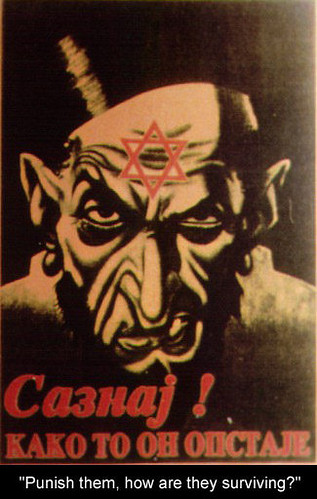
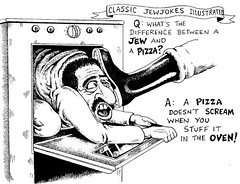
In addition to his coining The 14 Words, as a member of The Order, Lane is probably best known for his role in the 1984 murder of Jewish radio talk show host Alan Berg. Lane & Co. were inspired by The Turner Diaries, authored by the dead nutzi Dr William Pierce. The Diaries — along with My Awakening by ex-KKK Grand Poobah David Duke, The Myth of the Six Million by David Hoggan, In Defense of Anti-Semitism by Edgar J. Steele, The International Jew by Henry Ford, Did Six Million Really Die?, The Leuchter Report by Fred Leuchter and the video game Muslim Massacre — are all available for FREE! download on Australian Protectionist Party member Martin Fletcher’s website, Down Under Newslinks. There you can also find a gallery of ‘Anti-Jew posters’ produced by Serbian fascists during WWII, and cartoons produced by Tom Metzger’s White Aryan Resistance.

Sample poster:

Sample cartoon:

Martin Fletcher:

As for Lane’s remains, one little pyramid has made its way to Australia.

Over to the bizarros on Stormfront Down Under on David Lane – Ash Spreading Memorial Service!

b_gretel
Join Date: Sep 2008
Location: Perth, Australia

Pro-White concious [sic] people have the opportunity to attend the planned ash spreading memorial service of the late David Eden Lane in Perth, Western Australia upholding the final wishes of Mr. Lane and his family.

Mr. David Eden Lane (November 2, 1938 – May 28, 2007) was more commonly known for redefining the racial religion known as Wotanism. David Lane was first to coin the phrase “We must secure the existance [sic] of our people and a future for white children” known as the 14 words. David Lane also developed the 88 precepts which are widely accepted as a set of guidelines for achieving and maintaining white people only living spaces and nations.

Due to roles he played in the reactionary [sic] group titling themselves “The Order” he was sentenced [to] 190 years inprisonment [sic] during which he died of medical complications on May 28, 2007.

If you wish to attend this memorial serivce [sic] please contact: [email protected] RSVP-ASAP!

* Date will be finalized when attending numbers have been estimated.
* Civil and neat attire is expected for the proceedings.

    HatemongerCA
    Join Date: Feb 2009
    Location: Otways

    Sounds good. Who is hosting the event?

Steelcap Boot
Join Date: Feb 2004
[Location: Perth, Australia]

I have just returned from witness [sic] to the package that contained the ashes.

All those White Nationalists who wish to attend and show their respects during this overdue service for David [L]ane here in Western Australia will need to contact –

[email protected]

    HatemongerCA

    Okay SCB, I take it this is being kept on the low.

    I’m no where near Perth so I won’t be attending but good luck and best wishes to those who attend.

Mygeeto
Join Date: Dec 2007
Location: Victoria, Australia

Just asking, but why is he being scattered in Western Australia? thought he would want to be burried/scattered [sic] in America…

    b_gretel

    It was David’s wish to have his ashes spread around all the white nations.

Hate Society
Join Date: Mar 2007
Location: Perth. Australia

I can not urge people enough to attend the ceremony and pay their respects to such a great man. Please remember this man was not only the creator of the 14 words, but he suffered a great deal behind bars for our cause and practically gave his life for you and me. So please, come together, and give something back to some one who has sacrificed so much for our cause.

Hail David Lane! 1488

    Etain
    Join Date: Jun 2008
    Location: N/A

    Please forgive me for dictating a timeline for your planned event, but you’d probably find more people could attend if you coincide the ceremony with the B&H gig around ANZAC [D]ay. From what I understand they’ll [sic] be interstaters coming for the gig, and they could attend two nationalist [sic] events in one weekend. Just a thought.

http://www.stormfront.org/forum/showthread.php?t=570717

BONUS! PETA w e i r d n e s s

From the ridiculous to the sublime…

Posted in !nataS, Anti-fascism | 11 Comments

Switzerland for the Swiss…

RAHOWA! 14! 88! Hutt Hutt Hutt!

Russia for the Russians, British Jobs for British Workers, Australia for the Australians

Swiss ‘race’ attack stuns Brazil
BBC
February 12, 2009

Brazil has called in the Swiss envoy to discuss an alleged bonehead attack near Zurich on a pregnant Brazilian woman that caused her to miscarry twins.

Three boneheads are reported to have attacked Paula Oliveira, aged 26, on Monday, leaving her badly scarred.

Ms Oliveira received some 100 razor cuts, and the initials of the right-wing Swiss People’s Party (SVP) were also carved into her body.

Ms Oliveira’s family says the assault was racially-motivated.

It says she had been speaking Portuguese outside a Zurich train station shortly before the attack.

“What they did to my daughter is like a horror movie,” Ms Oliveira’s father, Paulo, told Brazil’s Globo TV.

The attack has caused shock in Brazil where it has been widely reported along with graphic images of the scars inflicted on Ms Oliveira, the BBC’s Gary Duffy in Sao Paulo reports.

Brazil’s Foreign Minister Celso Amorim has described the assault as “grave” and “shocking”.

The facts surrounding the attack remain unclear but police in Zurich say a man called them on Monday evening to report that a woman in a train station needed help.

The assault is said to have continued for about 10 minutes. Ms Oliveira told police that she had suffered a miscarriage shortly afterwards in a toilet near the train station.

Ms Oliveira was working as a lawyer for a big European company in Switzerland. She is said to have been living legally in the country for almost two years.

No-one has been arrested in connection with the attack. Swiss police have asked for patience while the investigation is continuing.

A lawmaker from the Swiss People’s Party condemned the attack.

“If that really was someone from our party, we wouldn’t hesitate for a second. That person would be immediately kicked out,” Oskar Freysinger told the Associated Press news agency.

Earlier…

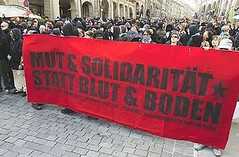
Courage & Solidarity not Blood & Soil

In Bern, Switzerland, according to AP, 500 antifa managed to disrupt a march by 10,000 members and supporters of the People’s Party (SVP), described as a ‘nationalist’ party by AP (Swiss president calls for calm after pre-election violence in capital, International Herald Tribune, October 7, 2007). In other reports, the SVP is described as belonging to the far right. In 2003, “The party ran an anti-foreigner campaign, in which asylum seekers were portrayed as criminals and drug dealers”, and gained 27% of the vote in national elections, or 55 seats from a total of 200. The party’s leader, Christoph Blocher, is a billionaire industrialist, and “The party recently launched a campaign to deport criminal foreigners, illustrating its point with posters showing white sheep kicking a black sheep off a Swiss flag.”

Whoever suspected Swiss nationalists could wield such influence over the ideological pronouncements of Australian-based Tories?

The next big bonehead gig is scheduled for ANZAC Day in Perth; the same location local plasterer Paul Innes — moderator of the White supremacist Stormfront Down Under, and a supporter of the two organising groups, Blood & Honour Australia and the Southern Cross Hammerskins — is planning on creating a Pioneer Little Europe: nie blankes!

Posted in Anti-fascism | 2 Comments

More fun and games in Russia

    “No offence but honestly who gives a shit about [96 dead ethnics] in Russia.” ~ Nowave, Melbourne Punx Forum

On the other hand, Russian nutzis have grave concerns over the actions of human rights activists. Thus:

Neo-Nazis threaten to murder journalists in Russia

New York, February 11, 2009–The Committee to Protect Journalists called today for Russian authorities to immediately investigate a death threat that was sent to a human rights research center. In an e-mail, a neo-Nazi group threatened to murder a number of journalists and intellectuals in the next year, according to the recipient of the threat.

The sender told Galina Kozhevnikova, deputy head of the human rights research center SOVA, which documents the activities of radical nationalist, neo-fascist, and xenophobic groups in Russia, to “prepare” to be the next in line, and made reference to recently slain lawyer Stanislav Markelov. Markelov was shot at the same time as Anastasiya Baburova, a Novaya Gazeta journalist who was with him. Kozhevnikova told CPJ she received the message, signed by a Russian neo-Nazi group known as “BTO,” on Sunday, a day after SOVA announced plans to hold a press conference on the rise of related crimes…

Given the Russian state’s denial, complicity and general indifference, SOVA plays a crucial role in monitoring the deadly antics of Russia’s burgeoning fascist parties and movements.

Rights group sees slight rise in Russia hate crime
Mansur Mirovalev

MOSCOW (AP) — The number of hate crimes rose in Russia last year as the global economic crisis fueled xenophobic feelings but higher conviction rates kept the number from going higher, a human rights group said Wednesday. Galina Kozhevnikova, deputy head of the Sova group, which monitors hate crimes in Russia, said 97 people were killed and 525 wounded in apparent hate crimes…

The increasing number of ‘hate crimes’, and the growing popularity of the movements and ideologies which nurture them, have important implications not only for Russia, but Eastern and Western Europe generally, in numerous parts of which fascist and racist movements are on the rise. The global economic crisis, and the anxieties it produces, provide fertile ground for demagogues. In conjunction with the collapse of European socialism — especially in the countries of the former Communist bloc — nationalist, racialist and xenophobic sentiment form a powerful matrix from which incipient fascist regimes may be born.

But so much for the macro-political.

Putin’s worst nightmare
Luke Harding
The Observer
February 8, 2009

It was 9.10pm and Karen Abramian was returning home to his flat in southwest Moscow. Abramian had been visiting his parents in a nearby tower block. His journey back took five minutes – past a series of grey high-rise buildings soaring into Moscow’s packed skyline and a children’s playground, and up a modest flight of steps. As he punched in the entrance code, two young men, one wearing a baseball cap and one a bandana, approached him from behind. And then they stabbed him. They stabbed him again – methodically slashing his head, neck, back and stomach. Abramian pleaded with his attackers. “Don’t do this. Please take my money,” he begged them. His assailants – two slight, boyish, almost nerdish figures – ignored him, stabbing him 56 times. At this moment, Abramian’s wife Marta peered out of their ninth-floor apartment window and spotted two boys beating a dark shape lying on the ground. The couple’s 14-year-old son Georgy, who had been playing nearby, found his father in the entrance, bleeding profusely. Georgy took off his T-shirt (it was April, still winter in Russia, and bitterly cold), wrapped it around his father and ran upstairs. Abramian was conscious when Georgy came back with a blanket and pillow. Georgy wrapped his father in it and they waited in the gloom for an ambulance. Abramian told his son simply: “They were skinheads.” Four hours later, in the early hours of 17 April 2007, Abramian was dead. Doctors had been unable to stem the colossal loss of blood…

Abramian’s killers were Artur Ryno and Pavel Skachevsky, both 17. According to Harding, the pair are among the worst mass murderers in Russia’s modern history, having killed 20 people and attacked at least 12 others, who had survived.

In December 2008, Ryno and Skachevsky were sentenced to 10 years in jail, the maximum sentence for a juvenile. Five other members of their gang were jailed for between six and 20 years. The jury acquitted [one female] and one other male gang member. During the trial the boneheads showed no remorse, giggling frequently and even laughing at the families of their victims.

The average age of murderous Russian boneheads is young: 15 or 16. They mobilise around the slogan ‘Russia for the Russians’.

According to Sova, 96 people were murdered in 2008 in racist or neo-Nazi attacks, with another 419 beaten or wounded. (The number of deaths was 50 in 2004, 47 in 2005, 64 in 2006 and 86 in 2007.) Last month, another 12 people were murdered. Sova’s research suggests that xenophobic prejudice has become mainstream, acceptable. And while most Russians don’t support radical ideas in practice, there are around 2,000-3,000 young boneheads prepared to attack and kill migrants, [Alexander Verkhovsky, director of Sova] estimates.

Russian authorities have, until recently, been more than happy to allow the little boneheads to butcher at will. The stark inequalities in wealth in contemporary Russian society can’t help but breed social resentment, and channeling social discontent in the direction of immigrant workers — rather than Putin and his cronies, the oligarch — is politically astute. This is especially the case given that the civic institutions which characterise Western democracies barely exist in Russia, and the transition from Communism to Capitalism was governed by an authoritarian regime remarkably similar in its composition to that which preceded it; the military and security apparatus remaining in near-total dominance throughout.

March 2005:

Even a cursory examination of the social situation in modern Russia reveals a deeply divided society. An array of statistics documents the reality of two different worlds that hardly come into contact with one another. One—the world of wealth and luxury—is inhabited by an insignificant minority. The other—the world of social decline and an arduous struggle for life’s necessities—is inhabited by millions upon millions.

Figures showing the distribution of wealth reveal the glaring nature of this social polarisation. According to government data, the incomes of the very richest members of Russian society are 15 times those of the poorest—one of the highest levels of social inequality to be found among the world’s leading countries. In Moscow, this difference is 53-fold…

April 2006:

The American business magazine Forbes recently published its list of the world’s billionaires for 2005, which included 33 Russian citizens, illustrating once again how the political life of contemporary Russia, under the leadership of President V. Putin, is aimed, first and foremost, at the satisfaction of the interests of post-Soviet big business and oligarchs.

The wealth of the planet’s richest people grows with unprecedented speed. In 2005, the number of billionaires reached 793, having risen by 102, and their net worth exceeded $2.6 trillion, having risen by 18 percent. The average wealth of a member of the list is $3.3 billion.

The indicators of the “Russian part” of the list, which grew by six people since the previous year, correspond exactly to this general tendency, and sometimes even exceed it. The net worth of the Russian nouveax riches nearly doubled in the course of a year, from $91 billion to $172 billion. Twelve of them figure in the world’s top 100. In the lead is Roman Abramovich, the governor of Chukotka and owner of the British soccer team Chelsea. His wealth grew—especially because of the sale of the company Sibneft—by nearly $5 billion, and is estimated at $18.2 billion. He rose from 21st to 11th place in the world list. [In 2008 Forbes ranked him as the fifteenth richest person in the world.]

After him follows the head of Lukoil Vagit Alekperov, the former deputy minister of the USSR’s state-run oil industry, whose wealth more than doubled to $11 billion. Next are Vladimir Lisin, the head of the Novolipetsk Steel; Viktor Vekselberg, buyer of Faberge eggs and pretender to the governorship of Kamchatka, director of the Siberia-Ural Aluminum Company SUAL and the oil company TNK-BP; Alfa Group Consortium head Mikhail Fridman; and other well- and not-so-well-known “heroes.”

In growing recognition of the potential threat an out-of-control populist, right-wing, xenophobic movement poses to the state — and the elites which govern it — Russian authorities have begun to extend their repressive measures to some elements of this movement. Thus:

In November 2008, police and federal security agents broke up the Slavic Union’s annual “Russian March”, arresting 1,000 people, including [its leader Dmitry] Dyomushkin. He was released after several hours in custody, however, and eventually fined a paltry 1,000 roubles (£23). Russia’s authorities are clearly rattled by the rise of the far-right, whose political appeal is likely to grow as the country slithers into economic crisis. As living standards tumble it is immigrants who will get the blame. There is no prospect of a pro-western Orange Revolution in Russia. But the possibility of a far-right revolt against Putin is real and growing. The boneheads – a pimply, adolescent army of lower-middle-class racists – pose a serious threat to the Kremlin’s otherwise vice-like grip on power.

In Australia, groups such as the Southern Cross Soldiers — a pimply, adolescent army of lower-middle-class racists, proclaiming ‘Australia for the Australians’ and shouting ‘Fuck off we’re full’ — provide a largely pacific, less organised, less articulate, less popular, much more marginal equivalent. That said, as a potential pool for recruitment, despite his obvious ineptitude, Dr James Saleam of Australia First is right, and the Soldiers’ WN critics on SF are wrong, in recognising these young patriots as being a potentially lucrative — if in other ways horrifyingly shallow — source of new talent. Their hostility to various forms of Wog — principally Lebanese, and Muslim — expresses an underlying anxiety regarding their place in Australia; or, alternatively — and more accurately — their own displacement from the centre of the Australian Story. Until HoWARd stole her thunder, Pauline Hanson was able to capitalise upon some elements of this among the rural and regional population of Queensland. Thus while they may be little shits, they are useful little shits, and, assuming they survive beyond the next few years, will likely produce at least a small number of more ambitious, and more talented, and therefore more likely successful, White nationalist militants.

This jingoist flag-waving has a tinge of 1930s populist fascism about it. We don’t like to say it, but Hitler was a very popular leader. If he’d bothered to run an election, he probably would have won it. He used populist techniques — appealing to the population but on the basis of chauvinistic and racist premises. Now, we’re beginning to see elements of that in the demeaning of the concept of patriotism by reducing it to coerced pledges of allegiance to the flag…

Posted in Anti-fascism | Leave a comment

Ciaran Murphy : Anti-social

We’re all middle class now anyway… right?

Ciaran Murphy
political
singer
songwriter
Belfast

Posted in Music | Leave a comment

Uncle Hugo & the Bolivarian Revolution in Venezuela

    Update : Chavez wins vote to scrap term limits in Venezuela, Niko Price, AP, February 16, 2009. ‘Chavez called the victory — which allows all public officials to run for re-election as many times as they want — a mandate to speed his transformation of Venezuela into a socialist state. “Those who voted ‘yes’ today voted for socialism, for revolution,” he said.’ Look out for exploding cigars…

Three cheers and a loud huzzah! for ten years of Chávismo!

On the other hand — and at the risk of sounding like a cynical whining right-winger posing as an anarchist — maybe celebrations are a little premature? For example, some French @ called Charles Reeve done an interview with some Venezuelan @s Miguel and Isabel; it appears on the blog of the steenky communists ‘The Commune’, and is apparently the first English translation of the March 2008 interview.

It portrays Uncle Hugo and his government in a rather unflattering light.

the revolution delayed: 10 years of hugo chávez’s rule (February 9, 2009):

This month marks the tenth anniversary of Hugo Chávez’s coming to power in Venezuela, and ten years of the “Bolivarian revolution”. This process has included waves of state intervention in the economy and fervent rhetoric against US imperialism. But while some on the left see this Chavista movement as the new “socialism for the 21st century”, groups such as ours have argued that it is actually more like an old-fashioned attempt at modernisation by a technocratic élite; that increased bureaucratic power over capital is not inherently progressive; and that the “revolution” in Venezuela allows for very little working-class control or initiative from below.

Here we present a translation of a March 2008 interview conducted by the French anarchist ‘Charles Reeve’ with two members of the El Libertario group in Caracas, the nation’s capital, which offers some stark insights into the reality of the situation. Looking at various aspects of the Venezuelan economy and living standards in the country, it argues that Chavismo and the mythology of the “Bolivarian revolution” conceal a raft of neo-liberal reforms and attacks on workers’ rights, and that we must break out of the dynamics of Chávez vs. the opposition in order to build an autonomous working-class alternative…

Note that, in 1995, Charles and Sylvie Deneuve published an essay titled ‘Behind the Balaclavas of South-east Mexico’, which argued that the Zaps were less the harbingers of a new, ‘post-modern’ revolution (see : Michael P. Pelaez, ‘The EZLN: 21st Century Radicals’) than “the new party of the Mexican Left”.

In Australia, the most vocal support for Hugo Rafael Chávez Frías, the Bolivarian Republic of Venezuela, and the Bolivarian Revolution, has come from the neo-Trotskyist DSP. (Its splinter, the RSP, also supports Chávez: Support the Cuban & Venezuelan revolutions! Join the Cuba-Venezuela solidarity club!, implores the latest issue of its zine.) The DSP argues that the Venezuelan experience provides a dramatic example of ‘Socialism of the 21st Century’. To promote this new-fangled Socialism, the DSP has devoted a site to promoting solidarity with the Venezuelan Government, organised study brigades, and frequently invites speakers from the Venezuelan Embassy to address their meetings.

Recently, it has republished a tract from the Ministry of People’s Power for Communication and Information (January 30, 2009), outlining the achievements of the last ten years under Chávez’s rule.

VENEZUELA: ACHIEVEMENTS OF 10 YEARS OF REVOLUTION

During 10 years of revolution, the Bolivarian Government has been breaking free from paradigms, beating obstacles, exceeding all expectations, facing empires, revolutionizing consciousness, beating foreign and internal propaganda, and even more, defending, as the engine and fuel of the revolutionary project, the deep conviction that the human being is the center and principle of the society.

The most representative achievements can be evaluated quantitatively through the Missions, infrastructure works and technological advancements, among others, but the qualitative analysis leads us to three big conclusions: with the arrival of the Bolivarian Revolution, the quality of life has been boosted for most Venezuelans, social inequalities have been reduced significantly and Venezuela has made important steps in the struggle to reach the real conditions of a developed country…

See also : Venezuela: Democracy, revolution and term limits, Chris Kerr, February 6, 2009 (Green Left Weekly, No.782, February 11, 2009) | El Libertario (English).

Oddly enough, one member of the Ministry of People’s Power for Communication and Information is Eduardo Rothe. Rothe was interviewed by the French zine Rouge et Vert: Le Journal des Alternatifs (Number 222, April 15, 2005; translated from the French by NOT BORED! July 2005), and is a former member of the Internationale Situationniste, contributing some thoughts on ‘The Conquest of Space in the Time of Power’ to the 12th issue of its journal (September 1969).

Just as anarchists are critical of Uncle Hugo, Uncle Hugo is critical of anarchists: “Critical thinking is fundamental to a revolution, but that is very different to going around talking badly about a party that has not been born, collecting signatures to present them who knows where. Anyone who wants to be an anarchist, get out of here, you are not wanted, what is needed here is a creative, but disciplined active membership.” One, rather important difference between the ‘anarchists’ and Uncle Hugo being, of course, that Uncle Hugo is in a rather better position to eliminate the bad-mouthed anarchists than the undisciplined anarchists are of getting rid of Uncle Hugo…

Chávez does have his champions in the academy, of course, one of note being Slovenian “superstar” philosopher Slavoj Žižek.

It is striking that the course on which Hugo Chávez has embarked since 2006 is the exact opposite of the one chosen by the postmodern Left: far from resisting state power, he grabbed it (first by an attempted coup, then democratically), ruthlessly using the Venezuelan state apparatuses to promote his goals. Furthermore, he is militarising the barrios, and organising the training of armed units there. And, the ultimate scare: now that he is feeling the economic effects of capital’s ‘resistance’ to his rule (temporary shortages of some goods in the state-subsidised supermarkets), he has announced plans to consolidate the 24 parties that support him into a single party. Even some of his allies are sceptical about this move: will it come at the expense of the popular movements that have given the Venezuelan revolution its élan? However, this choice, though risky, should be fully endorsed: the task is to make the new party function not as a typical state socialist (or Peronist) party, but as a vehicle for the mobilisation of new forms of politics (like the grass roots slum committees). What should we say to someone like Chávez? ‘No, do not grab state power, just withdraw, leave the state and the current situation in place’? Chávez is often dismissed as a clown – but wouldn’t such a withdrawal just reduce him to a version of Subcomandante Marcos, whom many Mexican leftists now refer to as ‘Subcomediante Marcos’? Today, it is the great capitalists – Bill Gates, corporate polluters, fox hunters – who ‘resist’ the state. ~ ‘Resistance Is Surrender’, London Review of Books, November 15, 2007

The full text of Žižek’s polemic — ostensibly a review of football hooligan, wrecker (and philosopher) Simon Critchley’s Infinitely Demanding : Ethics of Commitment, Politics of Resistance (Verso, 2007) — is available here, as is a reply by meddling outsider David Graeber. Resistance is Utile: Critchley responds to Zizek (Harper’s Review, May 2008) is available here.

See also : Venezuelan Anarchists on Chavez, WSF (January 10, 2006) | anarchy is a (Venezuelan) fag! (October 2, 2007) | Viva Chávez? WSJ on the student opposition… (November 26, 2007) | No Todos Somos Chávez: Venezuela says ‘No’ (December 4, 2007) | Uh-oh… troubled times ahead for anarchists in Venezuela // Bombings in Caracas (February 26, 2008) |

Posted in Anarchism, State / Politics | 12 Comments

Napalm Death : When All Is Said And Done

Blindness feeds the world to madness
Faith’s crumbling, there’s no doubt about it
Religion and science fighting a new kind of war

Helpless – wander the streets in desperation
Fearless – to the path they tread
Shameless – the powers that butcher
Ignorant to the deeds that they commit

When all is said and done
Heaven lies in my heart
No slave to beliefs that propagate pain
When all is said and done
Heaven lies in our hearts
This life is a gift to be lived and loved

Fracturing the structure of nature
Iconic catalysts to slaughter
A stalemate bursting bound by contradictions

Heartless – divine blueprints of hatred
Selfless – Diseased masterplans
Shameless – the powers that butcher
Ignorant to the deeds that they commit

Decoded treachery shielding the tyranny
Black Bible tyrants behind masks of righteousness
Relentless – the onslaught of misunderstanding
Descending into a unified chaos

One more chance for a shot at redemption
Lost within, can we summon the might?

Posted in Music | Leave a comment

The Anarchists in the Spanish Revolution

Chuck Morse done an interview (February 2, 2009) with Stuart Christie, author of We, The Anarchists (AK Press, 2001). I haven’t read the book, but it brings to mind Vernon Richards’ Lessons of the Spanish Revolution (Freedom Press, Third Edition, 1983), at least insofar as Christie’s final remarks are concerned:

I hope the book will give today’s anarchist activists some insight into the FAI [Iberian Anarchist Federation] experience so that they can create that new world in their hearts—without, hopefully, making the same mistakes. I also hope the book makes clear that anarchism is much more than a movement of permanent protest.

(Stuart’s site, incidentally, has a neat anarchist filmography. See also: AnarchoTV 2.0.)

Otherwise:

I also try to show, by using the historical example of the anarcho-syndicalist labor union, the Confederación Nacional del Trabajo (CNT) and the FAI, how anarchists and anarchist organizations are equally subject to the process of institutionalization and what the German sociologist Robert Michels described as “Iron law of oligarchy” as any other social groupings.

“It is organization,” Michels wrote, “that gives birth to the dominion of the elected over the electors, of the mandatories over the mandators, of the delegates over the delegators. Who says organization says oligarchy.”

We, The Anarchists outlines the evolution of the anarchist movement in Spain and its relationship to the wider labor movement, while providing insights into the main ideas which made the Spanish labor movement one of the most revolutionary of modern times. It also addresses, from an anarchist perspective, the problem of understanding and coping with change in the contemporary world: how can ideals survive the process of institutionalization?

As Christie notes, “The Iberian Anarchist Federation has been demonized both by the right and the authoritarian left”. Regarding the latter, ‘The Spanish Civil War and the Popular Front’, Part one & Part two by Ann Talbot (January 26 & 27, 2009) does not so much demonize the FAI as ignore it.

Also published online recently (@ Kasama, Mike Ely’s blog) is a Maoist analysis of the Civil War and Revolution, originally published in the Revolutionary Communist Party’s zine Revolution in June 1981. It concentrates on criticising the Comintern’s policy (ie, Uncle Joe). Naturally, anarcho-syndicalism is dismissed as “at bottom conservative, closer to the outlook and interests of the petty bourgeoisie than of the proletariat”, with the usual caveat that while there “is much to criticize in the anarchist line… it is unarguable that something about the spirit and style of their work much more challenged the masses, was much more rebellious, than the stuffed-shirt trade-unionism of the Socialists and what was soon to be the ‘respectable antifascism” of the Communist Party.”

They, The Anarchists — a bit stoopid (‘anti-intellectual’), but hella enthusiastic. The same line is evident in most leftist commentary on anarchism, whether it concerns that of the 1930s or the twenty-first century (see ‘Anarchism and the Anti-Globalization Movement’, Barbara Epstein, Monthly Review, September 2001) — which is not to suggest there isn’t an element of truth to some of these observations… but that’s another story, and not one many are interested in hearing.

For a recent Trotskyist criticism of the CNT/FAI, see ‘When anarchism was put to the test’ by Josh Lees (Socialist Alternative, No.134, October/November 2008). A more substantial critique is contained in ‘Towards a History of Workers’ Resistance to Work’ and Workers Against Work: Labor in Paris and Barcelona During the Popular Fronts by Michael M. Seidman (Seidman unsuccessfully resists working at the University of North Carolina).

I do not wish to ignore the fact that workers’ refusals to work harmed the fight against Franco and weakened French defenses in a period of Nazi rearmament. Yet one might interpret resistance itself as suggesting a working-class utopia in which wage labor would be reduced to a minimum. Resistance was also a conjunctural and cyclical phenomenon, but refusals remained an intrinsic part of working-class culture and manifested themselves in different periods with various divisions of labor. During the Popular Fronts, workers revolted against a variety of disciplines, including that imposed by working-class organizations. Wage earners certainly wished to control their workplaces but generally in order to work less. One may speculate that the way to eliminate resistance is not by workers’ control of the means of production but rather by the abolition of wage labor itself.

Duh. The question is: how?

Barry Pateman on ‘Anti-Franco Activism After the Spanish Civil War’, an extract from his essay in No.65 of Anarchy: A Journal of Desire Armed, Spring/Summer 2008:

As you get older you find yourself doing more and more of these events and it’s quite sad as well as quite heartening in many ways. I remember speaking 20 years ago in Conway Hall, in London, about 50 years after the Spanish Revolution, and it is somewhat haunting to think that that generation of militants are now dead and gone.

So tonight I want to talk about the anarchist resistance to Franco, from 1939 onwards. Before I do that I want to say two or three things, because some of the things I say may sound rather harsh and critical of the CNT (and I’m not really going to talk about anything else apart from anarchism). So if it sounds harsh, it’s simply to try and be realistic. I am not particularly cruel or thoughtless or heartless or smug. It’s very easy for all of us, 70 years onward, to say clever statements about it or think smugly about it or try and use it as a debating point. The truth of the matter is that probably if you look at the 20th century, the anarchists, both in the CNT-FAI and the FIJL (the libertarian youth), and the anarchists who were not involved in those organizations, came nearer to creating a revolutionary change in everyday life than anyone else ever did.

See also : Lucio Urtubia (June 6, 2008) | Fascist wankers in Spain mourn hijo de puta Franco (November 20, 2007) | Anarchy, Memory & ‘Forgetting’: Salvador Puig Antich (February 25, 2007) | Salvador Puig Antich : The Film (October 2, 2006) | The Guardian on the reign in Spain (July 30, 2006) | Barcelona, 1936; Strangling the life out of fascism : Spain, 1936 (July 21, 2006) | KSL on the Spanish Revolution (July 17, 2006) | The Spanish Revolution and the English Literati (July 16, 2006)

Posted in Anarchism, History | Leave a comment

The ALP ♥s Families… Working Families… First

The Victorian ALP is engaged in a further round of back-slapping following Steve Fielding’s declaration of sleeplessness during negotiations with the KRudd government over its $42 billion economic ‘rescue’ package. In 2004, the Victorian ALP put Working Families First by allocating its Senate preferences to Steve ahead of The Greens. Steve received just 45,260 votes; the Greens 205,920.

Thank God for the ALP; thank the ALP for Steve Fielding.

Speaking of Fielding, NALLIAH, Danny — God Hates Fags (and Victorians) — was Steve’s best mate back in 2004, placed second on the Family First Senate ticket.

Pollytics asks:

If Senator Fielding was, say, beaten to death by Chris Evans in pure frustration over the stimulus plan negotiations – who would fill the vacancy that such a robust set of negotiations would create?

Antony Green answers:

[Nalliah] didn’t actually need to be a member of Family First at all. Pre-selection for Senate tickets is a matter entirely for a party’s constitution and has nothing to do with the Electoral Act. In line with the Heather Hill and Robert Woods cases, had Fielding been declared [ineligible] to take his seat, then Nalliah would have been declared elected in his place even if he hadn’t been a member of the party.

If Fielding resigned, the casual vacancy provisions of Section 15 of the Constitution would apply. The State Governor/Parliament would fill the vacancy with the requirement the new Senator must be a member of the party and still be a member when they take their seat. Whether the person was a member would depend entirely on how the party defined membership.

The reference to Senate replacements being from the same party does not necessarily relate to registered parties. The word ‘party’ as used in Section 15 of the Constitution has no definition and was inserted in 1977 before party registration was introduced into the Electoral Act in 1984. The High Court would interpret the meaning of party more broadly than just registered parties. It would apply equally to unregistered parties.

If there was a dispute over whether someone was a ‘member’, say a challenge by other members of the party, then the whole thing would have to be decided by the Courts before anyone could take their seat.

According to Barney Zwartz (Failing to understand the nature of an understanding God, The Age, February 12, 2009), Danny is “wrong as a theologian, a thinker and a pastor”. Zwartz also writes: “Another key text is the Old Testament book of Job, probably the oldest in the Bible, which ponders suffering. The answer Job is given is that there is no answer — at least, not one accessible to humans; we can only endure. God rebukes Job’s comforters for offering false answers.”

Well, OK. But that’s not all God — or Job — says.

To test Job’s faith, God destroys Job’s life. He kills his ten children, takes way (or kills) his herd, and covers him with “loathsome sores” from head to toe.

In appreciation, Job writes:

“[God] destroys both the blameless and the wicked. When a scourge brings sudden death, He mocks the despair of the innocent. When a land falls into the hands of the wicked, He blindfolds its judges. If it is not He, then who is it?” (9:22–24)

“From the city the dying groan, and the throat of the wounded cries for help; yet God pays not attention to their prayer.” (24:12)

“Why do the wicked live on, growing old and increasing in power? Their homes are safe… their little ones dance… they spend their years in prosperity and go to the grave in peace. It is said, ‘God stores up a man’s punishments for his sons’. Let Him repay the man himself, so that he will know it!” (21:7–21)

After apologising for doubting God’s wisdom, a pacified God gives Job ten new (and more attractive) children, more animals than he had before, and 140 more years of life. “The fear of the Lord–that is wisdom.” (28:28)

As for Hebrews (which Zwartz also cites), “…without the shedding of blood there is no forgiveness of sins” (9:22). And Romans — from which Zwartz extracts what is “perhaps my favourite Bible verse, Romans 8:28” — also condemns social rebellion (13:1–2): “The authorities that exist have been established by God. Consequently, he who rebels against the authority is rebelling against what God has instituted, and those who do so will bring judgment on themselves.”

During many ages there were witches. The Bible said so. The Bible commanded that they should not be allowed to live. Therefore the Church, after doing its duty in but a lazy and indolent way for eight hundred years, gathered up its halters, thumbscrews, and firebrands, and set about its holy work in earnest. She worked hard at it night and day during nine centuries and imprisoned, tortured, hanged, and burned whole hordes and armies of witches, and washed the Christian world clean with their foul blood.

Then it was discovered that there was no such thing as witches, and never had been. One does not know whether to laugh or to cry. Who discovered that there was no such thing as a witch — the priest, the parson? No, these never discover anything. At Salem, the parson clung pathetically to his witch text after the laity had abandoned it in remorse and tears for the crimes and cruelties it has persuaded them to do. The parson wanted more blood, more shame, more brutalities; it was the unconsecrated laity that stayed his hand. In Scotland the parson killed the witch after the magistrate had pronounced her innocent; and when the merciful legislature proposed to sweep the hideous laws against witches from the statute book, it was the parson who came imploring, with tears and imprecations, that they be suffered to stand.

There are no witches. The witch text remains; only the practice has changed. Hell fire is gone, but the text remains. Infant damnation is gone, but the text remains. More than two hundred death penalties are gone from the law books, but the texts that authorized them remain.

It is not well worthy of note that of all the multitude of texts through which man has driven his annihilating pen he has never once made the mistake of obliterating a good and useful one? It does certainly seem to suggest that if man continues in the direction of enlightenment, his religious practice may, in the end, attain some semblance of human decency. ~ Mark Twain, ‘Bible Teaching and Religious Practice’, Europe and Elsewhere, 1923

Most people are bothered by those passages of Scripture they do not understand, but the passages that bother me are those I do understand. ~ Mark Twain

PS. Happy Birthday Darwin.

Posted in State / Politics | Leave a comment