
PATRONIZE ME
Subscribe to Blog via Email
Join 260 other subscribers~jk~
Two Greek anarchists are making molotov cocktails. One says to the other: "So who will we throw these at then?" The other replies: "What are you, some kind of fucking intellectual?"Search
slackbastard on twitter
Recent Comments
- Yeah Nah Pasaran #296 w Jason Wilson on imperial decline : August 13, 2026 | slackbastard on Yeah Nah Pasaran #279 w Jason Wilson on The Epstein Files : February 19, 2026
- Yeah Nah Pasaran #295 w Ariel Bogle on 764 (and more) : July 30, 2026 | slackbastard on Yeah Nah Pasaran #258 w Ariel Bogle & Cam Wilson on Conspiracy Nation : July 31, 2025
- @ndy on antifa notes (march 28, 2026) : The Afterlife of The NSN
- John on antifa notes (march 28, 2026) : The Afterlife of The NSN
- @ndy on antifa notes (june 7, 2026) : Nazi Gold in Hurstbridge Edition
- Lazy E. on antifa notes (june 7, 2026) : Nazi Gold in Hurstbridge Edition
- Matthew John John Walters on Blackburn Sth Sharps!
- @ndy on antifa notes (march 28, 2026) : The Afterlife of The NSN
- John on antifa notes (march 28, 2026) : The Afterlife of The NSN
- @ndy on Blood & Honour / Hammerskins ISD Gig : Melbourne, Saturday, September 13, 2008
August 2026 M T W T F S S 1 2 3 4 5 6 7 8 9 10 11 12 13 14 15 16 17 18 19 20 21 22 23 24 25 26 27 28 29 30 31 -
Recent Posts
- Yeah Nah Pasaran #296 w Jason Wilson on imperial decline : August 13, 2026
- Yeah Nah Pasaran #295 w Ariel Bogle on 764 (and more) : July 30, 2026
- Yeah Nah Pasaran #294 w Émile P. Torres on TESCREAL & the techno-fascist redux : July 23, 2026
- Yeah Nah Pasaran #293 w Tom Tanuki on Q Australia : July 16, 2026
- Yeah Nah Pasaran #292 w Amanda Moore on America’s 250th Birthday Party : July 9, 2026
- Yeah Nah Pasaran #291 w Lucy Hamilton on the Alliance for Responsible Citizenship : July 2, 2026
- Yeah Nah Pasaran #290 w Kels on Prairieland ICE & DFW Support Committee : June 18, 2026
- antifa notes (june 12, 2026) : Racist Pogroms in Belfast, Pauline Hanson in Moonee Ponds
- Yeah Nah, Nah Yeah, It’s the 3CR Radiothon!
- antifa notes (june 7, 2026) : Nazi Gold in Hurstbridge Edition
@ Sauce
- AK Press
- Anarcha
- Anarchism Pamphlets in the Labadie Collection
- Anarchism: A Documentary
- Anarchist news dot org
- Anarchist Studies Network
- anarchistfaq
- Anarchy Archives
- anarchy.org.au
- Anarkismo
- Black & Red
- Bob Black
- Christie Books
- CrimethInc.
- Daniel Guérin (1904-1988)
- Dead Anarchists
- flag.blackened.net
- Freedom Press
- Google Book Search : ‘Anarchism’
- infoshop.org
- Institute for Anarchist Studies
- Jura Books
- Kate Sharpley Library
- libcom.org
- Love & Rage Archive
- Marxism contra Anarchism
- PM Press
- Research on Anarchism
- The Anarchist Library
- The Nestor Makhno Archive
Anarchist Blogs / Sites
- Alpine Anarchist Productions
- Anarchist Writers
- Anarchists Against the Wall
- Anarchy Alive
- Angry White Kid
- Aragorn!
- avtonom.org
- Black Flame: the revolutionary class politics of anarchism and syndicalism
- Bombs and Shields
- DISACCORDS
- Fire To The Prisons
- Insurrection News
- It’s Going Down
- John Kinsella
- Mickey Z.: Cool Observer
- Molly’s Blog
- Mujeres Creando [Women Creating]
- Old Punks Never Die!
- Rad Geek People’s Daily
- Revolution by the Book
- Robert Graham
- Sketchy Thoughts
- subMedia
- the Disillusioned kid
- three way fight
- Void Network
- we are not afraid of ruins
Antifa
- AFA Ireland
- Anti-Fascist Action Sydney
- Anti-Fascist Network [UK]
- Antifa Austria
- Antifa Czech Republic
- Antifa Denmark
- Antifa Germany
- Antifa International
- Antifa Netherlands
- Antifa Sweden
- avtonom/antifa [russia]
- Fightdemback
- Fire and Flames
- idavox [usa]
- International Anti-Fascist Defence Fund
- London Antifascists
- Malatesta's Blog
- Melbourne Antifascists
- NYC ANTIFA
- One People’s Project
- rosa antifa wien [austria]
- Rose City Antifa
- South Side Chicago Anti-Racist Action
- threewayfight
- Torch Antifa [US]
- Who Makes the Nazis?
Art
- Art Spiegelman
- Banksy
- benfrostisdead
- Camille Pissarro
- Chick Publications
- Critical Art Ensemble Defense Fund
- Die screaming with sharp things in your head!!!
- Doug Minkler
- drawn and quarterly
- Emile Zile
- Eric Drooker
- Footy Jumpers
- George Grosz
- Good Show Sir
- Illegal Art
- James Gleeson
- James Koehnline
- Jay Kinney’s Clinic of Cultural Collision
- Jim Woodring
- Joe Sacco
- John Heartfield
- John Yates
- Latuff Archive
- Laughing Squid
- Marcsta
- Mark Vallen’s ART FOR A CHANGE!
- Mike Fluggenock
- MOAK47
- Open Source Cinema
- Platform Artists Group
- Radical X Stitch
- Scratch! Media
- SHOPDROPPING.NET
- shut up + shop
- Stencil Graffiti
- Surrealism-USA
- Syd Nicholls
- The Art of Revolution : Political Posters in the RedPlanet Archive
- The Asian Elephant Art & Conservation Project
- The Billboard Liberation Front
- The Official “Weird Al” Yankovic Web Site
- The Visual Front
- the z o m b i e t i m e Hall of Shame
- TurtleKiss.com
- Vexta
- Winston Smith
- Wooster Collective
Elsewhere
Journals / Zines
- |sticky institute melbourne australia|
- 325
- A Murder of Crows
- Abolishing the Borders from Below
- Anarchist Studies
- Anarcho-Syndicalist Review
- Anarchy
- Arena Magazine & Journal
- Aufheben
- borderlands
- Breakdown Press
- Chain Reaction
- Clamor Magazine
- Collective Action Notes
- Columbia Journalism Review
- Counterpunch
- CSE / Capital & Class
- Direct Action
- Dissent
- Dissident Voice
- Do or Die
- dollars & sense
- Earth First! Journal
- Eat the State!
- El Libertario
- Fifth Estate
- Fire To The Prisons
- Foucault Studies
- Freedom Fight
- Going Down Swinging
- Harbinger
- Killing King Abacus
- Last Hours
- Le Monde Diplomatique (English)
- Linchpin
- Links
- MAXIMUM ROCK’N’ROLL
- Monthly Review
- MORTAR
- Multinational Monitor
- Mute magazine
- Mutiny
- New Internationalist
- New Left Review
- New Matilda
- New Politics
- Not Bored!
- Organise!
- overland
- Perspectives on Anarchist Theory
- Prickly Paradigm
- Profane Existence
- Quarterly Essay
- Race Traitor
- Radical Philosophy
- Rebel Press
- Rolling Thunder
- Shift Magazine
- Slingshot
- Smearcasters
- Social Alternatives
- Social Anarchism
- The Baffler
- The Commoner
- The Indypendent
- The International Journal of Inclusive Democracy
- The Journal of Aesthetics & Protest
- The Monthly
- The Northeastern Anarchist
- turbulence
- Upping the Anti
- Upside Down World
- Urban75
- Venomous Butterfly Publications
- Wildcat (English)
- World War 4 Report
- Z Magazine
Know Your Rights
Melbourne
- 3CR
- Animal Liberation Victoria
- ASF-IWA
- CERES
- eco-shout
- Fantin Reading Group
- Friends of the Earth
- IWW
- KP Solidarity
- Latin American Solidarity Network (LASNET)
- Melbourne Anarchist Club
- Melbourne Anarchist Communist Group
- Melbourne Antifascists
- Melbourne Black
- Melbourne Free University
- MelbourneProtests Weblog
- New International Bookshop
- ThreeThousand
Other
- 7inchcrust
- A Theory of Power…
- Anonymous Lefty
- Antifascist Calling…
- antipoet
- Antony Loewenstein’s Blog
- archive : s0metim3s
- Atheist Foundation
- Australia Asia Worker Links (AAWL)
- aut-op-sy
- Autonomedia
- Benjamin Zephaniah
- Black People Love Us!
- Blogger on the Cast Iron Balcony
- Boing Boing
- buggery.org
- Bureau of Public Secrets
- Cageprisoners.com
- CLANDESTINE INSURGENT REBEL CLOWN ARMY
- Colonos
- Cornelius Castoriadis / Agora International
- Dave Warner From The Suburbs
- Democracy Now
- DIRELAND
- Dr. Cam Sexenheimer
- EngageMedia
- Eros Effect — George Katsiaficas
- Evatt Foundation
- Evolucion Hip Hop
- Existentialist Society
- FC St. Pauli
- Five Public Opinions
- For Communism
- Foucauldian Reflections
- Harry Cleaver
- Hoyden About Town
- InFiLtRaTiOn
- Informed Comment
- International Institute of Social History (IISH)
- International Solidarity Movement
- Inveresk Street Ingrate
- Iraq Veterans Against the War
- Italy Calling
- John Pilger
- Khrushchev's Secret Speech
- Kitten War!
- LabourStart
- Lucid Screening
- Media Watch (ABC TV)
- mgk
- Norman G. Finkelstein
- Ontario Coalition Against Poverty
- Open Anthropology
- Orcinus
- Oz Conservative
- Peoples' Global Action (English)
- Peter Tatchell
- Primitivism
- Prindle Rock and Roll Record Review Site
- prole.info
- Punkerslut.Com
- Rationalist Society of Australia
- RAWA
- Reason In Revolt
- S W E A T L U N G
- Shane Maloney & The World of Murray Whelan
- Sisters of Perpetual Indulgence
- Smithsonian Folkways Recordings
- SOVA Center for Information and Analysis
- Spanner Films
- Splintered Sunrise
- Tariq Ali
- The Anarchist Library
- The Angry Arab News Service
- The Centre for Political Song
- The Deletions
- The Koori History Website
- The Partisan
- The Perth Files
- The Stalin Society
- the vulgar press
- The Yes Men
- Tofu Notes
- Treason
- UCSJ: Union of Councils for Jews in the Former Soviet Union
- uncarved
- WAX AUDIO
- Whenua, Fenua, Enua, Vanua
- Wilson’s Blogmanac
- Working Class Movement Library (UK)
Red Menace
- Communist Party of Australia (CPA)
- Communist Party of Australia (Marxist-Leninist) (CPA-ML)
- Freedom Socialist Party (Australia)
- Louis Proyect: The Unrepentant Marxist
- Marxist Interventions
- Marxists Internet Archive
- Posadist 4th International
- Socialist Alliance (Australia)
- Socialist Alternative (Australia)
- Socialist Equality Party (Australia)
- Socialist Party (Australia)
- Solidarity (Australia)
- Spartacist League of Australia
- Surplus Value
- Trotskyist Platform (Australia)
- Weekly Worker (CPGB, UK)
- World Socialist Web Site
War On Dissent
Until someone gets killed…
By way of introduction…
A few weeks ago, the Melbourne Croatia Social Club played host to a group of neo-Nazis, numbering somewhere between 40 and 200. They’d assembled to hear Final War from the US — proudly supported, along with literally thousands of other fascist schmucks, by myspace — sing about killing Jews (which is apparently a far less serious crime than smoking marijuana), among other wholesome family entertainment. Last year, and in years previous, the annual gig organised by local neo-Nazi networks was held at The Birmingham Hotel in Fitzroy, otherwise known as a punk rock venue. This year, the gig also starred a band called Quick & the Dead, from Perth. They’ve recently reformed, and are now playing gigs alongside of punk bands such as The Homicides. In Melbourne, The Birmy continues to be supported by bands like The Worst. According to one source, in November, UK punks Beerzone are scheduled to play The Birmy on Friday November 23 with The Beefeaters, Distorted Truth, RUST and The Worst.
In Russia, anarchy is a dead fag.
A Killing in Siberia Injures Russia’s Green Movement; Environmentalist’s Son Confesses Role in Attack; Preserving a Sacred Sea
Alan Cullison
Wall Street Journal
October 29, 2007
IRKUTSK, Russia — Marina Rikhvanova is a mother of Russia’s green movement. Last year, she led thousands of protesters into the streets of this Siberian city against an oil pipeline that would have skirted the pristine waters of Lake Baikal. Afterwards, President Vladimir Putin scrubbed the plan.
This spring Ms. Rikhvanova put together new rallies against Kremlin plans to turn the Irkutsk region into a center for processing nuclear fuel. She helped protesters plan a tent bivouac near the fuel plant, and printed leaflets for campers to hand out to locals, warning of the dangers of radioactive leakage.
One morning in late July she got a phone call telling her the campers had been attacked in their sleep by masked men armed with metal pipes and wooden clubs. One camper was beaten to death.
What happened afterwards has shaken the environmental community and Ms. Rikhvanova’s role as its leader. Authorities arrested her 19-year-old son, who confessed to a role in the attack.
Ms. Rikhvanova’s defenders say she was set up by Russia’s security services, who they say lured her son, a sometime security guard who had recently fallen in with nationalist skinheads [sic], into the attack on the campers. Authorities dismiss that charge as absurd, and say the 46-year-old Ms. Rikhvanova should have spent more time with her family.
In any case, the incident has diminished the stature of one of Russia’s most influential environmental leaders. Until now, Ms. Rikhvanova’s group in Siberia was able to pull together scientists, ecologists and common folk into a populist groundswell that forced the government to pay attention. Her agenda of unspoiled air and water was seen as transcending politics. In the increasingly authoritarian era of President Putin, she and other environmentalists have comprised one of the few respected alternative voices to the Kremlin on public policy.
Now, some erstwhile allies are keeping their distance. “The attack and the arrest afterwards have been a tremendous blow to the environmental movement, and divided it like never before,” said Mikhail Kulekhov, a local journalist who had worked with Ms. Rikhvanova previously but now has backed off. “We all now have to think closely about whom we work with.”
After the fall of the Soviet Union in 1991, Russia’s green movement had a strong footing in Irkutsk because of Lake Baikal, a 25-million-year-old Russian national treasure.
Known to locals as the Sacred Sea, the lake is 400 miles long and more than a mile deep, and holds nearly a quarter of the world’s unfrozen fresh water and an abundance of unique animal life.
Ms. Rikhvanova studied biology in Irkutsk under the Soviet system, she said, “because I didn’t have to lie in the sciences.” She married a fellow biologist, and wrote a thesis on the effects of effluent being dumped into the lake by a Soviet-built pulp and paper plant.
The group she co-founded, Baikal Ecological Wave, started as a kind of tea society, but quickly gathered strength and members. In the early 1990s, Baikal Wave began collecting grants from the likes of the U.S. Agency for International Development and Germany’s Green Party, bought its own headquarters and started a newsletter.
Soon the group was locking horns with the federal government and Moscow’s newly minted energy barons. Ms. Rikhvanova probed the work of a nuclear fuel enrichment plant in the nearby city of Angarsk, and lined up experts to testify against plans of state and newly privatized oil companies to build pipelines skirting the lake.
In 2002, federal agents raided Baikal Wave’s offices, seized its computers and accused the group of acquiring secret maps of the nuclear enrichment plant in Angarsk.
But the group’s persistence paid off. When the Kremlin tried to push through a plan to build one pipeline through a seismically active area within about 900 yards of the lake, Baikal Wave helped organize street protests. One rally in central Irkutsk in March last year drew 5,000 people in freezing temperatures. Baikal Wave also organized “flash mobs” that deposited bottles of blackened water in front of administrative buildings that they labeled “Baikal Water”.
The Kremlin made an about-face the next month. At a news conference on national television, Mr. Putin ordered the pipeline moved 25 miles away from the lake.
The pipeline victory made Ms. Rikhvanova “a messiah,” said Igor Ogorodnikov, an organizer in a leftist [?] youth group, Autonomous Action. The American magazine Condé Nast Traveler flew her to New York and feted her at an annual awards dinner.
Born in 1988, just as his mother’s career as an activist began to take off, her son Pavel had trouble, as did millions of young Russian men, navigating the penury of post-Soviet Russia.
He wanted to study business at a private institute, but his parents had little money to help him. Ms. Rikhvanova and her husband made no more than $1,000 a month between them, and still lived in the same two-room apartment with Pavel and his sister that they had inherited in Soviet times.
While selling books to pay for business school, Pavel was hit over the head by a mugger who stole the books and money he was carrying. Then he got out of the hospital only to be hit in October of 2005 by a car while crossing the street, shattering his knee.
For most of last year he lay on the family couch recovering from an operation that put pins in his leg. When he was able to walk again, he reveled in his freedom by going to soccer matches. “I didn’t think there was anything wrong with it — I was happy that he was happy,” said his father, Yevgeny Rikhvanov.
But in Russia, racist gangs have often congealed around soccer fan clubs. Pavel began coming home from games drunk, his father said, and “speaking in racist ways that I had never heard before.”
In April of this year, Pavel told his parents that a new friend, named Stepan, had found him a job as a security guard working for a local businessman. His parents were alarmed — security firms are often closely tied to law enforcement in Russia. Ms. Rikhvanova thought it strange that Pavel, sickly and asthmatic from childhood, would be offered a job usually reserved for burly toughs.
She said she asked her son not to take the job, fearing it would draw him into trouble. But the salary — about $400 a month — seemed enormous to him.
The family had to worry in part about pressure from the government because Ms. Rikhvanova had just announced plans to oppose the nuclear fuel plant in Angarsk, a top-secret complex in Soviet times that lately had figured in Kremlin plans to make Russia a key player in the world energy market.
At a meeting of the G-8 in St. Petersburg in 2006, Mr. Putin announced Russia would create an international center for processing nuclear fuel, so that countries such as Iran could develop civilian nuclear power without having the technology to make nuclear weapons.
Ms. Rikhvanova said an official advising the local government told her that she risked her reputation by opposing the plant. Some of Ms. Rikhvanova’s former allies shied away from opposing expansion plans that were backed by the Kremlin and would have been a big source of new jobs in the region.
One group that was willing to help fight the plant was Autonomous Action, a loose coalition of mostly youths who call themselves anarchists and radical ecologists.
Mr. Kulekhov, the journalist, calls its members troublemakers because many dub themselves “antifa” — radical antifascists who have a history of clashing with [boneheads] at soccer matches.
Ms. Rikhvanova defends her work with Autonomous Action, which she said was vital to demonstrations against the pipeline last year. Each year the group has set up a tent camp somewhere in Russia that has doubled as a sort of discussion forum on ecological issues. When members said they wanted to set up the camp this year near the Angarsk nuclear facility, Ms. Rikhvanova agreed to help.
Yuri Mishutkin, injured in the July attack, was released from the hospital in September.
They chose a campsite at the edge of Angarsk, in a public forest of mixed pines and birch trees about three miles from the nuclear plant. Tensions simmered from the start: Police officers confiscated some notebooks and music discs from early arrivals. Police also blamed them for spraying antinuclear graffiti on the buildings of the city administration, and the pro-Putin political party, United Russia.
After visiting the camp, a local journalist wrote a scathing article suggesting the campers were living off foreign grant money, and hinted they could be “ecological spies” trying to collect information about secret nuclear installations in the area.
The campers held pickets in town, and handed out thousands of leaflets that Ms. Rikhvanova helped them print warning of the dangers of the plant. She arranged for a physicist to visit the camp and explain the technical side of nuclear enrichment.
On July 20 some officers walked into the camp and told the activists to hand over any cans of spray paint that might have linked them to the graffiti. Police also demanded to see the passports of people staying in the camp. Several campers who refused to surrender their passports were taken to the police station. Ms. Rikhvanova said she went to the police station to help them, and headed home after they were released.
That evening campers gathered around the fire. They were tired from a day of picketing, but worried about a report from a local youth who said he received a text message on his mobile phone, inviting him to take part in an attack on the camp that night, Mr. Ogorodnikov said.
The group decided that three volunteers should stay awake and stand guard. One was Ilya Borodayenko, 26, a lanky typesetter who had arrived that afternoon by train from the far east port city of Nakhodka. Mr. Borodayenko was an experienced fighter.
Alexei Sutyuga also volunteered to stay up that night, and sat by the fire with the others, drinking tea and talking to keep one another awake.
At about 5 a.m., he said, young men with scarves covering their faces ran into the firelight. Mr. Sutyuga said he rose to meet them but someone hit him over the head from behind with a bottle. He said several men beat Mr. Borodayenko with metal bars and he staggered away towards the woods.
Mr. Ogorodnikov said he woke up to screams, and opened the flap of his tent to see more than a dozen young men rampaging through the camp. They slashed open tents with knives and beat those inside.
The attackers poured out the campers’ drinking water on the ground and made a bonfire with their banners, leaflets and camping gear.
They left after about 10 minutes, he said. Campers found Mr. Borodayenko near the edge of the woods, unconscious and bleeding. Ambulances began to arrive 30 minutes later, and took him and eight others to the hospital with broken bones and bruises. He died of a cracked skull shortly after dawn.
Ms. Rikhvanova learned of the attack hours later. Her son, who came home from Angarsk later in the day, seemed preoccupied, she said. He was arrested later that week while at work.
Police arrested 17 other men, but identified only one of them, Ms. Rikhvanova’s son, by name. Ms. Rikhvanova says her son was assigned with the task of tearing down the anarchist flag that was flying over the encampment.
Police said the attack stemmed from hurt feelings over a fight at a soccer game two weeks before. Mr. Sutyuga dismisses the claim, and said no one from the camp had been involved in any fights — most had just arrived in Angarsk from different regions of Russia.
Allies have closed ranks around Ms. Rikhvanova, but they say the attack and Pavel’s arrest have badly dented the image of Irkutsk’s environmental movement.
“In Russia, there is a feeling that in an ordinary family, children support their parents,” said Maksim Vorontsov, a member of the National Bolshevik Party, which has worked closely with Ms. Rikhvanova. “Now people are wondering why children might be attacking their parents. They are saying [ecologists] must be abnormal.”
Ms. Rikhvanova set out her own views on the attack in a letter she wrote to erstwhile allies in the ecology movement. She said she later learned that the security company that hired her son, called Continent, was owned by a top official in the Union of Right Forces, a political party that was once headed by the man who now runs Russia’s atomic-energy agency.
Today she says she suspects that Stepan and possibly her son’s employer had some kind of link with the security services, and that her son was lured into the attack to help ruin Baikal Wave.
Igor Kokourov, the cigarette magnate who owns Continent, calls the accusation nonsense, saying he never met Pavel. “I have too many workers here to act like a parent,” he says, adding that minding Pavel is “her job, not mine.”
Ms. Rikhvanova said she communicates with her son today mainly by letters passed through his lawyer as he awaits trial in a local prison. “I am sorry for what has happened — I should never have gone there,” he wrote to her on a sheet of graph paper last month. “But I swear I never hurt anyone.”
He still has not explained to her how he got involved in the attack, she said.
Posted in Anti-fascism
Leave a comment
“The Serbs can say what they like.” Heil Thompson!
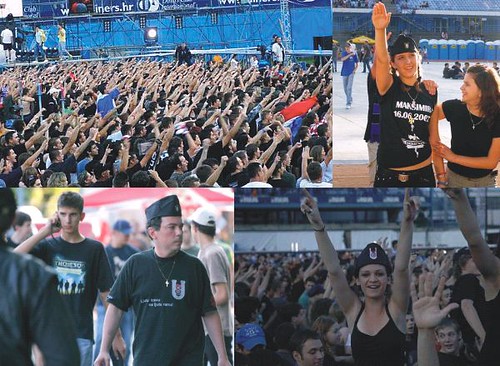
Croatian star’s gig sparks outrage
Greg Roberts
The Australian
October 31, 2007
SERBIAN and Jewish community leaders are outraged that the social arm of the Melbourne Knights Soccer Club is hosting a concert by a Croatian rock star with a strong following among neo-Nazi sympathisers.
The revelation follows the club’s apology for staging a concert for neo-Nazi skinheads at its North Sunshine complex this month.
A concert by Marko Perkovic will be hosted by the Knights-affiliated Melbourne Croatia Social Club at the complex on December 28.
Perkovic, Croatia’s top rock star, uses the stage name Thompson, in honour of the American-issued submachinegun of the same name that he carried as a soldier in Croatia’s war of independence against Yugoslavia in the early 1990s.
George Markovic, the publisher of Melbourne’s Serbian Voice newspaper, said the Knights should steer clear of extremist elements.
“People in our community are thinking of the Knights as the Gestapo Club,” Mr Markovic said.
Mr Markovic said Perkovic had been granted visas for previous visits to Australia, while Serb singer Ceca Raznatovic has been denied a visa in 2005. “It’s double standards,” he said.
B’nai B’rith Anti-Defamation Commission director Manny Waks said Perkovic’s visit reflected badly on the Knights and the Croatian community. “It is unacceptable,” Mr Waks said.
The Weekend Australian reported on Saturday that Melbourne Knights chairman Matt Tomas had censured his club’s social arm for providing a venue for the October 13 concert by skinhead [that is, bonehead] rock bands.
Mr Tomas yesterday again expressed exasperation at the Croatia Social Club.
“I can understand why people are upset and just wish the social club would focus on its football identity,” he said.
Croatia Social Club committee member [and former Football Federation Victoria VIP] Ivan Skunca said the club was not concerned about outside criticism.
“The Serbs can say what they like. It doesn’t bother us,” Mr Skunca said.
Immigration Minister Kevin Andrews said Perkovic had yet to submit a visa application, but it would be carefully considered.
- NB. Stormfront Croatia is moderated by an Australian Croat named, appropriately enough, ‘The Croat’.
http://www.stormfront.org/forum/forumdisplay.php/stormfront-croatia-156.htmlSee also : Croatian Rock Band Comes to New York, Bringing Controversy Over Nazi Imagery, Fox, October 25, 2007 | Controversial Croatian rock musician who plays nationalist songs to appear in Ohio, AP, International Herald Tribune, October 27, 2007 | Prosecutors and defense launch appeals in 1991 massacre of Croats seized from hospital, AP, International Herald Tribune, October 30, 2007
Posted in Anti-fascism, Music
27 Comments
Free the Urewera 17 (We Can’t Be Beaten)
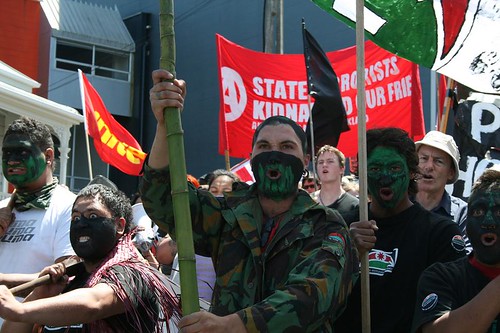
Above : Photo by John Squirrel of folks protesting in Auckland on the Global Day of Action, October 27, 2007. By the looks of ’em, they’re Not. Happy. Helen. (In the background is an @ banner reading ‘State terrorists kidnapped our friends’.)
Police in Aotearoa / New Zealand today applied to the Solicitor-General to bring terrorism charges against the Urewera 17. According to the NZPA (Solicitor-General to decide on terror charges, October 29, 2007):
Evidence about the operation leading up to this month’s police raids is now in the hands of the Solicitor-General for a decision on whether charges can proceed under the Terrorism Suppression Act. Seventeen people were arrested on October 15 following raids in Auckland, Wellington, Palmerston North, Hamilton, Christchurch, Whakatane and Ruatoki, 20km south of Whakatane. The raids were the culmination of a year-long investigation into weapons training camps alleged to have been held in the Urewera country and netted a haul of weapons. Among those arrested was Maori activist Tame Iti. Police deputy commissioner Rob Pope said police had reviewed the evidence collected over the course of the investigation. It has today been referred to the Solicitor-General for consideration whether consent will be given to charges under the Terrorism Suppression Act…
Some facts about the Terrorism Suppression Act 2002:
The law makes it a criminal offence to take part in, finance or recruit for a terrorist organisation or terrorist act;
Planning a terrorist act, or making a “credible threat”, is also illegal even if it is not carried out;
Unlike other countries the law does not give police additional powers of arrest or detainment;
The Attorney-General must give the green light to any prosecutions under the Act, but Michael Cullen has delegated this responsibility to Solicitor-General David Collins;
Under the Act groups can be listed as a designated terrorist entity, but so far no local groups have been designated. Those that have been listed are United Nations designated groups.
The troublemakers associated with Global Peace & Justice Auckland, in a shocking display of hatred for Big Brother, have issued a statement in response to the police referral, claiming it’s ‘politically-motivated’ — that is:
Behind this decision is the deeply political need to justify the huge extra resources and wide legislative powers the police and Security Intelligence Service have been given since 2001. They have to find terrorists. Uncovering criminal activity is not enough for these “wannabe terrorist fighters”.
What the police are now doing is charging political activists under a law which would have made many of the civil disobedience protests from 1981 into “terrorist activities”. Activities such as the 40 people sitting on Rotorua airport runway, the invasion of the pitch in Hamilton and the blocking of the Harbour Bridge could all qualify…
Of the 17, only six (by my count) have had their names publicly released by the courts, the sixth person — Marama Mayrick — having her name and person released on bail today. (The other five are Omar Hamed, Rongomai Bailey, Rawiri Iti, Jamie Lockett and Tame Iti. Bail granted and name suppression lifted for terror suspect, Radio New Zealand, October 29, 2007.)
See also : Civil Rights Defense
Posted in State / Politics, War on Terror
1 Comment
Anarchist statement on New Right (cont.)
Cool.
Since publishing the statement last week (October 21), both the Melbourne Anarchist Club and now Jura Books have added their names. You can read the statement here and also (with one spelling error) on @-Infos.
In this context, also of note is the latest scribbling by the New Right’s Führer Welf Herfurth, titled ‘The Strategy of Tension’ (October 25, 2007). In it, among other things, Welf disavows the label ‘neo-Nazi’ and identifies ‘Communists’ as the groupuscule’s main enemies, barrier to popular acceptance and the ushering in of a New Dawn for Australia (and er, New Zealand). Mixing banality with gibberish, the main point is that Welf is encouraging his followers to attend left-wing meetings (“…it is advisable that nationalists go out and attend as many political meetings as possible: lectures on Lenin, Trotsky, Chavez, etc., delivered by Socialist Alliance, Socialist Alternative, Resistance”).
Ho-hum.
Posted in Anarchism, Anti-fascism, Media
Leave a comment
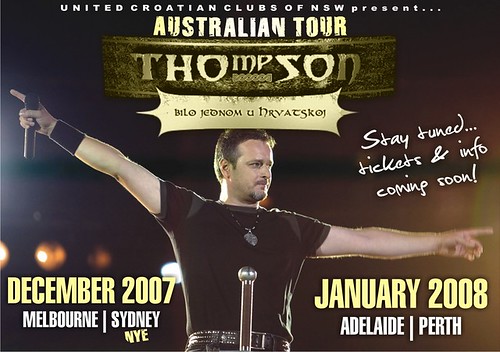
Tommy On Tour
Tommy gun — you ain’t happy ‘less you got one
Tommy gun — ain’t gonna shoot the place up just for fun
Maybe he wants to die for the money
Maybe he wants to kill for his country
Whatever he wants, he’s gonna get it
Tommy gun — you better strip it down for a customs run
Tommy gun — waiting at the airport ‘til Kingdom Come
An’ we can watch you make it on the nine o’clock news
Standing there in Palestine lighting the fuse
Whatever you want, you’re gonna get it
Tommy gun
Tommy gun
Tommy gun — a-you’ll be dead when your war is won
Tommy gun — but did you have to gun down everyone?
I can see it’s kill or be killed
A nation of destiny has got to be fulfilled
Whatever you want, you’re gonna get it
Tommy gun — a-you can be hero in an age of none
Tommy gun — I’m cutting out your picture from page one
I’m gonna a get a jacket just like yours
An’ give my false support to your cause
Whatever you want, you’re gonna get it
All right!
Okay, so let’s agree about the price
An’ make it one jet airliner for ten prisoners
Boats and tanks and planes, it’s your game
Kings and queens and generals, learn your name
I see all the innocents, the human sacrifice
And if death comes so cheap, then the same goes for life
Posted in Anti-fascism, Music
47 Comments
Neo-Nazis split Croat community
Neo-Nazis split Croat community
Greg Roberts
The Australian
October 27, 2007
MELBOURNE’S Croatian community is under fire for hosting a rock concert for neo-Nazi skinheads, publishing anti-Semitic material on the internet and naming a building after fascist Croatian dictator Ante Pavelic.
The Melbourne Knights Soccer Club yesterday launched an extraordinary attack on its social arm, the Croatia Social Club, for hosting the October 13 concert by groups that incite violence and attacks against Jews and other minorities. “I am deeply disturbed that the good reputation of our football club has been tarnished by the social club’s incompetence,” Knights chairman Matt Tomas said.
The concert at the Knights’ North Sunshine complex was headlined by US neo-Nazi band Final War. The band describes itself as “defenders of the Reich”, and its songs boast: “We fight Jews”.
Australian skinhead band Fortress also played. Its song, Parasites, urges repatriation of immigrants: “If they don’t f..king like it, it’ll be in body bags”.
The concert was organised by the Australian chapters of neo-Nazi skinhead groups Blood and Honour and Southern Cross Hammer Skins. Group members in the US and Europe have been convicted of assaults, bombings and murders.
Anti-Semitic messages from the Knights’ Croatian fans are posted on the Knights Army Forum website. One posting says Jews would “sell their mothers for a dollar”.*
Melbourne campaigner Cam Smith said anti-racism activists alerted the Knights to the nature of the concert several hours before it started. “As soon as we found out, we contacted whoever we could at the Knights through phone numbers on their website,” Mr Smith said. “They weren’t interested. One of their people asked one of our people if he was a dirty Jew.”
Mr Tomas said he did not know who was attending the concert, but he would investigate Mr Smith’s claim that Knights members were contacted, adding: “I don’t associate with that sort of scum. I’m utterly disgusted about this.”
Mr Tomas said the concert was approved by the Croatia Social Club, a separate legal entity to the football club.
Contacted by The Weekend Australian, social club manager Catarina Malacic denied the event was held. “There was nothing on at the venue that night,” she said.
Later, club committee member Ivan Skunca confirmed the premises were booked for a concert, but said the club did not know who made the booking. “It was a mistake. Perhaps we had an obligation to check these people out and we didn’t. We apologise for that.”
B’nai B’rith Anti-Defamation Commission director Manny Waks said he was disturbed the concert was held in view of links between the Croatian community and neo-Nazi elements.
Mr Waks said the Croatia Club — a separate entity to the Knights’ social club — had ignored Jewish protests against the naming of its Footscray hall after Ustashi Nazi collaborator Ante Pavelic, who was responsible for the slaughter of 700,000 Serbs, Jews and Gypsies.
* Note that, while the Forum administrators have recently deleted a thread dedicated to discussing the gig, another thread includes the following comments, made in reaction to reports in the Jewish press that at a concert in Zagreb by Croatian rock * Thompson, large numbers of his fans greeted him with the fascist salute (Jews slam Croatia’s failure to condemn ‘Nazi’ concert, EJP, June 17, 2007):
- 1) cantona : “Dunno about you guys, but after reading that – it makes me wanna go to a [Thompson] concert and make fascist salutes even more! [Z]a dom!” (NB. The Ustaše greeting was “Za dom – spremni!”. Salute: Za dom! For home(land)! Reply: Spremni! (We are) ready!)
2) Imocanka : ‘”Hundreds of thousands of Serbs, Jews, anti-fascist Croatians, Gypsies and others were killed by the Ustasha in the Croatian concentration camps.” [S]o we get condemned for doing the world a favour. [Anyhow], how do they actually know what we yell out at our concerts? [T]hey don[‘]t understand, it[‘]s all speculation[.]’
3) Bogdan Bonk : “Chelsea [Hajduk] are playing Caufield in this week[‘]s round. They are a [J]ewish club, so because of that they have to play on a Sunday. Every other game of the year is on [S]aturday, but because their [sic] Jewish, they play only on [S]undays. They want everything their own way! [H]itler = answer[.]”
4) Falcon Freak : “And the Jews wonder why so many people hate them…”
In the meantime, Thompson (Marko Perkovic) is playing to packed houses in New York:
Marko Perkovic is taking the stage November 2nd to literally sing praises of the Holocaust. The Croatian rocker goes by the stage name Thompson (for the American-issued Thompson sub-machine gun he carried as a soldier in the Croatian war)—and sings about the Ustaše, the Croation pro-Nazi regime that sent Jews, Serbs and Gypsies to concentration camps during WWII. The folk-metal musician is often greeted by audiences with a Nazi salute. He’s been kicked out of Canada and the Netherlands for hate speech, only to be welcomed by Manhattan’s own Croatian Center in Midtown…
Many fans deny Thompson is a fascist creep. Melbourne Croatia Social Club manager Catarina Malacic denies a neo-Nazi gig was held at the MCSC on the night of October 13. Others — like Welf Herfurth of the neo-Nazi New Right — deny that there was a Holocaust / Shoah…
I say:
- Fuck ’em all! Up the punx!
Croation [sic] Neo-Nazi Rocker To Perform in Midtown, Maria Luisa Tucker, The Village Voice, October 25, 2007 | Neo-Nazi Band Set To Play Amid Protests, Maruxa Relaño, New York Sun, October 24, 2007 | VPD looks into rock singer accused of hate crimes, Lloyd Dykk, Vancouver Sun, October 25, 2007 (“Croation Centre’s president defends ‘Thompson,’ saying things have been distorted”).
Posted in Anti-fascism, Music
28 Comments
Racism row over hiring (of Knights Stadium by neo-Nazi groups)
Racism row over hiring
Mario Xureb
The Age
October 26, 2007
VICTORIAN soccer bosses have come under fire from anti-racism groups after neo-Nazis hired grounds used by the Melbourne Knights Soccer Club to hold a racist rock concert.
Members of the white supremacist Hammerskins and Blood and Honour groups held a concert at Knights Stadium in Sunshine on October 13.
The ground is home to the soccer club and the Melbourne Croatia Social Club, which owns the site and hired out the venue.
Anti-racism campaigners yesterday criticised the Melbourne Knights and Football Federation Victoria for allowing the staging of the concert, which commemorated a dead white supremacist.
Anti-racism campaigner Anthony Main said the concert included overseas white power and local [bonehead] music groups.
“It’s racist music to the extreme, but it’s also a way for those guys to network and to meet,” Mr Main said.
He called on Football Federation Victoria to ensure the venues used by its clubs were hired out diligently.
Football Federation Victoria and the Melbourne Knights distanced themselves from the concert, saying they did not book events for the venue.
Melbourne Knights chairman Matt Tomas said the social club operated separately from the soccer club. He apologised for the incident, saying it was regrettable.
Note that there were apparently four bands performing on the night of the gig, three Australian, and one from the United States. The three Australian bands performing were Bail Up!, Fortress and Quick and the Dead. The band from the US (Orange County, California) was Final War. Here’s a sample of their lyrics:
- Final War – ‘Defenders Of The Reich’:
Sunshine, lollipops and rainbows
Everything that’s wonderful is what I feel when we’re together
Brighter than a lucky penny
When you’re near the rain cloud disappears, dear
And I feel so fine just to know that you are mine
My life is sunshine, lollipops and rainbows
That’s how this refrain goes, so come on, join in everybody!
Whoops. Sorry. I meant:
- Walking down the street with your head held high
People know you’re full of pride as you pass by
Boots and braces, short cropped hair
Fuck with us if you dare
Skinhead’s not a fashion, it’s a way of life
A way of life, living on the edge of a knife
Our flags fly high and our banners are unfurled
White power skinheads take the world
Skinheads – Defenders of the reich
Skinheads – We wage this nation’s fight
Skinheads – Standing proud and true
Skinheads – We fight the Jew
When the reds see us comin’, they cower in fear
‘Cause they know their end is near
Won’t be long until they fall
Fighting for our race and nation, fighting for our land
And we fight with the winning hand
A glorious battle it will be
A shining bright, white victory
Taken from the album Glory Unending (2002). That same year, Final War contributed a song to a compilation CD designed to raise money for Ken Mieske, a Portland bonehead imprisoned since 1988 for the brutal murder of an Ethiopian immigrant. Note that Portland was the location for the recent Hammerfest music festival organised by Hammerkins in the US, and which local Australian band Blood Red Eagle (Newcastle, NSW) traveled to in order to perform for their Yanqui brothers. Upon discovering that a neo-Nazi gig was taking place at their facilities, the Elks Lodge pulled the plug on the gig. The MCSC, on the other hand, not only refused to investigate the gig on the night of its occurrence, but has since lyingly claimed it never took place!
Posted in Anti-fascism, Media
Leave a comment
Exploring the case for armed struggle? Re-framing the Urewera 17
Update : Open Letter from John Minto to Chris Trotter, October 30, 2007 | Len Richards, Backwoods terror?, October 29, 2007
If an [armed] uprising is being considered in New Zealand, what are the reasons and what will it mean, asks CHRIS TROTTER.
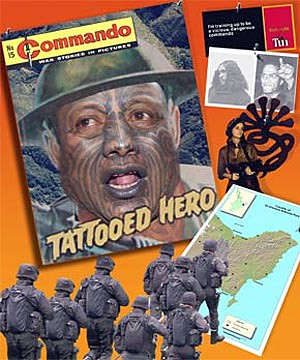
“MURKY PEDIGREE: History is littered with groups who have taken up arms in an attempt to bring about their political or anarchic claims.”
Uh-huh.
At least, so says the caption accompanying the above graphic in Chris Trotter’s recent article in the Independent Financial Review (Exploring the case for armed struggle, October 24, 2007). In this context, note that history is also littered with journalists who have taken up a tendentious line of argument in an attempt to bring about their personal monetary gain: Trotter’s article is a classic example; the text below is a response.
In essence, Trotter’s argument is that there’s a widening gulf between (bad) radicals and (good) moderates on the New Zealand left, and that the chief significance of the recent police raids lies not in the personal and political ramifications for those arrested, but in the role of the raids in exposing and entrenching this rift. Apparently, this is largely because the raids force individuals to pick a side:
- Police raids. Terrorism. Yes or no?
No, not a very sophisticated analysis, but yes, one which does have the virtue of allowing Trotter to trot out references to the ANC, the Provos, the Weathermen, Baader-Meinhof and (one of my personal favourites) the Symbionese Liberation Army:
“Death to the fascist insect that preys upon the life of the people!”
(Ahem.)
Note that Trotter invokes these disparate (non-state terrorist/armed struggle) groups in the context of a number of alleged firearms offences, committed by a group dubbed the Urewera 17. Further, that today police raided a house belonging to an elderly trade unionist named Jimmy O’Dea, apparently searching for a knife and — Eeek! — trousers (see Maori Yesterday: Trade Unions Today?). Which assault prompts what is for me another, equally obvious — and equally pressing — question:
If an armed uprising is being considered in New Zealand, what kind of trousers will the terrorists wear and what will it mean, asks SLACKBASTARD.
That said, according to Trotter, the central question dividing the Left (apart from trousers) is that old chestnut “Reform or revolution?“. Or to put it another way: “Do [the Left] see their society, and its manifold shortcomings, as being redeemable by the normal processes of constitutional government? Or, has New Zealand society passed beyond all hope of democratic redemption?” This question is given further impetus by the widespread belief, particularly among environmentalists, that humanity is fast approaching an ecological crisis of terminal proportions. Thus in both the Greens and the Maori Parties “…there is a potent strain of millenarian (and even apocalyptic) thinking: a conviction that we have entered or are about to enter a period of fundamental and irrevocable change, during which the institutions and patterns of thought and behaviour that have dominated people’s lives for centuries will pass away forever”.
And of course, a crisis of such proportions bolsters the argument that equally drastic solutions must be obtained: “Nothing less than wholesale systemic change will suffice”. Further “On the fringes of this millenarian grouping, Deep Green radicalism inevitably begins to shade into the darker hues of eco-anarchism“.
Eeek!
That being the case, it is entirely justifiable both ethically and politically to attack and seek to destroy the repressive society by which [the bad radicals] are persecuted and oppressed. More chillingly, they argue that none of those who, by their silence and inaction, are seen to endorse society’s evils should be deemed guiltless. And if everyone is guilty then everyone is a potential target.
Out of this dark green substance come the Urewera 17 — “Tuhoe separatists and eco-anarchists… in some sort of insurrectionary folie a deux“. This, supposedly, is the psychosocial dynamic that must have generated the 17, one which constitutes a basically psychotic response to the failure of their extreme demands for fundamental change to generate popular support, and to which, Trotter argues, the only alternative is “to abandon the fight and to sink back into passivity”. Further, the greater this failure to connect is, the more likely a violent response — terrorism — is going to be triggered: “This is the sort of thinking that spawned the Weathermen and the Baader-Meinhof terrorist organisations of the 1960s and 1970s”.
Well, kinda… but not really. Thus if you examine the actual list of targets ‘Baader-Meinhof’ — a/k/a the Red Arrmy Faction — compiled, it largely consisted of members of the military, industrial and political elite: generals, captains of industry and party leaders; not chaffeurs, factory workers, and nurses. Further, the emergence of both the RAF and the Weathermen owes a great deal more to the impact of Marxist-Leninist orthodoxies upon the New Left and 1960s counter-culture than it does, say, indigenous rights activism or a radical ecological sensibility (that is, the ideologies associated with those whom the police have targeted as ‘terrorists’).
Finally, while police, politicians and, it seems, Chris Trotter, have been happy to label those arrested as ‘terrorists’, police are yet to lay any charges for ‘terrorist’ offences. And of course, the laying of charges does not equal guilt. Further, given the seriousness of such charges — as in numerous other countries, specifically ‘anti-terrorist’ legislation was introduced to New Zealand following the attacks upon New York and Washington in 2001 (see Terrorism Suppression Act 2002 and Amendment Bill 2007) — a prosecutorial state is compelled, at least in theory, to produce very compelling evidence.
At the moment, however, it appears that the trousers simply don’t fit.
Guerrilla : The Taking of Patty Hearst (2004) Trailer
The Weather Underground (2002) Trailer
See also : Reading the Maps, The threat to your civil liberties – and your trousers, October 25, 2007 for some sensible disco…
Posted in !nataS, History, Media, State / Politics, War on Terror
3 Comments
The War on Terrorism in Aotearoa
…goes on.
Word on the street is that Helen Clark may have bitten off a little more than she can chew by authorising the ‘anti-terrorism’ raids of last week.
To begin with, while the 300 or so police who conducted the raids were — especially in the case of the Tuhoe — expected to deliver their orders in Maori, they did not (although the exact reasons why remain a little obscure). And when Clark claimed that “she’d been informed of the raids in advance”, and evinced “surprise… at the scale and numbers of people involved”, she was actually attempting to minimise the extent of her own involvement, which apparently included her helping to prepare this strategy (NZ police raid military-style camps, AP, The Age, October 15, 2007).
Secondly, the authorities have a list of approximately 60–70 or so individuals they wish to speak with in relation to the investigation, but are having some small difficulties in actually finding them, and so activists (of all sorts) can expect further raids on and searches of their properties. According to Tim Johnston of the International Herald Tribune (Anti-terror raids cause turmoil in New Zealand, October 22, 2007):
…According to the police, the investigation started in December of 2005, when two hunters in the remote Urewera mountains in northeastern New Zealand stumbled across a camp where armed men, some in balaclavas, were training. They reported what they saw to the police, and the camps were put under surveillance.
In the following months, the police logged 74 people passing through, although people who attended more than one gathering would have been counted every time. The police also intercepted telephone calls and monitored a number of computer accounts…
In addition, the raids involved the use of not only regular police, but paramilitary and military forces, including — supposedly — elements of the SAS, as well as having involved political and secret police forces in its planning (if not execution). Also included in the planning, in addition to the NZ PM, were the Government Communications Security Bureau (GCSB) — a bunch of spooks created in 1977 by ex-NZ PM Robert ‘Piggy’ Muldoon — and the Security Intelligence Service (SIS). Naturally, so as to avoid overly-‘politicising’ the issue, Clark’s Government seeks to minimise not only her, own personal involvement in the ‘counter-insurgency’ operation, but that of the spooks too.
In other schnews, one of the seventeen (18?) accused, Rongomai Pero Pero Bailey of Auckland, a 28 year old unemployed filmmaker, was today granted bail by the courts. He’s been charged with four firearms offences. “Prosecutor Ross Burns said police had reason to believe Bailey had attended the alleged military-style training camps near Ruatoki three times in the past year and that there was a chance he would follow through with violence should he be released on bail.”
Fortunately for the filmmaker, the police claim didn’t wash with the judge. As a result, Bailey is the second person to be released on bail by Judge Bouchier, the first being James Lockett, whose release was overturned by a higher court (Man arrested in terror raids given bail, Kim Ruscoe, Fairfax Media, October 23, 2007).
So where to now for the state? Despite increasingly widespread criticism, both national and international (see, for example, Claims of Maori separatist plot begin to unravel, Kathy Marks, The Independent, October 23, 2007), it would be difficult to envisage Clark’s Government instructing the relevant authorities not to lay charges of terrorism against at least some of those arrested. Certainly, a failure to do so renders inadmissible much of the evidence police (and other agencies) claim to have collected over the last year or more. The spectre of such charges being laid is also a useful device to threaten vulnerable arrestees into collaborating with police, just as has been the case in the United States in the state’s ongoing campaign against radical activists there. At this point, however, and unlike at least one of the cases in the US, there is no suggestion that state agencies actually employed someone to entrap activists.
In the meantime, this Saturday, October 27, has been designated a Global Day of Action in solidarity with the accused. In Melbourne, a solidarity demonstration — possibly consisting of terrorist hordes currently hiding deep within the sacred Dandenongs — will be held in Federation Square, at 12 midday. In Sydney, a public meeting and demonstration is being held on Thursday, October 25, @ 5:30pm, outside the New Zealand Consulate-General, 55 Hunter St, City.
See also : Aziz Choudry, New Zealand Government Is Not Fit to Sit on UN Human Rights Council (A Highly Unsuitable Candidate), Dissident Voice, October 22, 2007 | Anti-terrorism raids continue to cop flak, Niu FM, October 23, 2007 | Paul Buchanan, Guantanamo On The Pacific?, October 23, 2007 (“The arrest and detention without bail of seventeen individuals on grounds that they were planning terrorist attacks against political targets in New Zealand represents a step towards the “Guantanomisation” of national security policy in this country, at least as it applies to political dissent…”) | Civil Rights Defence… Oh yeah. Apparently, there’s thirteen men rotting in Barwon Prison too. According to Kath Wilson: “ONE OF THE MOST extraordinary features of the Barwon 13 case was that an undercover agent had infiltrated the group and influenced the men’s activities. The Age reported that an agent provocateur “of Middle-Eastern heritage” befriended the group “by pretending he shared similar beliefs”. The agent allegedly showed the men how to use explosives…” Thought Crime and Punishment, Overland, No.186, Autumn 2007.
- ALSO :
Background: Friends Of Wellington Terror Arrestees
October 23, 2007
Press Release: Friends Of Wellington Terror Arrestees
Background From Friends Of Wellington “Terror” Arrestees
Posted in State / Politics, War on Terror
6 Comments