The Divine Miss M has had an interesting column on Sharia published today. Maybe I’ll look at it a little more closely later–or maybe not. Two things in particular caught my eye, however, one being a reference to the ‘Australian Defence League’, the other the fact that the European Court of Human Rights ruled in 2001 that sharia law is “not compatible with democracy”. Miss M writes:
The court made special mention of the sneaky methods used by political Islam to work with the existing legal order in order to replace it with sharia: It is called “takiyye, which consisted in hiding its beliefs until it had attained that goal”.
The ruling and subsequent appeals make for interesting reading, but what I found especially interesting is the fact that Stephen Yaxley-Lennon, leader of the ‘English Defence League’–which Miranda describes as “a racist British group”–invoked the same (2003) ruling in his interview with Jeremy Paxman; which fact suggests that the Court’s decision has had a particular impact upon critics of Islam.
Aside from the applicability of the ruling outside of Turkey, however, the other point worth making in this context is that the passage Miss M quotes inre takiyye was not a ruling of the Court but a summary of the Turkish Government’s position:
59. The Government observed at the outset that the principle of secularism was a precondition for a pluralist, liberal democracy. A State which adhered to the principle of secularism was a political community which refused to organise society according to religious precepts. In such a community the State kept an equal distance from all religions and beliefs. Moreover, there were certain circumstances which made the principle of secularism particularly important for Turkey in relation to other democracies. The Republic of Turkey had been founded as a result of a revolutionary process which had changed a theocratic State into a secular State, and reactionary Islamic tendencies were still a danger in the present day. Political Islam did not confine itself to the private sphere of relations between the individual and God but also asserted the right to organise the State and the community. In so doing, it showed the characteristics of a totalitarian regime. In order to attain its ultimate goal of replacing the existing legal order with sharia, political Islam used the method known as “takiyye”, which consisted in hiding its beliefs until it had attained that goal.
Otherwise:
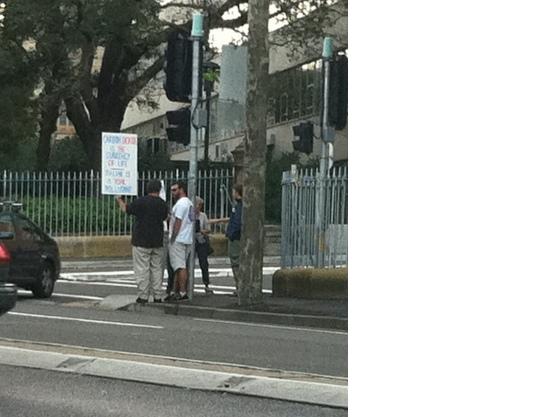
…there was a protest against sharia law in Melbourne by a new anti-Islamic group called the Australia Defence League, modelled on a racist British group. The protest turned violent when a larger group of Left-wing activists arrived.
This statement is somewhat inaccurate. Leaving aside the question of whether or not the EDL is racist as she claims, at the ADL protest there was little violence, nobody was injured (there were certainly no arrests), and the two groups noisily co-existed for at least an hour before the counter-demonstrators/Left-wing activists decided to push the ADL off the Square.
Anyway…
Read loon pond.
Bonus!
Speaking of extreme sports Islam, Chris Kenny has written a column for the foreign-owned newspaper (ironically titled The Australian) claiming ‘Hussain’s views on bin Laden disturbing and dangerous’ (May 17, 2011).
Having watched the Muslim comic’s performance, I thought his comments were quite reasonable. Having now read rival comic Chris Kenny’s response, I’m beginning to think that maybe Hussain used the method known as “takiyye”, and…
Well anyway. Like Devine, Kenny makes a number of highly questionable statements, the point of my interrogating with a keyboard is dubious (if legal). I mean, he gets it wrogn right from the start. Asked to comment on the ethical and legal dimensions of bin Laden’s murder, Hussain states–accurately–that the official story has changed over time, that the legal framework for the killing is extraordinary, and that it’s uncertain that the US (government) actually wanted to bring the Saudi multi-millionaire to trial.
Kenny characterises these quite mundane observations as follows:
Hussain insults us all by defining the age of terror not through this insidious evil and its consequences but through a list of anti-American grievances.
This is a moral backflip that instantaneously converts the terror campaign from being a savage and unprovoked attack against western people, their supporters and their values into a tale of western wrong-doings fomenting resentment and violence.
What is the point of these words if not an attempt to provide excuses for terrorism?
One could just as easily and with greater relevance ask ‘What is a trollumnist?’
Kenny also complains that Hussain refers to history as a means of understanding the development of Islamic (non-state) terrorism and failed to express sufficient distaste for bin Laden’s presumed actions: this latter point somewhat ironic given that a trial and a guilty verdict is precisely what his killing rendered impossible.
But like, whatevah.
Here’s another curly question:
We might ask ourselves how we would be reacting if Iraqi commandos landed at George W. Bush’s compound, assassinated him, and dumped his body in the Atlantic.
LOL.