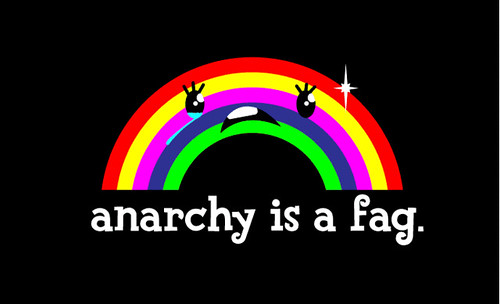
Do you remember when you said you cared
And that you would never be ensnared
By the lure of the music biz
‘Cos you were doing it all “for the kids”
Now that just seems like so many hollow lies
You’ve become what you said you despised
We can see from the dance floor
Those you opposed, you now work for
Which, in the case of Against Me!, is Time-Warner Corporation (via Sire Records): the largest of the handful of media monopolies that dominate the global market in music (and most other mediums). The Center for Public Integrity notes that “In 2005, Time Warner reported revenue of $43.7 billion, with a net income of $2.9 billion, down 14 percent from the year before”. To what extent Against Me!’s labour has contributed to Time-Warner’s coffers is at this point unknown, but their corporate debut, New Wave, peaked at #57 on the US Billboard charts on July 28 this year. (Critic Robert Christgau, incidentally, awarded it **** in a Rolling Stone review.) Akiva Gottlieb, meanwhile, has some reflections on the band’s status as a ‘sellout’ in ‘Political Punk: Rage Against the Band’ (The Nation, September 28, 2007).
We mean it, maaan!
Like x number of punk bands before them, Against Me!’s decision to go corporate has triggered a minor backlash among its (former) fans, and also — naturally — compelled the band to deliver a number of tortured justifications for doing so. Thus “the band, who made their name (exclamation point and all) not so long ago by playing raucous shows in church basements and laundromats, has burned its share of bridges on its way to the top, especially among the idealistic young fans whose idea of integrity can’t be found on a BlackBerry”, while Tom Gabel quotes Paul Stanley to the effect that “Credibility is someone else’s idea of what I should be doing, not mine”. And while, just as I’ve no desire to contradict a taxman on the subject of poetry, I’m naturally loathe to quibble over the meaning of words with a multi-millionaire businessman, I should note that ‘credibility’ may also be defined as meaning “the quality of being believable or trustworthy”. And it’s the presumed ‘credibility gap’ between recording for a corporation like Time-Warner and the band’s status as one of the latest in the massively long line of ‘musical rebels who enforce their own brand of cultural justice’™ that’s really at issue in this and similar debates. (On which subject, see ‘The End of Music’, a critique of punk and reggae, by Dave and Stuart Wise, available in Stewart Home’s otherwise worthless volume What is Situationism? — but not, unfortunately, online.)
Caveat emptor
Economically speaking, the tiny handful of fans of the band’s previous work who feel aggrieved by Against Me!’s decision to ‘sell out’ to The Man will have zero impact, easily being replaced one thousand times over by new fans unconcerned by such mystifying issues, and happy enough to join the boys in totally, like, “rocking out, dude!”; or at least until the next product emerges on the rock ‘n’ roll factory line. Or to put it another way: “Only a fool would be a rock star without protecting the hard work they have done and reaping the rewards. The person that says they’re only in it for the music is in for a sad awakening when they are working at a hamburger stand asking if they want fries. For us it becomes common sense if money is being generated, it should rightfully go into our pockets. We try to maximize everything we do. We’re proud to be rich and make no apologies.” Or in the words of another, aspiring rock *:
In the end, Gabel feels most comfortable justifying his band’s big move as a utilitarian quid pro quo. “We don’t owe anyone anything other than music. If you buy a CD, you get the music that’s on there. If you come to a show, we owe you music.” And with that, the comfortably established antiestablishment punk band takes the stage to give the consumers the protest songs they paid for. Because that’s how capitalism works.
And speaking of capitalism, the latest issue of Anarchy: A Journal of Desire Armed is dedicated to dissecting it, especially in terms of the relationship between being an ‘anarchist’ and living under capitalism (or in the words of a ‘friend’, the way in which anarchists wrapped up in their lifestylism struggle against an exploitative system):
Poke an anarchist whose project involves an exchange of money for goods, and chances are you will have to duck to avoid the stream of sticky, apologetic defensiveness.
“If we don’t charge, how do you expect us to provide you with this stuff and still sustain ourselves?”
“What should we do?”
“It’s classist to think that people can do this for free…” etc.
While the apologies and excuses do acknowledge that something contradictory and complicated is happening, the rationales tend to fall back into the same old purity reasoning, not much more engaged than the disingenuous complaints about Zerzan’s use of a typewriter.
These simplistic responses distract us from the questions that we could get creative with. Once we acknowledge that capitalism is in the air we breathe then we can have more interesting conversations…
On which subject, more later, when I review the copy kindly sent to me.
When we have nothing left to give
There’ll be no reason for us to live
But when we have nothing left to lose
You will have nothing left to use
We owe you nothing
You have no control
Merchandise, it keeps us in line
Common sense says it’s by design
What could a businessman ever want more
Than to have us sucking in his store?
We owe you nothing
You have no control
We are not what you own