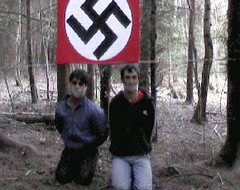
Oh, Darrin!

[A rather funny post, stolen from Lancaster UAF blog, and authored by Denise G. Cheers Denise!]

Darrin Hodges is hardly the prettiest individual on the Australian far-Right. His appearance suggesting, as one of our colleagues has mooted, a close relationship with the rat family, we suspect that Darrin’s fascist friends are given to making sudden embarrassed winces whenever the unlovely visage of the Sutherland Shire’s least popular son pops up in the Australian media.

Darrin is something of a thinker – or so he would like to believe. And Darrin has a plan. A Very Cunning Plan.

At its most complicated, Darrin’s Plan is to copy the BNP, lock, stock and lies.

That’s it.

And so it is that – just like the BNP – Darrin has put his Jew-hating, anti-black credentials in his back pocket and now sports those of the born-again anti-Muslim persuasion, because – as the BNP and Darrin will have it – Moslems comprise a religion, not an ethnicity. And, if you’re attacking a religion and not an ethnicity, how ever can you be called a racist?

Darrin is one of those far-Rightists who, having for years peddled the white supremacist line, has grown increasingly frustrated by the lack of any tangible success. On the factional and turbulent Australian far-Right scene this lack of success is hardly surprising, since – much as their British counterparts – Australian fascists seem to hate one another more than they hate anybody else.

Darrin’s overarching hatred is for Australian Nazi and sometime Australia First Party big-wig Jim Saleam, who he refers to in one of his many incriminating but judiciously terminated blogs as “a criminal lunatic” and an “oily spiv”. You’d never know that Darrin was once his loyal lieutenant. Darrin believes that racist hard-liner Saleam was in harness with Australia First leader Diane Teasdale, the pair conspiring to expel the newly-coined “moderate” on charges that certain of his internet postings did not reflect well on Australia First.

Disproving the hypersensitive Hodges’s theory, shortly after his own expulsion Teasdale sent Saleam packing, and this latter pair now run rival versions of the same organisation. For his part, Darrin contented himself with denouncing the “Australia Faggot Party”, basing his denunciation on the recollections of the AFP’s John Drew, who recalled sharing a flat with a noisily sexually active homosexual in the 1960s.

Darrin spent many happy years posting on the Nazi Stormfront Down Under forum, as well as maintaining his multifarious blogs. He felt that the forged Protocols of the Elders of Zion were essential reading for all Nutzis, and opined: “I’m more interested in the purer form of fascism… and while I don’t subscribe to the whole ‘worship Hitler’ thing, his comments on multiculturalism and politics in general are still just as relevant today as they were 70 years ago”.

Not subscribing to “the whole ‘Hitler worship’ thing” is what marks you out as a moderate on the far-Right, even if you are “interested in the purer form of fascism” – whatever that is – and believe that “… he [Hitler] laid a foundation that we should build on”.

Perhaps Darrin believes that the “purer form of fascism” is something close to anarchism?

Just a few weeks after Diane Teasdale tore up his Australia First membership card, the ubiquitous Darrin turned up with fifteen of his young male friends at Sydney Town Hall to protest against the APEC summit, taking place elsewhere in the city. Dressed in black clothing, and wearing dark glasses and scarves to obscure their faces, they carried, according to Antipodean anti-fascist @ndy Slackbastard, “three long banners — with slogans reading ‘Australia: Free Nation – Or Sheep Station?’, ‘Globalisation is Genocide’ and ‘Power to the People, Not Political Parties’ – which were joined together to form a three-sided bloc, within which those gathered assembled to form a ‘black bloc’. The group also distributed a leaflet, and claimed to belong to a group known as the ‘New Right’, one which — as other statements on the banners and on the leaflet stated — consists of ‘National Anarchists’ espousing a ‘Traditional-European Revolutionary’ philosophy”.

Darrin’s flirtation with “national” anarchism – and, along the way, a group of Tibetan monks – was short-lived as the moderate fascist-racist cast about for ideas – any ideas – that would bring salvation for the Australian lunatic fringe, and so he jumped aboard the brand spanking new Australian Protectionist Party, made up largely of expellees from Australia First. Darrin is now its New South Wales chairman.

From the beginning, the APP sought to jettison the political baggage carried by Australia First, claiming to represent a “new expression on an Australian Nationalist perspective”. Exactly how “new” can be seen on Darrin the moderate’s personal website, where the oversized rodent gives full vent to his vicious Islamophobia in post after predictable post, and in his statement to the Canberra Times that “if you’re an Asian, you are an Asian” – and most emphatically not a white Australian, or any kind of Australian, for the matter of that.

Long an admirer of Nick Griffin, with whom he says he corresponds, Darrin has swallowed the Griffin = Success fairy-tale hook, line and sinker, saying: “The BNP is a successful nationalist party … Griffin rescued the BNP from the murky depths of right-wing extremism”, and: “We look to the BNP as it is one of, if not the most successful nationalist party in the anglosphere and see no reason why we cannot draw ideas from them.”

Perhaps Darrin and his comrades took this drawing on the ideas of the BNP a little too literally, as an early disgruntled would-be member sourly informed Stormfront Down Under that the APP was a “scam ripping money off White Australians hoping to protect the future of this country and the heritage that is theirs”.

Recently Darrin was presented with an opportunity to shine in council elections held in south Sydney’s Sutherland Shire, which also happens to include Cronulla, the 2005 scene of vicious racial conflicts enthusiastically fanned by the Australian far-Right – almost certainly the origin of an anonymous text message received by hundreds of Australians exhorting whites to gather on Cronulla beach to attack the “wogs and lebs”.

Extolling “traditional and family values” (while neglecting to mention that he was once contracted to maintain the servers of a company dealing in decidedly non-traditional adult products and pornographic material), and railing against the “Asianisation” of Sutherland Shire, Darrin found himself treading on some very stony ground, achieving a thumping 2% and last place, and thoroughly demoralising the go-ahead Australian Protectionist Party’s tiny following. To add insult to injury, in a nearby division of Sutherland Shire, Darrin’s former friends in Australia First obtained double the APP vote share, even though they also came last, with 4% of the vote.

Rather than send for the Flying Doctor to cure their ills, the APP has sent for the Flying Führer, as detailed elsewhere on this blog.

Exactly what Darrin and the APP brethren hope to learn at the feet of Nick Griffin isn’t clear to us. They have already toned down their public expressions of racism, never mention The Jews, won’t talk about the Holocaust, and rant against everybody’s favourite punch-bag, the Muslims.

Maybe Darrin will come away thinking what a whizz it would be to set up a record label or a fake trade union? Perhaps Nick will impart the dark arts of BNP accounting to a spell-bound audience all dreaming of retiring as quickly as possible to their own pig farms in the Outback? Or he could do several sessions on the fine art of purging, for having so much experience in that regard.

Oh, Darrin!

The truth of it is that Nick hasn’t taken the BNP anywhere – rather, as we have previously noticed (posts passim), what little success came the BNP’s way happened despite Nick Griffin and his tantrums and his purges. Didn’t you notice May’s abysmal election results? Or those of the May before it? Hasn’t it occurred to you that in a climate never more condusive to the electoral prospects of the BNP that Nick Griffin has signally failed to advance the party in the one arena that matters? Why do you think Nick got his redundancy package sorted out when he did – could it be because he knows his members will one day make contact with the reality of his sham “success” and turn him out?

Oh, deluded Darrin! Nick Griffin can only teach you how to fail – and since you already enjoy failure, frustration and factionalism in great and unending abundance, you really do have nothing at all to learn from the Flying Führer.


Posted in Anti-fascism | 15 Comments

Jock Palfreeman & Fascism in Bulgaria

Nine months ago, in Sofia, Bulgaria, a 21 year-old Australian named Jock Palfreeman was arrested and charged with murder and attempted murder, following an altercation between Jock and a small group of Bulgarians on the streets of the capital. Jock maintains that he is innocent, and that the death of 20-year-old student Andrei (Andrey) Monov, and injury to Antoan Zahariev (19) — both of whom Jock admits he stabbed — were the result of acts of self-defence. According to Jock, on the night of December 28, upon leaving a bar, on Stambolijski Boulevard he witnessed a group of Bulgarian men beating a Gypsy (Roma), and intervened in order to end the assault. Subsequently, the group turned on him, and he drew his knife. In the ensuing melee, Jock stabbed the two men, one of whom later died.

Jock’s court case commenced in May, and is continuing. The prosecution case appears to rest on the testimony of the dead man’s friends, as video footage of the confrontation has been lost. According to the prosecution, Jock attacked the group of young men without provocation — “police say… an unprovoked frenzied attack on a public street” — and probably while drunk or under the influence of (other) drugs. His defence, at this point, rests upon the testimony of other witnesses, who confirm the broad outlines of Jock’s account, and the existence of a Romany (which Andrei’s friends deny outright).

Jock’s case is complicated by the existence of ultra-nationalist currents in Bulgaria, and the fact that the dead man, Andrei Monov, was acknowledged by his father, in court, as being a right-wing nationalist and as believing in ‘Bulgaria for the Bulgarians’. Secondly, and intimately tied to Bulgarian ultra-nationalism, is the existence of a strong current of anti-Roma feeling: according to this view, Roma are not Bulgarian, and do not belong in the country. Finally, Jock claims to have been assaulted by ‘nationalists’ in Bulgaria on a number of prior occasions, and that this was the reason for his carrying a knife.

Please note that, contrary to Marnie O’Neill’s claim (The Daily Telegraph, January 20, 2008), this blog is not “run by Palfreeman’s close friends”. In fact, this blog is “run” by one person; I have never met Jock; and I knew nothing of his existence until I read of his arrest in December, 2007. My interest in his case, therefore, derives from my more general interest in monitoring the activities of the far right, particularly, but not exclusively, within Australia.

Recently, Organise has published a survey of emerging ultra-nationalist and fascist currents in Bulgaria, and reading it provides some further background to Jock’s case, as well as demonstrates, I think, that his account of previous harassment, and being witness to an apparent assault upon a Roma, if not proven, is still not improbable. See also this video, titled ‘Special treatment for bulgarian anarchist’, dated December 6, 2007, and apparently showing footage of a gang of Bulgarian fascists harassing an elderly Bulgarian anarchist:

In June 2007, boneheads attacked fans at the Tangra Mega rock concert, injuring several (among the headline acts on June 20, 2007 @ Universiada Hall, Sofia, Bulgaria was the English punk band The Exploited).

Bulgaria and “Bulgarisation”

The example of Bulgaria is illustrative of the continuing problems in the peninsula. Bulgaria is a country of nearly eight million people, with a history of toleration of minorities and with a substantial Roma and ethnic Turk population. For years, even under the Ottoman rule that was endured for nearly five centuries, ethnic Bulgarians and ethnic Turks could live [as neighbours]. The program of the Bulgarian Central Revolutionary Committee, the 1870s organisation for the liberation of the country, forbade Bulgarians from attacking ordinary Turkish citizens in the struggle for independence. This stability continued into the 1980s until Todor Zhivkov, the infamous ruler for the majority of the People’s Republic’s life, started a campaign for “Bulgarisation” of the Turks in Bulgaria, forcing them to change their names, resulting in almost 300,000 leaving the country. The mid-to-late 1980s climate of terrorism by ethnic Turks, police actions against whole villages in their drive to “Bulgarise” them, and then the sudden collapse of the monolithic state threw things wide into the open. Rampant privatisation and ineffectual government in the nineties left a legacy of division that simply did not exist before. Many Roma families, left without the jobs provided for them under communism, fell into poverty and crime. The Movement for Rights and Freedoms (MRF) monopolised the Turkish vote and has been an element of every coalition government since its inception. Unemployment rose generally.

Latent nationalism lifts its head

It was, in short, a good climate for latent nationalism to come to the fore – one that was present since the 1980s. The National Union Ataka is the natural outgrowth of this. This is a party that was created only two months before the 2005 legislative elections, a coalition of insignificant right-wing and ex-communist splinters. It managed to win 9% of the popular vote in June of that year, bagging 21 seats out of 240 in parliament. Little, you might say, but considering it was running against parties with decades long histories such as the Socialist Party (BSP) or ones that had already had a stint in office such as the National Movement Simeon II (NMSII), it is no mean feat. What’s more, its leader – Volen Siderov – managed to poll 25% at the presidential elections of 2006. He was the only candidate apart from the winner, Georgi Parvanov, who made it to the second round, brought about by low voter turnout. For a party that is based around a strong Fuhrerprinzip (leader principle akin to that in Nazi Germany), that is significant.

This use of evocative language by the author is of course, deliberate. The party has been called fascist by many, and its members do appropriate the jackbooted style of many ultranationalist groupings. A closer examination of its stances, set out in the “20 Points of Ataka”, reveals a nationalist, populist party. What are its main currents? At the heart of Ataka’s political program lies a statement that Bulgaria is a monolithic, one-nation state, indivisible along ethnic or religious lines. The party also attacks the MRF and the national channel’s news in Turkish indirectly by stating that the national language is Bulgarian only, and that any ethnic parties should be prohibited. The party also supports an ill-defined criminalisation of verbal attacks on national “holies”. On economic issues, it supports a protectionist policy and state provision of health, social security and “spiritual and material prosperity” for all citizens. The party aims for isolationist foreign policies, including a withdrawal from NATO, operations in the Middle East and the expulsion of US bases from national soil. Quite apart from that, unofficially but widely supported, is the inclusion of the Bulgarian Orthodox Church in political decisions – a de-facto merging of state and church.

What emerges is a party that cleverly combines populist policies designed to appeal to both business people and the common person on economic grounds, and taps into cultural chauvinism that is an expression of dissatisfaction on the part of many Bulgarians with the current state of affairs. It is easy to blame Romas for crimes and the West for poor conditions, and whipping up the historical Turkish threat is also popular. Calling to spirituality, which is on the upswing in this traditionally conservative country, is also a good source of support. The official program of Ataka is worrying enough – it would create a state based on ethnic supremacy where other ethnic groups would not be allowed to be heard in the political process.

Traditional scapegoats

Privately, things are worse. The author himself has seen the graffiti – “all gypsies into soap” – and a visit to the forums of Ataka’s newspaper would reveal what its members really want. Complete social regression is the norm of the day, the ideals of Christianity imposed on all society; scapegoating of the traditional suspects – Romas and ethnic Turks – which goes hand-in-hand with anti-Semitism (which Siderov himself is guilty of in his various books). Ataka is not a fascist party then – if it was it would by easy for people to dismiss it. It is an ultranationalist entity that has addressed real poverty, income disparity, crime and corruption at the highest levels of politics in radical ways – nationalisation, exclusion of foreign business in preference for domestic firms, for example. At the same time it has taken unofficial harsh actions against ethnic minorities and has branded the current government as one of Turks and not Bulgarians. Centred around a charismatic ‘strong’ and ‘intelligent’ leader figure with a sharp tongue, the party is rallying social conservatism and economic promises that hark back to an almost quasi-Communist state of the nostalgic yesteryear. Alongside Christianity and populist history that is directed against “those other Bulgarians – the Macedonians” the party has a strong base from which to build on.

The consequences would be disastrous, of course. Bulgaria is not faced with the same problems that Serbia is – sectarian troubles – but it has a very sizable and growing Roma population while the nominally Bulgarian population is facing a demographic collapse, a Roma population that, it has to be noted, was not forced to revert to crime when they had housing, educational and job prospects in the years of Communism (not to excuse that state of affairs, of course). But rational debate is thin on the ground in Bulgaria. The popular media is distinctly patriotic, as in the popular history show of Bozhidar Dimitrov that champions any Bulgarian achievement with little academic justification, plus Ataka with its own channel. People find it easier to blame others rather than take action themselves. You might say that the election results show little, yet the voter turnout has always been extremely low – under 50% – and Ataka can only grow, with many of the voters who didn’t support the party in 2005 now turning towards it. The last polls in Bulgaria showed the party second in popularity only to the ruling Socialists. When the generation of the “red grandmas” – the elderly who vote Socialist out of nostalgia and promises of social security – leaves the political scene, and with some flocking to a party that is also promising pensions, who knows what might happen?

What we are facing is quite frankly a quiet nationalism rising up in a country that, for the Balkans, is stable and on the upsurge in economic terms. This nationalism threatens civil war between ethnic groups, even if a Kosovo scenario is unlikely because there are no real regions in the country that could secede or are likely to do so (even where ethnic Bulgarians are the minority). Time will tell. The next legislative elections will show whether the nationalist party have retained their appeal. But as long as it manages to play at its populist game while the establishment does nothing to address organised crime and corruption among its own ranks, the mentality of the population is unlikely to change. With the centre and centre-right of the political spectrum fractured in a way that we only think Communists can follow, there are few alternatives to the status quo in a political sense. Whilst everyone looks to Serbia or the Caucuses for the obvious signs of nationalism and ethnic trouble – as has been fashionable for a long time – a quiet, ‘unfashionable’ force is arising in a country that the EU would like to portray as a model for the Western Balkans…

~ ‘Unfashionable Balkan nationalism? The rise of ultranationalist politics in Bulgaria’, Organise, No.70, Summer 2008

Posted in Anti-fascism, State / Politics | 40 Comments

Racism in Austria

As expected, the far right — Heinz-Christian Strache’s Freedom Party (FPOe) (above, left) and Joerg Haider’s Alliance for the Future of Austria (BZOe) (above, right) — has done very well in the national election in Austria (birthplace of Mister Hitler).

The two major parties — the Social Democrats (SPÖ) and Christian Democrats (ÖVP) — have jointly ruled Austria since the end of WWII. In addition to cultivating xenophobic and nationalist sentiment, the far right has been able to capitalise upon the increasing convergence of the two — who will likely form another ‘Grand Coalition’ to rule Austria until the next election — as well as more general discontent with government corruption and ineptitude. According to AFP, “In a last-minute bid to demonstrate their decision-making abilities, the various parties approved on Wednesday a package of laws — expected to cost some three billion euros (4.38 billion dollars) — raising family aid and pensions and abolishing university tuition fees.” The results should give ♥ to activists of the far right across Europe, and follows similar developments in the neighbouring states of Germany, Italy and Switzerland.

“Ausländer Raus!”

Austria swings to the right in snap elections

VIENNA (AFP) — Austria’s two ruling parties, the Social Democrats and conservatives, received a severe drubbing in a snap general election here Sunday, which was marked by a resurgence of the far-right.

As of 7:00 pm (1700 GMT), two hours after the polls closed, the interior ministry calculated that the Social Democrat SPOe managed to hold on to first place, garnering 29.9 percent of votes.

But the reading represented a drop of 5.4 percentage points from the previous election in October 2006 and was the SPOe’s lowest score since the end of World War II.

The conservative OeVP’s losses were even more dramatic, plummeting 8.3 percentage points to 26.0 percent.

Both parties lost votes to the far-right FPOe and BZOe parties, with the Freedom Party (FPOe) under Heinz-Christian Strache seeing its vote-share surge by 7.1 percent to 18.1 percent while Joerg Haider’s Alliance for the Future of Austria (BZOe) saw its score more than double to 9.8 percent.

The Greens slipped slightly to 9.9 percent.

The estimate was made on the basis of 81.4 percent of votes cast.

Turnout at 78.5 percent was the same as in the last election in October 2006. Some 6.1 million Austrians were entitled to vote.

Of the 183 parliamentary seats, the Social Democrats would hold 59, the conservatives 51, the Strache’s Freedom Party 35 and both Haider’s BZOe and the Greens would hold 19 seats apiece, the ministry calculated.

Observers said the clear swing to the right stemmed from voter dissatisfaction with the constant bickering and political in-fighting that characterised the outgoing “grand” coalition.

Under Social Democrat Chancellor Alfred Gusenbauer, the two parties seemed incapable of passing legislation on even the simplest projects.

By contrast, the last week of campaigning was marked by a marathon parliament session last Wednesday, in which parties mixed and matched in various unconventional alliances to approve a flurry of new legislation on anti-inflationary measures, family aid, pensions and the abolition of university tuition fees.

Forming a new government could prove extremely difficult.

A repetition of the left-right coalition of Social Democrats and conservatives seems the most likely solution, but both sides will have to ensure that political paralysis is not allowed to return…

Posted in Anti-fascism, State / Politics | 4 Comments

Racism in Australia

Above : Australia First Party sticker, accompanying BBC report, Australia racism ‘still serious’: “Researchers in Australia have concluded that people are becoming more tolerant of cultural diversity. But racism remains a problem, with one in 10 Australians believing some races are superior to others…”

The results are in. 4 in 10 Australians are ‘racist’; 1 in 10 ‘racial supremacists’.

Well, that’s apparently what a recent survey ‘Challenging Racism: The Anti-Racism Research Project’ concludes. The SMH provides a ‘positive’ spin, selecting a photo of Asma Yusra, “a 21-year-old Muslim from Lakemba who will speak at [a forthcoming] conference”, holding the Australian flag, to accompany the article; the ABC goes for the more straightforward ‘One in 10 Aussies are racist: study’.

Simmering tensions seen as downside of diversity
Sarah Price
The Sydney Morning Herald
September 28, 2008

“NSW is the most racist state in Australia, a 10-year study has found. Challenging Racism: The Anti-Racism Research Project also found that while Australians were largely welcoming of diversity, the view of national identity was still narrow. The first results of the study will be unveiled at the 4Rs international conference – Rights, Reconciliation, Respect and Responsibility – at the University of Technology, Sydney, which starts on Tuesday. The full results will be released early next year, with the data to be used by human rights and anti-discrimination agencies across Australia to implement strategies specific to the needs of each region. The study, led by human geography and urban studies professor Kevin Dunn, from the University of Western Sydney, found high rates of migration meant NSW, on average, was the least tolerant of all the states and territories…”

The Australian adopts a less positive approach:

40pc believe others don’t belong here
September 28, 2008

“FORTY per cent of Australians believe some ethnic groups do not belong in the country with one in 10 having outwardly racist views, a new study shows…”

The study itself is certain to be more nuanced than a newspaper headline. A few points:

The results as reported are non-specific in terms of allocating particular attitudes to particular ethnic, racial, cultural and national groupings. It also appears that religion — in particular, attitudes towards Islam and Muslims (and to the extent that these may be separated from attitudes towards peoples from the Middle East) — play a large role in shaping overall attitudes. The SMH report states, for example, that “Women were found to be more tolerant than men, with one exception – attitudes towards Muslims”. Further: “Prof Dunn said people also revealed who they singled out the most. ‘The most often-mentioned groups were Muslims or people from the Middle East.’ The overall figures surge to 65 per cent for people over 65 but drop to 31 per cent for those aged 18 to 34.”

That ethnic/racial/cultural/national prejudice is much more common among older citizens than younger is not an unexpected finding, and reflects, it seems, more general attitudes towards ‘difference’. An earlier study — ‘Mapping Homophobia in Australia’, Michael Flood and Clive Hamilton, Australia Institute Webpaper July 2005 (PDF) — concludes that “Older Australians are considerably more homophobic than young adults. However, those in the 14 to 17 age group, especially boys, are much more inclined to hold antigay views than young and middle-aged adults. Homophobic attitudes are closely related to levels of education − 25 per cent of those with tertiary education hold homophobic views compared to 40-50 per cent among those who did not complete high school.”

The survey (again, according to the SMH) “scored highest when people were asked if Australia was weakened by ethnic groups sticking to their old ways and if there were any cultural or ethnic groups that did not fit into Australian society”. Which is an interesting finding — how are ‘old ways’ understood, and by whom? Which “cultural or ethnic groups”, in particular, are considered as unsuitable for Australian society, why, and what distinguishes the ‘cultural’ from the ‘ethnic’ — or are these terms synonymous?

Finally: “On average, about one in 10 people said it was not good for people of different cultures to marry and about the same number said not all races are equal. “It’s only about one in 10 people now in Australia across the different states that would have that sort of view – the racial supremacists for instance,” Prof Dunn said. “That’s still quite high I suppose – there’s a lot of concern that comes out of that”. Yeah… read literally, that means that there’s a political market of around two million or so people in Australia for whom (White) racial supremacy is appealing. Sadly for the supremacists, the major parties, especially the Tories, are well aware of this reservoir, and — leaving aside the brief challenge posed by Pauline Hanson and One Nation — appear reasonably adept at absorbing such sentiment into their programs and policies. Of course, given the diverse constituencies on which they rely for support, this is unlikely to always be the case, and so it’s certainly possible that, probably in response to other, future crises, this sector could be mobilised by other political forces less interested in ‘social harmony’.

Whatever…

Posted in Anti-fascism, State / Politics | 42 Comments

Good aftenoon! Good stuff, very nicely done!

Anti-Racist Canada

Huh. Stumbled upon this blog, which carries a three-part series on a mob of fascist nutters calling themselves the Aryan Guard. This particular gang of racist frootloops have inspired the US-appointed moderator of SFDU Paul Innes, who reckons that repeating the nutty performance of the Aryan Guard in Calgary last year at a forthcoming academic conference on ‘Whiteness’ would be a neat idea (although Paul admits he may not have the opportunity to grace the event with his own presence). The angry Aryans have produced a video commemorating their ability to put one jackboot in front of the other in March, 2008; the soundtrack is provided by the Californian neo-Nazi band Final War, who played at the Melbourne Croatia Social Club in September last year for the annual Ian Stuart Donaldson memorial gig. According to Anti-Racist Canada:

This article, the first in a three part series, will act as a summary of what most already know about the recent troubles of the Aryan Guard. We will be publishing additional articles during the next few days. Consider this first article to be a refresher on the more recent Aryan Guard antics and an appetizer for the main course to come.

On March 21, 2008, between 25 and 40 members of the Aryan Guard, Western European Brotherhood (W.E.B.), Klan members, unaffiliated neo-Nazis, and National-Socialist Party of Canada leader Terry Tremaine marched in the name of “White Pride” (a euphemism for White Supremacy, intimidation, and ethnic hatred) on the day designated by the United Nations as the International Day for the Elimination of Racial Discrimination. The spit in the face of Calgary civil society, organized by the Aryan Guard was opposed by 100s of anti-racist activists in Calgary. Though vastly outnumbered, that the Aryan Guard and their allies were able to march in the first place and to gather such a relatively large number of like-minded individuals indicated that they were a growing threat in the community…

The Decline of the Aryan Guard: Part 1, September 18, 2008
The Decline of the Aryan Guard: Part 2, September 19, 2008
The Decline of the Aryan Guard: Part 3, September 20, 2008

Irish Pirate Review : Return of the Sea Battle

“Avast!

A month ’tis a long time to be abroad upon the waves but shore hoves into view just in time to hear news to give an old buccaneer great heart. And it is a welcome lift, for a heavy gloom has fallen upon the crew and upon their Captain most of all…”

Pirates. Irish Pirates.

The Pirate Creed

Arr Me Hearties!

Irish Pirate Review is a new pirate-y online magazine. It do have features, essays, articles and treasure maps all intended to reflect the Pirate cause. Whether ee call yourselves a buccaneer, a pirate, a wrecker or a rake, we seek to hold the common cause of piratical behaviour up as an example to all. The cause of Pirates is the only true way forward, but in recent years we have seen a slackening in resolve by even the Saltiest Sea Dog. The Irish Pirate Review will help those who have embraced the life on the ocean wave to explain the superiority of their choices to others- especially to those who would seek to have Pirates give way in the face of the endless triumphalism of the Landlubber…

Tools And Fools: Trotskyites Unmasked!
How The Trotskyites Serve The Boss Class And International Zionism,
Why They Deny The Australian Identity And Oppose National Independence.

Dr. Jim Saleam
May 2003

A truly awesome analysis of those foolish toolish Trotskyites by everyone’s favourite Lebanese 100% fair dinkum Aussie Nazi patriotic Doctor.

http://ausfirst.alphalink.com.au/articles/partseven.html

Classic lines:

    “Yes, yes, yes! What a confession! As one worker said: “The Trotskyites consist of sexual perverts, not workers. They enter from behind – but not through the tradesman’s entrance”.”
    “How do young Australian Trotskyites pay “physical tribute” to their leaders? We can expect that many will learn, to their sorrow, it is their immune systems and not the state, which ‘withers away’ under Trotskyism!”
    “Take the ISO. It’s paper, Socialist Worker, like The Battler before it, is full of “worker talk”: “shit”, “piss off”, “f.. the boss”, “tell ’em to shove it” and so forth. And who writes this? Green-haired, ring through the nose, tattoo on the head, heroin-injector – dross! Does it impress the workers? Not a bit! To get recruits, the ISO must appeal to its target: feral yoof whose sexuality helps to bond them.”
    “There is little doubt that we are dealing with a false and perverted movement, that preys upon vulnerable people. Even ferals have rights!”
    “Because the nationalist programme offers a hope for the Australian people, it is the enemy of these would-be internationalist stormtroopers. It is a confrontation we cannot shirk!”
    “The defeat of the Trotskyite globalisers in every contest is vital. In the schools, the universities, the factories and workplaces of Australia, we will drive the Trotskyite state-servers to rage, distraction and back to the margins (and toilet blocks) from which they sprang!”

Brilliant. And a textbook example of the importance of using exclamation marks to make a point!!!

Books!!!

Two new, intriguing titles! First! Contemporary British Fascism: The British National Party and the Quest for Legitimacy, Nigel Copsey, Palgrave Macmillan, 2008. “Copsey’s updated book on the BNP is essential reading for political scientists and extremism-watchers who want to gain deeper insight into the evolution of the extreme right in Britain. It also presents a meticulous case study in the way the irresistible forces of virulent racism and fascism that dominated crisis-stricken inter-war Europe are prepared to cynically domesticate and ‘democratize’ themselves to survive in a contemporary world of globalization, multiculturalism, and mindless consumerism in their pursuit of the chimera of national rebirth.” – Roger Griffin, Professor of Modern History, Oxford Brookes University, UK

Secondly! Imprisoning Resistance: Life and Death in an Australian Supermax, Bree Carlton, Federation Press, 2008.

29 October 2007 marks twenty years since the death of five prisoners in a riot and fire in the infamous Jika Jika high-security unit. This book resurrects these events and invites us to learn urgent lessons in our current age of supermax and privatised prisons, detention of asylum seekers [Cheers Gerry!] and the controversial use of indefinite detention under the banner of a ‘war on terror’. Imprisoning Resistance provides an experiential account of life and death in the controversial Pentridge Prison Jika Jika High-Security Unit in Victoria during the 1980s. One of Australia’s first hi-tech supermax prisons, Jika Jika was designed to house and manage the system’s ‘worst of the worst’ prisoners. Several years of deaths in custody, multiple escapes, assaults, murders, prisoner campaigns and protests, hunger strikes and allegations of prison staff brutality escalated in 1987 to a dramatic protest fire that resulted in the deaths of five prisoners. The prison was closed and a series of inquiries were commissioned. Bree Carlton revisits this uncomfortable past and reconstructs events leading up to and surrounding the fire and deaths, while critically analysing official responses to the discreditable episodes, crises and deaths that plagued Jika Jika.

And er, finally, a posi-review of Uri Gordon’s latest bestseller! Anarchy Alive!: Anti-authoritarian Politics from Practice to Theory (Pluto Press, 2008) by Lawrence Jarach, which appears in the latest # of Anarchy: A Journal of Desire Armed, still one of the best English-language anarchist publications. “An Oxford University trained sociologist wrote this book, a retooling of his doctoral thesis?! An activist with Indymedia, Peoples’ Global Action, and Anarchists Against the Wall?! A participant-observer in current anarchist-led and/or anarchist-oriented and/or anarchist-tinged struggles?! How dare he write a book about anarchist politics that attempts to break down the barriers of the (in)famous dichotomy between theory and practice, between writers and activists? The audacity! The gall!”

Lawrence addresses a number of key themes to occur in Uri’s book, one of which is the anarchist critique of democracy, and the related, and under-theorised, notion of enforcement:

    Not content to leave the question of violence to the pacifists and hand-wringing moralists, Gordon (re-) introduces the issue of power (both as personal/group capacity and as the ability to exert compulsion or coercion on others) into the discourse—despite each topic getting its own chapter, there are clearly overlaps. His style throughout the book is densely informative, and therefore worth quoting at length. Eventually, after some preliminary discussion of definitions of coercion and capacity, the idea of enforcement looms large and central.

    Enforcement is coercion that follows formal procedures and guidelines… the means and protocols for enforcement are constantly available to the enforcer. The coercer, on the other hand, may have to ‘invent’ their own means and strategy for coercion… [W]hereas diffuse social sanctions are indeed coercive, they are hardly something on which an edifice of enforcement could be built… And aside from social sanctions, the available sanctions that can be exercised in a networked social movement are next to nil… [t]he lack of appropriate sanctions, then, makes enforcement not only undesirable for anarchists in their politics, but structurally impossible… I am not asking whether this absolute non-enforcement can or cannot work in an anarchist society and apply to all areas of life… [D]ecentralisation and autonomy are not just values but also facts on the ground. They are there because [of] the impossibility of rationalised, permanent enforcement… (pp.67-9)

    And in the very next paragraph, he even manages to sneak in (well it’s not really that sneaky, but it was a bit unexpected nonetheless) a dig at the obnoxiously persistent topic of democracy as it relates—or more accurately, doesn’t—to anarchist practice. Most anarchist critics of democracy take issue with representation, or majority rule, and try to force democratic processes into a more familiar anarchist framework—using the strange and internally contradictory term “direct democracy” as if that somehow alters the tensions between no rule and majority rule. Gordon, however, due to his examination of enforcement, scrutinizes a more interesting theoretical objection to anarcho-democracy.

    Once we shift our understanding… we are able to shift the mistake that most clouds our thinking over process – the continued couching of the debate in the language of democracy… Democratic discourse assumes without exception that the political process results, at some point, in collectively binding decisions… Binding means enforceable and enforceability is a background assumption of democracy. But the outcomes of anarchist process are inherently impossible to enforce. That is why the process is not ‘democratic’ at all, since in democracy the point of equal participation in determining decisions is that this is what legitimates these decisions’ subsequent enforcement – or simply sweetens the pill. Anarchism, then, represents not the most radical form of democracy, but an altogether different paradigm of collective action.

Which I think is a really interesting disco, especially given that, as Uri notes, “decentralisation and autonomy are not just values but also facts on the ground”.

But more on that later…

Oh, and:

For Dion

NEO-NAZIS CHARGED WITH MURDER. Neo-Nazis murdered a man in Kaluga, Russia, according to a Regnum news agency item dated September 23…
NEO-NAZIS CRITICALLY INJURE ANTI-FASCIST ACTIVIST. Neo-Nazis in Tolyatti, Russia (Samara Region) crushed the skull of an anti-fascist activist, according to a September 23 report by the Sova Information-Analytical Center. Doctors describe his condition as critical. In recent days, five different clashes between neo-Nazis and anti-fascists took place in the city.
RACISTS ATTACK NON-RUSSIAN BOY IN MOSCOW. On August 4, two men assaulted and robbed a 14 year old boy in Moscow while screaming racist insults, according to a September 19 report by the Sova Information-Analytical Center…
SHORT SENTENCES FOR NEO-NAZI KILLERS IN MOSCOW. The trial of a neo-Nazi youth gang accused of killing the internationally known chess player Sergey Nikolaev ended in shorter than expected sentences, according to a September 22 item posted on Jewish.ru…
~ Bigotry Monitor: Volume 8, Number 39 (September 26, 2008), Union of Councils for Jews in the Former Soviet Union

This new type of man… turns his interest away from life, persons, nature, ideas — in short from everything that is alive; he transforms all life into things, including himself and the manifestations of the human faculties of reasoning, seeing, hearing, tasting, loving. Sexuality becomes a technical skill; …feelings are flattened and sometimes substituted for by sentimentality; joy, the expression of intense aliveness, is replaced by “fun” or excitement; and whatever love and tenderness man has is directed toward machines and gadgets. The world becomes a sum of lifeless artifacts; from synthetic food to synthetic organs, the whole man becomes part of the total machinery that he controls and is simultaneously controlled by. He has no plan, no goal for life, except doing what the logic of technique determines him to do. He aspires to make robots as one of the greatest achievements of his technical mind, and some specialists assure us that the robot will hardly be distinguished from living men. This achievement will not seem so astonishing when man himself is hardly distinguishable from a robot.

The world of life has become a world of “no-life”; persons have becomes “non-persons”, a world of death.

–Erich Fromm, The Anatomy of Human Destructiveness, 1974

Posted in !nataS, Anarchism, Anti-fascism, History, Sex & Sexuality, State / Politics, Trot Guide, War on Terror | 1 Comment

Goddamned Nazis

The Church and the Nazis

“They were known as ‘brown priests’ – the small and relatively marginalised group of Catholic priests who joined the Nazi Party. Some were personally close to Hitler, including the Benedictine abbot Albanus Schachleiter, who preached at Nazi rallies flanked by members of the SA, the Hitler youth, and swastika flags. Others left the Church to join the SS. All were a headache for their Bishops. American historian Kevin Spicer is visiting professor at Notre Dame University, and his book Hitler’s Priests follows the careers of a dozen ‘brown priests’, examining their motives, the trouble they caused, and their eventual fate.”

[Audio]

The Nazis and the Australian State

An article in The Sydney Morning Herald in August, 1999 uncovered documents showing that scientists and technicians were brought from Germany to Australia as part of a scheme to bring in highly trained technicians. The Employment of Scientific and Technical Aliens Scheme (ESTEA) operated between 1946 and 1951, bringing in 127 German scientists of whom almost one-third were affiliated with either the Nazi Party or other Nazi groups. In addition some of the remainder had worked for the Nazis in military research or for I G Farben, the notorious chemical firm that used concentration camp inmates as workers.

In addition to individuals such as Konrad Kalejs and Srecko Rover, perhaps the most prominent example of non-Nazi fascist movements and groups operating in Australia is the Ustasha, and the most prominent puppet Lyenko Urbanchich (1923–2006), a key member of the NSW Liberals, mentor to David Clarke (a Tory member of the NSW Parliament). Clarke, in turn, has played a key role in shaping the career of Alex Hawke, the recently-elected member of Federal Parliament for the seat of Mitchell in NSW.

One of the leading experts on the matter of Nazis in Australia is Mark Aarons. In an interview with the AJN, it is written:

Aarons says postwar Australian governments knowingly accepted Nazi war criminals into the country. “The very first ship that brought displaced persons under the displaced persons scheme contained a significant number of people from the Baltic countries who, it was revealed, had fought or served in the SS. The then security service investigated and the file eventually made its way onto the immigration minister’s desk, Arthur Calwell, who shut the whole thing down and told them to stop investigating and that it was an immigration issue, not a security matter.

“That really set the tone,” he says, “the first minister, the first ship, the first Nazis, and he turned a blind eye, knowing that the consequences, and I don’t think there can be any doubt about this, would be a significant movement of ex-Nazis and Nazi collaborators into Australia.

“By comparison, the rules that applied for Jewish refugees were extremely harsh… The number of Jews arriving on any ship was restricted to quite a small percentage of the total passenger list, which meant you couldn’t get large-scale Jewish migration. It meant in many instances that Jewish refugees actually found themselves on the same ships as their former persecutors. There were many people who actually identified an SS guard or a Nazi official who had been responsible in their region for carrying out the Holocaust on the same ship.”

IT is now widely known that British and United States intelligence services actively recruited former Nazis to aide their anti-communist operations. Aarons says some of these recruits were subsequently handed on to Australian authorities and settled here.

“You can trace their war crimes, you can trace their recruitment by US intelligence, you can trace their illegal immigration into Australia, and then you can trace it all the way through to them going onto the payroll of ASIO once they arrived in Australia… The purpose being that they would help ASIO in anti-communist operations, both in the domestic hunt for communist agents, but also in the procurement of international intelligence — particularly of intelligence from behind the Iron Curtain. These people had a range of family and political contacts still living under communism and were thereby seen to be quite capable gatherers of intelligence.”

Australia has welcomed other war criminals to its shores, even since the last World War II criminals arrived, Aarons claims. He says similar black marks on the immigration record occurred throughout the 1980s and 1990s when former Afghan communists were recruited by Australian intelligence agencies and brought into the country.”

Dunno why, but The Age has just published a brief article by Giles-Tremlett-in-Madrid regarding the apparent expansion in the Spanish court system’s (slightly tardy) investigations into mass murder conducted by Spanish fascists. It’s a slightly odd article, in that it contains a reference to “anarchist death squads”; squads which, to the best of my knowledge, never existed. (And yeah, I’ve looked.) Anyway, while his use of the term may be almost unique, that anarchists were responsible for hideous crimes during the civil war is a commonplace of reportage. Thus: “Relations between the Church and the Left have been poisoned since the Civil War in the 1930s, when Communist and Anarchist irregulars burnt churches and killed thousands of priests. The Spanish Church strongly supported Franco’s Fascist dictatorship and some bishops were even pictured in stiff-armed salutes” reads a report in The Times regarding the intervention by the Catholic Church in Spanish politics (Vatican told to stop bishops ‘meddling’ in Spain’s election, February 14, 2008). Which account I’ve read many times before, and occurs in almost all reporting on the Church’s role in the Spanish Civil War and Revolution. Which is also odd, as while I’m aware that anarchist militias and other ‘irregulars’ burnt Churches, as well as shot some priests, I’m also aware that the involvement of the Church in fascist politics went well beyond a few bishops being photographed giving fascist salutes. Some, for example, were photographed carrying rifles. Others even used them. Like, to shoot workers? And peasants? One day I’ll get around to reading Julio de la Cueva, ‘Religious Persecution, Anticlerical Tradition and Revolution: On Atrocities against the Clergy during the Spanish Civil War’, Journal of Contemporary History, Vol. 33, No. 3 (Jul., 1998), pp. 355-369. According to this source, there was a death toll of 13 bishops, 4,172 diocesan priests and seminarists, 2,364 monks and friars and 283 nuns, for a total of 6,832 victims… although how many of these deaths may reasonably be attributed to anarchists is another matter.

In the meantime…

Judge widens Spanish war probe
The Age
September 28, 2008

A JUDGE looking into the brutal repression unleashed by General Francisco Franco’s opponents in the Spanish civil war has widened his investigation. Tens of thousands of people were victims of the so-called “red terror” unleashed by some of the dictator’s opponents. Judge Baltasar Garzon has asked authorities for a list of those killed on the orders of the tribunals set up by the left-wing republicans during the three-year civil war, which ended in 1939. The judge sparked controversy last month when he asked government departments and the Catholic Church to help provide a list of names of those who were put to death by General Franco’s military tribunals, or killed by right-wing death squads. That request followed a petition from campaigners who have been looking for and digging up the hundreds of mass graves. They delivered a list of more than 130,000 victims last week. Judge Garzon’s initial investigation was criticised by right-wing politicians, who claimed he was stirring up old hatreds. Conservative commentators also condemned his latest request. “It is a tactical move because there are doubts about whether the law permits Garzon to do what he is trying to do,” a historian [/barking mad right-wing pundit], Jose Maria Marco, told the right-wing radio station Cope. Campaigners said they saw no conflict. The names of those killed on the orders of republican tribunals or by left-wing or anarchist death squads are readily available, as they were put together during General Franco’s 36-year dictatorship. General Franco’s courts dealt with many of the perpetrators of those atrocities, often sending them to the firing squad. Many say the judge’s moves are too late, as most of the people involved are dead.

Earlier…

Spanish Judge Seeks Names of Victims in Franco Era
The New York Times (AP)
September 1, 2008

MADRID (AP) — A judge began gathering information on Monday about people who disappeared during Spain’s civil war and subsequent dictatorship, seeking to produce a reliable list of those who were killed away from the battlefield. The judge, Baltasar Garzón, issued a ruling seeking information from church leaders, mayors and other authorities about victims of Gen. Francisco Franco’s forces after his military uprising on July 17, 1936, touched off the war against the democratically elected Republican government [aka the conventional bourgeois account. See : Objectivity and Liberal Scholarship by Noam Chomsky]. Atrocities were committed on both sides, although the general’s victorious Fascists are generally considered to have committed the lion’s share…

See also…

Fascist wankers in Spain mourn hijo de puta Franco, slackbastard, November 20, 2007 | 16 year-old antifa stabbed to death in Madrid, November 12, 2007 | Anarchy, Memory & ‘Forgetting’: Salvador Puig Antich, February 25, 2007 | Salvador Puig Antich : The Film, October 2, 2006 | The Guardian on the reign in Spain, July 30, 2006 | Barcelona, 1936 : Strangling the life out of fascism : Spain, 1936, July 21, 2006 | The Spanish Revolution and the English Literati, July 16, 2006 | Albert Meltzer: The Fascist Objection to Anarchism, January 6, 2006

“Questions emerge”: RNC 2008 & The Spectre of Anarchism/Terrorism, September 17, 2008…

The study of collectivization published by the CNT in 1937 concludes with a description of the village of Membrilla. “In its miserable huts live the poor inhabitants of a poor province; eight thousand people, but the streets are not paved, the town has no newspaper, no cinema, neither a cafe nor a library. On the other hand, it has many churches that have been burned.” Immediately after the Franco insurrection, the land was expropriated and village life collectivized. “Food, clothing, and tools were distributed equitably to the whole population. Money was abolished, work collectivized, all goods passed to the community, consumption was socialized. It was, however, not a socialization of wealth but of poverty.” Work continued as before. An elected council appointed committees to organize the life of the commune and its relations to the outside world. The necessities of life were distributed freely, insofar as they were available. A large number of refugees were accommodated. A small library was established, and a small school of design.

The document closes with these words:

“The whole population lived as in a large family; functionaries, delegates, the secretary of the syndicates, the members of the municipal council, all elected, acted as heads of a family. But they were controlled, because special privilege or corruption would not be tolerated. Membrilla is perhaps the poorest village of Spain, but it is the most just.”

An account such as this, with its concern for human relations and the ideal of a just society, must appear very strange to the consciousness of the sophisticated intellectual, and it is therefore treated with scorn, or taken to be naive or primitive or otherwise irrational. Only when such prejudice is abandoned will it be possible for historians to undertake a serious study of the popular movement that transformed Republican Spain in one of the most remarkable social revolutions that history records.

Franz Borkenau, in commenting on the demoralization caused by the authoritarian practices of the central government, observes (p. 295) that “newspapers are written by Europeanized editors, and the popular movement is inarticulate as to its deepest impulses . . . [which are shown only] . . . by acts.” The objectivity of scholarship will remain a delusion as long as these inarticulate impulses remain beyond its grasp. As far as the Spanish revolution is concerned, its history is yet to be written.

I have concentrated on one theme-the interpretation of the social revolution in Spain-in one work of history, a work that is an excellent example of liberal scholarship. It seems to me that there is more than enough evidence to show that a deep bias against social revolution and a commitment to the values and social order of liberal bourgeois democracy has led the author to misrepresent crucial events and to overlook major historical currents. My intention has not been to bring into question the commitment to these values-that is another matter entirely. Rather, it has been to show how this commitment has led to a striking fiailure of objectivity, providing a particularly subtle and interesting example of “counterrevolutionary subordination.”

Posted in !nataS, Anarchism, Anti-fascism, History, State / Politics | Leave a comment

Crapitalism, actually

The failure of one of America’s biggest retail banks undermined confidence in a fresh clutch of US household names today as investors digested the implications of the biggest collapse of a high-street bank on record. Washington Mutual, which was bought by the banking giant JP Morgan for $1.9bn after being seized by the US authorities late yesterday, had a stockpile of controversial mortgages known as “option ARMs” that allow borrowers huge flexibility in setting the level of their own repayments. While popular at the height of America’s housing boom, the mortgages have proven to be a huge liability for banks and other firms known to have exposure to them were struggling to stem an erosion in credibility…

But never fear: George II is here:

US lawmakers battle to salvage bailout, WASHINGTON (AFP) — US congressional leaders are back in talks Saturday to cobble a massive financial sector rescue deal as the White House called for urgent action and a new bank failure added to the gloom… “You were being asked to choose between financial meltdown on the one hand and taxpayer bankruptcy and the road to socialism on the other and you were told do it in 24 hours,” Republican Representative Jeb Hensarling of Texas was quoted by The New York Times as complaining. With lawmakers rolling up their sleeves to get back to work after days of drama and confusion, hopes were high that an accord could be forged by the time markets open on Monday. Bush voiced confidence to visiting British Prime Minister Gordon Brown. “I told him the plan is big enough to make a difference and I believe it is going to be passed,” Bush said as they met in the Oval Office. With the world’s largest economy in a tailspin, other governments are nervously watching the protracted talks, concerned their economies could fall victim to any contagion…

Mr Bush warned that “the market is not functioning properly” and that with a “widespread loss of confidence” major business sectors were at risk. More banks could fail, triggering a recession, pushing down houses prices and “millions of Americans could lose their jobs”. He added: “We must not let this happen.” In the long run, he said, Americans had good reason to be confident in their country’s economic strength. “Despite corrections in the marketplace and instances of abuse, democratic capitalism is the best system ever devised.”

Sleep now in the fire…

See also : Good News Week! | CaPiTaLiSm In cRiSiS

…if you go back to, say, the 1850s, the beginnings of the Industrial Revolution, right around the area where I live, in Eastern Massachusetts, in the textile plants and so on, the people working on those plants were, in part, young women coming off the farm. They were called “factory girls,” the women from the farms who worked in the textile plants. Some of them were Irish, immigrants in Boston and that group of people. They had an extremely rich and interesting culture. They’re kind of like my uncle who never went past fourth grade — very educated, reading modern literature. They didn’t bother with European radicalism, that had no effect on them, but the general literary culture, they were very much a part of. And they developed their own conceptions of how the world ought to be organized.

They had their own newspapers. In fact, the period of the freest press in the United States was probably around the 1850s. In the 1850s, the scale of the popular press, meaning run by the factory girls in Lowell and so on, was on the scale of the commercial press or even greater. These were independent newspapers — a lot of interesting scholarship on them, if you can read them now. They [arose] spontaneously, without any background. [The writers had] never heard of Marx or Bakunin or anyone else; they developed the same ideas. From their point of view, what they called “wage slavery,” renting yourself to an owner, was not very different from the chattel slavery that they were fighting a civil war about. You have to recall that in the mid-nineteenth century, that was a common view in the United States — for example, the position of the Republican Party, Abraham Lincoln’s position. It’s not an odd view, that there isn’t much difference between selling yourself and renting yourself. So the idea of renting yourself, meaning working for wages, was degrading. It was an attack on your personal integrity. They despised the industrial system that was developing, that was destroying their culture, destroying their independence, their individuality, constraining them to be subordinate to masters.

There was a tradition of what was called Republicanism in the United States. We’re free people, you know, the first free people in the world. This was destroying and undermining that freedom. This was the core of the labor movement all over, and included in it was the assumption, just taken for granted, that “those who work in the mills should own them.” In fact, one of the their main slogans, I’ll just quote it, was they condemned what they called the “new spirit of the age: gain wealth, forgetting all but self.” That new spirit, that you should only be interested in gaining wealth and forgetting about your relations to other people, they regarded it as a violation of fundamental human nature, and a degrading idea.

That was a strong, rich American culture, which was crushed by violence. The United States has a very violent labor history, much more so than Europe. It was wiped out over a long period, with extreme violence. By the time it picked up again in the 1930s, that’s when I personally came into the tail end of it. After the Second World War it was crushed. By now, it’s forgotten. But it’s very real. I don’t really think it’s forgotten, I think it’s just below the surface in people’s consciousness.

~ Noam Chomsky, ‘Activism, Anarchism, and Power: Noam Chomsky interviewed by Harry Kreisler’, Conversations with History, March 22, 2002

Posted in State / Politics | Leave a comment

Keep racism out of music

Letter : Keep racism out of music
The Guardian
September 27, 2008

As anti-fascist musicians and campaigners, we were horrified to read (Report, September 25) of a gathering in Somerset last weekend in memory of Skrewdriver’s Ian [Stuart] Donaldson. Donaldson described himself as a neo-Nazi and Skrewdriver, which raised funds for both the National Front and British National Party, were instrumental in setting up Blood and Honour, a network of bands promoting Nazi ideology through music. The footage of the weekend’s rally on the BBC website clearly shows Nazi flags and members of the audience sieg heiling.

Despite the demise of Blood And Honour [sic — B&H actually organised the gig], the use of music by fascists to spread their ideas is not a thing of the past, with the BNP’s Great White record label being used to produce music targeted at young people. “It’s a great way of getting our message to children,” BNP leader Nick Griffin [performing live on stage in December in Australia] was quoted as saying in a TV documentary about the label shown last year, “because they will listen to songs again and again and pick the words up straight away, whereas maybe one in 100 would bother to listen to a speech.”

We believe racism has no place in music. LMHR has organised over 600 gigs, including our carnival in London’s Victoria Park and an LMHR show, headlined by the Kaiser Chiefs, in Rotherham, where two BNP councillors were elected in May. Our shows stand for unity and a celebration of our multiracial society. Rallies like the one that took place last weekend stand for the ugly politics of racial violence and have no place in Britain.

~ Jerry Dammers (The Specials/2-Tone Records), Roll Deep, Billy Bragg, Jon McLure (Reverend & The Makers), Dirty Pretty Things, Sam Duckworth, Get Cape, Wear Cape, Fly, Late Of The Pier, Akala, Drew McConnell (Babyshambles)

If you have a racist friend
Now is the time, now is the time for your friendship to end

Be it your sister
Be it your brother
Be it your cousin or your uncle or your lover

If you have a racist friend
Now is the time, now is the time, for your friendship to end

Be it your best friend
Or any other
Is it your husband or your father or your mother?

Tell them to change their views
Or change their friends
Now is the time, now is the time, for your friendship to end

So if you know a racist who thinks he is your friend
Now is the time, now is the time, for your friendship to end

Call yourself my friend?
Now is the time to make up your mind, don’t try to pretend

Be it your sister
Be it your brother
Be it your cousin or your uncle or your lover

So if you are a racist
Our friendship has got to end
And if your friends are racists don’t pretend to be my friend

So if you have a racist friend
Now is the time, now is the time for our friendship to end

GOODBYE

Note that, partly in response to the political pressures placed upon fascist bands in the UK and elsewhere, some minor transformations have taken place in the last few years. On the one hand, B&H continues its propaganda efforts: if much reduced in the UK, it flourishes in fascist hotbeds in Europe. On the other hand, in due recognition of the problems inherent in being a neo-Nazi, a plucker of strings and a thumper of tubs, others have decided to attempt to mainstream their image and their message — in much the same manner as the BNP has. Thus the neo-Nazi ‘English Rose’ is now gigging as ‘Tattooed Motherfuckers’; former members of ‘White Lightning’ (Australia) now perform as ‘T.H.U.G.’; the German label ‘Rock-O-Rama’ has re-established itself as ‘Pure Impact’; Perth band ‘The Quick & the Dead’ (which features Murray Holmes, briefly a member of Skrewdriver) has re-emerged (after a 20 year absence), and Murray himself invited on stage to perform with The Homicides. (The Homicides are also planning a split with T.H.U.G..) Beyond this, while Pure Impact distributes both neo-Nazi muzak and more general musical genres, RAC muzak is available locally through Deadset Music (Melbourne) and Snapshot Records (Sydney). A similar process is at work in heavy metal as in punk and oi!; numerous individuals, formerly sieg heiling twats, are downplaying their (former?) political commitments, and are keen to appear merely reactionary, at worst, or ‘apolitical’, at best.

It’s the same old song

Posted in Anti-fascism, Music | 8 Comments

(Protect Australia from) Bloody Muslims!

The APP are certainly busy little bees, and their buzzing about Islam has once again attracted the attention of the corporate media — in this case, Jano Gibson (‘Locals oppose Muslim school’, Sydney Morning Herald, September 26, 2008) and The Muslim’s nefarious plan to blow-up build a school in Austral (a rural area in south-west Sydney).

[The APP’s] online forum, www.australianidentity.net, which openly declares that “views, ideas and contributions that are hostile to [an Anglo-Celtic-European-white heritage] are not permitted” on it, received several postings about the proposal after the development application was lodged in April. “Any chance of an APP [Australian Protectionist Party] campaign on the basis of traffic usage etc?” wrote Casapound. “Yes, indeedy,” replied Darrinh, who is believed to be Darrin Hodges, the NSW chairman of the Australian Protectionist Party, who recently stood unsuccessfully as a candidate in the Sutherland Shire elections. The Herald was yesterday unable to contact Mr Hodges, whose campaign material stated: “I will oppose mosques, sex-shops and any developments that undermine Australia’s traditional and family values.”

What a Wally.

A few points:

one

‘Casapound’ is the pseudonym used by local Patriotik Yoof Luke Connors (pictured above, smoking a fag at the Sydney Forum). His handle is derived from the name of a fascist squat in Rome, Italy (est.2003) — one which, it appears, Luke is quite enamoured with (just as he is the Italian neo-fascist movement as a whole). Luke had his own brush with fame following the Cronulla pogrom in December 2005, when he was interviewed by The Age in his capacity as the spokesperson for the now-defunct Patriotik Yoof League.

In summary, he thought the pogrom was ace.

Illuminating the meaning of the phrase ‘Don’t count your chickens before they hatch’, however, according to the article ‘…groups such as the PYL are enjoying the publicity. Mr Connors explains: “Mate, I’m going to get brain cancer from having the mobile phone pressed to me ear all day and all night. Answering membership and media inquiries”.’ Assuming Luke has a brain (and it’s not cancerous), the irony is that, within the space of a few years, the PYL had dwindled down to one person: an elderly, tennis-playing Queenslander named John Drew (vociferously denounced by his kameraden on Stormfront Down Under for his apparent attraction to men and masturbation). Having, like Darrin, left both SF and the Australia First Party behind him, Luke now (like Darrin) extols the virtues of the APP and the mutant lump known as ‘national anarchism’.

I wonder if they’ll meet the same fate as the PYL…?

two

Apart from Darrin’s rather desultory performance in recent council elections, the APP has also come into the media spotlight (no doubt much to the chagrin of rival leader Dr James Saleam of the AFP: see Moffat, AFP, and those BLOODY FOREIGNERS!) as a result of its plans to bring the leader of the British National Party, Nick Griffin, to Australia in December. The announcement by the APP/BNP of Nick’s intention to visit the colonies has been greeted with joy by racist wingnuts Down Under, while in the Mother Country Searchlight and allied groups have launched a campaign to stop him.

Well, kinda.

In truth, some have expressed the view that Nick should go — and not come back (perhaps as the result of an unfortunate “accident” involving a blue-ringed octopus, crocodile, jellyfish, scorpion, shark, snake, spider, stonefish or dropbear). No doubt, if he does come, a Welcoming Committee will be formed to ensure his trip is as productive as possible.

three

Speaking of the BNP, they held a little rally in Hooked-On-Classics Stoke-On-Trent last weekend, ostensibly in order to protest the manslaughter in July 2007 of (BNP activist) Keith Brown by his (Muslim) neighbour, Habib Khan. Found guilty in May and sentenced to eight years jail for the crime in August 2008, ‘Local BNP councillor, Martin Coleman, told reporters the party would start a campaign to “expose what has gone on today in court” and said he viewed the case as “insanity and madness”.’

In response to the BNP rally — which attracted around 300 supporters — a number of groups organised a counter-rally. Anindya Bhattacharyya (The BNP shows its true Nazi colours in Stoke, Socialist Worker, September 27, 2008) writes:

Despite the frustrations of being blocked from directly confronting the Nazis, local people on the anti-fascist demonstration were pleased with the turnout and determined to build a mass movement on the ground against the BNP. Speakers at the anti-fascist demonstration included local Labour MP Joan Walley, Vince Simpson from North Staffordshire Race Equality Council, Jason Hill from Norscarf and a variety of councillors and trade unionists from the city and surrounding area… Martin Smith from [Socialist Workers Party front group Love Music Hate Racism] spoke of how the BNP was aiming to use the current economic crisis to build an organisation of racist thugs. “They have no right to march on our streets – they shall not pass,” he said. Martin also argued against the idea that anti-fascists should restrict themselves to peaceful methods, pointing out that key turning points in previous struggles – Cable Street in 1936, Lewisham in 1977 – had involved physical confrontation with the Nazis.

Uh-huh…

four

Presumably, this is an indication that the SWP will be reviving the nth version of the Anti-Nazi League (now known as ‘Unite Against Fascism’), and hope to be able to claim title to headlines such as ‘Fascists routed in Cologne’ — only in, say, Coventry. That a Labour Party politician is able to share an anti-fascist platform ‘against the BNP’ — when disillusionment with the endless ‘betrayals’ by Labour of working class people is one important reason for the BNP’s modest success — is indicative of the, er — witlessness? — of the SWP’s approach to ‘fighting fascism’ and the ‘Nazi’ BNP.

Still, the tough-talking is perhaps justified in the sense that, when it comes to the electoral process, the SWP are simply no match for the BNP. Dramatic illustration of this fact was given in May, when the SWP — using the moniker ‘Left List’, since dropped for the more alluring title of ‘Left Alternative’ — did exceedingly badly in local council elections. Thus the BNP’s Richard Barnbrook — who happened to pay a spectacularly unsuccessful visit to Cologne recently — was elected to the London Assembly (and gave a great, drunken acceptance speech). Barnbrook received 69,710 votes for Mayor, while the SWP candidate, Lindsey German, got a mere 16,796. (As the Respect candidate in 2004, German got 61,731 votes.)

Note that the fortunes of the SWP in the UK are in some ways mirrored by those of the Democratic Socialist Perspective (DSP) in Australia. Both parties are major forces on the Leninist left, and both parties decided, in their wisdom, to try and hitch their wagons to the ‘anti-capitalist’ movement in the early noughties by way of joining/forming an electoral alliance. In the case of the SWP this meant, first, joining/forming the Socialist Alliance (1999–2003), then Respect (2003–2007), then Respect Coalition (2007–2008), then the Left List (2008), and now the Left Alternative. In the case of the DSP, they comprised one of the founding members of the Socialist Alliance (2001) and — while every single other member of the ‘alliance’ has since departed — have remained there. This has come at a cost to the DSP, with the recent departure of a large minority to form the Revolutionary Socialist Party. (The electoral performance of the SA has also been quite dismal.) The SWP, on the other hand, has witnessed a declining membership and, most recently, the ejection (scapegoating) of two of the leading proponents of the electoral turn, John Rees and Lindsey German, from the commanding heights of the ‘Left Alternative’…

Remember the Left Alternative? Okay, maybe not. The Left Alternative, in case you haven’t been paying attention, is the current incarnation of the post-split Reespect/Left List/Left Party that did so well in the May elections. You remember, when Lindsey German came so close to winning a seat on the GLA? No? Still drawing a blank?

This puts you in the good company of many Socialist Workers Party members, who have been asking themselves “Whatever happened to the Left Alternative?”

…So the LA is going to be a parked front, much like Globalise Resistance, kept just about ticking over in case there’s a need to dust it off again. This makes sense. Since the election debacle, practically all the SWP’s allies – who weren’t too numerous to begin with – have flaked off. The four Tower Hamlets councillors have gone, three to New Labour and one to the Tories. Kumar Murshid has gone. The very able Sait Akgul seems to have dropped off the face of the earth. And the SWP itself doesn’t have the membership or the money to keep a halfway serious electoral intervention going under its own steam…

My first reaction to this is, about fucking time. The period of Rees’ ascendancy has been one long lurch from disaster to disaster, with occasional flashes of potential in between. In this tragic-comic situation, the tragic part is that, in fact, it’s been John and Lindsey who’ve been associated with attempts to break out of the old sectist rut and turn towards some type of united front politics. Unfortunately, they’ve been congenitally unable to make that work. The trouble with united front or coalition politics is that, in the nature of things, you’re going to be working with people to your right, and that creates liquidationist or opportunist pressures. Those pressures are an inevitable overhead, and it’s a matter of taste as to whether you think them a price worth paying for the sake of a possible, but far from inevitable, future as the revolutionary wing of a much bigger movement. Hence the pressures from those who preferred the certainties of the old-style SWP politics, and hence John and Lindsey making openings to other forces, and then ruining it all by the most crass manipulation, or by seeking to square the circle by promising enormous gains right around the corner. You know the phrase, hoist by your own petard? This is a good illustration of what it means.

~ Trouble at the top: The SWP’s palace coup, Splintered Sunrise, September 11, 2008

Anyway, while John and Lindsey have presumably moved on to bigger and better things, and Splintered Sunshine provides hours of fun for trainspotters, if the pair play their cards right, they’ll be back on the front pages soon enough.

Posted in Anti-fascism, State / Politics, Trot Guide | 8 Comments

Freedom isn’t free…

one

Hamilton man gets life for killing neo-Nazi
The Canadian Press
September 25, 2008

BARRIE, Ont. — A Hamilton man sentenced to life in prison Wednesday for the beating of a man in Collingwood, Ont., already had 26 criminal convictions against him, a Barrie court heard.

Christopher Broughton, 30, was sentenced after pleading guilty to the second-degree murder of Stephen Long, who was beaten to death with a baseball bat on April 16, 2006.

Court heard Long, who was a member of a white supremacist brotherhood called the Hammerheads [sic — Hammerskins], was attacked as he slept on the floor after a night of partying.

The group of white supremacist skinheads were at the home of Vaughn Newman, where Newman kept a baseball bat carved with slogans with reference to Hitler.

Broughton was not a member of the brotherhood, court heard.

When Broughton became drunk and obnoxious, he was put out of the house and beaten.

He returned after the others went to sleep and assaulted Long and another man with the bat, witnesses testified.

Broughton broke down in the prisoner’s box as he stood and tried to offer an apology to the father of the 22-year-old Ottawa man he killed.

“I’m sorry I killed your son,” he said, as he looked into Murray Long’s eyes.

Broughton will be eligible for parole in 15 years.

two

Extremists sent to prison over neo-Nazi webzine
ČTK
September 26, 2008

Havlickuv Brod, East Bohemia, Sept 25 (CTK) – Two Czech extremists, Erik Sedlacek [Sedlacek is a well known member of the National Resistance, a neo-Nazi group] and Libor Budik, were sent to prison for heading a neo-Nazi Internet magazine by a district court Thursday.

Sedlacek was sentenced to three years and Budik is to spend two years behind bars.

The court found both men guilty of support for and promotion of movements aiming to suppress human rights and freedoms.

Both men worked as editors-in-chief and authors of articles in the Last Generation Internet journal in 2003-2004.

According to the court, the articles in the magazine contained hateful statements about Jews, called for their liquidation and openly questioned the Holocaust, and their authors followed the ideas of national socialism.

[According to www.antifa.cz, Erik Sedlacek was also responsible for helping to organise the failed attempt last year by Czech neo-Nazis to march in Prague to celebrate The Night of Broken Glass.]

three

Austrian voters support party that wants to bring back Nazi symbols
Bojan Pancevski
The Times
September 26, 2008

“We are the owners of Austria and we will determine who gets in,” Mr Strache, head of the far-right Freedom Party, told a cheering crowd that was chanting his name.

    “We will decide who comes to this country and the circumstances in which they come” ~ John HoWARd, Prime Minister of Australia, December 6, 2001

…This time Mr Haider’s former protégé, Mr Strache, is expected to capture about 20 per cent of the vote, and his new party, Alliance for the Future of Austria, could win more than 8 per cent.

Mr Strache, 39, who overthrew Mr Haider as a leader of the Freedom Party with even more hardline policies against foreigners and the EU, is likely to establish himself as the third-largest political force in the country.

The former dental technician has campaigned successfully with slogans such as “Homeland instead of Islam” and “Vienna must not become Istanbul”.

He once wrote: “We must not allow our own sons to be insulted as ‘pigeaters’ in our schools and our daughters to be exposed to the greedy stares and gropings of whole hordes of immigrants.”

The popularity of Mr Strache was not damaged despite photographs being published of him in his youth wearing military uniform at an alleged far-right gathering and also showing Mr Strache raising his hand and stretching three fingers in an apparent covert version of the Hitler salute, used widely in the neo-Nazi scene. Mr Strache said that he was merely signalling for three beers in a pub.

four

ALL OUT TO CLEVELAND, OH FOR THE 14th ANNUAL ANTI-RACIST ACTION NETWORK CONFERENCE!

What: The 14th Annual Anti-Racist Action Network Conference
When: October 11-13 2008
Where: Cleveland, OH
Who: You!

Posted in !nataS, Anti-fascism, History, State / Politics | Leave a comment