Is it ‘cos I is (wearing) black?

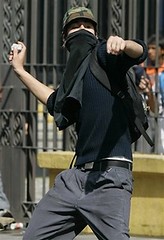
    Above : Another stylish anarchist youth from Chile in Melbourne black (Image stolen from Bombs & Shields)

US Gub’mint spooks have been Breaking the Law! Breaking the Law! again — and just for good measure, have been caught with their pants on fire while doing so. Judging by their I.N.T.E.L.L.I.G.E.N.C.E., let’s hope that they don’t pay a side-trip to Melbourne when Bush comes to shove in Sydney in September, or a great number of local residents will be reaching for the sky (while hurriedly trying to disassociate themselves from a revolutionary opposition to capital and state).

Judge Weighs Punishing City Lawyers Over Delay on Protest Log
Carol D. Leonnig
Washington Post
April 13, 2007

A federal judge said yesterday he was “deeply concerned” about newly revealed evidence that FBI I.N.T.E.L.L.I.G.E.N.C.E. agents interrogated war protesters about their political views at a Washington rally in April 2002 and was seriously considering sanctioning D.C. government lawyers for insisting for three years that they had no record of the FBI’s involvement.

The D.C. attorney general’s office surprised the court March 23 by reporting that it had found a D.C. police log from the day of the rally — the same log city attorneys had repeatedly said did not exist since protesters sued the D.C. police in 2003. The heavily redacted document confirmed that FBI I.N.T.E.L.L.I.G.E.N.C.E. officers were with D.C. police at a downtown parking garage April 20, 2002, and were directly involved in the questioning of 23 protesters later arrested for trespassing.

Yesterday, U.S. District Judge John D. Bates ordered the city to explain within the next week why it took so long to find a log that the police department routinely maintains during protests and why several attorneys had said it didn’t exist. He also ordered the FBI to immediately begin looking more deeply for records of its presence and role in the incident.

Protesters claim in the suit that their constitutional rights to free speech were violated and that they were illegally detained on the pretext of trespassing. Protesters said plainclothes FBI agents who did not identify themselves asked them one by one while being videotaped about their political and religious beliefs and their associates in protest groups.

The FBI considered them suspicious because they wore black clothes, the log shows, a color the FBI associated with anarchist groups

Similar semi-incomprehension is displayed by a hack writing for The Santiago Times on the subject of Chilean youth and its discontents (Nathan Crooks, ‘Chile’s Disaffected Youth Turn To Street Violence’, April 14, 2007). Three successive waves of protest — revolting students in May 2006, rioting on the anniversary of Pinochet’s 1973 coup (and on news of his death in December), and, most recently, in March — mean that “[t]o the world, a normally safe, business-orientated city looked like a war zone”.

Driving the trend is an increasingly disenfranchised youth, most of whom use the Internet to communicate and have no specific goals other than a shared resentment of society in general. A lax judicial system and increased media coverage are making the problem worse…

Jorge Lizama, a 19-year-old high school dropout, anarchist, and animal-rights activist, has emerged as a poster child in Chile’s current street struggles. He was arrested late last month for attacking the car of Justice Minister Gloria Chevesich during the March 29 protests and is also… accused of tossing a Molotov cocktail at the La Moneda Presidential Palace last year…

Lizama… came to feel at home with the many anarchist groups that operate in Chile. Using mostly the Internet to communicate, Chile’s anarchists are not organized [sic], are without leaders, and have no hierarchy. The only thing that unites them is a shared discontent with society.

“These kids are hostile to the system, and they feel threatened and excluded,” said Roberto Méndez, the president of survey firm Adimark. “They take their anger out on anything that represents the system, such as the Transantiago, and they are most aggressive towards the left wing sectors of the governing Concertación coalition because they feel they sold out to the current model.”

…Some suggest that Chile’s media is also inciting the violence. After the March 29 protests, Interior Minister Belisario Velasco blamed several television programs for promoting the violence. “A lot of the content on TV was almost a call to violence,” he said in a conversation with Radio Cooperativa. Both print and television media gave widespread coverage to the impending protests, and on March 29, one channel broadcast the live looting of a grocery store in Santiago.

Chile’s legal system is also a problem. Prosecutors must not only prove that the accused committed a violent crime, but also that they intended to commit the crime. When apprehended, most minors are released to their parents as it is assumed that they are incapable of criminal intent. Many bands of youth organize their protests so that only minors commit violent acts to take advantage of the system.

But the free pass may soon be over. Bachelet will sign legislation in June removing the requirement to prove intent in crimes committed by youth, and she is also floating legislation to hold parents legally responsible for the crimes their children commit.

While Bachelet’s firm hand has been applauded by many, it may be too little or too late. Méndez said that Chile’s students are angrier this year than ever and that university students are now joining what were once high school protests. “The risk of another student conflict, one more powerful than last year, is extremely high,” he said. “Chile has changed since last year, and respect for authority has declined. As was the case before, the situation is preventable. But it remains to be seen if the government will take appropriate measures to deactivate the movement or if the situation will be allowed to turn into the third, and possibly fatal, crisis of Bachelet’s presidency.

And on a final, black, !cinataS note, ‘Colonel’ William Hoff (‘Wild Bill’) of the US-based neo-Nazi NSM (who did an Ian Stuart last December), “took a secret with him to the grave, one he couldn’t share with his NSM buddies. Wild Bill, an icon of white supremacy, was himself part black” (Robert W. Dalton, ‘A force in NSM’, Spartanburg Herald-Journal, April 15, 2007).

Posted in !nataS, Anarchism, Media, State / Politics, War on Terror | Leave a comment

GO Pies!

Yes! After we was robbed last week by the drug-fuelled Weasels (soaring high on Godwin-knows-what) and their comrades the white rabbits (adjudicating under the influence of mInD-aLtErInG substances), the Mighty Magpies have returned to the winner’s list and defeated the toys from Tigerland.

Poor Richmond. Tom Hafey:

“I can remember Richmond people would always say, ‘I don’t care where we finish on the ladder as long as we beat Collingwood’,” Hafey says.

“I even had people on the board saying that to me when I was coach. I can remember people saying ‘as long as we beat those mongrels that’s all we care about’.

“That’s how they viewed it at the club. And particularly the dEmEnTeD supporters. They just hated Collingwood with a passion.”

Losers.

After a mediocre first half, Collingwood came good in the second, drawing even with the rabble known as Richmond by three-quarter time, and then proceeding to kick away in the final quarter to eventually win by 25 points — a 47 point turnaround. In other good news, three players made exciting debuts for the Pies: West Australians Shannon Cox, Brad Dick and Alan Toovey.

The comeback victory, in front of a crowd of 70,569, was all the more meritorious for the Magpies given they achieved it with a side light on experience.

Collingwood coach Mick Malthouse said the first-game players all “held up very well” and was also happy to single out Rocca for praise, saying even though he was quiet in the first half, he had attacked the football hard.

“When you lose your captains, he’s a very important player for us and he deserves the accolades that have been given to him,” he said.

Veteran defender James Clement was withdrawn from the side just 20 minutes before the opening bounce, after vomiting during the warm-up, to join injured skipper Nathan Buckley, Ben Johnson and Alan Didak on the sidelines…

Clement’s absence was sorely felt as Richmond burst out of the blocks, booting four goals in a seven-minute burst to establish a 19-point lead 12 minutes into the match, with Jay Schulz kicking two goals and Matthew Richardson and Kayne Pettifer one each.

Even that margin did not fully reflect the dominance they were enjoying in attack, with Richardson missing two fairly simple shots after marking early in the game. ~ AAP, ‘Rocca turns it on as Magpies storm home’, The Age, April 13, 2007

How we laughed.

Collingwood 17.13 (115) def. Richmond 13.12 (90)

Posted in Collingwood, Poetry | 1 Comment

Another Evil & Dangerous Woman Does Not Pass Go, Does Not Collect $200

[Update : Ex-member of German far-left group gets suspended sentence for failed bombings, AP, International Herald Tribune, April 16, 2007; Radical Left-Wing Feminist Given Suspended Jail Term, Deutsche Welle, April 16, 2007; Tony Paterson, Germany’s ‘Red Zora’ terrorist spared jail, The Independent, April 17, 2007: “Prosecutors agreed to a minimum sentence, mainly because unlike Germany’s other 1970s left-wing terrorist gangs, Red Zora successfully ensured that no one was harmed in the 45 attacks the organisation carried out between 1977 and 1995… Gershäuser left court yesterday to resume a normal life, her militant past a tiny footnote in history. Yet Red Zora’s reputation seems destined to live on. Montenegro, a state newly emerged from the tragedy of the Balkans, has made the story of the daring orphan girl [and source of the group’s name from the 1941 book Die rote Zora und ihre Bande by Kurt Held] the subject of its first full-length feature film. It is due to reach cinema screens this autumn.” See also : Red Dawns, a “non-hierarchical, non-exploitational and anti-capitalist” women’s festival (also) newly emerged from the ‘tragedy’ of the Balkans…]

Last month, Brigitte Mohnhaupt, a former member of Germany’s Red Army Faction, was released from jail after spending 24 years behind bars for her involvement in a number of attentats. Today-ish, Adrienne Gerhäuser, a former member of another German group, Rote Zora, goes to trial after turning herself in to German police in December last year, after many years on the run:

‘Former Left-Wing Extremist Tried For Failed Attacks in 1980s’
Deutsche Welle
April 11, 2007

…The 58-year-old defendant… presented a statement saying that she had “knowingly and willingly” attempted to bomb the Berlin Genetic Technical Institute in 1986 and a clothing factory in Bavaria in 1987 on behalf of the far-left organization Rote Zora.

She said the attacks were motivated by her political beliefs at the time, including a fierce opposition to genetic engineering and solidarity with striking female factory workers in South Korea.

Gerhäuser said she had provided alarm clocks for two detonators. But in both cases the devices failed to go off and no one was injured.

She stands accused of belonging to a terrorist organization and attempting bombing.

The Berlin court said that because Gerhäuser had turned herself in to the authorities late last year, the maximum penalty she would face would be [a] two-year suspended sentence.

Rote Zora was a women’s splinter group that claimed responsibility for 45 bombings and cases of arson between April 1977 and February 1988 with the aim of bringing about radical change in German society.

The group was part of the so-called Revolutionary Cells network until 1986…

According to another report in The Guardian (Kate Connolly, ‘Militant feminist on trial after 20 years on run’, April 12, 2007):

Edith Lunnebach, Gershäuser’s lawyer, told a German newspaper that her client wanted to make clear to the court “that the political connections which existed then no longer exist”, and that she no longer supported them. Her client would not express remorse, and she had given herself up because she wanted to “bring to an end the situation of illegality which had become a burden”.

Despite Connolly’s assurances that “Rote Zora is now little more than a footnote in the history of leftwing German terrorism”, what’s really interesting is the fact that she fingers Thomas Kram, “a leading member of the Revolutionary Cells” and Gerhäuser’s partner in crime, love and flight, as being responsible not only for “kidnappings, shootings and hijackings”, but “the bomb attack on Bologna station in August 1980 in which 85 people were killed”.

Which is very fucking odd.

‘Italy: Terror on the Right’
Thomas Sheehan
The New York Review of Books
January 22, 1981

Bologna, August 2, 1980. It was a hot Saturday morning, the first weekend of Italy’s traditional holiday month, and thousands of vacationers jostled their way to and from the trains in Bologna’s central railroad station. In the midst of that noisy crowd someone stopped midway between the second-class waiting room and the coffee bar, put down a heavy suitcase, and quickly left the station. The suitcase contained over forty pounds of explosives, perhaps stable nitroglycerine, connected to a timer. At exactly 10:25 AM it exploded, ripping through the crowd, tearing apart the reinforced concrete walls, and bringing the roof crashing down on hundreds of bodies and parts of bodies.

In the bloody aftermath, rescue squads worked for over twelve hours to pull the dead and maimed from the rubble. As they labored, a young neofascist entered a telephone booth across town and dialed Bologna’s leading newspaper. “This is the Armed Revolutionary Nuclei,” he said. “We claim responsibility for the explosion in the railway station.” The final toll: eighty-five dead—the eldest an eighty-six-year-old man, the youngest a three-year-old child—and more than two hundred wounded…

On the other hand, so is the fact that the Irish group INLA, “one of Ireland’s most ruthless terrorist groups”, was infiltrated by a German agent from the Bundesamt für Verfassungsschutz (BfV) (Federal Office / Agency for the Protection of the Constitution) — who, incidentally, initially made contact with the group via his involvement in the Revolutionary Cells network. (Well, according to an article in The Times anyways: Iain Cobain and Allan Hall, ‘A spy in the INLA’, January 8, 200/1). Currently, the BfV is engaged in monitoring with a view to disrupting the “extreme left” networks planning A Big Party to celebrate the arrival of at least 8 war criminals in the German resort town of Heiligendamm in June. Word on the street is that the BfV is hoping to utilise an informant within the ranks of local Kiwi anarchists in order to penetrate the highest echelons of the organisers. (The INLA, it should be noted, declared a ceasefire on August 22, 1998.)

The challenge to state authorities presented by anarchist and leftist social movements in Europe is examined, briefly, by another article on Deutsche-Welle by Nick Aimes (‘Europe’s Radical Left Confronts Global Issues and Enemy Within’, April 9, 2007); the ‘radical left’, in this case, being the Marxist left, and the ‘enemy within’ anarchist and other libertarian revolutionaries. Rather humourously, Guy Taylor of the SWP front Globalise Resistance is quoted as stating that “For protests such as the EU and G8 summits, there is an umbrella organization that is established to coordinate such mobilizations… More often than not, it is Globalise Resistance that takes that role.”

    “Globalise Resistance exists mainly to increase the influence of the SWP within the anti-capitalist movement. It is only interested in activities to the extent that its brand recognition increases. For instance, commenting on Gothenburg GR’s full-time organiser and SWP member Guy Taylor said “GR has gone down brilliantly, the words on the GR banner People before Profit, Our World is Not for Sale were taken up and chanted by the whole protest!” Globalise Resistance would no more take part in an action without prominently displaying its banners and placards than an oil company would give money to an environmental project without telling anyone.”

In most respects, Aimes’ article simply replicates the standard tropes — established in the 1960s, and resurrected, periodically, as the need arises — of reporting on protest movements and events. Thus we are informed that: a) ‘the left’ is in some manner resurgent, however; b) a small element causes ‘trouble’; c) happily, authorities both within these movements and within the state agree on the need to control unruly elements — but; d) somewhat troublingly, they disagree over the best methods by which to do so. An ‘objective’ assessment of the situation is therefore required, and is provided by the academy, in this case Mudde and March.

Our first expert, Mudde, notes that: a) while ‘the left’ — which is considered to be synonymous with the Marxist left — has lacked institutional support since the collapse of Communism in Eastern Europe and China, it remains ideologically purposive and; b) the far left and the far right have a common enemy in ‘globalisation’. Our second expert, March, on the other hand, quite boldly asserts that the violent elements what’s responsible for all the trouble may number no more than 200 (Europe has a population of 710,000,000), thereby constituting a vanguard of professional revolutionaries (and according to the familiar, Leninist model). Two ‘groups’ are singled out for attention in this regard: the Black Bloc and the ABC.

Recent examples, such as the riots in Copenhagen over the closing of a youth center which attracted radical left-wing extremists from around Europe, indicate that some activists are willing to travel to violently support causes in other countries. One far-left group which was involved in the Copenhagen demonstrations, the Anarchist Black Cross, organizes protests around the world…

Ah… er… um… yeah. Right. ‘Involvement’ is obviously a technical term meaning ‘subject to police repression’, while ‘protest organisation’ means ‘thorn in the side of the authorities’

Ah fuck it. Who cares anyway.

See also : Roger Boyes, ‘The feminist who fought sexism with fire bombs faces justice’, The Times, April 12, 2007; AP, ‘700 arrests for terror-related offenses in EU last year, Europol says’, International Herald Tribune, April 10, 2007; EU Terrorism Situation and Trend Report TE-SAT 2007 [PDF]; Statewatch analysis: Europol — The final step in the creation of an “Investigative and Operational” European Police Force, by Professor Steve Peers, Human Rights Centre, University of Essex, January, 2007 [PDF].

Posted in History, State / Politics, War on Terror | Leave a comment

“I call that bold talk for a one-eyed fat [little rich gay] man”

Bold talk: “I’m the person that’s led this charge”.
One-eyed fat (little rich gay) man: The name is Jones. Alan Jones: “It’s the tone that first strikes you. That slightly prissy, impatient, semi-sour way of speaking that makes his voice on radio so distinctive… That tone. Nagging. Insistent. Unrelenting.”

Actually, whenever I think of Jones — which is not often, thankfully — I think of two things: corruption and scandal. The corruption refers to his being on the payroll for various corporations, hawking their wares and praising their virtues, and failing to inform his elderly audience that he is being paid, quite handsomely, for his positive opinions. (Not that the old bigots cared, of course.) The scandal evokes memories of Chopper Read, Kerri-Anne Kennerly (Worst Female TV Personality, 2003) and probably the best moment in Australian television history, never to be acknowledged by the industry, but long to live in the discerning hearts and minds of the Australian public:

    March, 1998: Convicted murderer Chopper Read appears on The Midday Show on Channel 9 along with Alan Jones. Jones is there as a guest to voice his disgust at the ABC’s decision to give airtime to Read to defend his crimes. Read phones in and says, “People who throw stones better make sure they don’t live in glass houses… I never got arrested in [1988 in] a public toilet in London”. The charges [“outraging public decency” and “committing an indecent act”] in London were eventually dropped and costs awarded to Jones.

But of course. Actually, Read, not Jones, was scheduled to appear as Kerri-Anne’s very special guest that Friday, but a merciful appearance on Elle McFeast‘s (a/k/a Libbi Gore’s) execrable ABC show Elle McFeast Live put paid to that idea, Chopper’s drunken musings on feeding corpses into cement-mixers being considered a little too off-putting for the blue rinse brigade. Nevertheless, Midday Show producers conspired to have Chopper ‘spontaneously’ phone Kerri while his replacement Alan joined in the moral condemnation.

    I take the scum off the streets and give them a place to sleep
    Six-feet-deep under the concrete…
    It’s all a game, I’m a savage beast
    Especially when I’m drunk, ask Elle McFeast…
    Have ya whingeing to cops, claiming victims of crime compensation
    Then knock on ya door for my portion of the payment…
    I’m a dashing, silver-toothed, grinning lady pleezer
    As long as she doesn’t find the corpse stashed in the freezer

Sadly, while Chopper has recently been forced to file for bankruptcy, Jones continues to battle what to do with his hard-earned millions. He’s also recently been forced to tell the Australian Communications and Media Authority to go forth and reproduce after the deaf dumb and blind media watchdog decided in its wisdom that “2GB Sydney breached the code by broadcasting material on Breakfast with Alan Jones that was likely to encourage violence or brutality and to vilify people of Lebanese and Middle-Eastern backgrounds on the basis of ethnicity” back in December, 2005 — just prior to the Cronulla pogrom. A sample of Jones’ masterful DJing, from the (suppressed) NSW Police summary of the Hazzard report into the events at Cronulla, is provided by Fergus Michaels:

Talkback radio’s role in instigating the riots

Volume 4, Item 3 of the Hazzard report, entitled, “2GB Broadcast Synopsis: 4th December 2005 to 9th December 2005: Alan Jones, Ray Hadley, Jason Morrison,” devotes 108 pages to broadcasts from Sydney radio station 2GB in the lead up to the Cronulla riots. Whilst not “strictly verbatim”, it is a “verified and accurate” record.

On these radio programs, listeners call in, correspondents read out letters, and the hosts constantly volunteer their opinions and interpretations of events and issues.

Alan Jones is one of Australia’s most promoted personalities, and enjoys the closest of relationships with Prime Minister John HoWARd, as well as with the Labor government in NSW. He is a former speechwriter for the Liberal Party, and a recipient of the Order of Australia.

It is impossible to reproduce the volume of filth and backwardness spewed forth by these radio commentators and their talk show guests in the space available for this article. But to give a sense of the racialist climate they created at the time, it is crucial to revisit at least some of what they said.

Day after day, hysterical exchanges such as the following occurred on morning radio:

Caller: “What kind of grubs do we have here?”

Jones: “What kind of grubs? This lot were Middle Eastern, we’re not allowed to say it, but I am saying it.”

The following “correspondence” was read on air by Jones:

* “Unfortunately this happens regularly at Cronulla—gangs of Lebanese youth just swarm over the beach, stealing from and assaulting beach goers; they pick on the youngest.”

* “Alan it’s not just a few Middle Eastern bastards at the weekend, it’s thousands. Cronulla is a very long beach and it’s been taken over by this scum; it’s not a few causing problems, it’s all of them.”

* “Police are too afraid to act … if we were allowed to act the way we want to, we could solve a lot of problems … these Middle Eastern people must be treated with a big stick—it’s the only thing they fear.”

Jones openly advocated and encouraged violent reprisals and vigilante behaviour against young men of Middle Eastern appearance.

For instance a caller, John, said: “These people, half of them may be home grown; they have infected minds; they don’t live the Australian way … if the police can’t do the job the next tier is to us.” Jones replied: “Yeah, good on ya, John.” When John said: “Shoot one, the rest will run … when you’re outnumbered 20 to 1 you don’t put your hand up and play by Queensbury rules,” Jones replied with laughter and added: “You don’t play by Queensbury rules; good on ya, John.”

As a result, ACMA will be writing a strongly-worded letter to Jones’ employer, Harbour Radio Pty Ltd (licensee of 2GB), in the hopes of entering a dialogue regarding what may or may not be an appropriate action to take in light of Jones’ breach (Dylan Welch / AAP, ‘Jones rapped for pre-riot ‘scum’ remarks’, Sydney Morning Herald, April 10, 2007). More specifically, “Mr Jones was found to have breached the code by reading comments from a listener suggesting, in the week before the riots, that bikie gangs should head down to Cronulla to sort out Lebanese gangs” (Andrew Clennell, ‘Jones breaches code with riot talk’, Sydney Morning Herald, April 11, 2007).

Oddly enough, this sort of thing is what neo-Nazi salesman Peter Campbell suggested would be an appropriate course of action to take in response to the appearance of ‘men of Middle Eastern appearance’ at Cronulla. (Campbell was investigated by police in September 2006 for allegedly distributing a bomb-making manual, modelled on that produced by Douglas Copeland, the infamous Soho bomber.)

Generally speaking, bikies are loathe to involve themselves in ‘politics’, but there are exceptions. Later this month, for example, the Wellington chapter of Satan’s Slaves will be hosting Newcastle-based neo-Nazi Viking rock ‘n’ roll band Blood Red Eagle in a joint celebration of Adolf Hitler‘s birthday; while in Brisbane, members of Stormfront Down Under briefly used the Bandidos‘ clubhouse to meet after chancing upon some Muslims at their previous venue, a public park, and fleeing in panic.

One person who hasn’t fled in the face of the menace from the Middle East is Australian Prime Minister John HoWARd, who has fulsomely praised Jones’ role as a ‘controversial’ (read: bigoted) Sydney shock-jock and loyal Tory propagandist (AAP, ‘PM backs Jones in riot row’, Sydney Morning Herald, April 11, 2007):

…Mr HoWARd today called Jones an “outstanding broadcaster”.

“I am not going to get involved in comments on individual decisions, but let me say this; I think Alan Jones is an outstanding broadcaster,” Mr HoWARd said.

“I don’t think he’s a person who encourages prejudice in the Australian community, not for one moment, but he is a person who articulates what a lot of people think,” he said.

In his morning radio show, Jones today attacked the authority’s ruling.

“Anyone who knows me knows I’ve never encouraged violence or brutality in anything … and I did the exact opposite but our defences counted for nothing,” Jones told his listeners.

One excerpt Jones read from a listener on December 7 recommended that bikie gangs confront “Lebanese thugs” at the Cronulla railway station.

Jones today played another excerpt from about the same time telling a listener not to promote the riot, which eventually ensued on December 11…

Said ‘uprising’ being commemorated — in a rather pathetic manner, it must be said — one year later by the Australia First Party — led by, of all things, a man of Lebanese descent.

Posted in Anti-fascism, Media, State / Politics | Leave a comment

Wolf, blogs, journalism, blah blah blah I’m giving up smoking fuck you get pissed destroy

Above : Seemingly gratuitous img of a journalist. Sitting on Naomi Robson‘s shoulder. Oddly enough, despite the many and eminently sensible calls for Robson’s imprisonment for crimes against good taste, Australian corporate media has spent more time reading the entrails produced by her bloody departure last year from Today Tonight than it has paying attention to Josh Wolf‘s many months in prison for having attempted to engage in some ‘real’ journalism.

San Francisco Chronicle | Open Forum
On a journalist’s duty to the public / PRO: Federal shield law is needed to extend journalist protections
Josh Wolf
April 9, 2007

It feels as if I’ve barely had a chance to blink since walking out the front gate of the Federal Detention Center in Dublin on April 3, but the debates on what we should take away from my experience have already escalated into a full-on storm of differing voices. Much of the debate has focused on whether or not I am a journalist; this question is nothing more than a distraction and a red herring over the very real issues exposed by the marathon saga that only concluded when I was released from custody.

For the purposes of this argument, let’s assume that I am a journalist. What does this story mean for the role of media in our society?

In February 2006, I was subpoenaed by the FBI Joint Terrorism Task Force to appear before a federal grand jury with my source materials and submit to secret examination, a demand that would be unenforceable in a state court under the California shield law’s protection for journalists. The federal government claimed jurisdiction because it was investigating the alleged attempted arson of a San Francisco Police Department vehicle. The federal officials rationalized this claim with a tenuous connection, that is, that federal money was provided to the SFPD.

As would any journalist when his legal rights are circumvented, I decided to fight the subpoena and eventually found myself in federal prison on Aug. 1. During the course of our legal battle, my lawyers and I offered to screen the footage for U.S. District Judge William Alsup in order to show there was nothing of evidentiary value in the unpublished video, but he repeatedly refused to judge the merits of the tape. Though there was nothing of a sensitive nature on my unpublished tape, I continued to fight for the rights I feel were robbed from everyone through my available appeals.

The appeals proved unsuccessful and it was at this time that we decided to put forward the very same resolution we agreed upon last week: I would provide the tape for all to see in exchange for being excused from testifying before the grand jury. We were rejected.

After the judge ordered both parties into a mediation hearing with U.S. Magistrate Joseph Spero, we were eventually able to agree on the original November proposal. On April 3, my video was posted on the Internet, and then provided to the U.S. attorney, along with a declaration stating “no” to two questions:

Could I identify the person Officer Peter Shields was chasing?

Did I witness the incident of the alleged attempted arson?

Many have suggested I am not a journalist because I have personal views about my subject matter; others have argued that I don’t qualify for journalistic protections because I am not employed as a journalist by a corporation. How would a “journalist with a press pass” have responded to such a demand by the federal government?

While I was fighting my legal battle, two reporters for The Chronicle were in a similar situation. The circumstances may have been different, but I think the principle was the same. Thankfully, Chronicle staff writers Mark Fainaru-Wadu and Lance Williams were able to escape doing jail time, but in both cases, we resisted government demands that go against California law and a journalist’s ethics.

The question that needs to be asked is not “Is Josh Wolf a journalist?” but should journalists deserve the same protections in federal court as those afforded them in state courts.

The answer is yes and the means to do it is for Congress to pass a federal shield law equivalent to California’s law. Fainaru-Wadu and Williams could have just as easily been in my place at FDC Dublin. There are no protections afforded to journalists in the context of a federal grand jury. The debate over who qualifies as a journalist can wait, but we need a federal shield law now.

    See also : Dan Silkstone, ‘The blogs that ate cyberspace’, The Age, April 7, 2007. “Blogs give you voice and validation. Say anything you like and if you are lucky, somebody will hear you and leave a reply. Once upon a time people wrote their most private thoughts in a diary and hid it in their top drawer. Now they post them for all the world to see. Then, the writer’s warning was publish and be damned. Now, the great fear is publish and be ignored.” Geert Lovink, ‘Blogging, the nihilist impulse’, Eurozine, February 1, 2007. [Original in English. First published in Lettre Internationale 73 (German version).] “Media theorist and Internet activist Geert Lovink formulates a theory of weblogs that goes beyond the usual rhetoric of citizens’ journalism. Blogs lead to decay, he writes. What’s declining is the “Belief in the Message”. Instead of presenting blog entries as mere self-promotion, we should interpret them as decadent artefacts that remotely dismantle the broadcast model.”

100,000 protesters prepare to disrupt G8 summit
Roger-Boyes-in-Berlin
The Times
April 10, 2007

More than 100,000 demonstrators are planning to disrupt the G8 summit this June in the German seaside resort of Heiligendamm — and the dress rehearsals [sic] have already begun.

German [and Kiwi] anarchists travelled to Copenhagen last month to give a violent edge to street protests against the closing of a youth centre. The visitors helped the Danes to erect blazing barricades and filled an armoury of petrol bombs [?]. Then came a stand-off with riot police in Berlin — and more arson as the car of Thomas Mirow, the German deputy Finance Minister, was set alight.

    According to Der Spiegel, in an advanced case of what media spindoktors are calling ‘Anti-Globalization Rage’ Disease, in late December 2006 Mirow’s wife’s car was set alight “…and paint balls were thrown against the wall of [his] house. Mirow described the attack as “an act of banal violence of rare senselessness”, saying that it was not the way to gain support for a fair world order. The arson attack was the 37th protest in Germany to date by militant G8 opponents, according to a police spokesperson from the special “Kavala” police unit which has been created for the G8 summit” (‘Protesters Carry Out Series of Attacks Ahead of G8 Summit’, December 29, 2006). Note that Greek anarchists have been setting fire to enough things to be granted some (more) media too — ‘Diplomatic car destroyed in Greek arson attack’, International Herald Tribune, [AP], April 6, 2007.

    In general, while rage-filled German arsonists — generally referred to, in Anti-Globalization circles, as Die Deconstructionists — have been known to work closely with German engineers, the history of the relationship between arts graduates (and literature studies graduates in particular) and engineering students is punctuated by sometimes violent sectarianism. Sources close to European squatters’ networks, however, believe that the intervention of a small group of perhaps no more than 40 Kiwi football hooligans has prevented such disputes from emerging in the hothouse political environment of Copenhagen, and it was this key development that allowed the otherwise notoriously slow-moving Danes to place objects on top of one another in order to form what is often termed a ‘barricade’. As for the armoury of petrol bombs, it is unclear at this stage precisely what accounts for the Danes’ astonishing ability to pour liquid into bottles, but a police source states that the intervention of Kiwi anarchists was again crucial.

Opposition to the G8 meeting on the Baltic Sea runs like a thread through all the incidents. The last big showdown before the summit is expected to be May Day in the German capital. Police are already calling it “a warming-up exercise”.

For years May Day in Berlin has been a moment of controlled anger when teenagers go on the rampage, looting shops and setting fire to police cars. This time it seems likely to have a political veneer [sic]. Leaflets show a picture of President Bush’s Air Force One next to a mangled wreck. The “autonomist groups”, anarchist cells across Germany, have called for a month of violence. “Destroy the image of your town,” says one pamphlet Riot against G8. A music CD, meanwhile, entitled Move against G8, will be released after May Day.

“We have never before seen such a militant campaign of the extreme Left in northern Germany,” says Claudia Schmid, head of the Berlin wing of the Agency for the Protection of the Constitution, the equivalent of the Special Branch. Similar reports are coming from Denmark, the Netherlands and the Czech Republic.

About 16,000 police, the most concentrated deployment since the war, have been drafted from across the country and will be backed by soldiers. A 13km (8 mile) steel wall topped with barbed wire is being built around the spa that once played host to the Russian Tsar, Felix Mendelssohn and Adolf Hitler.

Two US naval vessels will be moored off the coast, partly to intercept possible missiles, partly to monitor the water-front. A Royal Navy vessel is to help to patrol the 11km maritime security zone. The 6,000 [embedded] journalists will be taken in and out of the red zone on a steam train, with armed guards.

“It will be a uniquely large and difficult operation, larger than the World Cup,” said Wolfgang Pistol, chief of police in Schleswig-Holstein. The two-day summit, entitled Growth with Responsibility, is costing close to €100 million (£68 million) for security alone.

Posted in Anarchism, Media, State / Politics | Leave a comment

Bübi

Above : Bübi casts a critical eye over the contents of Anarchy #56; later that afternoon he and I contemplated Michael William’s thoughts on ‘Cats and Domestication’.

Posted in Anarchism, Cats | 10 Comments

Anarchy 102 : Race

As previously noted, the latest issue (#63) of Anarchy: A Journal of Desire Armed contains an essay on ‘Anarchy 101: Race’ by Leona Benten. And here’s a few thoughts in response:

To began with, I live in (Melbourne) Australia, not the US, so I’m not sure I’m all that well qualified to comment on some of Benten’s observations, or to assess the accuracy of her claims regarding what is either the general understanding of ‘race’ in the US context, or what, in particular, have been the views advanced by US-based anarchists in addressing this subject. Further, the question of race in Australia — especially in terms of black and white — is usually addressed in terms of indigenous (black) and non-indigenous (white); a subject which deserves another post, in particular in relation to the question of Aboriginal genocide, sovereignty, and treaty (see The Black GST), and the implications this has for anarchism in Australia.

That said:

The distinction between scientific and historic understandings of ‘race’ — which are reckoned to be the two main schools of thought on the subject — would seem to boil down to an argument concerning race as a function of biology — or not. In other words, the acceptance or rejection of the proposition that an individual’s race may be discovered through a careful examination of their biology; in contemporary science, through analysis of their genetic inheritance or DNA. And, of course, that a person’s race, once established, has particular political and social ramifications for that individual.

A second and related proposition is that determining an individual’s race holds the key to understanding an individual’s ‘culture’. That is, an individual’s culture (and social standing) may be ‘explained’ through reference to their genetic inheritance.

‘Liberal’ scientists, according to Benten (one presumes in opposition to ‘radical’ scientists, perhaps), maintain that humans “are all the same”. Further, that ‘racism’, having no scientific basis, is an irrational disposition; one which may, presumably, be successfully countered through some form of educational program based on revealing this scientific truth to those who, for whatever reason, remain ignorant of it.

(At least, that’s my understanding of her argument, which may be inaccurate, especially as the following passages seem to depart somewhat from a critical examination of what it purports to be the scientific consensus on race, in order to examine instead what are presumed to be its political implications.)

The historic understanding of race, on the other hand, claims “that differences in culture (whether from non-European origins or from oppression once arriving here) and in social standing create a distinct group of people with identifiable and predictable characteristics”.

Benten then proceeds to delineate what are claimed to be the two archetypal positions adopted by anarchists in relation to the concept of race: activist and atomist.

The activist perspective is claimed to be the most common, and understands ‘race’ as being a fundamental category of social reality and existence; one modified, perhaps, by other factors such as class and gender. According to this perspective, ‘skin colour’ is synonymous with race, and knowledge of an individual’s skin colour is largely sufficient to describe the most important aspects of their existence (presumably as either oppressor or oppressed). This approach, apparently, is one adopted by such groups as Bring the Ruckus, and is also reproduced via workshops titled Challenging White Supremacy.

The atomist perspective, on the other hand, appears to acknowledge that ‘race’ exists — on some level, in some way — but only “barely”. In essence, “Race determines neither how a person will respond to the status quo, nor how the system will respond to them”.

As for Benten’s critique of these perspectives — again, as far as I can make sense of it — the main ‘drawback’ associated with the ‘activist’ approach seems to be its insensitivity to what are in fact complex political realities. In other words, being crude, it is inaccurate. Thus, while it may be useful in some respects — it enables marginalised or oppressed groups to organise and to obtain political reforms — it also tends to reproduce faulty modes of thinking, and thus help perpetuate the social divisions which it claims to want to overcome or to dismantle. It’s noteworthy that Benten claims that this approach once had more purchase because the racial stratification of US society it describes was once more real, but that subsequent historical developments have tended to place class, rather than race, at the centre of (radical) social analyses.

The atomist perspective, on the other hand, is flawed because it fails to take into account commonalities of experience and identity, whether contemporary or historical. In summary, the problem — which might be described as being the problem of ‘identity politics’ more generally (one which often, interestingly, fails to include class as being one form of ‘identity’) — concerns “what is best emphasized — our membership in (externally and internally defined) groups, or our individuality“. This is a result, Benten argues, of “living with the consequences of [US] culture’s successful perceptual split of individuality from membership”. Further, “how we negotiate and understand the relationship between the two is a continual question”, not easily given to resolution, on either a personal or public level, and despite attempts by individuals to ‘valorize’ one aspect of their (social) being over another.

Benten concludes her brief sketch by referring to various groups, writers and theories (see below). One theory of particular importance is ‘critical race theory’. According to Benten, the premises fundamental to critical race theory may be summarised as follows:

a) racism is a normal part of US society (i.e., that it is not a matter of a few bad apples);
b) the principle of interest convergence, which is that elites will only change when it is in their interest to change, and even then change only in ways that serve them;
c) context is essential to understanding specific events and;
d) race is socially constructed.

So… I should probably re-read Benten’s essay, but wtf, the top of my head says — in a manner vaguely resembling Henry Rollins impersonating Sylvester Stallone — ‘Go for it’.

I think that the issue of race qua biology is boring and stupid, as are most attempts to explain human society through reference to our bits and pieces. The fact that there’s been a vast array of cultures over a long period of time with very little or no variation in our basic physiology suggests that the ‘explanations’ for such facts reside elsewhere than in our jeans. That’s pretty obvious, and the starting-point for most any attempt to address a social question (and in fact may be considered what distinguishes the ‘natural’ sciences from the social). One objection to the failure to link ‘race’ to biology, however, is the need to determine the means by which races are constructed — in the above example, through ‘skin colour’. Which is fair enough, on one level, but the idea that ‘race’ may be the product of otherwise arbitrary characteristics must necessarily be understood in context. In the US — but not just in the US — black and white skin is important for reasons which may be traced back to the beginnings of the colonialist expansions into Africa and South America of the late fifteenth and early sixteenth centuries — Portuguese and Spanish in particular, as well as the somewhat later Belgian, Dutch, English, French, German and Italian experiments in bringing the blessings of civilization to the benighted savages.

As for ‘culture’, one aspect of this argument I think is worth drawing further attention to is the widespread, almost ubiquitous use of this term as though it were synonymous with ‘the nation’: that ‘culture’ expresses, in some way, the underlying essence of ‘the nation’. Which is bollocks: insofar as ‘culture’ — meaning: way of life — transcends the nation; to the extent that no individual may be reduced to a simple expression of this cultural essence (no matter how ‘charming’); and in the sense that accounting for culture does not account for race / does not account for racial hierarchies or racial politics, oppression(s) and resistance(s).

    “As in many other countries, assimilation was seen as necessary to full acceptance into [Australian] society. This society was, itself, always changing in character in response to new arrivals and it was not always clear what ‘assimilation’ might mean. To [Henry] Parkes it meant acceptance of British Protestant dominance, which was scarcely acceptable to the large Irish Catholic minority. But even this minority favoured White Australia, seeing assimilation in racial rather than cultural terms

    ‘Assimilation’ is a disputed term. To many it meant the disappearance of any characteristics which marked off individuals from each other. On this definition colour or facial features, which were inherited, made non-Europeans and their children unassimilable. This view was officially maintained well into the late 1960s as the basis for admission to Australia. This term also implied the adoption of majority culture, which was assumed to be uniform and self-evident. This attitude still surfaces in debate today. Most important was the adoption of the English language. Religious divisions are less important than a century ago, but non-Christian religions are looked on with suspicion by many. Clothing has become very varied, but some manifestly ‘ethnic’ dress may be criticised, from the long ‘reffo’ trench coats of the 1940s to the Muslim headscarves of today.” ~ James Jupp, From White Australia to Woomera: The Story of Australian Immigration, Cambridge University Press, Cambridge, 2002, pp.21–22

And as for science and history, I reckon it’s mistaken to assign ‘science’ the role of assigning racial determinations by way of the test tube or the microscope. It’s certainly the case that science has a history, even if the (academic) discipline of history’s status as science is questionable. It’s also the case that some scientists, whatever flavour their politics, have far more nuanced views on the matter of the relationship between our selves and our bodies, whether considered in terms of race or gender or by way of some other social category.

In reference to Benten’s references to dualism and “perceptual splits”, Knabb writes:

Avoiding false choices and elucidating real ones

We have to face the fact that there are no foolproof gimmicks, that no radical tactic is invariably appropriate. Something that is collectively possible during a revolt may not be a sensible option for an isolated individual. In certain urgent situations it may be necessary to urge people to take some specific action; but in most cases it is best simply to elucidate relevant factors that people should take into account when making their own decisions. (If I occasionally presume to offer direct advice here, this is for convenience of expression. “Do this” should be understood as “In some circumstances it may be a good idea to do this.”)

A social analysis need not be long or detailed. Simply “dividing one into two” (pointing out contradictory tendencies within a given phenomenon or group or ideology) or “combining two into one” (revealing a commonality between two apparently distinct entities) may be useful, especially if communicated to those most directly involved. More than enough information is already available on most issues; what is needed is to cut through the glut in order to reveal the essential. Once this is done, other people, including knowledgeable insiders, will be spurred to more thorough investigations if these are necessary.

When confronted with a given topic, the first thing is to determine whether it is indeed a single topic. It’s impossible to have any meaningful discussion of “Marxism” or “violence” or “technology” without distinguishing the diverse senses that are lumped under such labels.

On the other hand, it can also be useful to take some broad, abstract category and show its predominant tendencies, even though such a pure type does not actually exist. The situationists’ Student Poverty pamphlet, for example, scathingly enumerates all sorts of stupidities and pretensions of “the student.” Obviously not every student is guilty of all these faults, but the stereotype serves as a focus around which to organize a systematic critique of general tendencies. By stressing qualities most students have in common, the pamphlet also implicitly challenges those who claim to be exceptions to prove it. The same applies to the critique of “the pro-situ” in Debord and Sanguinetti’s The Real Split in the International — a challenging rebuff of followers perhaps unique in the history of radical movements.

“Everyone is asked their opinion about every detail in order to prevent them from forming one about the totality” (Vaneigem). Many issues are such emotionally loaded tar-babies that anyone who reacts to them becomes entangled in false choices. The fact that two sides are in conflict, for example, does not mean that you must support one or the other. If you cannot do anything about a particular problem, it is best to clearly acknowledge this fact and move on to something that does present practical possibilities.

If you do decide to choose a lesser evil, admit it; don’t add to the confusion by whitewashing your choice or demonizing the enemy. If anything, it’s better to do the opposite: to play devil’s advocate and neutralize compulsive polemical delirium by calmly examining the strong points of the opposing position and the weaknesses in your own. “A very popular error: having the courage of one’s convictions; the point is to have the courage for an attack on one’s convictions!” (Nietzsche).

Combine modesty with audacity. Remember that if you happen to accomplish anything it is on the foundation of the efforts of countless others, many of whom have faced horrors that would make you or me crumple into submission. But don’t forget that what you say can make a difference: within a world of pacified spectators even a little autonomous expression will stand out.

Since there are no longer any material obstacles to inaugurating a classless society, the problem has been essentially reduced to a question of consciousness: the only thing that really stands in the way is people’s unawareness of their own collective power. (Physical repression is effective against radical minorities only so long as social conditioning keeps the rest of the population docile.) Hence a large element of radical practice is negative: attacking the various forms of false consciousness that prevent people from realizing their positive potentialities.

To be continued… (April 20) with more extracts from Jupp:

Australian multiculturalism

…It has been argued by Mark Lopez, in his detailed study of the origins of multiculturalism [The Origins of Multiculturalism in Australian Politics 1945-1975, Melbourne University Publishing, 2000], that little attention was paid to the Canadian model [developed in the early ’70s] even while the terminology was accepted. Policy development was seen as concerned with the immigrant generation. Indigenous Australians were not regarded as relevant until 1989. Religious minorities were not taken into consideration either. Language was seen as the core of ethnic diversity. The basic question asked in Australia was, therefore, how to ensure that non-British immigrants were integrated into Australian society. The term ‘non-English-speaking-background’ (NESB) was coined to describe the target group. While policy development by 1982 argued that ‘multiculturalism is for all Australians’, this was never effectively implemented or understood.

The term ‘multiculturalism’ has been defined in different countries in accordance with the local situation. It was reluctantly adopted in the United States where it is has also endured the most consistent atacks. In the United States, human rights and ethnic relations have been defined and determined to a large extent in the courts, acting on the wording of the American Constitution and in response to political agitation. This has led to such innovations as school bussing, ethnic quotas in public appointments, and the drawing of electoral boundaries to take account of ethnic distribution. None of these has been the case in Australia. Yet much of the conservative attack on multiculturalism from the early 1980s was simply transferred from the United States as though the two situations were the same. A central claim of American critics is that multiculturalism endorses cultural relativism and thus denies the basic liberal principles upon which society and its institutions depend. This has never been the case in Australia. All official proclamations have stressed the supremacy of existing institutions and values as well as of the English language…

Other sources recommended by Benten:

Anarchist People of Color [APOC]: Lorenzo Komboa Ervin; Ashanti Alston; Aragorn! and Ernesto Aguilar. Some non-anarchist writers on race: Richard Delgado, Lisa Ikemoto and Ian Haney-Lopez. Also, Charles W. Mills, Blackness Visible: Essays on Philosophy and Race, in particular ‘But What Are You Really?: The Metaphysics of Race’.

Posted in Anarchism | 4 Comments

News from Nutziland (Stormfront.org)

Briefly:

Contrary to popular demand, David Innes, the chief Australian proselytiser for Stormfront.org, is back on the air, chundering away courtesy of LoudCity, and in explicit violation of its TOS: 5. “Content Guideline: User agrees not to post, upload or transmit to the servers of LoudCity or to any third party server used for User’s webcasting any sound recordings, communications, text, graphics or other information (collectively, “Material”) that is fraudulent, relates to hate-groups or other racist activities.” Elsewhere, Innes’ Serbian comrade, Goran D., has been detained by police after allegedly threatening to kill a Serbian journalist on the same happy, light-filled forum:

‘Suspect detained for threatening journalist’
B92
April 7, 2007

NOVI SAD — MUP announced Friday it detained Goran D. from Novi Sad suspected of having threatened a journalist.

Ministry of the Interior (MUP) statement said that Dinko Gruhonjić, journalist in question who received death threats, was placed under protection along with his family.

“With a view to identifying persons who had been threatening Gruhonjić, police carried out a search of Goran D.’s apartment in Novi Sad Friday,” MUP said in a statement.

Goran D. was interrogated Friday in Novi Sad police headquarters, remanded in 48-hour police custody, and scheduled to appear before an investigative judge afterwards.

Dinko Gruhonjić, chairman of the Independent Journalist Association of Vojvodina and the head of the Vojvodina branch of the independent news agency BETA, received anonymous death threats via a neo-Nazi Web site (Stormfront.org) last week, along with insults on personal, national and professional grounds.

Also!

The off-duty police officer what was driving the bus full of Jew-hating Ocean Grove footballers, Senior Constable Terry Moore, faces having his wrist slapped by the Office of Police Integrity (‘Force finds officer could have prevented antisemitic attack’, Australian Jewish News, April 5, 2007; Matt Cunningham, ‘Off-duty cop in OPI sights’, Herald Sun, April 9, 2007; Daniel Breen, ‘Ocean Grove bus police driver under fire’, Geelong Advertiser, April 9, 2007). And in truly shocking and completely-unrelated news having nothing whatsoever to do with the failure of police to breathalyse SC Moore, Jason Dowling reports that “More than half of Victoria Police officers caught speeding are being let off with a warning” (‘Too fast, but cops escape the fine’, The Sunday Age, April 8, 2007); in a press release, Police Association Secretary Paul ‘Don’t They Call You’ Mullet has not condemned the crackdown on police speeding which has produced the unusually low figure.

Posted in Anti-fascism, Media | Leave a comment

Black Rose? Black Rose!

From the Business [!] section of the Sydney Morning Herald, April 7, 2007:

In a clear sign that the protest movement is gearing up for the APEC and RFID summits, Sydney saw the reopening of its second anarchist bookshop this week — Black Rose Anarchist Bookshop in Newtown. “Two anarchist spaces means double the fun for us and double the trouble for the rulers,” said a flyer to anarchist book readers.

The Black Rose site is down, however. Any further information on the re-opening would be appreciated.

Via Jura by way of @-Infos:

Black Rose has re-opened “in an excellent new location”: 22 Enmore Road, Newtown (a minute from Newtown station), and is open between 11am and 5pm, Thursday to Sunday. Events in April:

6pm, Wed 11th: Swedish film screening and art show. Punk, activism and the Genoa protests.
6pm, Wed 18th: Book launch for Self-Organizing Men. This is an international anthology of ftm (female to male and/or transgender) writing and creative works published by Homofactus Press.

Posted in Anarchism | 2 Comments

Now that’s what I call journalism!

Huh. Almost nine months later, after a huge amount of media reportage, both local, regional and national, in the US and elsewhere, a grassroots campaign, and the recognition and championing by a number of journalistic and other media organisations — including something called a “union” — with regards his case, The Age finally reports on the trials and tribulations of vblogger Josh Wolf. Well, sorta… it’s republished a massively edited version — a little over 100 words — of an article in the Los Angeles Times by Joe Mozingo, which, among other things, notes his release.

Clap clap.

Blogger free after deal
The Age [Los Angeles Times]
San Francisco
April 5, 2007

A VIDEOGRAPHER who spent 7½ months in prison for refusing to turn over footage of a San Francisco street demonstration to a federal grand jury has been [“was”] released from custody after striking a deal to publish his outtakes on the internet [“Web”].

Under the deal [“agreement”], Josh Wolf, 24, will not have to testify or identify people shown in the video.

The US Attorney is investigating who hit an officer on the head with a pipe [“the wounding of a police officer, who was struck in the head with a pipe”] during the demonstration, as well as an alleged attempt to set fire to a police car.

Footage released on Tuesday on Wolf’s website [“The video footage Wolf released Tuesday morning on his website”] did not show either incident.

The blogger stepped free after 226 days at the federal prison in Dublin, California.

[The LA Times article continues:]

On Tuesday afternoon, Wolf was released after spending 226 days at the federal prison in Dublin, about 30 miles east of San Francisco. He served a longer term than any journalist in U.S. history has served for refusing to reveal unpublished material or sources.

[A key fact, completely unremarked upon by The Age or any other Australian infotainment source.]

“I feel really good, a bit overwhelmed,” he said in an interview via cellphone, as he drove to a news conference in San Francisco. “The pace of life is so slow in prison, I feel like a kid from the country coming to the city, even though I live here.”

All along Wolf had insisted that the video did not contain anything that would be relevant to the investigation, but he also said he had a constitutional right as a journalist not to cooperate with authorities and become “an arm of law enforcement.” Several media advocacy groups, including the Committee to Protect Journalists, supported his stance and called for his release. The U.S. attorney argued that Wolf was not a journalist and did not have that right.

In November, with his appeals exhausted, Wolf agreed to release the video as long as he did not have to testify. But the U.S. attorney wanted his testimony, he said.

On Feb. 12, Wolf was interviewed by the syndicated left-of-center radio program Democracy Now and said he received hundreds of letters of support. The next day, U.S. District Judge William Alsup referred the case to a magistrate for mediation. On Monday, Wolf and the government came to the current agreement.

Wolf released the video and answered two questions under penalty of perjury. He was asked whether he saw anyone throw anything at a police car and whether he saw the person whom San Francisco Police Officer Peter Shields was trying to take into custody when he was struck in the head. Shields suffered a skull fracture. “My answer is no,” he replied to both.

In court papers, the U.S. attorney requested that Alsup release Wolf from confinement but said the government would not be precluded from issuing another grand jury subpoena to Wolf in the future.

Wolf continued to insist that he was acting as a journalist, not a participant, on July 8, 2005, when he set out to film the anarchist demonstration. “The purpose of me going out that night was to go out and document a protest that would be ignored by the establishment media,” he said.

Wolf’s incarceration came as a spate of journalists faced prison time for refusing to comply with jury subpoenas. Former New York Times reporter Judith Miller spent 85 days in jail for refusing to testify in the CIA leak investigation. And two San Francisco Chronicle reporters were facing prison time for refusing to testify about who leaked confidential documents to them in the Bay Area Laboratory Cooperative sports doping probe. The threat was dropped when a defense attorney admitted that he had been the source and pleaded guilty to contempt of court and obstruction of justice.

Although California has a shield law to protect journalists from testifying in state court, there is no such protection in federal court. The federal government prosecuted the Wolf case on the basis that the victim — the San Francisco Police Department — received federal funding.

Wolf said he kept his sense of humor in prison. He said that he gained muscle mass by working out with Barry Bonds’ personal trainer, Greg Anderson, who has been in prison on contempt of court charges for refusing to testify in the BALCO probe. “He had everyone working out.”

News media advocates hailed Wolf’s release. “I give him a lot of credit,” said Kelli Sager, a media attorney in Los Angeles. “Without the backing of a major news organization, he went to jail to stand up for a principle that should be important for all reporters.”

This question of political principle and journalistic ethics, and their general absence in the state/corporate sector, is one of the issues which has been raised by Wolf’s case: in the US, by Wolf’s imprisonment; and in Australia, by both his legal and political persecution and the non-coverage his story has received.

Corporate radio and TV, which dominates the market, only very rarely pretends to provide consumers with something other than ‘entertainment’, while the ostensibly ‘public’ or state sector — with a small number of exceptions, principally in the community sector — often functions as little more than a less well resourced version of its corporate equivalent/s. As for press, Melbourne — with a population of around 3.7 million people — has just two dailies: Fairfax Corporation‘s The Age, a ‘liberal’ broadsheet principally published for the benefit of and as a marketing vehicle for yuppies, and News Corporation‘s Herald Sun, a reactionary tabloid published for the benefit of the lower end of the market. Both have until now scrupulously avoided making any mention of Wolf’s case.

In the case of the Herald Sun, given its overall market and political orientation, this is not surprising. But Wolf’s stance on the issue of active collaboration between the police and the fourth estate highlights The Age‘s own engagement in a political witchhunt following G20, an endeavour which actually trumped that of its downmarket competitor in terms of the fervor with which it was pursued. Thus the photos of ‘Melbourne’s Most Wanted’, of which only The Age and Crimestoppers published the full assortment, have remained in circulation on The Age website since their initial publication two and a half months ago, on January 18. And while since then Crimestoppers has removed the majority of images of ‘persons of interest’ police provided to the media (and as, in the words of The Age, the police “tighten the net on rioters wanted over the violent G20 protests in Melbourne”), The Age has not. In fact, The Age continues to publish all 28 images of the really interesting people police wish to have a yarn with.

Oh, and speaking of protest, Peter Gordon of Slater & Gordon has written a defence of his business’s conduct in relation to S11, claiming, among other things, that the business received less than half what was originally attributed to it in legal fees. And speaking of money, Slater & Gordon has released its prospectus, and The Age [AAP] reports that the business is interested in persons willing to invest $35 million: “Of the capital raised from the IPO, $15.4 million will go to an acquisition program and marketing and advertising. Slater & Gordon is forecasting revenue of $58.7 million for fiscal 2007 and a net profit after tax of $9.1 million. The offer opens on April 11 and closes on April 27.” The Australian, on the other hand, reports that institutional investors have flocked to Slater & Gordon. Further, “The prospectus reveals that Mr Grech, rather than senior partner Peter Gordon, has the largest stake in the company. Mr Grech holds 16.5 per cent of the firm, followed by Mr Gordon on 16.3 per cent, Paul Henderson on 15 per cent and four others. The firm predicts revenue growth of 28 per cent this financial year followed by 12 per cent next year. This is based on several factors including the recent acquisition of eight smaller firms, diversification and 20 per cent annual growth in non-personal injury fee revenue.”

So as someone once scribbled on a wall in Paris:

Quick!

Posted in Anarchism, Media, State / Politics | 4 Comments